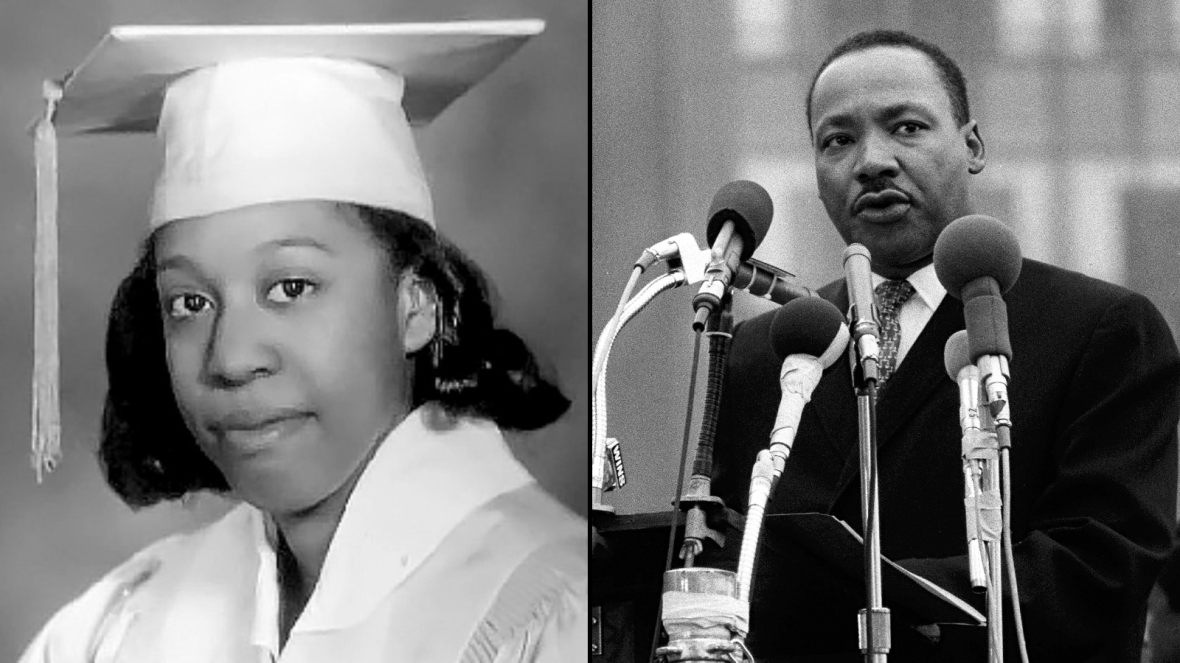
She was the civil rights activist who abandoned her militant tendencies after trying in vain to save King’s life in Memphis.
The Times
Early on the evening of April 4, 1968, Clara Ester, a 20-year-old black student, drove with a friend to the Lorraine Motel in Memphis, Tennessee. She did so less to see Martin Luther King, the great civil rights leader who was staying there, than to enjoy the special it was offering for dinner that night. “I just wanted some catfish,” she said.
Ester never ate the special. At 6pm she was standing in the motel’s car park and looking up at the man she called her hero and “our hope” as he greeted a few wellwishers from the walkway outside his first-floor room. He was “happy as a lark — laughing about stuff”, she said. “Just then, we heard a blast like a truck backfiring. It was a gunshot. I saw Dr King thrown up in the air and then back down.”
She and her friend rushed up the stairs to the balcony. “He was breathing, but very slowly. I unbuckled his belt to help. His eyes were open. On the side of his head and neck was a pool of blood.” She tried to stanch the bleeding with towels, but to no avail. “I guess because he’d just been involved in such pleasant conversation, there was a most comfortable, relaxed expression on his face,” she recalled nearly 50 years later.
Except for Andrew Young, who later became the US ambassador to the United Nations under President Carter, Ester was believed to be the last surviving witness to King’s assassination, and it was an event that irrevocably changed her life. Before he was shot she had flirted with violence in pursuit of equal rights for black Americans. Afterwards she embraced his creed of non-violent struggle, and spent the next half-century working peacefully for racial justice and reconciliation. “I was no longer the same person I had been,” she said. She regarded King’s death as a crucifixion, and her role was to “pick up the cross and carry it”.
Clara Jean Ester was born in Memphis in 1948. Her father was a railway worker; her mother a cook and cleaner. She was raised in an era of rigid racial segregation in the southern United States, but her parents managed to shield her from its effects until she was seven. She then witnessed some white officials berating her mother for using a bathroom for white people at an empty railway station. “I’d never seen anybody talk to my mother like that. My dad didn’t talk to my mother like that. That’s when I started seeing the injustices,” she said.
She did well at her all-black high school, and gained a place to study elementary school education at an all-black college in Memphis. By then the civil rights era was in full swing, and by her third year — 1968 — she was actively supporting a protracted strike by the city’s black rubbish collectors after two of them had been crushed to death in a garbage truck’s compactor.
Her support consisted of more than marching, picketing and organising student boycotts as the workers demanded better conditions. On occasion she borrowed her father’s car to drive more militant activists to burn down white-owned business premises, and even threw a few Molotov cocktails herself. Then King arrived in Memphis to support the strike. The evening before his assassination, she watched him deliver one of his most famous speeches at the all-black Mason Temple church that she and her family attended. “I’ve been to the mountaintop,” he declared as he appeared to anticipate his own death. “I’ve seen the promised land. I may not get there with you, but I want you to know tonight that we, as a people, will get to the promised land.” Scarcely 24 hours later he was shot by James Earl Ray, a fanatical segregationist.
In the immediate aftermath of the assassination, the police held Ester and other witnesses at the motel until 1.30am. “Why are y’all questioning us? We didn’t do it. Y’all did,” she told them in her fury.
She did go on to graduate from LeMoyne-Owen College, but soon after that she left Memphis and moved to a deprived area of Mobile, Alabama. There she worked at, and later became executive director of, a vibrant community centre that provided priceless support for homeless mothers and children, the blind, the deaf, struggling students and others. She also became a deaconess at her United Methodist church, preaching justice and reconciliation. “There’s no kind of injustice — gay rights, immigrant rights, whatever — that I don’t feel obligated to address,” she once wrote. “We have to learn how to love one another and live together.”
All that she did despite suffering various personal tragedies. In 1970 her fiancé was killed in a car crash; she never married. In 1985 she spent months in hospital after her car was crushed by an articulated lorry while she was driving back to Memphis for her father’s funeral. A four-year-old boy she adopted in 1981 suffered from severe mental illness as he grew up and had to be institutionalised.
Only towards the end of her life did Ester talk openly about her presence at King’s assassination, and about how it changed her. One reason for that was that she wanted her work to speak for itself. Another was a lack of irrefutable evidence that she really did witness King’s final moments.
The famous photograph that Joseph Louw, a South African documentary-maker, took immediately after the shooting showed various aides gathered around King’s body on the balcony and pointing in the direction of the shooter, but Ester was largely obscured.
But then, in 2013, the Memphis Commercial Appeal newspaper belatedly published a contemporaneous photograph retrieved from FBI files which demonstrated beyond doubt that Ester was present. “After that,” she said, “I felt there was some proof.”
Clara Ester, civil rights activist, was born on February 17, 1948. She died of a stroke on July 9, 2026, aged 78