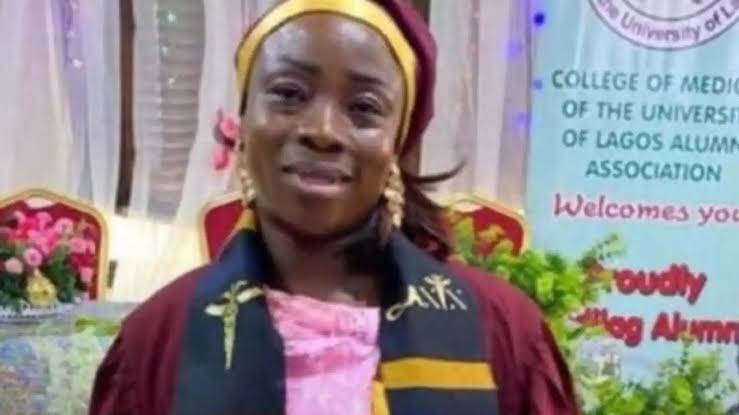
Married, a mother of three and already working as a laboratory technician, Damilola Odukoya returned to the classroom more than two decades after her first attempt at JAMB and refused to let age decide when her dream would end
By the time Damilola Odukoya returned to JAMB at 37, life had already given her plenty of reasons to settle for the career she had built.
She was married, had three children and was working full-time as a laboratory technician in a hospital. She had already established a family and a profession, and the years that had passed since her first attempt at the university entrance examination could easily have been taken as evidence that the opportunity to study medicine had come and gone.
Instead, she sat for JAMB again.
More than two decades after her first attempt, Odukoya secured admission to the University of Lagos to study Medicine and Surgery, beginning a journey that would eventually take her from the laboratory to the medical profession.
It was not a convenient time to start again.
She had three children to raise, one of them still a baby, while the demands of medical school were hardly compatible with the responsibilities of a working mother. At one point, she took study leave from her job so she could devote herself fully to her medical education.
Her younger classmates also noticed the difference in age and experience.
Some affectionately called her “Mummy”.
Rather than allowing the label to remind her that she had arrived later than most of them, Odukoya embraced the role and continued with the same course as everyone else: lectures, examinations, practicals, long hours of study and the relentless demands of medical training.
In 2022, she graduated from the University of Lagos College of Medicine.
The certificate marked the completion of a medical degree, but it also represented something less easily captured by a graduation photograph: the fulfilment of an ambition that had survived more than twenty years, marriage, motherhood, employment and the ordinary pressures that persuade many people to abandon plans they once held dear.
The dream that refused to disappear
Odukoya’s story challenges one of the most persistent assumptions about education and career — that there is a particular age at which people are expected to have made the important choices of their lives.
In practice, lives rarely follow such neat schedules.
People postpone university because of family circumstances, financial difficulties, work, illness or other responsibilities. Some abandon ambitions because the opportunity disappears. Others make peace with a different career and carry an old dream quietly for years.
Odukoya appears to have belonged to a different category: people who eventually decide that the dream is still worth pursuing.
Research on what economists describe as “late bloomers” provides useful context. A 2023 study by researchers at the National Bureau of Economic Research found that about one in five college graduates in the US obtained their degrees after the age of 30. The researchers found that later educational attainment has made a substantial contribution to overall growth in college completion, challenging the assumption that higher education is predominantly an early-adulthood achievement.
The phenomenon is not simply about academic qualifications.
Returning to education later in life often means entering a world in which the student has responsibilities that younger classmates do not yet carry. Adult learners may have jobs, children, mortgages, marriages or other family obligations competing for the same time required for lectures, assignments and examinations.
Research on adult learners has identified flexibility, supportive relationships and accommodating educational environments among the factors that can help students persist when they return to education.
Odukoya’s experience illustrates the human side of those findings.
Medical school with a baby at home
Medical school is demanding for any student. For Odukoya, the challenge was compounded by the responsibilities waiting for her outside the lecture hall.
She was not simply preparing for examinations. She was raising three children, managing a marriage and carrying the weight of having already established a working life before becoming a medical student.
One of her children was still a baby when she embarked on the course.
The decision to take study leave from her employment therefore became part of the sacrifice required to keep the dream alive. The laboratory career she had already built had to make room for a much larger undertaking.
Her husband, Abiodun Odukoya, remained an important source of support throughout the journey.
That support matters because resilience is rarely as simple as the popular version of the word suggests. People do not necessarily overcome difficult circumstances through determination alone. Family support, financial resources, relationships, institutional flexibility and previous experience can all influence whether someone is able to persist when circumstances become difficult.
Research into educational resilience has similarly examined how personal and family resources can help people return to education after leaving it earlier in life.
In Odukoya’s case, the decision to return was personal, but sustaining it required a network around her.
Older than her classmates, but not out of place
Being considerably older than most of her classmates could easily have become another obstacle.
Instead, it became one of the distinctive features of her university experience.
The younger students who called her “Mummy” were not simply acknowledging her age. They were also recognising the different life she brought into the classroom.
While many of her classmates were moving directly from secondary school into university, Odukoya arrived with years of employment behind her, a marriage, three children and experience in a hospital laboratory.
She had already seen part of the healthcare system from the perspective of a laboratory technician.
Medical school offered her the opportunity to see it from another side.
That experience may also help explain why her story resonates beyond the familiar message that it is “never too late”. She was not starting from nothing.
She was building on a life she had already lived.
A second chance after two decades
There is another detail that gives the story greater emotional depth.
Odukoya had to wait five years after her marriage before having her first child. By the time she returned to education, she had become a mother of three and had established herself professionally.
Her path therefore did not involve putting life on hold until the dream was achieved. She pursued the dream while living the life that had developed around her.
Many people imagine that achieving a major ambition requires clearing everything else away first. Odukoya’s experience suggests something more difficult: sometimes the ambition has to be pursued in the middle of everything else.
The children still need attention. The job still exists. The family still has responsibilities. Bills still have to be paid. There is no empty stretch of life waiting for the perfect moment.
The perfect moment, if it comes at all, may have to be created inside an already crowded life.
What late bloomers teach us
The phrase “late bloomer” can itself be misleading because it assumes that achievement has a universally correct timetable.
A person who graduates at 22 may be early by one measure and unprepared by another. Someone who graduates at 37 may appear late when compared with classmates, yet arrive with a maturity, professional experience and clarity of purpose that cannot be measured by age.
Research on later-life educational achievement increasingly complicates the idea that education must happen within a narrow window. The NBER research found that late educational attainment has played a much larger role in overall college completion than conventional measures focused on young graduates would suggest.
Other research on returning adult students describes some of these learners as “tenacious persisters” because their return to education follows years of interruption or delay and often involves overcoming barriers that conventional students do not encounter.
Odukoya’s story fits that broader pattern, but with a Nigerian dimension that makes it particularly compelling.
Here, where educational and professional opportunities can be heavily shaped by age, family responsibilities and economic circumstances, starting again can require considerably more than academic ability.
It requires the willingness to ignore the voice that says the opportunity has passed.
The lesson in her story
There is a tendency to celebrate success only when it arrives early.
Young entrepreneurs are celebrated for building companies in their twenties. Young professionals are praised for reaching senior positions before 30. The culture of achievement often makes speed look like a measure of talent.
But lives do not develop at the same pace.
Some people find their direction early. Others discover it after years of uncertainty. Some reach their first major goal quickly. Others take a longer route because circumstances intervene.
Odukoya’s journey belongs to the second category.
Her first JAMB attempt did not produce the career she wanted. The years that followed brought marriage, children and employment. None of those developments ended her ambition, however. When she eventually decided to try again, she did so with considerably more responsibilities than she had carried as a younger woman.
She also had something she did not have at her first attempt: years of life experience and a much clearer understanding of what she wanted.
At 37, she walked back into the examination system.
In 2022, she walked out of the University of Lagos College of Medicine as a medical graduate.
The journey took longer than she had originally imagined.
It did not make the destination any less valuable.
If anything, the years in between gave the achievement a meaning that a conventional four- or six-year journey could never quite have carried.
For anyone who believes that a missed opportunity becomes a permanently closed door, Damilola Odukoya’s story offers a different possibility.
Sometimes the door remains open.
Sometimes it takes twenty years to find the courage to walk through it.