By Law & Society Magazine Editorial Board
Four days. More than 120 people dead, abducted or missing. From highways in Kogi and Ondo to villages in Adamawa and Plateau, another wave of bloodshed has renewed an uncomfortable question: if the State’s first constitutional duty is to protect life, who answers when it repeatedly fails?
A succession of kidnappings, terrorist attacks and mass killings across Kogi, Ondo, Adamawa and Plateau states has left more than 200 people dead, abducted or missing within four days, reinforcing fears that large stretches of Nigeria’s highways and rural communities are slipping beyond effective state protection.
The incidents, which occurred between August 9 and August 18, have also reopened an increasingly urgent constitutional debate. While Section 14(2)(b) of the 1999 Constitution declares that “the security and welfare of the people shall be the primary purpose of government,” victims of recurring security failures have found little success in seeking judicial accountability from public authorities charged with protecting lives and property.
Those concerns came into sharper focus after the International Society for Civil Liberties and Rule of Law (InterSociety) alleged that no fewer than 92 travellers, most of them from Nigeria’s South-East and South-South, were abducted in a series of attacks along highways in Kogi, Ondo and Benue states between August 9 and August 13.
According to the organisation, about 30 victims either escaped or were rescued, while at least 62 others remained missing or were feared dead.
InterSociety said the attacks occurred in seven separate incidents around Ore in Ondo State, Okene and Ofu in Kogi State, and parts of Benue State, affecting travellers heading towards Abuja and Lagos.
Among the incidents highlighted was an attack on the Auchi-Okene Expressway involving a Sharon bus travelling from Delta State to Abuja and a Toyota Sienna conveying passengers from Abuja to Delta State. The organisation said armed men intercepted the vehicles and abducted 13 passengers.
It also reported another large-scale attack along the Itobe-Achigili-Anyigba corridor in Kogi State, where about 40 passengers travelling in three commercial vehicles, including a Peace Mass Transit bus, were reportedly taken into nearby forests by gunmen.
InterSociety further claimed that 32 travellers were abducted during another attack near Ore in Ondo State involving two commercial buses travelling to Lagos and Abuja, although several passengers were later said to have escaped or been rescued.
The figures released by InterSociety had not been independently verified at the time of filing this report. Its description of the attackers as “Jihadist Fulani” reflects the organisation’s own characterisation and has not been independently established.
Irrespective of those disputed details, the incidents reflect a pattern that has become increasingly difficult to ignore. Kidnappings on major highways have become so frequent that many motorists now regard long-distance road travel as an increasingly dangerous gamble, with forests bordering strategic roads serving as staging grounds for armed attacks.
Before those concerns had subsided, fresh violence erupted in Adamawa State.
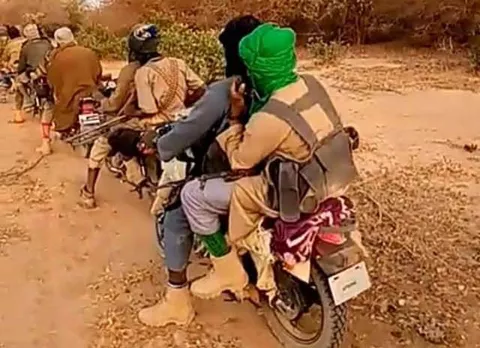
Suspected Boko Haram insurgents reportedly stormed Dhang community in Gaya District of Hong Local Government Area on Monday afternoon, killing at least five people, including a police inspector attached to the Gaya Divisional Police Headquarters.
Residents said the attackers looted shops, carting away medicines, foodstuffs and agricultural chemicals before forcing villagers to flee into surrounding bushes.
The Adamawa State Police Command confirmed the attack. Its spokesperson, SP Suleiman Nguroje, said security personnel had been deployed alongside the military to secure the community and assess the extent of the damage.
Residents, however, warned that the worsening insecurity could prevent farmers from accessing their farmlands at the height of the rainy season, threatening livelihoods in communities already living under the shadow of insurgent violence.
Within hours, another community came under attack hundreds of kilometres away in Plateau State.
Residents of Binper community in Mangu Local Government Area said heavily armed attackers moved from house to house shortly after midnight on Tuesday, killing at least 23 people, injuring several others and leaving others unaccounted for.
Eyewitnesses described a coordinated assault in which families were attacked inside their homes while asleep.
One resident said the attackers forced open doors before killing occupants, while another described the aftermath as devastating and called for a more decisive security response to halt the recurring attacks.
Security personnel were later deployed to the community, while the injured were evacuated to nearby hospitals for treatment.
The killings are the latest in a succession of violent attacks that have continued to plague parts of Plateau State despite repeated security operations and official assurances.
Taken together, the attacks reveal more than a deteriorating security situation. They also expose a recurring weakness in Nigeria’s constitutional order. Although the Constitution identifies the security and welfare of the people as the primary purpose of government, citizens have found it exceedingly difficult to hold public authorities legally accountable when that obligation is repeatedly breached.
For years, lawyers and civil society organisations have argued that persistent failures to protect lives should attract constitutional scrutiny through public interest litigation. Instead, many such efforts have struggled against restrictive rules on standing, narrow interpretations of enforceable rights and judicial reluctance to entertain suits seeking to compel governments to discharge what critics describe as their most fundamental constitutional responsibility.
The result, legal analysts say, is an accountability vacuum. While security agencies routinely investigate individual attacks, broader questions about systemic failures—why communities repeatedly come under assault, why highways remain vulnerable despite years of military deployments, and whether governments can be compelled to adopt more effective preventive measures—rarely receive sustained judicial examination.
The consequence is a cycle that has become painfully familiar: another attack, another deployment of security personnel, another round of official assurances, followed by yet another list of victims.
For families searching for missing relatives, constitutional theory offers little immediate comfort. Their concern is whether loved ones will return alive. Yet the deeper legal question remains unavoidable. If the Constitution places the protection of life at the centre of governance, can that promise remain meaningful when citizens have no effective legal pathway to challenge persistent failures of the State?
Until that question receives a more definitive judicial answer, Nigeria’s recurring tragedies may continue to be treated as isolated security incidents rather than symptoms of a constitutional obligation that remains honoured more in principle than in practice.