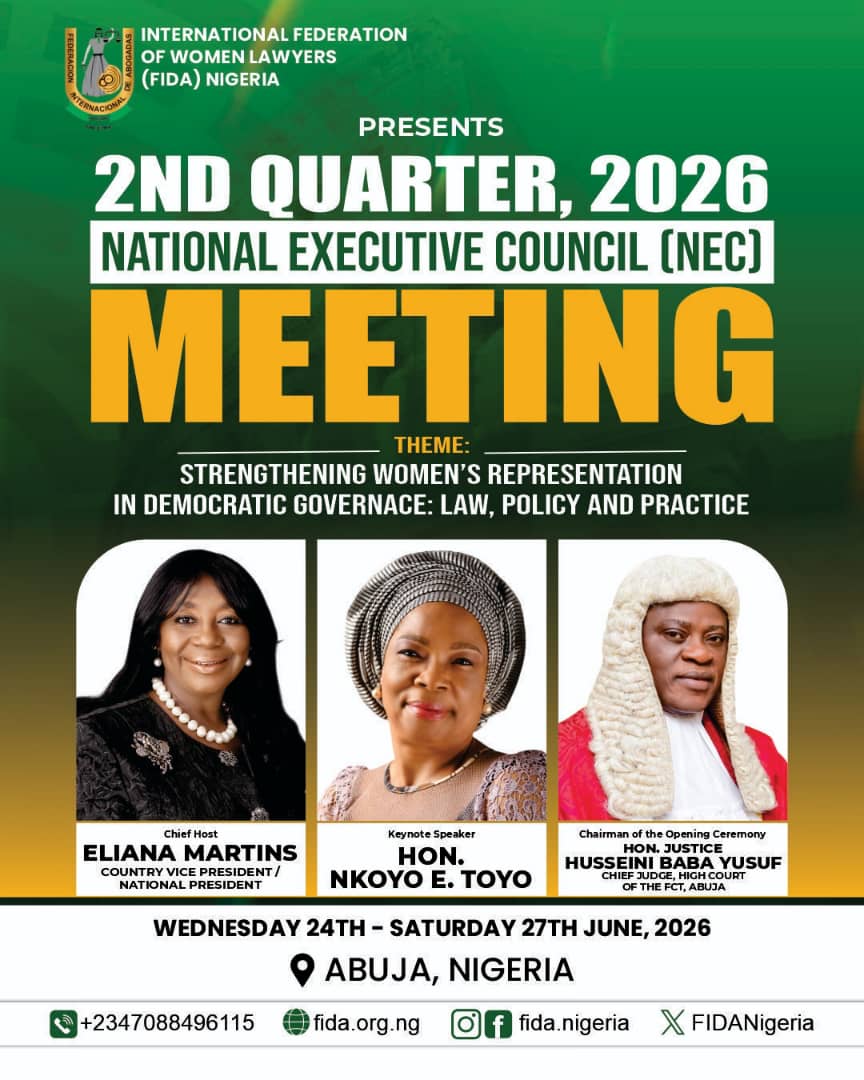
Leading women lawyers, judges and policymakers will gather in Abuja this week to chart legal and policy reforms aimed at breaking barriers to women’s participation in governance and decision-making ahead of the 2027 elections.
With conversations around women’s political participation gaining renewed urgency ahead of the 2027 general elections, the International Federation of Women Lawyers (FIDA) Nigeria is set to place gender-inclusive governance at the centre of national discourse as it convenes its 2026 Second Quarter National Executive Council (NEC) Meeting in Abuja.
The four-day gathering, scheduled for June 24–27, is expected to bring together some of the country’s most influential women lawyers, judicial officers, policymakers and civil society leaders to examine how legal and institutional reforms can accelerate women’s representation in leadership and democratic governance.
Under the theme, “Strengthening Women’s Representation in Democratic Governance: Law, Policy and Practice,” participants will explore practical strategies for dismantling barriers that continue to limit women’s access to elected office and key decision-making positions despite decades of advocacy.
The event comes at a time when women remain significantly underrepresented across Nigeria’s political landscape, fuelling calls for more deliberate action to translate constitutional guarantees of equality into measurable political outcomes.
FIDA Nigeria’s Country Vice President and National President, Eliana Martins, will serve as Chief Host, while former diplomat and lawmaker Hon. Nkoyo E. Toyo is expected to deliver the keynote address. The opening ceremony will be chaired by the Chief Judge of the FCT High Court, Hon. Justice Hussein Baba Yusuf, underscoring the judiciary’s role in advancing inclusive governance.
Beyond its internal deliberations, the NEC meeting has been designed as a policy platform to stimulate broader national conversations on gender equity, democratic participation and institutional reform.
Activities will commence with an outreach programme to the Jesus Kiddies Orphanage Home for Children with Special Needs in Kubwa, followed by a press conference, welcome cocktail, cultural night, business sessions and stakeholder engagements aimed at strengthening collaboration within the legal profession and beyond.
For the Abuja branch of FIDA, the event marks a significant milestone. Sixteen years after last hosting the organisation’s national leadership meeting, the branch is returning to the spotlight with an ambitious agenda that organisers say goes beyond logistics to influence national policy.
In a symbolic full-circle moment, Hajiya Laraba Shuaibu, who led FIDA Abuja during its previous NEC hosting in 2010, now chairs the Local Organising Committee responsible for delivering the 2026 conference. She is supported by former FIDA Nigeria Country Vice President Amina Suzanah Agbaje, reflecting what organisers describe as a blend of institutional memory and fresh leadership.
Eight specialised sub-committees have already been constituted to oversee logistics, publicity, accommodation, fundraising and programme development, highlighting the scale of preparations for what is expected to be one of the organisation’s most consequential gatherings in recent years.
Speaking on the significance of the meeting, FIDA Abuja Chairperson Chioma Onyenucheya-Uko said the objective extends beyond hosting a successful conference.
“This is about deliberate planning, coordination and collaboration to ensure a successful NEC meeting that reflects our impact and future direction,” she said.
Organisers insist the gathering is intended to move beyond rhetoric by developing actionable recommendations that can strengthen women’s participation in governance at all levels.
“Decisions that shape systems must include women at the table,” the organisers said, framing the conference as part of a broader effort to ensure that Nigeria’s democratic institutions better reflect the diversity of the society they serve.
As political alignments begin to crystallise ahead of 2027, the Abuja meeting is expected to amplify calls for legal reforms, policy innovation and sustained advocacy aimed at transforming women’s representation from an aspiration into a political reality.