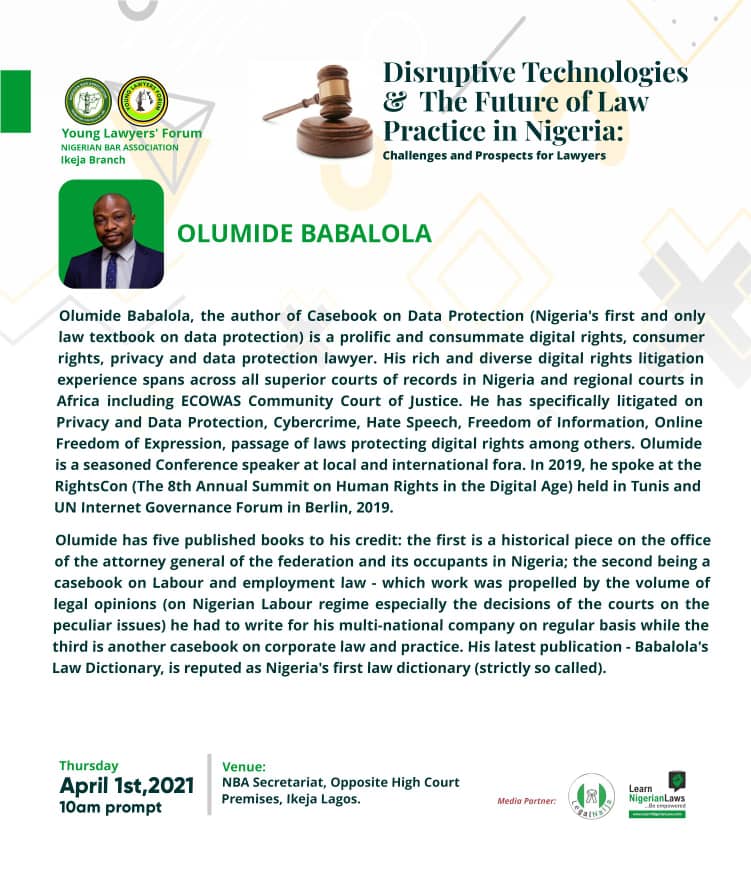
It’s no April Fool. Disruptive Technologies and the Future of Law in Nigeria summit organised by the Young Lawyers Forum of Nigerian Bar Association (NBA) Ikeja kicks off April 1, 2021.
The event which takes place at NBA Ikeja Secretariat opposite the High Court will feature a number of seasoned professionals.
A statement from the Ikeja Bar reads:
“Information technology is virtually driving major innovations around the world and also changing the way we do things ranging from Communication to Banking & Payments, Education, Transportation etc.
“The fast paced innovation, disruptive solutions and services that information technology is bringing about have serious legal implications for every country including Nigeria. It is therefore pertinent as Lawyers that we understand the practice of law in this technological era, how to be positioned and relevant. The relevance of a lawyer in a developing Nation and the world at large goes beyond litigation, Lawyers should be aware of how to gain relevance in a changing world and challenges to face.
“The Young Lawyers Forum, is inviting you to its 8th Annual Summit which holds on;
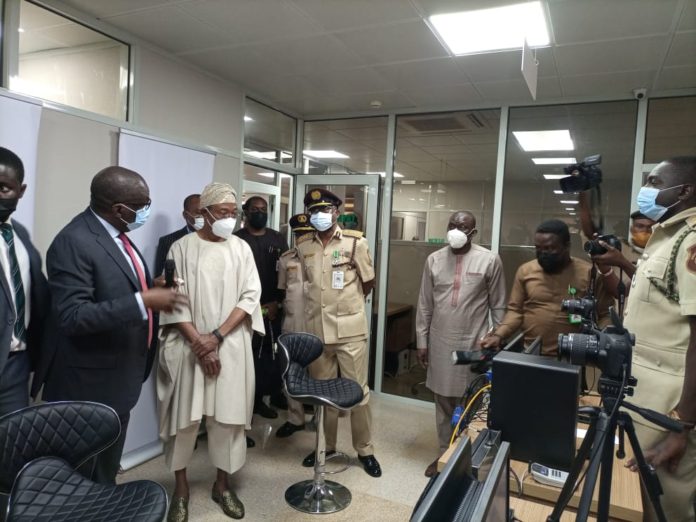
Nigerians can now get international passport issued in 24 hours, the Minister of Interior, Ogbeni Rauf Aregbesola said.
Speaking at the launch of a new automated fast passport-processing centre at the Maitama Passport Express Centre (MPEC) in Abuja, Aregbesola said it was the vision of the Ministry of Internal Affairs and Nigeria Immigration Services to build such centre in every local government of the country.
He said the new automated fast passport-processing centre was aimed at eradicating the challenges Nigerians faced in the administration of passport in the country.
He noted that the Maitama Passport Express Centre (MPEC) in Abuja which was established in partnership with IRIS Smart Technology was to run on premium service delivery to Nigerians who desired to obtain passport within 24 hours after successful applications.
Aregbesola said during the inauguration that the establishment of the passport-processing centre was in concordance with the Executive Order 1 signed by President Muhammadu Buhari in 2017 designed to aid ease of doing business in Nigeria and as well in response to the yearning of Nigerians to ease the stress of passport processing and administration in Nigeria.
The minister noted that the new centre was designed towards eliminating any form of corrupt practices in the issuance of passports and minimise human contact arising from COVID-19 pandemic safety protocol, adding that it was in the vision of the Ministry and Immigration Services to build such centre in every local government to suit the necessity of passport applications in the various regions of Nigeria.
In his remarks, the Comptroller General of Nigeria Immigration Services, Muhammad Babandede said the centre, which is run by a private firm, would charge N20,000 for normal applicant willing to collect the booklet in three days or N30,000 for 24-hour service.
He noted that the price for the traditional passport issuance at the Immigration centers remained the same.
He announced that the entire staff members of Amana Passport Office had been posted out for negligence, complicity in passport administration with many officers having been dismissed, de-ranked and others facing disciplinary procedures for corrupt practices and loss of passport booklets.
On the Maitama Centre, Babandede said: “The centre will be non-judgmental and has provision for large comfortable VIP lounge, refreshment, queue management system and other necessary facilities to ensure comfort and speedy delivery of quality service.”
He added: “This Centre will have a dedicated National Identity Number (NIN) registration unit and cater to the complete passport issuance process from enrolment to production for only Fresh and Re-issue passport applications.”
He said other categories of passport applications including Change of Data, Replacement of Damaged, Lost/Stolen passport, among others “shall continue to be processed at the Service Headquarters and other approved passport issuing authorities.:
He said: “We acknowledge and apologize for the challenges faced in the past few weeks regarding passport booklets availability. I am glad to inform you that booklets are now available and are being distributed to all our passport issuing centres. We therefore appeal for little more patience from passport applicants to enable the passport offices clear the pending backlog.” (theconclaveng)
[2021] 2 NWLR (Pt. 1761) 422 at 445, per Rhodes-Vivour, JSC
Notable Pronouncement
I intend to comment on the disturbing trend where all manner of appeals are filed against awards. It is time litigants fully understand, respect and appreciate the nature of arbitration agreements they freely enter into. It is the duty of counsel to explain the nature of these agreements and not encourage their clients to disregard them when they get unfavourable awards. Arbitration agreements out to be respected and the resultant awards complied with. We should always bear in mind the importance of respecting arbitration agreements, more so those that have international connotations. Building up and sustaining a globally respected dispute resolution system are major steps for the growth of our Nation into a preferred investment destination. The Nigerian Legal System, following international standards, has legislated on the nature of arbitration awards to be final and binding and only to be interfered with by the courts in the exceptional circumstances enunciated in the relevant arbitration statutes. Arbitration is widely acknowledged as an alternative to litigation which enables expeditious dispute resolution. Commendably, the legal framework provides for court interference in specified circumstances only. However, the unfortunate trend in which litigants, with the assistance of counsel who fail to appreciate their duties as officers of the court, all in a bid to win their clients’ case by all means, bring unsubstantiated and spurious challenges against otherwise good arbitration awards and the arbitration tribunal, ought to be frowned upon and discouraged. The courts should not allow itself to be used as a tool to set aside otherwise good awards or frustrate legitimate arbitration awards.
Notes
The words of Hon. Justice Rhodes-Vivour, JSC (now retired) are as bright as day. In the short pronouncement, the learned Jurists highlighted the core ideas surrounding the concept of arbitration. His Lordship has words for everyone – litigants, lawyers, the courts, and general public. This seminal pronouncement deserves to be recited like an anthem, and internalised by all.
The relevance of arbitration can never be overemphasized. It has developed to become one of the most potent means of commercial dispute resolution globally.
Although it is a quasi-judicial system in that an arbitrator, like a judge, decides the dispute, it still retains certain distinctive features which makes it attractive. For instance, unlike litigation, arbitration is private and not conducted in the public; and confidentiality is guaranteed. Final decision/judgment in arbitration (called an award) is precisely final as there is no right of appeal.
These features are underscored by the fact that arbitration is party-driven. The use of arbitration and the issues relating to the process and procedure are largely borne out of agreement by the parties. For instance, there can be no arbitration except the parties agree in writing that arbitration will be the mode of resolving their dispute. This agreement is usually in the form of an arbitration clause contained in the contract. The clause is drafted in a way that captures other accompanying details touching on process, like the number of arbitrators, the appointing authority, governing law, place and seat of the arbitration, etc. Sound solicitors, especially solicitors who also double as arbitrators, are familiar with how to draft a perfect arbitration clause.
As pointed out by the Supreme Court above, arbitration saves time and has gained international recognition and acceptance as an effective means of resolving commercial disputes.
Notwithstanding, in some part of the world like Nigeria, many litigants are still attempting to dethrone arbitration from its respected position in order to advance their unending craving for litigation. This is mostly by those who are unsuccessful at the arbitration. They move to challenge the award with the aim to set it aside. The move to set aside the award naturally flows from the understanding that an arbitral award is final and cannot be subject of an appeal. The law governing arbitration in Nigeria, the Arbitration and Conciliation Act, contains specific provisions on the conditions for which an arbitral award may be set aside. These include where an arbitrator misconducts himself or herself.
In order to allow arbitration to thrive in Nigeria, legal practitioners must hearken to the voice of the Supreme Court and abandon the “win-at-all-cost” mentality. Among all the reasons litigants and lawyers must comply with the Supreme Court’s advice, we should note the need to make Nigeria a preferred investment destination. A country with an uncertain and ineffective justice system and system of commercial dispute resolution have a lot to lose in terms of foreign investment.
Kwara State is in the news again, this time for the wrong reason. The State has recently been embroiled in needless controversies arising largely from the internal wrangling between various factions of the ruling All Progressive Congress, APC. The question that I’ve been asking myself in respect of this matter is this: why should a state government be involved in religion? Is the governor not aware that Nigeria runs a secular state and no government is expected to dabble into religious matters, to support one group against the other? In the course of last week, I watched a very disturbing video, of some persons, who assembled opposite what looked like a big cathedral, from where they were hauling stones and other dangerous objects, into the compound of the church, with the security standing and watching them, helplessly. Why should this happen? Or is the house of God no longer sacred? Is the church the problem or the management of the school, or the state government that jumped into the murky arena of religious conflict? How do we justify or even rationalise the attempt to destroy a church building, with the agitation for students to adorn a particular mode of dressing? What is the relationship? Will that be tolerated if the situation were to be reversed, for other members of the opposing faith to seek to destroy a mosque simply because a school located in the same premises has not allowed Christian pupils to adorn cassock as uniform? We dwell too much on minors.
Now in some years past, certain missionary organisations got permission from the government to establish churches and other worship centres, as facilities for the practice of their faith, where their members gather to serve God. Over the years, some of these worship centres grew in leaps and bounds and they were handed over upon independence, to the local members, to further their legitimate objectives. As part of their corporate social responsibility, some of these churches established schools, hospitals and even justice centres, where the indigent and needy can have access to social services. In the case of my own church, a maternity was established right in the compound of the church and it admits RCCG church members, Christians from other denominations, Muslims, traditionalists and even atheists, who daily patronize it, for delivery of their babies, at little or no cost. After all, the unborn baby in the womb has no religion yet and cannot be the subject of discrimination on account of the religion of the parents. These churches exist all over Nigeria, in Kwara State in particular. I have since confirmed that Kwara State is neither a Christian nor a Muslim State, for the government of that State to seek to take up arms in favour of or against any particular religion. In any case, Section 10 of the Constitution clearly prohibits any State in Nigeria from adopting any particular religion as State religion.
The genesis of the whole matter as I read from the news is that the government of Kwara State has been involved in the determination of private choices of students and their parents, as to what type of uniform students should wear to school. This is not about the school fees to be paid, the rehabilitation of the structure of the schools, or equipping the laboratories or libraries of the schools, or even improvement of the welfare of teachers and other members of staff of these schools, which number about ten in all, in the State capital in Ilorin. I read a statement where the Kwara State government announced the extension of the closure of 10 Mission Secondary Schools in Ilorin. In that statement released by Mrs Kemi Adeosun, Permanent Secretary, Ministry of Education and Human Capital Development, she said the schools should remain closed because of security reasons. Part of the statement state as follows:
“The government earlier shut the 10 schools belonging to some Christian Missions in the state on February 19, 2021, following a crisis on the wearing of Hijab by Muslim female students who are attending the schools. The government had earlier said that it approved the wearing of Hijab in all government grant-aided public schools in the state and directed that the schools be reopened today (Monday, March 8, 2021).
“Ministry of Education and Human Capital Development wishes to inform members of the public that the 10 government schools where the use of hijab is disputed will remain shut until a later date. This decision has been taken for safety reasons.
“A statement by the Permanent Secretary, Ministry of Education and Human Capital Development, Mrs Kemi Adeosun, listed the schools to include C&S College Sabo Oke, ST. Anthony College, Offa Road, ECWA School, Oja Iya, Surulere Baptist Secondary School, Bishop Smith Secondary School, Agba Dam, CAC Secondary School Asa Dam road, St. Barnabas Secondary School Sabo Oke, St. John School Maraba, St. Williams Secondary School Taiwo Isale, and St. James Secondary School Maraba.
“The government, therefore, directs school children and teachers in the affected schools to remain at home until the contrary is announced. The government remains committed to fairness, pluralism, and respect for the law and rights of every citizen at all times.”
Now this was greeted with protest from the management of the schools affected and a case was filed in court. Whatever the merit of the said case, it will be good for parties thereto, to await the final determination thereof, in the interest of peace and tranquility. Amongst the many problems of Kwara State, religion and dressing of students should be the least concern of the government. I take it that the government of Kwara State has only gotten itself immersed in this controversy purely for political capital, at the expense of the combatants themselves. And this is where I find all the controversies amusing, because the government is seeking to profit from the misfortune of its own citizens, purely for populism. I am not unmindful of the provisions of section 38 of the Constitution on the freedom of religion and the practice thereof, the same Constitution however in its section 43 grants persons and organisations the right to acquire and own property, such as churches, mosques and schools. If the right to acquire property is exercised for the establishment of churches, schools and hospitals, the right to freedom of religion should not antagonize or limit the discretion of the owners, in the choice of policy formulation. It should be a matter of dialogue and agreement, where non-members seek to take advantage of social infrastructure established pursuant to the lawful exercise of these rights. The government cannot and should not legislate it by fiat, as Kwara State is presently doing. It will not work.
I believe that there are Parents/Teachers Associations in these schools. They should rise to the occasion and save the children the trauma and stress of religious fanaticism. When we indoctrinate these children so early in life, we then turn around to preach unity to them, later on in life. It is hypocritical, in my view, to train up children in policy segregation, thus sowing the seed of discord among them. Meanwhile, in their examination hall, the issue of dressing and uniform, plays no role at all, in their performance or the outcome of their grading. The capacity to absorb instructions and teachings in the classroom is not affected by the contents of the Bible or Quran that the students can recite, especially in science-related subjects. What then is the value of all these hullabaloos?
I know very serious minded Muslims who attended Christian missionary schools and came out in flying colours, ditto for Christians who were trained in Muslim schools. Indeed, the children of prominent Nigerian Muslims are being trained in established universities in Europe and America, where the adornment of hijab is not an issue at all, but rather the content of their intellect and character. In this case however, the options for the Kwara State Government are very clear and narrow. It should steer clear of religion and allow the owners of schools to administer them in line with the objectives for which the said schools were established. Government should have no business with religion other than regulation. A situation whereby policies or actions of government lead innocent children to pelt themselves with stones is totally unacceptable. More condemnable is a situation whereby the church as an entity, and by extension its members, are subject to agony, ridicule and opprobrium by reason only that a school is domiciled in the compound of the church. In the final analysis, it may be that not all members of the said church have their wards attending the school located within its premises.
But I have a word for the owners of the schools. The Kwara State government claims that these schools are partly funded by the government and this has not been denied at all. As we say it, he who pays the piper must be allowed to dictate the tune of the music. Once the resources of the State are involved in the running of any school, then the State cannot be reasonably excluded from participating in the management of the school that it is funding. As students are pelting themselves innocently with stones, on account of the incitement of their parents, Kwara United Football Club shot itself to the top of the football league table over the weekend. Those who played in the field did not display their religion on their foreheads, nor was any particular uniform selected for them in order to earn them victory. Let there be peace in all schools in Kwara State, which will put a permanent end to the prevailing anomaly, occasioned by the poor handling of the situation by the government in power.
Ebun-Olu Adegboruwa, a Senior Advocate of Nigeria (SAN), writes from Lekki, Lagos.
It is no news that musical works are protected by copyright beginning from the moment they are created, subject to originality. Generally, the law protects musical works in the same manner it protects your rights to books written by you, movies you produce, etc. These rights are legally known as intellectual property rights. Although called “intellectual property”, you do not need to be an intellectual in terms of academic prowess before you can enjoy legal protection. It is sufficient that you own the works in question.
In a musical work, intellectual property rights may belong to more than one person such as the actual songwriter, beat producer, singer, etc. depending on the particular circumstances.
Any unauthorized use of works protected by copyright attracts legal remedy by way of damages. The person infringing your rights may decide to restrain himself upon being contacted and/or pay compensation in addition. In some cases, the person may opt to buy off the intellectual property rights of the owner in the works if the owner is willing to trade. It is usually when the person accused of copyright rights infringement fails to address the demands of the original owner of the work that recourse is had to the courts to mandate the person to comply.
This was what allegedly played out recently when the news made the rounds that one Jude Nnam filed a N150M copyright infringement suit (FHC/L/CS/304/202) at the Federal High Court against the popular Emeka Okonkwo (E-Money), Five Star Music and Kingsley Chinweike Okonkwo (KCEE). According to The Nigeria Lawyer, Mr. Jude claims that the song titled ‘SOM TOO CHUKWU’ which he had composed in 2001 was surreptitiously included in the music album titled “CULTURAL PRAISE VOL.1″ by the trio without his consent and authorization. He claimed that the Defendants infringed on his rights by adapting, producing, distributing, marketing, advertising and publicly performing the song without his approval.
As is expected in actions of this kind, Mr. Jude is also asking the court to compel the Defendants to render an account of the profits, income, and benefits generated from the adaptation, production, distribution, sale, advertisement, marketing, and performance of the song. Mr. Jude is also seeking an order of injunction against the Defendant’s regarding the song.
E-Money is a popular Nigerian socialite who throws around his wealth publicly. From the allegations leveled above, copyright law seems to be knocking on his door for a compulsory “giveaway” by way of damages. “Compulsory” because an order for damages to be paid where such allegations are proved must be complied with. This is far from the usual voluntary splash of cash or giveaways he is known for, as described by the Grammys-winning Burna Boy in his famous track, “Odogwu”.
Options
However, E-Money and his crew have a number of options available under the law. They may opt to defend the suit jointly. If any of them feels he has no business being joined in the suit, necessary action may be taken to have the name struck off by the Court.
If the Defendants admit to the allegations, they may decide to have the matter privately resolved amicably by paying adequate compensation as may be agreed.
But in the event that the Defendants believe strongly that the case against them is fuelled by mere allegations, and that the claims are frivolous, mischievous and gold-digging, they must take appropriate steps. It is not enough to call the bluff of Mr. Jude. E-Money and his crew are advised to seek the services of legal experts in intellectual property law to give a proper legal guide. Whichever option they are inclined to take, having an intellectual property lawyer by their side will guarantee that the matter receives the level of professional touch and closure it deserves.
Calls for speedy inquest, suspension of Danladi Umar
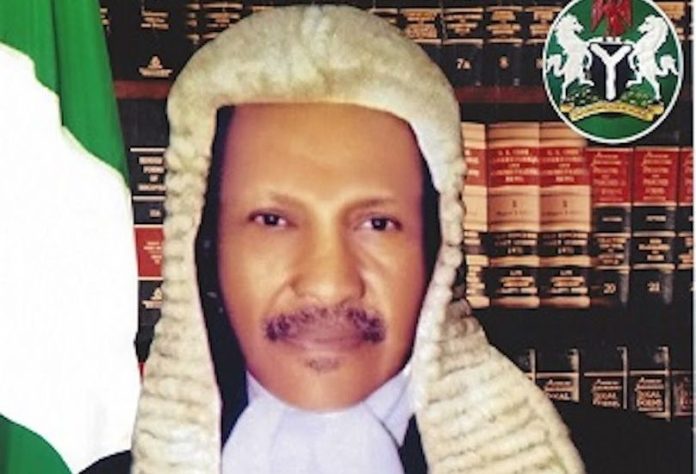
Sequel to a viral video showing the Chairman, Code of Conduct Tribunal, Mr. Umar and a member of his entourage assaulting a Security Guard at Banex Plaza in Wuse 2, Abuja Capital City, the Lawyers Network Against Corruption (LAWNAC) has called for his immediate suspension as Chairman of the tribunal.
In a statement issued by Henry Okolo, Esq, on behalf of LAWNAC, the group said: “Judges are expected to be the epitome of civility and moral turpitude. The constitutional Oath of Judicial Conduct mandates Judges to be patient, respectful and courteous to everyone in and outside the courtroom.”
“Occupants of the Bench must avoid all acts that erode respect for the courts, and confidence in the rule of law and public trust in the judiciary.”
“The actions of a Judicial Officer who undermines the Constitution amounts to gross misconduct and must be taken very seriously. We call on the Nigeria Police Force to immediately commence investigation and for Hon. Danladi Umar to step aside pending the conclusion of the investigation. If Mr. Umar fails to step aside, he should be suspended pending the outcome of the investigation.”
“Article 15 (2) of Part 1 of the 5th Schedule to the Constitution of the Federal Republic of Nigeria (1999) as amended, which is in pari materia with Section 20 (3) of the Code of Conduct Bureau Act provides that the Chairman of the CCT shall be a person who is qualified to hold office as a Judge of a superior court of record in Nigeria. In the same vein, Article 17(3) of the same Part 1 of the 5th Schedule which is reproduced verbatim in Section 22 (3) of the CCB Act also provides for the removal of the CCT Chairman for infirmity of the Body or Mind or Gross Misconduct.
“The assault of any Nigerian by a judicial officer is an assault on the Constitution of the Federal Republic of Nigeria. It is a violation of the Right to Human Dignity guaranteed by the Constitution and a gross violation of the last paragraph of the Judicial Oath by which the Chairman swore to ‘preserve, protect and defend the Constitution of the Federal Republic of Nigeria’. The time has come for the Nigerian Judiciary to purge itself of contaminants in the interest of preserving the Rule of Law and what is left of the Judicial system.
“There is enough evidence for LAWNAC to file a petition against Mr. Umar before the Legal Practitioners Disciplinary Committee.
“Nigerians should learn from the case of Judge Joe Brown. In 2015, a Florida State Judge, Joe Brown, was promptly fired by the Florida State Supreme Court for brawling in Court.”
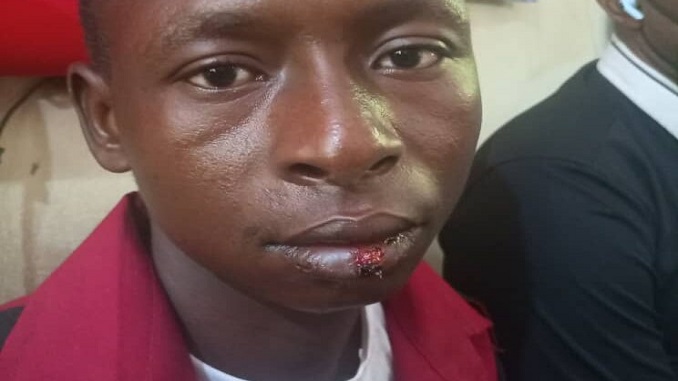
An online video making the rounds had caught Danladi Umar violently assaulting a security guard at Banex Plaza in Abuja.
Umar attacked the guard, Clement Sagwak from Plateau State, with slaps after those that accompanied him to the shopping complex had physically assaulted the helpless security guard.
An eye witness recounted that Sagwak only requested Mr Danladi Umar to park his car properly at the Plaza’s car park, only for CCB Chairman to slap, pull him down and severally inflict bodily harm on him.
According to the eye witness: “The CCB Chairman, Danladi Umar was on the verge of almost further hitting the young security guard with a dangerous object gotten from his car, only for tenants and his colleagues at Banex Plaza to intervene and stop him from further assaulting and violently attacking the young security guard.”
Irked by the attack, One Love Foundation, a Non-Governmental Organisation engaged the services of an Abuja lawyer, Ihensekhien Samuel Jnr, who swiftly intervened and made legal representations at the Maitama police where the Mr. Umar had gone to lay complaint against the security guard.
Barr. Ihensekhien, disclosed that when the DPO of Maitama Police Station where a criminal complaint was lodged against the security guard saw the video recordings of the act, he swiftly ordered for the prompt release of security guard on bail.
A lot has happened in rapid succession, since last week when I wrote the first piece on the religious crisis in Kwara State, infamously stoked by the government in power, purely for political expediency. Some new facts have also been made known to me, concerning the mutual agreement between the government of Kwara State and the owners of the mission schools in question. It was said that sometime in or about 1974, there was an agreement between all stakeholders, on limited involvement of government in the funding of the mission schools, without interfering in the day to day management thereof. In that agreement of 1974, it was stated that:
“ (b) The names of schools remain the same by proprietors. (c) Religious orientation and practices in the schools remain generally undisturbed. (d) The right to nominate Board of Governors with responsibility for the day to day management and welfare of the institution remain unchallenged. The Board of Governors will continue to function normally except in regards to staff matters which responsibility is now taken over by the State Schools Board. (e) The total tone of the institution remains the responsibility of the Board of Governors as the main organ of the proprietors.”
It then becomes crystal clear, at least from item (d) above, that the purpose of government intervention in the mission schools was to assist in the payment of the salary of their teachers, while the issues of management of the schools and general policy formulation, reside in the Board of Governors. There should have been no issue about this at all except that the Constitution of the Federal Republic of Nigeria has intervened in respect of policy formulation, orientation and religious practices. The agreement was signed in 1974 whereas the Constitution came into force in 1999 and with its supremacy clause in section 1, the provisions of the Constitution must, of necessity, prevail over private or public agreements. In the same vein however, there is a need for the government to respect agreements, especially as a way of engendering public confidence in governance generally. In this regard, the global concept of uniform in schools will be defeated where different religious establishments work tirelessly to incite their wards to adorn separate outfits. To the extent that the provisions of Chapter Four of the Constitution are unique and equal, it is doubtful if the right to religious practices by non-stakeholders attending private schools can override the right to freedom of association and to own property. However, I verily believe that this is a balance that the Kwara State Government must work out and sustain.
I received some responses to the first piece and I have decided to share them, largely unedited, in the hope that those concerned would take note and adjust themselves accordingly.
“Kemi:
Good morning sir, I think this problem was foreseeable. Government took over these schools because the churches were tired of running the schools without thoughts of future problems like this. Secondly sir, the Churches ought to have given conditions to government before the control took effect. Now the only solution I see here is to return the schools while those who gave out their land to build the schools should seek compensation from the churches.
Ayemoro Adebayo:
Kwara State governor should apply wisdom to resolve the issue without being biased, it is only in Nigeria you see people fighting for religions frequently. Can men fight for God? Many people are ignorantly putting themselves into bondage, in the name of religions. God didn’t create human beings to fight for Him but to serve Him, whoever that’s serving Him wholeheartedly will not plan to destroy others.
Adebayo Azeez:
The fact that the schools are partly funded by government would not make the Churches to allow what they don’t believe in the schools they established in their names.
Pius Isiekwene:
Thank you sir, for your fine commentary. Probably as you were posting your article, yet-to-be-denied news spread that the gates of two of the affected schools were forcibly uprooted in the dead of the night and removed under a contrived 30-minute blackout reminiscent of the Lekki Toll Gate fiasco of October 20, 2020. I just wonder, as you do, what could have happened if these blood-thirsty aggressors had been the victims of this government-incited madness.
Edafe Great Sakoko:
Please sir, what is the position of the law today on this issue. I do remember the Court of Appeal judgement in 2019. You are a rule of law advocate and I do expect you to support the enforcement of court judgements and not our emotions.
Ayeh Kootoh:
The governor of Kwara states seems to be the governor of the adherents of his faith and of Ilorin rather than being neutral and be the governor of a multi ethno-religious Kwara State. He should go by the advice of Hon Abdullahi and handover the missionary founded schools (Islamic and Christian) to their original owners like Lagos State did during Tinubu’s tenure or maintain status quo and wait for Supreme Court to give their verdict on the ownership of the schools. Common sense seems not to be common here or is it the fear of the emir or the jihadists that’s affecting him?
Hameed Awobifa:
Ayeh Kootoh, are you aware the CAN has gone to appeal court of law on this matter and lost and now to Supreme Court? Why don’t they allow court to come out with the final decision?
Ayeh Kootoh:
Hammed Awobifa, apparently, you read my text in order to respond and not to understand. Read my text again. (The ownership of these missionary founded schools is in contention and it is awaiting adjudication by the Supreme Court and the dress code of these schools hasn’t been changed, so why can’t your Muslim brother governor wait for the Supreme Court pronouncement before asking Muslim girls to be wearing hijabs in Christian schools?). It seems you hate CAN so much and relish the rubbish being spewed out by Isaq Akinola of MURIC concerning this issue.
Hameed Awobifa:
Ayeh Kootoh, honestly I expect such reaction like yours. But before you start vituperating over what I said I would rather recommend that you go and read the judgement very well. Oga, but let me quickly correct a notion which that court of appeal referred to that the plaintiff (former owner) willingly gave out the ownership to the state government as back 1974, which the government have been funding and controlled. So I wouldn’t have joined this issue if not raised by Big Sam Ebun-Olu Adegboruwa, SAN.
Sanni Moses JP:
The Kwara State government didn’t handle this issue well. I will advise the Kwara State government to learn from the way Osun State government handled a similar case too, during the administration of Rauf Aregbesola.
Hameed Awobifa:
Sanni Moses JP, but CAN in both Lagos and Osun didn’t handle it this way. And more so those cases were also settled at the law court.
Ayeh Kootoh:
Hammed Awobifa, you so much believe in these your courts because the justices and judges there are more of a particular religion. Let me shock you, Christian and Islamic Organisations got their schools back without going to court in Lagos. Google is your friend if you doubt this fact.
Iyeme Victor:
In all of this, the governor and his led government have been silent. It’s so sad and barbaric.
Hameed Awobifa:
While I really appreciate your position taking your precious time to educate us readers. I am still confused whether you do this as a pastor or a legal luminary because I know you well to be very objective in your dealings considering the appeal court judgement of 2019 on this same case. Are you now saying the court is wrong legally and we should go by way of our own way of dealing with the issue? I’m not and I will never be in support of any religious crisis because it’s always fueled by the elites in those groups.
Elizabeth Oyeniran:
The fall of a man starts with a step, I hope it won’t be too late for the governor and his cabinet members to reverse their steps.
Olayode Fortune:
Thank you for this eye opening. Your position herein is an indication that you took your time to do the findings about the prevalent issue in Kwara State. Truth be told, the governor made a mistake to have allowed himself to be deceived into making pronouncement permitting the use of hijab in these schools. Sadly, the case has been at Supreme Court since 2019 and the status quo should have been maintained. Now for him to reverse his earlier pronouncement has become a thing of shame.
On the other hand, there are too many people in his government who do not understand governance and are fundamentalist, the SSG and CPS are not helping the matter and this can be seen in the way they respond to questions from journalists and their press releases. They are just one sided – this in itself would do a lot of damage to any system.
After a week of attacking and vandalizing a church building, the government has not seen the need to make any comment and this has empowered the Muslim fundamentalists the more, such that yesterday, they went on rampage at Sabo-Oke area of the state, destroying and vandalizing other churches’ properties. Should a reasonable government not acknowledge the reality on ground and make it known to all? But he keeps playing ostrich. Let’s see how far this would take him and his government. Olayode Fortune, Ilorin, Nigeria.”
A major issue for concern as raised in some of the responses posted above is the revelation that the gates of some of the schools were uprooted and taken away allegedly by those campaigning for hijab. Should things go this way? Can any government, elected to protect lives and property, sit in the comfort of a government house while the house is on fire? This is tantamount to lording it over the owners and management of the schools, in unleashing the adversary upon them through inciting pronouncements and press releases and having done that, to sit by and allow them to be cowed and subjugated, through force and violence. The rule of law is meant to protect the weak and the meek and it is not proper, for any government, least of all one that boasts of no viable alternative, to halt the career of these young children through religious bickering, orchestrated purely for political gains. Let the Kwara State government take a cue from the experiences of other States in the resolution of this issue, let the owners of the schools also embrace dialogue and let the agitators refrain from force and violence. As experience has shown the world over, nobody truly has a monopoly of any option; thus, the deliberate choice of peace and engagement should be the primary target of all concerned.
Esther Wawire, 23, delivered her daughter at Kenya’s Punwani Hospital two weeks ago, but was unable to breastfeed due to complications arising from the delivery. “I had high blood pressure, so my baby was born earlier than expected, weighing 800 grams,” she said. “My pressure didn’t go down immediately, and I was bleeding excessively, so I was transferred to another hospital for admission and my baby was taken to the nursery.”
When Esther recovered 10 days later, she said she found her baby being fed breast milk, donated by other mothers at the hospital.
“It sounded very strange to me and I even called my mother to complain about it. But the nurse explained that the milk was safe and was very ok for my baby,” she said, adding that she had never heard of anything like it before.
Esther’s baby is among the over 500 babies at the hospital who have benefitted from the breast milk bank at the hospital over the last one year.
At the breast milk Bank, Millicent Maina, 25, is waiting her turn to express breast milk, not for her own baby, but for other new babies at the hospital.
“When my baby was born a month ago, she developed breathing problems. She had to be admitted for treatment. During this time the baby wasn’t taking much milk,” said Millicent.
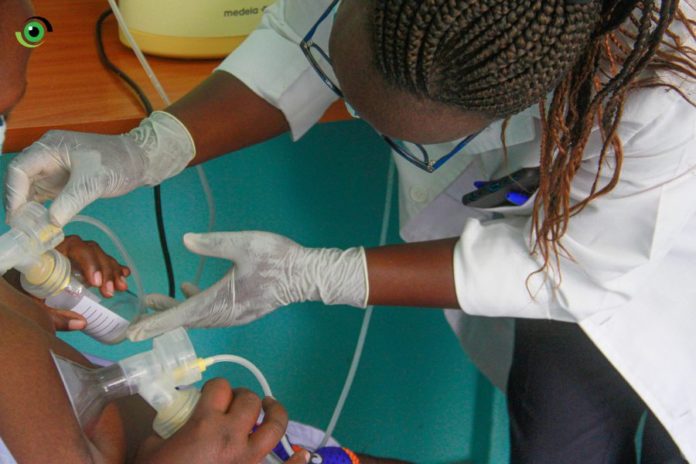
Sterile bottles on a tray used for collecting expressed breast milk for processing and storage. Photo credit: Nigeria Health Watch
“The nurse asked me if I could donate my milk for the other babies who didn’t have. I didn’t fully accept at first until she explained that it was safe and was meant for the babies who were sick.”
One of the mothers at the hospital who was also a donor at the hospital she said convinced her even more, why she should donate breast milk.
She donates her milk twice every day.
“I breast feed my baby first then donate the rest. It is enough,” she said adding that she will donate her milk until her baby is discharged.
“The doctor said the baby is likely to be discharged in two weeks’ time once the baby stabilises. So, I will donate to help other babies until my last day here.”
Pumwani Hospital has Kenya’s first and only Breastmilk Bank. It was set up in 2019 to help preterm babies whose mothers had died or were not present, full-term babies who are sickly and those whose mothers are unable to breastfeed, due to lack of breast milk.
The hospital sees the largest number of deliveries in Kenya, an average of 70 babies everyday according to Kezia Njau, a nurse and counsellor at the hospital. “During the peak months (April to October) the hospitals delivers over 100 babies in a day while the rest of the months it varies from 50 -80 babies. The majority of these mothers are teenagers,” she added.
Kezia Njau, Pumwani hospital nurse/counselor at the milk Bank unit explaining how milk is processed at the milk bank. Photo credit: Nigeria Health Watch
The Kenyan Ministry of Health set up the Milk Bank Unit in Partnership with the Program for Appropriate Technology in Health (PATH), and the United States Agency for International Development (USAID) African Population and Health Research Centre (APHRC) in order to reduce the number of newborn deaths in the country and at the hospital.
Kenya is the first East African country to develop a breast milk bank. The only other countries in Africa that has similar interventions for mothers who are not able to breastfeed their babies, are South Africa, Mozambique, and Cape Verde.
Breast milk is good for maintaining a steady and fast growth of the newborn child and it helps sick babies recover faster as it contains antibodies, white blood cells, stem cells and protective enzymes that fight infections and help faster healing. The World Health Organisation (WHO) recommends exclusive breastfeeding for newborn babies for six months, but if it is not available WHO recommends donor milk. The breast milk boosts the baby’s immunity with antibodies, and it is more tolerable by the baby and thus prevents them from gastrointestinal conditions.
Image credit: Nigeria Health Watch
Catherine Mumo, 26, delivered her daughter who weighed one kilogram prematurely at Pumwani Hospital.
“My baby was too small for me to be discharged. I was told that I will be discharged after she gets to 1.8 kilograms,” Mumo said. “The baby doesn’t take much milk and because I have a lot of milk that make my breasts painful when they are full, I was asked to donate for other babies.”
At first, she said she was hesitant because she had never imagined or heard of such an idea. But after the nurse explained that the milk would save another baby if she donated, she agreed.
“I express at least 150 millilitres two to three times a day,” she said proudly with a smile on her face. The milk bank unit is part of the hospital’s lactation unit operated and run by a counsellor, nurse, and a nutritionist. It has two expression units. According to Njau, these two units are sufficient to meet the hospital’s current needs for donating mothers and will be expanded if need be.
“We identify donor mothers during the maternity ward rounds when we educate mothers on how to breastfeed their babies. Only mothers who produce excess milk are encouraged to donate their milk,” said Beatrice Marube, Head of Nutrition at Pumwani hospital, adding that donating milk to the milk bank is voluntary.
Marube explained that once the mothers agree to donate their milk, they are referred to the lactation centre where the hospital counsellor takes them through the process and requirements of donating milk.
“At this point a mother would know if she really wants to donate or develops cold feet and turns it down,” noted Maribe, adding that because it is a new thing to most mothers, it is important for them to understand that it is a voluntary service to assist other mothers’ babies.
Njau said once a mother agrees to donate her milk she is screened for HIV/AIDS, Hepatitis B, C, and syphilis. If she tests negative to all of these, she then fills a questionnaire that provides information about whether the mother has pre-existing conditions like Tuberculosis, diabetes, high blood pressure, or is on any medication.
“Once it is clear that the mother is healthy, she signs a consent form that indicates that she is voluntarily donating her breast milk and that the information she has provided is correct,” said Njau, adding that the mother is then given a registration number that is used instead of her real name.
At the expression unit, the mother is shown how to express her milk by the hospital nutritionist.
“The date of donating the milk, the mother’s registration number and time of donating the milk is registered in a book,” Njau said, adding that the milk is then packed in a 120-millilitre sterile bottle ready for processing. “From the expressed milk, a sample is taken for testing to ensure that the milk has no microorganisms that can contaminate it.”
Once the milk is confirmed good for use, it is pasteurized at 63 degrees centigrade for 30 minutes then it is cooled suddenly at 4 degrees centigrade. The process kills any harmful bacteria and viruses in the milk. This process is automated.
As soon as the process is over, a sample of the milk is again taken to the laboratory for testing before it is stored in the ready to use freezer at 20 degrees centigrade.
Dr. Mary Waiyego, a neonatologist at the Pumwani Maternity Hospital and Head of the Milk Bank Unit, said the donated milk is given mostly to preterm babies. She said priority is given to babies born at the hospital who have lost their mothers, preterm babies that are not stable, very sick babies and those whose mothers struggle to produce milk.
Image credit: Nigeria Health Watch
“The donor mothers have to be healthy and must have delivered at the hospital before being allowed to donate her milk. She must be producing a lot of milk that is enough for her baby and for donating,” said Dr Waiyego. “As soon as the donating mother is discharged from the hospital, she stops being a donor. Also, as soon as the benefiting child is discharged, he or she stops taking the donated milk.”
Marube said one of the challenges with the solution is that the hospital currently relies on the donor milk from mothers only admitted at the hospital because there is no established system for collecting and transporting breast milk from mothers outside the hospital.
“Breast milk is very fragile and so it needs a lot of care and attention from the point of expressing it to the storage. At the moment the hospital does not have a mechanism of collecting and transporting milk from mothers outside the hospital,” she said.
Dr Waiyego said when they are able to establish a way to transport the milk, they will be able to let mothers outside the hospital donate their breastmilk. The hospital is the biggest maternity hospital in the country.
Dr Waiyego said the human milk bank is a new concept in Kenya, and there are many misconceptions and concerns about donating milk, including concerns about the hygiene of the milk as some people think it can spread diseases to the babies. Also, the solution is still limited to only mothers and babies born at the hospital and so very few mothers can donate milk and few babies benefit from the milk.
Still it has proven to be an innovative way to care for those most vulnerable babies who may not have survived without this intervention. “The milk is only dispensed on the basis of need,” Njau said, adding, “What these mothers are doing to donate their milk to other babies is an extraordinary thing. It has saved many lives of babies and has given a good health to them.”
Countries like Nigeria which have endemic child malnutrition problems have an opportunity to leverage on the continent’s sharing culture and set up breast milk banks. This could help reduce the proliferation of breast milk substitutes and reduce malnutrition in country. Lessons being learnt by Kenya to combat contamination of donated breast milk ampoules, as well as increase donor-culture and reception could help countries considering breast milk banks set up an effective roadmap for action. (nigerianhealthwealth)
No fewer than 20 people have dead after eating fried meet served by an alleged internet fraudster, popularly known as ‘Yahoo Boys’ at a bar, in Alagbole-Akute, Ogun State.
There are claims that the victims were used for ‘ritual purposes’ by an unidentified cyber fraudster.
It was reported that the victims after eating at the birthday party on Saturday, got home and at midnight, started vomiting blood before they gave up the ghost.
While others alleged that the food served was pepper soup which might have likely been poisoned.
A source which spoke with SaharaReporters noted that her apprentice, who was at the bar on the date of the incident said the alleged internet fraudster drove into the bar on a Thursday and ordered drinks for everyone, which he repeated on Friday.
The fraudster on Saturdays came to the bar and also paid for bottles of beer while he announced it was his birthday.
The source said the accused went to his car and brought out a cooler of fried meat and asked everyone to have a bite while sipping their drinks.
“It was at this point that my apprentice noticed his phone was missing. He wanted to capture the scene, make a video or take pictures and post but he couldn’t find his phone so he was more interested in getting the phone than the meat they were sharing. The bar attendants already gave him a bottle of beer paid for by the Yahoo boy and he drank from it before he left to look for his phone. Nothing happened to him, I think whatever caused the death should be the meat because he brought it out from the booth of his car, no one knows where he got it from.”
She added that 25 people from the incident are now confirmed dead as against the figure given on social media, 50.
She said, “The story is very true. I think it is a ritual not food poisoning. The Yahoo boy has been coming to the bar; that place is a place where they smoke, drink, anyone can declare that he will foot others’ bills so it was not new when the guy came the first day to say he would pay for all the drinks. Guys there were happy; the second day, the same thing and the third day, he said it was his birthday that he brought some fried meat in his car so he started distributing to them, telling them to use it to step down (take it along with) the chilled beer he bought for them. They were so happy and started eating.”
“From what I heard, at midnight, they would wake up and say, we ate last at City Concept, start vomiting blood and die. Like 25 of them are dead now. 10 at Keredolu, another 10 at Jolasco close to Lambe and another 5 at Alagbole. I can’t tell if the figure is up to 50 because some people who were not accustomed to going to the bar might have been there on that day to take a piece and return to their houses. None of them died at the bar, no one lodged in there, it is not a hotel.”
“The Yahoo boy did not die; he simply ran away. He has been declared wanted. His car is even parked at Ajuwon there, some people wanted to burn his car but they were advised against doing such so that the culprit would be traced.”
“The police are aware of the incident, they even wanted to go and lock up the hotel but when the owner heard of it, she called them and asked why because she did not produce the beer in her hotel and moreover, the beer was opened for each person at their own request. It was not like it was opened behind them and that was not the first nor second time they had come to the bar to drink.”
Another source said a 19-year-old boy who was at the scene of the incident also vomited blood before he died.
She said the boy, who was the son of her mother’s friend, has now been buried.
“He was at the bar; he ate and drank beer too. He vomited blood and died; he has now been buried. His mother and my mother are friends.”
A Twitter user identified as UdehEmm22446501, who claims he stays in the area where the incident occurred said, “Last week, the candlelight procession for one of the dead victims was done in my area…the supposed birthday was done in a hotel, I still believe the hotel is functioning now. Someone was contacted to cook the food as I heard the person is on the run.”
Another user, @Titi_Wunmi tweeted, “Happened around my area. Let’s just be careful of how we eat at parties and please stop taking food home from parties just because it is free. It is risky. Someone lost 3 kids from this. It is very sad. I am so sure more than 50 people died because some must have come from faraway and must have died on getting home. Some said the celebrant left the country that same night, so it’s not (a case of) food poisoning.”
Facebook said on Monday it planned two new undersea cables to connect Singapore, Indonesia and North America in a project with Google and regional telecommunication companies to boost internet connection capacity between the regions.
“Named Echo and Bifrost, those will be the first two cables to go through a new diverse route crossing the Java Sea and they will increase overall subsea capacity in the trans-pacific by about 70%,” Facebook Vice President of Network Investments, Kevin Salvadori, told Reuters.
He declined to specify the size of the investment, but said it was “a very material investment for us in Southeast Asia.”
The cables, according to the executive, will be the first to directly connect North America to some of the main parts of Indonesia, and will increase connectivity for the central and eastern provinces of the world’s fourth most populous country.
Salvadori said “Echo” is being built in partnership with Alphabet’s Google and Indonesian telecommunications’ company XL Axiata and should be completed by 2023.
Bifrost, which is being done in partnership with Telin, a subsidiary of Indonesia’s Telkom, and Singaporean conglomerate Keppel is due to be completed by 2024.
The two cables, which will need regulatory approval, follow previous investments by Facebook to build up connectivity in Indonesia, one of its top five markets globally.
While 73% of Indonesia’s population of 270 million are online, the majority access the web through mobile data, with less than 10 percent using a broadband connection, according to a 2020 survey by the Indonesian Internet Providers Association.
Swathes of the country, remain without any internet access.
Facebook said last year it would deploy 3,000 km (1,8641 miles) of fibre in Indonesia across twenty cities in addition to a previous deal to develop public Wi-Fi hot spots.
Aside from the Southeast Asian cables, Facebook was continuing with its broader subsea plans in Asia and globally, including with the Pacific Light Cable Network (PLCN), Salvadori said.
“We are working with partners and regulators to meet all of the concerns that people have, and we look forward to that cable being a valuable, productive transpacific cable going forward in the near future,” he said.
The 12,800 km PLCN, which is being funded by Facebook and Alphabet, had met U.S government resistance over plans for a Hong Kong conduit. It was originally intended to link the United States, Taiwan, Hong Kong and the Philippines.
Facebook said earlier this month it would drop efforts to connect the cable between California and Hong Kong due to “ongoing concerns from the U.S. government about direct communication links between the United States and Hong Kong”. (This story corrects Indonesian telecommunications’ company to Telkom in paragraph 6, not Telkomsel) (Reuters)
Our site uses cookies. By clicking “Accept All Cookies”, you direct Law and Society Magazine to store cookies on your device and disclose information in accordance with our Cookie Statement: cookie policyACCEPTREJECT
Privacy & Cookies Policy
Privacy Overview
This website uses cookies to improve your experience while you navigate through the website. Out of these cookies, the cookies that are categorized as necessary are stored on your browser as they are essential for the working of basic functionalities of the website. We also use third-party cookies that help us analyze and understand how you use this website. These cookies will be stored in your browser only with your consent. You also have the option to opt-out of these cookies. But opting out of some of these cookies may have an effect on your browsing experience.
Necessary cookies are absolutely essential for the website to function properly. This category only includes cookies that ensures basic functionalities and security features of the website. These cookies do not store any personal information.
Any cookies that may not be particularly necessary for the website to function and is used specifically to collect user personal data via analytics, ads, other embedded contents are termed as non-necessary cookies. It is mandatory to procure user consent prior to running these cookies on your website.