Home Blog Page 993

China’s March manufacturing grows by the slowest pace in nearly a year

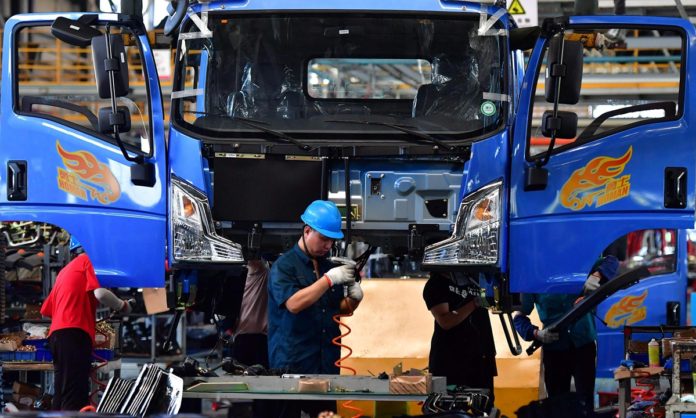
Business in China’s manufacturing sector in March remains in the expansion territory for the 11th month, but grew by the slowest pace in almost a year, according to a private survey.

The Caixin/Markit Manufacturing Purchasing Managers’ Index (PMI) dropped to 50.6 last month, the lowest level since May in 2020. The figure was down from February’s 50.9, missing analyst expectations of 51.3.

A reading above the 50 mark suggests growth, while a reading below indicates contraction on a monthly basis.

The Caixin survey, which concentrates on smaller private firms, is in contrast with the official PMI released by the National Bureau of Statistics (NBS) on the day prior, which registered 51.9 percent in March, up 1.3 percentage from February and shows the strongest growth in manufacturing so far this year.  

The NBS data showed an overall positive recovery regardless of industries or scale of the companies. Industries like professional equipment and nonmetallic mineral products recorded a New Order Index above 55 percent, and the New Order Index rose by 2.1 percentage points from February to 53.6 percent in March, showing the country’s fastening steps in manufacturing production. 

The discrepancy could be because the short term pressure from rising cost is more acutely felt by smaller businesses, who make up most of the interviewees in the Caixin survey, according to Bai Ming, deputy director of the international market research institute at the Chinese Academy of International Trade and Economic Cooperation.

“With the recovery from global economy, and the growing capacity of China’s factories, exports will show a robust growth in the long term,” Bai said. 

The inflationary pressure has already been felt in March by China’s exporters and manufacturers. He Chong, an electric bike vendor on AliExpress, told the Global Times that the costs of materials, including metal accessories and tires, have risen by around 10 percent in March compared to the previous month.

However, He does not expect inflation on material cost to impact his business much, as it will mostly be offset by the soaring international orders. 

“In March the orders we received from oversea rose by around 200 percent compared to February,” He said. Most of his international shipments are sent to Europe from Foshan, South China’s Guangdong Province, where his company is based.

Caixin’s PMI suggests that the pace of expansion in China’s manufacturing sector has been slowing for four months. In March, employment index was in contraction for a fourth month, while index on prices soared as raw materials such as metal and crude oil continued to rise. 

Wang Zhe, a senior economist at Caixin Insight Group, said in a statement accompanying the data release that while the figure shows the manufacturing sector is confident in economic recovery and pandemic control, more attention should be paid to inflation in the future, as the index on prices has been rising for several months. 

He also noted that the room for adjusting policies in the future is limited due to inflationary pressure, which will not assist the economic recovery after the pandemic. 

China’s non-manufacturing PMI, which gauges the sentiment in the service and construction sectors, climbed to 56.3 in March from 51.4 in February, the highest in four months, according to data released by the NBS. The result was above expectations of 52.

Global Times

An administration and its silver linings

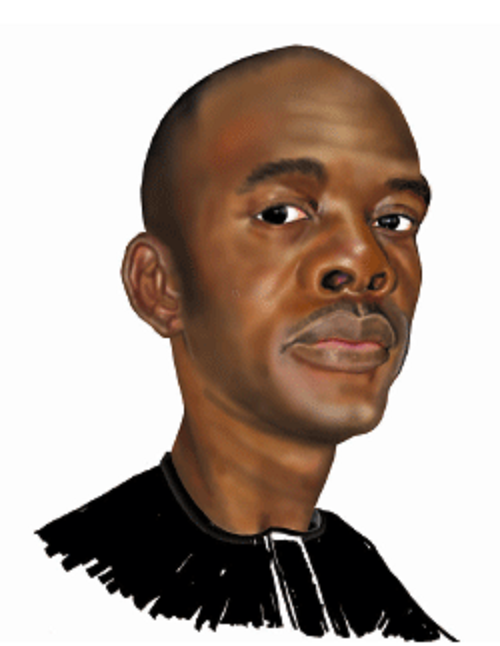
By Ikechukwu Amaechi

Spin doctors in the presidency and their cohorts outside seem to have devised a new strategy to muddle the waters.

Not content with seeing people as haters of President Muhammadu Buhari and being dismissive of opinions that disagree with their holy grail, they are now blaming  citizens for the woes of Nigeria.

On March 28, a friend of mine who believes that Buhari is beyond reproach forwarded to me an article trending on social media.

Titled “The problem with Nigeria,” the author, @harrydaniyan, narrated how he “carried out a social experiment” by standing up to unruly motorists, who, in a desperate attempt to avoid traffic gridlock on an Utako, Abuja road, flouted traffic laws by driving on the sidewalk meant for pedestrians.

He stood up to the indocile drivers even when everyone else acquiesced to their unruliness.

And for his audacity, he was almost hit by an errant driver, and pedestrians on whose behalf he risked his life staging a one-man protest ganged up against him.

“The mob came for me,” he wrote. “I was pushed around, someone slapped me, I saw anger and bile in the eye of the mob. I tried to explain to them why I am actually not wrong in this incident, the driver on the pedestrian sidewalk is the offender here. They wouldn’t have any of that! They pushed me out of the way.

“The driver drove off. The people stood there jeering at me. I stood there taking it all in. I wanted them to have their fill. To them, they have just carried out justice! Silly, frustrated old man!”

For such egregious conduct, he labelled all Nigerians a “wild bunch  of crude, uncouth and uncivil mob.”

“These are average Nigerian masses. They are angry at the government …They are angry at the police. They are angry at everything. They are the ‘EndSARS’ people. They are the ‘Buhari must go’ crew. They are the ‘What is Osinbajo doing’ mob. They are the ‘Naira is useless’ folks.”

His conclusion was rather predictable: “The problem with Nigeria is not the government. The problem with Nigeria is not the police. The problem with Nigeria is Nigerians.”

It was supposed to be a counterpoise to late literary icon, Chinua Achebe’s assertion in his 1984 magnum opus The Trouble with Nigeria where he asserted unequivocally that the only trouble with Nigeria is the failure of leadership.

Achebe didn’t mince words when he insisted that with good leaders, Nigeria could resolve its inherent problems such as tribalism, lack of patriotism, social injustice and the cult of mediocrity, indiscipline and corruption.

The idea encapsulated in the Utako road narrative is to undercut the Achebe narrative by blaming Nigerians for the woes of the country rather than the leadership.

So, I was not surprised when Buhari’s Media and Publicity Adviser, Femi Adesina, doubled down on the narrative same day on Channels Television’s Sunday Politics where he was a guest.

Asked to comment on the latest National Bureau of Statistics (NBS) figures which prove most conclusively that under Buhari’s watch all indices of social development have gone south, Adesina blamed Nigerians for “focusing on the negatives.”

Let me quote him verbatim:

“I think in any nation at any given time, it is not enough to focus on the negatives. In any country in the world, if you want to focus on the negatives, there will be more than enough for you to see and talk about.

“But then, there are always silver linings in the sky from time to time. It is typical of Nigerians that when those silver linings come, we don’t talk about them.

“You talked about inflation at 17.3 per cent. When that inflation dropped to about 11 per cent a couple of years back, we didn’t hear a sound about it.

“When we went into recession the first time and came out and we went the second time, COVID-induced, and came out, not much about it.

“When you hear that our budget performance was about 97 per cent, not much about it. All that you hear, most times, from critics, from a section of the media are just the negatives.

“The truth is that in any country in the world, if you want to focus on the negatives, you will have more than enough to chew. So, let us realise that in Nigeria, there are positives in economy, security, in all spheres of life, there are positives.

“It depends on the ones we want to focus on. If we want to focus on the negatives, we will have enough to focus on but if we also want to see the silver lining and encourage ourselves and encourage our countrymen, there are also things to focus on. The choice is ours.”

As seducing as Adesina’s argument may seem, it is hollow, if not mischievous, because in trying to paint the picture of Buhari as an achiever, he only compared the best of Buhari with the worst of Buhari. That is deceitful.

Compared with the much maligned administration of former President Goodluck Jonathan that he succeeded, Buhari falls ridiculously short.

For instance, while it is true that the inflation rate which ballooned to 15.68 per cent in 2016 and 16.52 per cent in 2017 was brought down to 12.09 per cent in 2018 and 11.04 per cent in 2019 – before it climbed back to an all-time high of 17.3 in 2021 –  there is no silver lining there.

Inflation was at single digit when Buhari became president on May 29, 2015. Under his watch, it climbed to double digits. Even his best performance on inflation, the 2019 rate of 11.04 per cent, is worse than what he inherited from Jonathan.

Where are the silver linings then? According to data released by the NBS last week, food inflation climbed to 20.57 per cent year-on-year in January 2021, the highest in 11 years. Could that be a silver lining?

Again, Adesina talked about entering and exiting recession and is piqued that Nigerians are not ululating over assumed Buhari’s economic wizardry. But where is the silver lining?  This administration drove the economy into recession twice in less than four years, the 2016 recession being the first in a generation.

No matter how hard some administration officials try to spurn the health of the economy Buhari inherited in 2015, the fact remains that GDP grew at 2.65 per cent in 2015. But within one year, Buhari, who promised Nigerians heaven on earth, had run it into a negative territory of -1.62 per cent.

Where is the silver lining in a country where the unemployment rate is 33.3 per cent, arguably the highest in the world; poverty rate a scandalous 40.1 per cent; headline inflation 17.33 per cent, from 16.47 per cent in January; food inflation 21.79 per cent, from 20.57 per cent in January. Total debt profile N32.92 trillion and counting.

Adesina said during the interview that Buhari did not promise to make N1 equal to $1 and challenged anyone with contrary evidence to counter his take.

Maybe he is right. But Buhari is right now in Britain on a two-week medical vacation.

On February 21, 2015, General Muhammadu Buhari, then presidential candidate of the All Progressives Congress (APC) at a public lecture at Chatham House, London, asked: “Why do I need to go for foreign medical trip if we cannot make our hospitals functional?” I hope no one will disclaim this tomorrow.

Aso Rock spin doctors claim that Nigerians are paying too much attention to Buhari. Someone accused me recently of devoting my column entirely to Buhari bashing. That is not true.

But come to think of it, what else is there to write about other than the state of the nation? Wouldn’t doing otherwise be tantamount to pursuing rat when someone’s house is on fire?

Spin doctors may indulge in their delusions, but the truth remains that as a leader, Buhari has failed Nigeria spectacularly. There is no sugarcoating the reality of the moment. There is hardly anything better today than when he became president.

The truth, which cannot be denied by any honest observer, is that the best of the Buhari administration has consistently fallen far short of the worst of his predecessors. That is no silver lining.


Brazil, Zambia And Echoes Of A $1.5bn Nigerian Repair, By Azu Ishiekwene

Brazil has proved a disaster in the management of COVID-19, but there are other areas where we can use their examples. 

Like what to do about failing refineries. This hot-button topic returned to the front burner after the Nigerian government recently announced plans to repair the Port Harcourt Refinery.

That refinery and the ones in Warri and Kaduna have a combined refining capacity of 410,000 bpd, an output far less than the local daily demand, but which all three refineries have only struggled to meet since they were installed.

According to a recent report in The Guardian, Nigeria has spent $26.5billion in fake maintenance in the last three decades or so. Yet, the decision by the government of President Muhammadu to shell out another $1.5billion to flog the dying refinery horse indicates that Abuja is clearly not in the mood to curtail corruption or rein in its appetite for waste.

It’s not money the government has. The government is cash-strapped and had, in fact, listed the Port Harcourt refinery among other assets for sale. In a dramatic U-turn, however, the government seems happy to compound its current debt misery of nearly $86billion, by borrowing more to keep an asset it no longer needs.

Government’s main argument is that if the refineries are sold in their current state, they’ll be flung for less than their scrap value. Officials are also saying that with Dangote’s refinery (650,000 bpd) coming on stream soon, exiting now would leave petrol supply completely in the hands of the private sector. 

There’s no need to wonder why this discovery is coming after the fact. Chaos is the gift of Buhari’s government, except that sometimes, this gift is in oversupply. Or how else can anyone explain why these concerns did not come up during due diligence, supposed to precede the listing?

Let’s leave that for a moment and examine how Brazil, famous for state-controlled refineries, is dealing with a similar problem. Petrobras, which manages the refineries for the state, recently decided to sell off Landulpho Alves refinery (RLAM), among other state-owned assets. Brazil could have made the lazy baby-and-bath-water argument, the trope for the Nigerian authorities. 

But the writing on the wall is clear. Faced with a tightening global oil market and an increasing number of nimble producers in many parts of the world, Petrobras, Brazil’s equivalent of Nigeria’s NNPC, decided that the smart thing to do was to sell off the asset and cut its loss.

In a competitive global bid, Mubadala, Abu Dhabi’s state-owned investment fund recently offered to buy the 333,000 bpd RLAM for $1.65billion, a value higher than what the Nigerian government intends to invest in a repair guaranteed to produce a worse outcome.

Petrobras is planning to sell seven other refineries by the end of this year. According to some reports, the company could realise about $25billion-$35billion from the sale of its non-core assets in the next four years. Which means, by re-evaluating its assets, Brazil could get in four years what Nigeria used in 30 to fix its own rickety assets.

We’ve been here before, and didn’t need a lesson from Brazil at the time. The same argument that government is making for hugging the refineries could have been made to prevent the sale of the Eleme Petrochemical Company in 2006, for example. 

Just like the refineries, the company was sinking in the mire of corruption and producing far less than its installed capacity of 1.2m metric tons of polymer-based products. The government of President Olusegun Obasanjo sold 80 percent of the government’s stake, held by NNPC, to Indorama at $250million – the sort of money that managers of today’s NNPC would consider less than scrap value.

Within two years of the sale, Indorama was in profit and sending dividend to NNPC. It still does, not only to NNPC, but also to the Onne Community where it is located and the Rivers State government, who are also part owners. 

The company has expanded its production capacity to 2million metric tons of polymer, built a fertilizer plant for export and also expanded the Onne Port, which had almost collapsed into a narrow wedge on government’s watch.

About 500 staff members were on payroll, most them leeching off the system while Abuja fat cats were milking the company in the name of “preserving our collective patrimony.” Today, there are 1,500 employees in Indorama Eleme, doing valuable work and earning wages they could only have dreamed off under government management.

It was a lesson which the Obasanjo government almost replicated with the refineries in 2007, before vested interests who use the refineries as private “oil blocks”, regardless of their pretentious nationalism, decided to subvert the sale of the Port Harcourt and Kaduna refineries to Blue Star, with labour goading them on.

The lazy, worn-out arguments for the catastrophic reversal over a decade ago, have not changed: Why sell cheap when you can fix and manage cheaply to reduce petrol imports? Why divest from the refineries and leave such a vital national resource in the hands of the private sector? Why, in short, throw away the baby with the bath water?

Well, this baby has been thrashed and abused by a derelict parent that seems determined to drown it in the bath water.  

The International Energy Agency (IEA) warned last week that, “The plans to repair and relaunch the country’s three existing refineries that have not been operating in recent years are unlikely to materialise.” 

The government is not listening. Or, to put it more correctly, it is listening to itself and instead of using best examples from elsewhere, and even from its own past, it is behaving like effigies from Chiluba’s Zambia.

It’s a story worth repeating – the story of Zambia’s copper mines. At their peak, Zambia’s copper mines produced 12 percent of the world’s copper. They were the pride of Zambia and the glory of southern Africa. 

And then it happened. A combination of steep crashes in commodity prices coupled with corruption, global politics, internal incompetence and mismanagement – all present in today’s Nigerian refineries – put the future of the mines in grave danger.

In response to the economic crisis facing Zambia at the time, President Frederick Chiluba, listed 287 state companies for sale and managed to sell 251. The jewel in the crown, also listed, was Konkola Copper Mines (KCM), the country’s largest.

Zambia was offered $165million but Chiluba, like his cousins in Nigeria’s government today, said the offer was insultingly low. He haggled for nine years. When the price of copper finally collapsed in 2000, the best he could get for KCM was $90m, the true and deserving scrap value.

It’s 14 years since President Umaru Yar’Adua’s government reversed the sale of the Port Harcourt Refinery for $500million to Blue Star set up by Aliko Dangote and Femi Otedola.

If the government is prepared to spend three times what it would have earned from the sale to repair it, your guess is as good as mine what the current market value of the refinery would be today. But it would be worse by the time government finishes the $1.5billion window-dressing.

And all of this is proceeding with a sickening and confusing haste. Tecnimont, the Italian consultant/contractor that estimated the cost of repair at $290million nine years ago, revised the cost to $1.78billion in its fresh bid. The government has neither publicly disclosed details of the first technical report in 2012 nor details of the current one.

All we are hearing from a government that is supposed to be deregulating, is that after the repair, Port Harcourt Refinery would refine enough petrol to flood the Suez Canal. Caution.

The deeper issues of NNPC’s importation monopoly, poor seaport infrastructure to admit and process larger vessels, the waste pipe that is the Petroleum Equalisation Fund, the changing refinery landscape in the world, and sheer corruption that overwhelms the system, are not even being mentioned. 

It would take more than one more repair to cover the developing scandal that Nigeria’s refineries have become. The writing, in grease, is all over the wall.•Ishiekwene is Editor-In-Chief, LEADERSHIP

NBA Reacts To Alleged Unprofessional Conduct Involving Danladi Yakubu Umar (CCT Chairman), Vows To Take Necessary Actions.

The Nigerian Bar Association has reacted to the show of power, displayed by the Chairman code of Conduct Tribunal, at Banex Plaza, in Wuse Abuja.

In the statement released by the National Publicity Secretary of the Association Dr. Rapulu Nduka, he noted that the NBA will launch an investigation into the matter.

Read the full statement below

STATEMENT OF THE NIGERIAN BAR ASSOCIATION ON THE ALLEGED CASE OF ASSAULT BY UMAR YAKUBU DANLADI, ESQ.

The attention of the Nigerian Bar Association (“NBA”) has been drawn to the video making the rounds where the Chairman of the Code of Conduct Tribunal (“CCT”) – Danladi Yakubu Umar Esq., was seen, together with his security detail, allegedly assaulting a citizen at Banex Plaza, in Wuse Abuja. We understand that this citizen turned out to be a 22-year-old employee of Jul Reliable Guards Services Limited, posted as a security guard to the Plaza and who is now reportedly hospitalised. The NBA has also read the statement credited to the Head, Press and Public Relations of the CCT in response to the actions of Mr Umar.

The NBA frowns at any display of naked power by a public officer especially one who, by virtue of his high office, is expected to exhibit a high standard of conduct. The situation is all the more critical when it involves the head of an agency of government set up to ensure compliance, by public officers, with the code of conduct.

Further, as a member of the legal profession, Danladi Yakubu Umar Esq. is expected, by the extant rules that regulate the conduct of legal practitioners in Nigeria, to maintain a high standard of professional conduct, and not to engage in any conduct which is unbecoming of a member of the legal profession. Prima facie evidence available at the moment raise questions regarding whether such standards have been met.

In view of the foregoing, the NBA shall through its relevant Committee, investigate the circumstances leading to the altercation, and depending on its findings, will ensure that appropriate action is taken to address this occurrence.

Dr. Rapulu Nduka
Publicity Secretary,
Nigerian Bar Association

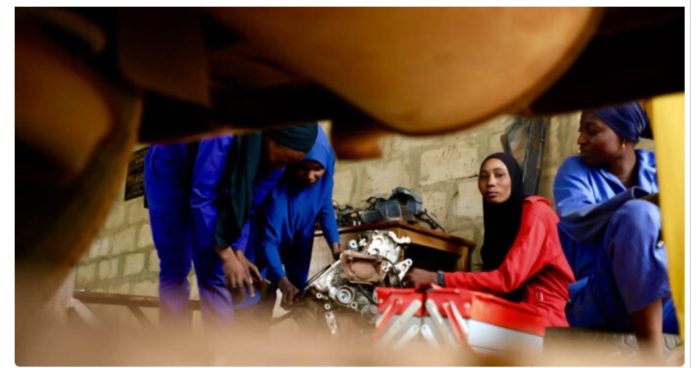
Check out the all-female mechanic workshop in Sokoto where gender roles are reversed

Traditionally, auto mechanic workshops are dominated by men — but the young women at Nana Female Mechanic Garage, Sokoto state, are changing that narrative and doing their bit to blur age-long gender lines. The women, some of whom are undergraduates, are making inroads in the male-dominated occupation on a daily basis.

“When I told my mother this is what I want to learn, she was surprised. I explained to her that the place is safe, they have gadgets that would ease our labour and most importantly, it will help reduce the problem of gender discrimination,” Gladys Obasi, one of the female mechanics, told TheCable.

While working on a Sienna vehicle, Obasi explained why she decided to venture into auto repairs despite currently studying radiology at Usmanu Danfodio University, Sokoto.

“I joined two months ago, just before schools resumed session after the long break due to COVID-19 pandemic,” she added.

For Shamsiya Ibrahim, who is training to be a nurse, it was a case of following in her father’s footsteps.

Shamsiya said she had been passionate about the job “since my childhood days” and was “very inquisitive” while her father worked.

“I play with my dad’s tools at his workshop, so it wasn’t surprising to my parents when I told them I was going into the profession fully despite being a student nurse,” she said.

“I love both jobs and it gives me sense of fulfillment that I can take care of myself without seeking assistance from anybody. When I have classes in the morning, I come here in the afternoon but I mostly run night shifts at the clinic.”

Shamsiya, who specialises in fixing the electrical issues of cars, is the life of the garage due to her larger-than-life attitude.

“I have worked on Peugeot, Honda, Mercedes, and other brands of cars that customers bring to our garage with a smiling face,” she said.

Shamsiya

Shamsiya and her colleagues in the mechanic garage were put together by Nana Girls and Women Empowerment Initiative, which is run by Fatimah Adamu, an associate professor of gender studies in the department of sociology, Usmanu Danfodiyo University Sokoto.

Adamu, a passionate advocate of women’s rights and empowerment, says the rise of female car ownership in Sokoto partly birthed the initiative.

She said: “We have so many women owning cars, we realised that some women who are working cannot take their vehicle for repair because there is the feeling that the place is not conducive for women. It’s a male environment. So, she would rather have to rely on her brother, son, or husband to take it for her. But I said that shouldn’t be the case, so we came up with the female mechanic initiative.”

Adamu said it was also important for women “to have serious income and not the frying of small things” so as to be financially independent to support their families.

“So we did an assessment of where we can get women to earn better pay and that was how the idea of mechanics came in. By doing that, we are rendering services to women as car owners and income generators,” she said.

Adamu said the mechanics are trained in three areas — “the mechanical, panel beating and the electrical sides of the vehicle”.

She, however, acknowledged that the female mechanics face the challenge of working on heavy equipment, hence they have male tutors to assist and guide them.

“We have the challenge of loosening vehicles. For them, it’s very hard and as women, they don’t have the energy, ” she said. “The teachers we have are men and they are used to the energy type of work. We also had to do research to find alternatives.”

She said despite the reluctance of parents to allow their female children to learn the trade, “many of the girls” are passionate about the job and dedicated to it.

Shamsiya

Gladys

Saratu

Rahila

Hafsat

The ladies with their male instructors

Fatimah, founder of Nana foundation

Credit:TheCable

WHY BUHARI MUST SACK UMAR, CCT CHAIRMAN, NOW


After reading the interview of the poor security man Code of Conduct Tribunal chair, Umar Danladi assaulted at the Banex Plaza, Abuja Tuesday, the only option left to the public officer who overreached himself is resignation.
Moreover, after attempts to use the police and the DSS to intimidate the 22-year-old helpless victim, Clement Sargwak, and others at the plaza, Umar compounded his case by trying to whip up sentiment against a section of the country he called Biafra Boys.
Rather than show some remorse and apologize for the misbehaviour captured in so many cameras in today’s smartphone generation, Umar instead wanted through a terribly written statement to narrow it down falsely to a section of Nigeria associated with Biafra.
Umar indisputably showed his animosity and deep seated hatred for some parts of Nigeria and the people.
Yet, with his hate laden mind, he still went to seek the services of the people he so hates that he quickly aligned his misdeeds to.
Umar was simply planning to cause disaffection and possible war in Abuja over his personal indiscretion to pit some parts of the country against others.
The only option in the melee is his resignation and prosecution.
Nigeria experienced similar incident when President Umar Yar’Adua was president of Nigeria.
Over an official issue that had no reason for ethnic biases, Nigerian Ambassador to the USA, Brigadier Oluwole Rotimi told Ojo Maduekwe, then Foreign Minister that “I will defeat you the same way I defeated your ragtag Biafra army.”
For that outburst, President Yar’Adua in March 2009 sacked and recalled Rotimi. That ended his one year diplomatic career that started in March 2008.
President Muhammad Buhari needs to show he doesn’t condone divisions in Nigeria and take a cue from Yar’Adua and sack Umar for prosecution now

Scandal: 800 assets worth $400m in UAE belong to Nigerian govt officials, security chiefs

About 800 assets worth $400 million stolen from Nigeria and domiciled in various cities in the United Arab Emirates (UAE) have been traced to 13 Nigerian security chiefs and public officials.

Of the 800 assets said to have been uncovered by investigators, the 13 security chiefs are discovered to own 216, while the remaining 584 have been traced to Nigerian public officials.

Investigators further revealed that about N17 billion, being stolen assets from Nigeria annually, are laundered in the UAE and the United Kingdom (UK).

These were some of the revelations made at an international conference in Abuja on Tuesday, with the theme; Fixing Financial Flows: A critical Review of UK and UAE Policies, Laws and Practices in Financial and No- Financial Institutions.

The event, organised by the Human and Environmental Development Agenda (HEDA) and other foreign and local development partners, was held at the Sheraton Hotels, Abuja.

The chairman of HEDA, Olanrewaju Suraju, said the illicit financial outflows from Nigeria have continued to hurt the vulnerable poor, fuel violence and constitute threats to moral authority of the Nigerian state.

Suraju said that the UAE and the U.K. have been facing attacks for failing to live up to international obligations in curbing illicit financial flow, mainly perpetrated by politically exposed persons.

▪︎ By The Nation

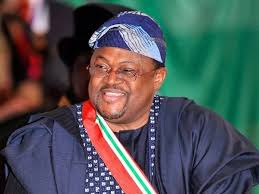
Drama As Adenuga’s Former Private Secretary Declares, ‘Adenuga Accusing Me Because I Ceased To Be His Mistress’

Ms. Honora Olumide Johnson, a former confidential secretary to Dr. Mike Adenuga, has said that the allegation of conspiracy, forgery, stealing and obtaining money under false pretence leveled against her by her former boss was because she walked away from a 30-year love relationship with him, for her peace of mind.

She disclosed this while taking an oath before Justice Mohammed Liman of Federal High Court, Lagos.

A firm, Worldspan Holdings Limited, owned by Adenuga, had through its counsel, Rotimi Jacobs (SAN), petitioned EFCC, alleging conspiracy, forgery, stealing and obtaining money under false pretence against Johnson and others.

“But contrary to the instruction, the first defendant and the 5th defendant allegedly issued a later instruction to the bank that the said balance be wired to DSL Nominees Limited account in China for their personal benefits,” the petitioner alleged.

The petitioner also alleged that sometime between 2018 and 2020, the first defendant, together with others, stole “various currencies in naira and foreign currencies in the total equivalent of $350,000.”

On account of that and others, the EFCC sought and obtained an exparte order, attaching various properties of the 1st defendant, including her residential building, (all, but one of which she had bought between April, 2001 and February 2010) and froze her bank accounts on February 16, 2021.

However, the 1st defendant filed a motion dated March 12, praying the court to discharge the interim attachment order.

She supported her motion with an affidavit denying all the allegations contained in the petition and averred that at no time in 2013 was she instructed by Dr. Adenuga or Worldspan to transfer the alleged $300,000/close any accounts nor did she participate in any transfer of the said sum to DSL nominees, China.

She maintained that she was never queried for any alleged diversion of $300,000 from 2013 till she left her employment in 2019 and further stated that she was never involved in alleged stealing of a phantom $350,000 from between 2018 and 2020, moreso as she had since early 2019 left Adenuga’s company.

She further swore to a 13 paragraph further affidavit that she instructed her counsel to file an application for stay of execution as well as for discharging the orders of the court, which was done and served on the prosecution.

According to her, the application was filed on March 12, 2021 and served on all the respondents on the same date.

“However, on March 17, 2021, I was suddenly asked by an EFCC officer via telephone call to come to the Commission’s office immediately. I informed the officer who called me that I had a pre-scheduled medical appointment for March 17, 2021 and that I would come to their office on the scheduled date, being March 18, 2021.

“The EFCC officer then told me that he and his fellow officers were coming to my house to pick me up and take possession of my house as there is a court order to that effect.

“The EFCC officers kept true to their threat as 30 minutes later they got to my house with Police officers, tried to eject me from my house, that they were taking possession of the house, despite the service of the application of the motion for stay on the EFFC,” she swore.

But the EFCC filed a counter affidavit, necessitating the need for the defendants to respond to it.

In his response, counsel to the 1st defendant, Oluwemimo Ogunde told the court that they had received the counter affidavit and written address to his motion dated March 12, 2021 and would require time to respond.

According to him, the further affidavit he filed on behalf of his clients was to document for the court what the EFCC was doing in harassing his client.

“We think it is important to bring this to our lordship’s notice,” he declared.

But counsel to EFCC, Rotomi Jacob (SAN) and I. A. Mohammed said they were not opposed to the adjournment but argued that the counter affidavit was not necessary.

“It is not a fundamental enforcement of rights action. The matter is for attachment, so that counter affidavit is not needed. But I am not objecting to adjournment,” Mohammed said.

Justice Mohammed Liman therefore, with the cooperation of both counsels, adjourned to April 22, 2021 to hear the motion to vacate the interim order.

Meanwhile, the 1st defendant had in her March 1, 2021 petition to the Executive Secretary of the National Human Rights Commission, Tony Ojukwu dening all the allegations, claiming that she was being harangued for refusing to continue to be the mistress (lover) of Dr. Adenuga.

In the petition, her lawyers, M.J. Partnership; Solicitors, said: “Our client worked for over a period of 30 years approximately, as confidential secretary to Dr. Adenuga starting from her appointment at Devcom Merchant Bank Limited in 1990.

“However, irrespective of which of Dr. Adenuga’s companies our client’s salaries were paid from, our client at all times worked personally in the office of Dr. Adenuga all through the period she worked in his organization receiving various cash gifts in foreign and local currencies from Dr. Adenuga.

“She handled many sensitive matters for Dr. Adenuga and at no point during her work as confidential secretary was she accused of any financial crime or misdemeanor whatsoever. She rather performed her role as confidential secretary to the best of her abilities,” the lawyers stated and urged the Commission to protect the rights of the accused from the “frivolous criminal allegations.”

▪︎Report by Infodailyng.com

Code of Conduct Tribunal boss caught in public misconduct, statement rocks social media

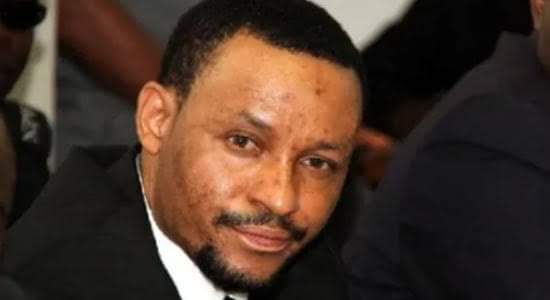
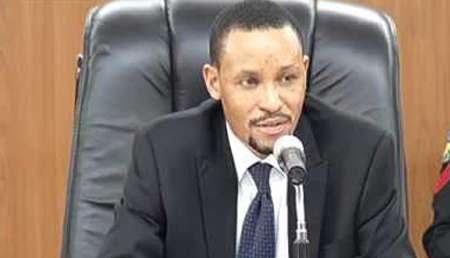
CCT boss, Danladi Umar

The conduct of the Chairman of the Code of Conduct Tribunal (CCT), Mr. Danladi Umar, was unbelivable: he violently attacked a security guard at a shopping area for advising him on how to use the parking lot..

A video recording of the shameful conduct of Umar has gone viral, with commentators lashing out at him, and calling for his arrest and prosecution.

Recall that Umar presided over the tribunal session that ended the career of former Chief Justice Walter Onnoghen

Worse, an official statement explaining what transpired from the spokesman of the CCT, Ibraheem Alhassan, was scandalous, not only in referring to a Nigerian as a Biafran, but in the terrible grammar it contained.

For the better part of Wednesday, it received traction on social media.

The state reads in full: “Our attention was drawn on (sic) a report from some online publication with a video cliff (sic) suggesting (that) Hon Chairman, Justice Danladi Y. Umar assaulted a Security Guard at Banex Plaza.

“To start with, the said plaza has been his usual place of visits for the past 18 years for shopping and repairs of his phones, and in all these periods there have never been any time he had any turmoil (sic) with anybody.

“Unfortunately, yesterday’s altercations started over a packing (sic) lot, which (the) Chairman met vacant and it was directly opposite a shop he want (sic) to make a purchase and to fixe (sic) his phone, when the young Security guard sighted him, he ordered that (the) Chairman should not pack (sic) his car in that particular empty space, but (when the) Chairman asked why (sic), the security guard couldn’t convinced (sic) chairman, though Chairman didn’t identify himself, because to him is (sic) needless and is a place he visited often, but the boy was rode (sic) in his approached (sic) and threaten (sic) to deal with Chairman if he refuse (sic) to leave the scene.

“Again, if Chairman had went (sic) there to cause trouble or intimidate someone, as suggested in the report, he would have gone there in his full official paraphernalia, but he went there alone with his younger brother.

“The Police men seen in the video cliff (sic) were not the Chairman’s police team, they were policemen operating around the plaza whom at first instance intervened before the arrival of police team from Maitama Police station. As the few policemen in the complex were apparently overwhelmed by the mobs, consisting of BIAFRAN boys throwing matches (sic) and shape (sic) object to his car, which led to deep cut and dislocation in one of his finger (sic), causing damage to his car, smashing his (sic) windscreen.

“At a point, he attempted to leave the scene, these same miscreants, BIAFRAN boy (sic) ordered for the closure of the gate thereby assaulting him before the arrival of police team from Maitama police station.

“An incident like this when it happened (sic), sympathy usually goes to the low (sic) personalities. Though is(sic) unfortunate as I said, it ought not to have happened.”

Ibraheem Al-Hassan,
Head, Press & Public Relations.
CCT HQ.
Abuja.

UK agency fines Pastor Oyakhilome’s Loveworld channel N65 million over ‘reckless’ coronavirus conspiracy theories

Ofcom, a regulatory authority for broadcasting in the United Kingdom, has imposed a monetary fine on Loveworld Limited for airing potentially harmful claims about the coronavirus disease.

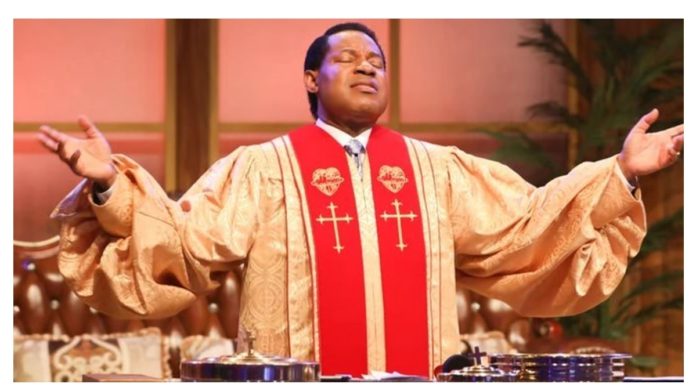
Loveworld is owned by Nigerian pastor, Chris Oyakhilome, who has on numerous occasions propagated outrageous claims about COVID-19.

Ofcom announced in a statement on Wednesday, March 31, 2021, that the company is to pay the fine of N65 million (£125,000) after a programme broadcast on its religious service, Loveworld Television Network, featured inaccurate and potentially harmful claims about COVID-19.

The regulator said the 29-hour programme, Global Day of Prayer, included statements claiming that the pandemic was planned for sinister purposes.

The programme also aired claims that the COVID-19 vaccine is a means of administering nanochips to control and harm people.

Previous disproven claims about the link between 5G technology and COVID-19 were also repeated during the programme which was broadcast via a direct feed from Lagos.

Ofcom ruled that the programme had the potential to undermine confidence in public health advice about the disease which has infected nearly 130 million people across the world.

The agency has previously sanctioned the station for similar issues in May 2020 and January 2021 without imposing a financial penalty.

In response to Wednesday’s decision, Loveworld gave Ofcom a number of assurances as to how it would improve its compliance procedures.

The company said it had brought the matter to Pastor Oyakhilome’s attention and would ensure that his live sermons are henceforth monitored and broadcast with a 20-second delay to screen out any potentially harmful claims in relation to COVID-19. (Pulse)

TIPS