Home Blog Page 972

Afaka students: How Nigerian govt released notorious kidnapper, parents paid N32m ransom

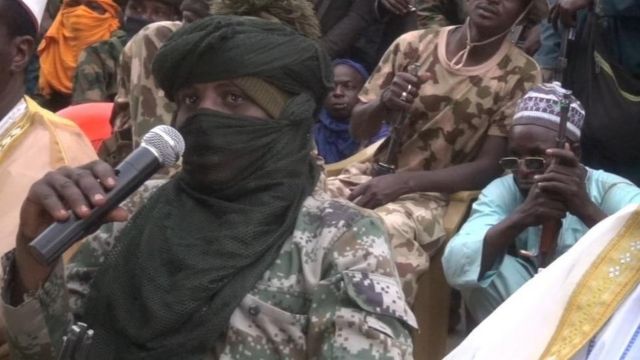
Detail has emerged as to how Nigerian government released a notorious kidnapper in exchange for the freedom of the last of batch of 27 students of Federal College of Forestry, Afaka, abducted on March 11.

In a prisoner swap deal brokered by former President Olusegun Obasanjo, DAILY NIGERIAN learnt, the kidnapper simply identified as Nanono was transported from a detention facility in Kano, were he was being held, and handed over to a traditional ruler in Kaduna who acted as the middleman.
Parents and relatives of the victims were then left with the payment of N15m, in addition to the N17m they earlier paid for the release of the 10 of the students earlier released in two batches.

The parents first paid N17m last month for the release of the all the victims, but the kidnappers released 10 students in two batches, insisting that amount was too small.

In view of the kidnappers’ failure to meet the obligation, the parents insisted on a middleman for the second round of negotiations.

A security source involved in the negotiation confirmed that the kidnappers demanded the release of three of their gang members in custody and payment of the N50m.

But after a series of negotiations and pleas, they accepted to reduce the amount and the only surviving gang member named Nanono,” said the source. (Observerstimes)

10 Best Legal Thrillers That Bring The Courtroom Drama

We’re revisiting the 10 best legal thrillers of all time. From international blockbusters to hidden gems, these classics deliver unbeatable courtroom drama without requiring you to report for jury duty.

Presumed Innocent by Scott Turow

Presumed Innocent by Scott Turow

When a beautiful and ambitious colleague is found murdered in her apartment, Rožat “Rusty” Sabich, chief deputy prosecuting attorney of Kindle County, Illinois, takes the case. But Carolyn Polhemus wasn’t just a co-worker—she was also Rusty’s lover. As evidence of the affair comes to light, Rusty goes from lead prosecutor to prime suspect; soon he’s on trial for his life. Is he an innocent bystander or a cold-blooded killer? You won’t know until you turn the final pages of Scott Turow’s brilliant debut novel, which combines deep philosophical insight, authentic details about the inner workings of a big-city courtroom, and a propulsive mystery plot that sets the gold standard for the modern legal thriller.

To Kill a Mockingbird by Harper Lee

To Kill a Mockingbird by Harper Lee

The daughter of a lawyer, Harper Lee was fascinated by the criminal justice system—she helped her good friend Truman Capote research In Cold Blood, and, as is revealed in the new book Furious Hours, came close to completing her own work of true crime. It’s no wonder, then, that this beloved coming-of-age classic contains some of the most riveting courtroom scenes in American fiction, as Atticus Finch defends his client, Tom Robinson, from the false accusation that he raped a white woman. For millions of readers all over the world, Atticus is the embodiment of what a good lawyer should be—trustworthy, fair, and willing to stand up for what’s right, no matter the personal cost.

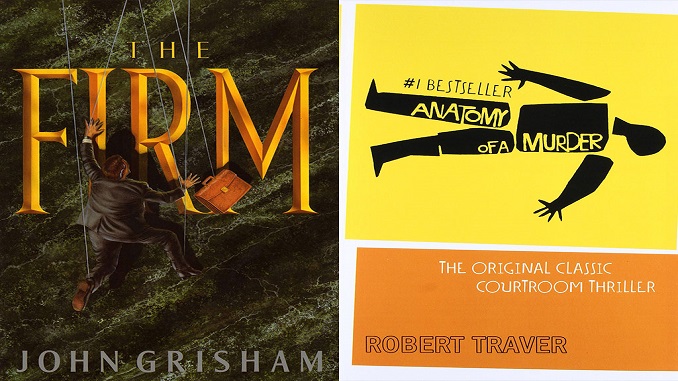
The Firm by John Grisham

The Firm by John Grisham

Leave it to John Grisham to turn Xerox-ing into a nail-biting adventure. Few authors would attempt such a feat, but then again, few authors have published a new international bestseller every year for the past 30 years. Grisham’s astonishing run of success began with this story of a Harvard Law School graduate, who uncovers dirty secrets at a Memphis law firm. With the FBI, the Mafia, and the firm’s homicidal head of security breathing down his neck, Mitch McDeere makes a dash for—where else?—the Xerox machine. With its breakneck pace and keen awareness of the temptations that come with the power to bend the law to your will, The Firm launched Grisham into the stratosphere of thriller writers.

Anatomy of a Murder by Robert Traver

Anatomy of a Murder by Robert Traver

In this 1958 bestseller often credited as the first legal thriller, US Army Lieutenant Frederic “Manny” Manion confesses to murdering an innkeeper but claims that the man raped his wife. When attorney Paul Biegler learns that Manion has no memory of pulling the trigger, he pursues a novel defense strategy: not guilty by reason of “irresistible impulse,” a version of temporary insanity. The legal jousting between Biegler and the prosecution is made all the more riveting by its firm basis in reality, proving that there are few places on earth more inherently dramatic than a courtroom.

The Lincoln Lawyer by Michael Connelly

The Lincoln Lawyer by Michael Connelly

Mickey Haller is a Los Angeles attorney whose “office” is the backseat of his Lincoln Town Car. He also happens to be the half-brother of Michael Connelly’s other iconic creation: LAPD detective Harry Bosch. When Haller agrees to defend a wealthy realtor accused of assault, he expects to rack up a small fortune in billable hours. Instead, he comes face-to-face with pure evil. To save an innocent man’s life, Haller will have to bend the law to its breaking point. Full of gritty details, dark humor, and high-stakes action, The Lincoln Lawyer announced Connelly as a major player in the legal thriller game.

A Covenant with Death by Stephen Becker

A Covenant with Death by Stephen Becker

Set in a small New Mexico town in 1923, this New York Times bestseller dramatizes the clash between frontier justice and the ethical imperatives of the modern courtroom. When Bryan Talbot is convicted of murdering his adulterous wife, 29-year-old judge Ben Lewis must carry out the death sentence, despite his strong misgivings about the case. But a shocking turn of events will force Lewis to reckon not just with his duty to the law, but with his own fate. Author Stephen Becker counted fellow writers John Irving, Joe Haldeman, and Michael Chabon among his many admirers.

Defending Jacob by William Landay

Defending Jacob by William Landay

Frequently compared to Presumed Innocent, this thriller also features a prosecuting attorney who’s more intimately involved with a murder case than he initially lets on. Here, though, assistant district attorney Andy Barber isn’t the accused killer—his 14-year-old son Jacob is. The victim was a classmate of Jacob’s and a bully, but Andy would rather the police focus their investigation on a local pedophile. When new evidence emerges, however, Jacob is arrested and brought to trial.

Landay, a former prosecutor, brings an intimate knowledge of the law to the courtroom scenes and paints a devastating portrait of a family in crisis. But it’s the novel’s terrifying final twist that will keep you up at night.

Mistaken Identity by Lisa Scottoline

Mistaken Identity by Lisa Scottoline

Bennie Rosato, head of an all-female law firm, has built her career on taking down dirty cops. So when her newest client, accused cop-killer Alice Connolly, says that her murdered police detective boyfriend was dealing drugs, Bennie believes her. What the crusading attorney has a harder time accepting is Alice’s claim that she and Bennie are identical twins. A DNA test will solve the mystery, but in the meantime, Bennie has to save Alice from the electric chair. Mistaken Identity is a standout entry in the Rosato & Associates series, which consistently delivers thrills, romance, and intense courtroom scenes.

The Emperor of Ocean Park by Stephen L. Carter

The Emperor of Ocean Park by Stephen L. Carter

Years ago, Judge Oliver Garland’s Supreme Court nomination was derailed by his connections to a rogue CIA agent. When the judge dies, it falls to his son, Talcott, to handle his “final arrangements.” Following a trail of cryptic clues, Talcott unlocks the hidden links between his father’s public humiliation, his sister’s death in a hit-and-run accident, and a network of corruption that reaches into the highest corridors of power.

Carter, a Yale Law School professor, fills every chapter with insider knowledge about the federal court system and the rarified world of New England’s black upper class, making The Emperor of Ocean Park one of the most eye-opening legal thrillers of the past 20 years.

The Legal Limit by Martin Clark

The Legal Limit by Martin Clark

Gates Hunt is a career criminal; his brother Mason is a successful lawyer with a loving wife and daughter. When Gates draws a long prison sentence for selling cocaine to an undercover cop, he tries to save himself by implicating Mason in an unsolved murder. The problem is, Gates is telling the truth—or half of it, anyway.

A circuit court judge in rural Stuart, Virginia, Clark based this profound and frequently funny story on one of his cases. The author finds a rich vein of material in the discrepancies between the letter of the law and the true nature of justice, and his electric prose reads like a cross between Elmore Leonard and John Grisham.

celadonbooks.com

9 Legal Fiction Books to Round Out Your Reading

By Kaitlin McManus

I’ve always wondered if asking a lawyer to read for pleasure was sort of like, as my grandmother liked to say, asking a mailman to take a walk on his day off. All lawyers do all day is read—wouldn’t their eyes get tired? And then I remembered: As an editor, all I do all day is read, too. And I still manage to (mostly) get through the pile of books on my nightstand. Because I just like reading and, clearly, many lawyers do too. But do lawyers like reading about lawyers in their free time? I think so. Lawyers are often the heroes of their stories—seriously, who doesn’t aspire to be Atticus Finch?—and we all like to see ourselves in the pages of our books. Plus, most of us are still stuck at home for the time being, so why not take a break from those billables with a bit of pleasure reading? So, for all the lawyers out there who can’t get enough of reading, regardless of the eye strain, I’ve got a list of books here, all starring lawyers, to get your hands on.

Sidebar: Since apparently the only thing I love more than reading is making things difficult for myself, this list follows one very important rule—no Grisham. Not that there’s anything wrong with the Grish, but there actually are other authors who write about lawyers.

Blood Defense – Marcia Clark

In today’s iteration of “Where Are They Now?”, it turns out that the lead prosecutor in the O.J. Simpson trial writes legal thrillers. This book, the first in Clark’s popular Samantha Brinkman series, features a high-profile case that could rocket Brinkman’s small firm to the forefront of criminal law—or destroy her life.

Abraham Lincoln, Vampire Hunter – Seth Graham-Smith

Well, Lincoln was an attorney. And, in this historical-revisionist horror book, he also chops up the undead like he’s splitting rails. This is one of those books that ended up being way better than I thought it would on the virtue of the author’s writing and research, so don’t talk yourself out if it based on the completely bonkers premise.

Thinner – Stephen King, writing as Richard Bachman

Thinner may have sold a lot better once King owned up that Bachman was his penname, but it’s good no matter whose name is on it. In it, a morbidly obese attorney gets away with manslaughter—and winds up with a gypsy curse that causes him to drop more and more weight every week. Can he reverse it before there’s nothing left of him?

Wolf Hall – Hilary Mantel

The conflict between Henry the VIII and the Catholic Church over divorce is legendary, and Thomas Cromwell, the king’s attorney, found himself at the center of all the politicking. This book is the first in Mantel’s masterwork trilogy, the finale of which, The Mirror and the Light, was released earlier this year.

The Last Days of Night – Graham Moore

This historical fiction novel revolves around the Current Wars and perhaps the most important IP question of all time: Who invented the lightbulb? A young, unknown attorney named Paul Cravath is determined to win the case for client George Westinghouse in this thriller.

The Poe Shadow – Matthew Pearl

How did Edgar Allan Poe really die? Baltimore attorney Quentin Clark is determined to find out. The amount of research that Pearl has done into the legendary poet’s last days is extraordinary, making this book a standout.

When Katie Met Cassidy – Camille Perri

Why does it seem that litigators get all the love in legal fiction? Well, Perri breaks that rule with this phenomenal queer legal romance. Katie and Cassidy have their meet-cute across the negotiation table, sparking a romance that’s equal parts sweet, charming, and plagued by BigLaw pressures.

Fear and Loathing in Las Vegas – Hunter S. Thompson

Raoul Duke and his attorney, Dr. Gonzo, go on the acid-and-booze-soaked road trip that could only have happened in the early 1970s—and could only have been taken by Thompson himself, as this book is based on a real-life trip he took with his friend, attorney Oscar Zeta Acosta. A wild ride, literally.

The Partner Track – Helen Wan

Ingrid Yung in on track to become the first partner of color at her BigLaw firm. But after an “insensitive incident” at a summer party, the firm ramps up a D&I program and asks Ingrid to run it—which could draw her focus from the partnership-making deal she’s about to close. Can she reconcile her ambitions and her conscience?

Vault.com

Judicial Financial Autonomy: A Way Forward For The Administration Of Justice In Nigeria (1)

By Ebun-Olu Adegboruwa, SAN

The Nigerian Bar Association, Gwagwalada Branch held a Webinar to deliberate on the above topic, with participants drawn from across the nation. I was privileged to present a paper at the said Webinar, the highlights of which I now share with you all.

Introduction

Our nation seems to be at the crossroads presently and this topic could not have come at a better time than now, when the entire system of justice administration has been thrown into an unnecessary comma, due to the ongoing nationwide strike embarked upon by judiciary staff workers.

Salute to courage of JUSUN

I must hasten to salute the courage and determination of JUSUN members, for sustaining the strike action since April 6, 2021, till now. The fact that the government is not working to resolve the issues raised shows the level of decay that permeates our governance structure. Or else, how do you have the entire courts locked up for close to a month and our leaders are not moved?

No witch-hunt or victimization of JUSUN members

The freedom of association is guaranteed under section 40 of the Constitution to the extent that citizens, including workers, are free to assemble for the protection of their interests, as has been done by JUSUN and other unions. It has been noted however that some state governments have attempted to decimate the rank of JUSUN in order to abort the strike through discordant voices of disunity and sabotage. This has been resisted firmly by JUSUN at the national level and it is commendable. I urge all lawyers, especially the Nigerian Bar Association, to work closely with JUSUN to ensure that no member of the union is subjected to any form of intimidation, witch-hunting or vicitimisation, on account of heeding the call of JUSUN for this all-important strike action. The global standard must be maintained, as obtained in industrial relations, that no unionist should suffer persecution as a result of any industrial strike action.

This is not to discountenance the view that lawyers are the ones bearing the brunt of the strike action, but it is a sacrifice that we must make for the future of justice administration in our country. In the golden words of the first indigenous Nigerian lawyer, Christopher Alexander Sapara Williams, “the legal practitioner lives for the direction of his people and the advancement of the cause of his country.” Since the Motto of the NBA is to promote the rule of law, the strike action embarked upon by JUSUN is a struggle we must all identify with.

What is judicial autonomy?

‘Judicial’ and ‘Judiciary’ are words associated with the system of justice administration as administered by the judge presiding over a court, otherwise referred to as a ‘judicial officer’. Thus, the learned authors of Black’s Law Dictionary defined the term ‘judicial’ as ‘relating to, or by the court’, while it is further stated therein that the ‘judicial branch’ is the branch of government consisting of the courts, whose function is to interprete, apply, and generally administer and enforce the laws. This is also known as the ‘judiciary’, which is a system of courts or a body of judges, oftentimes referred to as the ‘judicature’. This branch of government is provided for in measured details, in section 6 of the Constitution.

In the words of the learned authors of Merriam-Webster Dictionary, ‘autonomy’ is the ‘quality or state of being self-governing; self-directing …’. It connotes independence. Black’s Law Dictionary states clearly that autonomy is ‘the right of self-government.’ This makes more meaning in a legal gathering, as autonomy should be enforceable as a right, particularly when it has to do with the judicial arm of government, which is deliberately set up to administer and enforce laws. It will therefore be an anathema to have a judiciary that is caged or held in bondage or servitude, as it will be unable to dispense justice or protect the rights of the people. It is in this regard that all people of conscience demand that the judiciary should be independent from the other branches of government and that our courts (and their decisions) should not be subject to improper influence from the other branches of government or from private or partisan interests. The two basic tenets of judicial independence are that the judiciary should be free in the security of tenure of office and the discharge of judicial functions and it should also be in control of its own funds.

Why judicial autonomy?

The history of the Court system in Nigeria deserves some x-ray, in order to better appreciate the current clamour for judicial autonomy. The Courts are meant to protect the weak and vulnerable in the society. This was why in the early 1950s, ethnic minorities voiced out their concerns and fears, with the obvious imbalances in the way the Regions were being governed. They argued that with the exodus of foreign officers upon independence, the tendency would be for the majority ethnic groups to use their population and influence to dominate important organs of government such as the judiciary, the police and the public service, to the disadvantage of the minorities. This eventually led to the establishment of a Commission headed by Sir Henry Willink, which submitted its report in 1957, ahead of the proposed independence for Nigeria. The contents of the Willink Commission Report are best described as true restructuring, as it focused on an independent judiciary as a veritable weapon of checkmating all forms of impunity. The issues raised then are still largely the same issues being raised by the proponents of restructuring, even as of today.

The agitation for true federalism, resource control and equitable distribution of resources has been on for many decades and it was the bedrock of the lucid campaigns by Chief Obafemi Awolowo, Isaac Adaka Boro, Ken Saro Wiwa, Chief Odumegwu Ojukwu and a host of other nationalists. The WIllink Commission Report led to the inclusion of a separate chapter in the Nigerian Constitution for the protection of fundamental rights, given the predominance of the majority ethnic groups, who would certainly deploy their population during elections, to perpetuate themselves in power, almost forever. And it is the judiciary that is solely responsible for piloting the enforcement of these rights. Without independence and financial autonomy, the deprivations that led to the establishment of the judiciary, will continue to stare us in our faces.

Which is why many decades after the Willink Commission Report, the agitations have continued and escalated, even with more energy, largely because the problems have remained and hence the JUSUN strike action. The gains of the Willink Commission Report were rudely reversed by the various military regimes which forced themselves upon Nigeria. They virtually destroyed the various organs of state, bastardized all democratic norms and entrenched a unitary system of government that took us back many decades. They centralized the judiciary and put it directly under the control of the executive arm of government by making the latter the approving authority for all funds accruing to the former. This is why the judiciary must be independent, mainly to assert its powers under the Constitution in order to be better placed to offer succour to all those seeking justice.

Judicial financial autonomy as declared by the courts

The current strike action by JUSUN started on April 6, 2021, after the expiration of the fourteen day notice given to the Nigerian government. It is almost a month now, that state judicial and legislative workers have been protesting the refusal of governors to implement the constitutional provisions on financial autonomy. This is not the first time JUSUN will call out its members to demand financial autonomy for the judiciary. In 2015, JUSUN embarked upon a strike action as a means of enforcing judgments delivered by various courts affirming financial autonomy for the judiciary, both at the federal and state levels.

These three cases are the ones filed by JUSUN against the governors of the 36 States, in Suit No. FHC/ABJ/CS/667/13 and the two filed by a former President of the Nigerian Bar Association (NBA), Olisa Agbakoba, SAN, in Suit No. FHC/ABJ/CS/63/2013 and Suit No. NAD/56/2013. JUSUN called off the 2015 strike action, following the intervention of well-meaning Nigerians, who assured of a viable solution.

In a judgment on January 13, 2014, in the suit by JUSUN, the Federal High Court in Abuja (Ademola, J) held as follows:

(i)       that the provisions of sections 83 (1), 121 (3) and 162 (9) of the Constitution are clear and straightforward and should therefore be complied with. The judge said: “The Attorney General of the Federation and the states should act responsibly and promptly to avoid a constitutional crisis in this country, by ensuring financial autonomy for the judiciary.”

(ii)       that the piecemeal allocation of funds, through the states’ Ministries of Finance to the judiciary, at the pleasure of the executive, is unconstitutional, un-procedural, cumbersome, null, void, and should be abated forthwith.

(iii)     that having regard to the provisions of sections 81 (3), 121 (3) and 162 (9) of the Constitution “funds/amount standing to the credit of the judiciary in the Federation Account/Consolidated Revenue Fund shall be paid directly to the heads of courts concerned.

Although different views have been expressed concerning the proper interpretation of sections 83, 84, 121 (3) and 162 (9) of the Constitution as to whether they truly grant financial autonomy for the judiciary, it is sufficient that these constitutional provisions have been interpreted by the Courts. We cannot in our different offices and locations sit on appeal over valid and subsisting judgments of courts of competent jurisdiction, but rather to obey and give effect to them. This is why JUSUN is on strike, and why we must all unite to appeal to those concerned, in this case the governors, to join us to obey the judgments, in order to achieve effective administration of justice. The sad experience of most Nigerian litigants and judgment creditors is that it is very difficult if not impossible to enforce judgments against the executive arm of government in Nigeria, given the fact that the said arm also includes the police and other law enforcement agencies.

Intellectual Property And Sports; Importance, Landmarks And Current Trends

By TUALE CHARLES AJUYAH and NNADI, EZINNE TOCHUKWU

The world of sport has fast become a billion-dollar entity, morphing from a mere recreational activity to a financial and economic haven. In its own right, sporting activities account for over 3.7% of the aggregate GNP of the twenty-eight EU states. It is also responsible for over 3% of world trade. It employs fifteen million people in the EU, which is about 5.4% of the entire European labor force. In December 2020, NBA superstar Giannis Antetokounmpo agreed to sign a five-year contract extension with the Milwaukee Bucks worth $228.2 million, in what is the largest deal in NBA history today[1]. Barcelona FC conceded in January 2021 that Lionel Messi indeed earned $167 million a year on a 4-year contract he signed in 2017[2].

Evidently, sport is now bigger than it has ever been, in terms of its lucrativeness and the human resource it employs. It is only natural that in an industry with so much money and people, there would exist a barrage of laws. Although there is no defined and distinct ‘sports law’, it is governed by the basic principles found in our civil and criminal laws.

Arbitration is the primary dispute resolution mechanism employed in sport, with the Court of Arbitration for Sports (CAS) the apex Court for this purpose. The CAS recently overturned the UEFA’s club financial control body (CFCB) decision banning Manchester City FC based on allegations that the club is involved in serious breaches of financial fair play regulations.  Recent trends in sports have shown that intellectually property is increasingly regarded as a major source of value and revenue and is thereby heavily guarded. This article focuses on these intellectual property considerations in sports law.

IMPORTANCE

Intellectual Property Rights herein referred to as ‘IPRs” play a massive role in the world of sports, especially in terms of copyright and trademarks. This is because they enable the protection of rights and in this regard, sports branding and marketing, which in turn boosts the successful commercialization of Sports events; major sport events like the Olympic games, the FIFA World Cup, WrestleMania among others are built around IPRs.

One could argue that without the IPRs, these events would not hold. Simply because, nobody wants to pay a ton of money to sponsor sports teams, athletes or events, and not have rights to safeguard such investments. IPRs is the recognized law which breeds confidence in investors or sponsors to part with money and invest in sports because they know such rights, will be legally exploitable and also enforceable in cases of breach. IPRs are not only of importance to sponsors but also to athletes, organizations and personalities.

In marketing sports events, IPRs are important for the aforementioned reasons. The issues with marketing sports events in most common law jurisdictions is the fact that a sporting event as a whole cannot be protected, “A spectacle cannot be owned in any ordinary sense of that word.”[3]  This means that a sporting event is legally not a property that can be protected on its own rights. What happens therefore in practice is, potential marketers and investors in sporting events would have to focus on properties within the event which can be legally protected.

This element further raises the level of importance attached to trademarks and copyright. Special note should be taken on the importance of registered ‘domain names’ for sports bodies who use this domain names to promote, market and commercialize sporting events, organizations and personalities. In practice, these domain names serve as quasi trademarks and most times, it gives corporate identity with commercial and cultural goodwill[4].

LEGAL PERSONALITY AND GOODWILL

Goodwill generally is an intangible asset in relation to the acquisition of a company or business by another. Goodwill is an essential asset of any enterprise because the core essence of its existence is embedded into it. The spectators and supporters of a sports organization or federation are to a great extent its customers, as their passion for their favorite sports team/event makes them follow with unquestionable enthusiasm. Asides the proprietary interest in goodwill, there are also personality interests. Personality rights are not limited to natural persons, as juristic persons like companies also have personality rights like reputation and identity.

Goodwill as well as reputation is intricately related to identity. Identity entails a wide range of things including specific products of an enterprise and the pattern in which it is packaged. In relation to sports federation as an enterprise, the “product” is the sports events and its identity is echoed in the tournaments, events or matches which uniquely differentiates it from other sports federations or bodies.

For instance, when one thinks of the International Federation of Association Football (FIFA)World Cup, it automatically gives you an image of the FIFA world cup trophy (18carat gold with bands of malachite on its base)[5], the blue FIFA flag with the organization logo in the middle, the FIFA anthem, the grand opening of the ceremony, the idea of it being a football game amongst the member countries, the recognitions and awards, and so on. These are essential characteristics of the identity of FIFA, and same can be said for other sports federations and tournaments they represent. It is these identifications that make it easy for a football fan to differentiate a premier league game from the German Bundes liga.

The identity right of FIFA in the above is breached where another person uses these distinct features which are primarily attributable to the Association for commercial gains without authorization. The core element of this breach is that the use was for a commercial purpose which is solely aimed at promoting a product or service to attract customers. The unlawfulness in this case is mainly vested in the violation of the right to freedom of association and the commercial exploitation of the individual or company.[6]

PROTECTION

Sporting International organizations in most cases explore various avenues to protect their IPRs. For example, the Olympic Charter in Article 7[7] contains provisions which provide strict safeguard for these IPRs. It provides among others that, “The International Organizing Committee (IOC) is the owner of all rights in the Olympic Games and Olympic properties described in this Rule, which rights have the potential to generate revenues for such purposes.

It is in the best interests of the Olympic Movement and its constituents which benefit from such revenues that all such rights and Olympic properties be afforded the greatest possible protection by all concerned and that the use thereof be approved by the IOC”.  This point is further buttressed by paragraph 2 of Article 7 of the same Olympic Charter, which provided that “The Olympic Games are the exclusive property of the IOC which owns all rights and data relating thereto, in particular, and without limitation, all rights relating to their organization, exploitation, broadcasting, recording, representation, reproduction, access and dissemination in any form and by any means or mechanism whatsoever, whether now existing or developed in the future”[8]

This provisions show that the IOC have taken necessary steps to protect their brand. This protection goes beyond protecting the basic ‘properties’, but also the cultural goodwill and the commercial viability of the organization. In practice, along with the Olympic Charter, the IOC would need to have legislations passed by host cities to prevent ambush marketing. Host cities are also obligated to implement ‘brand protection programs’[9].

An instructive case study for this is the series of Intellectual Property cases that both FIFA and the Local Organizing Committee (LOC) of the 2010 FIFA World Cup had to battle against in South Africa, a decade ago. About 450 cases where filed against said offenders of these IPRs[10]. FIFA and the LOC’s campaign for protection of IPRs is probably one of the biggest in Sports history, as an extensive list of trademark registrations was released which demonstrated the paramount importance Sports organizations place on protecting their brands in terms of organization, staging and commercialization.

On the issue of FIFA and World Cups, in preparation for the 2014 World Cup, FIFA had 13,000 trademarks registered worldwide, 1160 of them registered for the World Cup and 400 occurred after the passage of the World Cup Law in Brazil, which was a law passed to prevent this ambush marketing[11]. This protection goes beyond, sports organizations or committee, and includes franchises who can file trademark applications for team names, logos and mascots.

Individual athletes also feel the need to create their own brands, gain endorsements and gain financially from trademarking names, initials, catch phrases or celebrations. In football and basketball, these are known as ‘image rights’, which allows a player employed with an organization to also gain value from the use of their images that is unconnected to their employer’s brand.

LANDMARK CASES OF TRADEMARK IN SPORTS

BARCELONA FC TRADEMARK CASE

In April 2013, Barcelona Football club (Barcelona) applied for the registration as a community (EU) Trade Mark of the silhouette of its crest in relation to a range of goods such as paper goods, stationery, clothing, footwear, headgear and even some sports activities. The Office for Harmonization in International Markets (OHIM) now known as the European Union Intellectual Property Office (EUIPO), which is the body responsible for the registration of community trademarks, rejected the application on the grounds that the mark lacked distinctiveness, and therefore did not meet the basic requirement for registration. Barcelona appealed until it got to the EU General Court, where they also dismissed the appeal and ruled that:

  • The crest silhouette is not capable of attracting the attention of consumers as a sign indicating the origin of the goods/services carrying that mark.
  • The silhouette of a crest does not differentiate itself much from the basic shapes generally used in various commercial sectors as a decorative element.
  • Therefore, the crest silhouette does not possess the inherent distinctive character[12]

WASHINGTON REDSKINS TRADEMARK CASE

There has been a legal fight which has persisted for about twenty years over the use of the Redskins team name by the Washington Redskins American Football club. The court in a ruling ordered the United States Federal Trademark and Patent Office to cancel several trademark registrations held by the club in respect of this name, on the ground that the name ‘Redskins’ may be reproachful to Native Americans, who have objected to the name for decades, while also citing dictionary entries stating that the name is considered to be offensive.

However, the present ruling does not prevent the club from using the name although the legal implication is that the name would no longer enjoy the full legal protection attributable to a federally registered trademark.

INTELLECTUAL PROPERTY RIGHTS IN THE NIGERIA SPORTS SECTOR

Speaking particularly about the branches of Intellectual Property in Nigeria, we shall begin the discussion with Patents. Patents can be defined as the legal rights vested on inventors of new and useful products and processes, the right to exclude all others from commercially exploiting the invention. It is a right that rewards, ingenuity of thought. It ensures the author of the invention is afforded legal recognition and protection.

Once a patent has been registered in Nigeria and indeed around the world, it prevents those not afforded the rights from exploiting the use of that invention for commercial purposes. Patent protects the authors time, effort and resources used in producing a new invention. The author or patentee then holds the patent to such invention for the next twenty years (Section 7(2) of the Patents and Designs Act)[13]

In Nigeria today, the Sports industry, is still lacking behind the rest of the world in terms of industrialization and technological development. Instead we continue to reap the reward of the invention of others. One can confidently speak on and say that patent is the least utilized IPR in Nigeria. It is also key to state that, Sports people and inventors should not be deterred from being creative. The resources or platform may not be there, but one can never truly know, when his invention is the next best thing.

Copyright is another branch of IPR that seems to not exist in the Nigeria Sports industry. This branch of IPR is not only infringed on, but one might argue it is abused in Nigeria. This is because local markets are field with all sorts of fake jersey’s, scarfs, cups, slippers, boots etc. Essentially copyright is a right which protects the expression of an idea in a definite form and gives rights to the creator or owner the right to sell, produce, reproduce that expression of idea for their commercial benefits. This could be by themselves or another via through a testamentary deposition or grant of license.

The areas of sports where copyright abounds are the merchandise, Television and media rights literature contained in match day programs sold to fans, ticket sales, the software of computer and online games. In Nigeria most of the aforementioned being copied without permission. This also seems to discourage creativity as inventors do not see the means to commercialize their ideas, the protection afforded to them or the penalties for infringement are not stiff enough to encourage inventors.

Another branch of IPRs are Trademark. This along with copyrights are the most popular IPRS. Trademarks has its rights embedded in the very things we see everywhere when it comes to Sports. From logos, team names, league names, sporting goods, broadcasting and apparel. It is essentially anything that gives a brand an identity, such as symbols, crests, logos, catch phrases or anything that distinguishes the products (goods/services) of one business to another.

Trademarks are important as they allow supporters recognize easily the brand they are associated with. Naturally, trademarking would lead to good commercial output. For example, seeing the Nike tick or Puma jaguar would tell one that such product is that of Nike or Puma and they guarantee quality. Various forms of trademarking exist which include registering of nicknames by sports celebrities, catch-phrases, mascots.

It is clear that in Nigeria we are behind most of the world in Intellectual Property rights. The need to develop commercially potent brands that would compete transnationally, is at an all-time high. A major issue with the lack of protection or platform for inventors to develop in Nigeria is the fact that, Nigerian Sport is generally managed and controlled by the government. With that, it is difficult to allow businesses in the industry genuinely grow. At the end of the day, no one wants his/her efforts to be wasted without gains, and this extends to possible investors and stakeholders in the sport industry

The U.S Chamber International IP Index 2021[14], Nigeria ranks 47 of 50 countries in the assessment of economies whose intellectual property systems provide a reliable basis for investment in the innovation and creativity lifecycle[15]. This is a damning report, because it proves most of the aforementioned faults of the legal framework for IPRs in Nigeria. It is a challenging environment for the prosperity of goods and involves a high right of physical counterfeiting and online piracy remains high and public awareness of the value of IP remains low.

Just like in most Common Law jurisdictions, in Nigeria there are statutory protection for regular trademark, and the doctrine of passing off is also applicable. Laws and regulations established for the protection and administration of intellectual property rights include: the Copyright Act[16] , the Patents and Designs Act[17], the Trademarks Act[18], and so on.

The courts have not interpreted the provisions of the Nigerian Trademark Act to include marks from the sporting industry, and this may be likened to the fact that the sports jurisprudence in Nigeria is not as developed as it is in other jurisdictions like Europe and the United States of America. Nevertheless, it merely provides enough general covers that sport brands can explore in order to fully relish the benefits attached to IPRs for stakeholders. In the Nigerian sporting sector, the provisions of the Trademark Act and the Common Law doctrine of passing off must be fully utilized, as they are still vastly underutilized.

It is highly recommended that organizers of sports events should always protect their event marks by adopting the provisions of the Trademark Act which is similar to the provisions of the UK Trademark Act.[19]It is also suggested that every state with a sporting presence should enact a Law that would provide a mirrored protection available in the Federal Act enacted by the National Assembly.

For instance, the Nigerian Premier Football League (NPFL) can have an Act titled ‘The Nigerian Premier League Event Mark and Related Rights Act’ to be adopted by the various state governments. This would serve as the principal protection for all the marks associated with the NPFL throughout the Federation while the Trademark Act serves as secondary or ancillary protection for the football league.[20]

The importance of a proper shield of sports events marks in Nigeria cannot be overemphasized, as it would allow owners to exclusively exploit their marks for economic and financial gains. This can serve as a booster to the confidence of prospective sponsors and business partners, as it gives a sense of security for their investments.

CONCLUSION

With the rising enthusiasm and passion of individuals in the sporting sector, it will be highly disappointing if the full potentials of intellectual property rights in sports activities are not utilized to the maximum. In a bid to achieve this and protect the rights of stakeholders in this sector, it becomes pertinent that professional sport clubs and sport event organizers within Nigeria maintain the global standard.

In addition, the Legislative and Judicial bodies in Nigeria, are advised to amend and adjust our laws to toe the line of international sporting communities while considering our local circumstances, as the legislature governing intellectual property and by extension sports, are somewhat anachronistic.

The judiciary also, do not provide a hasty and less adversarial means of dispute resolution mechanism, hence, more people involved in sports should seek resources in arbitration, and make more use of avenues like the Lagos Court of Arbitration. All these measures would be to the national benefit as the economic and cultural benefits of hosting sporting events in a city or a country are always astronomical.

BIBLIOGRAPHY

STATUTES

Cap C28, Laws of the Federation, 2004

Cap P2, Laws of the Federation, 2004

Cap T13, Laws of the Federation, 2004

  1. 1 (1) of the UK Trademark Act, 1994

Article 7 of the Olympic Charter

Article 7, Paragraph 2 Olympic Charter

CASES

General Court of the European Union Press Release No 144/15, Luxembourg, 10 December 2015, Judgment in Fútbol Club Barcelona v OHIM, Case T-615/14.

Victoria Park Racing and Recreation Grounds Co Ltd v Taylor [1937] 58 CLR 479

Wells v Atoll Media (Pty) Ltd [2010] 4 All SA 548 (WCC).

ONLINE SOUCRES

Allen Kim (2020) Giannis Antetokounmpo signs largest deal in NBA history with Milwaukee Bucks https://edition.cnn.com/2020/12/15/us/giannis-antetokounmpo-contract-spt-trnd/index.html

Blackshaw I.S. (2017) IP and Sport. In: International Sports Law: An Introductory Guide. Short Studies in International Law. T.M.C. Asser Press, The Hague. https://doi-org.gcu.idm.oclc.org/10.1007/978-94-6265-198-2_5

FIFA.com https://www.fifa.com/who-we-are/news/the-fifa-world-cuptm-trophy-517161 Accessed 4th Jan 2021

George Ramsey (2021) Barcelona denies responsibility for leak after report reveals Lionel Messi’s record $672 million contract https://edition.cnn.com/2021/02/01/football/lionel-messi-barcelona-contract-spt-intl/index.html

BOOKS

Owen Dean “Sport as a Brand and its Legal Protection in South Africa”, ‘Global Sports Law and Taxation Reports’, March 2012 pp 41

Ugochukwu Johnson Amadi (2017); Intellectual Property Rights in Sports: African Sports Law and Business Bulletin


Written by: TUALE CHARLES AJUYAH and NNADI, EZINNE TOCHUKWU

Tuale and Ezinne are Associate at Omaplex Law Firm.

Tuale, is a sports and entertainment lawyer who represents a wide variety of Nigerian and international clients including television broadcasters, Sport and Entertainment personalities, media companies, sports governing bodies, global brands and buddings musicians.

While

Ezinne is a member of the Firm’s Dispute Resolution Team with a focus on intricate Civil Litigation. She has an outstanding experience in contract and business disputes. She has represented major debtors and creditors in high-profile Debt Recovery proceedings.

[1] George Ramsey (2021) Barcelona denies responsibility for leak after report reveals Lionel Messi’s record $672 million contract https://edition.cnn.com/2021/02/01/football/lionel-messi-barcelona-contract-spt-intl/index.html

[2] Blackshaw I.S. (2017) IP and Sport. In: International Sports Law: An Introductory Guide. Short Studies in International Law. T.M.C. Asser Press, The Hague. https://doi-org.gcu.idm.oclc.org/10.1007/978-94-6265-198-2_5

[3] Victoria Park Racing and Recreation Grounds Co Ltd v Taylor [1937] 58 CLR 479

[4] Blackshaw I.S. (2017) IP and Sport. In: International Sports Law: An Introductory Guide. Short Studies in International Law. T.M.C. Asser Press, The Hague. https://doi-org.gcu.idm.oclc.org/10.1007/978-94-6265-198-2_5

[5] FIFA.com https://www.fifa.com/who-we-are/news/the-fifa-world-cuptm-trophy-517161 Accessed 4th Jan 2021

[6] Wells v Atoll Media (Pty) Ltd [2010] 4 All SA 548 (WCC).

[7] Article 7 of the Olympic Charter

[8] Paragraph 2, Article 7 Olympic Charter

[9] Blackshaw I.S. (2017) IP and Sport. In: International Sports Law: An Introductory Guide. Short Studies in International Law. T.M.C. Asser Press, The Hague. https://doi-org.gcu.idm.oclc.org/10.1007/978-94-6265-198-2_5

[10] Owen Dean “Sport as a Brand and its Legal Protection in South Africa”, ‘Global Sports Law

and Taxation Reports’, March 2012

[11] Ibid 11

[12] See General Court of the European Union Press Release No 144/15, Luxembourg, 10 December

2015, Judgment in Fútbol Club Barcelona v OHIM, Case T-615/14.

[13]

[14] Global Investment Journal: U.S Chamber International IP Index https://www.theglobalipcenter.com/report/ipindex2021/

[15] Supra n14

[16] Cap C28, Laws of the Federation, 2004

[17] Cap P2, Laws of the Federation, 2004

[18] Cap T13, Laws of the Federation, 2004

[19]  See S. 1 (1) of the UK Trademark Act, 1994

[20] Ugochukwu Johnson Amadi (2017); Intellectual Property Rights in Sports: African Sports Law and Business Bulletin
Onoja has the inestimable advantages of a committed scholar – Amucheazi, SAN

BOOK REVIEW

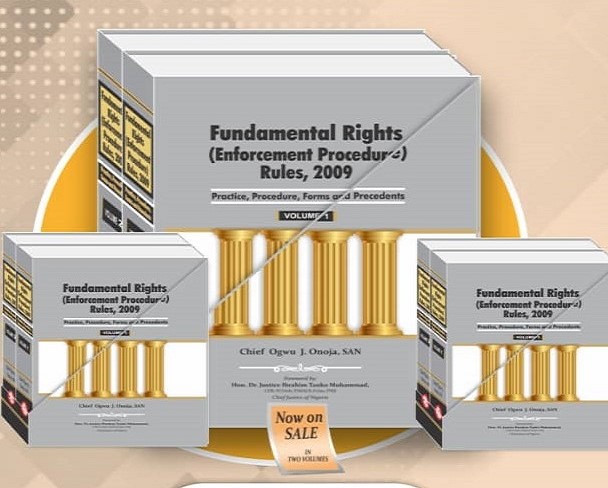
TITLE:                      Fundamental Rights (Enforcement Procedure) Rules, 2009: Practice, Procedure, Forms and Precedents.

AUTHOR:                CHIEF OGWU J. ONOJA, SAN.

PUBLISHER:           BAR & BENCH PUBLISHERS LIMITED.

VOLUMES:            1 AND 11

PAGES:                     1046 PAGES.

COVER PRICE:      N50,000

YEAR OF PUBLICATION:          2020.

DATE OF PUBLIC PRESENTATION:  19th MARCH, 2021.

ISBN NO:                  978-978-985-403-5.

REVIEWER:           PROF. OFFORNZE D. AMUCHEAZI, SAN, FCArb, FICIARB .

INTRODUCTION

It is indeed a great honour and privilege to be invited to review the book written by my learned colleague and an outstanding leading legal practitioner, Chief Ogwu J. Onoja, SAN. The book titled “Fundamental Rights (Enforcement Procedure Rules), 2009” which we gather to witness its public presentation is largely unrivalled by any work on human rights in Nigeria.

The book analyzes and simplifies fundamental issues relating to procedures, proceedings, jurisdiction and enforcement of fundamental rights in Nigeria and applicability of international instruments on human rights in Nigeria. It is remarkable for its clarity, rigorous analysis and examination of complex issues involved in human rights.  His writing style is simple and easy to comprehend.

Chief Onoja is a fine legal mind. He has the inestimable advantages of a committed scholar – fine and brilliant legal mind, the facility of language and the ability to raise and explore fundamental issues that other writers often fail to consider.  He examines issues with a combination of sophistication and dexterity rare to find among lawyers in litigation. Clearly evident all through the book is the resourcefulness, vitality, and enthusiasm of an enquiring scholar deeply committed to the task of using the law to make society better.

The book, Fundamental Rights (Enforcement Procedure) Rules, Practice, Procedure, Forms and Precedents, is an assemblage of a richly researched work and I commend the author for the painstaking and diligent research he has put into this work. As the Chief Justice of Nigeria, Hon. Dr.  Justice Ibrahim Tanko Muhammad, CFR,  stated in his foreword, 

“This book is both engrossing and handy. The book in its experimental and expository sense is a model text on the subject of procedure for the enforcement of human rights. It is recommended as a reference material and ready companion for practicing lawyers, the law enforcement agents, academics, law students and persons interested in advancing the course of human rights”

The book is divided into two volumes of three parts.

PART I

DISCUSSIONS

Part 1 contains in-depth discussions on the Preamble and fifteen (15) Orders of the FREP Rules, 2009.

PREAMBLE

The inclusion of Preamble in the FREP Rules, 2009 is the first major difference with the 1979 Rules.  The preamble, though not forming part of the Rules, encapsulates the principles and general intendment of the fundamental rights enforcement rules. It urges the courts (and equally admonishes parties and their representatives to assist the courts) in giving full effect to the overriding objectives of the Rules. Part of the overriding objective of the Rule is an expansive and purposeful interpretation of Chapter 4 of the 1999 Constitution and the African Charter on Human Rights. The objective also includes respecting municipal, regional and international instruments on human rights.

This preamble established the essence of the Fundamental Rights Enforcement Procedure (FREP) and x-rays the duties of stakeholders (the court, practitioners and the parties) in realizing the objectives of the FREP. The author painstakingly examines the duties of the lawyer to the court, as ministers in the temple of justice, using the provisions of the Rules of Professional Conduct, 2007, particularly, section 30 & 32 to drive home his point.

ORDER I – Application & Interpretation

The author in analyzing Order 1 of the FREP Rules, 2009 reminded Lawyers and courts on the use of rules of interpretation and the need to always resort to case laws, in interpreting its provisions where the need arises in FREP application.

ORDER II – Commencement of Action

The author brought his legal prowess to bear in his expository of the provisions of Order II of FREP. The book enumerated with the help of case laws what amounts to cause of action by FREP and what ought not to be included as a cause of action.

The book focuses more on the inclusion and applicability of the provisions of the   African Charter on Human and Peoples’ Rights (Ratification & Enforcement) Act, Universal Declaration on Human Rights and a host of other international instruments on human rights. The author explicitly outlines what constitutes a cause of action and stated thus; P. 59, paragraph 2. –

“thus, it is respectfully submitted that the right of action available under the FREP rules, 2009 are as sanctioned by the provisions of Chapter IV of the 1999 Constitution, the African Charter on Human and Peoples’ Rights… the various international protocols on human rights of which Nigeria is a signatory and the case laws which are the decisions of superior courts on cases on fundamental rights in Nigeria”.

He went on to enumerate rights protected under the 1999 constitution, rights protected under the African Charter, etc using the appropriate sections and articles for easy reference.

ORDER III – Limitation of Action

The book highlights a major difference between the FREP Rules, 1979 and FREP Rules, 2009 which is the expulsion of time limitation for instituting an action under the  FREP Rules, 2009.

The author notes that “under Order II Rule I of the annulled 1979 FREP rules, time was a limitation period of twelve months from the occurrence of the breach complained of within which an applicant could bring an application for leave to enforce his fundamental rights, except the delay could be explained to the satisfaction of the court, the right to institute and action would be extinguished”.

ORDER V – Service of Court Process

The author elucidated on the issue of service of court process and application for substituted service of court processes as provided by the FREP Rules, 2009. Even though the FREP, Rules, 2009 does not provide for electronic service of court process, the author makes a compelling analogy on the use of electronic means of service using the provision of various court Rules.

ORDER VIDeals with Amendment of Statement & Affidavits.

ORDER VII – Consolidation of Several Applications Relating to the same Infringement.

This order deals with procedures for making an application for consolidation. The author examines the conditions that must be met by the applicant before an order for consolidation may be made or granted. This part of the book is a compelling manual for any applicant or respondent rooting for consolidation. It is a guide to lawyers and saves the time of the court, lawyers and litigants.

ORDER VIIINotice of Preliminary Objections Disputing the Courts Jurisdiction.

In discussing   Order VIII of FREP, 2009, the author examines the conditions that have to be fulfilled before a preliminary objection is granted or refused.

ORDER IX – Effect of Non-Compliance

Order ix is at variance with the provisions of the 1979 FREP rules which allowed technicalities to be used to strike out an application based on non-conformity with the rules. Under the 2009 rules, non-conformity does not go to the root of the application as it is seen as a mere irregularity

ORDER X – Application to Quash Proceedings

The book, with the help of decided cases, explains and expatiates on the essence and meaning of order X and the rule therein.

ORDER XI – Order which the Court May Make.

The orders which a court may make are discussed here. These include an order of injunction, Habeas Corpus, Mandamus etc.

ORDER XII – Hearing of the Application.

The Order dealt extensively on written address, adoption of same, oral arguments and content of written addresses. It is a comprehensive guide for Lawyers before and after filing a fundamental right application.

ORDER XIII – Right of any Person or Body to be Heard

This Order is a class departure from the provisions of FREP rules, 1979. The FREP rules, 2009 expanded the category of persons and bodies that can be heard whether they filed processes or not. The capacity to appear on behalf of a person, group/class is also energized by this order. This includes provisions for the appearance or presentation of Amici Curiae in fundamental right cases.

ORDER XIV – Committed for contempt

ORDER XV – Transitional provisions.

PART II

This part deals with contemporary issues of enforcement of fundamental rights. It provided materials and guides on the use of Garnishee Proceedings in the enforcement of FREP Rules, 2009. It further discussed issues such as:

  • Derogation and limitation of fundamental rights under the 1999 constitution.
  • Power of the Police, EFCC and other law enforcement agencies to investigate and prosecute crimes.
  • virtual or remote proceedings
  • Covid-19 practice directions and guidelines
  • Ruling on mock virtual court proceedings.

Part two of the book depicts the entire book as a compendium on application and adjudication of Fundamental Human Rights applications with the inclusion of the following:

  • a complete sample of FREP application,
  • Chapter IV of the 1999 Constitution as amended
  • Fundamental Rights (Enforcement Procedure) Rules, 2009
  • African Charter on Human and Peoples’ Rights
  • Universal Declaration of Human Rights.

PART III

Part three of the book presents us with the opportunity of reading the mind of the court through a replication of Federal and State High Courts judgements/rulings on FREP applications.

CONCLUSION

The learned author has presented before us with a series of in-depth analysis and a working manual for both lawyers and the court on Fundamental Rights Enforcement in Nigeria. The end product, of course, is a timely, innovative and insightful work of very high academic quality that is conceptually and empirically rich and well researched. It is my hope that this book will prove to be of great significance to the legal community. It is therefore for this reason that I recommend this book to academics, judges and legal practitioners with an interest in human rights.

Thank you for your kind attention. God bless.

Parents of kidnapped students claim Gumi’s man took N800,000 from them for transport

A Fulani agent of the kidnappers of the kidnapped students of the Federal College of Forestry Mechanization, Afaka, Kaduna State introduced by Sheikh Ahmad Gumi allegedly collected N800,000 from the parents as transport money to meet the kidnappers it was disclosed on Tuesday.

One of the parents of the kidnapped students told Roots Television during their demonstration at the National Assembly complex that the agent after collecting the N800,000 told the parents to find the N500 million as demanded by the kidnappers.

The 29 students still in the kidnappers’ den were taken away from their school on March 11, 2021 along with 10 others who had so far been released.

Speaking to reporters outside the National Assembly complex where they laid siege after they were stopped, the parent of one of the students, a widow said:
“We had been going for several committee meetings; we were taken to meet Sheikh Gumi for a meeting. We were directed to a man called Ahmed who invited a Fulani man whom they gave N800,000. The money, we were told, was just for transport.

“I cried, I told him I am a widow and I don’t have a husband, I am just training this boy to help me tomorrow. I begged him and he said it was none of his business. We tried to begging and he said no, until we pay about N500 million,” the woman said.

Another woman at the protest ground said that the kidnappers who initially asked them to get the N500 million ransom from Governor Nasir el-Rufai said that upon the governor’s unbending stance asked the parents to mobilise for the money themselves.

According to her, the kidnapper asked if they would abandon their children if the government failed to budge.

Video:Video Player

(theconclaveng)

Nobody has confidence in Buhari let alone pass vote of no confidence – Afenifere leader replies presidency

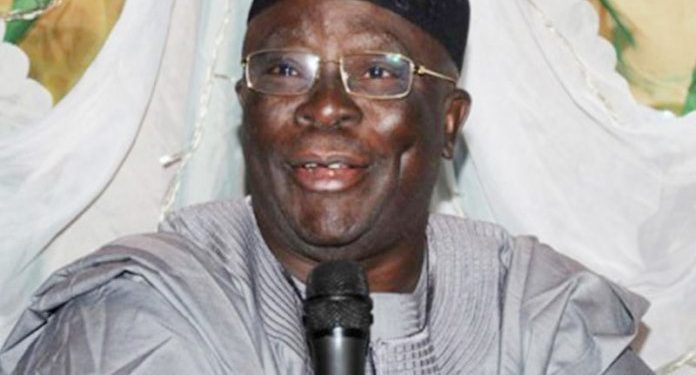
Chief Ayo Adebanjo

Leader of Yoruba socio-political group, Afenifere, Chief Ayo Adebanjo, says President Muhammadu Buhari, has lost control of the country’s leadership, adding that nobody needs to pass a vote of no confidence in him before the whole world knows that he has failed Nigerians.

The 93-year-old Afenifere leader stated this in an exclusive interview with The PUNCH on Tuesday.

He was reacting to claims by presidential spokesman, Femi Adesina, that disruptive elements were recruiting ethnic groups and politicians with the motive of convening conferences where a vote of no confidence will be passed in the President.

Adesina in a statement on Tuesday had also said the purpose of the move was to further throw the country into turmoil.

But speaking with The PUNCH on Tuesday evening, the nonagenarian Afenifere leader said the President already failed and there was no need for any group to gather anywhere to pass a vote of no confidence in him.

Adebanjo, who described the 1999 Constitution as a fraud, also urged the President to, as a matter of urgency, return the country’s constitution to the 1964 Constitution agreed on by the founding fathers of Nigeria including the late Sir Ahmadu Bello, Sir Obafemi Awolowo and Sir Nnamdi Azikwe.

He said, “Who is interested in passing vote of no confidence in Buhari? Who has confidence in Buhari before let alone pass any vote of no confidence in him. That is not the issue. The main thing is to restructure the country back to federalism and forget all these gossips by Adesina. We don’t have to pass a vote of no confidence for the world to know we don’t have any confidence in Buhari.”

“I don’t know of any group who wants to take over the government but I know those of us who want the country to be restructured in a peaceful manner.

“Those of us in Afenifere and all other groups in the South who are agitating for restructuring are the friends of Nigeria, are the friends of Buhari. I hope it is not too late for Buhari to realise this,” he added. (Journalist101)

Buhari has become chief recruiter for bandits, brigands & plonkers —Odinkalu

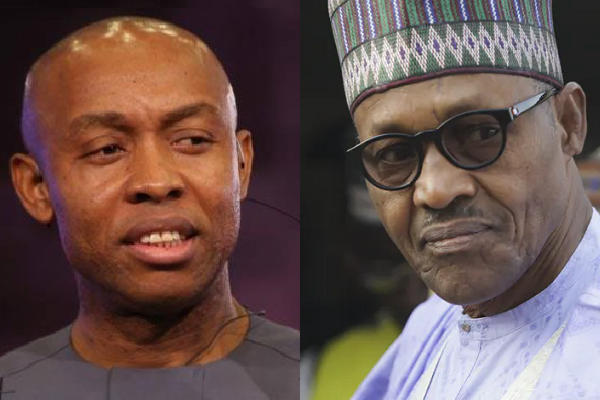
Prof. Chidi Odinkalu versus President Muhammadu Buhari

The former Executive Chairman of the National Human Rights Commission, Prof. Chidi Odinkalu has lamented that the President of Nigeria, Muhammadu Buhari has become the chief recruiter for bandits, brigands and plonkers, a term referring to foolish or inept persons.

Prof. Odinkalu made the remarks on Tuesday while commenting on the state of the nation and the systematic erosion of hope in the country on his Twitter handle.

Odinkalu lamented that Buhari’s cynical indifference to suffering, dearth of empathy, and the systematic destruction of hope in the country have by far out-paced what was foreseeable. (Elomba)

YES, NIGERIA CAN AFFORD ANOTHER WAR

By Moses Oludele Idowu

“Is life so dear or peace so sweet that it must be purchased at the price of chains and slavery? Forbid it Almighty God. I know not what course others may take but as for me, give me liberty or give me death”
– Patrick Henry, 1775

A very important dividend of this Conflict in which we now find ourselves is that for once we will be able to tell the truth to ourselves, truths that have been hidden for years.
How did Nigeria enters into this kind of trouble, this “junction of confusion”? How does a great shining light become a long – distant glimmer in the dark? How, if we are not cursed as a people, does a land flowing with milk and honey become a wilderness of squalor, a desert of miseries, a land where – in the words of a British racist and enslaver – “the worst never happens but the best is impossible.” (But even today the worst now happens frequently.)
How? How did we come to this sorry pass?
Simply and without wasting time, it is because we left the Truth, we turned our backs to Truth and by and large we became a nation of haters of Truth. In short we became a nation of liars.

Fathers stopped telling the truth to their children at home. Employers became exploiters telling lies to their own staff. Pastors began to deceive their congregation and the congregation prefers it so. Imams and sheiks preferred telling their people that the enemies responsible for their poverty and squalor are those of the “opposite religion” and not the false values they gave them that prevented them from having education that would liberate them; they send their own children to acquire Western education because they know that is the way to the future but tell the children of the Talakawas that the Koranic education is the best. Government officials and government itself became father of lies that cannot be trusted in anything. In point of fact lying, or what Wole Soyinka calls, “the phenomenon of unprincipled lying” became elevated as a tool of statecraft. Today Truth is fallen in the street and equity cannot enter. Righteousness has become fugitive in the land and in this climate of general deception and mass acceptance of fallacy even telling the truth becomes, in the words of George Orwell, ” a revolutionary act.”

In this process we have cultivated the use and misuse of language. Sorry, did I say misuse? The right word is abuse of the language. Nigerians have so much abused the English Language and the honour which God Himself has conferred on that universal language that I think today the owners of the language should be angry with us but for the fact they know us and even told us that we are “fantastically corrupt” – right in the presence of our Chief Servant himself.

Someone who should have been shot for treason against the state and subversion against the Constitution we call statesmen, Grand Commander of Federal Republic of thieves and robbers. A terrorist and land grabber who has turned many families into sorrow we elevate to a hero and brand him freedom fighter. Plain common thieves we decorate with honors and even our universities fall for the scams.
One man is collecting 10% ( or is it 15%) of the total earnings of a state in the Yoruba Southwest as I speak, a man of doubtful intellectual pedigree, contested paternity and duplicitous origin, yet no one can stop him. If he summons 100 pastors of CAN and imams to his residence this evening they would assemble to a man….at the hour.
We have a national assembly that knows the truth but cannot tell it or invoke the necessary clauses while terrorists are closing in on them in that ill-famous tabernacle of bribery.

It is very sad that though Nigeria secured her Independence from Britain and was associated for a.long time with that noble nation Nigerians as a people have failed to learn from the British the most important lesson: THAT YOU CAN DO NOTHING AGAINST THE TRUTH BUT FOR THE TRUTH.

Pay attention.
Patrick Wilmot, the radical leftist did much evil against Britain with his pen. He wrote several books and papers attacking Britain and her interests and which the British officials were aware of. Yet when Nigeria which he served in all his adult life threw him away and deported him it was to that Britain he wrote to seeking asylum. And guess what? Britain took him and had mercy on him because it was the lawful thing to do and it was in accord with their heritage and it was the truth.
When Germany too rose against Karl Marx it was to Britain he appealed and was sheltered where he wrote his diatribe even against the West. That is why his grave is in London today. Because it was the right thing to do, to provide shelter for troubled souls.
When France threw away Rousseau because of his subversive views he ran to Britain and Britain took him despite even the protests of citizens.

Standing for the truth, for values, for heritage. Is it a crime to express an opinion? Is it a crime to write a book? No. Britain took them all and today Britain still stands. The views of Marx or Rousseau never threatened Britain, no it only even proved to the world the authenticity of their foundation. For a foundation that cannot be challenged by contrary ideas and survive alien views is no foundation. It is a foundation built on quicksand. WE CAN DO NOTHING AGAINST THE TRUTH BUT FOR THE TRUTH.
This is the most important lesson Nigeria could have learned from Britain; alas it is the one she never learnt at all.

Today our public officials and prominent people parade some of this facades and shibboleths and you must have heard them: Nigeria is non- negotiable, democracy has come to stay, etc. I believe in one Nigeria but even then I still want to add that everything is negotiable. Enough of all these trash. And it is time we shall begin to challenge them.

Just this morning I heard one of those oft-repeated shibboleths, political correctness statements from our Vice President, Yemi Osinbajo: NIGERIA CANNOT AFFORD ANOTHER WAR (Nigerian Tribune, April 29, 2021 )

You must have heard many people say that and there is a sense in which it is true. This nation is in a bad state – financially, spiritually, economically, politically etc., and we cannot afford anything that serves as a distraction or waste of resources and even of human lives.
We all know this.
However that is only half the truth. It is more than that.
The very reason we have these issues was because of Nigeria – its faulty foundation, wobbly structure, iniquitous resource allocation system, fraudulent Constitution, geographic imbalance, wanton injustice, oppression of minorities etc.
Can anyone deny these? Why do we have these? It is for Nigeria.
Can we right all these wrongs? If we cannot afford another war can we afford justice, fairness, equality:’ to all etc?
Telling us we cannot afford another war solves nothing, it is not the point. It has been used to.justify all manners of injustice against Nigerians.
The people who annulled a free and fair election of June 12, 1993 told us the same thing. That we cannot afford another war, that we should accept our fate and soon they gave us one of them that we did not vote for that led us to where we now are today.
We cannot afford another war? But we are already in war.
As I write this 55 communities in Plateau State have been taken over by foreign Fulanis and the natives now in IDP camps, another unspecified number of villages in Niger State as I write this are under Boko Haram flag. About 70 persons have died in Benue and Enugu this week alone. Three university students and worshippers were killed in Kaduna this week for no other reason than that they belong to a nation that has more fools than wise. Just yesterday a couple was gunned down in Ogun State and another couple in Oyo State….
No one has been apprehended for these crimes.
How else can we be at war? If there is to be war would it be worse than this?
So it is not true to say Nigeria cannot afford another war. We are already at war. A war has been declared against us by these people and our government even seems to have favour for them. It is for the rest of us to decide how we intend to respond to this threat because it won’t go away. To fight it or to submit to their demands. It is our choice.
Enough of this ” we can’t afford another war” tying down the hands of the people while the rouge elements and terrorists are having field day.
Yes, we can afford another war. Another war is better than remaining a slave in your father land; another war is better than living under a religious system alien to your upbringing. Some people are dreaming of an Islamic Caliphate on the back of NIGERIAN resources and wealth, they envisage an Islamic Republic of Nigeria and they are working towards that goal in spite of tepid denials. Now why would I not live under a Caliphate? Let there be war instead.
War is not the worst thing. I hate war. I abhor it with all my heart. I seek peace and pursue it.
But I abhor slavery even more. I detest it with every fiber of my being. I shall not die a slave under any system or any power be it a Caliphate or Biafra or Oduduwa.
The God of heaven and earth made me free; no man, no power on earth or above the earth or under the earth will take my freedom away from me or abridge my liberty.
Yes, we can afford another war and even many wars still. If to live in peace means the rest of us must submit to a second slavery or submit to an alien and perverse system or religion – a pernicious religion that has brought more woes on the world than good, then, fine let there be war instead.
I shall not be a slave and my children will not be slaves here. It will not happen.
There are things to be fought for. Contrary to apologists of confusion and exploitation, not all wars are bad and to be feared. In my next piece on JUST WAR I will clarify this. There are wars that are good to be fought to redeem your honour and image which your Creator vouchsafed to you.
Israel has fought 4 major wars and several other undeclared wars, silent wars with quiet weapons, with terrorists and today she lives in peace. America has fought a Civil War and today the people are still preparing for another Second Revolutionary Civil War to recover their nation from Antichrist elements and liberal anarchists. War is better than slavery which the purveyors of stealth jihad are secretly and cleverly working for. Is there anyone who does not know what Boko Haram is fighting for? The Fulani terrorists who are enclosing and holding men hostage and occupying communities, who doesn’t know their objectives and goals?
Is there anyone who does not know what their aims and objectives are? And you think we should wait until they take us out one by one?
Please enough of these lies, holding people in fear because Nigeria cannot afford another war. No, we can afford another war because it is far more preferable than for all ethnic nationalities to be slaves to one tribe. A war is better and even more preferable than a Fulani Suzerainty or Hegemony.
I do not know what others may say and I do not speak for anyone. But as for me I stand with Patrick Henry, “Give me liberty or give me death.”
I shall not be a slave of anyone. Christ has made me free and I shall be free as long as I live.

“Stand therefore in the liberty wherewith Christ has made you free and be not entangled again in the yoke of bondage” ( Galatians 5:1)

©️ Moses Oludele Idowu
April 29, 2021
All Rights Reserved

TIPS