I am angry, frustrated, tired, and I feel sick. One of my security aides has been arrested for rape. I have known him for over ten years, so he is not a stranger who just joined my team. I have written in the past about three kinds of children. The ones you train well and who go out into the world showcasing all the values that have been ingrained in them. Those are the ones we call in Yoruba ‘Olu Omo’, ‘Favoured child’. Then there are those who are given the benefit of good home training but go out there and disappoint their parents. Those ones are the ‘Akoogba’, ‘The child who was taught but did not learn’. The third are the ones who were not taught any decent values because there was no one to teach them – the parents where either absent or negligent. Those are the ‘Abiiko’, ‘The child who was born but not brought up properly’.
This person, who for legal reasons I will call Mr XY, is a classic case of an ‘Akoogba’. If people out there in the markets of Ekiti State or in the garages can jokingly invoke my name as a caution against any form of violence against women and children, surely, a close member of my team should know better. There are no words to convey how bitterly disappointed and furious I am.
I was in Abuja last week for the launch of the Orange Pages, a directory of service providers for Sexual and Gender Based Violence Survivors across the country. It is a project of an organisation called INVICTUS, supported by the Open Society Initiative for West Africa (OSIWA). Like all things related to Sexual and Gender Based Violence (SGBV), the invitation was close enough to my heart to take me all the way to Abuja from Ekiti. Within two hours of my arrival in Abuja, Mr XY landed himself in hot water. His colleagues were understandably scandalized, but resorted to a default setting – they started to plead on his behalf. I told them that anyone who pleads on his behalf will be redeployed from my service or arrested, they can choose the order in which those fates will happen. No one has shown up to beg since, and there is nothing to beg for because the matter is with the police. If the Nigerian Police Force decides to sabotage the case because it involves one of them, we are watching. I, Olabisi Oluyemi Adeleye-Fayemi will not be involved in the cover up of the violation of any woman.
The rage I feel is not just about Mr XY and the charges he faces. As if the case of rape was not bad enough, the survivor (let me call her Mrs J) has another serious problem to contend with. After suffering through her sexual assault, Mrs J is about to be violated again. She comes from a community where there are serious penalties for women who engage in extra-marital sex. There are no penalties for men, just the women, but let us set that matter aside. This community does not make a distinction between adultery and rape. Any married woman who is found to have been the willing or unwilling participant in sex with a man she is not married to is guilty of desecrating her marital bed. I can force myself (at great pains) to understand why this would apply to cases of adultery (remember, in our communities only women commit adultery) but to claim that a rape victim is also guilty of adultery is a travesty. Now, Mrs J, a rape survivor who strongly believes in this dreadful cultural practice, will have to undergo a public cleansing ritual in her husband’s community. If she does not do this, it is believed her husband will die. Right now, she is forbidden from sleeping in the same room with him and he cannot eat any food cooked by her.
Initially, I thought that this was an excuse to extort money, but I have since learnt that this is not the case. This practice is real, people have been socialized into believing in its importance as a means of enforcing social control. It is common in several communities in the South-South and South-Eastern parts of Nigeria and people truly believe in the dire consequences of non-compliance.
How do we expect to support survivors of rape if this is yet another hurdle they have to contend with? The physical and psychological pain of the assault, the fear, back and forth with law enforcement, re-living the attack while giving evidence and now to be paraded in a town square for adultery with little children throwing things at you and hurling abuse? It sounds like something out of a badly written Nollywood movie. We have many valuable traditions – our respect and care for the elderly, our traditions of giving, communal service, the celebration of lives well lived, there are many things to be proud of that we can pass on to generations after us. There are however some traditions that are simply discriminatory and dehumanizing. Female Genital Mutilation, maltreatment of widows, child marriage, favouring boys over girls, all belong in the past. This tradition of publicly shaming a traumatized rape victim is another on this unsavoury list. I know that it is very difficult to tackle age old beliefs, but we have to try. We cannot afford to give up. A rape victim should not have to go through this, it is unthinkable. If you happen to know of this practice in your community, please ask questions. This is the point at which I need to re-echo a question someone asked at a program I attended a while ago, ‘Is it a crime to be born a woman’?
Bisi Adeleye-Fayemi is a Gender Specialist, Social Entrepreneur and Writer. She is the Founder of Abovewhispers.com, an online community for women. She is the First Lady of Ekiti State, and she can be reached at [email protected]
The political elites of the ruling All Progressives Congress (APC) have chosen to regress to the stone age in matters of election at a time that Nigeria is relentlessly digitalizing in every other sphere. Banking is now almost entirely digitized, POS vendors have become ever-present fixtures in even the remotest Nigerian village, ecommerce is now mainstream, national standardized tests such as the UTME are now wholly electronic, and the Communication and Digital Economy Ministry insists that every phone in the country should be linked to citizens’ National Identification Number.
Yet, regressive rubes in APC say while electronic voting is safe and acceptable, electronic transmission of electronic votes is dangerous and susceptible to manipulation by “Yahoo Boys.” Well,if “Yahoo Boys” who’re experts at robbing people of money don’t intercept the enormous electronic bank transfers that politicians routinely make to people in both towns and remote villages, why would they be interested in, or be successful at, altering the results of elections?
Let’s even accept, for the sake of argument, that the fear of the interception of electronically transmitted votes has a basis in reason, why have the yahoos in APC not considered the option of investing in cybersecurity to protect the sanctity of electronically stored and transmitted votes? Or insist that, as is the case in many U.S. states, electronic results match physical paper records? The truth is that they are resistant to the electronic transmission of votes for reasons other than what they are publicly admitting.
Here are at least four reasons why Buhari and APC politicians won’t yield to the popular demands for a transparent and fool-proof election in 2023.
One, every pointer at this point points to a plot to perpetuate the current ruling elites in power beyond 2023 whether or not they win an election. The stakes are high for them because they can’t risk people from outside their circle succeeding them for fear of being held to account for the terrible crimes they are committing now.
Second, as a consequence of the first point, they have already machinated a conspiracy to rig the next election with plausible deniability. Electronic transmission of votes would frustrate this.
Third, although Muhammadu Buhari failed in three bids to become president, he has benefited from quiet, almost fool-proof rigging at least three times in his political career. On January 30, 2019, former Sokoto State governor, Attahiru Bafarawa, who doubled as chairman of the defunct ANPP admitted that Rochas Okorocha won the 2003 ANPP presidential primary contest but that he rigged the election in Buhari’s favor—with Buhari’s active consent.
The normally loquacious presidency that responds to the littlest irritation against Buhari didn’t react to the story, which trended for days in 2019. Dr. Auwalu Anwar’s book titled “Politics as Dashed Hopes in Nigeria” contains irrefutable evidence of the 2003 rigging for Buhari. Bafarawa said Rochas Okorocha won “27 of the 36 states and the FCT, while Buhari could only win five.”The presidency ignored the story because it didn’t want the evidence to come out in the open.
It also turned out that even Buhari’s 2015 electoral victory was tainted by the sort of manipulation that electronic transmission of votes would have made impossible. According to DeepDive Intelligence’s analysis of INEC’s publicly available data on the 2015 presidential election, Buhari was a disproportionate beneficiary of possibly fraudulent votes that were masked with and legitimized by “incidence forms.” “Of the 31,746,490 accredited voters in the election, 13,536,311—representing 42.6 percent of voters—voted without biometric accreditation. Out of this number, 10,184,720 votes are from states won by Buhari,” the group found.
In other words, more than 30 percent of the votes Buhari got in 2015 did not have biometric accreditation and had to be legitimized by “incidence forms.” If provision hadn’t been made for incidence forms, if every vote had to have biometric accreditation, Buhari’s final vote tally might have been different from what it was.
That experience must have taught him and people in his inner circle that technology isn’t their friend and must be resisted at every point in the conduct of elections. This was perfected and implemented in the 2019 election, which Buhari obviously lost but which was rigged for him again.
The strategies for rigging started when Buhari declined assent to the Electoral (Amendment) Bill on December 7, 2018 that would have, among other things, made biometric verification of voters and on-the-spot electronic transmission of votes mandatory. You don’t expect a person who benefited from more than 10 million unverified votes to sign a law that requires that every voter be verified biometrically.
But Buhari’s official reason for declining assent to the bill (for the third time!) was that the bill “could create some uncertainty about the applicable legislation to govern the process” and that “Any real or apparent change to the rules this close to the elections may provide an opportunity for disruption and confusion in respect of which law governs the electoral process.”
Note that the bill had been sent to him much earlier, but he either ignored it or sent it back over trifles. And, although he was singlehandedly responsible for all the delays, he rejected the bill because it was too “close to the elections.”
He also knew that his rigging would invite judicial challenge, and that the overturning of his fraudulent victory would be a slam dunk in an independent, unpredictable Supreme Court. So, he exploited Walter Onnogen’s asset declaration infraction, which most government officials, including Buhari himself, are guilty of to illegally remove him as CJN and replace him with a pliant, acquiescent alternative from his geo-cultural neck of the woods.
Plus, Buhari is brazen in his acknowledgement of rigging to “win” elections. During a campaign event on January 27, 2019 in Osun State, Buhari inadvertently admitted that APC lost the governorship election in the state but “won” it nonetheless through “remote control,” which was his euphemism for rigging.“ I know how much trouble we had in the last election here,” he said. “I know by remote control through so many sources how we managed to maintain the [APC] in power in this state.”
The fourth reason APC politicians dread electronic storage and transmission of votes is that it would frustrate their plot to destroy forensic evidence of their electoral fraud. That was how they got away with naked electoral fraud in 2019. Notice that more than two years after the 2019 elections, INEC has not made available to the public the raw data of the election—like Professor Attahiru Jega’s INEC did in 2015.
They can’t because the numbers don’t—and can’t—add up. The actual votes declared at polling units nationwide, which were captured in real-time and stored in cloud-computing technology, were inconsistent with the numbers INEC declared. There were more votes cast in the election than there were accredited voters.
Recall also that in February 2019 Buhari ordered that “ballot snatchers” should be extrajudicially murdered. Well, the only guarantee against ballot snatching is the secure electronic transmission of votes, which every APC senator voted against, and which Buhari has consistently rejected since 2017.
Buhari and APC henchmen obviously love ballot snatching that favors them. After all, APC ballot snatchers in Lagos had a field day without the slightest consequences in the 2019 election. They only want to murder ballot snatchers that aren’t APC thugs.
It is obvious that the 2023 election is already rigged more than a year before it will take place. But if they are allowed to get away with it again, forget about democracy ever taking roots. Nigeria would officially be a rigocracy.
Hundreds of underage girls work as domestic help in cities across Nigeria.
Kaduna State, Nigeria – The clouds are receding after a light drizzle on a damp May afternoon in Sabon Tasha, northern Nigeria. The front door to the three-bedroom bungalow is wide open to let in air, as the neighbourhood wades through one of its frequent power outages.
Inside, 12-year-old Aisha* moves around, doing chores and serving guests. She is one of many underage girls working as domestic help – commonly called “house girls” – in cities across Nigeria.
A little light pours into the sitting room through two windows at the back as Aisha’s employer, Safiya (who asked that her full name not be used), sits talking to three visitors from Abuja – her eldest daughter who works as a teacher in the Federal Capital Territory, and two others. Aisha serves them saucers of peanuts and Safiya shouts at her to hurry up and leave whenever she feels the girl is lingering longer than necessary. She reminds her to sweep the kitchen.
Safiya is a widow and a civil servant in a government ministry. The lines around her eyes place her age at over 50, but the way she flits through the conversation, bantering with her guests, makes her seem much younger.
She talks in fluent English but switches to Hausa when addressing Aisha, her tone shifting with the language; sharp and curt for Aisha, but softer, friendlier and punctuated with frequent laughter as she relaxes back into conversation with her guests. On her fingers are a few gold rings and on her wrist two gold bracelets that jingle when she waves her hands as she speaks. Her hair is covered by a scarf but the edges reveal dark cornrows with a sprinkling of grey.
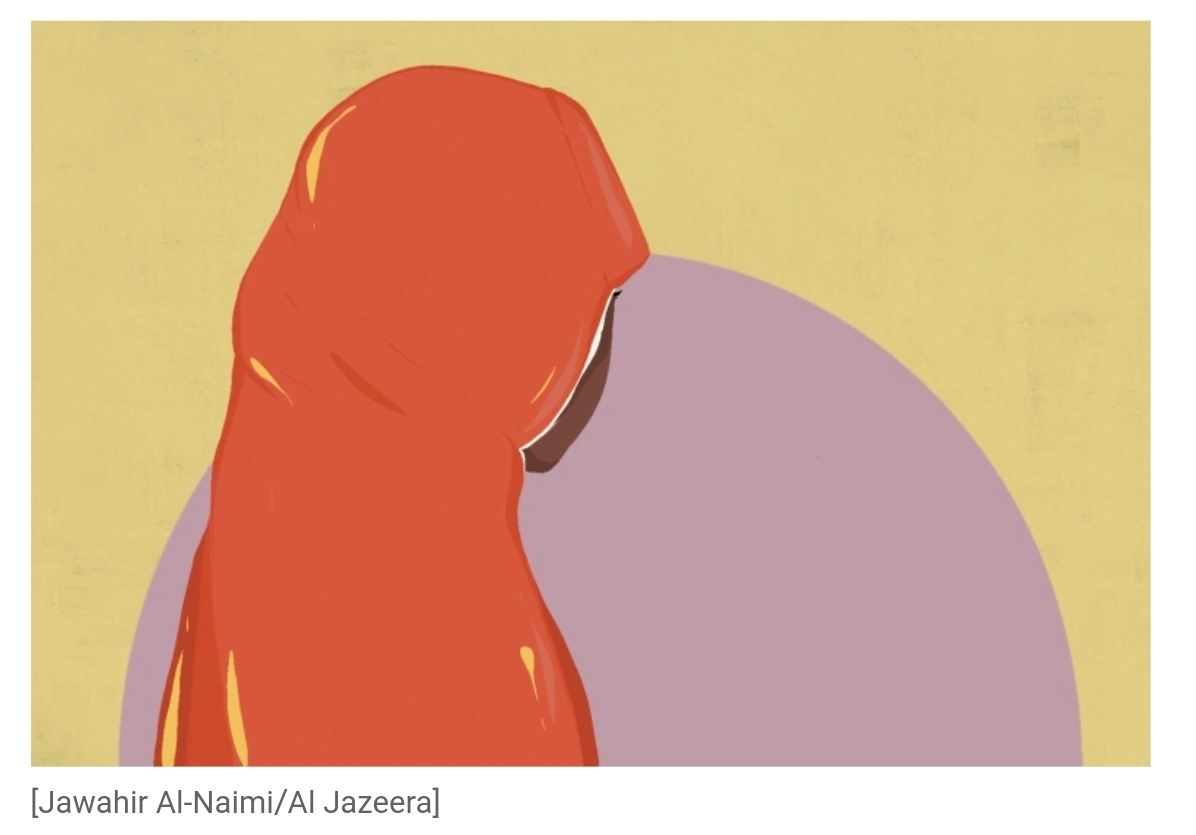
A bright orange hijab conceals much of Aisha’s tiny frame. She barely says a word to Safiya, but nods to acknowledge instructions. When called, she quickly reappears from a door hidden behind a brown curtain.
The village to the city
Aisha was born in Buda, a village in Kano state, some 250km (155 miles) away, that is known for its maize and groundnut crops. Her father works on a farm during the planting and harvesting season. When the farming season is over, he picks up odd jobs wherever he can find them. Her mother is a housewife who also cares for a small farm of their own behind the house – a single building made from mud and straw. Like most rural settlements, there is no electricity or plumbing, and water is sourced from wells within the community.
Aisha moved to Kaduna a few months after she turned 10, with the help of an agent who had promised to find her work as a “house girl” in the city. She was told that if she behaved well, after a while she would be enrolled in school, an opportunity she had never had before. At the instruction of her father, she had packed up her few belongings in a black polythene bag and followed the woman. That was two years ago. She has still never been inside a classroom.
Safiya, who is Aisha’s fourth employer, has two younger children, aged 12 and 14, and an elderly mother everyone fondly calls “Mama”. Aisha was specifically recruited to care for Mama although her responsibilities are not limited to this.
Safiya’s house is one of many middle-class homes in Sabon Tasha. There is electricity but power outages are frequent, and in the evenings the rumbling of generators fills the air. Plumbing runs through the house, but there is no running water and one of Aisha’s duties is to go back and forth to a nearby communal water pump to fill a 150-litre plastic container.
Safiya’s younger children both attend private schools in the city. They do not say much to Aisha, and she approaches them the same way she does their mother – to heed their instructions. Any prolonged interactions are viewed as suspicious by Safiya and may earn Aisha a beating and the children a scolding.
Safiya’s children do not do any chores besides the laundry of their school uniforms and running the occasional errand to a nearby store. Often, when they either cannot find the items in the store, or if it is considered too late for them to be out (after 7pm) they are instructed to give the money to Aisha who must run the errand in their place. Aisha is not allowed to send the children on any errands or request their help.
Life is better here … Back home things are not easy.
AISHA
Safiya’s children have a 9pm bedtime which is enforced with almost religious discipline. Aisha, meanwhile, goes to bed only after Safiya no longer needs her services, often at 10pm or later.
Once the family has gone to bed, in a corner of the parlour, Aisha pulls out a mattress that is tied up and hidden behind a door, and unrolls it into place. That is where she makes her room every night.
“I wake up before Fajr (the Muslim pre-dawn prayer). I clear my things and sweep the sitting room, then boil water for bathing on the firewood. After prayers I clean the compound, rooms, and kitchen, go to market, wash clothes, fetch water, then I stay with Mama,” Aisha explains in Hausa, her eyes focused on the ground. She seems anxious about being spoken to for so long. Her voice is soft and barely audible, and her words trail off as she speaks.
She is given food twice a day from the meals Safiya prepares for the household; in the morning at about 10am after she has finished her routine chores, and at around 4pm after Safiya’s children have returned from school. When she is not doing chores or running errands, Aisha spends most of her time sitting with Mama in the parlour, watching the television which is always tuned to either Zeeworld or Africa Magic. Although she does not understand English, Aisha is fascinated by what she sees on the screen.
Mama often suffers episodes of memory loss, and at times attempts to wander out of the house. Aisha is the one tasked with trying to steer her back to the safety of the couch. Other than running errands and collecting water, this is the only time Aisha is permitted to leave the house – and, even then, she must hurry back. She is not allowed to have any friends as Safiya claims friendships could corrupt her.
In search of a better life
Aisha does not know how much she earns, but 5,000 naira (about $12) is paid monthly to her agent, who takes a percentage before sending what is left to her parents in the village. Aisha has not been back to the village since she left and only gleans information about her family whenever her agent visits the house to check that Safiya is satisfied with Aisha’s services.
Back in Buda, her parents do not know exactly where their daughter is, and rely on the agent for information about her wellbeing. The last time Aisha received news from home, the agent told her that her younger sister Zainab would soon join her in the city once a job had been found for her. Aisha misses her parents and sister but says: “Life is better here … Back home things are not easy.”
Agents are the bridge between clients like Safiya and the families of girls like Aisha. They use a variety of recruiting methods, including visiting villages, relying on word of mouth, and putting printed “Vacancy” posters with their phone numbers up on street walls in low-income neighbourhoods. The most valuable strategy is an informal referral system where satisfied clients recommend the agent to friends and family members who are also looking for domestic help.
Agents often woo the young girls with promises of education and good earnings. When their families sign up, the girls are transported from their villages to economic centres like Lagos, Abuja, Port Harcourt and surrounding cities. Often, these families are in dire financial circumstances and see their children as a vehicle for financial support. Many parents can barely afford daily meals and basic healthcare for their children, which makes the prospect of someone else taking responsibility for the child, while offering a stipend, too tempting to resist.
The city offers them many opportunities. If they are in the village, it is only suffering and before long, some will get pregnant and that’s the end. Here they can go to school or save something to start a business.
PEACE, AN AGENT
As an agent gains a reputation in the villages, they no longer need to visit in order to recruit. Through referrals from families with children in their service, the agent finds other interested families willing to send their daughters to work. In some cases, the prospect of work opportunities makes older women sign up as well (however, most potential employers prefer hiring younger girls, counting on their age to keep them compliant).
The girls do not go through background checks and neither do their employers. Most clients insist the girls get tested for communicable infectious diseases such as HIV, hepatitis B, hepatitis C and tuberculosis. This is often at an added cost to the potential employer, but it is such a popular request that some laboratories even have a “house help screening package” available on request. A positive result for any of the listed diseases renders the girl unfit and a replacement is provided by the agent.
The ‘middle-woman’
Peace* is an agent in Abuja, the country’s capital. The 38-year-old wears a neat knee-length Ankara dress and no jewellery, her hair plaited into simple cornrows, while a wig hangs from a nail on the wall in a corner of her studio apartment.
Peace lives in Mararaba on the outskirts of the city. In her self-contained single room apartment sits a mattress, a few boxes, a box television set, and her shoes lined up in a corner. There are a few stickers from religious crusades on her door and a well-worn Bible on one of the pillows at the head of her bed.
Peace says she started this business because she was tired of working for other people. She currently has six girls recruited and placed in homes around the city, and is expecting a seventh from Nasarawa state whom she is scheduled to drop off at a home before the end of the day. The girls and women in her employ vary in age from 13 to their late 30s. “It depends on what the customer wants,” she explains. “Some customers prefer younger girls; others want matured women.” The girls are from different parts of the country such as Gombe and Taraba in the Northeast, Osun in the Southwest, Benue in the middle belt, and Nasarawa state.
Clients pay Peace a service charge of 10,000 naira ($25) before the girls or women are handed over to them. Afterwards, they pay the monthly salary of 30,000 naira ($37) – the current national minimum wage – directly to Peace. There are no formal contracts between Peace and the girls and women she recruits. They serve wherever they are placed until the clients decide they no longer require their services. In such a case, Peace will try to find new homes to place them in. If one wants to leave, they must contact Peace directly and cannot simply terminate their duties. In such a case, Peace usually reviews their complaints and tries to convince them to stay. When this does not work, they are let go but told they cannot reach out for any future jobs or placements. On rare occasions, domestic helpers have been known to run away from their employers. In such situations, agents are tasked with replacing them, at no cost to the employer.
“Out of the 30,000, I keep 5,000,” Peace explains. This is her cut. “I send what is left to their parents or if they are working for themselves, I give them the balance [25,000 naira (about $60) a month].” Most, like Aisha, never find out how much agents like Peace receive from their employers for the work they do. Peace’s clients are made to sign an indemnity form, ensuring that they will not directly transact with the girls.
“The people don’t have any business with the girls,” Peace says. “I am the one that brought them, so all complaints and matters regarding the girls must be communicated to me.”
‘House help’ to entrepreneur
Peace believes she has an insider advantage as she also started as a “house help”.
In 1996 at the age of 13, she was taken from a quiet village in Ikom in Cross River state, in the southern region of Nigeria, to the lively city of Lagos, a 14-hour drive away.
“One day two women and one of my aunts came to visit my stepmother. They went inside and talked for a while. As they were leaving, I was asked by my stepmother to follow them. That I will be going to work with a woman in Lagos. I was told there was no need to pack anything,” Peace recounts. “One of the women took me to her house and when we got there, she gave me a dress to change in to because the one I was wearing was torn. The next day at five in the morning we went to the motor park and left for Lagos.”
Peace is unemotional as she recalls the experience. When asked how she felt, she pauses briefly before responding that it was God’s will. “If I had remained in the village, I don’t know if I would even be alive today,” she adds.
Unlike Aisha, Peace had the privilege of getting some education. Her employer in Lagos enrolled her in a public school. But seven months later, after leaving the home of the employer, she had to leave school and has not been back since.
After that placement, Peace went from home to home, holding a series of cleaning jobs. In 2020, she decided to start work as an agent. She sees her service as altruistic; a means of “helping the girls”.
“Life here is better for them,” she explains. “The city offers them many opportunities. If they are in the village, it is only suffering and before long, some will get pregnant and that’s the end. Here they can go to school or save something to start a business,” she repeats, convinced.
If I had remained in the village, I don’t know if I would even be alive today.
PEACE
The story for most girls begins like Aisha’s – with all the possible “advantages” listed by Peace as a motivating factor for the decision: they all move to the cities for a chance to support their families, to save enough to start a business, to attend a school. In the end, a singular theme is palpable: a need to escape crippling poverty.
The exodus to the cities is always a tempting journey towards the possibility of a better future. For a few, this dream comes true. They find homes where they are treated decently or get access to an education. But such cases are few and far between. Stories of the abuse of domestic helpers are so popular that it is even a recurring theme in Nollywood movies.
Physical, sexual, emotional and psychological abuse are common. In May 2017 a well-known case of abuse was publicised in local daily papers: eight-year-old Miracle Edogwu was allegedly beaten to death by her employer, a businesswoman in Lagos simply referred to as Oby. Many other instances of abuse ranging from scalding by hot water, to near-death beatings, are rife in local news.
Peace admits these risks exist. “Everything is a risk,” she says. “If anything happens, they have my number. They will call me.” However, most of the girls do not own phones, and communication is often only possible through their employers or the random goodwill of others, which makes it harder for them to reach out in desperate situations.
An unregulated system
The ignorance of agents like Peace means they fail to understand the potential consequences of their actions. In 2018, the National Agency for the Prohibition of Trafficking in Persons (NAPTIP) reported that there were some 15 million children engaged in domestic child labour in Nigeria.
The NAPTIP Act of 2015 warns that “any person who employs, requires, recruits, transports, harbours, receives or hires out, a child under the age of twelve years as a domestic worker commits an offence and is liable on conviction to imprisonment”. This provision highlights 12 years as the age limit.
Mr Isaiah*, who works with NAPTIP and spoke anonymously because of concerns about professional retribution, explains that the government has shelters to cater for children found in such situations. NAPTIP currently operates eight such shelters across the country with a stay time limited to six weeks. It also provides counselling and rehabilitation for rescued children. Victims requiring longer periods of care are transferred to other non-governmental organisations.
When a case of any underaged child employed in domestic labour is reported, it is channelled through units that monitor and investigate it. “But a great hindrance to conviction,” he adds, “is cases of familial relations, where involved individuals refuse to allow judicial action.” Isaiah points to the use of public enlightenment campaigns aimed at re-educating communities about the laws regarding domestic helpers. He believes this will help in preventing these situations.
The real effort needed is sociological. We must induce a cultural recognition of childhood, and provide an alternative to child domestic labour, such as formal or vocational learning. The first has not been done, the latter remains to be seen.
RICHARD ALI, LAWYER
In 2003, Nigeria adopted the Child Rights Act (CRA), which defines a child as “anyone below the age of eighteen”. The law in summary states “In every action concerning a child, whether undertaken by an individual, public or private body, the best interest of the child shall be the primary consideration.” Section 11 highlights: “A child is entitled to respect for the dignity of his person, and accordingly, no child shall be subjected to physical, mental or emotional injury, abuse, neglect or maltreatment, including sexual abuse; no child shall be held in slavery or servitude, while in the care of a parent, legal guardian or school authority or any other person or authority having the care of the child.”
The CRA has been adopted by most states in Nigeria, including in Kaduna, where Aisha lives, and in Abuja, where Peace operates. But Richard Ali, an Abuja-based lawyer and writer who has had some experience with such cases, explains: “Thinking in terms of laws banning child labour, especially child domestic labour, under the CRA doesn’t address the issue because the real effort needed is sociological. We must induce a cultural recognition of childhood, and provide an alternative to child domestic labour, such as formal or vocational learning. The first has not been done, the latter remains to be seen.”
Lawyer and human rights activist, Ugochukwu Amasike, blames the lack of implementation of such laws on a shortage of trusted systems to protect children. “These policies cannot work without a system that can provide the child’s basic needs. Are there decent public schools providing free education to enrol them in? Can they get decent healthcare? When are the children taken from these homes are they taken back to the same environment that drove them into the industry in the first place?”
Dominic Ega*, a public servant who works closely with the Kaduna state government disagrees, instead blaming socio-cultural norms. “As with every government, we can’t successfully identify these cases if well-meaning people do not report to the state. If we still have many out there, then it is because the families of those children and the community are benefitting or in support of the practice.”
The future
Girls like Aisha who move to the cities are soon disillusioned. The school enrolments rarely come to fruition. They barely earn enough for their families to survive on let alone support them out of deep poverty. They are trapped in a cycle of basic survival. Aisha’s focus now is simply on working well enough to not be sent packing.
“I like working for Safiya,” she explains. “The work is not hard.” She adds that she is thankful that Safiya rarely beats her.
Maryam Aliko, the founder of Mariacutty, a non-profit focused on female empowerment, describes such low expectations as an adaptation mechanism. “The domestic service system being without any professional regulation will always be subject to abuse. When most of these girls are let go, they have nothing to fall back on. When they leave, the girls may find new homes to be placed in, or return to their villages; a place where they no longer fit in. After the city, they are too good for the villages and yet, still not good enough for the city. Soon, they fall prey to other exploitive systems such as prostitution.”
A large population and high rates of poverty, Maryam insists, are two of the major enablers of the system. “There is no registry of domestic workers, no data on the agents. As popular as this service sector is, it is invisible. This has made the system a preying ground for other services such as human trafficking for sexual exploitation and baby factories.”
The rising insecurity and displacement of people by armed groups such as Boko Haram and bandits in the northeastern region has also contributed a huge number of vulnerable girls to the pool. Maryam and a few others have begun to advocate for regulations and policies to be created to check the system. “Policies need to be created for the domestic service industry as a credible part of the labour force. This way we can control the recruitment of underage workers. Those who are fit, can be trained and taught to engage with domestic work as a skill. The domestic help system must be recognised as an enabler for women’s empowerment. It is mostly family women who recruit house helps to manage the home front while they go on to pursue their goals.”
Safiya’s tone betrays a mild irritation as she complains that Aisha is not as efficient as she would like. She says that sometimes Aisha is sluggish in doing her duties, or that she occasionally oversleeps. When questioned about Aisha’s schooling, she seems surprised that this is even a consideration. “That is not what she is here for,” she responds.
Aisha is asked the cliched question most children are faced with: “What would you like to be when you grow up?” She chuckles and replies quietly in Hausa: “Ban sani ba.” (“I don’t know.”)
For girls like Aisha, whose dreams have slowly dissolved into the background of a harsh reality, the most they can think of is getting through the day. There is little hope and little disappointment. And the recognition that although they might get something better, they will most likely get worse.
Former Lagos State Governor and chieftain of the All Progressives Congress (APC), Bola Tinubu, made a profound statement when he paid a condolence visit to the family of elder statesman and Afenifere leader, Reuben Fasoranti, in Akure on July 14, 2019.
Fasoranti’s daughter, Funke Olakunrin, was gunned down two days earlier at Ore junction on the Sagamu-Benin highway, and her driver, Tayo Ogundare, said hooded men emerged from the bush to attack them.
Announcing the tragedy the same day, the then Afenifere spokesperson, Yinka Odumakin, blamed herdsmen for it. His claim was echoed by the deceased’s brother, Kehinde Fasoranti, who told journalists that policemen at Ore police station confirmed that his sister was killed by herdsmen.
Tinubu was not impressed and cautioned against stigmatising herdsmen.
“I am extremely concerned about security but I don’t want stigma. I can go through history of kidnapping and we know how it started, where it all started. There are lots of copycats. How many years ago have we faced insecurity in this country and cases of kidnapping? Is Evans a herdsman who was arrested?” he asked.
Then, what seem like an alibi for herdsmen. “I don’t want to be political, I will ask you where are the cows?” he asked journalists.
Tinubu was right even though he was being sarcastic and many Nigerians, particularly his Yoruba kinsmen, rightly took umbrage at what they perceived as an unfortunate sarcasm.
But speaking tongue-in-cheek, as he did, does not detract from his message, which is, can there really be herdsmen without a herd of domesticated animals? The answer is no. A herdsman looks after a herd of animals such as cattle or goats. And those who killed Olakunrin were not herdsmen. They were terrorists.
For too long, Nigerians have been deceived by their leaders that there is a conflict between farmers and herders. But that is a false narrative that obfuscates issues.
What have those who go in the dead of the night to sack entire villages, kill and maim indigenes and occupy their ancestral homes got to do with the quest for herders to rediscover age-long grazing routes?
What has farmers-herders conflict got to do with abduction of students and demand for millions of naira ransom? Do they want to convert the schools to grazing reserves?
This false narrative has been pushed by no less a person than President Muhammadu Buhari and top officials of his administration. But there is no intractable conflict between farmers and herders in Nigeria, at least not one that accounts for the ongoing horrendous bloodbath. Fulani herdsmen have always co-habited with other ethnic nationalities across the country. Desert encroachment is not a new phenomenon.
So, when Buhari tells his Attorney General and Minister of Justice, Abubakar Malami, to dig up a so-called First Republic grazing gazette as a solution to the acts of terror that is about to consume the country, he is being economical with the truth.
Adopting the euphemism of banditry is equally deceitful. What is going on in all the nooks and crannies of Nigeria is terrorism. Simple!
Many people have wondered why the country is unable to tame this monster. The answer is simple. Those in positions of authority are pretending that what ails Nigeria is malaria (herders-farmers crisis) when it is malignant tumor (full-blown terrorism). They are either living in denial or deliberately mischievous.
Buhari knows the truth. Those killing and maiming indigenes in states like Benue, Plateau, Nasarawa, etc., are not herdsmen. They are dyed-in-the-wool terrorists. There is no conflict between farmers and herdsmen in the Southwest. Those who have taken over the forests here are not herders. They are inveterate gunmen and anarchists. The fact that the government would rather protect such vile characters, most of who are not Nigerians, while haranguing the likes of Sunday Igboho who volunteered to defend their people in the face of abdication of duty by security operatives explains why there is no solution in sight.
But the president should be mindful of the inescapable verdict of history. Enabling terrorists and terrorism is a slippery slope. Anyone in doubt should ask Nasir el-Rufai, Kaduna State Governor.
On July 15, 2012, el-Rufai tweeted boastfully: “We will write this for all to read. Anyone, soldier or not that kills the Fulani takes a loan repayable one day no matter how long it takes.”
And what was his angst? He was miffed that the administration of President Goodluck Jonathan was waging a war against terrorists, some of them Fulani, in the North.
And true to his word, when he became Governor in 2015, he told his Fulani kinsmen that one of their own has ascended the throne. Rather than waging war against terrorists, he went looking for them in their countries with sacks of tax-payers’ money for alimony.
But as John F. Kennedy, former U.S. President once said, “Those who foolishly sought power by riding the back of the tiger ended up inside.”
El-Rufai has found out to his chagrin why those who ride a tiger are always afraid to dismount.
This week, his government disclosed that bandits killed 222 people, injured 266 and kidnapped 774 in the last three months, and have started collecting protection levies from farmers in communities across 12 of the 23 local government areas of the State.
“Many farmers in these areas, fearing for their lives and safety, have abandoned their fields altogether. This has already begun to affect crop yields, and the threat of food insecurity looms large,” Commissioner for Internal Security and Home Affairs, Samuel Aruwan, told el-Rufai and other top government officials on Tuesday.
Receiving the security report, a highly flustered el-Rufai simply called on citizens to be law-abiding – whatever that means. The swagger is gone. That is the danger inherent in condoning evil and pampering terrorists.
In the same Kaduna State, terrorists have attacked five schools and abducted 204 students since January.
Last Friday, the State Commissioner of Police, Umar Muri, told the visiting Inspector General of Police, Alkali Baba Usman, that Kaduna State, the capital of Northern Nigeria, has become a failed state, literally.
Highways in the state – Kaduna-Abuja highway, Kaduna-Birnin Gwari Road and Kaduna-Zaria Road – are no-go areas for law-abiding citizens. Terrorists hold sway.
Schools are so unsafe that the brash el-Rufai, the state’s chief security officer, secretly withdrew his son from school to be taught at Kashim Ibrahim House, probably the only safe haven in the entire state. He has shut down 13 other schools because of terrorists.
El-Rufai, the roaring lion, is now a lily-livered executive governor, subdued by the same Frankenstein Monster he fed. He is no longer loquacious. Terrorists have forced him to eat the humble pie. What is happening to him is poetic justice, many insist, a deserved comeuppance for the injustice he has meted out to non-ethnic Fulani in the state.
A highly distressed CP Muri narrated his ordeal to IGP Usman thus: “From our records, the schools that have been attacked and students abducted in Kaduna State from January 2021 to date alone include:
“College of Forestry and Mechanisation, Mando Afaka where 37 students were kidnapped on March 11, 2021 and subsequently rescued.
“Green Field University along Kaduna-Abuja Highway where 23 students were kidnapped on April 20, 2021 and five of the students were gruesomely killed by their abductors while the rest were released.
“Nuhu Bamalli Polytechnic, Zaria where two kidnapping incidents were recorded, first involving three students on December 14, 2020 who were later released by their abductors and the second incident was recorded on June 10, 2021 involving two lecturers and seven students.
“The National Centre for Tuberculosis and Leprosy in Saye, Zaria LGA of Kaduna where eight staff were kidnapped on July 4, 2021 and Bethel Baptist Academy, Maraban Rido, Kaduna where 135 students were kidnapped on July 5, 2021 out of which 28 were rescued and the remaining 107 victims still in captivity.”
To be sure, none of these students was rescued. They either escaped or were released by their abductors after their parents paid millions of naira as ransom. In Kaduna, the state is none existent, literally. Terrorists are the lords of the manor.
When in 2018 kidnappers abducted a prominent traditional ruler in the state, Maiwada Raphael Galadima, the Agwom Adara, and murdered him after demanding N18 million ransom, el-Rufai chastised the victims rather than go after the villains.
Today, the chicken has come home to roost for both him and Kaduna State – as it has, indeed, for both Buhari and Nigeria.
Buhari should jettison this herders-farmers fallacy and wage a decisive war against terrorists. If not, the fate that has befallen Kaduna State under El-Rufai’s watch will also befall the entire country.
I hope it is not too late for him to listen. And to take action.
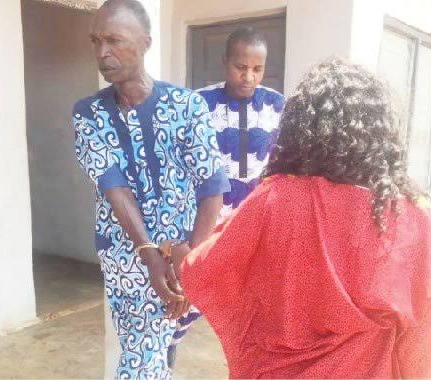
The Edo State Police Command has paraded a middle aged man identified as Emmanuel Asemota who allegedly beat his wife to death following a disagreement between them. In a video shared by Channels Television yesterday, the spokesman of the Edo State Police Command, Bello Kontongs has stated that the suspect was arrested after they received a complaint from his neighbours that one Victoria Asemota has been beaten to coma by her husband.
The neighbours stated that they have taken the victim to three different hospitals but she was rejected due to lack of security personnel together with them. The police then took the woman to a hospital where she was admitted for about 7 days before she died. Prior to her death, the woman stated that she was beaten to a pulp by her husband after he called her to his room but she told him that she was tired. She mentioned that he followed her to her room and attempted breaking the door, because she knew what will happen if he succeeded in entering the room, she tried to follow through the window and go out but he blocked her and started beating her till she lost consciousness.
While being paraded, the suspect stated that he beat Victoria to death because she refused to come to his room and sleep with him after he called her. He mentioned that he has been together with her since 2002 and they have two children. The suspect added that he did not intend to kill her, but unfortunately, she died after the incident.
Three members of the same family in Kwara State have died of food poisoning.
The victims were said to have lost their lives after consuming Amala, a local staple in Ilorin East Local Government Area.
Five siblings reportedly took the meal. They were all taken to the children’s hospital in Centre Igboro but three of them died.
This is coming just about a month after two similar incidents of suspected food poisoning in Baruteen and Kaiama communities of Kwara North.
17 people lost their lives in the incident.
When contacted, the spokesperson of the Nigeria Security and Civil Defense Corps (NSCDC), Babawale Zaid Afolabi, said he was not aware of the incident.
But the Kwara State Disease Surveillance Notification Officer (DSNO), Alhaji Muhammad Abdullahi, confirmed the incident, adding that the two survivors have been discharged.
He said: “When we got to the place, their father told us that five of his children ate the Amala meal but three later started vomiting before they were rushed to the Children Specialist Hospital, Ilorin.
“He said while they were battling to save the lives, another one was rushed to another hospital but the first three died. Their father, who is a farmer, told us he produced the yam flour (Elubo) himself and cannot say what really happened,” he added.
The DSNO said the remaining two children are doing well “when we saw them yesterday (Tuesday)”.
A 20-year-old girl (names withheld) has accused a pastor of a new generation church in Port Harcourt, Jesus Alive Word Refiners INTL Church, of conspiring with a choir member of his church and one other accomplice to rape her.
The victim, who protested in front of the church on Wednesday, said the pastor and two of others invited her to a place around Wepey junction, Ikwerre road in Port Harcourt, pretending that they wanted to resolve issues they were having with the pastor’s wife.
The victim, who is a hair stylist, said she obliged to meet them after one of her friend who is also her customer told her that the pastor’s wife will also be in the meeting.
The victim stated that she noticed the place was a guest house upon arrival but was not suspicious of anything since her friend was in the place.
The 20-year-old lady alleged that few minutes after she got inside the room, the pastor locked the door and increased the volume of the television set while he raped her.
The victim alleged that the pastor and his accomplice forced her to swear an oath with a substance suspected to be ‘juju’ not to reveal to anybody what transpired in the place.
The victim said that she protested in front of the church to draw the attention to the alleged continuous harassment and threat she is facing in the hands of the pastor even after the rape incident.
Barrister Festus Bonwin, a Lawyer with human rights advocacy group, Centre for Basic Rights Protection and Accountability, campaign told our correspondent that the group petitioned the Police in Rivers State, to demand a thorough investigation into the allegation.
Barrister Bonwin said the group is also asking that the Police to provide adequate security for the alleged 20-year-old victim as feelers indicate that there are threats against from some quarters.
Efforts to speak with the pastor were unsuccessful as his phone was unavailable at the time of filing this report.
Daily Law Tips (Tip 814) by Onyekachi Umah, Esq., LL.M, ACIArb(UK)
Introduction:
Laws are made for societies and like the societies, they grow with time. As at 1993, most Nigerians in Nigeria could not imagine purchasing a toothpaste, renting an apartment and ordering wraps of moi-moi (beans pudding) via online. While most online activities were accepted by Nigerians as mere social fun or remote fraud for the youth, many of such activists have now made more Millionaires in Nigeria than any government enterprise. Governments, organizations and even the self-rated sanctimonious religious center now seek online resources even on the “children platforms” like they tagged it; “Facebook”, “WhatsApp” and the Instagram.
The commencement path and the operation pattern of most online businesses have caused many to wonder; “Should Businesses and Online Entities Pay Tax in Nigeria?” and “When Online Businesses and Entities Must Pay Tax in Nigeria?”. This work answers the questions within the provisions of Nigerian laws. It considers Tax in Nigeria: the Concept and Brief History; Human Beings, Corporate Beings and Taxes in Nigeria; and the Online Businesses, Online Entities and Taxes in Nigeria. It also discussed the place of formal (organized) and informal (unorganized) sectors, registered and unregistered businesses and entities in Nigeria, viz-a-viz payment of tax, for revenues generated via online and digital platforms. Parts of the Constitution of Nigeria, the Personal Income Tax Act, the Companies Income Tax Act, the Finance Act, were considered.
Tax in Nigeria: the Concept and Brief History
Contextually, TAX is a statutorily recognized fee/dues demanded by government from all or some persons as an obligation to government. Tax is created and demanded by government through a written law, also tax must be certain and predictable. The collecting agent of a tax must be the person appointed and authorized by law and the person to pay tax must be expressly listed as well as the government account to receive the paid tax. Government cannot demand tax that is unknown to law.
Historically, Tax is not alien to the pre-Nigeria communities, especially the communities in the present-day Northern Nigeria. The position in the communities that were in the then Southern Nigeria was a bit different, as evidenced by the Aba Women’ Riot. In 1929, the women of Aba (in the present day in Abia State) protested the head count of women, children and livestock by the colonial masters (western thieves), that was set to usher in tax on women, having successfully imposed tax on men, earlier in 1928. The plan of Captain J. Cook met the opposition of Women from communities in Igbo land and unfortunately, the British invaders and looters murdered 51 Igbo women and a man. So, tax has been in Nigeria for long and will not cease anytime soon.
In the present-day Nigeria, taxes are been levied and enforced by the Federal Government of Nigeria, the State Governments and the Local Governments, within their respective legislative powers. Like the Edo State Local Governments Uniform and Harmonised Levies, Rates, Fees and Charges Law, 2017. Powers to impose tax and issues to be taxed are generally provided for in the Constitution of Nigeria. Furthermore, federal laws, state laws and local government bye-laws have gone further to forge elaborate legal frameworks for taxes in Nigeria. This work will only consider the federal laws on tax, due to their overriding and covering powers over all persons and entities in all parts of Nigeria.
Human Beings, Corporate Beings and Taxes in Nigeria:
One of the most popular taxes in Nigeria is the Personal Income Tax and then followed by the Company Income Tax. The Nigerian laws recognize human beings/persons and corporate beings/persons (Companies, Corporate bodies, Associations, Societies, Charities, Not-For-Profit and Non-Governmental Organizations). As such, both human beings and corporate beings are allowed by Nigerian laws to own properties, monies, and to sue and be sued by any person. To this extent, taxes focus on human beings and corporate beings as the owners of the factors of productions and the generators of wealth to pay tax to government.
Generally, in Nigeria, any person, business and entity can be formal (registered with government) or informal (not registered with government). For example, the informal sector has a lot of persons, entities and businesses in Nigeria that make millions of Naira but are not captured by any government, so they do not pay tax and perform other obligations. On the other hand, are the human beings and corporate beings that have registered with government to allow government to track and regulate them, as well as collect taxes (although, most governments in Nigeria are too corrupt and indiscipline to perform such duties). Registration with government often starts with the incorporation and registration of Business Names, Companies, Associations, Societies, Charities, Not-For-Profit and Non-Governmental Organizations at the Corporate Affairs Commission (CAC) and the issuance of Tax Identification Numbers (TIN).
Whether formal or informal, all persons (human beings and corporate beings) in Nigeria and even outside Nigeria that make money by any form or style in Nigeria must pay tax to the government of Nigeria. Yes, this is the position of the federal law; Personal Income Tax Act, 1993 and the Companies Income Tax Act, 1977. Section 2(b)(iv) of the Personal Income Tax Act provides that “(iv) a person resident outside Nigeria who derives income or profit from Nigeria” must pay tax to Nigeria. Expectedly, section 2(b)(i) – (iv) provides that all persons resident in Nigeria must pay tax to Nigeria. Then, section 9 of the Companies Income Tax Act mandates companies to pay tax on the income to the Federal Government of Nigeria. However, there are few tax exemptions to some of business and entities in Nigeria.
To this extent, human beings and corporate beings that make income or profit in any part of Nigeria, whether there are registered or not, in Nigeria or outside Nigeria, so far as they make money in Nigeria, must pay tax to Nigeria. So, any human being, firm, group, Business Name, Company, Association, Society, Charity, Not-For-Profit or Non-Governmental Organization (whether registered or not) that makes money (income or profit) from Nigeria is mandated by the federal laws to pay tax to the Nigerian government.
Online Businesses, Online Entities and Taxes in Nigeria:
The online space in Nigeria is also full of formal and informal operators; it is a true reflection of the unregulated Nigeria and her challenges. It is even easier to start up an online business or social enterprise than to start up such offline. They are more businesses that operate only online that those that operate offline. Also, more offline businesses are starting to operate online, generating revenue in both spheres; offline and online. The boom of online businesses in Nigeria is not unrelated with the lack of adequate regulations and the poor enforcement of regulations on online operators.
Online businesses and entities in Nigeria are either registered in Nigeria or not registered in Nigeria. There is also the class that is not registered at all in any country. However, the good, the bad and the ugly entities, all operate in the largely ungoverned internet/online space of Nigeria, making monies from persons in Nigeria, with or without having their offices in Nigeria. For example, the popular brands; Facebook Inc., Amazon.com Inc., Twitter Inc., and Alibaba Group are foreign companies that are not registered in Nigeria but sell their services to persons in Nigeria. They make huge revenue from the uncounted (or may be uncountable due to weak institutions) population of Nigeria. Also, there are unimaginable numbers of online businesses owned by Nigerians in Nigeria and in diaspora that make huge revenue from Nigeria. Shouldn’t all online and digital business that make money from Nigeria pay tax to Nigeria, whether they make such money in shrines, bus stops, internet or social media platforms?
Building on the above remark on section 2 of the Personal Income Tax Act and sections 9 of the Companies Income Tax Act, it is important to point out that section 6 of the Personal Income Tax Act and section 13 of the Companies Income Tax Act envisaged the situation where businesses, persons and entities outside Nigeria may make money from Nigeria without operating in Nigeria. In such circumstances, the federal laws place statutory obligations on such entities in any part of the globe. Businesses and entities (including online or digital enterprises) making money from Nigeria must pay tax to Nigerian government for the money made from Nigeria. The part of the monies (income and profit) of such entity that is not made from Nigeria is excluded from the tax to be paid to Nigeria.
Well, contrary to public opinions, most Nigerian laws do not need to be amended for them to apply to online businesses and entities that make revenue in Nigeria. For example, the provisions of the Personal Income Tax Act and the Companies Income Tax Act are clear, that any person that makes money (profit or income) in Nigeria should pay tax to Nigeria on the money made from Nigeria. It is not limited to making money through physical offices, representatives and operational bases in Nigeria, it clearly covers all forms and styles (including online businesses) so far as the ventures are lawful. To this extent, all online businesses and entities that make revenue from persons in Nigeria (whether such entities are registered or not in Nigeria, whether they have office or representatives in Nigeria or not) are by law mandated to pay tax in Nigeria on the money made from Nigeria.
Conclusion:
Tax is one key mechanism for generating revenue for government, to enable government perform its obligations to citizens. Hence, payment of tax is an obligation of citizens and the failure to pay tax could lead to imprisonment and other penalties. However, many have argued that the payment of tax to a corrupt government promotes the embezzlement and undue redistribution of wealth, like is seen in Nigeria. Well, above all, the realities of Nigeria will not supersede the laws of Nigeria, rather the Nigerian legislatures must ensure that the laws of Nigeria align with the realities of Nigeria, until then, tax laws and other laws must be obeyed at all times.
In line with the provisions of the Personal Income Tax Act, Companies Income Tax Act and the Finance Act, all persons, businesses and entities in any part of the world that make revenue (profit/income) in Nigeria must pay tax to Nigeria. So, all offline and online businesses and entities in any part of the world that make monies from Nigeria or persons in Nigeria are to pay tax to the government of Nigeria. As such, the Government of Nigeria (through its tax collectors; the Federal Inland Revenue Services) could engage online businesses and entities on the Nigerian space, for payment of Personal Income Tax or Companies Income Tax, among others.
Speak with the writer, ask questions or make inquiries on this topic or any other via [email protected], [email protected] or +2348037665878 (whatsapp). To receive free Daily Law Tips, join our free WhatsApp group via https://chat.whatsapp.com/L7h4f1exItZ38FeuhXG4WN or Telegram group, via the below link: https://t.me/LearnNigerianLaws
To keep up to date on all free legal awareness projects of Sabi Law Foundation, follow us via
Facebook Page:@LearnNigerianLaws,
Instagram:@LearnNigerianLaws,
Twitter: @LearnNigeriaLaw,
YouTube: Learn Nigerian Laws,
WhatsApp Groups via (https://chat.whatsapp.com/L7h4f1exItZ38FeuhXG4WN),
or visit our website: (www.LearnNigerianLaws.com )
Please share this publication for free till it gets to those that need it most. Save a Nigerian today! NOTE: Sharing, modifying or publishing this publication without giving credit to the author or Sabi Law Foundation is a criminal breach of copyright and will be prosecuted. This publication is the writer’s view not a legal advice and does not create any form of relationship. You may reach the writer for more information.
This publication is powered by www.LearnNigerianLaws.com {A Free Law Awareness Program of Sabi Law Foundation, supported by the law firm of Bezaleel Chambers International (BCI).} Sabi Law Foundation is a Not-For-Profit and Non-Governmental Legal Awareness Organization based in Nigeria. For sponsorship and partnership, contact: [email protected], [email protected] or +234 903 913 1200.
The Nigerian Army says it has launched a manhunt for the soldier who allegedly killed his lover, one Miss Jennifer Ugadu, an undergraduate of Niger Delta University, Ammasoma, Bayelsa.
The Director, Army Public Relation, Brig.-Gen. Onyema Nwachukwu, said in a statement, on Thursday, it was alleged that the student was shot in her apartment by the suspect now at large.
Nwachukwu said there was no place for such barbaric act in the army, adding that the Nigerian army had commiserated with the family of the deceased.
According to him, Nigeria army is an institution that is accountable to the people and would ensure the justice is served.
”The NA has taken the allegation seriously and joint investigation has commenced, while effort to profile and ascertain the true identity of the suspect is ongoing.
“The NA being a professional and disciplined organisation will continue to uphold and respect the Fundamental Human Rights of citizens as enshrined in the 1999 constitution of the Federal Republic of Nigeria,” said the statement.
Nwachukwu said members of the public should be rest assured that details of the investigation would be made public.
“The NA also wishes to reaffirm that as a force with zero tolerance for any form of criminality, such allegations will not only be investigated, but the culprit will be made to face the full wrath of the law,” he said.
The board of directors of African Development Bank (AfDB) has approved a loan of $50 million to for First City Monument Bank (FCMB) to channel to Nigerian enterprises and women-empowered businesses in the agribusiness, manufacturing, healthcare and renewable energy sectors.
Thirty percent of the funds, which are intended to mitigate effects of the challenging COVID-19 environment, are earmarked for underserved women-empowered businesses.
In addition, the bank will provide a technical assistance grant of $200,000 through its Affirmative Finance Action for Women in Africa (AFAWA) initiative supported by the Women Entrepreneurship Finance Initiative. The grant will complement the loan by enabling FCMB to provide non-financial services, including training, and to strengthen its monitoring and reporting functions.
“The African Development Bank is pleased to support FCMB’s strategy to become a dominant player in addressing the funding needs of women-empowered and local enterprises.
“This project will extend valuable resources to critical but underserved segments during the ongoing Covid-19 pandemic, with its adverse macroeconomic impacts,” said Stefan Nalletamby, the African Development Bank’s Director of Financial Sector Development.
Small- and medium-sized firms account for up to 80 per cent of employment in most African countries and women-empowered businesses typically face a considerable financing gap. The Nigerian economy has been hard hit by the COVID-19 pandemic, and falling crude oil prices have had a ripple effect on the wider economy.
AfDB noted that the project aligns with the objectives of AFAWA, which aims to improve gender inclusivity by improving access to finance for women entrepreneurs.
According to AfDB, the project also advances the bank’s ten-year strategy and is consistent with three of its high-five strategic priorities: industrialize africa, feed africa, and improve the quality of life for the people of Africa. It also aligns with the Nigeria Country Strategy Paper 2020-2024.
Our site uses cookies. By clicking “Accept All Cookies”, you direct Law and Society Magazine to store cookies on your device and disclose information in accordance with our Cookie Statement: cookie policyACCEPTREJECT
Privacy & Cookies Policy
Privacy Overview
This website uses cookies to improve your experience while you navigate through the website. Out of these cookies, the cookies that are categorized as necessary are stored on your browser as they are essential for the working of basic functionalities of the website. We also use third-party cookies that help us analyze and understand how you use this website. These cookies will be stored in your browser only with your consent. You also have the option to opt-out of these cookies. But opting out of some of these cookies may have an effect on your browsing experience.
Necessary cookies are absolutely essential for the website to function properly. This category only includes cookies that ensures basic functionalities and security features of the website. These cookies do not store any personal information.
Any cookies that may not be particularly necessary for the website to function and is used specifically to collect user personal data via analytics, ads, other embedded contents are termed as non-necessary cookies. It is mandatory to procure user consent prior to running these cookies on your website.