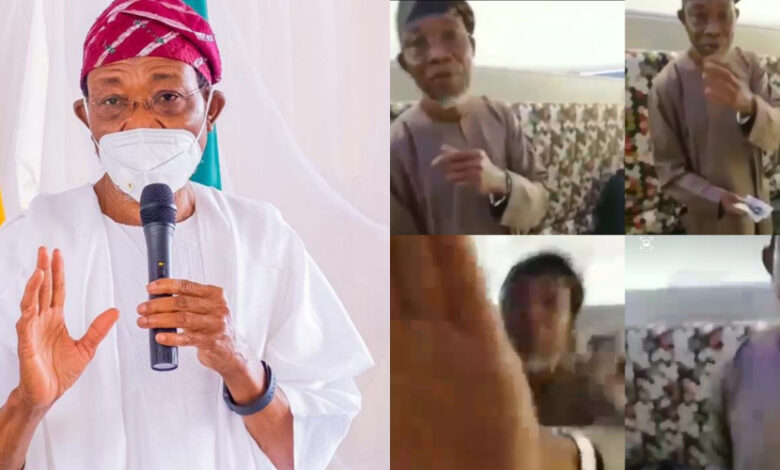
Few days ago the social media was agog with a video clip showing an encounter between a U.S. based Nigerian and the Minister of Interior, Ogbeni Rauf Aregbesola in a restaurant in the United States of America. From the video the U.S. Nigerian was seen asking, if who he was seeing was Ogbeni Rauf Aregbesola.
The Minister beckoned on the young Nigerian to seat beside him but he refused and continued recording the incident. At this stage, a lady, probably an acquaintance of the Minister intervened and poured fuel on an already tensed situation. Both the lady and the Minister demanded that the young Nigerian should stop recording and that he was violating the Minister’s right to privacy. The young Nigerian retorted that “This is America, I am not breaching your privacy” and in Yoruba language (which I will translate) shouted at the Minister that “It was hunger that brought me here”.
I will not be tempted to go into the jurisprudence of legal rights to one’s privacy and when it can be violated. Also, I will not go into the legal niceties of the legal implications of what the young man did. If Ogbeni Rauf Aregbesola is really aggrieved, he should seek legal redress. That is what politicians always say. However, the drama that played out in the restaurant has brought to the fore a dangerous new trend and it may get worse. Not too long ago, former Deputy Senate President, Ike Ikweremadu was assaulted in Germany by Nigerians. His clothes were torn by angry Nigerians who shouted at him to go home. President Buhari has also suffered same fate in some of his trips abroad. Nigerians are really angry at their leaders and they are sending subtle messages to them.
It is the past time of many top government functionaries and those who have looted enough from the public treasury to travel abroad for vacation, either for medical or tourism. Our President is the most guilty of it. Not surprisingly, immediately the major political parties rounded off their party primaries, their candidates; Bola Ahmed Tinubu, Atiku Abubabkar and Peter Obi, all travelled out to Paris, Dubai and Egypt, respectively. None of them considered TINAPA in Calabar, Yankari games reserve, Olumo Rock, Abeokuta or any other tourist or relaxation site in Nigeria. I have never heard of any foreign leader (not even African leaders) coming to Nigeria for vacation.
Our political leaders that are very quick in jumping into the next plane out of Nigeria to treat ordinary headaches do not see anything wrong with we, the ordinary Nigerians, using grossly ill-equipped hospitals, children squeezed in ramshackled shelters called schools, death traps called roads, now a nightmare for many Nigerians. If the United States, Europe and the U.A.E did not have visionary leaders who made huge sacrifices for their citizens to enjoy the basic amenities of life, would these so called Nigerian leaders run there and be fooling themselves? Nigeria is an oil producing country but for more than 22 years of the combined rule of both the APC and PDP, we cannot produce, if only for local consumption. ASUU has been on strike for more than 4 months and still counting, yet some Nigerian political leaders are ingloriously rubbing it on the faces of Nigerians by posting on the social media, celebrations of their children’s graduation from foreign universities. The political leaders have appropriated to themselves most of the armed security personnel to be their personal guards but no one guards the ordinary Nigerian.
The essence of having a government is for the security and welfare of the citizenry. The Fundamental Objectives and Directives Principles of State Policies contained in Chapter 2 of the Constitution of the Federal Republic of Nigeria, 1999, as amended imposes on government at all strata a responsibility to cater for the needs of all Nigerians; it is a social contract. Once the social contract arrangement is no longer working and the leaders, who ordinarily ought to be the servants of the people, are now acting like emperors, the people will be forced to change the corrupted order. Power resides with the people. All public officials must be accountable to the Nigerian people.
It is in this context that I expected a higher standard of civility from Ogbeni Rauf Aregbesola, under whose eyes more than 60 Boko Harm elements recently escaped from the Kuje Correctional Centre. There have been many other jailbreaks under his watch and nothing happened. Was he expecting Nigerians to embrace and praise him for his incompetence? He can safely fly back to Nigeria surrounded with more than enough armed security guards paid for by tax payers to protect him and his family but the young U.S based Nigerian cannot come back home for fear of being kidnapped or attacked by the elements that escaped from the Correctional Centres. Some of them that came home for short vacation are not alive today. And the Minister wanted to eat his delicious food peacefully in the U.S when Nigerians are dying in their hundreds every day because of hunger.
I do not know those handling the Minister’s public relations but the truth is that, they did a bad job of it. An American or British politician will not shout at his own citizen “you are invading my privacy” while in a restaurant. It will be a political suicide for him. In Nigerian, anything goes. The Minister lost a good opportunity to win the heart of a very angry Nigerian and convince him of why he should believe that the present APC administration is doing its best to make Nigeria better, even if it is a lie. A friend who watched the video clip told me, only the guilty are afraid. E go better one day.
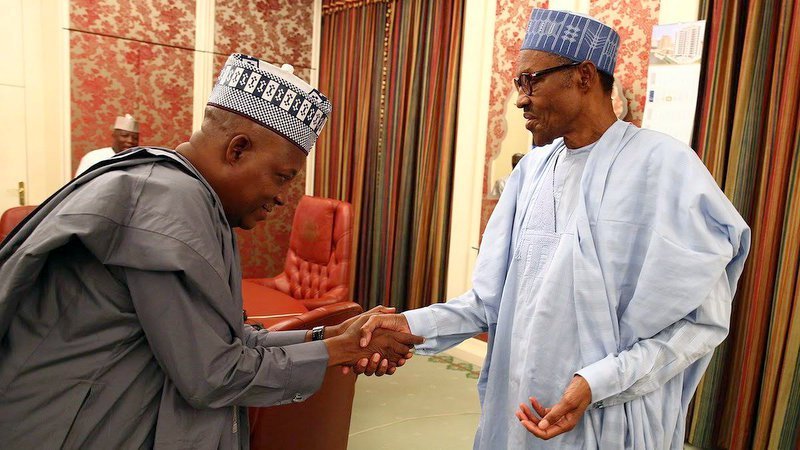
It is no longer news that Asiwaju Ahmed Bola Tinubu’s running mate in the 2023 Presidential Election, Kashim Shettima, has recently said that Nigeria needs a new President who would continue from where President Muhammadu Buhari stopped, First, let it be stated that the unintelligible and scattered-brained utterances and remarks of Mr. Shettima since he became the running mate of Tinubu not only portray him as unfit to be the next Vice-President of Nigeria but also buttresses what the public already know about the APC: that the party has woefully failed Nigeria in the last seven years and therefore should be voted out of power in 2023. Out of the abundance of the heart, we have been told, the mouth speaks. Anytime Tinubu and his running mate Shettima open their mouths in public to speak, we are more and more convinced that the duo do not possess the lowest common acceptable character to be entrusted with the affairs of their fellow men in 2023. Regardless of the iniquitous baggage trailing the candidacy of Tinubu and Shettima, mere listening to the duo evokes a sense of repugnance, alienation and rejection otherwise how can Shettima be saying that we need a President who would continue from where President Buhari stopped. Where did Buhari stop, if I may ask Mr. Shettima?. In festering corruption?. Or, in insecurity?. Or, in wooden-headed?. Or, in cluelessness?. Or, in imposing a corrupt and incompetent ex-Chief Justice of Nigeria on the country?
The most significant achievement of the Buhari government in the last seven years is to drag Nigeria into the membership of failed States. This is not surprising. A country reapeth what it soweth. In the last seven years President Buhari has been sowing nepotism (Fulanization), Islamization of Nigeria, banditry, political failure, economic failure, incestuous narcissism and wooden-headedness. Small wonder we are harvesting chaos, anarchy and helplessness today. Imagine the most populous and most richly endowed African country joining insignificant countries such as Somalia, Yemen, Democratic Republic of Congo, Central African Republic, South Sudan and Myanmar as a full-fledged failed State. The old image of Nigeria as a citadel of cultural and moral renaissance seems blurred. Amid the country’s abundant human and natural resources, there is insecurity, poverty, fear, suspicion, disorderliness, hatred and chaos everywhere. On social media, in the pulpit, lecturer rooms, market places, stadia and other fora, Nigerians soberly ask the following question: What does the future hold for us and our children? Amid the complete collapse of state machinery for protection of lives and property, anarchy has been let loose upon Nigeria. The Hobbesian bellum omnium contra omnes (war of all against all) characterized by barbaric abductions, assassinations, arsons, bloodletting, communal bloody feud, , kidnaps, banditries, gun running and so forth now reigns supreme in different parts of Nigeria including, for the first time, the hitherto peaceful Federal Capital Territory, Abuja. Amid the reign of mayhem in different parts of Nigeria, aggrieved ordinary citizens masquerading as “unknown gunmen” are now laying siege to different corners of the town and murdering their perceived victims. We now live in a country bereft of the rule of law. No law. No Justice. No peace either in men’s hearts because peace grows in the crannies of justice. While President Buhari is cluelessly junketing from one country to another, uncertainty, confusion, fear and apprehension rule our lives in Nigeria today. We now live in a free-for-all country where nobody seems to be in charge of anything or anybody. Imagine terrorists being allowed to blow open the Kudje Prison for their fellow terrorists detained therein to flee. In Nigeria we go to bed and wake up itching to hear the sad news of another abduction or murder. If the abductors are not on prowl trying to abduct their victims, the bandits are lurking in the corner to capture their next victims and kill them.
Is the foregoing the Buhari’s legacies which Shettima wants us to imbibe and continue to execute? The simple logic is that if President Buhari had sown the wind of corruption, nepotism, insecurity, Islamization of Nigeria, incestuous narcissism, stone-headedness and cluelessness, any President-elect who tries to imitate shall reap the whirlwind of corruption, nepotism, insecurity, Islamization of Nigeria, incestuous narcissism, stone-headedness and cluelessness on coming to power?. I still can’t understand why Mr. Shettima wants us to continue where Buhari stopped. In my part of the country, we only imitate successful people: we do not imitate a failure or a never-do-well. So, I can’t understand the point Mr. Shettima is making. Anyway, by the Grace of God, Tinubu and his running mate Shettima would not smell the seat of power in Aso Rock come 2023. In fact, voting out the APC in 2023 is no longer a civic duty or responsibility: it has become a moral duty. Why? Because Nigerians are being suffocated to death by the incompetence of this Buhari government.
At the moment Nigerians are no more living: they are just walking corpses waiting to collapse and die at the appropriate time. No food. No life. No employment. Only walking corpses are encumbering our streets and alley-ways. You can see how Buhari had imposed a corrupt and incompetent ex-Chief Justice of Nigeria on the country probably to destroy the remnant of good in the Nigerian judiciary. When the ex-Chief Chief Justice boggled his Senate screening exercise, I knew for sure that he was a disaster programmed to happen. What hasn’t this Buhari government done to undermine integrity in public life in Nigeria? This is why anybody voting for the APC in the 2023 Presidential election must go and have his or her head properly examined to ascertain whether or not he or she is mentally challenged. This Buhari government could be considered for inclusion in the Guinness Book of Record as the worst government on earth. So, beyond castigating APC’s Muslim-Muslim ticket, the electorate must not vote for the APC in the 2023 Presidential Election. Eleke the bird said that since men have learnt to shoot without missing, it has learnt to fly without perching. By the same analogy, since Tinubu and Shettima are hell-bent on continuing Buhari legacies of corruption, nepotism, insecurity, incestuous narcissism, Islamization of Nigeria, stone-headedness and cluelessness, the electorate should refrain from voting for Tinubu-Shettima in the 2023 Presidential Election.
The Osun State electorate has just made a bold statement by voting out the APC. The Nigerian electorate must follow suit in the 2023 Presidential Election. We have been enslaved for about eight years now. We don’t want another eight years of slavery. Oh! Lord, rescue us from the APC bondage. Oh Lord, let not our cries sink in silence at midnight. This is our land and the land of our ancestors. Protect us in it. Dislodge their plots and concoctions. They lay siege to the country expressways to kill us, we who are innocent, we who have committed no crime. Yet they want us to love Nigeria; they want us to dream of no other country except Nigeria. They want us to sing Nigeria’s National Anthem and recite her Pledge in order to feel proud that we are Nigerians. Yet they make Nigeria unlivable for us. In the last seven years the Fulani bandits, under the watch of the Buhari government, have been trying to dislodge us from the land of our ancestors. Yet this is our land. Poverty, hunger, and terminal illness continue to terminate our lives. Oh Lord, make haste to help us. Oh Lord, answer our prayers.
No man, no woman of good conscience listening to Shettima or reading Shettima can be at ease. Equally, no Street, no Broadway, no Village path in Nigeria can remain silent amid the stillness of death lying everywhere in different parts of Nigeria. With torn and bleeding hearts we may be smiling but we may not know peace until Nigeria is rescued from the iron grips of the evil politicians. Having been betrayed several times in the last seven years the Nigerian voters have no choice to vote out the APC in 2023. It is obvious that the Nigerian people have lost confidence in APC. At the moment Nigeria is being challenged on all fronts-politically, socially, culturally, intellectually and morally. The estrangement from pristine values finds dramatic expression in bullion-vehicle corruption, buying of votes, inordinate ambition to get rich quick at all cost, cheating, nepotism and fragrant violation of human rights and dignity.
In the last seven years we have been building a country with materially-rich political office occupiers who lack character. Many of our political office leaders have scandalously failed to live up to expectations in the last seven years. As I have constantly argued, we must restore the power of moral indignation in Nigeria. We must restore public shame in public offices in Nigeria. And the appropriate time to do that is in the 2023 Presidential Election. Before now our country had had some scoundrels in public office, but never before had a great number of scoundrels been in public office as in the last seven years. And the end of the vicious cycle is not in sight.
CHUKS ILOEGBUNAM offers an insider’s view of how Gov Peter Obi works and what values drove his actions as Governor. It’s the Governor’s birthday today 19 July.
Until the run up to the 2003 general elections, I was unaware of Peter Obi’s existence. Our first meeting was in Asaba late in 2002, when Dim Chukwuemeka Odumegwu-Ojukwu led an APGA delegation on a campaign trip to Delta State. I had travelled from Lagos to Asaba, to assist Prince Ned Nwoko, a friend from my London days, who was the APGA gubernatorial candidate for Delta State.
An excerpt from The Promise of a New Era, a book by Chuks Iloegbunam, out in August 2022.
Former Biafran Commando Colonel Joe “Air Raid” Achuzia led the Delta APGA reception team. With Ned exchanging pleasantries with some party supporters under a tree on the far side, I joined a handful of others who listened as Chief Achuzia stood by his car and delivered an impromptu lecture. This was happening on the grounds of the Grand Hotel, and while we waited for General Ojukwu’s team to arrive. Achuzia spoke on the need for everyone to always be on the alert for his or her safety. “If I got found today wielding an automatic rifle,” he said, “that would be trifling. I’ve gone past that age. But any of you young ones here with a job and salary for six consecutive months without acquiring an AK47 is foolish.”
Looking back now, I wonder whether Achuzia spoke in that vein because he had foreseen the calamitous security situation that has now drowned Nigeria. Anyway, Ojukwu’s convoy soon swept into the Grand Hotel. With the visitors from Anambra State, we formed a sizable crowd that soon plunged into a brightly lit hall.
With everyone seated and introductions concluded, Chief Ojukwu spoke on why APGA had become the “in thing, the party to belong to.” Deltans, he said, should elect Ned Nwoko their next Governor. Ned took his turn at the microphone, and thanked the party for reposing confidence in him by giving him its gubernatorial ticket. He described his electoral chances as bright and asked for everyone’s support. Peter Obi, the APGA governorship candidate for Anambra State, also spoke. He disdained the way politicians were carrying on and promised that, if he emerged victorious in the Anambra ballot, he would give his home state a new lease of life. “Is Anambra cursed, or are we the cause?” he asked. It was his slogan.
After the speeches, handshakes, backslapping and snacks, I seized a good moment to approach Peter Obi, asking where he could be reached for an interview.
“Onitsha!”
Fighting for a Mandate
Inever saw him again until months after the governorship ballot. I played no role whatsoever in his campaigns. But when INEC declared Dr. Chris Nwabueze Ngige of the People’s Democratic Party (PDP), the elected Governor of Anambra State, I became involved. The Ngige verdict raised a furore across the Igbo country. People were incredulous. Peter Obi headed for the Election Tribunal. I travelled East and interrogated the people’s misgivings. I returned to Lagos convinced that Mr. Obi had indeed won the election, only for his mandate to be stolen.
Indignant, I plunged into the fray, writing nearly fifty articles on the topic over the three years it took for the courts to restore Peter Obi’s electoral mandate. People approached me then from all over, pleading that I “die the matter,” because Dr. Ngige was, after all, my brother. “Both of you are from Idemili North Local Government Area, and his hometown of Alor shares a common boundary with Abatete, your hometown.” I didn’t want to know. Job offers and the promises of a glorious payday were thrown around but I remained steadfast with my pro-Peter Obi opinions in my Perspectives column in the Vanguard. All appeals for me to ditch my conviction amounted to hitting on a deer’s horns. My position was the same as I took in the matter of Chief M. K. O Abiola, whose June 12 1993 mandate was criminally nullified. As far as I was concerned, if someone won a properly contested election, his victory had to be upheld.
Thanks to Uncle Sam Amuka, the Chairman of Vanguard newspapers. And thanks also to Mr. Gbenga Adefaye, the newspaper’s editor. Not once did they impede the use of my weekly column for the advancement of Mr. Obi’s cause. After about three months of my continual articles on the Anambra election, Peter Obi invited me for a meeting. Only after Obi had become Governor did I learn the impetus for the invitation. Damian, Peter’s immediate elder brother, revealed that he was the one who advised his brother to meet with “this Chuks who, week in and week out, was championing our cause in the Vanguard.”
The book
The Enlistment
Idrove over to Peter’s office on Aerodrome Road in Apapa. The very large warehouse in the compound surprised me. How could this young man own this? I wondered. Our brief meeting marked my official enlistment in a cause I had been fighting on my own volition. I discovered that, like me, Peter lived in Festac Town. We discussed media strategy. From then and until he became Anambra’s Governor, we met regularly. Unless he or I was out of the country, or out of Lagos, we met practically every week. Otherwise, we chatted on the phone, discussing the progress of his case through the Election Tribunal and the Appeal Court, using such discussions to plot fresh manoeuvres for electoral justice.
I found myself touring media houses around Lagos, contacting editors, and features editors, and reporters, positing our points of view, writing rejoinders and rebuttals to stories coming out of our opponent’s camp.
At around noon on March 14, 2006, I was at home taking things easy when my phone rang. It was Peter Obi.
“Have you heard the news?” he asked.
“What’s the news?”
“We have won!” Before I could say “Congrats,” he continued: “Prepare to fly to Enugu tomorrow. Chief John Nnia Nwodo is waiting for you. You both are to write my inaugural address.” In Enugu the following day, Chief Nwodo and I sat in the study of his GRA Enugu home and pounded out a draft of Mr. Obi’s inaugural address. Meantime, Peter Obi, Emeka Etiaba, who since became an SAN, and Chief Victor Umeh, the APGA chairman, flew to Abuja to collect Mr. Obi’s INEC Certificate of Return. With all of us in Enugu on March 16, we put heads together and agreed the final text of the inaugural address.
March 17, St. Patrick’s Day, was inauguration day. From Enugu, we left early in the morning for Awka in a convoy of just three vehicles, with neither siren nor outriders. Peter Obi and I were in an SUV. The driver introduced himself as the Anambra Government House Chief Driver. As we approached Awka, I noticed that Peter was looking for something around the car’s panels. Not finding it, he asked the driver the button to wind down the window, saying it would be impolite for crowds to wave without his acknowledging their cheers.
All about cars
Sir, the windows are designed to be permanently shut. The vehicle is bullet-proof.” That week, we got a request from Ngige’s people asking to have the SUV and about four others back, they being the personal properties of Dr. Ngige. A cacophony of angry voices rose from all corners, saying the matter was unworthy even of discussion. If Governor Peter Obi had so desired, he could have kept the vehicles without the heavens crashing on any pates. Instead, he turned the matter over to Onyechi Ikpeazu SAN, who had successfully argued his governorship case. Dr. Ikpeazu studied all the papers and ruled that the vehicles rightly belonged to Ngige. They were turned over to Dr. Ngige who is alive and well, and who, without hesitation will confirm the veracity of this story.
There were a few Peugeot cars around. And those were the vehicles we started with. It made no difference to Peter because that was the brand of cars he had always used. But new vehicles had to be purchased. Commissioners would be appointed. And Permanent Secretaries and other senior officials too! None of them would be expected to be going about by “footwagen.” Governor Obi asked for quotes on the cost of Peugeot 406 cars from agents and from the Peugeot Automobile Nigeria (PAN) Limited in Kaduna. He ruled all submitted invoices outrageously high, especially as we were going to buy vehicles by the scores.
Closing from work one evening, Governor Obi mentioned that the French bosses at PAN would be in our office the following morning. He had invited them to a haggling match. “There is no reason I won’t yank a third off the price of each car we will be buying.” I grinned at his optimism. The men arrived as scheduled. In those early days, there were, apart from Mr. Uche Udedibia, the Permanent Secretary at Government House, and a handful of Civil Servants and members of our security detail, just four of us in the Governor’s Office. These were myself, the Chief Press Secretary, Mr. Mike Udah (Ojinnaka), Mr. Emeka Odumegwu-Ojukwu Jnr., and Chief (Mrs.) Uju Okeke, a retired Civil Servant and APGA leader who was fondly called Mkpulunma because of her beauty. Her son and Peter Obi were mates at Nsukka. Valentine Obienyem soon joined us.
We played no role in the haggling, which lasted all morning, with the Governor engaging three white men. At some point, Emeka Jnr was asked into the conversation – but only as an interpreter, because he was perfectly bilingual in English and French. He went in when the Governor sensed that the fire of his pitch was being tamed by linguistic inexactitudes.
By the time the match ended, I couldn’t swear that the PAN trio represented the happiest salesmen in the world. But Peter was beaming. “I told you I would do it.” At what cost? “They had me sign an undertaking that no other Governor would hear of the deal, lest they invade Kaduna asking for similar concessions.”
A master in frugality
All through the years we fought to reclaim his mandate, I hadn’t any inkling that Mr. Obi was a past master in frugality. The Peugeot deal opened my eyes. More was to come. Not being an old capital, Anambra had neither guesthouses nor enough living quarters for public officials. Some of us stayed in hotels for many months. When, one day, I told the Governor how much it would cost for us to move into Parktonia Hotel, which appeared more conducive, he said it couldn’t be true. He accompanied us to the place and out came his calculator. For many minutes he and the hotel’s manager kept hitting at the keys of their calculators. At a point, Peter asked for the hotel’s owner. Told that the man was away, Peter retorted that he obviously owned a cell phone. In the end the cost of our stay at Parktonia was cut by nearly a half.
Even on the international scene, his frugal disposition was always there, more acute, really, since expenditures abroad were mostly dollar denominated. I remember when we attended the World Igbo Congress convention in Detroit, Michigan, in 2007. It was an important convention with the theme of Repositioning the Igbo Nation, and all South East Governors were to attend. I wasn’t in the Anambra delegation; Mr. Obi was always averse to outsized delegations. But I was in the US on vacation at the time. Governor Obi, Chief Victor Umeh, the APGA Chairman, and Valentine Obienyem arrived with a morning flight the day the event started. Whenever schedules allowed it, Governor Obi would get into a country in the morning, conduct his business quickly and leave by evening flight, thereby avoiding the expenses an overnight stay would incur. I received the Governor’s team at the lobby of the hotel where the meeting held. The opening ceremony was seven hours away. Governor Obi said he was not prepared to take a suite in the hotel when he won’t spend a night on American soil. But Chief Umeh argued that the sight of a State Governor sitting out hours in a hotel lobby would be unfortunate. Obi didn’t take a suite. Fortunately, he didn’t have to spend hours hanging around a hotel lobby!
Corruption and the banks
Sometimes, Obi’s fastidious predilection to money matters score really big. We were in the office one day at around 9pm. The Civil Servants had long gone home. Only the security men and a few protocol officers and drivers remained. I was in my office with an eye on the window, to know exactly when the Governor called it a day. Instead he phoned me to come. I quickly strode across to his office. He was seated behind his desk a document in hand. Standing there, I waited for instructions. He waved me to a seat.
“A banker is going to lose his job tonight,” he said. He handed me a document. It was a statement on funds wired into one of Anambra’s bank accounts. As I handed it back, he showed me a second document. He soon eased my raised eyebrows. A bank manager in Awka had an hour earlier presented to him the balance of Anambra’s account in his bank. Obi was sure that the amount shown to him was incorrect. He, therefore, asked the banker to return to his office and do a recheck of his books.
The Governor and I engaged in small talk while we waited for the banker’s return. The Governor’s ADC soon ushered him into our presence. He was decked out in a dark suit and striped tie.
“Your Excellency, the original amount I submitted is correct.” He placed a sheaf of computer printouts on the Governor’s desk. Without casting a glance at the paperwork, the Governor reached for a drawer and pulled one of the documents he had earlier shown to me. He handed it to the man.
“How come your papers have no entry on this payment?” The banker swallowed hard. “And this too.” He handed over the second document. The air conditioner was on. But the banker started to sweat profusely. I expected the Governor to start railing at him. Instead, he gently told the man to leave. As he trudged the short distance to the exit, the Governor delivered a one-liner: “I will shortly be in conversation with your Chairman and MD.”
With this story in view, consider the debacle in Abuja where, under the watch of a confirmed epitome of financial prudence, Ahmed Idris, the Accountant General of the Federation, made away with the gargantuan sum of N80 billion. If N80 billion is too hefty for people’s psyche to easily handle, they could recall only the N2 billion of Federal pensions fund plundered by Abdulrasheed Maina. It is because of the thieving spree promoted by derelict leadership that kleptocratic vultures are antipathetic to the idea of Peter Obi directing the affairs of this country. For, under his watch, the very fear of assorted nemeses would never allow even the most seasoned of financial bandits to tamper with state funds.
Look again at the story of the middle-ranking banker that tried to rid Anambra State of a cool N100 million. He forgot that Peter Obi became Governor straight from being a bank chairman. He didn’t know that ever before Mr. Obi sends someone on an errand, he would have looked at all sides of the assignment from multiple angles and various sources. There is no doubt whatsoever that local bank officials, invariably in collusion with bosses at headquarters, routinely fleece countless states. And because every government in the country has multiple accounts in numerous banks, fraudsters and freeloaders have field days diverting state funds in the direction of their greedy pockets. But no one tried such nonsense with Peter Obi.
Like fable of the sour grapes
It was because Peter Obi is proficient in money management that he saved up billions in investments and raw cash that he handed over to the government that succeeded his. It was his frugality that made his government about the only one in Nigeria that never borrowed a dime. I often heard him say that, “Money is meant to be saved, not to be spent,” a clear commentary on financial thriftiness. In reality, what he practiced in government, and what he practices in his business affairs, is to scrupulously save money and to spend it only when it was absolutely necessary. Unlike Peter Obi, many heads of government don’t even bother to scrutinise bank returns presented for their signatures. But eagle-eyed Peter Obi examines everything with a fine toothcomb. He does so as a matter of course. He does so with regularity.
It is because everything is fair in Nigerian politics that people reeling in ignorance and those playing plain dirty accuse Peter Obi of achieving nothing while in government. We already mentioned that his government never indebted Anambra State. We also added that he left billions for the government he handed power over to. Yet, he that was tagged stingy achieved so much as Governor that most of his gubernatorial contemporaries can only turn green with envy. A different chapter takes a comprehensive look at his achievements in government. Suffice it to mention here a few of them, taken from the fields of Education and Health.
Return of Schools
One evening, a protocol officer came and announced that the Governor required my attention. I picked up pen and paper and went to answer the summons. At the entrance to the Executive Chambers, I saw the Governor and two visitors emerging from his office. So, I waited for them to reach me. Right there he thrust a piece of paper in my hand. “Go and write a press release on these schools we are returning to their original owners.” I glanced at the paper. It contained something between twenty-five and thirty secondary schools, all to be returned to the missionaries. Unguardedly, I remarked that it didn’t contain the names of privately owned schools that also came under the hammer of government takeovers.
“Uncle Chuks. Go and do as I’ve instructed!” It was a rebuke.
“Of course, Your Excellency.”
Less than twenty minutes later, I returned with my draft. He read and approved it. As I wheeled around to go call in the Chief Press Secretary and the Government House media crew, he said I should not release the statement yet. My spirit crumbled. I thought that, perhaps, in the little time it took to write the statement, people opposed to the return of schools to their original owners had thrown a spanner in the works. It was always a most contentious issue, right from 1970 when the Administration of the defunct East Central State headed by Mr. Tony Ukpabi Asika took over all the schools built and previously managed by the churches, communities and private educationists. But no one had had the courage to cancel the ill-conceived action.
It turned out that no one was playing the spoiler. Only that the Governor thought it would be improper for the heads of the two main denominations to first hear the news via the media. Therefore, he directed that I should go brief Archbishop Maxwell Anikwenwa of the Anglican Communion, and Bishop Simon Akwali Okafor of the Catholic Church on the development. After that, the press should be brought into the picture. Okechukwu Okeke, my driver, drove me and Ubaka Nkwoka (Mmagha), my personal assistant, the short distance to Archbishop Anikwenwa’s court off the Aromma Junction. From there we crossed the Enugu-Onitsha expressway and drove into the other half of Awka where Bishop Okafor’s residence sat on the grounds of the old St. Patrick’s Cathedral. Both prelates were overjoyed.
Thereafter, we shared the statement to the media, asking that it should be in the news the next morning. However, when I got home later that night, a neighbour enthusiastically welcomed me with the story that a special radio announcement had mentioned that Governor Obi had returned to their owners all the schools government took from them more than three decades earlier.
My neighbour was right, but not completely so. The first announcement was of secondary schools. It took place in January 2009. Nearly three years later, on November 22, 2011, Governor Obi announced at a formal ceremony in Awka, the return of 1,040 primary schools back to their original owners, and gave them N6 billion to maintain the schools.
Said Governor Obi: “The collapse of education in Anambra State is directly connected to the takeover of schools owned by the missionaries, churches and voluntary organisations in 1970. That singular exercise signalled the disappearance of morality and the building of character from our school system. This can no longer be allowed. Any society that deliberately allows its educational institutions to fall into stupor has already arranged the burial ceremony of the leaders of tomorrow. A progressive leader who sees danger for his people must take serious, radical actions, even if they are unpopular, in order to bring renewal and re-birth…We are not abandoning these schools, in the name of handing them over, because the State Government will continue to pay the salaries of all their academic and non-academic staff; while the Missions will be in charge of the day-to-day running and general administration of the schools.”
Dr. Valerian Okeke, the Catholic Archbishop on Onitsha, speaking on behalf of the missionaries, addressed the Governor thus: ”You have written your name in gold and you have wiped the tears of our people. You have rectified the anomalies of the civil war and rectified the fault of past leaders. With this action the church has forgiven them for forcefully taking our schools.”
Reaping the dividends
The Obi administration procured and distributed over 30,000 computers to secondary schools, 22,500 of them from Hewlett-Packard (HP). It was the first administration in Nigeria to achieve such a feat which Mr. Fabrice Campoy, the Managing Director for Personal Systems Group HP Inc, described as the biggest of such projects in Africa and the Middle East.
In addition, the Anambra State Government provided Microsoft Academies to more than 500 secondary schools. Mr. Ken Span, the Head of Microsoft in Nigeria described it as the biggest such deployment in Africa. All the secondary schools that got the Microsoft Academies were also provided with Internet connectivity. Mr. Gerald Ilukwe, the CEO of Galaxy Backbone characterized it as incomparable to any in the annals of Internet connectivity in the country.
It did not take time for Peter Obi’s innovative interventions in Anambra’s education sector to start yielding positive results. In three years Anambra jumped from the 24th position to the 1st of the nation’s 36 States in results of the National Examination Council (NECO), and the West African Examination Council (WAEC). Little wonder that Anambra State has about the highest cutoff marks for common entrance examinations into secondary and tertiary institutions.
Health & Wellness
The results in the Health Sector under Governor Peter Obi are equally spectacular. His government conceived and built the Chukwuemeka Odumegwu-Ojukwu University Teaching Hospital in Awka. His Government also built a medical centre where heart operations are now routinely performed. The idea of the heart centre grew out of a chance meeting between Mr. Obi and Dr. Joseph Nwilo, a celebrated Anambra-born cardiac surgeon based in the United States. Obi asked the doctor to relocate to Nigeria to continue his life-saving operations. Dr. Nwilo said he would gladly oblige on the condition of a well-equipped hospital. The cost of setting up the facility was computed. It came to N1 billion. Governor Obi instantly disbursed the fund. On August 3, 2014, months after Mr. Obi had completed his second tenure and left office, the first open-heart surgery was performed at the Joe Nwilo Heart Centre at the St. Joseph’s Hospital, Adazi Nnukwu, Anambra State. The record-setting feat was performed by Dr. Nwilo and a team of 14 doctors.
While Peter Obi had the foresight to establish a centre for heart surgeries, one of his fellow presidential contestants, said to be the best black phenomenon since the abolition of the slave trade, used up the thirty-one days of a whole month in a London hospital, fixing a dislocated knee.
Mr. Obi’s government won the $1 million Bill and Melinda Gates Foundation Prize as the best-performing state in Immunisation in the South East geopolitical zone. The government added to the prize money to build, in partnership with the churches, ten Maternal and Child Care Centres across the State, especially in the rural communities.
Ethics and good governance
There are other aspects of his administration that marked Peter Obi out as exceptional, patriotic and visionary. He had absolutely no truck with nepotism. Through the five years I served in his administration, not one person from his own Anaocha Local Government Area was appointed a Commissioner. He felt it would be unfair to the other twenty local government areas. His governorship was enough slot for his LGA. Compare this to some other leaders whose appointments are based on cronyism, biological affinity or religious considerations.
I remember that shortly after he assumed the governorship, pressure started piling for him to tar one of the roads that ran through Agulu, his hometown. Obi refused, insisting that road construction had to be based on need, not on where a Governor or a powerful politician came from. Dame Virgy Etiaba (Mama Anambra) later awarded the contract for the construction of the road in question when she became Governor. This happened when Obi stood unjustly impeached by the PDP-controlled State House of Assembly. Mama Anambra is alive and well to confirm this story.
His records speak for him
Everything written here is verifiable, as is the fact that Peter Obi spent the normal four years at the University of Nigeria, Nsukka, to earn a Bachelor’s degree in Philosophy. He entered Nsukka in 1980, the same day Mike Udah, who became his Chief Press Secretary, did. They both graduated the same day in 1984, with Peter earning a Second Class Lower degree. All the talk about Peter using up 12 years to earn a first degree is bunkum. Nsukka University records have not been deleted. Peter’s academic records are easily verifiable, unlike those of some other presidential candidates of unknown schools and unregistered certificates.
Since December 2020 when Peter Obi and I met in Ajalli at the funeral of Dr. Arthur Nwankwo, the Chairman of Fourth Dimension Publishing Company in Ajalli, we haven’t seen again. Our last communication took place on May 18, 2021, when he texted me from London to wish me a “Happy Birthday.” I replied him with a “Thank you, very kindly.” Since the political warm-up started for the 2023 general elections, I have keenly followed his progress and those of other politicians. Still, I saw no reason to contact Peter. I didn’t tell him that I was writing this book. I didn’t owe him that information. I simply saw my duty only in terms of telling the truth of my personal experience of his political leadership and, thereafter, dare anyone with a contrary opinion to controvert my thesis.
Few people know Peter Obi and his work ethics more than I do. That is why I can with authority say that the avalanche of lies being bandied about regarding him is to do with the desperation of drowning politicians futilely clutching at straws. They shamelessly lied through the teeth who have accused Governor Obi of being anti-Muslim and anti-North. What I know is that during Islamic festivals he always feted Muslims, leaders and non-leaders alike, either at Government House, Awka, or inside the Government Lodge, in Amawbia. Not even Peter Obi himself will deny that we annually sent cattle by the lorry load to Abuja, for officials at the Anambra Liaison office in the Federal capital to distribute to assorted political leaders.
Peter Obi served as Governor of Anambra State for eight years during which period he never went on vacation for a single day. During his tenure, there hardly was a time when stayed abroad for more than one week. Before he handed over power to his successor, he did not load to his convenience such outlandish pensions and gratuities as many a governor found irresistible. He didn’t ask for and was not given a house or houses by the state. He didn’t ask for and was not given a car or cars by the state. He didn’t factor into Anambra’s governance any contractual agreements to his benefit whatsoever, let alone the sort seen in many other states that have left them hemorrhaging.
Why he’s in politics
The truth about Peter Obi is that he is into politics with a consuming zeal to serve the people. Apart from when he was not in Awka, he mostly reported for work at 7 am everyday, and never closed until nightfall. It was, of course, a burden. One morning during our first months, I entered the Governor’s office and found him lying on a couch. Startled, I asked what the matter was. He thought it was an attack of malaria. Asked if I should fetch Dr. Ezenwa of the Government House Clinic, he demurred. At that moment, Damian, his elder brother, who was on his way to Enugu stepped in. He was sure the Governor’s problem was overwork. As I saw him to his car, he said, “Your friend listens to you. Please advise him to slow down.” Quickly back again inside his office, I found the Governor Obi at his desk – working!
“Sir, why are you back at your desk working?” I asked.
“I didn’t come here to fall sick” he replied. We didn’t leave the office that day until well past 7pm.
Because of his sterling achievements, adversaries have been mushrooming even from the woodworks, spewing lies and many more lies, all aimed at assassinating his character and rendering his presidential bid a nullity. How woefully the detractors are failing! People of this country, across all the states, through ethnic barriers, religious divides and conspiratorial animosities have stood out resolutely for him. For one reason. They want the country to take a decisive turn for the better. They want the country to turn its back to the ruinous politics that, to this moment, has held the country in the throes of grinding poverty, endless bloody conflicts, empty stomachs, leaking pockets and utter hopelessness.
The Nigerian peoples have examined Peter Obi and have also examined the others busily digging above their limits and purporting to be aiming for the highest office in the land. They have found that Obi is the way to go. Not because his initials are P. O., but because he represents a breath of fresh air in comparison to the malodorous stench of the capricious lot that have carpeted a country once bound for glory. The Nigerian peoples have taken to heart the admonition of Marcus Aurelius, who was the Roman Emperor from 169 to 180 AD. In his book, Meditations, is to be found countless arresting gems of quotable quotes. For instance, Emperor Marcus had this to say on the evil conspiracies to destroy genuine servants of the people: “When a bunch of known corrupt people unites against one man and spares no attempt to assassinate his character, blindly follow that ONE man.”
The Nigerian people have wisely decided to follow Peter Obi. Without question, Obi’s traducers belong largely in the category that cannot show their certificates, that are incapable of pointing out their ancestral homes, that frittered away the peoples’ commonwealth, that, with effrontery and impunity, pissed on all the citizens’ heads on the pretext that it was raining. That is why they decided to go with him. The people are insisting that the days are now in the past when they could be hoodwinked with the inanity that a receipt acknowledging the payment of electricity tariffs, or the label on a loaf designating its baker was enough certification for educational qualification. The people have decided the intolerability of ailing, nonagenarian leaders that would, every two minutes, be stretchered into air ambulances for medical tours of American and European capitals.
The tremendous thing about the positive developments of this New Era is that it is youth led. The youths are sick and tired of the interminable strikes by university teachers. They are fed up to the hairline with the incessant bloodbaths in places of worship, in villages, in townships, on farmlands. Their acclamation for Peter Obi rebukes a bedraggled leadership coterie of insensate hoodlums that is suffering from a crippling paralysis of the will to take remedial actions against vicious and incessant terrorist attacks that have rendered Nigeria about the most dangerous place to live in the whole wide world.
In every clime under the sun, the tired take a rest. Even God Himself rested on the seventh day of His run of creations, according to Genesis 2:2. But Nigeria is suffocating from the wiles of exhausted and panting Methuselahs who deserve a place by the fireside singing lullabies to their great grandchildren, but who insist on participating in political marathons they lack both the steam and the fuel to feature in. This impunity is precisely what has stoked Nigerian youths into open revolt. Happily their armament, for all its lethality, is solely the Permanent Voters Card. They have taken to heart the pronouncement of Chief Obafemi Awolowo, the sage, who famously prophesied that “A day will come when Nigerian masses from the North and South, Christians and Muslims and Animists will merge as a force for progress and unity, and kick against rigging, corruption and tyranny.”
Celebrating the youth
The Nigerian youths are to be celebrated. They are this country’s division of the global moral army that the American actor Harrison Ford spoke about when he addressed the United Nations Climate Action Summit in New York on September 23, 2019. Said Mr. Ford:
There is a new force of nature at hand, stirring all over the world. They are the young people, whom frankly, we have failed, who are angry, who are organised, who are capable of making a difference. They are a moral army. And the most important thing that we can do for them is to get the hell out of their way.
Nigerian youths have rejected the politics of the retrograde class, together with their avarice, mendacity and equivocations. They have abjured carrots thrown at them in the form of job offers as “Internet consultants.” That would have conscripted them into the ragtag army of social media marionettes fitted with cell phones and inexhaustible data, to sustain a campaign of calumny and perfidy against Peter Obi. They have called the bluff of faceless marauders in cyberspace, who have been employing false aliases, to impugn Peter Obi’s integrity. Nigerian youths are not asking for remuneration. They are not asking for bags of rice and cartons of “agbado”. They are no longer interested in their future being mortgaged. They would have nothing more to do with bloodsuckers that shamefacedly denied the massacre of young blood at the Lekki Tollgate. They want new. They want sparkling. They want whole. They yearn for a New Era. They shall vanquish.
This, then, is the score. For the rationale, the purpose of elections is to put in office the competent. From every available empirical evidence, Peter Obi trumps the tired and recycled candidates of the old order in this Department of Competence. Whoever does not vote for him in 2023, will no doubt have his or her reason. But it will be nothing to do with the imperative of competence. This is my testament. I stand resolutely on it.
ABOUT THE AUTHOR
CHUKS ILOEGBUNAN was Governor Peter Obi’s first Chief of Staff. He is a renowned critic, polemicist and author of many books, including IRONSI: NIGERIA, THE ARMY, POWER AND POLITICS.
The internet was once again agog on Sunday July 17, 2022 with a viral video showing a man videotaping one of the serving Ministers of the Federal Republic of Nigeria in what appears to be a restaurant located in one of the cities in the United States of America. The perpetrator, whose Nigerian identity was fairly exposed by certain words he uttered in Yoruba language, later identified himself in the video as a Nigerian based in the United States. The Minister in question, Mr. Rauf Aragbesola – Nigeria’s Minister of Interior, was seen resisting the invasion of his privacy by the unidentified man, thus creating an ugly scene of pandemonium in the restaurant to the utter dismay of spectators and embarrassment of the Honorable Minister. The unidentified man videotaping the Minister was heard arguing that his action was within ambit of the American legal system which entitles him to exercise such freedom.
A close consideration of the actions and arguments of both parties may appear a bit confusing in determining who among both of them is right. One may ask, is the purported act of the man videotaping the Minister against his will, right? Was his justification for perpetrating such action legally in order? Is the Nigerian Minister entitled to his right of privacy, especially as a public figure in America?
Before answering the above posers, I will start by commending the uncommon liberties enjoyed by citizens and residents of the United States of America as facilitated by its Federal Constitution together with the various amendments therein, even though same may be sometime susceptible to abuse as was evident in the extant case under consideration. However, unlike other climes in Africa, the replication of this U.S legislative feat is far from reality. No wonder the unidentified man under context appears somewhat too excited to do what he was doing, knowing fully well that similar privileges are not available to anyone back home where he came from.
Right to Press Freedom as Protected Under the First Amendment to the Constitution of the United States of America
The Federal Constitution of the United States of America, under its first amendment, enables the rights of individuals to photograph and videotape public figures in public places. First, it must be reemphasized that the person whom the action is carried against must qualify as a public figure (E.g., a government official, politician, celebrity, diplomat, business tycoon, royalty, anyone with high social standing etc.). Secondly, the place in which the person is located must qualify as a public place.
This law therefore, gives anyone in the U.S the right to photograph or videotape the actions of public officials like Police officer, when carrying out their official duties in public places. The law further denies these Police officers or public figures the authority to demand, seize, search, deletes or destroy either the device or the contents of the device used for such recording, unless upon the show of a search warrant validly issued by a competent court in the U.S and sighted by the perpetrator. It is also worthy of mentioning that the American Supreme Court, in the case of Burstyn V. Wilson, 343 U.S. 495 (1952), has further extended this right to include film making. It is submitted that the right of press freedom enabled by the first amendment to the Constitution of the United State of America is arguably the law that facilitates the now trending business of paparazzi in today’s America.
Having laid a brief foundation of the imports of the first amendment to the U.S Constitution with regards to press freedom, it becomes germane to critically examine its purports on the action of the unidentified man to the Nigerian Minister of Interior.
The American draftsmen were deliberate to use the word ‘public places’ in the first amendment. The issue for determination therefore, is whether or not a restaurant likened to the one which the Nigerian Minister of Interior was seen having his meal, could qualify as a public place within the contemplation of the first amendment.
Public places as far as the first amendment to the U.S Constitution is concerned, could be best described as government owned buildings, properties, businesses, establishments, or institutions which the government of the United States of America possesses certain equitable shares and which are located within the U.S. In other words, properties, facilities or businesses which the United States Government do not have direct or indirect pecuniary interest, and which in all ramification has no element of government ownership, cannot be said to qualify as public place. On the contrary, such places are deemed to qualify as private places, which entitles the private owners the right to set rules and regulations on how activities may be carried out within such facilities. Presumably, it may be safe to conclude that, given the physical appearance of the restaurant in the viral video, it depicts that same may be owned and operated as a private business.
Having alluded to the possibility of the restaurant being a privately owned business, it is submitted that same does not qualify as a public place withing the contemplation of the first amendment to the U.S Constitution. It is therefore, further submitted that the action of the unidentified man videotaping the foreign official is apparently wrong, as same violates the right to privacy of Minister Aregbesola. In this vein, the likely remedy available to the proprietors of the restaurant against the alleged offender is to hand over the man to the Police for harassing their client and for engaging in acts capable of breaching public peace. On the other hand, the Honorable Minister of Nigeria may elect to institute a private action under tort against the alleged perpetrator.
The above submission happens to be a segment of my argument and the attendant implications of the unruly actions against the Nigerian Minister. The second and most fundamental part of my argument and implication is the one facilitated by International Law, and whose effect may vary depending on the capacity in which the said Minister travelled to America.
US Federal Law that Protects Foreign Officials, Internationally Protected Persons and Official Guest.
Assuming that the Nigerian Minster of Interior travelled to the United States of America in his capacity as a serving foreign Minister, he is deemed to be protected under a U.S Federal Law known as the Protection of Foreign Officials – Internationally Protected Persons and Official Guest – 18 U. S. Code § 112. By the provisions of this law, the government of the United States of America is seen to have committed itself to protect any foreign official, foreign guest or internationally protected person from acts of endangerment whenever they are within the territory of the United States of America. In an attempt to paraphrase the said Federal Law, the law provides under paragraphs (a) to (c) that, anyone who attempts to, or willfully engages in acts of assaults, strikes, wounding, imprisonments, violence, intimidation, coercion, threats, harassment, attack, obstruction of officer from carrying out official functions and endangerment of the liberty of persons within the territory of the United States of America, would be liable to a fine, or 3-10 years imprisonment or both.
Paragraph (e) of that section of the law further provide that the alleged offender may not necessarily be a citizen of America, as an alleged offender who, though not a citizen of America, is later found in America, would also be apprehended and made to face the consequences of his/her actions. However, it must be mentioned here that by virtue of Paragraph (d) of the section of the law under consideration, these provisions are expressly made subject to the rights protected under the first amendment to the constitution of the United States of America as earlier discussed.
Following from the above cited legal provision, it is clear that the American Government have an obligation to protect the right of the Nigerian Minister of Interior, either as a Foreign Official – where his visit to the U. S is considered as official, or as an Internationally Protected Person and Official Guest – where it appears that he didn’t visit in his official capacity, and in view of his capacity as a high-profile visiting Government Official of the Federal Republic of Nigeria. Since the ‘did has been done’ the Government of the United States is left with the option of arresting and prosecuting the alleged offender in accordance with the dictates of this law regardless of the nationality of the offender, since the offence was committed within the U.S territory and the perpetrator is still domiciled within the U.S. This step, if taken, will build up diplomatic confidence between the government of the United States of America and Nigeria and would further strengthen the existing diplomatic ties between both governments.
Finally, if upon close investigation it is discovered that the alleged offender is a Nigerian citizen without any citizenship affiliation with the United States of America, the Nigerian Mission in the U. S may in collaboration with their American counterpart, commence the process of repatriation of the alleged offender back to Nigeria to face the weight of the law for his action as a citizen of Nigeria. This is in line with Nationality Principle recognized under international Law. This, in fact, should have been the action the Nigerian Government would have taken three years ago when the former Deputy Senate President – Senator Ike Ekweremadu – was assaulted in Nuremberg Germany in August 2019 by persons believed to be members of the Indigenous People of Biafra (IPOB). The same would have also been the approach of the Federal Government when a Vienna based Nigerian harassed some Nigerian Athletes in a bus in Austria in July 2021. Although I stand to be corrected, I am of the strong view that the governments of the United States of America, Germany and Austria all have bilateral ties on repatriation with the government of Nigerian, which would render the implementation of the above suggested approach possible.
Conclusion
Incidences of harassment of public officers from Nigeria by Nigerians in foreign countries is now very rampant. Conscious efforts are expected from the federal government to put an end to this ugly trend. The federal government of Nigeria must not just as usual, make official statements condemning such actions but take decisive steps towards putting an end to it. This could possibly be achieved by the Nigerian government if it takes advantage of the provisions of relevant international instruments and domestic laws of the receiving states where such public officials are being subjected to unwarranted harassments and abuse, to effect justice on perpetrators. This measure, if effectively explored, is capable of deterring future offenders, and making bare the likely implications for perpetrators of unpatriotic actions on foreign soil, thereby underscoring the truism of absence of territorial limitations for punishment of certain offences with extra-territorial flavours.
Prostitution: A Legit Business and the Reflection of the Demarcating Lines of Legality and Illegality in Nigeria.
By Samuel Oloumu
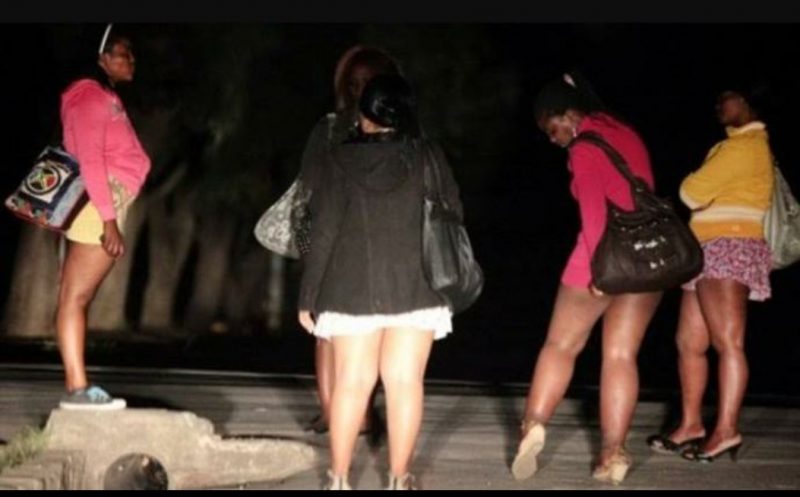
Did you know that “Olosho”, “Ashawo”, “public toilet” as innocent and “virgin-Nigerians” angrily call them are actually not breaking any law in Nigeria? Don’t be shocked if I reiterate that prostitution is a legit business in Nigeria. Prostitution is condoned and tolerated in various forms and manners. Paying for sex in cash or in kind is part of day-to-day social relationships.
Religious critics, law and policy makers might be prone to argue that such a law violates the religious and cultural values of the people. However, this disposition says very little in terms of what goes on in real life. While they see the religious side of it, they should at least see it reflected in terms of the legal and everyday experiences of people.
A crime or an offence is never created by morals but by law. So, an act can be a SIN but not a crime and you cannot arrest any person for committing a SIN in any part of Nigeria. The punishment for sin is judged by God but that of crime is earthly and punishment is awarded by man to man. As a result, prostitute are sinning against God not the government and if punished will be a rape of the ordinary law of the land.
No particular part of the Constitution prohibits prostitution in Nigeria.
However, sections 223 of the Criminal Code states that: “Any person who procures a girl or woman who is under the age of eighteen years to have unlawful carnal connection with any other person or persons, either in Nigeria or elsewhere;
“Or procures a woman or girl to become a common prostitute, either in Nigeria, or elsewhere;
“Or procures a woman or girl to leave Nigeria with intent that she may become an inmate of a brothel elsewhere;
“Or procures a woman or girl to leave her usual place of abode in Nigeria, with intent that she may, for the purposes of prostitution, become an inmate of a brothel, either in Nigeria or elsewhere; is guilty of a misdemeanour, and is liable to imprisonment for two years.
“A person cannot be convicted of any of the offences defined in this section upon the uncorroborated testimony of one witness.”
Chapter 532 of the Penal Code Act, Federal Capital of Abuja, 1990 criminalises prostitution and solicitation of prostitutes. The law states that:
“An ‘Idle person’ shall include a common prostitute behaving in a disorderly or indecent manner in a public place or persistently importuning or soliciting persons for the purpose of prostitution.
“The term vagabond shall include any male person who knowingly lives wholly or in part on the earning of a prostitute or in any public place solicits or importunes for immoral purposes; and
“Whoever is convicted as a vagabond shall be punished with imprisonment which may extend to two years or with fine which may extend to four hundred and fifty naira or both.”
However, a careful perusal of the stated statutes shows that there is no Federal or Nationally enacted law against PROSTITUTION in Nigeria. Although, owing to Sharia Law in Northern states in Nigeria, prostitution is illegal and therefore prohibited in all Northern states that practiced Islamic Penal Code. As accordingly imprinted under Chapter 532 of the Penal Code Act, Federal Capital of Abuja, 1990. But however, the Penal Code that penalises people meeting with prostitutes or prostitutes meeting with other people might fail if tested in the court,” on the ground that the Right to Freedom of Association (as contained in the constitution) of the person has been breached. And If we are to follow this Constitution, that means; as a Nigerian, you are free to meet with whoever you want to meet with. Though, this might turn out to be flooded!
Interestingly, in all the Western, Eastern and Southern states of Nigeria, prostitution is not a crime. Hence the police CANNOT arrest prostitutes in such states. In Southern Nigeria, the activities of pimps or madams, underage prostitution and the operation or ownership of brothels are penalized under sections 223, 224, and 225 of the Nigerian Criminal Code. Even though Nigerian law does not legalize commercial sex work, it is vague if such work is performed by an independent individual who operates on his or her own accord without the use of pimps or a brothel.
Although the operation of brothels is prohibited in Nigeria, the truth is it still exists. There seems not exists a clear demarcation lines between an hotel and a brotel. Many places officially called hotels today, are actually brothels hiding under the guise of an hotel operating fulltime commercial sex with a string of workers. People on the streets in Lagos, Ibadan, Owerri, Port Harcourt or Calabar, in Abuja or Lokoja identified which hotels in these places were brothels or quasi-brothels.
Also, the Nigeria criminal system prohibits national and trans-national trafficking of women for commercial sex or forced labour. Nigeria is a signatory to the 2000 United Nation Protocol to Prevent, Suppress and Punish Trafficking in Persons, especially Women and Children. Therefore, owning/running a brothel, being a pimp, trafficking persons for prostitution, use of children as sex slaves and other similar acts are criminal in all parts of Nigeria.
Sex workers have been facing severe human rights abuses and multiple forms of discrimination in Nigeria. According to the Nigerian Constitution, sex work is not specifically criminalised, rather the people that ‘benefit from the proceeds of sex work’. Sex workers can be punished when caught negotiating sex ‘aggressively’ with a client.
In conclusion, there is a huge gap between what is allowed or not allowed or what transpires in everyday life under the various law in different countries. To this end, prostitution is a complex issue and its complexity is made manifest in the way it is regulated and practiced in societies across the world. This complexities and contradictions needs being untangled in order to come up with an effective, practical and more scientific means of addressing the issue of the sex trade in Nigeria, Africa, and the world.
28 November 1988 was a Monday. In Abuja, Nigeria’s Federal Capital Territory (FCT), a Constituent Assembly inaugurated by military ruler, Ibrahim Babangida, had been in session for just over six months, since 11 May 1988. At the helm as its chair was Anthony Aniagolu, then a recently retired Justice of Nigeria’s Supreme Court. He was a Christian from Enugu State. His deputy was Muhammadu Buba Ardo, then Chief Judge of the Gongola State, who died suddenly in 1991, two years after the Assembly completed its work. He was Muslim.
The Secretary to the Constituent Assembly was one Alhaji Babagana Kingibe, whom the country has since then got to know a lot more eloquently, a Muslim from Borno State. Kingibe’s assistant was Amal Inyingiala Pepple, who would rise to the height of the civil service in Nigeria, before retiring in June 2009 as the Head of Service of the Federation. She is a Christian from Rivers State.
In those days, Nigeria had 21 States: Akwa Ibom, Anambra, Bauchi, Bendel, Benue, Borno, Cross-River, Gongola, Imo, Kaduna, Kano, Katsina, Kwara, Lagos, Nigeria, Ogun, Ondo, Oyo, Plateau, Rivers, and Sokoto States plus the FCT.
The Constituent Assembly, which Justice Aniagolu chaired, comprised 567 members drawn from all these states. 458 were elected, while 109 were nominated by the federal government, including the Chairman and his Deputy (both of them male), and drawn from the ranks of judicial figures, senior lawyers, titans of industry, traditional rulers, experienced public servants and administrators, academics and other professionals.
At the submission of its report on 5 April 1989, the membership was down to 565, owing to the death of two members: Dr. Daniel Obasi Agbafor, an elected member representing Ohaozara federal constituency then in Imo State in south-east Nigeria, who died on Sunday, 14 August 1988; and Honorable Justice Umaru Agora Isiaku, a judge of the High Court of Niger State nominated to represent Abuja in the Assembly, who died on 10 October 1988.
Assembled to negotiate the terms of a constitution on the basis of which the Babangida regime claimed it would hand over power to an elected government at the end of its transition programme, the Constituent Assembly got into a very animated debate from October 1998 over the irrelevant issue – as Nigeria’s current ruling party, the All Progressives Congress (APC) would have us all believe) – of religion in Nigeria and the role it is to play in civic and constitutional life. In this debate, there was no quarter given nor taken.
So, on Monday, 28 November 1988, the Assembly received an unusual assortment of martial guests. They were led by Augustus Aikhomu, a Navy Admiral, and second in command to the military president. Accompanying him in full military uniforms were Air Marshall Ibrahim Alfa, Chief of Air Staff; General Alani Akinrinade, former Chief of Defence Staff; Major-General Paul Omu, Minister of Defence; Rear Admiral Murtala Nyako, Flag Officer Commanding Western Naval Command; Air Vice-Marshall Hamza Abdullahi, FCT Minister; Colonel John Shagaya, Interior Minister; and Mr. Victor Pam, Deputy Inspector-General of Police. It seemed evident that their mission was serious.
On arrival, Admiral Aikhomu proceeded to read a Riot Act to the Assembly, declaring, as Justice Aniagolu recalls in his memoirs on the making of the 1989 Constitution that was never promulgated: “the Federal Government has decided that this Assembly should stop further debate and discussion on these clauses.” As the Assembly wound down its work on 20 March 1989, Admiral Aikhomu wrote a letter (Reference: GS/CGS/235) to Justice Aniagolu as its Chairman ordering them to “insert into the Constituent Assembly Draft Constitution all matters and clauses of the Revised CRC Constitution which were excluded from the jurisdiction of the Constituent Assembly.”
In this way, the military retained ultimate decision making in resolving the matter of the place of religion in Nigeria’s life. To address that, they defaulted essentially to the framework agreed in the 1979 constitution when, as in 1989, the then military regime had also sent their second-in-command to order the Constituent Assembly gathered in 1978 to stop debating the matter before it got out of hand.
Four years after this uneasy settlement, Nigeria’s political elite reached an equally uneasy truce in order to hurry Ibrahim Babangida from his ruinous and interminable political transition programme. At the end of the truce, Moshood Abiola, a Muslim from Ogun State in Southern Nigeria teamed up with the aforementioned Babagana Kingibe for the ticket of the Social Democratic Party (SDP), which triumphed in the June 12, 1993 presidential election before being frustrated from taking over power when Babangida nullified the result of the election. The 1999 Constitution, which ultimately transitioned Nigeria to civil rule six years later, essentially defaulted to the 1989 settlement, which in turned accepted the 1979 settlement. Many people prefer to say that the constitutional situation is that “Nigeria is a multi-religious state.”
At both national conferences convened first by President Olusegun Obasanjo in 2005 and then by President Goodluck Jonathan in 2014, religion nearly derailed proceedings. Indeed, at the 2014 National Conference, it was reported that “religion pitched Nigerians against one another at the national conference with delegates disagreeing over religion.” The leaders who have led Nigeria until date have attempted to walk the fine balance that religion evokes in the country. Even President Muhammadu Buhari, often accused with some justification of being narrow on issues of faith, was not unmindful of the sensitivity of this issue when he declined the importunations of Bola Ahmed Tinubu, like Buhari a Muslim, to be his running mate in the 2015 presidential election.
The ruling APC has acted convenient on these issues, however, rather than principled. In 2019, Kaduna State Governor, Ahmad El-Rufai, in a fit of sectarian hubris, toppled the conventions of faith and ethnic balancing in the state when he decided to “pick fellow Muslim, Hadiza Balarabe, as running mate.” The correlation between this decision and the deterioration in coexistence in the state since then has been spectacular.
In explaining his choice then, El-Rufai claimed his only consideration was “competence”. In justifying his decision to choose fellow Muslim, Kashim Shettima, as his running mate for the 2023 presidential contest, APC’s presidential candidate, Bola Tinubu, has similarly argued the urgings of competence with a bit of history, claiming that “the spirit of 1993 is upon us.” Like El-Rufai, Tinubu’s position implies spectacularly that individual competence and religious harmony are somehow mutually exclusive. If he wins and the country emulates the trajectory of Kaduna State, the country could become a level killing field.
Tinubu’s cheap appeal to the heady events of 1993 mis-reads contemporary Nigerian history in support of convenient, dubious and patronizing nonsense. All this takes place in a country in which citizens have been immolated without consequences on specious claims of blasphemy and the Supreme Court has recently ruled that female, Muslim students in public schools have the right to wear religious covering, none of which would be the case if religion were such an irrelevance in Nigerian civic life.
The Abiola-Kingibe ticket in 1993 was a product of a peculiar inflection point in Nigerian history unparalleled since then and unlikely to be repeated. Since then, if anything, successive rulers, none more so than the incumbent regime of Muhammadu Buhari, have invested considerable energy in divisive and toxic politics and policies.
Indeed, as someone has rightly pointed out “religious balancing is one of the first factors in determining competence for a Nigerian presidential aspirant. He who fails in this is incompetent.”
Let us assume then that Tinubu and Shettima triumph at the 2023 presidential election and proceed to complete two terms. Power will thereafter be liable to rotate to Northern Nigeria, which will probably produce a Muslim. At the end of two terms of that person, following the two terms of Tinubu-Shettima and counting back to the two terms of Muhammadu Buhari, Nigeria’s presidency would have been occupied by a Muslim for pretty much a quarter of a century or for 27 out of 32 years going back to the administration of Umaru Musa Yar’Adua. Children born at the beginning of this period may end up with the impression that Nigeria is indeed an Emirate in which only Muslims are entitled to aspire to the highest office. The point really is that it is not.
A lawyer and a teacher, Odinkalu can be reached at [email protected]
Some time in December 1986, I arrived Rutam House, head office of The Guardian, to begin what turned out to be a 24-year-old exciting and fulfilling career in journalism. I had realized early that only hard work and dedication will take me far in the career; just as it has brought me on board the flagship of media practice. Therefore, I focused attention on efforts that will take me higher, including knowledge acquisition. From being a reporter, I diligently and patiently climbed through the ladder to edit one of the titles within The Guardian stable and then moved on to be part of the pioneering team of some of the notable newspaper brands in the country. I was privileged to have been invited at different times to be part of great teams that midwifed The Independent, ThisDAY, National Interest and then The Sun in 2003.
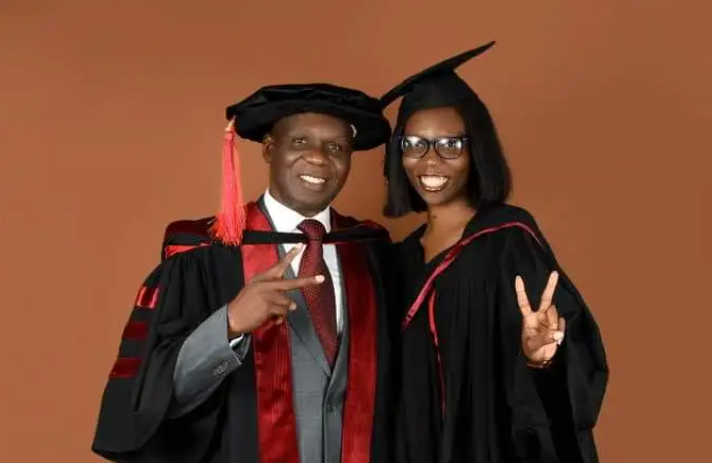
Dr. Tony Onyima and daughter, Nnenna
With a great team led by the irrepressible duo of Mike Awoyinfa and Dimgba Igwe (God bless his soul), we disrupted the newspaper business industry with exciting content and innovative distribution strategies. Seven years after (in 2010), I was given the rare privilege of leading the company as the Managing Director/Editor-in-Chief. Our mandate was to turn around the fortunes of the company and reposition it to be competitive in a digital environment. Halfway in the four-year tenure, I started thinking about life after the newsroom.
Among other couple of plans, going back to school to get a doctorate degree was but overarching. Anyone close to me then knew that I had become intensely obsessed with quest for knowledge. It was, therefore, not surprising that I ended up with three M.Sc. degrees in different disciplines. The knowledge picked up helped me tremendously in the latter part of my career. A doctorate, I had envisaged, will not just be an icing but would put one in good stead to participate actively in the knowledge production industry. Therefore, at the end of my tour of duty in December 2014, I had sufficiently primed my mind for a student life at Pan Atlantic University, Lagos where I had earlier gotten an M.Sc. in Media Enterprise. But Providence had a different plan. I was drafted to serve Anambra State as Commissioner for Information, Culture and Tourism. After a 14-month momentous and eventful public service, I returned to the dream and got admitted to Chukwuemeka Odumegwu Ojukwu University (COOU), Igbarium. Before I could accept the offer, I had a meeting with my family because my decision to go to school will affect them in one way or another. My children were happy but worried about the effects the school rigor would have on me. Nnenna, my second daughter was more interested in the length of the programme. I told her that, all things being equal, the programme will end in three years. If so, she reckoned that I might be graduating with her. The prospect excited her. Inwardly, I knew that things are not always equal in Nigeria.
Nevertheless, I plunged into the programme with much enthusiasm. After one and half years of coursework, I started losing steam. The toll was getting debilitating. My interest started waning. And the short lull caused by the university authority didn’t help matters. Then, one day Nnenna called. She wanted me to help her to source primary data for her final year project. After directing her where and how to source her data, she asked how my studies were faring. I lied. In the days and weeks to come, she kept asking me of my progress each time she called from her school. Coincidentally, there was renewed efforts by the university authorities to clear backlog of doctorate students. The idea of disappointing my daughter who was already working hard on her final year project in the hope that she will be graduating with her father, was unnerving.
I returned to the programme with renewed vigor and determination – a resolve not to disappoint my daughter, family and to uphold the dignity of man. Through God’s grace, I was able to successfully defend my thesis on July 14, 2021. To mark the anniversary of that auspicious ‘feat’, I finally granted Nnenna her wish to have a photo shoot of the class of 2021. After the photo shoot, an ecstatic Nnenna enthused: “This is my biggest pride. I feel special because I am one one of the few in the world who graduated with their fathers”. The photo shoot, she said “is also a comfort to me because I didn’t have a normal graduation ceremony due to Covid-19 pandemic. Knowing that the photographs I took with my daddy exist makes me happy and helps me forget the covid disruption”. She said that she was not surprised that I went to finish the programme. “It did not surprise me because my daddy has always been a high achiever. Secretly, I was worried for him because school can be tough even for young people let alone old people. I was therefore elated the day he defended his thesis. It was a moment of pride”. Warm regards from the class of 2021.
As irate man attacks medical doctor with axe in Bauchi
“Sexual abuse suffered in a medical setting is a disturbing and traumatic experience”, wrote Hurley McKenna & Mertz in an article on hurley-law.com titled “4 Real-Life Examples of Sexual Abuse by Doctors.”
The duo further noted that “often, victims of sexual abuse are left feeling confused and isolated. However, the sad truth is that sexual abuse in a healthcare setting is more common than you may realize. While many victims are afraid to come forward, plenty of others have—sometimes making headlines, and sometimes quietly bringing their abuser to justice. And whether you remain anonymous or not (the laws around anonymity vary), take comfort in knowing that speaking out can stop your abuser from harming future victims.”
In 2020 a distressed Nigerian lady called out a medical doctor for allegedly sexually molesting her at a hospital she visited in Ikeja area of Lagos State. @Shantellesse disclosed that the doctor, Gbenga Fadero who told her she had “malaria, typhoid, and food poisoning” after she complained of having serious stomach pain and fever, stuck his finger in her vagina and fondled her boobs while claiming he was checking for “hardness”.
But a rather bizarre occurrence happened days ago when a doctor who doesn’t appear to be in his right mind sexually assaulted a heavily sedated pregnant woman while she was having C-section. Pictures from a concealed camera showed Giovanni Quintella Bezerra sexually assaulting the woman while doctors performed a caesarian on her. Giovanni Quintella Bezerra an anaesthetist who says he has worked in at least 10 hospitals has now been arrested on suspicion of rape after allegedly carrying out the assault on an unconscious woman’s mouth while she was on the operating table.
He was hidden from the other medics’ view by a sheet at the time of the alleged offence but suspicions were raised due to the way the sheet was moving, as well as the unusually large dose of anaesthetic that the patient had been given.
Bezerra’s colleagues moved the procedure, the third of the day, to a different operating theatre at the Hospital da Mulher in São João de Meriti, Rio de Janeiro, where they had set up a hidden video camera. Footage from the camera showed the 32-year-old apparently placing his penis in the patient’s mouth. After some ten minutes, Bezerra appeared to zip up his trousers before wiping the woman’s mouth with a tissue.
Based on the doctors’ evidence Bezerra was arrested on Monday, July 11 on a charge of rape of a vulnerable person, which carries a prison sentence of up to 15 years.
In a statement, the Health Foundation of the State of Rio de Janeiro and the Secretary of State for Health said: “We inform you that an internal investigation will be opened to take administrative measures. They added that “full support” was being given to the victim and her family.
The authorities are currently trying to trace other potential victims. Meanwhile, Clovis Bersot Munhoz, president of the Regional Council of Medicine of the State of Rio de Janeiro [Cremerj] described the shocking incident as “absurd.” However, Bezerra has said that he will not enter a plea until he has had an opportunity to review all the evidence against him.
In the meantime, a yet-to-be-identified man has been arrested by men of the Bauchi state police command for storming the Misau General Hospital in the state and attacking the Principal Medical Officer of the hospital with an axe over the treatment of his niece who was in Labour.
Disclosing this to newsmen, the chairman of the state chapter of the Nigerian Medical Association, Adamu Sambo, said Sani was hacked by the uncle of a woman who was delivered of a child at the hospital.
“What happened was that a patient came to the facility, I think either referred from a private facility or they came on their own, on an account of prolonged labour. This woman was having her labour for the first time, but they concealed the information that she had convulsed in the facility she was referred from.
“When she was examined, they realised that her baby’s head was already in the perineum and that she lacked the maternal efforts to push the baby out for delivery. So, they decided to shorten the second stage of labour through the use of assisted vaginal delivery.
“After the delivery of the baby using forceps delivery, the woman had a small tear which was to enable her to deliver the baby. The woman was bleeding from the tear and they took her to the theatre and repaired the tear, but the bleeding persisted. So, they took a decision to explore more to see whether the tear extended upwards into the uterus.
“They did that and realised that the tear did not even extend up to the uterus; they closed the woman and started managing her. But her condition was not good enough; she was bleeding after she had fitted and they realised that she had a condition which is called Eclampsia and one of the complications of that is that the woman will start bleeding from other places,” he added.
Sambo explained that the hospital stabilised the woman and placed her on oxygen before referring her to the Federal Medical Centre, Azare, Katagum, where she was receiving treatment and recuperating.
He added that the suspect stormed the hospital before she was transferred to the FMC, with an axe and attacked the doctor.
What would he have done if the Brazillian woman were his relation?
Additional reports from Dailystar.co.uk and Lindaikeji’sblog
I would like to thank the Nigerian Feminist Forum (NFF) for joining issues with me in its very thoughtful and illuminating rejoinder entitled: “Re: Legalization of abortion in Lagos State”. For the avoidance of doubt and for the benefit of those who have not been following the recent development in the abortion debate in our country, three weeks ago the Lagos State government, contrary to the law, dramatically released what it dubbed abortion guidelines in Lagos State, that is, the guidelines for termination of pregnancy or killing of unborn babies in Lagos State. The release of the aforesaid abortion guidelines caused no small stir in the Lagos polity. Apart from triggering off a series of discourses in the media, it was trailed by peaceful demonstrations in Lagos and Abuja. For example, displaying different colourful placards inscribed with attractive inscriptions: “Say No to abortion”, “Abortion Kills Women”, “Abortion Kills Babies”, the members of the Civil Society organization staged a peaceful protest at Alausa, Lagos. The protesters, most of whom were young girls aged 10-18, danced joyously as they marched through the block of buildings of the Lagos State Ministries en route to the Lagos State House of Assembly before finally returning to the esplanade of the Ikeja Shoprite from whence they initially took off. Aside the protests, notable stakeholders in Lagos State including the Catholic Archbishop of Lagos issued public statements stating that they were not consulted in the making of the impromptu abortion guidelines, and, that besides the guidelines were antithetical to the political, moral, cultural, religious and philosophical convictions of the Nigerian people.
On my part, I penned an essay with the title: Legalization of Abortion in Lagos State. In that essay, I stated, inter alia, that the abortion directives fragrantly violate sections 145, 146, 147, and 201 of the Criminal Laws of Lagos State (as amended in 2011); sections 228, 229,230, 297, 309, 328, of the Criminal Code Act CAP C38 (and their equivalent provisions in the Penal Code); sections 3,4, and 17 of the Child Rights Act 2003; Child’s Right Law of Lagos State 2015: sections 17 and 33 of the 1999 Nigerian Constitution; Articles, 3, 4 and 5 of the African Charter on Human and Peoples’ Rights; Preamble to the 1990 Convention on the Rights of the Child (CRC) (ratified and adopted by Nigeria). Consequently, I prayed that in the interest of justice the aforesaid directives should be rescinded.
Apparently peeved by the facts contained in my said essay, the NFF had last week joined issues with me in their rejoinder entitled: In re: “Re: Legalization of abortion in Lagos State”. It is noteworthy that the members of the NFF are pro-abortionists and pro-choicers. They propagate, for instance, that a married woman in her matrimonial home can procure an abortion with or without the consent of her husband because, as far as NFF is concerned, women are the owners of their bodies, and, therefore men have no right to dictate to women how to use their bodies. Before faulting the said rejoinder of the NFF, let me quickly state that the Lagos State has suspended the aforesaid abortion guidelines. I must thank the Lagos State government for its prompt display of fatherly maturity and understanding in this matter.
Contrary to the view of the NFF, the guidelines were not anchored within the ambit of the laws of the land. They were ultra vires the laws and therefore were null and void. In my aforesaid essay, I stated that by virtue of the combined effects of sections 145, 146, 147, and 201 of the Criminal Laws of Lagos State (as amended in 2011); sections 228, 229,230, 297, 309, 328, of the Criminal Code Act CAP C38 (and their equivalent provisions in the Penal Code); sections 3,4, and 17 of the Child Rights Act 2003; Child’s Right Law of Lagos State 2015: sections 17 and 33 of the 1999 Nigerian Constitution; Articles, 3, 4 and 5 of the African Charter on Human and Peoples’ Rights; Preamble to the 1990 Convention on the Rights of the Child (CRC) (ratified and adopted by Nigeria) abortion is completely illegal in both Lagos State and in Nigeria as a whole without any exception under which abortion could be procured. I further submitted that section 201 of the Criminal Law of Lagos State which is in pari materia with section 297 of the Criminal Act is not an exception permitting abortion in Lagos State, and, that even if it is an exception it would, by virtue of the doctrine of covering the field, be inconsistent with the provisions of the Criminal Act and other Federal laws, and, to the extent of that inconsistency would be null and void.
It is amazing that the phrase: “killing the unborn in order to save the life of the mother” has somehow become a convenient cliché or a dubious catchphrase or subterfuge which the NFF and the abortionists always latch on or hide under to advocate for the perpetuation the heinous crime of abortion. Over the years they have been deceiving the unwary public into believing that abortion is permissible in Nigeria when the life of the pregnant woman is threatened. But this is completely unfounded under our law. As I have stated above, there is no such exception or provision both in the Lagos Criminal Law (as amended in 2011) and in the Criminal Act and that even if such an exception exists in Lagos State it is inconsistent with the Federal laws and to the extent of that inconsistency becomes null and void.
Sharing her own medical experience on this matter, prominent Nigerian public health practitioner, Dr. Regina Akosa, writes that even in situations in which the life of the mother is threatened, it is not permitted to kill the unborn child because such a murderous act may still not save the life of the mother. According to her, “when there is the medical need to separate an unborn baby from the mother because the latter’s life is threatened, say, in the case of eclampsia, every effort should be made to protect the life of the unborn baby and its mother. In the process of doing so, the unborn baby could survive, but even if it doesn’t survive, the process cannot be termed as an abortion because the doctor did not deliberately intend to kill the baby. Abortion is a deliberate act with the intention of killing a baby. That is wrong because doctors are enjoined under the Hippocratic Oath to save human life not to terminate or take away human life. No medical doctor should deliberately intend to kill the unborn baby under any circumstance, not even when the life of the mother is threatened because the doctor is not even sure that the mother would be alive after killing the unborn baby. Abortion is neither health care nor a human right not even when the life of the mother is threatened. By virtue of the Hippocratic Oath, it is the job of the Obstetrician and Gynecologist to save the life of both the mother and the unborn baby at all times. If a pregnant woman is sick of cancer, for instance, and wants to be treated even though she is pregnant, she has the right to be treated for cancer. But what the doctor must not do is to abort the woman’s baby in order to treat her for cancer. The baby must not be aborted. If the baby dies in the process of treating the woman for cancer, so be it, but in most cases, the baby does survive. The Society for Obstetricians and Gynecologists of Nigeria (SOGON) is notorious in Nigeria for always pressuring the government to legalize abortion in Nigeria. I recall that in 2006 Senator Daisy Danjuma sponsored a Bill to set up the Institute of Reproductive Health in Nigeria, which in actual fact was a cover-up for legalization of abortion in Nigeria. Because we all knew at that time that reproductive health was another euphemism for abortion, we all opposed the Bill and the Bill was defeated at the National Assembly”
I agree with Dr. Akosa. SOGON is heavily funded by foreign pro-abortionists. It has been pressurizing the government to legalize abortion under the fabrication that many Nigerian women are dying because they lack access to safe, legal abortion. I am not a medical doctor but common sense tells me that abortion is not food or medicine that Nigerian women badly need in order to stay alive. But abortionists argue that rape and incest victims and women whose lives are in jeopardy badly need abortion to survive. But cases of rape and incest are very rare cases. And even if they are not rare cases all rape and incest cases do not automatically result in pregnancy. The truth of the matter is that about 98% of all abortions committed in Nigeria are committed for other reasons unconnected with rape or incest or “circumstances where the continuation of the pregnancy threatens the life of the pregnant woman” as the NFF wants us to believe. 98% of female abortion seekers in Nigeria are unmarried young girls who willingly and knowingly got entangled in the complex web of pelvic issues and have resolved to abort their pregnancies without the knowledge of their parents. For example, two years ago, the Lagos Police raided the notorious Marie Stopes abortion Clinic located in Surulere, Lagos. During the raid, the Police discovered the abortion files containing the particulars of the under-aged girls who had been aborted by the Clinic. On being quizzed by the Police on why the clinic was committing abortion on the under-aged girls without the consent of their parents, Dr. Bernard, the abortion doctor on duty on that fateful day told the Police that the clinic was not aborting the girls but merely doing “family planning” with them. In response, the Police further queried and said to him: “How can you be doing “family planning” with unmarried young girls?. It was Eleke the bird that said that since men have learnt to shoot without missing he has learnt to fly without perching. Analogously, since abortion is illegal in Nigeria, and, since the word “abortion” is repugnant in our cultural and religious setting, Nigeria abortionists have deftly learnt to promote abortion under euphemisms such as “family planning”, “unsafe abortion”, “post-abortion care”, “family health”, “interruption of pregnancy” et cetera So whenever you hear the Federal Ministry of Health, Abuja, talking about “family planning” be assured that they are talking about abortion.
On February 7 2009 The Vanguard newspaper hit the newsstand with a screaming headline: “70-abortion-a-day doctor arrested. “A Lagos-based medical doctor got what he did not bargain for as a new year package when a team of detectives…swooped on his hospital…based on information earlier received about the doctor’s criminal activities in the hospital situated in the densely Orile area of Lagos State”. The name of the hospital where the doctor was criminally killing babies was Rotunda Hospital, a tall-four-story building once standing adjacent to Orile Police Station. The doctor’s clients, or, sorry, his victims, were mostly Nigerian secondary school girls including young girls from Cotonou, Togo and other countries sharing boundaries with Nigeria. The doctor charged between N1, 500 to N5, 000 to abort various degrees of pregnancies. For example, he charged N5, 000 to burst open the womb inhabiting a 5-month-old pregnancy. From his hospital diary, the police discovered, to their consternation, that he performed 11 abortions on Christmas Day, 25 December 2008. On January 1, 2009 he started the New Year by performing 9 abortions. His administrative secretary confessed that he is “stupendously rich as a result of proceeds from procuring abortion and had always ‘settled security agents’ with huge sums of money in order to divert their attention from his criminal activities”. Sources said the girls arrested in the hospital confessed that they throng the hospital because the doctor is reputed to “successfully abort pregnancies at any stage of growth…”. The Assistant Inspector General of Police Mohammed Abubakar who ordered for the doctor’s arrest said that the doctor was wasting humanity
The NFF argued that the suspended Lagos abortion guidelines have the imprimatur of SOGON, with support from the Population Reference Bureau (PRB). They also said that the guidelines were modeled after the National Guidelines of the Federal Ministry of Health, Abuja. And so what? Nobody is above the law of the land. Neither the abortionists nor SOGON nor PRB nor the Federal Ministry of Health, Abuja is above the law of the land. In any case, the directives are not laws. They do not have the force of law. Therefore nobody is bound to obey them. I had argued in my earlier essay that directives or policies that are in violation of the existing laws should neither be obeyed nor enforced. The Federal Ministry of Health, Abuja is a big scandal. It is in dire need of purge. Nigeria is the first country in the world with the highest number of people lacking access to basic primary health care. Cancer epidemics have erupted in Nigeria. Nigeria’s life expectancy has plummeted to 35 years. In various parts of Nigeria, the ordinary primary health care system for preventing preventable diseases such as polio, cholera, and measles is virtually non-existent. Medical infrastructure and equipment are in shambles in Nigeria. Yet the Federal Ministry, Abuja is busy channeling all its resources in promoting safe sex for kids, abortion, and population control in Nigeria.
The current Minister of Health Dr. Osagie Ehanire, who is the brother of Senator Daisy Danjuma, has recently, under the guise of “family planning (FP) services” or “Family Planning 2030” or “sexual reproductive health”, launched a comprehensive abortion, infanticide, and contraception national policies and programs in Nigeria aimed at killing Nigerian babies and children. In August 2012 Federal government said it was spending a total of $11.3 million to purchase condoms for ‘safe sex.’ In April 2011, the then Health Minister, Prof Chukwu flagged off an aggressive free distribution of contraceptives (including hormone and injectable contraceptives) in all public health centres and institutions in Nigeria. The Federal Government planned to spend N915 million in 2017 on procuring contraceptive commodities for safe sex. The then Health Professor Isaac Adewole announced in July 2017 that Nigeria, in collaboration with its partners and the private sector, would spend an additional $4.3 million on contraceptive procurement to achieve a modern contraceptive distribution rate of 27 percent among all women by 2020. He also stated that Nigeria was committed to increasing its annual allocation for contraceptives in each state to $4 million. At the request of Prof Adewole, the Federal Government announced in January 2018 that $1 million had been set aside for the free distribution of contraceptives to improve the quality of safe sex among Nigerian adults and teenagers. The preceding reveals the vast sums of money spent on promoting safe sex at the expense of people’s actual health problems. So why do we fail to get our priorities right in Nigeria? It defies belief that at a time when malnutrition and kwashiorkor are wreaking havoc on the citizenry; a time when medical statistics show that 2,300 under-five children and 145 pregnant women die in Nigeria every day, the Federal Ministry of Health, which was established to develop health policies and programs that will, among other things, strengthen the country’s health system, has chosen to conspire with foreign agencies such as the World Health Organization. In addition, the Federal Ministry of Health, Abuja provides the Nigerian public with IUCD, postinor 2, Lo-femenal, Norplant, suction tubes, Vasectomy y (male sterilization), tubal ligation (female sterilization), and other procedures. Shame to the Federal Ministry of Health, Abuja !.
In case the NFF does not know, although the Maputo Protocol has been ratified by Nigeria it does not have the force of law because it has not been domesticated in Nigeria by virtue of section 12 (1) of the 1999 Constitution. In the locus classicus Abacha V Fawehinmi, the Justices of the Supreme Court held that an international treaty or regional treaty entered into by the government of Nigeria does not have a binding force in Nigeria until created into law by the National Assembly by virtue of section 12(1) of the Constitution. In the aforesaid case, Justice Michael Ekundayo Ogundare JSC (of the blessed memory) unequivocally stated that the African Charter is not superior to the Constitution. Consequently, in the event of a conflict between the African Charter and our 1999 Constitution, the latter prevails to the extent of the inconsistency. Justice Okay Achike JSC (of the blessed memory) minced no words in stating that “unincorporated treaties cannot change the aspect of the Nigerian law even though Nigeria is a party to those treaties. Indeed unincorporated treaties have no effects upon the rights and duties of citizens either at Common law or Statute law”. To Justice Akintola Olufemi Ejiwunmi JSC, CON, (of the blessed memory) “If such treaty is not incorporated into our municipal law, our domestic courts have no jurisdiction to construe or apply its provisions…”. These pronouncements of the law Lords are in agreement with the position of the law in Nigeria on this matter. A contrary pronouncement would lead to a travesty of the Constitution.
Maputo protocol was hurriedly ratified on 16 December 2004 by a bunch of unknowledgeable Nigerian officials probably over a glass of champagne without knowledge of the import of the protocol. The National Assembly is empowered by the constitution to make good laws for the country. Therefore since the Maputo Protocol is a complete break with the values of African civilization, the National Assembly cannot proceed to domesticate it let alone Nigerian courts “respecting it”. Maputo Protocol is incompatible with African regional instruments such as the African Charter on Human and People’s Rights domesticated in Nigeria and applied by the Supreme Court in the case of Abacha V Fawehinmi. Specifically, Article 14 (2)(c) of the Maputo Protocol cited by NFF is incompatible with the language of African values, and in particular with the language of the African Charter which upholds the human rights of both the child and the mother. Therefore Maputo Protocol is unacceptable and must not be domesticated in Nigeria.
Contrary to the view of the NFF, Muslims, in principle, are against abortion (Quran 17:31 stipulates: “slay not your children, fearing a fall of poverty, we shall provide for them and for you, LO the slaying of them is greater sin”) although some Muslims believe that abortion can be committed at the early stage of pregnancy. Of course, the Ten Commandments and the Bible condemn abortion. But above all, the law “thou shall not kill” is a natural law written in everyone’s heart. It is a natural law which every rational person, be he a Christian, Muslim, Buddhist, atheist, Marxist, internet free-thinker, juju worshipper, agnostic, animist, etc applying his/her natural intellect comes to grasp and appreciate by his/her own effort. St. Thomas Aquinas, Hugo Grotius, Sophocles Antigone and St. Augustine of Hippo, and others of the Natural Law School argued that natural law constituted the basis for the good ordering of the society. Abortion destroys the good ordering of society. Abortion is murder. Murder is murder. Whether the victim is a vulnerable child in the womb crushed to death by the doctor or a 45-year-old politician killed by a bandit, it is the same murder. And we cannot be advocates of the human rights of adults and feign ignorance of the human rights of the most vulnerable unborn child.
I am surprised that after reading my earlier essay the NFF is still quibbling with the phrases “safe abortion” and “unsafe abortion”. As I said in my aforesaid earlier essay: “Safe abortion” is not only an oxymoron: it is a medical impossibility since every abortion is always unsafe for the unborn baby because it kills the unborn baby. The notion of “unsafe abortion” is also misleading because it implies that some abortions done by competent medical doctors are “safe” or without risks. This is a big lie. All abortions carry serious risks for the aborted woman regardless of the quality of medical care employed. If the abortion kills the child how can they be talking about “safe abortion”?. More importantly, abortion is a crime in Nigeria. Therefore you cannot modify the crime of abortion with the prefix “safe” in the same way you cannot modify stealing with the prefix “safe”. For example, you cannot say “safe-stealing”
Perhaps the biggest blunder in the rejoinder of the NFF is its assertion that maternal deaths in Nigeria can only be curtailed by giving Nigerian women access to safe, affordable abortion. I have never heard a more illogical assertion. With due respect, medical experts have ceaselessly maintained that the main cause of high maternal deaths in Nigeria is lack of access to acceptable and affordable primary, secondary and tertiary health care systems; lack of drugs, lack of access to skilled birth attendants; lack of consumables, medical equipment, poor referral linkages in our hospitals; poor transportation and general lack of access to basic emergency obstetrical care associated with safe birth in Nigeria. For example, severe bleeding (hemorrhaging), during birth and after birth accounts for about 44% of maternal deaths in Nigeria. So, what Nigerian women need for survival is access to well-equipped affordable Nigerian hospitals, not access to abortion. I hope I am understood.
All said I can understand why the Nigerian abortionists are putting so much pressure on the government to legalize abortion despite the fact that the U.S Supreme Court has recently upturned ROE V WADE. The abortion industry in Nigeria is now a multi-billion dollar industry. This is why SOGON, the Federal Ministry of Health, Abuja, and other pro-abortion persons and institutions are waxing stronger and stronger in the industry. They want money, quick money. But that is blood money. Blood money kills.
Can Police Release Recovered Property to its Owner even where it’s an Exhibit to be used in Court? Daily Law Tips (Tip 250)
By Onyekachi Umah,Esq.
Often times, Police officers refuse to release stolen but recovered property to their owners under the excuse that such are “exhibits” to be used in court against arrested suspects. This causes hardship and even damage to property.
Now by the Administration of Criminal Justice Act 2015, upon a request, a police officer has right to release any property recovered from an arrested suspect to the owner of such property or to any person that has interest on such property. Such property is to be released on bond (an undertaking to return such property where the need arises) until such arrested suspect is sent to court.
If police fails to release such property, then such police must make a report to the court stating information of the property recovered from the arrested suspect and the court can then order that such property be returned to its owners in the interest of justice, where necessary.
Note that where an arrested suspect is released and not charged to court for lack of evidence, any property recovered from such arrested suspect must be returned to him unless there is proof that such property is connected to crime.
References;
Sections 10(4)(5)(6)and 7 and 494 of the Administration of Criminal Justice Act, 2015 and other similar laws in states across Nigeria.
Our site uses cookies. By clicking “Accept All Cookies”, you direct Law and Society Magazine to store cookies on your device and disclose information in accordance with our Cookie Statement: cookie policyACCEPTREJECT
Privacy & Cookies Policy
Privacy Overview
This website uses cookies to improve your experience while you navigate through the website. Out of these cookies, the cookies that are categorized as necessary are stored on your browser as they are essential for the working of basic functionalities of the website. We also use third-party cookies that help us analyze and understand how you use this website. These cookies will be stored in your browser only with your consent. You also have the option to opt-out of these cookies. But opting out of some of these cookies may have an effect on your browsing experience.
Necessary cookies are absolutely essential for the website to function properly. This category only includes cookies that ensures basic functionalities and security features of the website. These cookies do not store any personal information.
Any cookies that may not be particularly necessary for the website to function and is used specifically to collect user personal data via analytics, ads, other embedded contents are termed as non-necessary cookies. It is mandatory to procure user consent prior to running these cookies on your website.