Home Blog Page 810

Can’t agree less versus can’t agree more…

By Chinua Asuzu

Can’t agree less means you don’t agree at all—you’ve reached the nadir of disagreement.

As a phrase, can’t agree less is unidiomatic, but if deployed consciously with malice aforethought, it can be rhetorically effective. It means “I disagree so much that I couldn’t disagree anymore even if I tried” or “I completely disagree” or “I perfectly disagree.”

The phrase can’t agree less expresses superlative disagreement.

To express superlative agreement, the correct idiomatic expression is can’t agree more, which means “I completely agree,” “I perfectly agree,” or “I agree so much that I’ve run out of agreement room.”

Assure_, _ensure_, _insure (verbs)

(A transitive verb is one that’s followed by a direct object. A transitive verb needs its object to make sense. An intransitive verb needs no object to make sense, and is not followed by any.)

Assure is a transitive verb. It takes an object.

To assure someone is to promise them (something) or convince them of (something) or set their mind at rest: The accountant assured us that the funds would be remitted before midday.

As a transitive verb, assure takes a personal object: The managing partner assured the associates that they would attend the workshop.

Ensure is an intransitive verb. To ensure is to make certain that things proceed (as planned) or occur or that events take place: The accountant ensured that the funds were remitted before midday.

As for insure, which has both transitive and intransitive senses, it should be restricted to insurance and similar financial contexts involving indemnification.

Intransitively, you insure against loss or damage.

Transitively, you insure your property or goods.

So confine insure to the senses “guarantee against loss,” “indemnify,” or “provide insurance.”

Childish versus Childlike

When Jesus Christ said, “Verily I say unto you, Except ye be converted, and become as little children, ye shall not enter into the kingdom of heaven,” Matthew 18:3, Holy Bible (KJV), he was urging his followers to become childlike, not childish.

Childish, a negative adjective, connotes immaturity, peevishness, puerility, and silliness.

Childlike, a positive adjective, connotes innocence, simplicity, truthfulness, and joie de vivre.

Odd world: He flogs daughter to death, another attempts to bury lover and kids alive…

In a country where churches and mosques compete for space on nearly every street and corner, where nearly every statement is punctuated with “by the Grace of God”, too many odd things are happening. Or could it be that the world as a whole is going mad? Below are some shocking stories of things happening in our time including the murder of a three-year-old by her father and more…

By Lillian Okenwa

The three-year-old girl as many her age was wont to do strayed into her neighbour’s house but her father would not have it.

In a fit of anger on sighting the little girl stepping out from their neighbour’s apartment, the 25-year-old Godsgift Uweghwerhen allegedly grabbed a whip and began to flog his three-year-old who was said to have been sick for some time. The suspect who reportedly inflicted bodily injuries on the child eventually beat her to death.

On realizing she had died, Uweghwerhen a native of Aladja Community in Udu Local Government Area of Delta State where the incident took place fled. He was eventually arrested by the Aladja Community Vigilante at Ubogo Community and handed over to the Police in Ovwian/Aladja Division.

Delta State Police Public Relations Officer, DSP Bright Edafe, has since confirmed the arrest.

In Anambra State, a man, identified as Nonso and a native doctor has been remanded for allegedly attempting to kill his lover, Uchendu Uchechukwu, and then bury her two kids —a 5-year old son and a 3-year-old daughter, alive with her.

Nonso who attempted to cut Uchendu’s throat in Umuona village, Isuofia in Aguata Local Government Area of Anambra State was said to have already dug a 4-feet grave at the back of his compound to bury the victim and her two kids.

Uchendu Uchechukwu, who claimed to be an orphan and fourth child in a family of eight, said she had been fending for herself after her parents’ demise forced her to drop out of school at SS2.

“I do menial jobs like picking palm fruits and make between N500 to N700 daily to feed myself and the two kids. In 2021, I met Nonso, a young man who claimed to be a native doctor. He promised to marry me. That was why he was frequenting my house for the last one year.

“On that fateful day, he called me to come around with my children for a surprise package. Without any suspicion, I accepted the offer and he asked his friend to convey us on his motorcycle.

“On arrival, he asked me to close my eyes while he tied my face with a white handkerchief in anticipation of a surprise package. He used a sharp knife to slit my throat, forcing me to struggle for survival.

“Immediately, he dragged me to the already dug grave, pushed me in, using a big stone to force me to remain there while he went to bring a shovel to bury me with the kids alive. It was at that point that I started shouting for help which attracted his elder sister who had already gone to bed to run out and she called other people to rescue me.”

Luckily for the young lady, the suspect was immediately apprehended by the mob who stripped and paraded him before handing him over to security agents. At the same time, his accomplice who rode the motorcycle escaped.

Uchendu Uchechukwu is calling on stakeholders in the justice sector to assist in ensuring that she gets justice.

Meanwhile, the Jigawa State Police Command has arrested a 30-year-old woman, Balaraba Shehu, and her partner, Amadu Sale, alias Dan Kwairo, for burying their newborn baby alive in Kiyawa LGA of Jigawa State.

The spokesperson of the Jigawa Police Command, DSP Lawan Adamu, revealed that the couple was arrested “following a report that one Balaraba Shehu was suspected to have given birth and buried the newborn baby.”

“On receipt of the report, a team of Policemen mobilized and proceeded to the scene of the crime and on arrival, detectives swung into action and exhumed the newborn baby from the toilet, where it was buried by the suspected mother.

“Consequently, the baby was rushed to General Hospital Dutse, and was certified dead by Medical Doctor.”

The police spokesperson said preliminary investigations disclosed that the woman buried her baby because the pregnancy was unwanted. Her disclosure led to the arrest of Amadu Sale, alias Dan Kwairo, who was allegedly responsible for the unwelcome pregnancy.

The two parties reportedly conspired to bury the baby after delivery. The Commissioner of Police, Jigawa State Police Command, CP Emmanuel Effiom, has directed that the case be transferred to SCID Dutse, for further Investigation.

The suspects would be arraigned on the completion of investigations.

The Rwandans on the other hand have not fared any better. In what reads like a movie script, a man raped his own daughter, resulting in a baby girl’s pregnancy and birth. Full of shame the girl fled home but returned after 17 years with a daughter who was fathered by her biological father. The shameless father turned to the ‘daughter fathered with his daughter’, raped and impregnated her. This is a real-life story that the Police is grappling with following the arrest of the 58-year-old man in relation to this case in the Kicukiro part of Rwanda…. Continue reading… https://www.newtimes.co.rw/article/145400/Lifestyle/why-would-a-father-rape-his-own-child

A Season of Political Malapropisms

By Chidi Anselm Odinkalu

Politics in Nigeria is largely of the transhumant variety. It is not defined by any big ideas. With the exception of perhaps the late Chief Obafemi Awolowo, Nigerian politicians have been largely devoid of clear ideological moorings. Freed as such from the forces of ideological gravity, the only impetus that they respond to for the most part is from the stomach. Gravity in Nigerian politics tends to be a force defined by the imperative of human grazing.

An opposition may be essential for democracy to thrive but no Nigerian politician or party wants to linger in that neighbourhood. In power for 16 years at the centre, the Peoples’ Democratic Party (PDP) has been an abject failure since it went into opposition in 2015, unable to articulate any alternatives to the unmitigated disaster that has been the government of the All Progressives Congress (APC). Both parties are separated by a revolving door.

Almost without exception, the leading actors in Nigerian politics have changed or evolved party affiliations with disconcerting regularity. Such frequent transition between different parts of the political alphabet soup can induce neural disorientation or a short-circuiting of even the most grizzled of political wirings to produce logocentric consequences. This may explain the rich harvest of political malapropism that has come to define Nigeria’s current political season.

Take, for instance, the case of Dino Melaye. In 2007, the people of Kabba/Ijumu Federal Constituency in Kogi State, north-central Nigeria, elected him to the House of Representatives on the ticket of the PDP. Eight years later, he took the oath of office as Senator for Kogi West on the platform of the APC. Today, Mr. Melaye, is official raconteur for the PDP presidential campaign. It is, however, not clear that his political wirings have purged themselves of their days in the APC. At the rally of the PDP presidential campaign in Maiduguri, Borno State, on 9 November, Dino passionately informed the people that they were going to be “voting APC everywhere.” One person tweeted in response that this kind of malapropism could only be the result of a tendency to “change party like pant.” It is difficult to fault this logic.

Some malapropisms bear the hallmarks of an unforced error. On a trip to Port Harcourt, capital of Rivers State, the Labour Party presidential candidate, Peter Obi, who was born in 1961 and did not enter High School until well after the Nigerian Civil War, which ended in 1970, appeared to claim that he had played football with a man who was born in 1948 and whose high school sojourn ended in the year that the civil was began. Some of his supporters tried in vain to clothe the implausible in the garb of the sensible. To his credit, Mr. Obi quickly walked back the claim.

This is much more than can be said for the presidential candidate of the APC, Bola Ahmed Tinubu, who is increasingly unable to open his mouth without unleashing a verbal outbreak of proverbial frogs. In the middle of October 2022, he proudly conferred on Kaduna State Governor, Nasir El-Rufai, a genius for “turning a rotten situation to a bad one.” To the majority who struggled to comprehend what this meant, Tinubu sneered that they “need to understand idioms.”

There has been little idiomatic about Tinubu’s mandibular malingerings since then. At the launch of his presidential campaign in Jos, Plateau State, on 15 November, Mr. Tinubu prayed for God to “bless PD…APC”. He flew thereafter to Owerri in Imo State in the same week where he suffered a catastrophic brain fart, addressing his audience about the profound business of “ba la blu, blu blu, bulaba….”, that has now become a legend of digital memes.

When he campaigned in Oporoza, in the Gbaramatu Kingdom of Delta State, on 25 November, Mr. Tinubu referred to the candidate of his party as the in-coming governor of “Niger Delta State”, a place that does not exist in Nigeria. The following day, in Lagos, he could not recall the Permanent Voters Card (PVC), admonishing his supporters instead to “get your APV, APC, you must vote.” He alone knows what “APV” means and while APC is a noun, you cannot vote with it but can only vote for its candidates.

Spokesman to the Tinubu campaign, Festus Keyamo, spins this bewildering harvest of malapropisms as evidence of Mr. Tinubu’s “sense of humour”, but on this he sounds as if he mocks his principal. Even a person with Mr. Keyamo’s artistry in shiftiness cannot dare take himself seriously on this point. Columnist, Farooq Kperogi, is more credible when he explains Mr. Tinubu’s barely believable descent into incomprehensibly infantile dialects in terms of  “the public indication of a cognitive decline.” Youth organizer, Ifeoma Chiata equally fears that Mr. Tinubu’s malapropisms are “a red flag” which raise questions about his cognitive capacity for the presidency.

That may be up to Nigerians to decide but some malapropisms invite serious legal consequences. Around 24 November, it emerged that Chief Justice of Nigeria, Olukayode Ariwoola, attended a state banquet in Port Harcourt, Rivers State, at which he publicly indulged in what one writer has described as “disgraceful and embarrassing hagiographic adoration” of a sitting state governor, while also appearing to align himself with a faction of the opposition PDP led by five state governors who have given themselves the moniker “Integrity Governors”. Indeed, the Chief Justice went as far as referring to them by that moniker. In a scathing editorial, one national newspaper mildly characterized the conduct of the Chief Justice as “unfortunate.”

In reaction, spokesperson for the Chief Justice, one Dr. Festus Akande, issued a statement describing the remarks credited to the Chief Justice as “barefaced falsehood.” In fact, however, video evidence shows quite clearly that the only person indulging in barefaced falsehood on this matter to be Dr. Akande.

At least three issues that arise here. First, a judiciary whose credibility is already in the doldrums suffers when falsehood becomes the mechanism by which anyone chooses to defend it or the Office of the CJN, as Dr Akande tried to. It would have been within the ballpark for him to admit the words that the CJN did indeed utter but explain them away or apologise for them. If the defence of the CJN is founded is falsehood as is routine with politicians, how do we trust the Supreme Court or the larger judiciary over which he presides?

Second, this situation could easily have been avoided if the CJN had declined an invitation that was manifestly fraught with political landmines. Having attended, he could have declined to speak. He chose neither. As one citizen said on Twitter: “attending the event at all was probably not a very wise decision.” The office of the CJN is the one in the country entrusted exclusively with exercising judgement. On this occasion, the incumbent showed a profound lack of it.

Third, by his conduct the CJN exposed himself to a credible charge of having breached rule 1(5) of the Judicial Code of Conduct which prohibits judges from social relationships that are improper “or may give rise to an appearance of impropriety or that may cast doubt on the ability of a Judicial Officer to decide cases impartially.” From every case involving the PDP at the Supreme Court, this Chief Justice must now recuse himself or risk being asked to do so either by the parties or by public opinion. That is an untenable position for a Chief Justice in a country in which nearly every election invariably ends up before the Supreme Court.

Now, in the middle of high political season, we confront a judicial malapropism with slow burning reverberations of high political salience. And we still have nearly three more months of campaigning yet to run. The real tragedy is having to harbour the thought that while Dino Melaye committed a malapropism, the Chief Justice of Nigeria may have committed a judicial malfeasance. That is a distinction with a difference.

A lawyer and a teacher, Odinkalu can be reached at [email protected]

Where is the outrage?

By Yemi Adamolekun

When citizens are beaten and detained by the First Lady of a democratic government, there has to be outrage.  It was outrage against the Special Anti-Robbery Squad (SARS) that started the #EndSARS protest in 2020.  Outrage against injustice and silence birthed Enough is Enough Nigeria in 2010. Here is the email from Chude Jideonwo that became a street protest and an organisation.

“Guys,

As I speak to you, the people’s president has finally given in to the constitution. But has anything really changed? Did those playing with our destinies understand the gravity of their actions? You and I know the answer to that.

Just like you, guys, I have had enough. Enough, this time, is enough.

For more than two months, our president went away without as much as an apology or explanation, we sat and watched as Jos boiled over, we continued to face a humiliating fuel scarcity and they shamefully went back on the promise of 6000 megawatts.

Ladies and gentlemen, we have been played like fools, and in all of this, the young people have been quiet.

Where is the outrage?????

I don’t mean on Facebook, Twitter and BBM status updates – I mean, outrage that can actually be heard by those causing the damage? I mean outrage that actually means something?

We should be ashamed that at over 70, Wole Soyinka is still the most prominent voice fighting against all this insanity.

Why are Femi Falana and Tunde Bakare on the streets and we are busy shouting only on the internet where no one cares?

The young people should be on the streets, showing their rage at how our future is being ruined. But no one is taking the gauntlet. People have begun to brand our generation as one that does nothing.

The National Association of Nigerian Students is busy giving awards to Maurice Iwu, the National Youth Council has effectively become an extension of the government. The Nigeria Labour Congress? Its silence has never been louder.

This cannot be allowed to happen. If the present government realises that it can do anything and get away with it, then we are doomed.

But how can we be doomed when we actually have the power to make our voices heard? At The Future Awards 2010, many young people heard clearly when the Keynote Speaker, Ngozi Okonjo-Iweala, said “In Nigeria, generation Y, 70%of our 105 million population is under 30 years old.”

We are in the majority. We have the power to actually make change happen. So what is our excuse? What will we tell our children – that we lay down and took whatever they hit us with?

No. And that is why I have decided to initiate this charge for young people to make a statement: that enough is enough and we will not take it anymore. And I have gotten my partners at The Future Project to be a part of this. However, this cannot be a private venture. This is a fight that is beyond us.

We need ALL of us to drive it right from the beginning. Because we want history to record that this was the point that the young people in Nigeria began to drive fear into the hearts of our leaders.

The people copied in this mail are some of the leaders that young people have accepted as opinion leaders in different areas. It is time for us to fill that position and defend that trust.

What have we decided to do?

We are organising a rally – not in Lagos (what’s the point? Governor Fashola already agrees with us), but in the seat of power itself; Abuja. We are taking hundreds of young people and we will be going to the National Assembly to directly tell the people in power that we are watching them, and we are not going to take it anymore.

We are staging a walk to the National Assembly and we will force them to come out and listen and we will talk to them straight up. Before the rally there will be MASSIVE on-the-ground, media and online publicity – and then on campuses.

There will also be a strong media presence at the walk and we will be getting certain ‘celebrities’ in the arts, entertainment, business, journalism and others who will draw attention to this cause and show that ALL of Nigeria’s youth are unified this one time.

This rally will be in March.

Right now we are in the process of confirming the exact date at the venue in the National Assembly where the rally will be held. There is no doubt that we will get the permission. We will communicate the date to you within five days.

At that rally, our demands are three fold and simple:

1) We want to know exactly what is happening in the Presidency and to keep Goodluck Jonathan on his toes,

2) We want an end to the fuel crisis,

3) We want them to keep their promises on electricity

We have selected you as one of the key inner team of resource people for this, and that is because we know you are committed to Nigeria, you understand the media and you have great influence amongst the youth population, as well as the resources to get this done.

However we must warn that this is not a project to be taken lightly. We are serious about this. This is not a fad and it is not for ‘show’. We need to do this; and it will involve time and it will involve money (though not a lot: principally your ticket to Abuja). So, if you cannot be a part of it for ANY reason, you can reach me with a private

mail and tell me so. Better to not be a part of it than to say you will be and then fall out along the way because history will judge harshly.

There are cynics who believe this cannot work and nothing will change. They lie! Our history shows that civil action can work. Ask Babangida, Ask Abacha, Ask Obasanjo. Even if we think it cannot work, it is better that we do something, rather than fold our hands.

Listen guys, whatever industry we work in, no matter how much money we have, if Nigeria becomes a failed state, we will all suffer! We all have a stake in this! We will be unable to drive our flashy cars and have the great events and do fine dinners if we have no country!

This rally will be the first phase. Other things will come up later. But this one we have to do first. This is the one we need you for. This is one we have to make a statement with.

This is our country; our duty; our future.

I look forward to getting a formal commitment to joining this effort from you and then we will contact you

immediately.

Regards,

Chude.

February 26, 2010”

‘Yemi Adamolekun is the Executive Director of Enough is Enough Nigeria (EiE Nigeria). She has an MSc inDevelopment Studies from the London School of Economics (LSE) and an MBA from Oxford University’s Said Business School.

Video: Daddy how can you sleep with your own daughter?

  • Only 33 Convicted of rape in Over 11,000 cases in Nigeria

Two distraught and anguished young girls are presently asking how their fathers could have found them sexually attractive and even proceeded to have sexual intercourse with them so many times.

Meanwhile, the Federal government has just revealed that out of 11,000 rape cases, only 33 persons have been convicted.

One of the fathers, 62-year-old Kehinde Adeleke took his act a notch higher when he and his 19-year-old son, Ayomide allegedly gang-raped his biological daughter (a blood sister of Ayomide).

 The young lady became pregnant in the process and the duo has been arrested by police operatives from the Gender Section of Lagos State.

The incident reportedly happened at Enelu Danisa Street, Ijeshatedo area of Lagos.

Likewise, 44-year-old Oluwafemi Oyebola has been arrested by men of Ogun State Police Command of the Nigeria Police for raping his own biological daughter (name withheld).

This was contained in a press statement issued by the Police Public Relations Officer in Abeokuta. Oyebola was arrested following a complaint by his daughter who reported at Owode-Egbado divisional headquarters that her father has been forcefully having carnal knowledge of her since 2015 shortly after the demise of her mother.

She further reported that she got pregnant for her father three times and that her father took her to a nurse who aborted those pregnancies.

According to the young lady, the suspect did family planning for her so as not to get pregnant any longer.

On realising she was in danger, she ran from home and reported to an NGO ‘Advocacy For Children And Vulnerable Persons Network’ who took her to Owode-Egbado police station to lodge her complaint.

On interrogation after his arrest, the suspect made a confessional statement conceding that his daughter said the truth.

The matter got even more morbid when Reuben Azariah was arrested by police in Gombe State for allegedly raping his 16-year-old daughter on a grave. Azariah was said to have committed the act in their compound in Kaltungo council of the state.

Police spokesman Mahid Mu’azu Abubakar said Azariah was apprehended after a neighbour reported the alleged incident.

Also,, the daughter of one pastor Orekoya Emanuel of RCCG Wisdom Tabernacle Parish Lawanson, Lagos has alleged that her biological father has been sleeping with her for over two years with the knowledge of her mother.

In a video that has gone viral, the young girl is seeking the help of Nigerians to get justice.

In the meantime, the Minister of Women Affairs, Pauline Tallen, has expressed concern that over 11,000 rape cases had been recorded in Nigeria with only 33 culprits convicted.

The minister said 401 of the cases were fatal, 592 were close while, and 3507 were open. Tallenspoke in Abuja at the orange ceremony and lighting of the UN house, which took place in commemoration of the 16 days of activism against gender-based violence.

She said harmful cultural stereotypes, failures of law enforcement to investigate rape cases, toxic misogyny and insufficient support for survivors had created a culture of silence and impunity that continued to fail hundreds of women and girls every year.
“Concrete actions have not been taken to tackle the rape crisis in Nigeria with the seriousness it deserves. Women and girls continue to be failed by a system that makes it increasingly difficult for survivors to get justice, while allowing perpetrators to get away with gross human rights violations,” she said.

Watch the video of the young lady calling for justice.

Intellectual property thieves will look better in prison uniform than in robes of affluence funded with the proceeds of victims like Mrs. Jonathan – Chidi Amuta

The Staying Power of Mrs. Jonathan

Very few Nigerians remember any quotable utterances by former President Goodluck Jonathan. A self-confessed introvert, the man was more preoccupied with finding enough confidence to fill a job whose scope clearly overwhelmed him. A man who hardly found shoes to wear till rather suddenly found himself struggling to fit into the oversized shoes of Africa’s most powerful presidency. Some think he was merely in office but not in power. A minority thinks he was in both but was perennially lost as to where exactly he found himself. The consensus is that he had neither an agenda of power nor a mission in office.

Mr. Jonathan and his handlers were content with him saying ordinary things in too many pedestrian words. His speeches read more like apprentice campus seminar papers than lofty presidential pronouncements. Power without rhetoric or memorable elocution is the tragedy of accidental leadership and unplanned ascendancy.

On the contrary, Mrs. Jonathan has endured in the minds of Nigerians in unforgettable words. Somehow, the ‘patience’ in her first name complemented the ‘good luck’ in her husband’s name and rather fortuitous emergence. She has emerged, seven years after leaving Aso Rock, as a very memorable voice that appeals to the people on the streets and boardrooms out of the seat of power. Her words still resonate. Her unvarnished and unwashed witticism spices up light conversation among the high and mighty as well as the lowly and common.

In a strange way, I have heard many ordinary non-political Nigerians express a hunger for the ‘return’ of Patience Jonathan in some format but not necessarily as First Lady of any enclave known to geography. Not even the delectable glamour of a Mrs. Aisha Buhari has lessened this nostalgia and lingering appeal of Patience Jonathan, a First Lady who has retained the uncanny and uncommon ability to make us all laugh at ourselves as a society. A return to Goodluck Jonathan beyond the ritual of professional peace missionary or envoy of the incumbent president does not look like an object of much interest. It is a dream path littered with fields of mines and shrapnel.

In her Aso Rock days, Mrs. Jonathan was stubbornly natural in her tenacious clutching to very simple convictions. She left her audience of more polished men and women to worry about the niceties of grammar and syntax. She blasted her grammar as natural cannons and cobbled her syntax with the natural ease of an Aba mobile tailor: little measurement, ready-made to fit all sizes and shapes and for all occasions. The result was a tapestry of expression with an uneasy seduction that was hard to ignore but could fit either beast or beauty. The remarkable point in her natural spontaneity was that she was confident in her natural convictions. This is an innocent Ijaw woman “on whose nature, nurture cannot stick”.

Because she came across in her authentic natural hew, she has managed to remain more memorable than most of her predecessors. No one remembers Flora Azikiwe for anything she said except for her beauty, ladylike carriage, and fashion flourish. Few recall Lady Aguiyi Ironsi as her tenure was too short-lived. Similarly, hardly anyone can recall anything that Maryam Abacha, Stella Obasanjo, or Turai Yar’Adua said while their spouses held sway. The only other memorable First Lady we have had was perhaps Maryam Babangida, not for anything memorable she said but for the topicality of her pet Better Life for Rural Women Programme because it touched the lives and realities of a forgotten segment of our society. Her natural beauty earned her the silent admiration of the menfolk as well as her fellow middle-class women.

Otherwise, within the over-decorated pageant of Nigeria’s First Ladies, Mrs. Jonathan occupies a pride of place and has become the most memorable occupant of that office on account of her linguistic freshness and unintended comic ingenuity. She was not exactly a ‘lady’ in the sense of the refinement and elegance that sophisticated high education and classy social exposure would confer. Let us not forget that she too was a graduate of one of our universities. Some media have even conferred a “Ph.D” on this naturally gifted and unusual Nigerian woman.

In the last seven years or more, comic skits and sundry comedy strips in Nigeria’s prolific social media scene have been profusely garnished with Mrs. Jonathan’s memorable interjections. Her authoritative matronly voice, her scant attention to the niceties of grammar, syntax or lexicon have produced a language and an idiom that belong neither to the street nor the high station of stately elegance. Sometimes, it is a fluid amalgam of pidgin and tolerable English. At other times, it is a series of direct transliterations from some Nigerian native tongue into a tolerably strenuous dialect of English.

Mrs. Jonathan’s interjections in comedy skits serve as irresistible adornments. Now and again, bits and pieces from her many well-meaning but simplistic interjections are inserted as moral rectifiers. She is available to hector the numerous foibles and serial foolishness of a half-literate society of street urchins, and roadside pundits. All manner of bus stop and street market pundits of diverse theologies fall back on her moralistic entreaties in that unmistakable matronly voice. Comedy skit makers quickly invoke and incorporate the kindred interjections of comedians like the late Sam Loco Efe, Chinwetelu Agu, ‘Akin and Paw Paw’ to beef up the comic spice with the authoritarian finality of a Patience Jonathan in amazement: “Chai… Na so una be?”

In societies with a fairer sense of intellectual propriety and property rights, Mrs. Jonathan should by now be laughing to the bank with bulging royalty accounts. More accomplished comedy script writers should have officially invited her to act major roles. But instead, all manner of comic scavengers and intellectual vultures have been busy cannibalizing her originality. Her iconic statements, utterances, and unforgettable interjections are being voraciously plagiarized, misshapen, or mischievously trivialized for commercial purposes. But those who have made fortunes from her originality and altruistic sense of plain unintended humour are yet to render their accounts to this authentic marketplace genius. I think the time has come for Mr. Lai Mohammed to descend on these comic skit plagiarists to pay up or justifiably proceed to jail on the orders of Mr. Abubakar Malami. The grounds are simple: intellectual property infringements and sundry violations. Intellectual property thieves will definitely look better in prison uniform than in their current robes of affluence funded with the proceeds of victims like Mrs. Jonathan. I think Mr. Lai Mohammed and Attorney General Malami will fare much better hounding intellectual property scavengers and comedy skit thieves than innocent journalists and social media influencers and youth right advocates whom Mr. Buhari’s media Hisbah are so fond of terrorizing. Jokes apart, the Nigerian social media industry, especially the skit comedians, owe Mrs. Jonathan troves of cash in arrears for their prolific abuses and massive thievery of her originality.

We need to understand the profitability of comedy in our society today. In fact, a casual stroll in places like Lekki or even Banana Island in Lagos will compel new enlightenment on the matter. I hear some of the most breathtaking and eye-popping architectural marvels in these places belong to comedians. The profitability of comedy in today’s Nigeria remains a controversial matter. Some say that our society today is like the English Restoration society (from 1660-1700), a patently unserious era. It is an era in which clowns became heroes and gossip was the major preoccupation of the entire society. Trivia replaced substance in the conduct of state. The media was awash with gossip. The tabloid became the most popular staple of an indolent and cavalier society. People were better entertained by caricaturing the foibles of the high and mighty. It was the clandestine prostitution, the endless concupiscence, the casual swapping of wives and mistresses, and the petty gossips that went with them which fed common conversation in pubs and clubs. Society’s hunger for entertainment was fed on this constant diet of scandals and small talk. The comedians had a field day. Restoration comedy emerged as a distinct genre of English literature.

In Nigeria, a case is being made for comedy from another angle. Some insist that the battles of daily living are too gruesome that something needs to lighten our mood. A constant dose of comic relief is what is keeping many Nigerians alive. The horror and terror in our daily lives have created a market and a social necessity for comedy. People prefer to watch comedy or play comic skits on their phones than listen to yet another presidential drawl or gubernatorial gibberish.

It is only fair that those who have made it their business to make us laugh in these bad times should be richly rewarded. It is demand, supply, and profit, the standard fare of a free racket (market?) economy. A good comic skit can make you forget that you are broke until the landlord comes calling for arrears of rent or the school calls you to say that junior’s tuition payments are still in arrears!

So, let us give unto our comedians their due. And in that fold, Mrs. Jonathan has by default become a voice of endless social relief. She is variously quoted, often mangled and distorted but hard to ignore. Her spontaneous outbursts of simplistic innocence touch the depths of humour of ordinary folk in the bus stations and vegetable markets. Her expressions of concern for the excesses of politicians as well as concern for the welfare of her fellow womenfolk. Yet no one can ignore the timeless hilarity of her statements.

The strength of Mrs. Jonathan’s verbal legacy lies in the fact that she intended her hilarious outbursts as serious commentaries on contemporary matters. But to ordinary folk, they came across as the unschooled verbal assaults of a common woman in an uncommonly high place of power. In a sense, ordinary women came to see Patience Jonathan as their ambassador in Aso Rock. She spoke to them and for them in a language that was authentically theirs. But to the elite, she was a demeaning departure from the common run of schooled elegance and cultural sophistication. Somehow, her utterances acquired a gravity of humour that lightened the weight of social and political disquiet unleashed by her husband’s rather rudderless prefecture.

With the benefit of hindsight and as a matter of important public observation, Mrs. Jonathan’s abiding legacy is in drawing our attention to the deficit of communication in our official language. Our leaders speak to us like textbooks. They present the facts that concern us in a format that communicates only to an esoteric cult of the highly educated. They speak above our heads about the things that concern us. They do not speak to us directly; a sad distinction between our politicians and those of the older democracies of the United States and the United Kingdom. In Mrs. Jonathan, therefore, we find a rough-hewn mediator of this divide between government and people, an attempt to remedy the broken bridge of political communication and social language.

She has therefore given to the Nigerian public a rhetoric that reconnects the high and the low, the official and the informal, the street and the boardroom. It is of course our pompous pretension to high education and cultural sophistication that has made us laugh off the likes of Mrs. Jonathan as cranks and comic prodigals. In reality, she is a realist with a pragmatic sense of social and political language.

Somehow, Mrs. Jonathan has acquired a certain permanent contemporary relevance. She can become our collective voice in the grueling and often gruesome realities of our present days. When we sense that too many people are being killed by bandits in Zamfara and Kaduna, we have reason to take helpless solace in Mrs. Jonathan’s spontaneous outburst of our helplessness: “Chai! Chai!! Chai!!!” If Mr. Lai Mohammed becomes too loquacious in his often groundless defenses of Mr. Buhari’s bad job approval rating, we can summon Mrs. Jonathan to intervene and caution the Minister: “Will you keep quiet?!”

When our present reality of insecurity becomes too sordid and bloody for the ordinary person to understand how Nigeria became so lawless and bloody, we have a right to invoke Mrs. Jonathan to openly exclaim our helplessness in unison: “Dia Ris God o!!”

When the girls of Chibok high school were abducted, Boko Haram was in its infancy. The bloodletting by the terrorists and insurgents was still minimal. Yet Mrs. Jonathan was able to see a future of more bloodletting to exclaim in protest to the terrorists and their influencers: “The blood you are ‘sharing’ (shedding!) in Borno …will come to touch all of us o!”. At that time, it was strange to Mrs. Jonathan that the local government officials and other government officials from Borno state should be so indifferent as to turn out in such low numbers during their visit to the Villa to report the Chibok incident to her. In outrage and desperate unbelief, Mrs. Jonathan asked the Borno officials in attendance: “Na only you Waka come?”

The comic side to her outbursts was often the product of her audience’s imagination. She took herself quite seriously. For one thing, she saw her audiences with women’s groups as her contribution to her husband’s political work. Thus, when it was time for Mr. Jonathan to seek re-election in 2015, Mrs. Jonathan had the candor and equanimity to tacitly admit that the president had not done too well in his first term. She came up with the ingenious analogy that when a child does not do too well in an examination, he should at least get a chance to repeat the class and re-sit the examination! The occasion was, I believe, an address to an assembly of widows somewhere in Akwa Ibom State. By a morbid irony, she opened her address with the rather ironic and fortuitous greeting: “My fellow widows!” But the unfortunate slip was a figurative forecast of the political ‘death’ of the Jonathan presidency! Jonathan re-sat the political contest and lost to Mr. Buhari. Patience Jonathan became a ‘widow’ of political power.

By a curious irony, Mrs. Jonathan is still reigning in our hearts, on our television screens but mostly in a series of comic skits on the social media platforms on every phone in every hand. To those who owe her royalties for massively stealing her intellectual property, we can only enter a plea to heaven on her behalf in her own words and voice: “Dia Ris God ooo!…”

Court rules on company’s liability for workplace victimisation of whistleblower

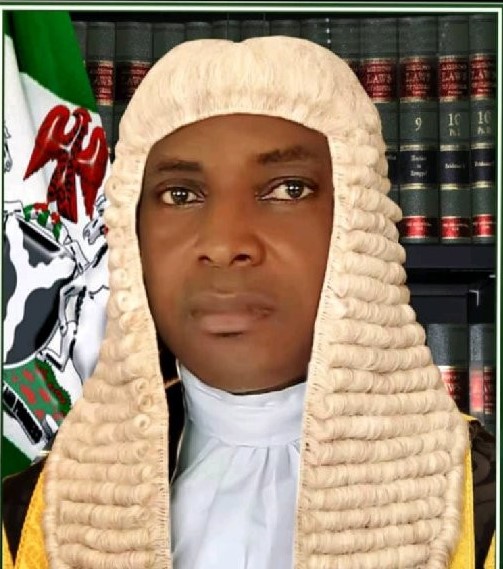
Hon. Justice Nelson Ogbuanya

By Stephen Azubuike

Introduction

Most companies have learnt to incorporate whistleblowing policy as part of their company policies. By this policy, a company may encourage its employees to report incidences of fraud, bribery, corruption and other unethical business practices to the company. This is to safeguard the company from the adverse effects of such practices.

As part of the policy, whistleblowers as well as all those who volunteer useful information to the company are promised adequate protection. Their identities are expected to be held in strict confidence. Also, they ought to be protected from any form of retaliation and victimisation.

A company known as Notore Chemical Industries Ltd introduced a whistleblowing policy dated 27 September 2013 and promised members of staff adequate protection. In no distant time, the company’s drive to implement the whistleblowing policy was tested. But it failed, woefully. This was in the case of Mrs. Sharon Philip v. Notore Chemical Industries Ltd. – Suit No. NICN/YEN/56/2015. The case was decided on 29 July 2022 by Hon. Justice N.C.S. Ogbuanya of the National Industrial Court, Port Harcourt Division.

Mrs. Sharon Philip v. Notore Chemical Industries Ltd.

Notore Chemical’s whistleblowing policy encouraged members of staff to ‘Speak Out’. Based on the Policy, an anonymous whistleblower hinted of some corrupt practices going on in the company through the available hotlines. An Ethics Committee was set up by the company at its Head Office in Lagos. The Committee was to investigate unethical business practices amongst some senior staff of the company in the company’s branch office at Onne, Rivers State. As a result, some members of staff of the company, including Mrs. Sharon Philip, were invited by the Committee. Mrs. Philip’s testimony before the Committee led to the suspension of some of the senior staff, particularly, Mrs. Tola Mbachu and Mr. Apollo Goma, for about a year. Mrs. Tola Mabachu was Mrs. Philip’s immediate superior/boss in her office.

Expectedly, trouble began.

According to Mrs. Philip, upon returning from the suspension, Mrs. Mbachu and Mr. Goma defamed, victimized and oppressed her. The duo orchestrated issuance of a query to her on 25 February 2014, and unjustly subjected her to disciplinary hearing under false allegations. The allegations bordered on her alleged involvement in fraud which allegedly resulted in loss of some millions of Naira to the company. She was also accused of engaging in corrupt and unethical business practice with one of the company’s contractors, Praiselink Integrated Services Ltd. Mrs. Philip responded to the query by a response dated 3 March 2014. Nothing was found against her after the disciplinary hearing.

Still bent on receiving her pound of flesh, Mrs. Mbachu made a written report against Mrs. Philip stating that Mrs. Philip was no longer in the new structure of the Administration and General Services Department of the company where Mrs. Philip worked. This made her to start floating like a piece of paper on water. She was left without scheduled duty or reporting line. The incident was evidenced by a Minutes of the Admin Meeting on 27 January 2014. Ultimately, Mrs. Philip’s employment was terminated on 5 March 2015.

Aggrieved, Mrs. Philip (as Claimant) filed an action at the National Industrial Court against the company claiming millions of Naira as employments benefits and damages for unlawful termination. The company, as Defendant, denied the claims.

Court decides

Upon a fine combing of the facts and evidence presented by both sides, the Court found that the exit pathway in the case was termination, and was neither redundancy (as claimed by the company) nor dismissal (as claimed by Mrs. Philip).

The Court believed the Claimant’s story. It was of the position that the Claimant’s termination had everything to do with her testimony before the Ethics Committee. Ogbuanya, J. stated:

From the foregoing testimonies and evidence of the chronological happening of incidents on the issue of the Claimant’s victimization at workplace, I find that the chain of events and incidents culminating to the termination of the Claimant’s employment has an unbroken link with her testimony at the Ethical Committee hearing of the Defendant, which indicted the said Tola Mbachu, the Claimant’s immediate Supervisor…

Protection of Whistleblower

In view of the above finding, the Court was left to determine whether the company offered any protection to the Claimant as it promised in its Policy. Again, the learned trial Judge painstakingly considered the surrounding circumstances.

  • Tola Mbachu resumed from suspension and the Claimant remained under her supervision. Mrs. Mbachu would naturally be inclined to use her superior position to oppress and victimize Mrs. Philip in retaliation. Undoubtedly the evidence on record established this.
  • No reason was furnished by the company regarding the Claimant’s performance that could warrant her being ‘restructured’ out of her office. This was in view of the fact that she had good rating in performance evaluation at the last exercise of 04/07/13.
  • There was no memo to show that the restructuring exercise was an office-wide exercise. Rather, the evidence showed that the exercise was restricted to Mrs. Philip’s Department and targeted at her and one other staff (Omadachi, who was not in Court).

The Court reasoned that Mrs. Philip was not just an anonymous reporter, like the one who triggered the investigation and subsequent hearing. Rather, she was called to testify as a witness, which would necessitate higher standard of protection. Consequently, Ogbuanya, J. held thus:

I hold that despite the assurance of protection under the Defendant’s Whistle blowing policy in exh.C4, the Defendant failed to take measures to protect the Claimant from workplace victimization incidents, orchestrated by the said Tola Mbachu (who was the Claimant’s erstwhile supervisor), in retaliation of the Claimant’s testimony against her at the ethical committee hearing that led to her suspension from duty.

The learned trial Judge held that the company owed the Claimant a duty of care which it failed to observe. His Lordship’s statement of the law and principles in this regard is worth quoting in full:

The Defendant surely owed the Claimant a duty of care to protect her against the risk of retaliation, which eventually happened unrestrained, culminating in the Claimant’s loss of her job without substantiated reason. It must be noted that the emerging whistle-blowing policy as a mechanism for anti-corruption crusade in both public and private sector cannot thrive without adequate protective measures for those involved in its implementation, particularly those who come forward to testify. Whistle-blowing policy is rooted in and can best thrive on confidentiality and protection of implementers of the policy, of which the court should ensure that those who set up whistle-blowing policy are mindful of its ground rules, to avoid its high risk of retaliation.

His Lordship further held that this duty of care to protect the Claimant from risk of any harm against retaliation under the whistle-blowing policy of the Defendant is not only contractual, but also founded in the common law rule on tort of negligence. He relied on the case of Kabo Air Ltd v. Mohammed [2015] 5 NWLR (Pt. 1451) 38 CA.

Decision on the claims

The Court awarded N5 Million to the Claimant as general damages. Also, it granted claims relating to unpaid terminal benefits. But rejected Claimant’s claims for terminal benefits involving December 2028. This was on the ground that such claims extended beyond the termination of the employment in March 2015.

The Claimant’s claims based on alleged defamation (libel) was dismissed for having not satisfied the pleading requirements for reliefs bordering on defamation.

On the Claimant’s claims based on recovery of solicitor’s fees, the Court acknowledged that there has been an unresolved debate flowing from conflicting decisions on the subject. The Court preferred to be guided by the provisions of the Rules of Court which holds that costs follow events. Thus, the Court awarded N500,000 as cost, relying on Order 55 Rules 1, 4, 5 of the NICN (Civil Procedure) Rules 2017.

Conclusion

It is a notorious fact that in most companies or firms, gossiping holds sway. As seen in the case, this unchecked gossip syndrome (UGS) is, perhaps, one of the reasons Mrs. Philip could not be protected from Mrs. Mbachu and Mr. Goma who were indicted and punished based on the report by the whistleblower and subsequent witness testimony of Mrs. Philip. In the case, the company claimed that the identities of all the witnesses who testified before the Ethics Committee were closely guarded and were not revealed to anyone other than members of the Committee. By implication, the company appears to insinuate that members of the Committee were the culprits. Whatever the case, the Court held that the company did not prove how the identity of the witnesses, including Mrs. Philip, was ‘closely guarded. It is believed that this case has sent the right signals.

This article was first published on November 25, 2022, by Stephen Azubuikehttps://stephenlegal.ng/court-rules-on-companys-liability-for-workplace-victimisation-of-whistleblower/

Stephen is a lawyer with expertise in Commercial Dispute Resolution and Technology Law practice. He is a Partner at Infusion Lawyers. He has successfully argued cases from the High Courts of various jurisdictions to the Appellate Courts on behalf of financial institutions, other corporate bodies, and multinationals. He has advised a number of both established and startup tech companies. He tweets @siazubuike.

Tales my patients told me: Grace and dignity in suffering

Dr. Emmanuel Fashakin

By Emmanuel Fashakin

Sandra was only twelve years old when her problems began. She noticed that she was getting tired easily, and could not run as fast as she could. Then one morning a few weeks later, Sandra woke up and found out that her eyes and urine were turning yellow. It was time to pay a visit to the family doctor. The initial test results were extremely good, Sandra was free from all forms of Hepatitis, the virus causing inflammation of the liver. However, Sandra only got worse. The yellow coloration of her eyes, and now skin only got worse, and it was time to get the specialists involved in her care. A liver biopsy was arranged, and the results devastated everyone: Sandra has Auto-immune Hepatitis.

An auto-immune disease is a situation where your own immune system starts producing immune agents to attack your own organs. For a crazy reason, your own immune system starts recognizing your own organ as foreign tissue, and attacks it. Sandra was put on multiple medications to suppress the immune system, but things went only downhill. Within three years, Sandra needed a Liver Transplant. After the Liver transplant, Sandra got better and was well enough to return to school. The whole family was relieved and happy. Unfortunately, after five years, the transplanted Liver started failing, because her body, which had attacked her own Liver, had started attacking it. The transplanted liver was being rejected. Sandra needed another Liver transplant!

The second Liver transplant took place six years after the first, and it was a huge success. With the advancement in transplantation surgery and the availability of better drugs to suppress rejection, Sandra did very well. Well enough to earn her degree and met a charming young man. She soon got married and had two children. Life could not be better. She continued to take her immuno-suppressive medications. That was the situation when Sandra first walked into my office seven years ago. Sandra was very beautiful and cheerful, and until she told her story, you will have no idea that she had gone through so much. It had been twenty years when her problems began, and the problem then was that she was having pains in her joints. She said she had been told that twenty years of steroid therapy, needed to suppress her immune system, had worn out her joints. She was having severe pains in both knees and hips, and was finding it difficult to walk. She came to me for medical clearance for arthroscopy of the knees.

Arthroscopy of the knees, and radiological studies of the joints confirmed that her knee and hip joints had worn out. A year after I first met Sandra, she had to undergo Total Hip Replacement on the Left side. The right hip was replaced two years later. In all these, Sandra was always cheerful whenever she came into the office. She was taking about twenty tablets everyday, and I knew despite all the strong pain killers we were giving her, she was in great discomfort. Sandra developed severe anxiety, which was understandable in the circumstances, and she responded to treatment with Xanax (Alprazolam). She continued to see me now and then for medical clearance for dental work and other treatment. Then two years ago, sixteen years after the second transplant, bad things started to happen again.

Sandra discovered that she had started feeling tired again, and then the slight tinge of yellowness of her skin. A visit to the Hepatologist confirmed her worst fears: her body had started rejecting her second transplanted liver which had served her well for sixteen years. Sandra came to see me afterwards and told me the sad news — she is going to need another liver transplant — her third! Even in her predicament, Sandra managed to give me a smile; I never heard Sandra say anything negative, or complain about her situation. Seven months after this sad visit, about fifteen months ago, Sandra came to the office to do blood tests and get referrals for Cardiology consultation in preparation for her impending transplant. Her jaundice had increased and she looked very pale. She tried to be cheerful, but you can see that she was in a lot of pains, and she appeared quite anxious. I tried to cheer her up as much as I could. I never knew that it was the last time I would ever see Sandra.

I did not hear anything from anybody for fifteen months (this is the major drawback of American medicine: lack of communication between the specialists and the primary care doctors, unlike in the UK). Sandra’s sister came to my Richmond Hill office to see me. I did not know that she had any relationship to Sandra until I asked her how she knew about me. She informed me that she was introduced to me by her sister, who is now dead. She said her sister told her that I am a good doctor. And who is your Sister? “Sandra xxxxxx” — it was as if someone hit me with a hammer. Sandra! It was then I looked at her closely, she had a striking resemblance to Sandra, and she had retained her maiden name, same as Sandra’s, who never changed it after marriage, as part of her married name.

Through the Sister, I learned the rest of the story. Sandra was indeed admitted to the hospital after her last visit to me, and she was being prepared for surgery. But Sandra went downhill and she was never well enough to have the transplant done. She died in hospital after holding tenaciously to life for five more months. Her husband remained steadfast to the end and has remained unmarried. He is caring for their two children with the help of his mother who lives with them. I am very grateful for the opportunity to close the chapter on Sandra, a patient who suffered so much despite not doing anything wrong (not that she caught STD from sex, cancer from smoking, or liver disease from excessive drinking), but who taught me that you can have grace and dignity, even when going through extreme suffering. I have treated tens of thousands of patients in my professional life, but a few patients make a deep impression on you; Sandra was that type of patient.

Emmanuel O. Fashakin, M.D.,FMCS(Nig), FWACS, FRCS(Ed), FAAFP, Esq.
Attorney at Law & Medical Director,
Abbydek Family Medical Practice, P.C.
Web address:
http://www.abbydek.com
Cell phone: +1-347-217-6175
“Primum non nocere”

Arguments against “Centralised Law School for Nigeria” are diversionary, mere distractions, and non sequitur

(Prelude to My Rejoinder to Chief Afe Babalola, SAN)

By Sylvester Udemezue

To be able to follow and appreciate my position and suggestions, I humbly enjoin us to first read the two articles titled

“Abuja central law school for Nigeria – archaic (1)” and (2) each written by the very respected Chief Afe Babalola SAN and published on many news platforms and blogs in Nigeria. While I agree that there is no central law school in England, unlike in Nigeria, may I respectfully suggest that those who argue against one Law School for Nigeria should have been all-encompassing in their comparison, if objectivity was their watchword, which I seriously doubt. Truth is, and I submit, there are really no bases for comparing England’s situation with Nigeria’s. But, if we must engage in such needless comparison, then let me respectfully remind us that licensing private Law Schools in Nigeria (to break the monopoly of Nigerian Law School) is at the bottom of the scale of preferences of the challenges facing the legal profession, that is, of the issues in respect of which we must urgently copy England and the United Kingdom.

Check these out:

1️⃣. Most lawsuits initiated in courts in England about January 2020/2021 are already concluded up to the highest court of the land, while the rest are near conclusion and may not last beyond December 2022. In Nigeria, on the other hand, most of the cases pending before our courts currently, were commenced between the last 5 years and 15–20 years and there’s hardly any hope of their being concluded any time soon. A typical example of the situation in Nigeria is the case of PILLARS V DESBORDES (a landlord and tenant case) which lasted over 28 years in Nigerian courts (from its commencement at the Lagos High Court to its conclusion at the Supreme Court) before being disposed of. I wrote: “… on 5 February 2021, while delivering the lead judgment in a landlord-and-tenancy appeal case, Pillars (Nig) Ltd v. Desbordes, His Lordship, the Honourable Justice Emmanuel Akomaye Agim, J.S.C., had started with the following introduction: ‘This appeal was commenced on 24/6/2009 when the appellant herein filed a notice of appeal against the judgment of the Court of Appeal at Lagos delivered on 8/5/2009 in appeal no.CA/L/859/2006 affirming the judgment of the High Court of Lagos delivered on 8/12/2000 in LD/148/93 and dismissing the appeal against it. The notice of appeal contains 5 Grounds of appeal”. The suit number shows that the suit was filed in a Lagos High Court in the year 1993, appealed to the Court of Appeal, Lagos Division, in 2006, and later to the Supreme Court of Nigeria in 2009. The suit lasted 13 years at the High Court, 3 years at the Court of Appeal, and 12 years at the Nigerian Supreme Court. A total of 28 years! The cited examples fall among the rule, the norm, and not exceptional or isolated cases”_(See:_”Snail-Paced Justice Dispensation in Nigerian Courts: Factors, Actors and Aftermaths” (yet unpublished). This is one major area that our senior colleagues need to copy something from England about. Those whose preoccupation is on how to decentralize, nay destabilize Nigerian Law School, should tell us whether a Central Law School for Nigeria is the reason why the administration of justice in Nigeria is the slowest and among the most ineffective in the whole world. If our learned senior colleagues had channeled their energy and efforts toward pushing for reforms to accelerate justice delivery in Nigeria, perhaps things would have become far better than they’re currently.

2️⃣Appointment of jurists into Courts in England is based on merit, competence, and honour. On the other hand, in Nigeria, almost all appointments are based on QUOTA, PLACE OF ORIGIN, TRIBE, LANGUAGE, RELIGION, OR POLITICAL LEANING. Is that what Nigeria ought to be doing in 2022 – the 21st century? What are our colleagues doing about this? Is licensing private Law Schools a more pressing challenge than this?

3️⃣Corruption in the High Court of England is at the lowest ebb. In Nigeria, corruption is the order of the day and has eaten so deep into our fabrics that even English leaders derisonly describe as “fantastic” the level of corruption in Nigeria.

What are the contributions of these respected senior colleagues of ours towards curbing corruption in the judiciary in Nigeria?

4️⃣Judges on the Bench in England are free to hand down their judgments and rulings based on facts, law, evidence, and the cases before them impartially and without fear of intimidation, harassment, or disgraceful treatment from other arms of government. Recently, the Court of England ruled against the Prime Minister of England on the Brexit deal. On the other hand, in our country, the DSS would invade the homes of jurists in the wee hours of the night, and bundle them into vans like common criminals. And nothing would happen by way of repercussions. An ex parte order from a court (Code of Conduct Tribunal) which has no jurisdiction to make such an order would remove easily Nigeria’s CJN, the head of Nigeria’s Judiciary, an independent arm of government, against the express provisions of the grund norm while some of our senior lawyers cheer the persecutors in support. Decentralizing the Nigerian Law School is their only headache. What a misplacement of priority; chasing after rats when your house is on fire!

5️⃣As of the year 2022, most Courts in England are fully automated, and their processes and procedures fully digitalized, ICT, and internet-propelled. During the COVID-19 lockdown, more than 70,000 cases were heard and disposed of in England, by virtual means, backed up by law. How many were heard in Nigeria during the lockdown? A laughable number, if any! One would ask, these advocates of private law schools in Nigeria, what efforts are they making to have Nigeria key into the new normal, following COVID-19? Oh, they’re more preoccupied with lobbying and arguing to have private law schools licenced for them to operate.

6️⃣. Courts in Nigeria are still recording proceedings in long land. Storage of data is majorly manual. And hardly any prompt and effective mechanisms are put in place for the timely, secure transmission of information about court proceedings, to litigants and counsel;  one still has to travel from Lagos State to Kano state for a case fixed for trial only, and on getting to Kano, after huge flight fares and hotel bills, one would be informed that COURT IS NOT SITTING. In England, under such a scenario, lawyers and their clients would have been informed/communicated in advance vide the Internet so that they would not waste money and time travelling such a long distance for a case that wouldn’t go on.

7️⃣. Courts in England operate and function wholly on a public power supply which is available 24/7, without any interruptions whatsoever. On the other hand, Nigerian courts depend on unstable, epileptic power supply, and dilapidated generators. Most Nigeria Courtrooms are worse than bakery ovens. Witnesses, parties, court officials, counsel, etc, operate under very non-conducive courtrooms, mostly with archaic chairs and sitting arrangements suitable only for a 17th-century courtroom. What efforts have these our respected senior colleagues made to remedy this ugly situation?  They’d not do anything because there’re more concerned with campaigns to license private law schools in Nigeria. That, to them, perhaps is the only challenge facing the law profession

8️⃣. How many times have you heard that Courts in England are embarking on industrial action to protest the poor condition of service or non-payment of salaries and allowances, or to press for judicial autonomy? Compare this with Nigeria’s situation. Why are our colleagues more bothered about licencing private law schools in Nigeria, than achieving judicial autonomy or improved working conditions for judiciary members and workers, so as to nip industrial actions in the bud and make the judiciary more stable and effective?

9️⃣. Electronic filing (E-filing) and Electronic Service (E-Service) of court processes and Virtual Hearings of lawsuits are a smooth practice in English Courts. Think about the position in Nigeria and you’d shed tears about how backward we’re?

🔟How long does it take to dispose of an appeal in England 🏴󠁧󠁢󠁥󠁮󠁧󠁿, on average? Contrast this with the position in Nigeria 🇳🇬!

In the paper referred to above, I wrote, “A distinguished Senior Advocate of Nigeria, Akajiugo Emeka Obegolu, SAN, was reported to have posted the following statement on Facebook on 22 February 2022: “Today, 22/2/22, a 2005 appeal came up for hearing before the Supreme Court of Nigeria. Counsel informed the court that both the appellant and the respondent are deceased. #Justicedelayed”. From the post, it is obvious that the appeal at the Supreme Court of Nigeria had lasted 17 years, the appeal having commenced in 2005. Who knows when the case was filed at the High/Magistrates’ Court? Meanwhile, when this author contacted Chief Obegolu, SAN, to confirm his authorship of the Facebook post and to get more facts about the case, Chief Obegolu advised that the case was later adjourned to 2024 to enable the parties file applications for substitution. A two-year adjournment to hear an interlocutory application”!

1️⃣1️⃣. How long does it take to get a certified copy of a judgment, ruling, or order of a court in England? What about Nigeria? Why does this not seem to bother some of our seniors, as much as they’re bothered about Nigeria having only one Law School?

Meanwhile, one thing appears common: did anyone notice that majority (if not all) of the campaigners for licencing of private law schools in Nigeria, are themselves either owners, proprietors or top managers of private Universities in Nigeria? Considering the vigor and tenacity with which they push the unnecessary advocacy, one wonders whether they are not engrossed in this campaign for some wholly unaltrustic ends. Else why are they more bothered about Nigeria having only one Law School, than making contributions towards the solving the pressing challenges of the Legal Profession in Nigeria? Why?

▪ TO BE CONTINUED

Respectfully,

Sylvester Udemezue (Udems),

[email protected].

(28 November 2022)

Introduction to the Epistles of Anthony Kila

By Tola Adeniyi

It is a delight to introduce any literary work that oozes out of Anthony Kila’s fertile brain and versatile mind; especially considering the fact that his writing exhibits uniqueness not only in stylistics but in its philosophical, classical, ideological, Aristotelian pedagogy and pragmatism, originality and sequential layout with the artistry and aesthetics of Italian architecture.

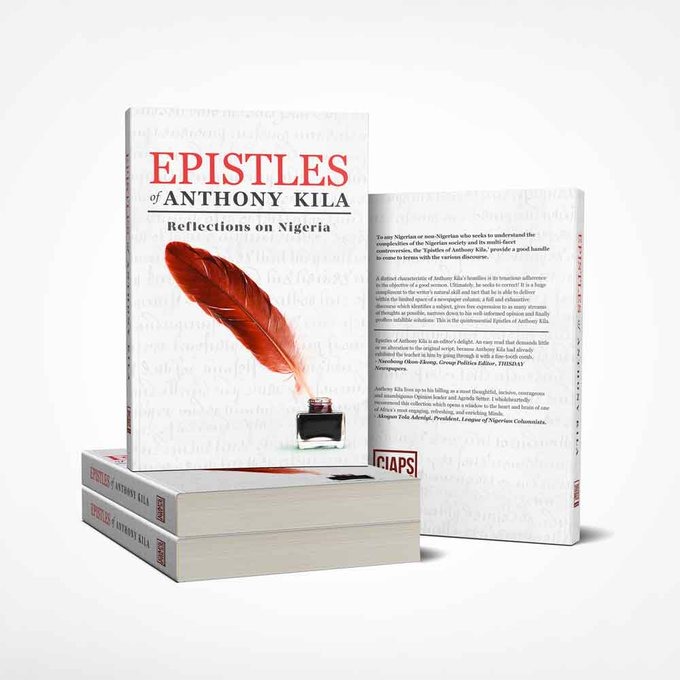
Epistles, sub-titled Reflections on Nigeria touches on virtually all aspects of life and living and is categorised/compartmentalised/departmentalised/ in 13 broad-based parts viz: Aviation, Business and Economics, Covid-19, Education, Environment, Ethnic Nationality, Health, Law & Corruption, Monarchy, Politics, Religion, Security, Social Media, Youth and is concluded with a chapter on EndSARS. {#EndSARS was added to Nigeria’s lexicon by angry Nigerian Youths who dared to massively demonstrate for a stop to police brutality and malfeasance.}

Epistle (/ɪˈpɪsəl/; Greek: ἐπιστολή, epistle, “letter”) is defined as a writing directed or sent to a person or group of people, usually an elegant and formal didactic letter. Kila, a scholar of classics and pedagogue remains faithful to this broad definition in all the articles in this rich and engaging collection.

The close-to-400-page volume is a compilation of some of Anthony Kila’s essays on national issues. Essay after essay, readers are treated to factual chronicles and considerations based on his worldview and positions in forms of letters sometimes to readers and, other times, to specific individuals who are protagonists of the topic being treated. The book tries to convey important questions in simple and clear language and always proffers a solution on every issue treated. The teacher in Kila rears its head and runs through all the articles in the brilliant collection.

As to be expected the opening chapter which chronicles personal experiences and observations on the country’s aviation sector is written in the classical tradition of Travelogue with its rich vividness and descriptive flavour while in the same breath the author seeks to teach the operators of the sector what to do and what not to do. “Time to rethink and reset Aviation”, he wrote matter-of-factly.

Chapters on Politics and Religion occupy prominent portions of the collection for obvious reasons: politics, political economy and the hues and cries generated by political acts of commission and omission, including wars, sanctions and threats the world over are the most commonly discussed and debated subjects in the media. And for a developing economy like Nigeria, it is more vociferous. The same is the issue of religion in a country which parades more Churches and Mosques than factories and where people are more addicted to prayers and fasting than working.

Any attempt to critique or even summarise each article in this collection will amount to writing another book, and any attempt to do a literary portrait of the author, a master of witticism and syllogism, may also end up in a fat book because Kila; his thoughts, his art, and style, is a subject by itself.

In keeping with the tradition of Epistles, Anthony Kila writes directly to his audiences, which may be personal, collective, professional, governmental, or which-ever, whatever, whom-so-ever.

“Dear Noemi Kila, Today’s epistle is addressed to you partly because generally speaking charity begins at home and it doesn’t get homelier than with you;’

“What do you think is the main problem facing Nigeria? Yes, you are not the only one that thinks so.” Direct conversation approach.

The Epistle is rich in samples of Kila’s authoritative style of conveying his thoughts to the reader and by addressing them directly, Anthony Kila makes each and every one of them a captive listener who must hear him out even if he or she disagrees with his views.

On the issue of engaging non-education graduate members of the National Youths Corps in teaching, Kila, a scholar and educationist charges “it is one thing to know maths, economics, biology or literature, it is another thing to know how to teach it. The fact that we do not consider this simple fact is a grave indictment of our consideration for education and one of the strong reasons why our educational system is failing’’.

His intervention in the prolonged tussle between a Pro-Chancellor and a Vice-Chancellor, Kila again, magisterially declares “in a citadel that wants to produce impactful ideas and great minds, a Pro-Chancellor does not exert power, the Pro-Chancellor exerts influence.”

On the country’s 49-year-old National Youths Service Corps, Kila opines, with his usual punctilious authority “The easiest thing to do is to scrap the scheme. We have 2 years to think of what to do with it. If we do not want to disband the NYSC here is an option: Let us make NYSC optional and specialised”.

On the absurdity of elected politicians being bosses to traditional rulers in Nigeria “there is something shockingly wrong intellectually and morally flawed in a system wherein someone elected to an office for a maximum of eight years if everything goes well, has the power and duty of installing, funding and maybe even sanctioning someone that is meant to be in power for life”.

Epistles is rich in aphorisms, oxymoron, onomatopoeia, and ecstatic play on words which, combined, makes the book rich in quotable quotes: “History has shown that regions that have always had someone in power have little to show for their presence there”. “Unchristian Christianity of our Christian Association” and “collective consciousness for constructive confrontation’ are few examples of Kila’s dance with words.

Kila, a philosopher, and writer in journalism defines his audience; he does not write in a vacuum. ‘’Dear Spiritual fathers and mothers’’…He addresses his targeted audience, some of them he calls to debate, some he celebrates, and some he hurls bricks and stones at, depending on how deaf or dumb or blind the audience is. And when he hurls stones and bricks, he does it with refreshing refinement and elegance of language.

On Insecurity he pointedly tells Mr. President “In war, there are only two options: you can only fight or surrender there is no option for pretending not to know it is war”

He calls NCC’s ultimatum to Nigerians “a Nonsensical Nuisance Taken Too Far”

The Epistles is concluded with what Kila, a professor of Strategy and Development, calls an ‘appeal for the development of a collective consciousness for constructive confrontation which is aimed and directed mainly at the young people of this country and those elsewhere in the world.’

In summary, the beauty and flawlessness of Kila’s deployment of language are found in his tribute to MKO Abiola:

“As if to teach all a lesson about how nothing is absolutely certain and how everything is possible in life, MKO Abiola left the world as President that did not preside, a known winner that was not declared though after convincingly winning right in front of the whole world. To become such a winner, he ticked all the proverbial boxes, dined and wined with all the right people, and made friends in high and low places and his web of connection covered every corner of his country but alas his friendship and connection was not enough to give him his ultimate desire, rather he got death.”

As the co-founder of the prestigious League of Nigerian Columnists Anthony Kila lives up to his billing as a most thoughtful, incisive, courageous, and unambiguous Opinion leader and Agenda Setter.

I wholeheartedly recommend this collection which opens a window to the heart and brain of one of Africa’s most engaging, refreshing, and enriching Minds. I applaud the quality and elegance of the book cover especially for its clarity and depth with its purity of Obatala motif and the outspokenness of Ayekooto in the plume, with a touch of Sango’s fiery flame.

High Chief Tola Adeniyi, fnge. President, League of Nigerian Columnists.

TIPS