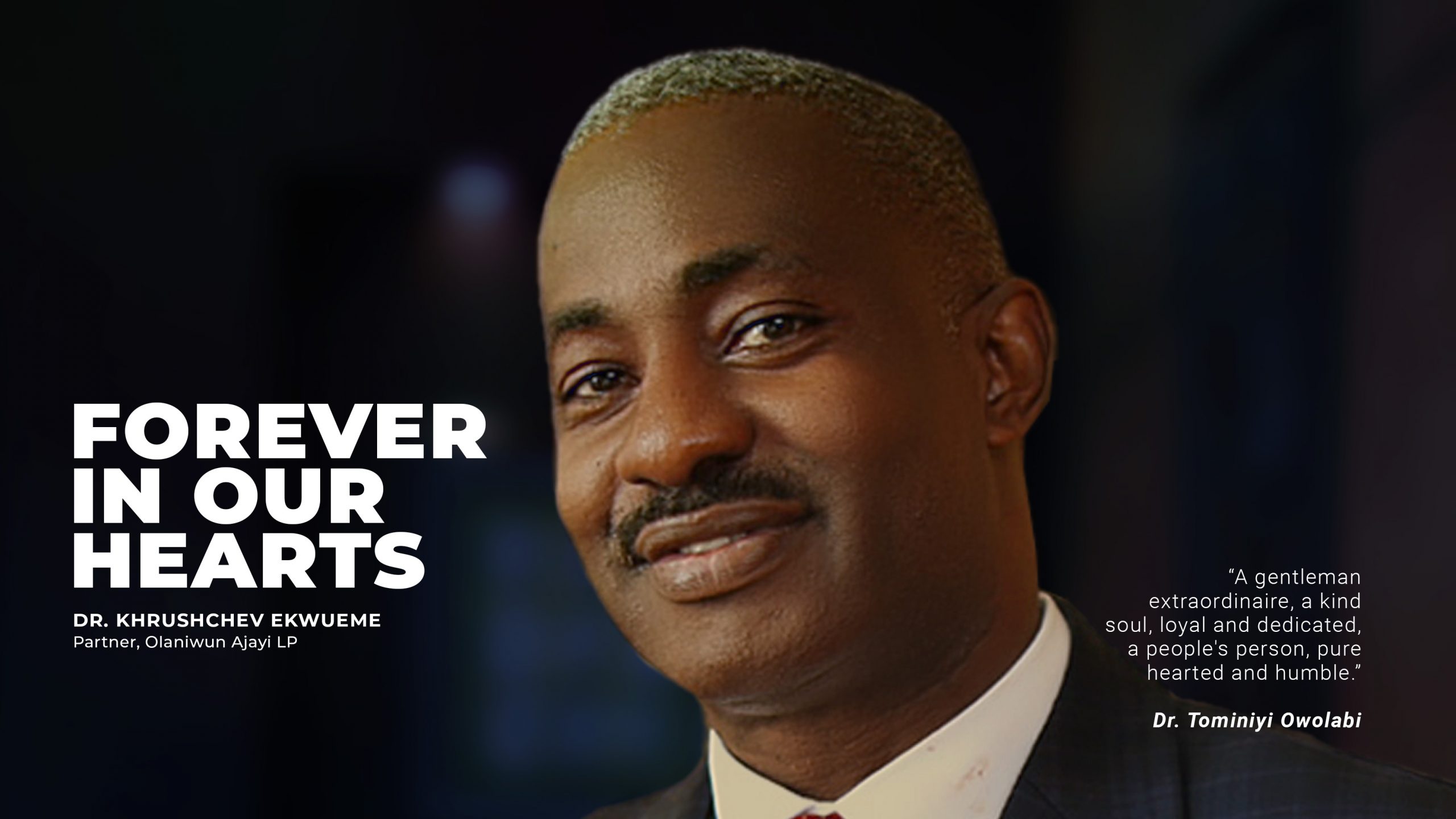
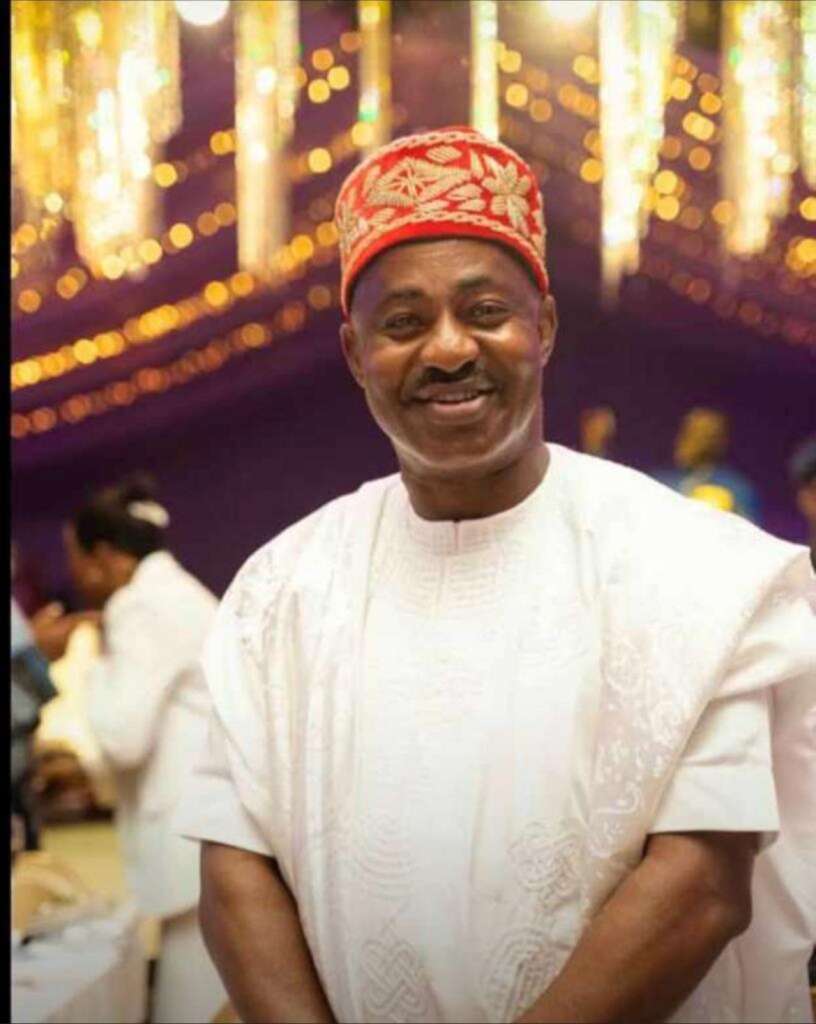
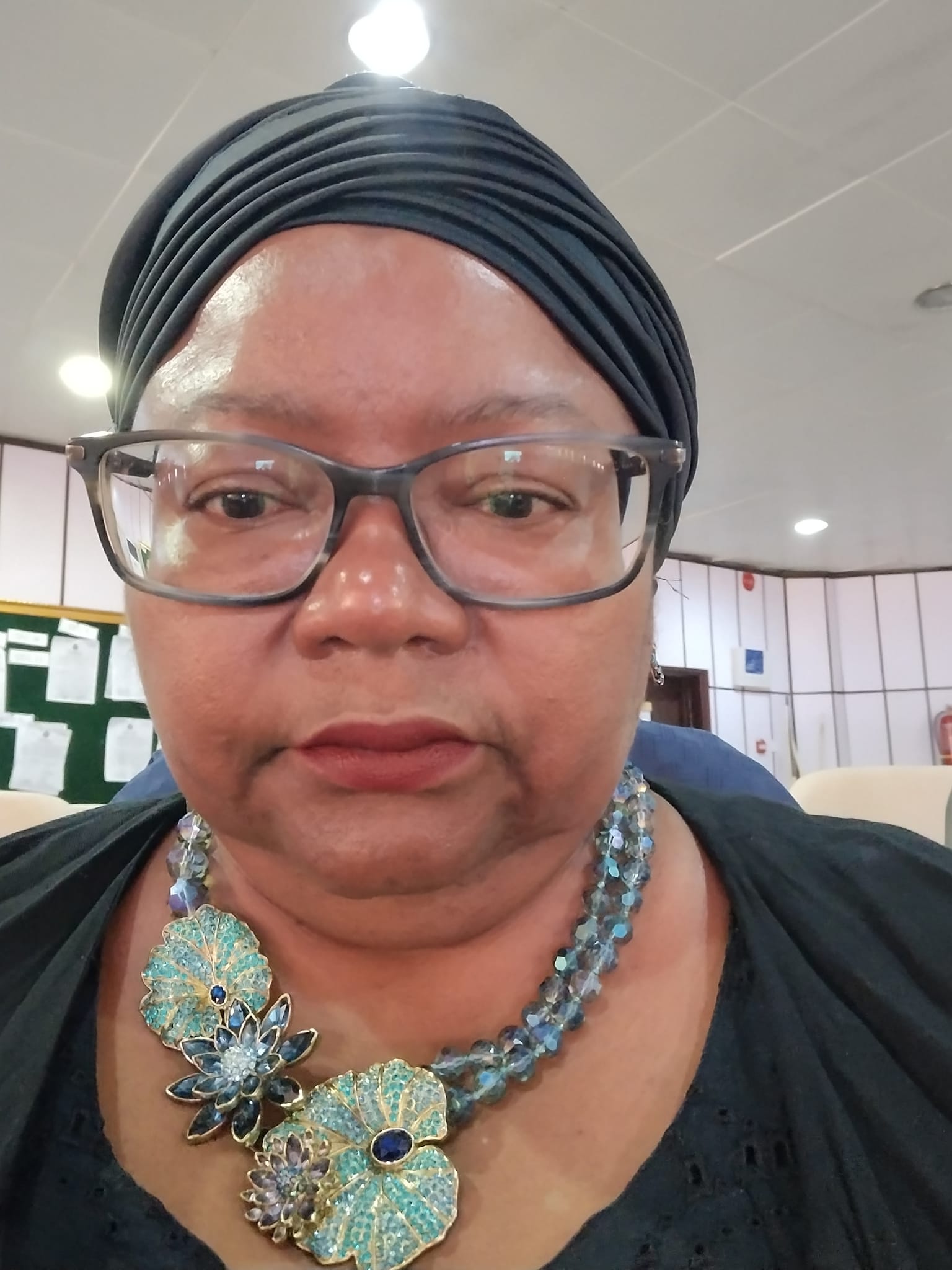
Tributes are pouring in as news about the death of Khrushchev Ekwueme continues to send shock waves across Nigerian legal circles.
Khrushchev a Partner in Dispute Resolution Practice at the law firm of Olaniwun Ajayi LP is a member of the Expert Group of the United Nations Economic Commission for Africa (UNECA) on Transboundary Infrastructure Projects in Africa. A former student of The Hague Academy of International Law and Visiting Researcher at the Harvard Law School, Khrushchev specializes in International Economic Law, and International Dispute Resolution, International Commercial Arbitration, Public Interest Litigation, and White Collar Crime Prosecution.
Fluent in German, Khrushchev is the author of Protection of foreign investment in context: Nigeria’s investment laws, treaties and petroleum agreements, and various articles. His knowledge development sessions for judges of the Lagos State Federal High Court and Justices of the Court of Appeal are widely acclaimed.
Khrushchev Ekwueme
While the cause of his sudden death is yet to be formally established, Khrushchev Ekwueme reportedly slumped at his law firm’s End-of-Year party and was rushed to the First Cardiology Hospital in Lagos where he was later confirmed dead.
One of his closest friends, Hon. Justice Nnamdi Dimgba of Nigeria’s Federal High Court captured his feeling with these words. “A star on earth left to rejoin the galaxy. This was not only my brother but a deeply treasured friend. He was my biggest and strongest cheerleader. His frame could not habituate any sentiment or emotion that’s not pure – no space, no matter how tiny, for envy, bitterness, hatred, or any such dark clouds; ever quick to forgive – like our Christ (yes, he was Christ’s follower). I watched as he rose, from ABSOLUTE NOTHING to what God has chosen us to be. When he was low, he carried it with grace and dignity (you could never tell from the outside the storms that brewed within); and when he was high as the Lord Himself chose to give, he carried himself with humility and with even greater grace. I never saw a human so complete like my brother and my friend Dr. KUK Ekwueme. Our hearts are filled with the deepest sorrow, broken to pieces. Yet, we must not fail, and indeed do thank the Lord God for the gift of such a wonderful personage; the God whose name is mercy. We trust His mercy to come through at this very hour because it is needed in abundance. Adieu my brother and my friend KUK, as you gaze down upon us from your place among the galaxy, and with that twinkle in your eyes. Our love for you will never wane. Adieu!”
“The law & humanity has lost a Supernova”, Konyin Ajayi, Chairman of the Advisory Board at Nasarawa State Investment & Economic Advisory Council announced on his LinkedIn page. Ajayi who was the first to post a tribute on LinkedIn wrote: “The untimely & shocking departure of Dr. KUK Ekwueme. A most distinguished international scholar, commanding advocate, brilliant Solicitor, highly regarded and well respected – just as he was respecting. A moving library, a great orator wonderful friend. Good night.”
Senior Partner, Kenna Partners, Professor Fabian Ajogwu, SAN.
“Deeply deeply saddening. A good man has gone, and way too soon and sudden. A refined gentleman, Dr. KUK Ekwueme practised law with the fear of God. He did so in the finest traditions of the Bar. He was warm and respectful to all he came across. Our deepest condolences to his beloved family and to our colleagues at Olaniwun Ajayi LP. Ndo nu. May KUK’s gentle soul, through the mercy of God, rest in peace.
Uche Val Obi SAN, Senior Advocate of Nigeria (SAN) and Managing Partner at Alliance Law Firm.
This is a loss of a dear brother and friend of over 3 decades. I’m still in shock. Words have failed me this time. KUK was a first-class lawyer, urbane, witty, warm, humane, loyal, and with a large heart. He was so full of positive aura and always with a charming smile that diffuses all manner of tensions. I just can’t imagine what the family should be going through at this point given the way we are feeling already. The world has certainly lost a very good man. May his gentle soul rest in perfect peace, Amen.
Omowumi Fajemiroye (ACIS), Company Secretary at Tropical General Investments (TGI) Group
“This hurts badly. It came as a rude shock. I still can’t believe. Thanks for all you did whilst under your leadership in OA. You made working in DRP easy for me. I can’t forget the last conversation we had when I was leaving. It was deep and profound. K.U.K you were an exemplary leader. I remember how you used to call me “Mrs. Fajem! Ah, Dr. Kru even though I am no longer in OA you made it a point of duty to always call to find out how I was doing. Those few minutes were always reassuring. You will be greatly missed. Rest in peace.”
Orji A. Uka, Dispute Resolution | Arbitration | Litigation |
“When I heard the news last night, I refused to believe it and hung on to the faint hope that it would turn out to be untrue. Dr. Kru was a quintessential gentleman and an outstanding legal mind who touched many lives. His 2005 seminal work on Investment Law in Nigeria proved very vital to my LLM dissertation research. May his soul rest in peace, and may the good Lord grant you, the OAL family as well his family and friends, the fortitude to bear such a colossal loss.”
To survive in Nigeria’s legal profession these days, practitioners and judges require skills in the martial arts; nimbleness of feet on an Olympian scale; weapons handling; not to mention advanced training in subterfuge. Sadly, these are not offered on the curriculum of the Nigerian Law School nor in judicial orientation. Even with these skills reinforced by a wing and a prayer, being connected with the business of the legal process in Nigeria today is often life endangering.
In August 2015, Nigeria’s State Security Service (SSS) announced that they had arrested members of a kidnapping syndicate who were about to abduct judges sitting on election petitions in Owerri, capital of Imo state. They named the leader of that syndicate as one Chibueze Henry, who went by the operational alias, Vampire. Charges followed against Vampire and his gang whose trial began in Owerri, the following year.
Now, the High Court in Owerri occupies a prominent piece of real estate, a shouting distance between the office of the State Governor and the headquarters of the Imo State Police Command. Entrance into the premises is controlled by gates, managed by security people who are public officials. In one of the court halls on this premises, the trial of Vampire and his gang was scheduled to continue on the morning of 27 January, 2017.
As officials of the Nigeria Prison Service (as it was then called) drove into the court premises, a black Sports Utility Vehicle (SUV) at the back of the convoy, sped past them, stopping suddenly. A horde of men armed with assault rifles jumped down from the SUV and started shooting indiscriminately. As judges, court personnel, lawyers, and court users scampered, the attackers liberated Vampire who fled along with up to 29 other detainees. The attack killed at least two persons, leaving many others injured.
Imo State, where this incident occurred, had been a site of targeted violence against judges and lawyers for over a decade. In March 2011, high court judges in the state embarked on a strike to protest the abduction of one their colleagues, Theophilus Nzekwe. He was not the first.
One year earlier, the judge-president of the state’s Customary Court of Appeal, Ambrose Egu; and senior Magistrate, Pauline Njemanze, were abducted near the Sam Mbakwe International Cargo Airport near Owerri on official duties.
In 2009, Florence Duroha-Igwe, another judge of the Imo State High Court, suffered an attack in which both her driver and police orderly sustained severe gunshot injuries.
Emboldened by the absence of accountability, these attacks would grow in both frequency and brazenness. In October 2019, a senior Justice of Appeal from the state, Chioma Nwosu-Iheme, was abducted in Benin City, while on duty presiding over election disputes. She spent a fortnight in captivity.
In September, 2021, former Chief Judge of Abia State, Nnenna Oti, was abducted in Orlu, Imo State. Seven months earlier, Presiding Justice of Appeal in Owerri, Rita Pemu, navigated the perils of abduction and possible assassination with an extra supply of native wiles.
Magistrate and court inspector, Oderachukwu Onumajulu, was not so lucky. As a child, Odera always desired to be a judge. In 2016, she climbed the first rung in her ambition when she was admitted to the Nigerian Bar. Three years later, she became a Magistrate in Imo State. On 22 May, 2021, unidentified men shot and abducted Odera at the Customary Court of Appeal in Owerri, where she worked as courts inspector. One month later, in June 2022, she died from her injuries.
Odera was the second judicial figure to be killed in line of duty in the state in as many years. On 23 November, 2018, a body found dumped along Amucha Road in Njaba Local Government Area (LGA) in Orlu Zone, Imo State, was identified as the remains of Remi Ogu, a Chief Magistrate in the neighbouring Oru LGA. Remi and his court registrar, Uju Nwanne, were abducted the previous day from their duty post. In March 2019, the police in the state paraded one Friday Nnaekezie, who claimed that he masterminded the abduction and killing of the Chief Magistrate.
Orlu zone, where Remi was killed, has become the epicentre of mass atrocities committed in the name of agitation. Three months before Remi’s murder, in August 2018, unidentified men incinerated the High Court and Magistrate’s court buildings in the city with all their records and archives. Four years later, on 17 December, 2022, they returned to finish the job.
One of the more vocal voices at the Bar in Orlu was Darlington Odume, who became a lawyer in 2016. The community admired him for his fighting qualities, comparing him to the lion. So, they called him “Omekagu”. In mid-September 2021, while out to procure groceries for his household in Orlu, unidentified gunmen assassinated Omekagu. He was married to a police woman in a location where it had become dangerous to be associated with one.
2021 was a particularly bad year for lawyers around the country. The month after Omekagu’s murder in Orlu, Ajah Ogbonna Ajah and another of his colleagues, both lawyers, were killed on the road by unidentified gunmen while on their way to court in Abakaliki, the capital of Ebonyi State in south-east Nigeria.
They were by no means the only victims in the region or in the year. In May, former High Court judge, Stanley Nnaji, died, assassinated by unknown persons on the streets of Enugu State.
In November, 2021, seven unidentified men macheted to death Kenechukwu Okeke, in Nkpor, in Anambra State. They killed him in the presence of his wife and young daughter. Okeke, a lawyer, had been outspoken in his support of Nigeria’s ban on Twitter.
These killings of lawyers, magistrates, and judges were not limited to south-east Nigeria. On 17 February, 2021, gunmen shot and killed Nkiru Agbasu, a pregnant lawyer, along the Warri-Sapele Road in Delta State.
As in Imo State, Nkiru died in a state with a record of no consequences for the killing of lawyers. In March 2014, unidentified gunmen reportedly dressed in police uniforms assassinated two lawyers, Eguno Dafiaghor and Samuel Ekuwangi on the Azoro-Asaba motorway in Delta State. It was widely suspected that they “were murdered as a result of the high profile case they were handling at the High Court, Ozoro.”
A little over one year later, in April 2015, unidentified men executed the chair of the Nigerian Bar Association (NBA) in Ughelli, Austin Icheghe, in his residence in front of his family and without consequences.
Impunity also explains insecurity among lawyers in Abuja, Nigeria’s Federal Capital. In October 2013, the police found the mutilated remains of Ijeoma Micah in her law office in upmarket Maitama, in Abuja. She had been missing for three days.
Seven years later, Ben Okpe, another lawyer, was killed near his home in Karu, near Abuja. In March, 2022, terrorists who hijacked the Abuja-Kaduna train, killed Farida Sule Mohammed, a young Abuja lawyer. She was 29. Suleiman Zailani, was killed in August; Sadiq Gaya in September. At the end of November, unidentified gunmen in the Federal Capital assassinated senior lawyer, Steven Eke, in the presence of his wife and son.
Feyitayo Obot was killed in her hotel room when she travelled to Lagos on professional business at the end of January 2019; nearly two months after the killing of Adeshina Adeola, who was killed on the outskirts of Abuja in the week of his admission to the Nigerian Bar in November 2018.
The killings and abductions of lawyers and judges recounted here are only a fraction of the story. Three things are clear about them. First, the perpetrators nearly always get away with it. Second, any society that tolerates these kinds of attacks on its courts, judges, and lawyers is lawless. Third, the NBA does not yet have a focused program for ensuring accountability for these attacks on lawyers and judges. That is the first thing that needs to change.
A lawyer and a teacher, Odinkalu can be reached at [email protected]
By virtue of section 1(1) of the LPA, CAP L11, LFN, 2004, any decision of the General Council of the Bar or the Body of Benchers with respect to the “affairs of the NBA” may be revoked or modified by the NBA.
(1) The BOB (BODY OF BENCHERS) as established by section 3 of the Legal Practitioners Act CAP L11 LFN 2004, as a statutory institution, is susceptible to government control or influence judging from its membership composition. The affairs of the Bar in most countries of the world is run/managed by the leadership of the Bar Association, an independent organisation elected in a periodic democratic election. In the UK, the bar (solicitors) is run by the Law Society of England. www.nysba.org reports that “the New York State Bar Association (NYSBA) has been the voice of the legal profession in New York state for more than 140 years. The www.americanbar.org reports that the American Bar Association is the national voice of the Bar in the USA. The Law Society of Kenya runs the affairs of the bar in kenya. In Canada, as reported by flsc.ca/about-usery lawyer in Canada and notary in Quebec is required by law to be a member of a law society and to be governed by its rules. According to the website, “The Federation of Law Societies of Canada is the national association of the 14 law societies mandated by the provinces and territories to regulate Canada’s legal profession in the public interest. It is the body through which Canada’s law societies collaborate at the national level, share information on trends and issues affecting the legal profession, and engage in collective action and decision-making. The Federation is also the law societies’ national and international voice on important issues related to the regulation and core values of the legal profession” Similarly, the Australian Bar Association is the peak body representing barristers throughout Australia. As reported by austbar.asn.au, The barrister profession in Australia is represented in each of the States and territories. Barristers are regulated by the Bar for the jurisdiction where they practice. All state and territory Bar Associations are members of the Australian Bar Association. The Bar is a private institution and must be managed and presided over by a private independent body like the NBA.
(2) The only leadership installed by all the lawyers in Nigeria, through a general election, to run the affairs of the Bar, is the NBA leadership. The leadership of the BOB was installed by only about 80 persons, none of whom was elected to represent any segment of the Bar. A leadership installed by 80 persons should not run the affairs of about 200,000 lawyers in Nigeria.
(3) Membership of the BOB comprises persons from both the Bar and the Bench. Section 3(1) Legal Practitioners Act, CAP L11, LFN 2004 provides, in that, the BOB shall “consist of the following members, that is- (a) the Chief Justice of Nigeria and all the Justices of the Supreme Court; (b)the President of the Court of Appeal (c) the Attorney-General of the Federation and Minister of Justice; (d) the Presiding Justices of Court of Appeal Divisions; (e)the Chief Judge of the Federal High Court; (f) the Chief Judge of the Federal Capital Territory, Abuja; (g)the Chief Judges of the States of the Federation; (h)the Attorneys-General of the States of the Federation; (i) the Chairman of the Council of Legal Education; (j)the President of the Nigerian Bar Association; (k)thirty legal practitioners nominated by the Nigerian Bar Association; and (l) such number of3 persons, not exceeding ten, who appear to the Body of Benchers to be eminent members of the legal profession in Nigeria of not less than 15 years post-call standing”. For God’s sake, leadership of the Bench (SC) is made up of only members of the bench. The affairs of the Bar should similalry be managed/run by ONLY members of the Bar.
(4) Judges who are BOB members are susceptible to government influence and control, and cannot effectively and independently speak for the Bar. Only an independent association (like the NBA) which is 100 percent free of government link or influence, can speak for the Bar, and speak truth to power.
(5) The BoB has performed woefully in the job of lawyers professional discipline which is legally assigned to it. The reward for good performance is more responsibilities. While the reward for woeful performance is that nothing more will be given to you. The BOB has failed woefully in discharging that function; the Legal Practitioners Disciplinary Committee (LPDC) is very ineffective, especially because it is allegedly controlled and unduly influenced by the BOB which reportedly doesn’t allow the LPDC to function effectively. The result is that discipline at the Bar is in a coma, because the LPDC cannot function effectively. One other reason the LPDC is in a coma, is because, instead of settling down on its statutory role of lawyer professional discipline, which is very enormous and strenuous, the BOB appears of late to be more interested in, indeed carried away by, working to change all extant laws with a view to wrestling controlling authority from the NBA, and all others regulators including even the Council of Legal Education. So, no one should look any further for reasons why discipline at the bar is in a coma; the body that ought to perform that role is busy pursuing other needless objectives.
(6) With due respect, the role of making or proposing laws and or reforms to extant laws at the Bar in Nigeria, is not not that of the BOB but of the NBA as the undisputed leader of the Bar with clear-defined and unambiguous-delineated, statutorily-endorsed objectives which include proposing and promoting law-making and law reforms especially for the Legal Profession, etc. See section 3(5) NBA Constitution, a statute-approved document and which, as a result, is an extant law in the legal profession in Nigeria
(7) Go and check the proposed/draft LPA Bill, being sponsored by the BOB. Almost all of its contents are targeted to make the BOB the Almighty God of the Legal Profession (the Bar) in Nigeria. BOB’s plan is to take over some powers of other regulators and give to itself. Why? How far has the BOB performed in the one job legally assigned to it? The reward for good performance is more responsibilities, as I said earlier. Lawyers’ professional discipline in Nigeria is so weak and ineffective that a Professor of Law, Charles Adekoya recently declared that many Nigerian lawyers cannot practice in the United Kingdom “due to their [Nigerian lawyers’] penchant for sharp practices and unethical conduct”. According to the renowned Learned Prof, many Nigerian lawyers would have lost their licenses or been fined on the grounds of unprofessional practices. Hear the Prof: “a Barrister could be sanctioned for unnecessarily appealing against a concluded matter or for bringing an appeal that is baseless, including the award of cost and report to the regulatory body which might lead to the Barrister being debarred. Many of our colleagues could not practise in the UK as they would have had costs awarded against them or even lose their licences on grounds of unethical or professional misconduct”.[See: “Why many Nigerian lawyers cannot practice in UK – Varsity Don”; December 15, 2022: Daily Post]. On the other hand, in February 2020, some prominent lawyers in Nigeria were fined by the highest court in the land for filing frivolous suits. Till date, there is no evidence they’ve paid the fine. The Cable had reported on 15 February 2020, that “The supreme court has imposed a N30 million fine on Afe Babalola and Wole Olanipekun, two senior lawyers, over the application for a review of its judgment on Bayelsa governorship election”. Hear Hon Justice Amina Augie, JSC, who read the lead judgment on behalf of the seven-man panel of the Supreme Court: “With tears in my eyes, I cannot believe that in my lifetime, I would see very senior members of the bar bring applications of this nature to this court which are aimed at desecrating the sanctity of this court, violating the principles and decisions of this court and destroying the esteem on which this court is held. The applications are vexatious, they are frivolous and gross abuse of court process. In the circumstances, the two applications are hereby dismissed and the cost of N10 million each is awarded against the first, second and third applicants respectively in favour of the first, second and third respondents to be paid personally by their respective counsels”. [See: “‘No force on earth can change our decision’ — supreme court”; 26 February 2020: the Cable].
(8) BOTTOM LINE: let everyone stay within his own legal limits. The BOB has the following powers and functions assigned to it within the legal profession in Nigeria; let it stick to these, to the extent it is permitted by law:
a) Formal Call to Bar or aspirants to the Bar. See section 3(1), and 4(1)(c), and 4(3) of the LPA, Cap L11 LFN 2004. Please, note that the fact that the BOB performs the function of inducting Aspirants into the legal profession doesn’t give the BOB the right or power to assume or arrogate to itself the role of leadership of the Bar. Call to the Bar is a swearing ceremony. The Chief Justice of Nigeria (CJN) performs the function of swearing in the President of Nigeria; this doesn’t make the CJN to think he should now be the Leader or manager of the affairs of Nigeria, to the be extent of trying to wrestle from the President, control of Nigeria. BOB issues certificate of call to the Bar to inducted lawyers. Similarly the Chairman of the INEC (Independent National Electoral Commission) issues Certificate of Return to an elected President. This doesn’t make the INEC to think itself the leader Nigeria or that it has control over Mr President. Let’s be careful.
b) A part-role in the Professional Discipline of Legal Practitioners in Nigeria. In a published commentary, titled, Who is the Leader of the Bar?” (the Nation: August 09, 2022), I observed
“The Head of the FIRST HALF of the Disciplinary Arm for lawyers is the BOB Chairman (see section 11, LPA). Please note that the BOB is not the only disciplinary authority in the Legal Profession in Nigeria. The Supreme Court is one. The CJN is another. See section 13 LPA, cap L11, LFN 2004. Note that the BOB has also the power to conduct formal call to the aspirants to the Bar. Section 3, LPA. The BOB also organises law dinners for aspirants to the Bar. These powers do not transform the BOB into the leader of the Bar. Being given a disciplinary power doesn’t make you the leader. Else, the head of the Nigerian Bench should be regarded as the Nigerian leader. Also, performing formal call to the Bar doesn’t make you the leader; else, the CJ of a state who administers oath of office and oath of allegiance to the governor should be regarded as the leader of the State. Similarly, the CJN of a state who administers oath of office and oath of allegiance to the President should be regarded as the other leader of the country”.
c) BOB may generally manage the affairs of the NBA, where and if the NBA permits: Under section 1 of the Legal Practitioners Act, CAP L11, LFN, 2004, (before the 1994 amendment, that is , Decree 21 of 1994), the General Council of The Bar (GCB) had the power for “general management of the affairs of the Nigerian Bar Association”. The powers given to the Bar Council (GCB) under section 1 of the LPA were later transferred to the Body of Benchers (BOB) vide section 2 of the Legal Practitioners Act, (Decree 21) of 1994. The question then arises, in view of this: DOES THE BOB HAVE LEGAL POWERS TO MANAGE THE AFFAIRS OF THE NBA? The answer, sure, is NO, based on extant law. Check it out! Attempts by the Body of Benchers to manage the affairs of the NBA have always been met with stiff resistance because section 1 of the same LPA, CAP L11 expressly provides that any decision of Bar Council (now the BOB) under that provision “may be revoked or modified by the Annual General Conference or any general meeting of the Association.” Such modifications are found in section 7 of the NBA Constitution, which clearly has almost taken all such powers away from the GCB/BOB. Section 7 of the NBA Constitution dealing with “Limitations to the powers of the General Council of the Bar” provides:
“(1) Pursuant to the powers conferred on the Association by Section 1 (1) of the Legal Practitioners Act, CAP L11, Laws of the Federation of Nigeria, 2004 (“Legal Practitioners Act”), to limit the powers of the General Council of the Bar, the General Council of the Bar shall not have: a. Any control over the budget or finance of the Nigerian Bar Association; b. The power to appoint representatives of the Association to any Statutory, Executive/Judicial, or other bodies; 7 c. The power to issue any statements purporting to express the view of the Association upon any matter of public interest or any matter affecting the interest of the Legal Profession generally; d. The power to make any arrangements whatsoever (including the drawing up of an Agenda or choice of venue) for the Annual General Meeting or any other General Meeting of the Association. (2) If at any time, due to unavoidable circumstances or any emergency, an election cannot be held at the appropriate time or the National Executive Council is incapable of functioning, the General Council of the Bar shall be convened with powers to constitute a 10-member caretaker committee of members of the Association to run the affairs of the Association for not more than the unexpired tenure of the National Officers or until when new National Officers shall be elected. (3) Provided however that the General Council of the Bar acting under Section 7 (2) hereto shall not be subject to any limitation of its powers under Section 1(1) of the Legal Practitioners Act, until the expiration of the unavoidable circumstances or emergency”.
(9) Please note that in this respect, and by virtue of section 1, of Cap L11, LFN, 2004, the provisions of the NBA Constitution SUPERSEDE any powers of the GCB/BOB under section 1 of LPA, Cap L11. This means that the powers given to the GCB/BOB are meaningless since they cannot be exercised except/unless with the NBA`s permission, and to the extent that the NBA permits. This buttresses the fact that NBA is on its own the highest regulatory organ (Regulator) in the Legal Profession. From the aforesaid, it is also obvious that the Legal Practitioners Act (LPA), Cap L11, has clothed the NBA with statutory powers to VETO decisions of GCB or BOB in respect of the affairs of the NBA, thus testifying to the far-reaching nature of NBA’s status as topmost regulator in the legal industry. See also: ‘Superiority debate within the Nigerian Bar: Between “a leader” and “the leader”’ (Everyday.ng; 6 August 2022).
(10) Accordingly, one should not be surprised that the Legal Practitioners Act draft Bill (pending before the National Assembly, since 2016) has not succeeded and may never succeed; it is a Bill which appears to have been designed to cause confusion and crises in the legal profession in Nigeria. My advice is that the BOB should focus on the job of call to Bar and lawyers professional discipline to do them (especially the latter) effectively, instead of working to wrestle control of the Bar from the NBA. NBA’s leadership of the Bar is not by accident; it’s the practice the world over, based on what I have pointed out above. Section 3 of the NBA Constitution provides for the objectives and functions of the NBA. Even with all of NBA’s deficiencies, leadership of the Bar is the safest in NBA’s hands. Else, we’re doomed.
See also the following:
(A) “An Expository Inquisition into the Hallowed Place of Nigerian Bar Association as the Most Far-Reaching Regulator in Nigeria`s Legal Profession” By Sylvester Udemezue (BarristerNG: 30 August 2020)
(B). “Who’s the leader of the Bar?” (The Nation: August 09, 2022)
Popular law teacher and ex-Chairman of Nigeria’s National Human Rights Commission, Prof. Chidi Anselm Odinkalu blew the lid on the word ‘malapropism’ with his trending article “A Season of Political Malapropisms.”
With a number of examples, he revealed how crisscrossing Nigerian politicians say one thing but actually mean another.
“Almost without exception, the leading actors in Nigerian politics have changed or evolved party affiliations with disconcerting regularity. Such frequent transition between different parts of the political alphabet soup can induce neural disorientation or a short-circuiting of even the most grizzled of political wirings to produce logocentric consequences. This may explain the rich harvest of political malapropism that has come to define Nigeria’s current political season.
“Take, for instance, the case of Dino Melaye. In 2007, the people of Kabba/Ijumu Federal Constituency in Kogi State, north-central Nigeria, elected him to the House of Representatives on the ticket of the PDP. Eight years later, he took the oath of office as Senator for Kogi West on the platform of the APC. Today, Mr Melaye, is the official raconteur for the PDP presidential campaign. It is, however, not clear that his political wirings have purged themselves of their days in the APC. At the rally of the PDP presidential campaign in Maiduguri, Borno State, on 9 November, Dino passionately informed the people that they were going to be “voting APC everywhere.” One person tweeted in response that this kind of malapropism could only be the result of a tendency to “change party like pant.” It is difficult to fault this logic…”
Now have you ever mistakenly used the completely wrong word while speaking, causing weird looks or perhaps laughter? You’re not alone – celebrities, politicians and well-known fictional characters do it too. And in case you didn’t know, there’s a name for these linguistic goofs: “malapropisms.” Here are 16 Reader’s Digest’s most famous malapropism examples.
What is this malapropism?
A malapropism is the use of an incorrect word in place of another, especially when the incorrect word sounds similar to the correct one. While most malapropism examples, and often the best funny malapropisms, are unintentional errors, a malapropism can technically be a deliberate misuse of a word, too. Here are our favourite examples of famous, funny malapropisms.
The mother of malapropisms
“He is the very pineapple of politeness!” Pineapple?! She subbed in this fruit name for “pinnacle.”
“She’s as headstrong as an allegory on the banks of the Nile.” As far as we know, allegories don’t spend time around rivers – she was going for “alligator.”
The term “malapropism” itself actually comes from a character called Mrs Malaprop, from The Rivals, a 1775 five-act comedy by Richard Brinsley Sheridan. Mrs. Malaprop did, in fact, use words incorrectly as a funny quirk of her character. Her name became the default term for misusing a word. Her name, in turn, comes from the French mal à propos, or “inappropriate.” Here are a couple of examples of Mrs. Malaprop’s malapropism examples:
More malapropism-happy characters
Mrs. Malaprop paved the way for plenty of other fictional characters to use funny malapropisms. Here are some malapropism examples in literature and pop culture:
In Much Ado About Nothing, Constable Dogberry uses multiple malapropisms – and is so known for them that “Dogberryism” has become another name for malapropism. At one point, he says, “Our watch, sir, have indeed comprehended two auspicious persons.” There are two malapropism examples in this line: He should have said “apprehended,” not “comprehended,” and “suspicious” rather than “auspicious.”
Shakespeare was quite the master of language, so it’s no surprise that his works contain numerous malapropism examples. In another instance, Henry IV, Part II’s Mistress Quickly says that the character Falstaff was “indicted to dinner” rather than “invited.”
You can find another malapropism in Mark Twain’s The Adventures of Huckleberry Finn. And, perhaps surprisingly, it’s not Huck who makes the mistake – it’s Aunt Sally, who says, “I was most putrified with astonishment.” Would that be “petrified”?
Australian TV characters Kath and Kim are also renowned for their malapropisms, most memorably: “I want to be effluent and practise serial monotony”… much more amusing than simply wanting to be affluent and practise serial monogamy.
Another character famous for malapropisms was Archie Bunker on All in the Family. The TV character provided us with such malapropisms as, “What do I look like, an inferior decorator?” instead of “interior decorator,” and “In closing, I’d like to say Molotov!” instead of “Mazel tov.”
Funny malapropisms from celebrities
As reported in a 1989 book, then-Vice President George Bush was discussing elections with baseball legend Yogi Berra. Berra reportedly said, “Texas has a lot of electrical votes,” instead of “electoral.” Hey, elections are confusing for everyone.
Mike Tyson came off worse in a boxing match in 2002. When a reporter asked him where he went from here, Tyson replied, “I might just fade into Bolivian.” Meaning “oblivion,” he wasn’t too far off, but the humorous mistake still went down as one of the funniest famous malapropisms.
In 2012, during an interview with Justin Bieber, David Letterman told the celeb that if he got any more tattoos, he’d look like the Sistine Chapel. Bieber replied, “I’m not going for the Sixteenth Chapel look.” Whoops!
Comedian Norm Crosby has made so many famous malapropisms (intentionally, for comedic effect!) that he was nicknamed “The Master of Malaprop.” He once directed his listeners to “listen to the blabbing” – not “babbling” – “brook.”
Professional baseball player Mike Smith once said that his new coat had “lots of installation,” rather than “insulation.”
Funny malapropisms from politicians
Politicians’ words are so widely seen, and already so subject to criticism, that their malapropisms go down in history. Some of the funniest are:
President George W. Bush was called out for several malapropisms, perhaps the funniest being 2000’s “We cannot let terrorists and rogue nations hold this nation hostile or hold our allies hostile.” Close, but we’re pretty sure he meant “hostage,” not “hostile”!
In his first entrance on the international stage, then-Australian Prime Minister Tony Abbott hit a decidedly ‘bum note’ when he announced: “No one, however smart, however well-educated, however experienced … is the suppository of all wisdom.” We’re pretty sure he meant ‘repository’, as opposed to a pill inserted into one’s bottom.
Former US mayor of Chicago Richard J. Daley is said to have called tandem bicycles “tantrum” bicycles, and, per the Chicago Tribune, said O’Hare Airport was “the crosswords of the nation” rather than the “crossroads.”
Gib Lewis, the Texas Speaker of the House from 1983 to 1993, supposedly said, “This is unparalysed in the state’s history.” We’re not sure exactly what he was talking about, but we have a feeling he meant “unparalleled.”
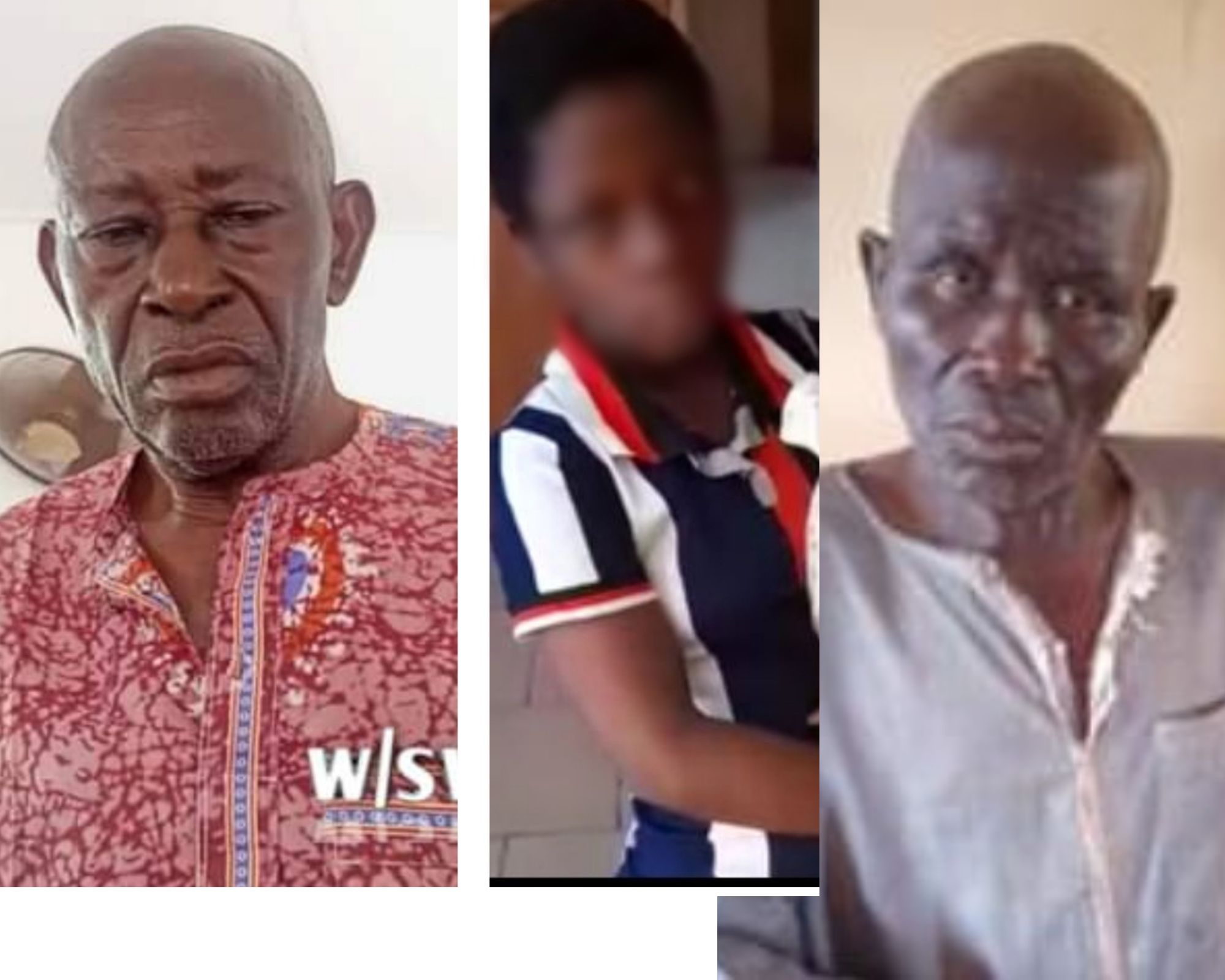
But for being held down following her inability to pay the hospital fees after giving birth, the unpleasant story of a 13-year-old girl, allegedly raped and impregnated by her guardian, Mr. Sunday Muoghalu might never have gone viral.
Thankfully, the 75-year-old pedophile, Mr. Sunday Muoghalu has been arraigned before the Children, Sexual and Gender-Based Violence Court, in Awka, on three counts of defilement, carnal knowledge, emotional, verbal, and psychological abuse.
Accepting responsibility for the pregnancy and the baby, Muoghalu, added that he was only playing with the victim and never intended to impregnate her.
The teenage mother was rescued by the Anambra State Ministry of Women and Social Welfare after a video showing her with her newborn at a hospital in Adazi-Nnukwu, Anaocha Local Government Area of the state went viral on social media at the weekend. She was detained for her inability to pay her hospital bill.
Consequently, the state government sought her out and took her into safe custody.
The young mother said she is from Akwa Ibom State, while her biological parents lived in Agulu, Anambra State.
Narrating her ordeal, she said her travail started when Muoghalu’s wife, known as Madam Ghana travelled to the village. “I am not the only one involved. There is another girl who is seven years old. Muoghalu used to sleep with her too.
“This started when I began to see my menstruation and he started forcing me to sleep with him. I once told Madam Ghana about it, and she cautioned her husband, but when it continued, I could not do much any longer.”
While ruling on the bail application by defence counsel, the presiding judge, Genevieve Osakwe held that the rate of rape and defilement of minors in the state is alarming; adding that the defendant is old enough to be the grandfather of the complainant.
She further stated that although the defendant’s counsel asked for bail on the grounds of his client suffering from acute diabetes and hypertension, he failed to present any medical report to that effect.
Muoghalu was remanded in prison custody, while the prosecution was directed to forward the case file to the office of the Director of Public Prosecution (DPP) at the State’s Ministry of Justice so that the matter could be brought before a High Court.
Another 75-year-old man, Isa Nana Okpoku has been arrested by the Nasarawa State Police Command, for allegedly raping his 4-year-old niece in Obi Local Government Area of the state.
Spokesperson of the command, DSP Ramhan Nansel, in a statement on Sunday, December 11, 2022, said police operatives attached to Obi Division arrested the suspect in Daddare Development Area, consequent upon a report that was lodged at the Divisional Police Headquarters on Saturday at about 0800hrs.
“Preliminary investigation revealed that the suspect and his niece are both residents in the same house thus, he lured the victim into his room and willfully had unlawful carnal knowledge of her,” the statement read.
“The victim was, however, rushed to the hospital for medical examination where the Doctor confirmed the hymen is broken,”
“The Commissioner of Police, CP Maiyaki Mohammed Baba has ordered a comprehensive investigation into the offence; upon conclusion, the suspect will be charged to a court of competent jurisdiction for prosecution.”
Then as people like Oluwatobi Raji who was raped at age eight by her maternal uncle and who survived rape ten times by ten different persons are rising from the vestiges of their misfortune, by inspiring others through her story and through her nonprofit, Every Child Initiative, a female teacher was arrested days ago in Maiduguri, Borno for allegedly sexually assaulting a four-year-old primary school pupil.
The Father of the victim, Hassan Dala, alleged that the teacher would tuck his daughter inside her veil and then insert her finger into the girl’s private parts. Dala narrated to newsmen that “it happened in Golden Olive Academy, Maiduguri.”
“The Academy is a Nursery and Primary school. The teacher usually put my daughter inside her veil and forced the girl to suck her, while inserting her finger in my daughter’s private part,” the heartbroken father tearfully told newsmen.
“One day, as her mother was bathing her, she complained of pains in her private part, but the mother first ignored it. When the complaints persisted, the mother noticed blood in the child’s urine and called my attention to it. We took her to a private clinic at Bulumkutu, Miyetti Clinic, where a doctor advised us to investigate what happened. An investigation at Umaru Shehu Hospital confirmed intrusion into the child’s private part,” the depressed and aggrieved father disclosed.
He called on Governor Zulum to, in the spirit of the state’s Violence Against Persons Prohibition Act and the Child Tights Act, intervene to ensure justice for his child.
The Borno State coordinator of the National Human Right Commission, Jummai Usman Mshelia, confirmed knowledge of the case. “Teachers in the school were paraded and the pupil pointed at the particular teacher,” Mshelia said.
Mshelia also disclosed that the teacher was alleged to be in the habit of distributing chocolates to the pupils. “And, it was alleged that the teacher used the same bait to lure the child.”
Mshelia said, initially, the police had wanted to file the case at magistrate court but they insisted the case should be taken to the high court for proper prosecution because the medical report had proved penetration.
The Police Public Relations Officer for Borno State Police Command, ASP Sani Kamilu Shatambaya, confirmed the arrest to newsmen in Maiduguri, on Saturday, November 25, 2022.
“The case is with the police and the teacher was arrested, “Shatambaya explained to newsmen on phone, continuing, “We are doing a thorough and objective investigation on the matter, and later refer it to court.”
Chief Mike Ozekhome, SAN, CON, OFR, FCIARB, PhD, LL.D.
Introduction
News that the National Judicial Council ( NJC ) – the nation’s judicial regulatory agency – has reversed its earlier suspension ( on corruption charges ), of Hon. Justice Rita Ofili-Ajumogobia and re-instated as a judge of the Federal High Court, has elicited mostly positive – even if muted – responses from a large section of the society, particularly stakeholders in the justice–delivery sector. So far, the apparent lone voice of dissent appears to be that of a Civil Society Organization ( CSO ) – the Access to Justice (or A2J for short). Let me clearly state here that A2J is one of the few credible CSOs still available in the country, many others have become nothing but mere mercantilistic money-guzzling and international donor-recipients, who merely look the other way even as the nation is being brazenly and rapaciously stripped bare by her minders, of what remains of her respect, dignity and claims to nationhood. Like the Egyptian Nero, the 5th Roman Emperor – (AD 54 – AD 68), a man who was notorious for his treachery and debauchery, they “fiddled while Rome burned”.
This is why I was surprised to read a press release, titled (rather most unkindly): “A brutal agonizing stab on the soul and body of Nigeria’s Judiciary”, made by A2J. The respected organization in the said statement frowned at NJC’s action in reinstating Justice Ajumogobia, a refreshingly welcome act, which it described as “unfortunate”; given what it called, “serious and damning accusations against Justice Ajumogobia”. In its opinion, NJC’s decision “will cast a long and dark shadow over the Judiciary for a long time to come and amplify questions whether the Nigerian Judiciary can continue to legitimately exercise judicial power”. The CSO, therefore, called on the NJC to immediately reverse its decision to reinstate Justice Ajumogobia. No. It is the other way around. The NJC should be commended and accorded plaudits and encomiums for this uncommon act of observance of due process and the rule of law.
BACKGROUND FACTS
To enable us have a full grasp and understanding of the depth and breadth of the circumstances surrounding the NJC’s overdue decision, it is necessary to put forward and review Justice Ajumogobia’s painful and agonizing travails over the years. Her Lordship was first dragged before Hon. Justice Hakeem Oshodi of the High Court of Lagos State on 28th November 2016, ( over six years ago), alongside a Senior Advocate of Nigeria, Chief Godwin Obla.
They were arraigned on 30 counts, in which the latter was accused of offering Justice Ajumogobia the sum of N5 million as gratification allegedly to influence her decision in a Suit marked FHC/L/C/482c/2010. Furthermore, Justice Ajumogibia was accused of receiving the sum of $793,800 in several tranches from different sources between 2012 and 2015 “so as to have a significant increase in your assets that you cannot reasonably explain the increase in relation to your lawful income.” That trial went nowhere and Justice Ajumogobia was reprieved after she was discharged.
Not satisfied, however, the EFCC re-arraigned her before Hon. Justice Ambrose Lewis-Allagoa of the Federal High Court, who in a ruling delivered on the 19th day of November 2021, brought her ordeal to an end, as the court accepted her counsel’s application and quashed all the 18 counts against her, which had alleged unlawful enrichment, bribery and money laundering. In the words of the court: “An order is hereby granted striking out or quashing the charge against the applicant in its entirety for being incompetent and this court lacks the jurisdiction to try same.” If the public thought that the ruling had far-reaching implications for the Judiciary in terms of obedience to court orders, more hair-splitting was to arise as to how the learned trial Judge arrived at his judgement.
The answer lies in a subsequent judgement delivered by the Court of Appeal on the 11th of December, 2017, in the case of FRN vs Hon. Justice Nganjiwa. The court in that case held that a serving Judge cannot be prosecuted by the EFCC or any prosecutorial agency unless the Judge had first been probed by the NJC, found guilty and dismissed. Justice Obaseki-Adejumo, JCA, who delivered the lead judgement which was unanimously endorsed by other members of the panel, declared that “the NJC is the sole body empowered by the Constitution to determine allegations of misconduct against judicial officers even on criminal allegations of bribery and corruption made against them”.
Continuing, the intermediate court held that “NJC is created by the Constitution to solely regulate affairs of the appointed judicial officer without interference from any authority, and that it is only when the NJC has given a verdict and handed over such judicial officer (removing his toga of judicial powers) to the prosecuting authority that he may then be investigated and prosecuted by the appropriate security agencies”. This judgement was subsequently affirmed by the Supreme Court earlier this year on 27th May 2022.
It was against this background that Hon. Justice Allagoa, upon being presented with the true and correct position of the law, discharged and acquitted Justice Ajumogobia, on the 21st day of November 2021, as aforesaid. Pray, where is Ajumogobia’s fault in any of these? Is she to blame for seeking justice through the constitutionally – guaranteed medium, having her day in court and prevailing in hotly contested cases that dragged her name in the mud for over six years? Must she be persecuted for being successful and coming out triumphant against all odds – the serial attempts to truncate her illustrious judicial career, prematurely? Must NJC be unfairly lampooned for obeying court orders and refusing to appeal the same after discovering its earlier error in hastily terminating her appointment? Is the NJC a court of law with supervisory jurisdiction over courts of law? The answers to these posers are too obvious to admit of any sophistry or Baba Sala’s Kerikeri histrionics. This conveniently takes us to the next question, which is:
IS ACCESS TO JUSTICE RIGHT IN ITS OPINION?
This question is legitimate because, even though opinion is free, it must, however, be expressed responsibly, with due regard to the facts of each case and the rights of other persons; and – in the peculiar circumstances of this case – the observance of the rule of law, equity, fairness, justice and respect for citizens’ fundamental rights. Yes, A2J has a right to its opinion on the reinstatement of Justice Ajumogobia; but is that opinion correct? Is Ajumogobia’s case of reinstatement to her duties unique, uncharted, or unusual? Is there anything to suggest that NJC’s decision was motivated by any untoward considerations? Was it actuated by inappropriate motives such as a desire “to protect one of its own”, seemingly at all cost? Was the decision, all things considered, in the public interest? Is it fair for Access to Justice to have jumped to the conclusion that it was not? Was Justice Ajumogobia’s case special? Is it unprecedented? Why should she – as the Organization suggests – remain suspended and traumatised indefinitely for over a year (since November 19, 2021), even after the Federal High Court had quashed the charges for which she was indicted in the first place? Is law an instrument of oppression? Is it no longer an instrument of social engineering as Prof Dean Roscoe Pound once propounded?
AJUMOGOBIA NOT AN ISOLATED CASE
These questions are pertinent because not only was Justice Ajumogobia in ‘judicial limbo’ for well over six years (since November 28, 2016, when she was first arraigned), hers was certainly not an isolated case. A host of judicial officers who were similarly indicted and charged to court for alleged corrupt practices and unjust enrichment by the EFCC, the Code of Conduct Bureau and the office of the Attorney-General of the Federation, had since been reprieved, with some of them fully restored or reinstated to their various posts and positions in the judiciary.
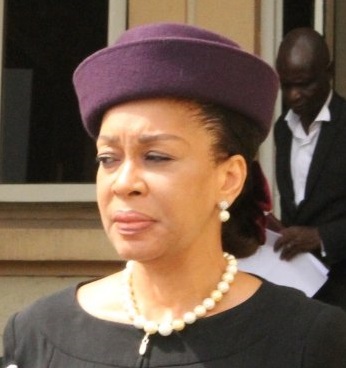
Some of these Jurists include, but are not limited to, the late Hon Justice Sylvester Ngwuta, JSC, of the Supreme Court; and Hon. Justice Adeniyi Ademola( rtd) of the FHC; Hon. Justice Hyeladzira Nganjiwa ( FHC); and Hon.Justice Agbadu Fishim ( NICN). All the charges against them were quashed and dismissed for incompetence, and all of them were reinstated as judicial officers by the NJC. The only curious exceptions were Hon Justices Agbadun Fishin and Gladys Ololtu ( FHC ), whose secured victories from courts of competent jurisdictions were surprisingly appealed by the NJC, a judicial organ that ought ordinarily to protect the dignity of the courts and to bow to superior decisions of such courts of law that delivered judgements after full-blown trials and hearings duly witnessed by members of the public. Justice Ngwuta later resumed his duties fully at the Supreme Court. I had the opportunity to appear before him in some cases before he transited. Not a few Nigerians believe that his subsequent death not long after his reinstatement to the apex court was occasioned by the humiliation, mental trauma, agonizing ordeal and psychological depression that attended his state-sponsored persecution. Hon Justice Ademola honourably retired from judicial service after his reinstatement. Continuing in service to an apparently ungrateful and lynching country was no longer necessary. Do you blame him? Former CJN, Walter Onoghen, was literally humiliated, intimidated, harassed, hunted, and finally hounded out of the apex court through a mere ex parte order instigated by an intemperate Executive that bayed for his juristic blood. So, why and how is Justice Ajumogobia’s case different, having won her case? Yet, some other Judges were merely investigated and never charged to court at all. Why? That is the question that Access to Justice should seek answers to. For example, the unfair case of Hon. Justice Nnamdi Dimgba cries to the high heavens here. The house of the cerebral and intellectually – grounded Scholar-Jurist was crudely attacked, broken into and ransacked by hooded SSS operatives who pulled down doors and windows. Nothing incriminating was ever found on him. But, did the government deem it fit, decent and noble to apologise to him; to balm his bruised ego? No. Has this government ever realized what harm and mental torture are thereby inflicted and etched forever in the psyche of such innocent citizens whose houses were brutally invaded, viet armies, and with them and their families brazenly subjected to intimidation, coercion, fear and humiliation?
THE UNFAIR CRITICISM
In castigating the NJC for reinstating Justice Ajumogobia, Access to Justice (which has undoubtedly made its mark as a credible Civil Society Organisation over the years), unfortunately terribly missed the mark this time around. This is because, without proffering any convincing logical, moral, legal or constitutional arguments for impugning Justice Ajumogobia’s reinstatement following her exoneration by various courts of law, A2J came across in its press release, as less-than-professional (with all due respect); and motivated by less than altruistic considerations. Perhaps, one of the very few instances, though.
THE CONSTITUTIONAL REGIME
For the avoidance of doubt, any criticism of Ajumogobia’s reinstatement can only be accommodated and must be located within the precincts and four corners of the clear provisions of sections 6,153(1)(i),158,292(1) and Paragraph 21(b) of the Third Schedule to the 1999 Constitution, which clearly spells out the plenitude and amplitude of the functions of the NJC –and no more. Anything short of that would be unconstitutional. Yes, corruption is bad; and judicial corruption is even worse – in fact, more deadly and cancerous. I once described corruption, on 12th September 2013 ( after my release from my three-week excruciating ordeal in the hands of kidnappers), as the 37th State of Nigeria, which I described as the wealthiest and most powerful. I had therefore theorized, and I still maintain my theory, that we must kill corruption before corruption kills us all. But, in fighting corruption, we must do so within the realm of decency, with respect to citizens’ rights and observance of the rule of law and due process. Fighting corruption with corrupt, unorthodox or unconscionable means is a worse form of corruption. Thus, to condemn Ajumogobia’s reinstatement to her position from which she was wrongly and unconstitutionally removed in the first place, so as to perpetually subject her to the asphyxiating and hanging Sword of Damocles, despite having been fully cleared of all charges by courts of competent jurisdiction – as A2J appears to suggest– is simply most unfair and uncharitable, to put it mildly.
This stance is surprising, given A2J’s pedigree as an organization consisting mostly of legal practitioners. They are, first and foremost, Ministers in the Temple of Justice. They therefore ought to be familiar with the famous aphorism that, “it is better for 10 guilty men (or women) to be set free than for an innocent man or woman (in this case, Justice Ajumogobia) to be convicted”. This is even worse where such conviction is by the court of public opinion that lacks all the necessary facts and the peculiar workings of our justice system. Put simply, A2J got it wrong this time around – big time.
CONCLUSION
My humble take on this is that instead of the NJC apologizing for doing the right thing and obeying valid court orders as A2J appears to suggest, it is the organization that ought to apologise to both the NJC and Justice Ajumogobia, for allowing itself to buy into frenzied ‘mob’ sentiments; the usual government’s ” name-and-shame” mantra; and pedestrian logic in its knee-jerk reaction to NJC’s action, which ought to be applauded by all and sundry.
Justice Ajumogobia has been tried in courts of law, discharged and given a clean bill of health. She has had her day in court. She has been vindicated. Whoever is aggrieved by her well-deserved exoneration and reinstatement should give her – and the NJC – a total break; and move on. The courts have spoken and it is final. Decisions of the NJC are inferior to that of a court of law. That is the extant position under our constitutional dispensation. There is no room for jungle justice, trial by media, sensationalism, hype, or speculation-least of all, from respected senior lawyers that ought to know better.
Beyond this, it remains to be emphasized that the Common law or Anglo-Saxon system of jurisprudence which we operate in Nigeria is accusatorial. It is not the French model, which is inquisitorial. In the accusatorial model, a person is presumed innocent until proven guilty by the State. This has been enacted into section 36 of the 1999 Constitution. This is different from the inquisitorial French model which is inquisitorial; where a defendant is presumed guilty until he proves his innocence. Consequently, to the extent that Hon. Justice Ajumogobia has undergone the full rigours of a trial and came out unscathed, to that extent is it most uncharitable for anyone to suggest, let alone insist, that she should continue to prove her innocence, as it were.
THE WAY FORWARD
The role of the NJC in all this also deserves some commentary. This is because, as a constitutional body, its role should be no more than to dispassionately investigate allegations of misconduct against Judges and, where unproven or disproved, it should unhesitatingly and promptly reinstate such Judges, in the event that they had earlier been interdicted. Under no circumstances should NJC go so far as appealing against a decision of a court of competent jurisdiction which exonerates a judicial officer as it is currently doing with respect to the cases of Hon. Justice Gladys Olotu and Hon Justice Agbadu-Fishim. This, with all respect, due deference and full humility, is patently wrong. I hereby humbly appeal to the NJC to immediately discontinue and withdraw those appeals. They are as unnecessary as they are persecutory. The NJC should admit to errors and fallibility. It is not God.
The NJC should only indict Judges in the clearest of cases. It should never allow itself to be used or misused, wittingly or unwittingly, by the other arms of Government (particularly, the intolerant and unaccountable Executive), to hound, hunt, or persecute hapless Judges doing their legitimate work. That would be grossly unfair and amount to a flagrant affront to the Constitution. Those arms of Government should first cleanse and deodorize their stinking Augean stables – where confirmed cases of corruption-on-steroids abound – before turning to the Judiciary – Alexander Hamilton’s weakest of the three arms of government (Federalist Paper No 78 ). This is because, compared to these other arms of government, the Judiciary – as a body – is a Saint occupying mother earth. Please, let Justice Ofili-Ajumogobia, a brilliant and fecund quintessential Jurist, be.
President of the Nigerian Bar Association Mr. Yakubu C. Maikyau, SAN, hasrevealed that when lawyers misconduct themselves, it is because they are expressing a certain form of disability.
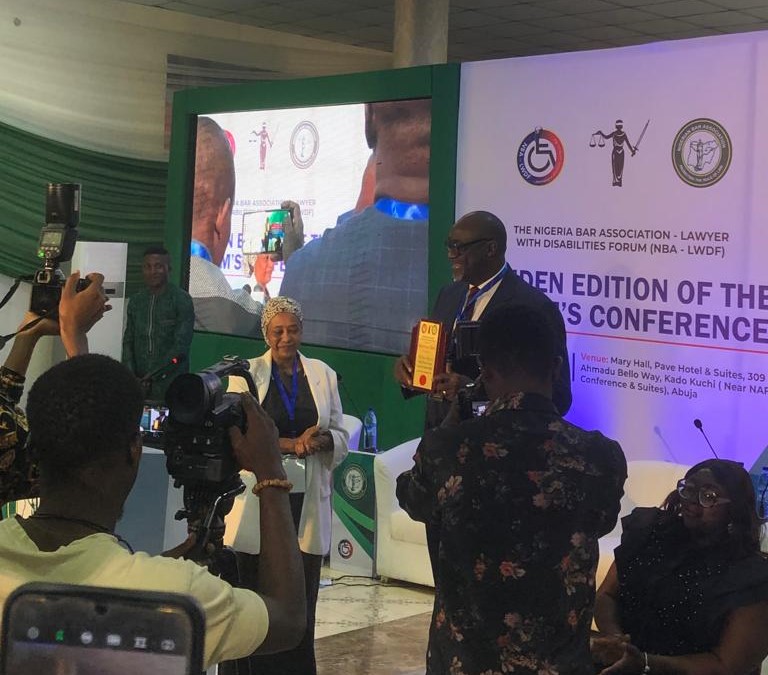
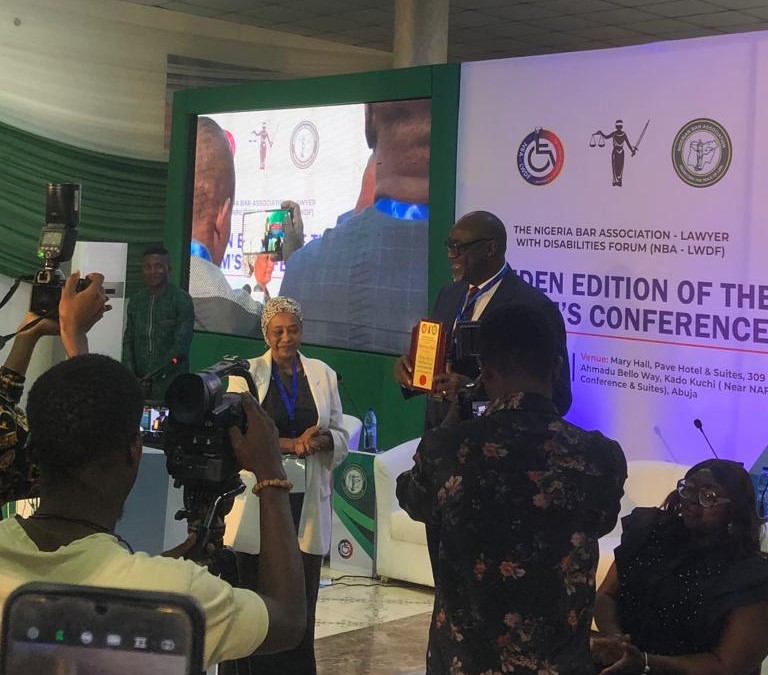
According to Maikyau who delivered the keynote address atthe just concluded Maiden Conference of the Nigerian Bar Association-Lawyers with Disabilities Forum (NBA-LWDF) in Abuja, “when we misconduct ourselves as lawyers, it is because we are expressing a certain form of disability; it is the deficiency in the knowledge of what to do, because, you can only do according to what you know.”
It has been three years since the proposed disability legislation took effect in Nigeria but reports show that most of the 31 million persons living with disabilities have remained victims of neglect, abuse, and stigma.
And although many persons with special needs in Nigeria desperately seek inclusion, this remains a mirage as they have no means of making this happen. Recently, the Christian Association of Nigeria, (CAN), called on state governors to work towards ensuring the domestication of the Discrimination Against Persons with Disabilities (Prohibition) Act in their respective domains.
However, lawyers with disabilities in Nigeria have been commended for their tenacity and resolve in ensuring that Nigeria has laws and institutions that protect and support persons with disabilities (PWDs).
James Lalu
Speaking at the NBA-LWDF conference, the Executive Secretary of the National Commission for Persons with Disabilities (NCPWD), Mr. James Lalu remarked that the NCPWD would remain grateful to lawyers with disabilities in Nigeria for facilitating the coming into being of the Discrimination Against PWD Prohibition Act and the establishment of the commission.
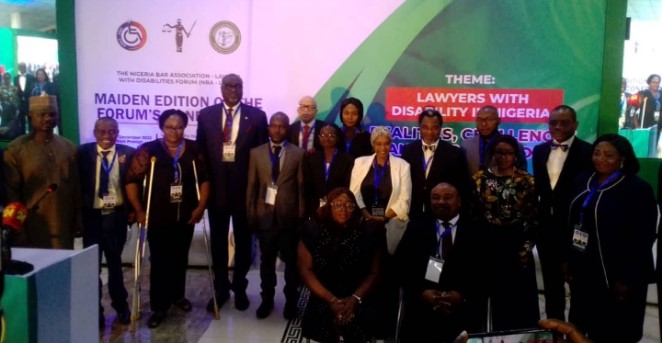
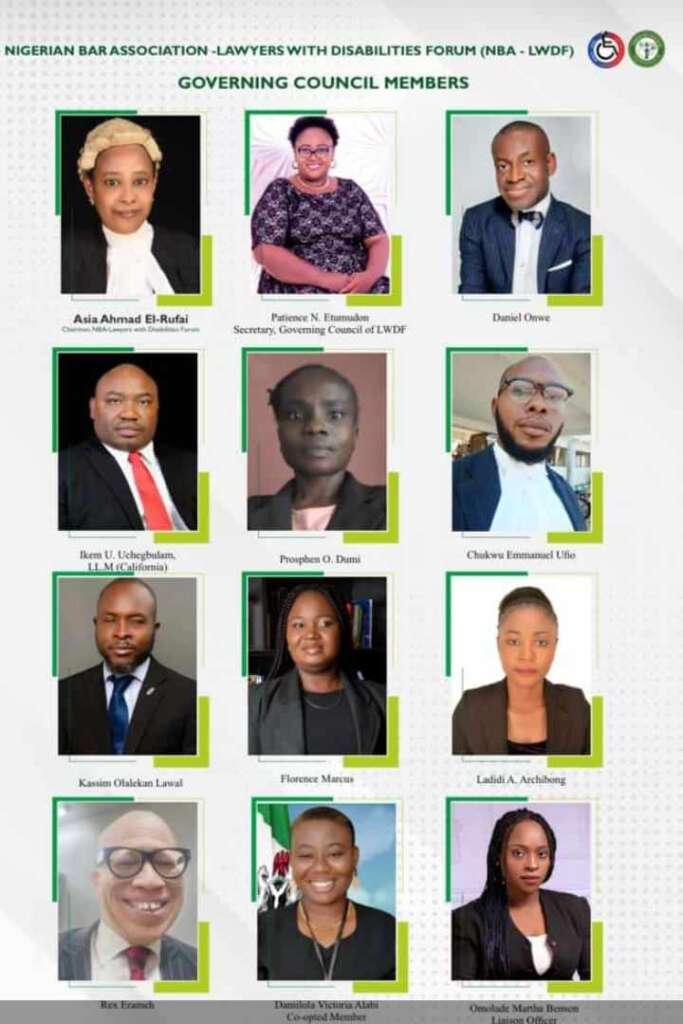
The Conference, with the theme “Lawyers with Disabilities in Nigeria: Realities, Challenges, and Expectations”, was organised by NBA-LWDF under the headship of its Chairperson, Mrs. Asia Ahmed El-Rufai, and supported by Asia Ahmed and Co, Law Forte, A.U. Mustapha, and Co. and others.
Lalu noted that “even when the Discrimination Against PWD Prohibition Act was passed by the then National Assembly and the Executive Arm of government did not sign it into law, the lawyers with disabilities never relented.
“They pushed so hard and here we are today. Therefore, we will always be grateful to lawyers with disabilities in Nigeria.
“However, we are working on regulations and we are hoping that as soon as possible we are going to achieve these regulations.
“The regulations make it very clear and provide the standard dimension and necessary measurement for unified standard facilities that are disability friendly across the country.
“The law provides five years period in which everybody or organisations must adjust to provide accessibility in their own offices and environments,” Lalu said.
The NCPWD boss called on the NBA to ensure that their offices are accessible to members of the disability community.
He hinted that in 2023, the Commission would host an Access to Justice Summit for PWDs, adding that the Commission is soliciting the support of the NBA.
Meanwhile, NBA President Maikyau, said he was not comfortable with the use of the word disability for lawyers or any human being.
He insisted that the word disability set a limit in the psychic of people that happens to dampen their aspirations, and expectations and set limitations to their dreams.
He explained that words influence and create the world, stressing that every time we describe ourselves as disabled, it does no good to us.
“However, I have seen the resilience of members of this Forum. I have seen purposefulness in what you have done. I can see everything you bring to bear in anything that you do.
“I can see your conviction and persuasions, and put them side by side with what you describe yourselves in this Forum. Imagine if that had been taken away, we would not be where we are today. We would have gone far.
“However, we have to embark on advocacy to liberate our minds and beliefs. We have to believe the best of us and we shall enjoy the fullest expression of what God has deposited in all of us. This is my call to all members of this Forum and all members of the NBA.
“We have come to think that it is what we see that we define as disability; many of us are dealing with one disability or the other.”
The NBA President pledged that all committees that would be set up by the NBA would comprise at least one of two members of the NBA-LWDF.
Maikyau also pledged to support the NCPWD in all their programmes.
Likewise, the Chairman of the Conference Planning Committee, Mr. Ikem Uchegbulam, said the essence of the Maiden Conference was to bring stakeholders in the legal profession to evaluate the realities, prospects, and challenges that LWDs are facing in Nigeria.
“We have been able to identify the inaccessibility of facilities, including courtrooms, employment deficiency, and issues relating to technology and how PWDs can be able to have a version that is accessible to them, especially persons with visual impairment.
“We are looking at the realities, challenges, prospects, and how these things can be cured so that LWDs can actually engage in legal practice without limitation,” Uchegbulam said.
The conference brought together stakeholders from the disability community, the legal profession, and many more.
…extols her for emerging topmost graduating student in medical sciences, bagging 7 awards
The Governor of Edo State, Mr. Godwin Obaseki, has applauded Dr. Godknows Osarenren Osarhiaekhimen, an indigene of Edo State, who emerged Best Graduating Student in Medical Sciences and Overall Best Graduating Student of the Obafemi Awolowo University at the institution’s 46th convocation.
In a statement, Obaseki celebrated Dr. Osarhiaekhimen’s achievements, hailing her for bagging seven distinguished awards.
He noted, “It is with great pride that I congratulate you, Godknows Osarenren Osarhiaekhimen, for emerging the Best Graduating Student at the 46th Convocation Ceremony of the prestigious Obafemi Awolowo University.
“We are, indeed, proud of your lofty achievements, as you have given a good account of yourself by clinching 7 distinguished prizes.”
The governor further noted, “This attainment is a testament to the indomitable Edo spirit, which places hard work, diligence, and determination as core virtues in pursuit of excellence.
“You have joined a long list of illustrious Edo sons and daughters, who continue to blaze the trail and record phenomenal results in their chosen life endeavours.
“Today, you serve as an inspiration to many young Edo boys and girls who are looking out for worthy mentors to guide them aright in a world filled with numerous distractions.”
“I celebrate your genius and wish you even more resounding success in your chosen field of medical practice,” he added.
For every course she took as a medical student at Obafemi Awolowo University, Ife, she made a distinction. And finally, she finished as the 2022 best graduating student in Medicine and Surgery with 15 distinctions and 7 awards. An amazing wonder, Dr.Godknows Osarhiaekhimen tells her story.
I had distinctions in every course in medical school. In my second year, I had distinctions in Anatomy Physiology, and Biochemistry. In my third year, I had distinctions in Anatomy, Physiology, and Biochemistry. In my fourth year, I had distinctions in Pathology and Pharmacology. In my fifth year, I had distinctions in Obstetrics and Gynaecology, Paediatrics, Mental Health, and Dermatology. In my sixth year, I had distinctions in Surgery, Medicine, and Community Health.
The Pro-Chancellor; Owelle Udoji giving me one of my awards, while to the right is the Vice Chancellor; Prof. Simeon Bamire.
I won the Faculty Prize for the Candidate with the best overall performance in Clinical Sciences, the Nigerian Medical Association Prize for the student with the best overall result in the MBChB degree examination, the Major General Olufemi Olutoye Prize for the student with the best overall performance in the first professional examination, the Abimbola Kolawole Prize for the best student in the final MBChB degree examination in Pathology, the Professor Adewale Akinsola Prize for the best student in final MBChB examination in Medicine, the Adeline Olu Ajayi Prize for the best graduating student in Physiology in the second MBChB examination, the Dr. Oluyemi O. Badero Foundation Prize for the best overall student in the Bachelor of Medicine, Bachelor of Surgery (MBChB) final examination in the Faculty of Clinical Sciences.
I hail from Ologbo N’ugu in Orhionmwon Local Government Area of Edo State. I am the first of five children. My father, Barr. Gaius Osarhiaekhimen is a private legal practitioner in Abuja, and my mother, Mrs. Chinedu Osarhiaekhimen is a nurse with the Federal Road Safety Corps Staff Clinic in Gwarimpa, Abuja.
My mother, Mrs. Chinedu Osarhiaekhimen, the Pro-Chancellor, me, the Vice Chancellor, my father, Barr. Gaius Osarhiaekhimen.
I was born and raised in Kubwa, FCT. I had my primary school education in Ideal Nursery and Primary School, Kubwa. I had my secondary school education at Baptist High School, Kubwa, Unity High School, Kubwa, and Anglican Comprehensive Secondary School, Kubwa. After finishing secondary school, I went for a pre-degree at OAU Centre for Distance Learning in Moro, Osun State, after which I gained admission to study Medicine and Surgery at Obafemi Awolowo University.
I resumed medical school on the 17th of May, 2015, concluded my final exams in August, 2022, and got inducted into the medical profession on the 14th of October, 2022.
Besides being a medical student, I was a member of AIESEC Ife, a youth-run not-for-profit organisation aimed at peace and fulfillment of humankind’s potential. I also took on several leadership roles as I was a group representative for some clinical postings and for my final year project group. I equally served as the academic secretary of my class in CMDA in my final year.
I’m presently doing my Housemanship at the Lagos University Teaching Hospital, Idi-Araba, Lagos. I started working here on the 4th of November, 2022. Housemanship is a compulsory one-year internship for graduates of medicine and surgery to get permanent medical licenses.
#SomberTuesday! Electioneering campaigns continue, and I’m glad I’m not alone in wondering why Nigerian politicians seek legitimacy by speaking at Chatham House instead of in the country, where they should take every opportunity to engage the electorate. Why at this point in our history as an independent country do we need validation from our former colonizers? As though that wasn’t bad enough, we don’t seem to be able to produce either female, young, or people with disabilities as candidates for the presidency. These categories of people are also few and far between among candidates for other positions. It’s also a matter of the utmost urgency that we must never forget that #EndSARS protesters demanded an end to bad governance, impunity, violence, and police brutality but were harshly suppressed in a violation of democratic norms and values. The economy is in a downward spiral. Many lost their lives in the catastrophic, unprecedented floods. Many survivors lost everything. Millions are displaced and in dire straits. #NigerianWomenArise #EndPoliceBrutalityinNigeriaNOW #EndSars #EndSWAT #EndImpunity Two years on, we must never forget that our peacefully demonstrating youths were massacred at #LekkiTollGate and other locations.
Like a broken record, I keep saying that Howard Zinn’s statement applies to Nigeria’s predicament: “Civil disobedience, that’s not our problem. Our problem is that people are obedient all over the world in the face of poverty and starvation and stupidity, and war, and cruelty. Our problem is that people are obedient while the jails are full of petty thieves, and all the while, the grand thieves are running the country. That’s our problem.” Let the kleptocrats give back our stolen wealth so that we can fix our infrastructure, schools, hospitals, and also offer worthwhile social protection to our people.
Let the masses enjoy the full benefits of citizenship in Nigeria. Let the leaders and political class repent and build peace with justice. This is no time for politics as usual. The people elected should be those trusted to bring justice, equity, and human security to the entire country, not expedient, unethical, and egocentric individuals determined to dominate for self-aggrandizement or sectional gain. We don’t need oligarchs’ continued domination. We also need a government that puts the interests of majority of citizens first.
Our site uses cookies. By clicking “Accept All Cookies”, you direct Law and Society Magazine to store cookies on your device and disclose information in accordance with our Cookie Statement: cookie policyACCEPTREJECT
Privacy & Cookies Policy
Privacy Overview
This website uses cookies to improve your experience while you navigate through the website. Out of these cookies, the cookies that are categorized as necessary are stored on your browser as they are essential for the working of basic functionalities of the website. We also use third-party cookies that help us analyze and understand how you use this website. These cookies will be stored in your browser only with your consent. You also have the option to opt-out of these cookies. But opting out of some of these cookies may have an effect on your browsing experience.
Necessary cookies are absolutely essential for the website to function properly. This category only includes cookies that ensures basic functionalities and security features of the website. These cookies do not store any personal information.
Any cookies that may not be particularly necessary for the website to function and is used specifically to collect user personal data via analytics, ads, other embedded contents are termed as non-necessary cookies. It is mandatory to procure user consent prior to running these cookies on your website.