Lola: Ah ah, what’s biting you? How can you just wake up and make such a blasphemous declaration?
Ola: How did blasphemy come into this matter? You don’t even know what I’m talking about.
Lola: I’m itching to find out, trust me. You, a man declaring that men, all men are fools. I’m a woman and I will not even say such a thing. You can call men overgrown babies. They love breasts and are never weaned from them. They love to be petted and pampered but they are no fools. No, I totally disagree with you.
Ola: By the time I’m done, you will agree with me.
Lola: Okay, I can’t wait.
Ola: Okay, start by explaining this. NYSC pays all corps members the same salaries and allowances, right? But when they get to mammy market, the male corper dips his hands into his pockets and like a fool buys drinks and pepper-soup for the female corper. The female corper saves her money after having a good time.
Lola: So, the Bobo corper is a fool because of that? That is so totally unfair. He’s just being a man. You don’t expect the babe to pay for suya when her boo is able and capable?
Ola: So, the babe is disabled and incapable?
Lola: Nooo, it’s just the way of the world.
Ola: When the Bible said a fool is easily parted from his money, don’t you think it was Nigerian men that it was referring to?
Lola: Oh please, stop this nonsense. Don’t turn the Bible upside down.
Ola: Okay, explain that little scenario.
Lola: The explanation is simple. Men are wired to give. Women are wired to receive.
Ola: Eeeeeh? What did you say? Did you come up with that all by yourself or it’s a quote from somewhere?
Lola: You heard me right. Men give. Women take. It is the way we are wired. We are just wired differently.
Ola: Who did the wiring?
Lola: God now.
Ola: This kind of wiring is electrocuting men. I don’t like it.
Lola: No. It is only when a man is trying to rewire himself that sparks fly. There is only trouble in Paradise when men refuse to follow the lines of their divine wiring. Once a man is willing to give, we are willing, always ready to receive.
Ola: Like Ever Ready battery?
Lola: Yes o. Consider how babies are made. The man gives and the woman receives and a new life is born.
Ola: Aaah, when we give in that way, we give painfully. The poor man will shudder, shake and groan before delivering the goods.
Lola: Don’t even go there. What painful shudder? The whole movement is divinely blissful or blissfully divine. It is the screeching to a halt that is done in a way to prevent the man from crossing to the other side of cloud nine, you know. Come on, you know it is a pleasure made in heaven, part of the way a man is wired. You groan and moan and send your millions of little men to work. The woman receives them and is in trouble for nine months, spitting and vomiting. You guys get all the pleasure.
Ola: You are a woman, how would you know if it is painful or pleasurable?
Lola: Someone should take a picture of your face when you are shaking and shuddering on top or below a woman… In any case, if it is painful, how come you guys want it so much, so often, in every way and at all cost? A man would do anything to achieve that blissful shudder.
Ola: I don’t know what you are talking about.
Lola: Ah ah, suddenly you don’t know what I am talking about, right? Were you not the one who asked me to explain the logic behind ‘men are wired to give’? It is not that men are generous willingly. It is because that is the only way they know how to live. They even pay to give a woman pleasure.
Ola: Can you imagine? If it is not foolishness, why would a man pay to give a woman pleasure?
Lola: Sometimes they even queue to pay for that pleasure.
Ola: Like say dem swear for us?
Lola: They are just fulfilling destiny.
Ola: Chaaaai, there is God oooo. Who did this to us?
Lola: You should be grateful to us too because I hear that if a man carries his full load around for too long without downloading, he may fall ill.
Ola: True. It may even cause a dangerous ailment.
Lola: Or make him misbehave and start seeing double.
Ola: True. When a man is too loaded and can’t find a woman in need, it can be catastrophic.
Lola: You see my point now? God has blessed men so much they have to continue to be generous givers.
Ola: Thank God women are programmed to receive, otherwise there would be trouble. God is a perfect God. He had it all figured out. He gave men what to give and women the capacity to receive.
Ola: That last part is arguable. Some men have more capacity than their women can cope with.
Lola: You have a point but it is usually something that can be worked out. Sometimes the woman wants more than the man can give. They just need to work on it and find a middle road. Where I have problem with men is their propensity to open branch offices everywhere.
Ola: When a man has so much to give, he has to continue to distribute. If a business is big, it spreads so more people can benefit from it.
Lola: Isn’t that why some men die in active servicewhen they become General Overdoer of the Sinners Chapel?
Ola: Those are the ones who don’t know when their pipeline has gone broke or empty. Wise men always know when to stop shopping and shuddering so the groan of pleasure does not become a groan of death.
Lola: So, you now see that women and men are created for different purposes? When a woman can’t receive, she cannot function like a full woman and when a man can’t give, he feels like half a man or no man at all.
Ola: That sounds a little complicated. Please expatiate.
Lola: If a woman is a breadwinner, picking all the bills and taking care of the man, she begins to lose her feminity. She becomes cranky. She is not so warm in bed. She begins to lose the tenderness and capacity to receive. Because she has started to give instead of receiving. Everybody starts blaming her for being rude, arrogant and bossy but a woman is not wired to give and receive. She is programmed to play only one role. She can only do her God-given duties. When circumstances force her to play a role written for a man, she starts acting deformed.
In 1968, Stanislav Andrzejewski, the former Polish soldier and prisoner-of-war, who later founded the Sociology Department at the University of Reading in England, coined the word ‘kleptocracy”, which he defined as “a system of government [that] consists precisely of the practice of selling what the law forbids to sell.” He saw in the system of Nigeria’s First Republic, “the most perfect example of a kleptocracy” in which “power rested on the ability to bribe.”
According to Andrzejewski, the defining characteristic of a kleptocracy “is that the functioning of the organs of authority is determined by the mechanisms of supply and demand rather than the laws and regulations.”
In a democracy, there are two things access to which should not be determined by the economic laws of buying and selling. One is the legitimacy of government; the other is the authority of the courts in the administration of justice. Today in Nigeria, however, the authority to govern is conferred not by the people but by the courts and, for the most part, we now know that the decision as to whom the judges decide to confer the mandate in most cases is traded, bought, and sold.
See also: Prof. Chidi Odinkalu’s Trilling Speech, Q & A Session During Nkata Ndi Inyom Annual Conference 2023
To be sure, courts always have a legitimate role in the democratic process and this was so well before Nigeria embarked on the experiment in presidential politics. The electoral process everywhere is established by law and the courts exist to interpret law. Ideally, the rules that govern elections should be determinate and determined by the courts while the outcome of elections should be indeterminate until the votes are cast. In Nigeria, however, the cone has been inverted so that the courts ensure that the rules are indeterminate, in order that the outcomes can be pre-determined.
This outcome has been achieved by judicial overreach resulting in a jurisprudence of kleptocracy. The four major landmarks in the evolution of this outcome occurred in cases arising from Anambra, Rivers, Zamfara, and Imo States.
First, the Courts granted themselves the powers of an electoral umpire to add and subtract votes in order to pick, choose, and determine who was declared winner in elections. A defining landmark in this trajectory was the decision by the Court of Appeal in March 2006 rightfully striking down the declaration of Dr. Chris Ngige in the 2003 as the Governor of Anambra State. In its judgment, the Court re-computed the numbers declared by the Independent National Electoral Commission (INEC), and found that Peter Obi had actually won the election. On the facts, the judgment looked unimpeachable. No one could question the powers of the courts to strike down an outcome procured by electoral debauchery. What this case also did was to establish that the courts could compute electoral arithmetic with greater finality than the INEC. The courts were to exercise this power subsequently in governorship elections in Ondo, Ekiti, and Edo ostensibly to check a perception of habitual abuse of the electoral process by the then ruling Peoples’ Democratic Party, (PDP).
Next, in October 2007, the Supreme Court determined in the case involving the governorship election in Rivers State that a person could be elected as Governor even when his name was not on the ballot. In that case, the then ruling party had arbitrarily replaced the winner of its governorship primaries with a loser in the primaries and acted in defiance of a court order. The Supreme Court struck down the substitution but, in a poorly reasoned fit of judicial pique, went further to say that a person who was not on the ballot actually won the election. To justify this, the court claimed that it was political parties alone who ran for office in Nigeria and not candidates. In so doing, the court established a dubious principle that candidates do not matter in Nigeria’s version of elective politics. Judicial kleptocracy was about to take off on a horse girdled with good intentions.
If the interventions of the courts in Anambra and then in Rivers appeared well-intentioned on the facts, the next two were evidence of courts amok. In May 2019, the Supreme Court ruled to confer the mandate to govern Zamfara State in north-west Nigeria on a man who had been hopelessly beaten into second position, losing in every local government area in the state. It held that the votes of the winning candidate were “wasted votes” because of some pre-election infraction. Now, votes are the only currency of an electoral process and a judiciary committed to upholding the people as the source of legitimacy in a democracy will not venture a jurisprudence that consigns any votes to the dust-bin but that is exactly what the Supremes ordered. So, today, Nigerian courts – many induced by material benefit – talk about “wasted votes” with undisguised glee.
Then, in January 2020, the Supreme Court nullified the election of Emeka Ihedioha as governor of Imo State, replacing him with a man who had been well beaten to fourth place in the election and substituting the computation of the INEC in that case with that of a rogue police officer who claimed to have the true results of the ballot. Miraculously, these rogue results just happened not to have been available to any other except the person for whom six Justices of the Supreme Court (none of whom was registered to vote in Imo State) cast their votes. In this decision, the Supreme Court effectively ruled that when it suits them, the courts could usurp or retrench the INEC as electoral umpire.
So, according to Nigerian courts, you can undertake an election without candidates; administer an election without INEC; and produce winners without votes. Acknowledging the extent of the resulting judicial overreach, former Vice-Chairman (north-west) of the ruling All Progressives Congress (APC), Salihu Lukman, describes Nigeria as a place in which “citizens can vote but winners are decided in the courtroom by conclaves of Judges.” In 2011, for instance, Alphonsus Igbeke who had never won an election, secured a court order returning him to the National Assembly for the third successive election cycle. On each occasion, he had worked with judges to send him to the National Assembly without any need for the votes of citizens. It was all transparent electoral kleptocracy perpetrated by judges.
The role of adjudicating election petitions has, therefore, become a very prized one in the judicial system. Judges lobby to be put on them. There, many of them indulge in trading in electoral outcomes and getting in bed with politicians and political parties.
Recent results from the election petition tribunals present a confetti of decisions that simply cannot be explained rationally except with reference to a jurisprudence of buying and selling judgments. There have been clear instances of judicial kleptocracy in Abia State, for instance.
But perhaps the state that evokes the greatest attention by far is Plateau State, where there appears to be a clear judicial design to overturn the will of the people and re-assign their mandate to candidates and parties for whom they did not vote. It could be entirely coincidental that the President of the Court of Appeal who oversees election petitions just happens also to come from the state.
There will be time to take a deeper dive into these outcomes sometime soon. What seems evident right now is that through a series of jurisprudential manouvres over the past decade and a half, Nigeria’s courts have become places where, to hark back to Stanislav Andrzejewski, the two things that no one should sell – electoral legitimacy and judicial authority – are now bought and sold in the courts.
A lawyer and a teacher, Odinkalu can be reached at [email protected]
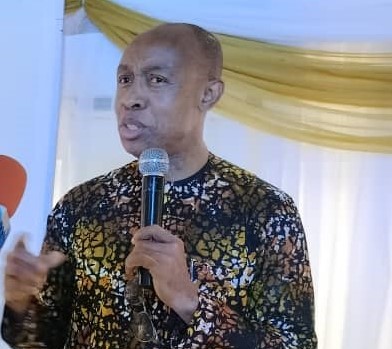
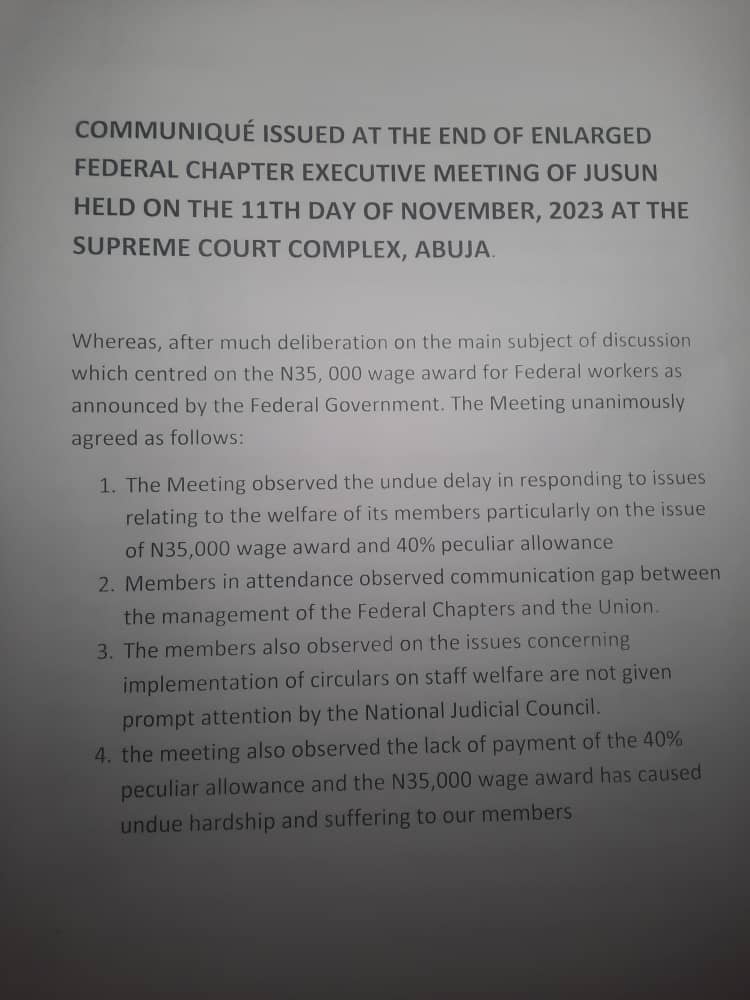
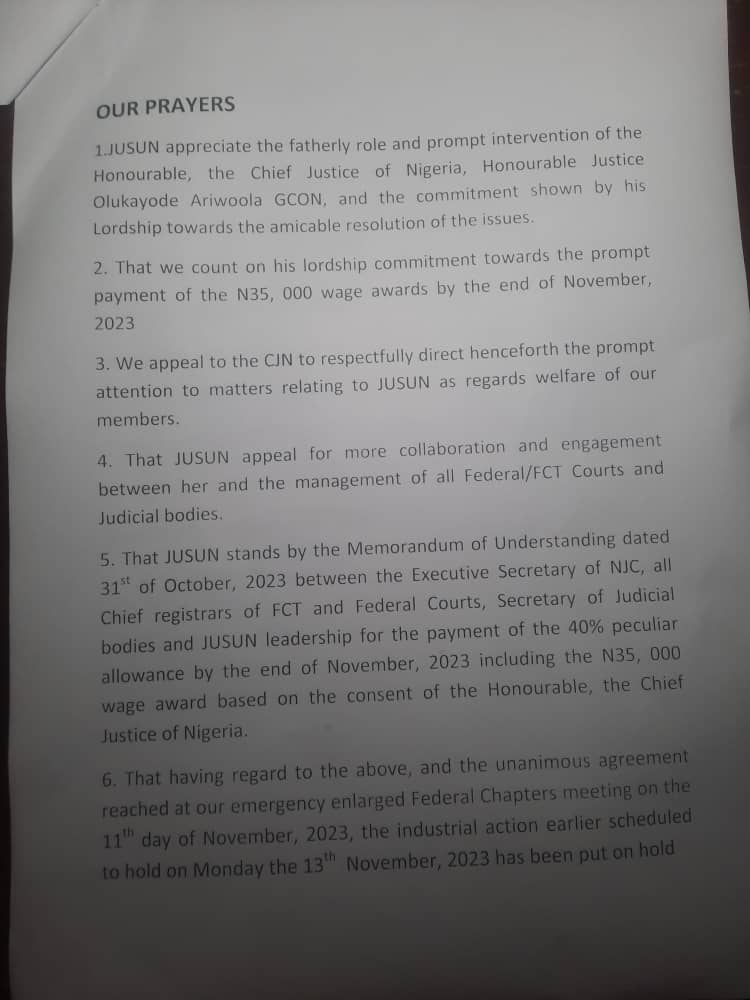
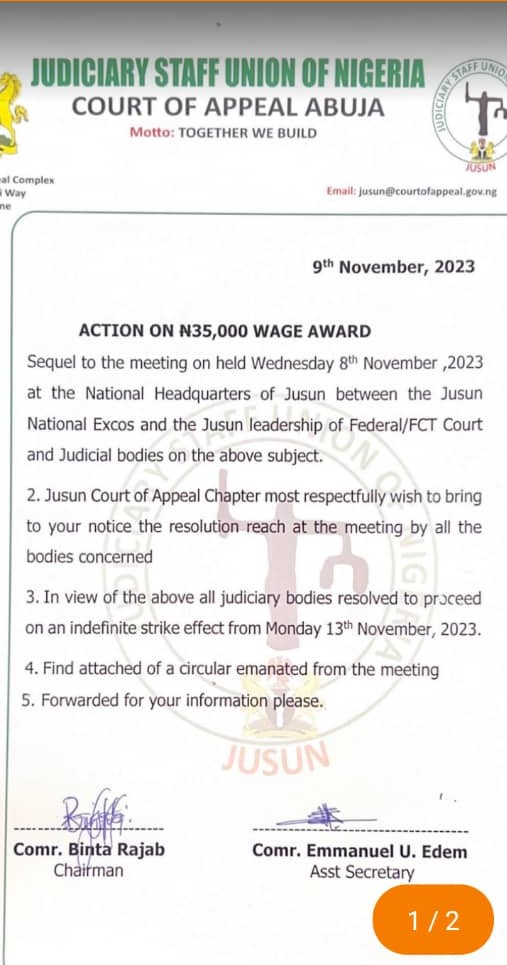
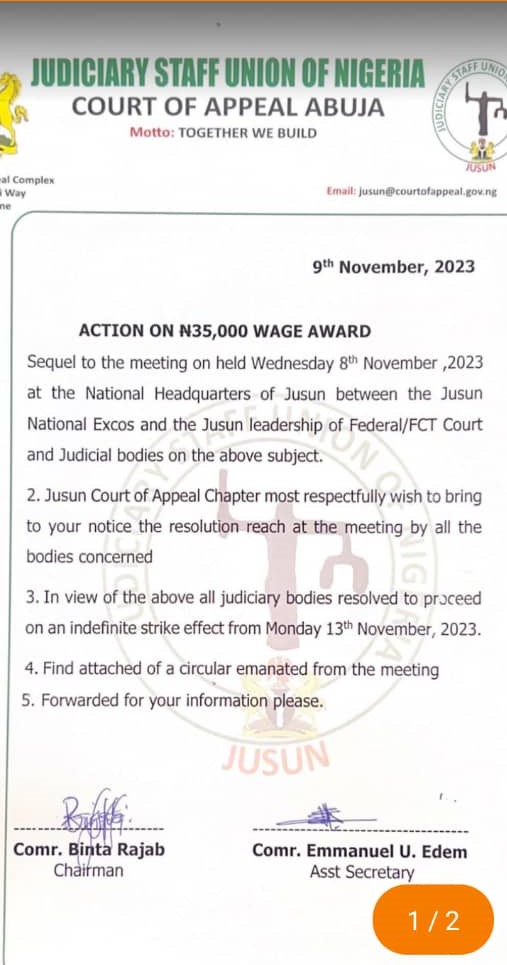
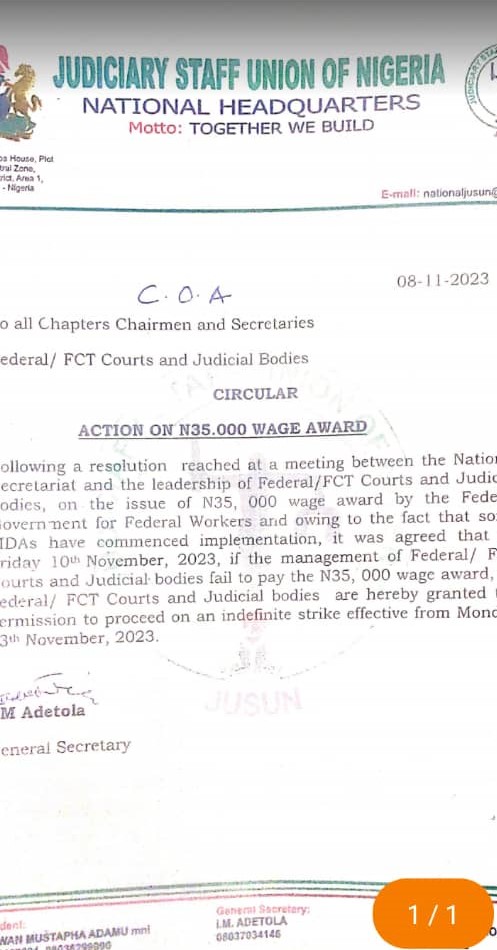
Following an enlarged meeting of the Federal Chapter Executive meeting of the Judiciary Staff Union of Nigeria (JUSUN) on Saturday, 11 November, 2023 the proposed nationwide industrial action which was proposed to commence on Monday, 13 November has been put on hold.
Although the Chief Justice of Nigeria (CJN) was said to have brokered a peace meeting with the JUSUN executive members, the JUSUN President, Mr. Marwan Mustapha is being accused of working against the interest of members.
Below is the communique issued after the meeting with CJN.
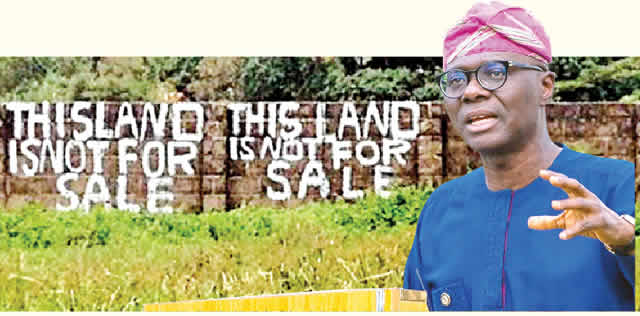
“Land grabbers operate with reckless abandon in Lagos State such that several residents believe that they must have the backing of some persons in authority in carrying out their nefarious activities…”
The menace of land grabbing is one that has eaten deep into the fabric of Lagos society for several years, yet with no end in sight.
Popularly called “omo onile” (landowners’ children), land grabbers operate with reckless abandon in Lagos State such that several residents believe that they must have the backing of some persons in authority in carrying out their nefarious activities.
More often than not, land grabbers invade building construction sites with different kinds of dangerous weapons to either extort site workers/labourers or chase them away from the site with claims that the piece of land upon which they are working belongs to someone else.
The dare-devil land grabbers are also in the business of forcefully taking over landed properties from rightful owners and reselling them to higher bidders.
In some cases, benevolent ones among the land grabbers may reallocate another piece of land in an entirely different location to the victim of their illegal act.
Activities of land grabbers in Lagos do not just end with the forceful taking over of landed properties, these weapon-bearing assailants also beat, batter, dehumanise and even kill their victims without remorse.
In recent times, the spate of violent land-grabbing activities has increased in Lagos resulting in incessant crises in some areas of the state, especially in Lekki, Ibeju Lekki, and Epe, among others.
Among these was the case of an alleged killing of a traditional ruler of Lotu Town in the Ibeju Lekki area of Lagos State, Fatai Jubril, who was alleged to have been shot dead over a land dispute in the area on July 15, 2023.
Jubril’s widow, Ejiro, who was nursing a three-month-old baby at the time the tragedy struck, had alleged that another traditional ruler in the area killed her husband and told her that “he (Jubril) got what he deserved.”
Narrating her ordeal to The PUNCH, Ejiro had said after the traditional ruler and the hoodlums he allegedly came with had beaten up brutalised her husband, “Suddenly, the Baale hit the butt of the gun on the ground three times and the next thing I heard was a loud bang. He shot my husband. I cried out ‘You have killed my husband’ but he simply said my husband’s eyes had seen what he was looking for and that the deed had been done.”
The Lagos State Police Public Relations Officer, Benjamin Hundeyin, who confirmed the incident to PUNCH Metro, assured that the police had launched a manhunt for the suspected killers, after which a suspect was said to have been arrested.
However, the spokesperson for the Zone 2 Command, Hauwa Idris-Adamu, later told The PUNCH that the prime suspect had been released on bail.
Jubril’s case was just one of several cases of how land-grabbing activities in Lagos have continued to thrive unabated, causing residents untold pain and loss of their loved ones and property.
In another land-grabbing matter, a Lagos resident, Shamsudeen Oluwo, is demanding justice over an alleged assault on him by one Saheed Mosadoluwa, also known as Ibile, in the Epe area of the state.
In a video currently in circulation on social media, Oluwo alleged that he was working on his site on July 8 when Ibile stormed the location with some policemen and armed thugs while they started to shoot sporadically.
In the three-minute video, Oluwo was forced to go on his knees while he was thereafter stripped naked by the thugs. The policemen could also be seen rounding up some men in the video.
The video, which was seen by our correspondent, showed some young men being brutalised, dehumanised and stripped naked by suspected land grabbers, while officers in police uniform were seen at the scene, forcing other men to lay on top of one another in one heap, and doing nothing to stop the suspected land grabbers.
While narrating his ordeal in another video, Oluwo said, “I have a serious issue that I want Nigerians to help me on. On July 8, I was working on my site around 10. By past 10 a.m., I saw people coming to the site. I saw Mr Saheed with many policemen and cultists with guns, cutlasses, machetes and jazz.
“They started shooting sporadically. Some people ran away while bullets hit some who escaped with gunshot wounds. But because I didn’t want to be shot, I lay down there with my boys.
“They came there and beat us. They took me to the police station in Lagos. From there, they took me to Abuja where I spent two weeks. Since then, I cannot go outside to work. Now I can’t go outside to work. These Ibile boys are targeting me. They have told them to injure me.
Speaking further, Oluwo narrated how he was blindfolded alongside his boys and taken into the bush by Ibile.
He alleged, “After beating us, Ibile took us into the bush and covered our eyes. They wanted to kill us but thank God, two men heading to their farm showed up at that moment and when they the people heading towards them, Saheed Ibile asked his boys to remove the veil on our eyes so that the people would not know what was happening and they also warned them not to take the route when returning. They said people had seen them and that they could not kill us again.
“They removed my clothes, tore them and naked me and my boys; they recorded us and posted it on Facebook without doing anything to him.”
Responding to the allegation, Mr Ibile, who spoke to The PUNCH in a telephone conversation, expressed his regrets for “overreacting” in what he said was a case of “self-defence.”
“I owe Nigerians an apology for overreacting and stripping him (Oluwo) naked,” Ibile said, adding “but it was an act of self-defence.”
He alleged that Oluwo called him on the phone while he (Ibile) was in Saudi Arabia to tell him that he (Oluwo) had been paid the sum of N12, 000,000 to assassinate him (Ibile).
“He is a renowned hired assassin. And I will prove it. He called me on phone while I was in Saudi that somebody paid him N12, 000,000 to assassinate me, but if I could part with N100, 000,000 he was ready to let me go,” Ibile alleged.
“After that, when I came back from Saudi, he actually attempted to come and assassinate me. But I’m well-prepared. Not that I’m happy, but nobody will hear (that) somebody wants to kill him and you see the fellow that wants to assassinate you and won’t overreact at that moment,” he added.
He further alleged that Oluwo confessed in the presence of the police that he was paid N12,000,000 to assassinate him (Ibile), a claim that The PUNCH could not independently verify as of the time of filing this report.
Ibile said he filed a petition to the office of the Inspector-General of Police against Oluwo on the matter which led to the arrest of Oluwo and five others who were later released. He added that Oluwo has been charged to court.
A certified true copy of a document said to be a Police Investigation Report and Legal Advice on the case, marked CR:3000/X/FHQ/ABJ/ADMIN/PPRO/VOL.273/82, but which could not be independently verified by The PUNCH, was obtained from Ibile by our correspondent.
The document states the case as “Case of criminal conspiracy, threat to life, attempt to assassinate, forcible entry, malicious damage, land grabbing, criminal trespass, and conduct likely to cause breach of peace.”
Speaking on the viral video and the presence of some police officers at the scene, Ibile alleged that Oluwo led some hoodlums to one of his properties and started shooting sporadically. He said he was with his personal security detail comprising some mobile policemen, adding that a team of policemen also came from Abuja following his petition to the Force Headquarters.
“The team from Abuja was around. We didn’t even know because the team didn’t have a direct conversation with me. They came to arrest them (Oluwo and others) and these boys were running towards where we were, where my construction staff were working at the back of the estate.
“Luckily, we were outside and heard the sound of gunfire exchange between the operatives that came from Abuja and Oluwo and his boys.
“Somebody just called me that Esho Olobo (Oluwo) was part of those land grabbers (being chased by the police). I had to join the police myself to launch a manhunt for Esho Olobo and he was arrested,” Ibile said.
He added that five of the boys were also arrested and stripped naked by the police. He said when they came out of the bush where the arrests were made, he faced Oluwo and said he (Oluwo) should also be stripped naked.
Efforts to reach Oluwo were unsuccessful as calls to his telephone for two straight days were not answered and he had yet to reply to a text message sent to him as of press time.
Meanwhile, a group of public interest lawyers, Lawyers for Reform Group, who is demanding justice for Oluwo, raised concerns in a video over the recent activities of land grabbers in the state.
Speaking on behalf of the group, the Executive Project Director, LRG, Oladotun Hassan, narrated that a victim of attempted murder (Oluwo) was converted to a suspect by the Nigeria Police Force.
“We, the Lawyers for Reform Group, a group of public interest lawyers committed to ensuring the protection of fundamental rights and equitable justice, readily offer to rescue Mr Shamsudeen Oluwo and Mrs Igbinoba Adeyinka who are victims of an attempted murder case but rearrested and converted in a separate matter whereby Oluwo was converted as a suspect in a matter he is the actual victim alongside his coworkers who we all see as victims and on whose behalf and instruction we call on the Inspector-General of Police to match his words with immediate action for onward sanitisation and reform of the Nigeria Police Force so as to pull out all bad eggs,” Hassan said.
In a telephone conversation with The PUNCH, Hassan said he had written a petition on behalf of Oluwo and others to the IG on the matter.
He also said that the Lagos State Commissioner of Police had waded into the matter between Oluwo and Ibile, and, according to Hassan, the CP had asked all parties to look for ways to resolve the issues amicably while maintaining the status quo.
“But Ibile on his own violated that stand of agreement. It was on the heels of parties maintaining the status quo and that issues should be reported back to the CP of Lagos State that Ibile took laws into his own hands.
“He admitted on his own (social media) timeline that if not for God, Mr Oluwo would have been killed. He said Mr Oluwo was lucky to only be stripped naked,” the lawyer told our correspondent.
Hassan, commenting on the viral video, said, “On that fateful day, Ibile came with his boys and some policemen and they meted harms and attacks and wreaked havoc, shooting sporadically with people sustaining injuries.
“Oluwo and other workers on the site were beaten to stupor and stripped naked. They were all piled up and packed like sardines. They took them from that same spot, having stripped them naked, into the bush and wanted to kill them. It was just the intervention of two farmers who were passing by that saved them from being killed. And that’s what happened.”
He added that Ibile is claiming assassination threats after attempting to kill Oluwo and others, wondering, “How can someone you beat to stupor with (the aid of) over 100 thugs and policemen be the one attempting to assassinate you?”
Hassan further stated that Oluwo and others were taken to the Force Headquarters in Abuja where they spent two weeks before they were returned to Lagos “and Ibile went ahead to charge them to court,” after he (Ibile) had “taken the law into his own hands.”
Reacting to the video showing the stripping of Oluwo and others, the Force Public Relations Officer, Nigeria Police Force, ACP Olumuyiwa Adejobi, said the Lagos State Commissioner of Police was already on the case, assuring that the Lagos Police Command would update Nigerians on the matter.
Adejobi wrote, “Lagos State CP is on this matter. We will do the needful, and justice will be seen to have been done. I am sure the Lagos State command will update us as and when due. Thanks.”
Efforts to reach the Lagos State PPRO, Hundeyin, were unsuccessful as calls to his telephone were not answered for two days and a text message sent to him had yet to be replied to as of press time.
Speaking with The PUNCH in a telephone chat, the Chief Press Secretary to Governor Babajide Sanwo-Olu, Mr Gboyega Akosile, said the Sanwo-Olu-led government frowns upon the issue of land-grabbing in the state and is doing everything possible to curb it.
“It is an issue that the Lagos State Government frowns upon very seriously. It is not something that the government is taking lightly considering what the menace does to society.
“We’ve had several cases of land-grabbing and, of course, the government has waded in.
“We have a department in the Ministry of Justice where land-grabbing cases are treated. And those that tend to be criminal in nature are taken up, and, of course, people have been happy because there are some people who have taken their cases through the land-grabbing department and whose cases have been resolved,” Akosile said.
He encouraged those having issues relating to land-grabbing “to come to the government,” urging them not to “resort to self-help which may turn them also into criminals when they take up arms against those suspected criminals (land grabbers). Just come to the government and the government will help you with your land-grabbing case.”
“The Ministry of Justice has a very effective and efficient unit that handles such cases,” the governor’s aide added.
“The administration of Governor Babajide Sanwo-Olu frowns on the issue of land-grabbing. It is something that the government does not condone and will always treat it with the measures that it deserves,” Akosile stressed.
In 2018, the Kano State Ministry of Works, Housing, and Transport released N20,179,800 million to Kano Agricultural Supply Company (KASCO) for the provision and supply of three trucks carrying 600 pieces of fertilizer at a cost of N6,105 each in Gabasawa and Garko Local Government Areas.
Kano Constituency Project document (2018)
Each fertilizer truck cost N3,363,300.00 million, for a total of N10,089,900.00 million.
The supplies of fertilizers were meant to be distributed to the farmers in Garko and Gabsawa LGAs in order to improve their harvest.
In this investigative report, Rashida Salihu Ozavizedisclosed how KASCO sold the Kampa fertilizers above subsidized rate to farmers.
A voice call to an official telephone contact number on KASCO website revealed that the subsidized fertilizers was N3,500 per bag in 2018.
However, Herald Reporters discovered that KASCO inflated the price with N1,500, making the farmers in Garko to buy the fertilizer at N5,500.
Also in Gabasawa, Investigation uncovered that there was no supply of subsidized fertilsers to farmers, but it was in market for sale.
KASCO
Kano Agricultural Supply Company Limited (KASCO) was established and incorporated as a limited liability company on 30th October 1981 under the Companies Act 1981, now the Companies and Allied Matters Law.
It started operation in early 1982, and the Kano State Government owns the company.
One of the major objectives of the agency is to increase revenue generation, diversify operations by going into projects of livestock feed production, poultry feed, fish feed, horse feed, and dealership.
The company procures and distributes an agricultural input which includes hardware such as irrigation pumps, milling machines, sprayers, oxdrawn-ridgers greenhouse equipment, agro-chemicals which include fertilizers, herbicides, insecticides, and rodenticides to farmers in the state.
It also provides animal medications such as Benozole, Vitacilin, Renide, etc.
KASCO also supplies vegetables /cereal seeds: tomatoes, carrots, watermelon, hybrid maize, Rice, sorghum, etc to smallholder and commercial farmers.
The distribution process of subsidized fertilizer
Discreet investigation findings of the subsidized fertilizer distribution process revealed that the state government through the Agricultural Development Program (ADP) and KASCO have warehouses at local government and ward levels.
Names of farmers who are in need of the subsidized fertilizers would have been selected and collected by the farmers’ association or community leaders for onward transmission to KASCO offices at thee ward level.
In some cases, the LGA Chairmen and others stakeholders also have names of their beneficiaries submitted too.
Depending on the quantity available and the subsidized rate a farmer may get one bag; sometimes 2 or 3 farmers share a bag.
It is the subsidy that determines the quantity of fertilizer a farmer gets. For instance, if the subsidy is less than 20%, there is a probability of a farmer getting one bag is high, but if the subsidy is 50% or 80%, two or three farmers may have to share a bag.
Somehow, the process have been compromised by politician and local government chairmen officials.
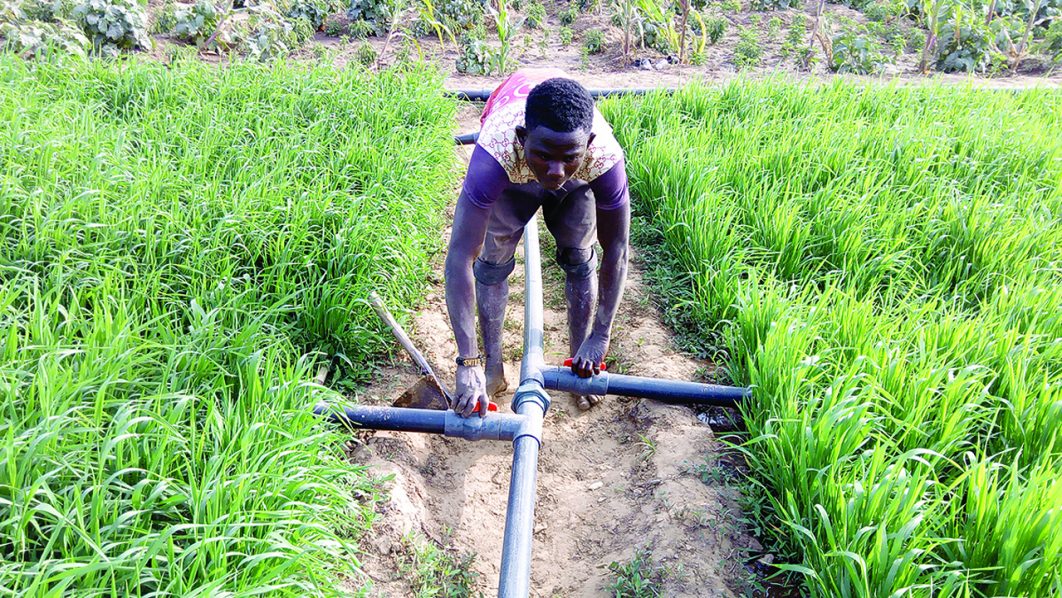
Saifullahi Usman, 32, is a young smallholder rice farmer in Kydagi village in Garko Town Local Government Area. He also grows maize, millet, and guinea corn, among other crops.
On a normal farming morning on Saturday, Usman was on his 4 hectares of rice farmland feeling depressed, worried, and concerned about his farm yield.
Usman revealed to Herald Reporters that in 2018, he purchased 12 Kampa fertilizers from the KASCO office in Garko town.
“In 2018, KASCO supplied trucks of fertilizer that were stored in their warehouse.
“On Monday morning in the month of July 2018, a text message was sent to us by our association, All Farmers Association of Nigeria, Garko Chapter, to come and register their names to benefit from the distribution of the Kampa fertilizer.
“A large number of farmers flocked to the KASCO office, expecting subsidized fertilizer.
“We were given a form to fill out with our names, phone numbers, age, home address, and signed as received.
Saifullahi Usman, 32, a young smallholder rice farmer in Kydagi village in Garko Town Local Government Area. PC: Herald Reporters
“Every farmer expected fertilizer after the exercise.
“After one hour of waiting, an unknown KASCO employee announced that the fertilizers are available, but they are for sale at a low price in cash and carry.”
Usman said that after that announcement, most farmers returned to their homes or farmlands.
“Immediately after the announcement, I confronted the KASCO staff who announced the message to inquire for the price – he said it was N5,500 per bag.
“The KASCO price was less than the market price, which was selling for N8,000 to N9,000 in 2018.
“I rushed home to sell my three goats and two sheep for N140,000.
“I hurried back to the KASCO office to make a cash payment of N66,000 for the purchase of 12 Kampa fertilizers.
“I spent the rest of the money on urea fertilizer in the market.”
Usman disclosed that he requires 25 of 50kg bags of Kampa fertilizer and urea for his 4 hectare farm of rice, millet, and guinea corn. At least 15 kampas and 10 ureas of fertilizer.
Usman declares low yield
Despite purchasing the 12 bags of Kampa fertilizer, Usman’s recorded low yeild for the 2018 farming season.
According to Usman, to compensate for the low yield, he used the broadcast method of fertilizer application to evenly spread the fertilizer on the farmland.
“After the broadcast method, I was only able to harvest 46 bags of rice; normally, I can harvest over 300 bags of rice.
“Despite spending so much money to get fertilizers from KASCO, my harvest was disappointing, because the cost of the fertilizers from them was high.
“If KASCO had given the Kampa fertilizers at the recommended subsidized rate to farmers, I would have used my money to buy more Kampa and have a bumper harvest.
“The way things are now, I use local manure from animals because the supply of fertilizers has stopped since 2018.”
“My farming has drastically reduced,” he added, “because I cannot farm for commercial purposes but only for subsistence.”
AFAN Offical in Garko lament
The All Farmers Association of Nigeria (AFAN) is the umbrella organisation for all farmers, commodity associations, cooperatives, and other bodies in Nigeria involved in agriculture and agro-allied matters.
Abdulmumin Alhassan, Auditor General of the All Farmers Association of Nigeria (AFAN) Garko Chapter.
He confirmed that fertilizers supplied by KASCO were sold to farmers, despite their efforts to stop the act of selling the fertilizers above subsidized rate.
He explained that “as a farmer’s association, we were aware that KASCO was about to bring fertilizers.
“We are all aware that whenever the government provides fertilizers to farmers, it is usually at subsidized cost.
“However, in 2018, despite our efforts to stop them, the fertilizers supplied by KASCO were sold to farmers at high cost, and they overpowered us because there was political influence in the issue.”
“We went to the Garko Local Government Secretariat’s agricultural department, but we were told that it was none of the LGA’s business.”
“Hearing that we gave up and allowed them to operate their act of selling the fertilizers.”
Alhassan, AFAN, Auditor General, who is also a farmer at the same time in Garko Town and has 15 hectares of farmland, recounted having bought a huge quantity of Kampa fertilizers from KASCO in 2018.
“KASCO sold the fertilizers for us at N5,500 by deducting N2,000 from the market price, which was sold at N7,000.
“I see other farmers buying fertilizer, and I, too, am in need of it, so I decided to buy about 65 bags of Kampa fertilizer for N357,500, which I paid in cash.
“But if the fertilizers were given for free, it would have helped in increasing farm produce.
Abdulmumin Alhassan, Auditor General of the All Farmers Association of Nigeria (AFAN) Garko Chapter. PC: Herald Reporters
For example, on farmland where 50 bags of rice are harvested, the fertilizers could lead to over 120 bags after harvest.
“Currently, I cannot farm the whole of the 15 hectares.
“I barely farm 2 hectares of my farmland due to the recent hardship in the cost of fertilizer and petrol.”
Groundnut Farming going into extinction in Gabasawa
In the early 1960s groundnut production in Nigeria was at its peak.
Gabasawa is one of the LGAs in Kano that produces groundnut in commercial quantities and the farmers believed groundnut farming is a very profitable business to generate profit.
Abdullahi Habibulah, an 87-year-old farmer told Herald reportersthat in those good old days women of different communities in Gabasawa used (What is the method called) a traditional method to extract oil from the crop.
“Also, Gabasawa was part of the LGAs in Kano that produced a large quantity of groundnut used for the known groundnut pyramid in Kano,” Habibulah added.
Today, the cultivation of the crop has gradually dropped as farmers in Gabasawa shared concerns about the government turning a blind eye to their plights.
Umaru Alhassan, a groundnut farmer and member of the Gabasawa Groundnut Producers, Processors, and Marketing Association in Zakirai town, Gabsawa LGA, cultivates five hectares of groundnuts each year.
He said: “I can only boast of 85 to 100 bags after harvesting the crop.” attributing his losses to a low-yielding seed variety and a lack of fertilizer.
He bemoans the lack of incentives for groundnut farmers in Zakirai, emphasising that the state government fails to recognise the importance of the crop.
He said: “Even when we were using local manures to farm groundnuts, I had a moderate harvest.
In an interactive session with Alhassan to know if he was aware of the provision and supply of three trucks of 600 pieces of fertilizer in Gabasawa, he responded that: “Yes, in 2018, I was aware of the supply of Kampa fertilizer to be given by KASCO.
“I learned about the supply from a friend of mine who is a KASCO official in Gabasawa.
Umaru Alhassan, a groundnut farmer and member of the Gabasawa Groundnut Producers, Processors, and Marketing Association in Zakirai town, Gabsawa LGA. PC: Herald Reporters.
“Around the middle of September 2018, our community elders made a public announcement that all farmers should gather at the KASCO office in Gabasawa to submit their names.”
“I rushed from Zakirai town to Gabasawa on my bicycle at 6 a.m., a distance of about 20 kilometres, to write my name so I could be one of the beneficiaries of the fertilizer.
“As far as I am aware, no fertilizer has been supplied to date, but our association has made efforts to follow up, but there have been no positive outcomes.”
He said: “In 2018, the non-supply of fertilizer affected my groundnut farming, resulting in a poor harvest and affecting the value chain of the crop,”
The farmer pointed out that a hectare of groundnut farmland that was producing between 30 and 35 bags now produces only seven bags.
“My groundnut yield would have been more than 50 bags if I got the supply of fertilizers from KASCO, particularly Kampa at the subsidized rate.”
KASCO Supplied Fertilizers to Farmers in 2011
In Gabasawa town, Mallam HaliruDahi, the Vice Chairman of the All Farmers Association of Nigeria (AFAN), told Herald Reporters that the state government has failed to supply fertilizers to farmers in Gabasawa LGA communities for the past 12 years.
Dahi, who is also the Chairman of Fadama, a farmer’s association that promotes development in agriculture, irrigation, livestock, and aquaculture, shared harrowing stories about how the lack of fertilizer supply significantly affects smallholder farmers.
“Farmers in Gabasawa LGA’s local communities are seriously suffering from low yields due to the non-application of fertilizer to their crops.
“From 1999 to 2011, farmers were given free and subsidized fertilizer by the State Government.”
“Farming was expanding, and farmers were producing more crops for commercial purposes.
“For example, in a hectare of groundnut farmland, 50 to 60 bags are being harvested, whereas now it is difficult to harvest 30 bags.
“But after the regime of Mallam Ibrahim Shekarau in 2011, there has not been any supply of fertilizer to farmers.
“On many occasions, the state government has asked me to compile the names of farmers who will benefit from the supply of fertilizers.
“However, in the end, they turn out to be false promises.
“Farmers are currently suffering from low yields due to the government’s lack of support,” he explained.
Dahi revealed that: “Most times whenever KASCCO has fertilizers for either free or at subsidized rates for farmers, somehow, the farm input finds its way to the market.
“We later discovered that the process of distributing the fertilizers is being compromised or politicized as many farmers may not have money to buy fertilizers even at the subsidized rate.
“The agency involved in the distribution then divert the fertilizers and sold it to some selected businessmen in Zakirai Market.
“by so doing, the price of the farm input gets inflated in the market to the extent that a smallholder farmer cannot afford to buy.”
Herald Reporters spoke to one Alhaji Mahmud MammanZakirai, a dealer of fertilizer in Gabasawa.
He denied: “We don’t buy fertilisers from any government agency.”
“But for those who are close to politicians they can get fertilisers that are meant to be distributed to farmers at a subsidized rate.
“But, personally I donot patronize such kind of government products.”
KASCO Ignores FOI
On September 26, 2023, a Freedom of Information (FOI) was sent to KASCO by this reporter, but the FOI was not received and attended to.
KASCO FOI, Copy
The FOI request was sent via KASCO’s mail address [email protected] around 10:20 a.m. on the same day. The mail delivered, but KASCO is yet to acknowledged receipt.
Mail sent to KASCO
Again, Herald Reporters called a phone number obtained from KASCO’s website. Nobody picked the several calls from the other end.
And, a text message was sent an up to the time of filling this report no response was received.
We are tired of fake promises – AFAN Gabasawa
Mallam Haliru Dahi, Vice Chairman of the All Farmers Association of Nigeria (AFAN), Gabasawa Chapter, stated, “I am tired of submitting names of farmers for any intervention because the process is unfair.”
“As a body, we will continue to strive and see that farmers in Gabasawa get relief.”
Another official of AFAN in Garko, the Auditor General, Abdulmumin Alhassan revealed that the farmers’ association is now reluctant as KASCO refused to recognize them.
“This is so, because when we (AFAN) will submit names of farmers in desperate need of farming equipment, but in the end, no one will benefit due KASCO’s attitude to farmers plights, – the process is always politicized.”
Today, Usman in Garko is battling with his farming activities, applying poultry and cow faeces as manure to boost his yield.
He said the application of the faecesis to leverage the cost of fertilizer, which is being sold at N27,500 in the village market.
In Gabasawa, Alhassan is suffering from a poor harvest of groundnuts.
He said: “I plant more guinea corn than groundnut because I cannot sustain farming anymore due to the fact that the government is not helping farmers and the cost of fertilizer is increasing by the day.
“To buy 50kg of Kampa, it costs N28,000. For now, I have decided to continue using animal faeces as fertilizer, which also contributes to the low yield of my groundnuts,” he added.
This publication was supported by the Wole Soyinka Centre for Investigative Journalism (WSCIJ) through Stallion Times under the Collaborative Media Engagement for Development Inclusivity and Accountability Project (CMEDIA) funded by the MacArthur Foundation.
The proposed nationwide indefinite strike by the Judiciary Staff of Nigeria (JUSUN) from Monday 13th November, 2023 has continued to elicit different reactions.
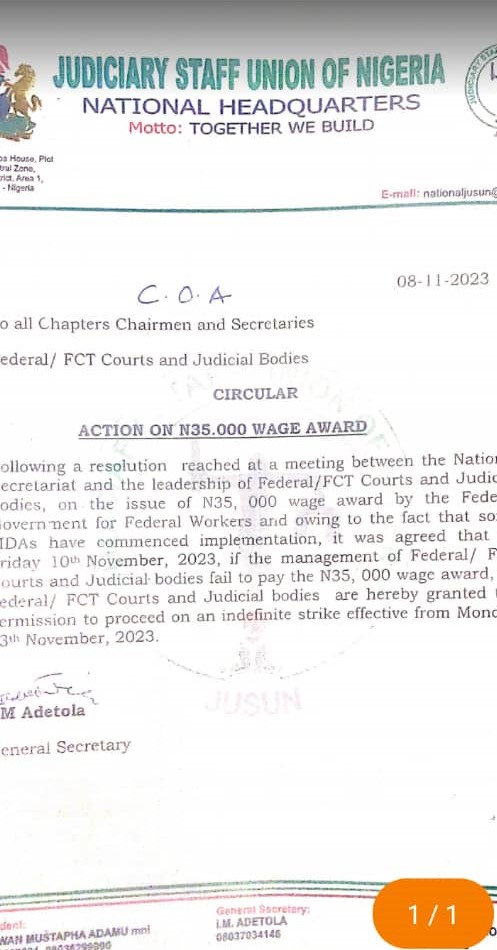
JUSUN in a circular said it will embark on an indefinite strike until the N35,000 minimum wage approved for its members is implemented. This agitation has been on over time as the new minimum wage which was approved since 2019 has not been implemented.
Aslawyers and defendants are increasingly troubled about the ever-rising backlog of cases, itis worthy of note that a nationwide strike of court workers in Nigeria will paralyze the justice system, resulting in extended prison remands for those awaiting trial or sentencing and lengthier delays for everyone else.
When Hon. Justice Ejembi Eko, JSC (Rtd.) challenged the handling of the judiciary’s finances and called on anti-graft agencies to probe its financial records many were aghast.
During his valedictory ceremony on 23 May, 2021, Eko, JSC, said: “Nothing stops the office of the Auditor-General of the Federation, the ICPC and other investigatory agencies from opening the books of the judiciary to expose the corruption in the management of their budgetary resources. That does not compromise the independence of the judiciary. Rather, it promotes accountability.”
Likewise, Hon. Justice Musa Dattijo Muhammad, JSC (Rtd.) who exited the country’s apex court on Friday, 27th October, 2023 raised posers about the utilisation of funds allocated to the judiciary.
“Beyond the issue of the salaries of Justices remaining static with no graduation for over 15 years now, it is instructive to enquire what the judiciary also does with its allocations. Who is responsible for the expenditure? An unrelenting searchlight needs to be beamed to unravel how the sums are expended.
“In 2015 when President Muhammadu Buhari became the president, the budgetary allocation to the judiciary was ₦70 billion. In the 2018 Appropriation Bill submitted to the National Assembly, the President allocated ₦100 billion to the judiciary.
“The legislature increased it to ₦110 billion; ₦10 billion above the ₦100 billion appropriated for the 2017 fiscal year. At the end of President Buhari’s tenure in May 2023, judiciary’s allocation had increased to ₦130 billion. That is an increase from ₦70 to ₦130 billion in 8 years. The present government has allocated an additional sum of 35 billion naira to the judiciary for the current financial year making the amount of money accessible by the judiciary to 165 billion naira. More than 85 percent of the amount appropriated by the 9th Assembly has so far been released to the judiciary. It is envisaged that the additional 35 billion naira will equally be released by the present government.
“Notwithstanding the phenomenal increases in the sums appropriated and released to the judiciary, Justices and officers’ welfare and the quality of service the judiciary render have continued to decline.”
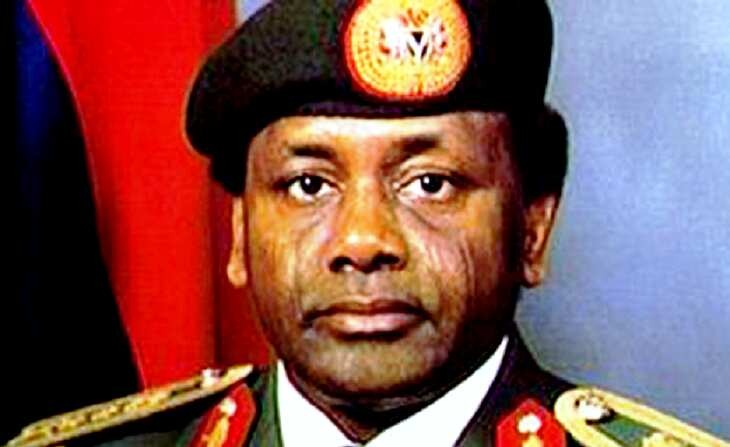
For the past several years, the joke in Abuja is that whenever Nigeria encounters dire financial straits, the late General Sani Abacha looks down on us from beyond and drops a hefty sum into the national coffers. While I disagree with a friend who insists that Nigeria may have used Abacha for money rituals, more than a few were delighted last Friday when President Bola Tinubu announced that a fresh tranche of $150 million is on the way. “Thank you for the good news on the return of Abacha loot,” Tinubu told Catherine Colonna, the visiting French Minister of Europe, and Foreign Affairs, who delivered the news. “We appreciate your effective cooperation concerning the return of Nigeria’s money. It will be judiciously applied in attaining our development objectives.”
As I wrote in my book, ‘The Last 100 Days of Abacha’, the massive loot amassed by Abacha was done mostly through crooked oil deals, debt buy-back scams, and siphoning money directly from the Central Bank of Nigeria (CBN). But it says so much about us as a people that more than a quarter of a century later, no effort has been spared to interrogate why Abacha was able to take more than $4 billion from the treasury so easily. If only to learn lessons that will ensure it does not happen again. A bullion van from the apex bank delivering stacks of public money, in local and foreign currencies, to an individual, no matter how highly placed, is beyond corruption. That is what Yoruba people would call, ‘Tani o mu mi?’, which I once explained in a column as impunity writ large.
Perhaps it is also deliberate that nothing is being done to learn lessons from the past. After all, there is nothing Abacha did that is not being done today in the Nigerian public space. The difference may be only in quantum. Having built a system in which we have allowed individuals to overpower the state and critical public institutions, accountability now means nothing. In Nigeria today, when people are in positions of authority whether in the private or public sector, they elevate themselves (with the acquiescence of the people) to ‘Kabiyesi’ (he who cannot be questioned). And when they abuse their powers and public trust, the same people hail.
Before I conclude with why we must change that paradigm to enable our country to progress, it may be important to rehash how ‘Abacha loot’ came about. At least for the benefit of those who still do not understand the weakness of critical institutions in Nigeria. It was done mostly through the ubiquitous ‘security vote’ that is still being abused at all levels in Nigeria today. The then National Security Adviser (NSA), Alhaji Ismaila Gwarzo, would write a memo, Abacha would endorse the request, and the then CBN Governor, Dr Paul Ogwuma would release the cash which was then laundered through banks in Switzerland, France, British Virgin Islands, United Kingdom, Liechtenstein, Luxemburg, Spain, and the United States.
Having followed the Abacha case since 2000, I have written several columns on the looting and a book on his political transition programme that ended with five political parties endorsing one candidate (Abacha) for presidency. As an aside, most of the political gladiators of today, including governors, senators and House of Representatives members were in bed with Abacha. But that is not the business of this column. Meanwhile, it was Abacha’s successor, General Abdulsalami Abubakar who blew open the scandal. On 13th July 1998, five weeks after Abacha’s death, Abdulsalami instituted a Special Investigation Panel (SIP) to establish “cases of swindled public funds and recover same back to the federal government coffers”. The panel was also to identify the culprits and recover all properties or assets illegally acquired by the culprits. The findings were staggering.
The whole thing started two weeks after Abacha pushed the late Chief Ernest Shonekan aside, specifically on 30th November 1994. Gwarzo first requested $100 million to combat ‘an economy that was deflected and distorted through the black market’. As many now remember to his credit, the Naira exchange value was relatively stable throughout Abacha’s era. It was because of a peculiar (some would say primitive) ‘Abachanomics’ that you would not find in any textbook. But it worked!
As indicated in Gwazo’s memo, the dollar was to be sold through Bureau De Change dealers at the then prevailing exchange rate, with a view to mopping up the naira, and beefing up its value. Having apparently been briefed by Abacha, then CBN Governor, Ogwuma released the cash in the following sums: $95 million and £3.2 million. The transaction was indeed carried out even though the money eventually returned to the CBN was not up to what was received, according to the SIP report. However, as I concluded in an earlier piece on this issue, the import of that first transaction was the realization by Abacha of just how easy it was to directly take money out of the CBN. It became a perfect scam. All that was then needed was a memo from Gwarzo seeking approval for any sum of money in the guise of ‘security’ and the CBN would release such demand in cash!
The following are a few of the documented transactions: On 13th and 15th February 1995, Gwarzo collected $200,000 and $600,000 respectively (totalling $800,000) from the CBN. This was sequel to Abacha’s approval of his letter dated 15th February 1995 where he requested for $4 million and £2million ‘to take care of some developments in a number of areas…’ The $800,000 was part payment for the approved sum of $4 million while the balance was paid in Travellers’ Cheques. On 29th December 1995, Gwarzo collected from the CBN the sum of $5 million based on Abacha’s approval of his letter to deal with ‘situation at hand’!
By 1996, the frequency of requests had increased even though most of the funds collected from the CBN for that year were for ‘foreign operations.’ On 8th May 1996, for instance, Gwarzo collected $9 million from the CBN on behalf of Abacha. He reportedly sent $7 million to then President Matthew Kerekou of Benin Republic as ‘assistance to the country to pay outstanding workers’ salary’ with additional $2 million for Kerekou himself. On 5th July 1996, Gwarzo collected from the CBN the sum of $8.1 million and £5.2 million based on a 14th June 1996 request endorsed by Abacha, to support the aspiration of five presidential candidates in Niger Republic. On 23rd August 1996, Gwarzo collected $30 million from the CBN following Abacha’s approval of his 20th August 1996 memo, requesting the said money to ‘assist our immediate neighbours and others within this sub-region’. A month later, on 30th September 1996, Gwarzo collected $50 million and £20 million from the CBN sequel to another memo dated 24th September 1996, requesting the money to ‘prop some African and other Third World countries to assist in Nigeria’s democratization and economic recovery’. On 13th November 1996, Gwarzo collected $5 million and £3 million from the CBN ‘to take care of foreign dignitaries who will attend the burial ceremonies of the first President of Nigeria, Dr. Nnamdi Azikiwe.’ On 9th December 1996, Gwarzo collected $5 million from the CBN sequel to Abacha’s approval of his 21st November 1996 memo where he requested the said sum ‘to finance the purchase of ten Toyota Land Cruisers, and ten Peugeot 505 saloons for the Republic of Mali’. On 18th December 1996, Gwarzo collected $66.5 million and £20 million based on Abacha’s directive to meet ‘some requests from Heads of State of some Francophone countries, and to cultivate African solidarity.’
It is only in a system like ours that the memos (mostly badly written) from the NSA, though approved by the Head of State, would compel a release of such staggering sums of public money. By 1997, the requests began to assume political undertones. On 21st February 1997, Gwarzo collected from the CBN the sums of US $60 million and £20 million for ‘pro-Nigeria propaganda’ abroad. On 28th April 1997, Gwarzo collected $60 million and £30 million sequel to Abacha’s approval of his 22nd April 1997 memo, requesting the funds for ‘public relations to international communities and organizations’. On 9th July 1997, Gwarzo collected $5 million from the CBN, following Abacha’s approval of his 23rd May 1997 memo, to meet all ‘demands and commitments as directed’. On 10th September 1997, Gwarzo collected $60 million and £30million from the CBN ‘to finance a campaign for a seat on the Security Council of the United Nations Organisation.’ On 25th October 1997, Gwarzo collected $80 million and £40 million ‘to sponsor military intervention in Sierra Leone, and garner support for same in the West African Sub-region.’ A month later, on 8th December 1997, Gwarzo collected $120 million and £50 million sequel to Abacha’s approval of his memo dated 26th November 1997 simply to take care of security.
By 1998, Abacha was facing both local and international pressure, especially following the conviction of several retired and serving military officers, including the late General Oladipo Diya, for a phantom coup. On 19th January 1998, Gwarzo collected from the CBN the sums of $100 million and £50 million to ‘counter insinuations that Diya’s coup was not real, and the government framed them to remove and replace the coupists with stooges.’ The interesting thing about this particular transaction was that while re-bagging the money, according to the SIP report, ‘four cartons containing a total of about US$8 million were set aside’ in Gwarzo’s own residence. On 1st April 1998, Gwarzo collected from the CBN the sums of $65 million and £30 million for ‘public relations at home and abroad, to counter the European Union campaign against the transition programme.’ On 30th April 1998, a few weeks before Abacha died, Gwarzo collected $80 million, £50 million and N250 million for the purpose of conducting ‘an enlightenment campaign on the virtues of an Abacha Presidency’.
I can continue with highlights of the illicit transactions as detailed in the SIP report, but the point is already made. Sadly, as we do with all issues in Nigeria, ‘Abacha loot’ has become another subject of humour. But the joke is not on Abacha; it is on us all. The absence of mechanisms for checks and balances and the inability of the people to hold public officials to account created the humongous pillage by Abacha. And nothing has changed. Establishing fanciful ‘anti-corruption’ agencies will not deal with such a systemic problem. To the extent that erecting a fence at the top of the cliff is far more productive than building a hospital below, we must work to build a more resilient system where every individual, no matter how highly placed, can be held accountable for the choices they make, particularly with public trust. When we do that, Nigeria can commence the march to progress.
Money Matters in Marrakech
Yesterday’s absence of senior officials of President Bola Tinubu’s government at the opening sessions of the Africa Investment Forum (AIF) in Marrakech, Morocco, does not speak well for an administration seeking investment opportunities. While I don’t believe in the kind of foreign jamborees many of our public officials indulge in on the pretext of investment drives, an African Development Bank (ADB) engagement is far more important than the United Nations General Assembly where Nigeria featured one of the largest contingents in September.
As Nelson Okwonna, the management consultant to the Kaduna Green Economic Zone project, reminded me yesterday here in Marrakech, this is the first time Nigeria would have its citizens at the helm of three critical financial institutions on the continent and such opportunity may not come again for a long time. With Dr Akinwumi Adesina at ADB, Samaila Zubair at African Finance Corporation (AFC) and Benedict Oramah at Afreximbank, other countries in similar position as ours would leverage on such good fortune. While ‘Market Days 2023’ (with the theme, ‘Unlocking Africa’s value chains’) has attracted an assemblage of high-net-worth investors and seasoned professionals across different fields, most Nigerians I have encountered, including President Olusegun Obasanjo and former Kaduna Governor, Nasir el-Rufai are here in their private capacities.
It is even more remarkable that in declaring the Forum open yesterday, the King of Morocco, Mohammed VI, not only harped on the need for an integrated, prosperous Africa that would pave the way for the creation of regional value chains, but also referenced the economic collaboration between his country and ours. “The Morocco-Nigeria Gas Pipeline project is part of that endeavour. It reflects my resolve to lay the groundwork for genuine regional cooperation,” the monarch said. “The project will enable all countries along the pipeline route to have access to reliable energy supplies and to be more resilient to exogenous energy price shocks.”
Founded in 2018, the AIF was designed as a vehicle for channelling capital towards critical sectors on the continent. Incidentally, Adesina, a Nigerian and former Agriculture Minister, and current ADB President, envisioned the idea. In a brief chat with AIF Senior Director, Ms Chinelo Anohu who runs the programme, the whole idea was conceived to reject the beggarly disposition that has for decades held Africa back by leveraging on the human and material resources to seek win-win partnerships and investments from within and outside the continent. This, as she argued, would require a collaboration with all critical stakeholders, including governments, the private sector, and NGOs.
Within the past five years of operation, the AIF has reportedly mobilised $143 billion in investment interest. Anohu, former PENCOM Director General under whose stewardship Nigeria recorded a geometric rise in pension assets, (from N2.4 trillion in 2014 when she took over to N6.5 trillion by the time of her exit from the commission in 2017), said the AIF is different from many of such forums where people gather just to talk, “it is a platform for mega deals for the advancement of Africa.” That the Forum commenced on the day the United Nations Conference on Trade and Development (UNCTAD) released the ‘Least Developed Countries Report 2023’ which listed no fewer than 33 of the continent’s 54 nations among the world’s Least Developed Countries (LDCs) makes it even more important. But the ADB President and AIF visioner, Adesina, was upbeat in his opening remark at the plenary yesterday morning.
In a speech he delivered both in English and French, Adesina said African economies witnessed a real GDP growth of 3.8% in 2022, which was higher than the world average of 3.5%. “African economies provide some of the best investment opportunities in the world. Do not believe me for my optimism, believe the data,” Adesina told the audience of over a thousand, adding that the size of the food and agriculture market in Africa will be worth $1 trillion by 2030. “The African Continental Free Trade Area presents a consolidated market size of $3.4 trillion. The future of electric vehicles in the world depends on Africa’” he said. “The size of the electric vehicles value chain is estimated to increase from the current $7 trillion to $57 trillion by 2050. That future depends on Africa. That is because Africa accounts for the largest source of the green metals for the development of electric vehicles, including platinum (70%), cobalt (52%), manganese (46%), bauxite (25%), and graphite (21%).”
Quoting a recent Bloomberg report, Adesina says that the cost of manufacturing of lithium-ion precursor batteries in Africa is three times less than in the United States, China, and Poland. Africa, he added, has the largest sources of renewable energy in the world, including hydro and solar. “So, whether it is in oil and gas, minerals and metals, renewable energy, agriculture, or the labour force that will drive the global growth, Africa is where to be. Investors should see Africa not from what they hear, but from what the facts say.” Moody’s Analytics, according to Adesina, “did an analysis of default rates on infrastructure financing globally over the past 14 years. Guess what they found: Africa’s default rate is the lowest in the world: 2.1% compared to Eastern Europe: well over 10%; and Asia: well over 8%.”
Echoing the same optimism expressed at the 7th Korea-Africa Economic Cooperation Ministerial Conference attended by CEOs of Korean corporations, heads of financial institutions as well as ministers and business leaders from Africa in September, Adesina described the continent as one that cannot be ignored by investors. “Africa is not as risky as you hear. It is a continent of opportunities, waiting to be tapped,” he concluded.
Adesina’s speech was followed by a presidential panel discussion with President Samia Suluhu Hassan of Tanzania, President Faure Gnassingbé of Togo, President Azali Assoumani of the Union of Comoros & Chairperson of the African Union (AU), President Julius Maada Bio of Sierra Leone, Prime Minister Mia Mottley of Barbados, and Prime Minister Edouard Ngirente of Rwanda. Many of the African countries were represented at the Forum by the Finance Ministers but the real movers and shakers are from the private sector. Nigerians who will speak at some of the sessions include Faruk Saleh, the CEO, Metro Capital Advisory Group, Tunde Folawiyo, CEO of Folawiyo Group, Olufemi Adeagbo, CEO of Comnavig, Obi Asika, Chairman of Dragon Africa, Dotun Popoola, an artist whose work would be on display and Dr Philip Mshelbila, the CEO of Nigeria LNG Limited.
Following the impasse on the implementation of N35,000 minimum wage for judiciary staff in Nigeria, the Union has concluded plans to commence a nationwide indefinite strike.
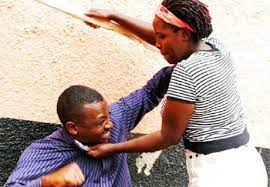
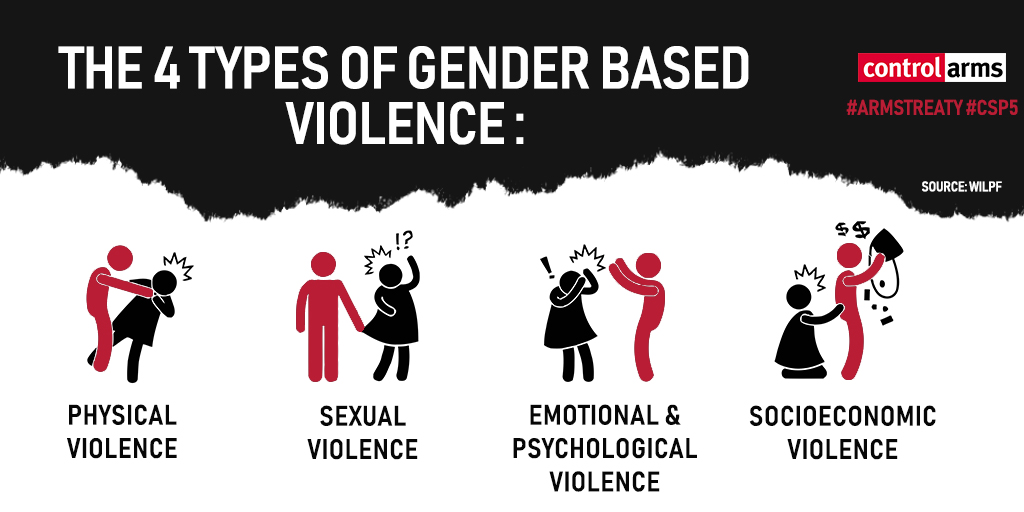
While cases of gender based violence affecting women has been in the spotlight over the years, the Lagos State Government has reported 340 cases of women beating their husbands within the state in the last one year.
The Executive Secretary, of Lagos Domestic and Sexual Violence Agency (DSVA), Titilola Vivour-Adeniyi, made the disclosure recently.
Ms. Vivour-Adeniy who revealed that the incidence of reporting of domestic violence from men increased during the last one year added that 340 men reported incidences of domestic violence perpetrated against them by their wives between September 2022 and July 2023.
She said this is more than twice the number reported between September 2021 and July 2022, which stood at 140 cases.
“This is an indication that the culture of silence amongst the male gender concerning issues of Sexual and Gender Based Violence is also gradually being broken,” she stated.
Vivour-Adeniyi added that research showed that majority of domestic violence occurred in the evening, while Sexual Violence occurred mostly in the afternoon.
She stated that 86.3% of all the reports received were perpetrated against women, saying this further strengthened the previous findings that the female gender were more at risk of experiencing sexual and gender-based violence, adding that 30% of the women disclosed that they were pregnant during the abuse.
The Executive Secretary also revealed that the trend for this year’s cases received for adults including male and female showed that there was a sharp increase in reportage of Sexual and Gender-Based Violence (SGBV) in September 2022 and in July 2023 cases.
“This can be attributable to the fact that there was a lot of awareness in September. A sharp decrease was observed in February 2023. This can be attributed to the fact that February is typically a month when love is expressed,” she added.
The United Nations (UN) Women and European Union have described sexual and gender-based violence (SGBV) as a global pandemic that requires fundamental and coordinated action that would guarantee the safety and security of vulnerable women and children across the world.
Delivering her goodwill message at the Strategy and Knowledge Sharing Workshop on Sexual and Gender-Based Violence (SGBV) for First-Time First Ladies in Nigeria organized by UN Women, the EU Ambassador to Nigeria and ECOWAS, Samuela Isopi said: “As we all know, sexual and gender based violence (SGBV) is a global pandemic that requires fundamental and coordinated action that would guarantee the safety and security of vulnerable women and children across the world.”
Isopi, who was represented by the Acting Head of Development Cooperation, European Union Delegation to Nigeria, Mr. Ruben Alba Aguilera noted that: “In Nigeria, the European Union continues to highlight the importance of the fight against SGBV through our political engagement with the government, and our development cooperation support in collaboration with like-minded partners and key stakeholders.
Our two flagship SGBV programmes; the Spotlight Initiative and the Rule of Law and Anti-corruption (RoLAC) Programme, have been quite instrumental in advancing this agenda. With a global envelope of 500 million Euros, the Spotlight Initiative is a clear demonstration of the EU’s commitment towards addressing SGBV. As the Spotlight Initiative comes to an end next month, a new SGBV programme is now in the pipeline, and we hope implementation can begin in 2024.
She said the European Union has been pleased to see an appraisal of the landmark achievements made, such as the adoption of relevant legal framework at state level, the establishment of more sexual assault referral centres and shelters, the launch of a national sex offender register as well as designation of SGBV courts by the judiciary. These are just some of the critical milestones achieved in the fight against SGBV in Nigeria.
She however said: “Moving forward, we simply cannot afford to rest on our laurels. Lessons have been learned over the years and many more challenges remain. Whether in establishing clear and efficient referral pathways for survivors of SGBV, or securing funding for designated institutions, speedy prosecution of cases, training of front line workers or inter agency collaboration and coordination. We hope that this meeting serves to further prioritise SGBV intervention as well as raise public awareness on what we consider to be one of the most heinous crimes in our society. We also hope that this meeting will explore ways to continue raising a call to action that asks everyone to take concrete steps to question, call out, and speak up against acts of gender-based violence (GBV).
Isopi noted that the EU has contributed over a billion naira in support of the fight against SGBV across the country and will continue to collaborate with stakeholders in supporting adequate legislative instruments, targeted healthcare and responsive policies aimed at addressing the issue.
She added that: “We urge the government to take ownership by allocating more funding and ensuring that the SGBV designated institutions have all they require to address the needs of the people. Sexual Assault Referral Centres and specialised SGBV courts are best practices, and as the new administration both at states and federal level begin to settle in their various roles, we need to set the SGBV agenda so that they begin to give this the much-needed focus that it deserves.
In her keynote remarks, the UN Women Representative to Nigeria and ECOWAS, Ms. Beatrice Eyong said the two-day workshop is one of the critical interventions of the joint EU-UN Spotlight Initiative which seeks to eliminate all forms of violence against women and harmful practices through women’s movement building to work together, provide support and resources towards addressing the causes and effects of Sexual and Gender-Based Violence.
She said: “We are confident about sustainability of the collaboration between the EU and the UN in the attainment of the Sustainable Development Goal (SDG) 5 which seeks to achieve gender equality and women’s empowerment through addressing violence and all forms of discrimination against women and girls
“1 in 3 women have experienced violence. Globally, an estimated 736 million women—almost one in three—have been subjected to physical and/or sexual intimate partner violence, non-partner sexual violence – 26% of women aged 15 and older have been subjected to intimate partner violence.”
She added that: “Although globally we have decreased maternal mortality, child marriage in the past decade, violence against women and girls, as you can see from these statistics remains pervasive, today almost one in five (19 per cent) in 2022 compared to 1 in 4 ten years ago have experienced child marriage. Irrespective, one girl is too many!
She noted that SGBV is one of the most significant human rights’ violations in today’s world, insisting that: “These violations have public health implications and negatively impact on the social, economic and political development of our society. In 2021, gender-based violence across the European Union was estimated to cost around EUR 366 billion a year. Violence against women specifically makes up 79 per cent of this cost, amounting to EUR 289 billion
“It is for this reason UN Women through the EU-UN Spotlight Initiative has enhanced engagement of the private sector to address violence against women and girls in the workplace and society through a private sector-led GBV Fund and uptake in the UN Global Compact and UN Women’s Women’s Empowerment Principles (WEPs). Excellencies, your offices present an invaluable opportunity to shape private sector’s influence on pervasiveness of violence in society. We call on you to continue challenging private sector entities to adopt policies to address violence.”
The Chairperson of the Nigeria Governors Wives Forum and the First Lady of Kwara State, Professor Olufolake Abdulrazaq said there is need to continue with frequent sensitization on SGBV in order to have a road map to follow.
Our site uses cookies. By clicking “Accept All Cookies”, you direct Law and Society Magazine to store cookies on your device and disclose information in accordance with our Cookie Statement: cookie policyACCEPTREJECT
Privacy & Cookies Policy
Privacy Overview
This website uses cookies to improve your experience while you navigate through the website. Out of these cookies, the cookies that are categorized as necessary are stored on your browser as they are essential for the working of basic functionalities of the website. We also use third-party cookies that help us analyze and understand how you use this website. These cookies will be stored in your browser only with your consent. You also have the option to opt-out of these cookies. But opting out of some of these cookies may have an effect on your browsing experience.
Necessary cookies are absolutely essential for the website to function properly. This category only includes cookies that ensures basic functionalities and security features of the website. These cookies do not store any personal information.
Any cookies that may not be particularly necessary for the website to function and is used specifically to collect user personal data via analytics, ads, other embedded contents are termed as non-necessary cookies. It is mandatory to procure user consent prior to running these cookies on your website.