Home Blog Page 672

Tsunami warnings in Japan: Thousands in shelter as powerful earthquake strikes

By Kelly Ng and Ali Abbas Ahmadi

BBC News

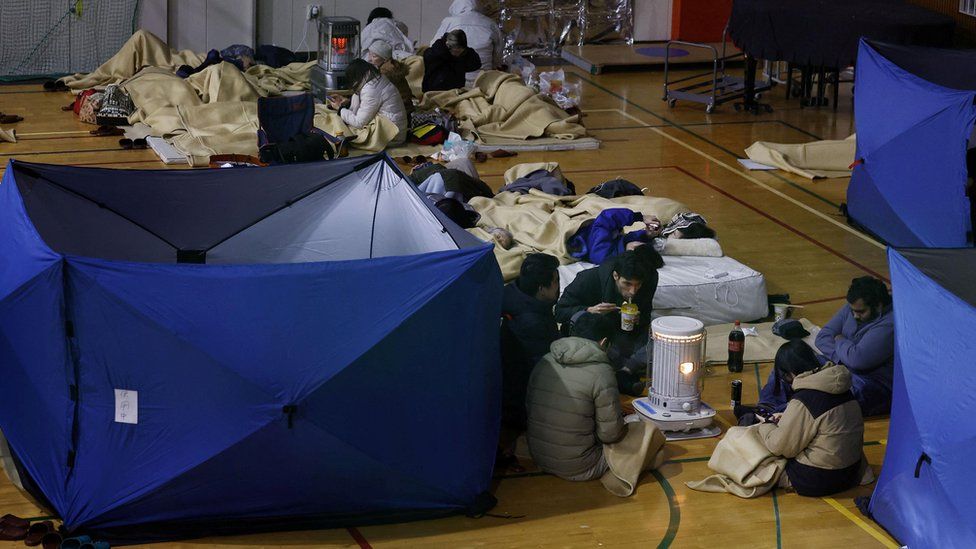
Thousands of people in Japan are spending the night in evacuation centres after a powerful earthquake.

Four people are confirmed to have been killed, the Kyodo news agency reports, and dozens of others have been injured.

An unknown number of people are trapped beneath the rubble of collapsed buildings in several towns.

The 7.6-magnitude quake struck at around 16:10 local time (07:10 GMT) on Monday. Tsunami warnings were issued and later downgraded.

About 60 tremors have been recorded following the initial quake.

A snowboarder on holiday in Japan’s Hakuba Alps said his entire hotel room shook. Speaking to Reuters, Baldwin Chia said he was concerned about avalanches but hadn’t received reports of any taking place.

He said it was common to hear about earthquakes in Japan, but “you wouldn’t expect to actually experience one”.

Andy Clark, a Briton in Japan, described to the BBC a “scary afternoon and evening”, as he was in the affected coastal city of Toyama when the quake hit.

He said he “grabbed the sea wall to stay upright” before heading to a school roof for safety. Mr Clark said it was proving “hard to get some sleep” due to the aftershocks.

Jeffrey Hall, a lecturer at Kanda University, said he felt tremors for about two minutes despite being in Yokohama, on the other side of Japan’s main island. He told the BBC the quake was “very, very serious”.

Local residents rest at an elementary school acting as an evacuation shelter after an earthquake hit central Japan
Image caption: Residents in central Japanese towns and cities were forced to move into shelters for the night

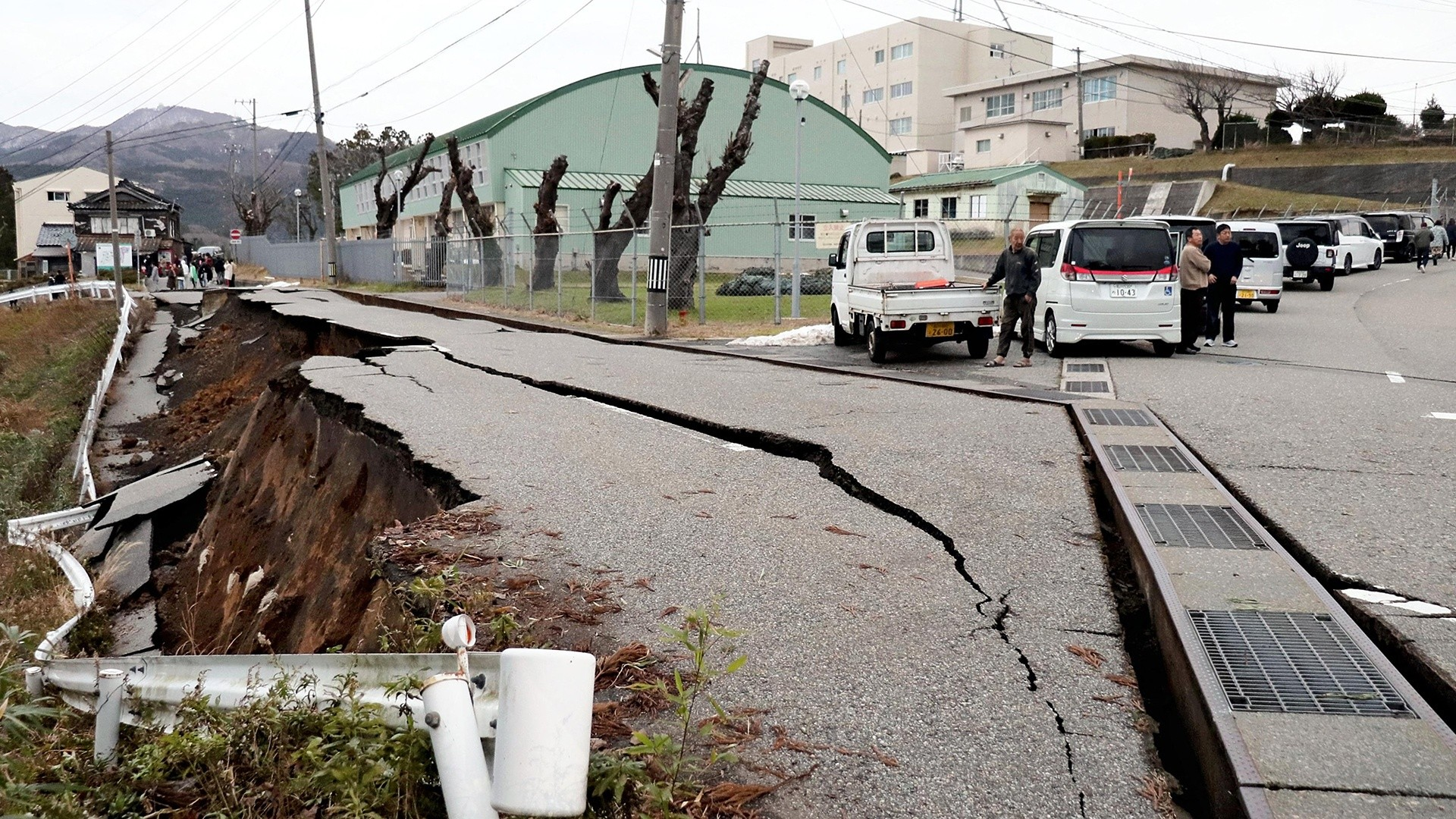
The full extent of the damage is unlikely to be clear until Tuesday morning, but major damage to infrastructure is evident.

Officials in Suzu City in Ishikawa prefecture said several houses and power poles collapsed, according to national broadcaster NHK.

Major highways were closed near the quake’s epicentre and more than 36,000 households were left without power, according to utilities provider Hokuriku Electric Power.

The BBC’s former Japan correspondent Rupert Wingfield-Hayes – who was reporting from Taiwan – said several hundred metres of the main expressway between the cities of Toyama and Kanazawa had been ripped apart by a landslide.

Video from Uchinada, also in Ishikawa prefecture, showed the surface of a road rippled and cracked. Damage to the Onohiyoshi Shrine in Kanazawa was also pictured.

Initially, a major tsunami warning was issued for the coastal Noto area in Ishikawa – near the quake’s epicentre – with authorities saying waves could reach heights of 5m (16ft).

Local reports said this was Japan’s first such warning since 2011, when a powerful earthquake tore through the north-east and unleashed waves up to 40m high.

The waves that actually hit the Sea of Japan coastline in Ishikawa on Monday were not much more than a metre high.

The major warning was later downgraded to simply a warning, and then an advisory. Nearby Niigata and Toyama prefectures were also on alert.

Japan’s allies have sent messages of support to Tokyo in the wake of the disaster.

US President Joe Biden said his country was prepared to offer assistance. “As close allies, the United States and Japan share a deep bond of friendship that unites our people. Our thoughts are with the Japanese people during this difficult time,” he said.

Prime Minister Rishi Sunak said the United Kingdom, too, was “ready to support Japan” following the disaster, and that his thoughts were with “all those affected by the earthquakes in Japan which have caused such terrible damage.”

Japan is one of the most seismically active nations on Earth, owing to its location on the so-called Pacific Ring of Fire, where many tectonic plates meet. The constant threat of earthquakes has led Japan to develop one of the world’s most sophisticated tsunami warning systems.

There are several nuclear power plants in the affected areas, however Japan’s nuclear authority said there was “no risk of radioactivity leaking” from the facilities.

South Korea’s meteorological agency and Russia also issued tsunami warnings after the earthquake.

The 9.0-magnitude earthquake which hit Japan in 2011 resulted in a tsunami – which tore through the country’s north-eastern coastal communities, killing almost 18,000 people and displacing tens of thousands.

Those tsunami waves triggered a nuclear meltdown at the Fukushima power plant, causing the most serious nuclear accident since Chernobyl.

BBC News

New Year, New Redemption Song

By Sonnie Ekwowusi

I am sure that, like this poor scribbler, you are being bombarded with New Year wishes and messages on your mobile phone. How is it said again? If wishes were horses, beggars would ride. If wishes were horses, Nigeria would have been the most politically and economically resilient country in the world by now. Our ingenuity in crafting sanctimonious New Year messages is unmatchable and unparalleled. For example, check out this beautiful New Year message which a bosom friend sent to me yesterday: “10 good wishes in this New Year 2024: joy unspeakable, love, affection, peace now and always, favor, promotion, good health, breakthrough, victory, anointing for excellence.

In principle, there is nothing wrong with the exchange of good New Year wishes and messages like the above. In fact, we should have an optimistic and cheerful attitude toward life. We must look at the bright side of things. No defeatist attitude to life. No surrendering to failure. We are not melancholies and sadists who always see the dark aspects of life. We are full of faith. We are full of hope. We are full of love. Therefore, it is proper and fitting that we wish ourselves all the goodies in 2024.

Having said this, it is also good to predicate our faith and hope on stark realities. We must not be naive. One does not reap where one has not sown. If we have sowed a whirlwind in the last eight years, why should we expect to reap a bounteous material harvest in 2024? If the APC government had failed to create jobs for our hapless young graduates in the last eight years (even though they are now telling lies and claiming the contrary), on what basis are you expecting better employment opportunities in 2024? If there had been unsteady electricity in 2023, why expect uninterrupted electricity supply in 2024? As I scribble this, there is a power failure in my area. And you are telling me that we are in a new year. What is new about 2024, if I may ask you?

If Nigeria was ruined in 2023 by monumental election rigging, a corruptible judiciary, and looting of the public treasury by the Presidency and National Assembly, why would anyone expect instant economic prosperity in 2024? If INEC chair Prof Yakubu Mamoud rigged the 2023 Presidency election in favor of the APC and is still being retained as the INEC chair, why should we expect to reap any democratic dividends in 2024 and beyond? If voters obtained their PVCs and voted in 2023, yet their votes did not count, why anticipate peace in Nigeria in 2024? I am asking you. Please answer my questions. If the standard of living condition of the average Nigerian deteriorated beyond belief in 2023, why expect a sudden improvement at the dawn of 2024? According to the National Bureau of Statistics (NBS), Nigeria is now acknowledged as the poverty capital of the world with 87 million “extremely poor people,” thus overtaking India in extreme poverty ranking. Nigeria has been ranked as the third most-terrorized country in the world. Nigeria has been ranked as the second-worst electricity supply in the world. The Nigeria Police have been ranked as the worst Police in the world. Nigeria has been ranked by the World Health Organization (WHO) as a country with the 3rd highest infant mortality rate in the world. Northern Nigeria has been ranked as the worst region in the world with the highest number of illiterates. And you are comfortably sitting down in your house, chorusing “Happy New Year.”

On July 25, 2018, the BBC reported that “Nigeria has the largest number of out-of-school children, totaling 13 million, in the world.” In the 2018 Global Rankings of the “Commitment to Reducing Inequality Index” of OXFAM and Development Finance International (DFI), Nigeria was ranked 157 out of 157 countries. In the same year, Nigeria overtook India as the country with the highest number of under-5 deaths. In the same year, Nigeria was ranked as one of the most dangerous places in the world to give birth and the 4th country with the worst maternal mortality rate globally. In the same year, Nigeria was ranked among the worst malaria-hit countries in the world. In the same year, Nigeria was ranked by the World Bank among the seven worst countries on the World Bank Human Capital Index. Meanwhile, in the 2018 Global Hunger Index (GHI), Nigeria ranks 103rd out of 119 qualifying countries. The latest World Bank Report on Nigeria says that more than 100 million Nigerians will be felled by extreme poverty in the next 10 years. Given the human rights violations in Nigeria in the last eight years, it is not unlikely that Nigeria will experience full-blown totalitarian democracy in 2024. The killings in Plateau State are most painful to me. You see, nothing damages a country’s reputation more than human rights violations, scuttling of the rule of law, and killing of innocent citizens. No country in which its narcissist leaders keep quiet in the face of the killings of innocent citizens, as we are now experiencing on the Plateau. This is why Nigeria under the APC government will never make progress. In the last eight years, foreign investors have steadily and unceasingly been fleeing Nigeria and going to invest in other African countries such as Ghana and now Rwanda. Can you imagine the erstwhile war-torn country Rwanda, now the pride of Africa?

Now , after reflecting on the foregoing, what should we expect in 2024? Should we anticipate economic prosperity? Unfortunately, Nigerians revel in high superstitious beliefs. Christianity may be flourishing in the land, but it is only a superficial Christianity that lacks depth. For instance, now that 2023 has come to an end, many Nigerians are already reveling in all sorts of superstitious beliefs about the goodness or badness of the New Year. There are many Christian worshippers who are now sleeping in churches, believing that new blessings would be showered on them inside the churches. To make matters worse, new paganism now thrives in Nigeria. Most Nigerian youngsters have gone back to worshipping the old abandoned idols. The old pagan oracles and shrines of our pagan ancestors may have disappeared in some places in Nigeria, but they have been replaced by the new paganism, which always harps on material prosperity, financial breakthroughs, and good health as evidence of success in life. This is why any small boy who manages to erect a signboard with the inscriptions: “Church of instant miracles, financial breakthroughs, fruits of the womb” is sure to attract dozens of gullible people, especially women who will start following him and calling him their “pastor” and all that.

Our miracle and prosperity mongers must not forget that happiness and sorrows are inseparable in this life. Nothing good here below lasts forever. Hardly has any pleasure started than it has ended. We are only wayfarers on earth. Our pathway as wayfarers on earth is strewn and intertwined with sadness and joy. No cross, no crown. As St. Josemaria Escriva vividly recaptures it, “On this earth, love and suffering are inseparable; in this life, we have to expect the Cross. Whoever does not expect the Cross is not a Christian. Whoever does not look for the Cross will encounter it anyway, and further will find that it brings him despair. If you look for the Cross, with Jesus on the Cross, you can be sure that at the hardest moments, if they come, you will be in the best company, happy, strong, and secure…”

If you ask me, I think the miracle we need in Nigeria urgently at the moment is the miracle of putting our human intelligence to work to improve the well-being of our fellow human beings. No New Year is intrinsically a good year. No New Year is intrinsically a bad year either. You have to work out your New Year to be what you want it to be. If you are a hard-working person, the New Year probably may be good for you. And if you are the lazy type, the New Year probably may be bad for you. We must stop deluding ourselves into believing that once we denounce Satan and all his works with the air of hubristic self-righteousness inside a church on the New Year eve, then all troubles and sufferings will vanish in 2024. It is not enough to renounce the evils plaguing our society at the dawn of 2024, as if that renouncing alone would negate their powers. We should try to work hard for the good of our families and the society. After all, God who created us has given us intelligence and expects us to put our intelligence to good use to improve the well-being of our fellow men and women. Therefore, God has no reason to work miracles to solve small human problems in Nigeria, which we can use our human intelligence to solve.

Therefore, as we cruise into yet another New Year, let us remind ourselves that no New Year comes with already-made bounties or a new lease on life. No New Year comes with already-made miracles. You have to work out your New Year. You have to resolve to do your ordinary work with a sense of responsibility. The Presidency should be more responsible. No wasteful expenditure in 2024. Ditto for the National Assembly. Ditto for the judiciary, that veritable third arm of government entrusted with the sacred duty of dispensation of justice. 2023 was a disastrous year for the judiciary in Nigeria. Our judiciary has been constituted into an object of derision by the very people who should labor to maintain its prestige. The level of official corruption and moral degeneracy in the Bar and the Bench was alarming in 2024. In Nigeria, the power of the judiciary has been whittled down by the ambitious tendency of some members of the executive to disobey the court. Nothing destroys the confidence of the public in the judiciary more than this kind of abuse. Our judges should adorn the breastplate of integrity, transparency, discipline, impartiality, and honor in the discharge of their sacred duty. Practicing lawyers must recognize that they are officers in the temple of justice and stop offering bribes to judges. Practicing lawyers must practice the ethics of the Bar. I am eagerly and earnestly looking forward to the redemption of the Nigerian judiciary in 2024. I am looking forward to seeing an incorruptible judiciary in 2024.

It was Lyman Bryson who once said that great citizens are built upon greatness when their leaders dare to let them use their minds, when the state helps them to know the competing choices open to them, preserving for them the essential democratic spirit which seeks the truths by its own efforts. However, the opposite of what Bryson said is happening in Nigeria at the moment. To begin with, many Nigerians have stopped thinking properly. Why? Because they can hardly sleep well at night owing to the suffocating heat caused by electricity failure. When you hit the road to ward off the frustration, a uniformed road merchant dashes out from nowhere and signals you to an abrupt stop. He may end up extorting money from you under one flimsy excuse or another. This is Nigeria for you.

Certainly, we cannot continue to live in this mess. This is not life. Please don’t misunderstand me. I am an optimist. I do not expect a big transformation of Nigeria overnight. We know that the problems are overwhelming. We also know that many of our political office holders are not so gifted to tackle the problems. But there is one thing all of us can do for ourselves: We can sing the redemption song. We should drown our melancholy with laugher for laughter is medicinal We should not wish anybody evil. We should love our fellow human beings. We should use our God-given intelligence to work out our salvation. We must remain focused on solving little problems that improve the lives of members of our respective families and the ordinary man in the street. This is the much-vaunted redemption.

Happy New Year, my friend.

Though I’ve failed UTME 6 times, I must study law! —9ice

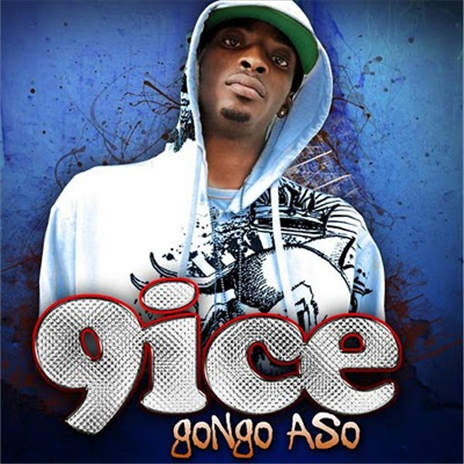
Nigerian singer Akande Abolore popularly known as ‘9ice’ has announced that despite failing the Unified Tertiary Matriculation Examination (UTME) six time, he will study law in his lifetime.

9ice’ who recently revealed that he wanted to be a lawyer before venturing into a music career during an interview with Iyabo Ojo, the actress, said he could not get into school to study law because he had multiple failures in the Joint Admissions and Matriculation Board’s (JAMB) UTME.

He added that he came from a family that was not supportive of a music career.

“I have always wanted to be a lawyer until now,” he said.

“I spent almost six years JAMB go jam me, I go write another one. This one go say I no meet up cut off mark, I go do another one. Because the family I came out from, you cannot be a musician.”

When asked if he regretted not becoming a lawyer, he replied, “I cannot regret because I am still on it. I must do it, probably not to litigate at a firm, but I can be an entertainment lawyer.”

9ice gained fame with the release of his hit single ‘Gongo Aso’ in 2008.

He is the founder of the Alapomeji Ancestral Record label.

The music star is renowned for his powerful use of the Yoruba language, proverbial lyrics, and unique delivery style.

He has received several awards, including MOBO, MTV Africa Music Award, and Nigeria Entertainment Award.

The Cable

Akeredolu, death desires and 2024

By Lasisi Olagunju

The first day of the year is never a good day to write about death and dying. Rotimi Akeredolu spent the last three or four years hard-headed on the frontline. As planted in his name, Akeredolu, he was a small man who nurtured himself to bigness on life’s battlefield. He was not my friend. Apart from one media engagement where I asked him two or three questions -one of which he answered with a frown, there was no direct meeting of our streams. But I later became his fan because he played his role well as an Ogboju Ode in this forest of heartless demons.

The aim of all life is death (Sigmund Freud). Medical science has repeatedly told us that a diagnosis of cancer is not in all cases death soon to strike. Akeredolu, I gathered very reliably, confirmed he had prostate cancer sometime in 2016. He had surgery in Germany in 2019. He was to go for a mandatory follow-up procedure in 2020. But he couldn’t go for that; COVID blocked him as it blocked all of the world for a whole year. That gap in treatment was the twist at the hand of fate. He lost the battle to cancer long before his final breath last week. Could he have helped it? No. That was why he was born; it was his exit path. King Sunny Ade sang in the ’70s: Gbogbo wa l’òpè nípa àkúnlèyàn (we are all novices in matters of fate).

Death is bad – especially for the living. But every death has a beneficiary – they could be the grave digger or the coffin maker. If you were a governor like Akeredolu, the beneficiaries of your departure would be many – your deputy would be the first. When a governor dies, he goes down with so many who wear his badge; and the deputy goes up with his own crowd of new men and women. I am tempted to say this: One of the risks of the American presidential democracy is the sword of deputies dangling every second over the principal. Under our laws, a deputy governor or vice president is number one in waiting. They may not admit this, but it is true that it demands superhuman efforts for a deputy governor not to imagine himself taking the place of the boss. And it takes just one death to achieve that without paying for votes. Almost exactly like the vulture in Kevin Carter’s Pulitzer Prize photo, they wait (im)patiently for their victims’ expiry date. It is in some kingship system too. In Ibadan, when the funeral bell tolls in the palace, the gong of joy sounds in the homestead of the next in line. Agbótikúyò is the oríkì the city gave that streak of sadistic desire. It means “people who hear news of death and rejoice.”

Read also: Bayelsa attorney cheers “good and understanding” Ijaw women who stay home to cook while husbands groove with side chicks

It is an eternal cause of tension and friction in power circles. No governor asks his deputy to watch over his drinks. But, is it strictly about structures or individual character make-up of persons involved? In J.D.Y. Peel’s ‘Ijeshas and Nigerians’ (1983, page 107), we encounter an Owá (king) of Ilesa who rebuked a messenger that announced with sorrow the death of the king’s deputy (Chief Ogedengbe). The messenger uttered “aiyé ti bàjé (the world is spoilt)”. The oba disagreed with his courtier. Instead of the world being “spoilt” by his deputy’s death, the king responded with affirmative joy: “mo j’Owá l’ónìí (I become Owa today).” Ogedengbe was a blustery, thundery number two in whose presence the number one quaked. Then he died one wet day in July 1910. To that king, the death of the overbearing Ogedengbe meant freedom from the deputy’s lethal shadow; it marked the king’s real enthronement as the owa and the actual beginning of an unfettered reign.

A potential widow inheritor must never be seen rejoicing at the husband’s death. I wish Governor Akeredolu’s successor, Lucky Aiyedatiwa, a successful tenure. A death has moved him from a potential known to an actual known; a shadow transformed to the real thing. I commiserate with him too on the death of Akeredolu, his destiny helper. But has Aiyedatiwa watched the television report of his very first public engagement and communication with the world as governor on the day his boss died? Is he satisfied with his conduct, comportment and choice of words immediately before and after his inauguration as governor? Has someone told the new governor that “A kú oríire” (congratulations) uttered at a mentor’s death is a slur on character (ìwà) and that it casts a pall on all of humanity? Was it a mistake or a Freudian slip? I do not know if it is acceptable in Ondo State to say “A kú oríire” (congratulations) in a time of mourning. Where I come from, that phrase belongs in joyous moments; it is especially said with uncontrollable joy in maternity wards when both mother and child are well and stable and their voices heard loud and clear. It is not a greeting for relations and friends of a man fresh in the morgue. Saying “A kú oríire” where it was said degrades all of us in the language group called Yoruba. It shames the people of the beginning who coined that phrase of joyous exultation.

Every human occasion has its currency of verbal engagement. Dirge, the vocalisation of pain; and elegy, written words of loss, are never songs of joy. They are time-honoured teary lines of loss; catharsis of anguish. To start commenting on death on the first day of a new year is a very heavy, foreboding thing to do. But what shall we do when all around us are fresh mounds of departure? Today’s graveyard has no grace; its wardrobe of skulls is stocked with frightening regularity: Governor Akeredolu, Speaker Ghali Na’Abba, over 200 nameless victims of terrorism in Plateau, hundreds of others north and south. How many songs of grief shall one then compose? W. H. Auden (1907 –1973), arguably the greatest English poet of the 20th century, shares my feeling in his poem ‘In Memory of Sigmund Freud’: “When there are so many we shall have to mourn, when grief has been made so public, and exposed to the critique of a whole epoch, the frailty of our conscience and anguish; of whom shall we speak? For every day they die among us, those who were doing us some good, who knew it was never enough but hoped to improve a little by living…”

Read Also: No Happy-New-Year wish for Southwest leaders

The death of Governor Akeredolu is a button of revelation pressed. First, I can see that one’s weakness in life can become one’s strength at death. My initial encounters with the departed Governor Akeredolu told me he was a brash, arrogant fellow. Nothing was too gross for him to say and I once watched him abuse a judge in open court. Then he became governor and Nigeria happened to his people and I saw that brash, raw, unbending courage becoming ready weapons of defence of the land. He did so well as a field commander that at his death last week at age 67, it was as if he had lived 100 years.

His death birthed another revelation: the colour of people’s commitment to humanness and humanity. We now see that there is no unanimity of judgement on what death and grief mean. At this death, people cried and people rejoiced. Those who cried had personal reasons for doing so; the happy party also had personal reasons for thanking their stars. Both sides take no heed of a lesson of life: the happy-at-death people will die; the sad ones will die too – and the living will continue the odious cycle of retributive reactions.

It is natural to react to death with emotions – some calm and sad; some wailing with what John Ruskin describes as “the extraordinary, or false appearances.” I read President Bola Tinubu’s eulogy of Akeredolu more than once. I read it and shouted God is great! The words of Tinubu on Akeredolu’s character, policy choices and political decisions should excite every student of human metamorphosis. People change – like Saul becoming Paul. Read this: “In a challenging moment of our statehood when marauding agents of darkness spread their tentacles across our country, Rotimi was a strong voice in the wilderness calling us to rethink our security architecture so we can have a more secure nation. His unrelenting advocacy led to the birth of the local police in the South-West… During the dark hours when marauding agents of darkness visited the state and killed defenceless citizens where 40 worshippers of the Catholic Church of Owo were killed on June 5, 2022, Rotimi’s leadership qualities as a true statesman and compassionate leader radiated brightly to the world. He was a mourner-in-chief who guided his people through an agonising period. Today, I mourn a fighter and fearless defender of truth and the masses.” That was Tinubu. Who would have ever thought the hitherto absent warrior would roar that tribute to valour? It is never too late to arrive. Al-Hariri, an 11th century Arab grammarian, would look at this turn-around and say: “What we cannot reach flying we must reach limping”.

Read Also: Intimate Affairs: Men just love forbidden fruits

In life, every new dawn breaks with a surprise. God is great is the appropriate exclamation to shout after reading the president’s emotional piece. It was more than a salute to valour; it was a surrender to a road despised and spurned. Akeredolu’s death simply brought back home to us the political forager tricked by ambition into the woods of Nigeria. The Yoruba man in the Villa finally spoke, endorsing actions his people unsuccessfully begged him to take when red-hot terrorism charred their forests. But every Saul has their Road to Damascus experience. If that is the case in this case, then the hem of Akeredolu’s death has raised Lazarus. It means Akeredolu has not died in vain. It also means we should ensure that the president’s patriotic words do not transit with Akeredolu’s transition. Now that the president appreciates the place of a decentralized police system, he should now encourage his protégé in Lagos to embrace “the local police in the South-West”. Let the president do that and also set in motion the ways and means of making Nigeria a true federation where the parts are free and encouraged to compete in excellence.

Big men, small men sometimes cuddle yes when no is what their hearts desire. They say one thing and do another. Public figures among them dub their choice of behaviour political correctness. We didn’t see that in Akeredolu and that is why, warts and all, he is going home in a blaze of glory. Even his enemies acknowledge his forthrightness. When terrorists attacked Owo, Ondo State, in June 2022, Akeredolu did not speak tongue-in-cheek. He shot straight for good and bad people to hear. He called for self-help: “We have called on our traditional rulers that we must all be ready to rise up to defend our land and defend our people…you can’t fold your arms and say people (attackers) are coming and you are running away. No. If they bring a fight to you, fight them back. There is no room to run away from it…We are not lazy; we are an indomitable people – in spirit and everything and nobody can dominate us…Fight these people back. If they come, push them (back) into the forest and leave. Whosoever has the (stronger) arm will survive.” That sounds like Julius Caeser addressing his commanders at the bank of Rubicon.

It was not the first time Akeredolu would speak so forcefully loud. When Amotekun was denied the use of adequate weapons by the Federal Government and President Muhammadu Buhari’s Katsina State got approval for same, Akeredolu took on the president; he spoke as a leader of his people: “The video making the rounds showing the equivalent of the Western Nigeria Security Network (Amotekun Corps) in Katsina, obtaining the approval of the Federal Government to bear arms is fraught with great dangers. Denying Amotekun the urgently needed right to legitimately bear arms is a repudiation of the basis of true federalism which we have been clamouring for. That Katsina was able to arm its state security force with the display of AK-47 means we are pursuing one country, two systems.” Akeredolu declared that the Katsina situation conferred advantages on some “in the face of commonly faced existential threats” He added that “it means that our unitary policing system, which has failed, is a deliberate method of subjugation which must be challenged.” He went beyond the superficial and dug deep into the foundational unfairness of our troubled union. “The Independence agreement was based on a democratic arrangement to have a federal state with devolved internal security mechanics. We must go back to that agreement. We want to reiterate that what is sauce for the goose, is sauce for the gander…We will defend our people.”

Believers in a truly federal Nigeria will miss Akeredolu’s ingenious interventions. But they will not miss him and his courageous essence if President Tinubu honours the memory of the dead by doing that which protects the people. The president has this new year to restructure Nigeria along some of the lines in his Akeredolu tribute. If he does otherwise, those words of his will be assumed to be opportunistic pods without seeds, a hollow homily composed to deceive. And when you deceive and you are caught, you lose all entry keys into circles of respect. You will be called a hypocrite.

Bob Marley sang many iconic songs; ‘Hypocrites’ is one. That is one soulful creation of the evergreen that has not stopped inviting us to question man, his ways and his motives. Bob Marley’s central themes in ‘Hypocrites’ cover the pervasive deception and false appearances around us; they cover life and the injustice that rules it. Above all, ‘Hypocrites’ stresses the need for man to shine his eyes, question authority and ‘drag’ its moral claims.

I am not sure anyone, no matter how depraved, would enjoy being labelled a hypocrite. Joseph Conrad has a synonym for that word in his ‘Heart of Darkness’. He calls it ‘whited sepulchre” – a beautifully painted white tomb that houses rotten skeletons. There are other synonyms of hypocrite. In a dictionary, I saw trickster; I also saw cheater, cheat, plaster saint, humbug, pretender, deceiver, dissembler, impostor, phoney. Each of those words is a poisoned spear; it should not be directed at any human of value. But, we will use it for the entire Yoruba elite (including me) if Nigeria remains unrestructured on May 29, 2027. President Bola Tinubu himself will not smell of roses if he ends his presidency and the 37 Local Council Development Areas (LCDAs) in his Lagos State remain illegal entities. He will be reminded that the entire political relevance of his was built on the German floor of agitation for true federalism. Claims and accusations that the Olusegun Obasanjo Federal Government was actively against allowing Lagos to have its required number of local governments were the concrete that cemented Lagos to its owner. Now, the freedom fighter has become what he wanted to become, he should not wait one day longer before setting in motion the process to do that which he accused Obasanjo and all others of not doing. He must recreate Nigeria along the lines of its beginning. If he fails to do and achieve this, all hypocrisy synonyms will apply and Bob Marley will be invited to sing for the Nigerian leader.

Read Also: Juliana and Vincent Igwe: POTY 2023

The last emperor of the Pax Romana and philosopher king, Marcus Aurelius (26 April, 121 – 17 March, 180 AD) in his ‘Meditations’ has a sermon, not for the dead, but for the living. He asks you to “think of the life you have lived until now as over and, as a dead man, see what’s left as a bonus and live it according to Nature.” He asks you to “love the hand that fate deals you and play it as your own…” He asks all of humanity to pass through this life – “this patch of time” in perfect harmony with nature. He asks us to go to our final resting place like a ripened olive that drops “praying the earth that nourished it and grateful to the tree that gave it life.” I think Aketi read Aurelius; his passing is a rendition of John Donne’s ‘Death, Be not Proud’ – particularly the line: “One short sleep past, we wake eternally…” He died in his sleep. May the soul of the departed rest in peace. I wish all of us a happy, safe and prosperous 2024.

One Chance: Inhumane treatment of humans – A call on FCTA to take action against life wasters

By Lois Otse Adams

The nation’s capital was designed to set a clear example of how robust security architecture should function, but in the days leading up to the yuletide season of Christmas, the alarming level of insecurity plaguing the city has become a cause for concern.

Tragically, the lives of well-intentioned Nigerians have been abruptly cut short recently, for reasons ranging from kidnapping, ritual killings to incidents involving ‘one-chance’ vehicles and reckless driving in traffic. These occurrences have become deeply troubling and detrimental to both the residents of the federal capital territory, encompassing the heart of the city and its outskirts.

It is disheartening to witness numerous families plunged into mourning due to these heinous acts inflicted upon innocent people. Many young men and women are bedridden, some mentally scarred, and others have lost their self-esteem due to the inhumane attacks carried out by unknown assailants. This situation has led families to lose faith in the government.

Reflecting on the government’s disregard for the populace, I was deeply affected upon receiving devastating news about a young man, Peter Imhontu, 28, from my home state. He was robbed, fatally stabbed on his way back home from a Christmas Eve church performance, and found dead in Abuja’s Light axis on Christmas day. Instead of being able to wish his parents compliments of the season, his death was the tragic Christmas gift that greeted them. Can these parents ever truly recover from such devastation?

Imhontu, like other victims, was laid to rest in his hometown of Essn Otokhihim, Ugboha, Southeast Edo State, on December 27, 2023. May his soul and the souls of other victims rest in peace.

The decline in the city’s condition began a few years ago. The previous ministers turned a blind eye to it, and although Nyeson Wike, upon assuming office, displayed enthusiasm, neither he nor the administration adequately addressed the city’s security issues. The minister should have prioritized concerns crucial to the people – protecting lives, ensuring orderly traffic, and addressing food security. Regrettably, these critical issues were ignored while the administration focused on land disputes and allocations.

Is this truly what the people desire? Abuja residents comprise the poor, a dwindling middle class (if it still exists in Nigeria), and the elites who live lavishly despite the dire situation affecting the nation’s capital and the entire country.

Enough of the inhumane treatment inflicted by political office holders on the people. The people’s destinies are clouded, and hope for tomorrow seems distant. The distressing news of the murders of numerous vibrant and ambitious Nigerians flooding the internet poses a severe threat to the nation’s future. If these vibrant individuals, with aspirations and contributions to their daily lives, are eliminated, who will steer the nation’s affairs tomorrow?

Why should thugs hold sway in the nation’s capital, where military headquarters and personnel are stationed? Why are the people being disregarded and left to their fate? Why does the FCT administration seem intent on confining people to their homes, while those who venture out risk falling prey to assailants? Who are these assailants, and why are they allowed to arbitrarily take lives? Is the Minister insensitive to the distressing recent killings in Abuja? Does he prioritize chasing landowners over protecting the people he represents?

The populace is weary of this inhumane treatment perpetrated by unknown individuals, terrorizing a city that once exuded peace and safety. Immediate action must be taken to rid the city of threats to its security architecture.

Inhumane treatment is among the worst experiences a person can endure. It strips individuals of their freedom, confines their movement, and subjects them to unpleasant situations. Witnessing fellow beings being killed with no hope for a better fate is emotionally devastating.

The administration of the Federal Capital Territory exhibits inhumanity towards Abuja residents. Its actions lack compassion and can be described as inhumane. A government that prioritizes pursuing land disputes while its people perish might rightfully be deemed inhumane.

The administration’s lack of sympathy, warmth, and compassion towards the people they represent is evident. The city’s current state is both cruel and brutal; an inhuman government should not be tolerated in Nigeria.

Wike should be held accountable for the incessant killings. He must channel the same vigor he employs in land disputes towards fortifying the city’s security architecture. Otherwise, the people must ensure he faces the consequences of his indifference and inhumane behavior. Concrete evidence must be gathered against the FCT administration to take decisive action against those wasting lives and safeguard more individuals from untimely deaths.

The administration has allowed deliberate mistreatment causing physical and mental suffering or, worse, fatalities among innocent individuals, leaving families in profound grief.

Urgent measures must be taken to identify and bring to justice those lacking compassion towards their fellow human beings, displaying actions that are outright inhumane.

We are not discussing animals; these are human beings being ruthlessly killed while going about their daily lives. What transgressions have they committed? The administration must address these individuals who show no regard for their fellow humans. Murdering another person is an inhuman act, the pinnacle of evil; being subjected to such brutality is inhumane treatment. This must be condemned. Concerned institutions like the Nigeria Labour Congress, Nigerian Union of Journalists, Association of Nigerian Authors, and other social activists should unite to halt this heartless and cruel treatment of human beings.

My prayer is for the Lord to console the families of one-chance victims and to strengthen those facing mental or physical afflictions due to the brutalizing acts.

We must wake up to the reality that nobody knows who or where the next victim might be.

Pain, anguish as suspected herders destroy farmlands in Ekiti

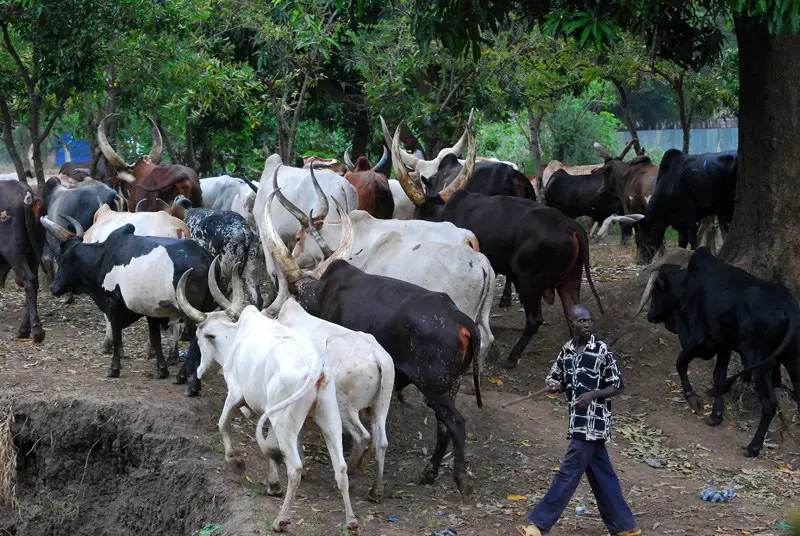
It was extreme sadness for farmers at Idege farm, a farmstead under Ado Ekiti, the Ekiti State capital, at the close of 2023 when suspected herders destroyed several hectares of farmlands in the area.

Mostly affected by the activities of these vandals were cassava and yam farmers, whose farms spanning several hectares of lands, were ravaged by cattle that were being reared free-ranged by some Fulani Nomads.

One of the victims, who identified himself as Ibrahim, revealed to journalists in Ado Ekiti, on Saturday, that over 30 farmers operating in the area were affected by the destruction.

Ibrahim said the Fulani herders, has been terrorising the area for the past two years, attacking people on their farmlands when resisted and causing wanton destruction to their crops.

He narrated how he and two of his brothers and son, narrowly escaped death in the hands of some of these evil doers a couple of months ago, when they were waylaid and gravely manhandled by some herders.

The suspected herders according to him were at that time on the prowl, brutalising farmers as they please and destroying their farms over accusation that some cows were killed in the area.

He stated: “Though, they had been coming to beat us and caused destruction to our farms, which we reported to the security agencies, but without serious action. We have been enduring this for long.

“But the current destruction was massive. They destroyed over 4,000 heaps of cassava in my farm alone apart from the havoc they wreaked on my brother–law’s farm. Over 30 of us were affected.

“In some instances, they went to the new yam farms we just cultivated, brought out the yam seeds and cut for their cattle. Some of us are currently removing the seeds for safekeep until the situation abates, so that we can replant. 

“They were not just destroying the cassava by eating up the leaves and stems, but they also uprooted the tubers to feed their animals. These were callous acts and the government shouldn’t allow these to happen without any check.

“Farming is our means of economic livelihoods and self-sustaining. These people are silently killing us. They are destroying our means of survival with intention to send us back to beggarly life. 

“Time for government to take action is now, because we know how much we contribute to attainment of food security in Ekiti from that axis”.

The affected farmers have appealed to Governor Biodun Oyebanji, the Commissioner of Police, Ekiti Command, Mr. Dare Ogundare and the Commandant of the State Amotekun Corps, Brig. Gen. Olu Adewa, to save them from unwarranted and willful destruction being wreaked on their farms in the farmstead. 

“The Police and even Amotekun corps were all aware of our plights at Idege Farm. We had reported our situation to them severally, but it seems these vandals thought they were above the law and this shouldn’t be allowed to happen”, they said.

Treasure Newspaper

Bayelsa attorney cheers “good and understanding” Ijaw women who stay home to cook while husbands groove with side chicks

A Bayelsa lawyer, Ebikebuna Augustine Aluzu, has eulogised the “good and understanding” Ijaw women who stay home to cook while their husbands have fun with their side chicks every weekend in Yenagoa.

“Married men and side chicks grooving every weekend in Yenagoa while understanding wife stay home to cook and wait for husband arrival as it should be. God bless all the good and understanding Ijaw women,” he wrote in a Facebook post on Wednesday. 

Bayelsa lawyer praises "good and understanding" Ijaw women who stay home to cook while their husbands groove with side chicks every weekend in Yenagoa

Credits: Linda Ikeji

2

No Happy-New-Year wish for Southwest leaders 

By Martins Oloja

On Sunday December 25, 2022, I wrote an article here titled, ‘No-Happy-New-Year Wish For Southern Leaders’.But for today, I had planned to write on the quantum of intellectual dishonesty going on in Ondo State where people are on one hand hailing the courage of the just departed Governor Oluwarotimi Akeredolu and on the other hand, blaming the tragedy of corruption in the state on members of his household. I can’t understand that logic which ignores the sanctity of the ancient word that any man who cannot take care of members of his household is worse than an infidel. Apparently, this mourning time isn’t the best time to deconstruct the tragic errors in ‘Akeredolu Vs Akeredolu’, which most commentators tend to be speaking in tongues about.
Let’s allow the state burial before revisiting the tragedy of consistency of poor leadership that has triggered a sunset in the Sunshine state that urgently requires some civic competence.

As I noted here a year ago, in normal times and climes, this time, Christmas and New Year celebrations shouldn’t be a time to read from the book of lamentation. For Christians, it should be a time of celebration of the reason for the season: the birth of the greatest leader of all times, Jesus. For me, I should remember the Christmas day (December 25) in a sober mood as I lost my sweet mother on this day (December 25, 2015). But this isn’t a normal time.

Sadly, we aren’t marking these remarkable times in a normal clime. In this most populous African country, we are in a democracy without its majesty. This is a place where morons show up in a public place and he is decorated as a baron. This is a location where unscrupulous dealers are (s)elected and appointed as leaders of the people. This is a country where ‘execu-thieves’ are sworn in as chief executives of states. We are in a milieu where ‘legislooters’ are heralded as legislators. I think it isn’t a time to celebrate. It is indeed a time to do a contextual reporting and commentary on the people we should hold responsible for the parlous state of the nation. Six months ago, we said goodbye to the Buhari administration that led us to where we are – down, down in the valley of political and economic recession.

As I remember the birth of the King of kings and dawn of a new year, as I ponder over the implications of the death of my mother eight years ago, I would not like to wish all the leaders, specifically in the Southwest, Nigeria, (Yoruba-land) Happy New Year. I think they don’t deserve any warm greetings in all sincerity. And my reasons are not too far to seek: they are not insultive. They asked to lead us and they must be held to account. The political leaders from the western part of the country think they are very clever and more sophisticated. They think they are what Charles Dickens calls the ‘Artful Dodger’ in his classic, ‘Oliver Twist’.

Jack Dawkins, better known as ‘the Artful Dodger’, is a character in that Dickens’s 1838 novel Oliver Twist. The Dodger is a pickpocket, so called for his skill and cunning in that occupation. He is the leader of the gang of child criminals on the streets of London, trained by the elderly Fagin. The term ‘artful dodger’ has become an idiom describing a person with skillful deception.

In the novel, he becomes Oliver’s closest friend (although he betrays Oliver when Oliver is caught) and he tries to make him a pickpocket, but soon realises that Oliver will not succeed, and feels sorry for him, saying “What a pity it is, he isn’t a prig!” He also has a close relationship with Charley Bates. The Artful Dodger is characterised as a child who acts like an adult. He is described as wearing adult clothes, which are much too large for him. Like an adult, he seldom gives in to childish urges. The Artful Dodger, meantime, who was of a rather saturnine disposition, and seldom gave way to merriment when it interfered with business, rifled Oliver’s pockets with steady assiduity…

Let’s get back to our ‘Artful Dodgers’ and their conscience. The Nigerian legislators, for instance, at state and federal levels are very self-deluding. They think they know enough to claim that we the people are too gullible. They think we don’t know how democracy works for the development of a nation. They think we (the people) don’t know what they unjustly earn. They do what they like in the 36 state capitals and Abuja. They think we don’t know their phantom constituency projects’ universe and costs.

They laugh at us that we don’t know how the state legislators allow the 36 state governors to tamper with the workings of the state legislatures and how they (governors) manipulate the state legislatures’ presiding officers. The Abuja Legislators feel they are quite clever. They play the ostrich. They too feel that we don’t know what they do with budget details every year. They are very unaccountable and their acts are opaque. They feel good that the political economy of a free press has been so bad that the media in Nigeria have been helpless to the extent that they can’t hold them to account for what they do with the people’s mandate. They claim that we don’t know that despite the criticism of the extant constitution, the national and state assemblies are supposed to be the most important institutions to defend the sanctity of the constitution and sovereignty that the people represent. They have been very naïve. The Abuja big men in National Assembly who always have enough war chest to run for presidential and governorship elections at the end of every session, hardly think that they will one day be made to account for their recklessness and disservice to the nation that they have helped to under-develop.

But as we still relish the joy of the Yuletide 2023 and expect a prosperous new year 2024, I would like to speak some truths specifically to all the LEGISLATORS in Southwest, Nigeria. I want them to listen to what the spirit is telling them today as an oracle from the most important office in the land – the Office of the Citizen: Let them know that I will never join any deceitful and sycophantic bandwagon to wish them prosperous New Year. If the iconic educationist and social critic, Tai Solarin (1922-1994) were to be around today, he would have wished all the leaders from Yoruba region a rough road to 2024. He would have written: ‘May Your Road Be Rough’. Whatever that meant then and what it connotes now! I can’t greet our Southwest leaders at all as we migrate to 2024 because they have disappointed the people a great deal.

And specifically, here is why: former President Muhammadu Buhari could not have the only reason for instance, all the link and federal roads in the South West aren’t passable and decrepit from one state to another.

Gbajabiamila

Here is the thing, it is an emblem of suffering and shame on all our legislators from Western Nigeria, for instance that on May 29, 2023, we celebrated 24 years of unbroken democracy but the roads to the two Ports in Lagos, we shamefully dress as the economic capital of West Africa, are a shambles. I was in Badagry recently to explore business opportunities with the very strategic Badagry Chambers of Commerce, Industry, Mines and Agriculture (BACCIMA). I was excited meeting the very resourceful officials of the Chamber. But at the same time I was disappointed as I regretted the trip because of the parlous state of the road network from Lagos metropolis to Badagry, which is part of Lagos State. Badagry is not just a historical city that could be a veritable tourist centre, it represents a great deal of facts of many firsts to Christianity and Western education. What is more, there are so many vital educational institutions on the expressway to Badagry including the Lagos State University, Lagos State University of Education, Federal Government College, Ijanikin, Administrative Staff College of Nigeria (ASCON) Topo, Badagry. Despite that poor road network that even Sukuk loan intervention can’t rescue still, the local nongovernmental agencies including BACCIMA confirmed that there could be up to 50 Police, Customs and Immigration check points to Seme Borders of the about 70 kilometre road from Mile 2 to Seme Border and barely 50 Kilometres to Badagry. I confirmed also that the checkpoints could be up to 100 in the night for obvious reasons that have nothing to do with public interest.

These are not new claims or allegations. What is curious is why our federal legislators who represent Lagos State at the National Assembly have not considered the national security asset that the Lagos-Badagry-Seme Border Road has become as a priority project in 24 years that the locusts have eaten. What is more curious, in Buhari adminitration’s eight years, a former Lagos State Governor, Babatunde Raji Fashola was the Minister of Works. He was said to have begun a reconstruction of the road when he was governor from 2007-20015. Lagos has been in the firm grip of the ruling APC since 2015, yet the Lagos-Badagry-Seme Border Road that links Nigeria to all West African countries has been uncompleted for 24 years by democrats from PDP to APC? How many times have the legislators of the Lagos State House Assembly and the federal legislators collaborated to draw attention to the expediency of completing these strategic roads through yearly appropriation details in the context of managing priorities?

In the same vein, we will celebrate 25 years of democracy in May next year, let the federal legislators from South West who are joining others to round off of 2024 budget details note that in the old Western region, there is no good road from Lagos to Abeokuta, capital of Ogun state. Besides, there is no passable federal road from Abeokuta to Ibadan, capital of Oyo State. There is no modern federal road to ply from Ibadan to Osogbo, capital of Osun State carved out of Oyo State in 1991. What is worse, there is no road from Osogbo to Akure, capital of Ondo State. What is more laughable, there is no tolerable federal road from Akure to Ado-Ekiti, capital of Ekiti state carved out of Ondo in 1996. Hold your breath, the Lagos-Ibadan Expressway has just been completed after many years of promises.

That isn’t good enough for Western Nigeria. Where are the completed constituency projects that have been more valuable than the Apapa-Roro Port roads, Lagos-Badagry-Seme Border roads, Lagos Ibadan Expressway, and all the federal link roads that all the political leaders have never bothered about for 24 years? Let us put it to all our feckless leaders in the South West that we know that in a representative democracy anywhere in the world, development of critical infrastructure can only happen through well-coordinated appropriation bills in parliament. In global context, legislators lobby the executive arm of government for allocations to projects in their constituencies. They sometimes fight and exchange blows, threaten to remove presidents who fail to pay attention to special projects in their regions or areas. That is the majesty of representative democracy!

A return to my alma mater

By Sonnie Ekwowusi

Last Saturday, for me, was a memorable day. I attended the Annual National Convention of the Immaculate Conception College (ICC) in Benin-City, my alma mater. The event took place at the Nigeria Air Force Officers’ Mess on Kofo Abayomi Street, Victoria Island, Lagos. The Convention was organized by the Old Boys Association of the College. Finding myself in the company of several old classmates and school compatriots, most of whom I had not seen for dozens of years, I was lost in deep thoughts and reminiscences about the path we had trodden in the past. Some philosophers identify life simply as mere activity. Yes, life brings with it an activity, but life cannot be reduced to mere activity. To be alive means to exist in a concrete way. And if we must exist in a concrete way, we cannot continuously move forward and forward, unsure of where we are going. Someday we must return. Those who do not manage to return are lost forever in the abyss. Last Saturday, I found myself returning. I was returning to the College where I was weaned.

Founded in 1944 by Patrick Joseph Kelly, an Irish missionary who was also the first Catholic Bishop of Benin (Kelly also founded the College of Immaculate Conception (C.I.C) in Enugu, St. Patrick’s College in Asaba, and Maria Goretti College in Benin-City), ICC was distinguished for imparting character and learning suitable for human flourishing .

In those good days, ICC was the college to attend. At ICC, there was keen competition in academics, Sports and other extra-curricular activities. Only the best and the brightest excelled. By the way, at ICC, you were adjudged one of the best and the brightest students if you were in the Science Class. Little did they tell us that a History major, for instance, could excel in this competitive world. We were meant to believe that carrying a Physics or Additional Mathematics book up and down was the best way to strike success in life. At ICC, studying late at night after the School Lights Out was dubbed “awoko.” Doing “awoko” was punishable, but somehow some stubborn students knew how to beat the law and do “awoko.” For instance, Christopher Salami was a ‘bookworm’. He was an “awoko” specialist. Prior to any Physics exam, for instance, Salami must have read the Nelkon Physics textbook from cover to cover.

There was keen competition in cleanliness. The four Houses at ICC, namely St. Martin de Porres House, College House, St. Kizito House, and St. Mulumba House, competed for neatness every week. I was in Porres House, the Blue House, and the best House in ICC. Up Porres House!

Our School Principal was the legendary Dr. Joseph Itotoh (of blessed memory). He was a strict disciplinarian, a wordsmith, an orator, and a consummate wag. Dr. Itotoh held students spellbound with his oratorical speech during the Morning Assembly. He was a grammarian. After the Saturday cleaning-up, Itotoh would swagger around the Houses with his walking stick to conduct what was known as the Saturday Inspection. Itotoh inspected everything: the students’ beds, the way the students dressed, the walls, the grounds, the ceilings, student lockers, and so forth, in search of dirt. Penmanship featured in my time at ICC. Students enrolled in the Penmanship Competition. The winners received various prizes. Godwin, one of our classmates, was the best in Penmanship. His handwriting was splendid. He wrote as if he were a printer. We used to admire his writing in his notebooks. Our teachers, some of whom were foreigners, were dedicated teachers. They knew our names by heart. I remember Mr. & Mrs. John, an Indian couple who respectively taught Biology. I remember Mrs. Nweze, who doubled as both our English Teacher and Literature in English Teacher. She was a soft-spoken and angelic-looking lady. Unlike the useless novels recommended for Nigerian students to study today, at ICC, we studied Macbeth, Things Fall Apart, Mine Boy, Jane Eyre, Zambia Shall Be Free, Treasure Island, and other intellectually engaging literature books. Something happened the day we read the portion of Things Fall Apart where Okonkwo killed Ikemefuna, the boy who called him father. Throughout that day, all our classmates were in mourning mood. While some maintained ominous silence, others simply refused to eat anything. “How can Okonkwo kill Ikemefuna, the boy who calls him father?, many queried.

Speaking Pidgin English, the Vernacular, or the Native Tongue was forbidden at ICC. The punishment for speaking Pidgin or the Native Tongue was the uprooting of a big tree in the School Orchard. Anthony Agho, a school footballer, was not very fluent in English. He could hardly utter an English word without multiple Bini words slipping off his tongue. As a result, he was always seen from morning till evening uprooting one big tree or another, the punishment meted out to Vernacular/Mother tongue speakers. Poor Agho! He uprooted many trees for speaking the Vernacular language.

All in all, at the heart of ICC’s philosophy is the all-round formation of the human person, which is why the College places so much emphasis on the academic, cultural, spiritual, human, moral, and scientific formation of its students. Special emphasis was placed on moral instruction at ICC at that time, to the extent that an ICC student who failed the Moral Instruction Exam was not promoted to the next class, even if they excelled brilliantly in subjects like Mathematics, Physics, History, and others. At ICC, you are not asked whether you are intelligent because that is already taken for granted. Rather, you are asked whether you are excelling along the line of the Motto of the College, “semper et ubique fidelis” (Always and everywhere faithful) in practicing the core values of service, humility, responsibility, human refinement, prudence, kindness, integrity, courage taught at ICC.

Speaking of courage, ICC is built upon the Benin Moat. The Benin Moat, traditionally known as Iya, was built around 1280-1295. It is said that the Benin Moat is the largest man-made earthworks in the world. Its remains consist of deep gullies dug with crude implements by the Bini Natives to protect the Benin Empire from European imperial invaders who were hunting for native slaves. Sighting the remains of the Moat from the ICC compound was dreadful. But casting fear aside, the Boys Scout Movement of ICC applied to cross the Benin Moat with bare ropes. Our principal granted them permission. Surprisingly, one Saturday morning, the members of the Boys Scout Club Movement, fully attired in their Boys Scout uniforms and led by Scout Masters Joseph Musa and Ikpefan, were seen marching towards the Benin Moat and intoning; “Baden Powell, he was a leader, he used to wear khaki; Paden Powell, he was a leader who used to wear khaki!, khaki!! Khaki!!!” All the students gathered and cheered the courageous Boys Scout members as they crossed the Benin Moat with ropes.

ICC has long been known for excellence in sports. In fact, sporting activities complement academic studies at ICC. I remember Rabbit Field, where sportive students competed in shot put and javelin. The four Houses competed favorably in various sports such as athletics, pole vault, football, badminton, volleyball, javelin, and shot put during the College Inter-House Sports. Our Vice-Principal, Epelle Ebedi, was always seen in his white sports attire jogging in the field every evening. You were not a complete student of ICC if you were not a sports student. Oladipo Okpeseyi SAN, for instance, who delivered a keynote at the Convention last Saturday, excelled in various sports at ICC. I may be wrong, but I think Oladipo once won the school’s victor ludorum. Peter Mordi was always seen in colorful sports attires. ICC football strikers Obaze, Polycarp, and Olise mesmerized and penetrated all starchy defenses during football matches. Even though he was in junior class that time Obiora, son of a previous ICC Vice-Principal, kept a clean slate in goal. Athletic-built Ologbesere was ICC’s 100 meters best. He won medals in the local 100 meters dash and 400 meters relays. At that time, ICC was always victorious in the Junior Table Tennis Championships, with Sixtus always demolishing his opponents.

It is impossible to say goodbye to ICC. Once a student of ICC, always a student of ICC. ICC is not just the name of a college. ICC is life. ICC is a way of being. It is an ideal that is lived every day. I look forward to returning to my alma mater. Semper et ubique fidelis.

10 questions to ask yourself before the new year

By Samiah Ogunlowo

Here are ten thoughtful questions to ask yourself before stepping into the new year, providing a compass to guide your aspirations and growth.

Begin with acknowledging your victories. Reflect on your goals at the start of the year and celebrate the milestones you’ve reached. Recognising your achievements, big or small, sets a positive tone for self-reflection.

Confronting challenges is an integral part of life. Identify the obstacles you faced this year. Understanding challenges helps you grow, and it sets the stage for planning how to overcome similar hurdles in the future.

Consider your well-being over the past year. Did you prioritise self-care, both physically and mentally? Recognising areas where you neglected self-care allows you to make intentional changes moving forward.

Reflect on the personal development you experienced. Did you acquire new skills, cultivate healthier habits, or enhance your emotional intelligence? Personal growth is a valuable measure of a fulfilling year.

Evaluate the quality of your relationships. Did you invest time in cultivating meaningful connections with friends, family, or colleagues? Building and maintaining healthy relationships contribute significantly to overall well-being.

Assess how you handled stress. Did you develop effective coping mechanisms, or did stress negatively impact your health and productivity? Understanding stress management is crucial for maintaining a balanced life.

Consider your actions in light of your core values. Did you make choices that align with your principles and beliefs? Living authentically requires continuous self-awareness and alignment with your values.

Life is a perpetual teacher. Reflect on the lessons the year offered you. Whether moments of triumph or challenges, every experience has the potential to impart wisdom.

Evaluate the equilibrium between your professional and personal life. Did you strike a balance that nurtured both aspects? Balancing work and personal life is essential for sustained well-being.

Look ahead and set intentions for the new year. What goals would you like to pursue? Ensure they align with your values and contribute to your overall growth and happiness.

Culled from Pulse.ug

TIPS