Home Blog Page 635

West Africa has three months to save the ECOWAS Court from Chief Justices who want to kill It

By Chidi Anselm Odinkalu

On Sunday, 24 February 2024, the Heads of State and Government of the Economic Community of West African States (ECOWAS) concluded an extraordinary summit in Abuja, the capital city of Nigeria, precipitated by the announcement on 28 January 2024 by Burkina Faso, Mali, and Niger Republic of their joint decision to denounce the Revised Treaty of the Economic Community of West African States (ECOWAS) and leave the regional bloc “without delay.” From within Nigeria, the anchor state in the region, many around government exuding hubris under the guise of patriotism claimed that “the three countries would have more to lose.”

By the time they finished counting the costs of the possible withdrawal of these three countries, however, the extraordinary summit found the costs to the Community rather prohibitive. Between them, Burkina Faso, Mali and Niger represent 10% of the GDP of the region; 17.4% of the population, and 54.35% of the landmass. The Summit concluded that their departure will “have political, socioeconomic, financial and institutional implications for the three countries as well as for ECOWAS as a group” and “will constitute a reduction of the market size of ECOWAS.” They, therefore, issued an appeal to Burkina Faso, Mali, and Niger Republic to “reconsider the decision [to withdraw from ECOWAS], in view of the benefits that all ECOWAS Member States and their citizens enjoy for being part of the Community.”

To sweeten the appeal, the Summit decided to withdraw most of the existing sanctions against the three countries and to invite them “to technical and consultative meetings of ECOWAS as well as to all security-related meetings.”

One of the institutions adversely affected by the issues concerning these three countries is the Court of Justice of ECOWAS. In existence since 1991 and functioning since 2006, the Court is the judicial organ of the Community and is composed by five judges elected by the Heads of State and Government for a tenure of five years.

At the end of July 2022, three judges of the ECOWAS Court respectively from Ghana, Côte d’Ivoire, and Nigeria, were due to rotate out at the end of their terms, to be replaced by judges elected from Burkina Faso, Guinea, and Mali. This would have enabled the two surviving judges from Cape Verde and Sierra Leone to become the senior members judges of the court, all but assuring their succession to the offices of President and Vice-President of the Court. The current Judge President is from Ghana and his Vice is from Côte d’Ivoire.

However, while they are suspended, Burkina Faso, Mali, and Guinea from ECOWAS cannot propose any candidates or their nationals for election into vacancies in any of the institutions of ECOWAS. Confronted as a result with an inability to fill judicial vacancies on the ECOWAS Court, the Assembly of Heads of State and Government of the Community decided at the end of their Summit in Guinea Bissau on 12 July, 2022 that in order “to facilitate the functioning of the Court of Justice in its task of administering justice in the Community…. the judges, nationals of Ghana, Côte d’Ivoire, and Nigeria, are maintained in office until the appointment and entry into office of their successors.”

The effect of this was to maintain the status quo with respect to both the composition of the court and of its leadership, in effect extending the tenure of the judges from the three named countries. In turn, the judges whose ambitions of becoming the new leaders of the court it also frustrated or deferred, did not take this lightly.

The week after the conclusion extraordinary summit of the ECOWAS Heads of State in Abuja at the end of last month, the Chief Justices of the member States of the Community convened also in Abuja as the ECOWAS Judicial Council. The meeting of the Judicial Council also marked the passing of the baton of leadership of the Chief Justices of the Community from Guinea Bissau’s António André Lima to Nigeria’s Olukayode Ariwoola.

 The Chief Justices grappled with two things. First, almost assuredly instigated by their Judges on the ECOWAS Court who now want to become leaders of the court, the Chief Justices of Cape Verde and Sierra Leone at the meeting of the Judicial Council loudly complained about the expiration of the tenure of the judges from Ghana, Côte d’Ivoire and Nigeria. At their behest, the Judicial Council resolved to advise the Heads of State to “set in motion the process of filling those vacancies to avoid potential infraction of statutory provisions governing appointment of Judges to the Court.” They were unable to offer any advice to the Heads as to how to do this while the countries from which the putative judges would come remain suspended from ECOWAS. There’s a limit to what the incredible powers of even Chief Justices can accomplish.

The second thing they grappled with was the low level of compliance with decisions of the ECOWAS Court of Justice. On this, they received and considered a report from the Judge President of the Court, Ghana’s Edward Amoako Asante. Thereafter, the Chief Justices divined that the main reason for the low level of compliance with decisions of the Court of Justice is that litigants do not have to exhaust domestic remedies in their respective countries as a criterion for admissibility before proceeding to the ECOWAS Court of Justice.

To address this problem, the Chief Justices promptly decided to constitute a sub-committee of themselves comprising their peers from Cape Verde, Liberia, Sierra Leone, Senegal, and Togo in order to review the treaties and protocols governing the ECOWAS Court of Justice so as to write into them a requirement for exhaustion of domestic and also “explore the possibility of creating a pool of qualified judges to serve as appellate judges on an ad hoc basis.”

In a manner of speaking, this amounts to killing the ECOWAS Court of Justice with an effusion of high judicial attention. In nearly every one of the attending ECOWAS Countries, the office of Chief Justice is a shrine to judicial despotism. The word of the Chief Justice is not open to question. Cases linger in court until the day after eternity except those which affect senior politicians to whom most Chief Justices seem beholden. By comparison, the ECOWAS Court of Justice has been something of a judicial miracle in West Africa. Cases receive prompt attention, the judgments are clear and understandable and litigants are treated as if their issues deserve serious attention. The ECOWAS Court is everything that the national court of the member states are not.

It is, of course, a misconception to take the machete of exhaustion of domestic remedies to a regional court of Justice. The design, treaty law and doctrine applicable to the legal system of the Community makes the idea of exhaustion of domestic remedies anathema to an integrated regional system. Imposing the doctrine on the Court of Justice will render it both irrelevant and impotent.

Around 18 years ago, beginning 2006, former Gambian dictator, Yahya Jammeh, sought to get ECOWAS to implement similar ideas. A concert of concerned citizens and governments in the region rallied and killed it. The true tragedy this time is that it is not a dictator, soldier, or politician who wants to ransack the ECOWAS Court before killing it. Rather, it is Chief Justices of the region wielding with maximum malevolence an appearance of commitment to due process and the rule of law. This is why citizens of the sub-region have a duty to resist them. On May 6-7, the Chief Justices propose to convene again in Abuja to “deliberate on the reports and recommendations of the Committees for adoption.” The citizens of ECOWAS States may have less than three months save the ECOWAS Court.

A lawyer and a teacher, Odinkalu can be reached at [email protected]

The Kaduna Mystery: Where is the Lawyer’s Girlfriend?

By Olanrewaju Onigegewura

Everyone in Kaduna knew Omobolaji Gaji. He was a solicitor and advocate of the Supreme Court of Nigeria. He was one of the leading lawyers in Northern Nigeria at the time. Rauph Omobolaji Gaji was an irrepressible advocate who was known far and beyond Kaduna where he had his base. However, he did not start his practice in Kaduna. It was in Lagos that he cut his legal teeth before he moved up North. If you had a complex case, one of the lawyers you would consider to stand in for you was Gaji, of counsel.

Gaji was as brilliant as he was versatile. He was at home with Land Law as he was comfortable with Law of Taxation. Criminal Law and Procedure was his forte, and hardly could you beat him when Law of Torts was on the table. Have I told you that he had a perfect mastery of English Language? His English was impeccable and flawless. This was years before written brief became the norm. Then, oral advocacy was the index the average man used for measuring the competence of a legal practitioner, and in this, Gaji excelled. No wonder he was known across the length and breadth of Kaduna as Gaji the Law or ROG.

He was the counsel for the appellant in the popular case of Ali Abadallabe v. Bornu Native Authority where he ingeniously asked my Noble Lords of the Supreme Court whether a burglar had a right to defend himself. He was also the defence counsel in the popular case of Queen v. Bello. Has Onigegewura told you that ROG was also popular? He was familiar to all the judges in Kaduna and was not a stranger to all the lawyers who practiced in the town at the time. There was even a rumour that ROG was a member of an exclusive club with some of the important stakeholders in the justice sector.

He belonged to the prestigious Lincoln’s Inn. Having been called to the Bar on 25 November 1952 and enrolled in the Supreme Court on Wednesday, 14 January 1953, he was already a senior lawyer when this tragic story happened. In fact, My Lord Justice Baptist Ayodola Coker described him as a “legal practitioner of many years standing.”

It was therefore only natural that he was the lawyer retained by Gladys Wey whose appeal was coming up before the Supreme Court. It was indeed an important matter and Wey had full confidence in her counsel. She had won the case in the High Court. The matter was now coming up before the Supreme Court to be determined with the finality which only the apex court could boast of. Onigegewura has already told you in the story of The Fall of a Godfather that there was no intermediate appellate court in other parts of the country outside the Western State before 1976.

Mrs Wey, a health practitioner, had arrived in Kaduna from her base in Zaria on the eve of the hearing of the appeal before the Supreme Court, and being a stranger in the city, she decided to put up with her lawyer. Young lawyers who are reading this story might be wondering whether the Supreme Court was ever in Kaduna. At the material time, the Supreme Court used to practice what was then known as assize. You are wondering what the term assize stands for. Onigegewura will tell you. When a court decides to have periodic sittings in different places, it is called assize. In those days, the Supreme Court used to have assize in Ibadan, Enugu and Kaduna to ensure that the litigants in those far-flung places were not deprived of justice on account of cost of travelling to Lagos.

That was the reason Gladys Wey found herself in the residence of ROG that fateful day. She was not the only guest in the house that evening. Gaji’s friend, Isaac Oshonoike who was working with the Posts & Telecommunications [previously known as Posts and Telegraphs] was also around. At the time, P & T was the body responsible for postal and telecommunication services throughout the country. The body was later unbundled into Nigerian Postal Service and Nigerian Telecommunication Limited respectively.

Wey and Oshonoike were soon joined by the duo of Cordelia Ego Ejiofor and Christopher Brown. Cordelia was Gaji’s girlfriend. She was a twenty-one year old teacher working in Kaduna. She had brought Brown to meet with her boyfriend that evening regarding possible employment as a legal secretary. Gaji had told her that he needed a secretary/typist and she promised to assist him to recruit a competent hand. Brown happened to have come from the same part of the country with her and she was confident that her ‘brother’ would get a job with her boyfriend. Gaji’s houseboy, Friday Igwegbu, was also in the house. He was the one who offered Brown a bottle of soft drink.

But their host was not around. Onigegewura has told you that Gaji was a master of English language. Perhaps that was the reason he was chosen to serve as the Master of Ceremonies at a social thanksgiving service which held that day at the Palace Hotel. He was at the event whilst the four guests and the houseboy waited for him at home.

Whilst Mrs Wey and Mr. Oshonoike were in their separate guest rooms, Cordelia and Christopher Brown were waiting for Gaji in the living room. The two of them heaved a sigh of relief when their host sauntered in. Their relief however turned into something else when they saw the countenance of the learned gentleman who entered. It was Gaji quite alright, but his visage was anything but friendly. He noticed that Brown was cradling a bottle of soft drink, perhaps this was what infuriated him. Cordelia must have sensed the change in her boyfriend’s temperament and she quickly explained that Brown was the male secretary they had earlier agreed she was to bring for interview. Gaji brusquely interviewed the applicant and immediately told him that he could not employ him.

Brown needed no further prompting. You already know that wọn kò fẹ ẹ niìlú, ó ń dárin, tí ó bá dárin náà tán, tani yóò ba ọ gbee? [You are not wanted in a town and you then decided to sing, if you sing who will join you to sing the chorus]. Brown jumped up from his seat and bade goodbye to the assembly. At the door, he turned to wave at Cordelia who gave him a reassuring smile to signify that everything was under control.

If only he knew!

The following morning, Gaji appeared before the Noble Lords of the Supreme Court to defend the appeal of his client. It was ROG at his best. With his flawless command of English language, and his mastery of the law, he left no one in doubt that his sobriquet, Gaji the Law, was a deserving title. It was not the only case he did that day. He also argued a couple of criminal appeals bordering on murder.

Christopher Brown was waiting to hear from Cordelia on whether she had succeeded in convincing the lawyer to change his mind. He wondered what must have triggered the renowned legal practitioner to have reacted the way he did when they had never met before. He was not the only one waiting. Cordelia’s sister who lived with her, Nkemdinem Ejiofor was also waiting. Before Cordelia went out that fateful evening, she had instructed Nkem to prepare yam for dinner and that she would come back very soon. Nkem finished cooking and waited for her sister to return. But Cordelia never returned.

Of course, she knew Lawyer Gaji and of his relationship with her sister. The previous week when Nkem’s child had convulsion, Gaji was the one who took them to a native doctor who assisted in finding solution to the illness. She also knew that her sister had told her that she was taking Brown to Gaji’s house. When by morning Cordelia had not returned, she informed people in the neighbourhood. Her major challenge was that she did not know Gaji’s residence but she knew someone who did. Temilade Bepo was Cordelia’s friend and classmate at the Teachers’ College. Together, the two of them made their way to the lawyer’s house on Abuja Road.

Fortunately, the gentleman of the Bar was at home having just come back from court. Gaji recognised Nkem as his girlfriend’s sister. He told them that Cordelia was not with him. He explained to the ladies that his house boy, Friday Igwebu, told him that Cordelia came with one boy but that they did not meet him at home.

He sympathised with the two young ladies and promised to use all his legal skills to look for his dear girlfriend. It was difficult to know whether they believed him or not. Having no evidence to prove otherwise, they left to continue their search for Cordelia. They did not go back to their house. They proceeded to Christopher Brown’s house to find out what he had done to Cordelia.

Brown was surprised on being informed that Gaji had denied seeing the two of them the previous night. He told the ladies to follow him in order to confirm from Gaji himself. It was however a different Gaji they met. The senior lawyer was shivering when they entered his house. Brown asked him if he had indeed said that he did not see them when they visited him. Strangely, Gaji changed his story. He admitted that he saw them but that Cordelia left immediately after Brown had taken his leave.

Brown was however not going to have any of it. He told the lawyer that Cordelia did not leave immediately because he saw the two of them, i.e., Gaji and Cordelia, on the veranda of the house when he was coming back from his brother who lived in the neighbourhood after leaving Gaji’s house.

The lawyer appeared confused for a moment. With the vehemence of Brown’s statements, it was certain that he was telling the truth and that it was the counsel who was being economical with the truth. Gaji advised that all of them should go back to Cordelia’s house to see if she was back. They all trooped into Gaji’s car and went to Cordelia’s house. There was no Cordelia.

Where could Cordelia have disappeared to? Could she have travelled back home to the East? Could she have been kidnapped? Was she involved in an accident on her way from Gaji’s house? They turned the whole of Kaduna upside down and inside out in their bid to locate Cordelia. They checked all hospitals and clinics in and around Kaduna. They visited police stations to see whether she was under arrest. It was around 10pm when they decided to call it a day.

It was a fruitless search….

The Kaduna Mystery: Will Cordelia Ever Be Found?

-Olanrewaju Onigegewura

Part II [Detective Farida Waziri and Senior State Counsel Isa Ayọ̀ Salami Joined the Case]

…Gaji then advised that her disappearance should be reported to the police which was done. Without any trace of Cordelia, and with the statement of Brown to the effect that he left her in the house of Gaji, the senior lawyer was arrested.

It was a strange twist of fate the day Gaji was arraigned before Chief Magistrate Salihu Belgore. For someone who was not only used to standing at the Bar to defend his client, but who had previously served as a magistrate himself in Kano, Gaji now stood in the dock. As Iya Agba would have said: ohun tí ó mú igún de ọdọ onídìrí kìí se kékeré [whatever must have taken the vulture to the stall of the hairdresser must be beyond ordinary]. He was accused of kidnapping Cordelia contrary to the provisions of Section 271 of the Penal Code.

As you already know, kidnapping is a bailable offence. When an offence is bailable, it means that the court has discretion whether or not to grant the defendant bail. Gaji was not a lawyer of two decades for nothing. He quickly applied to the Chief Magistrate for bail. With his stature at the Bar, and his undertaking to present himself for trial anytime he was summoned, he was granted bail. Gaji the Law was a free man, at least, for the moment.

It was a happy and boisterous Gaji that returned home triumphantly after his bail. His happiness was however not shared by the family and friends of Cordelia who were disheartened by the turn of event. Their expectation was that ROG would be held by the police until he was either able to produce Cordelia or disclose her whereabouts to them. Now, Gaji was a free man -at least for the time being, and their Cordelia was still nowhere to be found.

Onigegewura has told you that Cordelia was not a native of Kaduna. She was from the East Central State, one of the 12 States created in May 1967 by the Federal Military Government. The State is now made up of the present-day Abia, Anambra, Ebonyi, Enugu and Imo States. Messages were sent across the Niger to her home State to the effect that Cordelia, a full-grown woman and a trained teacher, had disappeared without a trace. What was more, the man accused of being responsible for her disappearance had been granted bail. The whole of the East Central State erupted like a volcano, the like of which it had never experienced before.

Ukpabi Asika was the Administrator of the East Central State at the time. If you are familiar with Abuja, there is a street named after him in Asokoro. He was informed of the protests and of Cordelia’s disappearance. He realized that if the government failed to do something, the protest was not going to abate. He contacted the Governor of North Central State, Brigadier Abba Kyari, who had been appointed a governor at the tender age of 32. Ukpabi was assured that anyone responsible for the disappearance of Cordelia would be found and prosecuted. With the assurance from the North, Asika was able to placate the restless protesters.

Back in Kaduna, Governor Kyari -who had made history when he appointed a woman into his executive council at the time – directed all relevant agencies of government to swing into action and solve the mystery surrounding the disappearance of the young lady. Based on the report made by Christopher Brown, Gaji the Law was once again arrested and the investigation started all over. The challenge before the police officers investigating the matter was the fact that there was no body to start with, and Gaji refused to disclose what happened to Cordelia, insisting that she left his house that night after Brown had gone. It appeared that Gaji intended to take the secret to his grave, after all, obẹ̀ kìí mì níikùn àgbà [stew does not slosh around once inside an elder].To compound the issue, Gaji went on a hunger strike as a result of his detention.

One of the police officers who investigated the case was a brilliant young detective, Mrs Farida Waziri, who was later appointed the Executive Chairman of the Economic and Financial Crimes Commission [2008-2011]. Interrogating an experienced counsel of the stature of Gaji was however not a stroll in the park as Waziri was to find out.

According to the seasoned detective, “I tried all known tactics to get the accused to reveal what he did with the body but to no avail…I had to employ feminine charms to get a confession out of him…”

You know that no matter how hard iron is, when heat is substantial, iron would melt. One day in the course of the investigation, it appeared that Gaji’s iron had been melted by Waziri’s heat. Gaji told the police officer that Cordelia -or rather her body- was at a particular place along Kaduna Road.

Finally!

It took all of Waziri’s professional experience to remain calm! Gaji had finally spoken. She mobilized her officers and off they went to the location described by the suspect. They did not go alone. They went with police dogs which had been trained to sniff out cadaver from wherever it is. After hours of digging and excavation like archaeologists searching for Ile-Ife bronze heads, the police officers realized that Gaji the Law had sent them on a wild goose chase.

Waziri was not someone to give up so easily. If anything, she was tenacity personified. She went back to the drawing board. She was determined to crack the kernel of Gaji’s calm exterior. Like a skilful psychologist, she deftly continued to probe the suspect. According to her, she appealed to Gaji’s vanity by telling him that: “You know, it’s not your fault. It’s an accident, these things happen. I will help you if you tell us where the body is.”

Again, it appeared that Gaji’s armour had cracked under the impact of Waziri’s skills. He told her that the body was at a location along Kachia Road. Once beaten twice shy, Waziri had learnt her lesson about how manipulative Gaji could be, she therefore asked him to confirm the exact location. Gaji admitted that this time around, he was telling the truth. He told Waziri: “You are kind. I thought no policewoman would like me because of the case I am here to answer.”

But it was another fruitless search.

Finally, a body was found, or let’s say that parts of what appeared to be a human body were found. It was a young girl, Saratu Jarmai, who stumbled on what remained of the body in Sabo Kakuri. She ran to inform her father, Bagudu Jarmai, of the gory discovery. The body was in such a state that Bagudu himself could not approach it but he could see that it appeared to be a female body because of the wrapper she had on. But the head was not part of what was found. It was later that the head was located some distance away. What was found was in such a state of deterioration that no one was certain whether it was Cordelia or another person.

Notwithstanding, the police concluded their investigations and forwarded the case file to the Director of Public Prosecution from where the file was forwarded to the Attorney General of North Central State. Mamman Nasir was the Attorney General at the time. He was called to the Bar on 29 November 1960, and was later appointed a Justice of the Supreme Court on 9 October 1975. When the Court of Appeal was established in 1976 as the penultimate appellate court, His Lordship moved from the Supreme Court to the Court of Appeal and later served as the 2nd President of the Court of Appeal between 1978 and 1992.

As you know already, ajá tí eré rẹ bá dáni lójú ni a n de si ehoro [it is a dog whose speed one has faith in that one sends after the hare]. Having regard to the complexity of the case, and its high-profile nature, the Attorney General assigned the case to a young but brilliant counsel who had shown potentials of being a star at the Bar. Isa Ayo Salami was called to the Bar on 28 June 1968 and had already earned his stripes as a litigator with several cases under his belt. The Attorney General could not have made a better choice. At the time of the case, Salami was a Senior State Counsel Grade II. However, before the case was finally disposed of, he had been elevated to the post of acting Solicitor General of North Central State. Salami later moved to the Bench and became Honourable Justice Isa Ayo Salami in 1978. Ten years later, His Lordship moved upstairs as a Justice of the Court of Appeal. Following in the footsteps of his mentor, Justice Mamman Nasir, His Lordship reached the peak of an eventful judicial career as the President of the Court of Appeal in 2009. But that was years after this case.

Salami studied the case file thoroughly. He came to the conclusion that without the body of Cordelia, the prosecution was not going to be a tea party. Even in cases where there was a body, prosecuting a homicide case is never a picnic, and now there was no physical body, to even start with. He knew that although it was going to be difficult prosecuting the case, he also knew that it was not impossible. He recalled that there were cases where the court had convicted the defendants even in the absence of a body.

He dug up the case of Segun Woghiren and Buraimoh Otokiti v. Queen which had been decided about ten years earlier. Like in the present case, the body of the victim was not found. Notwithstanding the absence of the body, the trial court found ‘prophet’ Woghiren and his accomplice guilty of the charge of the murder of Funmilayo Ose, a pregnant woman who was last seen with them. He also dug up the older case of the murder of Alfa Bisiriyu Apalara of Lagos whose body was never found. Salami was able to find other cases where the court had applied circumstantial evidence to convict the accused persons. He discussed his findings with the Attorney General. Mamman Nasir was happy that it was Salami that he assigned the matter to. The legal advice was comprehensive and in-depth. He agreed with the submission of his brilliant State Counsel.

The charge was promptly filed and Salami waited to see the court the matter would be assigned to. He was eager to set the ball rolling. That was when the story developed a new dimension. It was so bizarre that the most brilliant Nollywood script writer could not have imagined it not to talk of putting it down in writing. I hope you have not forgotten that Onigegewura told you about the rumour that Gaji belonged to an exclusive club. Well, as it turned out, Salami was checking the Registry of the court every day to find out when the matter would be coming up and which court it was assigned to. Every time he went to court, he was informed that the matter was yet to be assigned. Salami was not the only one who was concerned about the state of affair. Cordelia’s family and friends in Kaduna and Enugu were also worried about the non-assignment of the case.

What many people did not know was that all the judges in Kaduna at the time declined to try the case. Every time the case file was assigned to a judge, the next minute the case file would be returned to the Chief Registrar with a short note declining the case. This is what Iya Agba, Onigegewura’s grandmother, would describe as Ọba ránni niṣẹ́, Odò Ọbà kún, isẹ́ Ọba kò see kọ̀, Odò Ọbà kò se kó sí [on the way to deliver the king’s message, the Oba River -the only way to pass to deliver the message – has been flooded. One cannot return without delivering the king’s message, yet one cannot jump and swim across the Oba River].

Cordelia’s family became agitated. They were worried that perhaps this was a deliberate ploy by the powers that be to frustrate the case. Although they were not learned in law, they knew that a suspect could not be kept in a detention forever.

It was at this point that the dedicated prosecutor who was destined to become the future President of the Court of Appeal came up with another brilliant suggestion…

The Kaduna Mystery: Strange Tales of Midnight Mayhem
-Olanrewaju Onigegewura

Part III

…Salami informed the Attorney General about the development or lack of development in the case. It was indeed a strange situation. Without a judge, the suspect could not be tried. And without a trial, the suspect could not be acquitted or convicted as the case may be. And without a conviction or acquittal, the family of the victim would not get the deserved closure. Ìgbà òjò ńlọ, ìgbà ẹ̀rùn ńlọ, a níkí a di ihò eku ko le. Ìgbà wo ni a fẹ pa eku náà? [The rainy season passes, the dry season passes, and we keep on saying that the rat’s burrow be sealed tight; when will the rat ever be killed?]

It was at this point that Salami came up with another brilliant suggestion. Ordinarily, a judge’s jurisdiction is territorial, as you already know. Thus, a judge of one State could not preside in the court of another State. Well, what Salami was suggesting was to request for a judge of another State to come over to Kaduna to try the case.
The Attorney General must have looked at his State Counsel twice, wondering what had happened to the brilliant young man. But Salami was ready with his answers.

Onigegewura had told you in Awolowo, Akintola and Ooni’s case that every Region had its own constitution in those days. I hope you remember. Salami argued that under the Constitution of the Former Northern Nigeria as amended by the Constitution [Suspension and Modification] Decree of 1966, if a judge was unable to act, the Supreme Military Council was empowered to appoint another person as a judge to act in his stead. Mamman Nasir blinked twice and agreed that this was indeed the answer to their problem. He was glad once again that it was Salami that he had picked for the assignment.

He went to the Military Governor and explained the situation to him and the suggestion of Salami. The Governor also agreed that it was indeed the right thing to do. Promptly the Supreme Military Council was informed and in a matter of days, General Yakubu Gowon had issued the necessary order. By the Order dated 30 August 1973, the Head of the Federal Military Government appointed His Lordship Hon. Justice Jeffrey Jones who was Senior Puisne Judge of North-Western and Kano States to act as a Senior Puisne Judge of the High Court of North Central State for the purpose of the prosecution of Gaji’s case.

According to the Order signed by General Yakubu Gowon:

“…NOW, THEREFORE, THE SUPREME MILITARY COUNCIL, acting after consultation with the Advisory Judicial Committee, do hereby appoint MR. JEFFREY JONES, Senior Puisne Judge of North-Western and Kano States, to act as a Senior Puisne Judge of the High Court of North Central State with effect from 6th August, 1973 until the case The State v. Gaji is disposed of.”

That was how His Lordship Justice Jeffrey Jones came over to Kaduna. His Lordship was a graduate of the famous Keble College of the University of Oxford. He was called to Bar in 1954. He had practised as a lawyer in Zaria before being appointed a Magistrate in 1957 and was further elevated to the High Court Bench in 1961. He later served as the Chief Justice of Kano State between 1975 and 1980. His Lordship’s judicial career did not end in Nigeria. He moved to Kiribati where he retired as the President of the Court of Appeal.

The court was filled to the brim on 3 September 1973, the day the case came up before Justice Jones. Almost everyone in Kaduna found their way to the court. The lame requested to be carried, the blind asked to be led by the sighted, and the deaf even went to see what was going to unfold. It was a case the whole of the country was interested in.

Gaji the Law knew what was at stake. He had been practising law for more than two decades both on the Bench and at the Bar. He had also served as a Coroner at a point in his career. He was even called to the Bar before His Lordship. He knew that unlike when he was charged with kidnapping in the Magistrate Court, this time around, he was going to be charged with the king of heinous crimes, culpable homicide punishable with death. What was therefore at stake was not his name or professional reputation, it was his life that was at stake. Tí a bá ń gbàdúrà kí a má tẹ, tí a bá ti tẹ, àdúrà kii a máa kú ló kù [When you are praying not to be disgraced, once you have been disgraced, the next prayer is not to die in ignominy].
Although he could defend himself being a lawyer, he decided to go for one of the best legal experts in the country. As Iya Igba would say, Ọlọgbọn ò tẹ ara rę n’Ífá; omoràn ò fi ara re joyè; abẹ tó mú kò lè gbe èkù ara re [The wise person does not consult the Ifá oracle for himself; the knowledgeable person does not install himself as chief; the sharp knife does not carve its own handle]. His choice was no other than Chief Godfrey Kio Jaja Amachree of Grays Inn, popularly called GKJ, the first Kalabari to be called to the Bar.
Amachree was the Solicitor General of the Federation at independence. In recognition of his sterling performance at the Bar, he was appointed Her Majesty’s Counsel for Nigeria [Queen’s Counsel] on 28 September 1960 – some hours before Nigeria gained independence. In 1966, the Chief Justice of Nigeria appointed him Notary Public for Nigeria. GKJ had also served as United Nations Under-Secretary in charge of United Nations Civilian Operation in Congo. According to T. M. Mbu, Amachree “was … the first black African undersecretary of the United Nations”. It was this all-round legal practitioner that Gaji retained to defend him.
Hardly had the court settled down for the business of the day when the fireworks started. It was immediately apparent to everyone in court that this was not going to be just another criminal case. Gaji was in the court, but this time he was not seated at the Bar with his learned colleagues – his usual place. He was also not wearing his robe as a legal practitioner. Rather he was in the dock as the accused, wearing civilian clothes. Despite the travails of the past months, he still managed to cut the image of a successful counsel.

As was the norm, the Registrar read the charge to him. Gaji listened calmly as the solitary charge was read out in the open court. There was pin drop silence everywhere. The court directed the Registrar to ask him if he understood the charge preferred against him. Gaji did not speak but nodded to signify his understanding. He must have thought about the irony of fate. The same section 221 that he had used severally to defend his client was now what he was being charged with.

“Are you guilty or not guilty?”

The voice of the Registrar boomed out. Everyone in the court waited to hear what Gaji was going to say. Would he plead guilty? They waited. Justice Jones was waiting. The Senior State Counsel Grade II was waiting. It appeared that only two people in the court, Gaji and his counsel, were not waiting. The Registrar repeated the question. For all that Gaji cared, the Registrar could have been addressing the Staff of Oranmiyan in the ancient city of Ile-Ife. After several efforts to get Gaji to take his plea with nothing forthcoming, it was clear to His Lordship that it was not only the dead who stay dumb. Gaji was not going to open his mouth, at least for the time being. Finally, the Court ordered the defendant to take his plea. Gaji remained mute. The court looked at his Counsel wondering what was happening, the learned counsel looked back at the judge as if to say it was the prerogative of the man in the dock.

The judge was calm throughout. He opened the Criminal Procedure Code and flipped to the relevant section which he already knew by heart. It was Section 188. He read it and nodded. As a Magistrate before he became a Judge, he knew all the tricks in the book. He read out the provision to the hearing of the public.

His Lordship therefore entered a plea of ‘Not Guilty’ for the defendant.

The prosecutor then started the case. Salami had prepared for the case. He had assembled a stellar cast of seventeen witnesses to prove his case beyond reasonable doubt. His witnesses included Christopher Brown, Friday Igwegbu, Gladys Wey, Isaac Oshonoike, Nkem Ejiofor and Solomon Iyedoh. You remember that Onigegewura has told you that the first four were in Gaji’s house on that fateful day.

Salami had not spoken more than a few sentences when Chief Amachree raised an objection. In the best tradition of the Bar, Salami sat down to allow the former Solicitor General of the Federation to state his objection.

Gaji’s Counsel told the court: “We will challenge the statements of Gladys Wey, Friday Igwegbu, Solomon Iyedoh, Isaac Oshonoike; any statement made to the police by the accused, so State counsel should not refer to their evidence in his opening address.”

He was advised by the Court to keep his gunpowder dry and the case of the decade started to unfold.

Nkem was the first witness to be called. The young lady testified as to how they searched for her sister when she did not return home and how Gaji first denied seeing her but later admitted that she left his house immediately after Brown had left, a fact which was controverted by Brown.

Christopher Brown followed and he narrated what transpired that December evening and how he was summarily informed that his application for employment was not successful. He stated that on leaving Gaji’s house, he paid a visit to one of his brothers who lived in the same neighbourhood and that on his way back, he noticed that Gaji and Cordelia were on the veranda having heated argument, and that was the last time he ever saw Cordelia. He was cross-examined by Gaji’s counsel but his evidence that he left Cordelia alive in the house could not be shaken.

Salami was satisfied with Brown’s testimony. Although it did not establish the fact that Gaji murdered Cordelia, it showed that Gaji was one of the last people to see Cordelia alive. The onlookers who were not learned in law were wondering what was going on. But Salami knew he had a water tight case.

It was when Isaac Oshonoike entered the witness box that people observed that the defendant in the dock became uncomfortable…

The witness narrated how he was waiting for his wife who was coming to Kaduna by train and decided to pass the night in Gaji’s residence. He testified that immediately Christopher Brown left, he went back to his room to sleep. He was about to drift off into dreamland when a loud noise followed by a deafening scream jarred him awake. The shout was coming from Gaji whilst the scream of agony was from Cordelia.

Gaji was shouting: “Who gave him Fanta! Who gave him Fanta!” It was apparent that Gaji was referring to the bottle of soft drink Friday had offered Christopher Brown. The scream was getting louder and it was clear that someone was in pain. He ran out to see Gaji outside the house pummelling the young woman. Cordelia was sprawled out on the road. Gaji was kicking her as he was beating her. Oshonoike observed that the young teacher was having difficulty getting up on her own. He therefore rushed to assist her to stand up lest she was crushed by oncoming vehicle.

He was not the only one attracted by the scream coming from Cordelia. A neighbour of Gaji, Salihu Olohun- Iyo, a tailor also came out of his house when he heard the noise. He saw Gaji beating Cordelia and he also saw Oshonoike when he went to assist the lady. It was in his presence that Oshonoike carried Cordelia back to the veranda of the house.

Gaji was however not done. From the veranda, he dragged the young teacher by the legs into the sitting room. Now safely ensconced in his corner, Gaji began the second round of beating. He pounced on Cordelia the way a starved lion pounces on a star-crossed monkey. With all the fury he could muster, he battered away at the poor girl.

Oshonoike made efforts to restrain his friend but anger combined with whatever he had taken at the party he attended had made him a super power. Gaji turned to his friend and with the skill of a trained pugilist, he punched Oshonoike in his right eye. The P & T Territorial Controller was instantly soaked with blood. The now purblind Oshonoike had no choice than to stagger out of the house to try to treat his injured eye, after all bí iná bá jóni, tó jo ọmọ ẹni, tí ara ẹni la kọ́ gbọ̀n [when one is burnt alongside one’s child, common sense dictates that one takes care of oneself first].

Oshonoike first went to a nearby police station to report the incident but it was considered by the police a minor domestic dispute that did not warrant police presence. Perhaps if the police had listened to him and followed him that cold December evening…perhaps Onigegewura would not have been telling you this story. He was advised by the police to treat his bleeding wounds.

Oshonoike heeded the advice and went to look for a hospital where he was treated. It was after the treatment that he contacted another friend who followed him to Gaji’s house to retrieve his luggage. To their surprise, Gaji refused to release the luggage telling them that he was going to keep it as an exhibit. It was not until the following day that he was able to secure the luggage.

The following day, still smarting from the beating his friend gave him, Oshonoike reported the assault at the Central Police Station and at Sabon-Gari Police. Gaji was invited and he told the police that it was a domestic issue between friends and there was no need for police intervention.

Oshonoike concluded his testimony by informing the court that at the time he left the house, Cordelia was alive, although she had been battered and in pain.

You recall that there were five people in the house before Gaji’s return from the party he attended. Brown and Oshonoike had explained how they left the house, leaving Friday, Cordelia, Gladys Wey and Gaji. Cordelia had not been found. Her whereabouts could therefore be explained by only two people: Mrs. Wey and Gaji. The latter was in the dock, while the former was in the witness box.

And of course, there was Friday, the houseboy. Did Onigegewura tell you that Friday had abruptly absconded from Kaduna? Well, trust the diligent Nigeria Police, he was found in his village and brought back to Kaduna to testify at the trial.

If the testimonies of Brown and Oshonoike had dented the defence, the last straw that broke the back of Gaji’s camel was his client’s testimony…

The Kaduna Mystery: What Happened on Kakuri Road?
-Olanrewaju Onigegewura

[The Final Part]

Mrs Wey was the 6th witness to testify for the prosecution. She testified to the traumatic beating that Cordelia suffered in the hand of her lawyer. She stated that she was in her room when she was woken up by the noise of Cordelia. She ran to the living room to see Gaji kicking and beating the young lady. Oshonoike was trying to separate the senior lawyer from the poor girl. But when Oshonoike himself became a victim, he abandoned the warring couple to tend to his own wound. Friday, the houseboy, also fled and did not come back till the following morning.

But Mrs Wey, in addition to being a health practitioner was also a mother. According to her: “I am a mother. I could not leave the girl. I was defending her though he beat me too…Gaji did not allow me to hold the girl. He was pushing me and jamming the door of the dining room. The girl was now helpless and then unconscious because of the kicking.”

That was not all. She testified further:

“I came out from the room again. This girl was still like that in that condition. Then Gaji said: “Ah! Mrs Wey, I think I had better take her to the hospital.” The girl was so bad she could not get up. I helped Gaji get her into the car which was just outside the gate of the sitting room. I also entered the car and held the girl on the back seat. As we were going, Gaji said he was going to Kakuri hospital. As we were going, he stopped the car near a place with many lights and got out. When he came back, I said, ‘Gaji, this girl has died.’ He said ‘Haa’ and jumped inside the car and said, ‘Mrs. Wey, I will take you back home. I will take you back home.’ He turned the car, but we did not reach the house. He dropped me at Queen’s Club near Abuja Street. Then he turned the car full speed to where we had been coming. I found his house and sat in my room and slept.”

So where was Cordelia? According to Mrs. Wey, the following morning she asked him what he had done to the young teacher and Gaji told her: “I took her to Kakuri Road, ten miles away, and place the girl near the bush because then the people will report to their chief who will bury the corpse.”

The vivid and graphic pictures of the last moment of Cordelia’s life painted by Mrs Wey left an indelible image in the mind of everyone in court. And more was to come. Another of Gaji’s client, Solomon Iyedoh, a Chief Superintendent of Kaduna Prison, who Gaji was defending before his own travail testified. The houseboy, Friday, also testified. The men who found the body and the head were also brought to court to testify. You remember Gaji’s neighbour, the tailor? He was also brought to court to testify.

In addition, the police officers who investigated the matter testified and tendered statements which they said Gaji volunteered. Gaji however denied that the statements were not voluntarily made. According to him, he was tortured by the police.

The medical doctor who examined the skull found at the location on Kachia Road, Dr. Solomon Bankole also testified for the prosecution. He stated that the skull was that of a woman of between 18 and 25 years.

Witnesses after witnesses entered the box to give their testimony until all the seventeen witnesses had testified. Whilst it was clear to all that Gaji had something to do with the death of Cordelia, the unspoken question that hung in the air was: where is her body? It was expected that the answer to the riddle would be provided when Gaji opened his defence.

It was a trial like no other. Each of the witnesses presented by the prosecution was severely grilled by the defence counsel. Every document tendered by the prosecution was objected to by the Defence.

As the last of the seventeen witnesses stepped down from the box, the Attorney General, Mamman Nasir as the most senior prosecution counsel present in court stood up to inform the court that the State would be closing its case at that point. The court nodded and turned to Chief Amachree:

“Has the defence any witness other than the accused person or a witness to character only?”

The whole court was stunned when the defence informed the court that the defendant was not going to testify or call any witness. Justice Jones asked whether the defence was going to make a no-case submission to which the former Queen’s Counsel responded:

“No. I am not making a no-case submission, but we will rest our case on the prosecution’s evidence.”

His Lordship picked up his copy of the Criminal Procedure Code again and flipped to Section 236(1) which he proceeded to read out aloud. Of course, it was a provision that Gaji himself was familiar with. Justice Jones explained the import of the section to the defendant, his knowledge and familiarity with the law notwithstanding, after which Gaji spoke briefly:

“I do not wish to give evidence.”

To the people in court who had been waiting eagerly to hear Gaji’s version of the events, his refusal to testify or call witness was a sort of anti-climax. But that is the law. A defendant cannot be compelled to testify if he does not want to do so. It is one of the constitutional rights of an accused person. The prosecution has the entire burden to prove his guilt beyond reasonable doubt.

Following the decision of Gaji to rest his case on that of the prosecution, the judge called for the counsel to address the court. The future President of the Court of Appeal went first. Of course, you already know that where the defence calls no evidence, the prosecution addresses the court first, but where the defence calls evidence, the defence goes first. Mamman Nasir addressed the court and cited innumerable authorities to convince Justice Jones that the State had proved its case beyond reasonable doubt. Chief Amachree then addressed the court. The former Queen’s Counsel cited copious authorities to the effect that the Prosecution had not proved Cordelia’s death beyond reasonable doubt by its failure to present her body to the court.

The matter was then reserved for judgment.

Everyone in Kaduna waited with baited breath for the day of judgment to arrive. There was nothing else that was discussed by lawyers and non-lawyers alike save the Gaji’s case. Rumours and speculations went viral about the direction the pendulum was going to swing. It was speculated that members of the club the defendant allegedly belonged to had made arrangement to ensure that he was set free, more so that the body of Cordelia had not been found intact.

Finally, the day everyone had been waiting for arrived. The day of judgment in Gaji’s case. It was 5 October 1973, a Friday. The trial had taken exactly one month and two days.

There was no need to call for silence as His Lordship Justice Jones began to read his judgment. Everywhere was deathly quiet. The judge first underscored the peculiar challenge of the case when he stated that: “This is a case in which there is no corpus delicti. Cordelia has disappeared. Some human remains have been found which might or might not have been hers.”

The judge then went on to x-ray Mrs Gladys Wey’s evidence and stated that:

“The circumstances that she was brutally beaten up and that she is now nowhere to be found suggest strongly that she is dead. Mrs Wey said that she died in her arms. Mrs Wey has had experience in hospital of people dying. She is more able than most to know when a person is dead. It is significant that the accused’s actions which I shall shortly relate showed that he agreed with Mrs. Wey. There is no doubt in my mind that Mrs Wey was right and that Cordelia was dead. Thus, I have no doubt she died from the beating which the accused gave her. There is no evidence that Cordelia was ill or had any physical abnormality which could have caused her death apart from the beating.”

Having established the fact that Cordelia was dead and that Gaji was responsible for her death, His Lordship went on to examine what could turn out to be the game changer; the intention of Gaji. In other words, did Gaji intend to kill his lover? You may be wondering why this was important after all the court had found that Gaji had killed someone, what role has the intention got to do with the verdict again. Well, in criminal law, the mental element is of extreme importance.

If Gaji’s intention was to kill her, the offence would be culpable homicide punishable with death. If his intention was just to beat her and death was not intended, the offence would be culpable homicide not punishable with death.

After an extensive review of the facts, Justice Jones agreed with Chief Amachree that the prosecution had not proved the mental element beyond reasonable doubt.

Finally, the moment everyone had been waiting for had come.

Gaji was found guilty.

He was found guilty of the lesser offence of culpable homicide not punishable with death!

His counsel then spoke in mitigation of sentence, by way of allocutus. Before the sentence of court was passed on him, Gaji himself applied for leave to address the court. Justice Jones granted him the leave.

This time, unlike when he was asked to take his plea, the embattled counsel spoke out: “I thank the court for a fair trial. I ask for leniency.” He responded soberly.

The court therefore proceeded with the sentencing. According to the court: “This was a brutal killing and even though not intentional must be punished severely. No sign of remorse…”

He was sentenced to 12 years imprisonment for the death of his girlfriend, Cordelia Ego Ejiofor.

Gaji was naturally not pleased with the verdict. He filed an appeal in the Supreme Court to challenge the decision of the High Court on the same day. The State was also not pleased with the decision of the court to free Gaji on the charge of culpable homicide not punishable with death, and an appeal was also filed in this regard. However, for some technical reasons which shall not detain us here, the appeal by the State was not pursued.

At the Supreme Court, Gaji was represented again by Chief Amachree who led C. N. Okoli. The Attorney General Mamman Nasir and Ayo Salami (who had by now been promoted to the post of acting Solicitor General of the State) appeared for the State.

The appeal was heard by the trio of my Noble Lords George Baptist Ayodola Coker, JSC; Daniel Onwura IbekweJSC]; and Ayo Gabriel Irikefe, JSC. In a strange twist of fate, the judgment of the Supreme Court in the Gaji’s case was delivered by His Lordship Justice GBA Coker, the same judge who had earlier delivered judgment in the case of Adenekan v. Gladys Wey in which Gaji had appeared as the counsel to the respondent some months earlier.

The Supreme Court considered all the grounds of appeal filed by Gaji to challenge the decision of the trial court. Their Lordships were of the unanimous view that the appeal had no merit. On 23 May 1975, Gaji’s appeal was dismissed by the apex court and his conviction and sentence imposed on him by the High Court was affirmed.

With the dismissal of his appeal by the final court in the country, Gaji continued to serve his prison sentence.

Onigegewura knows what you are thinking. You are wondering what eventually happened to Gaji the Law? Well, that’s a story Onigegweura will tell you another day…

May the soul of Cordelia Ego Ejiofor continue to rest in peace…

Onigegewura’s task is done!

/

Uju Kennedy a threat to Nigerian women —Bakare-Yusuf

  • Women acting like fools does not prevent abuse – Reps Member tells minister

Following the latest counsel of the Minister for Women Affairs, Barr. Uju Kennedy-Ohaneye, that women should always keep quiet whenever an argument comes up with their husbands at home, Radio & TV Broadcaster, Ireti Ireti Bakare-Yusuf has announced that the minister is a threat to Nigerian women.

Previously, a member of the House of Representatives representing Ekiti North 1 (Ikole/Oye, Akin Rotimi, Jr. in a reply to the minister’s statement remarked that “women acting like fools does not prevent abuse.”

Taking to her X handle, Bakare-Yusuf, hostess of BORDERLINES @listedlagosian and @danfoconversations announced that Kennedy-Ohaneye is unfit to occupy the office of Women Affairs Minister.

Moreover, Bakare-Yusuf in a chat added: “And herein lies the dangers of that Uju Kennedy’s thoughtless and brainless utterance. Many more men will not only imbibe her words, they will act on it, and the women who have been empowered and strengthened by the decades of EXCELLENT work that has been done and still ongoing for decades, will end up as punching bags as a DIRECT RESULT OF UJU KENNEDY!

“What is being laughed about by many today whether it is more out of derision or otherwise will lead to the rate of DV increase significantly. Again, I repeat, it is time for the removal of Uju Kennedy from that important office!

“What is even more chilling is that, given the vast uncapturable structure of the Nigerian landscape. It is unlikely that we would be able to track the impact of her bile against the progress of women in Nigeria.

“The government should treat this issue called Uju Kennedy with the immediacy that it demands and deserves. Again, with her still remaining in office despite her many past goofs including where she was captured on audio threatening survivors of UniCal’s Professor Ndifon’s alleged predatory sexual attacks, one gets a sense of the value the appointing officers place on that office. That office should be occupied by someone who commands respect; someone has empathy for victims and survivours; someone who understands what the fight against gender based violence is all about.

“Frankly, its another sad day because Uju Kennedy is still in office doing damage to Nigerian women. It is even more shocking that she made this damaging statement at a ROLAC event and nobody stopped her. Groups like ROLAC and other agencies/partners in the struggle to emancipate Nigerian women must stand up to prevent this aberration.

“We must MUST put Nigerian women FIRST! This is about all the millions of abused women, and in the case of Dorothy Njemanze, gets harrassed, physically assaulted or even arrested and detained by the police for standing up for abused women!

“This is about the faceless women who we will never meet, never know. The time to ACT IS NOW! Nigerian women are in danger. This time, the danger is being caused by a female minister by the name of Uju Kennedy!

“UjuKennedyMustGo!”

In a statement which was a direct response to the Minister’s statement, Representative Akin Rotimi, Jr. said:

The recent statements attributed to the Minister for Women Affairs, Mrs. Uju Kennedy-Ohaneye, during an engagement with State Commissioners for Women Affairs, are deeply concerning, especially in light of the prevalence of gender-based violence in our society.

While promoting peace in the home is important, the suggestion that women should avoid confrontation with their spouses as a means to prevent violence, overlooks the complexity of the issue.

Advising women to “keep your mouth shut” and “act like a fool” in response to potential abuse does not address the root causes of violence and can further perpetuate damaging stereotypes. It is important to address gender-based violence by promoting respect, equality and mutual understanding in relationships.

Many victims of gender-based violence have been known to be submissive and quiet spouses, yet ended up being beaten up and even killed. This underscores the fact that violence is often a result of the abuser’s behavior and not the fault of the victim.

It is important to highlight that Intimate Partner Violence (IPV) and domestic violence have been on the increase, and we must never support a narrative that a survivor of gender-based violence must have caused it. Such narratives only serve to blame the victim and further perpetuate harmful prejudices.

I hold conservative views shaped by my Christian faith and culture as a Yoruba man about gender roles. It is, however, important to note that the Bible, taken in context, never provided for the subjugation nor abuse of women, nor does our culture undermine the place of honour and value of women in our society. Again, the importance of mutual respect and understanding in a marriage cannot be over-emphasised. It must however, not be used as an excuse for violence or abuse.

I urge the Minister and all stakeholders to engage in constructive dialogue and action to address gender-based violence, encourage victims to speak out, and ensure the safety and well-being of all individuals.

In this regard, I welcome other suggestions of the Minister, especially on the need to expedite the administration of justice in cases of GBV, and democratizing access to legal aid and support.

NOTE: This statement is made in my capacity as a Member of the House of Representatives, in line with a pact with my people to promote gender equality as well as the protection of women and girls.

It is not on behalf of the Tenth House of Representatives, for which I serve as Spokesman.

Rep. Akin Rotimi, Jr.
Ekiti North 1 (Ikole/Oye)

February 29, 2024

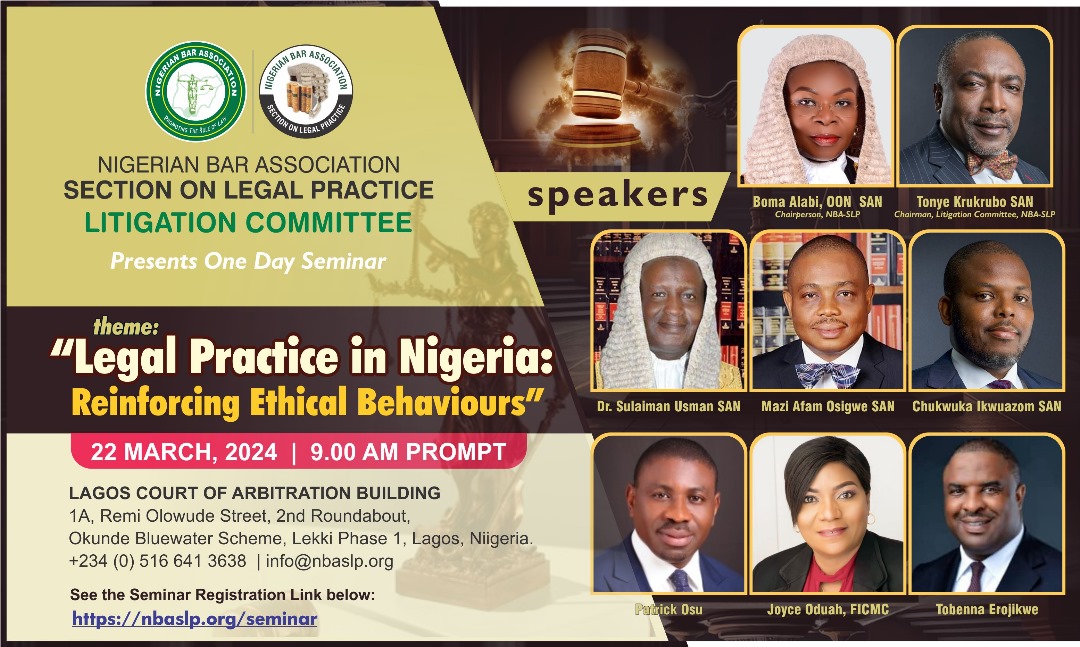
NBA-SLP schedules seminar on ethical behaviours in legal practice for 22 March

Dear Distinguished Colleagues,

We are delighted to invite you to a Seminar organized by the Litigation Committee of the Nigerian Bar Association – Section on Legal Practice (NBA-SLP), themed “Legal Practice in Nigeria: Reinforcing Ethical Behaviours”.

This event is scheduled to hold on Friday 22 March 2024, at the Lagos Court of Arbitration Building, at 1A, Remi Olowude Street, 2nd Roundabout, Okunde Bluewater Scheme, Lekki Phase 1, Lagos, Nigeria.

Registration Fees:

Category 1
MEMBERS

Free attendance to ONLY PAID Members 

Category 2. NON-MEMBERS

VIRTUAL ATTENDEES – N5,000 (FLAT FEE)

PHYSICAL ATTENDEES – N10,000 (FLAT FEE)

Registration Link:
https://nbaslp.org/seminar

For sponsorship or inquiries, please contact:

SLP SECRETARIAT

Email: [email protected]

Tel: 08166413698

We look forward to your active participation in this enriching event.

Kind regards,

SLP SECRETARIAT

Recovering ex-Tennis Star, Tania Okpala back on the courts

“Tania Okpala is back on the courts!” Governor Soludo posted on his X account.

“A few months ago, social media was flooded with a viral video showing Tania in a distressing state on the streets of Awka. I am pleased to report that we have successfully restored Tania to her winning ways.

“Today she was at a lawn tennis court in town to do what she knows how to do best. I sincerely appreciate my darling wife, Nonye Soludo, for her total commitment to the course of rehabilitating and reintegrating Tania into society.

“May Anambra continue to win!”

Recall that Tanya Okpala, a former Nigerian tennis champion found mentally unstable and wandering the streets of Awka, Anambra State capital.

Recall that on January 28, Governor Soludo said Anambra state Government will take full custody of Tania Okpala, a former Nigerian tennis champion found mentally unstable and wandering the streets of Awka, Anambra State capital.

In a video shared by @chude_ on X on Sunday, Tania Okpala, whose father from Anambra and her mother from Belarus represented Nigeria in championships in the 1990s was spotted begging on the streets of Awka in a widely shared video.

The multiracial athlete of Igbo extraction who appeared to be mentally sick at the time kept saying people always tell her to go back to your country.

“The whole world hears my story and they laugh at me. I do not know why they laugh at me. They will say ‘Go back to your country’. I am just tired. I am okay. Even though I am a half-cast I consider myself a black Igbo. I am going to the village tomorrow to look after my daughter until further notice,” Tania said in the viral video.

Okpala joined City Sports Club on the sponsorship of Nonye Soludo, She now engages in routine trainings as part of her rehabilitation process.

Mrs Soludo, wife of Governor Chukwuma Soludo of Anambra State, who described herself as Ms Okpala’s number one fan, expressed satisfaction at her level of recovery after seeing her play again.

According to Mrs Soludo, the training is part of her process of recovery, saying it keeps her busy, focused and mentally balanced.

“I am impressed with her training and work rate, her footwork, flexibility and understanding of the game. I am committed to Tania’s full recovery, as she recovers, we will engage her positively to ensure she goes back to tertiary institution for further studies,” she said.

Mrs Soludo took over the rehabilitation and welfare of Ms Okpala after she was seen in viral video roaming the streets of Awka with visible signs of psycho-social challenges.

BusinessDay/NAN

The Plateau State Legislators’ Debacle: Between law and justice

By Prof MIKE OZEKHOME, SAN, CON, OFR, FCIArb, LL.M, Ph.D, LL.D, D.Litt, D.SC.

INTRODUCTION
Error is becoming a norm in Nigeria. It has become our tradition. We have become a country of oddities; a country of one error per minute! We have become unshockable. Sadly, we spend the bulk of our time discussing inanities that ordinarily should not be heard in any serious forum. When some of us speak out boldly about these issues, some bootlickers, fawners and ego masseurs who seek favours from government of the day accuse us of partisanship; or of attacking national leadership; or Justices of the Court.

Last year, in Kano State, for example, we read about a certified True Copy of a judgment of the Court of Appeal, affirming a judgment and simultaneously overruling it at the same time. The said judgment not only created great uncertainty, it also cast aspersions on the Judiciary and the legal profession, which are expected to set professional standards for others to follow. The earlier we addressed, boldly, these unfortunate anomalies emanating from our courts, the better for the legal profession and the entire Judiciary. Those who know or follow my works as a constitutional lawyer, human rights activist and Pan- Nigerian very well know that I defend the Nigerian judiciary passionately with every fiber in me. This is because the judiciary is the only and last hope of the common man and woman. But we must be careful not to allow sentiments becloud our true sense of judgement and thus get consumed by the ricocheting consequences.

Some persons insist we are still learning. I thought learning leads to improvement? Like late legendary proverbsmith, Bashorun M.K.O. Abiola once metaphorically and laconically asked, if it takes a man 20 years to learn madness, how many years will he require to practise it? The focus of this write-up concerns not only about the serious implications of the recent Supreme Court judgement in Mutfwang & Anor v. Nentawe & Ors; SC/CV/1179/2023, (unreported), delivered on 12th January, 2024, to the effect that the nomination and sponsorship of a candidate are pre-election matters which constitute internal affairs of political parties, but also how the judgement highlights the grave injustice done to about 22 Legislators of Plateau State whose victories were snatched by the Election Tribunals and the Court of Appeal and handed over on a platter of gold to the APC losers. This is one judgement, aside the cases of Sen. Hope Uzodinma & Anor v. Rt. Hon. Emeka Ihedioha & Ors (2020) JELR 86967 (SC) and APC V. Sherriff & Ors (2023) LPELR – 59953 (SC), that have sparked national debates and which will never melt away in a hurry.

The article seeks to know how the said Supreme Court judgment in respect of the gubernatorial election in Plateau State re-iterating that the nomination and sponsorship of a candidate for any election is a pre-election matter and an internal affair of a political party, impinged on the earlier judgements of the intermediate court nullifying victories of 22 PDP Legislators and handing them over to APC Legislators.

THE BACKGROUND
Recall that the Court of Appeal had held that the failure of the Peoples Democratic Party (PDP) to comply with the orders of the High Court of Plateau State, Jos, directing it to conduct valid ward, local government and state congress elections before nominating its candidate for the various elective posts in the state was an incurable fundamental flaw. Relying on this finding, the Election Tribunal, under a petition brought by the All Progressives Congress (APC) and its members sacked many lawmakers elected on the platform of the PDP.

Under Section 246 of the Constitution of the Federal Republic of Nigeria, 1999 (as amended), the Court of Appeal is the final Court of last resort on appeals emanating from the decisions of Election Petition Tribunals in disputes arising from the conduct, outcome and legality of National Assembly and States House of Assembly elections. The implication of this is that no appeal can be filed before the Supreme Court after the Court of Appeal had decided on the matter. However, as noted by the apex court in the recent judgment involving Governor Caleb Mutfwang of Plateau State, both the tribunal and the Court of Appeal were in grave error when they entertained the matter and the appeal respectively, as they lacked the requisite jurisdiction in the first instance.

GROUNDS FOR REMOVING LEGISLATORS
Can disobedience to a court order (which in any case was not correct, as found by the apex court in the Mutfwang Governorship appeal), be a ground to remove a legislator in the face of the clear provisions of sections 106 and 109 of the Constitution of the Federal Republic of Nigeria, 1999 (as amended), which respectively deal with qualification and disqualification for the office of members of the House of Representatives and Assembly? I think not. A long line of cases vindicates me. See for example, Onor & Anor v. INEC & Ors; SC/CV/1194/2023; (Unreported), delivered on 12th January, 2024.

Thus, as found by the Supreme Court both in the Muftwang case and Onor & Anor v. INEC & Ors (Supra), disobedience to an earlier order made by a court (which was not even the case in the two matters) is not one of the qualifying or disqualifying factors of a Governor or Legislator. In the Onor & Anor v. INEC & Ors (Supra) which I handled, the apex court held that the punishment for a disobedient party is to take up contempt proceedings as provided for in the Sheriff and Civil Process Act, CAP 407; LFN 1990; not to use it to disqualify an elected person and take away his victory. Thus, brings us to the issue of jurisdiction.

WHAT IS JURISDICTION?
Jurisdiction is the authority of a court to proceed with the adjudication of a dispute. In Attorney General of Anambra State vs. Attorney General of the Federation (2005) FWLR (PT. 268) 1557, I.T Muhammad, JSC, held that:
“Jurisdiction to a court of law is equated to blood in a living animal. Jurisdiction is the blood that gives life to the survival of an action in a Court of law, without which the action will be like an animal that has been drained of its blood. It will cease to have life and any attempt to resuscitate it without infusing blood into it would be an exercise in futility.”

APC’S GROUSE BEFORE THE PLATEAU STATE ELECTION TRIBUNAL
The grouse of the APC and its members before the Plateau State Election Tribunal and the Court of Appeal was premised on what they alleged to be invalid primaries conducted by the PDP. They had argued that the PDP had no structure in Plateau State (whatever that meant). But the trite position of the law now is that the issue of membership, nomination, submission of forms and sponsorship of candidates for elections are internal affairs of a political party as clearly provided for in Section 84(1) & (14) of the Electoral Act, 2022. Section 84(14) of the Electoral Act makes provisions before whom and where any issue emanating from the conduct of the primaries can be determined. It is an Aspirant that participated in the primaries that can complain to the Federal High Court. No other party has the vires to. Thus, section 84(14) of the Electoral Act, 2022, provides:
“Notwithstanding the provisions of this Act or rules of a political party, an aspirant who complains that any of the provisions of this Act and the guidelines of a political have not been complied with in the selection or nomination of a candidate of a political party for election, may apply to the Federal High Court for redress.”

The appellate courts, in ringing tones, have upheld this trite position of the law in a plethora of cases: Enang v. Asuquo & Ors (2023) LPELR – 60042 (SC); Onubogu v. Anazonwu & Ors (2023) LPELR – 60288 (SC); Olabisi & Anor v. APC & Anor (2023) 59640 (CA); Odey v. APC & Ors (2023) LPELR – 59695 (CA); and Dickson v. LP & Ors (2023) LPELR – 60837 (CA). Indeed, the appellate courts have gone ahead to hold that a person or political party that attempts to peep through the fence to query the internal affairs of another political party wherein he /it was not a candidate in the primaries is nothing but a mere busy body and meddlesome interloper. See the cases of APC V. JEGA & Ors (2023) LPELR – 59866 (SC); Akpatason v. Adjoto & Ors (2019) LPELR – 48119 (SC); Daniel v. INEC & Ors (2015) LPELR – 24566 (SC); APGA & Ors V. APC & Anor (2023) LPELR – 59914 (CA); and PDP V. Edede & Anor (2022) LPELR-57480 (CA). Matters such as the Plateau Legislators cases where victories were snatched from the PDP winners and handed over to their opponents in the APC on a platter of gold were therefore carried out without the requisite jurisdiction of the Tribunals and the intermediate court. The Supreme Court said this much in the case of Mutfwang & Anor v. Nentawe & Ors (Supra).

CONSEQUENCES OF A COURT DETERMINING A MATTER WITHOUT JURISDICTION
It is trite law that any exercise carried out by a court of law without jurisdiction is a complete nullity. The tests for determining whether a court has the jurisdiction to adjudicate on a claim were laid down by the apex court in the causa celebre of Maduokolu vs. Nkemdilim (1962) 2 SCNLR 341. The apex court held in that case that a court is competent to adjudicate a claim when:
a. It is properly constituted concerning the number and qualification of its membership;
b. The subject matter of the action is within its jurisdiction;
c. The action is initiated by due process;
d. Any condition precedent to the exercise of its jurisdiction has been fulfilled.

ONLY A CO-ASPIRANT HAS THE LOCUS STANDI TO COMPLAIN
As clearly provided in Section 84(14) of the Electoral Act and Section 272 (3) of the 1999 Constitution, it is the Federal High Court and not an election tribunal that has the jurisdiction to adjudicate on pre-election issues and this must be carried out within 14 days. Also, it is only a co-aspirant in the primary being disputed that has the locus to challenge the conduct of the said primary; and not his opponent in another party. See the cases of Alahassan & Anor v. Ishaku & Ors (2016) LPELR – 40083 (SC); Otegbeye & Anor v. APC & Anor (2023) LPELR – 60030 (CA); Labour Party v. INEC & Ors (2023) LPELR – 60548 (CA); YPP V. APGA & Ors (2023) LPELR-59799 (CA); and Usman v. APC & Ors (2020) LPELR – 50308 (CA). Delivering his own judgement in the Mutfwang appeal (it was unanimous), Justice Emmanuel Agim held that the APC and its candidate who had challenged Mutfwang’s election were not members of the PDP and so could not competently challenge the primary elections held by the PDP. He also held that the tribunal and Court of Appeal lacked jurisdiction to have entertained the matter in the first place. He lectured further:

“The petition by the APC and its candidates is an abuse of the court process. I wonder why the matter came to court at all. This appeal is allowed. The legal profession should wake up or render itself irrelevant. The judgment of the Court of Appeal is set aside. My only worry is that a lot of people have suffered as a result of the Court of Appeal’s decision. It was absolutely wrong. The appeal is allowed.”

CHALLENGE TO PRIMARY ELECTION IS A PRE-ELECTION MATTER
Section 285(14) of the Constitution of the Federal Republic of Nigeria, 1999, as amended, particularly (a), (b) and (c), delineates the circumstances which come under pre-election matters and; which can be challenged within the electoral framework. It encompasses an Aspirant’s grievance regarding non-compliance with the Electoral Act; or National Assembly regulations during political party primaries; disputes by Aspirants concerning their participation; and compliance issues with the Independent National Electoral Commission (INEC).

It also includes legal actions by political parties challenging INEC’s decisions, including disqualification of candidates; and complaints related to non-compliance with electoral laws in selection or nomination of candidates; election timetable; voter registration; and other preparatory activities for an election. See the cases of Anyakorah v. PDP & Ors (2022) LPELR-56876 (SC); APM V. INEC & Ors (2021) LPELR – 58375 (SC); Akpamgbo-Okadigbo & Ors v. Chidi & Ors (2015) LPELR – 24564 (SC); Salim v. CPC & Ors (2013) LPELR – 19928 (SC); Akinremi & Anor v. Suleiman & Ors (2022) LPELR – 56903 (CA); and APC V. Suleiman & Ors (2023) LPELR – 59911 (CA).

COURT OF APPEAL AS FINAL COURT ON LEGISLATORS’ MATTERS
It appears that the Court of Appeal being the Court of last resort in respect of all appeals from the decisions of election petition tribunals in disputes arising from the conduct, outcome and legality of National Assembly and States House of Assembly elections becomes functus officio once it delivers its judgement and cannot reopen a matter it has pronounced upon with finality. In other words, a judgment once delivered by the intermediate court on National and State Houses of Assembly matters cannot be varied where it correctly represents what the Court decided. Nor shall the operative or substantive part of such judgement be varied or substituted. See the cases of Oyetibo & Anor v. Oyinloye (1987) LPELR-2883(SC) at 11-13. Dingyadi & Anor v. INEC & Ors (2011) LPELR 950 (SC); Udende v. Suswam & Ors (2023) LPELR-61304 (CA); and Owoo & Ors v. Edet & Anor (2013) LPELR – 22042 (CA).

THE COURT OF APPEAL’S RECENT DISMISSAL OF THE APPLICATION FOR A REVIEW INSTITUTED BY THE SACKED PDP PLATEAU LAWMAKERS
The sacked Plateau Legislators in an attempt to reclaim their lost positions in the light of the Supreme Court’s judgement in the Caleb Mutfwang case and it’s obiter pronouncement on the legislators’ injustice, filed a fresh application before the same Court of Appeal that had dismissed their appeal from the Plateau State Election Tribunal, requesting a review of the said judgement that sacked them. The appellate court however, as expected, on 28th February, 2024, dismissed the suit, describing it as a waste of judicial time, frivolous and lacking in merit. It further slammed a fine of N128 Million Naira (N8 Million per Applicant) on the already beleaguered Applicants.

BUT CAN A COURT THAT ACTS WITHOUT JURISDICTION IN THE FIRST PLACE NOT VARY ITS OWN JUDGEMENT DELIVERED WITHOUT SUCH JURISDICTION BY WAY OF A REVIEW?
The apex court had observed (on the Plateau Legislators’ case, albeit obiter), while delivering the judgment in the Governor Caleb Mutfwang appeal, that the lower tribunal and Court of Appeal erred as they acted without jurisdiction to have entertained the petitions sacking the lawmakers from the PDP over a matter bothering on internal affairs of their party. Couldn’t this issue of lack of jurisdiction as observed by the apex court have been further explored and subjected to the jurisdiction of the same Court of Appeal that delivered the judgement by way of review? Were the legislators wrong to have asked for a review? Let us have some guidance from earlier decisions of the Appellate courts.

In Iteogu v. LPDC (2018) LPELR-43845(SC) 18-26, the Applicant had asked the apex court to revisit its decision concerning him which had been decided by the apex court in 2009. This application for revisitation stemmed from the fact that on the 12th July, 2013 and the 13th May, 2014, respectively, the Supreme Court had held in the cases of Aladejobi v. NBA (2013) 15 NWLR (Pt. 1376) 66, and Rotimi Williams Akintokun v. Legal Practitioners’ Disciplinary Committee that it had no jurisdiction to entertain an appeal directly from the LPDC. The Applicant’s posture in his case was that in those cases, the apex court had held that it lacked the jurisdiction to entertain appeals directly from the LPDC. He had therefore urged that there was the need to revisit his own case and declare that the decision or judgment of the apex court delivered in 2009 pertaining to him was given without vires and so set it aside and have his status restored as a legal practitioner.

The apex court, per Justice Mary Ukaego Peter-Odili, JSC, while dismissing the application for review, held at pages 18 -26, inter alia, that aside the exception of the “slip rule”, the Supreme Court may only depart from its earlier decision in subsequent cases and thereby overrule itself. She emphasized that this: “does not however mean that the previous decisions in those earlier cases differently decided would be given a new lease of life on account of this new development. The reason for this is self-evident as Oputa JSC stated in Adegoke Motors Ltd v Adesanya & Anor. (1989) 5 SCN113: (1989) 3 NWLR (Pt. 109) 250 at 274 thus:”We are final not because we are infallible, rather we are infallible because we are final.” …. In other words, the Supreme Court enjoys the finality of its decisions. Except for clerical mistakes, accidental slips, or omissions, it seldom re-visits its decisions by way of review, variation or setting aside. Once the Supreme Court has entered judgment in a case, that decision is final and will remain so forever. The law may in the future be amended to affect future matters on the same subject, but for cases decided, that is the end of the matter.” (Emphasis supplied)
See also Anyagham v. FBN PLC (2021) LPELR – 55905 (CA); Emezie & Ors v. Linus & Anor (2016) LPELR – 40514 (CA); and Onuh & Anor v. Ogbe (2019) LPELR-48361 (CA).

THE PLATEAU LEGISLATORS’ FIASCO
In the light of the above judgment of the Supreme Court, was there no remedy for those legislators who were wrongly sacked by the Court of Appeal? It is important to note that 22 PDP members in both chambers of the Nation’s and Plateau State Legislature were sacked by the Election Tribunals and the Court of Appeal, a development that left tongues wagging and ruckus generated across Nigeria. The legislators affected included two Senators – Simon Mwadkwon and Napoleon Bali; four members of the House of Representatives – Dachung Bagos, Beni Lar, Isaac Kwalu, and Peter Gyendeng Ibrahim; and 16 members of the Plateau State House of Assembly.

They were all in PDP. Their constituents overwhelmingly voted for them. But the tribunal, supported by the Court of Appeal, felt otherwise. They took away the legislators’ victories and donated same on a platter of gold to the APC legislators who were roundedly trounced at the polls. The Plateau State people’s votes were rightly counted but the courts refused to make the votes count. This is what I have termed “Judocracy” in my OZEKPEDIA neologism, “as a genre of government practised only in Nigeria, where Presidents, Governors, Legislators and LG Chairmen are thrown up as having ‘won’ in an election. Their victory is immediately challenged. They get enmeshed in these legal calisthenics for the next 2 to 3 years of their corruption-ridden governance. Then, suddenly, they are conceived, incubated and delivered in the hallowed Chambers and precincts of our law courts, rather than through the ballot box. The will of the people is thereby subsumed in the decision and judgement of courts of law, the non-representatives of the people”. (https://www.youtube.com/watch?v=Yg8ByKVWWj)

SHOULD THIS PLATEAU STATE LEGISLATORS’ DEBACLE HAVE BEEN ALLOWED TO THRIVE UNREMEDIED?
Our case laws are decided based on precedents. Precedent is retrospective and ensures that a given posture is maintained even at the risk that harm may be caused by it.
The apex court in the Mutfwang’s case noted (albeit, by way of obiter), that the Court of Appeal was wrong when it sacked those legislators lawfully elected under the platform of the PDP, as it lacked jurisdiction to do so. However, precedent is saying, “Yes, we admit that there was an error. Nothing can be done about it.” I humbly disagree with this perpetuation of injustice under the thin guise of “my hands are tied”, or “that nothing can be done about it”.

Surely, something can be done about it. I agree with Emmanuel Agim, JSC, when he noted in his judgement that, “it is high time the legal profession woke up before it became irrelevant”. This admonition is in tandem with the admonition of venerable Justice Chukwudifu Oputa (JSC), in Adegoke Motors Ltd v. Adesanya & Anor (1989) 3 NWLR (Pt. 109) 250 at 274, 275, to the effect that “When therefore it appears to learned counsel that any decision of this court has been given per incuriam, such counsel should have the boldness and courage to ask that such decision be overruled”. I also find solace in the complimentary and immortal words of Lord Denning in PARKER V. PARKER (1954) 2 All ER 22, where he illuminated thus:
“What is the argument on the other side? Only this, that no case has been found in which it has been done before. That argument does not appeal to me in the least. If we never do anything which has not been done before, we shall never get anywhere. The law will stand still while the rest of the world goes on, and that will be bad for both”.

Afterall, law is but a mere handmaid to deliver justice, which is why “ubi jus ibi remedium” (Bello v. AG Oyo State (1986) 5 NWLR 820). Going by this, I humbly submit that when it comes to the critical issue of the court deciding a case in which it lacked jurisdiction in the first instance, then certainly, such a court has jurisdiction to revisit the said judgement and review it under certain laid down conditions. This is not a blanket or open-ended cheque for exhumation of buried cases. No.

A COURT CAN REVIEW ITS JUDGMENT
Thus, by reason of a long line of decided cases by the Supreme Court itself, a court has the constitutional power to enforce, review or set aside its own judgements under special circumstances as provided for by law. This is not tantamount to the court sitting on appeal over its own judgements. In Stanbic IBTC Bank Plc v. L.G. C. Ltd (2020) 2 NWLR (Pt. 1707), pp. 17-18, paras. D-C, the Supreme Court, per Abba Aji, JSC, held that the court has the power and leeway to set aside its own judgement and rehear a case, inter alia, under the following circumstances:
“…where any of the other parties obtained judgement by fraud or deceit…. When judgement was given without jurisdiction…”.

WHY THE PLATEAU STATE LEGISLATORS’ JUDGEMENT OUGHT TO HAVE BEEN REVIEWED BY THE COURT OF APPEAL
Surely, the judgement in the Plateau Legislators’ matter was dubiously obtained as there was no disobedience to any court order at all as rightly found by the Supreme Court in the sister Mutfwang case. All the cases had emanated from the same facts and circumstances. Secondly, both the Election Tribunal and the Court of Appeal lacked the requisite jurisdiction to have entertained the Legislators’ case the way they did in the first instance.

The reason or rationale behind this position in the above Stanbic IBTC case was graphically painted by Oputa, JSC, in Adegoke Motors Ltd v. Adesanya & Anor (1989) 3 NWLR (Pt. 109) 250 at 274, 275, inter alia, thus:
“We are final not because we are infallible, rather we are infallible because we are final. Justices of this court are human beings, capable of erring. It will certainly be shortsighted arrogance not to accept this obvious truth. It is true that this court can do inestimable good through its wise decisions, similarly, the court can do incalculable harm through its mistakes. When therefore it appears to learned counsel that any decision of this court has been given per incuriam, such counsel should have the boldness and courage to ask that such decision be overruled. This court has the power to overrule itself (and had done so in the past) for it gladly accepts that it is far better to admit an error than to persevere in error.” (Emphasis supplied).

Thus, where a judgment of a court was obtained without jurisdiction; or is tainted with illegality; or was obtained by fraud, the court surely has the vires, constitutional power and jurisdiction to revisit such judgement, even if time had since elapsed. This is because time cannot and does not run against illegality or fraud. A party cannot be allowed to benefit, or continue to benefit from the product of its own illegality and void conduct. This position was emphasized by the Supreme Court in Nwosu v. APP & Ors (2020) 16 NWLR (PT 1749) 28, where it held thus, through many of its justices as follows:
Per Eko, JSC:
“No person is allowed to benefit from illegality as illegality confers no right”
Per Peter-Odili, JSC:
“It is difficult in the light of the damming facts well pushed in this appeal wherein illegality was enthroned to be surveyed into endorsing of such acts and to allow the perpetrator of such profane acts to derive or profit from his own wrong”.
Per Amina Augie, JSC:
“The court cannot close its eyes to it (illegality) and allow itself to be used as a tool to perpetuate illegality, in whatever form or guise”
See also the cases of GTB V. Innoson (Nig.) Ltd (2022) LPELR-56657 (SC); Enterprise Bank Ltd v. Aroso & Ors (2015) LPELR – 24720 (SC); Oladosu & Anor v. Olaojoyetan & Anor (2012) LPELR – 8676 (CA) and Eco Bank v. Teak Naturale Investment Ltd & Ors (2017) LPELR – 42389 (CA).

The Court of Appeal which was approached by the grieving PDP Legislators sure had the power and jurisdiction to have calmly looked at and reviewed its judgements which have since been irretrievably punctured by the Nigerian people and the apex court itself (albeit, obiter). It should have meticulously reviewed its earlier judgements, all of which were delivered without following judicial precedents as laid down by the Supreme Court on the very issues dealt with in those appeals. Law is about justice. Being Siamese twins, one without the other is an orphan. The Plateau Legislators’ cases hallmarked a dangerous precedent where neither the law nor justice was followed or attained. The Court of Appeal ought to have seized the opportunity of the fresh application to correct itself. If for nothing else, at least for the sake of posterity, justice, fairplay, equity and good conscience. I so humbly submit.

30 Years after Leaving UK, HRM Govt still paying me!

By Emmanuel Fashakin, MD, Esq.

December 2023, Lagos Nigeria.
Few days after Christmas, I stirred awake at dawn and something felt different. It was just a few days past my 67th birthday, but I felt the fire was gone — like someone jabbed a needle into my balloon. I knew there and then it was time to slow down, and begin the handover.

January 2024, on returning to New York, I visited my local Social Security office to apply for Retirement benefits. They told me in person application no longer done after the pandemic. I was given instructions to apply online. I did. And they called me. They even gave me option of backdating my retirement benefits for six months, since I had been qualified. I approved the backdate immediately she told me the amount of the lump sum payment.

February 29, 2024. I finally decided to see if I could collect my pension for the four years of work I did in the UK 1989-1993. In 1991, a friend had advised me to opt out of SERPS. That means a private company, rather than government, will be custodian of my pension money. I chose Barclays Bank. I reckoned that at retirement, I would be back in Nigeria, and it would be easier to collect my money from a private company, rather than dealing with government bureaucracy.

My last correspondence from Barclays Life Assurance Company Limited, Romford Road, London was dated May 1995, almost 29 years ago. It was sent to an address I moved from exactly the same month that letter was received. We had lost contact since then. Not good.

In that statement, I was informed that the closing value of my pension as of April 1995 was £5377.29. I called the number on the statement. It was out of service. So I went on Google. I searched for the company. I got three different UK numbers from three different sources. All the numbers were out of service. Then an idea occurred to me.

I googled the phone number of Barclays BANK on Romford Road, London. Finally, I got a phone which worked. I went through the agony of being asked to put my sort code, account number, etc. I had none. I kept pressing * and 0 etc in response, and bellowing “Customer service”, “Representative” etc. After almost fifteen minutes, a live person picked the phone. Glory!

I apologized to the gentleman. No, I am not Barclays Bank customer. But I contracted out of SERP thirty-three years ago, and my pension is with a company called Barclays Life Assurance Company Limited. Could he be kind enough to give me the phone number to the branch of Barclays dealing with pensions and life insurance?

He was gone for a few minutes. He came back with a phone number. I called that number and after reciting my tale, the lady told me that I was in wrong place, but she would find me the number for the right department.

Eight minutes later, I was making perhaps the tenth call of the morning. I had to go through the prompts again. This one was gory. They wanted to know whether someone had died. No. I am still alive. Finally someone picked the call. No, you are in the wrong department. This is private pension plan? Yes. I will find you the number.

My next call was more joyful. The reason all the phone numbers for Barclays Life Assurance Company Limited was not working was because that company is no longer in existence. The new company is called “Reassure Company, UK”. Yes you have reached Reassure. Finally! I was elated. But my hopes were soon dashed.

I gave the Policy Number on the statement sent to me in 1995. Nope. I gave the Customer Reference Number. Nope. I gave my name, spelled by the letter. Nope. I gave my Date of Birth. Nope. This is reassure? Yes. Successor to Barclays Life Assurance Company Limited, 252 Romford Road, Forest Gate, London E7 9JB? Ah, he said. Let me give you the number to the Romford Road branch.

A lady with a soft reassuring voice answered the phone. For about the eighth time, I gave the Policy Number on the statement sent to me in 1995. Nope. I gave the Customer Reference Number. Nope. I gave my name, spelled by the letter. Nope. I gave my Date of Birth. Nope. My heart sank.

Then I remembered the last man I spoke to asking me for my National Insurance Number. I knew it by heart thirty years ago, but not anymore. All my old diaries containing the number were lost. I told the man I didn’t have it. I am not sure if it was on my UK Drivers License. But I left that license in a rented car when I went for my Medical School Reunion in 2014. So I could not give him the National Insurance Number.

Before I made the last call, I went into my brown bag — a conference bag given to me at the 20th Scientific Conference of the Nigerian Surgical Research Society held at Port Harvourt July 7-9, 1988. This bag contains all my certificates and important documents. I searched for the UK National Insurance Number. A card or document, but found nothing. Ok almost nothing. I found a small folded paper titled: “BARCLAYS LIFE Mr E Fashakin PERSONAL PENSION PLAN STATEMENT for the year ended 5th April 1995 including the current value of your Plan. On page 3 of this folded paper, right in the middle of the page, is a line “Your National Insurance No. XXNNNNNNX”.

I had reached a dead end with Miss Softvoice, but before I hung up on this despondent call, I asked her hesitatingly. “ If I give you my National Insurance Number, could that help?” “Sure, let me try that”, she answered. I gave her the numbers carefully, and held my breath. After what looked like eternity, she said “I have found you”. Are you serious? For over two hours, my name and date of birth did not show up in any database (what kind of records did they keep in the 1990s?), but here she found me? Another bombshell followed.

The value of your Pension as of today is £29,789.25 (the last value given me in April 1995 was £5377.29, and there were no further contributions). Are you kidding me? No I am not. That is the value. She started reading me the disclosures and the three options, getting an annuity, lump sum payment and installment payment.

I want lump sum! Ok the first 25% is tax free. The rest is taxed at 40%, but you can get the tax back from the government. So I will get about £21000 now and £8900 back from government later. I am still trying to figure out what to do with the money. I was just on the verge of giving up on it. I thought the max likely value would be about £9500. £29,789 is a big surprise. Barclays did a good job managing the money. I am grateful to them, and his Royal Majesty’s Government making this possible, for working for them for less than four years!

Emmanuel O. Fashakin, M.D.,FMCS(Nig), FWACS, FRCS(Ed), FAAFP, Esq.
Attorney at Law & Medical Director,
Abbydek Family Medical Practice, P.C.

Ritual killer of seven women confesses to getting ladies from hookup app

A suspected ritual killer on Thursday in Abeokuta narrated how he and other accomplices lured seven women to their deaths through a dating application.

The 32-year-old, who was paraded by the police command in Ogun, confessed to being a member of a ritualist gang which specialised in killing women and selling their body parts for money ritual.

The News Agency of Nigeria (NAN) reports that police operatives had arrested and paraded some members of the gang.

The suspect, who had been on the run and was later arrested by the police, said he joined the gang in September 2023 and had participated in the killing of the seven women.

“I got the ladies from MyChat which is a hookup app.

” I just talk to them that I want to hook up with them whenever a client contacted me that they needed human body parts.

“They will call me that they need body parts and I will go to the application and chat up the ladies for hook up.

” I don’t know the ladies, we don’t have any conversation, I only chat them up on the app.

” I ask if they are available and we negotiate on the amount they want to collect.

” When we reach an agreement, I will send my address to them and they will come over to me at Atan-Ota.

“I will pick them up and call my client that they ( victims) are around.

” I will then take them to his house in Igbo Olomi, Atan-Ota, where we will then kill them inside his sitting room.

“I joined the gang in September 2023 and we have killed seven ladies.

“I don’t know what they use the corpses of the ladies for, my job is just to source for the ladies and bring them in.

” They don’t usually tell me the amount they will give; at times, they will pay me N30,000, at other times, they will give me N40,000.

” I don’t know who they sell the body parts to and I don’t ask them about it, my own is just to source for the ladies and collect my money,” he said.

The Commissioner of Police in the state, Abiodun Alamutu, said that the suspects conspired with an herbalist to kill the victims for money ritual.

He said the suspects strangled their victims to death and dismembered their bodies for sale to the herbalist and another accomplice who was on the run.

The commissioner said that the command was working assiduously to unravel the identity of the victims.

He urged members of the public with missing relatives to report to the police with photographs of such persons.

” The command is using this avenue to advise our youths for the umpteenth time to desist from untoward behaviours.

” They are advised to use the social media and attendant technology positively.

” It is through a social media platform that all the victims were lured to their untimely deaths.

“The suspects have assured the police that they will recognise the victims they have killed if their photographs are made available,” he said.

The Conclave

“He deliberately ridiculed Christianity”, aggrieved Christians say about Asake’s new music video

By Hannah Johnson

Christians have criticised Afrobeat sensation, Ahmed Ololade, known as Asake, for his latest music video titled “Only Me,” alleging disrespect towards Christianity.

In the video, directed by TG Omori and which has gained over 150,000 views within five hours of release, Asake is seen dressed in priestly attire, sparking controversy among viewers.

X user, Solomon_Buchi, who voiced his concerns on his X handle on  Thursday wrote, “Asake keeps disrespecting the Christian faith in his music videos. Dramatising the eucharist, robed up in priestly regalia for a music video that has no connection with Christianity is disrespectful.

“In his Bandana video, he depicts black goats trooping into the church with cloven tongues of fire above weird men. Asake, I think, is a Muslim. Why doesn’t he go above and beyond to embarrass his Muslim faith in the same way?

“Why do Christians even listen to these musicians who bluntly disrespect Christianity?”

BG_Liberty wrote “This video 2/10, who directed this? Who accepted the idea? What a disrespect to Christianity! I wish you could try this with your own religion.”

Another X user, @AniBae94, wrote: “After using more than 50 goats to shoot a worldly music video in church, Asake is at it again, dressed as a priest and holding the communion in an ungodly manner, disrespecting Christianity. I’m so vexed right now.

“Unity and oneness it lacking in the Christian-dom. Imagine something as degrading and abusive to your faith, yet most people hold different opinions about it. It’s a shame and that’s why the divide amongst us will only grow wider. We can’t even speak as one voice.”

Aliuhammeed2 wrote, “When you are tolerant of anything, you stand for nothing If u talk dem go say u too de religious Dis is what happens to religion anywhere in d world when liberalism starts eating up citizens or leaders and adherents of a faith but can’t stand up for it and tolerant with no redlines”

X user AbjaySeries wrote, “My problem is that Christians would still listen to his songs. Someone is mocking your faith and you’re still forming “fan” Handfan?”

Recall that a singer, Olamilekan Taiwo, known as Logos Olori, who is signed to Afrobeat David Adeleke’s record label, Davido Music Worldwide faced backlash from Muslims over his music video “Jaye Lo,” released in July 2023, featuring scenes near a mosque and incorporating Islamic phrases, prompting criticism from some fans for perceived insensitivity.

The 45-second video showcased several men dressed in white Jalabias and caps dancing in front of a mosque. Additionally, Olori was depicted sitting on a speaker mounted on the building’s roof.

This portrayal, coupled with the singer uttering the phrase “Alhamdulillah” (praise be to God), received criticism from some fans, particularly Muslims, who found it disrespectful and condemned the video.

The PUNCH

Sylvester Udemezue and siblings announce burial/funeral ceremonies of their beloved father, Pa Nweke Edwin Udemezue

In a deep sense of sorrow, but with total submission and gratitude to the will of Almighty God, the family of Late Udemezue Chiezie of Enugu-Na-Uwani, Akiyi-Umulokpa, Uzo-Uwani LGA of Enugu State, Nigeria, announce the BURIAL/FUNERAL CEREMONIES of their beloved Husband, Uncle, Brother, Father, Grand-father, Great Grand-father, Father In-law, and Brother-in-law,

MAZI NWEKE EDWIN PETER UDEMEZUE
(a.k.a., Gbazuo Ágû; Ôjî Ógù Àgbâ Ósó),

HOLDING AS FOLLOWS:
◾03 APRIL 2024: Wake-keep at 6.00pm @ Nweke Udemezue’s Compound, Enugu-Na-Uwani;
◾ 04 APRIL 2024:
▪ Requiem Mass at Holy Cross Catholic Church, Akiyi-Umulokpa @ 9.00am.
▪Internment follows immediately @ 10.30am.
▪ Reception follows @ Central School, Akiyi-Umulokpa @11.00am on 04 April 2024
◾Thanksgiving @ Holy Cross Catholic Church, Akiyi-Umulokpa on 07 APRIL 2024

Pa Nweke Edwin Peter Udemezue is survived by his wife, a brother, a sister, 7 children, 20 grandchildren, 6 great grandchildren, nephews, nieces, cousins, and in-laws.

May his soul rest in peace.
Amen🙏

Signed:

Sylvester Udemezue (udems)
(For the family)

R S V P:
08039136749,
08109024556,
07032920610,
08130881162.
(Dated this 29th day of February, 2024)

TIPS