Home Blog Page 599

Miracles Still Happen: Kidnappers doze off after abducting pastor’s wife and others in Ondo

Everyday holds the possibility of a miracle.” Elizabeth David

Five suspected kidnappers that abducted a pastor’s wife and two other persons have been arrested after their victims identified one of them.

The victims had escaped when the kidnappers slept off while taking them to their den.

It was gathered that the effect of hard drugs taken by the kidnappers made them to fall asleep.

Names of the suspected kidnappers were given as Garuba Mumuni aged 27, Yusuf Tale aged 21, Kabiru Muhammed aged 16, Shaibu Umar and Adamu Mohammed aged 22.

Police said the suspects were arrested by men of the Ofosu Division after the victims identified one of them.

The police said: “A case of kidnapping was reported at Ofosu Division, that a pastor’s wife and a member were kidnapped in the church while the third victim was kidnapped while picking snails at the farm.

“The victims however escaped from their assailants at different dates after they had taken hard drugs and slept off.

“Through Intelligence, on the 1st of May, 2024, five among the six kidnappers were arrested by men of Ofosu division and have been identified by the victims as part of the gang that abducted them.

“On the 28th of March, 2024 at about 1800hrs, a case of Kidnapping was reported at Ifon Police Station, in which two people were abducted and a woman killed by suspected kidnappers.

“Police Detectives from the division in collaboration with local vigilantes arrested one Muhammad Bello, Muhammad Suraju and Suleiman Saliu.
One of the victims identified two of the suspects as part of the people who kidnapped him and collected the sum of ₦1,800,000 as ransom before he was released.”

Ondo police commissioner, Peter Abayomi, said the suspects would soon be arraigned.

Video: With just N5,000 fake Plateau doctor carried out abortions, lured minors into prostitution

  • As SSS operatives shut down another clinic in Plateau over death of patient

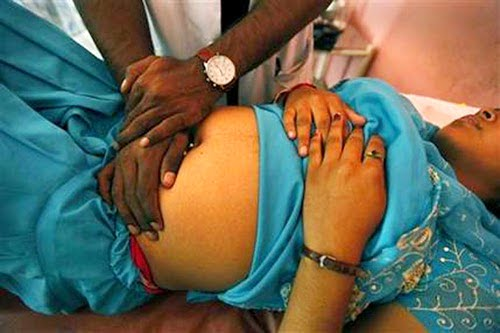
A probing report has revealed how a “fake doctor” conducted abortions for young girls in the Yan-Doya community in Jos, Plateau capital. and enticed minors into prostitution.

The report was undertaken by a freelance journalist from Kano with support from the Women Radio Centre and MacArthur Foundation.

The report highlighted how residents of the Yan Doya community have been patronising one Ali Madida who allegedly operated an illegal medical facility.

Madida was also accused of introducing girls who visited his facility for medical attention to prostitution under the guise of providing them a means of livelihood.

The report said many girls below the age of 15 were forced into prostitution due to “poverty, illiteracy and poor parental care” in the community.

According to the report, young girls who visited the clinic were matched with men who took advantage of them for N5,000.

The report said the girls were forced to return to the facility for an abortion when they got pregnant and made to pay the same amount for the procedure.

In the report, a source identified as Khadija said she visited the clinic with her friend Halima for an abortion.

While Khadija survived the operation, her friend died after she suffered some complications.

“After some months, I noticed that I was pregnant, so I went back to Dr. Ali and he aborted the pregnancy for me. I suffered from stomach pain for months. I nearly died before I got myself back,” she told the reporter.

“A few months later, a friend of mine, Halima went to him to abort her pregnancy and in the process of the abortion, she got some complications and died.”

Many victims who spoke with the reporter talked anonymously so as not to “lose business deals” with Madida.

The report said Madida had been arrested by law enforcement agencies many times but was later released.

Speaking during the virtual press conference on the investigative report, Toun Sanaiya, chief executive officer (CEO) of Women Radio Centre, commended the reporter for her “bravery and audacity” in uncovering the crimes.

Taiwo Adeleye, the project officer of the centre, said relevant authorities have assured that Madida would be arrested and his license would be revoked.

Adeleye added that Madida is already renovating the “unregistered clinic.”

Watch this 11mins video on the N5K illegal abortion on Jos minors below.

https://fb.watch/rUBWsmlvdG/

In another development, AL-Ihsan Clinic in the Unguwan Rogo community in Jos North LGA of Plateau State has been closed by operatives of the Department of State Services (DSS) due to allegations of unprofessional practices.

A report said that security operatives took the step following the unfortunate death of a female patient at the clinic.

The demise of the woman, who underwent surgery performed by Abdul Lukman, has caused significant uproar in the area.

Many individuals have reportedly attributed her death to the surgery, leading to concerns about Abdul’s medical expertise.

According to sources, the DSS took action after receiving complaints from community members who reported the alleged unprofessional conduct at the clinic to the state’s Ministry of Health and the DSS.

“The primary reason for sealing the hospital is the alleged quackery activities at the clinic which came to light after a woman’s death following a surgical procedure there.

“The issue is that Mr Lukman is not a qualified medical doctor,” Daily Trust quoted one of the sources, Muhammad Albasu, to have said.

“In fact, he is not a doctor at all, and therefore lacks the necessary qualifications to perform surgical procedures. He is not doctor. He is currently schooling but he has been carrying out surgery on people in the community,” he added.

Petrol pains, wilderness wanderings

By Lasisi Olagunju

A young taxi driver sat on the bonnet of his car some years ago thoroughly frustrated by Nigeria’s unending petrol mess. A television reporter asked him to speak on his experience in that filling station where he sat, stranded. He looked straight into the camera and said he wanted “the world to come to an end, this moment. I want all of us to die – all.” He thought Nigeria was a wilderness with a succession of fake Moses leading the country from Egypt to Egypt. To the taxi driver, mass death of victims and their victimisers would be the neat, equitable way to end all suffering. I watched the video and heard more than what the gentleman said. People who think and say what he said are persons who have run and got to the end of running. They are people who have shifted and shifted and have hit the wall.

Over the course of life, suffering, one way or the other, is inevitable. We do not need a priest to convince us of that. But, why is it that here, in this country, time and change give no relief to the poor?

As I write this, everyone is at the petrol station – exactly as they were 30 years ago when they thought democracy was the messiah that would dry their tears. In petrol stations where there are no queues, the price there is killing; where the price smiles a little, bedlam reigns. If matters remain as they are, driving a car anywhere in Nigeria will soon be a mark of the beast, the ultimate evil. Very soon (and I am so scared to say this), having money to buy petrol will be an exposure to marks of the dragon – the kind that is in the Christian Bible: ten horns, seven heads, “with ten crowns on his horns, and on each head a blasphemous name.” Why is this democracy this ugly and so unprofitable to the people? 

There is a joke about a man from Israel who demanded to know why Moses promised his ancestors good life, took them out to wander in the wilderness for forty years only to deposit them in a land that has no oil. I won’t be shocked to hear this said about our democracy. What is the worth of that struggle and that vote that birthed this suffering?

Our dog boasted in the last election that there was no danger in Tiger’s forest. That boast appears to have killed it. A saying in Yoruba approximates this: Ajá kì í dán’nu kò séwu lóko ẹkùn. Stealthy, strong Tiger is an ambush, apex predator; dog is one of its preys. The wisdom here eluded many who refused to trust the truth. They are now left behind, stranded by their faith in man born of woman. In their bowl of gaari, they now have water in destructive excess.

You are a very senior professor. Your monthly salary is N700,000, pre-tax. This past weekend, you and other petrol users bought a litre for N1,000. Your car uses 10 litres of petrol per working day. There are five working days in a week. That gives your car 50 litres of petrol per week, the cost is N50,000. There are four weeks in a month. Fifty thousand naira in four places makes it N200,000 – just to fuel your car. Because your residence is allocated Band E by NEPA, your ‘I-better-pass-my-neighbour’ generator will use 10 litres of petrol per day. In 30 days, that gives you 300 litres of fuel. At N1,000 per litre, the cost is N300,000. Do the maths. Petrol alone takes N500,000 from your pre-tax N700,000 salary. Tax takes about N120,000. Do the maths again. What is the way out? The Yoruba will join you to ask: Kí ni ònà àbáyo? Kí ni?

With ‘Darkness Falls’ as its title, the second part of Ngugi Wa Thiongo’s Weep Not, Child is about a country in distress, about a village where light is morbid and darkness is saviour. It is about a home that is no longer a place for telling good stories. It is here that we are asked to “turn to the Gospel according to St Matthew, Chapter 24.” Here we are told that we “shall hear of wars and rumours of wars” and that “nation shall rise against nation, and kingdom against kingdom: and there shall be famines, and pestilences, and earthquakes, in diverse places.” We are told that as horrible as these occurrences are, “they are (just) the beginning of sorrows…And because iniquity shall abound, the love of many shall wax cold.”

Could this moment be Nigeria’s hour of that prophecy? The havoc wreaked in town today is worse than the experience of the ill-starred, anecdotal sentry of Apomu whose oracle (ifa) got stolen and his wife snatched. He reached for his divining chain (òpẹ̀lẹ̀) and saw it in the mouth of an audacious dog. He pursued the dog to retrieve his last hope but the dog ran and jumped into a deep well. While panting, the distraught man was asked what next? “It is time to leave this town,” was his response – (Ìlọ yá Oníbodè Àpòmù, wón kó o ní’fá, wón gbà á l’óbìnrin, òpẹ̀lẹ̀ tí yíò tún fi tọ ẹsẹ̀ e rè, ajá tún gbé e lọ. Ó lé ajá, ajá kó sí kànga. Wón ní, ‘Ilọ yá àbí kò yá?’ Ó ní, ìlọ yáá…).” Today is worse than that hopeless situation. I have never been as afraid for Nigeria as I have been in the last one week.

The people are hopeless and helpless but they are quiet. And that is dangerous. There is a passage in Chinua Achebe’s Things Fall Apart which warns about silence and its potent danger: “Mother Kite once sent her daughter to bring food. She went and brought back a duckling. ‘You have done very well,’ said Mother Kite to her daughter, ‘but tell me, what did the mother of this duckling say when you swooped and carried its child away?’ ‘It said nothing,’ replied the young kite. ‘It just walked away.’ ‘You must return the duckling,’ said Mother Kite. ‘There is something ominous behind the silence.’ And so Daughter Kite returned the duckling and took a chick instead. ‘What did the mother of this chick do?’ asked the old kite. ‘It cried and raved and cursed me,’ said the young kite. ‘Then we can eat the chick,’ said her mother. ‘There is nothing to fear from someone who shouts.’ Nigeria’s streets are scanty and sad; neighbourhoods are dank and dark. Where the ice of fuel scarcity appears to be thawing, the price has remained prohibitively high. In food markets, traders’ looks are forlorn; buyers’ heartbeats are irregular. There is darkness in every home where light used to shine. Yet, there is quiet, silence, midnight, graveyard chill where prophets used to warn.

In Matt Lorenz’s ‘The Meaning of life in the Wilderness’, we are told that “the wilderness is a space where human beings can go morally astray.” True, many and more have gone astray here. Henry Bugbee, in his The Inward Morning, says that “our true home is (the) wilderness.” I read this and wanted to disagree. I wanted to ask how our home could be the wildness -uncultivated, uninhabited, inhospitable wild. But, then, I remember William Butler Yeats’s thoughtful line: “…the world is more full of weeping than you can understand.”

As long as we breathe, we keep hoping (and praying) for deliverance from evil. There is a line of divine promise in Ngugi’s ‘Darkness Falls’: “But he that shall endure unto the end, the same shall be saved…” He was quoting the Bible.

We will endure this to the end because we’ve been promised salvation. But, when is the end and where is the saviour? Or, when is the saviour coming? The government is quiet and silent. It acts the perfect I-don’t-care way of lords who have climbed the hills and have seen the very end of the world. But its defenders are not quiet. They blame the past and point at similar acts of official betrayal. What is in uniformity is no longer a shame. There is no new thing under the sun. They open history books of countries outside Africa, the first world. They say “even America once suffered what we suffer. We will be out of the problem one day.” They say the media of that and other countries still reminisce about their own era of anomie. One of such reflections is Reis Thebault’s “Long lines, high prices and fisticuffs”, a Washington Post’s 2023 video on the 1970s petrol shortage bedlam in America. “The line of cars stretches for blocks. Pumps run dry. Newspapers warn of a great ‘gas crunch.’ President urges calm. Panicked motorists turn on one another.” Thebault wrote, mimicking headlines from Nigeria’s future. If the abobaku of this regime come to see this Washington Post content, they will grab it with eureka; they will use it as a justification for the criminal betrayal that professed this suffering. What a country!

The elephant’s hunger is the shame of the forest. America would have remained where it was in 1970 if what it had were bumbling leaders like ours. To the US, the owner would rather starve than for the thief to be without food. We have that proverb, the United States appropriated it long ago to solve its “pumps run dry” problem. I always wonder why the elephant of oil-rich Nigeria keeps rumbling in the forest and goes to bed hungry. Imagine the Eskimo queueing for ice. But here, children of butchers fight over bones.

What really is the cause of this fuel scarcity? There is neither cohesion nor coherence in the little we’ve heard from persons who sit atop our welfare. All we’ve seen (and we are seeing) are quick-and-slow marches of crass confusion. What are they doing apart from fixing themselves up in vaults? The sheep of Nigerians won’t forget if they do well and provide it just bran. But they are behaving like àgbà òsìkà sowing suffering in people’s lives. They soil their breast pockets with red oil of impunity and keep a straight face. Is it true that this is all about jacking up the price of petrol as instructed by the holders of the Nigerian yam and knife? It is like land grabbers setting fire to a whole market because they covet the land. They are killing us without drawing a sword (apanimáyodà). But, they can eat their excess without scorching the city. Unfortunately, that is what they are doing with their take-it-or-leave it disposition to the petrol wickedness they put on the table. It is dangerous.

I borrow again from Yeats. In his ‘The Wind Among the Reeds’, the poet tells the powerful that he, “being poor” has only his dreams to nurture and keep. Then he begs them: “I have spread my dreams under your feet;/ Tread softly because you tread on my dreams.” The people are the eye of the earth. If this government must tread on them, it should do so gently.

In Nigeria, judicial appointments have become network corruption

By Chidi Anselm Odinkalu

“Fools at the top would cause damage to any system not to talk of the fragile institutions of a fledgling democracy.”  Charles Archibong, A Stranger in Their Midst: A Memoir, 97 (2021)

In the last week of April, 2024, Chief Justice of Nigeria, (CJN) Olukayode Ariwoola, co-convened and chaired a “National Summit on Justice” in Abuja, Nigeria’s federal capital. Addressing the participants “with a profound sense of responsibility”, the CJN invited them “on a journey of comprehensive reform to ensure that justice is not only dispensed but also perceived to be dispensed fairly and impartially.” More specifically, he asked them to identify “gaps and inconsistencies that hinder the efficient administration of justice.”

No issue is as afflicted with such gaps in knowledge and inconsistencies of practice and yet so dispositive of outcomes in justice administration as judicial appointments in Nigeria. Yet, it is the one area about which little is public and debate is discouraged.

On 21 December 2023, the Senate consented to the appointment of 11 new Justices of the Supreme Court, all of whom used to be Justices of the Court of Appeal. In addition to the 11 vacancies, mortalities and retirements together combined to create a total of 22 vacancies that the NJC approved to be filled on the Court of Appeal bench. On 24 January 2024, the President of the Court of Appeal, (PCA), Monica Dongban-Mensem, with consent of the National Judicial Council (NJC) led by the CJN, wrote to all heads of courts in the country to request nominations to the Court of Appeal.

Three years earlier, when they met on judicial elevations to the Court of Appeal on 19 November 2020, the Federal Judicial Service Commission (FJSC) had approved a rule proposed by Monica Dongban-Mensem, that “judges that had not spent up to five years on the Bench” and “those who would not spend up to five years if appointed before retirement” should not be considered.

On 2 April 2024, the same FJSC approved 22 nominees by Monica Dongban-Mensem for appointment to the Court of Appeal, including six from the north-central; five from the south-east; four from the south-west; three each from the north-west and south-south; and one from the north-east. To reprise the formulation of Chief Justice Ariwoola, this list is full of “gaps and inconsistencies.”

One of the nominees from the north-central is Eleojo Enenche from Kogi State. He was only appointed a judge of the High Court of the Federal Capital Territory (FCT) in November 2021 from his then position as personal assistant to the Chief Judge of the FCT High Court. Enenche spent nine months attached to Olukayode Adeniyi, a senior judge of the same High Court. At less than three years as a judge of the FCT High Court, few of his cases would have come to judgment and it is unlikely that any of his judgments would have been tested on appeal. On any objective reading of the applicable criteria, this is at best a profoundly premature preferment.

Eleojo Enenche is not the only one in this category. Sister-in-law to a senior politician and former junior to an influential Senior Advocate of Nigeria (SAN), Victoria Nwoye, the nominee from Anambra State, became a lawyer in 2005 and worked in the Customary Court system in Abuja before being sworn in as judge on 2 December, 2019. She is currently reading for an LL.M at the Nnamdi Azikiwe University in Awka, the State capital. Of the 30 judges currently in service in Anambra State High Court, she is dead last at number 30 in seniority and clearly below five years as a judge.

Born on 9 March 1959, Henry Aja-Onu Njoku, the nominee from Ebonyi State, does not have five years before mandatory retirement at 70. Nominated from Lagos State, Lateef Lawal-Akapo was born 6 August, 1959. From Nasarawa State and born on 2 November, 1959, Abdullahi Liman is currently the third most senior judge in the Federal High Court. None among these three has judicial shelf-life to spare for the Court of Appeal.

The applicable rules of the NJC require all judicial nominations to be accompanied by a “detailed medical certificate of fitness issued by government hospital or medical institution.” Although health information is ordinarily confidential, this requirement makes the health status of judicial nominees a matter of public interest and for good reason too.

In June 2023, Nyesom Wike, the husband of one of the nominees from the south-south, Eberechi Nyesom-Wike, publicly announced that she had been diagnosed with cancer in 2022. Ordinarily, cancer survivorship is computed at the threshold of five years post-diagnosis. It is proper and human to wish a cancer patient full recovery. It is a brutal and relentless disease. But it is doubtful that advancing a cancer patient to an equally relentless judicial office necessarily enhances the cause of their wellbeing (unless the administration of justice is not the primary consideration).

On this list of nominees to the Court of Appeal, Oyo State, which already has two Justices of Appeal, will receive another two, the only state to be so favored. This will bring to four the number of Justices from the State from which the out-going CJN hails. By contrast, Ogun State, which is also in the south-west, has only one Justice of Appeal – Adebukola Banjoko. In this round of appointments, they get none.

To understand the perverse incongruities in the Court of Appeal preferments, it is relevant to mention that there is also a contemporaneous process of hire into the bench of the FCT High Court. That list contains a daughter-in-law of the CJN, a daughter of the PCA, and a daughter of the current CJ of the FCT, among many judicial daughters on it.

It does not take a major feat of insight to figure out that the CJ of the FCT High Court, the PCA and the CJN are clearly doing mutual back-scratching in judicial appointments. The CJN gets whom he wants into the Court of Appeal and the FCT High Court in return for looking the other way with what goes on in the court systems run by the PCA and the FCT Chief Judge. Meanwhile, the FCT Chief Judge and the PCA square nomination accounts too. In so doing, these three arbitrarily retrench applicable rules and reduce judicial appointments to cynical transactions. There’s no need to add “for profit”.

A recent article about this CJN notes “his nepotistic appointments, especially his unbridled appetite for Iseyin-centrism and shamelessly keeping too much in the family.” Iseyin is the community in the Oke-Ogun area of Oyo State, south-west Nigeria, from which the CJN hails. The author seems oblivious to the contradiction when in another breadth he invites his readers to commend the same man for “being prudent and transparent with public money.” It is too much to expect anyone to produce evidence of financial breach by a person whose auditor is his own blood brother.

But such evidence not necessary in order to show that the methods of the CJN and his coterie is corrupt. He sits at the top of what is clearly a conspiracy by those responsible to subvert the rules governing judicial appointments in order to prefer members of their own families or intimate networks. It is condemnable because it makes judicial appointments hostage to irrelevant considerations and the judiciary liable to capture. It also disincentivizes honest, hardworking judges.

This is also a clear violation Rule 11(iv) of the Code of Conduct for judicial officers in Nigeria which requires that “in the exercise of his administrative duties, a judicial officer should avoid nepotism and favoritism.” The irony is that Olukayode Ariwoola would not be able to get away with this tendency if he were to be Adajo Agba (Chief Justice) of Iseyin or of Oke-Ogun. That is a sad commentary on the current state of the judiciary that he will leave behind when Olukayode Ariwoola departs from office on 22 August 2024.

A lawyer and a teacher, Odinkalu can be reached at [email protected]

For a thriving civic space, we must all advocate for press freedom — DiGiCiViC Initiative

Press Release

In commemorating the Press Freedom Day, we lend our voice to the call for media freedom as this is the hallmark of a true democracy.

Importantly, no democratic society can survive without a vibrant and free media, which holds governments accountable and responsible to the people.

Media freedom is integral to the right to freedom of expression which guarantees the right to access and disseminate information.

In the digital age, freedom of expression has continued to find meaning as it allows media organizations and journalists to impart information and ideas at a pace that empowers citizens to form opinions,
communicate, collaborate and exchange views about their government and governance. With the right information, citizens can participate in governance and hold their governments accountable.

However, where press freedom continues to be endangered in the forms of arbitrary media regulations from government institutions, this will lead to undue self censorship and censorship which promotes one narrative -the government’s, which leads to an unhealthy civic Space.

In addition, in the internet age where press Freedom over the internet is a digital right, we must join hands to uphold it. Every democratic society needs a free and open Internet which promotes media rights.

In this vein, we understand the dangers of misinformation and false news which can lead to crisis in any society. We urge media organizations and journalists to uphold the truth, self regulate and act as checks to false information. Undoubtedly, misinformation and censorship are threats to press freedom,
freedom of expression and democracy.

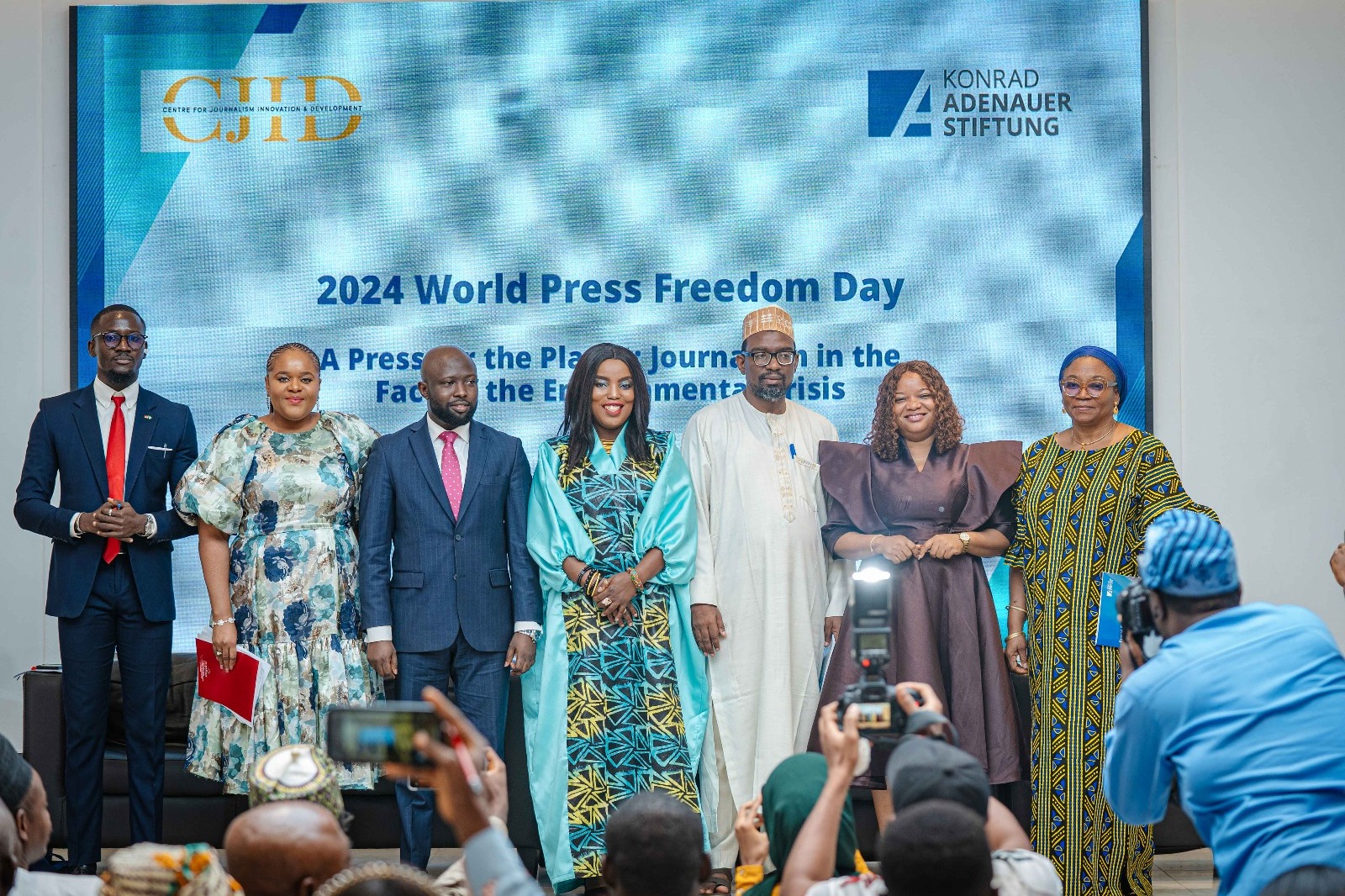
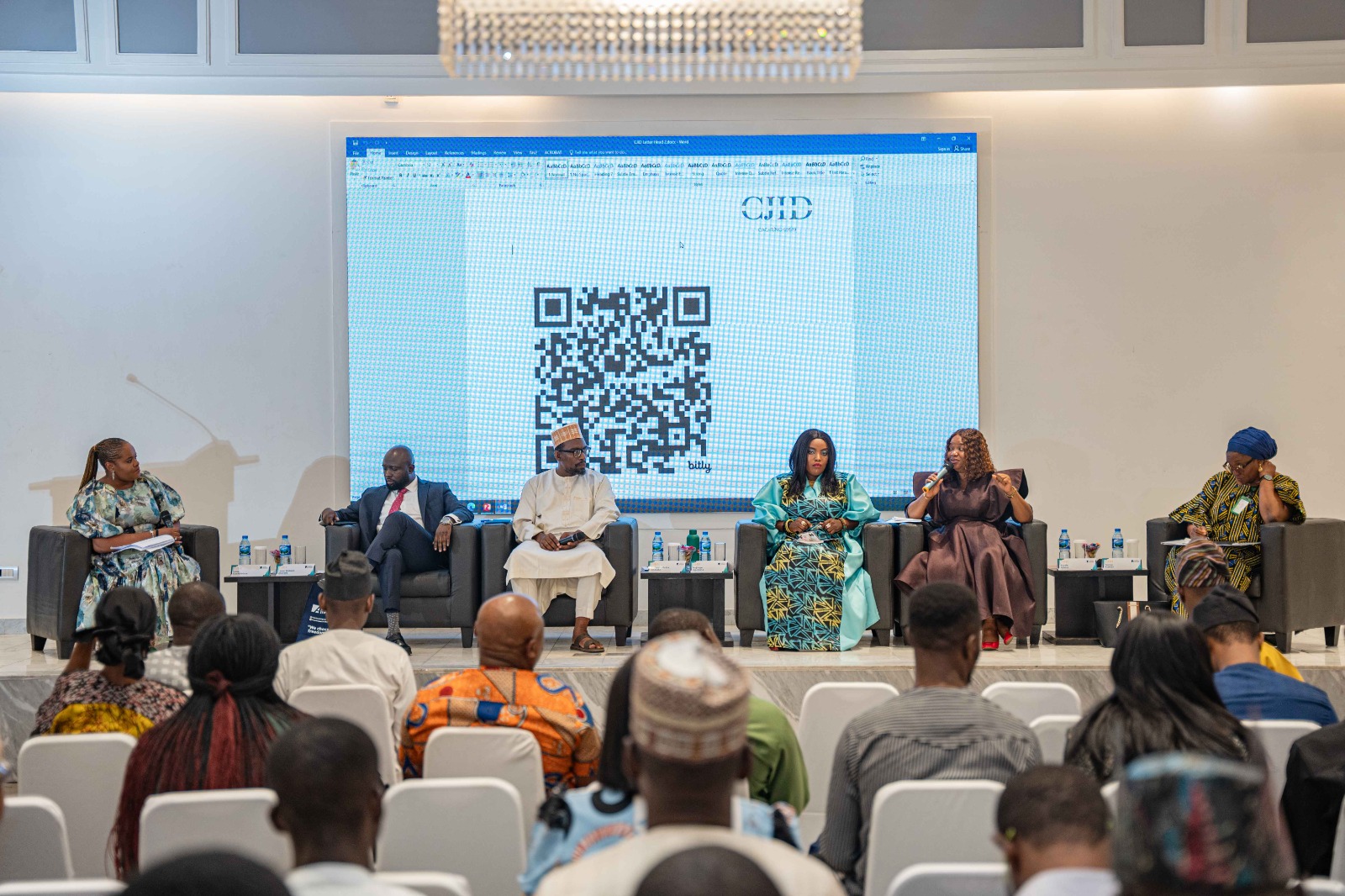
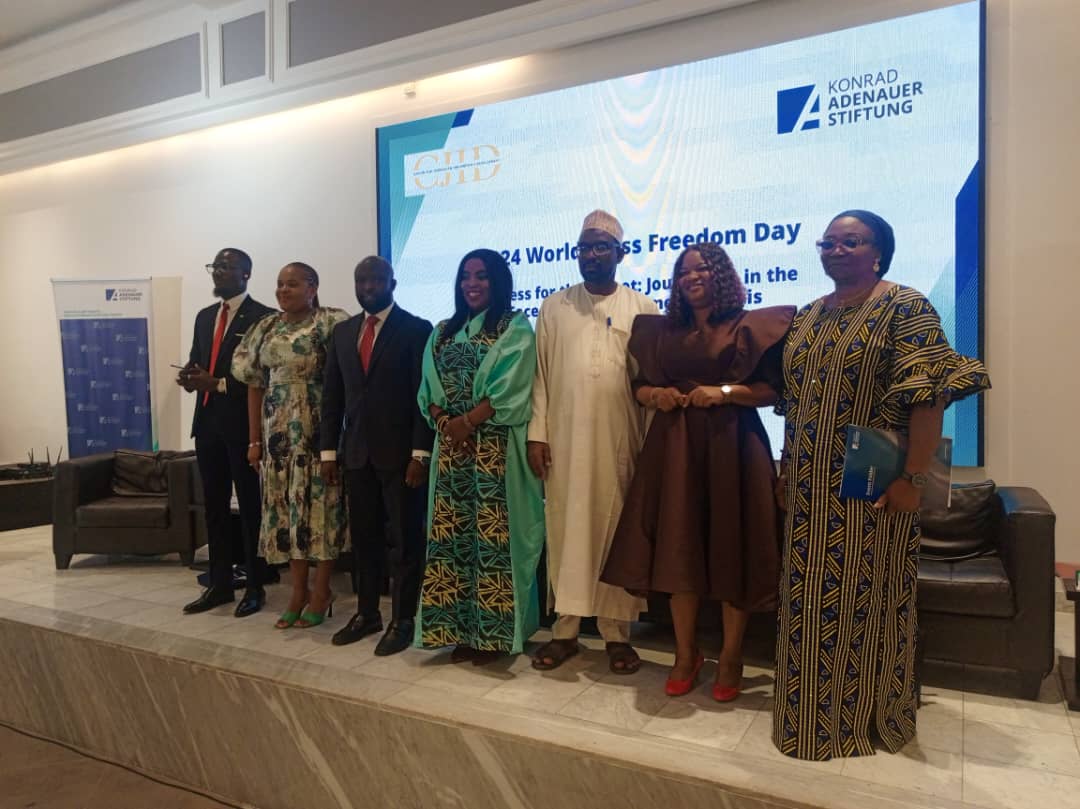
According to her contribution on a panel discussion at the Press Freedom Day event organized by KAS in collaboration with the Centre for Journalism Innovation & Development (CJID) in Abuja, the Executive Director of DI, Mojirayo Ogunlana O. stated that “professional journalists have a huge role to play in enhancing the media landscape.

“They must take up the responsibility of advancing the truth, be diligent in practice, and speak out against fake news, misinformation and all forms of distorted narratives in the public. They can also act as fact-checkers to ensure that the public has access to reliable and credible information both offline and online.”

Therefore, media organisations and journalists must account to themselves if they are to protect press freedom. The more they self-regulate, the more they reflect integrity and acquire societal trust.

Ultimately, press freedom is critical to a thriving civic space and we must all continue to advocate for it.

Signed

DiGiCiViC Initiative

86 years after, Reader’s Digest UK exits the market

The United Kingdom edition of Reader’s Digest is shutting down after 86 years of operation.

The magazine’s Editor-in-Chief, Eva Mackevic, announced this development on LinkedIn on Monday.

Mackevic explained that the magazine, founded in 1922 by DeWitt Wallace and Lila Wallace in the US, has been struggling financially

Mackevic wrote, “After 86 wonderful years, I am very sad to share that Reader’s Digest UK has come to an end. It has been my privilege and joy to contribute to this iconic publication for nearly eight years, leading its talented team for the last six.

“Unfortunately, the company just couldn’t withstand the financial pressures of today’s unforgiving magazine publishing landscape and has ceased to trade. I want to extend my heartfelt gratitude to all the
incredible colleagues, writers, PRs, and brands. I’ve had the pleasure of collaborating with you over the years.

“Your passion and expertise have made this journey unforgettable, and I’ve been fortunate enough to make some amazing friends along the way. To any writers awaiting payment for their work, I’ve been assured that the insolvency practitioners are working to communicate with everyone about the next steps. I sincerely hope this process goes smoothly and swiftly for you.”

Over its remarkable history, Reader’s Digest gained recognition through impactful campaigns.

One such campaign in 1924 raised awareness about the health risks associated with tobacco use.

Reader’s Digest also had a notable association with the British monarchy.

It received recognition from Queen Elizabeth II, including a commissioned portrait for her 60th birthday.

PUNCH

For lawyers and Non-lawyers: Watch your clients back

By David Oluwasegun Ogundipe

A lawyer of men should know much of life and human nature, he should be a novice in nothing and wide-minded in all things. He may not be a genius, but must be ripe in broad knowledge and general experience. If he is these, and he fails, it will be no fault of his own. J.W Donovan.

A woman in her 60s approached the firm. A “magic” had happened overnight and the magic left her shattered. She wanted to get to the root of it and consultations led her to the firm.

A piece of land was left for her by her late husband in a choice area in Abuja. She aspired so much to build on the land, but she could not afford it. She travelled outside the country for almost a year, returned to Nigeria and decided to go check the piece of land. To her shock, she met a beautiful structure on her land.

She ran around and did her checks. She realised someone had access to the title document, obtained several permits in her name, perfected several statutory documents in her name and even built the house in her name, before it was transferred. Strangely, her consent reflected on every document as required by law, but she couldn’t place it all.

She ran to the firm for help. A meeting was held, with our boss and three other lawyers in attendance. We resolved to file a suit. The suit was filed and the matter commenced. It was a tough one for us as documents speak for themselves and whoever ran the job for these guys learnt from Devil himself.

The Defendants did not turn up in Court all along, just their lawyers, but when it was time for them to start calling witnesses, two of them turned up. It was a very interesting proceedings, as they were visibly burnt and hurt by the fire or cross-examination. As young lawyers, we were excited. The woman was more excited.

To my shock, our boss invited the woman for a meeting in the firm. The purpose of the meeting was to advise her to seek out of court settlement and withdraw the suit. “Learned silk, Sir?” The woman said, voice trembling. She continued: “People said you will help me get what belongs to me. I met about 4 senior lawyers who asked me to come to you. I don’t have any regret. We are doing well in Court. Why do you want me to start begging on my right? They’re criminals. I should even be the one insisting that I won’t settle out of Court if they propose it”.

When she was done, our boss tapped the table before him several times, almost forcing us to start dancing to the tune. He took turns to look straight into the eyes of the 4 of us at the meeting, including the woman and started:

“War are fought because of a prize. So, every good warrior must devise a strategy that will win him the prize. Many win the war and lose the prize. I have 40 lawyers and among them are some of the best in the country. They like to do law. They want legal battles. To prepare court processes and run to Court. They’re not afraid of dragging cases. You also saw what we’ve done to those guys in Court? We are not losers and my suggestion is not from a place of weakness. But… (he paused, stared so long at the woman and continued) you. I care for you. I am worried about what might happen when you win the case and you’re far away from the eyes of the Court. Those guys I saw in Court will kill you! They will kill you (he said, slowly). People who can go to that length to take what belongs to you, went ahead to build on it and still have the gut to turn up in a law court to defend their acts will kill you. If you insist we will win your case, go home, enjoy with our families, but it will be the beginning of a serious war for you. I pushed them to this point so that we are in a position of advantage to negotiate. They will jump at our offer now.” The woman was quiet.

Our boss continued: “what’s the value of a land in that area? Do you know?” “Yes, SAN. It is about xyz million”, she replied. Our boss continued: “Okay, we will add 10 million naira to it and propose the prize for them in the settlement arrangement.”

We left the meeting. The settlement process started and spanned for about 3 months. After much protests and all, the Defendants agreed and paid the woman the estimated cost of the land and an extra 10 million naira our boss added. When she proposed to pay a part of it as professional fee, our boss said no. “It is all yours. You can go with it”.

I remember this today because I was in a meeting with him and when the client left, he faced me and said: “apart from a very sound knowledge of law, watch your client’s back. Some victories will hurt them, know how to tighten the noose and then when to loosen it, in their interest.”
I thought I should share this as we learn everyday.

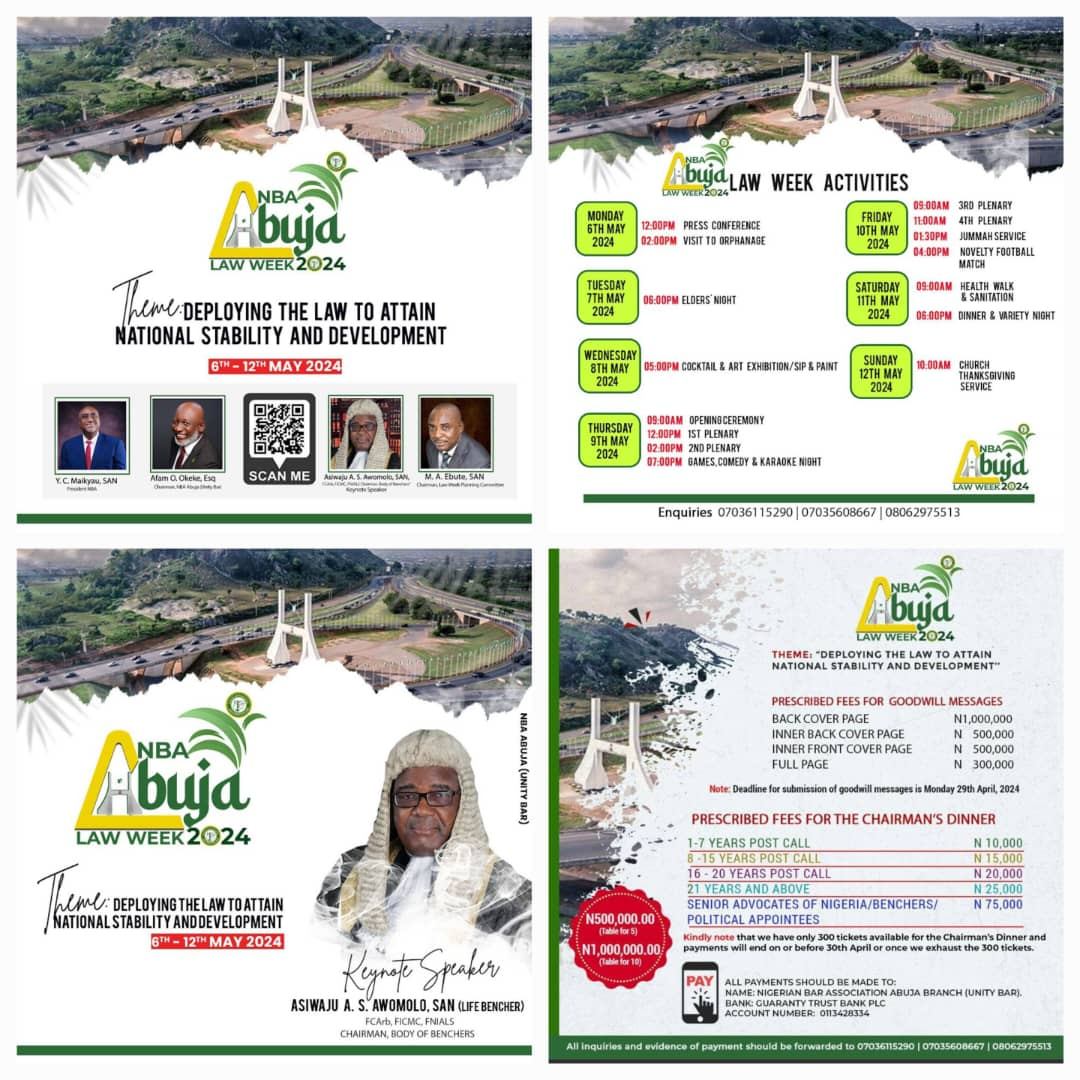
NBA Abuja Law Week 2024 begins tomorrow with a thanksgiving service

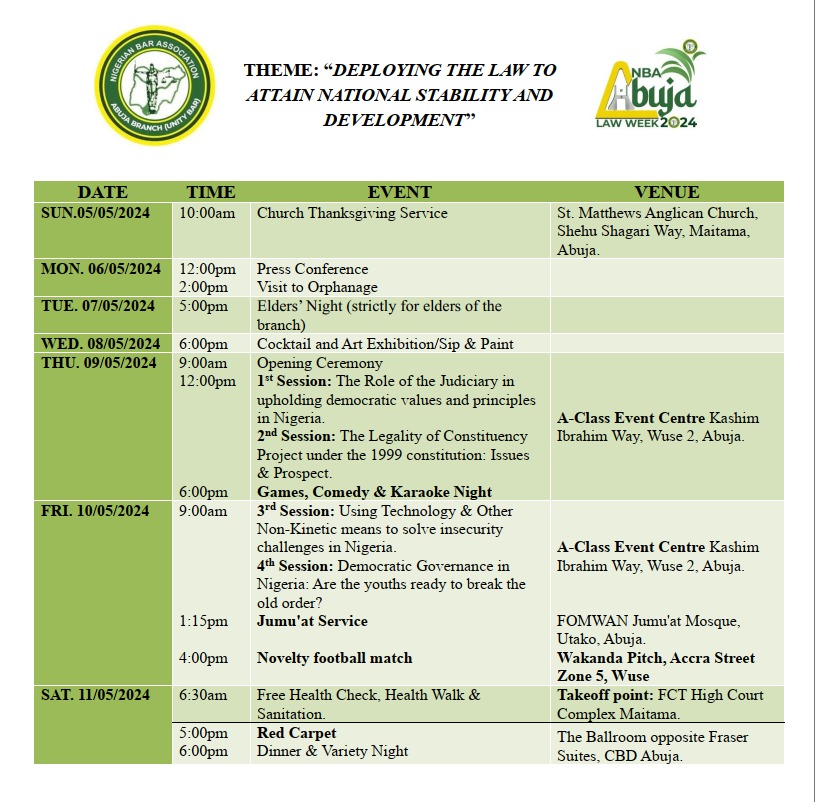
The 2024 Annual Law Week of the Nigerian Bar Association, Abuja Branch, (Unity Bar) themed “DEPLOYING THE LAW TO ATTAIN NATIONAL STABILITY AND DEVELOPMENT’’, will commence tomorrow with a thanksgiving service.

Chairman of the branch, Afam Okeke has also magnanimously announced that the first 20 members of the branch to attend the church thanksgiving service holding at St Matthews Anglican Church Maitama Abuja, will get free Chairman’s Dinner Ticket courtesy of a senior member of the branch.

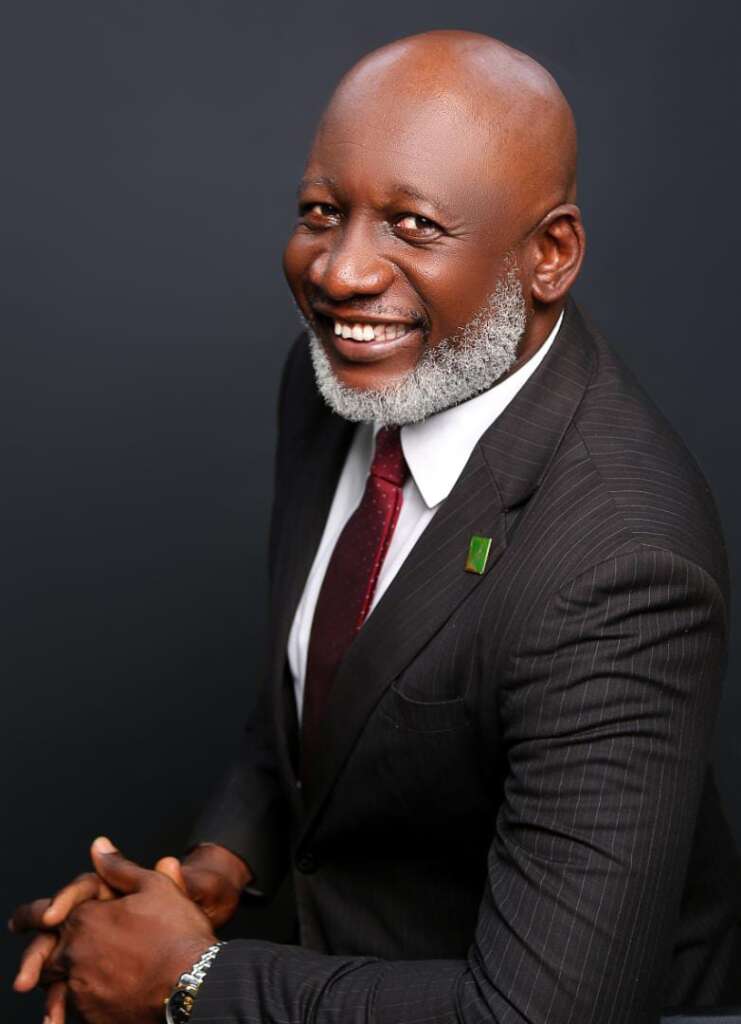
Afam Okeke, Chair, NBA Abujaj (Unity Bar)

Intimate Affairs: The foolhardy he-goat 

By Funke Egbemode

A man with the he-goat spirit is a man who does not listen to your advice. It’s not that he does not respect you. It’s just that he respects that thing in-between his legs more. He is not deaf either, he just likes the sonorous voice of his third leg. It is sweet in his ears. And anyway, the vibes he gets from doing things with his partner-in-crime, his third leg, leaves him feeling like a king and conqueror. A very good feeling, I gather.

The he-goat does not discriminate. He loves them old and young, fat and thin. He is a liberal and his third leg is deregulated. It goes everywhere like the petrol attendant’s nozzle. The only difference between the he-goat and the petrol attendant’s nozzle is that those who need the latter leave whatever they are doing to look for him and get their fill or refill. The nozzle does not leave the petrol station. It waits patiently for the tanks and fills them all, unless there is nothing in the underground tank. But the he-goat is a hunter. He goes from compound to compound, street to street, looking for whom to devour.

I admit that the he-goat and the nozzle are cousins, even if distant but in case you want to pick holes in my theory of differentiation, consider these two stories.

About 11 years ago, one Pastor Derek Ngulube, of Faith Ministries, a church in the Matobo District of Matabeleland South, South Africa was expelled by the church elders. His offence? Derek impregnated six married women! Prolific Derek did it all right under the noses of the pregnant wives’ husbands and something tells me those women sought out Derek. The report I read did not specify the venue or venues of the frolicking but then there was also no line or paragraph on the pastor raping the women.

So, we can safely conclude that the six unwise wives took their tanks to the prolific nozzle of Pastor Derek and the pastor being a cheerful giver gave them their hearts’ desires. Why Pastor Derek preferred married women, I do not know. We can also assume that a few dozens of the pretty young single women in the distressed church might have fallen under the toxic anointing of their rampaging minister. I strongly suspect so but since I have no proof, I’ll just stick to my sub-theory that Derek found married women sweeter and safer.

They are more experienced and are not likely to threaten Derek with accidental pregnancies. With single girls, there are more complications. They are likely to want to displace ‘Mama’ (that is the pastor’s wife) or even audaciously aspire to become ‘Second Mama’. Then when they get pregnant, which they often do, they’ll come running, all tears and threats. They’d want the pastor to do something about it or they would tell their daddies. Married female parishioners, on the other hand, just chop-and-clean-mouth. If pregnancies occur, they reallocate them because no daddy must hear.

However, the prolific he-goat seeks out his prey. He hunts them down. That is what gives him his kick. Give him new yam and he goes looking for last year’s yam. He wants water yam, cocoyam, even pounded yam. The he-goat runs and sweats. The chase gives him satisfaction. Like Dada.

Dada loves to experiment. He believes that a book should not be judged by its cover. Yes, he loves beautiful faces but his interests go deeper. For instance, he’ll tell you that a bow-legged woman is sweeter behind closed doors than the straight-legged ones. Did you say ah? He’ll tell you that a full-bosomed girl comforts him better than soothing words. He is not attracted at all to short or fat women because he believes they are not athletic or cannot be athletic enough in the sports that he wants them for. You understand that, right? So, if you introduce a beautiful girl to Dada, he’s looking beyond her fluttering eye lashes. He’s checking out the legs and the ‘comforters’. And since you can’t always find everything you want in one single place…

Dada goes shopping, and he shopped until he dropped.

Now why does that remind me of most men’s love for variety? It reminded you too? See, we are on the same page. There is always one day when the experienced goat eats something poisonous and he starts foaming in the mouth until it falls. I saw a couple of my mother’s goats die in such circumstances.

My grandmother’s diagnosis was always the same: the goat had eaten a poisonous leaf. No post-mortem needed. But does the death of one experienced goat while looking for varieties ever stop his friends and brothers from straying into the evil forest? No. Men are experienced he-goats. They love hunting. They brag about the number of mountains they have climbed and the exotic breeds and cross breeds of coco yams and water yam they have eaten. They look down on those who eat only potatoes.

Sometimes an experienced he-goat gets lucky and goes to his grave with all the epaulettes of his ranks but many go down foaming in the mouth. The trouble is when one takes a bow, 10 step into his shoes. And the beat goes on. I guess for that breed of men, it is all about ‘my Mercedes is bigger than yours’.

Funke Egbemode was managing director/editor-in-chief of New Telegraph Newspaper, president of the Nigerian Guild of Editors and commissioner for information in Osun State. Email: [email protected]

Yahaya Bello: Victim or aggressor?

By Prof Mike Ozekhome SAN, CON, OFR, FCIArb, LL.M, Ph.D., LL.D., D.Litt, D.Sc.

INTRODUCTION

The nation has been agog with news of the ongoing face-off between the EFCC and the immediate past Governor of Kogi State, Alhaji Yahaya Bello and the others over the (EFCC)’s attempt to arrest Bello in connection with alleged official corruption involving the sum of 80.2 billion naira which he allegedly misappropriated while in office for eight years as Kogi State Governor.

Accusations and counter-accusations have raged back and forth between both camps (with not a few officious by-standers proffering gratuitous, ill-informed advice in the guise of opinions). As usual, the truth is always the first casualty. In this case, it is worsened by the fact that the matter is the subject of on-going litigation before at least two different courts: a High Court in the former Governor’s home State of Kogi and the Federal High Court in Abuja. The situation has been compounded by the order of injunction granted by a Kogi State High Court restraining the Commission from arresting or attempting to arrest the former Governor. The alleged breach of the order so irked the judge who issued it that he apparently had no option but to cite the EFCC boss for contempt. That order has been stayed by the Court of Appeal. Because these proceedings are ongoing, no more will be said on them.

Let me stress here that I am neither on the side of Yahaya Bello, nor that of the EFCC, or the Government of Kogi State whose funds are allegedly at the heart of the dispute. I will not cry more than the bereaved. My intervention here is limited to the legal ramifications and propriety of the steps taken so far by both sides of the divide.

BACKGROUND

Before Bello’s Abuja house was raided in a gestapo-like manner on April 17, 2024, Bello had, believing that his fundamental human rights were being threatened, approached a Kogi State High Court seeking an interim restraining order against the EFCC (Commission) pending the determination of a substantive suit before the court.

Justice Isa Abdullahi (presiding), who was satisfied with the grounds upon which the relief was sought, on February 9, 2024, gave an interim restraining order against the EFCC from taking any action against Bello, pending the determination of the substantive matter.

The Commission, dissatisfied, approached the Court of Appeal, Abuja, on March 11, 2024, requesting the appellate court to set aside the interim restraining order. It argued that the lower court lacked the requisite jurisdiction to assist Bello escape his deserved justice. It also argued that Bello could not stop the Commission from carrying out its statutory duties, nor use the lower court to escape its invitation, investigation and possible prosecution as the court’s order directed.

The Appeal Court adjourned hearing to April 22, 2024, while refusing to hear EFCC’s application for a stay of the order of interim injunction.  In further affirming its earlier interim orders, the Kogi State High Court on April 17, 2024, delivered judgment in the substantive suit and directed the Commission to first seek the leave of the Court of Appeal before taking further steps against Bello. It granted some injunctive reliefs against the Commission “from continuing to harass, threaten to arrest or detain Bello”. The court directed the Commission to file a charge against Bello in an appropriate court if it had some reason to do so. The Commission later obtained a warrant of arrest against Bello from the Federal High Court presided over by Justice Emeka Nwite. On April 22, the anti-graft agency filed a notice of withdrawal of its appeal, predicating it on the ground that events had overtaken the appeal; while admitting that the appeal was filed out of time.

Bello’s team promptly challenged the arrest warrant by the Federal High Court and Justice Emeka Nwite has adjourned for his ruling on the propriety of his warrant of arrest against Bello.

WHEN AND HOW TO SUMMON A SUSPECT FOR INVESTIGATION BY LAW ENFORCEMENT AGENCIES

I condemn any brute and sensational arrest of a suspect such as Bello. It does not matter the station of life of such suspect, whether high or low. Hooded DSS operatives once did it to some Justices of the Supreme Court and other Judges on 8th October, 2016, when they viciously and savagely broke into their homes in the wee hours of the morning. I had condemned it in very strong words. (See https://www.bellanaija.com/2016/10/falana-ozekhome-melaye-react-to-arrest-of-judges-by-dss/) (October 10, 2016). Some of the victims like Justice Sylvester Ngwuta, JSC (of blessed memory) never recovered from the shock. He later died. Others took early premature retirement. Was the Commission therefore right in attempting to arrest Bello in the manner it did as some commentators have approved in their writeups? I think not. The relevant provisions of the law such as Sections 8(1) of the Anti-Torture Act, 2017; Section 6 of the Administration of Criminal Justice Act (ACJA) 2015 (applicable in Abuja, the FCT); and Section 35(2)&(3) of the Constitution of the Federal Republic of Nigeria, 1999, as amended, the sum total of which enjoin the fair and humane treatment of a suspect whether during his /her arrest, investigation, detention pending trial and arraignment. Was a bench warrant necessary against a suspect on whom charges had not been served as in the Bello scenario? I think not. Let us look at some decided cases on this.

In USANI V. DUKE [2006] 17 NWLR (Pt.1009)610 the Court of Appeal held thus:

“A bench warrant is a discretionary power of a court invoked to secure the attendance as in this case of an unwilling witness under the threat of contempt of court to give evidence on any area of a suit within his knowledge. It is not a discretion which is exercised as a matter of course. The court has to be satisfied that there is absolute necessity to procure the appearance of the witness in court. The lower tribunal based its refusal to issue bench warrant on non-compliance with section 229(2) of the Evidence Act.” Per ADEKEYE, J.C.A. (P. 38, paras. B-E)”.

In APUGO V. FRN (2017) LPELR-41643 CA, the Court of Appeal eruditely held that:

“Section 382 (4) and (5) of the ACJA provides for how to serve a Charge and notice of trial on a Defendant, who is not in custody, … In this case, the Respondent had filed a motion exparte under section 382(5) of the ACJA 2015 to serve Appellant by substituted means. That motion was not argued, but the trial court jumped the gun and ordered for the bench warrant to arrest the Appellant: and when it found out that that was wrong, it suspended the implementation of the bench warrant (instead of setting it aside) the trial court yet still ordered the Appellant to appear on the next adjourned date to answer to the Charge against him, pursuant to section 87 of the ACJA 2015. As earlier discussed and held above, I do not think the trial court had the vires to make such order, in the circumstances as I think it went beyond its role as impartial adjudicator, to that of the Prosecutor or Police or EFCC to forcefully produce the Accused person, without serving him with any charge or notice of trial. See NWADIKE v. State (2015) LPELR- 24550 (CA), Ededet v. State (2008) 14 NWLR (Pt 1106) 52. I do not think section 87 of the ACJA 2015, can apply without recourse to section 382 of the same Act which requires a Defendant to be served personally or by substituted means with the charge or information and notice of trial.  I believe it is upon compliance with section 382 (3) (4) and (5) of the Act where there is a pending charge, that the trial court can have the powers to apply the section 87 of the Act which says: “ A court has authority to compel the attendance before it of a suspect who is within the jurisdiction and is charged with an offence committed within the state Federal or the Federal Capital Territory, Abuja, as the case may be or which according to law may be dealt as if the offence had been committed within jurisdiction and to deal with the suspect according to law”. Per MBABA J.C.A  J.C.A (Pp. 46-48, paras. F-F)’’.

See also sections 113, 131, 394, 398 and 399 of the Administration of Criminal Justice Act 2015.

These domestic laws are reinforced by a regional (in fact, continental) statute – the African Charter on Human and Peoples Rights – Article 7 of which obliges the State (and all other persons) to respect the rights of every individual to have his (or her) cause heard. This right encompasses the following, inter alia:

  • The right to appeal to competent national organs against violating his fundamental rights;
  • The right to be presumed innocent until proven guilty by a competent tribunal;
  • The right to defence including by Counsel of one’s choice;
  • The right to be tried within a reasonable time by an impartial court or tribunal.

The importance of this statute is often overlooked by many Nigerians because, apart from the Constitution, it is superior to virtually every local or municipal law – including the EFCC (Establishment) Act itself. See ABACHA VS FAWEHINMI (2000) 6 NWLR part 660, pg 228, where the Supreme Court held that the Charter possesses “greater vigour and strength than any other domestic statute… (accordingly if there is a conflict between it and another statute its provisions will prevail over those of the other Statute”)

It is in this context that I believe the Commission’s tactics in attempting to arrest Bello ought to be situated. While no one quarrels with the Commission’s full mandate to tackle economic crimes, the way and manner in which it does so must however, not portray any impunity or suggest that it is above the law. After all, the Commission’s motto is “No one is above the Law”. To that extent, the fact that the person at the centre of the present controversy is a former Governor is irrelevant: it merely hugs the headlines for that reason. Afterall, he has since lost his immunity under section 308 of the 1999 Constitution, upon vacating office. However, once a person has been charged to court as Bello has, he becomes the subject of the court which becomes seized of the matter. His availability in court is thereafter controlled by the trial court, and not another through a bench warrant.

Many a time, it is argued that the court cannot restrain government agencies from arresting, investigating or prosecuting suspects. This is far from the truth as it depends on the facts of each case. For example, the Court of Appeal in OKEKE v. IGP & Ors (2022) LPELR-58476(CA) 1 at Pp. 9 paras. A, Per NWOSU-IHEME, J.C.A (as she then was), relied on a decision of the same Court to hold that the Police can be restrained from the improper use of its powers. In the unreported case of LUNA V. COMMISSIONER OF POLICE RIVER STATE POLICE COMMAND in Appeal No CA/PH/216/2004, the Port-Harcourt Division of the intermediate court held:

“… Notwithstanding the power of the Police as spelt out in Sections 4 and 24 of the Police Act, where this Power is improperly used, the Court can stop the use of the power for that improper purpose, as that would no longer be covered by Section 35(1) (c) of the 1999 Constitution. In other words, an order restraining the Police from arresting on some particular occasion or for some particular improper purpose may be made by the Court.”

THE EVILS OF MEDIA TRIAL

The Yahaya Bello case evinces a clear case of media trial which should never be. The notion “Media Trial” or “Trial by Media” got its name in the United States of America during the period of 19th Century and became familiar with the Indian legal system in the famous, case of K.M Nanavati v. State of Maharashtra AIR 1962 SC 605.

I have, on my part, always kicked against media trial, for it presumes a person guilty even before his trial in open court. At the first National Anti-Corruption Stakeholders’ Summit held in 2017 with the theme, “Building national anti-corruption consensus in a multi-agency Environment”, which was organised by the Commission at the EFCC Academy, Karu, Abuja, I made the following remarks:

“…. All my life that is what I have done. I take it very seriously when we talk about the issue of rule of law. I do not believe in media trial. For example, a case is being investigated in EFCC, the suspect is being interrogated, tomorrow it is in a particular newspaper as to the statement made by that suspect. That suspect may never be tried. Even if he is arraigned and tried, he may never be found guilty but you have destroyed his image, his reputation. We should run away from that, it is not good. There is the need in this anti-corruption war to make an example; just one example with one person in government. I am aware of many, many petitions against people in this government”. See Nigerian Tribune edition of 28th March, 2017. (https://tribuneonlineng.com/stop-media-trial-suspects-ozekhome-tells-efcc/).

I had also in 2017, written to the Commission and presented a paper at CACOL Roundtable, titled “The A-Z and 24 “Dos” and “Don’ts” of how to fight corruption”. (See Daily Times of 24th April, 2017 – https//issuu.com/dailytimes. ng/docs/dtn-24-04-17/19). This paper is still relevant today, as it represents my contribution to the fight against corruption which I personally believe in. But, such war must be within the confines of the law. At the time of my lecture, the Commission under Ibrahim Magu had not made any attempt to try government functionaries; and I challenged it to do so. I do not know, whether it was my wakeup call that made the Commission to finally start charging people in government, especially Governors and Ministers, to court. Or, do you? I had also clashed with the former Chairman, Magu, on this sore issue on 19th December, 2017, at the Federal High Court, Abuja, at its end of year event. (See: https://www.vanguardngr.com/2017/12/anti-graft-war-magu-ozekhome-clash-fhc-end-year-event/)

THE DANGER INHERENT IN MEDIA TRIAL

Media trial which has become the order of the day in Nigeria is simply the act of using media coverage to vilify and portray a suspect or an accused person as a criminal, even without trial. In the context of Nigerian jurisprudence, a trial is an avenue to challenge the innocence of an accused person. A Media trial is an improper use of the media to tarnish the image of an accused person before, during or after a trial. It is used to dampen the resilient spirit of an accused person. The Commission used this craft greatly, especially during the tenure of Ibrahim Magu; and it greatly chipped away some nobility in its patriotic war against corruption.

The public applauds media trial. The downtrodden guffaws when the rich also cry. With this, there are more media convictions than actual convictions in the courtroom. Unfortunately, Yahaya Bello, has become the latest victim of  media trial. If he is eventually acquitted, people will attribute his non-conviction to “a complicit judiciary”, (the whipping orphan).

Bello’s present ordeal may have undoubtedly brought some people immense joy. This submission has been tacitly corroborated by the Commission’s Chairman, very hard working and dedicated Mr Olanipekun Olukoyede, who stated, in a now-viral video, that the former Governor of Kogi State declined to come to the agency’s office because he complained that a female Senator had allegedly gathered journalists together to humiliate him anytime he appeared in the office of the agency for interrogation. Obviously, Bello was scared of media trial; so he avoided it. The evils of media trial are galore.

Media trials, especially in places like Nigeria, can be highly dangerous and prejudicial to a fair trial for several reasons:

  1. Presumption of Innocence: Under the provisions of Section 36(5) of the 1999 Constitution, every accused person is presumed innocent until he is found guilty. Media trials often disregard the principle of “innocent until proven guilty.” When suspects are portrayed as guilty before they have had a fair trial, it can prejudice public opinion and undermine the legal process. The Muhammadu Buhari government specialised in this Goebel’s propaganda style under its “Name-and-shame” mantra. Such removes the Anglo-Saxon accusatorial system we operate and whimsically substitutes it with the French inquisitorial system.

By the provisions of section 36(5) of the 1999 Constitution, every person who is charged with a criminal offence shall be presumed to be innocent until proven guilty. This is unequivocally the position of the law, and has not changed. Article 7(1) (b) of the African Charter on Human and Peoples’ Rights 1981, also guarantees the presumption of innocence when it states as follows: every individual shall have the right to fair-hearing, that is; to have his cause heard including a right to an appeal, to be presumed innocent until proven guilty by a competent court or tribunal, and also the right to defence, including the right to be defended by Counsel of his choice. These are provisions that guide the trial of any person suspected to have committed a crime. It further extends to the right to be tried within a reasonable time by an impartial court or tribunal Thus, the presumption of innocence is the legal principle in criminal cases that one is considered innocent until proven guilty. This therefore means that until a judicial pronouncement is made, a suspect or defendant as the case may be should be treated with dignity as an innocent citizen. Anything to contrary would amount to a breach of the fundamental rights of the individual. See the cases of Tosin .v. State (2023) LPELR-59635 (CA); Onyeka .v. State (2023) LPELR-60520 (CA) and OLALERE .V. STATE (2022) LPELR-58103 (CA).

  • Mob Mentality: Inflamed by sensationalized media coverage, the public can form strong opinions and even resort to mob justice. This can lead to violence, whether against the accused or others associated with them.
  • Interference with Legal Proceedings: Judges do not live on the island, Venus, Moon, Neptune or Mars. They live on earth and interact with members of the society. Media attention can influence judges, potentially leading to unfair trials. It can be difficult for a defendant to receive a fair trial when public opinion has been heavily influenced against him by biased media coverage. In the case of Rajendra Jawanmal Gandhi v. State of Maharashtra, (1997) 8 SCC 386, the Supreme Court of India noted that a trial by press, electronic media, or public agitation is the exact opposite of the rule of law. It held further that Judges should protect themselves from such pressure and scrupulously adhere to the rule of law since failure to do so could result in a miscarriage of justice. Parties are entitled by the Constitution to a fair trial in a court of law by an unbiased tribunal that is not swayed by popular culture or media coverage.
  • Violation of Privacy and Dignity: Suspects, especially those who are later found innocent, can suffer irreversible and irreparable damage to their reputation, mental health, and livelihood due to intrusive media coverage. See section 37 of the 1999 Constitution.
  • Impact on Investigation: Media trials can jeopardize investigations by prematurely revealing sensitive information or influencing potential witnesses or suspects.
  • Undermining Trust in the Justice System: When the public perceives that justice is being served through media sensationalism rather than through fair legal processes, it can erode public confidence and trust in the judiciary and law enforcement agencies. This is the situation our judiciary has found itself. When a wealthy man who is accused of looting the state treasury is acquitted of corruption-related charges, some members of the public readily accuse the judiciary of complicity. Because some Nigerians do not trust the judiciary, they believe, courtesy of media trial, that the judiciary is a tool of the ruling class to consolidate or legitimize their hold on power and the society.
  • Political Manipulation: In some cases, media trials may be used as a tool by powerful interests to manipulate public opinion, discredit political opponents, or distract from other issues. The ongoing trial of the former CBN Governor, Mr. Godwin Emefiele, is a perfect example. Virtually all the bad economic policies of the President Buhari government have been attributed to the leadership of the apex bank under Emefiele and the Bank Managing Directors. Was this really the case? Was Buhari not in charge?

There are many instances when suspects who had been subjected to needless media trial were later vindicated by courts of law. Let us see some examples:

  • The siege and break-in through the roof on the residence, ‘abduction’ and subsequent arrest and arraignment by the EFCC in a clearly orchestrated media trial of former Governor Rochas Okorocha of Imo State. He was later discharged and acquitted.
  • The trial and subsequent discharge and acquittal, only last month, by the Federal High Court sitting in Lagos, of the former Director-General of NIMASA, Mr Patrick Akpobolokemi, after over eight years on trumped up charges of conspiracy, stealing and fraudulent conversion involving the sum of ₦8.5billion. The court, coram, Justice Ayokunle Faji, upheld his Counsel’s no-case submission that the Commission had failed to make a prima facie case requiring him to enter his defence in respect of four out of six charges laid against him by the Commission. This was after eight years of gruesome trial and media hype, with Akpobolokemi, being physically dragged on the ground in one instance.

The discharge and acquittal earlier this year of the erstwhile Attorney-General of the Federation and Minister of Justice under the Administration of the former President Goodluck Jonathan, Mr Mohammed Bello Adoke and some companies by the Federal High Court, Abuja (Ekwo, J) and the High Court of the FCT (Kutigi J), on charges of money laundering and abuse of office after  over four years of hyped media trial which the latter court strongly condemned and for which it excoriated the Commission for the slip-shod manner in which it undertook what, to all intents and purposes, was a persecution rather than precaution. The investigation into the alleged offences was anything but diligent, forcing the Commission’s own Counsel (to his credit) to throw in the towel and admit that he could not, in all honesty, support their continuing trial. I had gotten vacated and set aside the Bench warrant earlier issued against Adoke by Danlami Zama Senchi (now of the Court of Appeal). I was the one who also argued Adoke’s bail applications before Justices Inyang Ekwo and Idris Legbo Kutigi.

Also apposite are the nasty experiences of former Senator Dino Melaye whose cases I also handled; and that of the Supreme Court Justices way back in 2016 (even though the latter was perpetrated by a sister agency, the DSS) .

What about late High Chief Aleogho Raymond Dokpesi? He was later discharged on a no case submission after over eight years of horrid trial in which I secured his bail in 2015!  The cases of Col. Sambo Dasuki, El Zakzaky and Elder Godsday Orube are well too known to enlist elucidation here.

The Commission surely had full knowledge of the ex-parte order made by the Kogi State High Court which had restrained the Commission from arresting Yahaya Bello. Yet, it laid a siege on Bello’s Abuja residence. The entire drama (which played out in the full glare of television cameras) was nothing short of disdain for the rule of law and the sanctity of court orders. It is trite law that, until a valid and duly issued court order is set aside either by the same or another court of superior or co-ordinate jurisdiction, it must be obeyed and complied with to the hilt.

The proper remedy open to the Commission which disagreed with the order was to challenge it and seek its reversal at the appellate court as it later did, and certainly not to flout or disobey it under any disguise. Needless to say that disobedience to court orders is a feature of self-help only in a society where anything goes; where life is poor, solitary, nasty, brutish and short, to quote the English Philosopher, Thomas John Hobbes. We must never allow Nigeria to degenerate to such a nadir state where government institutions disobey court orders with impunity. That is a ready recipe for organized disenchantment.

Indeed, so important is obedience of court order that it is given constitutional imprimatur in Section 287 of the 1999 Constitution.

In this regard, in FCDA V KORIPAMO-AGARY (2010) LPELR-4148 (CA), Mary Ukaego Peter-Odili, J.C.A (as he then was) held that:

“The Court frowns at disobedience of its orders; particularly by the executive branch of government and has used rather harsh language such as ‘executive lawlessness’, in describing such acts of disobedience. On the application of an aggrieved party, the Court has in appropriate cases, not hesitated to exercise its coercive power to set aside such acts done in disobedience of its order and restore the parties to the position they were before such disobedience. The rationale for this course of action by the Court is to ensure the enthronement of the rule of law rather than acquiesce in resorting to self-help by a party. The Court also has the power of sequestration and committal against persons disobeying its orders. It is an overgeneralization and therefore wrong to say that an act done in disobedience of a Court order is an illegality”.

See also ALL PROGRESSIVE CONGRESS & 2 ORS V HON DANLADI IDRIS KARFI & 2 ORS [2018] 6 NWLR (Pt 1616) 479, 493 SC and EZEKIEL-HART V EZEKIEL-HART [1990] NWLR (pt 126) 276. where the Supreme Court upheld the same principle.

By the same token, it is also settled that once the court is seised of a matter, it becomes dominus litis (master of the proceedings) and no party is allowed to take any step that will either overreach the court or the other party or present the court with a situation of fait accompli or complete helplessness in which whatever orders it makes might either be rendered nugatory or unenforceable. Such will be an affront on the court. See Ojukwu v. Governor of Lagos State (1986) 3NWLR (Pt 26) 39.

CONCLUSION

The judgment delivered by the High Court of Kogi State on April 17, 2024, finally vindicated Yahaya Bello on this issue as the court pointedly held:

“Thus, the serial action of the Respondent, dating back to 2021, right up to 2024, targeted against the applicant, has corroded their legitimate statutory duties of investigation and prosecution of financial crimes. These collective infractions on the rights of the applicant border on infringement of his fundamental right from discrimination”.

Central to the court’s rebuke is the condemnation of the anti-graft agency’s reliance on media sensationalism, characterized as a form of trial by public opinion. The court firmly asserted the principle that the agency’s role is not to act as both prosecutor and Judge simultaneously; but rather to present evidence within the confines of due procedure. This critique underscores the imperative of upholding the rule of law and granting individuals, including Bello, their rightful day in court devoid of extrajudicial influences.

Beyond the specifics of Bello’s case, there is need for a paradigm shift whereby agencies such as the EFCC, Police, ICPC, DSS et al, adopt a more public-friendly stance akin to their counterparts in advanced jurisdictions such as the United States, the United Kingdom and many European states. The importance of viewing law enforcement as a Service rather than as a Force, underscores the necessity of cultivating public trust and confidence through transparent, law-abiding practices. I hereby emphasize and advocate (as I have always done), strong institutions; not strong men.

We must, therefore, strike a balance between reporting matters that are of public interest and respect for the dignity of persons. In India, the Law Commission in its 200th report, “Trial by Media: Free Speech versus Fair Trial under Criminal Procedure (Amendments to the Contempt of Courts Act, 1971)”, has recommended a law to debar the media from reporting anything prejudicial to the rights of the accused in criminal cases, from the time of arrest to investigation and trial.

No individual, regardless of his position or authority, is above the law. There is no exception in the sense that even those who are protected from prosecution by the immunity clause in section 308 of the 1999 Constitution of the Federal Republic of Nigeria, as amended, will after vacating the office be answerable like all other citizens and subject themselves willingly or unwillingly to the law. By holding both governmental and non-governmental actors accountable to the law, a commitment to fostering a culture of accountability and respect for individual rights is built and maintained.

Be that as it may, the laid down procedures must be followed accordingly. Where such laid down procedures are not tenaciously complied with, it will become an agency of government dictating its own rules, procedures and modus operandi. This is only typical of an autocratic, despotic and dictatorial government which we do not operate. It is in the light of this that the Commission and all other agencies established by laws must ensure that they conduct their operations within the ambit of the laws that established them. The concept of rule of law entails that all actions of government must be carried out as spelt out by the law without any form of self-help. In an ideal society where everyone, the leaders, the followers and the law enforcement agencies follow the law, a pattern develops where there can be a reasonable expectation of what will occur in any given situation. And ultimately, this provides security and safety as people do not need to panic out of uncertainty or feel worried about any situation since what will happen is readily  predictable.

In the light of these considerations, there is need for a reevaluation of law enforcement practices and a renewed dedication to upholding the rule of law. There must be a balance of the imperatives of justice with the protection of individual rights, particularly in the face of media scrutiny and public pressure.

For now, citizen Yahaya Bello wears the toga of victimhood and not of aggression. He should be allowed to have his fair day in court without the present needless ruckus and brouhaha.


TIPS