Home Blog Page 594

Rivers and scorched earth governance model

By Onikepo Braithwaite

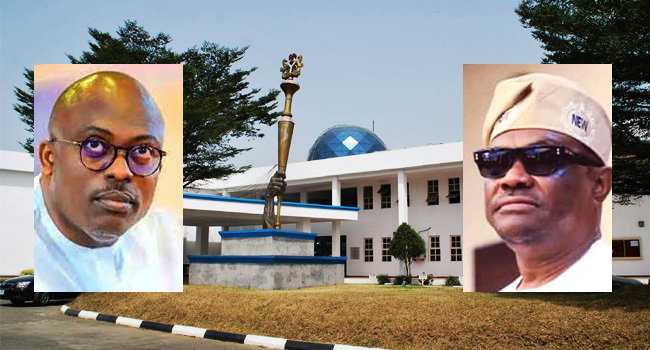
Governor Fubara v Rivers State House of Assembly 

What’s that saying about the ground suffering, when two elephants fight? The  ground in this context being Rivers State, her infrastructure, the people of the State, effective governance and development of the State. So much time and resources are being expended on the disagreement between Governor Siminalayi Fubara and the Rivers State House of Assembly (RSHA), that onlookers are wondering whether these arms of government are actually getting any work done. This is detrimental to the State. Their main concern should be the security and welfare of the people of Rivers State, which is the primary purpose of government – see Section 14(2)(b) of the 1999 Constitution of the Federal Republic of Nigeria (as amended in 2023)(the Constitution).

People are appalled, horrified really, by the arbitrary demolition of the Complex that housed the Rivers State House of Assembly (RSHA), built with State funds and tax payers’ money. What procedure was adopted, before the building was demolished? Was the procedure made public? Where is the assessment from the agencies and bodies empowered so to do, to decide that a public building constructed barely 20 years ago is no longer structurally sound, and required total demolition, not even partial renovation of the areas that may have been damaged by a fire, which apparently conveniently broke out during the same period when Nigerians heard that there was a plot by the RSHA to impeach the Governor? Was the demolition a political decision, which has no place in civil and structural engineering matters? While I prefer to stick to facts and evidence, we cannot ignore the fact that in Nigeria, it is not an entirely unknown phenomenon for public buildings to be set ablaze for suspicious reasons.

If it is the latter, this kind of bizarre, wasteful, destructive and out-of-control behaviour by those in authority must not be allowed to thrive in Nigeria, because the last time I checked we were in an ostensibly democratic dispensation, and not a military dictatorship. It appears that many Governors have turned themselves into tin gods and military generals, and have placed .themselves above the Constitution because of the immunity from suit and legal process they enjoy under Section 308 of the Constitution. 

Legislators’ Defection: Vacant Seats or Not? 

Being the provision that has been incessantly cited as the basis for insisting that the seats of the 27 Rivers Legislators who defected from PDP to APC are now vacant, I’m sure that if Section 109(1)(g) of the Constitution and its Proviso had ears, they would be buzzing, since they must now be permanently ingrained in the minds of many, particularly either of the two conditions that must be fulfilled for a State Legislator to be able to successfully defect from the Party on whose platform they were sponsored and elected into office, to another party, before their tenure is over, failing which such defecting Legislator shall vacate their seat: 1) that there’s a division in the previous political party; or 2) that there’s a merger of two or more political parties or factions by one of which the Legislator was previously sponsored. See the case of Abegunde v Ondo State House of Assembly & Ors (2015) LPELR-24588(SC). 

Section 109(1)(g) of the Constitution is not self-executory. It is obvious that the Constitution doesn’t contemplate a situation where Nigerians can sit at home, debate the defection of Legislators and decide whether their seats have automatically become vacant or not, or that the Executive would be the one to decide whether the reasons provided for a defection fall within the scope of the aforementioned constitutional exceptions that will not necessitate the vacation of a seat, if a Legislator defects. On the contrary, the Constitution envisages an issue for determination arising from such defection, because by virtue of its Section 272(3), it provides that the Federal High Court (FHC) has jurisdiction to hear and determine inter alia, the question as to whether the seat of a House of Assembly member has become vacant. For one, it appears that the courts must decide what amounts to ‘fractionalisation, fragmentation, splintering or division’ in the various cases of Legislators’ defection, as one size does not necessarily fit all – see Abegunde v Ondo State House of Assembly & Ors (Supra). Also see the case of INEC v DPP & Anor (2014) LPELR-22809(CA) per Helen Moronkeji Ogunwumiju, JCA (as she then was); INEC v DPP & Anor (2015) LPELR-24900(CA) per Ugochukwu Anthony Ogakwu, JCA

As Lawyers, it is obvious that because Section 109(1)(g) of the Constitution is not self-executory, by virtue of Section 272(3) thereof, it is the FHC that decides on the question as to the whether either of the two conditions in the said Proviso of Section 109(1)(g) has been fulfilled or not; and, until then, the seats cannot be declared vacant on the say-so of PDP or Governor Fubara, the people of Rivers State, or you and I. It is a misconception that the defection of a Legislator to another Party during their tenure, automatically translates to their seat becoming vacant. There is a constitutionally laid down procedure, for the process to declaring a seat vacant, because everyone has a different story as to why they defected from their previous Party, and it’s for the court to decide if the story is cogent or not. Consequently, the case must go through the proper channel, from the FHC to the Court of Appeal, and finally, the Supreme Court, if the parties go on appeal. In INEC v DPP & Anor (2014) (Supra), the Court of Appeal held inter alia that, it is only the Federal High Court that can determine the question as to whether the seat of a House of Assembly has become vacant. Also see the case of Ofobruku v DPP & Anor (2015) LPELR-24899(CA) per Ugochukwu Anthony Ogakwu, JCA. 

Abuse of Court Process

Governor Fubara’s ‘three-man House of Assembly’, going to the Rivers State High Court (RSHC) last week to obtain an ex-parte order that the House of Assembly members who defected to APC shouldn’t parade themselves as Legislators, is an abuse of the court process. There is an interim order dated 15/12/23 made by the FHC, which inter alia, restrains INEC and the RSHA from declaring the seats of the 27 Lawmakers vacant, pending the hearing and determination of the motion of notice. See the case of Ogboru v Uduaghan 2013 13 NWLR Part 1370 Page 33 at 53 per Clara Bata Ogunbiyi, JSC on the definition of abuse of court process. It is the improper use of the judicial process by a party in litigation, aimed on targeting on interference with due administration of justice. The acts of the minority members going to the RSHC to obtain orders, is simply to interfere with the due administration of justice in this matter. The RSHC also cannot sit as an appellate court over the decisions of the FHC, granting orders to counter the judgement of a court of competent jurisdiction in this matter (see Suit No: FHC/ABJ/CS/1613/2023 Rivers State House of Assembly & Anor v NASS & 16 Ors). The proper process, is to file an appeal at the Court of Appeal. But, the now popular unwholesome practice of forum shopping (in this case, of the highest order, I might add), was chosen instead. 

Lawyers who engage in such nefarious activities, should face disciplinary sanctions before the Nigerian Bar Association. Knowingly filing a multiplicity of actions when they can be consolidated with the action touching on the same subject-matter that was instituted first in time, if such matter was properly brought before a court of competent jurisdiction; knowingly filing matters before courts that obviously lack jurisdiction to hear and determine matters, but will flout the law to give favourable decisions – both constitute  abuses of court process. The actions of the Counsel to the minority Rivers Legislators fits like a glove into these two types of abuses, because the Constitution clearly provides in this case that such matters concerning the vacation of House of Assembly seats must be brought before the FHC and not the State High Court as they have done; and, the matter was already before the FHC before they started running to the RSHC continuously to secure all sorts of orders to override that of the FHC. 

Similarly, Judges that grant ex-parte motions recklessly, issuing interim orders in matters they shouldn’t, knowing fully well that their courts have no jurisdiction to hear and determine them, or that they are an abuse of court process in one way or the other, and they proceed to breach their oath of office to resolve disputes judicially and judiciously by instead, handing down decisions that are bound to cause more harm and confusion than resolution, should also face disciplinary sanctions from the National Judicial Council (NJC). 

It is time to start injecting some sanity into our legal system, where it is required. If Counsel and Judicial Officers who engage in abuse of court process are sanctioned immediately, it will serve as a deterrent to others who have no regard for the rule of law and prefer to make a mockery of it instead.

Governor Fubara: A Meddlesome Interloper

It is crystal clear that, in this particular circumstance, Governor Fubara appears to  be a meddlesome interloper, poke-nosing in how a separate arm of government, the Legislature, should be run, thereby arrogating unto himself powers which he doesn’t have, seeing as the Constitution doesn’t donate any such authority to a Governor concerning a State Legislature. Unfortunately, he’s certainly not alone in this type of autocratic behaviour, as many Governors have turned themselves into overlords, lording it over their State Legislatures and Judiciaries. Their words are law, in their States.

Concluding that the House of Assembly members who defected from PDP to APC have automatically vacated their seats, is not the place of Governor Fubara or any other person or agency  to decide, but a question for the FHC to determine – so says the Constitution. And, trying to run the State with a three member Legislature is not only ridiculous, but unconstitutional. Section 91 of the Constitution provides that a House of Assembly of a State shall have not less than 24 and not more than 40 members. RSHA has 32 members, one deceased, leaving 31. By virtue of Section 96(1) of the Constitution, a quorum of a House of Assembly must not be less than eight or more than 13.33 members (to the nearest whole number would be 13), that is, one-third of all the members. RSHA’s quorum is 11 members, not three. 

Nowhere in the Constitution is there a provision donating power to a Governor to determine where the Legislature should sit to conduct its affairs. Governor Fubara or any other Governor cannot command their State Legislators to hold their sittings in Government House; he doesn’t have such powers. Moreover, according to the principle of separation of powers, the three arms of government are meant to act as checks and balances on each other, not that the other two should be appendages of the Executive – see Sections 4,5 & 6 of the Constitution. 

Conclusion 

Be that as it may, this is one of those cases that requires expeditious hearing up to the final arbiter, as it concerns the seats in an elective office that is tenured, and unnecessary delay may end up turning litigation in this matter into an academic exercise, if the final decision of the courts is not handed down timeously. It is also affecting effective governance, in Rivers State, because by virtue of the provisions of the Constitution, any law purported to be enacted by a three member House of Assembly, be it the budget appropriation law or any other law, or any action, for instance, screening of nominees for official positions which require a quorum, would be null and void and of no effect, if they emanate from an improperly constituted House that did not form a quorum to pass the Bill into law or conduct the screening. 

Sometimes, I wonder why Nigerians are expected to be law abiding, when our public officials in the highest positions of authority can be quite lawless! As Pentecostal Christians like to say, anointing flows from the head; what appears to be flowing down from this Rivers State imbroglio that I described above, is a blatant disrespect and disregard for the rule of law on the part of the Governor and the minority House Members. Thank God for people like Donald Trump and Benjamin Netanyahu! Of, course, I say that scornfully, with tongue in cheek. At least, we can point to those two, when first world countries condescendingly allege that some African so-called leaders or senior public officials are lawless, since they appear to be no better! 

Onikepo Braithwaite [email protected]

Ex-NBA President Alegheh faults reconstitution of Body of Benchers committees, says compliance and respect for Regulations mandatory

“Regulations are sacrosanct and binding on all members of this distinguished body.”

A former President of the Nigerian Bar Association (NBA) Mr. Augustine Alegheh , SAN, has expressed grave concerns over the reconstitution of Body of Benchers (BoB) committees by its new Chair, Chief A.S. Awomolo, SAN asserting that “decisions of the Body of Benchers must be based on decisions taken on the floor of the Body.”

Stressing that “it would portend grave danger if each year the decisions made in the last year are overturned when a new Chairman assumes the mantle of leadership”, Alegheh in the 2 May, 2024 letter addressed to the Secretary Body of Benchers pointed out that although Regulation 11[6] states clearly that membership of Committees is for a period of three [3] years, Committees have been abridged f two [2] years only.

“I wonder how the tenure of members can be shortened to two [2] years, contrary to the clear stipulations of the Regulations….

“I was appointed as the Chairman of the Body of Benchers Appointment Committee and my letter of appointment, which I duly accepted, stated clearly that I was to serve for a term of three [3] years. I am surprised to see that whereas my tenure has not expired, my respected big brother and Life Bencher, Mallam Yusuf Ali, SAN, whom I hold in very high esteem, and who has a rich history of respect for the Rule of Law, was published in your email as the “Chairman” of the same Committee.

“Please note that I accepted to serve the full term of three [3] years and I have not resigned my appointment as the Chairman of the Body of Benchers Appointment Committee. I believe there must be an error which I respectfully request should be corrected immediately….'”, he said.

The most part of the ex-NBA President letter reads:

“The above Regulations show clearly that the power to create Committees rests with the entire Body. The practice has been for proposals to establish any Committee to be discussed and approved on the floor of the Body. I am not aware of any committee of this distinguished Body that has been created in a different manner.

“The Regulations clearly set out and define the Standing Committees of the Body of Benchers and
the names so ascribed to the Committees cannot be changed as if the Regulations have no effect whatsoever. The renaming of the Standing Committees clearly violates the Regulations.

“In your email, under reference, you stated that the membership of the Committees was now to be for a period of two [2] years only, whereas Regulation 11[6] states clearly that membership of Committees is for a period of three [3] years. I wonder how the tenure of members can be shortened to two [2] years, contrary to the clear stipulations of the Regulations.

Chairmanship of Body of Benchers Appointment Committee
“I was appointed as the Chairman of the Body of Benchers Appointment Committee and my letter of appointment, which I duly accepted, stated clearly that I was to serve for a term of three [3] years. I am surprised to see that whereas my tenure has not expired, my respected big brother and Life Bencher, Mallam Yusuf Ali, SAN, whom I hold in very high esteem, and who has a rich history of respect for the Rule of Law, was published in your email as the “Chairman” of the same Committee. Please note that I accepted to serve the full term of three [3] years and I have not resigned my appointment as the Chairman of the Body of Benchers Appointment Committee. I believe there must be an error which I respectfully request should be corrected immediately.

“This error is made more apparent by the statement in your email under reference as follows:

‘However, members already serving in Committees and are being retained, shall serve the remaining term of office as indicated in their letter of appointment earlier issued.’

“In the list attached to your email under reference, I am supposed to have been retained as a ‘member’ of the Body of Benchers Appointment Committee whereas my letter of appointment states clearly that I was appointed as the Chairman of the Committee for a term of three [3] years. I therefore would continue to act as Chairman of the Committee in the terms stated in my Letter of Appointment.

Stability of the Body of Benchers
“I believe that the efficacy, stability and sanctity of decisions of the Body of Benchers must be based on decisions taken on the floor of the Body and it would portend grave danger if each year the decisions made in the last year are overturned when a new Chairman assumes the mantle of leadership. I believe that the Regulations passed and all decisions made under the leadership of Honourable Justice Mary Ukaego Peter-Odili, JSC [Rtd] must be respected as they are decisions of the Body of Benchers.

“It will not be in the best interest of this distinguished Body for decisions to be changed when the
Chairman hands over. We should not allow such a precedent to be set in this Body.

Prayers
“I believe that the clear provisions of the Regulations may not have been brought to the attention of the Chairman before you sent the email under reference. I urge you, as a matter of urgency, to draw the attention of the Chairman to the provisions of the extant Body of Benchers Regulations, 2024 and ensure compliance and respect for the said Regulations.”

Read the entire letter below.

LETTER-TO-BOB-SEC-ON-RECONSTITUTION-OF-COMMITTEES04052024

Download Body of Benchers Regulations 2024 here.

BODY-OF-BENCHERS-REGULATIONS-2024-APPROVED-21ST-MARCH-2024

Rivers State (Part 2): Can the remaining members of a House validly conduct its business after an unconstitutional defection by majority?

A response to a senior legal analyst

(1). Under the Constitution of the Federal Republic of Nigeria, 1999, defection by a member of a legislative house (the National Assembly or the House of Assembly of a State) may be constitutional or unconstitutional. A constitutional defection is one that happens “as a result of a division in the political party of which he was previously a member or of a merger of two or more political parties or factions by one of which he was previously sponsored”. An unconstitutional defection occurs when the defection is not “as a result of a division in the political party of which he was previously a member or of a merger of two or more political parties or factions by one of which he was previously sponsored”.

A major different between a constitutional defection and an unconstitutional defection, in effect, is that in the case of the former, the defecting lawmaker does not lose his seat in the House, unlike in the latter case which results in automatic loss of his seat, meaning that his seat automatically becomes vacant. See Section 109(1)(g) of the Constitution. It’s respectfully submitted that, as I’ve explained earlier and based on available evidence, the defection by the 27 members of the Rivers State House of Assembly is a perfect example of an unconstitutional defection by virtue of which the affected lawmakers lost their seats, and accordingly ceased to be members of the House of Assembly of Rivers State. In A.G. FEDERATION v. ABUBAKAR (2007) 10 NWLR (PT.1041) 1 AT 178, the Supreme Court of Nigeria (per Aderemi, JSC at page 178) stated thus:


“Members of the Senate and House of Representatives were elected by the people…. I have no doubt in my mind that the legislators have made it manifest that if any of these elective members after winning an election on the platform of a political party, later, on being a member of the Senate or of the House of Representatives, defects to another political party, he is deemed, in law, to have automatically vacated his seat in the House of which he is a member. No other interpretation can be given to the above provision. *A similar provision was fashioned out for members of the State House of Assembly, Section 109(1)(g) of the Constitution which is the relevant provision…. It is manifest from the above quoted constitutional provisions that the lawmakers intended to and indeed made punishable the defection of an elected member, from the political party that sponsored him, to another political party before the expiration of the period for which the House was elected by declaring his seat vacant.”

The above case was followed in ABEGUNDE V. ONDO STATE HOUSE OF ASSEMBLY & ORS (2014) LPELR-23683(CA) (Pp. 78-79 paras. B)(CA), where the Court of Appeal (Per MSHELIA, J.C.A) had this to say:
“Appellant has violated the provisions of Section 68(1)(g) of the 1999 Constitution. The consequence is that appellant has to mandatorily vacate his seat as member in the House of Representatives. The case of A.G. FEDERATION v. ABUBAKAR (2007) 10 NWLR (PT.1041) 1 AT 178 is relevant and instructive on this issue. The Apex Court per Aderemi, JSC at page 178 stated thus: “Members of the Senate and House of Representatives were elected by the people as were the President. Applying the well known principles of interpretation to the above provision of the Constitution, I have no doubt in my mind that the legislators have made it manifest that if any of these elective members after winning an election on the platform of a political party, later, on being a member of the Senate or of the House of Representatives, defects to another political party, he is deemed, in law, to have automatically vacated his seat in the House of which he is a member. No other interpretation can be given to the above provision.

A similar provision was fashioned out for members of the State House of Assembly, Section 109(1)(g) of the Constitution which is the relevant provision. His Lordship further stated: -“It is manifest from the above quoted constitutional provisions that the lawmakers intended to and indeed made punishable the defection of an elected member, from the political party that sponsored him, to another political party before the expiration of the period for which the House was elected by declaring his seat vacant. No similar provision was made for the Vice-President or even for the President.”

(2). In his reply to my legal commentary entitled, “Rivers State: Court Pronouncement Not Necessary In Vacation Of Seat Of A Defecting Lawmaker In Nigeria”, a distinguished Bar leader, respected legal luminary and committed public legal affairs commentator who happens to be also an Attorney-General emeritus (AGE) for Rivers State, Sir Boms Worgu, left the following comment on The Law Centre (TLC), a WhatsApp platform:

“There is serious dispute that the person you call Speaker is not speaker. That 3 or 4 or 5 persons cannot sit down and elect or appoint a person speaker in a House of over 20 Persons. That disputed speaker, so enthroned, goes ahead to do what the Constitution says a speaker, properly so called, can do- making a declaration of who has lost seat by reason of defection- in the face of the subsisting challenge to his status as speaker- you now conclude, because you agree that he is speaker, (I do not, from the way he emerged) that the Court has no role to play, no need for any pronouncement as the Constitution did not say Court must make pronouncement. The Court will make pronouncement on the legality of his speakership and if found wanting, you already the consequences as to the validity of that which is claimed to have been done. Always, we must be reminding ourselves of the normativity of law as a crucial characteristic of Law.”

(3). In response to the submission of the Hon AGE (especially the aspect that suggests that “There is serious dispute that the person you call Speaker is not speaker. That 3 or 4 or 5 persons cannot sit down and elect or appoint a person speaker in a House of over 20 Persons”), I respectfully consider it necessary to make the following further observations:

(a). First, since the defecting 27 members well knew, or ought to have known the legal consequences of their said defection at a time when there was absolutely NO form of division in the political party on whose platform they were elected (PDP), one could never have reasonably expected the same defecting 27 lawmakers to be the ones to proceed and take steps to give effect to the provisions of Section 109(1)(g) of the Constitution, which had rendered their seats VACANT upon their defection. I think perhaps the 27 lawmakers had thought (unfortunately erroneously) that since they were in the majority, the minority members (that is, those who did not defect) would be incapable of validly taking steps to give effect to Section 109(1)(g), as required by Section 109(2). That’s why, perhaps, they had felt so confident in flagrantly flouting the Constitution of the Federal Republic.

(b). Second, perhaps the lawyers to the defecting lawmakers did not advert their learned minds to the operation of rules of Corporate Governance relating to Majority Rule and Minority protection/rights, especially those bothering on when the majority members are the ones committing a breach of the law and have therefore refused or are reasonably not expected to be willing to, or are legally incapable of taking necessary legal steps to rectify the situation or, as was/is the case in the Rivers State scenario, to give effect to the legal consequences of their own actions — legal consequences which would see they themselves losing their seats in the legislative house.

(c). Third, one may be right to suggest that the 27 defecting legislators having lost their seats, by virtue of Section 109(1)(g), had thenceforth lost also the right to participate in the businesses of the House.

(d). Fourth, the Constitution requires the Speaker to make a formal declaration signaling the end of the defecting lawmakers’ membership of the legislative House. However, since the Speaker and the Deputy Speaker in this instance, were among those defecting, it is not reasonably expected that the speaker or the Deputy Speaker would be willing or would be legally capable of implementing the provisions of the Section 109(2) to declare vacant his own seat and those of his fellow-traveller. In such a situation, it appears the remaining members of the House (those not affected by the defection) could take necessary steps (the only option practically and legally available to them) to give effect to the provisions of Section 109(1)(g) of the Constitution, more so, considering that the speaker and the Deputy Speaker were among the defecting lawmakers.

(e). Fifth, and with due respect, when Section 109(2) says the Speaker shall take steps to give effect to Section 109(1)(g), the Constitution envisages that the Speaker IS NOT the one defecting or is not among those defecting. As the Speaker in the present instance happened to be among the DEFAULTING/defecting lawmakers, the ball was then in the court of the non-defaulting/non-defecting lawmakers to take necessary legal steps in line with Section 109(2) of the Constitution.

(f). Sixth, please recall the necessary legal implications of the principle that nature abhors vacuum, in leadership, leadership being a continuous activity, as a result of which no one person or group of people has/have the right or power, by their actions or omissions, to hold the House of Assembly of Rivers State to ransom; there must never be any vacuum in the position of Speaker of the Rivers State House of Assembly. It therefore follows that since, upon their own voluntary, unconstitutional defection, the Speaker and the Deputy Speaker were deemed to have lost their respective seats, it’s not illegal for the non-defecting members to sit and elect a new Speaker to ensure the businesses of the House were continued in the interest of the good people of the State.

(g). Finally, on this point, it has become necessary at this juncture, to consider the necessary, legal and practical implications of the following provisions of the Nigerian Constitution:

(i). SECTION 92(1) OF THE CONSTITUTION OF THE FEDERAL REPUBLIC OF NIGERIA, 1999: “There shall be a Speaker and a Deputy Speaker of a House of Assembly who shall be elected by the members of the House from among themselves”. The implication of this appears to be that there shall never be a time a State House of Assembly does not have a Speaker or a Deputy Speaker. The Office of the Speaker or of the Deputy Speaker has perpetual succession. Existence of a Speaker and a Deputy Speaker is thus mandatory, and as such, does not depend on the will or whims and caprices of any member or group of members of the House of the Assembly.

(ii). SECTION 92(1) OF THE CONSTITUTION: “The Speaker or Deputy Speaker of the House of Assembly shall vacate his office –(a) if he ceases to be a member of the House of Assembly, otherwise than by reason of the dissolution of the House”. It is respectfully submitted that the legal implication of this provision is that the Speaker or Deputy Speaker of a House of Assembly would AUTOMATICALLY cease to be the Speaker or the Deputy Speaker where he ceases to be a member of the House of Assembly. Hence, where the Speaker or Deputy Speaker of a House of Assembly unconstitutionally DEFECTS to another political party, such a Speaker or Deputy Speaker AUTOMATICALLY loses his office as the Speaker or Deputy Speaker of the affected House of Assembly. It therefore follows that, from the day the Speaker and the Deputy Speaker joined the other 25 members of the House of Assembly of Rivers State to defect to another political party in a manner contrary to Section 109(1)(g), the Speaker and the Deputy Speaker lost not only their seats in the House, but also their respective positions as Speaker and Deputy Speaker. My humble opinion, please.

(iii). SECTION 95 OF THE CONSTITUTION: “(1) At any sitting of a House of Assembly, the Speaker of that House shall preside, and in his absence the Deputy Speaker shall preside. (2) In the absence of the Speaker and Deputy Speaker of the House, such member of the House as the House may elect for a purpose shall preside”. It is humbly submitted that the implication of the above provision is that where there is no speaker or a deputy speaker to preside over the affairs of a House of Assembly, eligible members of the House are entitled to elect one of their own to preside as the Speaker of the House. If one agrees that the Speaker and the Deputy Speaker of the Rivers State House of Assembly had, upon their said defection, lost their seats and also their leadership positions, then we are entitled to agree that the remaining members of the House at that point in time (their number notwithstanding) could/can validly sit and elect anyone from among them to preside over the affairs of the House as its Speaker. Yes, the House originally had 32 members; but since the 27 members who unconstitutionally defected had thereby lost their seats from the date of their said defection, it then follows that the House as at that point had only five (5) valid members, and these five (5) members of the House were from that point entitled to sit to conduct the businesses of the House.

(iv). SECTION 96 OF THE CONSTITUTION: ”The quorum of a House of Assembly shall be one-third of all the members of the House”. With due respect, the expression “one-third of all the members” appears to mean one-third of all the valid members at any point in time. If we agree that the unconstitutional defection had rendered vacant the seats of the 27 members, then one may argue that the House thenceforth had only 5 (five) members pending when the INEC would conduct necessary bye-elections to fill the 27 vacant seats. Hence, the term “one-third of all the members” may be interpreted to mean one-third of all the 5 (five) remaining members after 27 seats had become vacant.

(v). SECTION 99 OF THE CONSTITUION: “Any person who sits or votes in a House of Assembly of a State knowing or having reasonable grounds for knowing that he is not entitled to do so commits an offence and is liable on conviction to such punishment as shall be prescribed by a Law of the House of Assembly”. It appears from this provision, that any member of a House of Assembly who, upon an unconstitutional defection has lost his seat in the House, would no longer be eligible or entitled to join in conducting the business of the House. Else, such a member may be considered to be committing a triable, punishable criminal offence.

(vi). SECTION 102 OF THE CONSITUTION: “A House of Assembly may act notwithstanding any vacancy in its membership, and the presence or participation of any person not entitled to be present at or to participate in the proceedings of the House shall not invalidate such proceedings”. This provision appears to be self-explanatory; in the absence of any other legal inhibition(s), NO amount or extent of vacancy in the membership of a House of Assembly shall be sufficient to legally prevent the House from sitting to transact the business of the House. Put differently, where 27 seats out of 32 seats, as is the case in the Rivers State House of Assembly, have become vacant, the remaining five (5) members of the House may validly sit to do the business of the House, including electing one of their own as the Speaker. Accordingly, the argument does not hold water, that the election of Hon Edison Ehie as the Speaker of the House by four or five members of the remaining five members of the House was not valid, lawful. And since the election of a Speaker by the remaining five members was valid, it follows that all actions of the said remaining five members, pending bye-elections to fill the vacant 27 seats, would be considered valid, lawful.

(vii). Consider this please: it was reported that immediately upon being elected Speaker by the remaining members of the House, and backed up by a High Court order which had authorised him to continue with presiding over the House as the Speaker, Hon Edison Ehie (the new Speaker) had sent a letter to the Independent National Electoral Commission (INEC) to conduct bye-elections for purposes of filling the 27 subsisting vacancies. The fact that the INEC was/is yet to conduct the said bye-elections, could not/cannot stop the remaining five members from continuing to sit to conduct the businesses of the House. Besides, it is not part of the business of the remaining five members to fill the existing 27 vacancies. All they needed to do was to notify INEC of the vacancies, and ask INEC to do the needful; that, they had done.

(4). From the foregoing, one may be right to conclude that any suggestion to the effect that “There is serious dispute that the person you call Speaker is not speaker” or that “3 or 4 persons cannot sit and elect or appoint a person speaker in a House of over 20 persons” is not valid. With due respect, the truth is that as of the time Hon Edison Ehie was elected the Speaker by 4 or 5 members, the House of Assembly of Rivers State was a House of only 5 members, not “a House of over 20 persons”. It’s therefore respectfully submitted that Hon Edison Ehie was validly elected speaker by the remaining 4 or 5 members after the seats of 27 members had become vacant, unless there are other valid grounds to question his said election, which grounds are however yet to be seen. Besides, there was an order of a competent Court of law, validating the position of Hon Edison Ehie as the speaker which court order had also given him the go-ahead and preside over the businesses of the House, pending the determination of the, then, pending lawsuit. How then, can anyone suggest he couldn’t preside over the House after the court had given him the green light?

Hon Justice Oliver Wendell Holmes, Jnr once wrote that, “The prophecies of what the courts will do in fact, and nothing more pretentious, are what I mean by the law,” meaning that the law is whatever the Court says it’s, and the law is with whoever the Court is with. (See: Oliver Wendell Holmes in The Path of the Law by Oliver Wendell Holmes, Jr., 10 Harvard Law Review 457 (1897))

(5). Well, this is a continuing law discussion. And as have I earlier said, we shall continue to learn as we move on with this discussion which, I submit, is in the interest of general public, of Nigeria’s constitutional democracy and of the rule of law. Meanwhile, I thank the Hon AGE, Sir Boms Worgu, for his gracious intellectual intervention on this point, which then informed the current commentary. We hope to hear more from him and from other law writers and legal affairs commentators within and without Nigeria. The REALITY is that as I wrote in an earlier legal opinion titled “The Place For “Kick-Backs” & “Bribes” In Our Efforts To Kick Back Corruption & Kick-Start Responsible Governance In Nigeria”, published on October 23, 2018, “A major duty legal researchers and rule of law campaigners owe society in the practice of constitutional democracy for promotion and sustenance of responsible and responsive governance is to constantly offer legal opinions on issues of law to guide our leaders and institutions in the discharge of leadership responsibilities”.

(6). Do not forget that I have observed that the legal questions thrown up by the present scenario in the Rivers State House of Assembly are many and complex, and require the contribution of all well-meaning intellectuals and public law analysts towards their fruitful resolution. It is an interesting opportunity to learn and contribute at the same time. My own opinions are offered respectfully and without prejudice to whatever the courts of law may say in the end, on the matter or related scenarios.
(7). Let the discussion continue, please. Meanwhile, long live the rule of law.
Respectfully,
Sylvester Udemezue (Udems)
08039136749.
[email protected].

Federal High Court says NMA membership not mandatory, Doctor lands groundbreaking Judgment

Hon. Justice D.U. Okorowo of the Federal High Court in Abuja has declared in a landmark judgement that the membership of the National Medical Association is voluntary in line with section 40 of the 1999 Constitution of the Federal Republic of Nigeria (as amended).

Justice Okorowo in the matter between Dr. Olusola Adeyelu and the Medical and Dental Council of Nigeria and The Incorporated Trustees of Nigerian Medical Association as Defendants, held that the submissions made by the plaintiff on his right to freedom of association was correct. He also affirmed the right of Dr. Olusola Adeyelu to associate or dissociate from the Nigerian Medical Association.

The court in the judgement delivered on May 6, 2024, held that under Section 40 of the 1999 Constitution of the Federal Republic of Nigeria (as amended), every person shall be entitled to assemble freely and associate with other persons.

His Lordship also held that the plaintiff may form or belong to any political party, trade union or any other association for the protection of his interests, adding that the membership of the Nigerian Medical Association cannot be mandatory or imposed but rather voluntary for medical doctors in Nigeria.

In 2019, Adeyelu, a Nigerian activist and specialist respiratory physician, after alleging a lack of internal democracy in the running of the affairs of the NMA, particularly as regards the indiscriminate imposition of levies he considered extortionist, wrote to the association to withdraw his membership of the body, and notify the regulatory body of medical practitioners in Nigeria, the Medical and Dental Council of Nigeria.

On September 20, 2021, SaharaReporters reported that Olusola Adeyelu had sued NMA and MDCAN over the alleged imposition of unjustifiable charges on medical practitioners.

It was reported that he also sought a court order declaring NMA membership as voluntary and that he has the right to resign his membership from the association and still practise as a medical doctor.

However, in 2020, upon payment for the renewal of his practicing licence, the Medical and Dental Council of Nigeria insisted that the payment of the Nigerian Medical Association’s building levy was compulsory for all doctors in Nigeria before practising licence could be renewed and indeed made it a precondition for the mandatory renewal of the practising license for the year and without any legal justification.

The MDCAN had indirectly saddled itself with the duty to serve as a levy collection agent on behalf of the NMA, of the building levy prescribed by the NMA which formed one of the reasons Adeyelu resigned his membership from the association to stop paying such levies.

Consequently, he went to court to challenge the imposition and in 2020, through his counsel, Tope Temokun, filed an action by way of originating summons before the Federal High Court Abuja in suit No FHC/ABJ/CS/1094/2020 (Dr Olusola Adeyelu Vs Medical and Dental Council Of Nigeria and Nigerian Medical Association), praying the Court, among other things, a declaration that membership of the NMA is voluntary and that neither the NMA nor the regulatory body, MDCAN could force membership or membership obligation of the NMA on him.

The suit dated and filed on September 1, 2020, was supported by a 42-paragraph Affidavit sworn and deposed to by the Plaintiff, Dr. Adeyelu.

In the suit, he formulated 10 questions for the determination of the court and sought 15 reliefs, resting his case on Section 40 of the 1999 Constitution of the Federal Republic of Nigeria (as amended) which provides, inter alia, that: “Every person shall be entitled to assemble freely and associate with other persons, and in particular he may form or belong to any political party, trade union or any other association for the protection of his interests.”

Among the 15 reliefs sought are: “A DECLARATION that based on the facts and circumstances of this case, Section 14(4) of the Medical and Dental Practitioners Act Cap M8, Laws of Federation of Nigeria, 2004 (as amended), by practical application and/or implication, do rob the plaintiff of his right to freedom of association and as such, inconsistent with Section 40 of the Constitution of the Federal Republic of Nigeria, 1999 (as amended) and to the extent of such inconsistency therefore, unconstitutional, null and void?

“A DECLARATION that based on the facts and circumstances of this case, the 1st defendant’s imposition of the 2nd defendant’s financial resolution and/or the 2nd defendant’s association subscription and/or the 2nd defendant’s building levies or other levies on the plaintiff is in contravention of the plaintiff’s right to freedom of association and as such, inconsistent with Section 40 of the Constitution of the Federal Republic of Nigeria, 1999 (as amended) and to the extent of such inconsistency therefore, unconstitutional, null and void?

“A DECLARATION that membership of the 2nd defendant as an association registered under the Company and Allied Matters Act (CAMA) as incorporated trustees is not mandatory under the law?

“A DECLARATION that by Section 40 of the Constitution of the Federal Republic of Nigeria, 1999 (as amended), the plaintiff is entitled to freely and voluntarily associate with or dissociate from the 2nd defendant?

“A DECLARATION that based on the facts and circumstances of this case, the 2nd defendant does not have the powers to impose or continue to impose or enforce its financial resolution and/or its association subscription and/or its building levies or other levies on the plaintiff?

“A DECLARATION that based on the facts and circumstances of this case, the 2nd defendant does not have the powers to impose or continue to impose or enforce its financial resolution and/or its association subscription and/or its building levies or other levies on the plaintiff having resigned his membership of the 2nd defendant?

“A DECLARATION that the 1st defendant’s statutory mandate and duty do not extend to cover the enforcement of the 2nd defendant’s financial resolutions or collecting the 2nd defendant’s building levies or any other levies on behalf of the 2nd defendant?

“A DECLARATION that based on the facts and circumstances of this case the 1st defendant’s imposition of the 2nd defendant’s financial resolution on the plaintiff and/or collection of the 2nd defendant’s association subscription and/or the 2nd defendant’s building levies or other levies on behalf of the 2nd defendant is ultra vires the 1st defendant and as such illegal?

“A DECLARATION that the 1st defendant does not have the powers to impose or continue to impose or enforce the 2nd defendant’s financial resolution and/or 2nd defendant’s association subscription and/or 2nd defendant’s building levies or other levies on the plaintiff.

“A DECLARATION that the 1st defendant does not have the powers to impose or continue to impose or enforce the 2nd defendant’s financial resolution and/or 2nd defendant’s association subscription and/or 2nd defendant’s building levies or other levies on the plaintiff having resigned his membership of the 2nd defendant?

“AN ORDER of perpetual injunction restraining the 2nd defendant henceforth from further imposing on the plaintiff its membership and/or its membership obligations and/or its subscription and/or its building levies or other levies, either directly or through the 1st defendant.

“AN ORDER of perpetual injunction restraining the 1st defendant from further subjecting the plaintiff to the 2nd defendant’s membership and/or mandatory payment of the 2nd defendant’s association subscription and/or the 2nd defendant’s building levies or other levies before recognizing or according to the plaintiff his rights and privileges as a medical practitioner in Nigeria.

“AN ORDER of perpetual injunction restraining the 1st defendant from further remitting to the 2nd defendant 70% of the plaintiff’s mandatory annual practicing fees having ceased to be a member of the 2nd defendant.

“AN ORDER of mandatory injunction directing and/or mandating the 1st defendant to henceforth, within one month of the payment of the plaintiff’s annual practicing fees, remit 70% of the plaintiff’s mandatory annual practicing fees to the plaintiff having ceased to be a member of the 2nd defendant.”

CJN to confer Asiwaju Awomolo, SAN with NJI Fellowship award today

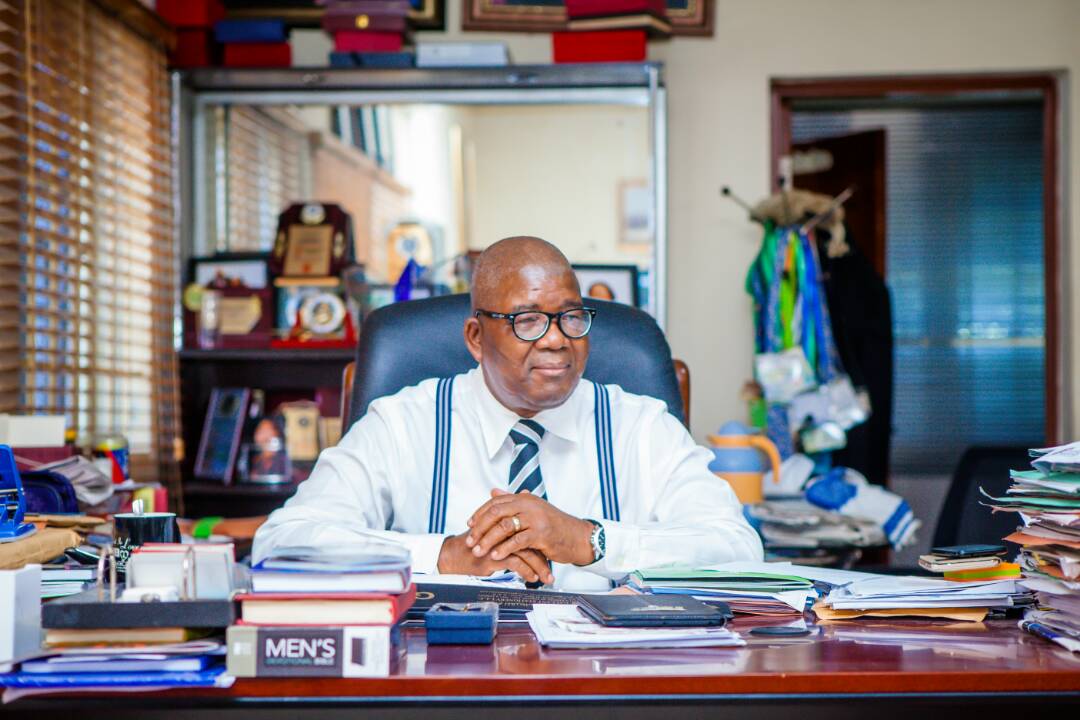
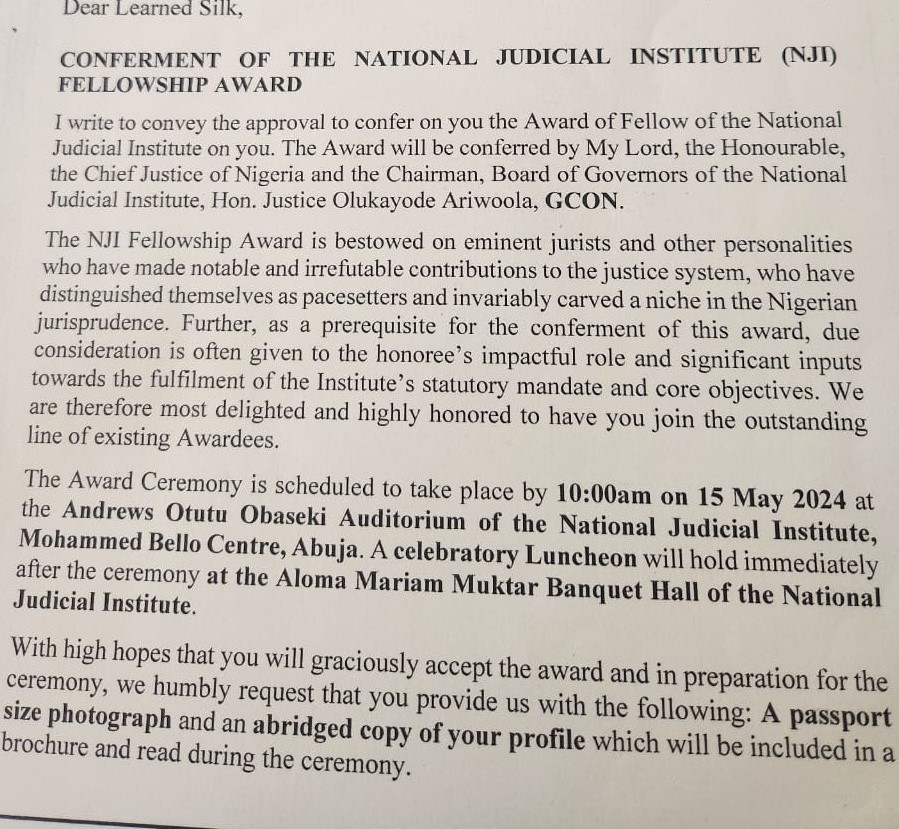
The Chief Justice of Nigeria, Hon. Justice Olukayode Ariwoola will at 10.00am today (15th May) confer the National Judicial Institute (NJI) fellowship award on the Chairman of Nigeria’s Body of Benchers (BoB) Asiwaju Adegboyega Solomon Awomolo, SAN.

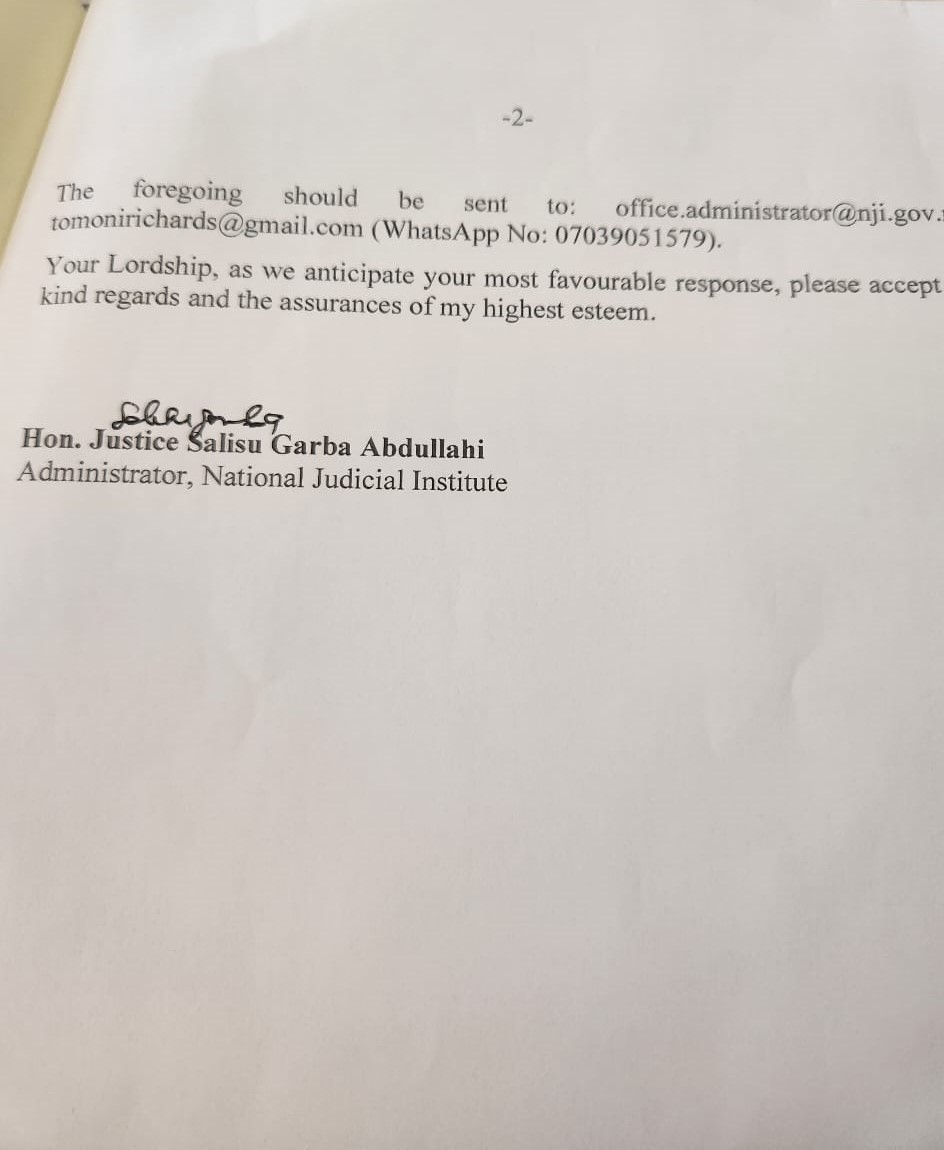
Details of the award which is bestowed on eminent jurists and personalities that have made notable contributions to the justice system was contained in a letter addressed to the Senior Advocate and signed by the institute’s administrator, Hon. Justice Salisu Garba Abdullahi.

IKB, top Igbo industrialist loses doctor son to drunken driver in the US

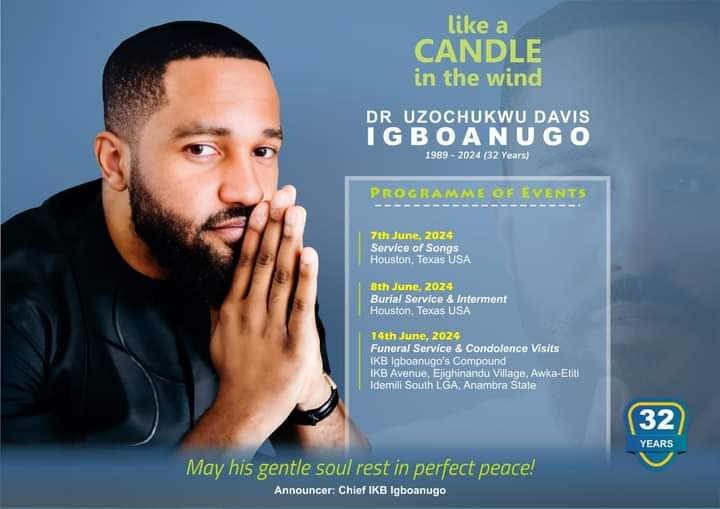
Notable industrialist, Chief Ikechukwu Igboanugo, of the IKB cosmetics fame has announced the death of his son Uzochukwu Igboanugo, a 32-year-old ophthalmologist , in the United States of America, USA.

Chief Igboanugo, whose IKB cosmetics range, particularly soap and skin lightening cream was very popular in the1980s/90s made the disclosure in a Facebook post on Monday.

The grieving father said Dr. Uzochukwu lost his life in a fatal car accident allegedly caused by a drunken driver.

He wrote, “I lost this my son 3 weeks ago, I have been crying like a baby. A medical doctor (ophthalmologist) in America.

“An accident victim of a drunkard who felt asleep while speeding on the highway, jumped his lane opposite direction and hit with speed force on the driver’s side door where my son was as he was driving home after work.

“We can’t question God as He has the final decision.”

The grieving father described his late son as “a very nice boy, always happy, intelligent, friendly, caring, loving, and sociable.”

Igboanugo said his late son wasn’t married as he “sacrificed all his time” to become a medical doctor. He added that he and his wife have been going through psychological trauma since their son’s death.

He wrote, “He was 32 years old, not yet married despite my nagging, he sacrificed all his time and achieved Ophthalmology which is a very difficult medical course in the history of reading medicine to become a medical doctor.

“Since his death, I have been going through mental and psychological trauma, as my doctor has been warning me. My wife also has not been herself.”

He further expressed the pain of losing a child, saying that even the worst enemy doesn’t deserve this kind of tragedy.

“Please don’t wish your worst enemy this type of tragedy, now I pray for anybody who has not lost his child never to experience it. It is hellish and a disaster.

‘Uzochukwu, my son, you are now in God’s bosom and working for Him; that was why he took you this early. As your soul will rest in God’s bosom in Jesus name,” he added.

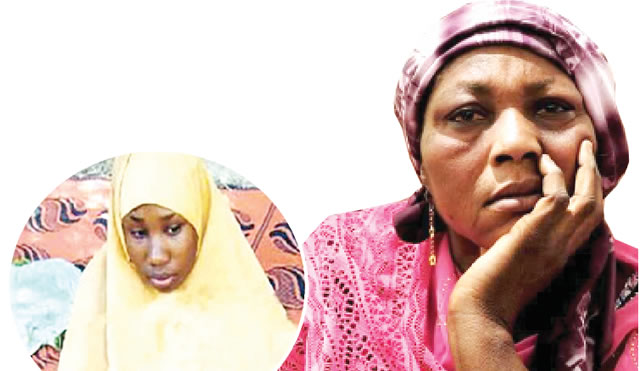
Leah Sharibu’s 21st Birthday: How Leah exercised her legal rights in captivity 

By Emmanuel Ogebe

On her 21st birthday, we were concerned to read media reports about captive Christian heroine schoolgirl Leah Sharibu. While most of the facts reported in the story is old news, including our world exclusive report on her birth of a second child in captivity, we’re troubled by the claim that Leah converted to Islam and was married, “According to a “repentant” terrorist, Sharibu first married Abdulrahman after converting to Islam and had a son with him.”

Our sources which include women who were fellow captives with Leah however said

“When she first arrived their camp, they gave her out to a certain commander who took her as his slave, but later on went ahead to free her and marry her.

After taking in for him, she asked for a divorce, because she was always fighting with his wives

She then married her second husband had a baby girl for him in May 2021.

But heard he passed sometime last year Abu Farahi Aka Ali Abdallah.”

The fact of the matter is that Leah was enslaved due to her refusal to convert to Islam and served a particular commander.

He was so impressed with her that he on his own volition decided to emancipate her from serfdom and then married her. 

However bitter conflict arose between her and his other wives who still looked down on her as an infidel even if she was now supposed to be their co-wife. Just like the biblical story of Joseph who found favor as a slave in Pharaoh’s commander’s house but got into trouble with his wife, Leah had a similar predicament.

Seizing on her coequal status as a wife and her matrimonial rights under the law, Leah who is a highly intelligent girl applied for divorce and therefore escaped from that toxic environment. 

It was a short lived victory because she was immediately taken by a high ranking commander as his wife in view of her status as a high value captive but at least her circumstances changed dramatically henceforth.

The military recently rescued  Chibok girl Lydia Simon with three children after 10 years in captivity. it is feasible that the military can rescue this global Nigerian icon too. We commend the military for their gallantry.

In addition to seeking her release by the Tinubu regime to show greater concern for Leah Sharibu, we ask for protection and relocation for her birth mother and siblings who were recently displaced during Easter by terror attacks near Sambisa. 

We call on FGN to reunite all rescued Chibok girls to their families and to provide full details of and access to information on total numbers of those rescued to resolve the needless and scandalous controversy of figures of those still missing.

We call on Kano state government to release the Du Merci orphans kidnapped over four years ago by the APC government who have still not been released till date despite full and total exoneration of the wrongfully persecuted humanitarian professor Solomon Tarfa.

Kano state cannot afford to be a running mate to Boko Haram terrorists in kidnapping schoolchildren like its predecessor.

We call on Nigeria to clear the air on false narratives that the CIA rescued 30 Chibok girls as published in a recent book “The Sisterhood: The Secret History of Women at the CIA” by Liza Mundy (Crown Books, October 2023).

Emmanuel Ogebe

US Nigeria Law Group

Washington 

Of randy lecturers and their students

By Zayd Ibn Isah

One of the worst things to happen to a country’s educational institution is to have teachers and lecturers who cannot tame their sexual urges around students. Surely, such a country’s educational system will end up breeding students who are not only vulnerable, but possibly dysfunctional and likely to continue the heritage of abuse and mediocrity. And why wouldn’t this be so, when such students were deprived of the safe and conducive learning environment which is the basic right of any student seeking enlightenment.

Normally, schools and other educational institutions, whether at primary, secondary, and tertiary levels, are supposed to be hallowed citadels of learning. Within them, students are trained and equipped with the tools needed for them to become leaders, critical thinkers, and agents of positive change in society. This ensures that beyond the walls of the school, students would have imbibed enough moral instruction to contribute to national development.

However, when these institutions are infiltrated by predatory lecturers who sexualize students for their depraved gains, campuses become jungles where only those who are ready to play by the rules survive, establishing a hierarchical sense of predatory dominance over helpless prey. As such, those who are not ready to submit to the whims and caprices of randy lecturers are frustrated, and their dreams of acquiring knowledge to better their lives quickly turn to ashes. When these things happen, the very essence of education is tarnished, trust in academic institutions is shattered, and the potential for meaningful learning and personal growth is gravely compromised.

Recent events unfolding in our tertiary institutions call for grave concern. Last month, a lecturer at the University of Nigeria, Nsukka (UNN), was caught in the act of trying to sexually molest a female student at the university. The predatory lecturer’s victim is even married, but this was of no concern to the lecturer, Mr. Mfonobong Udoudom. Although his act is no less severe regardless of the victim’s marital status, one would have expected the man to act more like a professional and shun the act altogether. But apparently, such reasoning and logic must have eluded Mr. Mfonobong Udoudom at the level of depravity he no doubt felt comfortably assured within.

The irony of the whole situation is that the lecturer works at the General Studies Programme (GSP) Unit of the university, where he teaches Peace and Conflict Resolution and Nigerian People’s and Culture. I wonder if he thought anything at all about what his actions could mean to the outside world, especially about the Nigerian people and our culture, by threatening to fail his student if she fails to yield to his sexual advances. Did he ever think on how, by pushing ahead with his evil agenda, he would have been implying that in Nigeria, part of the educational culture maintains that students must sleep with their lecturers in order to pass exams?

According to reports, the lecturer is notorious for sleeping with his students to pass exams. In fact, once he sets his interest in you, it doesn’t matter how many hours you spend reading his courses and attending his lectures; as long as you have not followed him to the other room for practicals, you are on your own. But as the saying goes, every day for the thief, one day for the owner. Even the king of the jungle runs out of luck eventually. And so it went for Mr. Mfonobong. It appears his alleged victim arranged with her husband and others to get the man into a trap, and part of the strategy was for her to play along. This is why, just when the lecturer thought his food was ready, the tables were turned against him and everything came crashing down hard.

“You can see. We have been following this case from day one. We have all the tracks, all the voice notes and everything,” a voice said in the background of the viral clip that was posted on social media to document Mr. Udoudomʼs disgrace.

This was the same strategy that was used for another predatory lecturer desecrating our citadel of learning. Mr. Theodore Shey, a lecturer at the Department of English and Literary Studies, Federal University, Lokoja, was caught in his house while trying to sleep with a female student. According to reports, the lecturer had been on his victim’s neck for sex, but the lady failed to yield. He failed her as a result. She reported the matter to her father, and she was told to play along. And that was how the cookie crumbled for Mr. Theodore.

There is a popular adage that if the hunter learns how to shoot without aiming first, the bird will also learn how to fly without perching. While it may seem that these predatory lecturers are beginning to get their comeuppance, it is quite unfortunate that we are still talking about sex for grades in our schools and that this is happening at a time when parents are encouraged to educate their girl-child to foster an environment of safety and respect. Our campuses are supposed to be a sanctuary for female students, not a jungle where predatory lecturers prey on their bodies.

Although there have been concerted efforts to tackle the menace of sex for grades by the government, at the wake of the BBC Eye undercover investigations into the activities of lecturers in both Nigerian and Ghanaian universities in 2020, The National Assembly passed a bill for the prohibition and punishment of sexual harassment by teachers/lecturers in tertiary institutions. Unfortunately, this law, like every other law criminalizing crimes in Nigeria, does not deter some lecturers from sexually harassing their students. According to a recent report conducted by Women Advocate Research and Documentation Centre (WARDC) with support from the Open Society Initiative for West Africa, the rate of sexual harassment in our schools remains high, and it is not just a case of lecturers to students; it is even more prevalent among students, likewise non-academic staff.

The report observed that, “There are different manifestations and prevalence of SGBV among different categories of people in the university community. All forms of SGBV are present on campus and with unacceptable frequency. The most prevalent forms are sexual harassment followed by rape. The main perpetrators of SGBV are predominantly students and academic staff, although it is also common for non-academic staff to sexually harass students during the admissions process and when securing accommodation. There is also grossly under-reported sex for promotion and other SGBV amongst staff.”

What this suggests is that a lot needs to be done to stem the tide of all forms of sexual harassment in our schools. There should be an avenue for victims to report incidents of sexual harassment without the fear of victimization. Those caught in the act of sexual harassment should be prosecuted to serve as a deterrent to others. Only through punitive measures can we maintain the sanctity of our educational institutions. And these recent incidents should not serve as an avenue for people to surface and blame the scourge of sexual harassment in schools as consequences of indecent dressing. Even if female students were to be restricted to the hijab in terms of dressing on campuses, corrupt minds would still fantasize, lust and scheme to perpetrate dastardly acts.

As much as students are expected to dress decently as a reflection of their duties within the school environment, staff should be held up to much higher standards of professionalism, morality and duty. If we must get things right and eliminate the malaise afflicting our learning spaces, everyone must be held to the highest standards and expectations. By doing this, excellence will thrive and mediocrity, along with inane depravity, will become a thing of the past in our educational institutions.

Zayd Ibn Isah can be reached via [email protected]

Fastest woman on earth! Tobi Amusan shatters old records!

Nigeria’s sprint icon Tobi Amusan is now the fastest woman on earth! She achieved this latest feat in the women’s 100m hurdles after running a world-leading 12.40 seconds.

In an exhilarating race, the world record holder secured the victory, leaving behind Danielle Williams, the world champion, who clocked her best time of the season at 12.46 seconds. Following closely was American Christina Clemons, claiming the third spot with a time of 12.54 seconds.

This triumph means the Nigerian athlete has now claimed the top spot globally, surpassing American Tonea Marshall’s previous record of 12.42 seconds set in late April.

Tobi Amusan’s impressive win arrives just two months before the Paris 2024 Olympics, setting the stage for an exciting competition ahead.

John Enoh, the minister of sports development, on his X handle congratulated Amusan over the feat.

“Take your flowers Tobi Amusan, you stormed to an emphatic win in the women’s 100m hurdles at the Jamaica Athletics Invitational, clocking a time of 12.40s (0.9), a World Lead time! You defeated World Champion Danielle Williams, who came 2nd in 12.46s, while Christina Clemons was 3rd in 12.54s,” he wrote.

“Tobi, you keep making our country proud. Paris Olympics is around the corner, your performance gives us hope just like others, that Nigeria is set to break a jinx. Keep soaring, we are proud of you.”

Recall the 26-year-old athlete recently set a new African record in the 60m hurdles event, clocking in at 7.77 seconds during the Astana Indoor Meet in Kazakhstan. This impressive feat shattered a record that stood for 25 years, previously held by Gloria Alozie.

With her exceptional performance, she is anticipated to lead the Nigerian team’s charge for gold medals at the upcoming Olympics, scheduled to kick off on July 26 at France’s national stadium.

Unveiling the Cultural Nexus: Exploring the factors underpinning gender-based violence in Nigeria

By Paulyn Owhievbie Ugbodaga

In the rich landscape of Nigerian culture, interspersed with terraces of tradition and heritage, lies a complex labyrinth of norms and beliefs that shape the lived experiences of its people. Yet, amidst the vibrant diversity of our nation’s cultural mosaic, a troubling reality persists: the pervasive scourge of gender-based violence (GBV). To truly understand this phenomenon, one must delve into the cultural underpinnings that contribute to its perpetuation.

At the heart of Nigerian culture lies a deeply entrenched patriarchal system, where power dynamics often favour men at the expense of women. From the Hausa-Fulani of the north to the Yoruba of the southwest and the Igbo of the southeast, patriarchal norms are deeply ingrained, dictating gender roles and expectations. Women are often relegated to subordinate positions, their voices silenced by centuries-old traditions and customs.

One such tradition is the concept of “gendered respect,” whereby women are expected to defer to men in all aspects of life. This cultural norm, rooted in notions of male superiority, can create a power imbalance that leaves women vulnerable to abuse and exploitation. Moreover, the stigma surrounding divorce and marital discord often compels women to endure violence in silence, lest they be ostracised by their communities.

Religion also plays a significant role in shaping attitudes towards gender and sexuality in Nigeria. Christianity and Islam, the two dominant religions, both espouse teachings that can be interpreted to justify male authority and control over women. This has led to the perpetuation of harmful stereotypes and beliefs that reinforce gender inequality and justify violence against women.

Furthermore, traditional practices such as female genital mutilation (FGM) and child marriage continue to undermine the rights and dignity of women and girls in Nigeria. While efforts have been made to eradicate these harmful practices, they persist in many communities, perpetuating cycles of violence and oppression.

The institution of marriage, revered as sacred in Nigerian culture, can also be a site of violence and coercion. The practice of bride price, whereby a groom’s family pays a sum of money or goods to the bride’s family, can commodify women and reinforce their status as property. This transactional view of marriage can perpetuate the belief that women are subordinate to men, laying the groundwork for domestic violence and abuse.

Moreover, the lack of economic opportunities for women in Nigeria exacerbates their vulnerability to GBV. In a society where men are often the primary breadwinners, women may be economically dependent on their husbands or male relatives, making it difficult for them to leave abusive relationships. This economic disparity can trap women in cycles of violence, with few options for escape.

Education also plays a crucial role in shaping attitudes towards gender and violence. In communities where girls’ education is undervalued, women may lack the knowledge and resources to challenge the status quo or seek help when they experience abuse. Furthermore, the absence of comprehensive sex education leaves many Nigerians ill-equipped to navigate healthy relationships and understand the dynamics of consent.

Addressing the cultural factors that contribute to GBV in Nigeria requires a multi-faceted approach that recognises the interconnectedness of tradition, religion, and social norms. It requires challenging deeply ingrained beliefs and stereotypes, promoting gender equality and women’s empowerment, and creating supportive environments where survivors can seek justice and healing.

As Nigeria continues its journey towards progress and development, it must confront the cultural roots of GBV with courage and determination. Only by dismantling the patriarchal structures that perpetuate violence and oppression can we create a society where every individual, regardless of gender, can live free from fear and violence.

#GBV

#GBVSurvivors

#ViolenceAgainstWomen

Paulyn Owhievbie Ugbodaga
[email protected]

TIPS