Home Blog Page 585

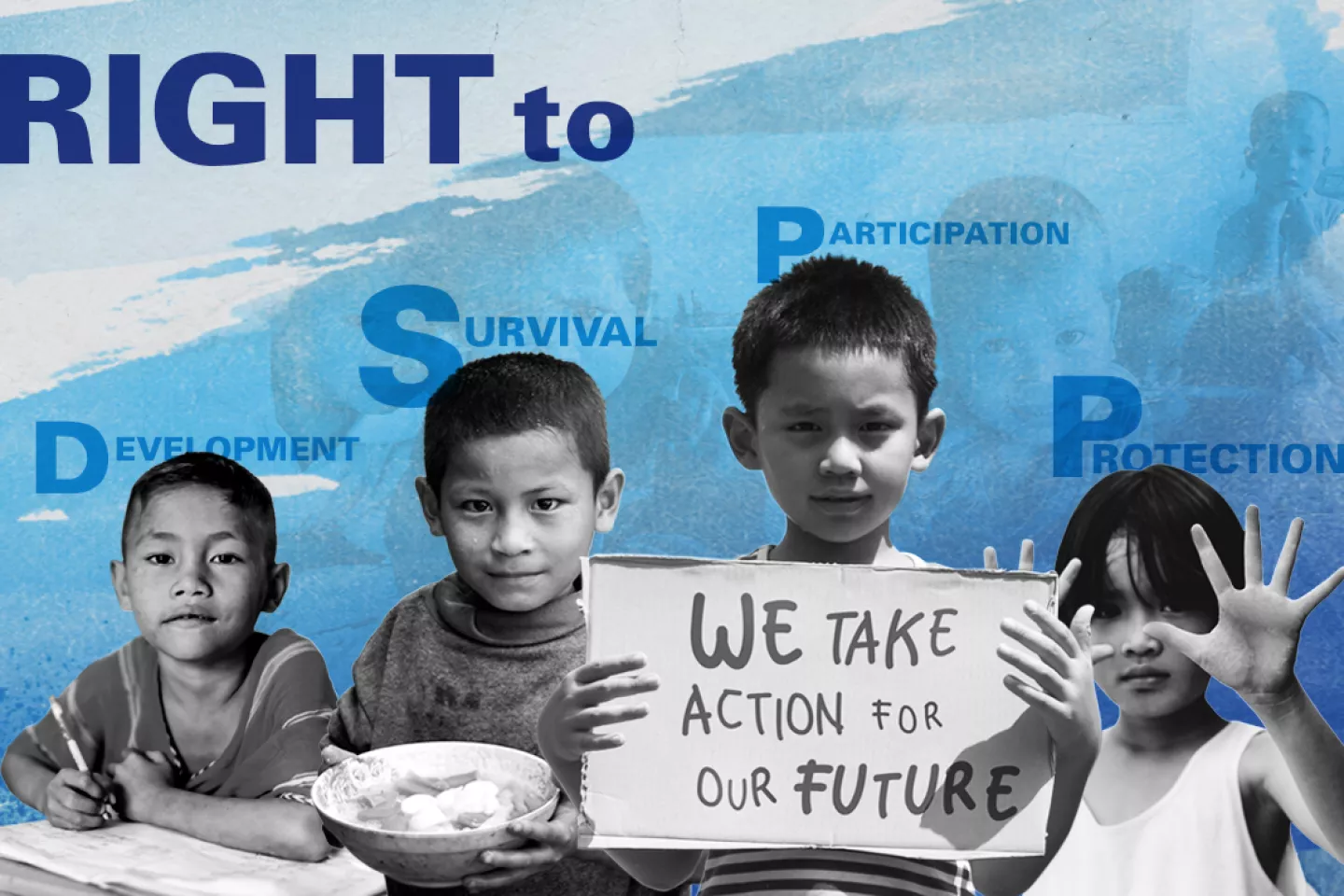
Children’s Day: Gov. Yusuf pledges to do justice in little Hanifa murder case

The Governor of Kano State, Alhaji Abba Yusuf has vowed to resurrect murder case of 5-year-old school girl, Hanifa Abubakar killed by her proprietor, Abdulmalik Tanko with the intent to follow case to a logical conclusion.

The Governor made this known during an event to commemorate the 2024 International Children’s Day Celebration in Kano on Monday.

Recall that a Kano State High Court has sentenced Tanko and his accomplice, Hashimu Ishyaku to death by hanging.

He however, vowed to ensure the deceased school girl get justice.

Governor Yusuf continued when he said the state is on the verge of declaring state of Emergency on Education to ensure quality education for children in the state.

“When we say State of emergency, we mean holistic approach such as free education, renovation of dilapidated schools and infrastructures among others to ensure quality education.”

The Governor also promised that in no distance time it will introduce free school feeding and free uniforms for school children between Primary one to three in the state.

Earlier, the State’s Commissioner for Women, Children and Disable, Hajiya Aisha Lawan, commended the Governor for his initiatives (free education for primary and secondary students as well as slashing of school fees by 50 per cent for tertiary students) with the aim to improve their Education.

On her part, the Speaker of the Children’s Parliament in Kano state, Hauwa Ibrahim called on the state Government to implement Child right act for the well being of Children in the state.

Vanguard

Woman remanded in prison with son over alleged N122m property theft

A Lagos based woman, Lola Muniratu Disu and her son, Ahmed Olasunkanmi Disu have been remanded at the Kirikiri Correctional Centre for allegedly stealing office property value at over N122milion belonging to Uccas Resources Ltd.

Justice Abimbola Awogboro of the Federal High Court, Lagos ordered their remand following their arraignment by the Police on a 14 count charge of stealing.

In the charge, the  Police alleged that Lola, Ahmed and others at large on June 25, 2021 at No 16 Lagos-Abeokuta Expressway, Magboro Bus Stop, Ikeja Lagos, conspired amongst themselves to steal the property belonging to Uccas Resources Ltd represented by it’s Managing Director, Ukata Christian.

The duo were also alleged to have forged a court order with the inscription ‘possession taken by court order on June 25, 2021’ with the intent that it would be used against Uccas Resources Ltd and its Managing Director, Ukata Christian .

Some of the property the defendants allegedly stolen from different sections of the company office,  include computers, office chairs and table, air- conditioners, printers, scanners, copiers, industrial water filters, heaps of undistributed copies of cargo news publication , confidential documents, midgets, internet routers, 2.9kva generator, fans etc.

One of the charges read: ”That you, Lola Muniratu Disu ‘f’, Ahmed Olasunkanmi Disu ‘m’, on the same date, time and place, within the aforesaid Judicial Division, did steal office properties of the Reception Desk: (a) reception tables with drawers valued .N650,000.00 (b) reception chairs valued N71,000.00 (c) Computer (CPU, monitor and printer; all HP Pavilion Tower Computers) (10 generation intel core, 17, 1.8GHZ):dual storage drive 256 (GB) valued N861,000.00 (d) HP 5 in 1 printer, scanner and copier valued N73,000.00 (e) Intercom connected to all offices:receiver valued N5,000 (f) office main line 012916425 (with handset) valued N45,000.00 (g) visitors memo booklet valued N700.00, total value of properties amount to N1,705700.00, property of Uccas Resources Ltd, represented by Ukata Christian, the MD/CEO.

Another charge reads: “That you, Lola Muniratu Disu ‘f’, Ahmed Olasunkanmi_ Disu ‘m’ on the same date, time and place, within the aforesaid Judicial Division, did steal office properties of the Marketing Cubicle Office: (a) Black table (folded with leather) and chair valued N210,000.00 (b) Computer (CPU, monitor & printer)-all HP Pavilion Tower computers general intel core, 17, 1.8-GHZ), dual storage drive 256GB valued N861; 000.00 (c) Printer HP 5 in 1 Printer, Scanner & Copier valued N73,000.00; Intercom receiver  valued N5,000 (d) Black table (folded leather and chair) valued. N210, 000.00, Computer (CPU, monitor & printer) all HP Pavilion Tower Computers: (10th general intel core, 17, 1.8 GHZ), dual storage drive 256GB valued N861,00; (c)-Printer HP S in 1 Printer, Scanner & Copier valued N73,000.00; intercom receiver valued N5,000; giant stainless industrial water filtration imported ‘from China -valued $33,000 US Dollars, on behalf of OK Food — Ibadan, equivalent to N24,750, 000.00.

The offences according to the Police are punishable under Section Section 390 (8)(c)&(9) of the, Criminal Code, Cap. C38, Laws of the Federation of Nigeria, 2004 (as amended).

After the defendants pleaded not guilty to the charges, Justice Awogboro proceeded to remanded them in prison pending the hearing and determination of their bail application.

Hearing for their bail applications has been slated for tomorrow May 29, 2024.

Nigeria continues to breach its obligation to protect, enforce, fulfill children’s rights—Ezeilo, SAN

By Joy Ezeilo, SAN

Happy Children’s Day!
As we commemorate yet another day of the year 2024 dedicated to children, I can’t help but reflect on the situation of Nigerian children. Unsafe schools and school abductions constantly threaten their fundamental rights to survival and development. This issue came to the forefront in 2014 with the kidnapping of the Chibok girls. Since then, our schools, streets, cities, and communities have become crime scenes, with children paying the ultimate price and being denied the right to grow up in a secure and loving environment. Child hawking, child labour, child trafficking, child marriage, and child abuse and neglect continue to occur without being effectively addressed.

On Children’s Day, I want to take a moment to think about girls who are victims or survivors of early and forced marriage. The recent reports of marriage sponsorship in Niger state lack details about whether those affected are under 18 years old. Undoubtedly, child marriage undermines the well-being and growth of girls, leading to a cycle of poverty, inequality, gender disparity, and violence, mainly targeting girls and women. When I talk to young people, I always say to them, “Education First, Marriage and Sex Much Later”.

It is unfortunate that despite Nigeria’s status as a State Party to the globally ratified Convention on the Rights of the Child (CRC) and the African Charter on the Rights and Welfare of the Child, and despite domesticating the CRC in the Child’s Rights Act and laws of almost all the states of the federation, Nigeria continues to breach its obligation to protect, enforce, and fulfill children’s rights. Of utmost importance are the rights to education, protection from all forms of exploitation, adoption of a minimum age for marriage, and consent to marriage when of an appropriate age, in line with international best practices.

Considering this and other recent happenings opposed to children’s advancement in Nigeria, all actors and non-actors must take accountability seriously by specifically leading actions to ensure the effective implementation of the extant laws on children’s rights 

All children in society, especially the most vulnerable children – street children, children with disabilities, children from poor economic backgrounds, rural children, and those living on the margins of urban cities – deserve a childhood free from hunger, pain, hate, or any harm. They deserve a childhood where their innocent curiosity is nurtured and not exploited and where they are not constantly at risk of becoming victims of insecurity, violence, harmful practices, and worsening economic hardship.

All hands must be on deck to safeguard the next generation and ensure their best interests are prioritized in all circumstances.

Happy Children’s Day!

Prof Joy Ngozi Ezeilo SAN, OON

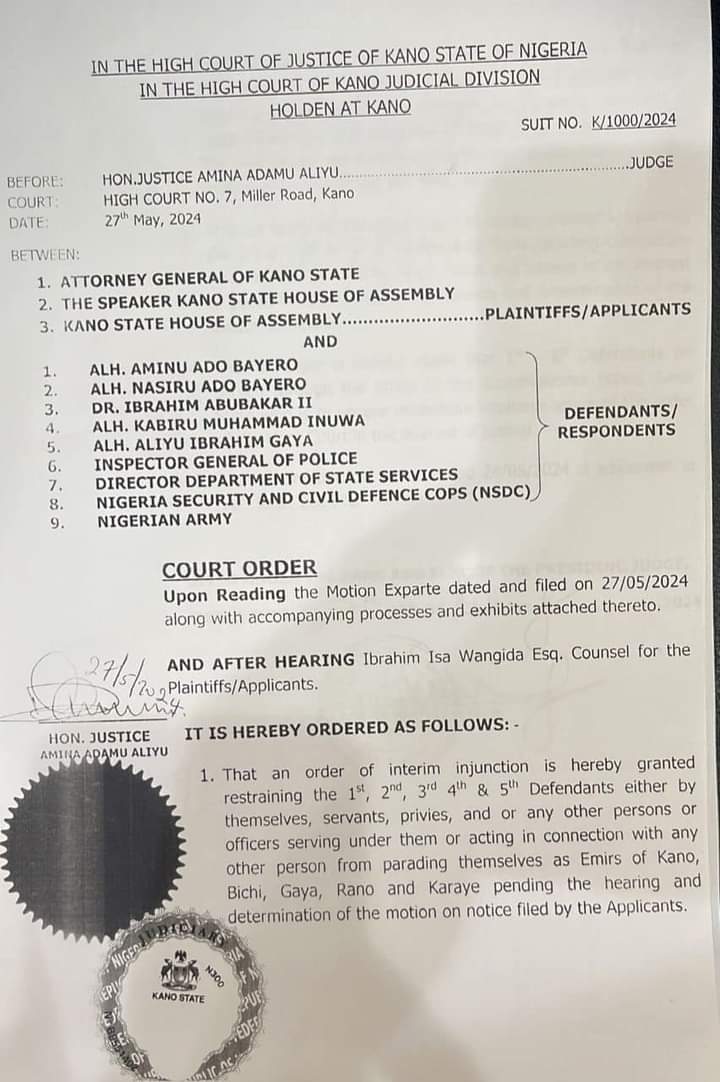
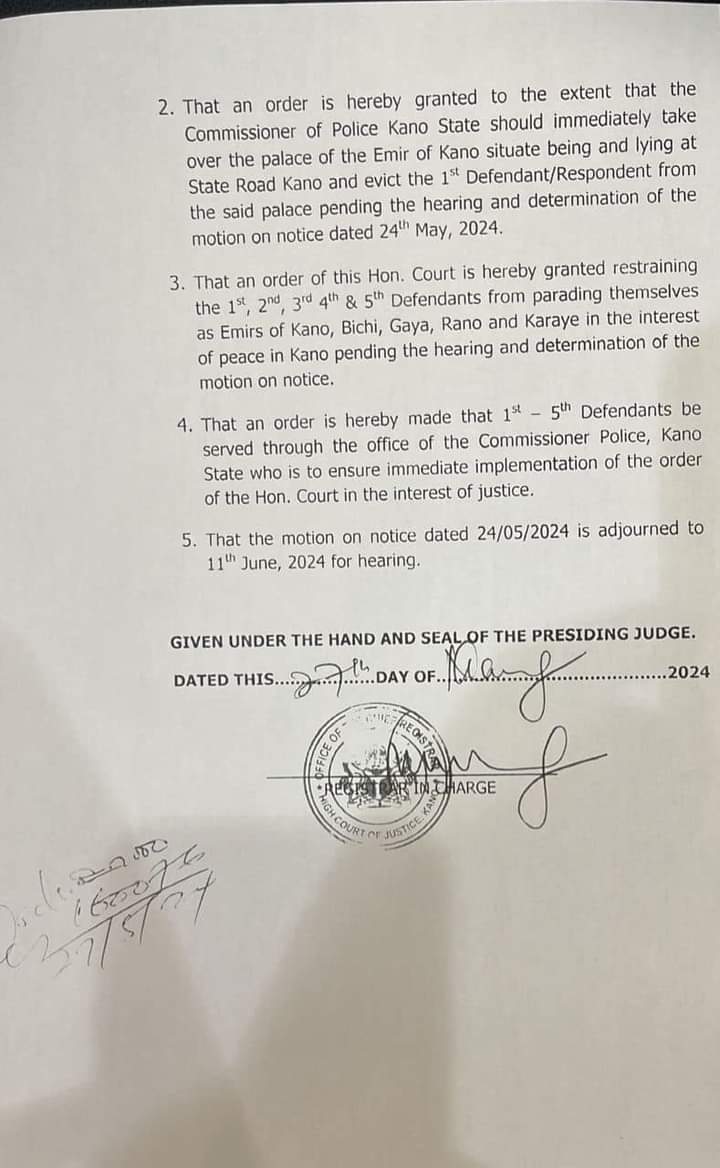
Just In: Kano High Court orders Bayero, others to stop parading as Emirs, Directs CP to take over palace

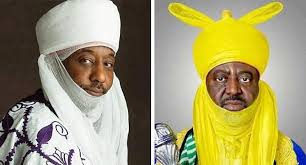
A High Court of Kano state has made an order directing Alhaji Aminu Ado Bayero to desist from parading as the Emir of Kano State.

Hon. Justice A. Adamu Aliyu in the order which directed four other defendants to stop from parading themselves as the Emirs of Bichi, Gyaya, Rano and Karaye pending the determination of the Motion on Notice filed by the Attorney General of Kano State, Speaker, kano State House of Assembly and Kano State House of Assembly, also ordered the Commissioner of Police Kano State to take over the palace immediately.

The order was made on Monday 27 May, 2024.

The controversial rulings Kano judge who issued order ‘from US’

By  Sodeeq Atanda

The ongoing inflammatory atmosphere in Kano State over the dethronement and re-enthronement of Kano Emirs drew much of its strength from a judicial intervention halting the execution of a new law enacted by the Kano State House of Assembly on Thursday.

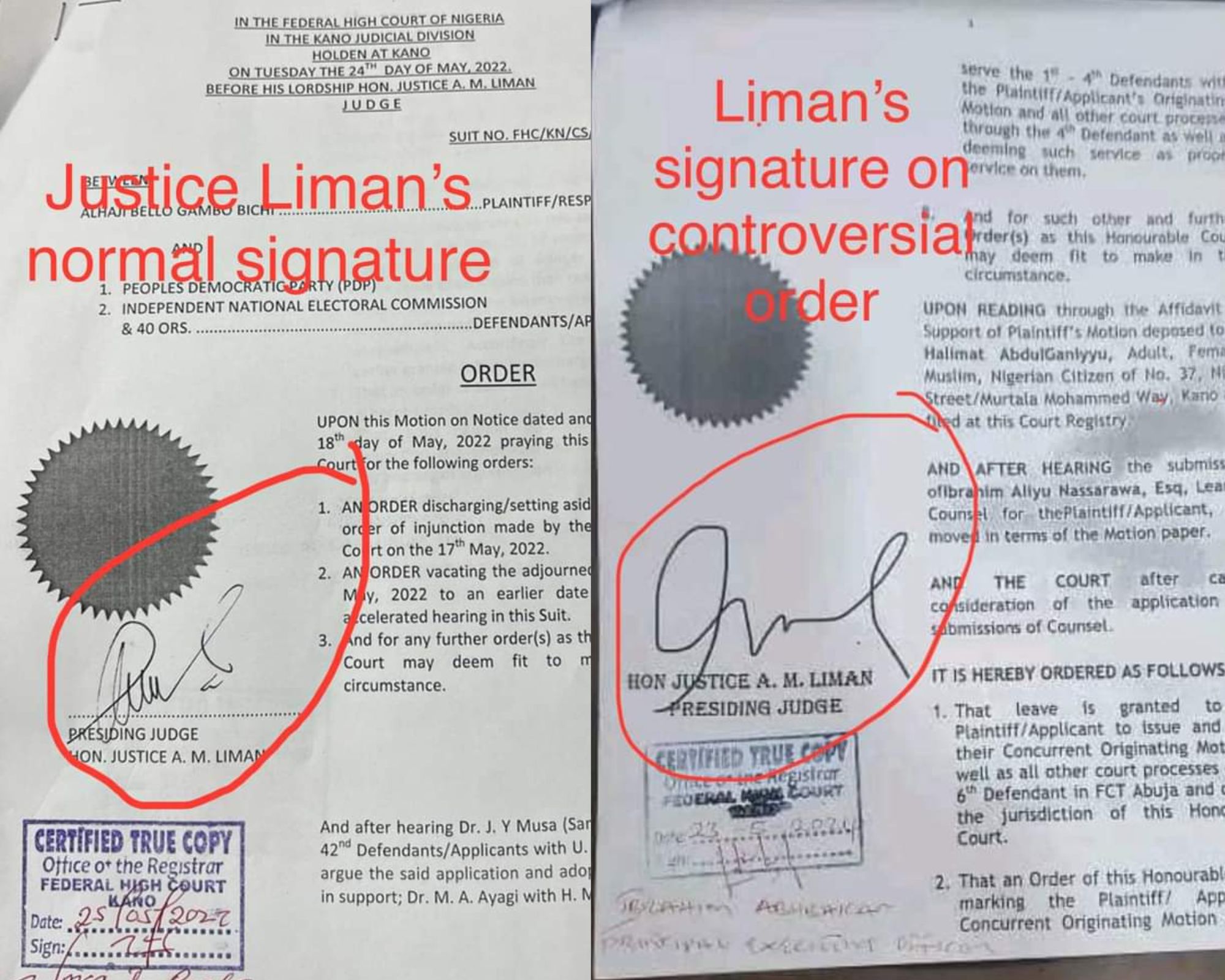
Justice Abdullah Muhammad Liman of the Federal High Court, Kano Division, had issued an interim injunction preventing the state government from dethroning all the five emirs in Kano, who derived their powers from the Kano Emirate Council Law of 2019. The judge ordered that the status quo be maintained.

Some legal practitioners have questioned the legitimacy of the judge assuming jurisdiction over a chieftaincy matter that is lawfully within the purview of state high courts alone.

Notwithstanding the order, the Abba Kabir Yuasuf-led state government moved ahead to dethrone the five emirs and re-instal Muhammad Sanusi, previously sacked in 2020, as the emir under one Kano Emirate Council.

Shortly after giving Sanusi his reappointment letter, Yusuf claimed that the judge was still in the United States when he issued the order. Describing the order as an abuse, Yusuf threatened to report Liman to the Nigerian Governors Forum.

“The person that issued the court order was in America but he is ordering us to stop what we are doing. This issue of abuse I must present it before the Governor’s Forum so that we can tackle it accordingly,” said the governor. “We are agents of following due process, that’s why we did what we did openly before everybody. Those that are meant to maintain that rule of law remains must follow that also.”

Over the years, however, Liman’s judgements and judicial actions have become a public issue, with some people accusing him of corruption and professional misconduct. He has spent some of his professional life defending such accusations and coming out unhurt. The National Judicial Council (NJC) recently dismissed a petition against him.

Below are some of his recent decisions that have attracted negative public reactions.

MICHAEL IGBINEDION’S N25B CORRUPTION CASE

In April 2015, Liman presided over a corruption case involving Michael Igbinedion, a younger brother to Lucky Igbinedion, a former Edo State governor, who had been accused of laundering N25 billion of state funds. Patrick Eboigbodin was the ex-governor’s brother’s co-defendant in the matter.

Liman was then sitting at the Edo division of the Federal High Court. He convicted Michael over three counts out of the 81-count charge preferred against him by prosecutors from the Economic and Financial Crimes Commission (EFCC). Michael was permitted to pay a fine of N1 million for each of the three counts rather than spend two years in jail.

Curiously, Liman denied Eboigbodin, a former aide to the former governor, the option of fine after finding him guilty on 10 counts. Not only was he sent to 20 years imprisonment, the judge further ordered him to pay a compulsory fine of N250,000. His conviction caused some Nigerians to ask why a principal criminal was allowed a fine and the co-offender wasn’t given such a fine. The fines were also considered ridiculous compared to how much they stole.

2016 DSS ARREST

In 2016, the Department of State Service (DSS) went all out arresting serving judges on account of sharp practices. In the ensuing exchange of words, the secret police claimed that Liman had $2 million cash suspected to be illicit money in his residence in Port Harcourt.

Nyesom Wike, then governor of Rivers State, successfully prevented the operatives from arresting Liman.

Hours after, the Nasarawa-born judge issued a rebuttal, claiming that the DSS missed their target and that he had never had such money in his life. He said he could “have abandoned this horrible profession that has lost its dignity” if he had such money. He admitted that he had a “notoriety for delivering controversial judgements; because the cases are also controversial and the stakes probably very high”.

PETITION BY PETERS OMORAGBON

In 2022, Peters Osawaru Omoragbon, the governorship candidate of the National Conscience Party (NCP) in the Edo State 2020 governorship election, publicly accused Liman of “misconduct and dereliction of duty.”

Omoragbon initiated a case before Liman’s court in Edo State in May 2020 against the Independent National Electoral Commission (INEC), and a ruling was subsequently fixed for December of the same year. According to Omoragbon, the said ruling had not been delivered more than one year after.

Omoragbon’s statement published by Vanguard read in part: “A case of misconduct and dereliction of duty against Honourable Justice M. Liman of the Federal High Court, Kano Division (formerly of the Federal High Court, Lagos Division) dated January 3rd, 2022 by Pastor Peters Omoragbon, Gubernatorial Candidate of the National Conscience Party at the 2020 Edo State Governorship Elections.

“The National Conscience Party instituted an Independent legal dispute against INEC and the AG of the Federal Republic of Nigeria on May 5, 2020, through Originating Summons with an Affidavit of Urgency. This case was not heard until October 13, 2020, where all the parties adopted their written submissions and judgement reserved till December 18, 2020.

Even though the bureaucratic bottlenecks constituted a stumbling block to my aspiration as Governor in the Edo State Elections, I was very hopeful that no matter the undue delay, justice would eventually be served. It must be recalled that prior to the Edo State Governorship elections in 2020, INEC had ignominiously deregistered some political parties including the NCP. This led to a series of legal disputes against the INEC and judgement awarded against INEC, some of which are pending rulings at the Supreme Court.”

Ladies and gentlemen of the Press, as at today January 3rd, 2022, the ruling that was to be given on December 18, 2020, is yet to be delivered by Justice M. Liman. I am constrained by circumstances beyond my control to call this press conference over the deliberate act of dereliction of duty by Honourable Justice M. Liman over the legal dispute instituted by our Party, the National Conscience Party against INEC and the Attorney General of the Federal Republic of Nigeria.

It was in the light of this abuse of office that I directed my Legal Team led by Barrister Marcus Eyarhono Esq to formally petition Justice M. Liman to the National Judicial Council for his dereliction of duty.

GANDUJE’S CORRUPTION CASE

In 2023, the Kano Public Complaint and Anti Corruption Commission was making plans to criminally sue Abdullahi Ganduje, a former governor of Kano State and now the national chairman of the All Progressives Congress (APC), over bribery allegations.

Daily Nigerian had published a video of Ganduje stashing dollar bundles suspected to be bribes collected from a contractor into his attire in 2018.

However, the same judge granted an all-encompassing interim restraining order following an ex-parte application to stop the state anti-corruption agency “from harassing, arresting, inviting, or detaining the Applicant (Ganduje) or his children, or any member of his family, or any appointee who served under his administration, or forcefully taking over properties of his children or any member of his family, or any appointee who served under his administration, pending the hearing and determination of the substantive originating motion”.

GANDUJE’S SUSPENSION

Two factions of the APC in Kano State suspended Ganduje from the party earlier this year. Both factions claimed that Ganduje was unfit to lead the party again, situating reasons for the suspension on the bribery allegations against him.

“We the leaders of the APC in the Ganduje ward, Dwakin-Tofa Local Government engaged in thorough deliberations and subsequently decided to suspend the erstwhile governor of Kano State, Abdullahi Ganduje, in light of the allegations of bribery involving foreign currency. It has come to our attention that Ganduje has been summoned to court to answer for these accusations, a development that we believe could besmirch the reputation of our esteemed political party,” Haladu Gwaju, the ward legal adviser, said on April 15.

“Because of this, we have reached a resolution to pass a vote of no-confidence on Ganduje and to collectively on behalf of all executive members of the APC in Ganduje ward, Dawakin Tofa to suspend him until he clears his name and that of his family in court.”

A week later, another faction led by Jaafar Adamu, issued another fresh suspension notice to Ganduje. However, a faction led by Ahmad Ganduje, threw its weight behind the former governor.

In trying to calm the political storm, Ganduje approached Liman’s court, and the judge issued a protective order in his favour. This was despite the fact that a state high court had earlier upheld the suspension.

Liman, who became a judicial officer on July 28, 2000, was born on February 11, 1959. Currently 65 years of age, he recently enjoyed the nod of the NJC to be elevated to the Court of Appeal.

Chidi Anselm Odinkalu, a legal practitioner and teacher, has faulted his appointment, however. He argued that, being less than five years to the 70-year retirement age for judicial officers, Liman was unqualified for the position.

But for the headline that was altered and the cover photograph, this article was originally published by Foundation For Investigative Journalism on 25 May, 2024.


Why Are Male Voices So Quiet ?

By Ireti Bakare-Yusuf

Yesterday, Punch posted a video of a young male student being beaten by other male students.
The school is Ajayi Crowther school, Oyo State.

Thankfully, Punch (or was it even Vanguard) did the right thing by warning viewers. Thus, I didn’t have to watch the video. A detailed detailed narrative was included in the body of the post. The boy was said to have allegedly stolen an iPhone.

The boy was beaten to death.

As a journalist, I have had to watch horrific videos in the course of my work. However, I can’t imagine the horror, the shock, and paralysing fear that that must have travelled through the brain of deceased as the beating continued, leading to loss of consciousness and his very last breath.

Alex Timileyin was someone’s child, too! A symbol of one mother’s love and one father’s hopes. According to social media reports, Alex is also said to be a prince from Warri.

Social media reports also claims that the perpetrators have all been expelled. That is not good enough.

Disturbingly, this most depraved murder has not made it to national news (not that I have seen anyway). Which makes me even more angry !!

Why the silence????

Had Alex been a female, women’s voices would be loud, rightly so. It is also likely that women will also be the ones to speak for Alex !!!!

While the responsibility for our children is our collective responsibility, why are Nigerian men quiet ? Why the heck are male voices not shouting loud for justice for Alex Timileyin??

Why is it that fathers, uncles, and brothers rarely lead these important social issues?

This is partly why our boys often have to default to self- help. The men who should speak for them are too busy doing God knows what.

JusticeForAlexTimileyin should be trending everywhere!

Do the right thing by sharing this post.

Alex Timileyin deserves justice !! May his young soul rest in peace. 🙏🏽

Sisioge 💔

Children’s Digital Rights vs. Parental Control: Striking a balance on Children’s Day

By B.C Obilor Esq.

As we approach this year’s Children’s Day celebration in Nigeria, it’s important to reflect on a crucial aspect of modern childhood: the balance between children’s digital rights and parental control. In an increasingly digital world, children are exposed to a plethora of opportunities and risks online. Understanding how to navigate these waters is essential for both parents and children.

Children’s Digital Rights:

Children’s digital rights encompass the right to access information, the right to privacy, and the right to freedom of expression online. These rights are protected under various international and national laws. For instance, the United Nations Convention on the Rights of the Child (CRC), which Nigeria has ratified, emphasizes the importance of protecting children’s privacy and their right to access appropriate information.

In Nigeria, the Child Rights Act 2003 aligns with these international standards, ensuring that children’s rights are protected in all spheres, including the digital realm. This act underscores the importance of protecting children from exploitation and harmful content while promoting their right to participate in digital spaces safely.

Parental Control: A Necessary Measure;

Parental control is essential for safeguarding children from the potential dangers of the internet. These dangers include exposure to inappropriate content, cyberbullying, and online predators. Parental controls can take various forms, such as monitoring software, setting time limits on internet usage, and educating children about safe online practices.

It must be noted that the importance of recognizing and protecting children in the digital space, cannot be overemphasized. However, the necessity of parental supervision to protect children from online harm cannot be ignored. Thus, it is humbly submitted that while children have rights to access digital information, these rights must be balanced with the need for their protection.

Finding the Balance:

Balancing children’s digital rights with parental control requires a nuanced approach. Here are some steps to help strike this balance:

  1. Open Communication: Encourage open and honest discussions about internet use. Children should feel comfortable sharing their online experiences with their parents.
  2. Education and AwarenessBoth parents and children should be educated about the benefits and risks of the digital world. Schools and communities can play a significant role in this education.
  3. Setting BoundariesEstablish clear rules and guidelines for internet use. These rules should be age-appropriate and evolve as children grow older and more responsible.
  4. Using Technology Wisely: Utilize parental control tools and software that allow parents to monitor and manage their children’s online activities without being overly intrusive.
  5. Respecting Privacy:While monitoring is necessary, it is also important to respect children’s privacy. Trust and mutual respect are crucial in maintaining a healthy relationship.

Legal Framework and Court Decisions:

The Nigerian legal framework provides a robust basis for protecting children’s digital rights while allowing for necessary parental control. The Cybercrimes (Prohibition, Prevention, Etc.) Act 2015 also plays a role in ensuring the safety of all internet users, including children, by criminalizing cyberbullying, online harassment, and exploitation.

Conclusion:

As we celebrate Children’s Day this year, let’s remember that children’s digital rights and parental control are not mutually exclusive but rather complementary. By fostering open communication, educating both parents and children, and using technology wisely, we can ensure that children enjoy the benefits of the digital world safely and responsibly.

This Children’s Day, let’s commit to protecting our children’s digital rights while providing them with the necessary guidance and supervision to navigate the online world.

For further discussions or to collaborate on child rights advocacy, please reach out to me at [email protected] or call 08069395552. Together, we can create a safer digital environment for our children.

Happy Children’s Day!

Moving away from kakistocracy

By Sonnie Ekwowusi

It is sad that the Nigerian democracy has been churning out undisciplined rabble and entrusting them with the sacred duty of governing the affairs of their fellow men and women. Whether we admit it or not, Kakistocracy (government by the least suitable or incompetent citizens) has triumphed in the land. This tragedy cannot lead to human flourishing. Until we reinvent Nigerian democracy or refashion it to suit our peculiar circumstances, we are simply wasting our time by creating opportunities for those who would steal political power and wreak havoc on the country.

If Nigerian democracy must yield the so-called democratic dividend, then it must have a national character that establishes the parameters and moral high ground on which it should operate to promote the well-being of the people. Devoid of character, politics and political activities in Nigeria, in the words of Frederic Bastiat, the French political economist and philosopher, are legalized plunder.

In all democracies, especially in presidential democracies, sovereignty resides with the people. At periodic elections and through other intervening periods, the people determine who should govern them and how they should be governed. Unfortunately, in Nigerian democracy, the reverse is the case: the people are at the receiving end, and mostly unfit leaders determine how they should be governed. Worse still, the people’s votes do not always count at periodic elections.

Democracy rests on many assumptions. One of those assumptions is that men have enough wisdom and virtue to pursue the promotion of the welfare of the people. However, viewed against the backdrop of history, men often lack the necessary wisdom and virtue to achieve this goal. Democracy is challenged from within by sheer ignorance and the pursuit of personal interests at the expense of the common good and welfare of the people.

Plato, in particular, was hostile to democracy because he feared that such powers and institutions would be imperiled under the watch of men with unruly passions and appetites. In his often-cited classic work, ‘Democracy in America’, French political scientist, historian, and diplomat. Alexis de Tocqueville writes that democracy bereft of equality of conditions is bound to gravitate towards despotism. To these thinkers, democracy is not synonymous with instant political and economic prosperity. That democracy liberates all men assumes that there are political leaders with high moral principles ready to navigate democracy to a safe harbor. Unfortunately, most democracies, including the Nigerian democracy, are not run by men with high ethical principles.

If Nigerian democracy is to yield democratic dividends, those communally binding ideals must hold sway. Alexis de Tocqueville once stated that a country cannot escape destruction if the moral tie is not strengthened in proportion to the political tie. Simply put, if we want to strengthen our democracy in Nigeria, we must first strengthen the moral tie because the latter gives rise to the former. In her essay, ‘A Disposition of Delight,’ Elizabeth Covey, an assistant professor of political science in the Honors College at Baylor University, writes that when the religious and social traditions of society wither, we are left “with nothing but a dry and gritty residue.”

We should understand that the political enterprise is not an end in itself; it is a process to render service to the people and promote the common good. The separation of culture from politics or public life in Nigeria has led to a palpable moral bankruptcy that has been hindering progress over the years. We say we are a democratic society, yet we have been steadily excluding from our policies those cherished values that make democracy thrive and lead to human flourishing. Gradually, we are building a country of people who may be materially rich but who are culturally very poor.

Totalitarianism is present in constitutional democracy as much as it is in military despotism. Simply put,

Africa’s Infrastructural Revolution/May ’29

  • Watch Video

By Richard Odusanya

Across the continent of Africa, economic growth and development have gained significant momentum in recent years. But with growth comes a challenge: building and funding the infrastructure to support it. Therefore, it throws-up some pertinent question: the first question which is where will the funding for Africa’s infrastructure come from? 

Secondly, with the Fourth Industrial Revolution (4IR) underway, another question that remains largely unanswered pertains to the extent to which Africa has positioned itself to take full advantage and the implications of the 4IR for Africa, given the capacity of the Fourth Industrial Revolution to change and shape the continent of Africa?

Third and most importantly, in all honesty, does Africa appear like investment destination of choice without Infrastructural Revolution? The three questions and perhaps many more are likely to be agitating the minds of our compatriots home and abroad.

Undoubtedly, Africa is in dire need of modern railway infrastructure to propel the continent to rapid development. In addition, transportation costs keep rising due to fluctuating fuel prices. Therefore, for the purpose of maximization in infrastructure, it is clear that there is a need for massive investment in key transportation areas, particularly, the rail sector in Africa. Railways are critical to creating continental value chains and trade corridors. 

As such, failure to achieve the set goal will be considered failure of leadership in Africa. Because railroads provide a means for goods to be transported from one location to another, as well as allowing for the transfer of information and knowledge across different countries in the continent.

Furthermore, efficient rail transportation in Africa, particularly, in these era of the Fourth Industrial Revolution (4IR). Railways has the potential to transform Africa’s economy, increase its productivity and enhance its global trade. In doing so, it would dramatically improve the wellbeing of African citizens. Study shows that the lack of physical infrastructure in Sub-Saharan Africa is still keeping many investors at bay. Let me share an example: the cost of transportation in Africa is on average 50 – 175% higher than other parts of the world as a result of poor infrastructure. 

Additionally, about 60,000km and 100,000km of new roads are required to provide effective intra-continental connectivity in Africa by 2030. The current pace of infrastructure development in Africa cannot keep up with rising demand from communities and markets, subsequently having an impact on Africa’s competitiveness and participation in global markets. Particularly, in these era of the Fourth Industrial Revolution (4IR).

Consequently, the poor state of infrastructure has led to the reduction of national economic growth by 2% annually in most African countries and as much as 40% reduction in industrial productivity. This means that with proper arrangements, railroads can help create regional integration, which in turn accelerates inclusive economic growth through increased efficiency and lower costs as the continent takes advantage of the 4IR.

Let me at this point reminiscence and flash back to May 29, 2023. In my contribution through an article that was specifically dedicated for the inauguration of the new government then with the title: “Nigeria We Hail Thee’ or ‘Arise O Compatriots” of which was widely published by local and international media organizations, the contribution was targeted at reawakening our consciousness as a people and as a nation. Thankfully, it received the attention of the government and a few days ago was passed to law by the Federal House of Representatives (HoR). 

Also, as a patriot, my prayers for President Bola Ahmed Tinubu (PBAT), which goes thus: “Today as the destiny of Nigeria is handed over to President Tinubu. I join my faith with millions of our compatriots home and abroad in praying for the wisdom of king Solomon, knowledge and understanding to pilot the affairs of the nation to heal the wounds, embrace all entities for a feel of inclusiveness and to move the nation to a progressive development” in this vein,   it is important to join hands together for the purpose of rebuilding hope and trust in ourselves.

Before I proceed, I need to be clear: Nigeria is currently experiencing its worst economic crisis in a generation, this is based on empirical evidence. One year down the line, Nigerians may still not have experience significant change. But, it is not all doom and gloom for Nigeria. For example, Nigeria’s Gross Domestic Product (GDP) grew by 2.98% (year-on-year) in real terms in Q1 2024. This growth rate is higher than the 2.31% recorded in the Q1 2023 and lower than Q4 2023 growth of 3.46%. ~ Nigerian Bureau of Statistics (NBS).

Lest I forget, Nigeria, at some point in history, was a country where foreigners used to come for medical and educational tourism in the 60s and 70s, has now become a shadow of its old self. Long-story-short: the foundation of where we are today, as a nation was recklessly laid by successive administrations through profligacy recklessness and corruption. Obviously, It didn’t start on May ’29, 2023. Yes, we made mistakes, but there’s no point in crying over spilled milk. We’ve got to move on, rebuild our nation from the ruins of the past. This is where the campaign about Mind Restructuring becomes inevitable.

Undoubtedly, Nigerians are going through tough times. However, the situation that we found ourselves, in all honesty are basically self inflicted. Yes! The nation is bleeding and there is hunger in the land. Somehow, there is great advantage for nations that produces good citizens and leaders, but, sadly, becomes a pipe dream for Nigerians. The attributes of good citizens and leaders are a combination that has eluded Nigeria for very long time. Even those who are not yet Presidents want to live in opulence without the commensurate effort at earning what is required for such a life! 

Therefore, it is time, for us to begin to interrogate issues with open minds. Somehow, those who are not Presidents, or governors, when making choices, mostly gravitate towards what they condemn. Those who live on others, as many Nigerians like to do, would live on the State if they get the opportunity. Because majority of our people want to live rich without the resources to do so, and then we complain about so-called leaders, who are nothing but a reflection of the society that raised them. This is the sad realities of our beloved country Nigeria.

In conclusion, and to further drive home the point of the Fourth Industrial Revolution, AFRICA’S INFRASTRUCTURAL REVOLUTION and the Nigerian DEBACLE. Permit me to share with you the profound words of Orji Uzor Kalu, the senator representing Abia North Senatorial District. Speaking on the floor of the Senate chamber, a couple days ago. OUK, eloquently posited: “If we don’t revamp the steel industry in Ajaokuta, Kastina, Alaja, Jos and Aluminum in Akwa Ibom, there’s no way we can talk of industrialization in Nigeria.”

OUK continued: “Aba and Nnewi has the human resources to engage in any form of manufacturing but the steels are not available. There is nothing that can stop Nigeria from dedicating a one year budget to rebuild our steel industries. The job creations we are always talking about lies in the steel industries.The country can be great if we do the right thing”

In my view, one of the right things is to improve upon the content and quality of our human capital especially at the low-income levels because, in the final analysis, they are the ultimate users of this infrastructure and can make or break them

Finally, I like to make specific reference to the speech of Yoweri Kaguta Museveni, president of the Republic of Uganda, who in an address to the ‘AFRICA HEADS OF STATES SUMMIT’ in a 19:06 video clip Museveni succinctly captured the essence of the Fourth Industrial Revolution in the African context and how best to reason and think developmentally.

Also, on this’d 25 May, ‘Africa day 2024.’ I am privileged and honoured to dedicate this article “Africa’s Infrastructural Revolution..” a day which commemorates the historic event in 1963, when African nations came together to form the Organization of African Unity, the precursor to the African Union (AU). It is a day to celebrate the many successes and progress made throughout the continent while recognizing each nation’s challenges.

Watch the video below.

Richard Odusanya, [email protected]

Edo State High Court jails man for life over rape

  • Remands another for allegedly defiling 11-year-old
  • Three to die by hanging for armed robbery, kidnapping and murder

A High Court of Justice in Benin City, Edo state has sentenced one Enaho Odigie to life imprisonment for rape.

In the matter prosecuted by S. E Okojie, M. I. Akhabue and E. Okunrobo, Her Lordship, Hon. Justice Mary Itsueli, of Criminal Court 4 delivered Judgement last week in charge No: B/CD/24CV/2021, State Vs Enaho Odigie and convicted Odigie.

Meanwhile, another Benin High Court on Monday ordered the remand of one Osasumwen Vincent, who allegedly defiled 11 years old in 2022.

Adjourning the case to June 10 for hearing, Hon. Justice Efe Ikponmwonba ordered that the suspect who was arraigned on one count charge bordering on rape be remanded at the correctional custodian centre, in Benin.

Vincent pleaded not guilty.

The state prosecutor, Hamma Iyamu, had disclosed that sometime in October 2022 at Ohovbe Quarters in Benin Juridical Division, the suspect forcefully had carnal knowledge of an 11-years old girl.

According to the prosecution, the suspect committed an offence contrary to section 4 and punishable under section 5 (1)of the Edo State Violence Against persons (prohibition) law, 2021.

“The suspect committed the offence in October 2022 at Ohovbe Quarters in Benin Juridical Division forcefully raped an 11-years old girl.

“The suspect committed an offence contrary to section 4 and punishable under section 5 (1)of the Edo State Violence Against persons (prohibition) law, 2021,” she said.

Also, three persons, Solomon Abuede, James Monday and Kelvin Edward, have been sentenced to death by hanging for armed robbery, kidnapping and murder in Edo State.

The sentence was handed over to the trio at the High Court in Benin by Hon Justice R. Irele-Ifijeh for the kidnapping and murder of one Ephraim Akhere in Ihumudumun Quarters, Ekpoma, the headquarters of Esan West Local Government Area of Edo State, on June 13, 2014.

The court also sentenced one Oviasogie Sunday to life imprisonment for receiving an Infinity Jeep with registration number EFR 218 FB, property of the late Akhere, which was stolen after his murder.

The offences are punishable under Section 3 of the Kidnapping Prohibition Amendment Law of Edo State 2013 and the Armed Robbery and Fire Arms Act.

They were among the six persons arraigned before Justice R. Irele-Ifijeh in suit number HEK/25c/24 on a six-count charge of armed robbery, kidnapping, conspiracy and receipt of stolen property.

Two others, David Williams and Monday Ozomo, were discharged for lack of evidence linking them to the armed robbery and kidnapping.

In a 91-page judgement made available to journalists on Wednesday, Justice Irele-Ifijeh said that the confessional statements of Solomon Abuede, James Monday and Kelvin Edward that they participated in the armed robbery were corroborated by the evidence of one Sandra, a prosecution witness who was in the same vehicle and kidnapped with the late Akhere.

Giving judgment, the judge said, “The kidnappers rode on a motorcycle, armed with dangerous weapons, kidnapped their victims and asked Akhere, the driver and Sandra to move to the back seat, and lower their heads, while Abuede took over the driver’s seat.

“They then drove to the bank; two of the kidnappers stayed with their victims inside the car, and the other went to the bank with an ATM card from Akhere to withdraw money from his account.

“From there, they were said to have driven to an uncompleted building where Abuede threw Ephraim into a well after giving him rat poison to swallow, while the girl was given the option of jumping into the well or eating the rat poison given to her.”

Solomon, who provided the rat poison, later spared Sandra’s life but raped her after she pleaded with him.

James Monday who was said to have provided the gun used for the operation and Monday Ozomo took the Infinity Jeep to Kano, where Oviasogie paid N420,000 for the vehicle out of the agreed N500,000.

TIPS