Home Blog Page 571

Tinubu’s reckless expenditure amid grinding poverty

By Sonnie Ekwowusi

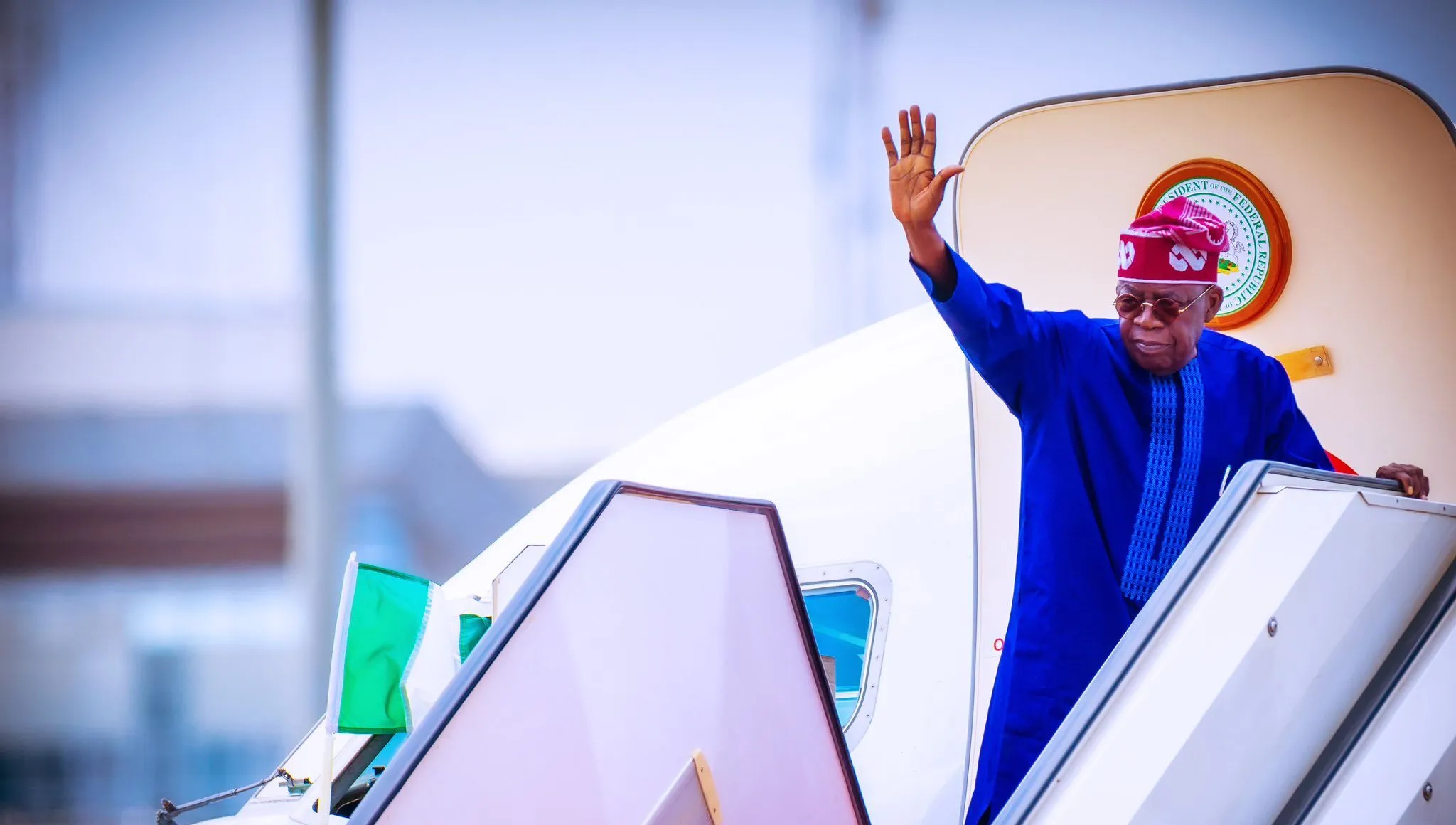
President Bola Tinubu has recently been quoted as saying that Nigeria is not the only country in the world afflicted by poverty. Mr. President made this statement when he received a delegation from the National Assembly who came to felicitate with him on the occasion of the last Eid-el-Kabir celebration. In other words, President Tinubu believes that the widespread public outcry about Nigeria’s high poverty rate is unnecessary because Nigeria is not the only country in the world affected by poverty. President Tinubu had earlier stated at the 55th International Conference, Exhibition, and Emerald Anniversary of the Chartered Institute of Personnel Management of Nigeria that poverty is not a shameful thing, albeit it is unacceptable under his administration. Because of this, President Tinubu is contemplating acquiring a new presidential jet to join his fleet of presidential jets.

However, the Labour Party has criticized Mr. President over his statement and his move to acquire a presidential jet. The Labour Party (LP) says it is disappointing that despite the excruciating poverty which Tinubu’s administration’s policies have unleashed on Nigerians, Mr. President is still underestimating Nigeria’s increasing poverty rate. The Labour Party implored the president to uphold the constitution he swore to protect, stating that under the 1999 Constitution, the security and welfare of the populace are the primary purposes of the Tinubu government. The Labour Party presidential candidate in the 2023 election, Peter Obi, has reprimanded Mr. President for contemplating purchasing a new aircraft to add to the existing presidential fleet. Mr. Obi described the move as unacceptable and a clear show of insensitivity to the suffering of the Nigerian people. “With rising insecurity, poverty, hunger, and homelessness, this decision highlights the disconnect that is apparent between the government and the people. It is unacceptable,” said Obi.

Mr. Obi also criticized the Tinubu government for completing the official residence of the vice president with $15 million at a time when the country’s dire economic situation is deepening. According to Mr. Obi, “the value of the official residence of the American vice president stands at about $7.5 million even though that country is the world’s largest economy. To elucidate further, despite dropping down to the fourth-largest economy in Africa, with a GDP of $252 billion and a per capita income of $1,080, with huge debt burdens and borrowing to service debts, we are spending $15 million for our Vice-President’s residence, while the USA, the world’s largest economy with a GDP of $25 trillion, about 100 times our GDP, and a per capita income of $80,000, about 80 times ours, still houses their Vice President in Number 1 Observatory Circle, a house built over 100 years ago, and whose value is less than the $15 million we are spending on our VP’s residence.”

It is obvious that President Tinubu, like his immediate predecessor in office, Mr. Muhammadu Buhari, is not in touch with the economic hardship in Nigeria. That explains why he is downplaying Nigeria’s burgeoning poverty rate and contemplating acquiring a new presidential jet. In case President Tinubu does not know, it is no longer news that Nigeria has overtaken India as the poverty capital of the world. What is perhaps news today is that Nigeria’s frightening poverty statistics, rather than diminishing, are increasing in large proportions day by day across the different states of the federation. The previous survey carried out by the National Bureau of Statistics (NBS) had acknowledged Nigeria as the poverty capital of the world with about 87 million “extremely poor people.” But in November 2022, the Multidimensional Poverty Index (MPI) survey carried out by the same National Bureau of Statistics revealed that no fewer than 133 million Nigerians, representing 63 percent of the population, were currently living in multidimensional abject poverty.

A breakdown of the poverty ratios in different geopolitical regions of Nigeria reveals that 65% of the Nigerian poor (86 million people) live in the North, while 35% (nearly 47 million) live in the South. Multidimensional poverty is higher in rural areas, where 72% of people are poor, compared to 42% of people in urban areas. Regarding the proportion and intensity of poverty, the poorest states in Nigeria are Sokoto, Bayelsa, Jigawa, Kebbi, Gombe, and Yobe. Sokoto State accounts for 91 percent of the multidimensional poverty in Nigeria, while Ondo State accounts for only 27 percent.

It is disheartening that while the citizens of Nigeria, who should ideally be the bedrock of a flourishing society, are finding themselves navigating a landscape marred by adversity amid the reckless expenditure of the Tinubu government, President Tinubu is contemplating increasing the fleet of his presidential jets. Those who argue that Tinubu inherited a worse economy from Buhari forget that government is a continuum. It is the same APC still in power. Even if Tinubu inherited an economic liability from Buhari, it cannot be cured with reckless expenditure. The pervasive and prolonged hardships that the people endure not only paint a bleak picture of a nation grappling with numerous challenges but also depict the failed hopes and dreams of the people. At the moment, the wasteful spending of the Tinubu government erodes public trust in the government. The citizens have become cynical about the government’s ability to address their needs and provide essential public services such as healthcare, education, and infrastructure development. This is sad.

In fairness to President Tinubu, he never promised to fix Nigeria upon coming to power. He merely stated that it was his turn to assume the presidency and follow in Buhari’s footsteps. Like Buhari, President Tinubu is ruling Nigeria as if it were his personal fiefdom. Instead of appointing his ministers to reflect the federal character of Nigeria and promote national unity, as stipulated in section 14(3) of the 1999 Constitution, President Tinubu prefers to surround himself with the same wheeler-dealers with whom he executed many shady deals during his stint as Lagos State Governor. Like Buhari, Tinubu is not subject to the checks and balances of the National Assembly. Why? Because the current National Assembly is also a mere rubber-stamp assembly. It cannot refuse Tinubu anything. For example, Senate President Godswill Akpabio (off the mic) is Tinubu’s man. Akpabio cannot refuse President Tinubu any deal. Like Buhari’s daughter, Tinubu’s son, Seyi Tinubu, flies the presidential jet. In their first 100 days in office, President Tinubu and Vice-President Senator Shettima have been indulging in an overspending spree. For example, the Federal Government spent a gargantuan sum of $507,000 on hotel accommodation for President Tinubu at the 78th session of the United Nations General Assembly. The irony of it all is that the same Federal Government, which cannot pay Nigerian workers a livable minimum wage, has spent a gargantuan N90 billion sponsoring the Hajj pilgrimage. I tire.

Amidst scarcity and economic hardships in the country, the Federal Government has purchased 360 exotic cars, each costing about N160 million, for the 360 members of the House of Representatives. You may recall that in August 2023, it was reported that the Buhari government was spending a huge sum of N16 billion to purchase exotic cars for Buhari’s 48-member cabinet, the largest cabinet in Nigeria since 1984. It is preposterous that amid the economic hardship in Nigeria, President Buhari retained a bloated cabinet, a bloated number of Special Advisers, and bloated special aides, among other things.

Like the Buhari government, the Tinubu government is also overspending and overborrowing money from abroad with little or no thought on how to repay the accumulating debts. Similar to Buhari, President Tinubu is also giving out subtle bribes, otherwise called palliatives, to the people in a bid to silence them. The Tinubu government plans to spend a whopping N3.27 trillion on palliatives alone. Like the failed Buhari palliative policy, the Tinubu palliative policy is already a failure. The policy is a drain, dishing out free money and bags of rice and beans to APC stalwarts and election riggers.

Meanwhile, prices of goods and articles in the Nigerian market are prohibitive. For example, ordinary shoe polish now sells for between N1,500 to N2,500. The most tragic is the simmering soaring prices of foodstuffs in Nigerian markets at the moment. When was the last time you went to the market to buy foodstuffs such as garri, rice, tomatoes, tubers of yam, egusi, pepper, eggs, and so forth? A mudu of yellow garri sells for more than N280, while a bag of yellow garri goes for N22,000. A mudu of beans now sells for N1,300. The price of sachet water, popularly known as pure water, is now N300 per bag. Meat is unaffordable. Ditto for fish. A long loaf of bread sells for N1,200. The smallest Agege bread sells for N35. Primary health delivery is in disarray. Essential drugs and medications are now so scarce and exorbitant. A bag of cement costs no less than N10,000. Some hospitals have shut down as most medical doctors continuously flee the country in search of a livable medical practice abroad. A bag of rice now sells for N88,000.

The logical question in light of the above is: why should Nigeria be entrapped in circles of endemic poverty despite her abundant natural and human resources? There is no doubt that failed leadership is the bane of economic development and growth in Nigeria. Therefore, to mitigate the consequences of the humongous wasteful expenditure, it is essential for the Tinubu government to adopt responsible fiscal policies, ensure transparency and accountability in financial management, and prioritize investments that contribute to sustainable economic development and the improvement of the well-being of the people. A nation’s greatness is measured not only by its economic and political standing but also by the well-being and contentment of its people.

The paradox is that, having finished squandering the national treasury in wasteful expenditure, the government is now desperately trying to borrow more money. Whereas if all the money squandered in reckless expenditure had been saved, they would have been enough more to pay workers a livable minimum wage and fix ailing Nigeria. Only prudent financial management contribute to the overall well-being and contentment of the people of Nigeria. Nothing else. During his tenure, Mr. Buhari had promised that his administration would “lift 100 million Nigerians out of poverty” but ended up putting more than 100 million Nigerians into excruciating poverty. Therefore, in the coming months, the Tinubu government is urged to implement and adhere to fiscal responsibility measures. It should identify and prioritize essential expenditures over non-essential ones. Anything short of this is carrying irresponsible government too far.

Kano Emirate imbroglio: No court registry is open by 5pm—Odinkalu

  • Insists Justice Liman owes Nigerians an explanation
  • The supreme court had held federal high courts lack jurisdictions on chieftaincy matters —Falana

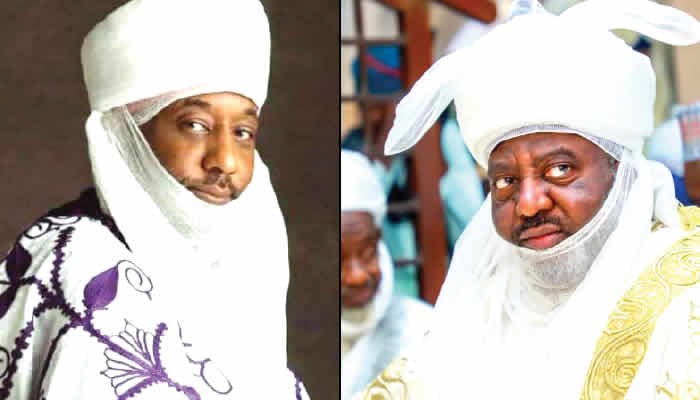
As some legal practitioners continue to question the legality of the Federal High Court’s judgment which nullified the reappointment of Muhammadu Sanusi II as the 16th Emir of Kano, law teacher, Ex Chair of the National Human Rights Commission and Pro Chancellor of Chukwuemeka Odumegwu Ojukwu University (CCOU) insists that the judge has a lot to explain to Nigerians as there are inconsistencies surrounding the filing of the suit.

Meanwhile, though the court declared the actions taken by Governor Abba Kabir Yusuf of May 23, 2024, as “null and void”, it stated, however, that its ruling does not affect the validity of the Kano Emirates  Council (Repeal) Bill 2024, which was passed by the Kano State House of Assembly.

Taking to his X handle, Odinkalu said: “The judge in Kano here claims he made an order on 23 May, 2024 via virtual proceedings in a suit concerning a law that was assented to at 17:10 hrs (5:10 pm) on the same day.

“The judge has to explain at what time the suit was filed because no court registry is open at that hour.

“The court then claims that “paras 3, 4 & 6 of the enrolled orders are not relevant to this application.” But those are where the judge recognized that there was a jurisdictional issue with his exercising powers in relation to a Chieftaincy dispute. How can they not be relevant?”

On Thursday, the federal high court in Kano nullified the decisions of Abba Yusuf, governor of Kano, taken on May 23, 2024.

Speaking in an interview on Arise TV on Friday, rights lawyer Femi Falana, SAN said the supreme court had ruled that federal high courts do not have jurisdictions on chieftaincy matters.

Muhammed Liman, the presiding judge, held that the defendants were aware of an interim order previously granted by the court but ignored it and implemented the Kano Emirates Council Law 2024.

The judge, however, ruled that his order did not affect the validity of the emirate law passed by the state house of assembly.

On May 23, the Kano governor announced the reinstatement of Muhammadu Sanusi as Emir of Kano.

The governor also ordered the dethronement of Aminu Bayero as Emir of Kano.

LIMITATION OF THE POWERS OF THE FEDERAL COURTS’

Speaking during the interview, Falana said the supreme court had issued two separate judgments limiting the powers of the federal court on traditional institutions.

The Senior Advocate of Nigeria said judgments of the supreme court are binding on all authorities in the country adding that the apex court had ruled that being a chief is not a fundamental right and issues of chieftaincy should not be entertained by a federal high court.

“The order is a bit confusing,” Falana said.

“But what is important, which the learned judge did not address in his ruling, is the convenient way in which two solid judgments of the supreme court on the limitation of the power of the federal high courts to interfere in the affairs of traditional institutions.

“It cannot be done via fundamental rights application. I listened to him, his lordship was talking about the need to respect the rule of law.

“In any country that loudly claims to pronounce and operate under the rule of law, the judgments of the supreme court are binding on all authorities.

“It is a mockery of the rule of law, if the high court judge decides to ignore or overrule the judgments of the supreme court.”

As it stands, the hopes of the two contenders to the ancient throne have been dashed since the Federal High Court’s verdict left both sides in limbo.

Between our govt. and New York Times

By Suyi Ayodele

The New York Times in its June 11, 2024, edition described Nigeria as a nation of 200 million citizens who are skilled at filling the gap for government. Let me quote it directly: “A nation of entrepreneurs, Nigeria’s more than 200 million citizens are skilled at managing in tough circumstances, without the services states usually provide. They generate their own electricity and source their own water. They take up arms and defend their communities when the armed forces cannot. They negotiate with kidnappers when family members are abducted. But right now, their resourcefulness is being stretched to the limit.” For writing this, our federal government thoroughly abused The New York Times at the weekend. It said the newspaper lied. You and I know it is the government that lied, denying the truth!

The piece, written by Ruth Maclean and Ismail Auwal, with graphics supplied by Taiwo Aina, is titled: Nigeria Confronts Its Worst Economic Crisis in a Generation. It dwells deeply into the ailments of the Nigerian economy under the Bola Ahmed Tinubu administration. It says: “People in Africa’s most populous nation are suffering as the price of food, fuel and medicine has skyrocketed out of reach for many. Nigeria is facing its worst economic crisis in decades, with skyrocketing inflation, a national currency in free-fall and millions of people struggling to buy food. Only two years ago, Africa’s biggest economy, Nigeria is projected to drop to fourth place this year. The pain is widespread. Unions strike to protest salaries of around $20 a month. People die in stampedes, desperate for free sacks of rice. Hospitals are overrun with women wracked by spasms from calcium deficiencies.” The newspaper knows where the problem lies. Again, I quote it: “The crisis is largely believed to be rooted in two major changes implemented by a president elected 15 months ago: the partial removal of fuel subsidies and the floating of the currency, which together have caused major price rises.”

The naked truth by the foreign newspaper drew the ire of the government. Rather than address the issues raised in the article, the government resorted to blame-game. Bayo Onanuga, President Tinubu’s Special Adviser on Information and Strategy, who responded on behalf of the government said that instead of blaming Tinubu for the current pains in the land, Nigerians should blame General Muhammadu Buhari, whose government, Onanuga accused of spending $1.5 billion monthly to defend the Naira! To Onanuga, and the presidency he represents, Tinubu should be absolved of all blames because he inherited the present economic problems from Buhari.

The above is the thinking in the circle of power. Everybody else must be blamed but themselves. I wonder what Onanuga was thinking when he penned all the incomprehensible verbiage contained in his rejoinder to The New York Times piece. What is the difference between Buhari and Tinubu? While Buhari was borrowing the “$1.5 billion monthly to defend the Naira”, what did Tinubu, Buhari’s godfather say? Or, if indeed, Tinubu made Buhari president, did he not have the responsibility of ensuring that his protégé did the right thing in government? During the 2023 electioneering, when Tinubu said that he would continue with the policies of Buhari, what exactly was he talking about? In the last one year, how much has Tinubu committed to support the Naira? When, about two months ago, Onanuga and other Aso Rock clappers said that we should thank President Tinubu for making the Naira to appreciate against the dollar, which magic did the president use then? What is the simple explanation of floating the Naira?

Nigerian government officials need neurological attention. I mean every alphabet in these words. I say so because I believe that most of them are suffering from auditory hallucination. Everyone in government appears to hear voices and noises that are not in tandem with the reality on the ground. The groaning in the land is too loud enough for the deaf to hear. But those in power hear something different, non existing reality! That calls for serious medical attention.

Medical experts are on the same page that auditory hallucinations are associated with schizophrenia and other mental health conditions. They explain it as “a disorder that affects a person’s ability to think, feel and behave clearly.” Nothing, in my opinion, aptly describes our leaders than this definition! If I were to be the only one to choose those who get to power, the first parameter I would set would be for all government officials, or would-be government functionaries to go for a mental health examination. When leaders are cut off from the reality of the situations of the masses, the poor in the society suffer. This is our case in Nigeria now. Those in charge of our affairs are far away in distant lands. They are as unfeeling as they are as unapologetic about their abysmal failure. The gap between the leaders and the led is too wide. In the comfort of their cozy offices, those in authority over us don’t feel the heat on the streets.

The current party in power got to the saddle over nine years ago. In the build-up to the 2015 general elections that produced this current administration under the banner of the All Progressives Congress (APC), Nigerians were so tired of the woeful outing of the then-ruling Peoples Democratic Party (PDP), such that they developed the cliché of “Anything or anyone but Jonathan.” A friend, who had since checked out of the country for second slavery in Europe because he could no longer cope with the crushing economic situation in Nigeria, told me then that if the APC fielded a goat against President Goodluck Ebele Jonathan (GEJ), he would go and vote for the goat. Truth be told, PDP, like we say in our street lingo here, nor dey give joy! So, when the APC threw up the most lethargic candidate in the person of General Muhammadu Buhari as its presidential candidate, some of us warned that the nation was heading for a calamity. Nobody cures a curse with another curse, we cautioned. But we were shouted down!

We need to settle this once and for all. Nobody, especially any adult in Nigeria, who witnessed the perfidy of the PDP between 1999 and 2015, would give a thumbs up for the party and the government it ran for 16 years. However, for anyone who was already an adult when Buhari first came to the nation’s political limelight in 1983, such a fellow would never wish for a second time of Buhari in power and in government.

But it happened. For eight solid years, Buhari, as the President and Commander-in-Chief of the Armed Forces, ruled over us. For those eight years, all Buhari did was to blame the PDP and its 16-year rule for virtually everything from the mundane to the most bovine issue. Sadly enough, Nigerians, especially most of the educated class, joined the blame-game wagon. Everything bad was heaped on the PDP, particularly, Buhari’s immediate predecessor, GEJ. From being named a clueless president, to his wife, Patience, being body-shamed by one of the most celebrated scholars in the Black race, Professor Wole Soyinka, Nigerians indulged Buhari as he sat in the Aso Rock Villa flat-footed!

The nation’s economy went from being bad to being completely comatose. The security architecture, one of the crosses upon which GEJ’s administration was nailed, completely collapsed under the watch of the Daura-born retired General. Buhari became President-do-nothing! He was so toneless that he could not even effect any change in his cabinet! His wife, Mrs. Aisha Buhari, at a time was so frustrated that she voiced out that her husband barely knew anybody in his cabinet.

Buhari’s era was an era of presidential absenteeism. He was nowhere; he did nothing, yet many things did Nigeria in! Nigeria was literally dead! All Nigerians got was the blame on the PDP for ruining the nation. Even when we argued that Buhari was ‘voted’ in to correct the abysmal performance of the PDP, the government clappers said that the damage caused by the PDP was such that it would take eternity for anyone to correct them!

Among the Buhari clappers of those ruinous eight years are members of this present government of President Bola Ahmed Tinubu. Tinubu was indeed the chief promoter of Buhari! So, when the Buhari era was fading out and a new round of elections was around the corner, not a few Nigerians warned again that the APC’s failures under Buhari must not be rewarded with another electoral victory. Granted that the PDP’s perennial presidential candidate in the 2023 general elections, Atiku Abubakar, is in no way different from the old PDP, the nation was presented with an alternative in the avant-garde Labour Party (LP), and its candidate, Peter Obi.

Unfortunately, sentiments came in and took the better part of us all! The major factor then was the silly political arrangement known as turn-by-turn, which the Tinubu campaign body nicknamed Emilokan! No other argument was allowed to flourish. The slogans being: “Tinubu made Buhari president. Tinubu ‘built’ Lagos. The man has paid so much for democracy. He has the magic wand. He uses technocrats and experts, bla bla bla!” Nigeria went to the February 2023 election a divided nation. The Igbo people outside the South-East became endangered species. The election was held. The rest is now history.

President Tinubu is in power today. He has spent one year and 20 days in office. What has he done differently from the past administration? Just as he promised to continue with the policies of his predecessor, Buhari, President Tinubu has taken the issue of blame game to the next level. Since May 29, 2023, when he assumed office as the President, Tinubu has blamed everybody else but himself for the woes that have been the lot of Nigerians in his over one year administration. A most interesting aspect of the blame game is that Tinubu’s tirades now are against his fellow party man and mentee, Buhari! For once, the PDP, and particularly, former President Jonathan, can now breathe fresh air of freedom. In any case, it would have been completely uncharitable of the Tinubu administration to turn to the PDP or GEJ as the proverbial scapegoats for the present economic tragedies.

There should be a limit to perfidy in government circles. I think government spokesmen should learn the art and act of communication. They should study the audience before emitting whatever they are asked to do. Methinks there is a problem with the guys handling Tinubu’s communication channel. The way they are going, a day will come when they will mistakenly blame the president himself. They have lied so much. There is nothing left in the bag of falsehood hanging on their shoulders. Where is Buhari, for God’s sake? On the moon, or he rubs disappearing cream every day? If he created the present woes, why not ask him some questions? And come to think about it: where is Tinubu’s famed strategy? Where is his legendary masterstroke? Why should the deity of success forsake him when it matters most?

Let this be my last shot at Onanuga and his fellow ranting gang in power. Nigerians are hungry, simple! They need food on their tables and in their bellies. Tinubu promised “Renewed Hope.” It is too late for him to change the narrative. He promised to fix the economy and make life more abundant. Anything short of that is an abysmal failure. Nigerians cannot differentiate between Buhari and his ‘maker’, Tinubu. To an average hungry Nigerian, APC is APC. They no longer remember the party called PDP; that is history.

Let the president get down to work. Nobody wants to listen to the story of how much Buhari borrowed every minute to support the Naira without telling us how much Tinubu is spending on the same improvidence. That na old tori! A very nauseating one for that matter! Nigerians don’t need anyone else to tell them that Buhari was a huge mistake! If the Onanugas of Aso Rock don’t have any plausible explanation to give on why their idol has been so pitiable in government, can we advise them to cut the cackle and just get us there!

Reviving the vanishing vernacular language


By Sonnie Ekwowusi

Recently, a lawyer friend in Lagos went to enroll his daughter in a primary school in Lagos. During the enrollment process, he learned from the vice-headmistress that speaking in vernacular languages was forbidden in the school. The pupils could learn to speak other foreign languages; they could mumble some French or German words, but they were flatly barred from speaking their native languages or mother tongues.

Outraged, or better put, scandalised by the strange school rule, my friend immediately discontinued the enrollment and proceeded to another school to enroll his daughter. The reason: he wanted his young daughter to be in touch with her Igbo roots.
This incident and others illustrate that vernacular languages are becoming dead languages because they are gradually ceasing to be spoken. If Latin is said to be a dead language, are Nigeria vernacular languages also becoming dead languages? The first set of Nigerians who came in contact with Western education loved their native tongues and anything relating to them.

With high oratorical power, most of them were proficient in both English and vernacular languages. For example, after obtaining the golden fleece from the United States in that early period, Zik remained a brilliant Igbo orator until death came calling. Armed with a certificate from the prestigious Oxford University, the late Ikemba Emeka Odumegwu Ojukwu was still one of the best Igbo speakers I knew before death came calling.

Cicero Bola Ige was distinguished for his eloquence in both the English and Yoruba languages. Chinua Achebe’s renowned novel, Things Fall Apart, highlighted the richness of Igbo tradition and culture. In fact, a reader of Things Fall Apart would think they were reading the book in the Igbo language. Achebe must have been thinking in Igbo when he penned down Things Fall Apart.

Unfortunately, nowadays, vernacular languages are dying or have died. Most parents living in big cities do not communicate with their children in vernacular languages. They proudly communicate with them in English. As far as they are concerned, English is a status language that befits their social standing.

This was not so in the past. In the past, parents insisted that their children spoke their native language first before venturing into learning and speaking English. In the good old days, most important books were constantly written in many Nigerian languages and dialects. I remember the Onitsha Igbo Market literature, a genre of popular Igbo literature, such as Omenuko (1963), Ije Odumodu Jere (1963), and Oguaamalam (1979). Today, there is a scarcity of new books in vernacular languages. Paradoxically, some literary works that had been translated into local languages were translated by foreigners enthused with Nigerian languages.

I think I have come across either a Yoruba or Igbo dictionary authored by a German. I remember seeing a dictionary entitled Dictionary of the Yoruba Language (1858) written by Dr S. W. Koelle, a German missionary. Also, there is an Igbo grammar textbook entitled: Igbotic: A Comprehensive Guide in Igbo Language. This Igbo textbook was written by a team of non-Igbo authors. Samuel Ajayi Crowther, a former slave who later became a bishop, was the first person to translate the Bible into the Igbo language. However, the first complete translation of the Bible into Igbo was done by Thomas John Dennis, an Anglican priest, between 1913 and 1917.

The paradox is that most young Nigerians born and bred in cities such as Lagos shy away from speaking their native tongues. They may be proficient in English, French, German, Spanish, and other foreign languages, but they can hardly utter a word or two of their mother tongue. Gradually, the vernacular language is becoming a language of villagers and never-do-wells.

The native name of a person expresses the essence and identity of the person and the meaning of their life. Through one’s native name, one communicates oneself and makes oneself accessible, capable of being known by others. Additionally, a person’s native name expresses something unique to that person and adequately represents his/her cultural identity.

Most native names also express societal beliefs anchored in the philosophical path of man towards God and the meaning of human existence. Two native names, which easily come to mind are: Madukaku (a person, ontologically, is worth more than wealth) and Ibukun Oluwa (blessing of God). Unfortunately, the native name has stopped being popular. Even the way some people pronounce their surname shows that they are not happy identifying with their ethnic origin.

Ask a typical Igbo child living in Lagos his surname, and he is likely going to Englicize it or “murder” it in such a funny way that completely obliterates the real meaning of the surname. This may be due to sheer ignorance or the deliberate effort to hide one’s ethnic origin to avoid unnecessary tribal hatred, stereotyping, or derogatory name-calling.

However, the greater blame goes to parents. The truth remains that most modern parents discourage their children from speaking their native tongue. They believe that it is a sign of progress or affluence to forbid their children from speaking their native tongue or getting acquainted with the cultural practices of their town. They enroll their kids in Ivy League primary and secondary schools in big cities where the speaking of vernacular languages is prohibited. Every summer, the kids are dispatched to Europe or America to spend the summer. Upon graduation, they send them abroad for their university studies. So, the young boy grows up without any clue about his language, culture, and roots.

Primary and secondary schools are supposed to act as foundations for fostering pride in indigenous language and culture. But most of our schools are not performing this vital function. I attended a secondary school where the speaking of Pidgin English and vernacular languages was strictly outlawed. The punishment for speaking the vernacular language was uprooting a tree in the school orchard. There was this particular Bini boy who could hardly open his mouth without speaking the only language he knew in the world—Edo.

I remember now with great nostalgia that while we were in the classroom studying, this boy squandered most of his study hours uprooting one tree or another in the school orchard as punishment for speaking vernacular. Even though the speaking of the vernacular language is no longer a punishable offense in most Nigerian schools, the fact remains that most students are losing interest in anything pertaining to their language or culture. Igbo, Hausa, and Yoruba have been included in our secondary school curriculum, but most students don’t take the study of these languages seriously.

Therefore, many people are worried. Even the authorities of unity schools are disturbed that many students are uprooted from their culture. To address this, the unity school authorities have organised a back-to-land programme for students, reminiscent of Marcus Garvey’s back-to-land movement. The aim of the programme is to take the students back to their respective ethnic homes to help them get acquainted with their culture and traditions.

A couple of years ago, Chinyere Ohiri-Aniche, an Associate Professor at the University of Lagos, expressed her concern about the vanishing vernacular languages. Worried that their children were becoming alienated from the Igbo language and culture, some members of Aka Ikenga, an Igbo socio-cultural group, recruited Igbo teachers to teach their children living in Lagos the Igbo language.
A few years ago, I visited a young Nigerian couple in Washington D.C. Before I could talk to their children, the man turned to me and said, “English is forbidden in this house. I don’t want my children to become Americans.” The couple communicates with their children in Igbo, they eat traditional Igbo meals, and they only watch Nollywood movies.

To prove how Nigerian the family was in D.C., the man’s wife briskly walked into the kitchen and later came out with akpu and ofe onugbu stacked with okporoko. While I busied myself “demolishing” the delicacy, of course with my “bare hands,” they put on the latest Nigerian movie for me to watch. I remembered my home. Before I left, the man insisted that their first son tell me his Igbo name. While the poor boy stood there racking his brain to remember his Igbo name, I said goodbye to the couple and finally took my leave. The father was disappointed with his son’s inability to remember his Igbo name. I was highly impressed that a Nigerian couple in the diaspora was trying to preserve their cultural identity.

Of course, promoting the vernacular language or native tongue in this age is a gargantuan task. The English language is not just a lingua franca; it is the medium of communication for great social, educational, and political ideas in our multilingual and multicultural society. In our global village, it also serves as the medium for transmitting great universal ideas. Those who want to move ahead with the rest of the world today are primarily interested in reading and writing in English, Spanish, French, Portuguese, German, etc., not vernacular languages.

To begin with, very few Nigerians still think in their vernacular language. More importantly, most of our daily business and transactions are conducted in English. So, there are few opportunities in a day to speak the vernacular language. Even the illiterate village woman grinding pepper along the road prefers to communicate with her customers in English. An unspoken vernacular language is a dead language.

That notwithstanding, the vernacular language must not die. I am always impressed seeing the Hausa security man in front of our office listening to the BBC (Hausa Service) every day with his small transistor radio. That man is a true son of his father. The native language preserves the identity of a people. It is also an eloquent expression of the existential value of a people.

People who do not speak their native language are people without existence. Europe and America are defined by their language and culture. We cannot be copying foreign languages and cultures wholesale and imposing them on our people. We are a different people. In an age plagued by eroding cultural values and vanishing identity, the native language remains the only thing which the new generation can hang on to in rediscovering their roots.

‘Heroes of democracy are in South Africa’

By Martins Oloja

After watching all the shenanigans, peccadillos, frills and thrills of the strange Democracy Day June 12, 2024 last week, I had wanted to write on the inconclusive list of ‘Heroes of Democracy” President Bola Ahmed Tinubu’s historians drew up and made public on May 29, 2024.

I wanted to deconstruct the list, which markedly diminished the democratic landmark as an event rather than a process. I intended to reveal from my June 12 “diary of a debacle” as Professor Olatunji Dare’s book on the subject calls it, and list more significant “Heroes of June 12 Debacle” that the Tinubu Government curiously forgot last Wednesday.

But the wind of our perilous time had after the June 12 self-glorification in Abuja digitally blown me to South Africa where I think we should share more significant lessons on how to nurture democracy for development at this time. That is where they have organic heroes of democracy. Or so it seems.

And so, I would just like us to join others to tell our leaders that South Africa has left us behind and we can’t continue deceiving ourselves with stale statistics and data that rebasing of the economy alone done so many years ago will continue to make us Africa’s richest economy without reforming our political culture.

I took my time to follow the South Africa’s elections as a process, not just the events of the last few days in their parliament. And I came to the conclusion that really that the people of Nigeria and indeed the elites must begin to build a consensus to restructure our political system away from this very expensive and opaque presidential system of government. Yes a presidential system that can easily facilitate state capture, which can render the majesty of the principles of separation of powers useless. This is not a reflection on systems of government that cannot work.

But from the democratic system I observed in South Africa last week, we are still far away into the wilderness. Interestingly, the South Africa’s organic law doesn’t have immunity for the president and the premiers. In their National Assembly, no powerful political leader can decide election of all the presiding officers. I think we need another Constituent Assembly that will lead us to a quasi-parliamentary system of government where even minority parties can shake table at a critical time of leadership recruitment.

The world has just witnessed a peaceful election in South Africa where there were no excuses of technical glitches. There was no serious allegation that political party primaries were marred by dubious processes and court injunctions. The election of presiding officers of the South Africa’s unicameral legislature was done with the involvement of the country’s Chief Justice inside the Chambers of the National Assembly. Despite their wealth and industrial and entrepreneurial power, they have only one chamber of the legislature. They also elect their regional premiers through a very simple and transparent process, no one disputes in court.

What is more interesting, there has emerged a national democratic culture of electing female speakers, sixth in a row, not through an affirmative action that some groups prefer. The female speakers have always evolved from sound education background and political party management experience and engagement.

I think we should swallow our pride and vanity to learn some lessons from South Africa that has emerged a clear leader of the continent. After last Friday’s conclusion of the election of the president at the National Assembly, the country’s president and regional premiers aren’t going to spend a dime from the country’s treasury on election petitions.

What is more, the election management agency isn’t going to parliament to ask for supplementary appropriation for by-elections and petitions. There will be no bill to the same parliament on how to set up electoral offences tribunal that will further blow up public expenditure. It is amazing how their democratic and governance institutions work for development.

The fact file:
It is all over the global media now that South Africa’s 2024 election holds key lessons for democratic maturity in Africa. The maturity of democracy hinges on the active participation of an informed electorate, the integrity of the electoral process and the willingness of political leaders to collaborate for the common good.

Doubtless, our leaders in Nigeria need to reflect on why not many Nigerians actually celebrated the so-called 25 years of unbroken democracy with them last Wednesday. All over the country, our leaders were just talking to themselves, making more promises the people knew would never be fulfilled.

In the elections in South Africa, which actually took place on May 29, 2024, the ruling ANC has lost its majority power in parliament but South African voters won. They now have an emerging Government of National Unity (GNU). One of the consequences of the new coalition government is that there will be a new deal in South Africa: South Africa’s ANC strikes coalition deal with free-market Democratic Alliance (DA).

The country’s second-largest party, DA agreed on Friday to support re-election of Cyril Ramaphosa as president and that is consequential. The ANC and the DA have agreed to form a coalition in which the former liberation movement and the pro-business party will set aside their rivalry in an historic governance pact. The ANC lost its parliamentary majority in 29 May elections for the first time since it swept to power in 1994 at the end of apartheid. Its vote share collapsed from 57.5% in 2019 to 40.2%, as supporters defected to breakaway parties amid chronic unemployment and worsening public services.

Final results in seismic South Africa election confirm ANC has lost majority position.

The free-market-supporting DA, which received almost 22% of the vote, thereafter supported Ramaphosa’s election by lawmakers for a second term. In the new deal, DA’s MPs also voted for an ANC speaker of parliament in return for the position of deputy speaker. The deal was successful on Friday night. An ANC-DA coalition was favoured by large businesses and international investors, with Ramaphosa expected to continue to try pushing forward policies such as allowing the private sector to generate renewable energy, which has contributed to a fall in power cuts.

Negotiations will continue this on policies and cabinet positions, Steenhuisen DA leader said, adding that the two-week period after election results that the constitution mandates for the election of a president was not long enough to reach a full coalition agreement.

Meanwhile, two smaller parties, the Inkatha Freedom party (IFP), a Zulu nationalist party, and the Patriotic Alliance (PA), which wants to bring back the death penalty and deport illegal immigrants, have also said they would join the government.

The inclusion of the IFP, which received 3.8% of the vote, is seen as a way to deflect criticism of the ANC for working with the white-led DA. The PA, led by the self-described reformed bank robber Gayton McKenzie, got 2% of the vote and has its support base in South Africa’s Coloured communities.

The ANC’s vote share collapsed in large part due to the new uMkhonto weSizwe (MK) party, named for the ANC’s armed wing during apartheid. It came a surprise third place in the election with 14.6% of the vote, just six months after it was launched by the former president Jacob Zuma in December, who has feuded bitterly with Ramphosa since being forced to resign the presidency in 2018. Ramaphosa’s call for a GNU, however, was in keeping with his cautious political approach, some analysts said, and positioned the ANC as inclusive, with parties that didn’t join excluding themselves.

Another lesson here is that the ANC faces tough decisions after losing majority. But in Nigeria’s presidential system, you can lose majority and still win with our constitutional provision as long as the highest court in the land can confirm your victory. Thereafter, the winner takes all (the decisions) and a compliant National Assembly can confirm anything for even a reckless executive head. Now in South Africa’s constitutional democracy, the party without a majority will have to pick coalition partners and then try to reform itself in response to declining support. After losing majority, this is how conciliatory Ramaphosa sounded after losing majority:

“Our people have spoken; whether we like it or not, they have spoken,” he said, adding that South Africans expected political parties to work together and find common ground….”
There is no protection for an incumbent president in South Africa. And so we can recall what led to the fall of Jacob Zuma:
A judicial inquiry alleged that Zuma fired competent officials, appointed loyal ministers and influenced the awarding of large contracts while he was a leader from 2009 to 2018. The deal was to benefit the Indian businessmen brothers Atul, Ajay and Rajesh Gupta, the 2022 Zondo commission report said, in a scandal known as “state capture”. Zuma, 82, who has waged a bitter feud with Ramaphosa, 71, since being ousted as president by the ANC, is due to go on trial next year on charges that he took bribes from the French arms manufacturer Thales in 1999. Zuma pleaded not guilty in the Thales case and has separately said the “state capture” allegations were part of a conspiracy against him.

In 2022, President Ramaphosa was under mounting pressure to resign when an inquiry found evidence that he might have committed serious misconduct in relation to a large amount of cash stolen from his game farm in 2020.

Trouble began when a South Africa’s former spy chief, Arthur Fraser, walked into a police station in June and accused Ramaphosa of money laundering, corruption and covering up a large theft of cash. In a sworn statement, Fraser said thieves had raided Ramaphosa’s Phala Phala game farm in February 2020, found at least $4 million in foreign cash hidden in furniture, and made off with the money. Police opened a criminal investigation into the case after Fraser’s statement, which raised questions about how Ramaphosa had acquired so much cash and whether he declared it. The media dubbed it the “farmgate” scandal. Ramaphosa was later cleared of the allegation.

As for Nigeria where it is well known that systemic corruption has produced the wealthiest people from a tribe of former political office holders, none of its former leaders is facing corruption charges. There is a curious immunity clause in Nigeria’s constitution for serving President and Governors of the 36 states of the federation. What is worse, no anti-graft agency can try former leaders for allegations of corrupt practices after leaving office. Any wonder then that South Africa is a member of the influential G-20 and BRICS (now expanded) and Nigeria isn’t.

Should we be surprised too that the giants we worship in Nigeria, Multi-Choice and MTN are from South Africa? Is there any more doubt that there can be nexus between good democratic governance and development? Let’s hail the authentic heroes of democracy in Africa👌👌

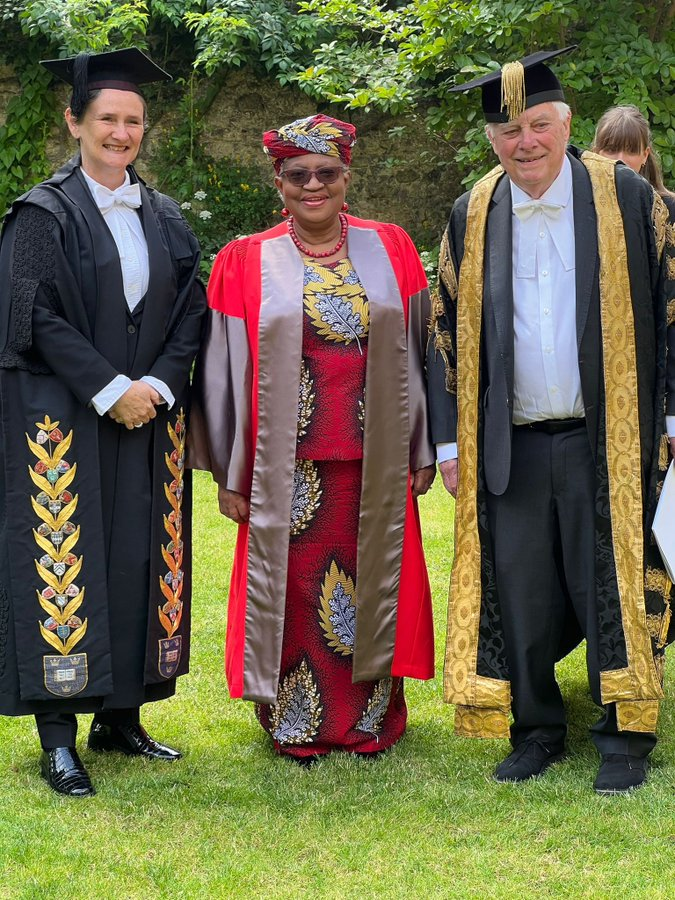
Photo News: Oxford confers Okonjo-Iweala with honorary Doctorate

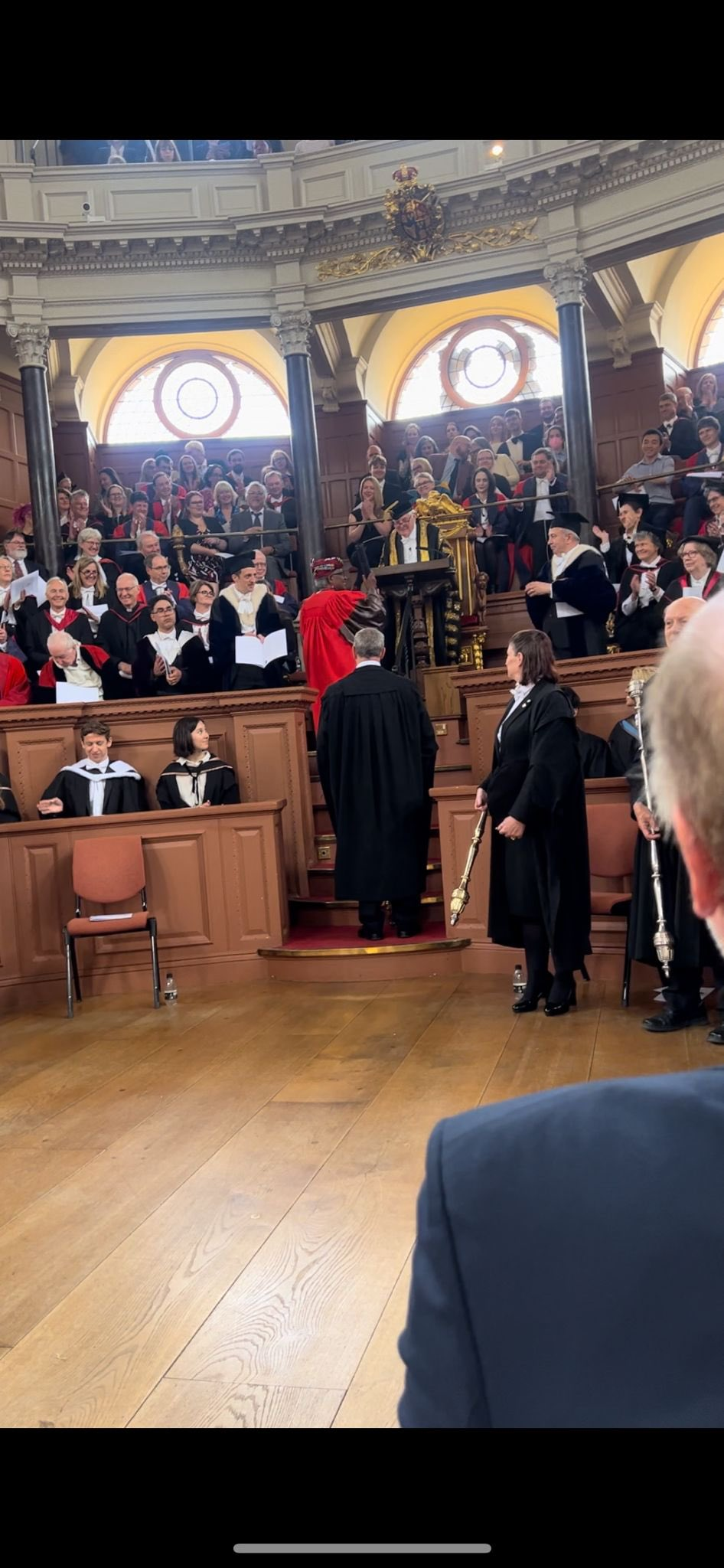
The Director-General of the World Trade Organization, Ngozi Okonjo-Iweala has been conferred with an honorary doctorate degree by the University of Oxford.

Sharing the exciting news via her X handle, Okonjo-Iweala who is the first woman and first African to lead the World Trade Organization as Director-General said:

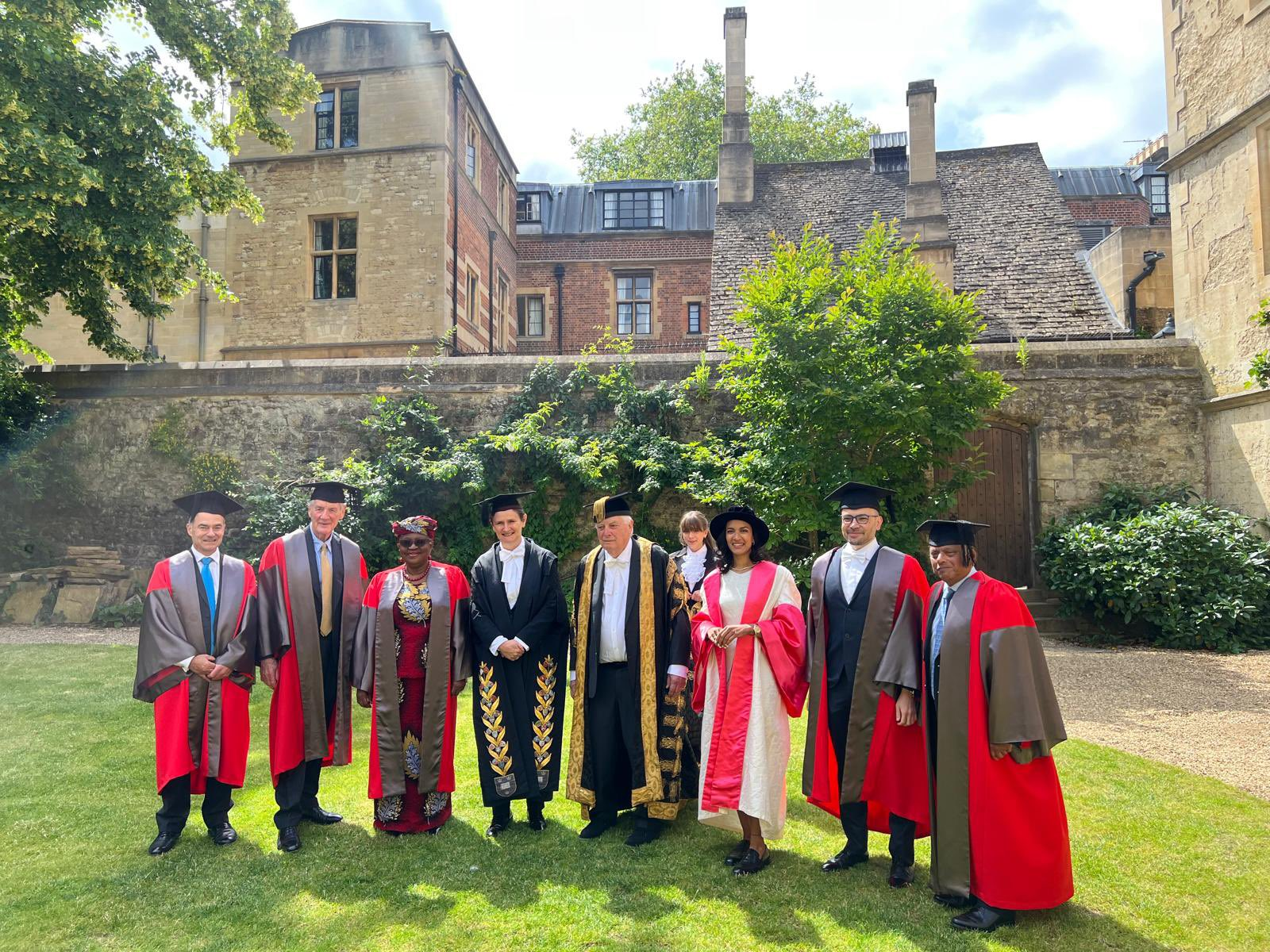
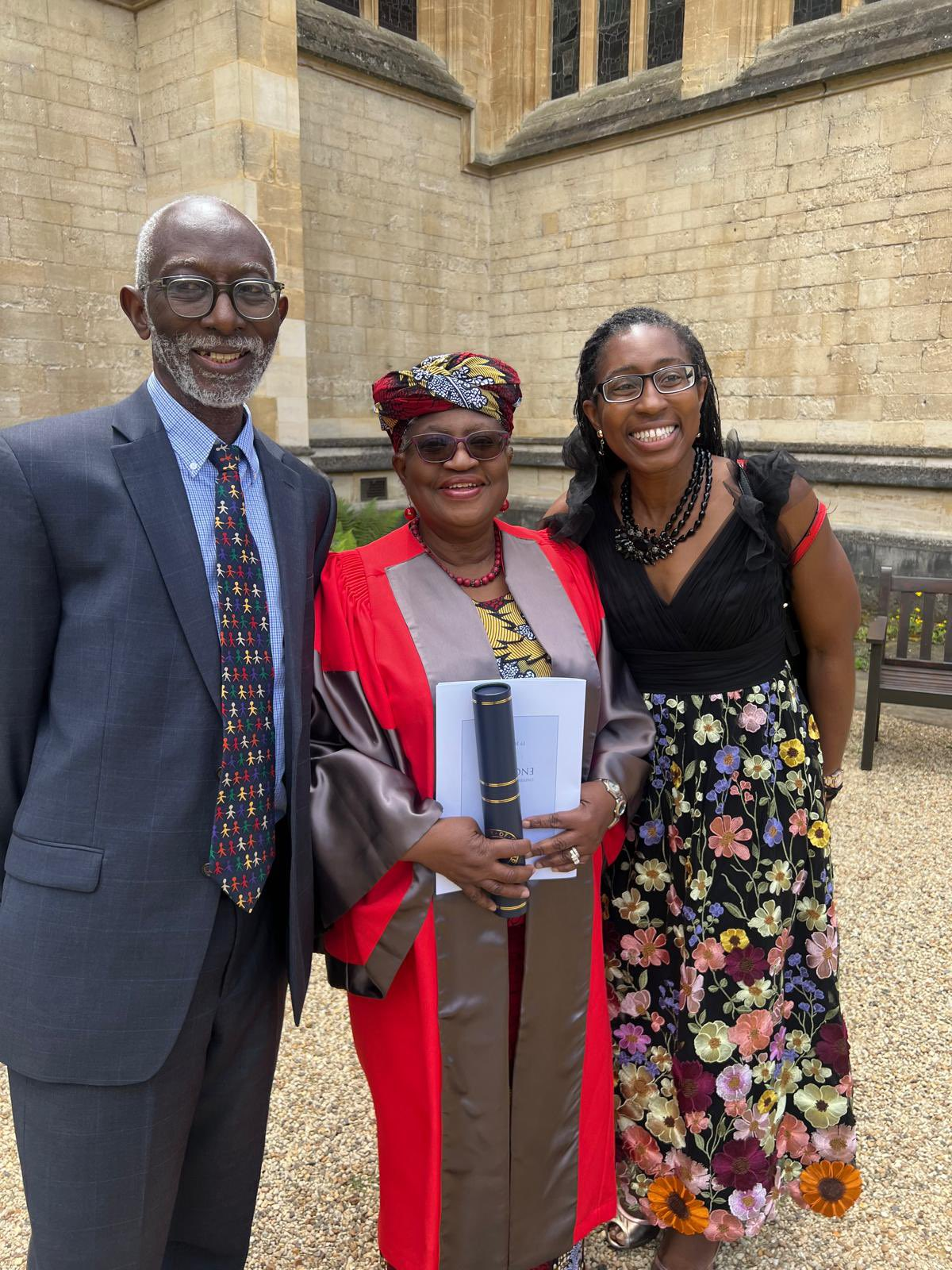
“A great honor to be recognised today by Oxford University with the Honorary Degree of Doctor of Letters (D.litt. honoris causa). A marvellous ceremony at the Sheldonian Theatre followed by receptions at All Souls and St Johns Colleges. With Chancellor Lord Christopher Patten and Vice Chancellor Dr. Irene Tracey and the other 5 Honorands- Sir Michael Palin, Warren East, Sir @demishassabis, Professor Salim Yusuf, and @ShankarAnoushka. Also with my husband, Dr Ikemba Iweala and my daughter, Dr. @onyiiwealamdphd.”

With the other 5 Honorands- Sir Michael Palin, Warren East, Sir @demishassabis
, Professor Salim Yusuf, and @ShankarAnoushka

With husband, Dr Ikemba Iweala and daughter, Dr @onyiiwealamdphd

Born 13 June 1954, Okonjo-Iweala served twice as Nigeria’s Finance Minister (2003–2006 and 2011–2015). She acted briefly as Foreign Minister in 2006 and was the first woman to hold both positions.

During her first term as Finance Minister in the administration of President Olusegun Obasanjo, Ngozi Okonjo-Iweala spearheaded negotiations with the Paris Club that led to the wiping out of US$30 billion of Nigeria’s debt, including the outright cancellation of US$18 billion.

When children become liabilities

By Olusegun Adeniyi

Last week, Governor Abba Kabir Yusuf painted a pathetic picture of the state of primary education in Kano. “Above 4.7 million pupils are sitting on bare floors to take lessons while about 400 schools have only one teacher for all classes subjects and all pupils,” said Yusuf who put the current figure of out-of-school children in the state at 989,234.

Not surprisingly, he blamed his predecessor, Abdullahi Ganduje for the problem. “Rather than building more classrooms and providing basic furniture in the schools, as well as hiring more teachers, the administration we took over from chose to butcher the land belonging to those schools. In some places, it demolished classrooms to create space for shops.”

The schools that could not be sold, according to Yusuf, were closed. “The encroachment of public-school lands and the conversion of these vital institutions into private business premises is an affront to our communal values and a direct assault on our commitment to public education. This reckless appropriation of educational spaces for commercial use is unacceptable and must stop immediately.”

The growing number of out-of-school children has become not only a social problem but a serious national security challenge. More worrisome is what appears to be the lack of any concerted effort to deal with this vexatious problem beyond bandying statistics.

According to the United Nations Educational Scientific and Cultural Organisation (UNESCO), a huge percentage of the world’s total number of out-of-school children come from Nigeria. And this is not only a Kano problem. While perhaps more pronounced in the north, no state is free of the problem which is compounded by projections that Nigeria’s population could rise to 440 million by 2050.

Such uncontrolled population growth of largely illiterate people poses a serious threat to the survival of a nation. Besides, it is from this constituency that criminal cartels now recruit their members. After all, as the saying goes, an idle hand is the devil’s workshop.

Yet, there is hardly any national conversation regarding primary schools. This tragic error has become the bane of education management in Nigeria. Our obsession with university education is based on the warped thinking that we can build a house from the roof while we discount the foundation, which primary schools represent.

A recent report by the Universal Basic Education Commission (UBEC) that no fewer than 27 states in the country have failed to access the sum of N54.9 billion basic education fund as of the end of March this year is very telling.

The UBEC fund is an annual grant to help states upgrade primary schools. But to access the money, they are required to match the federal government’s grant. To evade accountability, many states ignore this facility even as children study under deplorable conditions, including lessons under trees and in dilapidated classrooms.

The growing population of out-of-school children is a symptom of the larger problem of irresponsible procreation. Unfortunately, population control is rarely discussed in Nigeria, not only because we choose to live in denial about what ails us but also because once we cloak an issue in the garb of religion, it becomes taboo for any serious engagement.

The major concern about our rapidly growing population, as Dimos Sakellaridis, a population control advocate once reminded us, is the absence of infrastructural support. Especially since social services like schools, health care facilities etc. are not also growing at an equally comparable rate. In fact, they are deteriorating everyday which means that the only thing we are producing at a comparative advantage in Nigeria today are babies.

It should worry all critical stakeholders that a demographic crisis is already upon us. That there is a class dimension to this crisis merely compounds the problem. Deutsche Welle (DW), a German international broadcaster, recently produced a documentary on Nigeria’s exploding population. “Having a large family is a blessing from God. I am a product of a large family. I like a large family,” a resident of Makoko waterfront slum in Lagos who has three wives and 18 children reportedly said without a care about how to raise such a huge number of children that may end up on the street. “As a youth, I decided that, when I was older, I would have a large family.”

That mindset is replicated across the country by thousands of poor people based on the illusion that Nigeria is a wealthy country. We have never been one, though the potential was huge at independence 64 years ago. Even if we didn’t squander our riches, the rate at which our population has grown from 45.2 million to 229 million today would still be a problem.

Meanwhile, in 1960, the population of the United Kingdom was 52 million, meaning that the country from which we were gaining independence had about seven million more people than Nigeria. Today, the UK is about 68 million, an increase of almost 14 percent over the past 62 years while Nigeria’s estimated population has increased by about 500 percent!

At some point we must come to terms with the reality that at the rate our population is growing amid dwindling resources, there is no way millions of children will not be left behind to our collective detriment. There must therefore be an enlightenment campaign on responsible procreation. “The resources available are unable to meet the basic needs of the growing population,” John Oyefara, a professor of demography at the University of Lagos, told DW. “This has resulted in inadequate facilities in our health sector, food security, housing, transportation and even employment.”

The numbers don’t look good. As of 2020, Nigeria’s share in the global Gross Domestic Product (GDP) adjusted for purchasing power parity (which is used to measure both the economic growth and living standards in any country) amounted to approximately 0.81 percent. Meanwhile, using data from the American Central Intelligence Agency (CIA) World Factbook, Pratap Vardin, an Indian full-stack data science engineer, came up with a graphic of countries where the next 1,000 babies would statistically be born into based on population and birth rates estimates. By his projection, 57 of those babies would be born in Nigeria. That means we will account for about six per cent of children born into the world who will then have to battle for less than one percent of global resources!

There is ample evidence to suggest that most educated and relatively comfortable people in our society produce only the number they believe they can care for. In fact, most of the middle-class professionals who have embraced the ‘Japa’ syndrome do so for their children, despite the sacrifices involved.

On the other hand, it is those who are at the lower rung of society who have no qualms about having as many children as they like without considering the welfare of those they are bringing into the world. Having allowed the majority of our people to remain chained to belief systems that shun family planning, we now have a huge but largely unproductive population on our hands. If we are to develop as a society, we need an enforceable population policy that is tied to incentives as it is done in several countries.

As I have written several times on this page, the 1974 controversial book, ‘Lifeboat Ethics: The case against helping the poor’ by Garrett Hardin has now become a ready handbook for policy makers in most immigration departments of Western countries. It also accounts for the rise of right-wing leaders to positions of power and why opportunities for ‘Japa’ are shrinking in most of these countries.

Metaphorically, according to the late American ecologist and microbiologist who focused his career on the issue of human overpopulation, “Each rich nation can be seen as a lifeboat full of comparatively rich people. In the ocean outside each lifeboat swim the poor of the world, who would like to get in, or at least to share some of the wealth.” He then asked: “What should the lifeboat passengers do?”

This was the way Hardin answered his own question 50 years ago: “So here we sit, say 50 people in our lifeboat. To be generous, let us assume it has room for 10 more, making a total capacity of 60. Suppose the 50 of us in the lifeboat see 100 others swimming in the water outside, begging for admission to our boat or for handouts.

We have several options: we may be tempted to try to live by the Christian ideal of being ‘our brother’s keeper,’ or by the Marxist ideal of ‘to each according to his needs.’ Since the needs of all in the water are the same, and since they can all be seen as ‘our brothers,’ we could take them all into our boat, making a total of 150 in a boat designed for 60. The boat swamps, everyone drowns. Complete justice, complete catastrophe.”

The critical point in Hardin’s thesis is that most of the countries from where citizens flee are suffering the consequences of the choices their people make, especially regarding an unbridled population explosion. “The harsh ethics of the lifeboat become harsher when we consider the reproductive differences between rich and poor. A wise and competent government saves out of the production of the good years in anticipation of bad years to come. Joseph taught this policy to Pharaoh in Egypt more than 2,000 years ago.

Yet the great majority of the governments in the world today do not follow such a policy,” Hardin wrote. “They lack either the wisdom or the competence, or both. On the average poor countries undergo a 2.5 percent increase in population each year; rich countries, about 0.8 percent. Because of the higher rate of population growth in the poor countries of the world, 88 percent of today’s children are born poor, and only 12 percent rich. Year by year the ratio becomes worse, as the fast-reproducing poor outnumber the slow-reproducing rich…”

For decades, we have sold the myth, especially to the poor of our society, that the government is responsible for taking care of them. And that the only problem is ‘corruption’ which our politicians keep ‘fighting’. The message must be that everyone is ultimately responsible for themselves and their family. Conducting a conversation on this issue is more urgent than ever before.

We need voices like that of the Zamfara State Council of Chiefs chairman and Emir of Anka, Alhaji Attahiru Muhammad Ahmad, who once cautioned low-income earners against marrying more than one wife. “Civil servants on a salary of N15,000 a month marry more than one wife and end up raising families they cannot cater for,” the emir said. “It is this attitude that is responsible for increasing out-of-school children because the parents cannot shoulder the responsibility.”

On the immediate challenge, Kano and the other states must find the human and material resources to take children off the streets and put them in schools. But in the long term, Nigerians must also begin to understand that only a moderate population growth that enables a high quality of life for citizens can guarantee a sustainable society.

You can follow me on my Twitter handle, @Olusegunverdict and on www.olusegunadeniyi.com

Ekiti court sentences man to life jail for rape of 15-year-old girl

  • Gov. Obaseki gives Edo CP seven days to fish out perpetrators rape, murder of 22-year-old UNIBEN fresh graduate, Glory Adekolure

A High Court of justice in Ado-Ekiti, the Ekiti State capital, has sentenced one Ojo Ayegbusi to life imprisonment for the rape of a 15-year-old girl in the state.

Ayegbusi who faced a single count charge of rape, according to the Director of Public Prosecutions, Julius Ajibare, perpetrated the act when the victim was returning from school.

“She was accosted by the convict, who lured her into his room and had carnal knowledge of her. The 15-year-old girl could not tell anybody of her nasty experience but her father found out when the girl collapsed at home and blood was gushing out of her private part.

“She was, however, rushed to the hospital while the convict was arrested and charged to court,” Ajibare told the court.

The offence of rape is contrary to section 31 (2) of the Child’s Rights Law, Cap.C7, Laws of Ekiti State, 2012.

The prosecutor called five witnesses and tendered three exhibits in support of his case.

The convict, who spoke through his counsel, E O. Sunmonu, gave evidence in his defence and called one additional witness.

Delivering judgement on Wednesday, June 19, 2024, the court presided by Justice J.O Adeyeye declared that the prosecution proved the offence of rape against Ayegbusi beyond reasonable doubt and sentenced Ojo Ayegbusi to life imprisonment.

In the meantime, the Edo State Government has condemned the alleged rape and gruesome murder of Adekolure Idowu Glory, a fresh graduate of the University of Benin (UNIBEN), who was allegedly raped and killed in Iyowa Community, Benin City, on Thursday, June 13, 2024.

22 year-old Glory was said to have been on her way home from processing her clearance when she was tortured and raped to death by yet-to-be-identified persons, and her remains dropped close to her mother’s house.

In a statement, the Edo State Commissioner for Communication and Orientation, Chris Nehikhare, who expressed shock and sadness over the incident, noted that the State Governor, Mr. Godwin Obaseki has ordered the State Commissioner of Police to fish out the perpetrators of the dastardly and unconscionable act within the next 7 days.

The statement reads: “The Edo State Government is shocked and deeply saddened by the gruesome murder of Adekolure Idowu Glory, a fresh graduate of the University of Benin (UNIBEN) who was allegedly raped and killed by yet-to-be-identified persons in Iyowa Community, within the Benin metropolis.

“It is most disheartening to hear of the sad incident and the State Government condemns, in the strongest terms, the dastardly and unconscionable act.

“The Edo State Governor, Mr. Godwin Obaseki, expresses his deep-felt condolences to the family of the victim and has ordered the State Commissioner of Police, CP Funsho Adegboye to thoroughly investigate the circumstances that led to the death of Miss Adekolure Idowu Glory and fish out the perpetrators of the heinous and mindless act within the next 7 days.”

Evil! Nigerian woman allegedly inserts firewood into 12- year-old’s private part

A Magistrates’ Court in Isabo Abeokuta on Wednesday, remanded a 25-year-old woman for allegedly causing grievous harm to a 12-year -old girl by inserting a piece of burning firewood into her private part.

The defendant, who resides at No 6 Isewo Dotin, in Obada-Oko area in Abeokuta, is facing a one-count charge of causing grievous harm.

The defendant pleaded guilty to the charge and begged for the court’s forgiveness.

The Magistrate, Mrs B.V William, ordered her remand in a correctional facility and asked the Prosecution to duplicate and send the case file to the Director of Public Prosecution for legal advice.

William adjourned the case until June 26 for mention.

Earlier, the prosecuting counsel, Insp Lawrence Olu-Balogun, told the court that the defendants committed the offence on June 11, at No 6, Isewo Dotin in Obada area

He alleged that the defendant, being the victim’s guardian, inserted a burning firewood into her private part over alleged theft of beverages valued at N650.

He told the court that the offence contravened Sections 316 and 319 of the Criminal Code Laws of Ogun 2006.

NAN

Soludo inaugurates Odinkalu, Bianca, others as COOU Governing Council members

  • Says educational system should be fit for purpose

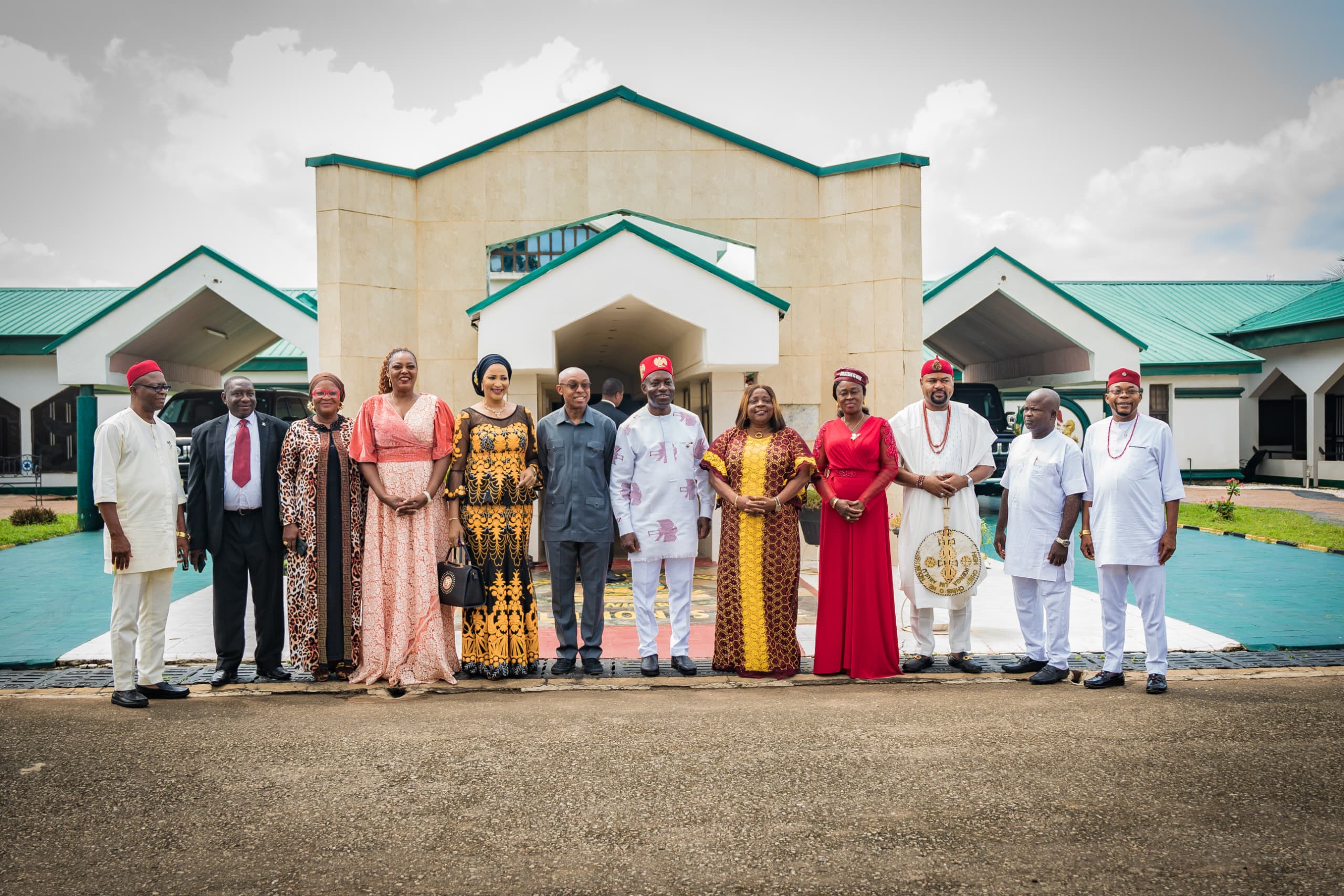
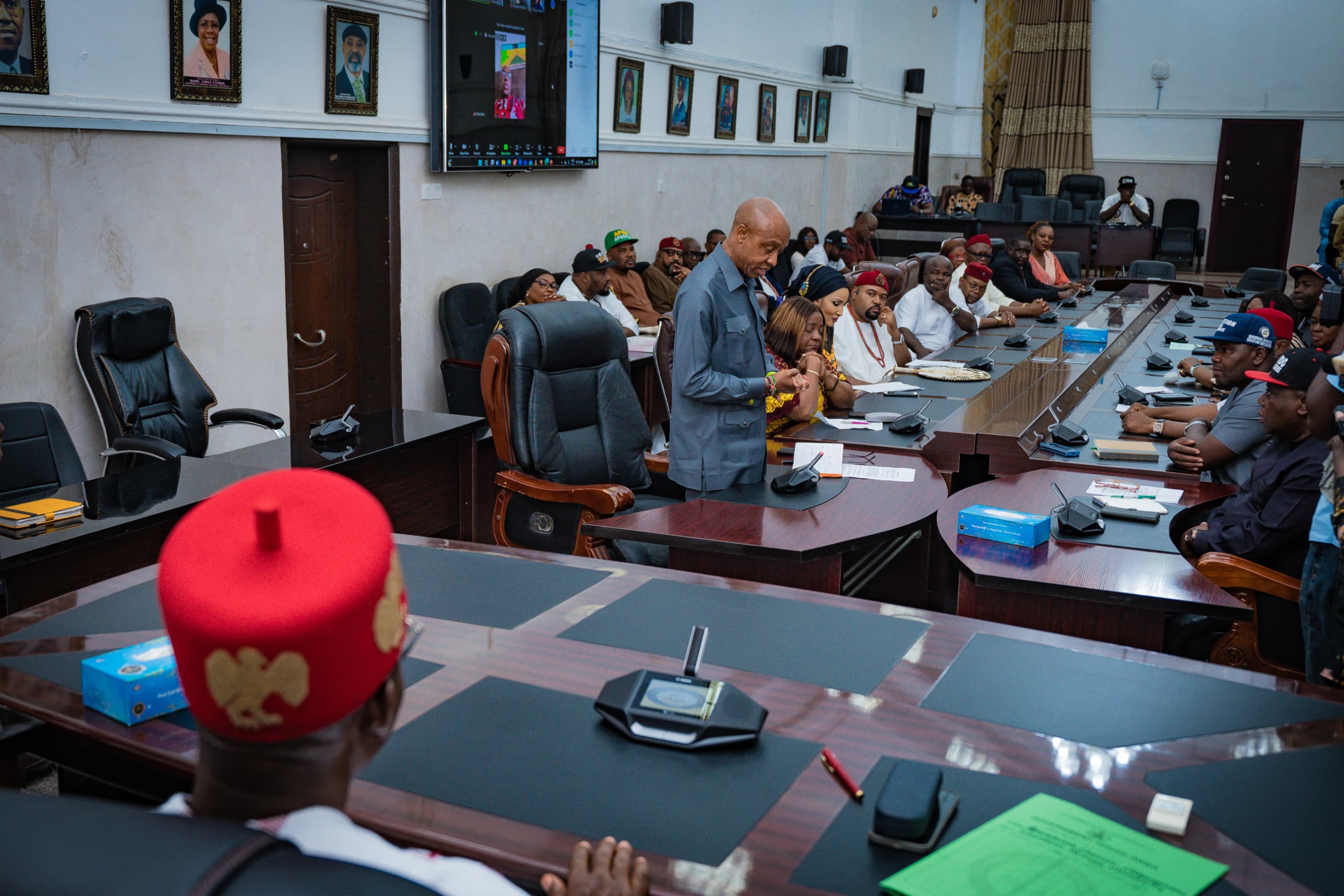
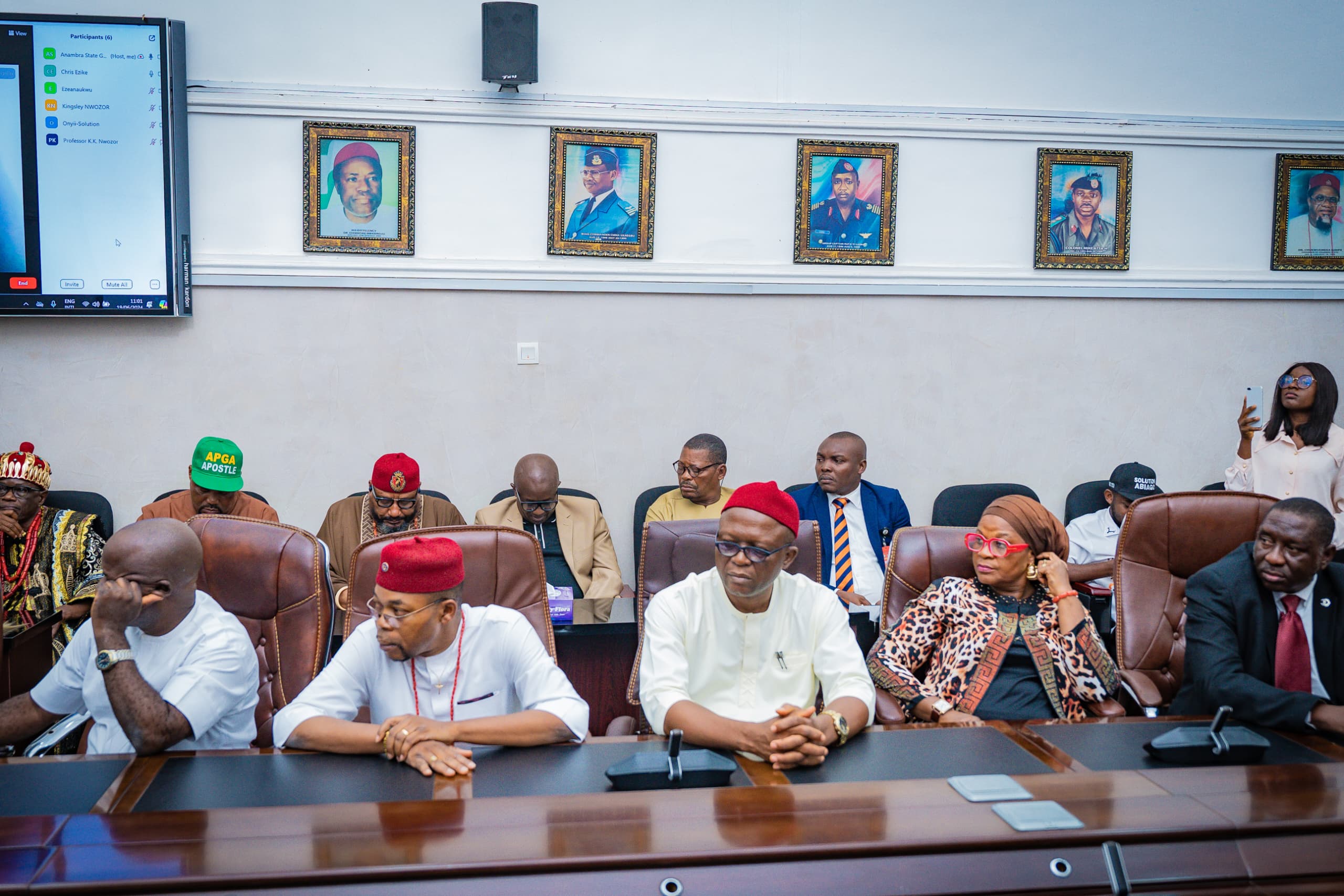
The governor of Anambra State, Prof. Chukwuma Charles Soludo on Wednesday inaugurated the Governing Council of Chukwuemeka Odumegwu Ojukwu University, COOU.

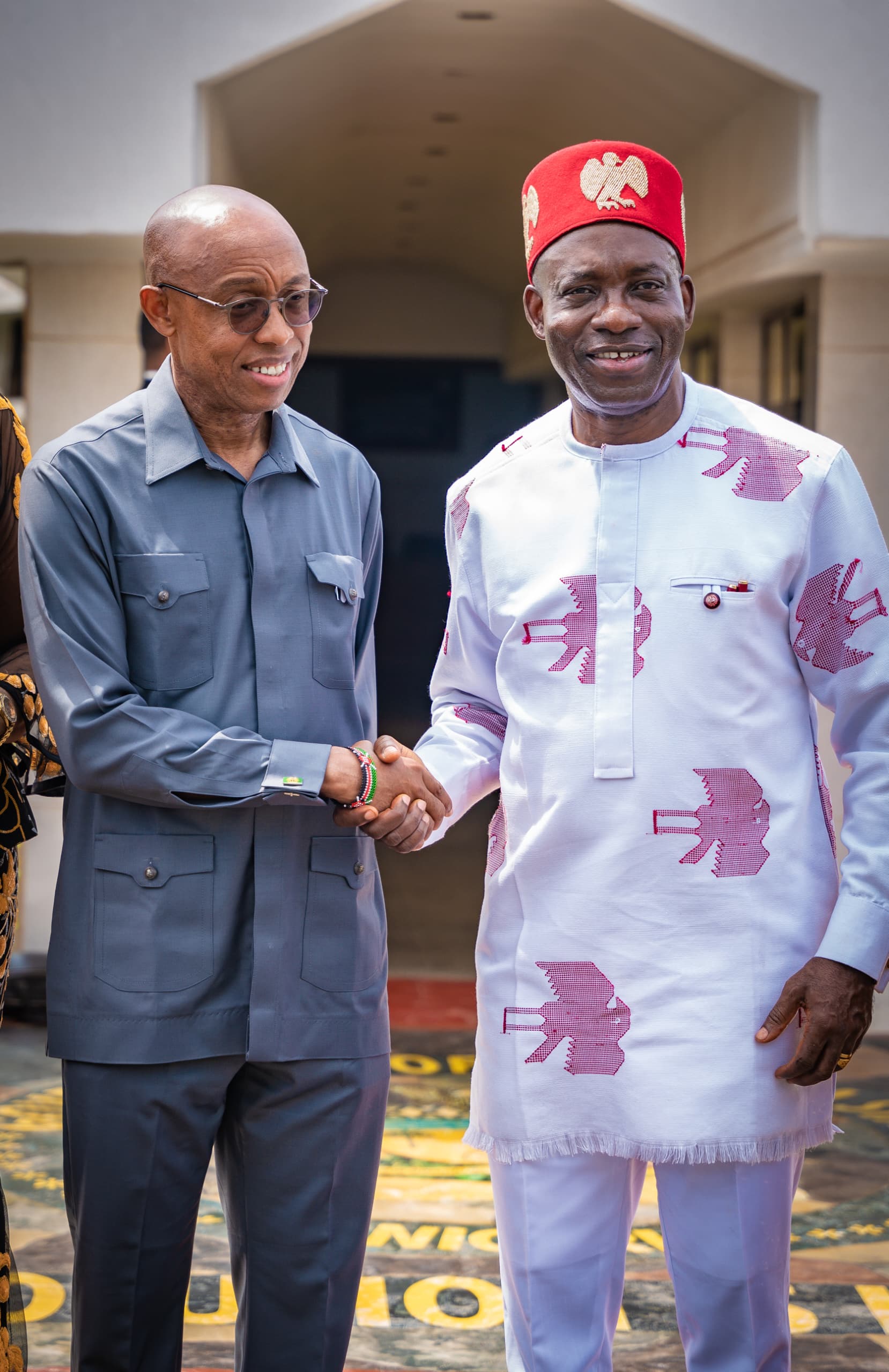
Pro Chancellor, Prof. Chidi Odinkalu and Governor Soludo
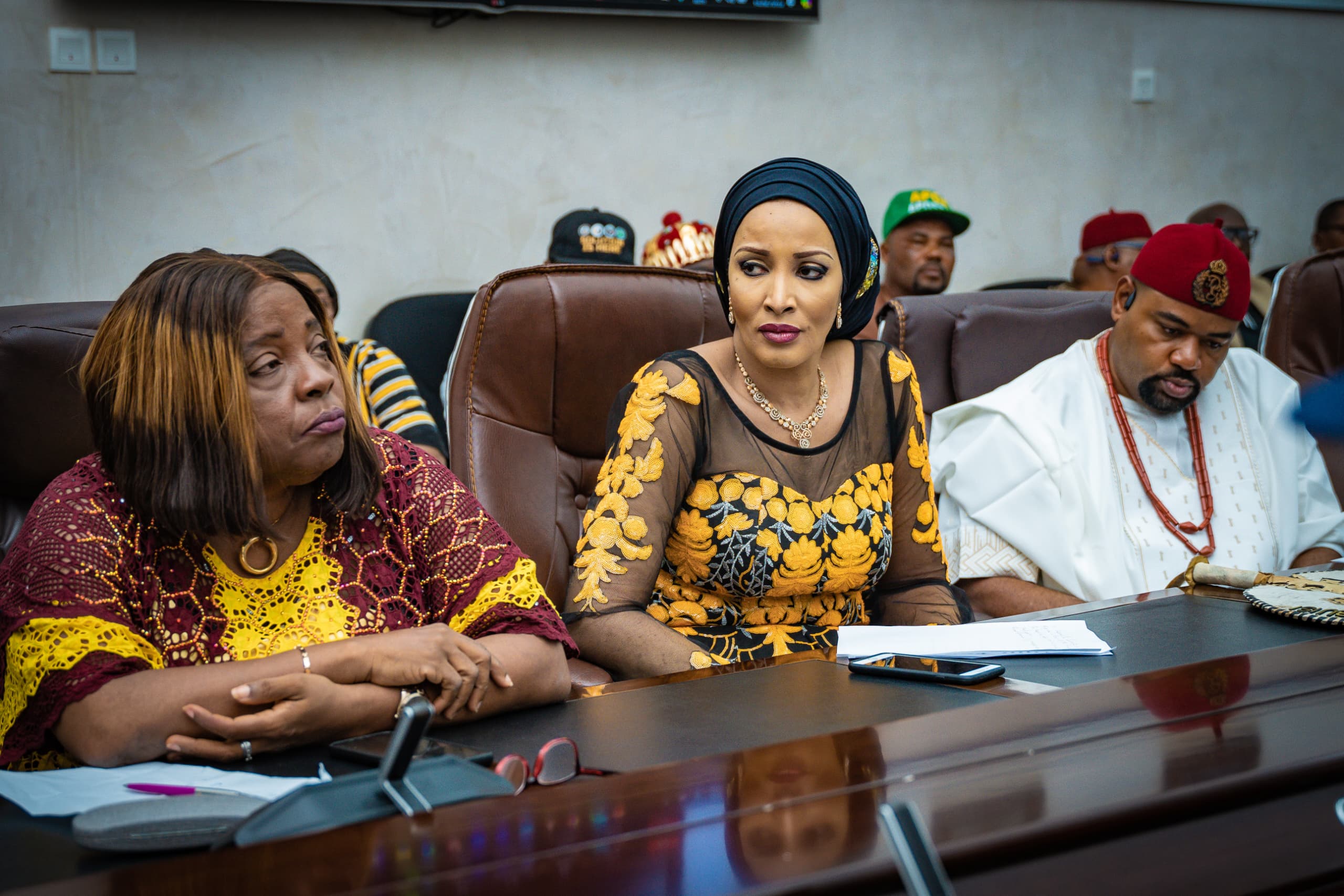
Amb. Bianca Odumegwu-Ojukwu (Middle)

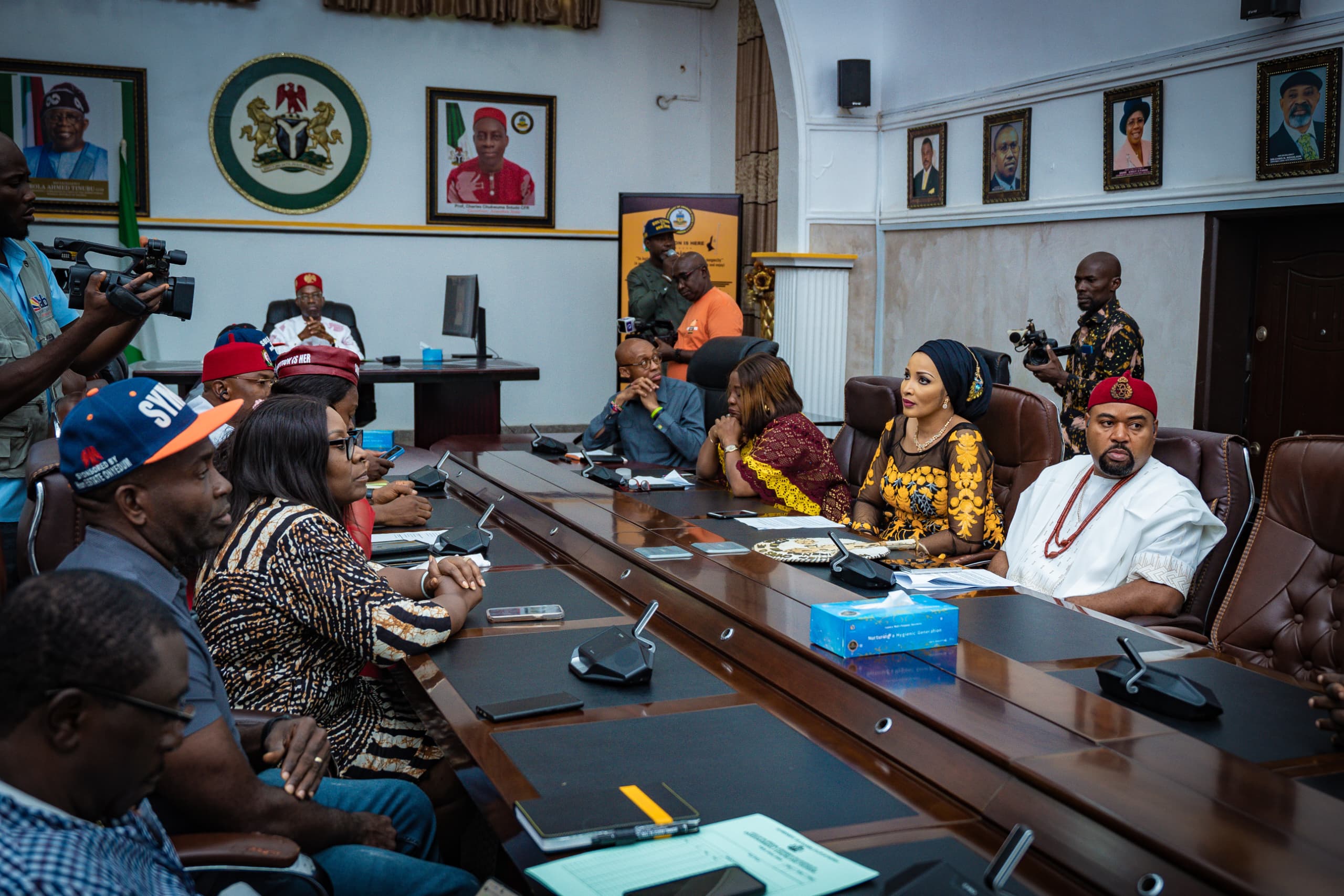
The ceremony took place at the State Executive Council Chambers, Government House in Awka.

Members of the council include; Professor Chidi Odinkalu (Pro-Chancellor/Chairman, Amb. Bianca Odumegwu-Ojukwu, Chief Christopher Ndubuisi, Igwe Oranu Chris Chidume and AIG Chris Ezike (Rtd).

The Senate Representatives to the Council include, Prof. K.K. Nwozo, Prof. Angela Nwamuo, Prof. C.C Chukwueloka, Prof. Obi Emeka and Prof. Anselem Nweke while the Congregation Representative to Council are Prof. M.N Chendo and Mrs. Eucharia.

According to the Governor, government views the institution as the apex of tertiary institutions in the state, and charged them on building an educational system that is fit for purpose, projecting into where the state want to be.

“The primary challenge you have is to work hard to reinvigorate and regenerate the university for the times we live and the times yet to come.”

“Are we preparing our children to be able to dominate the future? The university needs to carve its own unique identity, its own brand.”

“Fiscal sustainability is part of the challenges but you have to compete and dominate with the little resource base at your disposal”.

Governor Soludo expressed his passion for the university, saying he looks forward to seeing the university become the shinning light, if not the leader in university education in Nigeria.

While expressing absolute confidence in the ability of the Council, the Governor pledged to support the council in whatever feasible way, subject to resource constraint.

Responding, Professor Odinkalu thanked the Governor for extending to them the privilege to serve.

According to him: “The COOU law of 2014 have some very inspiring lines that we intend to work with.”

He also observed that “A part of the law talks about investing in research in African cultural heritage, promoting the social heritage of the state and stimulate and sustain interest in agriculture.”

He further paid glowing tribute to the Odumegwu Ojukwu’s dynasty whom the school is named after, describing it as a family that have inspired enterprise humility, enlightenment, courage and leadership as virtues that have to be taken seriously

He assured of working with the Vice Chancellor, management and staff of the institution to address basic rest facilities, build a beautiful green environment and infuse sustainable dignity

Secretary to the State Government, Professor Solo Chukwulobelu, Chief of Staff to the Governor, Mr. Ernest Ezeajughi, Commissioner for Education, Professor Ngozi Chuma-Udeh, Commissioner for Special Duties, Barr. Beverly Nkemdiche Ikpeazụ, Chief Protocol officer, Hon Chinedu Nwoye, SA entertainment, leisure and Tourism, Bob-Manuel Udokwu among others were also present at the event.

TIPS