Home Blog Page 538

NYSC: Serving their Bandit-land

By Suyi Ayodele

Mr. Ross: be not uneasy, your son, Charley Bruster, …we got him and no powers on earth can deliver out of our hand.” This was one of the letters sent to a distraught father, Christian Ross, whose son, Charley Ross, was kidnapped on July 1, 1874, in Philadelphia, United States of America, by two unknown fellas.

The felons were said to have written about 23 different letters of ransom demands to the Ross family. The kidnappers, according to the Pennsylvania Center for the Book, demanded the sum of $20,000 for the release of Charley, an amount of money the family could not afford. The father of the victim detailed the agony of the family over the kidnap of Charley in a book titled: “The Father’s Story of Charley Ross, the Kidnapped Child.”

The US security agencies did all they could to get Charley released from captivity all to no avail. The closest clue they got was the match of Charley’s ransom-demand letter with another letter written for ransom in another kidnapping case. The police were able to link the two letters to one ex-convict, William Mosher, who was killed earlier in a police shoot-out. Mosher’s accomplice, Joseph Douglas, who was arrested during the encounter, was said to have confessed to the kidnapping of Charley, but regrettably announced that only Mosher knew where he was kept.

Charley’s father, Christian, died in 1897, and the mother in 1912. His older brother, Walter Ross, who was present when Charley was kidnapped, equally passed on in 1943. To date, Charley Ross’ kidnap is one case the US has not been able to unravel. The Pennsylvania Center for the Book documented the ugly incident in the history of America as the first known victim of kidnapping for ransom in the US.

The beauty of the whole incident, however, is that as far back as 150 years ago, the US had developed a technology that allowed it to match handwriting. Yes, Charley was never discovered, his abductors were unravelled. Douglas, the accomplice, who could have been of help, unfortunately died before he could volunteer more information.

America learnt its lesson from the Chaley Ross’ case. One century and 17 years later, another kidnapping took place in California. An 11-year-old Jaycee Lee Dugard was kidnapped on her way to school on June 10, 1991. The US authorities swung into action and searches began. No positive results were achieved despite all the identity profiling supplied by witnesses. However, on August 24, 2009, 18 years after Dugard disappeared, one sex offender convict on parole, Phillip Garrido, showed up in the University of California, Berkeley, accompanied by two young girls. Eagle-eyed security personnel in the university observed something unusual about the party. Garrido was taken into custody for questioning. One thing led to the other, and the suspect invited the mother of the young girls to prove his case. The mother turned out to be Dugard, who was kidnapped 18 years ago, and the girls, her children; all products of serial rape she suffered in the hands of Garrido, who, in connivance with his wife, Nancy, kept the victim at the back of their house!

Pronto, the husband and wife were arraigned, convicted, and sentenced to 431 and 36 years imprisonment on April 28, 2011. But that was not the end of the matter. For failing to discharge its responsibilities of monitoring Garrido, who had been on parole for the rape he committed in 1976, Dugard sued the State of California. In 2010, the courts awarded the sum of $20 million to Dugard against the State of California for its contributions to the young girl’s ordeals in the hands of the felon. California paid the awarded sum of money because America runs a system that punishes infractions, negligence and inefficiency in governance. The accounts of Dugard’s kidnap are recorded in two books: “A Stolen Life” (2011), and “My Book of Firsts” (2016), written by Dugard.

What America learnt over the years was put to test in 2020, when an American, Phillip Walton, aged 27, was kidnapped in Niger Republic and ferried to the Nigerian side of the border by his abductors. The US special forces came visiting the camp. In the operation that lasted less than 20 minutes, the elite US special forces “…executed a daring night-time operation to rescue their fellow American with exceptional skill, precision and bravery…”, wrote the then US President, Donald Trump. Walton was rescued on October 31, 2020, 96 hours after he was kidnapped in Niger Republic, and 11 of his abductors were said to have “dropped dead before they knew what hit them!” The US Secretary of State, Mike Pompeo, said of that rescue mission thus: “The United States is committed to the safe return of all US citizens taken captive. We delivered on that commitment late last night in Nigeria….We will never abandon any American taken hostage.” That is a nation that cares!

I have dwelt on those cases above to show that crime and criminality are not natives of Nigeria. The most developed countries of the world also have their own share of the good, the bad and the ugly. However, what separates Nigeria from other sane countries of the world, is our inability to initiate a concrete system that rewards good deeds and punishes bad behaviours. We also do not learn from experience and mistakes! Take the case of the eight intending National Youth Service Corps (NYSC) members who were kidnapped in Zamfara State on August 17, 2023 while on their way to Sokoto State where they were mobilised to observe the compulsory NYSC programme for one year. According to the reports, 11 of the fresh university graduates from Akwa Ibom State were in the bus enroute Sokoto State Orientation Camp when bandits waylaid them. Three of the travellers escaped while the remaining eight, alongside their driver, were shepherded into captivity.

A serious nation, which considers the safety of its citizenry as priority, would have given all to ensure that those children did not spend a day in captivity. But not Nigeria. From the lackadaisical attitude of those in authority to the flat-footed nature of the nation’s security agencies, all Nigerians got was assurance that the victims would be rescued. Anyone, who is familiar with the advancement Nigeria has made in technology, especially in the telecommunications sector, would be appalled that in the Nigeria of 2024, kidnappers could still hold victims and go ahead to make calls demanding ransom without being tracked! That is our collective shame! Unfortunately, it happens to us daily! The last victim of the vibrant eight young school leavers was released, or ‘rescued’, as the authorities would want us to believe, on Thursday, August 2, 2024. That was a clear one year and five days after the victims were kidnapped!

More nauseating was the pattern with which the first set of victims was ‘rescued’. Like birds in a poultry cage, the victims were ‘rescued’ piecemeal as detailed by the NYSC Director General, Brigadier-General Yusha;u Ahmed, who said: “On August 22, we rescued the last corps member in a set of eight, Solomon Daniel Basse. On the 30th of August 2023, we rescued the first prospective corps member, Emmanuel Esudue. Victoria Bassey Udoka was rescued on the 20th of October 2023. Abigail Peter Sandy was rescued on the 7th of December 2023. Sabbath Anyaewe Ikan was equally rescued on the 7th of December 2023. Obong Victor Udofia was rescued on the 3rd of February 2024. Daniel Bassey was rescued on the 8th of February 2024. Glory Etukudo Thomas was rescued on the 9th of June 2024.” The Army General, as usual with all our security agents, had an alibi for the scattered ‘rescue’ operations. He said that the movement of the kidnapped prospective corps members from one camp to the other by their abductors made the ‘rescue’ operation to be piecemeal!

Ahmed was not through. He intoned that “no state government brought any amount for their rescue as claimed in the media. No mention was made of any of the abductors “neutralised or fell to the superior firepower of the security agents, while some escaped with bullet wounds!” Pity!

Now, in recognition of their service to their Bandit-land, the ‘rescued’ eight intending corps members would be issued their discharge certificates for the completion of the one-year compulsory NYSC programme in the camps of their abductors! Wow! That is a good gesture, anyway, for it would have amounted to double jeopardy if the young boys and girls were asked to repeat the service year. However, the problems of the ‘rescued’ victims go beyond the issue of issuance of discharge certificates. While in captivity, a lot must have happened to their psyche. Would these ones ever trust the Nigerian nation again? Would they ever have confidence in the ability of the state to rise to defend them anytime the need arises? What about the agony they were subjected to, and yet, there is no cheering news that one of the felons who visited the inhuman treatment on them was apprehended? How do we build their confidence and ensure that they remain patriotic? The females among them, who can tell what they went through?

Those in charge of our communication and technology have harassed Nigerians to no end in the last two years, or more, demanding from us all sorts of data. From Bank Verification Number (BVN) to National Identification Numbers (NIN), and the compulsory registration of mobile phone numbers, Nigeria has wasted billions of naira on these projects. Yet, in the year of the Lord 2024, kidnappers still make calls to collect ransom without being detected!

The same is applicable in the case of the 20 medical students from the University of Maiduguri and the University of Jos, who were kidnapped in Otukpo area of Benue State while on their way to Enugu on August 16, 2024. The medical students were said to have been rescued, with the mastermind of the abduction “killed during rescue operation.” The Inspector General of Police (IGP), the self-acclaimed “wounded lion”, Kayode Egbetokun, while addressing a press conference in Abuja on Sunday, added that two other members of the gang that kidnapped the medical students were arrested during the operation, in addition to the fact that no ransom was paid.

While we rejoice with the ‘rescued’ victims, their family members and the nation at large, our sympathy also goes to the family of Alhaji Isa Bawa, the Sarkin Gobir, Gatawa District, Sokoto State, who was killed by his abductors because the family could not raise the N1 billion ransom demanded. The District Head’s case becomes even more pathetic because after killing him, his abductors vowed not to release his corpse until a ransom of N60 million and six motorcycles are paid!

Again, all the negotiation for ransom for release alive, and for the release of the corpse, were carried out using telephone! Nigeria once had various satellites like NigeriaSat-1, NigeriaSat-2 and NigeriaSat-X which cost the nation huge sums of money in hard currency! NigeriaSat-1, for instance, when it was launched in 2003, was said to have cost $13 million, with a capacity of monitoring disaster in orbit 700km, whatever that meant! Where is that facility in the face of the calamities befalling the nation! The nation launched the NigeriaSat-2 in 2011, which is still in orbit and is said to be providing “imagery for the country.” What do our security agents do with the “imagery”, or are they blurred?

Why do we still pay the personnel in the Nigerian Communications Satellite Limited (NIGCOMSAT) if kidnapped victims could be made to serve their fatherland in captivity? If those facilities are no longer functioning, have we asked what happened?

Truth be told, Nigerians are yet to see the difference between the total collapse of security under the Buhari administration and the complete absence of security in the present government. If there is any difference at all, it is that the nation has moved from bad to worse, while the worst stares us in the face as the nation’s leadership pay us visits from their ‘work stay’ abroad.

I end this discourse with the headline. A solidarity salute to our Ajuwaya, the children of nobodies who served their country in Bandit-land! Corper Shan!

The Post-war 1970 military decree that robbed certain Nigerians of their assets

By Ikenna Emewu

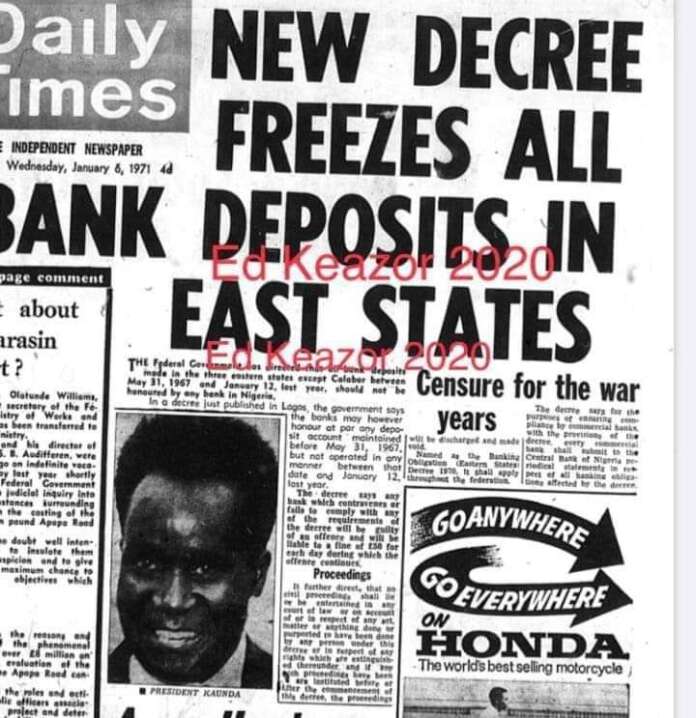
In January 1970, the Federal Military Government of Nigeria led by General Yakubu Gowon made a decree to freeze all bank assets of Nigerians from the East.

That included the three states that used to be Eastern Region prior to May 27, 1967 when Gowon split them into three states of East Central, South East and Rivers states
That law stands till date and was never reversed, abrogated, or compensation made for the victims.
It was the screamer headline of the government’s newspaper, Daily Times the following year, on January 6, 1971.

Being a military decree, it’s possible the contents had been implemented prior to public pronouncement or the decree was back dated. It was named BANKING OBLIGATIONS (Eastern States) DECREE, 1970.

Because of the target on accounts owned by citizens from the region in respect of accounts operated before the war, its application was decreed to be nationwide.

While the decree exempted Calabar from the blanket ban, it further ousted the courts from entertaining any civil processes or proceedings that may be brought by any affected party or parties to challenge the decree.

Whereas the military law covered the period between May 31 when Biafra was declared, it also extended to bank accounts that existed prior to the date, but were operated in any form during the war years.

Those that existed before the war years, and were never operated were the ones that got a “compensation” of £20 in lieu.

The implication is that whatever amount such accounts had in excess of £20, even in millions, including those of Sir Louis Odumegwu Ojukwu who was African richest man, were expropriated by the government of Nigeria and the individual owners stripped of their own money.

AfrcaChinaPressCentre

Limiting the Age for admission into tertiary institutions is ill-advised

An Open Letter to the Ministry of Education from a concerned Citizen

By Ozioma Izuora

I am a trained teacher (PGDE and a Masters in Education of the Exeter University, England).

I know that the Educational Policy of Nigeria under the 6-3-3-4 system envisions that entry age into tertiary institutions is age 18.

Most respectfully Sir, however that is a policy, not a law. No such law can be made in any case, as it would be against the freedom to develop to one’s full capacity, which has been a fundamental right since the UDHR of 1948 and through a plethora of treaties and conventions ratified snd domesticated by Nigeria.

The Ministry may achieve its aim over time by sanitizing the educational system of Nigeria without appearing to apply a knee jerk remedy that is ignorant of the existing policy which has so far been applied in the breach.

The many immature children showing up at 15 in universities currently, is a syndrome resulting from improper testing and evaluations at primary and secondary levels. Hardly does one hear of children repeating classes anymore! institutions are more focused on making money than on rating abilities.

By the way, the proper interpretation of the 6-3-3-4 system is that students can exit formal school at either of the 3-3-4 and move into the world of work…there were technical and vocational educational training in place to enable such movements. That has all crumbled. All that is left now is for garbaging in and out of the universities….some students barely able to write their names!!

People visit cybercafés to get help with articulating CVs, the contents of which they have no comprehension of.

It is a bad idea to pronounce a ban in age of admission to a person who has proof that they have rightfully attained the requirements for proceeding. The problem is simply that the system has been messed up. The children do not have to be made to pay for that.

By the way, emplacing such a ban will only raise the level of corruption in the already messed up system.

People who willingly pay for miracle exam centres will happily indulge in forgery of birth certificates in order to achieve the same end.

My concern, however, is that placing a ban without articulating how to separate the sheep from the goats, will emasculate the GENIUSES among us. What is education if we do not create a nurturing environment to enable the best brains flourish?

The ban is retrogressive in the 21st Century where Nigerian children have been celebrated at home and abroad for obtaining PHDs in their teens.

Please Sir, let’s not do this to our children! Please reverse this ill-advised ban.

Most humbly,
Ozioma Izuora

Izuora an Abuja lawyer and law teacher was a Vice-President of the Nigerian Bar Association (NBA) Abuja (Unity Bar).

4-Year study reveals Fulani ethnic militia killing Nigerian civilians unopposed

Abductions and torture of whole families go largely unchallenged as military pursue targets hundreds of miles away, finds four-year data project

Data scientists behind a four-year study, have revealed that Islamist extremists enjoy relative freedom to carry out atrocities against civilians in large regions of Nigeria, according to  the latest report by the Observatory for Religious Freedom in Africa (ORFA) released on 29th August 2024.

The report, titled “Countering the Myth of Religious Indifference in Nigeria’s Terror” covers the four-year period of between October 2019 and September 2023. Specifically, it gave an insight into the nature of religion-based kidnappings and killings within the period of former President Muhammadu Buhari’s second four-year tenure and the first four months of President  Bola Ahmed Tinubu presidency.

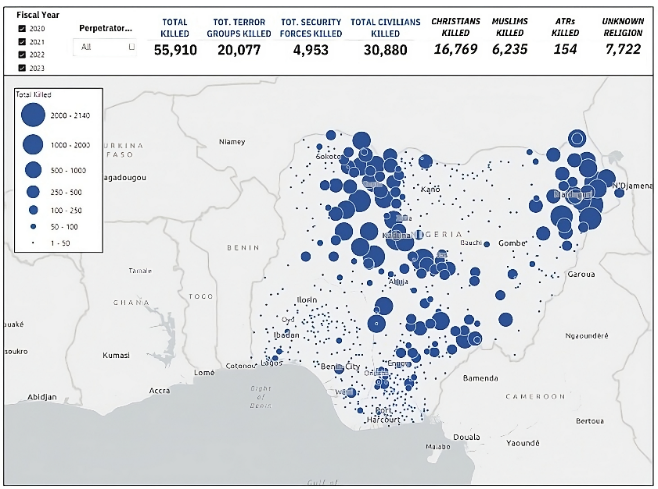
Researchers at ORFA recorded over 55,000 killings and mapped thousands of farm massacres and mass abductions in a four-year period, including in Nigeria’s fragile North Central Zone and Southern Kaduna.

According to the report, “a little-known terror group, the Fulani Ethnic Militia or FEM, commit mass killings hundreds of times a year through this region.

“Across the country, over 11,000 incidents of extreme violence took place during the data period, with more than 55,000 killings and 21,000 abductions. In the North Central zone alone, 3,007 incidents of extreme violence occurred.  2,010 incidents involved killings, 700 were abduction incidents, and 297 were a combination of killings and abductions.

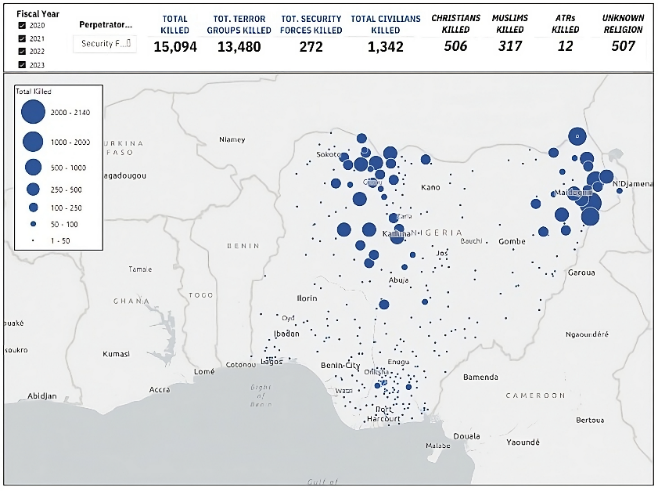
According to the ORFA repor, “data mapping has revealed security operations are concentrated in the North-East and North-West of Nigeria, hundreds of miles from the scenes of FEM atrocities.”

Fulani Ethnic Militia, Others Kill 55000+ Nigerian  Civilians In 9000 Unopposed Attacks- Report
Fig.1. All killings in study period. Source: ORFA four Report
Fulani Ethnic Militia, Others Kill 55000+ Nigerian  Civilians In 9000 Unopposed Attacks- Report
Fig.2. Terrorists and others killed by security forces. Source: Observatory for Religious Freedom in Africa Four-year Report. 

The ORFA four years of large-scale data study on kidnappings and killings in Nigeria produced what the data scientists believe to be the most extensive research in this area to date, revealing trends and data patterns of significance to human rights investigators.

While 55,000+ killings are recorded in the data period October 2019 – September 2023, 60 data elements are logged for each violence incident.

ORFA in a statement made available to Prime Business Africa, said the study was externally examined, and its methodology published.

ORFA, a programme  of the Foundation Platform for Social Transformation, a registered charity in Voorburg, The Netherlands, monitors the state of religious freedom, documents rights violations, and informs decision-makers through advocacy.

The report notes that Nigeria has continued to face a multifaceted security crisis marked by widespread violence, particularly against religious communities.   “The most striking point is that the Fulani Ethnic Militia (FEM) are killing Nigerian civilians unopposed. Mass killings, abductions and the torture of whole families go largely unchallenged as government forces pursue targets hundreds of miles away, according to the research findings.

The report also concludes that “Nigeria was a very violent and insecure place to live in the 4-year reporting period, at least in parts of the country. In total 55,910 people were killed in 9,970 attacks, while 21,621 people were abducted in 2,705 attacks. There was some overlap. ORFA documented 11,610 distinct attacks in which people were killed and/or abducted. Out of these, 8,905 involved killings without abductions; 1,065 involved both killings and abductions; 1,640 involved abductions without killings. This is an average of 8 attacks per day involving killings and/or abductions over a 4-year period. These numbers include attacks with civilians, Security Forces and/or Terror Groups killed and abducted.

“Across the North-Central zone and Southern Kaduna – where hundreds of FEM atrocities occur – there is markedly little security engagement at the scene of attacks.
‘Millions of people are left undefended,’ notes Frans Vierhout, Senior Analyst at The Observatory of Religious Freedom in Africa. ‘For years, we’ve heard of calls for help being ignored, as terrorists attack vulnerable communities. Now the data tells its own story.’

Key Findings On Fulani Ethnic Militia Killings In Nigeria

1.55,910 people were killed in the context of terror groups in Nigeria within four years.

2. Only a fraction of civilians were killed by ISIS or al-Qaeda affiliates. The little-known Fulani Ethnic Militia (FEM) killed at least 42% of all civilians, while Boko Haram and ISWAP (‘Islamic State West Africa Province) combined killed 10%.

3. The Fulani Ethnic Militia (FEM), an ethno-religious terror group, are considered by many security experts to be a ‘twin’ of Islamists killing and kidnapping civilians in Northern Nigeria.

4. Land-based community attacks form the largest category of civilian killings (81%). FEM invade small Christian farming settlements to kill, rape, abduct and burn homes

5. 2.7 Christians were killed for every Muslim in the reporting period.

6. Islamist extremists kill both Muslims and Christians, although Christian death tolls are far higher.

7. Proportional loss: in states where attacks occur, proportional loss to Christian communities is exceptionally high. In terms of state populations, 6.5 times as many Christians are being murdered as Muslims.

Abduction: Hallmark Of Islamist Terror

The ORFA data project also reveals the widening reach of Islamist kidnapping in Nigeria, with incidents escalating through the four years: 2020 (1,665 people abducted) 2021 (5,907 people abducted) 2022 (7,705 people abducted) and 2023 (6,255 people abducted).
Christians are 1.4 times more likely to be abducted than Muslims. In terms of state populations, proportional loss of Christians is higher: around 5.1 Christians are abducted for every Muslim in terms of local populations.
‘Fulani Ethnic Militia (FEM) are targeting Christian populations, while Muslims also suffer severely at their hands,’ notes Rev. Dr. Gideon Para-Mallam, partner to ORFA and analyst.
‘Kidnappers work to Islamist goals. Where young women are kidnapped, tortured and sexually violated, hope for normal married life, and family, may vanish.’
At the end of 2023, the IDMC reported 3.3 million Nigerians were forcibly displaced from their homes and surviving in makeshift camps.
The authors of the ORFA data project urged the international community to examine the data and to do more to fully understand the scale of the challenge to Nigeria.

Credits: Prime Business Africa

How Taiwan court slammed 3 months jail term on man for catching wife cheating

A court in Taiwan sentenced a man to three months in prison for ‘invading’ his wife’s privacy by installing hidden cameras around their home.

Chinese media recently reported the unusual story of a Taiwanese man surnamed Fan who managed to land himself behind bars for daring to expose his wife’s cheating by installing cameras around their home.

The couple had reportedly been married for several years and had two young children in 2022 when Mr. Fan began suspecting that his spouse was having an affair.

He installed a camera under the piano in the living room of the family home and another one next to the computer in the master bedroom.

About two weeks later, the cameras caught Fan’s wife and a mystery man having intimate relations in the family home, footage that the husband later used as grounds for a divorce.
In February 2022, Fan invited his wife and her lawyer to divorce negotiations, but they were unable to reach an agreement, so Fan filed a civil lawsuit against his spouse for civil damages.

Little did he know that his wife had an ace up her sleeve. The woman went to a local police station and accused her husband of invading her privacy by installing hidden cameras around their home without her consent.

Fan’s wife eventually filed a lawsuit against him, and his excuse of having installed the cameras out of worry for his children who often complained that their mother spent an unusually long time in the bathroom didn’t sit very well with the judge.

At the end of last year, the Taoyuan Court sentenced Mr Fan to 3 months in prison for secretly filming other people’s private activities without their consent and without a valid reason.
The Taiwanese man appealed the decision, but the Taoyuan High Court recently rejected his appeal and upheld the original verdict.

Mr Fan now has to spend 3 months behind bars for catching his wife cheating in their family’s home.
This strange case sparked a heated debate on Taiwanese and Chinese social media regarding the boundaries between privacy and collecting evidence of adultery, as well as the impact of modern technology on family-related issues.

MyJoyOnline

New CJN inherits the house of rot

By Punch Editorial Board

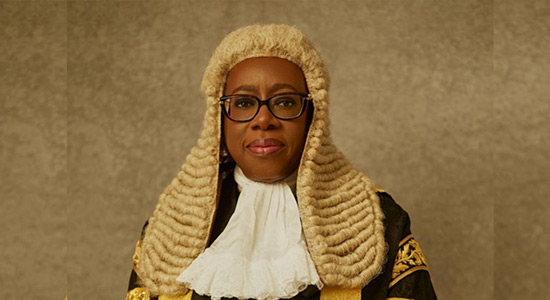
The enduring condemnation and concerns expressed by the public over pervasive corruption in the judiciary are proof that the new Chief Justice of Nigeria, Kudirat Kekere-Ekun, has inherited a house of rot. President Bola Tinubu swore Kekere-Ekun in on August 23 as the 23rd CJN before parliamentary confirmation. She must find the courage to roar all the wolves in her house to submission to run an enviable tenure and build a legacy for an improved and credible justice system.

For her to perform creditably, the independence of the judiciary, with its inherent tenets, must be upheld.

Unfortunately, achieving this has been a nightmare. The courts have become houses of rot and victims of state capture. At 75 per cent, the judiciary and the Independent National Electoral Commission have the lowest public trust among Nigerians, per Afrobarometer.

The appointment process of judges is fraught with nepotism. The immediate past CJN, Olukayode Ariwoola, and the Chief Judge of the FCT High Court, Hussein Yusuf, were recently accused of violating the federal character principle by appointing family members as judges.

A retired Supreme Court Justice, Amina Augie, recently revealed in an interview that there are godfathers in the judiciary and that “politicians are very strategic…they want to put their own people that will be useful for them as judges.” Unfortunately, this is obvious.

A senator, Adamu Bulkachuwa, confessed at the valedictory session of the Senate last year that he reached out to his wife, Zainab, the President of the Court of Appeal, to get favourable decisions for his politician friends in election cases.

Ex-Rivers State Governor Peter Odili, standing trial for fraud in 2007, was granted a perpetual injunction in a rapacious display of judicial barbarism.

In two separate cases challenging the signing of a nomination paper or result form in more than one constituency in the same election by Ahmad Lawan and Godswill Akpabio, the Supreme Court ruled in favour of both in violation of Section 115 (d) of the Electoral Act.

Courts, including courts of coordinate jurisdiction, engage in notorious abuse of interlocutory injunctions in mockery of the judiciary and the country.

This house of the “messiah” of the common man is falling and must be urgently fixed.

The new CJN must institute reforms and overhaul the judiciary to save it from its embarrassing profile. She must build institutions and inculcate in judicial officers the ethics and ethos of the judicature. This should be complemented with the provision of technology to deliver best practices.

The CJN must ensure discipline and accountability to restore the dignity and integrity of the judiciary. The integrity of the National Judicial Council should be enhanced by reducing the power of the CJN in appointments. The appointment of judges must be merit-driven.

Stringent efforts should be made to investigate all pending corruption and controversial cases and erring judges must be brought to justice to deter others. Courts should review their controversial judgements in the interest of entrenching justice and preserving judicial integrity.

The CJN cannot do it alone. The National Assembly must muster the needed political will to review the laws that hold the judiciary hostage. These include vesting the appointment of the CJN in an independent body rather than the President. The same model goes for the states.

To eliminate professional and national embarrassments arising from territorial jurisdiction overlaps, the CJN needs to establish practice guidelines with clear penalties for breaches.

There is a need to insulate the judges from manipulation and bribery by the emplacement of robust salaries, other welfare packages, and decent work conditions.

The CJN must build on her predecessor’s achievements, including the 300 per cent salary increment for judges and the digitisation of the courts.

A new, improved judiciary is possible. With determination, the country’s judiciary can be transformed for the benefit of all.

Worsening sexual abuse among young Nigerian female hawkers raise concern

By Timothy Agbor

As economic hardship bites harder in Nigeria, many poor homes have intensified struggle to survive the crisis.

Findings by The Point revealed that more parents who are poor subject their children into child labour through hawking in order to support the family sustenance.

Sadly, these children, especially girls, have become easy prey to sexual predators.

Under the guise of patronising the young female hawkers, The Point learned that some randy men lure them into all sorts of sexual harassment and rape.

According to the World Health Organization, childhood sexual abuse is one of the most common types of childhood trauma, especially among females.

Global reviews have suggested a fairly greater prevalence of sexual abuse among children in fold higher risk in females compared to males.

Teenage girls have become the most vulnerable as they hawk to provide food for their families. It is the little they can contribute for family survival but they have become prey to predators, sexual molesters and abusers on streets.

According to reports, incidents of sexual assault have taken alarming turn among Nigerian female petty hawkers.

From touching them seductively while negotiating their wares to luring them into desolated areas where they defile them, some young girls have narrated their ugly experiences while making efforts to assist their parents through hawking.

14-year-old Deborah is a victim. The junior class two student in Ogun State was raped by a man who lured her with some amount of money before assaulting her sexually.

Deborah could not disclose her painful experience to her mother after she got back from work and her mother did not suspect anything despite that Deborah was bleeding.

However, her disturbing situation was discovered by a patent medicine seller Deborah approached for a cure for her bleeding.

The medicine seller narrated how Deborah, a virgin, came to her and narrated how she was sexually abused by a man on a Sunday evening and ended up bleeding profusely for days.

“She came to me and sat on a chair that she has been bleeding after a man raped her inside a shop while hawking on a Sunday evening. She said immediately after the sexual intercourse, she saw blood coming out of her private part.

“According to her, the man gave her some pills to take and when she asked what the drug was meant to do, the man told her it was to flush her system. As the bleeding became worse, she went to buy a pad to control it. She told me that she used six pads overnight on Sunday.

“I asked her the name of the drug the man gave her but she said she didn’t know. I asked her to go home and bring the carton. Immediately she stood up from the seat, I saw blood on the seat. I then asked her to use a towel to clean it, go home and wash it and return with the drug carton the next day.

“When she returned the next day, she told me that she had already used about five pads afterwards and that the bleeding was yet to stop. She said that the man gave her N2, 000 to pay for her school’s inter-house sports uniform. I think she had asked her parents for the fee and they could not provide it for her,” the lady identified as Bisi narrated.

Zainab’s ugly experience is similar to that of Deborah.

The secondary school graduate said she became sexually active very early and as such, her dream to become a lawyer is bleak.

Zainab said she was raped while hawking soap in Ogun State and was later tested pregnant.

Ever since her pregnancy, Zainab has dropped out of school and now works as a sales girl to fend for herself.

“I used to be a sales girl from Monday to Saturday. There was a shop I always go to. On Sunday, I will have to hawk pepper for my mother, from 6:30am till 1:00pm before I will return home to do other domestic chores. While hawking one day, I met a guy whom I thought wanted to buy soap, but dragged me into his room and raped me.

“I left school after I got pregnant from the rape. All I do now is a menial job to take care of myself and my child. Maybe in the near future, when I have money, I will further my education. My dream is to become a lawyer and I hope that comes to fulfillment someday,” she said.

According to statistics from Ogun State Sexual Assault Referral Centre, no fewer than 33 cases of child sexual abuse and 23 cases of domestic sexual abuse have so far been reported in the first quarter of the year.

Stakeholders have been urged to team up and ensure the government ends street trading by teenage girls.

A human rights activist, Citizen Lola Wey, called on parents to protect their children by not exposing them to sexual abuse through hawking and other means.

Culled from The Point

Corruption’s Albatross: The Nigerian Reality

By Stephanie Sewuese Shaakaa

Corruption has become the albatross strangling Nigeria’s progress, weighing down its potential, and infecting every fiber of its society. In a country blessed with vast natural resources, abundant talent, and an industrious populace, the wheels of progress grind to a halt under the burden of corrupt leadership.

Politicians, who should be the harbingers of hope, have instead become merchants of greed, siphoning wealth and exploiting the vulnerability of the masses. They manipulate ethnic and religious divisions with precision, ensuring their continued dominance while the common Nigerian suffers the consequences of their unchecked ambition.

It is a common consensus that the country’s political elites are corrupt, with stolen wealth tucked away in foreign accounts and luxury lifestyles funded by the nation’s resources. The same leaders who cry for patriotism and unity are often the first to abandon ship when the going gets tough. The disconnect between the rulers and the ruled is stark, with leaders insulated from the suffering they inflict on the nation.

The story of corruption in Nigeria is not just about high-profile scandals and missing billions; it’s woven into the fabric of everyday life. Consider the plight of the informal sector, a crucial part of Nigeria’s economy that suffers from corruption’s ripple effects. Small business owners, who form the backbone of the economy, are forced to pay bribes for basic licenses and permits. These illicit payments add to the cost of doing business, stifling entrepreneurship and innovation. Local markets, once bustling centers of trade, are now battlegrounds for survival where the cost of corruption is counted in missed opportunities and shattered dreams.

This theft of resources also means a theft of time. Every year that corruption goes unchecked is a year that Nigeria falls further behind in the global race for development. Investments that could have driven the economy forward are instead diverted into self-serving projects, lining the pockets of those who already have more than enough. Meanwhile, small businesses struggle, entrepreneurs lose hope, and the country’s vast potential remains unrealized. It’s as if Nigeria is running a marathon with chains around its legs, unable to break free from the weight of corruption that drags it down.

But the damage goes beyond the economy. Corruption poisons society, creating a system where wealth and connections determine who gets ahead and who gets left behind. It turns government services into commodities that only the privileged can access. Ordinary citizens are forced into impossible choices bribing their way to better healthcare or watching their children suffer in overcrowded, underfunded hospitals. Corruption steals dignity, leaving people to navigate a world where merit is meaningless, and survival depends on playing a rigged game.

Politically, corruption erodes the very foundation of democracy. It turns elections into spectacles of deceit, where votes are bought, and the will of the people is subverted by those with deep pockets. The leaders who emerge from such processes are not there to serve the public; they are there to serve themselves and the interests of those who paid their way into power. And so, the cycle continues.

Corrupt leaders protect a corrupt system, ensuring that nothing changes.

Yet, amidst all this, there is still a flicker of hope. The fight against corruption in Nigeria is a battle for the nation’s future, a fight to reclaim the values of honesty, integrity, and service. This battle isn’t won by merely passing laws or setting up commissions; it’s won by changing the culture that allows corruption to thrive.

For instance, the emergence of grassroots organizations like “The Citizens’ Voice” has demonstrated the power of local advocacy in challenging corrupt practices. These groups, often comprised of ordinary Nigerians, work tirelessly to expose corrupt acts and demand accountability, often at great personal risk. Their courage exemplifies how collective action can challenge entrenched systems and drive change.

This is not an easy fight, nor is it a short one. It will require determination, resilience, and the collective will of a people who refuse to be defined by corruption. It will demand strong institutions that uphold the rule of law, leaders who lead by example, and citizens who hold their government accountable. And, perhaps most importantly, it will require a sense of urgency. Every day that corruption is allowed to continue is a day that Nigeria loses, loses opportunities, loses potential, loses hope.

Consider the story of Maryam, a mother of four from Bauchi. When her son fell ill with malaria, she traveled miles to the nearest public hospital, only to find that the medicines meant to be free had mysteriously disappeared from the shelves. A corrupt chain of officials had diverted them to private pharmacies for profit. Maryam’s story is not unique it’s the everyday reality for millions of Nigerians trapped in a system that prioritizes greed over life. Her story is our call to action.

The education sector is severely impacted by corruption and mismanagement. Despite the high percentage of the population living below the poverty line, significant resources are siphoned off, preventing adequate funding for education. This corruption diverts essential funds, exacerbating existing challenges and making quality education increasingly inaccessible.

The government’s inability to meet its financial obligations for education reflects a broader pattern of mismanagement, where essential services suffer while public debt and interest payments consume a large portion of tax revenues. This misallocation leaves many Nigerians struggling with inadequate educational opportunities, as the burden of costs increasingly falls on parents and communities.

The persistence of these issues may be driven by a strategy to maintain control over an uneducated populace, reinforcing a cycle of poverty and dependency. Corruption thus not only hampers educational progress but also ensures that the socio-economic gap remains entrenched, undermining the nation’s potential for growth and development.

The future of Nigeria depends on whether it can rise to this challenge. The stakes could not be higher. Corruption is not just an obstacle to progress; it is an existential threat to the nation’s future. If left unchecked, it will continue to undermine every effort to build a better Nigeria. But if confronted head-on, with courage and conviction, there is a chance just a chance that Nigeria can break free from its chains and finally realize the greatness that lies within its grasp.

Stephanie Shaakaa, University of Agriculture, Makurdi, Benue State

NBAAGC2024: Inauguration of Elected NBA National EXCO

The Nigerian Bar Association (NBA) will on Thursday, August 29, 2024 inaugurate of its newly elected National Executive Committee (EXCO).

A statement issued by Chief Emeka Obegolu, SAN, PhD announced that the newly elected national Officers with Mazi Afam Osigwe, SAN as President, will be sworn-in at The Ballroom, Lagos Continental Hotel, Kofo Abayomi Street, Victoria Island, Lagos State.

All guests are enjoined to be seated at the venue by 10:30 am. The event will always be broadcast live via Zoom.

Mazi Afam Osigwe, SAN, will be sworn in as the 32nd President of the NBA, alongside other EXCO members, succeeding Yakubu Chonoko Mailyua, OON, SAN, whose two tenure as President will expire on 29th August, 2024.

Zoom link details: https://us06web.zoom.us/j/84236203069?pwd=EswSrnSxPbvTai08HjXB1KOC2Cr6tv.1

Passcode: 950544

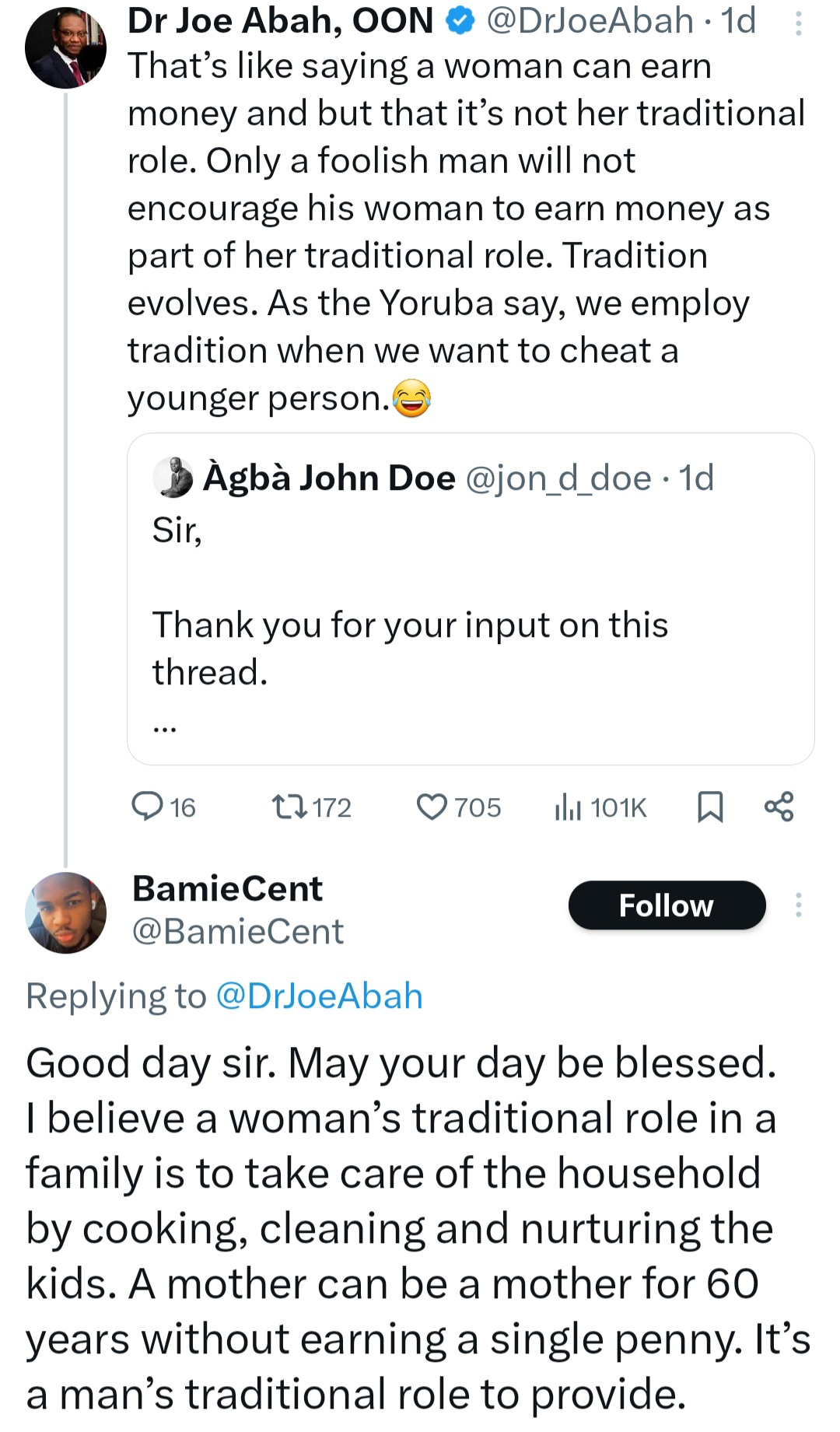
“If your wife is Tobi Amusan, you’ll keep her at home cooking for you and managing with your N70k civil service salary?” Lawyer, Joe Abah, asks man who insists running the home is a woman’s role

Lawyer and public affairs analyst, Joe Abah has queried a man who disagreed with his suggestions on running a successful home.

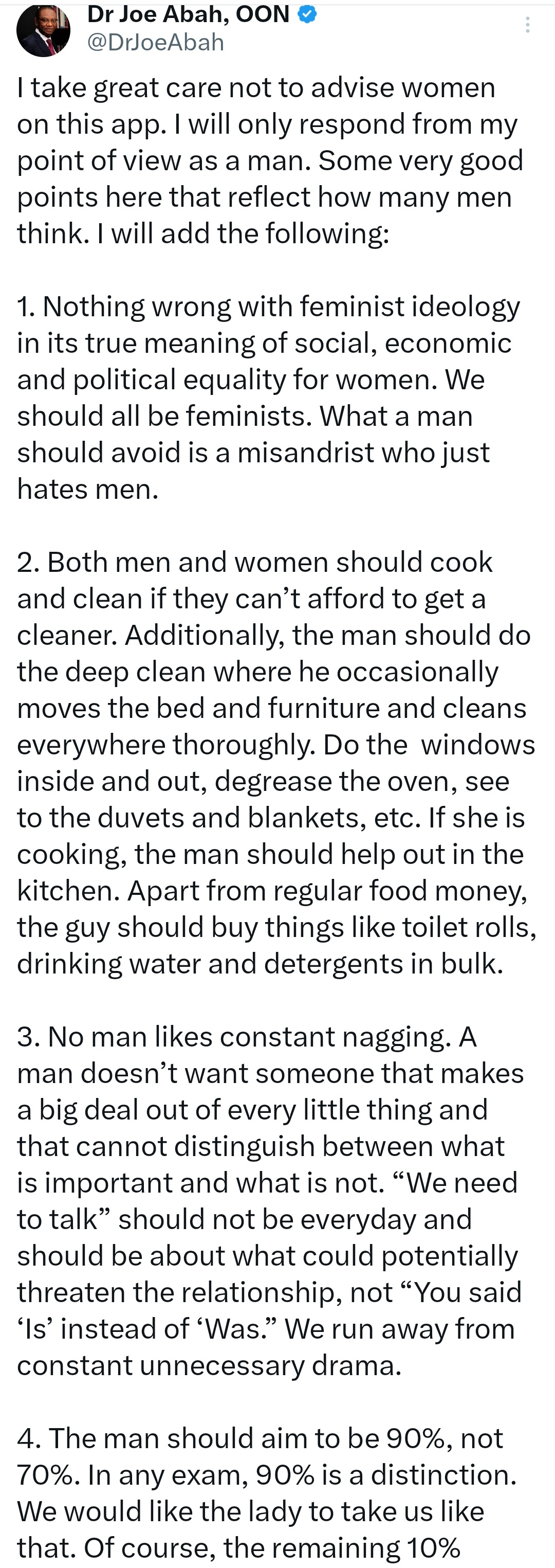
Joe had shared his suggestion on X, telling husbands to do house chores, especially the physically tasking ones like lofting furniture’s to sweep underneath.

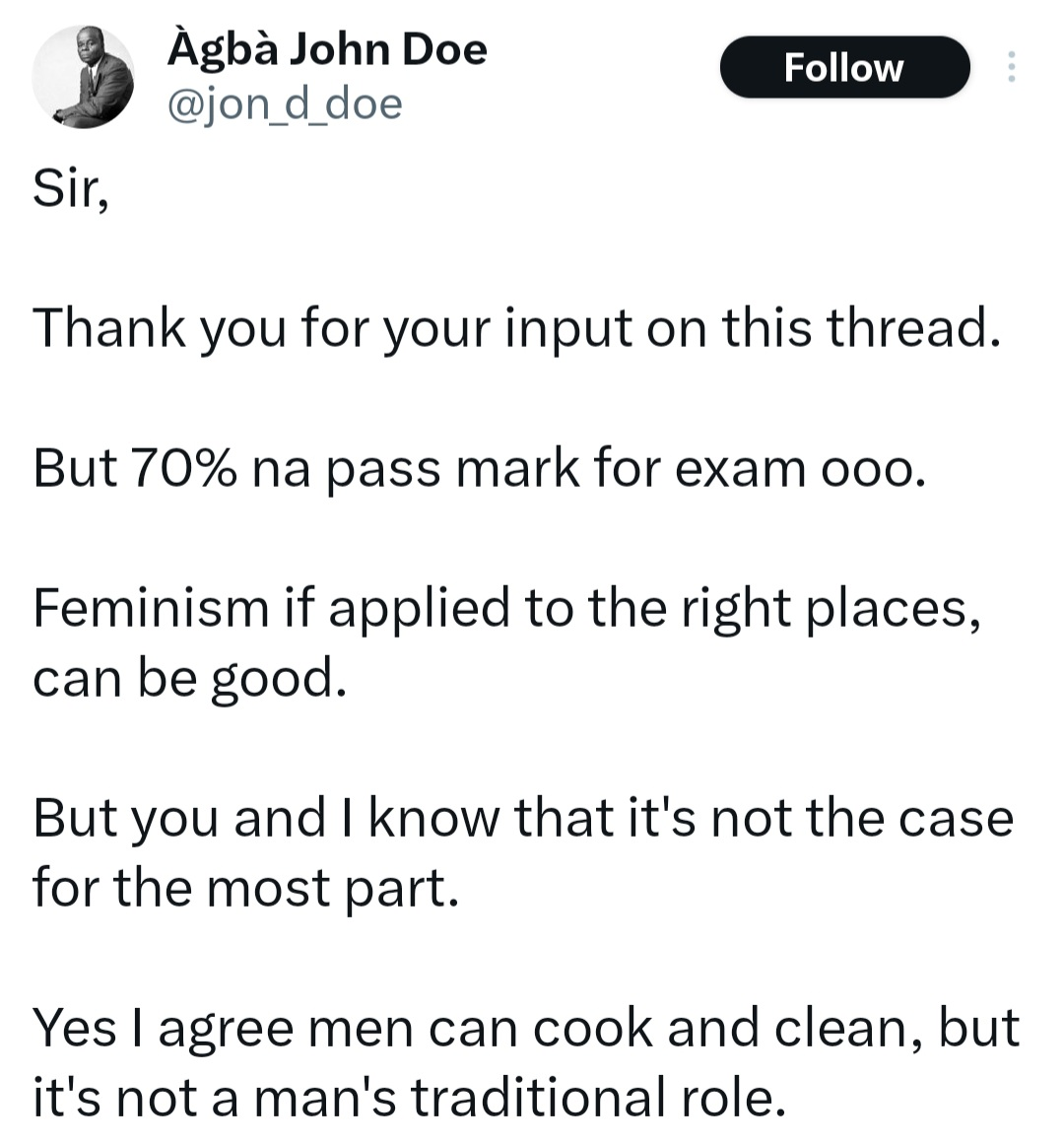
However, some X users disagreed with him and told him women’s traditional roles should be cleaning and cooking, not the men’s. They added that the men can only help if they wish to because home making is not men’s traditional role.

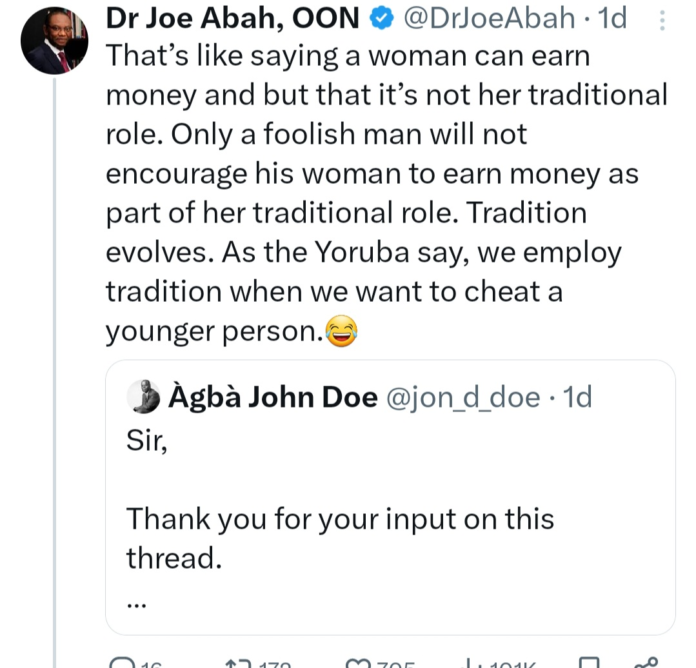
Reacting, Abah wrote: “That’s like saying a woman can earn money and but that it’s not her traditional role. Only a foolish man will not encourage his woman to earn money as part of her traditional role. Tradition evolves. As the Yoruba say, we employ tradition when we want to cheat a younger person.”


An X user replied to Abah, writing: “Good day sir. May your day be blessed. I believe a woman’s traditional role in a family is to take care of the household by cooking, cleaning and nurturing the kids. A mother can be a mother for 60 years without earning a single penny. It’s a man’s traditional role to provide.”

And Joe replied: “So, if your woman is a software engineer with a specialism in AI, or a cardio-thoracic surgeon, or a brilliant tax lawyer charging £1,000 an hour, or Tobi Amusan (the athlete), you’ll keep her at home cooking and cleaning for you and managing with your N70k civil service salary?”

"If your wife is Tobi Amusan, you?ll keep her at home cooking for you and managing with your N70k civil service salary?" Lawyer, Joe Abah, asks man who insists running the home is a woman

TIPS