Home Blog Page 477

Defamation lessons from Trump to Babalola

By Martins Oloja

The case of Dele Farotimi, a lawyer and author, has raised concerns about the treatment of individuals by the police and courts in Nigeria, particularly in libel cases. Farotimi who has just been granted another bail was arrested and detained following a petition by Afe Babalola, a prominent lawyer, who alleged that Farotimi’s book, “Nigeria and its Criminal Justice System,” contained defamatory statements against him. The petition led to Farotimi’s arrest by the Ekiti State Police Command, who then arraigned him before a magistrate court. The court granted an order remanding Farotimi in prison custody.

This curious case has sparked worries about free speech in a democracy. The arrest and detention of Farotimi have been seen as an attempt to silence him and stifle criticism of the Nigerian justice system. The fact that the libel case against Farotimi hasn’t been properly filed has also raised concerns about the misuse of the legal system to intimidate and harass individuals. Ultimately, this case highlights the need for greater protections for free speech in Nigeria and the importance of ensuring that the legal system is not used to silence critics and stifle dissent.

Meanwhile, as the civil society organisations including the media have been worried about the case that has led to continued detention of the lawyer is still dominating public discourse, there are some remarkable lessons about the same libel case by one of the world’s greatest complainants against the media, in fact, the President-elect of the United States, Donald Trump who actually tagged the U.S mainstream media as “the enemies of the people”. The former president actually sued a major television network ABC News and here are some of the outcomes so far all of us including the elder statesman, Aare Afe Babalola can learn from.

The recent $15 million libel settlement between Donald Trump and ABC News is a significant development that offers valuable lessons for media outlets, politicians, and the public. At the heart of the dispute was a comment made by George Stephanopoulos, claiming that Trump was found liable for rape, which was said to be inaccurate.

‘Significance of the Settlement’
The settlement is a substantial win for Trump, who has long accused mainstream media of bias and defamation. The $15 million payout, along with an apology and an editor’s note from ABC News, demonstrates that media outlets can be held accountable for inaccurate reporting. This settlement also highlights the challenges of reporting on high-profile individuals, particularly in today’s polarised media landscape. The case serves as a reminder that even slight inaccuracies can lead to costly legal battles and reputational damage.

‘Lessons for media outlets’
There are significant lessons for media outlets and media law scholars in this regard:
Accuracy is paramount: The settlement emphasises the importance of accuracy in reporting. Media outlets must ensure that their reporting is thorough, accurate, and unbiased to avoid costly lawsuits.
Clear apologies and corrections: ABC News’s apology and editor’s note demonstrate the importance of clear and prompt corrections. Media outlets must be willing to acknowledge and correct mistakes to maintain credibility.
Understanding of legal nuances: The case highlights the importance of understanding legal nuances and complexities. Media outlets must ensure that their reporting accurately reflects the complexities of legal cases.

Lessons for Politicians

Consequences of litigation: The settlement demonstrates that litigation can have significant consequences, financially and can affect reputation. Politicians must be cautious when pursuing legal action, as it can backfire and damage their reputation.
Importance of media relations: The case highlights the importance of maintaining positive relationships with media outlets. Politicians must work to build trust with journalists and media outlets to avoid misreporting and defamation.
Thick skin and strategic communication: Politicians must develop a thick skin and strategic communication skills to navigate the challenges of modern media. This includes being prepared to address inaccuracies and misinformation promptly and effectively. There may not be any smooth relationship between Trump and the mainstream media in his second term as Elon Musk, Trump’s most trusted digital media baron, has already declared the mainstream media persona non grata in the new media ecosystem in the United States.

Broader Implications

The settlement has broader implications for the media landscape and the relationship between politicians and the press. It highlights the challenges of reporting on high-profile individuals and the importance of accuracy, fairness, and transparency in journalism.

In the main, the ABC News $15 million libel settlement to Trump serves as a reminder of the importance of responsible journalism and the need for media outlets to prioritise accuracy and fairness in their reporting.

The nexus between strategy of Trump and Babalola

The ABC $15 million libel settlement to Trump and Afe Babalola’s use of the court and police to detain Dele Farotimi, author of a book he claims defames him, may seem like unrelated cases, but they share some common lessons.

Power of libel laws: Both cases highlight the power of libel laws in holding individuals and media outlets accountable for false or damaging statements. Afe Babalola’s actions demonstrate that individuals can use libel laws to protect their reputation but without having to use the police to torture the accused, while the ABC settlement shows that media outlets can also be held liable for false reporting.
Importance of fact-checking: The ABC settlement payment to Trump emphasises the importance of fact-checking in journalism. Similarly, Afe Babalola’s case against Dele Farotimi highlights the need for authors and publishers to verify the accuracy of their content to avoid libel claims.
Consequences of false reporting*: Both cases demonstrate the consequences of alleged false reporting, which can lead to financial losses, damage to reputation, and even long-drawn litigation.
Need for media literacy: The ABC News settlement case underscores the need for media literacy and critical thinking in consuming information. The ABC News case, for instance highlights the importance of verifying information through reputable sources to avoid spreading misinformation.

In conclusion, while the ABC settlement payment to Trump and Afe Babalola’s case against Dele Farotimi may seem like unrelated cases, they share common lessons about the power of libel laws, the importance of fact-checking, the consequences of inaccurate reporting, and the need for media (law) literacy.

But Elder Babalola should also consider 10 reasons most leaders, politicians and business barons avoid defamation lawsuit:

Fear of scrutiny: Defamation lawsuits can lead to increased scrutiny of their activities, which may expose their corrupt and unethical practices.
Loss of reputation: A defamation lawsuit can damage their reputation, even if they win the case. The negative publicity surrounding the lawsuit can be detrimental to their business and personal interests.
Financial consequences: Defamation lawsuits can be costly, and the financial consequences of losing a case can be significant.
Fear of discovery: During a defamation lawsuit, the discovery process may reveal information that the corrupt and unethical barons would rather keep hidden.

Intimidation tactics: Corrupt and unethical barons may use intimidation tactics, such as threatening to sue for defamation, to silence critics and avoid accountability.

Lack of transparency: Unclean barons may operate in opaque environments, making it difficult for critics to gather evidence and build a strong case against them.
Influence and power: Corrupt barons may have significant influence and power, which can be used to silence critics and avoid accountability.

Fear of retaliation: Critics may fear retaliation from filthy barons, including physical harm, financial ruin, or damage to their reputation.
Limited access to justice: In some cases, corrupt barons may have significant resources and influence, making it difficult for critics to access justice.
Culture of impunity: In some environments, corrupt barons may operate with a sense of impunity, believing that they are above the law and that they can avoid accountability.

Meanwhile, appeals for Dele Farotimi to apologize to Afe Babalola before a proper trial are misguided and can undermine the principles of justice and free speech. Here are several reasons why:
Presumption of innocence: In any democratic society, an individual is presumed innocent until proven guilty. By demanding an apology before a trial, Babalola’s supporters are essentially presuming Farotimi’s guilt.
Undermining free speech: The demand for an apology can be seen as an attempt to stifle free speech and criticism. Farotimi, as an author and lawyer, has the right to express his opinions and critique the justice system.

Lack of due process: A proper trial ensures that due process is followed, and both parties have an opportunity to present their cases. By demanding an apology before a trial, Babalola’s supporters are circumventing this process.

Apology as admission of guilt: An apology can be perceived as an admission of guilt. By demanding an apology before a trial, Babalola’s supporters are essentially asking Farotimi to admit to defamation without a proper investigation or trial.

Precedent for Intimidation: If Farotimi is pressured into apologising before a trial, it sets a dangerous precedent for intimidation and silencing of critics. This can have a chilling effect on free speech and open criticism.

Disregard for the rule of law: The demand for an apology before a trial disregards the rule of law and the principles of justice. It is essential to allow the legal process to unfold without external pressure or interference.

Let’s examine why libel case should not be treated as if we were going to war: Already, there are curiosities surrounding the claims by Chief Afe Babalola, SAN, that a younger lawyer, Dele Farotimi, defamed him in a book on the judiciary. For this, the police had invaded Farotimi’s chambers, assaulted his staff, threatened two of his lawyers with guns and, practically abducted the lawyer. He was first dragged in handcuffs before a Magistrate Court in Ado Ekiti, Chief Babalola’s hometown where he is a legend. The Magistrate first denied Farotimi bail. While the bail conditions were being argued, the Inspector General of Police Kayode Egebtokun had Farotimi brought from prison to a High Court to face new charges: cybercrimes. Another bail was granted in this case which Farotimi had not perfected at press time.

Then while still being held in prison, Babalola and his supporters filed more charges against Farotimi before courts in Abuja, Ibadan and Port Harcourt. The Babalola Chambers additionally, petitioned the Legal Practitioners Disciplinary Committee to remove Farotimi from the roll of Nigerian legal practitioners. But in the case of Donald Trump vs ABC News, the ABC Newsanchor, George Staphanopoulos who allegedly claimed that Trump was found guilty for rape wasn’t arrested by the U.S police high command, nor was the ABC News operations disrupted at any time before the influential news organisation opted for the settlement of $16m dollars. What if elder Afe Babalola had filed a lawsuit against Dele Farotimi without humiliating him, would that have made any difference? Why is the accused being tried in Ado-Ekiti at the instance of the accuser in a democracy? Is this a warning signal to those who would like to deconstruct and critique the current systemic malaise in the country? Let’s manage allegations of defamation like Trump and his supporters. The trial of Dele is becoming messy and complicated. Simplify and dignify it, AGF!

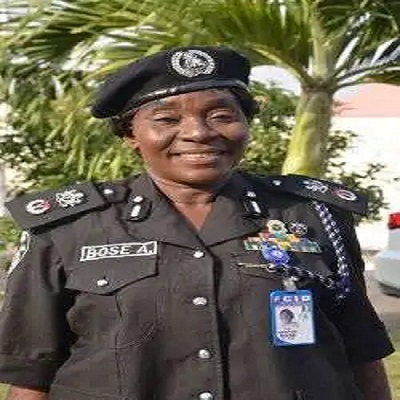
Ekiti gets first female Commissioner of Police

Bose Akinyemi has become the first female Commissioner of Police ever produced by Ekiti State.

The Ekiti-born Akinyemi was among those recently elevated by the Police Service Commission to the position of Commissioner of Police.

According to a write-up on an online platform, cited by Eagle Online, “the renowned daughter of Ikere-Ekiti with the remarkable milestone not only brings pride to Ikere, where she hails from but also to the entire Ekiti State.”

It was further disclosed that: “Akinyemi’s promotion is a testament to her dedication, hard work, and commitment to excellence in her career.

“Her achievement serves as an inspiration to women and girls in Ekiti State and beyond, demonstrating that with perseverance and determination, they can break barriers and reach great heights.

“The people of Ikere-Ekiti and Ekiti State are celebrating this historic achievement, and Akinyemi’s promotion is being hailed as a victory for women’s empowerment and representation in leadership positions.

“Congratulations to CP Bose Akinyemi on this remarkable achievement!”

Nigerian Navy fingered in alleged disappearance of Barr. Kevin Okorie

The Nigerian Navy is being accused of the illegal detention of a Port Harcourt-based lawyer, Kevin Okorie

Details of his alleged detention and refusal by Nigerian Naval authorities to release him were shared by one Gloria Worlu on WhatsApp.

Worlu in the post wrote:

“Barr. Kevin Okorie from Ebonyi State Onitcha Igboeze (sorry if I spelt it wrongly) is a member of the NBA.

“He was invited for a meeting on the 10th of September 2024 by the Navy at Iwofe Aker base in Port Harcourt he didn’t come back that day. On the 11th he called his wife that he was coming back home with some Naval officials. But he didn’t come back, the wife called but his number wasn’t available till the end of that day.

“On the 12th his wife went to the naval office herself. They told her to go to the police station and report that he was missing. She said NO, that her husband told her he was in their custody.

“They sent her away.

“Only for him to call with a naval officer’s phone to say that he’s being held by the Navy. She took food to him and spoke with him the same day. But they didn’t allow her to see him, he was talking to her from another office or cell nobody knows

“It went on and on till His community wrote a letter to the NBA that their son was in Naval custody. Two weeks later human rights advocate and some NBA members went to Naval base but they denied he wasn’t there.

“Human rights invited the wife to follow them again to Naval base on reaching there they said she should go and come on a Monday but the woman protested that she wouldn’t go anywhere that they’ve been holding her husband for 3weeks If he committed any crime he should be charged to court. They denied that there was no record of him.

“The wife said “So who is the person I spoke to and brought food for twice in this same place? Who ate the food?” That was when Mr Eko with this phone number 08035362486 said that Barr Kevin had been moved to Abuja. With no crime being stated. That she should call him (Mr Eko) so that he will give information about where they moved him to in Abuja. Only for her to call as instructed he said he has been moved to Abuja that’s all he knows.

There is no information on his whereabouts from September 10th till today the 26th of December 2024.

The community where he came from has written a petition to the NBA to help get back their son. The wife has been frequenting the naval office. The children have been crying and asking for their dad. The wife has partial blindness. She has been managing her eyes like that for months now. Barr Kevin is the source of support to his family. We don’t know if he is dead or alive. The only clue we have is the Naval base Iwofe Port Harcourt.

Bauchi High Court dismisses blasphemy, cybercrime charges against Rhoda Jatau 

Rhoda Jatau, a health worker resident in Warji Local Council, Bauchi State, has been discharged and acquitted after a Bauchi High Court found her not to be guilty of the cybercrime, blasphemy and religious disturbance charges filed against her following a two-year trial.

Jatau was arrested and detained on May 24, 2022, after residents of the area accused her of blasphemy for sharing a video of someone condemning the lynching of Deborah Samuel, a 200 Level student of the Shehu Shagari College of Education, Sokoto.

Sean Nelson, the legal counsel for Global Religious Freedom at the Alliance Defending Freedom (ADF), shared on his X page on Thursday that Jatau was freed after the Bauchi High Court found her not guilty of the charges.

He stated that the court dismissed the charges against her on December 10 although she was granted bail a year earlier.

Read Also: Finally Rhoda Jatau freed from Bauchi Prison

Jatau, who spoke in the five-minute-long video attached to the post, said after she shared the video condemning the murder of Samuel, Muslims who were offended by it visited her home and burnt it down.

“That was when the crises started. They went on and burnt our houses and so many places. A day after, on Tuesday the 24th, they took me to prison after taking me to court. They charged me for cybercrime, blasphemy and religious disturbance,” Jatau said.

Read Also: Nigerians ask, who will compensate Rhoda Jatau?

Jatau, who is also a mother of five, said no one except her lawyer was allowed to visit her and described the treatment she received in prison as terrible.

“There are many things that are not enjoyable in that place. One cannot explain. It is just too bad,” she said.

She was released on December 9, 2023, after spending 19 months in detention. Her release followed interventions from the Christian Association of Nigeria (CAN), the Nigeria Inter-Religious Council and the Christian Solidarity Worldwide who criticised her unjust persecution.

The prosecution of Jatau by the Bauchi State Government was only made public in November 2023, about 18 months after she had been detained.

On November 29, 2023, FIJ reported how the health worker was arrested and charged under sections 114 and 210 of the state penal code, and section 24, subsection 1b(i) of the Cybercrime Prohibition Act of 2015 with inciting public disturbance, exciting the contempt of religious creed and cyberstalking.

Credits: FIJ

Creating demand for the Naira

By Victor Ogiemwonyi

A national currency is one of the things that makes a country sovereign, it should be the pride of a Nation , its strength, purchasing power and therefore guarded with all …its acceptability of its legal tender ( National Currency) is important, with vast economic implications.

In a recent conversation, with my friend and market colleague, Mr Sonnie Babatunde Ayere, he reminded me that the word “ current “ in any National Currency…. implies the flow of energy…in the business activities that are tied to a Country’s Currency. The more the activity in your National currency, the more, the demand for it, and therefore, value. In his view, when the only thing the world really wants to buy from a country, is not sold in that Country’s local currency, then the currency is doomed. The consistent depreciation of the Naira, regardless of the levels of Reserves and import cover, attests to this. Simple economics dictates, value rises where there is consistent demand. Something he says he has been canvassing for years on end.

In our discussion, the issue of the value of Naira, came up. He believes selling our oil in Naira was the solution. Why shouldn’t a Vitol or Trafigura ( oil traders who frequently buy our oil) sell its Dollars to our newly created FX Market (EFEM ) to buy Naira and then use the Naira to pay NNPC Limited for our oil? After all, NNPC is now a private Nigerian Company and legally should accept Naira for its products. The coming on stream of the Dangote Refinery has done Nigeria and Africa great pride. Selling oil to it in Naira for refining is the right thing to do. We should complete the cycle by selling all our oil in Naira.

This point mirrors the position expressed by Mr Femi Falana SAN, a prominent lawyer, who brought this up sometime in 2023. Although, his concern at the time was more about the dollarisation of transactions in Nigeria by those who transact here in Dollars. Also earlier this month, a Bill that is now being considered, emerged in the National Assembly, seeking to ban transactions in Dollars in Nigeria. I think this law will not be necessary, once we have a market priced Naira.

Any time you make a law to ban something this nebulous, implementing it, is usually, almost impossible. The effort to monitor and enforce it, will usually take away the oxygen in the idea.

The calls to have the Naira, as the only transaction currency, in our economy, are grounded in good economic logic and on its merits, and a move in the right direction, that is deserving of a considered look.

Selling our Oil in Naira for instance, will have huge positive implications, that will help in stabilising the Naira … let those who buy our oil, convert to the Naira and pay us in Naira.

Let’s move from our current approach and fixation, only on increasing the supply of Dollars to our economy, and focus on getting more demand for the Naira.

We do not have much to sell in dollars, we are a consuming nation, that may always import and also consequently, always importing inflation, with our Dollar purchases from abroad. It will take very many years, to produce enough to significantly to reduce our dependence on imports.

We can immediately focus our energies on creating demand for the Naira, to generate an uplift in value and create dollars to be supplied to our economy in a significant way. Oil is our main product to the world, let us leverage it, to boost our National Currency. It is a quicker and more effective way to enhancing the value of the Naira.

Let’s put in perspective, the recent smart decision by the Government, to sell crude oil to Dangote Refinery, in Naira… that means, that the nearly 60% of our FX demand for importing refined petroleum products into Nigeria , disappears from our Dollar demand, and less pressure on the Naira. If we can finally persuade, those who insist that, they must import what we produce to ensure “ competition” even though that means, importing dirty fuel from Malta, with unknown owners from a blending plant, that has mysteriously appeared from nowhere… and now the largest facility for importing fuel into Nigeria.

As they say, If you understand Nigeria, then you don’t know Nigeria.

We should also wean NNPC off, their love for borrowing Dollars with Crude Oil swaps. It does not matter to them, that they cannot now supply Dangote Refinery, its crude oil requirements. Nobody has been able to explain to us, the new Nigerian phenomenon of importing crude oil to refine locally, despite now having the capacity to refine our own crude oil, to save FX and reduce our demand for Dollars.

I was surprised a few years ago on my visit to Kenya and found that Kenyan Taxi drivers are not excited to be paid their fares, in Dollars…they will direct you to a bureau de change, to change the Dollars and pay them in their Kenyan Shillings ( their National currency)

No matter how rich you are in Dollars, you can only buy and pay for goods and services in Pounds in the UK, Euro in Germany and Yen, in Japan… they will not accept Dollars for any physical payment.

Companies report their activities in their currency, even when some of those activities occur outside their home country, where the company headquarters are located. Nigerian Companies Report in Naira. Even NNPC that is so much in love with borrowing in Dollars to swap for oil, also report their Financials in Naira.

Funding Government budgets in Nigeria today is by selling oil in Dollars and then convert to Naira, and share at FAAC. Why not sell our oil in Naira and avoid the run around of first selling in Dollars, and exchanging it back to the Naira?

This current trade flow kills the value of the Naira as it does not by design, create demand for the Naira. The flow to create demand, should be for buyers of oil to sell the US dollars to buy Naira ( creating daily demand for large quantums of Naira) This demand should over time, bring about levels of Naira scarcity and eventually, Naira begins to require more Dollars to be availed to it, therefore increasing Naira value.

Recent examples of creating demand for National currency, like in Russia for instance, have proven positive. Since Russia started demanding that, its oil be paid for, only in Rubble.. (their National currency ).
Two years down the line, and despite the crippling sanctions, the Russian Rubble, has not fallen from the sky as was expected. It has strengthened and has also remained stable.

We now have a market price for the Naira, all our contracts should accordingly be priced and paid in Naira. Importing inflation with these Dollar denominated contracts, no longer makes sense.

A true Nigeria FX market will emerge once the demand for the Naira goes up … imagine selling 2m barrels of oil every day in the market at N1500, this will translate to a demand of N30billion daily, and also automatically translates to $2b inflow daily, effortlessly. Those buying our Oil will need to sell Dollars to get the Naira they need to pay.
A US $2b dollar market daily transaction, just from oil alone, will transform the value of the Naira, increase Dollar liquidity and improve the overall economy. It will help moderate inflation, promote strong growth, and stabilise the Naira.

We recognise that Oil is sold in Dollars, we will sell in dollars but receive payments in Naira.
Since our Oil buyers will have to come to the Nigerian FX market to buy the Naira, the true value for the Naira will emerge, from a market mechanism, leading to, true price discovery. That, buying and selling activity in the market, will make the Naira a trade-able currency in the International market. It will also give the Naira, more visibility and enhance its status.

Victor Ogiemwonyi is a retired Investment Banker and writes from Ikoyi, Lagos.

Hunger, stampedes and death

By Olusegun Adeniyi

I commiserate with the families who lost loved ones to the stampedes of recent days in Ibadan, Oyo State, Okija, Anambra State and Abuja, Federal Capital Territory (FCT). There can be no greater tragedy than for anybody to die while looking for something to eat, especially during a festive season like this. So, for those in authority at all levels, the message should be clear. But from what I have been reading in recent days, it appears some may simply be looking for scapegoats while others are playing politics with a problem that has always been with us. In the process, important lessons are ignored. If only to honour the memories of the dead, we must not waste this moment.

While ordering a probe into the tragedies, the Inspector General of Police (IGP), Kayode Egbetokun “warned groups and organizers of similar events to ensure the involvement of security agencies as negligence on their part is criminal and would not be overlooked…” These incidents, according to the National Emergency Management Agency (NEMA) Director General, Zubaida Umar, who also waded in, “undermine the goodwill behind charity events, turning acts of kindness into sources of grief due to poor planning and crowd control.” The impression being unwittingly created is that these tragedies would not have occurred if the police and other security agencies as well as NEMA ‘experts’ had been involved in planning and execution. Even President Bola Tinubu seems to have bought into that narrative considering what he said during his media chat on Monday night. But is the blame game supported by empirical fact?

On 23 February this year, seven people died following a stampede during the distribution of 25kg bags of rice at a discounted price of N10,000 by the Nigeria Customs Service (NCS) in Lagos. Aside the fact that the NCS is a quango whose personnel bear arms, policemen were also at their zonal headquarters in Yaba when the stampede occurred. “Unforeseen challenges arose when we ran out of stock and announced the continuation of the exercise the following day, leading to a regrettable outcome,” spokesperson for the service, Abdullahi Maiwada, explained after the incident. “The crowd became desperate and charged through our barricades in search of rice bags inside emptied containers. In the stampede that ensued, some fatalities and injuries were regrettably recorded.”

A month later, two female students at the Nasarawa State University in Keffi, also died while 17 other students were injured following a stampede inside a hall where bags of rice were kept. Security personnel at the scene were reportedly ‘overpowered’. At the instance of Governor Abdullahi Sule, each tertiary school student in the State was to receive two 7.5kg bags of rice and N5,000 to cushion the effect of the difficult times in the country. “After our arrangement for the distribution of palliatives to the students that was to be held at the university’s convocation square, they (students) suddenly arrived at the venue in their numbers and overpowered security,” the Nasarawa State Students Association national president, Yunusa Yusuf Baduku, explained. “They (the students) broke through the gate into the hall where the bags of rice were to be shared. Unfortunately, most of our female students sustained injuries. We rushed several students to the school clinic and Federal Medical Centre Keffi. I learned that two female students died from suffocation.”

Given the foregoing, the self-righteous fixation about ‘criminal negligence’ on the part of organisers of these events may not be accurate. And it could be counterproductive. Since I arrived Ilorin last Saturday for the Christmas holiday, I have found it difficult to sleep well as I reflect on where I would probably be now if God had not intervened on behalf of our church three weeks ago when we organised a similar programme. Therefore, as much as I share in the grieve of the bereaved families, I also sympathise with the organisers of these events who must now be going through trauma. So, before I conclude with my take on these tragedies, I seek the indulgence of readers to share a personal experience.

The Everlasting Arms Parish (TEAP) of the Redeemed Christian Church of God (RCCG), where I worship in Abuja, features an annual programme that supports the less fortunate with gifts of food items and household wares during the Christmas period. Called ‘Tabitha Tent’, it was initiated by Pastor Chinedu Ezekwesili in 2007 and continues with his successor, Evaristus Azodoh. Dependent on donations from church members (with some members also using their networks to get external support), the event is held on the first Saturday in December every year. While my wife and I had been actively involved from the beginning, Pastor Azodoh raised the stakes in 2019 by appointing me chairman of the organising committee. Our responsibilities include raising funds, procuring essential foodstuffs and coordinating the programme. I have able lieutenants in Modupe Ogundimu, the Lagos Zonal Director, National Health Insurance Authority (NHIA), Elizabeth Ekpenyong, Director of Strategic Programmes, Debt Management Office (DMO) Abuja, Funke Abegunde, a teacher at the American International School, Abuja and Bello Bissalla, Managing Director/CEO, Beltina Printing Press.

Being both a retired army Colonel and a medical doctor (with his wife also a medical doctor), Pastor Azodoh ensured we had security and medical teams in place for the programme every year. Despite that, we have had situations of some participants going home with bruises and other minor injuries after being treated by our team of medical personal led by Dr Rosemary Nwokorie, a consultant anaesthesiologist and Chairman Medical Advisory Committee (CMAC), Asokoro General Hospital and Bayo Olakareem, a pharmacist. Last year, a woman broke her arm in the struggle at the gate. After the preliminary intervention by our medical team, I asked my driver to take her to the hospital with N50,000 as a deposit. Before they left the church premises, the woman asked to be given the money and just taken home. When all entreaties for her to be taken to the hospital proved futile, we acted as she demanded. She was around three weeks ago for this year’s edition and told us she had spent a fraction of the money to heal the arm through traditional methods. That is the kind of poverty you deal with at these charity programmes.

On Saturday, 7th December, our medical team was on ground and for security, we had ten policemen and another ten men from the Nigeria Security and Civil Defence Corps (NSCDC) to support them. These 20 official security people were joined by our 13 in-house security personnel (we have an expansive compound that also hosts both primary and secondary schools) and several Ministers/Workers. In the days preceding the event, as it was the practice every year, we (in the organising committee) also fasted and prayed together. On D-Day, we believed we were well covered despite the thousands who had camped outside our church premises from Friday 6th December—24 hours before the programme.

The programme started by 8am with beneficiaries (the number we could cater for) allowed entrance into the premises through a guided process once they collected the accreditation tags. Everything went well and by 10.30am we had concluded the sharing of foodstuffs to as many as 1,300 people – only clothing materials and shoes were left. By our arrangement, beneficiaries had to remain inside the church premises so that they could all leave at the same time since the number of people outside was almost three times the number inside. When we felt our assignment was completed, we asked the security personnel to open the two gates to allow beneficiaries to exit with their packs. That was when all hell broke loose.

The moment the gates were opened, the thousands of people outside rushed in. And that was the point of divine intervention. For some inexplicable reason, the people inside practically froze. Likewise with all the security men who became mere onlookers. That was how we were saved from what could have been a tragedy. If those inside had attempted moving out while those outside rushed in, as it almost always happens on such occasions, many lives would have been lost. Although Pastor Azodoh was evidently shaken by what we witnessed, I had a delayed reaction. It was only after the Ibadan tragedy that I began to ruminate on what could have happened at Tabitha Tent 2024!

The first lesson I take from ‘Tabitha Tent’ every year is how the level of desperation in our society continues to rise and the need for concerted efforts to deal with food insecurity for millions of our people. This is a programme that we do not advertise yet huge crowds turn up every year. Packs contain little more than rice, beans and garri (vegetable oil has disappeared from our list in the last two years) that would last no more than two weeks at most. Yet people come from as far as Nasarawa and Plateau States. Since they are mostly women, another story on its own, many come with their children. They sleep on bare ground outside the church premises and endure the scorching sun the next day. Meanwhile, some still go home empty-handed because the turn-out almost always exceeded our provision—even when we were catering for about 5,000 people.

Now to the critical issues. If you remove his usual divisive slant, the Muslim Rights Concern (MURIC) Executive Director, Prof Ishaq Akintola, is right to demand the immediate and unconditional release of those arrested over the Ibadan disaster. “Queen Naomi Silekunola in particular is well known for her philanthropic activities and nobody in his or her right mind will assume that she deliberately planned a massacre,” Akintola wrote following her arraignment along with two others on a four-count charge of conspiracy, acceleration of death, negligent acts causing harm, and failure to provide adequate security and medical facilities. “By the same token, the arrest of the principal of Islamic High School, Orita Bashorun, Ibadan, was quite unnecessary because the alumni of that school have confirmed that the venue was approved by the Oyo State Ministry of Education and not by the principal acting unilaterally.”

The point for me is that in a nation where there is no safety net for the poor by the government at any level, criminalising charity work is unconscionable. How the programmes should be organized can be debated but it would be catastrophic if public-spirited individuals and corporate bodies were discouraged from supporting such programmes. That can easily happen with the way some officials are carrying on about seeking government permits bla bla bla. But there are also lessons that organisers of these charity programmes should take onboard going forward.

As I wrote in my March column, ‘The Stampede for Food to Eat’ (https://www.thisdaylive.com/index.php/2024/03/28/the-stampede-for-food-to-eat/), there is a lot we can all learn from the ‘Al-Habibiyyah Society Food Programme’ through which Imam Fuad Adeyemi has, for almost two decades, been feeding thousands of people every day in Abuja during Ramadan, in a flawless manner. The secret is that the Imam deploys several unarmed volunteers from the elite of our society because they can attest to his integrity. If you unleash too many arms-bearing security personnel to confront an army of hungry and desperate people where food is being shared, as is being suggested, you are inviting trouble. But we must also rethink the idea of a safety net for the poor beyond ‘palliatives’ that do not address the challenge of hunger in a sustainable manner.

Many have suggested that empowering the people through vocational training and providing funds for small scale businesses is the way to go for philanthropic organisations. I subscribe to the idea. But it is also not as easy as they imagine in a nation where not only are many people lazy but also have an entitled mentality. Four years ago, Pastor Azodoh expanded the mandate of ‘Tabitha Tent’ to include empowerment. We were to organize training programmes and give out loans to support small businesses. The church provided a tidy amount as seed money. I delegated Bissalla to handle that assignment. We would spend a lot of money to organize training programmes, invite resource people and at the end, only a few people would turn up. But when we ask for proposals on viable ideas that could be supported with soft loans, we would receive hundreds of applications, each requesting for millions of Naira “to do business”!

While investigations continue on the stampedes that claimed dozens of lives in Ibadan, Okija and Abuja, government agencies must be ready to provide the support needed to individuals and organizations carrying out acts of charity. They should not scare them away. Based on the demography of the casualties in the three recent tragedies, it is evident that victims are mostly women and children—the most vulnerable of any society. Considering that Nigeria’s population is predominantly youth based, there must be a deliberate policy to identify and implement empowerment initiatives that directly impact their lives and communities. But as a matter of urgency, the government must also address the root causes of the kind of poverty that pushes our people to the point of animalistic desperation.

I wish all my readers the compliment of this glorious season.

You can follow me on my X (formerly Twitter) handle, @Olusegunverdict and on www.olusegunadeniyi.com   

A day’s affair of a Jewish and Muslim calling in Morocco

By Yossef Ben-Meir
Marrakech

This article describes a day in December when the Moroccan Jewish community implemented restoration work of its High Atlas cemetery in Tafza, carried out by members of local farming families. This joint local action crystalizes the sublime Moroccan Jewish and Muslim national experience.

On the 12th of December 2024, I set out with four colleagues of the High Atlas Foundation (HAF) to meet with members of the rural community of Tafza (Al Haouz province, Marrakesh region), located in the mountain range that bore the horrendous epicenter of the September 2023 earthquake. Unlike the countless visits that members of our Moroccan and US non-profit organization have made to many hundreds of village communities in this area since that natural disaster, this recent December visit was of a different, yet still humanly essential, restoration purpose

The president of the Moroccan Jewish community in Marrakesh, Jacky Kadoch, followed by the authorization of the provincial governing authorities, had asked that we perform a sacred duty at the Tafza Jewish cemetery. Our purpose that day was to gather and bury again the human bone remains that have emerged from the ground from the years of terrible erosion, likely exacerbated by the previous year’s earthquake.

The High Atlas Foundation’s re-tombing of the beloved departed, upon request, is an honoured service that we perform with urgency. HAF implements community development projects based on the local people’s collective will for initiatives that meet their individual and shared priority needs.

Our best expertise is in facilitating those introspective conversations that result in the peoples’—the beneficiaries’—action plan for the development they want most of all. For us, and as is underscored by global experience, projects endure and meet the people’s goals of their lives because of the communities’ dedication in carrying them out. It is therefore vital that the re-tombing be done together with the people in closest proximity to the historic mountain cemetery since doing so also holds importance for them.

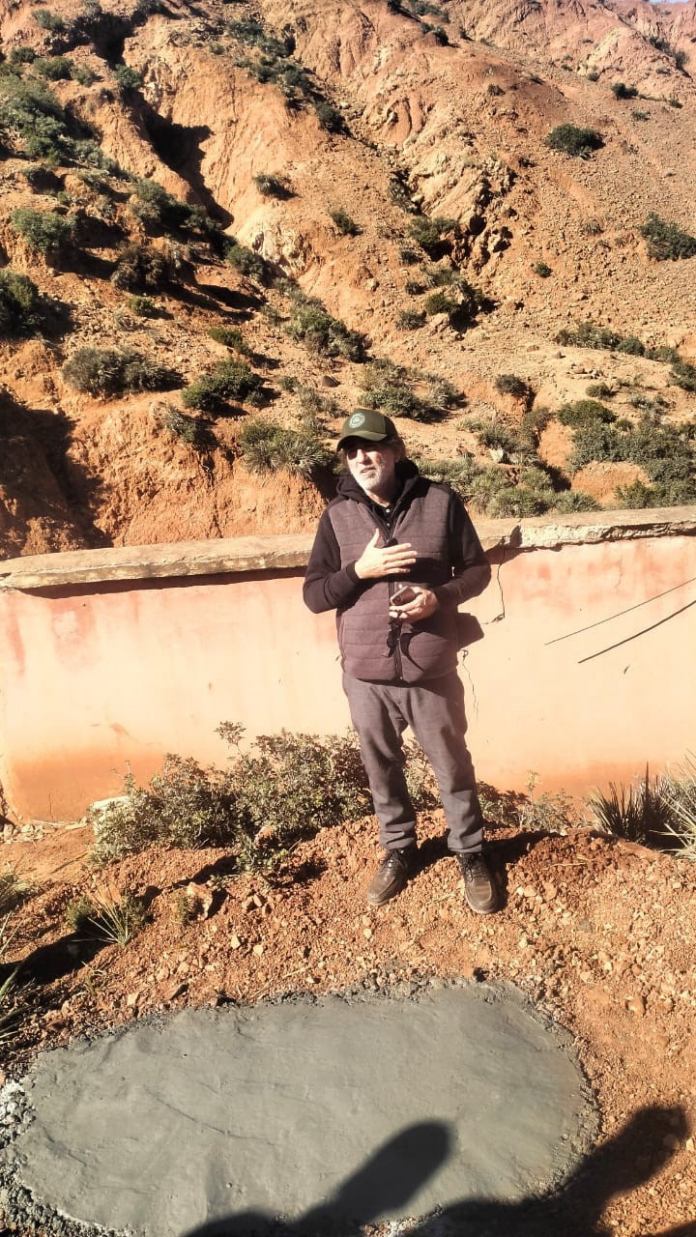
The Sunni Muslim Kingdom of Morocco’s caretaking of Jewish cemeteries in all parts of the nation comes as naturally as the peoples’ identity itself may come. It requires no explanation, no persuasion, only the confirmation of a day and a time when men of all ages gather to restore what the collective community sees as part of their own indelible and revered past. When we arrived that morning, roughly 30 people were already gathered with their tools to traverse the 1,200-square-meter cemetery, pick up every observed bone, place them in a cloth sack or covering (as per Moroccan Jewish and Muslim traditions), and re-bury them in a new grave that Tafza residents had dug, lined with brick, and built to endure for the next millennia.

As we walked together with Tafza people in all parts of the cemetery with our eyes to the ground, we also spoke about the work needed to redress and end the erosion of this degrading mountain slope. We identified the critical points at which to add and level soil and plant non-bearing fruit trees in a manner allowable by Jewish custom. We spoke about the three Jewish village communities who left the area several generations ago to which this circa 1,000-year-old cemetery belonged. We went to the unmarked burial site of a revered rabbi, whose name this adult generation of Tafza people no longer recall. Most local oracles of knowledge about this cemetery, great grandparents of today’s farming families, are no longer alive.

We addressed the exigency of bone reburial, but an enormity of restoration work remains. Even with the highly commendable national initiative of the Moroccan Jewish community led by Serge Berdugo with financial backing of the Moroccan government following Royal instructions that restored 167 Jewish cemeteries, a large number still require attention.

The Moroccan government representatives’ presence that morning was warm, helpful, and kindred. It felt as if all together we had created that day a subcommunity of Moroccan protectors of the past and future. It is a Moroccan Jewish custom at the anniversary of the passing of their righteous ones (the occasion referred to as a hiloula) to eat together and enjoy a shared moment of bounty. On that December day, it was not an anniversary of anyone passing, though it might have been. But we did break bread, dipped it in local raw honey and olive oil, drank tea made with local herbs, and shared a moment atop infinite previous moments of Moroccan Muslim and Jewish people from government, civil society, and small businesses, from city and rural places, completing something that was calling to be done.

We brought before all of our eyes the miracles and blessings of Morocco that find their way into our daily affairs. It explains for me, as well as I have been able, that to serve in Morocco is to never let go.

Dr. Yossef Ben-Meir is a sociologist, a former Peace Corps Volunteer who served in the High Atlas Mountains 30 years ago, and President of the High Atlas Foundation in Morocco.

Married father of two stabs ex-girlfriend to death over failed attempt to revive relationship

A 38-year-old man identified as Bill Jallah has stabbed his ex-girlfriend, Princess Zuo, to death in Liberia. 

Witnesses detailed that the incident occurred late Saturday evening, December 21, 2024, at a local Entertainment Center in Paynesville. 

It was gathered that the attack occurred after Zuo refused to reconcile with him. 

Further reports indicated that the relationship between the deceased and Jallah who is married with two kids, collapsed after his wife rendered several death threats to the late Princess Zuo.

According to reports, threats from Jallah’s wife made Princes afraid, hence she decided to put an end to the relationship.

It was reported that the Jallah and Princess had been on a breakup for a month, when the late Princess had decided to abort Jallah’s calls and refused to respond to his text messages, which had the relationship dormant until the suspect’s sister asked to Intervene in the relationship at a nearby entertainment center, where the incident occurred.

She was reportedly stabbed multiple times in her stomach, her neck, and her back, resulting in her death.

The suspect has since been apprehended by the police, while Princess’s body has been deposited at a local funeral home as the investigation continues. 

Liberia: Married father of two stabs ex-girlfriend to d3ath after failed attempt to rekindle relationship

Nigerian widow accuses brothers-in-law of taking over her late husband’s house, changing locks

A Nigerian widow, Uba Princess Chidinma Ugoji, has accused her brothers-in-law of taking over her late husband’s house, leaving her and her children homeless. 

Lamenting her ordeal in a Facebook post on Tuesday, December 24, 2024, the mother of four said her late husband’s brothers allegedly went to the house in her absence and threw her staff and younger sister out.

She also claimed that they changed the locks on the house and went away with the documents after threatening to kill her if she approached the property. 

“It’s not my wish to become a widow at this time leaving this innocent 3 little boys and our adopted daughter for only me to carter for, God decided to call my dear husband home on time, away from sickness and pains. But it will be an error for I Uba Princess Chidinma Ugoji to fold my arms and allow my late husband brothers take away what their late father and I laboured for,” she wrote.  

“Since last week I have been denied access to the home I live with my children, my husband brothers went to my house with men of the under world thinking I was inside so that they can end my life and that of my children, unfortunately for them they met my absence inside my compound but unleashed their anger on my staff and my younger sister went away with documents, pushed them out my home almost naked and gave a stern warning that I shouldn’t come close to my house if I don’t want to my family to come carry my dead body. 

“As if that wasn’t enough, they changed my house keys and locked I and my kids outside. With the help of the Nigeria police, they were able to apprehend them yesterday and took one of them to my house and made him unlock their keys so that I and my kids can have access to my house.

“I never knew this is what young widows go through in the hands of some Mbano people. Death!!!!! You do this one.” 

They changed the keys and locked me and my kids outside  - Nigerian widow accuses brothers-in-law of taking over her late husband

Linda Ikeji

Bishop Kukah says failure of government behind hunger crisis, tragic stampedes

  • Nigerians don’t like to queue; organisers made grave errors – Tinubu

Bishop of Sokoto Diocese, Mathew Hassan Kukah, has blamed the government for the hunger crisis that led to recent stampedes in Abuja, Oyo, and Anambra States, claiming innocent lives during food distribution.

In his Christmas message, Bishop Kukah criticised the government’s inaction, describing the tragedies as a “metaphor for the situation of despair” gripping the nation.

“The tragedies that occurred in Okija, Ibadan, and Abuja where innocent people lost their lives in stampedes at food distribution points are a metaphor for the situation of desperation that citizens have been thrown into. The failures of government to respond concretely toward ending the horrible crisis of hunger and desperation has created the conditions for these avoidable tragedies,” he stated.

He urged the government to collaborate with institutions committed to societal welfare and ensure citizens live with dignity.

The Bishop also reflected on Nigeria’s progress since independence, stating that the nation continues to “walk in darkness” due to entrenched issues such as ethnicity, nepotism, and greed.

“Our journey to greatness is still severely constrained by the forces of ethnicity, nepotism, and greed,” he remarked, adding that these forces exacerbate feelings of exclusion and violence among citizens.

Bishop Kukah also addressed barriers to youth participation in politics, citing the high cost of running for office as a persistent challenge, despite the passage of the Not Too Young to Run Bill.

On education, he commended the government for introducing loan schemes but stressed the importance of extending such opportunities to vocational and technical students while removing bureaucratic obstacles.

“In future, poverty should not exclude anyone from a good education. We encourage the youth to seize this opportunity with both hands,” he said.

While acknowledging progress in combating insecurity, he called for a detailed national security plan addressing unemployment and religious extremism to ensure lasting peace.

“Insecurity is the first child of corruption. We cannot win the war against insecurity without addressing the issues of unemployment and violent religious extremism which create the conditions for violence,” he added.

Bishop Kukah’s message served as both a critique of government shortcomings and a call to action for a brighter and more inclusive future for Nigeria.

President Bola Tinubu however blamed the masses and organisers for the stampedes that occurred during palliative distribution in Ibadan, Abuja and Anambra last week. The president stated Nigerians don’t like to queue, saying that it reflects in our bus stops.

Tinubu made these remarks during his first Presidential Media Chat in Lagos on Monday, blaming the organisers of the giveaways for the tragedies, which claimed the lives of more than 50 Nigerians, including children.

“It reflects in our bus stops where we don’t even like to be in the queue before we rush into the vehicle. It is very sad, but we will continue to learn from our mistakes.

“To me, I see this as a very great error on the part of the organisers but things are improving and it doesn’t kill our happiness,” Tinubu said.

While sympathising with the families of the victims, Tinubu dismissed the claim that the stampedes were caused by hunger and economic hardships. He said there are food banks in the United Kingdom and the United States but stampedes don’t happen there.

Credits: Vanguard Newspaper and BusinessDay

TIPS