Home Blog Page 419

Nigerian British, Amanda Amaeshi, is UK ‘Changemaker of the Year’ 2024

Amanda Amaeshi, an award-winning activist, campaigner, and writer specialising in gender equality, anti-racism, and youth voice, has been named My Life My Say’s ‘Changemaker of the Year’ for 2024.

Ms Amaeshi, a final-year Law student at University College London (UCL), has consistently used her voice to influence policy and advocate for social justice.

The award, decided by public vote, was announced at My Life My Say’s ‘Next Generation Conference’, held on November 22, 2024, at the Barbican Centre in London. The conference – an annual highlight of the youth-led, non-partisan charity’s activities – brought together hundreds of young people alongside renowned speakers, activists, and politicians to explore innovative solutions to some of society’s biggest challenges.

Amanda emerged as the winner from a shortlist of inspiring changemakers, including youth leader Yahye Abdi, social enterprise founder Abdirahman Ahmed, TV personality Georgia Harrison, climate activist Clover Hogan, and artist Jordan Stephens.

A Journey of Advocacy and Activism
From an early age, Amanda showed a keen interest in addressing social issues. In 2017, she won the Young Reporters for the Environment competition for her writing on food waste solutions in Scotland. Her advocacy journey gained momentum when she became a Year of Young People 2018 ambassador, advocating for youth participation in politics and young people’s rights — issues important to young people across Scotland.

As a member of Girlguiding’s national Advocate Panel, Amanda spoke out on issues affecting girls and young women in the UK. She engaged audiences of CEOs, politicians, and decision-makers through speeches, blogs, and live radio interviews.

Today, Amanda remains a Young Spokesperson for Girlguiding Scotland and serves on Scotland’s First Minister’s National Advisory Council on Women and Girls (NACWG), engaging in collaborative intersectional policy scrutiny and providing the much-needed youth voice to ensure that NACWG’s work in holding the Scottish Government to account is helpful for girls and young women.

Her guest articles for Scottish newspaper The National further amplify her advocacy, challenging societal norms through her fresh perspective, and inspiring readers to engage in collective action against injustices.

Amanda also works closely with organisations including the Young Women’s Movement Scotland, Intercultural Youth Scotland, and the National Youth Agency in England — showing her unwavering commitment to fostering inclusive and intersectional practices across various sectors.

Recognised and Celebrated
Amanda’s contributions have already earned her numerous accolades. She was named on the Young Women’s Movement’s 30 Under 30 list in 2020, featured in the WOW Foundation’s Young Leaders Directory in 2022, and was honoured as the Glasgow Times Young Scotswoman of the Year for 2020.

In her acceptance speech at the Next Generation Conference, Amanda reflected on the broader impact of her work: “Winning is an honour, as I’ve said, but it’s even more of an honour to have a platform to share what I’ve done with others, perhaps with those who otherwise wouldn’t have known. Because, really, this award’s not about me: it’s about the work that I’ve done, the work that I do together with other people, and its positive impact for society at large.”

Inspiring the Next Generation
Amanda is hugely grateful to not only all those who voted for her, but everyone who has supported her throughout her advocacy journey so far.

Amanda is determined to use her platform to motivate others to make a difference, encouraging everyone to contribute in their own way to creating a better world.

Congratulations to Amanda Amaeshi, a true changemaker and an inspiration to many!

Find Amanda’s work here: https://linktr.ee/amandaamaeshii
Watch Amanda’s acceptance speech here: https://youtu.be/gBl0QcJ7kzU

Remorseless ex-prison guard trainee sentenced to death for ‘cruel and calculated’ slaying of five women at a Florida bank

An ex-prison guard trainee who executed five women inside a Florida bank almost six years ago was sentenced to death on Monday as his judge called the slayings calculated, heinous and cruel.

Zephen Xaver, 27, appeared to gulp but otherwise showed no emotion as Circuit Judge Angela Cowden pronounced the sentence at the Highlands County Courthouse in Sebring. 

After a two-week penalty trial, a jury in June voted 9-3 to recommend that Cowden sentence Xaver to death.

According to Daily Mail Online, Cowden said the weeks of planning that Xaver performed before the 2019 murders at Sebring’s SunTrust bank, the enormity of the crime and the fear the victims felt as they were shot greatly outweighed the two dozen mitigating factors his attorneys had presented, including his history of mental illness, his benign brain tumor and his jailhouse embrace of Christianity.

‘May God have mercy on your soul,’ Cowden told Xaver.

Xaver pleaded guilty last year to five counts of first-degree murder for the slayings of customer Cynthia Watson, 65; bank teller coordinator Marisol Lopez, 55; banker trainee Ana Pinon-Williams, 38; teller Debra Cook, 54; and banker Jessica Montague, 31.

At gunpoint, Xaver ordered the women to lie on the floor and then shot each in the head as they begged for mercy.

Kiara Lopez told Xaver and the court that her mother Marisol had welcomed him into the bank with a smile, an act he repaid by murdering her.

‘You shattered me into a million pieces,’ Lopez said.

 ‘I will celebrate the day you die, whenever that might be. Let it be known that you will always be a killer, a coward, a nobody and a waste of human life.’

Michael Cook, Debra’s husband, also called Xaver a coward and told the judge, ‘I have absolutely no sympathy for him.’

Xaver´s lead public defender, Jane McNeill, had asked that Cowden spare her client, saying a life sentence would put an end to the case instead of dragging it out for a decade of appeals and possibly a retrial if the sentence is overturned.

‘The only way for this matter to be brought to an end so that the families of the victims and this community is able to move forward is a life sentence,’ McNeill argued. The sentence will be automatically appealed.

Under a new Florida law, death penalty sentences can be rendered by a jury vote of 8-4 rather than a unanimous recommendation. 

The change was adopted after the 2018 Parkland high school shooter could not be sentenced to death for murdering 17 people despite a 9-3 jury vote.

McNeill called the new law unconstitutional.

Xaver moved to Sebring, a city of about 11,000, in 2018 from near South Bend, Indiana.

In 2014, his high school principal contacted police after Xaver told others he was having dreams about hurting his classmates. 

His mother promised to get him psychological help.

He joined the Army in 2016. A former girlfriend, who met him at a mental hospital where they were patients, told police he said joining the military was a ‘way to kill people and get away with it.’ 

The Army discharged him after three months. 

In 2017, a Michigan woman reported him after he sent her text messages suggesting he might commit ‘suicide by cop’ or take hostages.

Despite his psychological problems and dismissal from the Army, Florida hired Xaver as a guard trainee in November 2018 at a prison near Sebring. 

He quit two months later, two weeks before the shootings and the day after he bought his gun.

Hours before the murders, Xaver began a long, intermittent text message conversation with a former girlfriend in Connecticut, telling her ‘this is the best day of my life’ but refusing to say why. Fifteen minutes before the shootings, he texted her, ‘I’m dying today’. 

Then, from the bank parking lot he texted, ‘I’m taking a few people with me because I’ve always wanted to kill people so I am going to try it and see how it goes. Watch for me on the news.’

Daily Mail

Fiasco at CCT as Umar, Kogo parade selves as chairman

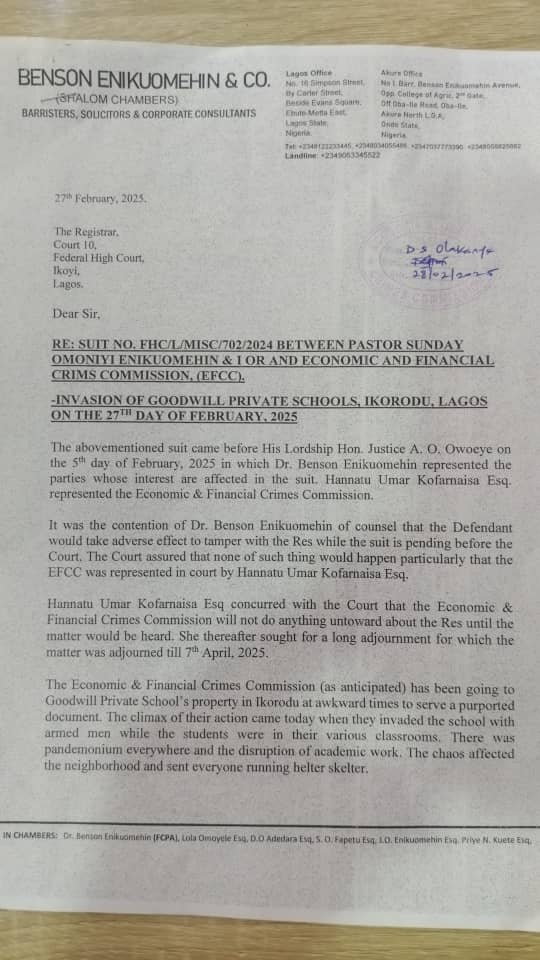
Nigeria’s Code of Conduct Tribunal (CCT) is embroiled in a sizzling confusion as both embattled chairman, Danladi Umar, and the newly-appointed chairman, Mainasara Kogo, are laying claim to its chairmanship.

A report by Daily Trust indicated that both persons had officially visited and held discussions with staff members of the tribunal without any clear directive on who is in charge.

President Bola Ahmed Tinubu had on July 13 appointed Kogo as the new chairman of CCT the same day he announced Omolola Oloworaran as the Director-General of the National Pension Commission (PenCom).

Although the staff members complained about the lull in the work of the tribunal since the controversy over Umar’s removal began, it was observed that corruption cases involving public servants were still being taken with several charges listed on the course list either for trial or arraignment.

However, senior staff members of the tribunal, who spoke on the condition of anonymity, told Daily Trust that they are confused about who to work with as both men have spoken with them and they are only civil servants who obey instructions.

“We are civil servants and we believe we can work with anyone that comes,” a staff said.

“We have not seen any letter to the effect of these changes. We believe there is a procedure for the removal and appointment of a new chairman of the CCT.

“We know that the president and the two arms of government have made pronouncements but we don’t know if invisible hands are working on these but we know there is a process,” he added.

One of the officials said the process is for the appointee to go through the screening by the Federal Judicial Service Commission (FJSC), who recommends to the National Judicial Council (NJC) and then to the President, who approves and forwards to the Senate for confirmation.

The senior official said there has been a pile of unattended files arising from a lack of clarity on the chairmanship of the tribunal.

“He came today and left and the entire judiciary is now on holiday so we have taken the liberty to adjourn all the outstanding cases to January,” the witness said.

However, a former staff of the tribunal, who pleaded anonymity, criticised Umar for visiting the office after what he said his valid removal.

“Why is he still coming to work seeking to sign some documents and approve payments to contractors?”

He said Umar’s visits were illegal as he was no longer the chairman of the commission.

Umar’s removal was endorsed by Senate and Reps

After the presidential announcement removing Umar, both the Senate and the House of Representatives in separate plenaries on November 20 and 26, also endorsed his removal as CCT chairman on allegations of misconduct and corruption.

Both resolutions were hinged on Section 17 (3) Part 1, Fifth Schedule of the Nigerian Constitution and Section 22 (3) of the Code of Conduct Bureau and Tribunal Act 2004 for the decision.

The section provides that “A person holding the office of chairman or member of the code of conduct tribunal shall not be removed from his office or appointment by the president except upon an address supported by 2/3rd majority of each house of the national assembly praying that he be so removed for inability to discharge the functions of the office in question (whether arising from infirmity of mind or body) or for misconduct or for contravention of this code.”

The legal dispute over Umar’s tenure is being tested in a suit before a Federal High Court in Abuja by the Community Rescue Initiative, Toro Concerned Citizens and Relief Foundation, who are contending that by the provisions of sections 1(1) and (3), 6(6), 153 (1) (e) & (i) of the 1999 Constitution of the Federal Republic of Nigeria (as amended) as well as Paragraph (3)(a) (vii) and (b) of the Third—Schedule thereof, the purported concurrence of both Senate and the House of Representatives was null, void, unconstitutional and of no effect whatsoever.

Lawyers say Umar has not been validly removed

Lawyers have picked holes in the process that has created the situation in the CCT with both Umar and Kogo claiming leadership of the tribunal.

Reacting, Sunusi Musa (SAN) said the president did not announce Umar’s removal as provided by the constitution, which states that he can only do so after a resolution of two-thirds of the two houses of the National Assembly.

He explained that at the same time, there have been no further announcements about Kogo’s appointment by the NJC after Umar’s purported removal.

“Where is he getting the powers to visit the tribunal if he has not been appointed by the NJC and has not been inaugurated as the chairman of the tribunal?,” he asked.

Similarly, Dayo Akinlaja (SAN) said if the newly announced chairman has not been issued any letter, which ought to be an instrument of appointment, his appointment is not binding.

He said a letter of appointment would imply that removal has been done which the person affected could then challenge “Not by taking the laws into his hands but through the judicial process.”

In his submission, Haroun Eze, Esq said there are some irregularities in the purported removal of the CCT chairman, Umar.

“The removal did not accord with the procedure for the removal of the CCT chairman and that is why the National Assembly provided that aspect by their resolutions for the removal,” he said.

“Even the resolution, to what extent does it conform to the provision of the Code of Conduct Tribunal Act, particularly Section 22?”

He said the Attorney General of the Federation ought to have commenced an action to establish a case of misconduct against the CCT chairman, which would have given the National Assembly the leeway to pass the resolution they did.

Credits: Daily Trust

Human rights in crisis: Addressing the challenges facing Nigeria (2)

By Ebun-Olu Adegboruwa, SAN

The UDHR was the first document in history to explicitly define what individual rights are and how they must be protected. The Preamble of the document outlines the rights of all human beings: “Whereas recognition of the inherent dignity and of the equal and inalienable rights of all members of the human family is the foundation of freedom, justice and peace in the world,

Whereas disregard and contempt for human rights have resulted in barbarous acts which have outraged the conscience of mankind, and the advent of a world in which human beings shall enjoy freedom of speech and belief and freedom from fear and want has been proclaimed as the highest aspiration of the common people …”

Thus, for the first time in history, human rights were assembled and codified into a single document. The Member States, or sovereign states that are members of the United Nations, came together in agreement to protect and promote these rights. As a consequence, the rights have shaped constitutional laws and democratic norms around the world, such as the Human Rights Act of 1998 in Britain; the Civil Rights Act of 1964 in the United States; the African Charter on Human and Peoples’ Rights (Ratification and Enforcement) Act 1983 and the Constitution of the Federal Republic of Nigeria, 1999 (as altered) [“the Constitution”]; both in Nigeria; etc.

  1. What led to the Human Rights Day (HRD)?

The United Nations General Assembly established Human Rights Day in 1950 to commemorate the adoption of the Universal Declaration of Human Rights (UDHR) on December 10, 1948. Human Rights Day is observed by the international community every year on 10 December. It commemorates the day in 1948 when the United Nations General Assembly adopted the Universal Declaration of Human Rights. The formal inception of Human Rights Day dates from 1950, after the Assembly passed resolution 423 (V) inviting all States and interested organizations to adopt 10th December of each year as Human Rights Day. When the General Assembly adopted the Declaration, it was proclaimed as a “common standard of achievement for all peoples and all nations”, towards which individuals and societies should “strive by progressive measures, national and international, to secure their universal and effective recognition and observance”.

2. NBA as a key stakeholder on HRs:

    The Nigerian Bar Association (NBA) is a professional body of lawyers in Nigeria and it plays a significant role in promoting and protecting human rights in the country. NBA is an avowed defender of HRs through advocacy for the rule of law in Nigeria, emphasizing the need for justice, equality, and fairness in the legal system; legal aid and pro bono services; human rights committees; Public Interest Litigations, and through collaboration and linkages with HRs organizations globally and locally.

    3. NBA’s Aims and Objectives in its Constitution:

      The NBA, by its aims and objectives, as embodied in its Constitution, expresses its overarching vision to uphold the regime of HRs in its operations. Section 3 (11) and (12) of the NBA Constitution, 2021 provides thus:

      1(1). Promotion and protection of the principles of the rule of law and respect for fundamental rights, human rights, and people’s rights.

      4. 1(2). Creation of schemes for the empowerment of newly qualified members and members living with disabilities, and for the provision of assistance to aged or incapacitated members of the Association.” [Emphasis supplied].

      We hold the view that above is the framework that sets up the vision and mission of the NBA in relation to HRs.

      4. NBA HRs Institute (NBA-HRI):

        The Nigerian Bar Association Human Rights Institute (NBA–HRI) was established to effectively and efficiently promote and protect the rule of law, the independence of the legal profession, and to advance human rights enforcement in Nigeria. It will promote respect for human dignity, and translate human rights into specific guidelines for putting those principles into practice. The Institute provides technical development programmes and is also a resource development framework for advocacy in the Nigerian Bar Association. The Institute has a human rights desk in all the 120 branches of the Nigerian Bar Association across the country. The Human Rights Institute at the branch level is chaired by the Vice-chairman of the NBA of each branch. The Institute is governed by 15 members of the Governing Council saddled with the responsibility of supervising and controlling its affairs. The 1st Vice President of the NBA is the Chairman of the Council. The Institute also has four full-time staff that run its activities daily.

        The role of the NBA-HRI is to empower lawyers to manage issues relating to the protection of the fundamental human rights of citizens as guaranteed by the Constitution of the Federal Republic of Nigeria and international instruments to which Nigeria remains a signatory. Also, to participate in the education on human rights, publish regular reports on issues relating to human rights and carry out other related functions in regard to the Human Rights Institute. The NBA-HRI is primarily concerned with the promotion, protection and advancement of human rights in Nigeria and its work is predicated on the standards embodied in the various international and regional human rights instruments ratified by Nigeria in addition to existing local legislations. The mandate of the NBA-HRI is certainly midwifed by the NBA objectives contained in its Constitution as already identified above.

        The Strategic objectives of the NBA-HRI include:

        To develop human rights policies and programmes for the Nigerian Bar Association.

        To implement and advocate for the implementation of the National Action Plan on Human Rights.

        To collaborate with the Human Rights Committee of the NBA at National and Branch levels in the implementation of human rights policies and programmes.

        To promote, protect and enforce human rights under a just rule of law.

        To adopt and implement standards, practices, and instruments regarding human rights accepted and enacted by the comity of nations.

        To promote and protect the independence of the Judiciary and the legal profession in Nigeria

        To develop programmes relating to rule of law and advocate for compliance with principles of rule of law and due process.

        To monitor and ensure strict compliance with all court orders by governments, institutions, agencies, and individuals.

        To gather and disseminate information concerning issues relating to human rights, judicial independence, and the rule of law.

        To establish and maintain relations with other national, regional and international Human Rights organizations.

        To promote the objects, principles, and aims of the Nigerian Bar Association

        To collaborate with other organs of the NBA in developing and improving the image and status of the NBA and members of the legal profession in Nigeria.

        • To promote compliance of the Nigerian government with regional and international treaty obligations on human rights.

        To engage in promoting accountability from public officials.

        5. The nature of hrs crisis in Nigeria

        The crises beleaguering HRs in Nigeria are multi-faceted. They are hydra-headed and like the octopus have many tentacles. We shall x-ray some key areas of these crises affecting HRs in Nigeria.

        1. Judicial Crisis:

        The judiciary is a member of the trinity of government. Following the Legislative and Executive Arms of Government which make and implement laws respectively, the judiciary, as per the courts, is constitutionally vested with the powers to interpret laws. It has the mandate to hold power accountable through checks and balances in relation to the other arms of government. In an ideal situation, the judiciary ought to be the last hope of the common man. Right from the colonial era, through the various civil and military regimes since independence, there is no doubt that the judiciary has been at the forefront of the fight for HRs through epoch-making landmark decisions that shaped constitutional jurisprudence, particularly as touching HRs. Such decisions as: Olawoyin v. A-G., Northern Region (1961); Nafiu Rabiu v. Kano State (1980) 8-11 SC 130; Ransom-Kuti v. A.-G. Federation (1985) 2 NWLR (Pt. 6) 211; Chief Gani Fawehinmi v. General Sani Abacha (2000) 6 NWLR (Pt. 660) 228; Ogugu v. State (1994) 9 NWLR (Pt. 366) 1; Uzoukwu v. Ezeonu II (1991) 6 NWLR (Pt. 200) 708; and a legion of other cases, have shaped the landscape and advanced the frontiers of the our legal system in the area of Human Rights practices.

        However, our judiciary, particularly in recent times, has become bedeviled with so many interfering crises which have, in turn, affected HRs drastically. Some of the challenges are identified below:

        Political corruption through the interferences and undue influences by the Executive and Legislative arms of government, undermining public confidence;

        Stifling of independence of the judiciary;

        Favouritism of the elite and affluent at the expense of the marginalized. This erodes the ideals of equality before the law (See Section 42 of the Constitution);

        Delay in hearing suits especially Fundamental Rights Enforcement actions despite the provisions of the Fundamental Rights Enforcement Procedure Rules for expeditious disposal of Fundamental Rights Enforcement causes;

        Threat of violence or harassment of the judges and justices or their relations;

        Infrastructure failure such as lack of adequate power supply leading to incessant adjournment of cases;

        Inability of the judicially to hold the security agents accountable;

        More value is placed on property and assets than on human beings. You can get an order to arrest a ship than to release a citizen wrongly detained.

        Portable, Queens and Badenoch badmouth matters

        By Suyi Ayodele

        The Oxford English dictionary defines ‘portable’ as “able to be easily carried or moved…” Now, I am using ‘portable’ to qualify Yoruba queens – wives of obas – who are now easily snatched by any loudmouth in town with enough careless cash. A Queen Dammy dashed out of the Aafin in Oyo and landed on the laps of dirty-looking musician Okikiola in Lagos. It is not an isolated case. In Ile Ife, in Ilesa, in Iwo, it happened. Wives of our kings have become snacks (guguru and epa) in the mouths of street urchins. It is sad.

        The happenings between Habeeb Okikiola Badmus, popularly known as Portable, and Queen Dammy, the ex-wife of Oba Lamidi Olayiwola Adeyemi III (October 15, 1938- April 22, 2022), the late Alaafin of Oyo, run contrary to the Yoruba ethos of Omoluabi. It is a sad commentary about the future of the Yoruba race, its culture, worldview and respect for age-long traditions.

        I could not resist every video of the sordid episodic events not because I cherish them but just to keep abreast with the development and see when sanity would come calling! The question I keep asking myself over the matter is: how did we get here as a race? This is highly disturbing. Couldn’t these two kiss-and-tell spalpeens drag each other without involving the late Alaafin; thereby bringing shame to the entire Yoruba race?

        Who are the parents of these ruffians? What about the elders in their communities? Are the two completely out of control, or nobody cares about them? If they are beyond redemption, can’t the race they are denigrating do something?

        There are taboos in Yorubaland. One of them is that no man sleeps with the wife of a deity. Yoruba Obas are deities. The Alaafin has as part of his oriki, like every other Oba, “Aláse, ekejì òrìsà” (Sovereign, second in command to the gods). Alaafin is a combination of death (ikú), disease (àrùn), and loss (òfò). He doesn’t die; he lives. He can only change position. Then why these insults on his memory?

        The other taboo that speaks to the Portable and Queen Dammy tango is that no mortal has an amorous affair with the wife of a Babalawo and lives to tell the story. By Yoruba cosmology, an Oba is the head of all principalities and powers, Babalawo inclusive. Whether ex, live-in or legal, no man touches the consort of a king and boasts about it later the way Portable is doing. The repercussions are too grave. Here is just an illustration.

        In the days of our fathers, three different men had amorous affairs with Orò, the wife of Òrúnmìlà. The affairs produced three different children, all boys. But the defiants did not live to tell the story. Òrúnmìlà, who newly married his wife, Orò, was about to go in to her when he received the Macedonian call to come to Òyán by post because of a calamity in the town. He went with his wife, and they had a child there.

        When the child was weaned, and Òrúnmìlà was about to get a second benevolence, another summons came from another distressed town, Ònkò, and pronto Òrúnmìlà again left with his wife. They also had a male child there. Later, Ilé-Ifè called on Òrúnmìlà for another assignment and he went back with his wife and had another male child.

        So, when Òrúnmìlà was asked to come to the rescue of another town, he decided to leave Orò behind at Ilé-Ifè. He calculated that he would not stay too long and gave provisions that would sustain his family for the 17 days he planned to spend at the new place of assignment called Olókun. However, after three months, when Òrúnmìlà failed to show up, the 17-day provisions he left for the wife got exhausted and hunger set in.

        To salvage the situation, Orò joined a party of women firewood hewers. On their way to the forest, Orò met Òndàáró, who gave her money, slept with her and produced a male child. After weaning that child, she went back to the forest, met another man, Òngòósùn, who also had affairs with her and she had another male child. On yet another trip, Orò met Olúkoóló who gave her money and had carnal knowledge of her. The affair led to the birth of another male child. When each of those men knew Orò was the wife of Òrúnmìlà, they disappeared.

        Òrúnmìlà did not return to Ilé-Ifè until after 16 years. He met his wife and the six children. Three of them were for him and the remaining three for the concubines. Òrúnmìlà kept quiet, adopting the Yoruba philosophy of Àgbàlagbà se’nú kodoro (Let the elderly widen his stomach). He taught five of the children, the three from concubines and two of his own, Ifa divination and when they had learnt enough, he sent the three children from other men to other lands to go and practice their trade.

        After their departure, Orunmila entered his inner recess. He invoked the power of Ifá and killed Òndàáró, Òngòósùn and Olúkoóló. He fulfilled the wise saying that Akìí fé aya Babaláwo j’ayé (Nobody marries the wife of a Babalawo and lives thereafter), òkìkí gèè n’ílé eni fé’ya Èkejì Òòsà (Wailing and lamentation in the home of the one who dates the king’s wife).

        Professor Wande Abimbola blamed the fate of Orò on Òrúnmìlà. The Àwíse Àgbáyé said that Òrúnmìlà was responsible for what happened because when he consulted Ifá, and a sacrifice was prescribed for him before he married Orò, he did not sacrifice the whole goat prescribed but half of it (See Ìjìnlè ohùn Enu Ifá, Apá Kejì, pg. 51). That notwithstanding, the three randy men were not allowed to gloat over their amorous relationships with Òrúnmìlà ’s wife.

        If we may ask, what happened that Queen Dammy left Oyo Palace? How, in the first instance, did a character like her get into Alaafin’s harem? We cannot question the late Kábíyèsí. By the appellation, Kábíyèsí, it means that his authority cannot be questioned. I will not do that here, either. But I am worried about the loss of our traditional values.

        The rate at which Oloris divorce kings in Yorubaland calls for sober reflections. What happened to the traditional rites of passage for would-be Oloris? Is it normal for our Obas’ wives to dash out of the palaces into the hands of scapegrace like we have in the Portable and Queen Dammy matter? How many Portables are waiting out there for the next Olorì? As far back as 1964, the late Hubert Ogunde enjoined us to think deeply; Yòrùbá Ro’nú. When are we going to do just that? Exactly WHEN?

        The issue of Omoluabi concept brings us to the position of the leader of UK’s Conservative Party, Kemi Badenoch, on the parlous state of Nigeria. The reactions of Vice President Shettima, and the unofficial defender of Nigeria, Femi Fani-Kayode (FFK) speak more to the level of intolerance for truth by our leaders.

        If Vice President Shettima and FFK were to have their ways, they would change the spousal name of Kemi Badenoch to “Badmouth’! The questions to ask are: what is more painful to Vice President Shettima and FFK in Kemi Badenoch’s statement of facts about Nigeria?

        Is it the obvious fact that Badenoch said that corruption had finished off Nigeria? Or she said that she is not a Nigerian but Yoruba? Or, that she had nothing in common with the North of Shettima, which the UK politician said is the haven of insurgents?

        Badenoch grew up on the streets of Lagos before she went to the UK. She was already an adult before she ventured out of Nigeria. She is in a good position to make comparisons. Our elders say that when a child has not seen another man’s farm, he boasts that his father’s farm is the largest in the community. The UK politician has seen both the Nigerian farm and the British farm. She knows which is better managed; better administered and has the potential to grow.

        What are the issues she raised? First, Kemi Badenoch said she ran away from Nigeria and adopted the UK as “my country”, and would not want to come back to Nigeria, where she “saw firsthand what happens when politicians are in it for themselves, when they use public money as their private piggy banks, when they pollute the whole political atmosphere with their failure to serve others.” We may wish to ask Shettima and FFK if these are not statements of facts. Is it not true that in Nigeria today, there is no difference between the public till and the private purses of our politicians?

        Badenoch added that while growing up in Nigeria, “fear was everywhere. You cannot understand it unless you’ve lived it. Triple-checking that all the doors and windows are locked, waking up in the night at every sound, listening as you hear your neighbours scream as they are being burgled and beaten, wondering if your home would be next.” Is that not correct in Nigeria of today?

        The eight years that Shettima was governor of Borno State, what was the level of security there? Even now, would the Vice-President venture in Borno without the full compliments of all the nation’s security architecture providing land and air surveillance and protection? Can FFK drive from Abuja to his hometown, Ilé-Ifè, unaccompanied by armed-carrying policemen?

        If we go by common sense and the present situation of things in Nigeria, who does Nigeria need most between Kemi and the duo of Shettima and FFK? Would the nation have preferred to have more politicians without clear-cut ideologies; ones who jump from one political bed to another at the slightest change of power, or a Badenoch, who sees the truth and says it? Today, the people in power, who were once described as the direct descendants of the devil itself, are FFK’s buddies! Is that the man who will tell us the type of people Nigeria wants and does not want?

        And if the duo of Shettima and FFK are asking Badenoch to drop her Nigerian name, Kemi, what do we ask them to drop? The fog of pretence that has shut their eyes to the naked truth? Truth is always bitter! Badenoch said that as a Yoruba lady, she identifies more with her Yoruba ancestry than the entire country, Nigeria, emphasising that she had nothing in common with the North.

        As it is typical of FFK, he threw caution to the wild wind and used indecorous language by asking Badenoch to “Do us a favour by shutting your foul mouth, dropping ‘Kemi’ as your name & changing it to ‘Aunty Jemimah’ instead.” He stated that Nigeria does need nor want her! What banality!

        She said: “I find it interesting that everybody defines me as being Nigerian. I identify less with the country than with the specific ethnicity Yoruba. That’s what I really am. I have nothing in common with the people from the north of the country, the Boko Haram area, where the Islamism is. Those were our ethnic enemies and yet you end up being lumped in with those people.”

        Up North, how many genuine northerners are happy with the havoc Boko Haram and other insurgents are wreaking over there? How many of our brothers and sisters up North are free to go home? Shouldn’t that be a wake-up call to Shettima and other leaders of the region to tackle the problem headlong instead of calling for a change of name for a lady who simply said it the way it is?

        And to worsen the matter, FFK said that Badenoch was doing “PR for the House Ni*gers Association & the racist, fascist scum that constitutes the far-right wing of your adopted country.” Does it occur to FFK that here in Nigeria, nobody gets to power without playing the ethnic card? Is the former minister oblivious of the fact that In Nigeria, patriotism takes the back seat, while selfishness is at the forefront? Does he not know that this accounts largely for why we are where we are today as a people?

        In case FFK pretends not to know, may we bring it to his hearing that here, everyone has their selling formula. General Muhammadu Buhari sold himself by calling all of us corrupt. He said he was the only ‘Saint’ around; we bought the dummy and for eight years, the Daura-born retired General showed us shege, as corruption wore three-piece suits, walking our streets with impunity! The best Buhari did was to pick his teeth!

        FFK’s current friend and leader, President Bola Ahmed Tinubu, bellowed “Yooba l’okan; Emilokan.” He approximated a whole race to himself and got what he wanted. So, what is wrong in Kemi displaying the torn, unwashed undergarment of Nigeria per second if that is what titillates her audience?

        There has been nothing she said that is false. What her homegrown critics have been saying is that she shouldn’t have spoken ‘this’ and ‘that’ truth. that runs contrary to the ethos of Omoluabi as a Yoruba lady. If you ask me, I will tell you that Nigeria needs more people like Badenoch and less of Shettima and FFK, for a better country!

        Death of two Okuama community leaders in the custody of Nigerian Army condemnable — Kunle Edun, SAN

        • Says CDS must tell Nigerians how they died

        The Chief of Defence Staff, General Christopher Musa has been asked to provide information regarding the circumstances surrounding the reported death of two community leaders from Okuama community in Ughelli South Local Government Area of Delta State —81 years old pa Dennies Okugbaye and Pa James Oghoroko.

        Pa Dennis Okugbaye was said to have died on the 10th of December, 2024 while being transported by road from Abuja to Asaba after being in the custody of the Nigerian Army since August, 2024 without being charged to Court or formally remanded.

        Piqued by the development, Senior Advocate of Nigeria, Kunle Edun said: “The Nigerian military is subordinate to the Nigerian Constitution and must comply with the laws of the country, particularly the provisions of Chapter 4 of the Constitution guaranteeing the fundamental rights of Nigerians.

        “The elderly community leaders were detained, their personal liberties, dignity and communications with their counsel denied for no justifiable reason.

        “The Nigerian military is not the body allowed by law to arrest, investigate and prosecute civilians for crimes allegedly committed. This is the responsibility of the Nigerian Police and not the military but has unfortunately led to the death of two elderly Nigerians in their custody. The life of every Nigerian matters and cannot be taken except as provided by the law.”

        Continuing he said: “It would be helpful if the Chief of Defence Staff and the military High Command tell Nigerians how these persons died while in their custody because they were healthy before their arrest by the Nigerian Army.

        “While the duty of the military to defend the territorial integrity of Nigeria and be engaged to quel emergency security situations are appreciated and encouraged but the performance of these responsibilities must be in strict accordance with the civil laws of the country and must not extend to the arrest and detention of civilians who are not subject to military laws. This is an infraction of their fundamental rights and I urge the military High Command to do the right thing to address these infractions.”

        Be honest in small things, and all things

        By Bob and Debby Gass

        ‘Provide things honest in the sight of all men.’
        Romans 12:17 KJV

        In his poem ‘The Road Not Taken’, Robert Frost writes, ‘Two roads diverged in a wood, and I – I took the one less travelled by, and that has made all the difference.’ Sadly today, the road less travelled is honesty in small things and honesty in all things. According to Psychology Today, 70 per cent of US high school students and almost half of college students admit to cheating. USA Today stated that 91 per cent of Americans lie regularly. The situation may not be any different elsewhere. Our culture says, ‘If you want to get ahead, you have to break a few rules.’ But the Bible warns that ‘the little foxes…spoil the vines’ (Song of Songs 2:15 KJV). Solomon is referring to little sins that whet our appetite, distort our values, and lead to bigger sins.

        Bible commentator Matthew Henry writes, ‘Adam’s eating forbidden fruit seemed but a little sin, but it opened the door to the greatest.’ Are you being tempted to compromise your character? Tempted to deceive classmates? Pressured to be untruthful at work? Caught up in an ‘innocent little relationship’? Evangelist Charles Finney said, ‘A person who is dishonest in little things isn’t really honest in anything.’

        Unless the small, secret areas of your life are governed by your convictions, you endanger them to corruption from your compromises. One of the greatest promises made in Scripture is to those who are faithful in small things. ‘Well done…you were faithful over a few things, I will make you ruler over many things’ (Matthew 25:21 NKJV). Guard your thoughts; they become your deeds. Guard your deeds; they form your character. Guard your character; it decides your destiny.

        The small things do matter, after all.

        Obadiah, Revelation 6

        Re: Tinubu’s Taxing Times, FG has far more important responsibilities to Nigerians than tax collection —Agbakoba, SAN

        By Olisa Agbakoba, SAN

        The tax bill strikes at the heart of devolution of powers. The implications of the bill is seen from the revenue side but it does have wider significance. The resistance is not based on the distribution of tax revenue.

        The hidden issues are more sensitive, if not spoken. The hidden issue strikes at the nature of Federalism in Nigeria. This is a most opportune time to take up the debate.

        I don’t understand the role of the Federal Government to be a mere collecting agency !! The Federal Government has far more important responsibilities to Nigerians. VAT is simply a sales or consumption tax applicable at the State level. Certainly not Federal.

        Consumption and sales tax are generally not matters concerned with the central Government. These are local and state Government revenue sources. The potential to generate tax at the base is underestimated. This has caused the stampede by states to lean on the Federal Government for revenue. But this is simply not sustainable. It is time to free up a centralized tax system to allow creativity at the local and state levels.

        My recommendation is to abolish VAT and transfer it to the local and state Governments. Each state has its unique revenue resource. As a Jos boy, which is where I grew up, I’m very much aware of the potential of Plateau state in massive mechanized Agriculture with absolutely flat Savannah land that can grow every produce.

        We must not forget that Europe does not have oil resources at all. Spain, as the world’s largest producer of olive oil, makes billions. The United Kingdom is the only country in the European bloc with oil reserves in the North Sea.

        The tax reform bill may be the key we need to unlock the vast revenue potential of Nigeria hidden in a centralized and inefficient collection process..

        Dr Olisa Agbakoba, SAN

        Who can redeem the Nigerian judiciary?

        By Sonnie Ekwowusi

        Stakeholders can take advantage of Afe Babalola- Dele Farotimi conundrum to call for a Summit of lawyers, court personnel (Court Bailiffs, Court Registrars, Court clerks etc) and judges and Magistrates to try to fix the Nigerian judiciary.

        Is the Nigerian judiciary beyond redemption? I don’t think so. So, let the stakeholders do something. Let us do something. Heaven helps those who help themselves.

        The Nigerian judiciary, as you and I know very well, operates in a bubble or facade. Everything is wrong with the Nigerian judiciary starting from the filing of court process in court, getting the baillif to effect service, applying for certified copy of judgement or ruling, securing a date in court, applying for bail, the police adjudicating on civil cases in Police Stations, getting lawyers to come to court, getting judges to sit, 70% of awaiting trial inmates (ATM) in our Correctional Centres languishing in various detention without any succour coming from anywhere. I can go on and on.

        So, let’s do something. Senior lawyers keeping quiet over the oddities plaqueing the legal profession in Nigeria are doing great de-service to the legal profession.

        Is it Frank Fanon or ex-US President J F Kennedy who said the hottest place in hell should be reserved for those who keep quiet in times of great moral crisis.

        So, senior lawyers should no longer keep mum over the judiciary mess in Nigeria.I am still pained by the damage I incurred flying from Lagos to Abuja to try to attend to two court cases just two weeks ago.

        Before leaving Lagos I called the Registrars of the two courts and they assured me that their respective courts would be sitting. But upon arriving at the two courts on the fateful days fixed for the matters the courts were not sitting. No apologies from the Registrars. Nothing. Nada. I had spent a gruelling one week in Abuja incurring expenses. I had taken risks flying to and fro Abuja.

        I am suggesting for a Summit of all stakeholders next year. The NBA could facilitate such a Summit or an NGO could shoulder the responsibility of organising such a Summit.

        Keeping quiet is not the solution. Pretending that all is well is not the solution either. Gossiping on Social media is NOT the solution. Accusations and Counter accusations are no solution. Insulting others is not the solution. Cooling off in one’s comfort zone is not the solution

        Sonnie Ekwowusi

        PS: Making money is the only purpose of being a lawyer. It includes justice dispensation, using justice as a fine thread to knith the society. It includes using law as that social engineering often spoken about in legal jurisprudence to fix society

        Defamation: How not to punish misdemeanour, uphold civil rights

        While some states in Nigeria still criminalise defamation, others treat it as a minor offence, therefore creating inconsistencies in the application of the law. Either way, the discrepancy earns the country an infamous reputation akin to an abuse of power, Ameh Ochojila reports.

        The discretionary application of defamation law in Nigeria highlights the complexities of the country’s federal system, particularly the division of legislative powers between the federal and state governments.

        The Second Schedule of the 1999 Constitution, which outlined the Exclusive Legislative List, placed certain matters under the sole jurisdiction of the National Assembly. Defamation, however, does not fall under this list, thereby situating it within the legislative competence of state governments.

        This decentralised approach allows each state the autonomy to determine whether to retain defamation as a criminal offence or to decriminalise it. The position of the State, legal experts noted, is influenced by such factors as socio-cultural existence of such a state.

        As a result, Nigeria lacks a unified standard for handling defamation cases, leading to significant variations in their application and enforcement across the states. This
        inconsistency poses challenges, particularly in a country where individuals and entities frequently traverse state boundaries for business, politics, and social engagements.

        For instance, some states maintain criminal defamation laws, allowing for imprisonment and fines, while others favour civil remedies. Critics of criminal defamation argue that it stifles free speech and democratic engagement, often serving as a tool for the powerful to silence dissent.

        Conversely, proponents argue that criminal defamation laws serve as a deterrent against reckless speech that could harm reputations unjustly. Ironically, criminal defamation is captured in the Criminal Code, which is a Federal legislation.

        The lack of uniformity raises broader questions about the balance between federal government oversight and state autonomy. Should the National Assembly’s legislation on defamation be adopted as harmonised law across the federation? Or should the states continue to exercise their autonomy, reflecting the unique cultural and socio-political contexts of their jurisdictions? Even if the National Assembly was to legislate on a uniform law, due to our federal system of government, such law must be domesticated by the state legislatures for it to be operational in those states.

        From a policy perspective, the retention of defamation as a criminal offence in some states reflects a lingering colonial-era legacy. In contrast, global trends lean toward decriminalising defamation, prioritising civil remedies that align with international human rights standards, such as the protection of freedom of expression.

        The existence of criminal defamation laws in over 160 countries, including several European Union (EU) member states, still points to the global challenge of balancing freedom of expression with the protection of individual reputations.

        While there has been a global trend toward decriminalisation, this issue remains contentious in Nigeria, where defamation laws are not only criminalised but are frequently seen as tools to suppress dissent and restrict press freedom. Critics argue that such laws undermine democratic principles and discourage accountability.

        In the EU, there has been notable progress in repealing criminal defamation laws. For instance, Ireland abolished its criminal defamation statutes in 2009, Malta followed in 2018, and Romania also invalidated these laws after a series of reforms. However, several member states, including Germany, Poland, and Greece, still maintain defamation-related criminal offences. This reflects a fragmented approach within the EU, where the shift toward civil remedies is far from universal.

        For a fact, the appropriate remedy for defamation ought to be the award of damages upon conviction. This is because the injured party gets the benefit of the money for the loss of reputation. But where criminal defamation is invoked, the ultimate penalty upon conviction is imprisonment, which does not restore anything to the victim, except perhaps, the satisfaction that such a convict has been deprived of his or her liberty. Again, criminal defamation is usually invoked only if the alleged defamatory statement is likely to cause public disorder.

        Ultimately, this issue underscores the need for legal reforms that balance individual rights with societal interests, taking into account Nigeria’s federal structure, cultural diversity, and democratic aspirations.

        Consequently, some proposed a national discourse on defamation law that could serve as a catalyst for achieving a more equitable legal framework that promotes both accountability and freedom of expression, making reference to the manner in which lawyer and human rights activist, Dele Farotimi’s liberty has been curtailed since December 4, 2024 over alleged defamation that could have ended in civil court.

        As of today, criminal defamation laws remain in effect in numerous African countries, though several have taken steps toward decriminalisation. The legislature in South Africa in 2023, repealed the common law crime of criminal defamation through the Judicial Matters Amendment Bill, recognising the sufficiency of civil remedies for defamation. In Zimbabwe, in 2016, the Constitutional Court declared criminal defamation laws unconstitutional, aligning with the right to freedom of expression.

        Also, Lesotho, in 2018, the Constitutional Court struck down criminal defamation provisions, citing violations of constitutional free expression rights. For Sierra Leone: Parliament repealed the 1965 Public Order Act in 2020, effectively decriminalising defamation. In 2022, the Penal Code was amended to abolish the offence of criminal defamation of the President in Zambia.

        Despite these reforms, many African countries, including Nigeria continue to enforce criminal defamation laws, often utilising them to suppress dissent and limit press freedom.

        A 2018 UNESCO report indicated that, at that time, four African Union member states had decriminalised defamation, suggesting that the majority still maintained such laws. However, it does not look like Nigeria is interested in decriminalising defamation as different states love to have it in their statutes.

        According to a lawyer, Paul Mgbeoma, defamation is an issue that is within the legislative competence of the State Legislatures because it is not in the Exclusive Legislative List for which the National Assembly has exclusive authority to legislate on.

        He added that if it was one of the items that the National Assembly could legislate on, there would have been uniformity of application nationwide. “It is for this reason that different States are at liberty to decide whether to retain or abolish it as part of their criminal laws,” he said.

        Also, Douglas Ogbankwa, a lawyer argued that since Nigeria runs a federal system of government, each of the 36 states and the Federal Capital Territory (FCT) has the liberty to codify their distinct criminal codes or criminal laws. That, he said, is the reason defamation may be a crime in some jurisdictions and not in others.

        He noted that the criminal code act, which is a federal law, is applicable across all the federation in only Federal High Courts. He, however, argued that any confusion created by the disparity from State to State could be cured by a federal law.

        “If any defamatory statement enters into cyberspace, it has assumed the status of a cybercrime, if it is one that is capable of stirring public reaction in a way that will lead to the breakdown of law and order as provided for by Section 24 (1) of the Cyber Crime Prohibition Act 2015 (as amended) in 2024,” he said.

        Ogbankwa stressed that making statements about people and institutions in the public space without proof, can activate criminal liability against the fellow. He warned citizens to be circumspect in making statements about persons and instructions without proof or evidence.

        According to him, many people have laboured for years to build a reputation and won’t allow it to be ruined due to reckless statements and slurs that have far reaching implications for the person and his family. For the fact that some people will allow it to slide, he said, does not mean that others will do the same.

        Ogbankwa explained that once a defamatory content is posted on the web, it activates a global jurisdiction, meaning that the suspect could be arrested and sued anywhere in the world where that content is read, downloaded or watched.

        Senior lawyer, Ebute Moses, argued that allowing states to legislate on defamation laws would not create any confusion. He explained that defamation could carry criminal imputations, leading to criminal trials that may result in imprisonment or fines.

        Simultaneously, the civil aspect of defamation allows the defamed person to seek damages and declaratory reliefs. According to him, these two aspects—criminal and civil—can operate concurrently without conflict.

        Addressing concerns about forum shopping, Ebute dismissed the notion, stating that defamation occurs wherever the defamatory statement is published, spoken, or read, which grants the courts in that location jurisdiction over the matter.

        For instance, if someone is defamed through a newspaper publication distributed and read in Abuja, he stated, the High Court of the Federal Capital Territory (FCT) would have jurisdiction, regardless of whether the offender resides in Lagos or any other state.

        He further clarified that civil defamation is categorised as a tort, governed by distinct principles from other torts or crimes. This distinction, he explained, ensures that civil defamation has no territorial jurisdictional limitations, making it unique in its application.

        “Defamation can convey criminal imputations and can ground criminal trial and conviction by way of prison terms or option of fine. But the civil aspect of it entitles the defamed person to damages and other declaratory reliefs.

        “Civil defamation is a tort and the law and principles applicable to it are not the same with other torts or crimes, hence it has no territorial jurisdictional limitations as such,” he said.

        For Douglas Terkura Pepe, also a lawyer, penal laws governing crimes involving harm or injury to individuals typically fall under the jurisdiction of state legislatures. According to him, defamation of character is criminalised by some State Houses of Assembly, because it falls within the Residual Legislative List.

        Historically, Pepe noted, Nigeria inherited penal laws on sedition from the British, which criminalised speech or actions inciting opposition against government authority. “However, these laws were later declared unconstitutional by the courts. Presently, there is no uniform federal penal law on defamation of character, leaving it to individual states to decide whether to criminalise the offence or not. This is not a matter of judicial discretion but a legislative prerogative vested in state governments,” he said.

        Similarly, the Executive Director, Sterling Law Centre, Deji Ajare, believes that different defamation laws for different jurisdictions would not cause confusion.

        According to him, it is a reflection of Nigeria’s federal system. It enables each state to determine what best suits their circumstances and realities, he argued, adding that it is an ideal situation for a functional country without eliciting any confusion.

        Credits: The Guardian

        TIPS