Home Blog Page 401

President Tinubu cannot legally remove an elected governor of a state

By Prof Mike A. A. Ozekhome, SAN

INTRODUCTION
In an era where democracy is supposed to reign supreme giving democracy dividends to beleaguered Nigerians, the nation has once again found itself at crossroads, a sober moment of reckoning where constitutional order is being tested in the most brazen of ways. President Bola Ahmed Tinubu, the president of the Federal Republic of Nigeria, sworn to uphold the Constitution, has taken a most unprecedented and unlawful step: the suspension of a democratically elected Governor, Deputy Governor and an entire State House of Assembly under the thin guise of emergency rule. What emergency? Nigerians and Rivers people did not see or feel any such emergency.

Let me be very firm most categorically and unequivocally that no constitutional provision, statute or any known convention grants the President the imperial and dictatorial authority to single-handedly dissolve the structures of an elected state government. That may probably have been in the locust days of military juntas, but Nigeria is today not under the firm grip of a military dictatorship. The last time I checked, she is supposed to be governed under a constitutional democracy that operates a presidential and republican form of government. The emergency provisions under Section 305 of the 1999 Constitution exist to restore order only in times of grave national crisis; certainly not to topple duly elected state officials. Lois X1V of France as an absolute dictator could not have done better and would therefore green with envy from his cold grave, having on 13th April, 1655, stood in front of parliament and imperiously exuded,” L’Etat C’est Moi” (“I am the State” ).

A state of emergency does not and cannot translate to a civilian coup d’état, executed by executive fiat through a national broadcast which torpedoed elected structures and whimsically imposed a sole Administrator who would now illegally receive Rivers State allocations from the Federation account under section 162 of the Constitution contrary to the very judgement of the Supreme Court which President Bola Ahmed Tinubu pretended to be executing. We have seen this script play out before during the infamous 2004 Plateau State emergency, where former President Obasanjo suspended Governor Dariye in what was widely condemned as a travesty of constitutional governance. Then, as now, the excuse was “exceptional circumstances”; but the reality was nothing short of executive lawlessness and overreach masked as national interest. I had criticized it in the same way I also criticized those of former Presidents Olusegun Obasanjo and Goodluck Ebele Jonathan.

And now, as Rivers State stands at the centre of this unfolding simulated constitutional debacle, one must ask: Is this the signal of a dangerous precedent for and kite-flying to Nigeria, of a looming maximum dictatorship in the offing in a one-party State? Will other “erring” Governors who refuse to align with the central government be next in line? Are we witnessing the return of a dangerous era of impunity where emergency rule becomes the bludgeon of political control rather than a tool for stability?

Let me be very clear about this for historical purposes: President Tinubu clearly lacks the power, authority and vires to suspend democratic structures, especially the removal of Governor Sim Fubara and the Rivers State House of Assembly members. His act constitutes nothing but a gross constitutional aberration and a most illegal, unlawful, wrongful and unconscionable step that has the potential of imploding Nigeria at large and Rivers State in particular. The Constitution must stand hallowed, unassaulted, or democracy will fall and perish. Although time shall tell ,but time is certainly not on our side.

THE CONSTITUTIONAL FRAMEWORK FOR A STATE OF EMERGENCY
The Oxford Advanced Learner’s Dictionary, at page 379, defines “Declaration” as an official or formal statement, especially about the plans of a Government or an organization; the act of making such a statement.

Declaration or proclamation of a state of emergency therefore means proclaiming or making known a situation of emergency. What does “emergency” itself mean?
Emergency Doctrine is variously referred to as “emergency”, “imminent peril” or “sudden peril” Doctrine [Black’s Law Dictionary, 6th Edition, Page 523) A “state of emergency” is defined in the Longman Dictionary of Contemporary English (P.1620) as:

“when a government gives itself special powers in order to try to control an unusually difficult or dangerous situation, especially when this involves limiting people’s freedom”
“Emergency powers” are such powers as are conferred on a Government during such an unusual situation to hold the state together.

The Constitution in Section 305, of the Federal Republic of Nigeria as altered (the organic law and grund norm of the land) embraces three adjuncts of a declaration of a state of emergency: (1) Reasons for proclaiming it; (2) How it is proclaimed; (3) How it can be halted both before and after its proclamation. It also envisages two types of State of Emergency: (i) By Mr. President under Section 305 (3) (a) and (b), when the Federation is at War; or the Federation is in imminent danger of invasion or involvement in a state of war. (ii) The scenario where it is the Governor of a State who personally calls for the state of emergency under situations envisaged in Section 305 (3) (c), (d) and (e). This occurs where the threat does not extend beyond the boundaries of the State.

Section 305 of the 199 Constitution, as altered, provides:
1) “Subject to the provisions of this Constitution, the President may by instrument published in the Official Gazette of the Government of the Federation issue a Proclamation of a state of emergency in the Federation or any part thereof.

2) The President shall immediately after the publication, transmit copies of the Official Gazette of the Government of the Federation containing the proclamation including the details of the emergency to the President of the Senate and the Speaker of the House of Representatives, each of whom shall forthwith convene or arrange for a meeting of the House of which he is President or Speaker, as the case may be, to consider the situation and decide whether or not to pass a resolution approving the Proclamation.”

None of the factors envisaged in Section 305 of the Constitution has occurred at all to warrant the steps taken by the president. In the present scenario, the bi-camera National Assembly had not even first met, discussed and approved the president’s emergency proposals before he acted. He did it in advance ( in futuro) in expectation of rubber-stamping by a pliable and malleable NASS. I hereby call on the NASS to show class for once by roundly rejecting the President’s unconstitutional act of first declaring a state of emergency before its approval and also for acting ultra vires by accompanying it with the suspension of elected democratic structures. This will place them on the right path of history. Otherwise, they should be prepared to be damnified by history.

I must emphasize that the declaration of a state of emergency does not translate into a dissolution of governance structures within the affected state. Under a state of emergency, the Governor, as the chief executive of the state, remains in office, whilst the institutions of government at the state level continue to function unless expressly provided otherwise by law. There is no such law in Rivers State or at the national level.

The framers of the 1999 Constitution were deliberate in ensuring that the power to declare a state of emergency is not an avenue for executive overreach or imperious excursion into the realm of narcissism or ego trip. While the President may take extraordinary measures to maintain peace and order, those measures must align with the provisions of the Constitution. There is no provision howsoever, express or implied, that allowed President Tinubu to remove a sitting Governor and state House of Assembly legislators under the thin guise of emergency powers. There is no war in Nigeria. There is no threat of external aggression or invasion either across the country or in Rivers State. All that we have seen have been tussle for power between the Governor and the House of Assembly and the courts had already waded in with the Governor declaring he would comply with the Supreme Court’s judgement. A mere blow-up of oil pipes in two communities by unidentified persons certainly does not constitute a war or external invasion situation.

THE PRINCIPLE OF SEPARATION of POWERS AND FEDERALISM
Nigeria operates a federal system of government, which means that power is divided and shared between the federal, state and Local Government Areas. This structure is designed to prevent excessive concentration of power in any one level of government, for as Lord Acton once explained, “power tends to corrupt and absolute power corrupts absolutely”. The President’s authority over the states is limited, just as a Governor cannot interfere with presidential functions at the federal level.

Furthermore, the principle of separation of powers, a cornerstone of constitutional democracy as ably propounded in 1748 by a great French philosopher, Baron de Montesquieu,e nsures that no single branch of government has unchecked authority. The removal of a Governor is a matter strictly within the purview of the State House of Assembly, as stipulated under Section 188 of the Constitution. The process is quite detailed, lengthy and rigorous; and requires a legislative supermajority to accomplish. It is not a power and prerogative the President can usurp and exercise as did President Tinubu, regardless of the circumstances.

CAN THE PRESIDENT SUSPEND OR REMOVE A SITTING GOVERNOR, DEPUTY GOVERNOR, OR HOUSE OF ASSEMBLY EVEN UNDER A STATE OF EMERGENCY?
Nigeria stands at a critical juncture in its democratic evolution. Recent developments in Rivers State, where President Bola Ahmed Tinubu purportedly suspended Governor Siminalayi Fubara, his Deputy, and the entire House of Assembly, call for a meticulous constitutional examination and analysis. At the heart of this matter lies an age-old question: Can the President, under the guise of emergency rule, lawfully suspend or remove a democratically elected Governor, Deputy Governor, or Legislature?
The answer, based on constitutional provisions, legal precedents and the very principles of federalism which we operate, is an unequivocal NO. The 1999 Nigerian Constitution (as amended) does not, under any circumstance, empower the President to remove, suspend, or torpedo duly elected state officials even under Section 305, which governs the declaration of a state of emergency.

THE CONSTITUTIONAL LIMITS OF EMERGENCY POWERS
In no place does Section 305 of the 1999 Constitution grant the President the power to suspend a Governor, Deputy Governor, or the State House of Assembly. This reality is backed by constitutional jurisprudence and was reaffirmed in Attorney-General of Abia State v. Attorney-General of the Federation (2002) 6 NWLR (Pt. 763) 265, where the Supreme Court clarified that the Constitution is supreme and that no authority including the President can act outside its provisions.

Yet, this is not the first time that Nigeria has witnessed an outright abuse of emergency powers. Former President Olusegun Obasanjo’s 2004 suspension of Plateau State’s Governor Joshua Dariye and the House of Assembly remains a painful reminder of how emergency provisions have been misused to subvert democratic structures.
That unconstitutional precedent, which many Nigerians condemned then as executive overreach reminiscent of military juntas, appears to have resurfaced in Rivers State where President Tinubu’s action has eerily followed that same better-forgotten pattern, with the Judiciary left untouched as a token concession to constitutionalism. But can democracy survive when two out of the three arms of government are arbitrarily dissolved? I believe not.

FEDERALISM, SEPARATION OF POWERS, AND THE ROLE OF STATE GOVERNMENTS
Nigeria operates a federal system, meaning that power is distributed between the central and state governments, as explicitly outlined in Sections 4, 5, and 11 of the 1999 Constitution. Under this system, a Governor is not an apron string of or a mere extension of the Presidency. He is an independently elected authority answerable to no one but only the people of his state who elected him.

The Constitution does not permit a President to unilaterally whimsically and arbitrarily remove a Governor—not by fiat; not by emergency decree; and certainly not by mere executive pronouncement. The doctrine of separation of powers, a fundamental pillar of democracy, dictates that such removals must be carried out strictly in accordance with constitutional provisions.

This principle was reinforced in Attorney-General of Ogun State & Ors v. Attorney-General of the Federation & Ors (1982) 3 NCLR 583, where the Supreme Court ruled that the Federal Government cannot unilaterally impose duties or restrictions on state officials. This means that even if a state of emergency is lawfully declared, the Governor remains in office unless impeached through due process.

The Constitution provides only one legal pathway for the removal of a state Governor, and that is through impeachment, as stipulated in Section 188 of the Constitution. The process is legislative, not executive, requiring a State House of Assembly to initiate and conduct impeachment proceedings as dictated by the Constitution. In any event, the Rivers State House of Assembly ( whether rightly or wrongly) had already commenced one against the Governor. Why truncate the constitutional process through an unconstitutional executive fiat? Why? Why?? Why???

THE PUBLIC ORDER ACT AND THE LIMITS OF FEDERAL CONTROL
Some have sought,in most illogical and unscholarly manner, to justify the President’s emergency intervention in Rivers State under the masquerade and facade of maintaining public safety. They cite the Public Order Act, which grants state Governors powers over public assemblies, meetings, and processions. However, even this statute does not authorize the suspension of an entire government structure.

The irony, of course, is that while Governors are designated as the Chief Security Officers of their states, they lack actual control over security forces. Section 215 of the Constitution subordinates a State Commissioner of Police to the Inspector General of Police and the President, meaning that even if Rivers State were experiencing insecurity, it was ultimately to the same traducing Federal Government it would have turned to.

The absurdity of this power imbalance, even though Rivers State had not gotten there, was noted in Attorney-General of Abia State v. Attorney-General of the Federation (2002) 6 NWLR (Pt. 763) 264, where the Court observed that the Federal Government cannot pass the blame for state security failures to a Governor who lacks the constitutional means to deploy security personnel.

THE ROLE OF THE NATIONAL ASSEMBLY: A CONSTITUTIONAL FIREWALL?
Even if the National Assembly, sought to legislate on emergency rule, section 11(4) of the 1999 Constitution explicitly prohibits it from removing a Governor or Deputy Governor. This means that not only does the President lack the power, but even the National Assembly itself is equally barred from such unconstitutional acts.

Prof. Ben Nwabueze, one of Nigeria’s foremost constitutional scholars, had long warned that allowing a President to wield unchecked emergency powers would erode democracy and lead to an authoritarian system where Governors served as vassals at the pleasure of the President rather than the electorate.

In line with this reasoning, Chief F.R.A. Williams had condemned the Plateau State emergency declaration as “a contradiction of all known principles of true federation operating in a democratic society.” Are we not now witnessing history repeat itself in Rivers State?

THE PRINCIPLE OF EXPRESSIO UNIUS EST EXCLUSIO ALTERIUS
One of the most fundamental principles of statutory interpretation is expressio unius est exclusio alterius, meaning that the explicit mention of one thing implies the exclusion of all others. Sections 4 and 5 of the 1999 Constitution donate specific executive and legislative powers; but nowhere do they mention any inherent powers allowing the President to remove Governors undemocratically.

This principle was applied in Attorney-General of Bendel State v. Aideyan (1989) 4 NWLR (Pt. 118) 187, where the Supreme Court held that powers not expressly granted by the Constitution cannot be assumed. Thus, any claim that the President possesses inherent emergency powers to remove a supposedly erring Governor is legally baseless. The President can not dorn the garb of a Primary School headmaster who has absolute control over and supervises his pupils.

HOW A GOVERNOR MAY BE REMOVED FROM OFFICE
If Not the President, then who can remove a Governor under emergency rule? The answer remains the State House of Assembly as the only body constitutionally empowered to initiate impeachment proceedings against an erring Governor.

Under Section 188, impeachment is a rigorous and multi-step process, requiring:
a.. A written notice signed by at least one-third of Assembly members;
b. A two-thirds majority vote to proceed further;
c. The formation of an investigative panel by the state Chief Judge;
d. A full-blown hearing granting the Governor a right to defence either by himself or through a counsel of his choice;
e. A final two-thirds majority vote for removal after thorough hearing, recommendations, etc.

If a Governor remains in office, it is because the State House of Assembly has not found legal grounds for removal. The President’s personal opinions, political considerations, or security concerns do not change this constitutional scenario.

ANY HISTORICAL PRECEDENT FOR RIVERS STATE?
The declaration of a state of emergency in Rivers State and the subsequent suspension of Governor Siminalayi Fubara, his Deputy, and the State House of Assembly by President Bola Ahmed Tinubu brings Nigeria into another moment of constitutional crisis and democratic reckoning. While this may appear to be a novel occurrence, history reminds us that this is not the first time a Nigerian President had wielded emergency powers in a manner that undermined the very, very essence of democracy.

Emergency rule in Nigeria has precedents, but each instance had always been marred by legal controversy, constitutional breaches and political opportunism. The most striking parallel to Tinubu’s action in Rivers State can be drawn from the 2004 Plateau State emergency declared by former President Olusegun Obasanjo. In that case, Obasanjo had suspended the Governor and the State House of Assembly, replacing them with a Sole Administrator, Major-General Chris Alli (Rtd.). That action was roundly criticized as an overreach of executive power, much like what is unfolding today in Rivers State. I was one of the critics.

However, even further back in Nigeria’s history, the Western Region crisis of 1962 under the First Republic presents another instructive example. Under the 1960 Independence Constitution, the then Governor-General, Dr. Nnamdi Azikiwe, acting on the advice of Prime Minister Tafawa Balewa, had declared a state of emergency in the Western Region due to political turmoil. Balewa had removed the Premier, the Governor, all Ministers, and members of the Regional Assembly, installing Dr. Moses Majekodunmi as Sole Administrator.

The striking difference, however, is that this took place under a Westminster parliamentary system, where Parliament held sovereignty. In contrast, Nigeria’s current presidential system operates under constitutional supremacy, not parliamentary supremacy. The framers of the 1999 Constitution deliberately excluded any provision that would allow such sweeping executive powers, particularly those that could enable a President to remove a sitting Governor or dissolve a State House of Assembly under emergency rule.

WHY TINUBU ’S EMERGENCY RULE IN RIVERS STATE IS UNPRECEDENTED
Even within the history of emergency rule declarations, Tinubu’s action in Rivers State is particularly alarming. While previous Presidents who declared emergency rule (Balewa in 1962 and Obasanjo in 2004) did so under questionable legal interpretations, they at least had some statutory backing, however flimsy.

Tinubu, on the other hand, has no legal foundation whatsoever to suspend an elected Governor, Deputy Governor, or the State House of Assembly. There is no enabling law, no precedent under the 1999 Constitution, and no Supreme Court ruling that grants the President such sweeping powers.

The 1999 Constitution, as amended, is as clear as a whistle that section 305 which grants the President powers to declare a state of emergency does not provide for the removal or suspension of an elected Governor.

Section 11(4) explicitly denies even the National Assembly the power to remove a Governor under emergency rule; meaning it certainly cannot authorize the President to do so.

The principle of federalism, which underpins Nigeria’s governance structure, dictates that Governors derive their mandate directly from the people and not from the President.

WHAT COULD HAPPEN IF THIS PRECEDENT IS ALLOWED TO STAND?
One of the most dangerous aspects of President Tinubu’s action is the precedent it sets for the future of democracy in Nigeria. If a President can wake up one morning and, under the guise of an emergency, remove a Governor and dissolve the State Legislature, what prevents the same President or future Presidents from doing the same in other states?
In fact, if the logic of this unconstitutional action is stretched further, it raises an even more disturbing possibility:

What if a President wakes up tomorrow and declares an emergency in the Federal Capital Territory (FCT)? The Constitution recognizes the FCT as a state.

Could the President then suspend the Senate and the House of Representatives that supervise the FCT and appoint himself as Sole Administrator of the FCT and Federal Republic of Nigeria?

These hypothetical scenarios, once dismissed as absurd,l in my earlier research have now become real threats when constitutional violations are left unchallenged and unchecked.

PRESIDENT TINUBU ’S ATTEMPT TO RELY ON NONEXISTENT EMERGENCY LAWS
To compound the legal crisis, Tinubu’s government seeks to justify its actions by invoking emergency regulations that do not exist in Nigeria’s current legal framework. The 1961 Emergency Powers Act, which was made pursuant to Section 65(1) of the 1960 Constitution, is no longer in force. That law had allowed the Governor-General to make sweeping regulations, including appointing an Administrator, restricting fundamental rights, and even suspending state governments.

However, this law ceased to have effect long ago. When Nigeria transitioned from the Westminster system to the presidential system in 1979, the framers of the Constitution deliberately omitted any provision that could allow such broad emergency powers.
The Laws of the Federation of Nigeria, 1990, provide a clear confirmation: the 1961 Emergency Powers Act is described as “omitted; spent”. This means that it has since been consigned to the vehicle of historical oblivion and cannot be resurrected to justify Tinubu’s current unconstitutional acts.

A CLOSING CAVEAT: THE PERILOUS PRECEDENT OF TINUBU’S EMERGENCY RULE IN RIVERS STATE
Not a few Nigerians have argued quite plausibly, too, that President Bola Ahmed Tinubu’s recent declaration of emergency rule in Rivers State and the suspension of Governor Siminalayi Fubara, his Deputy, and the State House of Assembly was not purely a matter of law and order, but an act driven by political expediency and personal indignation.
The President finds himself presiding over a nation teetering on the brink of economic hardship, rising insecurity, public angst, and deep-seated political fractures. Yet, rather than confront these crises headlong with statesmanship, his administration appears to be flexing emergency powers in a manner that raises more questions than it answers. If Rivers State warranted emergency rule, why then have states like Zamfara and Niger where armed bandits and insurgents have reduced governance to an afterthought not received the same treatment?

Even the most ardent defenders of Tinubu’s emergency Decree ( for a Decree it is in reality) must pause and ask: Is Rivers State the greatest threat to national stability, or is it merely the most convenient political battleground? If emergency rule in Rivers was truly about law and order, why was a hand-picked Administrator imposed while duly elected officials were unceremoniously suspended from office? Is this about democratic governance, or is it about power and control?

If Nigeria remains a constitutional democracy, then the same Constitution must apply to all, irrespective of political affiliation or convenience. If Tinubu’s draconian action in Rivers State is allowed to stand, it sets a dangerous precedent where emergency powers become a tool for political suppression and repression rather than a last resort for genuine intractable crises.

So, the question remains: Is this the Nigeria we want or deserve? Or shall we, in our studied silence, watch democracy dismantled piecemeal with one emergency declaration at a time? History will surely judge us all.

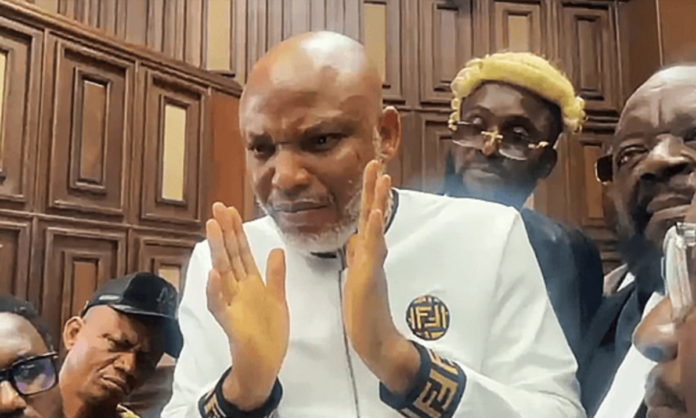
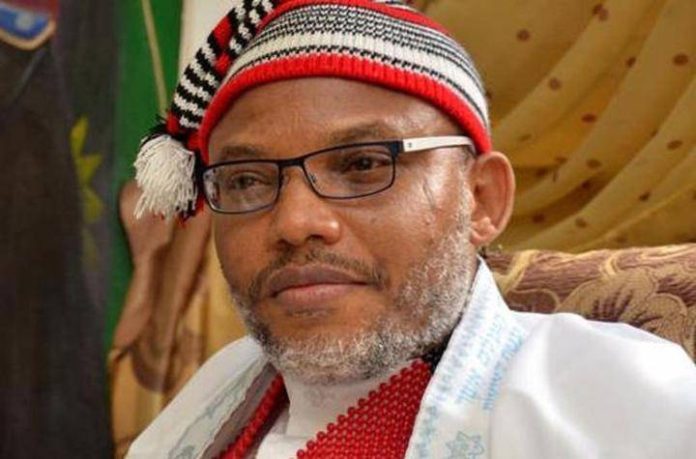
Again, Nnamdi Kanu denies FG’S terrorism accusations

  • Ex AGF, Kanu Agabi leads defence team

At his fresh arraignment on Friday, the leader of the Biafra nation agitators, Nnamdi Kanu pleaded not guilty to the terrorism charges brought against him by the federal government.

Meanwhile, a former Attorney General of the Federation(AGF) and Minister of Justice, Chief Kanu Agabi, SAN now leads the agitator’s defence team.

Chief Agabi, a Senior Advocate of Nigeria is expected to lead Aloy Ejimakor who had been holding forth the embattled activist.

Kanu’s arraignment was conducted at the federal high court in Abuja before Justice James Kolawole Omotosho amid water tight security provided by operatives of the Department of the State Service DSS.

Upon the reading of the 7-count charges one by one, Kanu who dressed in his usual white sports wears denied the accusations of threatening Nigeria’s corporate existence and operating illegal radio station to broadcast the Biafra messages.

After the plea, the federal government counsel, Adegboyega Awomolo SAN announced to the court his readiness to conduct prosecution in line with the spirit and letters of the Supreme Court that ordered fresh trial.

He asked for an adjournment to enable him assemble his witnesses and also applied for accelerated hearing which was granted by the court.

Based on the request and having not objected by the defence counsel, Justice James Kolawole bOmotosho fixed April 29 and May 2 and 6, 2025 for full blown trial.

Kanu, who was brought back to the country in June 2021 from Kenya had since been in the custody of the DSS on the order of court, also conceded to speedy trial of the charges against him.

The Chief Judge of the Federal High Court, Justice John Tsoho, had, in a letter dated March 4, 2025 and addressed to Kanu’s lead counsel, Aloy Ejimakor, communicated the re-assignment of the case from Justice Binta Nyako to Justice Omotosho.

The re-assignment followed the demand by Kanu and his team of lawyers for the transfer of the seven-count terrorism charge to another judge after alleging bias.

Justice Nyako, on September 24, 2024, withdrew herself from the case and sent the case file to the Chief Judge of the Federal High Court for re-assignment.

The judge said she could not proceed with a trial where a defendant lacked confidence in the court.

Justice Ahmed Mohammed, who has been elevated to Appeal Court and Justice Tsoho (before becoming the CJ) had presided over Kanu’s trial before it was assigned to Justice Nyako, following the defendant’s rejection of the two judges.

However, unlike the previous proceedings, Kanu was cooled and calmed throughout the re-arraignment.

Our correspondent gathered that latest decision to engage Agabi was arrived at because of his persuasive approach in criminal matters.

The former AGF led the defence of former Senate President, Bukola Saraki when the federal government filed criminal charges against him on alleged false declaration of assets.

Nnamdi Kanu apologises over misconduct in open court

Nnamdi Kanu, leader of Indigenous People of Biafra, IPOB.

The leader of the proscribed Indigenous People of Biafra, Mazi Nnamdi Kanu has formally apologised to the federal high court, Justice Binta Nyako and Adegboyega Awomolo SAN over his misconduct at the last proceedings of his trial on the terrorism charges.

He pleaded passionately for forgiveness and promised to be of good conduct throughout his trial.

Kanu’s apology was contained in a lengthy prepared speech delivered by his lead counsel and former Attorney General of the Federation and Minister of Justice, Mr Kanu Agabi.

In the emotion-laden speech, Kanu specifically begged Justice Nyako and Awomolo to forgive and forget his outburst and attacks against them in the open court.

Agabi said that Kanu had cause to be angry but ought not to have spoken when anger overwhelmed him.

” In expressing his anger, he attacked the federal high court, he attacked Justice Binta Nyako, he attacked the prosecutor and his own lawyers.

“I hereby apologize to Justice Binta Nyako. She did not deserve the unjust attack. I apologize to Chief Adegboyega Awomolo SAN. He deserves the highest respect. He was castigated without reservations.

” I appeal for forgiveness. Kanu is good man but all of us cannot be of one mind. He is not perfect but defending the cause of Igbo people who are resilient, fearless and using their God given talents to give good account of themselves.

“We may have misgivings but we must seek forgiveness. In resolving our differences, let us employ peace and not violence to resolve our differences”, he pleaded.

In a brief remark, Awomolo SAN said he was moved by the plea and has forgiven Kanu for all he said against him.

The senior lawyer said he was not a persecutor but a prosecutor and will work to ensure a quick resolution of the charges.

British teenager who slaughtered his family and planned school massacre gets 49 years in prison


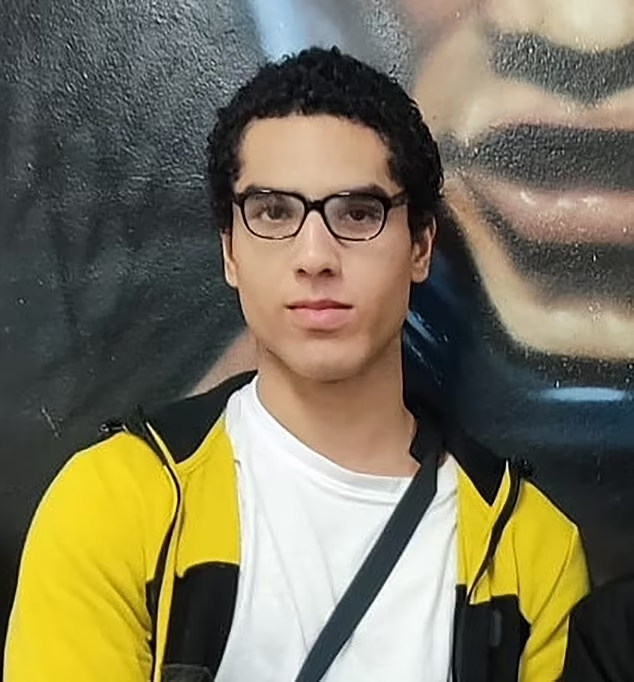
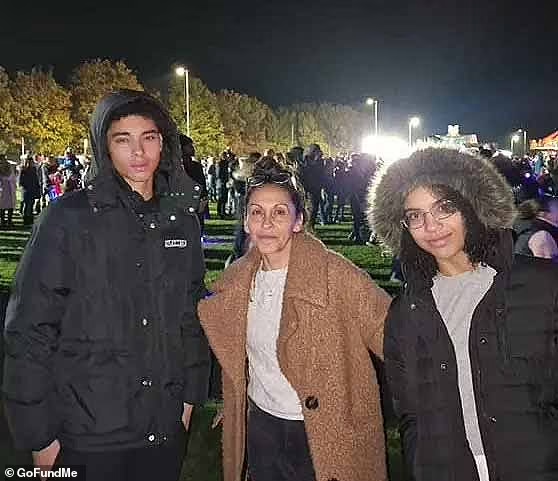
Nicholas Prosper, the 19-year-old British teen who murdered his mother, 13-year-old sister, and 16-year-old brother and who wanted to carry out a high-profile school shooting has been jailed for 49 years.

He will also not be eligible for parole until in about 49 years.

During the sentencing hearing at Luton Crown Court on Wednesday, Justice Bobbie Cheema-Grubb said she had considered handing Nicholas Prosper a full life order in prison but opted against that given his age — he was 18 at the time of the shootings — and the fact that he had pleaded guilty,

Last month, Prosper admitted at a hearing to murdering his mother Juliana Falcon, 48, and his 13-year-old sister Giselle Prosper and 16-year-old brother Kyle Prosper at the apartment the family shared in Luton, Bedfordshire, on Sept. 13.

The judge said Prosper had wanted to emulate and outdo the U.S. school massacres at Sandy Hook in Dec. 2012 and Virginia Tech in April 2007.

How it happened

At 7.50 am the school-run traffic was already building up as two weary police officers returned to the station after a night shift guarding a horrific triple murder scene.

But something odd caught the driver’s eye.

Wearing a yellow and black tracksuit, reminiscent of Uma Thurman‘s trained assassin in hit movie Kill Bill, a solitary figure stood by the roadside staring at the officers, holding his clenched fist aloft in a kind of salute.

As the patrol car slowed to a stop after the curious officers decided to take a further look, Nicholas Prosper stepped forward, pointing his bloodied palm towards them.

It was a chance encounter that was to save countless lives. The routine police stop ended the rampage of a teenage gunman who was on his way to a primary school to shoot a classroom of four and five-year-olds, having already executed three members of his family in cold blood.

After a year of meticulous planning, the 18-year-old was less than a mile away from completing his bloodthirsty mission to become, in his own words, the ‘most notorious’ school shooter in the world.

But on that sunny Friday morning on September 13 last year, the two officers had no idea as they approached Prosper that he was the man responsible for the triple murder scene where they had earlier stood guard.

Around 5am that day, Prosper embarked on his shotgun rampage, blasting his mother Juliana, 48, sister Giselle, 13, and brother Kyle, 16, in the head.

In a sickening joke, by their bodies he left a copy of the best-selling novel How To Kill Your Family.

When he encountered the police officers hours later, Prosper still had in his pocket the bloody knife which he had used to stab his brother 100 times.

In a bush around 200 yards away, Prosper had stashed a shotgun and 33 cartridges as he lay in wait, counting down the hours until St Joseph’s Catholic Primary School opened its gates.

In chilling police body-worn video footage of his arrest, the teenage killer showed no emotion, robotically repeating to officers, ‘It’s not murder’, as he was cuffed at the roadside.

When armed officers arrived, Prosper couldn’t resist boasting: ‘Did you see the fake shotgun certificate I made?’

The shocked officer replied: ‘I think we have got the offender.’

Little did he know that this was no ordinary offender, Prosper had been planning the ‘biggest massacre in the 21st century’.

THE TRIPLE SHOOTING

At 5.30am that day, those living near Prosper’s family home in Leabank Court, Luton, were awoken by screaming and groans followed by gunshots.

As his terrified neighbours dialled 999 reporting that they had heard sounds like someone’s throat had been cut, Prosper was already gathering up his weapon for the next stage of his plan.

Having placed Bella Mackie’s darkly comic novel about a woman who sets out to kill her estranged family by the bodies of his mother and siblings, Prosper stashed his gun and cartridges in a bag meant for fishing rods.

Just three minutes later he was heading out of the door, at 5.33am.

The killer would later complain in prison to a nurse that the murders were carried out earlier than he had intended.

In a chilling glimpse into his planning, Prosper produced a number of sketches showing the killing outfit he had purchased in preparation and the layout of his old primary school which he intended to hit next.

In Bedford Prison, the then 18-year-old confessed that he ‘wanted to cause the biggest massacre in the 21st century’, whispering to the nurse: ‘I wish I had killed more.’

Prosper said he planned to kill his family in their sleep before raping his sister, moaning that his mother had woken up too early.

A note in his cell said: ‘I was right in predicting no one would’ve called the police had I killed them in their sleep. 3 shots under 30 seconds.

‘The only known phone call to police that day was made by the b**** (neighbour) at the door as a result of my B**** mother waking them up and it being turned into a long struggle.

‘My plan wasn’t ‘stupid’. I was f****** right. MY MOTHER IS A STUPID F****** COW.

‘But why so early? So I’d have time to cannibalise my family, and rape a woman at knife point before the shooting.

‘Why? Because I could.’

LYING IN WAIT

CCTV captured the moment that Prosper made his getaway through the stairwell at the tower block where his family lived, clutching his bag in his bloody hands at 5.33am.

By mistake, the murderer left behind a yellow bucket hat he had intended to be part of the outfit.

But as he strolled across the car park outside in the darkness, Prosper appeared in no hurry. At 5.40am he was seen climbing over a wall into some woodland.

He hid there, crawling into undergrowth to stash the weapon as he whiled away the hours, waiting until the school opened.

SCENE OF HORROR

When police arrived at Prosper’s home at 5.50am, they found a scene of carnage with the killer’s bloody handprints, knives and gun cartridges left everywhere.

In a matter of minutes, Prosper had shot his family six times – after carrying out a test fire on a teddy bear.

At 6.22am Prosper uploaded a video on Facebook, which he had recorded the day before, promising to shoot his sister in the face.

He said: ‘On June 30 my sister decided to make the incorrect choices on episode one of season one of the [zombie apocalypse] Walking Dead games, and for that her face will be mutilated further than necessary.’

At 6.55am, Prosper was seen striding along Bramingham Road with his bloody hands still stinging from the nettles and thorns he had hid amongst.

Prosper ignored passing traffic and pedestrians until he saw the passing police car at 7.50am.

THE SHOTGUN

Within a short time of his arrest, police discovered the hidden gun and cartridges.

However, it would be weeks before they uncovered his murderous mission.

Officers learnt that Prosper had purchased the shotgun less than 24 hours before his deadly attacks from an unsuspecting pensioner, whom he had duped with a fake shotgun certificate. In an extraordinary loophole in gun laws, lethal weapons can be traded privately without any official checks if the buyer is able to produce a paper firearms certificate to the seller.

Prosper had spent months perfecting his faked certificate by painstakingly copying real ones posted online which he found during 200 searches on firearms.

His research started a year earlier when Prosper booked a gun range appointment in September 2023, aged 17.

He signed up to several websites where guns could be bought and sold and attempted to buy a firearm on a site called Gun Trader in August 2024, but the seller backed out after becoming suspicious. Weeks later, Prosper contacted a gun owner on another website called Gun Star, offering the seller £600 – £150 over the £450 asking price – for the shotgun and 100 cartridges.

He claimed that he just wanted to go clay pigeon shooting.

They met in a car park on September 12 where Prosper handed over cash after a brief inspection of the gun in the boot of a car.

Grinning, Prosper was later seen hugging the gun in a lift to his family’s apartment.

PRACTICE SESSION

On Prosper’s mobile phone, police found videos showing him practising the shooting clutching a piece of wood in his family’s kitchen. Dressed in his killing costume, with the gun bag slung over his shoulder, Prosper aimed at the camera.

The teenager pretended to fire off a couple of shots with the wood before motioning as if to reload and opening fire again, whispering: ‘Bang.’

FIXATED ON VIOLENCE

When officers examined his two phones, they found a sickening enthusiasm for violence.

Prosper had researched every school shooting, mass murder, and bloody atrocity. Such were his warped views that when Axel Rudakubana killed three young children at a Taylor Swift dance class in Southport in July last year, Prosper said that the riots the case sparked were ‘beneficial’.

The teenager became hooked on a twisted website trading in gore and death, only to be later banned due to his repugnant ideas about necrophilia and child abuse.

In the hours before he killed his family, he pored over school shootings and notorious murders such as the killing of Sarah Everard in March 2021, staying up until 4am scrolling through gruesome images.

During Prosper’s trial Timothy Cray, KC, prosecuting, told Luton Crown Court that the teenager had been fixated on ‘images and audios that showed deep alienation from normal life and interest in the darkest sides of humanity, including people being killed or seriously injured and violent video games’.

OBSESSED WITH CHILDREN

Police found more than 200 indecent images of children on Prosper’s phone.

His sexual preoccupation with young children may have been what led Prosper to plan an attack on four and five-year-olds.

Prosper planned to target his old primary school, St Joseph’s Catholic Primary School, where he was remembered by teachers as a ‘quiet, geeky boy’.

The teenager abandoned senior school in March 2023 after complaining about people being ‘in his personal space’ and trying to talk to him.

His family sought help from a GP about ‘autistic traits’, but Prosper refused to engage.

He was not known to police before carrying out the murders and had never been referred to the Government’s deradicalisation scheme Prevent.

As the prosecutor said in court, Britain’s biggest massacre was ‘prevented by chance and circumstance alone’.

© 2025 DailyMail

Click here to join our WhatsApp channel for your updates!

If only Fubara will head to Supreme Court 

By IfeanyiChukwu Afuba 

President Bola Ahmed Tinubu’s invocation of state of emergency in Rivers State on Tuesday, March 19, 2025, prompts us to appreciate Goodluck Ebele Jonathan as an outstanding hero of democracy. Jonathan first wrote his name on the sands of our electoral history when he refused to rig his way to a second term in office in 2015 and allowed the electorate’s verdict to prevail. He also exhibited political maturity when he declared a state of emergency in three states, Borno, Yobe and Adamawa states without devaluing democratic principles by ousting the Governors from office.

The deliberate bastardisation of state of emergency in the Fourth Republic was started by former military dictator, Olusegun Obasanjo. Obasanjo, who got away with several illegalities, made a mockery of democracy when he pronounced the removal of Governors on the basis of a state of emergency. One had thought that after Jonathan’s elevating application devoid of political interference, that there would be no more return to the trivialisation of the provision. But no, President Bola Tinubu, who did not call his Minister at the centre of the crisis to order, would rather jettison democratic governance in the name of a state of emergency.

The bizarre misinterpretation of state of emergency poses a danger both to our democracy and the Nigerian State itself. The intendment behind the provision in modern society is not about scuttling democratic mandates. Essentially, a state of emergency is not political by design nor by application. Wikipedia defines a state of emergency as “a situation 

  in which a government is empowered to put through policies that it would normally not be permitted to do, for the safety and protection of its citizens. A government can declare such a state before, during, or after a natural disaster, civil unrest, armed conflict, medical pandemic or epidemic or other biosecurity risk.” What is very clear from the above is the continuity of government in such dire circumstances. The government is not disabled; if anything, it is enabled. It is empowered to be able to deal with the prevailing extraordinary circumstances. For instance, civil liberties could be suspended. Security agencies may assume power of arrests, search and detention without a warrant. But the idea of political objectives as raison d’etre of emergency is alien to Western democracy. Indeed, in the United States, whose model influenced our presidential system, state governments themselves declare state of emergency in their jurisdictions when the necessary conditions are present.

Where does the President derive the power to suspend the Governor, House of Assembly and to appoint an unelected citizen as Administrator? Not from the 1999 Constitution amended. Yes, Section 305 provides for state of emergency. It outlines the procedure and steps. But nowhere does it mention ousting or suspending of elected public officers or democratic institutions. The purported authority of suspension is an importation in the reading of this section. Subsection 4 of Section 305 which gives the Governor a role to play in initiating the emergency process, would have gone further to indicate his subsequent disqualification from office if that was the intention.

Why would the same Constitution which sets out conditions for the national assembly to assume legislative functions of a State House of Assembly not be forthcoming on when and how a Governor’s mandate may be truncated? The Constitution already dealt with that. This is in Section 188 and none of the criteria and stipulated conditions have anything to do with state of emergency. Only the courts have the power to make distilling and binding pronouncements on silent or conflicting provisions of the Constitution.

At this juncture, it’s pertinent to take note of the position of legal and constitutional constituencies. NBA President, Anyiam Osigwe, SAN, in a scathing statement, denounced the presidential offensive against constituted authority in Rivers State as an affront against democracy. The Punch, March 19, 2025, quoted the Bar’s President: “A declaration of emergency does not automatically dissolve or suspend elected state governments. The Constitution does not empower the President to unilaterally remove or replace elected officials – such actions amount to an unconstitutional usurpation of power and a fundamental breach of Nigeria’s federal structure.” Constitutional lawyer, Prof Auwalu Yadudu also saw the President’s action as an overreach. In an interview with Daily Trust on March 19, 2025, he stated that President Tinubu lacked the necessary competence.

“Clearly, therefore, in my view, although Tinubu possesses the power to declare a state of emergency—which may be effective if approved by the National Assembly—such power does not entitle him to suspend a governor or members of the House of Assembly.

“It is my considered view that if his actions are challenged, they risk being overturned as unconstitutional by the courts.” Farah Dagogo, who represented Degema/Bonny constituency in the 8th House of Representatives submitted that “even during a state of emergency, the governor and deputy governor remain in office.” 

Interestingly, Tinubu in 2014 opposed the incorporation of the loss of democratic office in a state of emergency. In a piece titled, Jonathan bares his Fangs, the former Governor of Lagos State took issues with the declaration of emergency in parts of Borno, Adamawa and Yobe states. He wrote:

“Any measures put in place which alienate the people, in particular their elected representatives, should be considered as fundamentally defective by every right thinking person in the country.” Why then the volte-face today? What has changed to warrant the current assault on democracy? It’s unsettling to think that this contradiction can be associated with someone with the President’s record. In the more active years of his life, Tinubu was a pro-democracy activist. Up till his governorship of Lagos State, he was considered a leading light of progressive politics. He was admired for standing up to Obasajo’s messianic attitude in the revenue seizure case eventually won by Lagos State.

Many have been waiting to see the implementation of those lofty proposals championed as an antidote to Nigeria’s crises in the NADECO and Afenifere movements. Has the distance between theory and practice proven difficult to bridge? Whatever the case, the national interest should be put above partisan considerations. The House of Representatives erupted in disagreement a day after the state of emergency broadcast. The polarisation of the House on the controversial policy should serve as a wake-up call. 

Supporters of the emergency route have been at pains defending the ill-advised decision. Their protestation of the constitutional provision does not go to the substance of the matter, that the provision does not prescribe nor envisage the powers assumed in the proclamation. Not even the attorney general, Lateef Fagbemi, has come up with evidence of the constitution’s permission for wrecking the democratic order. It appears to be the case that the emergency drum was a desperate, fire brigade approach to competition for political and economic power. The sweeping emergency formula seems like a panicky response to the threat to oil production arising from the conflict in Rivers State. As Senator Babafemi Ojudu has counselled, the emergency stick in these circumstances is “reckless and unnecessary.” The APC chieftain and former political adviser in the Buhari administration advised Tinubu in a statement that “a state of emergency is not a strategy – it is an admission of failure.”

From indications, the President lacks the courage to tackle the matter frontally. The most effective way of containing the crisis would be sacking the Minister of the Federal Capital Territory. Everyone knows that once stripped of the badge of federal might, the recalcitrant 27 legislators would become sober and begin to act responsibly. The other option is to allow the dispute to be sorted out through appropriate channels including the courts. To seek to make the principles of federalism and democracy pay the price of presidential inaction is unacceptable. The presidency should cancel and withdraw the emergency instrument. But if it chooses the obstinate path, His Excellency, Funmilayo Fubara as the lawful custodian of Rivers State authority should immediately approach the Supreme Court. He has both the backing of the law and a groundswell of popular support.

*Afuba, a public affairs analyst, wrote from Awka, Anambra State 

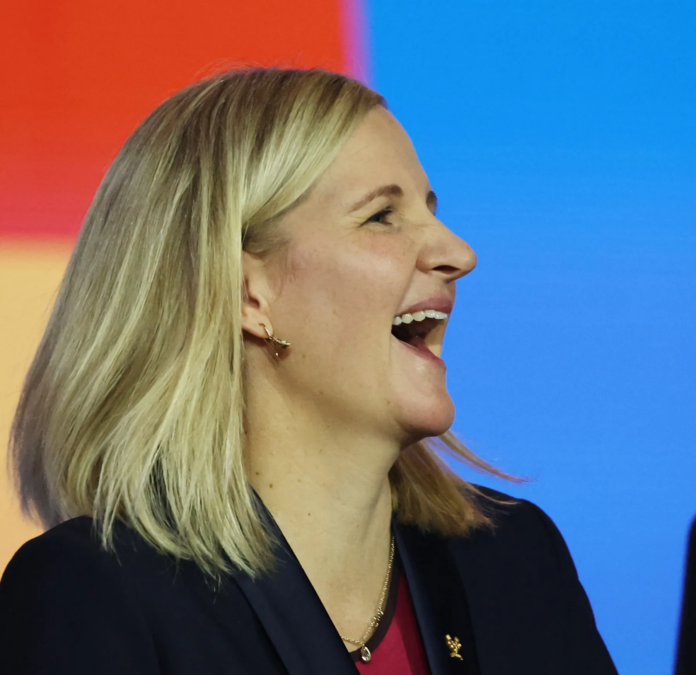
Zimbabwean former swimmer, Kirsty Coventry becomes IOC’s first female president

Kirsty Coventry, a Zimbabwean swimmer has become the first woman to lead the International Olympic Committee in its 131-year history after a stunning first-round knockout over a seven-strong field that included Britain’s Sebastian Coe.

In a contest that had been expected to go through multiple rounds of voting, the 41-year-old won 49 of the 97 votes in the first round, giving her an immediate majority. She is the first African to become IOC president and becomes the most powerful woman in global sport.

But it was a crushing day for Coe, who could only secure eight votes, putting him third behind the Spaniard Juan Antonio Samaranch Jr with 28.

Coventry’s victory came despite a manifesto that was widely seen as bland, and a campaign that started slowly. However, in the final few days before the secret ballot, strong lobbying from outgoing IOC president Thomas Bach and other senior IOC members proved to be crucial in tipping support her way.

Suddenly a contest that had been fought over in the shadows for months was all over in just two minutes: the time it took for the IOC’s quixotic membership of royals, former athletes, politicians and billionaires to throw their weight overwhelmingly behind the seven-time Olympic medallist.

It took a while for Bach to confirm the result – and the electronic voting machine of Afghanistan IOC member Samira Asghari appeared not to function. But when it was finally announced Coventry, who won seven Olympic medals in swimming including gold in the 200 metre backstroke at the 2004 Athens and 2008 Beijing Games, was full of smiles.

“The young girl who first started swimming in Zimbabwe all those years ago could never have dreamt of this moment,” she said. “I am particularly proud to be the first female IOC president, and also the first from Africa. I hope that this vote will be an inspiration to many people.

“Glass ceilings have been shattered today, and I am fully aware of my responsibilities as a role model. I will make all of you very, very proud and hopefully extremely confident in the decision you have taken. Now we have got some work together.”

Beforehand Coe was widely accepted to have the best CV, having won two Olympic gold medals, run the London 2012 Games and having been World Athletics president since 2015.

He had hoped to get votes by positioning himself as the change candidate, who would make the IOC more democratic and also protect women’s sport.

However, his strategy to get the backing of a majority of former athletes before winning a majority in the later rounds when other candidates dropped out was blown away.

“It’s very early to start poring over the numbers, but I think it’s pretty clear that the athletes, and in particular the female members, voted for her in very big numbers in the first round,” Coe admitted. “Clearly it’s a disappointing result, but that’s what happens when you go into an election.”

Not all candidates were as downbeat. Japan’s candidate Morinari Watanabe, the president of international gymnastics who came fourth with four votes, summed up his efforts succinctly afterwards. “Eight years gone in two minutes,” he said, smiling as he clapped his hands.

Coe’s chances were certainly hindered by becoming an implacable enemy of Bach when World Athletics banned all Russian athletes from the Rio 2016 Olympics for state sponsored doping.

But the stark reality is that there was probably little any candidate could have done given Bach’s power and influence over the organisation he has run since 2013, during which time he has appointed more than two-thirds of the electorate.

The 71-year-old German, who was voted in as honorary president on Wednesday, will continue to wield significant influence even if he denied having a direct involvement in Coventry’s victory afterwards. “There is a good democratic rule, when you don’t win,” he said. “Don’t blame the voters and don’t blame the procedure.”

But while many will rejoice at the first woman to lead the IOC, her election victory will be seen as controversial in some quarters.

Part of that is because Coventry is the sports minister of a Zimbabwean government that is subject to sanctions from Britain, which are “aimed at encouraging the Government of Zimbabwe to respect democratic principles and institutions and the rule of law”.
Human Rights Watch’s assessment of Zimbabwe reads: “In August 2023, President Emerson Mnangagwa was reelected in an election characterized by repression of civil and political rights. Southern African Development Community observers and others found that the election failed to meet regional and international standards for free and fair elections.

“Following the elections, abductions, arbitrary detention and torture of parliament members, opposition political activists, and human rights defenders escalated. Since then, the government has repeatedly targeted opposition members and activists, holding them in prolonged detention, mistreating them in custody, and weaponizing the judicial system against rights defenders.”

Coventry also received US$100,000 (about £55,000 at the time) in cash from Zimbabwe’s former president, Robert Mugabe, upon her return from the Beijing Games in 2008.

But for now Coventry, who will take over when Bach formally leaves office on June 23, having reached the maximum 12 years in office, is only looking forward.

“Sport has an unmatched power to unite, inspire and create opportunities for all, and I am committed to making sure we harness that power to its fullest,” she said in her victory speech. “The future of the Olympic movement is bright, and I can’t wait to get started.”

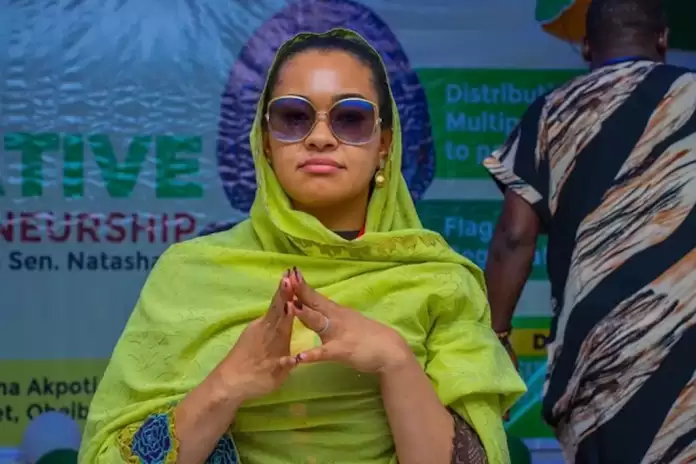
Court stops INEC from receiving petition to recall Natasha from Senate

The Federal High Court sitting at Lokoja, Kogi State, on Thursday, granted an interim injunction restraining the Independent National Electoral Commission (INEC) from receiving a petition to initiate a recall process against Senator Natasha Akpoti-Uduaghan from the Senate.

The Court also restricted INEC staff, agents, privies or assigns from accepting or acting on any petition containing fictitious signatures of purported members of Kogi Central Senatorial District and conducting any referendum upon such pending the determination of the Motion on Notice to the same effect.

The court, according to the order paper made available to Newsnen Friday morning, granted the application following an Ex-parte application for interim injunction supported by an Affidavit of Extreme Urgency together with other court processes sworn to by Anebe Jacob Ogirima for himself and four others who are registered voters and constituents of Kogi Central Senatorial District of Kogi state.

The application was moved by Smart Nwachimere, Esq of West-Idahosa, SAN & Co.

The case has been adjourned to May 6, 2025, for a report of service and further mention.

Reacting to the development, a pressure group, Action Collective, praised the judiciary for granting the order.

The group’s coordinator, Dr. Onimisi Ibrahim, said in his reaction that, “the order will further expose impunity of some sponsored individuals behind the failed plot to recall Senator Natasha.”

First female president of Namibia sworn in

Nandi-Ndaitwah, 72, became one of the few women leaders on the continent in a ceremony attended by heads of state from several African countries including Angola, South Africa and Tanzania.

Previously in the post of vice president for a year, she is a veteran of the South West Africa People’s Organisation (SWAPO) that led the sparsely populated and uranium-rich country to independence from apartheid South Africa in 1990.

Outgoing president Nangolo Mbumba, 83, handed power to Nandi-Ndaitwah at a ceremony that coincided with the 35th anniversary of Namibia’s independence and was moved from the Independence Stadium to State House because of rare heavy rains.

There was applause and ululations as NNN, as she is popularly known, took the oath of office.

She secured 58 percent of the vote in the chaotic November elections, which were extended several times after logistical failures led to major delays.

Namibia is witnessing one of its “foremost daughters breaking through the glass ceiling”, Mbumba said. “It has been a long time coming.”

“We are living an historic moment. Super-excited at the inauguration of a female president,” said businesswoman Monica Geingos, wife of president Hage Geingob who died in office in 2024, as she arrived for the event.

“It’s an exciting day for Africa. She will continue to be a role model for many other young women and women of all ages,” said former South African deputy president Phumzile Mlambo-Ngcuka.

Unemployment, unity

The youthful opposition Independent Patriots for Change (IPC) mounted a strong challenge at last year’s election but took only 25.5 percent of the presidential vote, underscoring continued loyalty to SWAPO even as the popularity of other southern African liberation parties has waned.

A key issue at the ballot box was massive unemployment among the young population, with 44 percent of 18- to 34-year-olds without work in 2023 in a country of just three million people.

On the eve of her inauguration, NNN said tackling unemployment was a priority.

Netumbo Nandi-Ndaitwah (R) takes over from Nangolo Mbumba (L) as president of Namibia
Netumbo Nandi-Ndaitwah (R) takes over from Nangolo Mbumba (L) as president of Namibia © SIMON MAINA / AFP

“In the next five years we must produce at least 500,000 jobs,” she told South Africa’s national broadcaster SABC, adding it would require investment of 85 billion Namibian dollars ($4.67 billion, 4.3 billion euros).

Key sectors for job creation are agriculture, fishing and the creative and sports industries, she said.

She appealed for unity after political divisions surfaced during the elections, which the IPC sought to annul in a failed court action.

“We can make our politics during the campaign and so on but once it’s over, we must build Namibia together,” she said.

On her election as Namibia’s first woman president, she told SABC: “Of course it’s a good thing that we are breaking the ceiling, we are breaking the walls.”

NNN, a conservative daughter of an Anglican pastor, has taken a strict stance against abortion, which is banned in Namibia except in exceptional circumstances. Gay marriage is also illegal.

A member of SWAPO since her early teens, she was exiled in Moscow during the liberation struggle. As foreign minister between 2012 and 2024, she praised her country’s “good historical relations” with North Korea.

Namibia is the world’s third or fourth biggest natural uranium producer, depending on the year, and supplies the radioactive metal to countries producing nuclear power, including France.

The sunbaked and dry Atlantic Ocean country is also rich in diamonds and hopes to exploit its natural gas and oil deposits.

© 2025 France24

Hollywood director charged for swindling Netflix out of $11M

A film director, Carl Erik Rinsch has been arrested on charges that he swindled Netflix out of $11 million for a sci-fi show that never aired, instead steering the cash toward cryptocurrency investments and a series of lavish purchases that included a fleet of Rolls-Royces and a Ferrari.

Carl Erik Rinsch – a writer and director perhaps best known for directing the film 47 Ronin – has been charged with wire fraud and money laundering over what federal prosecutors allege was a scheme to defraud the streaming giant.

Prosecutors said Netflix had initially paid about $44 million to purchase an unfinished show called White Horse from Rinsch, but eventually doled out another $11 million after he said he needed the additional cash to complete the show.

Instead of Rather than using the extra money to wrap up production, Rinsch quietly transferred the money to a personal brokerage account, where he made a series of failed investments that lost about half of the $11 million in two months, according to prosecutors.

The filmmaker then dumped the rest of the money into the cryptocurrency market, which proved to be a profitable move, with Rinsch eventually transferring the earnings into a personal bank account, according to an indictment.

From there, Rinsch spent about $10 million on personal expenses and luxury items in a spending spree that, according to prosecutors, included about $1.8 million on credit card bills; $1 million on lawyers to sue Netflix for more money; $3.8 million on furniture and antiques; $2.4 million for five Rolls-Royces and one Ferrari; and $652,000 on watches and clothes.

Click here to continue reading.

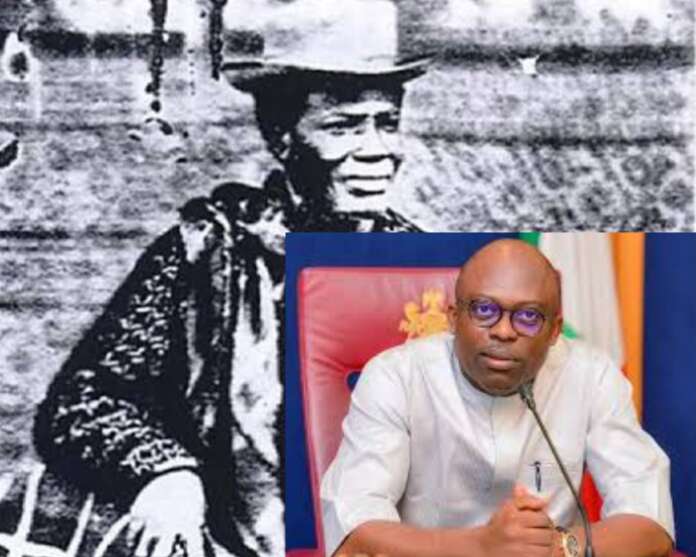
Like Father, Like Son, Governor Fubara’s Battles as a Reminder of King Jaja of Opobo: A “small boy” whom the combined forces of the Supreme Court, Wike, RSHA, AGF, NASS and the PBAT had to tackle

By Dr. Tonye Clinton Jaja

Governor Fubara has just entered the history books of Nigeria!!!

Many years from now, people would read about Governor Fubara and students of history and government would write essays about his heroics!!!

Poets would write epics and odes about his courage during the many battles that he fought!!!

In the eyes of right-thinking persons, Governor Fubara has entered the annals of Nigerian history for his greatness as a man (even though his antagonist described him as a “small boy”)!!!

How can Governor Fubara be described by Wike as a “small boy”.

Yet, Wike alone could not tackle and subdue the said “small boy”!!!

Wike had to engage the services of not less than when it took the combined forces of Nyesom Ezenwo Wike (NEW), a Resolution by two-thirds of the 469 Legislators of the National Assembly (NASS), five Justices of the Supreme Court of Nigeria, 27 law-makers of the Rivers State House of Assembly (RSHA), Attorney-General of the Federation (AGF) and finally President Bola Ahmed Tinubu (PBAT) to tackle Governor Fubara!!!

Therein lies the greatness of Governor Fubara, a so-called “small boy” whom it required all the three Arms of the Federal Government to tackle, the arms of government are as follows:

  1. the judiciary (or is it juju-sharing-lol);
  2. The Executive (PBAT and the AGF; and finally;
  3. The National Assembly.

How do we define such greatness? What is greatness?

The reputed Historian “H. G. Wells said a man’s greatness can be measured by what he leaves to grow, and whether he started others to think along fresh lines with a vigor that persisted after him .”

From the foregoing definition of greatness, Governor Fubara’s greatness meets all the criteria of true greatness!!!

Ever since his battles started in December 2023, Governor Fubara’s ordeal has caused so many right-thinking Nigerians to ” start thinking along fresh lines with a vigor that persisted after him”

It was Governor Fubara’s resistance to impeachment by Amaewhule and his gang of 26 law-makers that got right-thinking persons to reason along the fresh line of thoughts that the entire (or even a part of it) monthly allocations or Commonwealth of Rivers State (and any other State) ought not to be submitted to any godfather even if the said godfather is responsible for the electoral victory of Governor Fubara!!!

It was Governor Fubara by his words and actions that demonstrated that the ultimate and paramount loyalty lies to the adherence with the oath of allegiance that Governor Fubara (and all other Governors) swore to the Constitution of the Federal Republic of Nigeria, 1999 and not to any other oath of loyalty to any godfather!!!

With each battle that Governor Fubara fought, whether against Wike, the Supreme Court of Nigeria, the 27 law-makers of the RSHA, the 469 legislators of the NASS, AGF and PBAT, the overwhelming public sympathy was in favour of Governor Fubara.

An online search shows an overwhelming number of essays and commentaries in favour of Governor Fubara’s.legal arguments as he battled all these institutions and officials!!!

In a sense, the battles of Governor Fubara has come to resemble the historical battle “at a place called Thermopylae , where three hundred (300) brave Greeks held off a Persian army of a million men… For two days, the Greeks made them pay so dearly that the Persian army lost all taste for battle and was defeated soon after”!!!

If all the aforementioned Nigerian Judiciary and other major institutions.and officials operated a “level playing field” or strictly adhered to the Rule of Law, Governor Fubara would have defeated all of them namely AGF, Wike, PBAT, NASS, the 27 law-makers of the RSHA.

Contrary to the claim by the AGF, that Governor Fubara was rescued from potential impeachment by the 27 law-makers of the RSHA, it was the other way around.

Governor Fubara was already winning the battle regarding impeachment plot by the said 27 law-makers of the RSHA considering that the Chief Judge of Rivers State was not a willing ally in the hands of the 27 law-makers of the RSHA.

The intervention of PBAT by way of declaration of a State of Emergency is both a face-saving gesture and underhanded, illegal and unconstitutional manner of snatching victory from Governor Fubara (nothing more, nothing less)!!!

This particular last action is reminiscent of how the colonial Government of British had to deploy illegal methods (an amicable meeting aboard a ship) to entrap the great-grandfather of Governor Fubara namely King Jaja of Opobo in the year 1887.

The colonial Government of the United Kingdom did this because all their previous battles against King Jaja of Opobo (through their proxies which were mainly indigenous Niger Delta kings and European trading companies based within the Niger Delta region) had failed to defeat King Jaja of Opobo!!!

Just like Governor Fubara, King Jaja of Opobo displayed a combination of strategic thinking and courageous actions to win majority of his battles.

Let me highlight just two important battles that King Jaja fought.

In the year 1875, the then Queen Victoria of England presented King Jaja of Opobo with a sword and honoured him with a medal of bravery because King Jaja of Opobo supplied military men and war canoes that assisted the then colonial Government to win the war against the Ashanti Kingdom of Ghana. It must be noted that before that time, the Ashanti Kingdom of Ghana had proved difficult for the British Empire to conquer. It was King Jaja’s assistance that made the difference in favour of the British Empire!!!

In the year 1881, the Kingdom of Ibeno (a strong ally of the British Empire) which is in modern day Andoni of Rivers State fought a war against King Jaja of Opobo, however, King Jaja of Opobo proved victorious.

One of the reasons for this victory was King Jaja’s tactical and strategic thinking and planning before the actual battle began.

King Jaja sent spies on espionage to spy the Kingdom of Ibeno especially the British trading companies that were based in Ibeno Kingdom. These were the persons that provide arms and ammunitions to the Kingdom of Ibeno.

Based on information received from his spies, King Jaja of Opobo decided to commence battle during the period that the said British trading companies had traveled to England to bring their products for sale in the Niger Delta region (while taking home to England, the raw materials especially palm oil)!!!

King Jaja won a decisive victory and conquered Ibeno and carried away many of their indigenes as captives and the resided as refugees within Opobo Kingdom!!

In similar manner, in the battle that ensued after the Supreme Court judgment of 28th February 2025, Governor Fubara displayed exceptional tactical and strategic thinking in several ways!!

He issued public statements and followed up with public actions to demonstrate his commitment to implementing the said judgment of the Supreme Court of Nigeria!!!

Just as King Jaja of Opobo also waited and attacked the Ibeno Kingdom during the period that their strongest ally had departed, Governor Fubara ensured that the Chief Judge of Rivers State, who was supposed to be a strong ally to the 27 law-makers of the RSHA had “departed” from the side of the said 27 law-makers. This had the effect to nullify any planned impeachment!!!

It was at the very low-point in the whole war that WIKE had no other choice than to engage the services of PBAT and the NASS to arrange a “smoke-screen” series of action named State of Emergency by a Gazette dated 18th March 2025) that resembled the sham meeting that the colonial British Government arranged for entrapping King Jaja of Opobo in the year 1887 aboard the ship named H.M.S Goshawk!!!

There are several similarities between King Jaja of Opobo and Governor Fubara’s ordeal!!

The colonial Government of the United Kingdom had previously signed a Treaty dated 1873 between the Kingdom of Opobo and themselves that all trade disputes between the two parties would be amicably settled be arbitration. Based upon the terms of this Treaty, King Jaja of Opobo went to attend the meeting aboard the said ship named H.M.S. Goshawk. Instead of holding an amicable arbitration meeting aboard the said ship, the officials of the colonial British Government kidnapped King Jaja of Opobo as soon as he set feet aboard the said ship and sailed to Gold Coast in modern day Ghana. As soon as the landed in Ghana a “kangaroo trial” was conducted and King Jaja of Opobo was sentenced to exile in St. Helena in the West Indies. Where he later died.

In a similar manner, the institutions and officials of the Federal Government of Nigeria, have used the pretense and unsubstantiated allegation that Governor Fubara is responsible for “Tele-Guiding” the preventing vandalism of crude oil pipelines within Rivers State to impose this State of Emergency!!!

It is ironic that it is the AGF that issued a public statement to this effect.

Vandalism of crude oil pipelines in Nigeria is a serious crime that is classified as a felony and carries not less than fourteen years imprisonment under the Nigerian Security and Civil Defence Corps Act, 2007.

As a very senior lawyer, the AGF did not provide any concrete evidence of any crude oil pipelines vandal that was arrested by the Nigerian Security and Civil Defence Corps and no such vandals confessed that it was Governor Fubara that “Tele-Guided” him to vandalise said pipelines!!!

In a clear case of double-standards, the Supreme Court of Nigeria in its judgment of 28th February 2025, held that there was INSUFFICIENT “EMPIRICAL” EVIDENCE to support the alleged defection of the 27 law-makers of the RSHA who were captured on video and television as announcing their defection from the People’s Democratic Party (PDP) to the All Progressives Congress (APC).

However, Governor Fubara against whom there is no EMPIRICAL evidence of making any public statement in support of “Tele-Guiding” vandals to destroy crude oil pipelines within Rivers State, was adjudged as having committed the said offence of “Tele-Guiding” by the AGF.

This is the height of double-standards by officials and institutions of the federal government of Nigeria!!!

Exactly what King Jaja of Opobo suffered in the hands of the British colonial Government is what Governor Fubara is enduring in the hands of the federal government of Nigeria!!!

TIPS