Home Blog Page 297

There is only one presidential vacancy in 2027, but there are six ravenous and desperate contenders

By Dr. Wumi Akintide

There is only one presidential vacancy in 2027, but there are six ravenous and desperate contenders; six angry and hungry dogs, whose ultimate, non-negotiable mission is to grab the bone of power and run away with it, leaving nothing for the others.

Their ambition is not collective; it is deeply personal. They are not in the race to share; they are in it to conquer and dominate.

Let us briefly examine these six gladiators.

Abeni Aso-Oke
First on the list is Atiku Abubakar, a Fulani chieftain and seasoned political juggernaut with over three decades of active political engagement. Having served as Nigeria’s Vice President for eight years under President Olusegun Obasanjo, Atiku is a serial contestant who has refused to abandon his long-standing ambition to become President.

He sees himself as the best-prepared and most deserving candidate, and he is unrelenting in his pursuit, despite several unsuccessful attempts in the past. To Atiku, the 2027 race may very well be his last chance, and he is prepared to deploy everything within his arsenal to seize the moment.

Next is Nasir El-Rufai, another Fulani power player often described as an “Oliver Twist”—always asking for more. El-Rufai is widely known for his sharp intellect, administrative ruthlessness, and long-standing ambition to ascend to the presidency. His decision to enrol for a PhD at Oxford University is not merely academic; it is part of a grand strategy to bolster his profile and position himself as a global statesman.

Having served as the Federal Capital Territory (FCT) Minister for years and as the Governor of Kaduna State, El-Rufai has earned a reputation as a shrewd but polarising figure. He was recently humiliated when his nomination as a minister was rejected by the Senate, a defeat that still rankles him. He remains bitter, especially towards President Tinubu, whom he blames for not fighting hard enough to push his nomination through. For El-Rufai, 2027 presents both a mission of ambition and a personal vendetta.

Following El-Rufai is Peter Obi, the former Governor of Anambra State and one of the most charismatic politicians to emerge in recent years. Obi, who came close in the 2023 presidential election, is widely regarded as the face of a new political movement driven by the youth and the Labour Party. He believes it is time for an Igbo man to break the jinx and finally become the Executive President of Nigeria,more than five decades after the Biafran War.

Obi sees himself not just as a candidate, but as a symbol of hope for the marginalised South-East. He believes his time is now, and he is unlikely to back down from the fight, no matter the odds.

Next is Rotimi Amaechi, former Governor of Rivers State and former Minister of Transportation. Amaechi is no stranger to political battles. He is fearless, outspoken, and has carved out a reputation as a political bulldozer, always ready to confront and challenge the status quo.

He was one of the earliest high-profile dissenters within the APC after the 2023 elections, boldly declaring that the political space had been reduced to a brutal fight among hungry dogs. His comments reveal not just frustration, but a determination to be a major player in the looming battle.

Also in the mix is Governor Seyi Makinde of Oyo State, a technocrat-turned-politician who has carefully built his profile as one of the more progressive and pragmatic governors in Nigeria. Makinde, one of the PDP governors in the South-West, may see himself as a bridge-builder and a potential unifier. However, the political terrain he seeks to navigate is treacherous. His ambition may be noble, but whether he can withstand the weight of entrenched political forces remains to be seen.

Finally, there is Pastor Tunde Bakare, General Overseer of the Citadel Global Community Church, a man who has consistently declared that God revealed to him that he is destined to be the 16th President of Nigeria. Bakare is no ordinary contender. His blend of spiritual conviction and political aspiration makes him a curious figure in the race.

However, Nigeria’s political history is littered with prophets whose divine visions did not materialise. Whether Bakare’s prophecy will stand the test of time or fade into the familiar dust of political disappointment is something only time will reveal.

These six political gladiators are not merely challenging the incumbent, President Bola Ahmed Tinubu. They are simultaneously scheming against one another. Their collective ambition to dislodge Tinubu in 2027 will likely be undermined by their individual greed, conflicting interests, and deep-seated rivalries. Before they can even dream of unseating Tinubu, they will first have to battle one another, possibly to the point of mutual destruction.

It is easy to predict that the two Yoruba contenders; Tunde Bakare and Seyi Makinde will likely suffer the fate of political miscalculations, much like the historical betrayals that saw Obasanjo abandon Awolowo, MKO Abiola, and even Tinubu himself.

Those betrayals ended in failure and are still bitter reference points in Nigeria’s political discourse.

It is also foreseeable that the remaining four; Atiku, El-Rufai, Amaechi, and Obi, will face insurmountable challenges if President Tinubu manages to stabilise his administration and deliver, even partially, on his Renewed Hope Agenda.

In such a scenario, their ambitions may crash under the weight of Tinubu’s political machinery, incumbency power, and deeply entrenched networks.

They all have their work cut out for them. As the Yoruba proverb wisely says, “Lai ku Ekiri, ko seni je fi awo re se gbedu”—meaning, “Unless the Buffalo dies, no one can use its skin for a ceremonial drum.” In this context, Tinubu is that proverbial Buffalo; stubborn, resilient, and not easily toppled.

For now, all we can do is “siddon dey look”, as the late Uncle Bola Ige once famously advised, and watch as this Nigerian political drama plays out over the next two years. The battle promises to be brutal, intriguing, and ultimately defining for the future of Nigeria.

We wait patiently.

I rest my case.

Prince Dr. Wumi Akintide, a Public Affairs commentator, writes from Oyemekun Terrace, New York City.

The views expressed by contributors are strictly personal and not of Law & Society Magazine.

Barroom Battles and the Burden of Example: Rethinking civility and responsibility in public discourse(A Reflection on the Unfortunate Exchange Between Mike Ozekhome and Adebayo Ojo)

By Sylvester Udemezue

  1. The Decline of Decorum in the Legal Profession: The Nigerian legal profession has long stood as a bastion of intellectual rigour, civil discourse, and constitutionalism. In a democratic society where lawyers are not only officers of the court but custodians of reason, civility, and the rule of law, it is both unfortunate and instructive to witness public exchanges between learned silks devolve into personal invectives. The recent exchange between Prof. Mike Ozekhome, SAN and Mutalubi Adebayo Ojo, SAN, arising from the former’s remarks during an interview on Channels TV and the latter’s rejoinder on Facebook, represents a regrettable low in legal discourse, because they starkly threaten to erode the standards of civility, maturity, and responsibility that membership of the Bar demands. This article is not an attempt to adjudicate the correctness of either party’s opinion about governance or national issues. Rather, it is a principled intervention meant to reinforce the constitutional values of free speech, tolerance, civility, and constructive engagement, especially among legal practitioners, in advancing democratic discourse, strengthening public confidence in the legal profession, and setting a moral compass for the larger society. In the spirit of democratic ethos and legal professionalism, personal attacks are wholly unnecessary and incompatible with the noble calling of the Bar.
  2. Freedom of Expression Is Both A Right and Responsibility: In the affected Channels TV interview, Prof Mike Ozekhome was only exercising a right that is as old as constitutional democracy itself: the right to freedom of expression, guaranteed and protected by Section 39(1) of the Constitution of the Federal Republic of Nigeria, 1999, which provides that “Every person shall be entitled to freedom of expression, including freedom to hold opinions and to receive and impart ideas and information without interference.” This right, while not absolute, is fundamental to democratic governance. In ARTHUR NWANKWO v. THE STATE (1985) 6 NCLR 228, the Court of Appeal held that public figures, especially political office holders, are subject to public scrutiny and criticisms. The Court declared that criticism of government is permissible, even harshly worded criticism, so long as it does not cross the boundaries of incitement to violence or public disorder. Hence, when a lawyer like Mike Ozekhome critiques the government, regardless of his tone or opinion, he is only exercising a right that is protected by both domestic and international legal frameworks. Similarly, Mr. Ojo was entitled to react to any matter in the public domain. However, while freedom of speech is constitutionally guaranteed, it does not include the freedom to abuse, slander, or vilify others. Voltaire once remarked, “I may disapprove of what you say, but I will defend to the death your right to say it.” This timeless quote underscores the essence of free speech: it is a right accompanied by responsibility, a duty especially incumbent upon lawyers, who are custodians of the law, stewards of reason, and guardians of democratic health. With due respect, the manner of Mr. Adebayo Ojo’s reaction (resorting to personal invective) crossed a boundary incompatible with the nobility of the legal profession. Responding with vitriol instead of reasoned counter-argument, as Mr. Ojo unfortunately did, is not only unhelpful, but also a betrayal of democratic values and the ideals of civil discourse. Jean-Jacques Rousseau captured this truth succinctly when he said, “Insults are the arguments employed by those who are in the wrong.” When robust debate is reduced to shouting matches and character assassination, our civic culture is diminished. A pluralistic society demands mutual respect for differences and tolerance of opposing views. Jennifer Chen wisely advised: “Give others the freedom to be themselves; appreciate the differences between their ways and yours, and you’d be wiser and greater.” It is time we moved past the habit of making enemies out of those who merely disagree with us. The hallmark of a mature democracy is not uniformity of opinion but the civil exchange of divergent views, guided by mutual respect and rational engagement.
  3. Criticism Is A Duty of Democratic Scrutiny: Criticism in a democracy is not an act of sabotage but a civic obligation. Criticism functions like pain in the human body; a necessary indicator of dysfunction and a prompt for healing. As I argued in my 2019 article on Governor Seyi Makinde’s and Vice President Osinbajo’s pledge to waive immunity, public officers must expect to be “bashed front, back, left, right, and centre.” And such criticisms, whether constructive or even mistaken, must be met with maturity, not malice. Thomas Jefferson’s observation remains relevant: “Were it left to me to choose between government without newspapers and newspapers without government, I would not hesitate to choose the latter.” Unfortunately, when lawyers and public intellectuals respond to critique with insults, we imperil the open dialogue upon which democracy rests.
  4. The Fallacy of Ad Hominem: Attacking the Person, Not the Idea: A central flaw in Mr. Adebayo Ojo’s reaction to Prof Mike Ozekhome’s critical comments against the government was his deployment of argumentum ad hominem: attacking the messenger rather than engaging the message. Labelling Chief Ozekhome a “pseudo activist” or one of “warped mind” neither advances the argument nor enriches the discourse. Rather, it constitutes a fallacy that diverts attention from the substance of the argument, discredits the speaker without addressing the issue at hand, and evades responsibility for reasoned counter-engagement. I repeat that lawyers occupy a privileged position in society. As public intellectuals and members of the Bar, their words carry weight. It is therefore troubling when legal practitioners resort to name-calling rather than reasoned analysis. This informal logical fallacy occurs when someone attempts to refute an argument by attacking the person making it, rather than engaging with the argument itself. Such tactics reflect weakness in reasoning and must be avoided. They are fallacious for several reasons: (a). They are irrelevant. Attacks on personality do not address the truth or falsity of an argument. A superior approach would be to present a better argument, backed by credible evidence; (b). They serve as diversion. By shifting attention from ideas to individuals, they appeal to emotion and derail substantive discussion; (c). They rely on a flawed premise: the mistaken belief that discrediting the source of an argument discredits the argument itself. As Robert G. Ingersoll aptly warned, “Arguments cannot be answered by personal abuse; there is no logic in slander, because falsehood, in the long run, defeats itself.” To challenge an idea, one must offer a better idea, not venom. Mr. Ojo could have responded to Chief Ozekhome’s critique with facts, logic, or legal authority. Instead, he attacked the critic. That approach, regrettably, is unworthy of the learned rank of Senior Advocate. The learned rank of SAN is not just an accolade; it is a badge of responsibility. Holders of the rank must set standards, in speech, in writing, in conduct. Personal vendettas and verbal violence erode public trust and denigrate the nobility of the profession. Mutual disagreement is part of intellectual engagement. But, as Don Lemon once said, “We can also disagree without being disagreeable. It doesn’t mean that I don’t like you, or you don’t like me. We just disagree, which is fine.”
  5. The Legal Profession’s Higher Calling Demands Civility and Responsibility, Always: The Rules of Professional Conduct for Legal Practitioners (2023) is unequivocal: (a) Rule 1: “A lawyer shall maintain a high standard of professional conduct and shall not engage in any conduct which is unbecoming of a legal practitioner”; (b). Rule 30: Lawyers must treat colleagues with “respect and courtesy;” and (c). Rule 55 cautions against “allusion to personal peculiarities or idiosyncrasies.” When lawyers abandon these codes in the public square, they imperil public trust and collapse the high moral walls that separate the Bar from common polemics. Hon Justice Oputa, formerly of the Supreme Court of Nigeria, now late, once noted: “The judiciary and the legal profession are like Caesar’s wife — they must be above suspicion.” Hon Justice Kayode Eso, also formerly of the Supreme Court of Nigeria, and now late, wisely added: “A disagreement is the salt of legal argument. But it must remain just that– disagreement, not personal warfare.”
  6. The SAN Rank: A Badge of Leadership, Not License: The rank of Senior Advocate of Nigeria (SAN) is a recognition of legal excellence and moral leadership. Its holders are expected not merely to win arguments, but to model dignity, tolerance, and intellectual refinement. This is why it is so disheartening when disputes among SANs devolve into “barroom battles.” The public watches. Our students and aspirants to the Bar are watching. The profession is watching.
  7. Raising Words, Not Voices Is A Culture of Constructive Engagement: A quote by the poet Rumi captures the ideal: “Raise your words, not your voice. It is rain that grows flowers, not thunder.” Public discourse, especially among lawyers, intellectuals and enlightened people, should focus on substance, not personalities. It should favour persuasion over provocation. Jennifer Chen has the following advice for all: “Give others the freedom to be themselves; appreciate the differences between their ways and yours, and you’d be wiser and greater.” In reflecting on public criticism of former Vice President Yemi Osinbajo and Governor Seyi Makinde the governor of Oyo State, Nigeria, I earlier emphasized that true leadership is best tested in one’s response to critique. Instead of lashing out at one’s critics, one ought to prefer respectful engagement to retaliation. The legal profession and its members should never deviate from this path. Disagree with ideas, but never descend to character assassination. Mr. Adebayo Ojo’s response to Prof. Mike Ozekhome’s critical remarks about the government was laced with invectives and personal insults, without any meaningful engagement with the substantive issues raised. Provoked by what he saw as an unwarranted personality attack, Ozekhome retaliated forcefully, perhaps in an attempt to teach Ojo a lesson. The outcome was an unfortunate exchange between two senior advocates, one that cast the legal profession in an unflattering light.
  8. The NBA’s Role and the Way Forward: This episode must serve as a moment of reflection and rededication. The Nigerian Bar Association (NBA), the Body of Senior Advocates (BOSAN) and our law faculties must (1) Reaffirm the principles of civil and respectful public discourse; (2). Institutionalize orientation for both junior and senior lawyers on how to engage criticism with maturity; (3). Convene dialogues on the ethical dimensions of public commentary in law and governance. We need to reclaim the legal space as a marketplace of ideas, not a theatre of insults.
  9. A President for All: No One Owns Him More: It bears repeating: the President of the Federal Republic of Nigeria is a public officer, not an ethnic chieftain or a tribal totem. No one owns him more than another. His office, like his performance, is subject to the judgment of the entire citizenry. Criticizing him is not treason; it is civic engagement. As leaders of thought and defenders of the rule of law, lawyers must lead the campaign for a Nigeria where no opinion is silenced, and where opposing views are not criminalized. In New York Times Co. v. Sullivan, 376 U.S. 254 (1964), Justice Brennan wrote: “Debate on public issues should be uninhibited, robust, and wide-open… even though it may well include vehement, caustic, and sometimes unpleasantly sharp attacks on government and public officials.” As Justice Hugo Black of the U.S. Supreme Court once declared, “The freedom of speech must be protected even for the thought we hate.”
  10. Let Us Rebuild the Bridge: We live in a deeply polarized polity. The rule of law, democracy, and national healing require lawyers and intellectuals to lead by example. We must rise above petty squabbles and re-dedicate ourselves to truth, civility, and constitutionalism. Frederick Douglass once warned that “No man can put a chain about the ankle of his fellow man without at last finding the other end fastened about his own neck.” The exchange between two otherwise distinguished SANs is a teachable moment. Let us draw the right lessons. Let us elevate our conversations, protect the dignity of dissent, and guard the soul of our democracy; one idea at a time. As Socrates famously reminded us, “Strong minds discuss ideas, average minds discuss events, weak minds discuss people.” We are lawyers. Let us be strong minds.
    Long live the legal profession!
    Long live Nigeria!
    Respectfully,
    Sylvester Udemezue (Udems).
    Proctor, The Reality Ministry of Truth, Law and Justice (TRM).
    08109024556.
    [email protected].
    (12 June 2025)
  11. The views expressed by contributors are strictly personal and not of Law & Society Magazine.

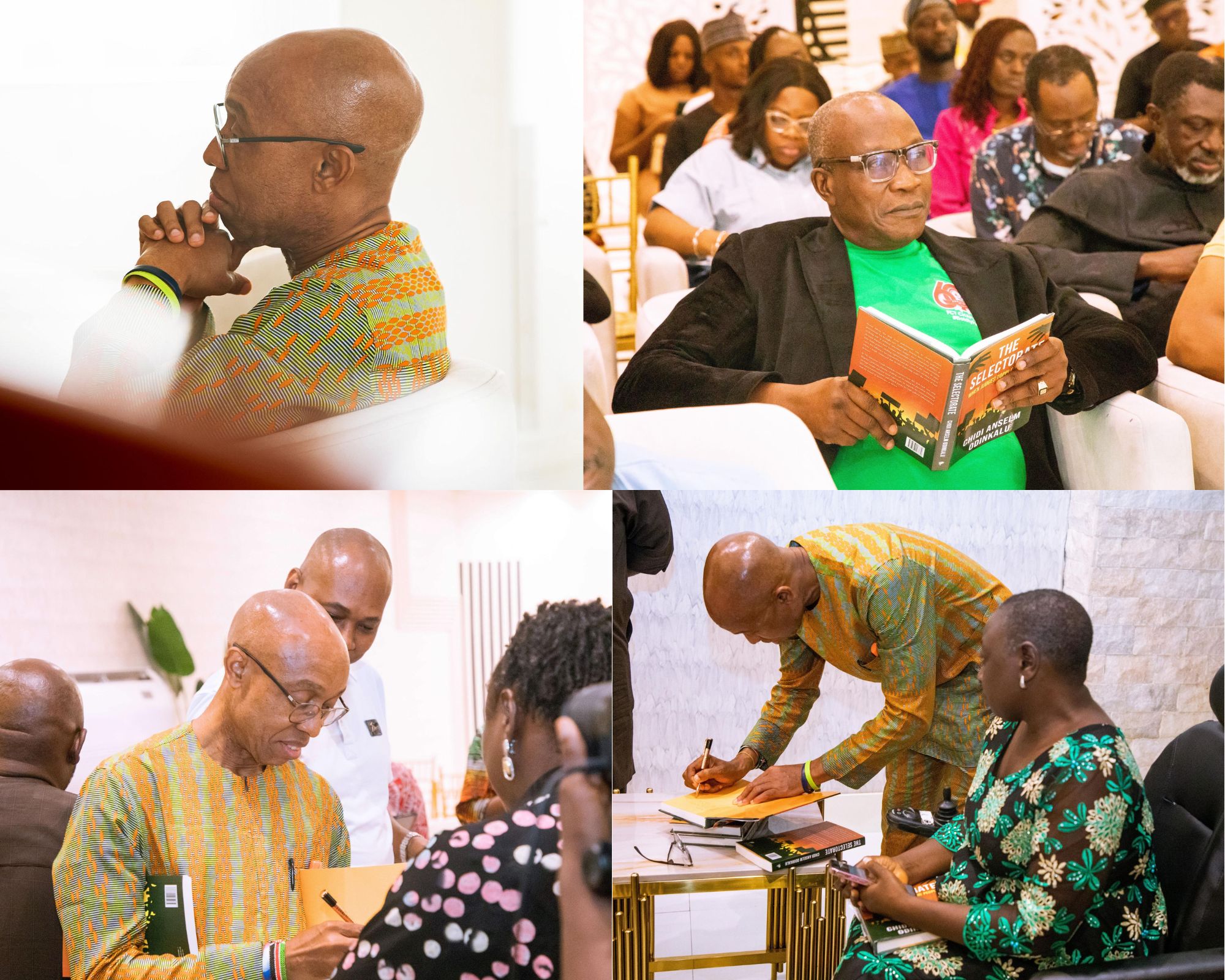
As Supreme Court warns against mischievous reports against justices, Odinkalu insists,”Those who claim a judge can mix with anyone or go anywhere are either deliberately uninformed or wilfully illiterate”

While the Supreme Court of Nigeria has issued a warning against peddling falsehood and mischievous reports against Justices on its bench and the judiciary as an institution, rights activist and law teacher, Chidi Odinkalu, maintains that members of the judiciary should not be found mingling with the public to avoid casting ….

The topmost court on Saturday said it will no longer tolerate deliberate falsehood being propagated to lower the integrity of individual Justices and the judiciary.

This was in reaction to a post on X by Chidi Odinkalu, suggesting that one of its Justices was found in the company of the Attorney General of Edo State during a trip to Benin City despite a political case recently filed before the Court.

The apex court then urged commentators on judicial matters to always exercise responsibility, discretion and restraint in their comments.

A statement on Saturday signed by Dr. Festus Akande, the Director of Information and Public Relations of the Supreme Court reads in part, “The attention of the Supreme Court has been drawn to a disturbing and false narrative being circulated on social media and certain online platforms alleging that a Justice of the Supreme Court travelled to Benin City on account of a political case recently filed before the Court.

“For the avoidance of doubt, the Honourable Justice in question travelled to Benin City on Thursday, 12th June, 2025 to attend the funeral rites of the late mother of Mr. Hannibal Uwaifo, a senior member of the Bar and immediate past President of the African Bar Association.

“Prior to the journey, the said Justice formally sought and obtained permission from the Honourable Chief Justice of Nigeria to embark on the trip.

“This private visit was strictly for the purposes of condolence and bereavement as is customary and humane.

“The Honourable Justice neither attended any political meeting nor solicited for inclusion on any panel as falsely alleged.

“In fact, apart from the funeral service held at St. Matthew’s Catholic Church and a brief stop at the service of songs, the Honourable Justice retired to his hotel room without attending any further gatherings or receptions.

“The image being circulated purportedly as evidence merely shows the Justice returning alone to his hotel, hardly a basis for the sensational claims being peddled.

“The Supreme Court wishes to state unequivocally that this sort of baseless speculation and malicious conjecture, especially when publicly propagated by persons who ought to know better is not only unhelpful but also deeply harmful to the integrity of the Judiciary.

“We strongly urge members of the public, especially commentators on judicial matters to exercise responsibility and discretion.

“Where there is any doubt or lack of clarity, the appropriate step is to seek verification from the Supreme Court through its official communication channels rather than resorting to the spread of falsehoods aimed at maligning the image of the Justices or bringing the judiciary into disrepute.

“The judiciary remains committed to upholding the rule of law and will not be distracted by deliberate attempts to undermine its credibility”, the statement said.

In a statement issued on X Saturday, 14 June, 2025, Odinkalu maintained that “The Judicial Code of Conduct imposes clear constraints on the social networks & movement of judges.”

The statement reads:

CONCERNING JUDICIAL INTEGRITY: A STATEMENT

In the week in which we buried the longest-serving Justice of @SupremeCourtNg & the 2nd-longest-serving #CJN, we find ourselves once again in a situation that calls attention to the need to address tone-deafness to judicial integrity.

2 days after the Edo State Governorship Election Petition ended up in @SupremeCourtNg, the 2nd senior-most JSC was where he did not need to be & company he didn’t need to keep in Benin-City. Only the wilful wld miss the implications of that for optics of judicial impartiality.

Since I disclosed this yesterday, I have received lots of calls from political & judicial insiders explaining why he was in the state; telling me that judges need to have a social life; & saying that a judge still shd enjoy the fullest of constitutional rights of free movement.

There are also claims that he cld not have gone to Benin to collect a bribe. That is silly & I will begin with that. S. 36(1) makes an independent & impartial judiciary a constitutional right. We have a duty to defend it as citizens. We defend judges & ourselves when we do.

No one has said or suggested that the judge in question went to Benin to collect a bribe.

The fact that those who say this think it is a defence shows how serious our crisis of judicial integrity is. The constitutional standard is appearance of bias, not active bribery.

Those who claim that a judge can mix with anyone or go anywhere are either deliberately uninformed or wilfully illiterate. The Judicial Code of Conduct imposes clear constraints on the social networks & movement of judges. Those constraints are not artifices. They are mandatory.

Image

There is no right to be a judge nor a duty to remain a judge after appointment. A person who prizes their social networks above judicial office has a choice: they can resign from the bench in order to fully access the right “to enjoy”. That wld be both honest & lawful.

Let me be clear: being a judge is a very serious privilege & call to service. Those who are appointed to that office were traditionally held up to standards that are divine. So we call them #MyLord. It comes with obligations too: being a judge is a constraint on social life.

In recognition of that, society offered judges a place of respect reserved only for the divine. This #implicitbargain has now been retrenched in favour of judicial impunity. Those who justify this want us to normalize the casualisation of judges. We refuse….!

Any judge, no matter how senior, who chooses to remain in office, is bound by these standards. The provisions are clear. The leadership of @njcNighas a duty to ensure consequences for infractions that compromise perceptions of judicial integrity. https://njc.gov.ng/code-of-conduct

No one seriously denies the facts I put out. Instead, facts have bn provided which corroborate the essential contours of everything I said. If @SupremeCourtNg or SANs don’t realize that the optics of this situation are destructive for the Court at this time, then we’re in crisis.

The judiciary is too important to be ignored & @SupremeCourtNg is a shrine in whose sanctity every citizen must have an interest. It wld be prudent for the leadership of the judiciary to police itself. To the extent that they have failed to do so, citizens must help & remind them.

To adapt the late Thandika Mkandawire, we cannot behave as it our judiciary can be transformed by the force of impunity or wilful ignorance. On this, I hope, we can achieve critical consensus.

Federal High Court admits Radio Biafra transmitter allegedly smuggled into Nigeria by IPOB Leader

The Federal High Court in Abuja on Friday admitted in evidence a radio transmitter allegedly smuggled into the country by the detained leader of the Indigenous People of Biafra (IPOB), Nnamdi Kanu.

Justice James Omotosho on Friday admitted the transmitter along with a 20-foot container on which it was allegedly brought into the country from London, without relevant Customs documentation.

Justice Omotosho admitted the container as Exhibit PWY and the radio transmitter as Exhibit PWZ during a brief proceeding conducted on Friday within the premises of the Department of State Services (DSS) in Abuja.

The decision of the court to conduct the proceeding in the DSS headquarters was informed by an oral application by prosecuting lawyer, Adegboyega Awomolo (SAN), who prayed the court to inspect the transmitter and container which was kept in the DSS’ facility.

Awomolo made the application midway into the testimony of the fourth prosecution witness, who among others, testified about how the transmitter and container were recovered in a premises in Ubuluisiuzor in Ihiala Local Government of Anambra State.

The prosecuting lawyer said it was impossible for the prosecution to bring the transmitter and the container to the court premises and urged the court to relocate to where they are kept for the purpose of sighting and for the prosecution to tender them.

Defence lawyer, Onyechi Ikpeazu (SAN) did not object to Awomolo’s application which was subsequently granted by the judge.

Earlier in his testimony, the fourth prosecution witness, a DSS agent, told the court that he knew Kanu as the leader of IPOB, a group campaigning for the sessision of the South Eastern states, parts of the South South states, Benue and Kogi states from Nigeria to form a Biafra Republic.

He said Kanu utilised his Radio Biafra to propagate his messages and incite his followers to engage in violence and other terrorism activities.

The witness, who said he was among those who investigated the allegations against Kanu, told the court that sometimes in October 15, his agency got intelligence that Kanu smuggled into the country an FM radio transmitter, in a container.

He said the transmitter, which was concealed among household items in the container, was not declared to the Nigeria Customs and that It was to be used for Radio Biafra.

The witness said he later saw a video where the defendant (Kanu) and one of his associates, Benjamin Madubugu were inspecting the transmitter l, which they described as a game changer.

“After I watched the video, I was instructed to obtain a warrant, locate the transmitter and relocate it,” the witness said, adding that himself and others located the transmitter in the premises where Modubugu lived with his family and a brother named Francis and relocated it.

He said when the search warrant, obtained from a Chief Magistrates Court in Ihiala, Anambra State was executed in the residence of Benjamin Madubugu at Ubuluisiuzor, they found the radio transmitter in a 20-feet container; two pump action guns (without licenses), lap top computers, some ammunition, small quantity of marijuana, among others.

“The transmitter was concealed with household items, including second hand clothes. When we asked Benjamin about the other items that we saw in the video, he said one Chimezie came to take them away.

Awomolo subsequently tendered a video recording, showing Kanu, inspecting the container and its contents, including the transmitter.

The video showed Kanu, being assisted by an individual and being recorded by another, opened the container, identified all its contents and explained how the transmitter would be deployed.

The video also showed Kanu, while his hand on the transmitter and said: “This is the monster itself. This is what will destroy enemies of Biafra…this is nuclear munster that will destroy the zoo.”

When asked what Kanu meant by “the zoo,” the witness said the defendant was referring to Nigeria.

The witness said Kanu inspected the container in Madubugu’s premises in Ubuluisiuzor in Ihiala, Anambra State.

He said after recovering the transmitter, they arrested Madubugu, who later made statement, drailing how the container got to his premises.

The statement, written by Madubugu on November 3, 2015, was admitted in evidence by the court and later read by the witness.

In the statement, Madubugu admitted among others, that he agreed to house the container on the grounds that he will keep it (the container) after all the contents have been evacuated.

Madubugu said Kanu came to inspect that container and said it would be used to broadcast Radio Biafra activities.

He added that Kanu came to his house with Chimezie between March and April 2015 to make the video of the inspection of the container.

The witness said Madubugu was later arraigned with Kanu before the former judge handling the case, Justice Binta Nyako. He added that the joint trial was later separated when Kanu jumped bail, adding that Madubugu is still on trial before Justice Nyako.

PW4 who said he once served in the South East, told the court that the activities of members of IPOB and its military wing, the Eastern Security Network (ESN) have greatly hamperee the socio-economic life of that part of the country.

The witness said: “ESN is the military arm of IPOB. All ESN members are IPOB members, but not all IPOB members are ESN.

“They carry out instructions of the defendant, which he broadcast through Radio Biafra. They are trained in the act of gorilla warfare.

“They engage in acts of terrorism.
They maim, kill and propergate hate against other ethnic groups, particularly the Hausa/Fulani.”

The witness said his agency has a desk assigned to monitor a d record every broadcast made by Kanu on Radio Biafra.

Awomolo later tendered some audio recordings of the broadcast, which the court admitted in evidence.

In one of the broadcast, which the defendant made on May 29, 2021, used disparaging words in describing Minister of Works, David Umahi, former Governor of Imo State, Rochas Okorocha and his successor, Hope Uzodinma

He described South East political leaders as fools, vagabonds and idiots and proceeded to declare a sit at home for May 31, 2021.

Kanu warned that anybody who disobeys his sit at home order venture out of his or her house on the said day will die.

“If you come out on the 31 you are going to die and if the zoo army tries anything they will be confronted,” Kanu said, claiming that “the Nigerian Army is made up of cowards, who always attack civilians.”

In another broadcast he made on May 30, Kanu called for complete and total lockdown in the south east and warned that who
ever opens his or her shop will be burnt with the shop.

In his broadcast on May 31, Kanu was heard telling his followers that he did not asked them to attack businesses in the area, but to focus on their enemies.

The PW4 said he knew a commander of ESN called Nwokike Anyinayo Andy, who was popularly known as Ikonso, but killed by security forces on the 24, April 2021 in his home town, Awomama, Oru East Local Government of Imo State.

The witness said Kanu did a broadcast on April 25, 2021 in which he mourned the death of Ikonso, spoke highly of him and vowed that there shall be repercussion.

Kanu claimed that Ikonso was killed in his sleep in his home by state security personnel and not on the battlefield.

Said Ikonso would be mourned in a very special way and will be buried in a very special way.

The witness told the court that in one of his broadcasts, Kanu claimed that Ikonso would be buried with 2000 heads, but that when they arrested an IPOB member – Emeyiri Uzoma Benjamin known as Onye Army – he made statement and said they were only able to get 30 heads.

The prosecution tendered through the witness a publication in Vanguard newspaper, detailing the alleged statement made by Benjamin.

Further hearing in the case has been adjourned till June 18, 19 and 20 within which the prosecution is expected to close its case.

An Urgent Appeal to End the Discrimination Against NABTEB Certificate Holders in Nigeria’s  University Admissions: A clarion call for inclusion and justice 

HE President Bola Ahmed Tinubu, GCFR,  

The President and Commander-in-Chief, Federal Republic of Nigeria 

Aso Presidential Villa  

State House 

Abuja. 

Your Excellency,  

AN URGENT APPEAL TO END THE DISCRIMINATION AGAINST NABTEB CERTIFICATE HOLDERS IN NIGERIA’S  UNIVERSITY ADMISSIONS A Clarion Call for Inclusion and Justice 

We write this public appeal with deep concern—and an even deeper hope—that the time has come for Nigeria  to embrace equity and inclusion in its higher education admission system, particularly with respect to the  National Business and Technical Examinations Board (NABTEB) certificate holders. 

In an age defined by the Fourth Industrial Revolution (4IR), where digital skills, robotics, artificial intelligence,  and technical innovations are shaping the future of nations, Nigeria must urgently reconsider its exclusionary  stance against NABTEB certificate holders—especially in critical fields like engineering, computer science, and  technology. 

NABTEB: A Legitimate Pathway, Not a Lesser One  

NABTEB was created to promote technical and vocational excellence. It certifies young Nigerians who graduate  from technical colleges with hands-on skills in mechatronics, computing, industrial mechanics, electrical  installation, plumbing, and more. These young men and women are not “dullards” or “alternatives.” They are  gifted, skilled, and ready to build Nigeria’s future. 

And yet, most Nigerian universities—including older ones like the University of Lagos and the University of  Ibadan—do not accept NABTEB certificates for admission into engineering and other technical faculties. This  systemic discrimination contradicts the government’s stated vision of promoting Technical and Vocational  Education and Training (TVET). 

A mother’s testimony of heartbreak and injustice 

Princess Temitope Aladegoroye, a respected broadcaster and mother, shares the story of her gifted son—a  young engineer and coder with professional certifications from FESTO (Germany), CISCO (USA), and the  Nigerian Federal Ministry of Labour. He graduated with distinction from a technical college and passed NABTEB  brilliantly. 

However, he could not gain admission into his dream faculty—Engineering at UNILAG—because his NABTEB  certificate was rejected. He was then forced to sit for WAEC GCE. But in a shocking twist, his result was withheld,  possibly due to a traumatic experience during the examination where he was harassed and demonized for  wearing traditional Yoruba beads (Òdè-Ifá and Ò?un beads) which he has worn from birth as an ? nÌ ì?e?e  (traditional spiritual worshiper).

The result is a young genius plunged into depression and despair. A child full of brilliance, now withdrawn and  broken—not for lack of ability, but because his country shut the door on him. 

This is just one child. But there are thousands more like him, hidden in communities across Nigeria—burning  with ideas, but blocked by policies that fail to recognize their path. 

The Current Reality  

Out of Nigeria’s over 170 universities, only a handful accept NABTEB for technical courses. These include: i) Abubakar Tafawa Balewa University, Bauchi 

ii) Ahmadu Bello University, Zaria 

iii) Bayero University, Kano 

iv) Federal University of Petroleum Resources, Effurun 

v) Federal Universities of Technology in Akure, Minna, and Gashua 

However, most other private and public universities—including top-tier institutions—do not accept NABTEB,  relegating thousands of technically gifted youths to the sidelines. 

Why This Must Change 

1) Inclusion and Social Justice: NABTEB is a federally recognized exam body. Its exclusion contradicts  constitutional guarantees of equal opportunity. 

2) Skills-Based Economy: 4IR demands hands-on thinkers and makers. Technical college graduates are  exactly what Nigeria needs. 

3) Government Policy Alignment: The Federal Government is actively promoting TVET, entrepreneurship,  and youth employment. Universities must not work at cross purposes. 

4) Mental Health and Talent Waste: As seen in Princess Aladegoroye’s story, these rejections damage  lives, morale, and national potential. 

Our Prayer and Appeal 

Your Excellency, we respectfully callon you to direct the following urgent actions, that: 1) JAMB should mandate all UTME-participating institutions to accept NABTEB as a valid O’Level  requirement, especially for technicaldisciplines. 

2) Nigerian Universities should update their admission guidelines to remove discriminatory clauses and  embrace NABTEB. 

3) WAEC should investigate and release all unjustly withheld results, especially in cases involving cultural  or religious profiling. 

4) Ministry of Education & NUC should issue a policy directive reaffirming NABTEB’s status and its place in  the National Qualifications Framework. 

A Nation That Believes in Its Builders  

Your Excellency, it is our belief that every robot built by a Nigerian child matters. Every app coded by a young  genius counts. Every drone, every circuit, every hydraulic project in a Technical College classroom is a step  toward national greatness. We appeal to Your Excellency to kindly discourage blocking the future of our  children with elitist barriers.

We urge Your Excellency to listen to the voices of reason and compassion, and to build an inclusive, just, and  future-ready education system—one where no gifted child is left behind. 

Respectfully, 

Richard Odusanya & Princess Temitope Aladegoroye 

(On behalf of Nigerian Parents, TechnicalCollege Students, and Concerned Citizens) 

Richard Odusanya 

Concerned Advocate for Youth & Technical Education 

Email: [email protected] 

Princess Temitope Aladegoroye 

Executive Director, Nubia Africa 

Broadcaster, Lifestyle Coach & Humanitarian Advocate 

Email: [email protected] 

Cc: 

* The Minister of Education 

* The Registrar, Joint Admissions and Matriculation Board (JAMB) 

* The Register West African Examinations Council (WAEC) 

* The Register National Business and Technical Examinations Board (NAPTEB) 

* Chairmen, Senate & House Committees on Education 

* All Vice Chancellors and University Governing Councils

Hon. Justice Mohammed Lawal Uwais: A Judge’s Judge

By Prof Mike A. A. Ozekhome, SAN

THE SILENCE BEFORE THE GONG

When a great Iroko falls, it does not do so quietly. It thunders in the forest.

I was sipping coffee that morning as the world was yet wrapped in its festive linen. Eid al-Adha, the celebration of obedience and the commemoration of Abraham (Ibrahim)’ willingness to sacrifice his son in obedience to God’s command, had brought families together under canopies of roasted ram, plenty food, laughter and spiritual rejuvenation. And then a friend called me to announce, “Justice Mohammed Lawal Uwais has passed on.” The words staggered out of my phone like a wounded gazelle. For a moment, I thought it was a mistake. Not because Justice Uwais was too young to die. No. After all, life expectancy in Nigeria is only 61.2 for men and 62.6 for women, all below the global average of 73.3.So while the acclaimed Jurist was not too young to die, he was certainly too good to die. Just like that. My humble submission.

Justice Uwais had exited the stage quietly without pomp and without pageantry just days shy of turning 89. So his was surely a long life, certainly, outpacing that of the average Nigerian male. Yet, no arithmetic can capture the fullness of a life lived in rigour and relevance such as that of Uwais. As the Hausa would say: “Mutuwa ba ta da rana”, meaning that ‘death does not have a fixed day’. But his felt symbolically placed, almost divinely arranged.

To die during the sacred season of Eid al-Adha when souls are softened, when the air is filled with remembrance of the ultimate sacrifice was itself a testament to Uwais’ fulfilled life. It was a sign that suggested he had made peace with his maker and thus the time when Almighty Allah had chosen the hour to welcome back a faithful servant.

AND TRULY, WAS HE NOT A STEWARD?

This man, who walked into the Supreme Court at a mere 43, not merely young but burning with judicial fire, would sit on the bench for decades. By 1995, he had become the Chief Justice of Nigeria. He held that seat, the very apex of Nigerian justice, for 11 formidable years, the second-longest tenure in the nation’s apex history, following the 14 years spent by the longest serving CJN, Sir Adetokunbo Ademola ( 1958-1972). Uwais was not just a judge. He was the Judge; a Judge’s Judge. Uwais did not just jump into the seat of the CJN. He had pupilaged, serving patiently under 5 whole CJNs- Hon. Justices Darnley Alexander; Atanda Fatayi- Williams; George Sodeinde Sowemo; Ayo Gabriel Irikefe; and Mohammed Bello.  

In the ancient Ashanti kingdoms of West Africa, elders would say, “When the drumbeat changes, the dance must also change.” It is the same adage in my Uvhano language in Etsako, Edo State. And Justice Uwais came drumming a new rhythm into the judiciary. Law was not for theatrics. Law to him, was a sacred text, precise, divine, unyielding. A thing to be revered, not wielded like a cudgel. He did not just apply laws. He understood their soul. Calm with penetrating eyes and sharp wit, Uwais was a pleasure to appear before at the apex court. And I did so many times. He would never harass nor talk down on a Counsel, not even junior ones. His humility and respect for the Bar were legendary. 

There was a certain meticulousness to his rulings, an almost surgical devotion to jurisprudence. He would dance between the lines of legislation, looking out for justice, with a clarity and erudition that reminded one of sunlight on steel. And he had the rare gift of seeing the implications, not just the letter, but the heartbeat of the law. With him, a lawyer could easily know the outcome of his case based on available precedents. He saw law as the handmaid with which justice is delivered (Bello v AG, Oyo State (19686) 5 NWLR 820 (SC); (1986) CLR 12(b)( SC).

And when he spoke, the courtroom held its breath. This was no ordinary Jurist. This was the son of the Chief Alkali and later Waziri of Zaria emirate. Nobility ran through his veins, but humility shaped his demeanour and persona.

He often quoted legendary Justice Samson Uwaifo (JSC)’s memorable words at  his valedictory speech, “A corrupt judge is more harmful to society than a man who runs amok with a dagger in a crowded street. The latter can be restrained physically, but a corrupt judge deliberately destroys the moral foundation of society and causes incalculable distress to individuals through abusing his office, while still being referred to as honourable.” And this was not some offhand remark. It was a creed for him. He lived it. Believed it. Fought for it. It was not a speech given to hyperbole. It was truth wrapped in fire.

For a Judge is not just a man in robes. A Judge is the final arbiter in the face of injustice. He sits between God and his fellow beings. A corrupt judge does not merely break laws. He breaks people. He breaks morals. He breaks society. He breaks the future. Justice Uwais, thankfully, did none of these. 

THE JUDGE WHO SAW TOMORROW

In the vast drama of Nigerian politics, an ever-rolling masquerade of power and promises, one name will never be forgotten: Mohammed Lawal Uwais. Why? Because after retirement, when he could have retreated into quiet gardens to write memoirs, he chose instead to lead a silent revolution.

President Umaru Musa Yar’Adua had called upon him to chair the Presidential Committee on Electoral Reforms. It was in 2007, and Nigeria’s democracy was haemorrhaging. Elections that brought in Yar’Adua as president had been marred by fraud, violence and brazen manipulation. And like the prophet who warns his people not out of anger but out of love, the now late Justice Uwais stepped forward and accepted the challenge. 

The committee’s recommendations were not timid revisions. They were seismic. Audacious. Brave. Revolutionary.

They proposed unbundling of INEC and to emerge from its stable, three brand-new commissions to handle Electoral Offences, Constituency Delimitation, and Political Party Registration. These were responsibilities hitherto buried within INEC, that sacred cow of electoral hopes, but which has serially dashed Nigeria’s hopes.

The boldest recommendation perhaps? That the head of INEC should no longer be appointed by the President, but by the Judiciary.

It was a direct shot at the veins of partisanship, to remove it from Executive control of the president. Unsurprisingly, the corridors of power shuddered. The result? Yar’Adua rejected it. Others danced around it. But Justice Uwais stood his ground, steady as a Baobab tree.

“Let justice be done though the heavens fall,” the old Romans said. And Justice Uwais would certainly have agreed.

In time, Acting President Goodluck Jonathan did something unexpected: he dusted off the unedited Uwais Report and sent it, unaltered to the National Assembly. A rare moment of political courage. It was as though the ghost of the law had whispered in his ear: “Do not fear. Do right.” But the battle raged. Senators balked. “Separation of powers!”, they cried. “Letting the judiciary appoint INEC chair compromises neutrality!”, they argued. As if appointment by the President was not itself the greatest show of partially.

Justice Uwais watched. He did not yell. He did not rage. He let the report speak. For true men of wisdom do not throw stones. They plant seeds. And watch them grow. Today, even though the report saw little fragments implemented, its endearing impact remains undeniable. It has ever since shaped national discourse and conversation on electoral matters. It was a case of “res ipsa loquitur”. It framed new expectations. It was not just a document, it was a mirror through which we were to see ourselves during elections. And Nigeria saw herself in her full nakedness, watts and all, perhaps for the first time, without her make-belief makeup.

OF DUST, LEGACIES AND THE QUIET ROAD HOME

The Holy Qur’an says in Surah Al-Baqarah (2:286): “Allah does not burden a soul beyond that it can bear.” And surely, Allah knew what He was doing when He burdened Justice Uwais with the weight of the Nigerian judiciary. Not all men can sit on the edge of power and not be seduced by the corrosive power of power. Uwais was not. Not all men can dwell among the many rogues within the larger society and still remain robed in white. Uwais was.

UWAIS’ TENDER FEET

Justice Uwais’s formative years set the stage for his distinguished career. Born in Zaria on the 12th of June, 1936, he was raised in a family with strong roots in education and leadership. In 1950, Uwais advanced to Zaria Middle School and later attended the prestigious Barewa College in Zaria.

His legal journey took him to the Institute of Administration at Ahmadu Bello University, followed by studies in England, where he was called to the Bar at the Middle Temple in 1963 and admitted to the Nigerian Bar on January 17, 1964.

In 1973, Justice Uwais was appointed Acting Judge of the High Courts of North Central, Benue-Plateau, and North Eastern States of Nigeria. His judicial career continued its upward trajectory as he became a substantive Judge in 1974; briefly served as the Chief Judge of Kaduna State in 1976, and was elevated to the Federal Court of Appeal in 1977. At just 43, he became a member of Nigeria’s Supreme Court, where he served for 27 years and his legal acumen shone. As at today, no Justice of the Supreme Court has ever spent, close to the over 3 decades he served.

A SUPREME BAPTISM OF FIRE

Still very fresh at the court, Uwais was invited by the then Chief Justice of Nigeria, Hon. Justice Atanda Fatai-Willlams to join the panel that decided the appeal which today is a cause célèbre. This was because Justice George S. Sowemimo who later became a CJN himself declined to be part of the panel. His excuse was that he convicted Awolowo in the 1960’s in the then Western Region. Uniquely, Uwais also holds the honour of being the first Alumnus of the Nigerian Law School to have occupied the exalted position of CJN and the first Chief Justice of Nigeria to retire at 70.

As Chief Justice of Nigeria, Uwais was known for his professionalism, impartiality, and dedication to the rule of law. He was instrumental in reshaping the Nigerian judiciary and strengthening public confidence in the justice system. His efforts to establish a full complement of 16 Justices of the Supreme Court, which improved the court’s ability to manage cases efficiently, were pivotal. He also introduced new court sitting arrangements, which included special sittings at the beginning of the legal year and the swearing-in of new Senior Advocates of Nigeria.

EVEN AFTER RETIRING, UWAIS’S COMMITMENT TO NATIONAL PROGRESS DID NOT WANE

Even after retiring, Uwais’s commitment to national progress did not wane.

In 2002, he expanded the political space by allowing the registration of new political parties, an act that electrified democratic possibilities. He served as Chairman of the Federal Judicial Service Commission from 1999 to 2006, the very engine room of Nigeria’s legal bureaucracy. And in all these years, he remained untouched by scandal. Untouched by corruption. Unmoved by politics. But unyielding in character and dignity. And then came 6th June, 2025, and he breathes his final breath. But let no one say he died. Say instead he went home.

The African proverbs tell us that when a lion dies, the forest mourns for seven days. For Justice Uwais, the forest may mourn for seventy. They say in Yoruba lands, “Eni ba ku, ki a ma fi oro e se eré.” meaning ‘When a man dies, his name should not become a joke’. Let his deeds speak. Let the winds echo his memory. Let the heavens blaze forth his legacy. 

Forever, Uwais’ deeds are engraved in rulings and judgements; in judicial and political reforms; in the minds of generations of Nigerian lawyers who studied his judgements the way others study scripture. And for the skeptics, the cynics who say one man cannot change a nation, I offer Justice Uwais.

He did not make speeches on podiums. He simply wrote judgements. He signed reports. He told truth to power in long lonely corridors. He was a light. Incandescent. Not flamboyant, but persistent.

HE WAS A LIGHT INCANDESCENT; NOT FLAMBOYANT, BUT PRESENT

An illuminating light in a country too often plunged into judicial darkness. While Uwais was a Judge’s Judge, he has now returned to his maker, the JUDGE OF ALL JUDGES. The One before whom robes, bibs, collars, studs and gavels are meaningless, and only sincerity and nobility stand. Sir, you served your nation faithfully with every fibre in you. Now, rest in perfect peace, unburdened by Nigeria ‘s spirally problems. May Allah forgive your earthly sins and grant you Al-Jannah Firdausi. Amin

Democracy Day Address: The expectations of Nigerians

By Richard Odusanya

As we mark another June 12 — a day symbolic of our collective struggle for democracy, justice, and the voice of the people — Nigerians have clear and heartfelt expectations of leadership. These are not mere wishes, but urgent calls to action for healing, progress, and transformation:

1) Restitution and Justice for the June 12 Legacy
The annulled June 12, 1993 election remains a painful scar on our national conscience. As
many patriots have rightly pointed out — including Senator Orji Uzor Kalu and former
Governor Sule Lamido — there can be no true reconciliation without restitution.

Nigerians expect the federal government to offer official restitution — including financial
compensation and a national monument — to the family of Bashorun M.K.O. Abiola, the
widely acclaimed winner of that election. This is not just about a family; it is about restoring dignity to our democratic foundations.

2) Genuine Electoral Reforms
A stable democracy demands free, fair, transparent, and credible elections. The spirit of June 12 calls for an electoral system where every vote counts and no citizen is disenfranchised. Nigerians expect the President and National Assembly to:
a. Implement the recommendations of past electoral reform panels (e.g., Uwais,
Nnamani Committees)

b. Strengthen INEC’s independence and transparency

c. Legislate the use of technology for real-time results collation

d. Protect voters and electoral officers from violence and manipulation

3) A Vision to Make Nigeria Great Again
To reclaim our nation’s greatness, we must build a vision rooted in good governance, equity, innovation, and national unity.

The people expect a leadership that:
a. Empowers entrepreneurs, particularly youth and women
b. Invests in public health and universal healthcare
c. Fosters sustainability and environmental resilience
d. Strengthens institutions and the rule of law
e. Prioritizes education, job creation, and digital transformation

4) Security and National Unity
Without security, there is no freedom. Without unity, there is no future.
Nigerians are yearning for:
a. Decisive and intelligent responses to banditry, terrorism, and communal conflict
b. Community policing and intelligence-driven security
c. National healing across ethnic, religious, and regional divides
d. Justice for victims of violence, injustice, and neglect

5) From Rhetoric to Results
The Nigerian people no longer want promises — they want results.
Democracy Day must not end with symbolic speeches. Let it mark the beginning of tangible
reforms, courageous decisions, and people-first leadership.

Conclusion
June 12 is a call to conscience.
It reminds us that power belongs to the people, and leadership must be used to right wrongs, build trust, and deliver hope.
Let this year be the year we take a bold step forward — not just in memory of the past, but in service of our future.

God bless Nigeria
Richard ODUSANYA
[email protected]

The views expressed by contributors are strictly personal and not of Law & Society Magazine.

Upward & Forward: Christos Church Hosts 2025 Conference of Pastors and Bishops

By Tony Eluemunor

Since 2018, the Christos International Worship Centre, Abuja, has hosted thousands of Pastors, Ministers, Evangelists and dozens of Bishops in a yearly conference. While the themes of the conferences have differed from one year to another, the aim has always remained the same; to enhance the unity in the body of Christ, help the budding workers in the Lord’s Vineyard to navigate hidden land mines, learn how to stand firm in the face of adversities and to encourage networking and foster even more love among them. And to grow stronger and become more effective as soldiers in Christ’s Army.

The two –day Conference will kick off on Saturday 14th June with a grand gathering of Ministers’ Conference. Thousands of church Ministers – Pastors and Evangelists will converge inside the sprawling Christos church headquarters called the Dome, at No. 1 David Ogudu Avenue, Off Kabusa New Express Road, Apo, Abuja, opposite the African
Medical Centre of Excellence (AMCE), a gigantic hospital which President Bola Ahmed Tinubu commissioned a few days ago – on the 5th of June this year.

The following day, Sunday the 15th will mark the closing of the conference and it will witness ordination of Pastors and Thanksgiving.

Yes, on the final day of the conference, the Bishops present help to ordain the new shoots coming out from the vines of the church, the new Ministers and Evangelists that will go on with the work of spreading the Gospel of Christ. And Thanksgiving? Oh yes, those who have been attending the Conference over the years must have noted one solid fact about Bishop David Ogudu and the Christos International Worship Centre; that the Conference grew from the heartfelt, massive and celebratory thanksgiving the Church and her Bishop render unto the Lord for the great event of June 11th. Yes, that is when the church
celebrates the God of June 11th.

Why? Answer: God called Bishop David Nwachukwu Ogudu, while he was a student of Chemical Engineering at the Bida Polytechnic – aged 19! And he has been in the Lord’s Vineyard now for some 30 years. Does that tell the entire world his age? Oh, don’t worry about that, he even declares his age right from his pulpit. So, yearly since 2018, he has hosted the God of June 11th Yearly Prophetic Conference.

To watch Bishop David Ogudu in action is to have an idea of an Old Testament prophet in action. No, I’m not dwelling on the fire and the brimstone part of it, though he is not averse to calling them down if the Spirit leads him. What stuns the first time visitor to his church is his confounding authority. He would first tell someone of his, say, medical problem and then ask “Oh, did you bring a copy of a lab/medical test from a hospital” (which proves that someone is actually ill)?

He could just pray and ask for a photocopy of the medical test result, then tear it into pieces declaring with all authority that the person has been healed. Then, please, wait for this, he will then make the patient promise to return to the same laboratory at an appointed time for another test which should be taken
to the same medical doctor to prove that a miraculous healing has taken place. For that person to come to give testimony, he or she must come with the result of the subsequent lab test or doctor’s report which would scientifically prove that a healing has actually taken
place. He puts himself to that rigorous test!

In fact, he encourages the members of his congregation to take adequate advantage of the goodies medical sciences have to offer. So, too, he hates people who would refuse to work but spend all their time in praying for miraculous benefits to fall from heaven. He said that
to be idle when there is work to do is sinful and that we must work as hard as if success depends solely on how much we work and to pray at the same time as if our success comes from God alone. He added that there is no confusion there because the life and energy we have to enable us to work comes from God who also blesses the work of our
hands.

And oh, he does take church hymns, worship songs, very seriously. No, I’m not saying this because he waxed a music album this year which is doing well in the number of downloads and shares it has received, but he inter-spaces his prophetic messages with hymns, leaving the congregation in no doubt that he hears the hymn first with an inner ear. Then he would approach the choir asking it to match the tempo or cadence as well as the melody of what he heard in his inner ear.

Sometimes, he may not even know the title or the wordings of the song. And if the choir flows with him, the more the prophecies flow from his mouth. In fact, Bishop Ogudu explained that this Sunday will be a prophetic service.

He also said that the theme of this year’s conference –Upward and Forward- is biblical, and comes from the Book of Revelations, chapter 4 verse 1; “After this I looked, and behold, a door was opened in heaven; and the first voice which I heard was, as it were, of a trumpet talking with me, which said, Come up hither, and I will shew thee things which must be hereafter.” This verse describes the apostle John being invited to a higher place, a spiritual realm, to witness events that would take place in the future. So, this year’s conference
is geared towards helping the invitees to develop their closeness to God and their spiritual gifts.

Last year’s theme was on how to know how to avoid burn-out while labouring in the ministry. That year, General Overseer of Christos International Worship Centre, Bishop David Nwachukwu Ogudu, from Okposi town in Ebonyi state, stressed the need for Pastors and Evangelists to learn how to juggle their duties towards their church congregations and taking adequate care of themselves.

He said that if they unduly forget to take care of themselves, especially to take adequate rest, they will experience easy burn-out as their health would begin to suffer. He said then that the Pastors should remember that they often have spouses and children, as well as other members of their families such as parents (for the young ones) to take care of. He said sagely that the same God that gives holiness and answers their prayers and performs miracles through them, also gave them wisdom at the same time.

Also, on that final day of the conference, the church will empower some 250 widows. Someone explained that most of the widows to be so empowered are not members of the Christos church. When I wondered why, he laughed, saying that at Christos they have very few widows as they rarely lose church members through untimely deaths because it is a
prophetic church and the “Lord reveals to redeem”. He said that sometimes though some members could fail to obey prophetic instructions and they only have themselves to blame if anything untoward happened to them.

Over the years, the conference has brought many Bishops, at the same time, to Christos. This year, for instance, Bishop Angel Nunez is coming in from Baltimore, USA, while several respected Bishops from Nigeria will be in attendance. Over the years, other Bishops from
Ghana, Kenya, Cameroon, the United Kingdom and other far-flung countries have attended the conference.

Odinkalu releases video of Supreme Court Justice with Edo State Attorney General in a hotel ahead of S’Court verdict on Edo Guber Election appeal

Ahead of Nigeria’s Supreme Court verdict on the appeal filed by the Peoples’ Democratic Party challengiong the Court of Appeal’s decision in the Edo guber elections, law teacher and rights activist Prof. Chidi Odinkalu released a video on X showing a man who appears to be a justice of the apex court at Protea Hotel in Benin City.

A footnote accompanying the video reads: “For the benefit of those seeking corroboration of my claim about Justice of @SupremeCourtNg in Protea Hotel Benin, yesterday.”

Odinkalu in an earlier post on X said: “The records will show that senior Justice of @SupremeCourtNg, Inyang Okoro, drove out of the premises of Protea Hotel near ShopRite in Benin last night with State Attorney-General, Samson Osagie, in the latter’s car. Did he disclose that to the CJN? Where did they go together?”

University student saved from Air India flight because she was caught in a traffic jam

She would have been dead if she had arrived 10 minutes earlier. She begged airline staff to let her board, but was turned away because she was 10 minutes late. Today she’s alive.

A British student who was meant to be on the doomed Air India plane missed the flight because of a traffic jam.

Bhumi Chauhan, who lives in London, said she had arrived at the airport in Ahmedabad 10 minutes too late to board the flight to Gatwick and pleaded with staff to let her on.

She told NDTV: “I got late because I was stuck in traffic. I was upset [after being denied boarding], and reached the airport exit when I learnt the plane had crashed. My Ganpati ji [a deity in Hinduism] saved me.

“I was getting ready to step out of the airport when I learnt about the crash. I began shivering. My legs started trembling. I felt numb for quite some time.”

Ms Bhumi, a business student at the University of Gloucester, added: “The flight was scheduled to take off at 1.10 pm. The boarding procedure was over at 12.10 pm and I reached it at 12.20 pm.

“I had reached the checking-in gate and requested them to allow me to board the flight. I told them I shall clear all the formalities quickly, but they did not allow me to proceed.”

Ms Chauhan’s mother said: “We thank God for protecting my daughter. She left her child with me, and it’s all because of God’s blessings – because of that child, she is with me. By God’s grace, she returned home safely.”

Bhoomi Chauhan
Bhoomi Chauhan arrived at the airport in Ahmedabad 10 minutes too late to board the flight to Gatwick

The plane crashed into a residential area of Ahmedabad within seconds of take-off, killing at least 265 people on board and on the ground. Of the 242 passengers and crew, one man, Vishwash Kumar Ramesh, who was returning to his family home in Leicester, miraculously survived.

On Friday, Narendra Modi, the Indian prime minister, met Mr Ramesh, a 40-year-old who had been in seat 11A, next to one of the aircraft’s emergency exits, when the crash happened.

Source: Telegraph.co.uk

TIPS