Home Blog Page 201

Generals, Marabouts and Boko Haram

By Lasisi Olagunju

General Lucky Irabor wrote a book that attracted a gathering of Generals in Abuja last Friday. Irabor, in the book, describes the January 1966 coup as “a shield that became a sword;” a solution that became a problem. He may be right. Bishop Matthew Kukah, who reviewed the book, described the January 1966 coup as the nation’s primary crime scene. I disagree. Nigeria’s real crime scene is located far before 1966. We still have not learnt any lesson.

General Irabor is the immediate past Chief of the Defence Staff. Born 5 October, 1965, he was a baby – three months, ten days old – when January 1966 happened to Nigeria. General Olusegun Obasanjo wrote the Foreword to the book and chaired the Abuja gathering. I have not seen what he wrote in the Foreword but I heard what he said at the book launch. He said Boko Haram was not about politics and not really about religion. So what is it about? He suggested that frustration and lack of “better life” perverted the pervert. He then wondered why terror and terrorism have become Nigeria’s way of life.

There were other Generals there. One of them is the Sultan of Sokoto; he belonged in the Armoured Corps. Another is the Etsu Nupe. Both of them left the army as Brigadier-General. The Sultan said Generals don’t retire. And because they do not retire or get tired, we keep seeing them in our lives beyond the barracks. Irabor’s book launch turned out to be a confab of Generals in search of what eludes them on the battlefield – victory over the collective enemy.

They were there looking for a solution to Nigeria’s interminable terrorism. I watched them and reached for 16th-century English statesman, scholar and saint, Sir Thomas More. In his ‘A Dialogue Concerning Heresies’, More wrote a line which became the idiom: “looking for a needle in a haystack.” Our Generals need to interrogate that English clause locked in seven words of frustration. It speaks to their gathering. What they seek they won’t find except they really want to see it.

Irabor’s book carries the title: ‘Scars’ in bold, capital letters of blood. Beyond quotes from the review, I have not seen the book to get what his ‘SCARS’ really talks about. But ‘scars’ as book or as sabre cuts on the face cannot be anyone’s sweet story.

Bishop Kukah, the book reviewer, said Irabor’s story is about Nigeria’s scars of insecurity; the ugly, unhealed, unhealable wound gashed on our collective face by Boko Haram. President Goodluck Jonathan was there with the Generals; and he got the metaphor right. He said the abduction of Chibok Girls is an everlasting scar on the face of his presidency; he hinted that it was a monument to leadership failure. But is Jonathan the only one with that scar?

Nineteenth-century Scottish novelist and essayist, Robert Louis Stevenson (R. L. Stevenson) wrote ‘Treasure Island’, an excellent novel of pirates and blood, hidden treasure chests, death and disappointments. It was published in 1883. If you read more of Stevenson beyond his popular fiction, you would likely come across where he wrote the truth that our “wealth took their value from our neighbour’s poverty.” You would read how this someone who lived and died 131 years ago saw that despite the “free man’s” pretence to kindness, “the slaves are still ill-fed, ill-clad, ill-taught, ill-housed, insolently entreated, and driven to their mines and workshops by the lash of famine.” The passage reads like it is about 2025 Nigeria and its unfed, unclaimed, unclad, untaught children.

I watched the cream of Nigerian Generals, serving and retired, on Friday at that book launch of one of them. I watched them pontificating, one by one, on TV about Nigeria and its scars and I remembered Major-General Sir Thomas Vandeleur in R. L. Stevenson’s ‘The Rajah’s Diamond’, a story in his ‘New Arabian Nights’ published in 1881. Thomas Vandeleur is a General in blind, desperate but fruitless search for his family’s lost jewel. Nigeria’s Generals, like Vandeleur, old adventurers in uniform who once held the diamond of power, have ruled and been ruined by it. The nation’s story, like Vandeleur’s, is one of obsession with that fatal jewel called authority, which brings suffering to all who covet it.

Our Generals are helpless. That is what I saw at that event on Friday. Power has cast Nigeria’s fortunes into the river of defeat; it has left generations searching the muddy depths for the nation’s lost promise. Dethroned by coups and transitions, Nigeria’s power elite always come back as “handsome tobacconists” of democracy, reinvented messiahs and born-again democrats. They trade in influence and illusion; their scars, like Stevenson’s Vandeleur’s, are the marks of past violence disguised as experience, and their continued grip on Nigeria’s destiny shows that, though the diamond of nationhood is lost, its curse endures.

When I get General Irabor’s book to read, I will search for words that define wounds inflicted by bad and absent leadership, by aborted dreams and betrayed hopes. I will look for phrases, for sentences and paragraphs on heists that cut deeper into the nation’s face. I will love to read through its jagged pages of dreams deferred.

I scanned the Generals’ faces and read their lips. The gashes of insecurity, from Boko Haram’s bombs in Borno to herders’ bullets in Kwara, are the handiwork of decades of neglect and decay. The scar of insecurity has become our national birthmark, neither healed nor hidden; its permanence mocks every promise of reform. Obasanjo said at the book event that “Boko Haram is now virtually becoming part of our life. Should we accept that? If we should not accept it, what should we do? How much do we know? Even from the other side, and from this side, have we been active enough? Have we been proactive enough?” If a General and former president asked us those questions, to whom should we then turn for answers? Like Vandeleur’s scar, Nigeria’s wounds carry an ambiguity; they are signs of survival, yet also of complicity, for we are all, in one way or another, marked by a bad story we refuse to rewrite. General Irabor has done very well by writing a book that has provoked a discourse. We wait for others.

The Generals who spoke were very eloquent on the scars of Boko Haram. Did I not hear excuses for what the terrorists do and why they do them? One of the Generals even said “they (Boko Haram) never said book is haram.” Valuable minutes were spent doing definition of terms. Is that also a solution to the problem? They said so much but I didn’t hear a word from the Generals on the millions of out-of-school children who feed the machinery of terrorism and banditry. Today, Nigeria has an estimated 20 million out-of-school children, the highest number in the world. Read United Nations’ records: More than 60 percent of these children are in the northern states; they are the almajiri; the system is there till tomorrow; entrenched.

Was it not General Obasanjo who wrote in one of his books that “our fingers will not be dry of blood” as long as lice abound in our clothes? I agree with him.

Because we are a dirty, contaminated nation, lice keep laying their nits in the seams of our garments. The line of Boko Haram lies is lengthened daily by mass child illiteracy and adult disillusionment. Our Generals would not acknowledge that the poverty of our streets is both symptom and scar: proof of the violence of neglect and the betrayal of the future. They, and we, still do not see that in every Almajiri begging for miserable morsels of leftovers, the nation’s unhealed wounds find new violence and new weapons.

Then, there is Bishop Kukah’s jarring charge that marabouts have become a substitute for government and governing. He hinted that we’ve outsourced the leadership of the nation to some “blind clerics” somewhere. That statement should strike a chord with all who heard him. But because it is true, all who heard it pretended it was not said.

The Bishop was on solid ground when he uttered what he said. The proofs are everywhere: In August 2015, the Adamawa State government announced that it had earmarked N200 million to engage prayer warriors against Boko Haram. In March 2016, a certain Aminu Baba-Kusa, once a powerful executive director of the NNPC, appeared before the High Court in Abuja with a witness statement and disclosed in it that a total of ₦2.2 billion was expended, not for arms or intelligence, but for prayers, solemnly commissioned to hasten the fall of Boko Haram. The money went out in two waves: ₦1.45 billion first, then another ₦750 million. It was a contract sanctified by faith and sealed by silence.

Nothing that has happened in the last ten years suggests a change of strategy. Marabouts still cash out from a mugu nation and a leadership that worships in unworthy shrines. Kukah stepped on toes; he said the manipulation of religion for politics, using religion to enforce power, has become destructive to religion in northern Nigeria. It took remarkable episcopal courage for Kukah to say publicly that northern politicians use Islam for political cash-out. I watched the Sultan, calm and angry at Bishop Kukah for daring to stray away from the book he was asked to review into a realm angels fear to tread. As the Sultan spoke, the TV man’s camera panned to a defiant Kukah fiddling with a piece of pamphlet.

Speaker after speaker spoke on what they thought caused insecurity in northern Nigeria. I waited in vain to hear the Generals acknowledge that northern children, denied books and purpose, are the soldiers of chaos in Zamfara, Sokoto, Niger and, now in Kwara. In vain I listened to hear the truth from our Generals that today’s violent elements, products of a past of negligence, are proof that unattended scars can erupt again in new forms of pain.

Our Generals are searching for what is not lost. The spring head of terror and terrorism in northern Nigeria is the wrong religious philosophy which atrophies millions of children. Every child anywhere, including in northern Nigeria, wants and deserves what General Obasanjo called “better life.” A child who has opportunities for self-discovery and development won’t be readily available for employment by merchants of terror. Terrorism will dry out the moment its recruitment market winds up. Educating the street children of the North, and equipping them with the right skills will sound the death knell of Boko Haram and banditry, its brethren. But this is where even the Generals feared to tread last Friday. They were afraid of the clerics in whose hands lie the yam and the knife of power and privileges.

The people who spoke at that event were not up to ten. Several scores of other big men and women were there, silent and quiet, sometimes clapping. They either did not have the chance to be called to speak or they did not want to speak and be quoted into trouble. But, really, what is trouble? Trouble can sneak into the hole of silence. Jeff T. Johnson writes in his ‘Trouble Songs’ that “Trouble may appear in a title and disappear in a song,” and “’Trouble’ may sneak up in a song without warning.”

Trouble is Nigeria, the sick, denying its illness. Real trouble is homicidal or suicidal silence; it is treating eczema when leprosy is the ailment.

So, at the risk of courting abuse and insults and threats, I join Bishop Kukah in urging Nigeria to stop keeping quiet in the face of evil. Enough of saying that you do not want to ruffle feathers or open old wounds. Wounds that refuse to heal should be opened and given the right medicine. That is what heals.

A broken nation, sworn to silence, or to denial of truth, hurtles down a roller coaster of failure. Silence scars with ugly gashes. Screaming within, yet saying nothing out is sickness. The Yoruba say silence is the foundation of misfortune. Speaking out does not mean you will die young, broke and broken. Not speaking out when you have a voice is no guarantee for safety and comfort. Bishop Kukah’s Hausa proverb is the ultimate counsel here: “Not going to the toilet does not mean you won’t be hungry.”

Iyaloja-General at Oba of Benin’s Palace

By Festus Adedayo

The earliest example of personal rule gone awry in the world was given in the biblical account of Eli, the prophet. Personal rule has become prevalent in Africa and other Third World countries. In the account, Eli was High Priest and Judge of Israel in the city of Shiloh. Kindhearted to the troubled and oppressed, the prophet’s renown for kindness became weightier in the narrative of his comforting words to Hannah, one of the hitherto barren wives of Elkanah. When Hannah eventually gave birth to a son named Samuel, Eli extended his affable disposition to Samuel’s upbringing at the tabernacle. Powerful man of God that he was, Eli was however irredeemably lax in the upbringing of his two children, Hophni and Phinehas, who served as priests at the tabernacle. The children were corrupt, wicked, greedy and morally bankrupt. They abused their father’s priestly office and authority at the sanctuary.

Hophni and Phinehas deployed their positions for personal gains and in the process were embroiled in acts of adultery with women who served in the sanctuary. Again, whenever sacrificial offerings of meat were being offered to God, even before the fat was burned, Eli’s sons stormed the venue, forcefully appropriating the best portions of the meats for themselves. In Israel of the time, this was a profound contempt for God’s law and a grave sin. Eli’s rebuke of his sons was tepid and weak.

In His wrath against this selfish use of personal rule, God’s judgment on Eli was fierce. Hophni and Phinehas were both killed in battle. When he heard the news, Eli fell headlong from his chair and died. Worse still, his lineage was forever de-linked from priestly reign.

Léopold Sédar Senghor, Senegal’s first president from 1960 to 1980, co-founder of the Negritude movement, poet and cultural theorist, gave an apt definition of personal rule. According to him, it “is not… the art of governing the State for the public welfare in the general framework of laws and regulations. It is (a) question of politician politics: the struggle… to place well oneself, one’s relatives, and one’s clients in the cursus honorum, that is, the race for (benefits).”

Personal rule, otherwise known as presidential monarchy, is a plague in Africa. It is another variant of despotism. It operates where institutions are replaced with persons and systems with individuals. Arising from another plague called the Big Man syndrome, the state is ruled by a strong man who informally distributes offices to friends, relatives and associates, according to the dictates of his whims. The state is then informally captured by patronage and a distribution network of spoils of office. Individuals who are not formally recognized take over the formal functions of the state. What we then have is widespread corruption, impunity and abuse. This leads to the atrophy of public institutions, thus severely limiting the ability of public officials to make policies in the general interest of the people.

In Nigeria’s 65 years of self-rule, either under military or civilian, personal rule has been very prevalent. In it, government is run like a monarchy or, in the lingo of lawyers, as chattels personal. Personal rule has little or no demarcation of private and public domains, or even purses. Apart from giving official responsibilities to cronies and family members, being a relative of the Big Man opens doors, vaults and commands attention.

The first publicly known instance of the familial brand of personal rule in Nigeria was under General Sani Abacha. Before him, little was known in the interface of the families of military despot leaders and the public. For instance, little was known about the excesses of families of Yakubu Gowon, Murtala Muhammed, Olusegun Obasanjo, Shehu Shagari or even Ibrahim Babangida. Under Abacha, however, familial impunity reigned. It came in the form of usage of Nigeria’s presidential aircraft by children of the military leader.

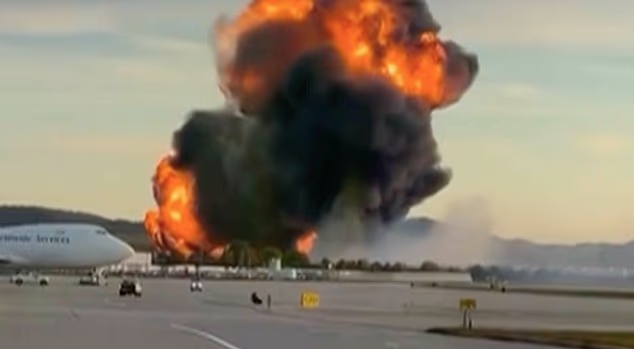
On January 17, 1996, for instance, Ibrahim, son of the late despot, was on a jolly ride in the Nigerian Air Force presidential Falcon jet. He was headed to a party and private family engagement in Kano. Lagos being his departure, he was flying with 14 other friends, including his Yoruba girlfriend, Funmi; Bello, younger brother of Aliko Dangote; and a wealthy young man called Dan Princewill. The jet was almost landing in Kano when it mysteriously exploded mid-air, swallowing all and their dreams.

Obasanjo was particularly loath to this deployment of public assets for personal use. So also were there no public examples of such deployment during Umaru Yar’Adua and Goodluck Jonathan’s time in office. Perhaps taking a cue from their parents’ personal rule disposition, children of successive Nigerian presidents have made this a pastime. Deploying public assets and office for private advantage resurfaced in 2020. Late President Muhammadu Buhari’s daughter, Hanan, flew the presidential jet on a private photography trip to Bauchi State. By convention, only the president of Nigeria, the First Lady, Vice-President, Senate President, Speaker of the House of Representatives, Chief Justice of Nigeria, ex-presidents and a presidential delegation are authorized to use the presidential jet. The convention does not grant the president any powers to transfer his right of usage of the presidential jet to any of his children.

Following in these footsteps, in October 2023, First Son, Seyi Tinubu, flew the presidential aircraft to attend polo games in Kano State. Before him, children and spouses of Nigerian leaders and top government officials who should have no business with the aircraft had become forerunners of this aberration. This provoked the question: is this an endemic problem that should bother us as a people, or is it a mere frivolity that we have allowed to detain us over time? Why do Nigerian public officials always fail to see the divide between the public and the private?

Of particular interest have been the two children of the current Nigerian president, Seyi and Folasade Tinubu-Ojo. In a May 4, 2025 piece entitled Tinubu’s Ajantala Son, I articulated how, if indeed all those democratic flowery words ascribed to the Nigerian president are not cosmetic, Seyi Tinubu must be a pain in the neck of his father, as he is to responsible parenting. I wrote, “In Nigeria’s history, I am not aware of any president’s child who has threatened public peace, public decency and the public space as Seyi. His name has come out in every socially distasteful national issue.” I also wrote further: “You will recollect that this same young man was one who, but for his father’s peremptory scold, would probably have been attending Executive Council meetings with ministers. Seyi has no precis in illicit behaviour, so much that he outperforms himself in irresponsible public acts. He is reputed to have nominated ministers and behaves in socially anomalous manner that baffles… He causes so much stir with his long convoys of glittering automobiles and is chaperoned to occasions by Nigerian security apparatuses.”

Around the time when he paid “official visits” to northern states early this year to donate billions of Naira to victims of Nigeria’s social malady, an allegation by the NANS President that Seyi ordered him tortured, beaten and his nude pictures taken for his voyeuristic pleasure took over the stratosphere. There are allegations that he will be put forth as the next governor of Lagos State. I do not see any ooze from Seyi’s mind that justifies a mental fit for this task. In personal rules where there is no distinction between public and private purses of state runners, the question people ask is, where do the billions Seyi spends come from?

The president’s daughter, Tinubu-Ojo, who christened herself ‘Iyaloja-General of Nigeria’—whatever that means—is another sore thumb pointing at the evil of deploying personal rule for familial advantage. The eldest daughter of Nigeria’s president, from inception of her father’s presidency in 2023, Tinubu-Ojo has positioned herself as ‘godmother’ of Nigerian open-air markets. Immediately her father came into office, in a baffling manifestation of an inflated hubris, she was said to have updated her Twitter bio with the title, “First Daughter of the Federal Republic of Nigeria (FRN).” She thereafter sent tongues wagging when a viral video of hers, with Nigerian flags flying behind her, positioned her as addressing what looked like a national broadcast. It was seen as pointing at a desire to appropriate all the perks from her father’s presidency.

Capitalizing on the low capacity to stick to rules that is Nigeria, Folasade catapulted herself from Lagos market headship where she made herself Iyaloja. That position was appropriated by her after the passage of Mama Abibatu Mogaji who occupied the same position. After this, she then made herself the market godmother of the whole of Nigeria. She was apparently yielding to an earlier call for a Hobbesian flee after power by her father in that famous counsel, to “fight for it, grab it, snatch it and run with it.” Folasade has made a pastime of positioning her representatives in various markets across Nigeria. The ultimate aim, it is said, is to protect her personal financial interests. In a Nigeria where genuflection before public office is widespread and public officials are like gods, the president’s daughter, with the panoply of power and wealth at her disposal, is dreaded and worshiped.

Edo State, it will seem, will prove a fatal limitation of this hubris. In 2024, Folasade was said to have begun an attempt to impose an “Iyaloja of Edo State markets” on the ancient city of Benin. Last Tuesday, when she visited the palace of the Oba of Benin, Ewuare II, the president’s daughter, however, met her match in the impregnable culture of the Edo people. She must have assumed that, like other states, Edo palace bows before ineptitude dressed in the garment of political power. Either out of stiff-necked resistance or inability to mentally penetrate, appreciate and understand the ancient culture of the Benin, the president’s daughter had continued in her imposition gambit, which seems to have become a familial trait. At the palace, she told Oba Ewuare II that a Pastor Josephine Ivbazebule would be her surrogate for all markets in Edo State.

After she was done talking, the palace taught her a lesson with words that were harmless on the surface but lacerating in deed. Not only was she taught that she couldn’t recreate her power drunkenness in Edo, she was told in plain terms that the cultural and historical foundations of market leadership in Edo State were far different from what obtains elsewhere in the country. Speaking through an interpreter as he does whenever he considers it demeaning to exchange verbal reply with a guest, Oba Ewuare told Folasade that in Benin culture, market leadership is not a political creation nor is it an external imposition. It is the product of tradition and is under the suzerainty of the Oba of Benin.

If Nigeria’s No. 1 citizen is not embarrassed by the activities of his children, parents all over the world are. The Yoruba, deploring this grotty descent in character of the First Family, say when an elephant trumpets, its child should not too. They also counsel that if one’s barn posts a bountiful yam harvest, a wise man would cover it from prying eyes.

Apart from the raw power to browbeat and be kowtowed to, as well as illicit funds and majesty associated with being the president’s children, Nigerians will be glad to harvest what these ones’ parents planted inside their skulls for national benefit. Certainly not the cunning that produces quick wealth and unearned advantage. Folasade Tinubu-Ojo could have earned more umbrage from the people of Edo State for her audacity if not for the decency of the palace. Let the little darts from the Bini palace remind the president’s daughters that it is the overripe orange that invites the throwing of stones.

The views expressed by contributors are strictly personal and not of Law & Society Magazine.

ASUU Vs FGN: Renewed hope, renewed struggle


Jeff Godwin Doki, Ph.D

One can say with considerable justification that our politicians do not know the meaning of honor. And this is because honor is a very expensive gift, and that is reason you cannot find it among cheap Nigerian politicians. For example, some of the salient attributes of honor include integrity, honesty and the keeping of a promise or an oath. No where is this idea of honor illustrated with more completeness than in the poem, ‘The Franklin’s Tale’ written by Geoffrey Chaucer (1342-1400), the first English poet.

The story goes like this: Dorigen’s husband had traveled out of town when a young man came earnestly asking for her love. Jokingly, Dorigen gave the young man an almost impossible condition which is that: he can only get her love if he is able to clear away all the rocks from the sea. Now, the young man took his assignment very seriously because he was in love and through the use of magic and astronomy, the young man was able to clear all the rocks away from the sea and thereafter he returned to Dorigen’s door asking her to make true her promise. Now, Dorigen’s husband had returned and when she informed him of her rash promise, he views what she had told the young man, not as a joke but, as a promise-for-a promise contract from which there is no honorable withdrawal. Accordingly, Dorigen’s husband gave his wife permission to go and keep her promise with the young man. This is the real meaning of honor. In other words, a promise is a matter of honor and integrity. Once it is given it must be fulfilled. Can Nigerian politicians borrow a leaf from Dorigen’s husband?

Now to our beloved country Nigeria, the giant of Africa, that turned 65 years some days ago. During electioneering campaigns in Nigeria, it is fashionable to see Nigerian politicians on the pulpit. They usually put sugar and honey in their tongues in order to win votes from the electorates. They give us empty promises: ‘We will build schools and hospitals’, ‘we will provide water to every backyard’,’ we will drive poverty away from the land’, ‘strikes in the University system will become a thing of the past’,’ we will turn all nights into day,’ ‘we will give the farmer the best for his sweat’, ‘Our children in the universities will complete their degree programs on record time’…The list of their promises could be as long as a railway line. Sometimes, they even promise to build a bridge even where there is no river. They give the electorates so much hope. They persuade us to hold on to the belief and the conviction that there is a better life, a better world beyond the horizon. But truth is that with Nigeria politicians, we are only facing a future that holds the hope of a thousand mirages.

The most recent example of this deceit and falsehood is the Renewed Hope Agenda of the present government. All our hopes were raised even during electioneering campaigns when we were told at rally after rally that there will be no more strikes in Nigerian Universities if Nigerians vote for the All Progressives Congress (APC). We had high hopes and we voted.
But,It is more than two years now since our hopes were raised and renewed. To his credit, Mr President, is a very experienced politician having served as Governor of Lagos State from 1999 to 2007, and as Senator representing Lagos West in the third Republic.

With such a vast experience in leadership and Nigerian politics, one expects that the Government in power should be more democratic by honoring agreements especially the re-negotiated 2009 agreement between ASUU and the FGN submitted by Yayale Ahmed some months ago. This very agreement is at the heart of the face-off between the FGN and ASUU. One expects that Renewed Hope should mean respect for the Collective Bargaining Principle as enshrined in the laws of the International Labor Organization (ILO). Renewed Hope should mean making progress and not making excuses. For example, what steps has the present Government taken to ameliorate the rot in Nigerian public Universities since it assumed power in 2023? Even the Students Loan Scheme (NELFUND), the Government boasts about cannot get to the real Nigerians and, by that, I mean indigent students. Very recently, the Government announced a loan scheme for staff of the tertiary education sector. But is that the solution to the incessant strikes in the tertiary education sector?

Why is the government behaving like the absurd man in the proverbs who left his house on fire to pursue a rat fleeing from the flames? In any case, it is common knowledge that the same Nigerian Government is owing University teachers about four months withheld salaries. As a matter of fact, the Tertiary Education Loan Scheme represents a queer irony: you are owing some one and you are still offering your debtor another loan? What an upside-down-way of thinking. The whole loan project is balderdash and it smacks of deceit and folly. The sad truth is that the Nigerian Government has arrogantly betrayed everything for which our people struggled for because it has been able to count on the silence of the Nigerian people. Not even under past military juntas has there been such a deliberate and carefully organized strategy of pretense, sham and renewed deceit.

On August 26,2025, the Academic Staff Union of Universities ( ASUU) called out its members in all public universities in Nigeria to hold rallies on their campuses. Some members of ASUU also engaged in peaceful protest marches, chanting solidarity songs all over Nigeria. And what was the purpose of all these? The rallies and peaceful protests were meant to be a wake-up call, asking the Government in power to remember its campaign promises. Several interviews granted by the ASUU President, Zonal Coordinators and Branch Chairpersons after the public rallies all but had one common denominator namely: (1) Re-negotiation of the 2009 ASUU/FGN Agreement, (2) Sustainable funding of the universities (3) Revitalization of the universities, (4) Victimization of our colleagues in LASU, KSU and FUTO (5) Arrears of 25-35% wage award (6) Promotion Arrears, (7) Remittance of third-party deductions (8) Payment of three and half months withheld salaries. And this is only a partial list.

One must concede that since this Government assumed power in 2023, ASUU has employed various peaceful methods of resolving the crisis in Nigerian public Universities, including negotiation and dialogue. Lamentably, all these efforts have failed to produce any tangible results. Meanwhile, the Education Minister, another man of power, has consistently continued to demonstrate sheer ignorance about the Negotiation between ASUU and the FGN. Perhaps the negotiation took place before the Minister was appointed, or perhaps he is suffering from a poverty of sincerity. Whatever way, it is obvious that the Education Minister needs some education about the ASUU-FGN face-off.

The general public knows for sure that all is not well in Nigerian public universities and that there shall be a strike action in the nearest future except the President himself may wade into the matter and perhaps, very quickly too. This is as much as to say that the present regime, like others before it, has made a habit of treating Nigerian university teachers with utter contempt and disdain. For now, the much-talked-about Renewed Hope propagated everywhere by the Government’s numerous megaphones seems to appear like deceit labeled as official truths.

Any careful observer would have noticed also that dialogue between ASUU and the FGN has failed. Public rallies and peaceful protests have also fallen on deaf ears. It has become appallingly obvious, therefore, that the only language the Government shall understand is STRIKE. For the benefit of the doubt, it is the Government’s silence and willful incapacity to resolve the crisis in the public universities that has re-energized a renewed spirit of struggle among the ranks of ASUU. To put it bluntly: a fake Renewed Hope gives rise to a Genuine Renewed Struggle. A Government that gives the electorates fake campaign promises should not complain when citizens begin to embrace STRIKE ACTION as the only alternative. For ASUU as a union, there can be no way out after all struggles are required to survive under a regime founded on the structures of deceit and pretense.

As usual, ASUU is prepared to stand for education; to stand for what is right; to stand for the truth even if it means standing alone. But it should be borne in mind that the FGN shall take the blame if our public universities in Nigeria are shut down in the coming days. Our folks say that a woman who brings home ant-infested faggots should not complain when lizards begin to pay her a visit. It is the social responsibility of government to provide education for all its citizens and Section 18 of the 1999 Constitution is very explicit about this. Furthermore, Section 15 of the Child Rights Act provides that every child has a right to free, compulsory education. And this is precisely what ASUU stands for. The Federal Government should quickly rise up to its Constitutional responsibility. Nothing less than that will be adequate.

Jeff Godwin Doki is a Professor of Comparative Literature at the University of Jos (UNIJOS), Nigeria

The views expressed by contributors are strictly personal and not of Law & Society Magazine.

Japan set to get first female PM after Sanae Takaichi wins ruling party leadership

Japan is on the verge of getting its first female prime minister after Sanae Takaichi was elected as leader of the governing Liberal Democratic Party (LDP) – a victory that should lead to her being installed as the country’s new leader in the middle of the month.

Takaichi, a rightwing politician who has voiced admiration for Margaret Thatcher in her quest to build a “strong and prosperous” Japan on the international stage, beat her moderate rival, Shinjiro Koizumi, in a runoff election at the LDP headquarters in Tokyo on Saturday.

The election for party president was held after the outgoing prime minister, Shigeru Ishiba, announced his resignation after just a year in office. Ishiba, a moderate whose election last year had angered the right of his party, said it was time to find a successor to lead a “new LDP”.

Takaichi, 64, inherits a party that has endured two bruising elections in the past year as voters punished it over a funding scandal and its failure to address the cost of living crisis.

“Together with so many of you, we have carved a new era for the LDP,” Takaichi said moments after defeating Koizumi by 185 votes to 156. “Rather than feeling happy right now, I feel real challenges lie ahead. I am convinced that there is a mountain of work we must tackle together.

“We must all pull together across all generations and work as one to rebuild the LDP. Everyone will have to work like a horse.”

As expected, Takaichi won the first round of voting, securing 183 of 589 votes, with Koizumi in second place with 164 votes. Three other candidates were knocked out of the contest. The runoff, in which MPs’ votes were given greater weight than those of rank-and-file party members, theoretically favoured Koizumi, who was said to be more popular among lawmakers. But it was Takaichi who emerged the winner after the second, decisive round of voting.

Although the LDP-led coalition no longer holds a majority of seats in parliament, Takaichi is widely expected to be approved as prime minister when MPs vote, with 15 October the most likely date.

To deny her the prime ministership, opposition parties would have to unite behind their own candidate – a scenario observers agree is unthinkable.

Her immediate task will be to unite her party and win back public support after more than a year of scandal and poor election results.

She will also have to address public concern over immigration and mass tourism, and try to win over younger voters who turned to populist minor parties such as Sanseito in this summer’s upper house elections. Japan should “reconsider policies that allow in people with completely different cultures and backgrounds”, Takaichi said during the campaign.

It is impossible to understate the symbolism of Takaichi’s victory in a country that has few female politicians and business leaders, and consistently ranks poorly in global gender gap comparisons. She has, though, opposed policies that many voters believe would advance the cause of gender equality, such as allowing women to become reigning empresses and married couples to use separate surnames.

Saturday’s vote had been described by analysts as a battle for the future of the LDP, which has governed Japan almost uninterrupted for the past seven decades. Its electoral dominance has been badly shaken, however, by a long-running scandal involving dozens of MPs who were found to have siphoned unreported profits from the sale of tickets to party gatherings into slush funds.

Takaichi, a foreign policy hawk, will also face a volatile security environment in east Asia, including the rise of a loose anti-western alliance comprising China, Russia and North Korea, and the redrawing of economic ties with the US under Donald Trump, who will reportedly visit Japan towards the end of the month.

Each of the LDP’s 295 lawmakers voted in the first round of Saturday’s vote, with an equal number of votes distributed based on the preferences of just over 1 million grassroots members who had already cast their votes.

After none of the candidates secured an overall majority in the first round, Takaichi and Koizumi went head to head, with each of the LDP’s 295 lawmakers getting one vote and the membership’s share dropping to 47 votes, one for each of Japan’s prefectures.

Credit: The Guardian

FIDA Nigeria, Abuja felicitates Chief (Mrs.) Stella Omiyi on her election into Defence Committee and Amicus Committee of the International Criminal Court Bar Association

FIDA Nigeria, Abuja Branch, heartily congratulates a distinguished elder of our branch, Past Country Vice President of FIDA Nigeria and Past Regional Vice President of FIDA International – Chief (Mrs.) Idenyemih Stella Omiyi – on her recent election into the Defence Committee and the Amicus Committee of the International Criminal Court Bar Association (ICCBA) at the Hague, Netherlands, on the 26th of September, 2025.

Chief (Mrs.) Omiyi’s exceptional achievements continue to inspire women in law across Nigeria and beyond. Her election is a testament to her unwavering commitment, sterling contributions, and remarkable leadership in the legal community, both within and outside Nigeria.

The Branch celebrates this well-deserved recognition and commends her for continually projecting the values of excellence, professionalism, and service which FIDA represents.

Congratulations once again, our very own Elder, Chief (Mrs.) Stella Omiyi! We are proud to be associated with you.

Chioma Onyenucheya-Uko,
Chairperson,
FIDA Nigeria, Abuja Branch.

Germane opportunities for Nigerian lawyers, By Audrey Chinelo Ofoegbunam

WELFARE NUGGETS

In an evolving legal landscape, lawyers must adapt and innovate to thrive.
Thus;

Remote Practice & International Clients
Platforms like UpCounsel, Clio, and LegalZoom enable Nigerian lawyers to service global clients, particularly in areas such as:

  • Intellectual Property (IP) registration
  • Contract drafting
  • Compliance

Niche Practice Development
Consider specializing in emerging areas of law, including:

  • FinTech regulation
  • Blockchain and cryptocurrency law
  • Data protection compliance

Alternative Revenue Streams
Diversify your income by exploring:

  • Online legal courses
  • Subscription-based advisory platforms
  • Publishing digital books and toolkits

By expanding your reach, developing niche skills, and exploring alternative revenue streams, you can stay ahead in the competitive legal landscape and achieve success as a Nigerian lawyer.

Supreme Court says fathers are legally bound to support wives and children whether or not there is divorce

The Supreme Court of Nigeria has held that fathers are legally bound to support their wives and children, whether or not a marriage is dissolved.

This verdict was delivered in the matter between UGBAH & Ors V. UGBAH (2025) LPELR- 8173 (SC)

In its 4th July 2025 decision, the Supreme Court in Ugbah & Ors v. Ugbah, a case that questioned whether a wife and children can sue for maintenance, welfare, and education while the marriage is still subsisting, and without first filing for divorce, the apex court gave the phenomenal verdict.

Key highlights of the case are that Mrs Veronica Ugbah sued her husband, Mr Patrick Ugbah, seeking money for her upkeep, their children’s education, and an alternative accommodation.

Patrick Ugbah, however, argued that such claims could only be made under the Matrimonial Causes Act (through a divorce or separation petition), not by a writ of summons.

The High Court dismissed his objection, but the Court of Appeal struck out the case, insisting that only a petition under matrimonial law was proper.

But the Supreme Court disagreed with the Court of Appeal and held that:

A wife does not need to file for divorce before asking for maintenance.

Children’s right to welfare and education is independent, enforceable, and not tied to divorce proceedings.

Courts must focus on substantial justice, not technicalities of procedure.

Outcome: The appeal was allowed, the High Court’s ruling was restored, and the wife and children’s claims were recognized as competent.

Why It Matters
This judgment underscores that:

Fathers remain legally bound to support their children whether or not a marriage is dissolved.

A wife can independently seek maintenance and support during marriage without being forced into divorce proceedings.

Courts will not allow technical rules to override the justice owed to vulnerable parties like wives and children.

The brazen customs officer who shunned court order, used Zone 2 police, thugs to evict tenants with 2-month-old baby in Lagos

A Customs officer identified as Ritji Stephen Gobak Gomos recently went berserk, defying a valid court order which stopped him from taking possession of his apartment occupied by one David Afam Akaraiwe and family, including a two-month-old baby, used policemen from ‘B Ops’ of Zone 2 Onikan and some thugs to forcefully evict a tenant at the Devine Estate Amuwo Odofin, Lagos.

And while the horrendous drama was on, the husband of the nursing mother, David Akaraiwe, was out of town.

It was gathered that trouble started with his tenant whose name was given as David Afam Akaraiwe after the customs officer landlord told him to leave his gate open that he was coming to fix an airconditioner at the adjoining apartment adding that Mr. Akaraiwe told him that there was no way he could keep his gate open because that would be a security breach, that if the landlord was around and wants to carry out any repair works on the adjoining apartment, he would gladly open the gate for him. Sources said the response of Mr. Akaraiwe did not go down well with the officer who vowed to eject him.

Subsequently, he served him with a quit notice and later a court Summons was pasted on his gate to appear before Court 4, Apapa, preparatory to his eviction on 3 September 2025. 

However, a twist was said to have been introduced into the drama after the landlord ordered his gate man, ThankGod Matthias, minutes after the Summons was pasted on the gate of David Afam Akaraiwe to secretly remove it so that he will not know the date of the court sitting. While doing this, the gate man was caught by a CCTV camera. So, while the court sat severally, Mr. Akaraiwe was not aware and judgment was given against him to quit the apartment.  While court Bailiffs came to execute the order, Mr. Akaraiwe was shell-shocked, questioning when the court sat. His lawyer, Edward Porbeni Esq, quickly went to the same court to pray to the Magistrate, Hon. L. O. Kazeem, that his client was never served a court Summons prior to judgment, adding that his client’s CCTV camera, however, caught the gateman, ThankGod Matthias, removing what seemed to be the court Summons. The Magistrate then gave a counter order forbidding possession order saying that in the interest of justice, he could not grant possession to the customs officer and therefore put in abeyance the application by his counsel. Hearing has been fixed for October 8, 2025.

Angered by the action of the customs officer and his gateman, the Magistrate gave an order for the arrest of the gate man and subsequent arraignment for subverting the cause of justice. Even though the gate man confessed on camera that it was his employer, the customs officer who asked him to remove the summons, his plea was not taken. He is presently remanded in Kirikiri Correctional Centre while the matter has been adjourned to October 20, 2025, for hearing.

However, still holding on to the initial order to quit, Mr. Stephen Gosom went to Zone 2, to seek policemen to help him execute the order. And the officers, instead of going to execute with court Bailiffs, sought the services of thugs to break open and pack out the tenants’ belongings, including forcing the nursing mother out in the cold air and welding the apartment with iron rods.

It was gathered that while the forcible ejection was on,  police officers from Area E’ Festac Town, on the order of the DPO, came to the scene to alert the officers from Zone 2 that what they were doing was illegal, as there was a counter court order stopping such. But agents of Gosom carried out the execution, locking the man’s dog tied to a chain inside.

According to some sources, the customs officer has even petitioned the Zonal Intelligence Response Squad ZIRS of the same Zone 2, accusing David Akaraiwe of kidnapping, breaking and entering and stealing, and a letter of invitation to that effect had already been sent to him. 

Present Counsel to Mr. Akaraiwe,  Barrister Yinka Sanni, who apparently was miffed by the whole scenario, describes the act of Customs officer Gomos as gross abuse of power, vowing to seek redress in a court of competent jurisdiction and claim damages. He said he was already doing a strong-worded petition to the Comptroller General of customs to the effect. “How can a customs officer, trained with the taxpayers’ money, who is supposed to be a custodian of the law, openly violate the law in this manner? He questioned. Continuing,  Barrister Sanni added, ” Even the officers from ‘B ops’ of Zone 2, don’t they know that you can not carry out ejection or execution of a valid court order without court bailiffs around, why hire the services of thugs?

The CCTV camera showed that no Bailiff was with them, they only came with thugs to execute a court order that had been set aside. I will sue the organization of this so-called Superintendent of Customs, join him, the Nigeria Police zone 2 and claim damages because my client was illegally detained and his property worth several millions of naira was destroyed. People don’t know that when you throw somebody’s property out illegally, you have literally detained the person. The battle line has been drawn; we will see where it ends between us and this lawless customs officer.”

Calls put to the customs officer on  +234 806 579 4596 to hear his side of the matter were rebuffed. He has neither responded to our text message to that effect as of the time of filing this report. Even calls put across to the Customs spokesperson, ACC Maiwada, were not picked up. He too did not respond to our text message as of the time of this report.

For Nigeria, 24 million reasons to fear the future?

By Chidi Anselm Odinkalu

When Olusegun Obasanjo took over in the middle of 1976 from the slain Murtala Mohammed as Nigeria’s military Head of State, the regime was already committed as a matter policy to transition power to an elected civilian administration in 1979. This was a big deal alright but not one over which he had much say as such. As military Head of State, General Obasanjo identified two issues to define his personal legacy.

One was food security. To address that, he launched “Operation Feed the Nation”, better known by the acronym (OFN). Those were the same initials of Obasanjo Farms Nigeria, the name of the company under which the General would later pursue his post-retirement vocation in agriculture. The coincidence was not lost on many.

The other issue was education. To pursue this, General Obasanjo launched the Universal Primary Education (UPE) in 1976. 40 years later, an independent study determined that the UPE had “a statistically significant impact on schooling attainment of beneficiaries”, but there were questions as to its reach and coverage. Quite apart from the usual dysfunctions associated with centrally dictated government programmes, the UPE also faced opposition from traditional and religious leaders in some parts of Nigeria, who reportedly felt “that it is a Christian brainwashing which alienates their children from their own religious beliefs.” Those were also people who largely opposed the education of the girl-child.

The three and a half years of the Obasanjo military regime were too short for such an ambitious programme as the UPE to prove itself. The best he could hope for was that his civilian successors would continue with the idea.

At the launch of the UPE, the country was in the middle of what its rulers believed would be an interminable Oil Boom. In hindsight, the onset of the UPE coincided with the beginning of a bust. The programme became one of the casualties of the rampant corruption and the subsequent Austerity that bedevilled the administration of Obasanjo’s chosen successor, President Shehu Shagari.

The military regime that toppled Shehu Shagari four years later paid no heed to basic education. Chronically careening from the twin crises of balance of payments and elite banditry of the Nigerian political class, the system never quite rediscovered the will to invest in basic education as a duty of the Nigerian state. By the time Obasanjo returned as civilian president 20 years after his first tour of duty, the country had begun to reap whirlwind from decades of costly omission.

President Obasanjo appeared to understand this but arguably waited too long to address it. In the fifth year of his eight-year tenure, he enacted the Universal Basic Education Programme (UBE), which made basic education compulsory for all children in Nigeria. Basic education under the law was defined as nine years of formal education – six years in primary school and three years of junior secondary education. It also became a federal crime to deny a child in Nigeria access to such education. To encourage uptake by the states, the Federal Government offered generous co-financing incentives to the states. Many failed to take it up.

Two years later, in 2006, President Obasanjo launched a National Policy on Education. By this time, a diagnosis had indicated the depth of the emergency. Of 42.1 million Nigerian children eligible for primary education at the end of 2005, “only 22.3m were in the primary schools. This figure implies that about 19.8m or 47% Nigerian children that should [have] been in primary schools [were] not.”

It is no surprise that this period coincided with the onset of what would later become an Islamist insurgency founded on an ideology opposed to Western education.

As with his first tour of presidential duty, the policy measures implemented by President Obasanjo on his second coming equally relied for their durability on his successors sharing his sense of mission and urgency. It was a tall hope. In the two decades since Obasanjo’s National Policy on Education of 2006, successive administrations neglected it to a point where the country has become the most natural recruiting ground in the world for radicalisation.

On Monday, 13 November, 2017, Muhammadu Buhari, another Nigerian ruler on his second tour of presidential duty, hosted a Cabinet retreat on education. Vice-President Yemi Osinbajo, himself a teacher of considerable stature and Education Minister, Adamu Adamu, also addressed the retreat which, however, involved little deliberation and ended with an inconclusive communique.

A high point of the Buhari Cabinet retreat was the presentation of Minister Adamu Adamu’s “Education for Change: A Ministerial Strategic Plan, 2016-2019.” Launched in August 2016 and better known under the acronym MSP, its title was a play upon the “Change” mantra of the then government, and the United Nations’ Education for All campaign. If it had been launched today, the plan would probably have been called “Education for Renewed Hope”.

At over 120 pages, most Nigerians, including senior staff of the Federal Ministry of Education (FMoE), were unlikely ever to read the MSP. In his foreword, Minister Adamu promised to “welcome rigorous discussion with all levels of stakeholders to ensure a sustainable and enduring document.” It never happened.

The MSP offered the government’s vision for education in Nigeria, setting out three strategic outcomes namely: improving access, enhancing quality, and strengthening sectoral systems. The scope covered ten major areas. Under access, in particular, the MSP focused on out-of-school children (OOSC).

The MSP identified a priority in the twin challenges of OOSC and mass illiteracy. The plan estimated the number of OOSC at 10.5 million and illiteracy at 38% or 60 million Nigerians. With reference to OOSC, it proposed “a state of emergency on education in the states most affected by the (Boko Haram) insurgency.” This was an implicit recognition of the relationship of cause and effect between policy failure and national security consequence.

By 2019, the plan hoped to reduce by half the number of illiterate people in Nigeria through the deployment of 170,000 instructors, 100,000 of whom will be mobilised by the Federal Government and another 70,000 by the States. For the first time, the MSP offered a plan for a pre-primary (nursery) education curriculum. Not much has been heard of these since then.

The pivotal planning data on which the MSP was anchored was dubious and dated. On the issue of OOSC, for instance, it claimed that Nigeria had “10.5 million out-of-school children”, a figure first used by the FMoE in its planning in 2006. Contradicting the MSP, however, President Buhari informed the country at the retreat that in Nigeria “an estimated 13.2 million children are out of school.” This was one-third more than the estimate by the MSP.

On the back of this frightening number, President Buhari then touted the goal of the FMoE as “fostering the development of all Nigerian citizens to their full potentials, in the promotion of a strong, democratic, egalitarian, indivisible and indissoluble sovereign nation under God.”

For all its ambition, the MSP was starkly un-costed. Instead, it proposed to increase already bloated education overheads by elevating the National Board for Arabic and Islamic Studies (NBAIS) to a parastatal. It is hardly any surprise that President Buhari’s goal of enlightened governance based on egalitarian civics came to naught.

These and many more flaws in the MSP highlight the reasons why Nigeria’s educational sector drifted into a zone of dangerous incoherence under President Buhari’s watch. In the period since then, the country has descended into a snarling cauldron of inter-ethnic hate.

This past week, President Obasanjo disclosed that the population of OOSC in Nigeria has nearly doubled to 24 million, which is over 10% of the country’s current population estimate. He predictably warned: “You don’t need an oracle to know they will become the recruiting ground for the Boko Haram of tomorrow.”

Education should be a national security priority for all levels of government. States need both a coherent policy environment and a committed partner at the federal level. Yet very few Nigerians can say who the Minister of Education is, what is his or her name and what is their plan for addressing Nigeria’s 24 million reasons to fear the future.

A lawyer and a teacher, Odinkalu can be reached at [email protected]

The views expressed by contributors are strictly personal and not of Law & Society Magazine.

High court sentences man to life imprisonment for defiling four-year-old in Lagos

A High Court in Lagos on Tuesday sentenced Femi Ayoade, a 22-year-old graduate, to life imprisonment for defiling a four-year-old girl inside a tricycle.

Hon. Justice Abiola Soladoye of the Ikeja Sexual Offences and Domestic Violence Court delivered the judgment, stating that the prosecution had proven the one-count charge of defilement beyond a reasonable doubt.

The judge described Ayoade as a criminally audacious man who shamelessly turned a child’s vagina into a playground.

“The prosecution has successfully presented compelling evidence against the defendant.

“Consequently, the defendant is hereby found guilty of the charge of defilement and is sentenced to life imprisonment,” Justice Soladoye ruled.

The judge further ordered that the convict’s name be entered into the Lagos State Sexual Offences Register.

The State Counsel, Mrs Olufunke Alebiosu, presented the survivor and her father as key witnesses.

The convict committed the offence in September 2021 at No. 19, Milestone Close, Infinity Estate, Skido Bus Stop, Eti-Osa, Lagos.

TIPS