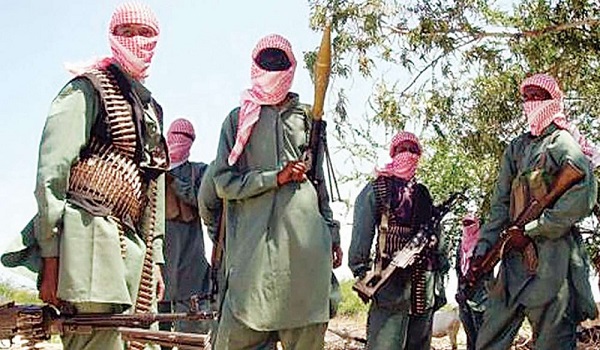
In confirming the death of the Boko Haram leader Abubakar Shekau in June 2021, the breakaway Islamic State of Iraq and the Levant’s branch in West Africa (ISWAP) said he “killed himself instantly by detonating an explosive” when offered to repent and join them (ISWAP). “Shekau preferred to be humiliated in the afterlife than getting humiliated on earth.” But after getting rid of his rival—notorious for the kidnapping of 276 Chibok school girls in April 2014 before several other cases of kidnappings, killings, raping of women and suicide bombing—Abu Musab al-Barnawi (who has also since joined his ancestors) pledged loyalty to a more sophisticated foreign terror network. Despite an initial lull, it is now evident that ISWAP has reopened a new chapter in their campaign against the corporate existence of Nigeria with the execution of the 25 Brigade Commander in Damboa, Borno State last weekend.
I commiserate with the family of the late Brigadier General Musa Uba and the Nigerian army and enjoin authorities in the country to accept that we are witnessing a breakdown of law and order on an unprecedented scale. In the last few months, there has been a dramatic upsurge in gruesome attacks on civilians as well as members of the armed forces in the Northeast. In the Northwest and Northcentral, gunmen are now everywhere, killing and kidnapping innocent people, especially in rural communities. On Monday, bandits attacked the Government Girls Comprehensive Senior Secondary School (GGCSS), Maga, Danko Wasagu area of Kebbi State, killing the Vice-Principal and abducting no fewer than 26 students. And as I write this column, I just received the horrific video of how a church in Eruku, a community in Ekiti local government area of my state (Kwara), was attacked on Tuesday evening by assailants who killed two people and abducted several worshippers.
Across the country today, we are dealing with criminal gangs whose purpose is to kill, rape or maim innocent people without any provocation or justification. To compound the challenge, we have overstretched the military with the task of internal security while police personnel are saddled with performing guard duties for our very-important-persons (VIPs).
In his book, “Man and His Government: An Empirical Theory of Politics”, the late Harvard Professor and one of the greatest scholars in political science, Carl Joachim Friedrich argued that the defense of any community (state) is the primary responsibility of the political authority as wars are won and lost at that level. In war, according to Friedrich, “political and military considerations are intertwined in complex ways, but in the last analysis, the political must and will prevail, even in the military field”. Friedrich had relied on the thesis of his 19th century German compatriot and military strategist, Carl von Clausewitz, generally regarded as the foremost authority on war. National defence preparedness, according to Clausewitz, presupposes “an army which is soundly trained for war, a military leadership which does not await enemy in perplexed and confused uncertainty, but with quiet determination…and finally a healthy nation which does not fear its enemy any more than it is feared by the enemy.”
In Nigeria today, enemies abound on numerous fronts. Yet, the connecting thread for the variants of violence we are witnessing across the country, as I have consistently argued, is the loss of what Max Weber described as “the legitimate use of physical force” to criminal cartels. That also explains why violence has moved from social deviance to a thriving enterprise in the hands of sundry syndicates with transactional kidnapping becoming an unofficial subsector of the economy. Even more frightening is the quantum of lethal weapons, including machine guns and rocket-propelled grenades, in the hands of non state actors and contestants of state authority in different theatres across the country.
Meanwhile, in almost two decades of the insurgency, the Nigerian defence establishment has hardly varied its approach and response which has mostly been to deploy conventional forces to face the terrorists, with periodic Air Force bombardment of their positions. But over time, the insurgents have mastered our approach and continued to improve their game. Worse still, there is evidence of intelligence leakages leading to many ambushes and abductions of our troops. More importantly, the Nigerian state has left much doubt as to its right of sovereign control of the affected territories, leading to many ungoverned spaces that have become ready abodes for criminal gangs.
What worries me most is that while we face this existential threat, it is still business as usual for our politicians who are either organizing decampment jamborees to the ruling party or fighting over control of the secretariat by a shrinking opposition party that is as useless in managing defeat as it was in managing victory while in power. Now, their new national chairman is begging President Donald Trump to “come and save democracy in Nigeria”. For him, it is ‘democracy’ that is endangered not the people, including in the Northwest where he hails from. Behaving like the proverbial cabin crew who were busy arranging the deck chairs inside a sinking Titanic, these politicians are oblivious to the danger we all face.
In their own enlightened interest, our politicians across board must understand that is the time to stand together to fight this common threat to our national survival. But the greater responsibility lies with President Bola Tinubu who must also understand that this is no time to be dancing to some ‘On your mandate we shall stand’ song while criminals kill our citizens in droves. The conversation our politicians should be having is about how to dig our country out of this existential hole that we have found ourselves. To retrieve Nigeria from the plunder of terrorists, bandits, kidnappers, and sundry criminals, we must collectively declare this war as a clear and present national security emergency.
NAKED ABUSE: As Prof Ndifon Goes to Jail…
The former Dean of the Law Faculty at the University of Calabar and a central character in my 2020 book, ‘NAKED ABUSE: Sex for Grades in African Universities’, Prof Cyril Ndifon, was on Monday sentenced to five years imprisonment without an option of fine. “It was with dismay that I read through this case that a dean of law can turn himself into a sexual predator”, said Justice James Omotosho of the Federal High Court while convicting Ndifon on two of the charges which include soliciting nude photographs and videos from a 16-year-old student, as an inducement to consider her for admission to read Law. “The instances of undue advantage (against female students) are so many. The first defendant abused his office.”
I understand the social dysfunction that encourages this misconduct on university campuses. But there should be no place for sexual predation in an environment of learning. Details of the scandal on which justice has now been served to Ndifon are as lurid as the one captured in my book, which involved the Police, the State Security Service (SSS), the Independent Corrupt Practices Commission (ICPC), a female student (who alleged that Ndifon sexually abused her), parents of the girl, a prominent NGO, the National Industrial Court, the Federal High Court, and the local media. While the victim of that sordid episode couldn’t receive justice, I am sure she would feel some justification now that Ndifon is paying for what appears to be a habitual crime.
Unfortunately, the victim in the case on which Ndifon was convicted has now been put in trouble. In the judgement, her name was ‘concealed’ as TKJ (which incidentally are her real initials) but her mobile number was referenced several times. I understand from ICPC sources that the young lady, who is still a student at the University of Calabar, has been receiving abusive calls since the judgement was delivered. By alluding to her through initials and providing her phone number, the lady in question has been placed in harm’s way. I believe our courts can do better in cases like this. Judicial officers, and indeed all law enforcement officers, must bear in mind the harm that can befall witnesses and survivors of sexual harassment cases.
Investigating authorities, judges and the media must remain committed to protecting the privacy and dignity of anyone who reports or provides information about personal issues, especially on incidents relating to sexual harassment. As it is done in other climes, the identities (which include names and contacts) of complainants and witnesses must be kept confidential throughout the reporting, investigation, and resolution processes. And they should never be disclosed to any person who does not have a legitimate and necessary role in handling the matter. This confidentiality requirement should also apply to all staff, management, consultants, investigators, and affiliated third parties, including judges, as in this instance.
At all times and in all circumstances, complainants and witnesses of cases like this must retain the full right to speak about their experiences, including the right to seek support, advice, advocacy, legal counsel, or any personal or professional assistance without fear of reprisal, whilst also preserving the integrity and fairness of the investigative and judicial process. And no individual should be required to suffer in silence from heinous abuse which disclosures of this nature could trigger. Meanwhile, for the benefit of readers who may want to know more about this Professor, below are excerpts from my book, with the hope that authorities on our campuses will begin to take this problem more seriously.
=============================================================
On 29 August 2015, in a letter titled, ‘Report of Sexual Assault and Harassment by Professor Cyril Ndifon on Me’, addressed to the Vice Chancellor of the University of Calabar, Miss Nkang Akpan narrated her harrowing experience when she sat for a test on ‘Law of Trust’, a class taught by Ndifon. The test was to last one hour. However, approximately 40 minutes into the exercise, according to the student, the professor ordered everyone to submit their scripts.
As is often the case in such circumstances, students were making frantic efforts to write more, in the hope of properly completing their work. Nkang was unlucky. Professor Ndifon walked up to her, took the script, tore it and threw the shreds on her seat as he walked away. For a 400-level student, this was an academic death sentence. The implication was that she would not graduate that year. Immediately, the girl was at the mercy of the professor. As she recalled: “All my classmates who saw what happened exclaimed and sympathised with me.”
The events that followed were captured in the story of the humiliated student who explained that when she was heading back to her hostel with friends, they passed through the faculty as Professor Ndifon was driving in. He asked if the distressed girl still had shreds of the test script. Jubilant and hoping that God had touched the heart of her lecturer, the girl quickly produced the torn script which she had kept in her bag. The Dean then instructed her to gather the pieces of paper, get a new foolscap sheet, and go to his office to recopy it.
Keen to ameliorate a situation capable of extending her academic years on campus, the student quickly went to the office of the professor as directed. Her friends waited downstairs, hoping she would soon finish the task and rejoin them. Considering how the Professor of Law later countered the allegation, it is important we first take the story as told by Nkang herself:
‘I met his secretary and two other staff and explained to them so they could let me sit in their office and write it. He later came into his secretary’s office and told me to go to his private office upstairs so that I could be more comfortable since in his secretary’s office, I was keeping it on my lap to write. On getting to his office, five minutes into when I started writing, he came in with a glass of alcoholic wine, he told me to kiss him with the wine in his mouth and I refused. He offered me the drink and I resisted it, telling him that I don’t like alcoholic drinks. He left me and went downstairs. He came back in another five minutes. This time around, he locked the door and took the key, telling me he also had some work to do while I’ll be recopying the test. He sat on his chair doing his work when suddenly he stood up and walked up to me and asked me again to kiss him. I told him I can’t, and he pretended to let me be and told me I shouldn’t worry that I should continue with what I was writing. Not up to ten minutes after, he walked up to me again, and he tried to force me to take the alcoholic drink.
‘On my refusal, he put the drink inside his mouth and came to forcefully kiss me. As God would have it, I tightly sealed my lips and while he tried to kiss me with the drink in his mouth, it spilled on the floor and the cloth I wore. He dragged me up from the chair and pushed me to a two-seater seat in his office and told me that he wanted to have sex with me. I bluntly told him that I cannot have sex with him. He dragged my clothes in a bid to remove them, I screamed amidst struggling but there was no way anyone could hear me because his office is on the last floor and his secretary, and two other staff were in his official office on the first floor. He removed his cloth and brought out a condom from a shelf in his office, wore it and penetrated (me) forcefully and painfully. We heard a knock on the door, he picked up his clothes and quickly wore them and acted like everything was normal then he proceeded to open the door. He left me there and went downstairs with the person that knocked.
‘I seized that opportunity, put myself together and tried to rush up and finish writing the test before he came up again. After about twenty minutes, he came back into the office, and I just finished recopying the test and I submitted it to him. About to leave the office, he pulled me back and locked the door. At this point, my friends that have been waiting for me downstairs started calling repeatedly because they were worried why I stayed too long upstairs. This time around, he came in with a bottle of Guinness Stout which he started drinking. He once again asked me to drink it and I told him that I don’t take alcoholic drink. He told me this time it’s by force that I must drink. He tried to force the drink through the bottle into my mouth and I spat it out on the floor of his office. He dragged me, forcefully opened my mouth and transferred the drink in his mouth into my mouth. I immediately spat it on the floor of his office again. He got angry and dragged me, telling me to strip off my clothes at the count of three.
‘At this point, I was tired and exhausted coupled with the fact that I had not eaten since morning. When he finished counting three and I still did not strip like he ordered, he dragged me to the chair, locked my knees with his legs and started dragging my trousers forcefully and in the process spoilt the zip. As exhausted as I was, I started crying and begging him that I was weak and had not eaten since morning. He refused to hear, telling me that I was acting and that I’ll make a very good actress; that he has met a lot of my type so many times. I finally succeeded in pushing him off my body and knelt to beg him since I no longer had the strength to continue struggling. He persisted and pushed me down again, wore a condom and penetrated. When I threatened to faint, he finally told me that I can go and offered to drop me off since I was exhausted. I rejected the offer and told him I was going on my own. He insisted but I strongly refused. At that instance, as I was walking out of his office, staggering and very drowsy, he sent me to help him carry his bag to his car downstairs. That’s when one of his staff and himself locked the faculty and they drove off.’
Humiliated and dejected, Nkang said she sat by a new building beside the Law Library, crying. A man driving by saw the young lady in her pathetic state and decided to ask what was wrong. It was the concerned passer-by who reportedly persuaded Nkang to take the matter to the police. At the police station, after she wrote her statement, Nkang was referred to the police clinic where she underwent a medical examination. That marked the beginning of a protracted battle for justice that involved her parents, the police, university authorities and the ICPC.
Determined to get justice for their daughter, Nkang’s parents took the case to the media. Mrs Irene Akpan also corroborated her daughter’s allegation in a letter to the management of the University of Calabar. She maintained that the lecturer forcibly had sex with her daughter after a fierce struggle. The moment the complaint became public, both the University Registrar, Mr Moses Abang and the Vice Chancellor, Prof James Epoke, described the issue as being of “grave concern to management for such an awful report to be associated with a professor of this University and the Dean of our Law Faculty for that matter.” The accused was asked to answer, in writing, the allegations against him. The university authority subsequently established a panel to investigate the lecturer; and on 11 September 2015, Ndifon was suspended.
THE FIGHTBACK
As perhaps expected, Professor Ndifon disputed the allegations levelled against him by Nkang Akpan. By March 2016, he had filed a suit at the National Industrial Court sitting in Calabar, challenging his suspension. However, in a judgement delivered on 21 September 2016 by Justice Eunice Agbakoba, the suspension was affirmed. Ndifon then approached the Federal High Court, Calabar, where he joined issues with the ICPC and the accuser as respondents. In addition to asking the court to grant him an ex-parte order for the enforcement of his fundamental rights, the lecturer sought an interim injunction restraining the ICPC from “harassing, molesting, arresting, abducting, detaining or further threatening to arrest and detain” him.
According to Ndifon, he was invited for questioning on the date the student laid her criminal report against him with the police in Calabar. When he reported at the station, he was arrested, detained and subsequently released on bail. After the police conducted a discreet and thorough investigation into the matter, according to Ndifon, nothing incriminating was found against him. Apparently not satisfied with the police investigation, Nkang’s parents petitioned the State Security Service (SSS), Calabar Office; and on that account, he was rearrested, detained and again released on bail.
Still, in Ndifon’s account, at about the time officers were concluding their investigation, an NGO, the Nigerian Feminist Forum (NFF), petitioned the Inspector General of Police, requesting him to take over the case from the Cross River State Command. The matter was subsequently transferred to the Force Headquarters in Abuja for investigation. The lecturer asserted that he was further subjected to another cycle of arrest, detention and bail. As with previous investigations, he noted that nothing incriminating was found against him.
Ndifon further stated that his main concern in approaching the court was that, while the parties were awaiting the official police report, the ICPC Chairman, Mr Ekpo Nta, speaking at a public function in Abuja on 17 September 2015, announced that the commission had concluded arrangements to prosecute him (Ndifon) for alleged abuse of office. The lecturer alluded to an alleged claim by the accuser and her parents that the ICPC chairman, being their relation, had assured them that the commission would deal with him. To Ndifon, therefore, the ‘hasty’ presumption of guilt and the ICPC decision to prosecute him supported the alleged threats by the Akpans. The professor alleged: “The operatives and men of the ICPC are unabatedly hounding, harassing and threatening to arrest and detain me even upon the same incident, allegations, facts, circumstances and matters which are presently pending investigations at the Force Headquarters, Abuja and the Department of the State Security (DSS), Calabar. I also know as a fact that the respondent’s threat to arrest and detain me under the foregoing circumstances is wrongful and unlawful.”
NTA RESPONDS
The former ICPC Chairman has denied any relationship with Ndifon’s accuser. “I am not in any way related to the girl and never knew her until the scandal broke. In fact, the investigation by the ICPC on the alleged abuse of public office was based on a petition sent by the victim’s mother,” said Nta, currently Chair of the National Salaries, Income and Wages Commission (NSIWC), during our chat at his office in Abuja in December 2019.
According to Nta, the whole idea of fighting abuse of power on campuses started following the collaboration between the National Universities Commission (NUC) and ICPC, which led to the University System Study and Review (USSR) to address corrupt practices in the university system. “This gave rise to several students, parents and other stakeholders seeking redress from ICPC over abuse of processes, including malicious non-release of results, victimization and sexual harassment. The petition on Ndifon was just one of such petitions received. Other similar ones came from Ambrose Alli University and the University of Lagos,” Nta said.
Aside the petition to the ICPC by Nkang’s mother, there were other interventions on the matter. For instance, the ‘Class of 1997’ Alumni of the University of Calabar Faculty of Law, in an online petition dated 14 September 2015, demanded for Ndifon to be prosecuted. Claiming, as his former students, to know the professor very well, the alumni members, 31 in number, made several damaging allegations against Ndifon before concluding with what they considered to be the critical issues in the case. Some are as follows:
‘It is against university regulations for a lecturer to hold a test on a Saturday in a programme that is full time. Assuming that the girl had been guilty of examination malpractice as alleged by Prof Ndifon, tearing up her answer script was not the proper course of action to take, as the university has a clear protocol for dealing with examination malpractice issues. Assuming that the girl had been guilty of examination malpractice, Prof Ndifon had no authority whatsoever to forgive her as she broke university rules, not his private rules. In asking her to recopy the answers on a fresh sheet, he therefore acted ultra vires as a lecturer; and, in covering up a wrongdoing, he fell afoul of university regulations. In fact, he broke extant law. There is no satisfactory explanation for why Prof Ndifon took the girl from his office as a Dean, where there were two or three other people, to his personal office as
a lecturer – where there was absolutely nobody. The facts reveal that the girl had been carefully chosen as a target.’
However, there was a contention about whether the petition was authorised. In a statement released two days after the petition went viral, Mr James Ibor expressed regret over “the embarrassment caused to all the persons wrongly named as signatories in the petition” while promising that “an authorized statement duly signed will be published soon.”
BATTLE OF WITS
Ndifon’s defence before the University of Calabar authorities, set out in his response to the query from the office of the registrar dated 2 September 2015, is certainly interesting. After a lengthy account as to what transpired in his two offices between him and the student, Ndifon deployed his knowledge of law and logic to argue that it was impossible for a sexually harassed female student to behave in the manner reported in Nkang’s police statement. He wrote: “According to Ms Nkang Sinemobong Ekong, I locked up the office, dragged her clothes and raped her and her screams [for] help were not heard because my office was on the last floor of the building.” This, the professor claimed, was mere fantasy. Quoting from the accuser’s statement as to how he supposedly went to open the door for someone who had knocked, before coming back to further molest her, Ndifon raised critical posers:
‘At this juncture, certain fundamental questions beg for answers. Why will a hapless girl who a while ago screamed for help not seize the golden opportunity of the sudden presence of a third party to ask for help and rescue? Why will a hapless girl who is being raped still find the composure to complete the academic assignment of recopying the test without any fear or trauma whatsoever? Why will a hapless girl who is being raped in an office still find comfort to remain in the same office even after the assailant had left the office for about 20 minutes instead of fleeing from this ugly scene? When her worried friend repeatedly called her phones in my absence when I went downstairs, why did she not inform them of her abduction and assault in my office? As a follow-up, whilst her parents alleged in their attached petition that I seized her phones, the student is stating the contrary that she was in possession of the phone even in my absence. Why this contradiction? Who do we believe?
‘Why will the hapless girl who had the opportunity to escape stay back until I returned for another round of un-consented sex with her? Why will the same girl who had been raped repeatedly be so ‘nice’ to carry my bag from the office to the car at the parking lot, and when she met staff at the Faculty of Law, she never seized the opportunity to report the incident to them? One is curious and will like to ask why would a person that has just been raped and traumatized choose not to report to the university’s security post which is five metres from the scene, and the Medical Centre which is also is five minutes’ drive from the scene? These first responders (security post and medical centre) are closer to the ‘victim’ than the Airport police station.’
THE POLICE EXONERATION
The police exonerated Ndifon in June 2016, after completing their investigation. According to the report signed by Assistant Superintendent of Police Babatunde Lasisi of the ‘Force Gender Unit’ in Abuja, three findings were made, none of which indicted the accused. “The evidence of the complainant, according to the police report, [was] incoherent and partly disjointed; there is no material evidence to corroborate the testimonies of the complainant and build this offence of rape around the suspect sufficiently. Sexual intercourse is deemed complete upon proof of penetration of the penis into the vagina,” Lasisi wrote.
The report added that the police officers who took Nkang’s statement after the alleged incident, observed that she looked “too calm” to have undergone such harassment. “The voluntary statement of the medical officer revealed that the complainant’s clothing was intact, no sign of rumpling nor torn pant, and she was calm as she gave her stories.” The report further noted that, upon examination: “There was no bleeding part of her body, no laceration, abrasions nor bruises on her body. On vaginal examination, her panties were not stained, normal female external genitals observed, no abrasion, bruises, no laceration. There was no hyperemia to show forceful penetration within her vulva and pineal region including her anus.”
The Akpans dismissed the police report as dubious. “The police went to the scene six days after the report was lodged, at about 8 p.m. the following Thursday, after the incident happened on Saturday, August 29, 2015. This indicates compromise by the police there,” Nkang’s parents said. The ICPC, meanwhile, continued their investigations. In March 2017, a Federal High Court sitting in Calabar ruled that the commission had the right to investigate Ndifon.
In setting aside the police report upon which Ndifon had sought to restrain the ICPC, Justice I.E. Ekwo concluded that other issues had arisen which were within the purview of the ICPC to investigate. The judge added that the offence of sexual gratification was contrary to Sections 8, 9, and 19 of the ICPC Act, which refer to any public officer who receives benefit of any kind in the discharge of his duties or uses his position to confer corrupt advantage upon himself.
However, relying on the police report that exonerated him, the University of Calabar recalled Ndifon in November 2017, along with another suspended lecturer, Mr Joseph Odok. Upon his reinstatement, Ndifon held a church thanksgiving service where a clergyman and lecturer with the Catholic Institute of West Africa (CIWA), Rev. Fr. Francis Adeyemi asked him to “forgive” the accuser and her family. “Seek not for vengeance, put your trust first in God, for vengeance belongs to God who is in heaven. For many who would have similar experience would want to seek fetish means for solution,” said the priest.
Reputed as the first Professor of Law from Cross River, Ndifon is by no means a small man in the South-South state. This was reflected in the number of prominent personalities in attendance at the church service. “What happened was that they aimed to destroy my career, reputation, the reputation of my family, my village, state and everything that I stand for. They took me and my family through the valley of the shadow of death, but God delivered me and did not allow their scheme to succeed,” Ndifon told the congregation. “You won’t understand that there was an unseen hand manipulating and directing the movie but, in all things, I give God thanks, I always saw the hand of God. The fact that I am alive today is a miracle. If not for God, there were many avenues to have brought me down. When the medical report came out, I was exonerated, when the police report came out, I was exonerated and they passed the file from Federal Attorney General to the State Attorney General but in all these, they gave the verdict that I had no case to answer; and to sum it up, it shows the favour of God.”
Although the case appears to have gone cold – the Court of Appeal did not sit on 25 September 2019 when the matter was to come up for hearing again – the accuser, Nkang Akpan, seems to have moved on. She completed her Law degree with a Second Class Upper. She also made Second Class at the Nigerian Law School.
You can follow me on my X (formerly Twitter) handle, @Olusegunverdict and on www.olusegunadeniyi.com.
The views expressed by contributors are strictly personal and not of Law & Society Magazine.