Home Blog Page 158

Nigeria’s Delegation to Washington: A diplomatic misstep with serious implications

By Nuhu Dawisu Kuje

This week, Nigeria dispatched a high-level delegation to Washington, D.C., to engage American officials on matters of mutual concern. Yet instead of inspiring confidence, the visit exposed troubling weaknesses in Nigeria’s foreign policy machinery, delegation planning, and diplomatic reach. At a time when Nigeria needs clarity, coherence, and credibility on the global stage, what transpired in Washington raises significant questions we can no longer ignore.

This write-up expands on those concerns—not to assign blame, but to underscore lessons necessary for Nigeria’s strategic future.

  1. Leadership of the Delegation: A Blurring of Institutional Lines

The decision to have the National Security Adviser (NSA) lead a mission composed of Ministers, Service Chiefs, and the Attorney-General of the Federation is highly unusual and symbolically problematic.

Traditionally, delegation leadership reflects seniority, institutional relevance, and the core theme of the mission. Ministers are political heads of statutory ministries; the NSA is a personal appointee of the President with an advisory mandate. When the NSA leads Ministers, Protocol is inverted. It signals:
• A weakening of ministerial authority
• An over-concentration of power in the Presidency
• A blurred distinction between political leadership and advisory roles

Such role confusion rarely plays well in foreign capitals, where institutional clarity is essential for credible, structured engagement.

Washington watches these details carefully. When a personal staff of the President leads senior statutory officers, America sees a system struggling to define itself.

  1. Nigeria’s Diminished Diplomatic Access

Perhaps the most alarming aspect of the visit is the level of U.S. officials Nigeria was able to reach. Despite its status as Africa’s largest democracy, biggest economy, and a leading security partner of the United States, Nigeria managed to secure only a meeting with a Congressman—not a Senator, not a Ranking Member, not a Committee Chair, and certainly not senior officials from the State Department, the Pentagon, or the National Security Council.

This naturally leads to a disturbing question:

Has Nigeria’s diplomatic influence in Washington declined to the point where we can only make our case to 1st term Congressman—not a Senator, not a senior diplomat, and not even the NSA or Chief of Staff to President Trump?

In diplomacy, access is currency. Nations are measured by the level of door they can open. For Nigeria to be restricted to mid-tier congressional access is a signal of waning influence—a development no serious country can afford to ignore.

Every major nation cultivates deep ties in Washington:
• Senators who shape foreign policy
• Senior NSC officials who advise the President
• State Department strategists
• Think-tank ecosystems that influence policy
• Lobbying firms that open doors

Nigeria appears increasingly absent from these networks. The Washington visit made this gap painfully visible.

  1. The Puzzling Exclusion of the NIA

Equally significant is the absence of the Director-General of the National Intelligence Agency (NIA), Nigeria’s principal institution for external intelligence, strategic diplomacy, and covert foreign engagements.

Instead, the delegation included:
• The Inspector-General of Police (IGP)
• The Chief of Defence Staff (CDS)
• The Attorney-General of the Federation (AGF)
• An ONSA Director of Foreign Relations

This composition raises critical questions about Nigeria’s institutional judgment:
• What is the IGP’s role in international diplomacy beyond policing?
• What does the CDS contribute to diplomatic negotiation outside military matters?
• What foreign policy experience does the Attorney-General possess that supersedes the NIA’s constitutional mandate?
• Why would a Director of “Foreign Relations” in the NSA’s office be preferred over the nation’s actual foreign intelligence service?

Excluding the NIA—an agency with decades of institutional memory, strategic networks, and diplomatic channels—weakens Nigeria’s negotiating posture and sends a message of internal incoherence.

That the Police Chief made the trip while the NIA DG stayed home is diplomatically baffling.

  1. Security vs. Diplomacy: A Misdiagnosis of the Problem

The episode reflects a deeper issue: Nigeria increasingly frames complex geopolitical challenges as security or defence problems, rather than diplomatic ones.

But the matter at hand is not purely military.
It involves:
• intelligence
• international law
• bilateral trust
• geopolitical persuasion
• strategic communications
• high-level negotiations

This is the natural jurisdiction of the Ministry of Foreign Affairs and the NIA—not the Police Chief, not even the military hierarchy.

By misdiagnosing the nature of the challenge, Nigeria misaligned the instruments needed to respond effectively.

  1. A Signal of Weak Coordination at Home

The Washington visit exposes something larger than a miscomposed delegation: it reveals a widening gap in Nigeria’s foreign policy coordination.

We are witnessing:
• weakened inter-agency harmonization
• over-centralization in the Presidency
• the marginalization of the Ministry of Foreign Affairs
• sidelining of the NIA
• the rise of informal foreign policy actors
• the erosion of longstanding diplomatic structures

In international relations, these gaps become visible instantly. And foreign partners calibrate their respect accordingly.

Nigeria, a nation with immense geopolitical weight, cannot afford to appear incoherent or unsure of its institutional architecture.

  1. What Nigeria Must Learn From This Episode

To move forward, Nigeria needs an immediate recalibration of its foreign policy approach:

a. Restore Institutional Roles

Ministers should lead delegations in their domains. Intelligence services should guide strategic diplomacy. Advisory offices should advise.

b. Strengthen Our Reach in Washington

Nigeria must rebuild high-level access in the White House, State Department, Pentagon, Senate, and major think-tanks. A nation of our profile cannot be meeting Congressmen while rivals secure Oval Office conversations.

c. Reinforce NIA

The NIA must regain a portent role in external engagements. Its absence diminishes Nigeria’s voice and strategic intelligence. A nation speaks with one voice when its institutions are aligned—not when functions overlap and roles collide.

  1. The Hard Question Nigeria Must Face

Ultimately, this episode forces us to confront uncomfortable truths:
• Why was the NSA—not a Minister—leading?
• Why did Nigeria not reach key decision-makers in Washington?
• Why was the NIA excluded from a mission requiring diplomatic intelligence?
• What does this say about Nigeria’s foreign policy governance?
• And most importantly: Is Nigeria losing influence on the world stage?

These questions demand honest national introspection.

Nigeria Must Correct Course Now. In diplomacy, perception is power. A poorly constituted delegation, limited access, and weakened institutional coherence send the wrong signals at a time when Nigeria needs strength and clarity. The Washington mission was more than a visit—it was a mirror.
And what it reflected is a Nigeria that must urgently reorder its foreign policy machinery if it is to remain a serious actor in global affairs. Countries rise or fall on the discipline of their institutions. Nigeria cannot afford to keep getting this wrong.

The views expressed by contributors are strictly personal and not of Law & Society Magazine.

Salem University honours Dr Ogwu Onoja SAN with second doctorate, as he unveils scholarship scheme for law students

Salem University, Lokoja, came alive with celebration as Dr Ogwu James Onoja, SAN, was conferred with an Honorary Doctorate Degree in Law—an honour that complements his already earned doctorate in law from Nasarawa State University.

With this latest academic laurel, Dr. Onoja now holds the rare distinction of being a double doctor of law, a feat applauded as both exceptional and richly deserved.

The Founder and Chancellor of the university, Archbishop Sam Amaga, who presided over the ceremony, extolled Onoja for his magnanimity and continuous support to the university, while the Vice Chancellor, Professor Johnson Akubo, described him as “a scholar whose influence extends far beyond the courtroom.”

The auditorium was filled with academics, other recipients, students and dignitaries who came to felicitate a man widely regarded for his legal brilliance, philanthropy, and national impact.

In his acceptance speech, Dr Onoja expressed heartfelt appreciation to the university’s Board of Trustees and Governing Council for the honour.

His tone was humble and reflective, but the ceremony reached a high note when he made a generous announcement: scholarships for law students of Salem University. The hall erupted into applause as he pledged his commitment to supporting future legal scholars and strengthening legal education in Nigeria.

The celebration grew even more momentous with the recognition of Hon. Justice Stephen Adah, JSC, making the day a dual tribute to judicial excellence and national service.

This recognition adds to Dr Onoja’s growing list of honours. In November 2024, he received a prestigious award from the institution for his exceptional contributions to leadership, development, and education in Nigeria.

His philanthropy, continued support for academic advancement, and advocacy for youth empowerment have been repeatedly acknowledged by the university’s management.

Beyond academia, Dr Onoja is the CEO of Bar and Bench Publishers, the Principal Partner of Dr O.J. Onoja, SAN & Associates, and founder of the forthcoming Fortlugard University, Abuja, a private institution that recently secured a provisional licence from the National Universities Commission.

The university is part of his mission to expand educational access and help reduce unemployment across Nigeria.

With this new honour, Dr Ogwu James Onoja, SAN, stands even taller as a legal luminary, philanthropist, and builder of institutions—an inspiration to both the Bar and the Bench, and a beacon for the next generation of leaders.

Video: “Kanu’s conviction is the culmination of Igbo marginalisation” — Sam Amadi fires back after court verdict

The Executive Director of the Abuja School of Social and Political Thoughts, Dr Sam Amadi, says the conviction and life sentence handed to Indigenous People of Biafra (IPOB) leader Nnamdi Kanu marks the peak of what he describes as decades of political marginalisation of the Igbo.

Speaking during his Thursday Democracy Broadcast, Amadi argued that Kanu’s prosecution by the Federal High Court in Abuja carries the unmistakable imprint of a “political trial,” rather than a fair and neutral application of justice. According to him, the case reflects a broader pattern in which Igbo-related grievances are handled with disproportionate severity compared to other violent agitations across the country.

To illustrate this point, Amadi pointed to alleged Boko Haram sympathisers in the North, violence linked to Fulani herdsmen, and past OPC-related attacks in the Southwest, none of which, he noted, resulted in the kind of prolonged terrorism trial now associated with Kanu.

“Kanu is the first person who has faced trial and been convicted after many years of being put on trial. This is a political action by the Nigerian state,” he said, insisting that the legal processes leading to the verdict were “deeply unfair.”

Amadi recalled Kanu’s controversial extraordinary rendition from Kenya, his prolonged detention in the custody of the DSS, and the repeated disregard of court orders granting him bail or relief. Together, he argued, these events expose glaring inconsistencies in Nigeria’s justice system.

However, even while condemning the trial, Amadi urged the Igbo people to reject any temptation toward violence. He warned that resorting to force would only reopen the security wounds that destabilised the region during the Buhari administration.

“The message to Ndigbo is simple: Don’t fall for this. No violence in the South-East—none whatsoever,” he cautioned.

Instead, Amadi called for strategic political mobilisation, stressing that the solutions the region seeks will not come from foreign governments or international institutions but from building strong internal political structures.

“Kanu is convicted because the Igbo have been convicted. He is sentenced because the Igbo have been sentenced politically,” he declared, arguing that the judgment should serve as a wake-up call for renewed political organisation across the South-East.

He urged governors, senators, and local political actors to close ranks and actively defend Igbo interests. “This moment is a moment of clarity for us to resolve that we’re going to take over the South-East,” he said, advocating unity and coordinated political engagement.

Kanu’s sentencing on Thursday by Justice James Omotosho sparked fresh debates nationwide. Delivering the judgment, the judge said he attempted to “temper justice with mercy,” even as he criticised Kanu’s conduct throughout the trial.

Despite earlier court rulings—such as the October 2023 judgement that nullified IPOB’s terrorist designation and awarded Kanu N8 billion in damages—the court held that Kanu’s actions constituted terrorism under the Terrorism Prevention Act.

Justice Omotosho said he declined to impose the death penalty in line with global trends and biblical principles of mercy, even though he described Kanu as “arrogant, cocky, and full of himself.” He ultimately convicted Kanu on counts 1, 4, 5, and 6, sentencing him to life imprisonment. He also imposed sentences of 20 years and 5 years on additional counts, all to run concurrently.

The court further noted that Kanu’s alleged outburst in court and an attempted assault on security personnel reinforced its perception of his “tendency toward violence.” After removing him from the courtroom earlier in the day, the judge ordered the trial to proceed in his absence, ruling that the prosecution’s evidence stood unchallenged since Kanu declined to mount a defence.

The court also upheld the charge that Kanu issued a violently enforced “sit-at-home” order across the South-East, describing it as a terrorist act under Section 16 of the Act, which prescribes death or life imprisonment. It further affirmed that Kanu’s own statements linked him directly to IPOB and the Eastern Security Network, both designated as terrorist groups by the Federal Government in 2017.

Chaos Across Nigeria: Police deny students abduction in Nasarawa, FG blames US remarks as kidnappings spark nationwide fury

The Nasarawa State Police Command has dismissed widespread reports claiming that pupils of St. Peter’s Foundation Secondary School, Rukubi, in Doma Local Government Area, were abducted on Friday.

However, the denial came at a time when the country was already on edge. As outrage spread over the abduction of schoolgirls in Kebbi and the attack on worshippers in Eruku, Kwara State, the Federal Government on Wednesday blamed the renewed wave of violence on recent remarks by the United States.

In a statement issued by the Police Public Relations Officer, Ramhan Nansel, the Nasarawa command described the viral claims as “false,” noting that the panic began when students heading for Physical and Health Education classes sighted armed hunters and fled, mistaking them for kidnappers. Teachers quickly returned them to safety.

Nansel added that Commissioner of Police Shetima Jauro Mohammed deployed police and military personnel immediately after receiving the initial distress report. When operatives arrived, they discovered that the pupils had run after sighting hunters carrying Dane guns. The area was searched and calm restored. The school proprietor also confirmed that no abduction occurred.

While the police urged the public to ignore the reports, advising journalists to verify information before publishing, the Federal Government was dealing with a much broader security fallout.

Transitioning to the growing national tension, the Secretary to the Government of the Federation, George Akume, blamed the resurgence of violent attacks on comments made by U.S. President Donald Trump. In late October and early November, Trump claimed Christians were facing genocide in Nigeria and threatened to deploy American troops if the killings did not stop.

Akume argued that these remarks had “emboldened opportunistic violent groups” attempting to exploit international narratives. According to him, insurgent networks had been weakened before the statements but were now seeking visibility by hitting soft targets.

He maintained that Nigeria does not need foreign troops and that the Armed Forces have reclaimed territories and degraded Boko Haram and ISWAP. What the country needs, he said, is intelligence, technology and equipment support — not intervention forces.

Akume also rejected the “Christian genocide” label, insisting that attacks by insurgents have targeted both Christians and Muslims. He stressed that Nigeria remains a secular state, and government appointments reflect national diversity.

Even as the Federal Government tried to calm tensions, the situation on the ground continued to worsen. Early Monday morning, bandits stormed Government Girls Comprehensive Senior Secondary School, Maga, in Danko/Wasagu LGA of Kebbi State, killing Vice Principal Hassan Makuku and abducting at least 24 students. Two girls who initially escaped have been reunited with their families.

Barely 24 hours later, gunmen attacked the Christ Apostolic Church, Oke Isegun, in Eruku, Kwara State, killing at least two people and abducting about 35 worshippers during a live-streamed service. The attack, captured on video, triggered panic across the state.

As security forces launched a manhunt, President Bola Tinubu cancelled planned trips to South Africa and Angola, choosing instead to remain in Abuja to receive briefings. He ordered the deployment of additional security personnel to Eruku and directed agencies to rescue the Kebbi schoolgirls.

Yet local frustration remained high. During a visit to Eruku, Kwara State Governor Abdulrahman Abdulrazaq called for a new Forward Operating Base and a Mobile Police Squadron, accusing police officers in the community of failing to respond during the attack. Residents also blocked the Ilorin–Kabba road in protest, saying they felt abandoned.

Amid the growing chaos, the Jama’atu Nasril Islam condemned the Kebbi school attack, calling it “one tragedy too many.” The group noted that repeated abductions from Chibok to Dapchi and now Maga suggest that the country has not learned from past failures.

Political parties also weighed in. The African Democratic Congress warned that the government’s refusal to confront the security reality was making the “Christian genocide” narrative a self-fulfilling prophecy.

Prominent politicians, including former Kano governor Rabiu Musa Kwankwaso and ex-transport minister Rotimi Amaechi, joined the criticism, accusing the Federal Government of failing its primary duty of securing lives and property.

The Nigeria Labour Congress also expressed deep concern, describing the Kebbi abductions as alarming and calling on the Federal Government to “do more.”

Public anger intensified as celebrities and activists entered the conversation. Omoyele Sowore, Falz, Inibehe Effiong, Debo Macaroni, Femi Adebayo and Simi took to social media demanding accountability. Several called on President Tinubu to resign, arguing that he had failed to protect Nigerians.

Macaroni warned that the attacks affected every region and every citizen. Adebayo described a viral video of the Kwara church attack as a painful reflection of Nigeria’s security collapse. Simi lamented that citizens’ grief had become routine, saying the government’s silence showed where its priorities lie.

As Nigeria grapples with fear on one hand and frustration on the other, the government faces mounting pressure to restore confidence, strengthen security, and convince a restless public that the violence sweeping across the country can be brought under control.

FIDA Nigeria Abuja Celebrates a Longstanding Ally – Aare Olumuyiwa Akinboro – On his 60th birthday anniversary

On behalf of the International Federation of Women Lawyers (FIDA) Nigeria, Abuja Branch, we extend our warmest congratulations and heartfelt felicitations as you mark this remarkable milestone.

Today, we celebrate not just a birthday, but a legacy of service, the kind that makes us smile proudly and say, “Yes, that is our Aare.” A distinguished legal practitioner, a generous mentor, a principled Life Bencher and Senior Advocate of Nigeria, you have contributed to strengthening our profession and lifting many across the bench and bar (sometimes with wisdom, sometimes with humour, but always with heart).

We honour your decades of unwavering dedication to the rule of law, access to justice, and professional excellence, from founding and leading a respected practice, to sharing your wisdom far and wide as a speaker, mentor and bar leader.

Your counsel to younger lawyers, your public-spirited contributions to legal education continue to inspire the legal community and civil society alike.

FIDA Abuja is especially grateful for the personal warmth and professional solidarity you have consistently shown to us and to organisations advancing access to justice. Your support to us has been more than assistance; it has been encouragement. The kind that says, “Go on, you can do more,” and indeed, we have done more for our indigent clients and for our members because you have never hesitated to stand with us.

As you celebrate sixty years (a golden age where wisdom meets a youthful spirit), we pray for continued health, joy, clarity of purpose, and renewed strength to keep doing what you do so naturally: shaping lives, supporting institutions, and helping build a more just future for Nigeria.

May the years ahead be filled with fulfilment, laughter, family blessings, and even more opportunities to mentor the next generation of leaders.

Happy 60th Birthday, Aare Olumuyiwa Akinboro, SAN!
May your new chapter be as generous and inspiring as the legacy you have already written.

With admiration and warm regards,

CHIOMA ONYENUCHEYA-UKO
Chairperson,
FIDA Nigeria, Abuja Branch

From Benue to Kebbi to Kwara: A week of terror and global scrutiny, Three grieving mothers speak as violence escalates

A Nigerian widow from Yelewata in Benue State has testified before the U.S. Congress on violence against Christians. She spoke through a priest who translated her Tiv testimony into English.

She described how attackers invaded her community and destroyed her home. She said her husband and five children were killed during the raid.

The attack reportedly claimed over 200 lives in the area.

U.S. lawmakers reacted strongly during the hearing, which was held by the House Subcommittee on Africa.

It followed President Donald Trump’s redesignation of Nigeria as a Country of Particular Concern.

Rep Riley Moore said a Plateau pastor warned of an incoming attack but that the military dismissed the warning as a false alarm.

Noting that 13 people were killed the next day in the same community, he questioned the government’s ability to protect Christian communities.

Oge Onubogu from the Africa Centre for Strategic Studies, who addressed the hearing, said the violence is complex and affects many communities..

Mrs Amina Hassan the wife of the slain vice principal of Government Girls Comprehensive Senior Secondary School, Maga, in Ribah Local Government Area of Kebbi State, shared with the media how her daughter narrowly escaped being abducted during the attack that claimed her husband’s life and led to the kidnapping of 25 schoolgirls.

She recalled hearing movement behind their window around 3:30 a.m. She said armed men forced their way into their home soon after. Her husband was killed during the struggle inside the house.

According to Mrs Hassan, the attackers ordered her and her children to follow them, but she refused to go with them after her husband was killed.

When her daughter appeared, drawing the attackers’ attention, she recalled, they ordered the girl to lie down during the confrontation.

The girl requested to step outside briefly. Then the attackers opened the door and saw other girls nearby ans their attention shifted, allowing the girl to flee into the bush.
She returned home later in the morning.

Another grieving mother from Ekuru community in Kwara State spoke about her missing child.

Her child is among the worshippers abducted during an attack on Christ Apostolic Church, Oke Isegun on Tuesday, November 18.

‘’I have not see my child ooo!! Timileyin my child! I have bot seen my child since yesterday ooo!!!” she wailed.

Another member of the church said they were actually holding a thanksgiving service for the release of some of their members who were kidnapped about three weeks ago when they were attacked.

“The incident happened at about 6 in the evening. The armed bandits came to our church. They kidnapped almost 35 members of our church. Three were killed, and one is in the hospital. We were doing Thanksgiving service for the people that were kidnapped about three weeks ago, and all of them were rescued. That is why we were doing the evening service to thank God for the rescue of those people”

Once a Priest, Now a Politician”: Cleric blasts Gov. Alia for denying killings in benue

For years, Benue State has been the epicentre of Nigeria’s deadly conflict between farming communities and armed marauders — a crisis that has claimed thousands of lives and displaced entire populations.

The largely agrarian residents of the state have cried out repeatedly, insisting that their land, faith, and identity are under siege. Many looked to their leaders for clarity and courage, especially one who once stood at the altar preaching compassion: Rev. Fr. (now Governor) Hyacinth Alia.

When Alia was sworn into office in 2023, many believed he understood their pain both spiritually and politically. Months into his administration, he echoed what many already feared — that the killings bore the markings of religious targeting. That claim fed into a growing international debate about whether Christians in Nigeria were facing what former U.S. President Donald Trump described as a “Christian genocide.”

But this week, Governor Alia formally recanted that position — a reversal sending tremors through Benue’s political, religious, and humanitarian circles.

“There Is No Genocide in Benue State” — Alia Declares

Speaking at a consultative forum on the protection of IDPs and forcibly displaced persons, organised by the National Human Rights Commission (NHRC) in Abuja, the governor dismissed allegations of genocide.

“In my state of Benue, we don’t have any religious, any ethnic, any racial, any national or state genocide. We don’t have that,”
he said, adding that while insecurity persists, it does not meet the United Nations’ definition of genocide.

The remark has angered many residents who say their suffering is being trivialised. Critics accuse the governor of political expediency, arguing that his current stance contradicts earlier comments in which he attributed persistent killings in rural communities to anti-Christian extremism.

For many displaced families, Alia’s reversal feels like betrayal.

A State Still Under Attack

Despite political disagreements, the violence in Benue is undeniable. ACLED data indicates that in the past two years, the state has witnessed dozens of mass-casualty attacks.
One of the darkest episodes occurred on June 14, when coordinated assaults in Yelewata, Guma Local Government Area, left more than 100 residents dead.

These numbers translate into orphaned children, razed villages, and swelling IDP camps.

Governor Alia argued that mischaracterisations are hurting Nigeria internationally, revealing that he met with the U.S. ambassador to clarify that “the UN parameters for genocide do not apply to Benue.”

Supporters say he is preventing damaging international labels.
But for many in Benue, it is not about terminology — it is about trust.

As one displaced resident of Guma asked:

“If this is not genocide, what then do you call what we are going through?”

Catholic Priest Blasts Alia: “A Disgrace to the Priesthood”

The backlash intensified on Wednesday after a Catholic priest, Rev. Fr. Prince Chidi Philip, issued a blistering condemnation of the governor.

In a strongly worded statement, Fr. Philip accused Alia — himself a suspended Catholic priest — of betraying both his calling and his people.

“Even though he is no longer in union with the Church because of his political ambition, the sacred mark of ordination never disappears. Once a priest, always a priest,”
Fr. Philip wrote.

He described the governor as “a total disgrace to the Catholic priesthood,” accusing him of choosing political safety over moral truth.

“Communities have been wiped out, churches burnt, farmers murdered, women assaulted, yet a man trained to defend the weak now stands before the world claiming nothing is happening.”

Fr. Philip argued that the Church was right to bar priests from partisan politics, insisting that “priesthood demands truth while politics demands compromise.” He accused the governor of prioritising his re-election prospects over acknowledging the suffering of persecuted Christian communities.

“Padre, I know you are trying to secure a second tenure, but for Christ’s sake, speak the truth for once. It is better to lose political office than to lose your soul or the trust of the people you vowed before God to serve.”

For many in Benue, Alia’s comments have reopened old wounds and raised new questions about leadership, loyalty, and the future of a state still battling violence.

Unending Nightmare: Five days after Kebbi abduction, over 100 students, teachers snatched in Niger state school

A mere five days after marauding terrorists abducted scores of schoolgirls in Maga, Kebbi State, another large-scale tragedy has struck—this time in Niger State. In the early hours of Friday, armed attackers stormed St. Mary’s Papiri Private Catholic Secondary School in Papiri, Agwara Local Government Area, abducting students and teachers in a sweeping overnight raid.

Although early reports put the number of kidnapped schoolgirls at 56, local officials say the true figure is far higher. According to updates from the Agwara Local Government authorities, over 100 students—both boys and girls—and several teachers were taken by the attackers.

The assault reportedly occurred between 2:00 a.m. and 3:00 a.m.

Ahmed Abdullahi Rofia, Head of Disaster and Relief for Agwara LGA, confirmed the incident. Bello Gidi, media aide to the Chairman of Agwara Local Government, also verified the attack in a phone call with SaharaReporters.

“Yes, it’s true that bandits have kidnapped students and teachers at St. Mary’s Papiri Private Catholic Secondary School,” Gidi said. “The information reaching us is that over 100 students and teachers have been taken. It is a mixed school with boys and girls.”

Security agencies have not yet issued an official statement.

The latest abduction comes just five days after terrorists attacked Maga Comprehensive Girls’ Secondary School in neighboring Kebbi State, kidnapping about 25 female students and killing at least one staff member during the raid.

Niger State Government Reacts, Blames School for Ignoring Security Directive

In an official press release titled “Niger State Government Condemns Kidnapping of Pupils in Papiri Area… Reiterates Earlier Security Directive,” the government expressed deep sadness over the new abduction and noted that the exact number of victims is still being verified.

The government, in the statement signed by the Secretary to the State Government, Alh. Abubakar Usman, on November 21, 2025, revealed that it had earlier received credible intelligence warnings indicating an increased threat level in parts of the Niger North Senatorial District.

Based on this intelligence, the state issued directives suspending all construction activities and ordering the temporary closure of all boarding schools in the affected zone.

However, St. Mary’s Papiri reportedly reopened and resumed academic activities without notifying authorities or obtaining the required clearance.

“This exposed pupils and staff to avoidable risk,” the government said.

A full-scale investigation and search-and-rescue operation has begun, and the state says it remains in close communication with security agencies.

The government urged school owners, community leaders, and residents to strictly comply with security advisories to prevent further tragedies. It also appealed for calm and encouraged the public to provide any useful information that could support rescue efforts.

Kanu Jailed, Gumi Untouched: Sowore, Omirhobo ignite national debate over double standards

  • Sowore: “This injustice will not stand”

Human rights activist Omoyele Sowore and Lagos-based constitutional lawyer Chief Malcolm Emokiniovo Omirhobo have condemned what they describe as deepening injustice in Nigeria following the life sentence handed down to Nnamdi Kanu, leader of the Indigenous People of Biafra (IPOB).

Kanu was sentenced on Thursday, November 20, 2025, by Justice James Omotosho of the Federal High Court, Abuja. The court imposed life imprisonment on several counts, alongside 20 years on one count and five years on another, all to run concurrently.

Justice Omotosho held that video evidence showed Kanu urging his followers to “ambush,” “kill,” and “burn down” government facilities and security personnel, and ruled that his sit-at-home directives amounted to terrorism under the Terrorism Prevention Act, 2013.

The judge noted that Kanu had no constitutional authority to restrict movement, stating that such powers belong exclusively to the President under Section 305 of the Nigerian Constitution. Despite condemning Kanu’s actions, the court declined to impose the death penalty, citing global objections to capital punishment and emphasising the place of mercy in justice.

Sowore: “This injustice will not stand”

Reacting to the judgment, Sowore said the global reaction within hours of the sentencing showed that the ruling had backfired.

“It is not even 24 hours yet, and the situation has already changed,” he wrote. “Those who were jubilating and gloating over the monumental injustice done to Mazi Nnamdi Kanu yesterday have suddenly fallen silent. The world has awoken to the heinous crime committed against MNK, and the very foundations of that injustice are being exposed.”

Sowore added that the case again highlights Nigeria’s lopsided justice system.

“In this federation, some are treated as more equal than others,” he said. “A handful of people in power believe they can weaponize compromised state institutions to enforce their will. But I warned before, and I warn again: this shall not stand.”

Omirhobo: “Kanu jailed, Gumi untouched — a case study in selective justice”

In a press statement titled “Nnamdi Kanu’s Conviction vs. Sheikh Gumi’s Freedom: A Clear Case of Selective Justice and Unequal Application of the Law,” Chief Malcolm Omirhobo accused the government of running a discriminatory justice system.

He argued that while Kanu has been arrested, detained, tried, and convicted for incendiary broadcasts, Islamic cleric Sheikh Ahmad Gumi—who frequently enters bandit enclaves, negotiates with armed groups, and publicly defends them—remains free and untouched by law enforcement.

“If broadcasts amount to terrorism, then direct contact, negotiation, and advocacy for armed groups constitute far more grievous offences,” Omirhobo stated.

He said the disparity violates sections 17, 36, and 42 of the Constitution, which guarantee equality before the law and freedom from discriminatory enforcement.

“This is not rule of law; this is rule by selective discretion,” he said.

Omirhobo called on the Federal Government, Attorney-General of the Federation, DSS, and the Police to investigate Gumi, end selective prosecution, and restore public confidence in the justice system.

“A nation cannot claim to be fighting insecurity while protecting those who fraternize with the authors of national sorrow,” he said. “Until the state proves that the law is blind to religion and ethnicity, justice in Nigeria will remain compromised.”

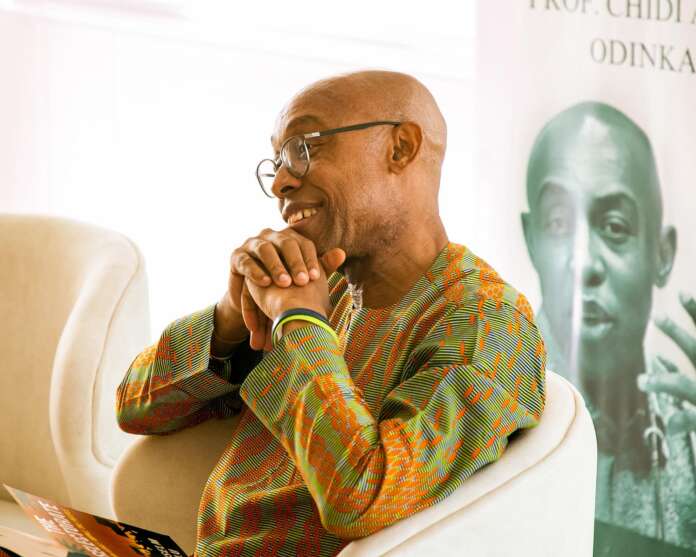
NJI denies partisanship as Odinkalu accuses senior judges of “decamping” to APC

Law teacher and former Chairman of the National Human Rights Commission, Prof. Chidi Odinkalu, has triggered a nationwide debate after accusing Nigeria’s top judiciary of aligning with the ruling All Progressives Congress during the opening of the 2025 All Nigerian Judges Conference.

In a post on X, Odinkalu described the moment judges rose to the tune of “On Your Mandate We Shall Stand” as “the moment when Nigeria’s senior-most judges, led by CJN Kekere-Ekun, officially decamped to APC.”

The conference, held at the National Judicial Institute in Abuja, drew more than 1,000 judicial officers from across the country. President Bola Tinubu, who opened the event on November 17, urged judges to maintain integrity and reject “justice for sale.”

However, controversy erupted moments after the Chief Justice of Nigeria, Justice Kudirat Motonmori Olatokunbo Kekere-Ekun, delivered a speech championing judicial independence.

As Tinubu entered the hall, a rendition of the APC campaign anthem filled the venue, prompting rows of judges to rise, clap and sway — a scene captured in widely shared video footage.

The anthem, popular during Tinubu’s 2023 campaign, was sung with visible enthusiasm by attendees as security personnel ushered the president into the hall. The display sharply contrasted with the CJN’s earlier warning that the judiciary must resist external influence and protect public trust.

Reacting online, Odinkalu said he initially dismissed the reports as rumour. “The CJN spent her speech preaching judicial independence. After she was done, the judges did ‘On Your Mandate We Shall Stand.’ They will not be able to blame any Navy Lt. for this one!” he wrote, referencing the recent Wike–Yerima confrontation.

He intensified his criticism the next morning, tying the moment to national grief. “On the day terrorists immolated a Nigerian General in Borno and abducted 25 female students in Kebbi, the C-in-C did not lower the flag. Rather he got judges to sing ‘On Your Mandate.’ Tueh!”

The post, accompanied by video clips, has drawn thousands of views and widespread condemnation.

Civil society leaders have also expressed dismay. Governance advocate Abdulherphyz wrote: “This isn’t what democracy is designed to be. Submitting all institutions to one individual will lead to perilous places.”

Across social media platforms, users lamented what they described as the judiciary’s “open partisanship,” with a trending Nairaland thread declaring the judiciary “gone” and “the last hope no more.”

But in a statement on Wednesday, the National Judicial Institute dismissed the reports as “misleading and inaccurate.”

According to the NJI, the only song sung collectively at the ceremony was the national anthem, performed at the start and end of the event. The institute said the tune “On Your Mandate” was played briefly by the Guards Brigade band as part of standard military protocol to usher the president to the podium.

The NJI insisted the judges stood only out of respect for the office of the President, not as a show of political allegiance. “No judge sang or chanted any political song,” the institute said, stressing that the judiciary remains “strictly non-partisan, deeply committed to constitutional neutrality, and insulated from political activities.”

The controversy continues to fuel heated debate about the independence of Nigeria’s judiciary and its relationship with the executive branch.

TIPS