Home Blog Page 1304

African women face two pandemics

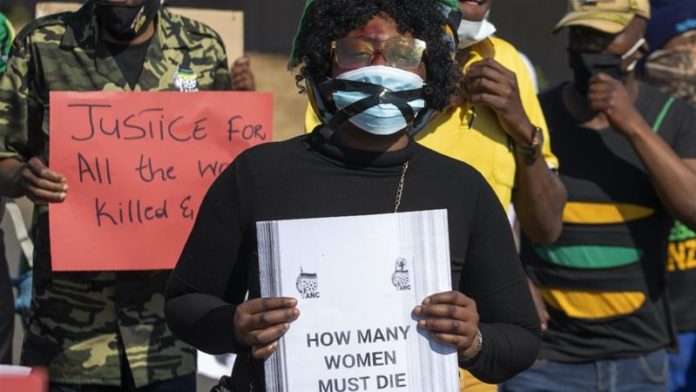
People march to a local police station to protest the rising levels of violence against women and children, in Thokoza township, South Africa, July 4, 2020 (AP Photo/Themba Hadebe)

African states have failed to protect women and children from violence amid the coronavirus pandemic.

by Rosebell Kagumire & Vivian Ouya

In the last few months, as the coronavirus has spread across the world, African countries have registered a surge in cases of domestic violence and sexual violence, which has provoked public outrage.

In May, South Sudanese activists protested the gang rape of an eight-year-old girl by three men while holding her mother at gunpoint, in the capital, Juba. The online campaign #SouthSudaneseSurvivor prompted women to share their harrowing experiences to break the silence on sexual abuse and rape culture in their communities both in the country and the diaspora.

Around the same time, in one of his national COVID-19 addresses, South African President Cyril Ramaphosa decried that “the scourge of gender-based violence continues to stalk our country as the men of our country declared war on the women.” Calls to the government-run GBV and femicide command centre had reportedly doubled during the nationwide lockdown.

In early June, Nigerians started the #WeAreTired campaign after two young women, Vera Uwaila Omosuwa, a 22-year-old microbiology student, and 18-year-old Barakat Bello were raped and killed five days apart. Following the online campaign and nationwide protests by women’s rights activists, all 36 Nigerian governors agreed to declare a state of emergency over gender-based violence against women and children. In the same month, Nigerian Popstar D’banj faced allegations of rape and abduction.

In late June, campaigners in Sierra Leone protested the rape and killing of a five-year-old girl, Kadijah Saccoh. In July, Liberian human rights activists called on President George Weah to announce policy responses to the alarming increase in rape.

In Machakos County in Kenya, 3,964 girls became pregnant in five month period to June, , as children stayed at home due to COVID-19 closures. Similar grim trends have been registered in neighbouring Uganda. Most of these cases are a result of statutory rape. The majority of cases of sexual violence are perpetrated by people known to the children, proof that home is hardly a safe place.

African countries are not unique in this pattern of increased gender-based violence during the pandemic. The UN has warned of a “shadow pandemic“, as countries across the world have reported a spike in domestic violence. The reality, however, is that violence against women and girls is hardly a “shadow” pandemic. The term “shadow”  trivialises and minimises the consistent and harrowing violence African women and girls experience on a daily basis. To address violence against women and girls, African governments must first acknowledge its historic existence and tackle it as a matter of national emergency. 

What the present crisis highlights across the African continent is the ineffectiveness of past measures. It seems the little band-aids that existed in normal pre-pandemic times have been ripped off, and the perpetual state of violence that African women experience can no longer be ignored.

No normal times for women’s safety

The gender-based violence pandemic sweeping through Africa today comes on the heels of a series of protests, calls for action from activists and declarations of commitment to eradicating the problem from government officials over the past few years.

In Sierra Leone, President Julius Maada Bio declared a national emergency over sexual violence in February 2019 after hearing the testimony from a five-year-old girl who was paralysed after being raped.

In Sudan, an independent commission was formed in September 2019, to investigate the massacre and mass rape of protesters during a sit-in in Khartoum, demanding the military hand over power after the deposing long-term ruler Omar al-Bashir. The commission is still to release the results of its inquiry.

In South Africa, in 2018, activists presented 24 demands to the government calling for action against Gender-Based Violence. A few months later, in response to these demands, the Presidential Summit Against Gender-Based Violence and Femicide was held, and the presidency expressed its commitment to addressing all of them. But just a year later, the rape and murder of 19-year-old student Uyinene Mrwetyana at a post office sparked mass protests against the lack of progress on eliminating gender-based violence.

In Nigeria, photographer Busola Dakolo’s testimony detailing her rape by the pastor of a large church in Abuja sparked public outcry and precipitated the campaign #ChurchToo to demand accountability from the Church in 2019. The Christian Association of Nigeria pledged to get to the “root of the matter”.

And perhaps even more importantly, across West Africa, in the aftermath of the Ebola outbreak of 2013-2015, evidence was collected of a significant increase in sexual and gender-based violence. Yet the local authorities did not take action to put protocols in place to protect women and children.

Why does sexual violence continue to rise?

Rape does not happen in a vacuum. It is part of a continuum of gender-based violence allowed and meted out on women through harmful social and cultural norms embedded in society. Stereotypical gender norms and practices endorsed by patriarchy remain at the root of it.

When it comes to irrevocably and radically shifting societal standards towards humanising women outside violence, most of society remains impervious.

Various actors – from legislators to law enforcement, religious bodies, the media and gatekeepers of culture – have not taken their role as guarantors of the rights of women, girls and minorities seriously.

As Nigerian feminist scholar, Amina Mama, has said, “African ‘liberated’ states have never liberated women. It’s been an edifice of male complicity engaged in pacification forever … colonial, post-colonial, neoliberal, theocratic.”

Survivors often find themselves between a rock and a hard place, between a societal system that silences them and a state that constantly fails to value their lives. Globally, 30 percent of women experience physical or sexual violence by an intimate partner in their lifetime. Women do not always report their experiences of violence because of deep-rooted barriers including “fear of stigma and shame, financial barriers, lack of awareness of available services, fear of revenge, lack of law enforcement action and attitudes surrounding violence as a normal component of life”.

Containing COVID-19 has now become the primary focus of governments, with little attention paid to gender-based violence. State control and militarism have taken centre stage. The solidifying of oppressive state power in a pandemic means a consolidation of patriarchal power and violence at micro- and macro-levels.

Economic pressures have significantly limited alternatives for victims of violence. COVID-19-related restrictions have forced survivors to co-exist with their abusers and justice systems offer little hope for the punishment of perpetrators.

Investment by African governments in state-funded shelters could have created safe spaces for victims of gender-based violence, but that has not happened. Additionally, civic support has been limited by both by restrictions on movement and the lack of capacities in addressing occupational safety and protection in these times.

What COVID-19 response must bring?

Building a post-COVID-19 society that better addresses inequality and provides a better social contract for women is a liberation struggle that requires society-wide commitment. Social and cultural norms that uphold scrutiny and control of women’s sexuality, enable victim-blaming and excuse violence against women must be dismantled.

As Oyeronkee Oyewumi, professor of sociology at Stony Brook University, has argued: “What I see is what I call cultures of impunity that colonisation represented … The colonisers did whatever they wanted, and so they did lay out these institutions that were not responsive to the colonised. As a result, today, we have all sorts of cultures of impunity from the top-down … We must never accept.”

The pandemic has tested the fabric of society as we know it. It has exposed the failures and the unsustainable nature of capitalism. The social-political and economic impact of the health crisis has forced us to re-imagine a just world. As we advocate for that just world, we must, with similar gusto, advocate for a safer world for women.

We must stop interventions that entrench performative male support of gender equality with no shift in how power is held and exercised. Any responses to sexual violence in this pandemic must be mindful of the ways in which societies were already failing women. Therefore, an understanding of systemic inequalities is essential in creating alternatives.

The long-term impact of COVID-19 on women and girls in all their diversities depends on what responses African states and communities put in place regarding gender-based violence. States must acknowledge and link the historical institutionalisation of male dominance to gender-based violence and work towards eliminating the hurdles to women’s right to a dignified life.

Women’s voices must be centred in decision-making both at the national and community level and services – from medical-legal and psychosocial assistance – expedited to mitigate gender-based violence within COVID-19 response plans. A continent-wide response is necessary and urgent.

An Interview with Tsitsi Dangarembga

*Note: In this 2013 interview, Tsitsi Dangarembga discusses a book called Chronicle of an Indomitable Daughter which was later published as This Mournable Body, shortlisted for the 2020 Booker Prize.

In 1988, at the age of twenty-eight, Tsitsi Dangarembga published her first novel, Nervous Conditions. Immediately acclaimed by Alice Walker and Doris Lessing, the book has come to be considered one of Africa’s most important novels of the twentieth century. Lessing wrote: “This is the novel we have all been waiting for . . . it will become a classic.” Set in Rhodesia in the 1960s, almost twenty years before Zimbabwe won independence and ended white minority rule, the novel’s heroine, Tambudzai Sigauke, embarks on her education. On her shoulders rest the economic hopes of her parents, siblings, and extended family, and within her burns the desire for “personhood,” to no longer be part of such an “undistinguished humanity.” Nervous Conditions borrows its title from Jean-Paul Sartre’s introduction to Frantz Fanon’s The Wretched of the Earth, in which Sartre evokes the “disassociated self” created by colonialism: “Our enemy betrays his brothers and becomes our accomplice; his brothers do the same thing. The status of ‘native’ is a nervous condition introduced and maintained by the settler among colonized people with their consent.”

Nervous Conditions was the first book in what would become a trilogy. However, eighteen years would pass before Dangarembga published her second novel, The Book of Not. With its searing observations, devastating exploration of the state of “not being,” wicked humour, and astonishing immersion into the mind of a young woman growing up and growing old before her time, the novel is a masterpiece. Dangarembga is almost alone in mining the psychological “nervous condition” in African women and the relationship between this troubled inner landscape and the current crisis in contemporary Zimbabwe. In the last decades, she has chosen film as her medium and founded the International Images Film Festival for Women in Zimbabwe, which is now in its twelfth year. In 2006, the Independent named Dangarembga one of the fifty greatest artists shaping the African continent. Last year, she completed the final book, Chronicle of an Indomitable Daughter, which will be published in Zimbabwe in 2013.

I first met Tsitsi Dangarembga in Nigeria in 2010, where we taught a workshop organized by Helon Habila. Habila had never met Dangarembga before, but he told me that his experience of reading Nervous Conditions decades ago had marked and changed him. When I met Tsitsi, Zimbabwe was moving forward from a disastrous 2008 election that saw the opposition Movement for Democratic Change pull out of the second round of the presidential vote in the wake of widespread and horrific violence. At the same time, the economy had collapsed: between 2007 and 2008, the rate of inflation was seven sextillion percent. As much of the world knows, a power-sharing agreement was reached between Robert Mugabe and Morgan Tsvangirai in 2008, and Zimbabwe retreated from the news headlines. In the fall of 2012, Tsitsi invited me to come and teach in Harare. She envisioned a workshop called Breaking the Silence, which would gather testimonies from across Zimbabwe on political and domestic violence. These testimonies, which could be submitted anonymously, would form the basis of our reading material. Any Zimbabwean interested in writing could come into the workshop, read the collected testimonies, and, informed by these stories (more than one hundred were collected), write fiction. Tsitsi asked these writers to think not only about the victims but also about the lives and histories of the perpetrators. She also asked each of us to consider our own acts of violence or aggression, including instances when we used our authority or status for purposes of intimidation or personal gain. She wanted writers to claim these stories, wrestle with and interrogate them, and, finally, bring them back to the communities from which they came. As someone from outside, I did not know if what Tsitsi imagined was possible; I must admit, I was stunned and moved to find that it was.

We had this conversation in early December 2012, on the balcony of Tsitsi’s home in Harare, at sunset, just before I caught my flight home.


Thien: I wanted to ask you about the few years you spent overseas in the 1960s, when you were a child. Outside of Rhodesia and white minority rule, what was it like?

Dangarembga: In England?

Thien: Yes. I’m wondering about your first experience of race.

Dangarembga: The racism in England was not so institutionalized. Well, it was institutionalized, but then it was so efficiently realized that it didn’t need institutions, if you understand what I mean. In England, it was much easier not to be affected by it to that extent because my parents were students and people were somewhat respectful.

Thien: And you were six when you returned to Rhodesia.

Dangarembga: Coming back here . . . you know, it was such a shock. Everywhere we’d been before, my parents were so well respected. But in Rhodesia, the fact that we were black meant that once we walked into that society, all of that meant nothing. It was really a blow.

You might actually say that white people in this part of the world were so insecure, I suppose about having so many black people around, that they had to make their institutions into very obvious apartheid structures. But the whole internalized attitude, that’s been going on for centuries, these are attitudes that we have.

It was very interesting for me to have a character like Tambudzai, who understands the lack of respect because of poverty but not because of blackness. When she is taken into her uncle’s house, she feels everything is now okay because the poverty factor is no longer effective. Then she moves into the school [the elite Young Ladies’ College of the Sacred Heart, a convent school attended by mostly white students], where she’s doing everything as well as everyone else. The only issue is her blackness. She has an experience, a different kind of movement, into that position. Because if you have always been aware of racism, I think that you develop ways of dealing with it. I think it was Ama Ata Aidoo who said she didn’t even know there was such a thing as racism until she came to Germany. That’s where she learned she was black. So it was a bit the same for Tambudzai. She knew she was poor, and she knew she was uneducated because she could see the poverty of her home and she could see the differences with her relatives who were educated. But then she had to learn that she was black.

Thien: Yet Nervous Conditions begins as a very hopeful book. Does this hope come because she sees her freedom in relatively straightforward terms, that education will equal emancipation?

Dangarembga: Tambudzai starts off as a typical gifted child. She achieves a lot through her own initiative, and she sees the world as an arena in which she can act and succeed, no matter what comes. In a childish way, she thinks of herself as a kind of superwoman, but she cannot succeed on those terms because there never has been such a person, there has never been a superman or a superwoman. Sometimes what one perceives as freedom binds you more tightly.

There was so much invested during the Rhodesian era in educating Africans only up to a certain level and for certain tasks. An illusion had to be created, however, that there was some sort of mobility and fairness in the system. People like Tambudzai were swept up in that illusion. She had to find her own painful way out of it.

Thien: At the beginning, she also looks for freedom through selfhood, and the concept of unhu. The traditional greeting is “How are you?” “I am well if you are well too.” Can you describe unhu?

Dangarembga: This is a very interesting concept. In South Africa, ubuntu is exactly the same kind of philosophy, which is “I am because you are” or “I am because we are.” This is the kind of philosophy that used to bind villages and communities together until other forces interrupted those communities. So now I feel that this idea of “I am because you are”—meaning there is no great difference between you and me, so if you need something I can give it to you because I know you’re just like me, and when I need it you will also give it to me—has been disconnected from its material, physical base because of the way the world has progressed. Yet people retain the psychological emotion of it. So here we have a whole nation of Zimbabweans thinking we’re so wonderful because we have this unhu. We believe in “I am because we are,” and certainly, symbolically, we know that’s part of our framework and our reference, but on the ground it’s not happening anymore because all the conditions have changed and do not support that notion. And so this is why there is so much questioning in that book. Is this really the unhu that I believe in, that I came from? People are not behaving in that way anymore. Tambudzai does not resolve it for herself, but I think that there is a kind of a metanarrative there that shows the complexities, that actually the society has moved away from unhu even if they think they haven’t.

Thien: I was fascinated by the idea that personhood, or wholeness, requires reciprocity. But unhu was completely incompatible with the Rhodesian political structure, wasn’t it?

Dangarembga: Absolutely, I would say so. But I would not only say that it’s not reciprocated. For sure, when you come out of the confines of a society that had unhu, you kind of expect to find it elsewhere, which was baffling to Tambudzai in the beginning. But also, once you’ve gone outside and you’ve come back, the question is, do you also experience that from your own people? Or will they now see you as somebody outside the whole unhu construct? I feel that she has become an outsider, especially with her mother. You know, the mother should have been really happy for her daughter, and then that relation would have been reciprocal. But then Tambudzai is denied the comforts of home, and the mother is also denied the benefits of associating with a daughter who has some education and some access to the exterior world. Even if the construct doesn’t transfer outside, does it persist when the person comes back? If not, then the person coming back also becomes part of the fragmentation, as we see in the third book.

Thien: In the end, the pragmatic ones who accept the status quo, which is white rule, seem to flourish. Halfway through the trilogy, Tambu has refused to accept society as it is, and she nearly loses herself. Why?

Dangarembga: When I write, I try not to put messages in but to say, Are we here or are we there? You’ll find people who are willing to accept what happens at the advertising agency, thinking, Well okay, the money I’m getting is better than sweeping floors somewhere. So they protect their position. And then there are the type of people who will talk about it at parties or when they’re with their friends and just shake their heads and laugh. But can that be said to be emancipation? It’s this internalization of your own inferiority that Tambudzai has to struggle against. The question becomes, Do you identify with the sector of society that has money and business opportunities? That’s what people aspired to before. Or do you identify with other women like yourself? Where do you place yourself?

I realize that creative women often do not fit easily into certain paradigms. I think to myself, Then where do they go? Where do they go? Because I feel that these women have so much to contribute, that they just see things in a different way. Every society has people like that and marginalizes them in some way. So it’s a very difficult situation.

Thien: Can I detour here and ask how you left medicine? You were at Cambridge and you came home and went in an entirely different direction.

Dangarembga: I’d been studying psychology at the University of Zimbabwe, and I became involved in the drama club there and did a couple films. I started writing seriously, plays and prose, and I just felt that was really my niche. I was studying industrial psychology at the time I was seriously writing, but I realized it was going to be a struggle to make a living out of writing. So I thought, Okay, what other things can I do that are still within narrative and dealing with powerful subjects and putting ideas out there? I began to see the usefulness of film in a country like Zimbabwe. We boast about an 80 percent literacy rate. But even if you’re literate, which means you can fill in a form, it doesn’t mean you can read a piece of literature and understand what’s going on. So it seemed to me that film was also a very important medium for telling the stories that I felt needed to be told.

Thien: But why turn to film at the moment when you had such enormous international success with Nervous Conditions?

Dangarembga: Oh, Nervous Conditions was not so successful in the beginning. I finished it in 1984 and tried to have it published here, but most of the publishing houses at that time had young black men who had been outside the country writing and then came back and became the editors. When I submitted Nervous Conditions they would never give it respect. I realized they would never engage with a voice like mine.

Thien: Really?

Dangarembga: Yes, it took me four years.

Thien: So it was published outside first, in 1988?

Dangarembga: Yes, the Women’s Press. I actually didn’t know it was going to be published. So I thought, Let me try to do something different.

Thien: Were you already in film school in Berlin?

Dangarembga: I’d applied and been accepted. So when I got that letter I thought, I’m not going to lose this chance. I’m going to take it. Then what happened is that there was this huge conflict between the amount of work I was doing in film and in prose. But I just had to do the work together.

Thien: What was the conflict?

Dangarembga: They were just completely different. The skills I had learned for prose didn’t work in film. Those telling details, they’re completely different. Or the fact of these inner monologues in which you can write a whole book. Whereas prose is teasing out, film is stripping down, concentrating and compacting. I found I could not learn the one while doing the other. So it was a big struggle, actually. It took me years.

Thien: So The Book of Not was put aside.

Dangarembga: Yes, because I found I couldn’t do the two. Now that I feel I’m proficient in both, it seems to be working. But at the time, I really felt that I could not write The Book of Not while I was learning how to speak in film language.

Thien: Seventeen years, though! How could you keep Tambudzai quiet?

Dangarembga: Oh, my goodness! She was hopping mad. But you know, the point is, about the war and the racism, Nervous Conditions ends just as the war intensifies, 1977. So it was a very difficult thing to want to allow Tambudzai to talk. Because what she had to say is what happens in The Book of Not, and it wasn’t something that I thought at that time would be useful. I thought that with the kinds of divisions we had, it might be more inflammatory than anything else. The war might have brought us a little nearer to where we think we want to be as a people, but what did it consist of? It consisted of lies, forced abductions, horrible brutality on both sides, and treachery even within families. Afterwards it was just, Let’s forget, that’s all behind us. We had slogans like “This is the year of the people’s transformation.” I was young. I believed it.

So I think it was actually quite good for me to have something else to do at the time. It was only when other conflicts began again at the end of the 1990s that I thought, Tambu has this story to tell that is actually appropriate for what’s happening.

Thien: In what way was it appropriate?

Dangarembga: Because at the end of the 1990s, the whole land issue came up in Zimbabwe. We were looking at about 80 percent of the land being owned by about 20 percent of the population, which brought back the issues of racism, imbalance, and inequality. Zimbabwe had simply pretended 1890 to 1980 hadn’t happened, and many people had gone on with the same prejudices as before. It all came up again. And that’s exactly what Tambudzai was experiencing after Nervous Conditions. What resurfaced in the 1990s was in accordance with what she went through. And so, at that time when the villagers were assembling and organizing themselves into battalions that were going out into farms, I felt it was appropriate to look at those issues of race and who owns what and who has the power to bequeath what to whom in a fairly innocuous story of a young girl at school. You know, a kind of, “If you have ears to hear, then you will hear.”

Thien: Tambudzai has so much anger but not against the system itself. It all goes inward. Do you think it’s her own personhood that disturbs her most?

Dangarembga: You know, this idea of the happy African is something I really wanted to interrogate. Because if someone smiles at you it does not mean they’re happy. It just means “I think that if I smile I might get out of this alive!” And so I wanted to look into this notion of the happy African. Who is this person you are saying is the happy African? Is this person really happy? And if this person is not happy, then what is likely to be happening in this person’s life? Is this smiling, this being so complicit with the system, going to benefit society in the long run? And, of course, from my perspective as the writer, I thought not. But it was also important for me not to write an obvious kind of situation where black people are angry with white people because that doesn’t get us anywhere either. It was much more important for me to try to show to people what is happening to individuals within a certain system, and to hope that, after hearing this, people will understand, and maybe their conscience will become a little more open to things they were not open to before.

Thien: Christopher Okigbo talked about an inner exile in his generation of educated Nigerians, that they were so fully assimilated into Englishness that their ethnic memory was erased. Would it be fair to say that Tambudzai’s education expands, but also erases, her sense of self?

Dangarembga: That is true, but I think this is a reflection of what happens in almost anyone’s life. We all have our dreams. We dream about happiness and security and how to achieve them. Sometimes we do not achieve what we dreamt of and find we can be wonderfully happy without it, or with something else. Other times we do obtain what we dreamt of and find that it has not given us the peace and contentment we wished for. It is all about coming to terms with the conditions. The big problem for Tambudzai is that Rhodesian society is asking her to come to terms with a system that negates her as an African woman, and the sad thing is that she does not, cannot, or will not see that the system has nothing but contempt for her. So she tries to adjust until she becomes contemptible herself. I don’t know how she makes it through, but she does.

Thien: What about Nyasha? She’s about the same age as Tambudzai, but she looks at things directly. It’s the silence of everyone around her that breaks her down.

Dangarembga: That’s why Nyasha just goes away. Then she can consolidate herself, and when she’s ready, she comes back. I was so shocked, though, because about five or six years after Nervous Conditions was published, I asked some young women what they thought happened to Nyasha, and they said they thought she died.

Thien: I did too. Dangarembga: Oh, really? Thien: I feared she would die. I’ll never forget the scene where Babamukuru finally realizes he has to get help for Nyasha. The psychiatrist in Umtali says that Nyasha can’t be ill because “Africans did not suffer in the way we had described.”

Dangarembga: These days it’s not so difficult to go out of the country and find somewhere else where you can just explore who you are. It was important for me to say, “Whoever you are, whatever your fight is, you can come through.” I have friends who committed suicide, and I think that was actually my task, to bring these two young women through so that people can see that it’s possible, it doesn’t matter, there is a way forward. Look, the mother comes through also. All the women come through. I think the one who comes through least is Nyasha’s mother.

Thien: She’s the most educated, the one who has achieved the most, and she just disappears.

Dangarembga: Yes, she just disappears. I think the difference for Nyasha’s mother is that she doesn’t know what the conflict is. Because she has this wonderful social situation by virtue of marrying Babamukuru . . . Is she going to leave him? Whereas for the other female characters the adversity is much more concrete. It’s easier for them to grapple with it.

Thien: By the beginning of the third book, Tambu’s sense of self is severely fragmented. But the novels themselves are not fragmented. I’d say they are actually very classical. The thread never breaks. The storytelling never falters, not for a moment. Was this conscious? How did you approach it?

Dangarembga: Thanks, Maddie. I struggled to get that continuity. I struggled hard. That’s why everything took so much longer than I thought. And when it got too much, I had to have the courage to leave it until I was ready to go back. It was being alert at any moment so that if a phrase came I could write it down to contemplate later. It was very much like inviting the work to join me and waiting until it decided it would.

Thien: I had the chance to see some of your writing process these past few weeks. You get so deeply inside the psychology. You become the mindset. Was this a skill you had from the beginning, even before the writing?

Dangarembga: It is something I picked up early because I had to understand for myself why people were the way they were, and I had to be able to cope with the understanding I got. For me, the way to understand a character is motivation, so I have to focus on that. Once I understand why a character is behaving a certain way, everything else, all the other attributes, fall into place.

Thien: And then how do you step back? Is there a point of too much understanding?

Dangarembga: Stepping back is sometimes more painful than going in. A writer once said to me, “I thought I was writing it out, but actually I’m writing it in!” Also there were places I did not want to go with Tambudzai. The way she hates other black people was traumatic for me. The extent of her violence was disturbing. Her return to the village breaks my heart. But I still think, Let’s have it out in the open, then perhaps we can move on.

Thien: By the third book, white rule is finished, Zimbabwe is a new country, but the war has gone inside. Tambudzai breaks down, but just before this happens we hear what she tells her student: “You say if they do not want an A-level in biology then they will get an A-level in violence.”

Dangarembga: Is that what she says? She says it to her student?

Thien: In Chronicle . . .

Dangarembga: As I said, I started writing the second book during the land invasions at the end of the 1990s, and violence had reappeared as a way of life in Zimbabwe. I knew there must be an issue with violence here that we were not addressing. And also this idea of “we happy Africans are smiling at you” does not mean that we are free of violence. Actually, Tambudzai was a very appropriate character for me to explore what is happening underneath that happy African surface. There is all . . . all this rage that maybe the people themselves do not know is rage. But it comes out from time to time. And it definitely was an issue for me to say to people, Look, we tell the world that we are peace-loving, but are we really? When at the drop of a hat teachers can beat people to the extent where they lose eyes or they even die. There are stories like this. So it was important for me to say, The war is behind us, but if we have now incorporated this kind of violence into the very fabric of our society, are we aware of it? Are we concerned about it? To say, I am concerned, as the writer, as Tsitsi. To say, Let’s really look at ourselves.

But I think this is why these books are very difficult. They’re difficult for everyone because if you are not a black Zimbabwean, you don’t want to have to identify with some of the characters. I was on a reading tour for The Book of Not and a young woman came up and said, “I really want to apologize. My mother was at school with you. I hope she wasn’t one of those people.” People do not know it. It’s astonishing, but they really do not.

So I think it was difficult for people to read The Book of Not, and it will be really difficult for them to read Chronicle because I’m asking people to make certain connections. I do think we also need the kind of narrative that questions and helps you take a few steps further than you have been. That was also the basic idea in the workshop, Breaking the Silence. All these stories of violence: Are we just accepting them? Are we not making the connections because it’s easier? What is there to do about it? And for me, that’s why it was so emotional at the end of the workshop. I was beginning to despair of finding Zimbabweans who understood where I was coming from. It’s always, oh, you know, You’re out on a limb again! You’re causing discomfort! You’re disrupting and making everyone so uncomfortable! So it was really a special moment for me to have those eight people, besides yourself and myself, in that room. And to really feel we were all understanding the significance, the necessity. It was one of the most gratifying experiences I’ve ever had in my life.

Thien: Nobody walked away. This surprised me.

Dangarembga: I hope that they’ll be able to take it further. I’m not going to take it further. I think I’ve done my thing. If somebody ever contacts me and says, Can you . . . ? But you know, it also takes its toll on me. [Tsitsi is taking the project further, and has continued to mentor the writers who participated. She will be publishing the stories from the workshop in late 2013.]

Thien: When I look around me in Harare, there are entire interactions I wouldn’t know how to begin describing. And I realize I can’t find the words because I don’t actually know what I’m seeing. There’s a complex system of silences that you also have to find the language for.

Dangarembga: Yes. Mmm. You know, the language is really important. If I want to say certain things in Shona to a Shona speaker, I don’t have the language. First, because Shona is basically pre-colonial, so that whole experience of being colonized and being warped toward yourself is not really something we have put into language yet. Then the other language is English, whose purpose, I suppose, is to be imperial. You know, I’ve often looked in dictionaries to see if there is a word for people who enslave other people. You’d expect there’d be a word like enslavers or something. There isn’t. Or the dictionaries I’ve looked in haven’t got it! So English hasn’t got the language either.

The language in Shona is for the collective “you.” Shona is also very passive, as I think you might have noticed, and the language of narrative has to be active so it pushes the narrative along. I think that’s what I see as my job. So, okay, if this is what is now necessary to put into language, into narrative, how can I do it? It is a great act of magic to make submission active.

Thien: Can you read an excerpt from The Book of Not to give an example of Tambudzai’s submission?

Dangarembga: Sure.

Could I conceive of standing up and looking around me in a different manner? I could not. Truly, I could not imagine that I should have looked around me in another way, and analyzed what was taking place from my own perspective. For to do that, one requires a point of view . . . I resorted to the usual way of not feeling anything, of concentrating on every inch of skin, on the opening of every pore until I could feel nothing else and the sensation of me filled the entire universe. But I was not, I could feel nothing, and when I had come to this point of not being, I took the precaution of appropriately looking down.

Thien: Did you have mentors? Dangarembga: I was very fortunate to come into my writing career in the 1980s, when Toni Morrison was coming onto the scene. And also Alice Walker. I think that, now, the book of Alice Walker’s that I prefer most is Meridian, about this young woman coming of age in her late teens, early twenties, during the civil rights movement. She knows that she’s got to keep walking. But as a human being and as a woman you don’t want to always be nurturing conflict, as it were.

And I remember very specifically there was this point where the protagonist is crying. Tears stream down her face as she works. I was a young woman in my mid-twenties when I read it then; it didn’t speak to me. Now I don’t have access to a copy, but I remember that scene after more than three decades. So I had good role models. You know, Toni Morrison is absolutely fearless. I’m actually very fearful, so, you know, it takes a lot out of me to pretend I’m fearless.

Thien: That’s why you have “indomitable” in the title of the third book!

Dangarembga: Exactly! Just to convince myself. But yes, to have been coming into my writing career at a time when African American women were also making their mark and during this wonderful flowering of the literature, that was very good for me.

What I did notice however, especially with Toni Morrison, is that if you’re African American you have slavery as a construct around which to frame your narrative. Everyone has a view that slavery was evil and that it was a crime against humanity. It’s very different when you’re dealing with something that people have not generally accepted as having been criminal, such as colonization. This different set of values makes it very difficult for me to engage with the atrocities in my work without appearing pugnacious. And then, it sounds foolish, but another example comes from the biblical teaching that you take everything unto yourself. So Tambudzai had to become the essence of all that is wrong in order to get people to come along with her and see what’s wrong. That for me is the only way it will work, by making the person represent both sides of the story, as it were. I can’t confront people all the time. If I do that I begin to become my own worst nightmare.

Thien: Would you say Tambudzai was fortunate to go mad? It forced her to see that all is not well.

Dangarembga: Exactly. It was her own conscience that was telling her somewhere that this is not right. Which is why she couldn’t sustain it.

It was extremely intricate and extremely taxing to take all that violence into myself. But you have to live in your world otherwise it doesn’t ring true, it doesn’t resonate. But I’m glad it’s done now.

Thien: How do you know it’s done? Dangarembga: Oh, I know! It’s definitely finished. I know what happens to the characters and, you know, I could write it but it wouldn’t be anything new. It would just be, okay, everything went happily and then—

Thien: I just feel so attached to her.

Dangarembga: I don’t think I would be adding another dimension to our understanding of the way things work in Zimbabwe. So I don’t need to.

Thien: Do you see young Zimbabwean writers coming up now really confronting society the way that you do or that Dambudzo Marechera did?

Dangarembga: To be honest, I’m a little concerned about the status of writing here in Zimbabwe. The political situation is so prominent, it allows people not to deal with the real human side of the conflicts. In other words, it’s very easy to say, This person is from that party, the Dictator’s Party, and this person is from the good party, the Party of One Who Is Going to Free Us from the Dictatorship, and to frame it in those terms.

Also, we don’t really have publishers of fiction. The flip side of that is, if you put your manuscript together, you can publish yourself. And the way that you publish is that you get development aid money, which is really not concerned with quality. It’s just concerned with empowering people to do things. So they can also empower people to put certain narratives into the marketplace. And I think there’s a lot of this going on.

I think we are going through a phase where we are not pushing our writers to give of their highest. So I think that we are not being fair to them. Our experience in the workshop showed us that when people come in with something that has potential, when they just need that guidance to get closer, they will do it. One of the things I really want to do is start working on a new institution where creative arts, narrative, and performance can be taught properly. If we could only nurture properly, Zimbabwe could be really significant, not only in literature but also in music, dance, everything. But we’re just not harnessing that. We are not enabling our young people to realize their potential. And that’s something I want to change. Which is also why I’m mentoring these young women. This is on a very small scale, we have three or four in the office all the time, but it’s something.

Thien: They’re making films. They’re publishing.

Dangarembga: Yes, I hope we get there. There is an idea in Zimbabwe that is very prevalent. People think, I am, therefore I can. I think it would be more useful to think, Because I am, I can learn. However, to learn is to imply that someone has a capacity you do not. That does not sound egalitarian. And it suggests that you are somehow less, somehow inferior to the other person, and this brings back a lot of ghosts concerning inferiority. As a result, few people want to be told how things might be better done. So for me, it was mind-blowing in the workshop to see how Ignatius [Mabasa, a Zimbabwean novelist and poet who works in Shona and co-taught the workshop with us] could suggest to a writer, “How about this?” “How about that?” And to have them take it in. Underneath all the superficiality, people are craving that guidance. They must be. And they must be conscious that the society is not giving it to them either. So I wouldn’t like to make any blanket statements about the young people who are writing now, but I really feel that we, who should be setting things up for them, are really doing them a disservice.

Thien: You were away for a little while in the late 1990s. Was it difficult to come home?

Dangarembga: No, I had gone abroad specifically to acquire skills, which I did. It was not a difficult decision. I always knew I was coming back. It was simply a question of when.

Thien: What do you find most striking when you go back to Nervous Conditions after all these years?

Dangarembga: The agility of the narrative and the joy and hope in the text.

Thien: Thanks, Tsitsi.

Dangarembga: Thank you, Maddie.

brickmag

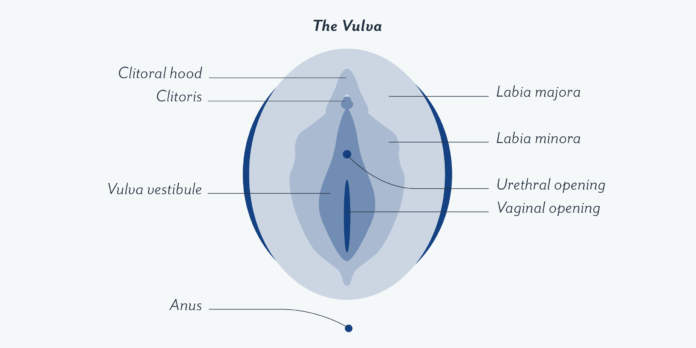
The vagina is for pleasure and childbirth period!

Vivian Emesaraonye Dimgba

I hate when people say the vagina is sacred or has some sort of spiritual sanctity.
This is why children are getting raped. And women predisposed to be used for rituals. We have been spewing this rubbish for so long.

The moment a woman chooses to sexually express herself, we now remember she is a sacred creature, that needs to be respected and treated with honour. Simply because she’s choosing to live life on her terms.

I’ve heard confessions of men who raped month old babies, because they’ve been told that the vagina of these babies could heal them of Aids, Poverty and stupidity.

Dear single woman, there’s nothing special about your vagina. It was designed for pleasure and childbirth. That sanctity nonsense, is a scam men spew to keep you submissive, and stupid. Have you ever wondered why they think you’re inferior! But somehow your vagina magically becomes superior any time you’re breaking out? They indirectly stifle you. They play on the emotions that you’ve been indoctrinated with your whole life, by telling you how you’re a spiritual being, simply because you have a vagina and a breast. A being, with barely no rights!

You’re spiritual.. But the hospital where you bring forth spiritual life is basically a slaughter house. No facilities. A spiritual being that cannot get justice when she’s raped or wronged. Or even inherit properties. Spiritual being with mutilated clitoris so you can’t feel pleasure; but the man can take his pleasure. Everything tradition and culture in this damn country has been designed to make you feel less. Insignificant. Inconsequential. Irrelevant. You can’t even get appointments or political relevance, because you’re not built for leadership. But your spiritual vagina is powerful.

They tell you how your vagina is the pinnacle of decency and the yardstick to measure common sense. All lies. Freaking lies.
Can you see the hyprocrisy?
Can you see they do not care about you? But basically about themselves.

You are not your genitals . You are not your vagina. You’re a complete being, sensual and intelligent. You’re the full package. Revel in it. Stop feeling guilty for the things you feel down there. It doesn’t define what’s up in your head. Don’t let the society and their hyprocrisy define you. Live your best life, with no regrets. No one cares.

Imo State ACJL No: 2 2020, Auschwitz On My Mind

By S. Long Williams Esq. Governor, EBF

Absurd events are unfolding with great and ferocious rapidity in the geographical space called Nigeria in geometric proportions. It takes one with the same proportion to be abreast with events and drama in Nigeria.

A few minutes of absence from the news and one will be drowned in an avalanche of macabre absurdities. Ferris Bueller once said “life moves very fast, if you don’t stop once in a while to look around, you could miss it”

While we are still sourcing for a compass to navigate out of one of such dramatic absurdities as regards the illegal, unilateral and demonic amendment of the Rules of Professional Conduct for lawyers by the Honourable Attorney General of the Federation, Abubakar Malami SAN, we were soon inundated with news of the promulgation by the Imo State Governor, Senator Hope Uzodinma of the Imo State Administration of Criminal Justice Law No. 2 of 2020.

Section 484 of the Imo ACJL reads:

“Where any person is ordered to be detained during the Governor’s pleasure he shall notwithstanding anything in this Law or in any other written law contained be liable to be detained in such place and under such conditions as the Governor may direct and whilst so detained shall be deemed to be in legal custody”.

Section 485(1) A detainee may only be discharged if granted license by the Governor.

(2) A license under subsection (1) of this section may be in such form and may contain such conditions as the Governor may direct.

(3) A license under this section may at anytime be revoked or varied by the Governor and where license has been revoked the person to whom the license relates shall proceed to such place as the Governor may direct and if he fails to do so, maybe arrested without warrant and taken to such place.

The salient areas to note in the above provisions are as follows;
1. Anyone can be detained at the pleasure of the Governor.
2. The provision is not subservient and is superior to any other law including the Constitution of the Federal Republic of Nigeria 1999 as amended.
3. Anyone can be detained at any place or anywhere be it a pit, dungeon, concentration camp or any other place not necessarily a Correctional Centre.
4. Anyone can be detained under any dehumanizing condition.
5. That such detention is legal.
6. A detainee may only be discharged at the license of the Governor
7. There is no time frame or limit to the period of detention.
8. That licence may be granted on the conditions to be set out by the Governor.
9. The conditions may be varied or revoked at anytime at the pleasure of the Governor and the detainee rearrested and further destined.

When I first went through the provisions of the said law, what first swept my consciousness was Auschwitz.

Auschwitz, also known as Auschwitz-Birkenau, opened in 1940 and was the largest of the Nazi concentration and death camps. Located in southern Poland, Auschwitz initially served as a detention center for political prisoners. However, it evolved into a network of camps where Jewish people and other perceived enemies of the Nazi state were exterminated, often in gas chambers, or used as slave labor. Some prisoners were also subjected to barbaric medical experiments led by Josef Mengele (1911-79). During World War II (1939-45), more than 1 million people, by some accounts, lost their lives at Auschwitz. In January 1945, with the Soviet army approaching, Nazi officials ordered the camp abandoned and sent an estimated 60,000 prisoners on a forced march to other locations. When the Soviets entered Auschwitz, they found thousands of emaciated detainees and piles of corpses left behind.

Is Senator Hope Uzodinma, the Governor of Imo State about to take us back to Auschwitz? How do we juxtapose this law with Section 35 and 36 of the constitution of the Federal Republic of Nigeria 1999 as amended and the supremacy of the said constitution as provided in Section 1(1).

Section 1(1) of the constitution of the Federal Republic of Nigeria 1999 as amended states as follows ” This constitution is supreme and its provision shall have binding force on all authorities and persons throughout the Federal Republic of Nigeria ”

Can it therefore be said that the provisions of Section 484 of the IMO State ACJL No. 2, 2020 supersede the provision of Section 1(1) of the 1999 Constitution as amended. The answer is definitely in the NEGATIVE and the said law is illegal, null avoid and of no effect whatsoever.

Besides offending the supremacy of the constitution, the said Imo State Law contravenes the clear and extant provisions of Section 35 & 36 of the constitution of the Federal Republic of Nigeria 1999 as amended and therefore illegal, null and void to the extent of its inconsistency.

My friend, the indefatigable Chairman of the Nigerian Bar Association, Aba Branch Bertram Faotu Esq. has opined that there is nothing new about the Imo State law, that the said law exist as a Federal legislation in Section 401 of the Criminal Procedure Law which in itself gives directions in Sections 230, 235, 328 & 368 of the Criminal Procedure Act. Ditto for my Political Chairman J.S. Okutepa SAN. The question that agitates me with the argument of my learned chairmen in this present circumstance are as follows:

1. Why did Section 484 of the Administration of Criminal Justice Law No. 2 of 2020, Imo State not make any directions to any other section or law dealing with persons found guilty who are suffering from insanity, persons that do not understand the proceedings or persons under the age of 17 or 18 as in the provisions in the Criminal Procedure Law.

2. Why is Section 484 ACJL Imo State standing on its own? Does that not raise a red flag as to the intendment of the law makers. Aristotle in his book, De Interpretatione noted thus” written words are the signs of words spoken and words spoken are symbols and signs of affection or impressions of the soul”. Also Jerry Foder in his book, Language of Thoughts wrote ” spoken and written language derive intentionality and meaning from an internal language encoded in the mind”

From the above, l state without any equivocation that the written words as contained in Sections 484 & 485 of the Imo State ACJL 2020 are signs of affection/ impressions of the soul and represent the internal language encoded in the mind of the law giver.

3. Also why were these sections smuggled into the law as alleged by Hon. Frank Ugboma, the Deputy Minority Leader of the Imo State House of Assembly who is the sponsor of the bill. How did a bill of 372 sections metamorphose to 485 sections and beyond without the knowledge of the law makers whose duty and primary responsibility is to make laws for the good people of Imo State?

One thing that is also curious about the said Imo State law is that it is the only domesticated Administration of Criminal Justice Law in Nigeria that contains the said provisions. The question that will agitate any discerning mind is why Imo State? We are all aware that the Imo State Government, especially the Governor, has been particularly restless over criticism trailing his administration and the usual and popular reference to him as “Supreme Court Governor” Has the Governor prepared to deal ruthlessly with his opponents real and imaginary as that explains the sole purpose of this provision.

We must not allow the Governor to be the accuser, judge and executioner at the same time or else we shall soon find ourselves in Auschwitz.

Wriiten by By S. Long Williams Esq. Governor, EBF

Woman Without Home or Family Delivers Baby Boy Under A Bridge In Lagos

The Lagos State Emergency Management Agency (LASEMA) made this known on Saturday.

Dr Olufemi Damilola Oke-Osanyintolu, DG/CEO of LASEMA said the agency ambulance team at Eti-Osa delivered Ms Blessing Emmanuel, a 35-year-old woman of the baby.

“The lady, who has neither home nor family in Lagos, is from Cross River State.

“Mother and baby are fine and have been taken to Island Maternity where they will get expert care,” Oke-Osanyintolu said.

When Traffic Wardens May Be Required To Perform Military Duties In Nigeria

#OBSCURELEGALFACTS BY AROME ABU.

In Nigeria, Police officers may be required to discharge military duties.

Traffic wardens are however, exempted from performing Military duties. Except otherwise provided by law.

See Section 120(4) of the Police Act 2020

Arome Abu is the Principal Partner of TCLP.

CAVEAT: Note that this information is provided for general enlightenment purposes and is not intended to be any form of legal advice.

Obscure Legal Facts is an exclusive daily publication of THE COUNSEL L-P.
Plot 108 Idris Gidado Way, Wuye, Abuja.
[email protected]
+234 803 262 2359
+234 708 1156 539.
Twitter: @abu_olaniyanLP

Over 80 Magistrates In Imo State Have No Individual Court Halls And Chambers — Acting Chief Judge

Imo State parades over 80 magistrates, but a good number of them have no individual court halls and chambers.

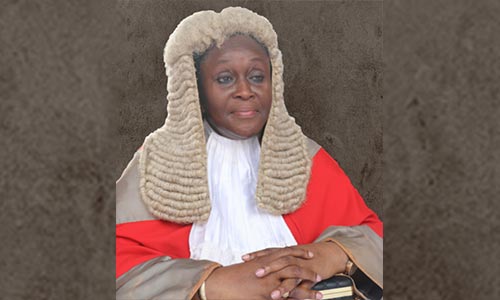
The Acting Chief Judge of Imo State, Justice Ijeoma Agugua, disclosed this in a 21-page address, delivered in Owerri, during the 2020/2021 Legal Year and Assizes of the state judiciary.

Her words: “We have over 80 magistrates. A good number of them have no individual court halls and chambers.

“On my resumption of office in March this year, I met a sordid state of magistrates daily sharing court halls and chambers, with time allocated to each.

“This arrangement not only gave rise to strife, when a magistrate could not rise on the dot of the stipulated time, but it also reduced the dignity of the office of a magistrate.

“The affected magistrates now sit on alternate days, affording them the opportunity of a whole day in chambers and court halls unhampered by time constraint, to conduct their cases freely.”

Continuing, Justice Agugua said that no fewer than 225,240 cases are pending in Imo State High Court, as at September 1, 2020.

Giving details of the cases, Justice Agugua said that while 209,406 cases were pending as at October 1, 2019, and 16,254 fresh cases filed, “420 cases were disposed in the High Court, from October 1, 2019, to September 1, 2020”.

After rolling out the staggering figures of filed, disposed and pending cases before the Customary Court of Appeal, magistrate courts, Agugua said: “What emerges from the statistical data, is that the number of cases pending in both the High Court and the Customary Court of Appeal, is on the high side.

“The people of Imo State, are litigious people. The number of judges and magistrates, manning these courts have increased since the last Legal Year, but then, we all know the effect of Covid-19 pandemic and total lockdown, which started March 2020, on the productivity of the nation. The courts were not exempted.”

Speaking also, the Attorney General and Commissioner for Justice, Sir C. O. C. Akaolisa, opined that “there is the need for a paradigm shift in the administration of justice through the deployment of appropriate technologies, to drive the administration of justice in the state”.

He also encouraged judicial officers to be cautious in granting remand orders, except in exceptional cases, subject to the guidelines to be put in place by the Ministry of Justice and the Nigerian Correctional Service.

“Alternative Dispute Resolutions, ADR, or out of court settlements should be encouraged in the state in non-contentious civil cases.

“There is need to give greater attention to plea bargaining option, within the context of Section 270 of the Administration of Criminal Justice Act, 2015”, Akaolisa said.

For the Senior Advocates of Nigeria, SAN, the country is being run in breach of the nation’s statutes.

Chief Mike Ahamba, SAN, who spoke on behalf of his colleagues, particularly mentioned the non-payment of pension and gratuity, as one of the critical areas where the Constitution is flouted without qualms.

ABOVE WHISPERS: IF ONLY

By Bisi Adeleye-Fayemi

If only Boma had understood how wrong it was for her boyfriend of just one month to yell at her in public.

She had met Sam at a cocktail organised by the chambers where she worked. Sam worked for one of the top banks and he ticked the right boxes – handsome, charming, good prospects.

Four weeks later, they were both at a birthday dinner for one of his friends. There was a heated but friendly conversation about the state of insecurity in the country.

Some of the guests, including Sam, thought the government was not doing enough to make citizens safe.

Boma sided with others who felt that the situation had started deteriorating under the previous administration with huge amounts of sums earmarked for security ending up in private pockets.

As the lively exchange was going on, and Boma was speaking, Sam yelled at her in a thunderous tone ‘Shut up!’.

Everyonewas taken aback at this rude behaviour. The conversation stalled, and the guests made awkward attempts at small talk, but the damage had already been done. The evening was ruined.

Later on, Sam accused Boma of trying to impress people with her intelligence, just to let them know she was a Lawyer. Boma said she was only expressing her opinion to which Sam replied, ‘I had already stated my own opinion. Why should your own opinion differ from mine?’.

Boma’s friends discussed the episode with her and she told them that Sam was only behaving the way most men behave, they want to be seen as the boss. It didn’t mean that he did not care for her. If only.

If only she had told her friends about the first time he slapped her. She only told them the third time he hit her, and that was a week to their wedding.

They had argued over something minor, and she muttered under her breath that he was so sensitive about everything. He asked her to repeat what she had just said and she claimed not to have said anything.

All of a sudden, she was spinning from the blow he dealt her and that scary tone of his, ‘So I am now a liar?’.Her committee of five friends were divided. Two of them advised her to leave the controlling bxxxxxd and forget about the wedding, someone better would come along.

A man who has not married you and is already beating you will do worse once you become his wife. Three of them told her to let her Pastor know. Bomawas in love.

She had a wedding to plan. After the wedding there would be plenty of time to talk to Sam as carefully as she could about his behaviour.

He always apologised when he hit her and would promise not to do it again. He couldn’t be that bad as to continue, maybe he was feeling insecure because they were not married yet.

She did not have time to start telling long stories to their Pastor, who would only advise them to pray and for her to submit to him wholeheartedly, which she was already prepared to do.  

She did not want to involve others because she did not want to give Sam another excuse to attack her before the wedding. It was too close to risk getting bruises that makeup would not be able to cover.

Boma’s older brother David would have been another option, but he lived in Abuja and Boma did not want to have the conversation over the phone.

Both her parents lived in Ibadan, they were Professors at the University. That was another sore point with Sam.

His father was a civil servant and his mother was a teacher. He accused Boma of acting as if she was superior to him because she felt her background was more illustrious than his.

She kept saying this was not true and wondered why he would think that way.So Boma did nothing and said nothing.She focused on the wedding not the forthcoming marriage. If only.

The honeymoon was uneventful, unless you want to count the kick in the thigh she received when she did not get out of bed quickly enough to open the door for room service.

Months passed, then years, three in all. The days, weeks and months were all a blur of fear, tears and blood.

After the beatings would come the pleas for forgiveness, gifts and promises. Till the next time. She lost her first pregnancy.

When she called her mother from the hospital to tell her what had happened, her mother demanded to know the cause of the miscarriage. Boma told her mother that she didn’t know, the doctors said things like that happen.

She did not say anything about the fall as she was trying to escape Sam’s blows. Her mother-in-law came to stay with them for a few weeks when their daughter Tiwa was born.

When the woman was leaving, Boma clung to her as if her life depended on it. When Sam’s mother was around, the beatings stopped. Mama Sam was a very religious woman.

She advised Boma to be more prayerful and hopefully he would change, just as his father had done.

Mama Sam went up the mountain to do a special one-week vigil and fast to ask God to soften Sam’s heart and watch over his young family.

When Boma’s mother was around, Sam did not show that much restraint. During one encounter with his wife, when Boma’s mother intervened, Sam asked her to leave his house and take her daughter with her.If only.

Boma stopped working when she was pregnant with Tiwa. Sam had managed to convince her that the stress of commuting to work was a threat to their baby. Boma got too weary and scared of arguing with him about it.

Without a job she felt trapped even more, but she soldiered on. Her parents and brother attempted to stage an intervention, but it did not work.

Boma was too afraid to leave Sam because he had threatened to kill her if she tried. By this time, her committee of friends operated at a safe distance, through WhatsApp and the few phone calls she could manage in between the times Sam raided her phone to check for ‘unauthorised communication’.

They had all seen their smart, beautiful friend shrink before their eyes and they felt powerless. They each had their own issues to deal with, so Boma’s violent marriage was sad, but it was her problem.If only.

Boma stared at her photograph. Her image smiled back at her, though she didn’t like the shade of lipstick she had used when the photograph was taken, and the foundation was a shade too dark for her skin tone.

The fresh flowers were lovely though, her favourite pink roses. She looked around the church. David’s wife was holding Tiwa’s hand, while David had his head bowed for most of the time.

She wondered why her parents where not there, then she realised that they couldn’t be there. She saw her friends, as well as old colleagues from work.

After the service, she followed them to the cemetery, and watched as they lowered the casket into the ground. Her friends were no longer trying to comport themselves like they did in church, they weptopenly. Hot tears of regret. Tears of ‘If only’. David fell to his knees, his wife held on to him with one hand, clutching Tiwa with the other.

Boma watched the casket going further into the ground and felt herself being drawn higher up as if she was in sync with the casket lowering device.It came back to her in flashes. The yelling. The familiar blows and punches. Tiwa crying at all the commotion. The choking.

She had fought back to try and get away and that is when the push came as if the devil himself was the force that propelled her over the railings. She felt herself suspended in mid-air for what seemed like an eternity, till she crashed and struck her head hard against the floor.Then everything went black.

As David walked away from the graveside, feeling as if he had stones tied to his feet, he took comfort in the fact that Sam was not allowed to attend the funeral, he was awaiting trial without bail. If only he had done more to protecthis sister.

He looked back at the grave. ‘Look up’, Boma wanted to shout out to David, but she couldn’t. Then she saw a bright ball of light speeding towards her. If only.

Bisi Adeleye-Fayemi is a Gender Specialist, Social Entrepreneur and Writer. She is the Founder of Abovewhispers.com, an online community for women. She is the First Lady of Ekiti State, and she can be reached at [email protected]

FRANK TALK: Between rhetoric and reality

By Steve Nwosu

Anyone who dispassionately followed the facts that emerged from last week’s two-day ministerial performance review retreat, put together by the office of the Secretary to the Government of the Federation, would, no doubt, award the President Muhammadu Buhari-led government a pass mark for its stewardship over the last five years.

At a point, I was even tempted to up the score to a B- – what with all the landmark achievements in the areas of road, rail, aviation, education and health (especially, in its handling of the Covid-19 pandemic) as well as the impressive post-pandemic economic recovery plan (including all the monetary and fiscal policies articulated by the Central Bank and other relevant agencies), Second Niger Bridge, the AKK Gas Pipeline, Security, the anti-graft war and all.

It was understandable, therefore, that President Buhari could thump his chest and say he is proud of (and satisfied with) the administration’s achievements. Who wouldn’t be?

I too would be just as satisfied, if, like the President, I’m buffeted and bamboozled with so much PowerPoint and theoretical colourations of success. The tendency would be to forget that what is on ground is not always the same thing as the PowerPoint presentations and textbook growths claim.

The reality on ground is that many of us are worse off today than we were five years ago. Hunger is gnawing at our intestines. Of course, that is not saying we might not have gotten to this point if PDP were still in power. It is just that all this is happening while the APC that promised us a better deal is in power. But, partisanship apart, the fact remains that more people than used to be the case have fallen into poverty. We are now the poverty capital of the world. And the situation is so dire that even officials of the administration have begun differentiating between ‘poverty’ and ‘extreme poverty’.  

That we have not poured out into the streets in protest might not be because we’re happy with you. Rather, it is because we’re too hungry, wearied and wary to even put up a fight.

However, dear President, it would do your legacy and our survival a world of good if you begin to look beyond the rhetorics to the realities.

Yes, the rails have come alive, and we can say, without fear of contradiction, that Transport Minister Rotimi Amaechi is one of the few aides of yours whose rhetorics before you match the reality they have on ground. But, even then, the quantity and quality of the coaches are nowhere close to nearly enough.

BUHARI

Of course, I wouldn’t want to ask the question, ‘at what cost?’ because that would drag us into the controversial Chinese loans. We wouldn’t also want to go into the equitable spread of the rail and other projects across the six geo-political zones – lest we would be touching the sore spot of nepotism, marginalization, and outright abandonment of certain parts of the country.

Dear Maigaskiya, before you join them in celebrating our handling of the Covid-19 situation, based on the humongous amount you approved for palliatives, have it at the back of your mind that the bulk of the money got lost in transit; that many of us who qualified to receive the conditional cash transfer are still waiting for bank alert. That the joke of the much trumpeted lockdown school feeding is still on you.

As for the grains you cleared to be released from the strategic games reserve, the same people troubling your already weary ears with figures of distributed grains have probably opened rice supermarkets for their wives and concubines with the wholesome batch.

What they eventually distributed to the ‘lucky’ few of us were the contaminated bags in our Customs warehouses, which you had long declared unfit for human consumption, and ordered that they be taken out and destroyed.

Nothing probably captures the gulf between official rhetorics and reality better than the pranks the banks are playing with us. While genuine manufacturers and the real sector, for lack of access to credit facilities, are daily closing down their businesses and throwing family breadwinner out of employment, by their thousands, the banks are chasing after merchants and large-deposit customers with loans they don’t need, or have any plans of ever paying back.

Meanwhile, small businesses are deliberately fenced off credit facilities with impossible pre-qualification requirements. The result is that the proposed N2.3 trillion government response to reflate the economy from the covid-19 induced meltdown would just disappear into the wrong pockets, with no appreciable impact on the economy.

As for the war against corruption, it would appear that a major ‘Mumu button’ of the president’s is the trophies that come from the anti-graft war.

So, the smart Alecs around PMB regularly load his platter with the severed heads of a few yesterday’s men of power, garnished with the entrails of one or two out-of-favour presidential aides.

The president thus contentedly distracted while deals, more heinous than Malabu and P&ID scandals, are carried on right under his nose. And it would seem the ring is so carefully woven to ensure the president never gets the luxury of a counter narrative.

This, largely, has also been our lot with the worsening insecurity in the country. While it might be difficult to fault the fact that this Buhari administration has devoted more attention, and committed more materials and resources to the fight against insurgency and terrorism, PMB might do well to look beyond the rhetorics of the military high command as to how we have liberated all the local government areas under Boko Haram control and continue aerial bombardment of the insurgents’ bases.

He should view this against the backdrop of how, despite having routed the insurgents, indigenes of such liberated communities are still stuck in IDP camps, with the military insisting it is not safe for them to return to their villages. How then are we claiming that we’re winning the terror war?

Or are we planning to put the liberated villages to other use, while their original inhabitants permanently roam abroad landless? Why do we continue to get this impression that some people, for some reason, do not want the war to end?

And, while we are still at it, my dear President, you may also want to look beyond the now tired rhetoric of communal clashes and farmer/herder clashes in the situation in Southern Kaduna, Benue and much of the North Central states – and now spreading to the Southern parts of the country.

  The narrative of ‘bandits’ and ‘cattle rustlers’ might look temptingly acceptable for the situations in your native Katsina, Sokoto, Zamfara and other adjoining states, but it is increasingly not providing all the answers to the questions arising therefrom. I know these explanations are straight forward, more simplistic and less-tasking on the brain than such strange terminologies as ethnic cleansing, state-sponsored terrorism and artificial demographic re-engineering, through the instrumentality of open border emigration from West Africa and the Maghreb, but time has come for us to explore new narratives for the realities that confront us today.

Mr. President, in the spirit of separating reality from rhetorics, you may also need to look beyond the narratives of field commanders who are clearly desperate to bring home a trophy in this unending war against terror and insurgency, as you seek to unravel what actually happened in Benue State last week regarding the death of that state’s most wanted criminal, Terwase Akwaza, a.k.a Gana. 

Do take a second look at the counter narrative coming from Gov. Samuel Ortom, his predecessor, Sen. Gabriel Suswan, and other leaders of Benue State. Resist the temptation to swallow hook-line-and-sinker, the tale that Gana, was working hand in glove with the political leaders in Benue – who, for now, happen to be in a political party opposed to your ruling APC.

Ask for explanation on how and why Gana got to be where he was when the army killed him.  How could an unarmed man engage soldiers in a gun battle, where he now got killed in the gunfire?

Your Excellency sir, you may also ask to see the special gun that our police and soldiers use these days. Special guns which fire knives instead of bullets, and inflict machete cuts and not bullet wounds on targets. For it appears to have been the same ‘gun’ used on the notorious kidnapper,

Boborisky, who was apprehended in Port Harcourt at the weekend. In that instant too, while the police said it engaged the kidnap kingpin in a gun duel, it also confirmed that the kingpin and his driver died from machete cuts and bullet wounds.

The simple truth, sir, is that, rather than interrogate arrested criminals and use them to lead to other gang members, our police and soldiers regularly resort to the extrajudicial killing of these suspects – usually with machetes and other such crude weapons and cudgels.

The result is that we never really get to the root of any criminal gang, or crime, to completely uproot it. We just treat the symptom, while the disease continues to fester – resurfacing again a short while later.

Mr. President, Sir, I’m particularly interested in this Gana matter because it reminds me of the killing of Boko Haram founder Mohammed Yusuf in July 2009.

Yusuf who was arrested, unharmed and unarmed, and handed over to the police for proper processing and transfer to Abuja, was suddenly said to have been killed while trying to escape from police detention.

Yes, a handcuffed, unarmed and even shirtless so overpowered our heavily armed police formation that the officers and men had no other option than to shoot him dead. Not even demobilizing with a shot to the leg, if a shot ever needed to be fired.

Clearly, somebody somewhere was too scared to allow Yusuf his day in the open court. For if he were to ever open up on the how and why of Boko Haram, a few big names might have had to run for cover.

My fear, however, is: like it happened with Boko Haram, where the elimination of Yusuf paved the way for the emergence of a more bloodthirsty Abubakar Shekau, and ultimately yanked the leash on the insurgents out of our control, I pray that we have not taken out Gana to hand control of his militia to a new leader who might not be as enamored by the proposal of ‘amnesty’ as Gana appeared to have been towards his last days.

So, Mr. President, before rhetorics lead us into celebrating pyrrhic victories, let’s for a moment flip over the coin to see what the reality really is. Checkmate!

Man finds lost phone full of Monkey selfies

A Malaysian man who lost his phone found it full of Monkey selfies and video of the animal he believes stole the device after retrieving it from a jungle near their house, CNN reports.

Zackrdyz Rodzi thinks the animal had stolen the phone when he fell asleep.

Rodzi shared the images and video of the animal on social media which have since gone viral.

The pictures show the animal starring into the lens of the camera while the video shows the animal trying to push the phone into its mouth in apparent move to eat the device.

Rodzi said he realised his phone was missing when he woke up on Sunday morning.

“There was no sign of robbery. The only thing on my mind was is it some kind of sorcery,” he told the BBC.

He said it was not until the following day his uncle saw a Monkey nearby and after dialing the phone discovered it lying under a palm tree just beyond their back garden.

His uncle suggested that there could be a picture of the thief in the phone and so when they opened the phone gallery, they saw it was full of money selfies.

“Something that you might see once in a century,” he tweeted when sharing the images and videos.  

He also shared some of the images and videos in a TikTok post, calling the monkey a “sneaky little hairy toyol”, an undead baby used in witchcraft to commit theft and mischief in south east Asian folklore.

In a follow up tweet, he joked: “Hey @Apple I need a new phone since im giving mine to the monkey.”

TIPS