Home Blog Page 1244

Poland honours Nigerian man, August Agboola Browne, who fought with country to resist Hitler

Among the hundreds of thousands of patriots that Poland celebrates for serving in the resistance movement in World War Two there is one black, Nigeria-born man.

Jazz musician August Agboola Browne was in his forties, and had been in Poland for 17 years, when he joined the struggle against Nazi occupation in 1939 – thought to be the only black person in the country to do so.

Under the code name “Ali”, he fought for his adopted country during the Siege of Warsaw when Germany invaded, and later in the Warsaw Uprising, which ended 76 years ago this month.

Astoundingly, he survived the war in which 94% of the residents of Poland’s capital were either killed or displaced, and continued living in the ravaged city until 1956 when he emigrated with his second wife to Britain.

A small stone monument in Warsaw now commemorates Browne’s life. But the scant details that there are may never have been known were it not for an application he made to join a veterans’ association in 1949.

The document was filed away for six decades, until 2009, when Zbigniew Osinski from the Warsaw Rising Museum came across it.

This form, filled out in beautiful cursive handwriting and with a passport-style photo attached to one corner, is his Rosetta Stone – the documentary fragment that led researchers to interpret isolated facts about his life and locate living descendants.

In the picture, Browne, dressed in a jacket and a snugly fitting jumper, looks lively and youthful with a hint of a smile on his face. All who met Browne described him as a handsome man and a sharp dresser.

By this time he was in his fifties, as the form reveals that he was born on 22 July 1895 to Wallace and Jozefina in Lagos – then part of the British Empire.

He arrived in England aboard a British merchant ship with his longshoreman father. From there, he joined a theatre troupe touring Europe and ended up in Poland via Germany.

‘Sheltered ghetto refugees’

Frustratingly, the form does not say what inspired him to leave Nigeria, or make Poland his destination, so an adventurous spirit seems the likeliest explanation. But by the 1930s, he became a celebrated jazz percussionist playing in Warsaw’s restaurants.

What Browne did write was that in the resistance he distributed underground newspapers, traded electronic equipment and “sheltered refugees from the ghetto”. This was a sealed-off area of the city in which Jews were forced by the Nazis to live and where 91,000 died from starvation, disease and murder. Some 300,000 were transported to their deaths in Nazi concentration camps.

Warsaw Uprising

August-October 1944

The Polish underground, known as the Home Army, attacked the German occupying forces on 1 August

They swiftly gained control of much of the city

Germany sent reinforcements and the nearby Soviet army did not help

The Poles surrendered on 2 October after 63 days

200,000 civilians and 16,000 Polish fighters died

Source: Encyclopaedia Britannica and Warsaw Rising Museum

It appears that for Browne, staying in Poland after the war was a choice – as a citizen of the British Empire, he had the opportunity to leave.

When he arrived in Poland, he first settled in Krakow where he married his first wife, Zofia Pykowna, with whom he had two sons, Ryszard and Aleksander.

The marriage failed but at the outbreak of the war, Browne arranged for his children and their mother to seek refuge in England. But – perhaps committed to the Polish struggle – Browne did not go with them.

The incomplete jigsaw of information gives rise to many questions about his life.

‘A quiet, private man’

Tatiana Browne, his daughter from his second, much longer, marriage to Olga Miechowicz, was born and brought up in London and is his only surviving child in Britain. She says he never talked about what had happened to him.

She is now 62 – her father died in 1976 when she was 17. She remembers him as “very quiet, very private, and quite distant” and that he never discussed his background in Poland or his early years in Lagos.

Tatiana is not certain why neither of her parents told her much about their past. She suspects it was to bury the trauma they endured and atrocities they witnessed.

Thinking back, she recalls watching a documentary about the war with her parents and her mother saying: “I remember seeing people being hanged in the streets; I know that’s true because I saw it with my own eyes.”

But there was no discussion and now she wishes they had told her more.

Browne, though, never turned his back on the Polish culture that he had lived in for almost 35 years, and Tatiana says that Polish was the only language spoken in their London home.

He was remembered by an acquaintance in Poland for speaking “the purest Polish language, even with a Warsaw accent”. He was fluent in several languages.

“Dad taught me how to read and write in English,” Tatiana says.

‘Quick wit and real charm’

How the musician, who as a black person would have been so conspicuous, was able to survive in Nazi-occupied Poland remains a mystery.

Two other African men, Jozef Diak from Senegal, and Sam Sandi, whose exact place of origin on the continent is unclear, had served in the Polish army during the Polish-Bolshevik War (1919-1921) and remained in Warsaw afterwards, but both died before World War Two began.

Discounting them and Browne, experts say there may have been two other black Warsaw residents in the interwar years, professional entertainers whose traces disappear during the occupation.

Being black in Nazi Germany

But Tatiana’s recollection of her father’s charismatic personality may give a clue to his own endurance.

“Dad had a real quick wit and a real charm about him,” Tatiana says.

“When we used to go to church on a Sunday, I used to see him interact with other people. He had real warmth that drew you in so you automatically liked him.

“When he was in company with other people, there was just this [energy]. People were drawn to him.”

Browne’s story emerged in 2009 at a time of heightened patriotism and xenophobia in Poland.

It drew immediate interest from across the political spectrum and there were calls to memorialise him as a national hero.

At that time, then-President Lech Kaczynski, co-founder of the conservative Law and Justice party, wanted to “honour him on the occasion of the 65th anniversary of the Warsaw Uprising”, said Krzysztof Karpinski, a jazz historian who served as vice-president of the Polish Jazz Association, which was contacted by Kaczynski’s office for more information about Browne.

But Kaczynski died in a plane crash in 2010 and the plan apparently went with him.

It was not until last year that a small monument to the Nigerian-Polish resistance fighter was finally unveiled. That was funded by a non-profit organisation, the Freedom and Peace Movement Foundation. His war service is honoured by conservatives and progressives alike to symbolise the Poland of today.

Browne led a modest existence in England for the last two decades of his life. He continued working as a musician, at first doing session work. When he got older, “we had a piano at home so he used to give piano lessons”, Tatiana says.

They were a “lovely family”, Dr Michael Modell, who treated Browne for cancer, remembers.

He died at the age of 81 in 1976 and is buried under a plain headstone in a north London cemetery.

There is no sign of the traumatic and tumultuous events that he had been part of, which reflects the way he apparently lived his life in London.

“To me, it was just me growing up at home with a mum and dad. Whatever our life was, it was my normal,” Tatiana says.

Yahoo.com

How China adapted tech expertise from others and built world’s best, largest railway system

*Today,66% of world’s High Speed Rail is domiciled in China. That is the ingenuity of China that powers her growth

When an intercity high-speed train pulled out of Beijing South station in 2008, China’s rail network had ushered in a new fast-moving era.

Over the past decade, the country has added over 35,000 kilometers to its high-speed rail (HSR) network, with the total length that far exceeds the rest of the world combined. Train speeds have increased from a maximum of 200 km per hour to 350km per hour – the fastest in the world.

The HSR offers shorter travel times, comfort, convenience, safety and punctuality and is by far the largest passenger-dedicated network of its type in the world, a report shows.

The World Bank report also said that China was the first country with a gross domestic product (GDP) per capita below $7,000 to invest in developing an HSR network.

The road from planning to operation

Looking back, a key milestone for China’s HSR development was the approval of the Medium- and Long-Term Railway Plan (MLTRP) in 2004 when freight volume was growing rapidly and the low speed of the existing railway limited competitiveness in passenger transport.

The plan envisaged that, by 2020, the national railway infrastructure would grow to 100,000 km, of which 12,000 km would be high speed, and four horizontal and four vertical corridors would be established to link all major cities.

After detailed plans had been approved, the next step was to ensure a solid technological base for both infrastructure components and rolling stock.

In the early stage, construction was pushed forward under technology transfer agreements with some European countries like Germany and France, as well as Japanese suppliers, but China quickly adapted and improved the designs for local use.

Based on accumulated experience in this field, China has also worked with the International Railway Union to develop international standards for HSR equipment.

The implementation was carried out through a series of Five-Year Railway Development Plans (FYPs), setting out the projects to be undertaken in each five-year cycle to 2020.

A further revision took place in 2016. The network structure has expanded from the original “four vertical and four horizontal” corridors to “eight vertical and eight horizontal” corridors, designed to be supplemented with more regional and intercity rail links.

According to China’s Ministry of Transport, the plan is based on a detailed analytical process involving basic investigations, data collection, project research, as well as extensive external consultation and review by an expert advisory committee.

The 2020 target is a railway network covering 150,000 km, including over 35,000 km of HSR reaching over 80 percent of large and medium-sized cities.

The HSR network will then connect almost all large and medium-sized cities. It will create travel times of one to four hours between the large and medium-sized cities and half an hour to two hours for regional centers, report shows.

The original intention for the project was to enlarge the capacity of the country’s overloaded network and enhance passenger services. But thanks to the spillover benefits, it has improved regional and provincial connectivity, serving as a strong catalyst to support economic development and urbanization.

SOURCE:cgtn.com

Qinghai-Tibet Railway: China’s tech wonder that sets 8 world records

  • Longest rail track of 550km on ice
  • Highest train tunnel built on permafrost
  • 85% of 2000km on over 4000ft altitude
  • 33 passageways along track to preserve wildlife
  • Builders carried on their backs oxygen cylinder to work at high altitude

When construction was first announced decades ago, it was a project that many engineers thought could never finish. Spanning over 2,000 kilometers, the railway has made eight world records. Construction began in 1958 and was completed decades later in 2006, using innovative engineering concepts.

Known as one of China’s greatest engineering projects of the 21st century, the Qinghai-Tibet Railway sets the record for having the longest track running through frozen areas. More than 550 kilometers of the railway was built on permafrost, a mixture of soil and ice that remains frozen for at least two years. Since water expands in winter and contracts in summer, it threatens roadbed stability – the foundation for railroad tracks.

By graveling embankments and installing vent-pipes underneath the roadbed to provide thermal stability for the permafrost, Chinese engineers successfully solved the problem. On a few stretch, the high-speed trains run on elevated rails. Tracks were laid on a bridge, with piers placed underground. It avoids direct contact between tracks and the permafrost.

At an altitude of nearly 5,000 meters, Fenghuoshan Tunnel is the world’s highest tunnel built on permafrost. It was the most challenging part of the project during the construction of the Qinghai-Tibet Railway.

Roughly 85 percent of the Qinghai-Tibet Railway is over 4,000 meters above sea level. The lack of oxygen posed another challenge. Workers carried oxygen tanks weighing 10 kilograms while completing the construction. Over 110 medical facilities were constructed along the railway with more than 600 medical staff to take care of the workers.

Protecting the fragile ecosystem was also a key concern for the engineers. The railway runs through Hoh Xil National Nature Reserve and several other nature reserves, where many rare plants and animals live, including the endangered Tibetan antelope. A total of 33 passageways were built along the railway for wildlife to safely cross.

The Qinghai-Tibet Railway has boosted the economic and social development of Qinghai Province and the Tibet Autonomous Region and made traveling more convenient across the nation. Its construction showcases China’s perseverance. 

SOURCE:cgtn.com

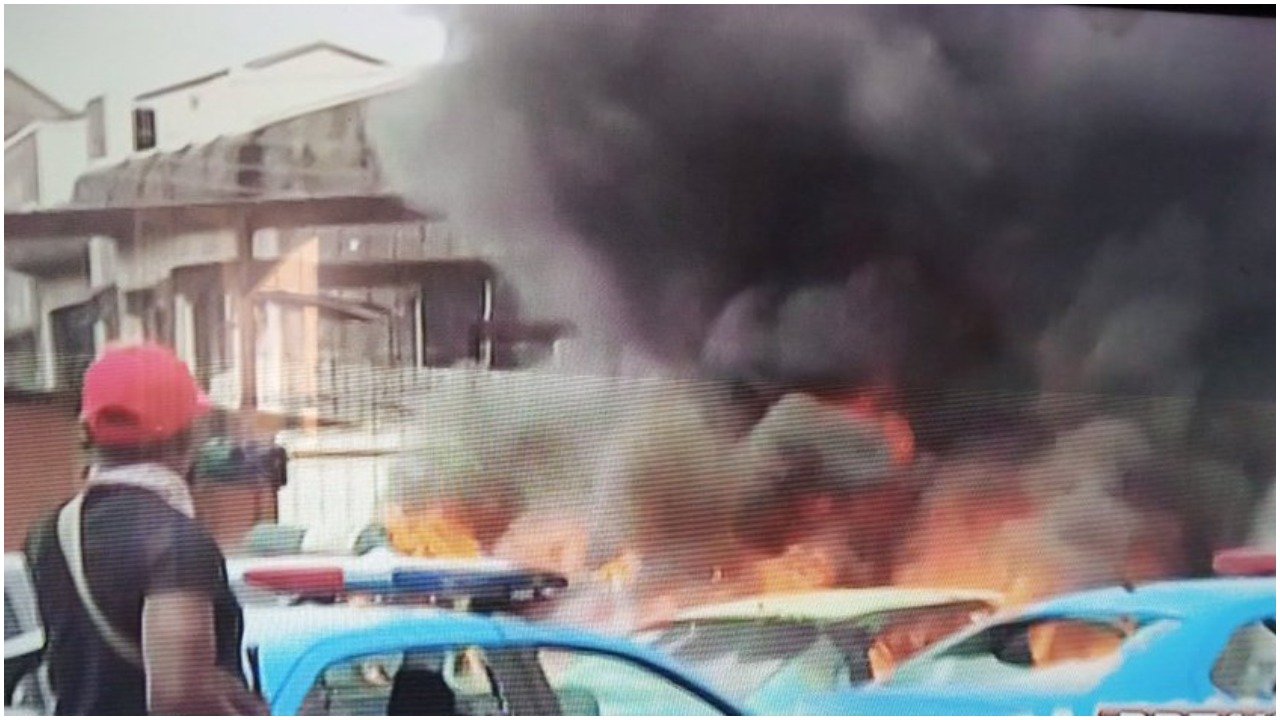
Explosion hits another gas station in Lagos

LAGOS – Explosion has hit another gas station in Lagos with the number of casualties presently unknown, NewsBreakNG can report
According to reports, the explosion occurred around 5.44am at Best Roof Gas Station located at Unity bus stop, Fatade area of Baruwa in Alimoso Local Government Area of the State.
“The explosions started around 5.44am and people were shouting, running helter-skelter. A thick smoke engulfed the whole area,” a resident said.
As at the time of this report, fire is still raging in the area while officials of the Lagos State Emergency Maintenance Agency (LASEMA) have been contacted. (NewsBreakNG)

NBA-SPIDEL REJIGS MEMBERSHIP

The Nigerian Bar Association Section on Public Interest Law (NBA-SPIDEL) is set to reinvent its membership database.

In an announcement made available to CITY LAWYER, the leading NBA organ for the promotion of public interest causes urged members to take advantage of the exercise to ensure that their information is captured in the section’s database.

Below is the full text of the announcement.

Good morning Sirs/Mesdames,

I trust that you are doing great.

This is to inform you that SPIDEL Secretariat is updating its members database and in view of this we kindly request members on this platform to click on the link below to provide the required information.

We look forward to cooperation.

Thank you

Edidiong Peter, Esq.
SPIDEL LIAISON OFFICER

CITY LAWYER

JICAM RULES: ‘P & ID CONTRACT WAS FRAUDULENT, POORLY DRAFTED,’ SAYS SAN

A senior advocate of Nigeria and chartered arbitrator, Prof. Paul Idornigie SAN at the weekend took a hard look at the controversial P & ID Case and concluded that the contract was fraudulent and poorly drafted.

Idornigie was speaking at the weekend in Abuja during the launch of the Janada International Centre for Arbitration & Mediation (JICAM) Rules 2020.

The foremost arbitrator whose paper was titled “Institutional Arbitration in Africa Post-COVID-19” stated that “the (P & ID) contract was fraudulent ab initio,” adding that “the contract was not properly drafted.”

According to Idornigie, the courts are not equipped to cure defective contracts, even as he urged arbitrators to “Africanize” arbitration by choosing Africa as the seat of arbitration in line with the “Africa Promise.”

On why Nigeria is not a leading arbitral centre and seat of arbitration, Idornigie who is also a member of the JICAM Governing Council said: “From my personal knowledge, most hearings in Nigeria are either held in hotels or law offices of the Legal Practitioners.  Such hearings whether domestic or international are not documented.  This probably accounts for the poor performance of Nigeria in this survey report.  This is without prejudice to the fact that issues of security, facilities, infrastructure and integrity of the Nigerian courts may also be factors responsible for the poor ranking of Nigeria in the continent.”

“The above lends credence to the establishment of JICAM.  JICAM is not only an arbitral centre but will perform arbitral services as it has its own Rules of Arbitration and Mediation.  These Rules are modern and comparable to other Rules like that of ICC and LCIA.  Indeed they are a blend of both.”

He stated that Nigeria’s legal framework would not adversely impact arbitral proceedings due to the advent of virtual hearings, saying: “Arbitration in Nigeria does not suffer the effect of the Evidence Act (s256(1)(a), the Constitution (s36(3) & (4) and the judicial pronouncements on hearing in public.  Prior to the COVID-19 pandemic, I have used Skype, audio and video-conferencing at JICAM and ICAMA, Abuja and LCA, Lagos.”

Continuing, he said: “However, quite unlike physical hearing, we must prepare adequately for virtual hearing.  This is the challenge post-COVID.  For African arbitration institutions to survive, they must have facilities for virtual hearing side by side  the existing facilities for physical hearing.  There are enough Protocols, Guidelines, Guidance Notes, etc on this as highlighted above.  Thus several issues will arise before, during and after the arbitral proceedings that must be carefully addressed.”

He warned that “The arbitral institutions that will survive are those with modern rules and facilities for both physical and virtual hearings.  The arbitrators that will be in business are those who are innovative, creative and digitally knowledgeable.”

In his remarks, former Chief Judge of the Federal High Court, Hon. Justice Ibrahim Auta said that he was “proud at the strides JICAM has recorded since its formal establishment in 2015. In keeping with its aim to promote a forum for the resolution of disputes, we have supported disputing parties in active reconciliation and resolution of their disputes.”

A fellow of the Chartered Institute of Arbitrators (UK), Justice Auta, who is also the Chairman of the JICAM Governing Council, stated that online dispute resolution (ODR) has witnessed a resurgence due to the COVID-19 pandemic, saying: “We have witnessed online giants utilize this mechanism in the resolution of buyer to customer disputes but we have failed to expand its use to the resolution of the common disputes. Perhaps this is an appropriate time to discuss the Rules we aim to launch, today.”

Noting that “parties with bad cases could easily frustrate such an attempt by withholding the consent to conduct such proceedings virtually,” Justice Auta, who was represented by Mrs. Diane Okoko, added that “we have equipped our center with state of the art facilities including high speed internet for this very purpose. In similar fashion, the Rules take care of numerous other issues which have been unclear in the arbitration space which I do not intend on boring you with today.”

On his part, the President of the National Industrial Court of Nigeria, Justice Benedict Kanyip who was the Special Guest of Honour stated that the Arbitration and Conciliation Act “does not apply in trade disputes,” adding that such disagreements are sui generis.

In his welcome address, former Nigerian Bar Association (NBA) presidential candidate, Chief Joe-Kyari Gadzama SAN said: “Indeed, while I consider it a huge privilege to have some of the best minds in the Alternative Dispute Resolution sector present at this event, I strongly believe that the launch of the JICAM Arbitration & Mediation Rules 2020 will usher in a new era in the realms of our Alternative Dispute Resolution engagements, which in the long run, will contribute significantly to the development of ADR both locally and internationally.”

According to Gadzama who is also a chartered arbitrator and fellow of the Chartered Institute of Arbitrators (UK), JICAM “was established in 2015 and commissioned by the then President of the Court of Appeal, Hon Justice Zainab Bulkachuwa, OFR, CON, as a dispute resolution center designed to promote a suitable forum for the resolution of domestic and international disputes,” adding that “JICAM is fully equipped with state-of-the-art facilities, with its rules and guidelines accommodating both ad hoc and institutional arbitration.”

Concluding, the leading litigator said: “I strongly believe that this comprehensive document will facilitate speedier, more effective and efficient arbitration cum mediation proceedings, which in the long run will promote the advancement and viability of Alternative Dispute Resolution in Nigeria and Sub-Saharan Africa.”

In his goodwill message, the President of Institute of Chartered Mediators and Conciliators (ICMC), Chief Emeka Obegolu, commended JICAM for unveiling the new Rules.

Noting that there are over 10 prominent Arbitration and Mediation institutions in Nigeria, the former NBA General Secretary said: “I believe the general hope is for these institutions to leave their mark in the dispute resolution landscape, and contribute to the effective resolution of disputes. However, to achieve this, there must be synergy of some sort between these institutions. We must see ourselves not as competitors, but as partners in this dynamic field of ADR.”

In a similar goodwill message, the Chairman of the Abuja Chapter of the Chartered Institute of Arbitrators (UK), Mr. Chinwendu Madumere noted that the institute maintains a robust relationship with JICAM, adding that the emergence of the centre would “bridge the gap of having a world class arbitration centre with appropriate facilities and Rules.”

The event was moderated by the JICAM Acting General Manager, Chimdindu Onyedim-Etuwewe while Bar. Lama Joe-Kyari Gadzama gave the vote of thanks.

Retreat: Buhari, Lawan, Gbajabiamila Seek More Powers For APC

By Mathew Dadiya, Abuja

The two-day Executive/Legislative retreat presided over by President Muhammadu Buhari has called on the ruling – All Progressives Congress (APC) to exercise more control on its members to enable it resolve crises that may arise. 

The advice came as Vice President Yemi Osinbajo noted that given the poor economic conditions of Nigerians and the poor state of infrastructure, it would be callous and irresponsible for the arms of government not to work together. 

In its 10-point recommendation read by Minister of the Federal Capital Territory (FCT), Mohammed Bello, at the end of the programme held on Tuesday at the Presidential Villa, Abuja, the parley also advocated respect for party leadership by its members. 

According to the recommendations, “the ruling political party should be encouraged to take ownership of its members to be able to reconcile them whenever conflict arises and members in both arms of government should show regard for the party and its leadership.https://galleria.com.ng/pushgalleriaads?q=201&i=56&ho=dailyasset.ng”

It called for a concrete understanding and working knowledge between both the Executive and Legislature just as it noted that an effective confidence building measure should be put in place in the governance process to ensure mutual respect and cordial relationship between the Executive and Legislature.

The parley further recommended the creation of an effective conflict management and resolution mechanism in resolving areas of disagreement between the Executive and Legislature in the overall national interest.

Other recommendations were that there should be modalities for better access, interfacing and engagement between the leadership of both arms of government, the NASS Committees and MDAs should be worked out by the SGF and NASS-Executive Liaison. 

“There should be regular pre-budget consultations between the Executive and Legislature particularly between the MDAs and NASS Committees, Ministry of Finance, Budget and National Planning and the appropriate Committee in NASS. 

“There is need for an effective communication and collaborative engagement to enhance and strengthen the relationship between the arms of government for the benefit of Nigerians. 

“The relationship should not be adversarial but complementary, thus, more interpersonal and informal relationship between heads of MDAs and NASS members should be encouraged.

“Operators in the arms of government should act with moderation and limit their sense of entitlement by placing public interest over and above personal and parochial interest.

“The Presidency should strengthen the capacity of the Executive Liaison Offices in the National Assembly.

“There is need for an organic budget law which will optimize the budgetary process so as to deliver effective and efficient service to the citizens.”

The summation from the retreat highlighted what it referred to as weak mechanism for conflict management and dispute resolution between both arms of government and limited consultation between them on critical governance issues such as policy initiation, programme implementation, planning, and legislative processes.

Other issues that arose from the parley include lack of clarity in communication and poor feedback mechanism leading to different and subjective interpretation of intent and purpose of the message. 

The retreat also pointed at limited understanding of the workings and internal processes of each arm of government by government operatives; lack of mutual respect between the Executive and the Legislature in the conduct of governmental business; and lack of and/or absence of pre-budget consultations and briefings between the Executive and Legislative branches of government making the budgetary process acrimonious. 

Others observed issues according to Bello are “the pursuit of personal interest as against national interest; ill-equipped and poorly resourced offices of Presidential Liaison Offices in the National Assembly;

poorly defined channels of communication between the executive and legislative arms and weak utilisation of the Offices of the SSA-Ps to the President in managing communication between Committees of the National Assembly and MDAs. 

“Limited participation of MDAs at public hearings organised by the National Assembly on critical bills to influence the process but choose to raise objections when the bill is transmitted for Presidential assent.

“The current operational budgetary process is sub-optimal; and political parties have not really played the fatherly role that is expected of it in managing the relationship between the Executive and the Legislature.”

In his closing remarks at the retreat, Osinbajo noted that the context within which the arms of government operate was important, noting that given the situation in the country, it would be callous and irresponsible if the different arms of government to work together to resolve the problems. 

 “The fact that we have all been here for two working days demonstrates our common commitment to collaboration. 

“Frankly, we have no choice if we are not to fail the Nigerian people who have given us this incredible  opportunity amongst millions of our compatriots to serve at this high leadership levels we occupy today”he said.

While noting that “this is all about Nigeria and Nigerians,” he added: “This is the context for our operations. Let me say that every generation of leadership must understand  context. Law itself  must be interpreted and implemented in context. What is the reality of the context that we operate in today? We all know, our nation has millions of extremely poor people, the COVID – 19 pandemic has worsened employment and poverty. 

“We have huge deficits in infrastructure, many children are out of school. If that is our context we will be callous and irresponsible if we don’t come together, work together to sort out these grave life threatening problems our people have to confront everyday.

“The dogmatic emphasis on procedural niceties is a luxury we cannot afford.  In any event, there is no pure practice of the doctrine of separation of powers. The Anglo American traditions that we hold on to in support of the separation of powers are not pure…so for example the US Vice President serves as the president of the Senate and presides over the Senate’s daily proceedings.”

Participants at the two-day event include President Buhari, Vice President Osinbajo, President of the Senate, Speaker of the House of Representatives, Deputy President of the Senate, Deputy Speaker of the House of Representatives, and Chairmen of Committees in the Senate and House of Representatives. 

Others were Members of the Federal Executive Council, Heads of Agencies and Senior Government officials including the management of the National Assembly. 

NO RETREAT, NO SURRENDER

Sonnie Ekwowusi urges all to soldier on, in spite of the contradictions and difficulties

I don’t have a job anymore since this COVID thing started. And I am ashamed to beg. My wife is the one supporting me now. But you know women; she now treats me with utter contempt. She talks to me anyhow. The most regrettable aspect is that my children will soon be going back to school and I don’t have any money to give to them. My house rent will be due in January. On top of these calamities, they sent me a message yesterday that my mother in the village is seriously sick. They said I should come home next week to take her to the hospital. I am the first son of my parents. I don’t want my mother to die. She is a diabetic patient. Three months ago she suffered a second stroke. Even nowadays to feed is a big problem for me, unless through the efforts of my wife. My life is miserable.

I understand. Weep no more. Wipe away the tears from your eyes. Don’t give up. You can still make it. Hold your head high, stick out your chest. I understand. You no longer have a good name. People look down on you. All who see you shake their head in derision. They sneer at you.

They laugh at you and say, “This is the man who started to build but could not finish”. Don’t mind them. Don’t surrender to melancholy. It is untrue that the world is about to collapse on top of you. Take another look around you. Look up. Those birds you see flying and chirping do not store. Yet divine Providence provides for all their food and needs. I agree, it gets dark sometimes, but the morning does not delay in coming. Besides, nothing here below lasts forever. Yesterday has passed. Tomorrow will soon come and pass. After the rain comes sunshine. Suffering breeds endurance. Endurance breeds hope. And hope does not disappoint. Don’t surrender.

My friend, don’t surrender to drugs. We cannot lose you to drugs. Don’t surrender to violence, cynicism, and pessimism. Deploy hope and imagination as weapons of survival and progress.

Dream dreams. Remember the name which your parents gave you as an infant. Remember the land of your birth. Remember your home. I am often told, “Some of us take drugs as anesthesia to quench our pain and suffering. We take drugs to escape the burdens of the day which oftentimes seem unbearable”. I have heard you. I know it is tough sometimes but you are wrong. If you go on living like this you will be enslaved by drugs. You could even commit suicide. And if you commit suicide, your children and your grand-children will rain curses on you for having been a big failure in life. Don’t lose focus. You might have mastered the air, conquered the sea, annihilated distance but you have not mastered the vicissitudes of life. You have to live on this earth with your share of difficulties. Try to excel within your own little space. And let’s come together to the public space to build together for the common good. Ask yourself the following questions: Why is there something rather than nothing? What is the purpose of human existence? What is reason? What is faith? If faith and reason are the two wings with which to fly to the truth, why fly only on the wing of reason or only on the wing of faith? Fly on both wings.

We stand today at a crossroads. We stand at the end of a long night of uncertainty. The good of our country is at stake. Instead of making giant strides on the path to progress our country is drifting backwards towards its precipice. At independence in 1960 there was only one national flag in Nigeria – the green-white-green flag. But how many Nigerian adults (not to talk of children) can still tell the colour of the national flag let alone recite the national anthem or the pledge? Very few. Why? Because there are many flags of different colours being hoisted and flown across Nigeria- there is the Biafra flag, Niger Delta flag, Oduduwa Republic flag, Mid-West flag, Arewa flag, Middle Belt flag and so forth. Instead of listening to President Buhari’s independence anniversary speech, most Nigerians prefer to listen to yesteryears’ speeches of Tafawa Balewa, Nnamdi Azikiwe, Obafemi Awolowo, H.O. Davies, Anthony Enahoro, K.O. Mbadiwe, Mbonu Ojike (Boycott the boycottables) and other heroes and heroines of Nigerian independence. Governance? What is that? Forget it. Governance is virtually non-existent. Insecurity (of lives and property) is our first name. Bloodbath is our middle name.

Death is our surname. So, our full name is Mr. Insecurity Bloodbath Death (IBD for acronym).More in Home

The names of the visitors who regularly visit us to kill us or torment us are terrorists, kidnappers, bandits, night marauders, murderous cattle breeders and murderous Fulani herdsmen and land grabbers. What haven’t they done to us? A person who has consumed the stomach of a dog has gone half way into eating human faeces. Everywhere you go you will discover that their hands are stained with the blood of the innocent; blood which no water on this earth can wash away. On top of all these woes, the blame game goes on unabated. We blame the constitution for our woes. We blame the government. We blame corruption. We blame the judiciary. We blame APC. We blame PDP. We blame ourselves. We blame the day we were born. We blame our children. We blame our neighbours. We even blame God for creating us and making us citizens of Nigeria.

I understand. But don’t surrender to hopelessness. Look, don’t remain in the same place. You can still go forward. Nothing is gained by constantly sitting down and complaining about those things that do not work. Get up and move. Stop brooding over failed democracy. In case you don’t know, democracy alone cannot save us. One of the wrong assumptions about democracy is that the political office holders possess enough wisdom and virtue to pursue the end of democracy-promotion of the welfare of the people. But viewed against the backdrop of history, political leaders do not have enough wisdom and virtue to pursue the end of democracy. Besides, democracy is challenged from within by sheer ignorance and pursuit of personal interests at the expense of the common good and welfare of the people. We must begin to move away from the mentality that once we establish democratic institutions, bureaucracies and enact laws all our human problems will be solved. In principle, functional bureaucracies, democratic institutions and laws are good, but not every obligation that augurs well for proper ordering of society can be democratized, bureaucratized let alone legislated upon or codified in positive law.

Most important, democracy is not the first thing: the first thing is culture and at the heart of culture are those communally-binding ideals which make society tick. In fact, for society to function effectively there ought to be a fine convergence between public life, culture and authentic religion.

#EndSarsNow: Nigeria Police Lacks Power To Punish.

Daily Law Tips (Tip 670) by Onyekachi Umah, Esq., LL.M, ACIArb(UK)

Introduction:
Across Nigeria, police men and almost all law enforcement agents see themselves as parents and the entire public as children. At times, they perceive themselves as creditors and the entire pubic as debtors. Hence, indiscriminate whipping, slapping, kicking, canning, detention, torture, killing and disregard of court orders is an everyday tool in the hands of police men and other law enforcement agents in Nigeria. Without fear, law enforcement agents now assume the role of courts and correctional officers without fair hearing to their victims. Unfortunately, many persons in Nigeria, assume, believe and take the shameful conducts of police officers as normal and unchangeable. While some people claim to be disinterested, many take advantage of the unprofessionalism of police officers and employ police officers as debt recovery agents, political thugs, domestic servants and close body guards. Police officers get away with murder, torture and all forms of crime while most people assume that Police officers have powers to punish and this is part of the foundation for police extortion, bribery and corruption. This work will examine the powers of police to punish suspected offenders in Nigeria.

New Powers of The Nigerian Police Force:
The greatest of all laws in Nigeria, is the Constitution of the Federal Republic of Nigeria, 1999. Every other law, government, institution, religion, tradition and person bow to it. The Constitution creates the Nigeria Police Force to be headed by the Inspector General of Police and to carry out the functions and duties that will be provided in a law to be enacted by the National Assembly. Sequel to this, the National Assembly made/adopted the Police Act of 1943, which has recently been repealed and replaced by the Police Act of 2020.

To avoid doubts, the Police Act of 2020 seem to have gather together all the powers/functions of the Police Force in one place. So the powers are not new but ambled together in a new federal law; the Police Act 2020. It has listed the primary functions of the Nigeria Police Force, to include:
(a) the prevention and detection of crime, protection of rights and freedom of persons in Nigeria as provided in the Constitution, the African Charter on Human and Peoples Rights and any other law.
(b) maintain public safety, law and order;
(c) protect the lives and property of all persons in Nigeria;
(d) enforce all was and regulations without prejudice to the enabling Acts of other security agencies:
(e) discharge such duties within and outside Nigeria as may be required of it under law;
(f) Collaborate with other agencies to take any necessary action and provide the required assistance or support to persons in distress, including victims of road accidents, fire disasters, earthquakes and flood
(g) facilitate the free passage and movement in highways, roads and streets open to the public; and
(h) adopt community partnership in the discharge of it’s responsibilities under this Bill or under any law; and
(i) to vet and approve the registration of private Detective schools and private Investigative outfits

New Duty of the Police Force Under Police Act of 2020:
By the new Police Act of 2020, there is a police duty that has been greatly emphasised and a section is specifically devoted to it, with the description; “Duty of Police Force to enforce certain constitutional provisions”. This duty is really not new, it has been there and reiterated countless times by the courts, although the Nigeria Police Force rarely complies with it.

Now, the new Police Act of 2020, provides that the Police Force is responsible for promoting and protecting fundamental human rights of persons in police custody as protected in the constitution of Nigeria, the African Charter on Human and Peoples Rights and other international laws on human rights. It also requires the Police Force to work closely with government agencies and private organisations on increasing access to justice and promoting legal services and protection of rights of detainees and defendants. This seems like a step in the right direction, if there is a means to train the ordinary police man on the streets and constantly monitor conducts of police officers.

Police Force and Separation of Powers:
There are too many powers and institutions that make up a nation/country. The powers are toxic and intoxicating when combined and controlled by a single person or institution. Hence, there is a separation of power for orderliness, accountability, rule of law, checks and balances among institutions, stakeholders, key players and the public in the affairs of men and nations. On this foundation, the National Assembly (Legislative Arm) makes laws while the Courts (Judicial Arm) interpret the laws made by the National Assembly and the Presidency and other agencies (Executive Arm) implement the laws made the National Assembly. Every arm of government stays on its own lane to avoid conflict and anarchy. This is carefully contained in the constitution of Nigeria. Under the Executive Arm are the agencies, institutions and bodies created by the constitution of Nigeria or the executive itself, to assist the executive in implementation of laws and policies. The Nigeria Police Force is under the executive arm of government and the Inspector General of Police answers to the President of Nigeria (the Chief Executive Officer of Nigeria).

Hence, the Nigeria Police Force does not have legislative and judicial powers. It cannot perform legislative or judicial roles of the National Assembly and the courts. It is outside the powers of the Nigeria Police force to try disputes and determine guilt of offenders. The only institution allowed to determine the innocence and guilt of persons is the Judiciary (courts of law) and only the courts can order a lawful punishment for any offender. It is constitutionally wrong for any police officer to punish any person unless a court orders such. I am not unaware of the powers of law enforcement agencies to apply force where it will be in the interest of a suspect/safety of the agent and the public and stop a convict from fleeing justice. They are restrains to ensure justice and not punishment, however, must be conducted professionally and according to best practises. By the way, torture is not one of the lawful punishments that a court can order and all forms of torture is illegal in Nigeria. The colours of torture will be examined below.

Lawful Punishment and Police Torture:
The laws of Nigeria prescribe lawful punishments for offenders and only a court of law can assign a lawful punishment to an offender after hearing the offender and his accuser. The lawful punishments include; death, fines, imprisonment, probation, canning, labour and community service. Torture is not a lawful punishment and lawful punishment does not include torture, in any part of Nigeria. Torture is illegal and can never be ordered by any court of law. It is a violation of fundamental human right. Torture is the intentional infliction/causing of mental or physical pain/suffering on a person in order to obtain information/confession, or to punish, intimidate and force him or a third party. Torture includes; beatings, food deprivation, rubbing of pepper/chemicals, assuming of stressful bodily positions, rape, exposure to cold/sunlight, use of drugs, blindfolding, threat, prolonged interrogation, unscheduled transfer of persons, secret detention, denial of sleep, shaming, stripping naked and parading in public places.

Police torture is a crime, irrespective of the alleged offence of the victim of torture. There is no justification for torture, not even war, national security or high-profile case. Every police torture is a violation of fundamental human right. Where there is torture in any security agency, the immediate commanding officer officer in-charge of the unit/department that committed such offence of torture will be held liable as an accessory to the crime, for any act or omission or negligence on his part that may have led to the commission of torture by his subordinates/colleagues. Any person that witnesses or is present when torture is being conducted is as liable as the person that conducted torture. Such witness is deemed as having participated in the torture. This applies to any person; military, para-military or civilian!

By the Anti-Torture Act 2017, any form of torture is an offence and a court can punish an offender with imprisonment for not more than 25 years, without an option of fine. Where torture leads to death, the violator will be tried for murder. The punishment for murder is death. Also, with internal disciplinary measures, the concerned police officer may lose his/her job, too. There is obviously no gain in torture and violation of any human right.

Conclusion:
The Nigeria Police Force is not permitted to punish any person in Nigeria. The police is rather empowered to arrest, detain and bring to court any person suspected of committing an offence. It is only a court of law that can punish an offender. Also, police and law enforcement agencies are not allowed to collect fines for any offence. Any money demanded by a police officer is a bribe and the request (no matter how polite) is an extortion. Extortion is a crime and you have a duty to report the police officer and his team/office.

The silence of victims of torture and their families seem to be emboldening police torture and unprofessionalism. One should never be shy or too religious to report and sue any police officer involved in any form of torture or misconduct. Do this to discourage the surge in police brutality and national decay. The Nigeria Police Force must ensure that its budget (tax payers fund) is not used to pay damages on behalf of police officers found liable by courts for their misconducts, rather the concerned violators/police officers must be made to pay for any damages/liabilities from their salaries and retirement benefits. Contact your lawyer and sue any police officer or law enforcement agent that has ever tortured you or any other person. There is no expiration date for the investigation and prosecution of any police officer or person involved in torture or any form of illegal punishment. Nigeria Police Force cannot punish.

My authorities are:

1. Sections 1, 2, 3, 4, 5, 6, 33 to 46, 214, 215 of the Constitution of the Federal Republic of Nigeria, 1999.
2. Sections 1, 2, 3, 4, and 5 of the Police Act, 2020
3. Sections 2, 8 and 14 of the Anti-Torture Act, 2017.
4. “Nigeria: Special police squad ‘get rich’ torturing detainees and demanding bribes in exchange for freedom” (Amnesty International, 21 September 2016) accessed 5 October 2020.
5. “Special Anti-Robbery Squad” (Wikimedia Foundation, 5 October 2020) accessed 5 October 2020.
6. “End SARS” (Wikimedia Foundation, 5 October 2020) accessed 5 October 2020
7. “Demand justice for Police Brutality in Nigeria” (Amnesty International) accessed 5 October 2020
8. “Nigerians want police’s SARS force scrapped”, Aisha Salaudeen (Aljazeera, 17 December 2017) accessed 5 October 2020
9. “Any Security Agency’s Manual/Protocol That Allows Torture Even For National Security Cases Is Unlawful And Its Officers Are Liable”, Onyekachi Umah (Daily Law Tip [Tip 412] accessed 5 October 2020.
10. “What Is The Punishment For Any Person Including Police Officers That Tortures Another Person”, Onyekachi Umah (Daily Law Tip [251]) accessed 5 October 2020.
11. “Is Obeying “Orders From Above” A Defence For Torture In Nigeria”, Onyekachi Umah (Daily Law Tips [Tip 409]) accessed 5 October 2020.
12. Direct access to previous works on Torture in Nigeria
13. Direct access to previous works on Nigeria Police Force

#SabiLaw
#DailyLawTips
#SabiBusinessLaw
#SabiElectionLaws
#SabiHumanRights
#SabiLawOnBeatFm
#SabiLawLectureSeries
#CriminalJusticeMonday
#SabiLawVideoChallenge

Speak with the writer, ask questions or make inquiries on this topic or any other via [email protected] or [email protected] or +2348037665878. To receive our free Daily Law Tips, follow our Facebook Page:@LearnNigerianLaws, Instagram: 
@LearnNigerianLaws and Twitter: @LearnNigeriaLaw

Please share this publication for free till it gets to those that need it most. Save a Nigerian today! NOTE: Sharing, modifying or publishing this publication without giving credit to Onyekachi Umah, Esq. and “LearnNigerianLaws.com” is a criminal breach of copyright and will be prosecuted.

This publication is the writer’s view not a legal advice and does not create any form of relationship. You may reach the writer for more information.

Powered by www.LearnNigerianLaws.com {A Free Law Awareness Program of Sabi Law Foundation, supported by the law firm of Bezaleel Chambers International (BCI).}

Sirika: Anambra Cargo Airport To Serve Trading Population, Others

The Minister of Aviation, Senator Hadi Sirika, yesterday expressed belief that the ongoing Anambra State cargo airport project would be successful in serving the interests of the trading population of the state and its environs.

Sirika stated that airports could be viable if they are built with specific objectives in mind, and therefore, advised the state Governor, Chief Willie Obiano, to sustain the ongoing collaboration with the regulatory authorities to ensure that all regulations and guidelines for the construction and operation of airports are met.

The Aviation Minister made the appeal when he received the state governor in his office in Abuja.

Sirika, in a statement made available to journalists by the Director of Public Affairs, Ministry of Aviation, James Odaudu, commended the Anambra State Government for embarking on a cargo airport project that would positively impact on the economic development of the state and the South-east region at large.

According to him, “the Federal Ministry of Aviation and its agencies will always give the necessary guide and cooperation to states embarking on such projects in order to ensure that all internationally set standards are met.”

Earlier, Obiano had said the Anambra State International Cargo Airport located at Umueri would be ready for inauguration in April 2021, and that the state would be honoured to have him (the minister) perform the task.

Obiano said: “We are sure of the date because we have the money to compete it. We are not asking for any assistance neither are we taking any loan. I am here personally to brief you on the project and to invite you to unveil it for us in April 2021.”

Obiano told the minister that the decision to embark on the airport project was informed by the need to cater for the economic interests of the state and its environs.

The airport, he said, has the second longest runway in the country after the Murtala Muhammed Airport in Lagos, and is being built with the best available materials to guarantee a lifespan of 100 years.

“The airport is just a few kilometres from Onitsha town, the economic nerve centre of the South-east region. It is strategically located, and it is a worthwhile investment,” he said.

According to the governor, the construction of the airport has been guided by recommendations and guidelines of the Nigerian Civil Aviation Authority (NCAA) as it hopes to meet the best international standards.

TIPS