Home Blog Page 1237

I’m Back, COVID-19 Free, Immuned – Boastful Trump Declares

United States President, Donald Trump is certainly not in any hurry to slack in controversies ahead of the November 3, 2020 presidential election, announcing his return from COVID-19 in a fundraising letter to supporters.

The letter, sent out on Sunday complete with lots of bolds and caps, said: “I’m back. I’ve just been CLEARED by the White House doctor to return to the campaign trail. Amazing! I feel great – better than I have in the last 20 years – and I cannot wait to be back with the American People.

“The Democrats were hoping I would be out of commission for WEEKS. They wanted to keep me from YOU. They wanted to keep me from WINNING. Too bad for them – I AM BACK AND BETTER THAN EVER.

“So there you go, Donald Trump has the sculpted body of a 54-year-old.”

Obviously lending support to the President’s position, the White House doctor declared that Donald Trump is no longer at risk of transmitting the coronavirus, but failed to disclose whether the US president has tested negative for the virus.

In a memo released by the White House, Dr Sean Conley said Trump met the Center for Disease Control and Prevention (CDCP) criteria for safely discontinuing isolation and that by “currently recognised standards”, he was no longer considered a transmission risk.

The memo did not say whether Trump had tested negative, but stated that a test on Saturday had showed the President was no longer a “transmission risk to others”, and there was no longer evidence “of actively replicating virus”.

Sensitive lab tests, like the PCR test, detect virus in swab samples taken from the nose and throat. Dr William Morice, who oversees laboratories at the Mayo Clinic, said earlier this week that using the PCR tests, the President’s medical team could hypothetically measure and track the amount of virus in samples over time and watch the viral load go down.

News on the President’s health status broke out as cases continued to spike in midwestern US states and the Health Ministry in India, the second-worst hit country after the US, issued figures showing its total infections had climbed over 7 million.

Some medical experts had been skeptical that Trump could be declared free of the risk of transmitting the virus so early in the course of his illness. Just 10 days since an initial diagnosis of infection, there was no way to know for certain that someone was no longer contagious, they said.

The memo followed Trump’s first public appearance since returning to the White House after being treated in hospital. Hundreds of people gathered Saturday afternoon on the South Lawn for a Trump address on his support for law enforcement from a White House balcony.

President Trump took off his mask moments after he emerged to address the crowd, his first step back onto the public stage with just more than three weeks to go until election day.

Once more, he flouted the safety recommendations of his own government just days after acknowledging that he was on the brink of “bad things” from the virus and claiming that his bout with the illness brought him a better understanding of it.

His return was a brief one. With bandages visible on his hands, likely from an intravenous injection, Trump spoke for 18 minutes, far less than at his normal hour-plus rallies. He appeared healthy, if perhaps a little hoarse, as he delivered what was, for all intents and purposes, a short version of his campaign speech.

“I’m feeling great,” said Trump, who said he was thankful for their good wishes and prayers as he recovered. He then declared that the pandemic, which has killed more than 210,000 Americans, was “disappearing” even though he is still recovering from the virus. With The Guardian reports

forefrontng

Lecturer, wife, 3 children, another lecturer die in Benue motor accident

The University of Mkar in Benue State has confirmed the death of its two lecturers, Mr Joshua Leva and Mr Moses Tarnongo, in a motor accident on October 10 at a village near Gbatse in Ushongo Local Government Area of the state.

The institution’s Registrar, Rev. Emmanuel Astor, who confirmed the deaths on Sunday in Makurdi, said  one of the lecturers,  Tarnongo, also lost his wife and three children during the incident.

The accident occurred near Gbatse village in Ushongo Local Government Area of the state, and the two deceased lecturers were from the Department of Mass Communication of the university.

The registrar  said the victims were on transit to Adikpo, Kwande Local Government Area to see a friend when the incident occurred.

“Yes. They were involved in an accident on their way to see one cleric in Adikpo. One staff, who also drove was with a friend from Tor Donga village. The other staff was with his wife and three kids.

“All seven people are dead, and lying at Oostra Gum Hospital, Ushongo, Benue State,” he said.

The Federal Road Safety Corps (FRSC) had earlier confirmed the death of seven passengers involved in a road accident at Gbatse Village in Ushongo Local Government Area of the state.

FRSC Public Enlightenment Officer in the state, DRC Joyce Akura, said in Makurdi that the incident occurred along Ugbema-Adikpo road late Saturday.

Akura said that the accident involved two vehicles – a truck with registration number WKR 496 XA and a Toyota car with registration number MKD 300 NH.

She said that 12 passengers were involved in the crash.

She explained that seven passengers were confirmed dead, one was injured and was receiving treatment, while the remaining four escaped unhurt.

The FRSC official said the cause of the accident had yet to be ascertained, adding that the corps would conduct a “crash investigation’’ to determine the cause of the crash.

“Twelve passengers were involved in the crash; nine were males, three females.

“The accident was between two vehicles, a Man-diesel truck with registration number WKR 496 XA and a Toyota car with registration number MKD 300 NH,’’ she said.

She said the dead bodies had already been deposited at a morgue in Ushongo. (FreedomOnline)

ANALYSIS: Why IGP’s pronouncement on SARS may mean nothing in the end

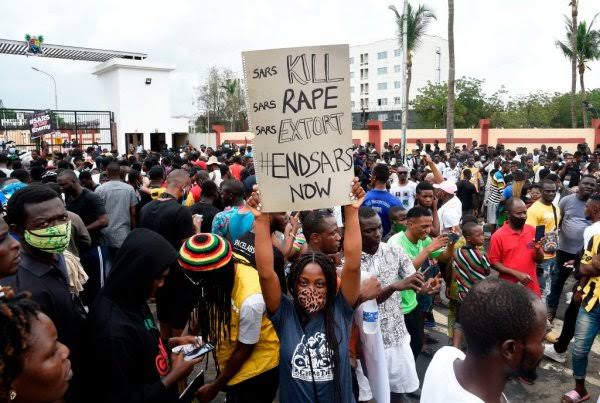
After days of nationwide protest, Mohammed Adamu, inspector-general of police (IGP), announced the dissolution of the special anti-robbery squad (SARS), a unit of the police known for excessive use of force, arbitrary arrests and, in some cases, extrajudicial killing.

At a media briefing on Sunday, the IGP announced that SARS operatives would be redeployed to other police commands, formations and units while a new arrangement will be made to combat crime.

But the big question remains: does this address the concerns about police brutality? TheCable had reported how policemen, including SARS officials, reportedly killed 92 Nigerians in one year. The #EndSARS protest was triggered by incessant cases

of brutality.

IGP’s action on SARS has evoked mixed feelings

Before the IGP’s comment on Sunday, the police authorities had at different times announced measures to check the excesses of SARS but nothing fruitful was achieved.

So, despite the dissolution of the unit, there are still concerns that the real issues cannot be addressed unless the police force is reformed. Of what use is it to scrap the unit if its operatives remain in the force and end up in numerous other police formations? Will that solve the problem that triggered the dissolution of the unit? 

To achieve a meaningful reform, some have called for different measures that would sustain professionalism in the police force.

Joe Abah, a former director-general, Bureau of Public Service Reforms, suggested that the officers must first “undergo psychiatric evaluation before being deployed anywhere else” and any of them found “unfit or with a record of abuse should be sacked”.

The house of representatives had also pledged a new law that will hold erring police officers to account and ensure they are “held in the highest standards of professional conduct”.

The IGP had also promised a “citizens and strategic stakeholders forum to provide an avenue for citizens to regularly interface and advise the police authorities on issues touching on the general public”.

THE NEXT STOP FOR SARS OPERATIVES

Protesters have refused to leave the streets

Amid concerns that the police personnel under SARS may continue to operate especially as they are not easily identifiable, there are calls for an executive order and possibly a law to legalise the proscription order.

However, checks by TheCable show the anti-robbery squad is not a creation of law.

It was reportedly set up in 1992 by Simeon Midenda, a former police commissioner, who once said he had been asked to “set up an anti-robbery team strong enough to make sure robbers were dislodged from Lagos”.

Although TheCable could not immediately confirm the number of SARS operatives in the police, they are believed to be in their thousands and would likely end up in police formations with similar mandates and mode of operations.

Until the reforms are introduced, the directive to redeploy SARS operatives to other units may just be a scratch on the surface while the real issue is untouched.

thecable.ng

4yrs After He Quit Nollywood to Become A Security Guard In The USA, See Fresh Photos Of Actor Femi Ogedengbe

Yeah, this actually happened- a Nollywood actor, director, and filmmaker actually quit the movie industry and went to the United States of America to seek greener pastures.

His name is Femi Ogedengbe and justifying his mind boggling decision, he told reporters that he has achieved more as a security guard than he did as an actor in Nigeria. “Oh yes! I am now a security guard in the USA and so what? Well, I have only been doing this for a little more than one year now and I can boldly say without any shame that what I have achieved more than I did in my father’s land being an actor/director/producer for over twenty-something years.”

“In fact, the stories about most pan-Africa Leaders like Mandela, Kwame Nkrumah, Julius Nyerere, Robert Mugabe and a host of the generation after them were all involved in one menial job or the other across western countries to support their education. But today, we can only remember them for being great African leaders and not for the dirty jobs they had to do on their road to greatness. Indeed the end justifies the means.”

Before his move, Oogedengbe was a popular actor in Nigeria. He was known for movies such as “Onilara” (2008), “She Is My Sister” (2007) 

and “She is My Sister 2” (2007).

See his fresh photos;

SOURCE: www.Ghgossip.com

Tears Flow For Beautiful Nigerian Lady Who Was Allegedly Killed By Her Own Friend After Her Rich Boyfriend Proposed to Her With Three Rings

Tears are flowing for a very beautiful Nigeria lady who mysteriously died a few days after her boyfriend proposed to her with three rings.

Apparently, the lady, Chichi Eze, took to social media to share photos of the ring after announcing her boyfriend proposed to her along with a caption. This probably infuriated one of her best friends within her circles who took her life out of extreme jealousy.

The friend who committed this heinous crime has not been identified but in the meantime, that’s the rumour being spread on the internet.

See the photos below;

Six confirmed dead as building under construction collapses in Lagos (photos)

Six persons have been confirmed dead after a building under construction collapsed at number 60, Odo street in Obalende, Lagos state today October 11.

According to the Lagos State Emergency Management Agency LASEMA, the building collapsed at about 5.55pm. Six fatalities including five men and one woman were recorded in the incident. Five severely injured persons were brought out from the rubble and transferred to hospital.

See more photos below

Court convicts seven SIM card registration offenders

The commitment of the Nigerian Communications Commission (NCC) to stop the use of unregistered SIM cards to perpetrate cybercrime and other criminal activities in the country is yielding results.

The Commission, through concerted enforcement efforts with the Nigeria Security and Civil Defence Corp (NSCDC), as well as the Department of State Services (DSS), has secured court convictions for SIM card-related offences.

The seven convicts were all charged and convicted at the Grade 1 Area Court, Nyanya, Abuja and the Senior Magistrate Court, Kano, for offences bordering on violation of SIM registration laws in the country on September 4, 2020 and October 24, 2020 respectively.

The offenders, Bako Joseph Boy, Umar Kabiru Abdullahi, Lawal Sani, Shamsuddin Aliyu, George Eze, Ayuba Ishak, and Kabiru Ali were convicted for various SIM card-related offences.

Specifically, the first convict Bako Joseph Boy was charged with the sale of SIM cards outside controlled environment, while the other six were arraigned on the charge of the sale of fraudulently registered SIM cards.

The offences were contrary to section 517 of the Criminal Code Act; Section 65 (1) of the Nigerian Communications Act (NCA) 2003 and Section 65 (2) of the NCC Act, 2003 and punishable under the same Act.

The suspects, who pleaded guilty to the charge preferred against them, were subsequently convicted as charged and sentenced to two months’ imprisonment with an option to pay a fine of N15,000 and six months imprisonment or the option of fine in the sum of N20,000.

The arrest of the suspects followed the signing of a Memorandum of Understanding (MoU) between the NCC, NSCDC and DSS to strengthen inter-agency collaboration towards curbing the criminal act of registering and selling of pre-registered SIM cards in the country.

The use of pre-registered SIM cards gives cover for unwholesome activities like kidnapping, call masking, threat to lives, bullying, armed robbery, identity theft financial crimes and SIM swap fraud, among others.

The general public is encouraged to stop the sale, purchase and use of pre-registered SIM cards as it constitutes a punishable offence under the law.

#EndSarsNow: Compensation For Police Brutality

#EndSarsNow: Compensation For Police Brutality. Daily Law Tips (Tip 668) by Onyekachi Umah, Esq., LL.M, ACIArb(UK)

Introduction: 

“Police is your friend” is now an annoying fallacy in Nigeria. The media is full of reports of reckless police brutality, especially from the Special Anti-Robbery Squad (SARS) of the Nigerian Police Force. This has spurred backlash from the public and caused a withdrawal of the SARS from patrol duties, by the head of police. However, many believe that change of theatre for SARS is not the solution, hence the call for #EndSarsNow. Police brutality is found across all units, departments and locations in Nigeria even though Nigeria has laws to punish and deter police torture. This work focuses on remedies that a victim of police brutality can access in Nigeria.   

Police And Human Rights: 

Nigerian Police Force is a creation of the constitution of the good people of Nigeria. The Police Force is designed to protect lives and property among other things, as expected, this does not include brutality to people. The same constitution that created Nigerian Police Force, also created  the unshakable fundamental human rights of persons in Nigeria. Fundamental human rights are those basic rights that make us human beings and not cockroaches that can be caged, killed and tossed around. Every human right is golden and cannot be disrespected or suspended by any police officer, not even the Inspector General of Police. For avoidance of doubt, the full list of the fundamental human rights in Nigeria, will be shown below. 

Full List Of Fundamental Human Rights In Nigeria:

The fundamental human rights contained in the constitution of Nigeria are: Right to Life, Right to Dignity of Human Person, Right to Personal Liberty, Right to Fair Hearing, Right to Private and Family Life, Right to Freedom of Thought, Conscience and Religion, Right to Freedom of Expression and the Press, Rights to Peaceful Assembly and Association, Right to Freedom of Movement, Right to Freedom from Discrimination and then, Right to Acquire and Own Immovable Property anywhere in Nigeria. These rights should not be violated by any person, including  law enforcement  agencies or agents in any part of Nigeria. Consequently, where there is a violation or even mere attempted violation of a fundamental human right, the victim and any other person on behalf of the victim, can seek justice against the violator. Part of justice is compensation and many other remedies, as will be shown later. 

Police Torture and Law:

The keepers of people are now the killers of people; this is the sorry state of policing in Nigeria. Torture is the best friend of police officers across Nigeria. So, what does the Nigerian law say about Torture? Torture is the intentional infliction/causing of mental or physical pain/suffering on a person in order to obtain information/confession, or to punish, intimidate and force him or a third party. Torture includes; beatings, food deprivation, rubbing of pepper/chemicals, assuming of stressful bodily positions, rape, exposure to cold/sunlight, use of drugs, blindfolding, threat, prolonged interrogation, unscheduled transfer of persons, secret detention, denial of sleep, shaming, stripping naked and parading in public places. 

There is no justification for torture, not even war, national security or high profile case. Every police torture is a violation of fundamental human right. Where there is torture in any security agency, the immediate commanding officer officer in-charge of the unit/department that committed such offence of torture will be held liable as an accessory to the crime, for any act or omission or negligence on his part that may have led to the commission of torture by his subordinates/colleagues. Any person that witnesses or is present when torture is being conducted is as liable as the person that conducted torture. Such witness is deemed as having participated in the torture. This applies to any person; military, para-military or civilian! By the way, the new punishment for torture since 2017, will be discussed below.   

Compensation For Victims Of Police Brutality:

Every violation or attempt to violate a fundamental human right comes with huge consequence, irrespective of the status and office of the offender. Any person in Nigeria can be sued (taken to court) for violation or attempting to violate a fundamental human right of another person. Even the President of Nigeria, Vice President of Nigeria, any Governor or Deputy Governor, that may be enjoying executive immunity from being sued while in office, can be sued for violation of human rights, immediately after his/her tenure in office. Human rights cases do not expire, they can be brought to court any time. The court for cases of enforcement of fundamental human rights are the State High Court, the FCT High Court or the Federal High Court) any time. 

Where a victim is alive, he is entitled to compensation/remedies for his violated human right and where a victim is dead, the dependants/family of the victim, are entitled to the compensation/remedies that should have gone to the victim. Among the compensation/remedies of any victim of police brutality or the family/dependants of a victim, include; 

  1. Immediate Release of Victim: Where a victim is being detained by any law enforcement agency, a court can order the immediate unconditional release of the victim from detention.  
  2. Access to Medical Treatment: A court can order a violator of human right to pay the cost of medical treatments of a victim. 
  3. Access to Lawyer and Family: A court can order that a victim be immediately granted access to a lawyer of his/her choice as well as the family members. 
  4. Prohibitive Injunction: A court can make an order, prohibiting the police or any law enforcement agency from further violation of human rights of a victim. This is good to stop and avoid further harassment and the shameful practise where victims are released and immediately re-arrested.
  5. Declaration: A court can declare that the rights of a victim has been violated, that such violation is wrong and with consequences. This often clears the way for the administration of consequent punishment on a violator. 
  6. Special and General Damages: For any human right that is violated or attempted to be violated, a court can order monetary compensation to be paid to a victim by the violator. In some cases, the victim needs to prove that he spent or lost certain amount of money/property that he or she would want want to recover. Such can be established through receipts, emails, cards, SMS, pictures, videos, witnesses and any other proof, this type is known as “Special Damages”.  Also, a victim may seek for monetary compensation for trauma, pressure, shame, stress, loss of job, delay, hardship and any other thing that can not be quantified/ascertained. This last type is known as “General Damage”. 
  7. Apology: A court can order a violator to write and publish an apology letter to a victim. It can even be published on newspapers, websites and any platform. 
  8. Any Other Remedy: The court can order anything that the court considers appropriate for the enforcement of fundamental human right of a victim. This may include, an order that a victim be produced in court from any detention centre, or that a given government office/officer must do any duty it has been created to do, among other things. 
  9. Imprisonment: Under the Anti-Torture Act 2017, any form of torture is an offence and court can punish an offender with imprisonment for not more than 25 years, without an option of fine. 
  10. Death: Where violation of fundamental human right leads to death of victim, the violator will be tried for murder. The punishment for murder is death. 

Conclusion: 

While we demand for SARS to be ended because of the brutality baked daily by the squad, the victims of such torture have legal remedies. For any fundamental human right that is violated, there are huge consequence on the violator and there are compensation/remedies for the victim. Never be shy or too religious to enforce your fundamental human right, enforcement will discourage law enforcement agents from being reckless and unprofessional. Contact your lawyer and sue any police officer or law enforcement agent that has ever violated your fundamental human right. Do this to discourage the surge in police brutality. The Nigerian Police Force must ensure that budget of police force (tax payers fund) is not used to pay damages on behalf of police officers, rather concerned violators/officers must be made to pay for any damages/liabilities from their salaries and retirement benefits. Police can only be a friend, when police becomes professional and behaves like a friend.  

My authorities are:

  1. Sections 1, 33 to 46, 214, 215 of the Constitution of the Federal Republic of Nigeria, 1999.
  2. Sections 2, 8 and 14 of the Anti-Torture Act, 2017.
  3. The judgment in the case of Fawehinmi V. Abacha  (1998) 1 HRLRA 665 (where court granted victim access to his wife and medical care).
  4. The judgment of the Supreme Court of Nigeria (on meaning and nature of fundamental human rights) in the case of RANSOME-KUTI & ORS v. AG FEDERATION & ORS (1985) LPELR-2940(SC)
  5. The judgment of the Supreme Court of Nigeria (on meaning and nature of fundamental human rights) in the case of AGBAI & ORS v. OKOGBUE (1991) LPELR-225(SC)
  6. “Any Security Agency’s Manual/Protocol That Allows Torture Even For National Security Cases Is Unlawful And Its Officers Are Liable”, Onyekachi Umah (Daily Law Tip [Tip 412] <https://learnnigerianlaws.com/any-security-agency-s-manual-protocol-that-allows-torture-even-for-national-security-cases-is-unlawful-and-its-officers-are-liable-daily-law-tips-tip-412-by-onyekachi-umah-esq-llm-aciarb-uk/> accessed 5 October 2020. 
  7. “What Is The Punishment For Any Person Including Police Officers That Tortures Another Person”, Onyekachi Umah (Daily Law Tip [251]) <https://learnnigerianlaws.com/daily-law-tips-by-onyekachi-umah-esq-tip-251-what-is-the-punishment-for-any-person-including-police-officers-that-tortures-another-person/> accessed 5 October 2020.
  8. “Is Obeying “Orders From Above” A Defence For Torture In Nigeria”, Onyekachi Umah (Daily Law Tips [Tip 409]) <https://learnnigerianlaws.com/is-obeying-orders-from-above-a-defence-for-torture-in-nigeria-daily-law-tips-tip-409-by-onyekachi-umah-esq-llm-aciarb-uk/> accessed 5 October 2020. 
  9. Direct access to previous works on Torture in Nigeria <https://learnnigerianlaws.com/?s=torture+ 

#SabiLaw

#DailyLawTips

#SabiBusinessLaw

#SabiElectionLaws

#SabiHumanRights

#SabiLawOnBeatFm

#SabiLawLectureSeries

#CriminalJusticeMonday

#SabiLawVideoChallenge

Speak with the writer, ask questions or make inquiries on this topic or any other via [email protected] or [email protected] or +2348037665878. To receive our free Daily Law Tips, follow our Facebook Page:@LearnNigerianLaws, Instagram:

@LearnNigerianLaws and Twitter: @LearnNigeriaLaw

Please share this publication for free till it gets to those that need it most. Save a Nigerian today! NOTE: Sharing, modifying or publishing this publication without giving credit to Onyekachi Umah, Esq. and “LearnNigerianLaws.com” is a criminal breach of copyright and will be prosecuted.

This publication is the writer’s view not a legal advice and does not create any form of relationship. You may reach the writer for more information.

Powered by www.LearnNigerianLaws.com {A Free Law Awareness Program of Sabi Law Foundation, supported by the law firm of Bezaleel Chambers International (BCI).}

Denial of Inheritance Rights Is A Crime In Nigeria.

Denial of Inheritance Rights Is A Crime In Nigeria. DAILY LAW TIPS (Tip 667) by Onyekachi Umah, Esq., LLM. ACIArb(UK)

Introduction:

Across Nigeria, by custom and religion, women are treated and perceived to be lesser than men, by men and even some women themselves. Women and girls are often treated as mere articles, property and tools for satisfaction of men. Hence, women are expected to have no dreams, vision and even religion, because they will be only what their fathers/husbands declare them to be or permit them to do; present day slavey. Obviously, one who is treated as a property cannot own a property, hence this is basis, most women, wives, widows and girls are denied inheritance by tradition and religion. This also plays a role in the rising cases of sexual abuse and domestic violence against women in Nigeria. This work examines the denial of women’s right to inheritance/succession in Nigeria and the new criminal implication, with a focus on widows.

Religious And Traditional Violation Of Women Rights: 

For obvious reasons, there have been clamour for women rights; women demanding to be treated as human beings. This dates back to July 19–20, 1848, in Seneca Falls, New York. From Prague to Durban, Lisbon and to Saint Petersburg, women are treated poorly at homes, schools, sports, work, politics, national service, entertainment and even in the religious covens. Coming to the largest black nation (Nigeria), the situation is worse. Note that the worse of women, in terms of violation of their rights, are widows, whom are often poor, uneducated and without means of catering for themselves and their children. The villains and enemies of women and their rights, are never strangers rather their family members.

Religion is often argued to be a tool for harmony. Most religions are designed to exalt men over women. Women are to be seen not heard, women cannot hold/play certain religious positions or roles. Women are pushed so low that many are treated as children without rights. This also leads to early marriage and pressure to continue in unsafe matrimonial relationships. Religious leaders expect only women to be the peacemakers, home keepers and receivers of absues, while men are worshipped and expected to lord over women. In religions, the synonym for “Woman” if “Submission” while the synonym for “Man” is “Lord/Power”.

Traditions across Nigeria are designed to mentally suppress women as mere tools for achieving men’s dreams. Notwithstanding the educational might, exposures and status of a woman, she is often perceived as lesser than all men (at times boys), even by her male employees. Hence, male children are assigned greater traditional roles compared to girls and even women. For example, in most Igbo cultures, a woman cannot transact (buy or sell) on land or even discuss on land maters, rather a boy/male child can. In cultures and streets, you will find statements that depict that a woman is worthless without a husband and that a woman is a mere property of a man. Ever wondered why most customs in Nigeria, accepts bride prices (symbolic cost of a bride). Some customs charge bride prices of over One Million Naira (N1,000,000.00) (ie; about $2,222 USD), depending on the educational achievements/status of a bride. By the way, high bride price is said to have huge negative impact on young couples and often assign dominating roles on husbands, after all, they bought their brides.

At this rate, both in religion and tradition, women have no basis to challenge men and demand for enforcement of human rights. However, all hopes are not lost, since the gaps created by greed, conspiracy, conveince, religions, traditions, native laws and customs are to be bridged by LAWS made by the legislatures. However, the sex composition of the legislatures and the political gladiators, often will affect the interest of the legislatures and may have negative impact on Pro-Women Rights Bills. The impact of the sex of judges and executives may have huge impact on their roles in execution and interpretation of laws, including the enforcement of women rights.

Protection of Women (Widows) Rights To Inherit Property. 

Departing from the pains caused by religion and culture, the legislature has made several laws to protect women, nationally and internationally. The constitution of Nigeria, bestows on every Nigerian some fundamental human rights, including the right to own property. Several other estate administration laws, clearly provide for women rights to own property. On the international space, we have the “Convention on the Elimination of All Forms of Discrimination Against Women” and the African Charter on Human and Peoples’ Rights (Ratification and Enforcement) Act, among others. Most these laws, lead to payment of damages/compensation to victims by offenders. In a country like Nigeria, fines will not deter offenders, rather imprisonment will. The Appeal system may aid an offender to still be with his/hr funds while appalling against a judgment ordering fine, but whether there is appeal or not, an offender once convicted and sentenced to imprisonment, goes to the correctional centre, and may fight for an appeal from there.

In 2015, the National Assembly (Nigeria’s federal legislature) made the Violence Against Persons (Prohibition) Act 2015 to discourage violence against human beings in Nigeria and to severely punish offenders. The said law listed the denial/violation of the inheritance/succession rights of a widow as a harmful traditional practise and declared such harmful traditional practises as unlawful and criminal. The Violence Against Persons (Prohibition) Act 2015 is popularly known as the VAPP ACT, it is operational in the Federal Capital Territory and many states across Nigeria, have adopted and enacted similar laws. So, there are now the Violence Against Persons (Prohibition) Law in many states across Nigeria.

Punishment For Denial of Inheritance/Succession Rights:

Any denial or attempt to deny a widow (a woman that has lost her husband to death) of her rights to inherit any property of her husband is a crime. Aside bing a family matter, it is now a criminal matter and should be reported to the law enforcement agencies. The violation and denial of the inheritance/succession rights of a widow punishable with maximum of 2 years imprisonment or and fine of N500,000.00. The punishments for attempting such offence or assisting and aiding such offence is a maximum of 1 year imprisonment and or fine of #200,000.00.

Recommendation and Conclusion: 

The denial or violation of the inheritance/succession rights of a widow is a crime in Nigeria. Stop suffering in silence and going to traditional leaders and religious houses, please get a lawyer and report denials of inheritance to law enforcement agencies.

Kindly note that the law creating the above offence is operational in Federal Capital Territory, Abuja. Similar laws are now operational in Oyo, Ogun, Lagos, Osun, Ekiti, Edo, Anambra, Enugu, Ebonyi, Benue, Cross River, Kaduna, FCT, and Plateau states. Soon, more States will enact similar laws as we encourage states to do so and condemn violence. However it is advised that the punishment stated in the VAPP Act be made to be minimum punishment instead of maximum punishment to avoid releasing offenders with mere slaps on wrists. Click this to ream my earlier works on women rights in Nigeria <https://learnnigerianlaws.com/?s=women+rights>.

My authorities are:

  1. Sections 42 (1), 43 and 44 of the Constitution of Federal Republic of Nigeria, 1999.
  2. Sections 15, 47 and 48 of the Violence Against Persons (Prohibition) Act, 2015 and similar laws across states in Nigeria.
  3. Articles 2 and 13 of  the African Charter on Human and Peoples’ Rights (Ratification and Enforcement) Act
  4. Articles 13, 15 and 16 of the Convention of Elimination of All Forms of Discrimination Against Women (CEDAW)
  5. Judgment of the Supreme Court in the case of ANEKWE & ANOR v. NWEKE (2014) LPELR-22697(SC) and in the case of Nzekwu V. Nzekwu (1989) 3 SCNJ page 167
  6. Judgment of the Court of Appeal in the case of UGBENE v. UGBENE & ORS (2016) LPELR-42110(CA)
  7. Judgment of the Court of Appeal in the case of MOJEKWU v. MOJEKWU (1997) LPELR-13777(CA)
  8. Judgment of the Court of Appeal in the case of AMUSAN & ANOR v. OLAWUNI (2001) LPELR-6976(CA)
  9. Judgment of the Court of Appeal in the case of OKAFOR v. ISITORH & ANOR (2015) LPELR-25892(CA)
  10. “The Women’s Rights Movement, 1848–1920” (History, Art & Archives, United States House of Representatives)<https://history.house.gov/Exhibitions-and-Publications/WIC/Historical-Essays/No-Lady/Womens-Rights/> accessed 2 October 2020.
  11. “What Research Tells Us About How Women Are Treated at Work”, Gretchen Gavett (Harvard Business Review, 27 December 2017) <https://hbr.org/2017/12/what-research-tells-us-about-how-women-are-treated-at-work> accessed 2 October 2020.
  12. “Women Have Equal Rights To Own/Inherit Any Property In Any Part Of Nigeria Irrespective Of Culture/Religion”, Onyekachi Umah ((Daily Law Tips [Tips 521]) <https://learnnigerianlaws.com/women-have-equal-rights-to-own-inherit-any-property-in-any-part-of-nigeria-irrespective-of-culture-religion-daily-law-tips-tip-512-by-onyekachi-umah-esq-llm-aciarbuk/> accessed 2 October 2020.
  13. “25% of women report discrimination, unfair treatment at work”, Noria Corporation (Reliable Plant) <https://www.reliableplant.com/Read/6967/25-of-women-report-discrimination,-unfair-treatment-at-work> accessed 2 October 2020.
  14. “Women’s Rights in Nigeria: What’s Holding Nigeria’s Women Back?” (World Politics Review, 3 January 2017) <https://www.worldpoliticsreview.com/insights/20822/womens-rights-in-nigeria-what-s-holding-nigeria-s-women-back> accessed 2 October 2020.
  15. “Approval For Marriage Of Female Officers/Staff Is Unconstitutional and Discriminatory”, Onyekachi Umah (Daily Law Tips [Tips 660]) <https://learnnigerianlaws.com/approval-for-marriage-of-female-officers-staff-is-unconstitutional-and-discriminatory/> accessed 2 October 2020.
  16. “Nigerian Women Say ‘No’ To Gender-Based Violence” Leone Usigbe (United Nations) <https://www.un.org/africarenewal/news/nigerian-women-say-‘no’-gender-based-violence> accessed 2 October 2020
  17. “Human Rights Situation in Nigeria and Women’s Rights Concerns in Mauritania: Submission to the African Commission on Human and Peoples’ Rights” (Human Rights Watch, 27 April 2018) <https://www.hrw.org/news/2018/04/27/human-rights-situation-nigeria-and-womens-rights-concerns-mauritania> accessed 2 October 2020.
  18. “Abolished Anti-Women Custom of Onitsha People of Anambra State, Nigeria” Onyekachi Umah (Daily Law Tips [Tips 522]) <https://learnnigerianlaws.com/abolished-anti-women-custom-of-onitsha-people-of-anambra-state-nigeria-daily-law-tips-tip-522-by-onyekachi-umah-esq-llm-aciarbuk/> accessed 2 October 2020
  19. “The Role of Women Judges and a Gender Perspective in Ensuring Judicial Independence and Integrity”, Judge Vanessa Ruiz (UNODC) <https://www.unodc.org/dohadeclaration/en/news/2019/01/the-role-of-women-judges-and-a-gender-perspective-in-ensuring-judicial-independence-and-integrity.html> accessed 2 October 2020.
  20. “Citizen By Marriage Is Discriminatory and Against Nigerian Women”, Onyekachi Umah (Daily Law Tips [Tips 653]) <https://learnnigerianlaws.com/citizen-by-marriage-is-discriminatory-and-against-nigerian-women/> accessed 2 October 2020.
  21. “Abolished Anti-Women Custom of Yoruba People of Nigeria”, Onyekachi Umah (Daily Law Tips [Tips 653]) <https://learnnigerianlaws.com/abolished-anti-women-custom-of-yoruba-people-of-nigeria-daily-law-tips-tip-523-by-onyekachi-umah-esq-llm-aciarbuk/> accessed 2 October 2020.
  22. “It’s Not Freedom For Women in Nigeria as 23 States Hold Back Signing on the Violence Against Persons (Prohibition) Act”, Aderemi Ojekunle (Dataphyte, 15 June 2020) <https://www.dataphyte.com/gender/its-not-freedom-for-women-in-nigeria-as-23-states-hold-back-signing-on-the-violence-against-persons-prohibition-act/> accessed 2 October 2020. 
  23. “Can a Married Woman Inherit Her Parents’ Property?”, Onyekachi Umah (Daily Law Tips [Tips 535]) <https://learnnigerianlaws.com/can-a-married-woman-inherit-her-parents-property-daily-law-tips-tip-535-by-onyekachi-umah-esq-llm-aciarbuk/> accessed 2 October 2020. 

#SabiLaw

#DailyLawTips

#SabiBusinessLaw

#SabiElectionLaws

#SabiHumanRights

#SabiLawOnBeatFm

#SabiLawLectureSeries

#CriminalJusticeMonday

#SabiLawVideoChallenge

Speak with the writer, ask questions or make inquiries on this topic or any other via [email protected] or [email protected] or +2348037665878. To receive our free Daily Law Tips, follow our Facebook Page:@LearnNigerianLaws, Instagram:

@LearnNigerianLaws and Twitter: @LearnNigeriaLaw

Please share this publication for free till it gets to those that need it most. Save a Nigerian today! NOTE: Sharing, modifying or publishing this publication without giving credit to Onyekachi Umah, Esq. and “LearnNigerianLaws.com” is a criminal breach of copyright and will be prosecuted.

This publication is the writer’s view not a legal advice and does not create any form of relationship. You may reach the writer for more information.

Powered by www.LearnNigerianLaws.com {A Free Law Awareness Program of Sabi Law Foundation, supported by the law firm of Bezaleel Chambers International (BCI).}

Osinbajo Asks State to Accelerate Processing of Land Documents

Vice President Yemi Osinbajo has asked state governments to cut down the bottlenecks in processing of land documents and collection of certificate of occupancy to further enhance ease of doing business in Nigeria.

He gave the advice at the 2020 National House Fair held in Abuja, saying since the custody of land “is technically within the purview of the states, it behoves them to make sure the impediments are removed.”

Osinbajo, who was represented at the house fair by Mr. Abubakar Aliyu, Minister of State for Works and Housing, stated that housing would play a major role in the government’s effort to reduce poverty in the country.
He said: “As we are all aware, the Land Use Act has technically vested the housing responsibility on states and local governments, the custodians of land in the country.

“This presupposes that these two tiers of government must be at the forefront in housing development.

“As a government, we have identified land titling as a rapid tool for economic development as it creates the basis for land taxation, access to credit, increased market value and investment stimulation, amongst others.
“I wish to appeal to state governments to ease-up and quicken the process of issuance of Certificate of Occupancy (C-of-O) and other titles.”

Acknowledging the aptness of this year’s theme, “Gateway to Better Life: Affordable Housing Solutions”, to the country’s housing journey, the vice president disclosed that the federal government was determined to lift 100 million Nigerians from poverty in the next 10 years.

In line with the Economic Sustainability Plan, he explained that the Central Bank of Nigeria (CBN) had approved the sum of N200 billion for 300,000 households to enable Family Homes Funds Limited (FHFL) finance the construction of social housing units for low-income earners.

According to him, the programme was designed for the purpose of reducing the housing deficit through collaboration with public and private entities by creating a robust housing management of public buildings, hostel accommodation, among others.

He said the pilot project of the Affordable Housing Development and Management Initiative (AHDMI) would commence in October 2020 in Gwagwalada with the construction of 2,500 mixed housing units under a Public- Private Partnership (PPP).

In his remarks, Ooni of Ife, Oba Adeyeye Ogunwusi called on the federal government to make policies that would enhance the provision of affordable housing for Nigerians, noting that national development could only be possible when basic needs are met.

The traditional ruler enjoined his colleagues to work very closely with the government and the private sector in the development and provision of affordable housing for the citizenry.

He added that by their status, traditional rulers are natural custodians of land and therefore relevant in the development of their communities through the provision of affordable housing for their citizens.

TIPS