Home Blog Page 1210

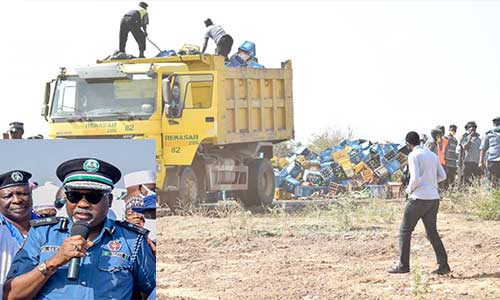
What is happening? Kogi Deputy Governor presides over looting; soldiers advise looters; Civil Defence officers join in (Videos)

SHARES Share on WhatsappShare on FacebookShare on Twitter

The videos are telling, but analysts are suggesting that top government officials may be aiding looting to prevent violence and loss of lives as happened at the National Emergency Management Agency (NEMA) warehouse in Jabi District of Abuja on Sunday. Security agents looked on as the looting happened.

Kogi Deputy Governor, Mr. Edward Onoja, advised looters to be orderly, even telling them that the items in the warehouse in Lokoja were meant for flood victims. He told them not to touch building materials as the youths hailed him and Governor Yahaya Bello.

In Kwara, overrun soldiers advised looters not to hurt themselves or cause damage, as they rushed in.

In an unidentified location a Nigeria Security and Civil Defence Corps officer was seen joining the looting as passersby hailed him.

Projects: Justice Galadima Wants Engineers To Explore Contract Law

BY CHIKA OKEKE, Abuja

A former Justice of the Supreme Court, Justice Suleiman Galadima has enjoined engineers in the public and private sector to explore the basic principles of law of contract in executing projects, negotiating contracts and Bill of Quantities (BoM).

He stated this in Abuja over the weekend during the ‘2020 Engr Charles Mbanefo Distinguished Lecture Series’, organised by the Nigerian Society of Engineers (NSE) Abuja branch, with the theme, “Contractual Duties and Tortuous Liabilities – Law and Ethics in Engineering”.

Galadima disclosed that law of contract pervades all spheres of human endeavor such as construction, haulage, logistics, hire-purchase, insurance, banking, medical practice, engineering and among others, adding that engineers and engineering firms work with clients and almost every project involves contract.

The Justice, who was represented by Barr Lilian Okenwa, hinted that understanding the basics of contract law protects engineers’ rights and obligation and helps to avoid potential lawsuits due to breach of contract.

According to him, “Engineers are expected to exhibit the highest standard of honesty and integrity as they have a direct and vital impact on the quality of life of the people and must perform under a standard professional behaviour that requires adherence to the highest principles of ethical conduct”.

Also speaking, the NSE chairman, Abuja branch, Engr. Abdulbari Abdulmalik noted that in the law of contract, the government follows certain procedures by mandating the Bureau of Public Procurement (BPP) to ensure that all contracts in Nigeria follow due process.

Abdulmalik added that Infrastructure Concession Regulatory Commission (ICRC) plays a vital role by making the beneficiaries adhere strictly to the 2007 procurement act, saying that the government is mandated to ensure that engineers and non-engineers follow the procedure judiciously.

On his part, the founding chairman of NSE Abuja branch, Engr Charles Mbanefo, encouraged the chapter to engage professionals from other sectors to boost their enlightenment campaign.

The president of NSE, Engr Babagana Mohammed stated that building collapse is caused either by the use of substandard materials or quacks, saying that apart from the amended Council for the Regulation of Engineering in Nigeria (COREN) act, some top professionals are facing the tribunal.

He maintained that henceforth, NSE is mandated to assess a building site and uncover the engineer handling the project in case of any collapse, as well as raise the alarm over any quack working at any construction site.

Leadership.ng

Renegotiate Nigeria, Danjuma, Others Insist

*Say imbalance producing poverty

The National Christian Elders Forum (NCEF), led by a former Minister of Defence, Gen. Theophilus Danjuma (rtd.), and other statesmen, has demanded that Nigeria should be renegotiated, insisting that the current imbalance is producing sorrow and poverty in the country.

In a resolution after an emergency meeting of the group on Thursday, which was made available yesterday by the NCEF Secretary, Mr. Bosun Emmanuel, the group accused the federal government of mismanaging the #EndSARS protests in the country by deploying the army to attack unarmed protesters in the country.

The resolution was titled‘#EndSARS – It is time to renegotiate Nigeria.’

NCEF demanded that whoever authorised the deployment of troops should be court-marshalled for murder.

The group also urged the government to take advantage of the protests to introduce state police.

The resolution read partly, “It is time to re-negotiate Nigeria. The time is ripe for Nigeria to be re-negotiated. The political imbalance in the country has produced nothing but sorrow, poverty, and death for Nigerians. The unjust and sectional political structure left behind by the British colonialists is no longer sustainable.”

Speaking on the protests, the group said, “NCEF wishes to express great sorrow at the recent events in the country which commenced with nationwide protests against the excesses of the Special Anti-Robbery Squad and climaxed in the death of some of the unarmed protesters, security personnel, and mindless destruction of properties. All the lives lost are Nigerian and there was no need for any of them to have died.

“There must be full National Assembly inquiry into the causes of death and destruction that trailed the peaceful #EndSARS protests…. The government must be fully investigated for the role played by security agents in transporting, and supervising vandals and thugs to attack the protesters

“The prison breaks and widespread arson should be diligently investigated as there are allegations of government complicity to discredit the protest.

“The current situation was mishandled by the government of President Muhammadu Buhari because the army was released against unarmed protesters in Nigeria. Whoever authorised the deployment of troops to face the protesting youths should be court-marshalled for murder.

“It is curious that a government that claimed it negotiated with terrorists and integrated them into the military could not negotiate with unarmed protesters but chose to shoot them. This double standard that is characteristic of the Buhari administration is condemnable.

“As the country mourns the death of the protesters, the security personnel, as well as other people who died as collateral damages, NCEF appeals to the youths to suspend any further public protest. The point has been made that though Nigerians are tolerant and patient, they are not docile.

“The government should take advantage of the protests rejecting police brutality to introduce state police. This is the appropriate step under the circumstances to ensure adequate and effective security nationwide and henceforth localise any case of policeexcesses to the states.

“The failure of government to declare state police at this point should be interpreted to imply that a centrally controlled police is desired by the government in order to continue to provide state cover for marauding Fulani herdsmen, kidnappers, bandits and Boko Haram.”

Journalist, bystander shot in Lokoja as looting spree continues

A journalist and bystander have been shot in Lokoja, the capital of Kogi State, as reeling looting, shooting continued there.

Video of looters in Lokoja

Emmanuel Adeyemi and the unnamed bystander are receiving treated at the state hospital, but disturbing videos and photos from there show, like in Abuja and elsewhere that security forces stood down as the raging, bare-faced criminalities continued.

Kogi, for months, has been notorious for violence up to and after last November’s gubernatorial elections which sitting Governor, Yahaya Bello, won.

Observers have noted that the violence in Kogi has been on for years, in a state with a history of brazen impunity, especially by those in power or seeking power. “It was a matter of time before Kogi did this, we are even surprised it took two weeks for this to happen given the number of unemployed, sacked unpaid workers, and anger in the state”, a resident said

All through the night, the Agriculruraal Development Project was venue of of unrestrained looting as many basically carted away fertiliser bags.

Businesses and traders shut down their outlets as shooting rent the air, and Police spokesman there, William Aya, exonerated the Police of the shootings, blaming on miscreants

The state government in a statement by its spokesman, Kingsley Fanwo, said, “It is unfortunate that sponsored mercenaries were sneaked into the town to cause mayhem. And it is sad that they shot a journalist who was performing his legitimate duties.

“Government will ensure that all the people involved in the violence are brought to book”.

Onitsha boils again as DPO Rabiu Garba gets accolades

The eastern commercial city of Onitsha began to boil Monday morning, according a resident, simply named Raphael, just days after accolades were poured on the ‘beloved’ Divisional Police Officer, Rabiu Garba, for the role he played in dousing tension when youths and hoodlums came to set his station ablaze.

Raphael, who is hiding himself within the confines of his office feared today’s protest appeared to be spiralling, and wondered if Rabiu’s station will be spared this time.

In Nnewi, also in Anambra State, two police stationshad their armouries looted and were burnt last Friday. Both cities are notorious for their backing for the renegade group, Independent Peoples of Biafra (IPOB), headed by Mazi Nnamdi Kano, who has been fanning the embers of ethnic hatred as the #EndSARS protests raged last week.

Recall that Rabiu gained popularity after a viral post on him circulated days ago. It read: “A friend who lives at Onitsha told this story and it was a refreshing departure from the usual narrative, considering the harrowing experience of the past week.

“Rabiu Garba is the Divisional Police Officer (DPO) at Fegge Onitsha. He built a borehole for the neighbourhood without any fund raising.

“He organizes soccer tournaments for the youths of Fegge at their stadium where he also goes to play table tennis weekly.

“For Rabiu Garba, Fegge is his home. Fegge is his community.

“He has attended almost every church and every event in the area as he is invited because he is accepted as one of them.

“When the rampaging youths came to burn his Police Division yesterday, he neither fought nor fled.

“While his men were panicked, he walked out to meet the mob with the courage of a man who had nothing to fear.

“They recognized him and the angry chants were silenced! Most of the youths could vouch for him as a professional cop and a role model for many young men in the community.

“They even granted him audience to address and counsel them before the mob dispersed.

“It had nothing to do with his tribe.
It had nothing to do with his religion.
He was just a model cop.

“Yes, there are still good cops.

“Thank you DPO Rabiu Garba”.

Pastor Bakare speaks on birth pangs of nationhood, unveils blueprint for a new Nigeria

BEING TEXT OF SPEECH BY PASTOR ‘TUNDE BAKARE AT THE STATE OF THE NATION BROADCAST ON SUNDAY, OCTOBER 25, 2020.

Introduction: A Banner Without Stain
Citizens of our beloved great nation here present; Nigerians at home and in the diaspora joining us via various media platforms; friends of Nigeria across the African continent and the world; political leaders, policymakers and bureaucrats from the national and subnational levels of government; private sector stakeholders; the intelligentsia, opinion moulders and thought leaders from various institutions of knowledge; gentlemen of the press: When our nation attained independence on October 1, 1960, it was with fervent faith in the possibilities of a great nation that our founding fathers lowered the British flag and hoisted the Green-White-Green. Their dream of a great nation was etched in the lyrics of our founding national anthem, the second stanza of which states:
Our flag shall be a symbol
That truth and justice reign
In peace or battle honour’d,
And this we count as gain,
To hand on to our children
A banner without stain.

In the past week, we witnessed with great sorrow the desecration of our nationhood as Nigeria’s armed forces stained the banner of our nationhood, the Nigerian flag, with the blood of our children, the Nigerian youth, to whom our founding fathers charged us to handover a banner without stain. It is, therefore, with a heavy heart over the current state of our nation, but with resilient hope in the possibilities of a New Nigeria, that I bring you this State of the Nation Broadcast originally intended to celebrate Nigeria’s 60th Independence Anniversary. In this moment of despair and sobriety, I have titled my address ‘The Building Blocks of Nationhood: A Blueprint for the New Nigeria’ because this dark chapter of our history is not how Nigeria’s story ends.

The Birth Pangs of Nationhood

All across the nation, there is a wave of people movement. It is a wave of citizen engagement championed by the so-called ‘ordinary Nigerian’ who has proven in extraordinary terms to be by no means ordinary. It began in Edo State with an awakened and resolute electorate defying the political establishment to make their voices heard and their votes count. In the past couple of weeks, that wave has been transformed into a tsunami of people movement led by our young people who have had enough of the horrendous brutality of the now-disbanded Special Anti-Robbery Squad (SARS). I believe that this wave of people movement is the physical manifestation of the birth pangs heralding the New Nigeria.

As I observed the End SARS protests, I could not but conclude that we are witnessing the crescendo of an era and the beginning of another. Ten years ago, when we convened civil society organisations under the umbrella of Save Nigeria Group (SNG), our objective was not to be the voice of the people, but to restore the voices of the voiceless in a nation where social mobilisation had been frozen for too long at that time. Ten years later, the End SARS protest has assured me that a generation of Nigerians has arisen, armed with clear and unmistakable voices, refusing to dim their lights or turn down the volume of their requests, because we have entered the era of ‘Soro Soke.’ I salute the courage of this unbreakable generation; I salute the resilience of every Nigerian youth, named and unnamed, who has stood up to be counted in this momentous era.

A Solemn Remembrance

We remember at this time the heartbreaking tales of extortion, torture, rape, and murder that drove our young people to the streets in the first place. We remember Linda Nkechi Igwetu who, in 2018, was reported to have been shot in a friend’s car by SARS operatives the day before her passing out parade, after serving her nation as a member of the National Youth Service Corps (NYSC) in Abuja. We remember Stella Ifeoma Abugu, another corps member, reported to have been raped and murdered while being unlawfully detained by SARS officials in Abuja. We remember Saliu Alli Haruna, a twenty-one-year-old student of Business Administration at Ambrose Alli University, Edo State, whose remains were found in a well after a reported raid in his hostel by SARS operatives.

We remember Kazeem Tiyamiyu, a promising Nigerian footballer who, based on eyewitness reports, was pushed out of a moving vehicle to his death by SARS operatives. We remember Femi Bello, an enterprising 300-level student of Kaduna State University, reported to have been arrested without charge and murdered extrajudicially in the custody of the Nigeria Police Force. We remember Tina Ezekwe, a seventeen-year-old secondary school girl who was killed by a police officer while assisting in her mother’s shop.

We cannot forget twenty-year-old Jimoh Isiaq who was reportedly killed by operatives of the Nigeria Police Force as they violently clamped down on peaceful protesters in Ogbomosho, and whose unfortunate death propelled Nigerians across the nation in their rejection of police brutality. Our hearts bleed at the memory of the peaceful protesters at the Lekki Toll Gate who were shot and killed on Tuesday, October 20, 2020, by the Armed Forces of the Nigerian state as they held up the Nigerian flag; young compatriots pledging allegiance to ‘one nation bound in freedom, peace and unity’ as they sang our national anthem in their final moments. Let us observe a moment of silence for these Nigerians and many others, named and unnamed, who have been unjustly killed by agents of the Nigerian state. May their souls rest in peace and may God comfort their families.

In like manner, we also remember those unsung heroes of the Nigeria Police Force who, despite being part of an institution that has the worst reputation for corruption and ineptitude in the Nigerian public sector, serve with remarkable professionalism and bravery, sometimes doing so at the cost of their lives. In this regard, we remember Sergeant Chukwudi Iboko who, in 2017, was seen in a viral video bravely combating armed robbers at a bank in Owerri, Imo State, losing his life in the process. We remember Inspector Musa Sunday, ironically of the now-disbanded SARS, who, in 2016, was reported to have been buried alive by hoodlums, after he gallantly rescued a man who was being attacked by the said hoodlums while he was on duty in Oshoko, Ibeju-Lekki, Lagos.

We remember Sergeant Sunday Idoko who was killed in Ilaro, Ogun State, while firmly resisting an attempt by hoodlums to snatch election results during the 2019 elections. Once again, let us observe a minute’s silence for these and hundreds of other unsung heroes of the Nigeria Police Force who lose their lives yearly in the line of duty. May their souls rest in peace and may God comfort their families.
Ultimately, the Government is Liable

When people elect their leaders, they hand over the responsibility to protect and defend them. The gun in the hand of the policeman is the closest, most visible and most easily identifiable symbol of that handover of power and responsibility from the people to the government. The people do not have as much access to the president, governor or even the local government chairman or councillor as they do to the policeman on the street. In other words, as far as the responsibility of the government to guarantee the security and welfare of the people is concerned, the policeman on the street is the first ambassador of the government to the people.

Any misuse of that power by the police, especially to repress and oppress any citizen, is ultimately an abuse of the power conferred by the people on their government. This is why the widespread protests against police brutality are justified. I acknowledge the efforts made by the government to address the protesters’ demands, but the government must move from commitment to full compliance in the implementation of the 5-for-5 demands of the End SARS protesters and in overhauling our policing architecture.

Above all, I strongly recommend that President Muhammadu Buhari should ensure that those who ordered armed soldiers to fire on innocent citizens are fished out and made to face the full weight of the law. The officers who carried out such wicked acts should also be prosecuted under international legal standards.

Unfortunately, the protests took a sad turn, from the attacks on protesters by thugs to the infiltration of protests by hoodlums unleashing mayhem in cities and communities. According to Alan Bible:

No nation, no matter how enlightened, can endure criminal violence. If we cannot control it we are admitting to the world and to ourselves that our laws are no more than a facade that crumbles when the winds of crisis arise. Furthermore, in the words of President Lyndon Baines Johnson (LBJ):
The poor suffer twice at the rioter’s hands: First, when his destructive fury scars their neighbourhood; second, when the atmosphere of accommodation and consent is changed to one of hostility and resentment.

Unfortunately, this is where peaceful protests hijacked by thugs and hoodlums have landed us. Be that as it may, governments at the federal and state levels have lent credence to the conclusion of protesters that the government itself was behind these smokescreen tactics to discredit the protests. By its actions and inactions, the government has burned the bridge of trust. It is my hope that this address will help rebuild that bridge and resolve the issues in the interest of the Nigerian nation.

Deconstructing SARS: Beyond Police Brutality
Any attempt to resolve the issues must go beyond the surface to excavate underlying factors. Our overarching challenge is systemic governance failure which, over the decades, has worsened the living conditions of Nigerians. As a result, although the Special Anti-Robbery Squad has been disbanded, the spirit of SARS continues to prowl unchecked. Therefore, my fellow citizens, lend me your ears, as I unveil to you the true meaning of SARS and why we must End SARS.

For too long, the Nigerian people have been subjected to a less than desirable nation. For too long, the citizens of our country have been served insecurity, poverty and underdevelopment. For too long, our people have been denied access to the basic goods that make for a decent standard of living. We have been denied quality education, good healthcare, quality roads, access to electricity, and much more.

The brutal impunity of the gun-wielding policeman or SARS operative is the symbol of this bad governance experience. SARS is also the symbol of that politician who loots public funds to build a political war chest and spends it during elections buying votes, hiring thugs, intimidating voters and robbing the people of the power of choice. SARS is the symbol of the electoral officer who colludes with politicians to rob the people of their voice as expressed by the vote. SARS is the symbol of that appointed public official who, with a stroke of the pen, robs the people of funds that are allocated to education, healthcare, and other social infrastructure. SARS is the emblem on the agbada of the legislator who robs the people through budget padding, outrageous allowances, and unaccounted-for constituency projects.

SARS is the symbol of the corrupt judge who compels Lady Justice to remove her blindfold to check whether the person in the dock is a poor phone thief or a wealthy pension thief so as to sell justice to the highest bidder. Together with the murderous members of the police force who have robbed our young people of their lives with the trigger of a gun provided for them by the state, these pen-robbers who deploy the powers, privileges and provisions of their offices to rob the Nigerian people of our common patrimony are all operatives of SARS. They all belong to the State-Aided Robbery Squad (SARS). That is the true meaning of SARS: State-Aided Robbery Squad.

Fellow citizens, at the root of the issues that confront our nation is a foundational problem of nationhood that has persisted from one administration to another and provided a conducive environment for the State-Aided Robbery Squad (SARS). Until this foundational problem of nationhood is addressed, the call to End SARS will persist long after the disbandment of the Special Anti-Robbery Squad. No degree of brutal repression of protesters can quench the flame of protests in the hearts and minds of the Nigerian people. Your bullets may drive them off the streets, but your bullets cannot pierce their spirits or puncture their resilience. This speech is about how to disband the State-Aided Robbery Squad (SARS) and rebuild the foundations of our nation from the current undesirable state to the Nigeria of our dreams.

Apologies to a Generation
Before I proceed to unveil the building blocks of nationhood, permit me to address an issue that is heavy upon my heart, for we cannot proceed with laying the building blocks of a new nation without addressing the issue of how older generations of Nigerians have failed our youth. By the older generations, I refer to the so-called ‘Independence Generation,’ those who were born before and immediately after the independence of Nigeria. I refer to the parents and grandparents of the millennial generation.

One can understand why the younger generation would so heavily indict preceding generations. At independence, we inherited a promising nation, but we are bequeathing a predatory nation to the young generation. We inherited a nation whose structural foundations were built on principles of true federalism, a nation in which the diverse groups had the freedom to determine their destinies, but we are bequeathing a unitary nation, federal only in name, in which subnational expressions are suppressed by an overbearing centre. We inherited a nation in which free and functional basic education, as well as affordable and quality tertiary education, guaranteed the path from penury to prominence, but we are bequeathing a nation whose educational system is lying-in-state.

We inherited a nation where a young graduate was guaranteed immediate employment with housing and a car loan, but we have bequeathed a nation in which our youth are largely underemployed, unemployed or Yahoo-employed. We inherited a relatively secure nation characterised by a thriving nightlife and a peaceful village life, but we have bequeathed to the younger generation a society grappling with kidnapping, banditry, terrorism, and police brutality. We inherited a banner without stain, but we have introduced a new colour to our green-white-green: blood red.

is why there has been a definite generational spin to the protests. It is why we hear rallying cries like ‘You messed with the wrong generation.’ It is why young people are telling stories of how they went out to protest in spite of the warnings of their parents. It is why you hear the indicting lamentation: ‘If before I was born the generation that were there had fought for a great Nigeria, I won’t be here doing this.’ It is why some protesters have asked why the likes of Prof. Soyinka, Tunde Bakare, Oby Ezekwesili, Pat Utomi, Femi Falana, the so-called ‘senior activists in Nigeria,’ are not on the streets.

To citizens of the young generation who are disappointed in the older generation; to those young freedom fighters who believe that the generation of their fathers and mothers has failed them; to those young Nigerians who have stood up to oppression; permit me to stand in the gap to apologise on behalf of my generation and the older generation for the undesirable state of the nation you were born into. Permit me to apologise on behalf of your parents and grandparents for the kind of country you have grown up in. We salute your courage, and we applaud your resilience. We hear you, we share your pain, we share your story, we share your dreams for a better nation; and, although you may not realise it, we did our best to fight for you.

Fighting to ensure that you live in a nation where you can even air your views was what sentenced Prof. Wole Soyinka to twenty-two months in prison as a thirty-three-year-old man. Fighting to ensure that you inherit a nation where every Nigerian has access to justice was what subjected the late Chief Gani Fawehinmi to three decades of harassment, assassination threats and thirty-two episodes in detention. Fighting for equity, justice and dignity was what led to Ken Saro-Wiwa uttering his final words: ‘Lord, take my soul, but the struggle continues.’ Fighting to ensure that every Nigerian is treated with respect was what deprived Dr. Joe Okei-Odumakin of the bliss of young womanhood and sent her to torturous detention cells no fewer than seventeen times.

Fighting to bequeath to future generations a nation governed by ideas rather than the barrel of a gun was what subjected the likes of Prof. Pat Utomi, Dr. Oby Ezewesili and other members of Concerned Professionals to repression by a brutal military dictatorship. Fighting to ensure that the generation of their children would not be beaten, teargassed, arrested or shot at by the police or soldiers as they were, was what sent the likes of Olisa Agbakoba, Femi Falana, Shehu Sani, Yinka Odumakin, Chief Frank Kokori, the late Beko Ransome-Kuti, the late Chima Ubani, and many other pro-democracy activists to the torturous jail cells of a cruel military junta. As I have had to explain to my children, fighting to bequeath to them and their generation a better nation than the one I met, was what exposed me to the harassments, defamation of character, arrests and threats to life that my children witnessed their dad being subjected to as they grew up in this country.

It is obvious that the fight of my generation and the older generation has not yielded the Nigeria that you, the youth of our nation, can be proud of. In 2002, at Grand Slam, an event that hosted a gathering of young Nigerians from across the six geopolitical zones in the country, I preached a message titled ‘Nigeria: A Land Filled with Crimes of Blood.’ It breaks my heart that, eighteen years later, this still holds true. The Nigerian landscape is filled to the brim with the blood of its citizens. By its brutal repression of unarmed protesters, the Nigerian state has blood on its hands. That agents of the Nigerian state would resort to using live ammunition to silence fellow citizens, fellow human beings, is heart-rending. Their blood will yet speak, as truly as there is a God. In this time of great despair, we are united in pain with all who have suffered, in grief with all the families who are hoarse with sorrow, and in a sense of shared loss with those whose hard-earned livelihoods have been damaged or burnt. May God console all who mourn in Nigeria, and give us beauty for our ashes. Amen.

We should be encouraged by the fact that every battle won is a step taken in the direction of a better nation. The fight is a progressive one, and every generation must contribute its victories. The battles won by the generation of your fathers and mothers has become the launchpad for you to fight and win this battle for the recognition and preservation of the dignity of the human being. But the fight is also a collaborative one. As some among the older generation observed the protests with a sense of history repeating itself, it was obvious after a while that it was time to deploy a diversity of strategies. The laudable creative expressions of the protests were being threatened by descent into anarchy even if stage-managed as alleged. The protests had also begun to infringe on the rights of law-abiding Nigerians. It was clear that a change of strategy was required to avert loss of lives, to safeguard the credibility of the movement, and to strengthen the gains made. To this end, we reached out to the presidency and challenged the government to be empathetic to Nigerians and to address the demands of protesters.

We also reached out to some prominent organisers of the protests to fashion a way out of the debacle. Unfortunately, our collective entreaties to some of the young arrowheads of the End SARS protests were ignored.

Our past experience with organising protests had shown that there comes a time when strategies are re-evaluated. In 2010, when we marched to the National Assembly to protest power hijack, after registering our demands, we left the complex early enough to avoid the counter-protesters who trailed us. Subsequently, when we marched to the Lagos State Secretariat, Alausa, we registered our demands, handed a letter to the governor, and left the arena. When we marched to Aso Rock some weeks later, we presented a letter to the Secretary to the Government of the Federation and left thereafter. Similar protests held across the globe. The cumulative effect of these protests forced the National Assembly to invoke the Doctrine of Necessity by which President Goodluck Ebele Jonathan became acting president and later, president

In 2012, when we needed to gather to protest against a patently corrupt fuel subsidy regime, we converged at the Gani Fawehinmi Park, a venue that was unobstructive to vehicular movement. Our rallying cry was ‘Kill Corruption, Not Nigerians!’

For five days, we brought the nation to a standstill through the massive gathering of Nigerians. However, when, by the fifth day of the protest, we caught wind that the Goodluck Jonathan government would deploy armed soldiers in the early hours of the morning to dismantle our installations and potentially engineer a bloodbath, we deliberated and decided that our desire to see change was not worth the blood of any Nigerian. At the risk of being misunderstood and maligned, we called off the protests and channelled our collective energy in a more sustainable direction.

Our change of strategies from the oppositional to the propositional gave us access to the Jonathan administration to influence policy changes in a range of areas. It also won us the trust of President Goodluck Jonathan such that, during the contentious 2015 elections, we were able to mediate between the contenders, and we worked to ensure that President Jonathan left office with his head held high as a democrat. As a result of our cordial relationship, President Jonathan wrote a tribute for my 60th birthday which I still cherish till today. Our proximity allowed us to protest to the president directly when the national interest demanded it. All the subsequent impact we made was due to a timely decision to change strategies to avert bloodshed. This is why I am heartbroken by the current events.
Citizens of our great nation, to build the Nigeria of our dreams is a collaborative responsibility.

We must not pitch one generation against another. Generational integration, rather than generational shift, should be our strategy of choice. As I have said in times past, the hindsight of the older generation must propel the foresight of the younger generation. The dreams of the fathers and mothers must be the backdrop of the visions of the sons and daughters. The wisdom of the elders must guide the knowledge of the youth as we build the Nigeria of our dreams. Where there are no patriarchs and matriarchs, there will be no offspring. Nation-building is a continuum; there must be a unity of purpose across generations and across regions.

Let us Unite to End SARS!
This unity of purpose means we choose to see the plight of the almajiris and their inability to access quality education, not as a Northern problem, but as a Nigerian problem. Because we are a nation of human connection, we choose to see the murder of seventeen-year-old Tina Ezekwe by a trigger-happy policeman in Lagos, not as a Southern problem, but as a Nigerian problem. That is why every heart, young or old, male or female, in the East, West, North and South of Nigeria, must beat with one rhythm. This is why every Nigerian voice must declare with one accord: ‘End SARS! End the State-Aided Robbery Squad!’

End the brutalisation and murder of the Nigerian people by reckless police operatives and soldiers. End SARS! End the oppression and subjugation of the Nigerian people by those who ought to protect and serve them. End SARS! End the diversion of funds earmarked for the provision of quality education and healthcare for our people. End SARS! End the inflation of contracts and give the Nigerian people quality roads and efficient transportation networks. End SARS! End the corruption that has denied our people access to steady electricity supply. End SARS! End political banditry and the looting of the treasury to build political war chests. End SARS! End vote-buying, electoral fraud and the killing of innocent Nigerians just to win elections. End SARS!

End legislative brigandage, budget padding, backdoor allowances, and the siphoning of funds through perennially uncompleted constituency projects. End SARS! End judicial rascality and the merchandising of justice to the highest bidder. End SARS! End the State-Aided Robbery Squad. End SARS! End SARS!! End SARS!!! End SARS so the Nigerian people can have access to every resource required to actualise the Nigerian dream.

The Nigeria of Our Dreams
The Nigerian dream is the hope in the heart of every Nigerian who desires a better nation. It is the longing in the heart of that Nigerian girl child who seeks to be educated despite her parents’ offer to marry her off because they cannot afford to send her to school. The Nigerian dream is the aspiration of that young graduate who decides to learn an honest vocation and to create jobs rather than succumb to the frustrations of unemployment or resort to crime. The Nigerian dream is the drive that wakes that father who lives in Sango-Ota, and who must leave home before dawn at the risk of being robbed, just to beat the dense traffic to Lagos Island, where he labours to put food on the table for his family.

The Nigerian dream is the hope behind the sacrifice of that Nigerian teacher who continues to prepare lesson notes, to teach schoolchildren in dilapidated classrooms, to administer and grade homework and tests, and to organise extra revision classes months after her last salary was paid. The Nigerian dream is what propels the Nigerian business owner who strives in difficult environments, with limited access to funds or electricity, to create solutions and deliver innovative services across sectors, from agriculture and finance to communication and entertainment. The Nigerian dream is the hope of every Nigerian who lost a job, or a business, or even a loved one, to the COVID-19 pandemic, but who has refused to stay down and is now re-energised and propelled by that tireless bounce back spirit that makes us Nigerians. The Nigerian dream is the fuel that has fanned the flames of those young Nigerians on the streets of Lagos, Abuja, Benin, Ibadan, Owerri, Jos, Makurdi and cities across the Nigerian landscape and the diaspora, as well as on various social media platforms, all chanting the rallying cry for freedom: End SARS!

The Nigerian dream is that mental portrait of the Nigeria of our earnest hopes, the New Nigeria, a nation that is possible, a nation we must come together to create, a Nigeria where the right to life is sacred and no one is brutalised or extrajudicially murdered; where no one goes to bed hungry and no child is left without access to quality education; where our homes, schools, streets, villages, highways and cities are safe and secure, and Nigerians can work, play or travel with their minds at rest, and go to bed with their hearts at peace; a Nigeria where our hospitals are life-saving institutions and every Nigerian has access to quality healthcare; where no youth is unemployed and our young men and women are job creators; where businesses thrive on innovation and made-in-Nigeria goods can compete anywhere in the world; where homes and businesses have access to uninterrupted power supply, and ideas are facilitated by functional infrastructure and cutting-edge technology; where no part of our nation – North, South, East or West – has a reason to feel marginalised, and where every Nigerian is proud to say, ‘I am a Nigerian;’ a Nigeria that is a model for Africa and a beacon of hope to the world – that is the Nigeria of our dreams; the Nigeria we must come together to build.

Nation-Building in a Time of Difficulty: Now is the Time
In the midst of public outrage over the brutal repression of protesters by the Nigerian government, with the nation in a state of emergency, it would appear that now is not the right time to talk about building the Nigeria of our dreams. However, I believe that the ultimate resolution of the current challenges we are confronted with as a nation lies in our ability to embrace a compelling picture of our desired future.

I am confident that this ground-zero state of our nation can become the foundational launchpad for the building of a great nation. As history shows us, great nations are built, not on beds of roses, but on the rocky grounds of adversity. That was the story of Israel, a model nation that was forged out of four centuries of slavery and four decades of wandering in a desolate wilderness; it was the story of the United States of America, a global power founded by immigrants who fled Europe to the New World and advanced westward against an intolerable wilderness. It was the story of Japan, a war-torn country which emerged from the devastation of the Hiroshima and Nagasaki bombings to achieve one of the fastest economic recoveries of the 20th century; it was the story of Germany, devastated by two world wars but rising from the ruins of the Second World War to become the industrial model of the world; it was the story of Singapore, rejected by Malaysia and sandwiched between adversarial neighbours, yet rising to become a centre of global finance and the world’s leading model of infrastructural development; it is the story of Dubai, a once sandy desert that has transformed the world’s skylines and become one of the most visited cities in the world; it is the unfolding story of Rwanda, a landlocked country which emerged from a gruesome genocide to become Africa’s pacesetter in innovation and economic growth. It is why I believe this is the best time to rebuild Nigeria.

The Pathway from Dream to Manifestation
The pathway from the present state of our nation to the Nigeria of our dreams is paved with transformational landmarks in four dimensions, namely: Culture, Structure, Infrastructure and Intra-Structure. These are the four strong pillars around which the Citadel Global Community Church (CGCC) is built as a governmental, authoritative, powerful institution, generating solutions, influencing policy, and providing clarity; and these are the four building blocks from which a new nation can be forged.

1. Our National Culture

The first landmark in the journey from the status quo to the Nigeria of our dreams is the birth of a New Nigerian culture. The cultural dimension of nation-building is the value system or value superstructure upon which the nation must be built. It brings to focus what I call the 4 ‘IDs’ of our nationhood, namely the Nigerian Identity, the Nigerian Idiosyncrasy, the Nigerian Idiocy, and the Nigerian Ideal.
To address the current issues plaguing our nation and to make meaningful progress towards the Nigeria of our dreams, we must resolve certain unanswered questions that border on the Nigerian Identity. Who is a Nigerian? What is the irreducible minimum standard of decency below which no Nigerian must fall? To find answers to this question, I recommend revisiting the Nigerian Charter for National Reconciliation and Integration which was unanimously passed by delegates to the 2014 National Conference.

We must then deconstruct the Nigerian Idiosyncrasy – those modes of behaviour that have defined us over time for better or for worse – our exuberance, our ostentation, our love of pleasure, our aversion to risk, our resilient tolerance of adversity, our inclination to ethnic identities, and the religiosity that encourages us to ‘leave am for God.’ We must tell ourselves home truths as to how these modes of behaviour have contributed to our current state and how they could be geared towards unleashing our collective potential and building the Nigeria of our dreams.

Upon further reflection, we will discover that, by not positively harnessing our idiosyncrasy, we continue to court what I call the Nigerian Idiocy. This is what is at play when politicians corner the nation’s resources through the politics of banditry while citizens remain spectators, cheering looters on. It is what is at play when we defend the corrupt because they are our kinsmen and we sell our votes for a loaf of bread and a bag of rice. It is what is at play when our nation produces crude oil but imports refined petroleum at a higher cost, when we favour consumption over capacity-building, when we are more inclined to devouring over discovery, when we choose imitation over innovation, and when we embrace mediocrity over merit in the selection of leaders.

The antidote to the Nigerian Idiocy is the Nigerian Ideal. The Nigerian ideal is a quest; the quest to redefine ourselves by our most noble qualities and aspirations. It is the quest for a Nigeria where no citizen is subjected to living below an irreducible minimum standard of decency. It is the quest for a new Nigerian culture, one in which the people are bound by common hopes and common dreams irrespective of ethnic and religious differences.
In the spirit of the New Nigerian culture, government must jettison the leadership model of the biblical Pharaoh and Rehoboam who ruined their nations through obstinacy. Leaders must begin to listen to the people and show empathy to their plight. We need leaders like Nehemiah who quelled a protest, not by the force of arms, but by the moral authority of exemplary, sacrificial leadership. We need leaders like the late Nelson Mandela who converted institutions of division and oppression to symbols of unity and empathy. We need sensitive leaders who are not ashamed to shed tears with the wounded and who can tell the broken, ‘Your pain is my pain, and I will do everything in my power to lift your burden.’

The New Nigerian culture is what has ignited in the hearts and minds of our young people a new wave of patriotism, a rejection of the status quo and the demand for accountability among public servants. The New Nigerian culture is not defined by antagonism as an end in itself, or looting and pillaging as a solution, but is shaped by a willingness to take responsibility, to find new answers to old questions, to refuse to simply accept that this is the best we can do and be as a people. To this end, rather than destroy, we must build; rather than revel in attacks on tangible and intangible infrastructure, from buses and police stations to palaces and state-owned cyber assets, we must protect our common patrimony. Instead of accepting a status quo that appears to leave us no choice but to go through the backdoor, we must build enduring edifices of open governance using such bricks as the Freedom of Information Act. Our conduct should at all times be moral, ethical and legal, moderated by the reality that there are no shortcuts in nation-building.

From protests to progress, we must now proceed to the next phase of citizen engagement. We must organise ourselves like the nation-builders who teamed up with Nehemiah to build the wall of the city. With one hand they built the wall, and with the other, they held a sword to defend themselves. In like manner, when this battle is won, we must defend our gains. Some of us must join civil society groups to continue to hold government to account; some of us must become entrepreneurs creating jobs that will build our economy; some of us must become public servants, making and implementing policies that can facilitate and sustain growth; some of us must step into politics to ensure that the best of us lead the rest of us. Whichever path we take, every one of us must be ready at all times to defend our freedom so that never again will our people be subjected to such indignity.

2. Our National Structure

Upon the foundation of a New Nigerian culture, we must revisit conversations around the structure of Nigeria. The End SARS protests have once again brought to the fore the diversity of the challenges and aspirations of the Nigerian people across geopolitical zones. Let me at this juncture address those young people, particularly in the North, who have taken a different position and called for reforms, rather than the outright disbandment of SARS. I am referring to those who argue(d) that they need such tactical formations to combat their peculiar security challenges in the North. First of all, I say to these young Nigerians, you have the right to air your views, no matter how unpopular they may be. We hear you, too, because you are also Nigerians.
We do not desire a nation that is intolerant of seemingly contrarian opinions, nor a nation where one cap must fit all. Instead, we desire a nation where policy ideas are debated at the policy roundtable, where facts are separated from fiction, and where the best ideas are implemented for the benefit of all, bearing the realities and opportunities of each geopolitical zone in mind. We desire a nation where policy is based on evidence and where governance decisions are preceded by thorough strategic analysis.
It has become clear that an excessively centralised government cannot sustain a culture of responsive leadership and responsible citizenship. As Nigerians begin to exercise the powers of the Distinguished Office of the Citizen, we must demand a government that is close enough to facilitate our welfare and strong enough to provide security. This is why I am confident that the current wave of people movement and individual responsibility will ultimately lead to the restructuring of our nation.

3. Our National Infrastructure

As ‘We the people’ begin to take responsibility to shape the New Nigerian culture, the government must facilitate the right kind of infrastructure that can channel that culture into productive ventures. Our cities and communities must host affordable and decent housing units, functional education and health facilities, industrial facilities, sports and recreation facilities, all linked by efficient multimodal transportation networks and broadband technology, protected by intelligent security architecture, and powered by sustainable energy solutions. Such state-of-the-art infrastructure will facilitate the development of our young people, the incubation and growth of enterprise, and the drastic reduction in crime rates.

Within the construct of our national security infrastructure, let me use this opportunity to reiterate my call for a new approach to youth development in the context of the National Youth Service Corps (NYSC). This has become all the more necessary with the recent brutalisation of the Nigerian youth by the police force and the military. The NYSC provides an opportunity to achieve capacity building for economic development, to beef up our national security and defence infrastructure, as well as build the bridge of trust between the people and the armed forces. At this juncture, I reiterate my recommendation that NYSC becomes an optional two-year programme with the first year spent on military training for our young people and the second year spent on agro-entrepreneurship.

In addition, I recommend that a minimum of an Ordinary National Diploma (OND) obtained from a recognised polytechnic, or two years in a recognised university with a cumulative grade point average not lower than a second-class lower division, be among the prerequisites for admission into the Nigeria Police Academy. This will compel an upgrade of the Nigeria Police Academy to a degree-awarding tertiary institution affiliated with a Nigerian university, transform the Nigeria Police Force into a Nigeria Police Service, and further build the bridge between Nigerians and the Police.

4. Our National Intra-Structure

The intra-structure question is what, for years, has been referred to as the National Question. It is the quest for how best to coexist as a nation irrespective of our differences and diversities. The intra-structure question has remained unanswered since the era of our founding fathers, and it explains the various conflicts that define our nation, including inter-ethnic, interreligious, partisan, and, especially now, intergenerational conflicts. It explains the ethnic colouration wrongly applied to the destruction of lives and property in Lagos State, the South West, and other parts of the country by hoodlums who hijacked the End SARS protests.
Resolving the infra-structure question calls for a national redemption experience and an appropriate institutional framework. A national redemption experience is modelled in Revelation 5:8-10 (NKJV):
8Now when He had taken the scroll, the four living creatures and the twenty-four elders fell down before the Lamb, each having a harp, and golden bowls full of incense, which are the prayers of the saints. 9And they sang a new song, saying:
“You are worthy to take the scroll,
And to open its seals;
For You were slain,
And have redeemed us to God by Your blood
Out of every tribe and tongue and people and nation,
10And have made us kings and priests to our God;
And we shall reign on the earth.” (Emphasis mine)
A national redemption experience entails forsaking a primordial attachment to ethnicity and tribalism and pledging allegiance to a higher national identity. An appropriate institutional framework for such an experience would be the Presidential Commission for National Reconciliation, Reintegration and Rebirth which I have called for on various occasions. This Commission must be charged with the mandate to address intra-structural issues, reconcile sectional interests, rebuild trust in the Nigerian State, and birth a truly integrated Nigeria. Furthermore, this Commission can serve as a Truth and Reconciliation Commission where citizens can publicly narrate their ordeals with agents of the Nigerian State and find healing, compensation, justice, and reconciliation. Above all, this commission can design and implement a Strategic Agenda for the Restructuring of our Federal System. By so doing, we can convert the current ugly narrative from a State-Aided Robbery Squad (SARS) to a Strategic Agenda for a

Restructured State (SARS).

Conclusion
In conclusion, I appeal to the Nigerian youth whose patriotic spirits have been brutalised and traumatised by a repressive Nigerian state. I appeal to them not to lose hope in Nigeria. I encourage them to keep hope alive because the Nigeria of their dreams, the New Nigeria, is within reach. I appeal to the older generation to speak up at this point in defence of our hard-earned freedom. This is not the nation our founding fathers lived and died for. This is not the nation we fought for in the trenches of pro-democracy movements. This is not the nation we hope to bequeath to our children. We will build this nation, not upon the altar of the blood of our young people, but on their visions and aspirations. I am confident that we can end the brutalisation of our people, put an end to the State-Aided Robbery Squad, and begin the process of nation-building. It is time to turn the stumbling blocks of our past into stepping stones to our future. Let us, therefore, arise to build a great nation, that all who have died in the quest for a new nation will not have died in vain, and that the Nigerian dream will become the Nigerian reality.

Nigeria will be saved! Nigeria will be changed!! Nigeria will be great in our lifetime!!! Amen.

Thank you, God bless you, God bless the Federal Republic of Nigeria, and God bless the continent of Africa.

Pastor ‘Tunde Bakare
Serving Overseer, The Citadel Global Community Church (CGCC);
Convener, Save Nigeria Group.

Protests :Bola Tinubu Finally Speaks On Attack On TVC, The Nation And Other Allegations Against Him

The National Leader of APC Asiwaju Bola Ahmed Tinubu has finally spoken on the allegations levelled against him concerning the shooting at Lekki tollgate and burning down of some of his business interest which includes TVC , Max FM ,The Nation Newspaper 

This is his unedited statement 

THE #ENDSARS PROTESTS; A FUNDAMENTAL LESSON IN DEMOCRATIC GOVERNANCE

I heavily grieve for those who have lost their lives or been injured during the period of these protests. My deepest sympathies go to their families and loved ones for none should have been made to pay such a dear price.  My career as an active politician spans nearly three decades.  In that time, I have seen many things as Nigeria has struggled, sometimes against itself, to undertake the often painful yet inexorable push toward democratic government accountable to, and protective of, the people. 

Though this journey, I have traversed the landscape of human experience. Having been as a political prisoner during our struggle for democracy but also having the singular honour of serving this state and its people as governor, I have known highs and lows, seen both the good and the bad of things.

But the events of the past few days have been extraordinary in a most dire sense. Only time will tell if we have the collective wisdom and requisite compassion to learn the proper lessons from these events that we may yet steer toward a better, more just Nigeria. Despite the tumult we now see, I believe with all my heart that we will meet the current challenge. 

Here, let me directly address the sharp point aimed against me. I have been falsely accused of ordering the reported deployment of soldiers against peaceful protesters that took place at Lekki on 20 October 2020. This allegation is a complete and terrible lie. I did not order this or any assault against anybody. I would never want such a vile thing to happen nor did I have any prior knowledge about this sad event. It is my firm belief that no one should be harassed, injured or possibly killed for doing what they have the constitutional right to do in making their contribution to a better, more equitable society.

As a political figure, I am accustomed to people attributing to me all manner of indiscretions of which I have no knowledge and in which I played no role. I have usually ignored such falsities as the cost of being in the public eye.

This time, it is different. The allegation now levied against me is that I called on soldiers to kill my own people. This allegation is the foulest of lies. 

The use of strong force against any peaceful protesters is indefensible, completely outside the norms of a democratic society and progressive political culture to which I aspire and have devoted my public life. That people were angered by the reports of violence and death is acutely understandable. 

Understandably outraged, people sought to hold someone accountable. For various reasons, I became the most available scapegoat. Some people don’t like me because they believe the false rumours uttered about me over the years. Some  maligned my name because they hide ulterior motives and harbour unrequited political scores they intend to settle.

A week ago, such people tried to bring enmity between me and the state and federal governments by contending I was sponsoring the protests. When that did not work, they then sought to sow enmity between me and the people by saying I ordered soldiers to quash the very same protests they first accused me of organising. 

My opponents have every right to oppose me politically but let them have the courage to do so in the open, above board and to employ facts not evil fiction in their efforts against me. They have no right to slander and defame anyone with the terrible and vile fabrications now cast at my feet.

Those who have decided to hate me will hate me regardless of the truth. Again, they have the right to think as they may and I am not troubled by their unfounded animus. Today, I speak not to them. I leave them to the workings of their own conscience. 

Today, I speak to those who believe in the importance of, and want to know, the truth. 

The slander aimed at me is based on the untruth that I own the toll gate concession. The hate mongers prevaricate that I ordered the Lekki assault because the protests had caused me to lose money due to the interruption of toll gate activity.

Minus this alleged ownership, the slander employed against me falls to the ground as a heavy untruth. I ask people to thoroughly investigate the matter of my alleged ownership of the toll gate. By seeking facts, instead of being swayed by gossip, you will find I have no ownership interest or involvement in the toll gate. Having no business interests in the operation, my income remains unchanged whether one or 100,000 vehicles pass through that gate.  

At bottom, the toll gate is a public asset. Given what has happened, I would like to propose to government that the toll gate be left closed for an indefinite period. If it is reopened, revenues should be donated to the confirmed victims of the Lekki attack as well as to other identifiable victims of police brutality in Lagos. Let government use the money to compensate and take care of those who have lost life or limb in the struggle for all citizens to go about the quiet, peaceful enjoyment of life without fear of undue harassment at this or that checkpoint. 

On the other hand, I am, indeed, a promoter and financial investor in the Nation newspaper and TVC. It was widely known and circulated through social media that certain malevolent elements were going to take advantage of the situation to attack the Nation newspaper facilities and TVC in Lagos.

The attackers came. Both facilities were significantly damaged. Although equipped with prior notice of the imminent trespass, I did not call any one to seek or request for the army or police to deploy let alone attack, kill, or injure those who razed and vandalized these properties. I did not want any bloodshed. These elements, mostly hirelings of my political opponents, wreaked their havoc and destroyed those buildings and facilities and I thank God that the employees of these two media institutions managed to escape largely unharmed. 

There is a deeper truth involved here. Burned buildings and damaged equipment can be rebuilt or replaced. There is no adequate substitute for the loss of even a single human life. I am not one to encourage violence. I abhor it. Thus I did nothing that might endanger lives, even the lives of those who destroyed my properties. 

Now, those who claim I ordered violence in Lekki must face the sheer illogic of their assertions. There is no rationale that can adequately explain why I would order soldiers to repel peaceful protesters from the toll gate where I have no financial interest, yet, choose to do nothing to protect my investments in the Nation and TVC.   

Why would I be so moved as to instigate the army to attack peaceful, law-abiding people at the toll gate where I have no pecuniary stake, yet lift not a single finger to stop hired miscreants bent on setting fire to these important media investments? 

The allegations against me make no sense because they are untrue. They are parented by those seeking to stoke and manipulate the peoples anger in order to advance political objectives that have nothing to do with the subject matter of the protests.

The good and creative people of Lagos have worked hard over the years to build it into the dynamic economic and cultural focal point it has become. Lagos has enjoyed over two decades of sustained, uninterrupted growth. No other place in Nigeria can stake that claim. Some people are unhappy with this. They seek to tear down what we have worked hard to build that they may reshape Lagos to fit their own more destructive image. Such people have taken advantage of the current situation and of the publics passions to set in motion a plan the people would never support if they only knew what the destructive schemers actually had in mind. 

Not only lives have been lost in Lagos and throughout Nigeria, but livelihoods have also been impaired. I have seen the destruction to businesses, shops and homes. 

I empathise with those who have lost their businesses and residences through no fault of their own but because hurtful, destructive misanthropes took it upon themselves to use this moment to disguise their efforts to destroy and upend the prosperity and hope so many of us took so many years to build. This is not what the genuine protesters wanted and no one should blame them for this destruction. In this tense situation, we must be careful not to rush to conclusions and to make sure we ascertain the true facts that we not be deceived toward rash action that may prove to be against our own interests. 

This is particularly true regarding the Lekki incident. Various players will promulgate different casualty numbers. At this moment, no conclusive figure has been ascertained. Although an investigation has been launched by the governor, a totally accurate picture of the events may never be known. I for one refuse to engage in futile speculation regarding the possible number of casualties for such talk misses the vital point that we all must recognize. 

We strive for a more compassionate, progressive society. Thus, we must do more than measure injustice by the number of dead or wounded. Injustice is injustice regardless of the number of victims from whom blood is drawn. 

Based on the facts that come out of a thorough investigation, government may need to amend the terms of engagement for deployment of military forces in instances of mostly peaceful civil disobedience and protests. Although one of our nations most respected institutions, the military is not adequately equipped and trained to deal with such situations. It is placing a burden on the military they are ill-suited to carry. 

Moreover, the time has come to take the necessary legal actions to allow for the creation of state police and the recruitment and training of many more police officers. Such state-created forces should be based on the modern tenets of community policing and optimal relations and cooperation with local communities.    

Measures such as these are needed to cure present gaps in how military and law enforcement treat the general public. These proposals are important and they do not hamstring proper law enforcement and security operations. We know there are criminal elements in society primed to harm people and seize property. We expect this of criminals. What is not expected is that people will be brutalized and scarred by those commissioned to protect and serve them. This anomaly must end.

Given all that has happened, I must stress the great theme that underlies this entire situation so that it is not obscured and its proper societal impact lost. The right to protest is more than integral to the democratic setting; It transcends any form of government. The following thought may seem incongruous  but the right to protest exists only where orderly society exists.

Because of my strong belief in the right to protest and my adherence to democratic ideals, I was among those who actively protested the annulment of the June 12 election. I eagerly joined and sometimes led multitudes who took to the streets to protest the singular injustice of that historic moment. We demanded the establishment of a new democracy in Nigeria. Those protests are a part of the reason we have democracy in Nigeria today. They laid the foundation for the youth today to protest and to call to the fore their grievances whenever our social or political institutions fail them in a material way.

Thus, I cannot not wax nostalgic about pro-democracy protests of the 1990s yet castigate those who today protest against any form of institutionalized brutality.   

No democratically minded person can fault those who protests in this regard. No society, even the most democratic, is perfect. All nations suffer lapses that cause even their most respected institutions to fall short of their better ideals. However, our imperfection does not preclude improvement or reform. We must constantly put our institutions and government to the test that we may reshape ourselves into a better nation constantly improving the manner in which it treats its citizens. If we do not commit ourselves in this way, democracy may not long be ours. We must be frank in recognizing our societal ills as well as  resolute in curing them. Sometimes progress comes one election at a time. Sometimes, one protest at a time. 

It must stand as a maxim for any compassionate, sane society that innocent people should not die or be injured at the hands of law enforcement. Enough blood has been spilled; enough pain has been felt. 

Yes, some in the police have lost their way by distorting their helpful mission into its opposite. This gross malpractice by a tainted minority must stop so that the bulk of good police officers may do their job properly, with the support and thanks of a grateful community. This cooperative, productive embrace between the people and their genuine police protectors cannot occur as long as some in uniform continue to serially abuse fellow Nigerians. 

In this regard, I must say that the steps thus far taken by the government are constructive. SARS has been ended and further reform has been promised with tangible steps taken in that direction. However, much more needs to be done for there is valid evidence of recurrent brutality and violence. Indeed, this is why the protests began in the first instance. 

We are in a complex situation where almost every step has political overtones. Among the protesters, there are many people who do not politically support either the state or federal governments. However, this should not be a determinative factor in how one views the protests. We must not allow subjective politics to taint our view of what is right when it comes to the exercise of the fundamental civil liberties that we should all hold dear. Partisan narrowness cannot be allowed to redefine our core precepts of justice and human rights. This matter transcends daily politics. It goes to the of our constitutional arrangement and love of the people. While others may play politics with this issue, those who care about the nation dare not. 

Young Nigerians across the country have peacefully stated their case. The president has pledge reform and should be given reasonable time to achieve them. The protests have accomplished their primary objective. There is no question that more needs to done. To achieve further progress, however, will require greater dialogue between government and protest leaders. As has been the case with almost every successful protest in every nation, there comes the decisive moment where a protest movement must shift gears to from demonstrations in the streets to negotiations with government. The protests against brutality are nearing this new stage or perhaps have already entered it. 

Protest leaders and their genuine companions must now be careful. If the protests become too protracted, those genuinely interested in combating police brutality stand in danger of losing control of the protests. The risk is that the protests degenerate into something starkly inferior to the noble cause initially pursued. If so, the protests may then become associated in the public mind with localized disruptions and serious inconveniences. Through no fault of their own, except not having adequately planned their strategic endgame, protesters might lose the moral high ground they now occupy.

Here, government must also be exceptionally restrained. The protesters have remained peaceful. What has happened is that petty criminals and political miscreants sponsored by those who seek to stir mayhem are misbehaving and sparking trouble on the outer fringes of the protests.

Police and law enforcement have an overriding responsibility to differentiate between protesters and criminal elements. No doubt, they must stop the criminals. However, it would be morally wrong and politically counterproductive to use the existence of this fringe criminal element as a pretext to checkmate genuine protests. While some may think this is a cunning way to short-circuit the protests, such misguided cleverness will only worsen matters, rendering discussions towards a satisfactory settlement more difficult. 

The present situation clearly does nothing to profit me politically or otherwise. It has complicated matters for me because many people now wrongfully blame me for a violent incident in which I played no part. Still, I stand strongly behind the people of Nigeria and affirm their right to protest peacefully. Along with all well-meaning, patriotic Nigerians, I want to see an end to all forms of institutionalised brutality and I shall do my utmost to see that this humane objective is realised. 

For, if these protests can generate meaningful reform, our youth will have achieved a compound national success. First, they would have ended the terrible matter of institutionalized police brutality. Second, Nigeria would have made an important accretion to our political culture whereby government listened to and acted on the recommendations of ordinary people protesting against the wrongs done them. 

This would establish a healthy precedent. Yet such durable progress can be made only if government respects the protesters and protesters actively negotiate with government. No steps should be taken by government to  curtail protest activity as the people have chosen this vehicle as their preferred way to interface with government on this issue.

Yes, protest leaders too must appreciate the concrete realities of this situation. Street protests cannot last indefinitely without degenerating into other serious problems that no one wants. You have gotten governments ear and attention, use this moment to press your case. 

The right to protest should be pacifically exercised and never abused; neither should it be feared or unduly curtailed. It is essential because it lends greater depth to the relationship between government and the governed. If we are to attain parity with older, more established democracies, we must accept protests as part of our national development. It is important that Nigeria get this situation right. The direction and pace of our democratic progress weighs in the balance as the entire world watches to see how we manage ourselves at this delicate moment.

Asiwaju Bola Ahmed Tinubu 

Viral post on Police reforms by anonymous policeman causes disquiet

A social media post detailing how the Nigeria Police Force can be reformed is creating waves in security circles, but disquiet among officers and men of the Force, who, it was learnt, are discreetly investigating its source.

“It is not clear if it was indeed written by a person of lower rank, as he claims; or by a senior officer desirous of changes in the rot that has crippled the Force and made it a but of jokes and disdain among most Nigerians,” a source said.

Recall that the rot in the Force led to the #EndSARS protests that have spiralled out of control, and led to over 69 deaths, massive looting, and rocking of the ethnic fault lines in the country.

The post reads in full:

I whole hearted give my senior officers compliment, “MORNING SIRS!”

My heart had been disgusting for the past decades I have been recruited into NIGERIA POLICE FORCE (NPF). It’s disheartening that many of the corrupt acts carried out by we RANK & FILES, INSPECTORS, P&Gs, DEPARTMENTAL OCs, SOTs, SOs, ADMINISTRATIVE AOs, all in the name of “RETURN” (daily paid return, weekly paid return, monthly paid return, CP’s return, AIG’s return, IGP’s return; has not given the NIGERIA POLICE FORCE to discharge there full policing duty at divisional offices (POLICE STATIONS) and commands..

MY ABLE IGP SIR,, I want you to deeply address this aforementioned issue, sir”
IMPLEMENT THIS FOR A BETTER NIGERIA POLICING:

▪︎ BUILDING AT LEAST TWO POLICE PETROL STATION IN EACH COMMAND, WHERE OUR PATROL MEN FUEL UP THEIR VEHICLES AND PROCEED ON EFFECTIVE OPERATIONAL PATROL, WITHOUT NEED FOR EXTORTION FROM MOTORISTS BEFORE THEY CAN FUEL THE VEHICLE;

▪︎ PUNISH AND DISCIPLINE OF SENIOR OFFICERS WHO LOVE TO FUSTRATE RANKSl AND FILE AND INSPECTORS WITH BAD POSTING AND IMPROMPTU TRANSFER;

3) IGP SHOULD GIVE ALL NPF PERSONNEL LISTENING EAR, NOT ONLY OFFICERS VOICE SHOULD BE CONSIDERED;

▪︎ ALL NPF ACCOUNTREMENTSMUST NOT BE SOLD BY CIVILIANS AGAIN,, ONLY AT STATE COMMANDS;

▪︎ ALL STATEMENT FORMS/STATION DAIRIES/COMPUTERS, GENERATORS, WALKING TALKING (Walkie-talkies), MUST BE ISUED OUT TO DIVISIONS BY EACH COMMANDS, NOT BEGGING FOR IT FROM CIVILIANS;

▪︎ ALL PRINTING MUST BE FROM POLICE PRINTING PRESS,NOT FROM CIVILIANS AGAIN BECAUSE THEY DIVULGE OUT OUR INFORMATIONS AND USE IT TO FIGHT US BACK;

7) ALL DIVISIONAL CRIME BRANCH PERSONNEL SHOULD BE SENT TO INTELLIGENCE AND INVESTIGATING COURSE EVERY SIX MONTHS TO REFRESH THEM (MANY OF OUR IPOs ONLY ACT ON DCOs say pay certain amount of bail fee and you will be released, should Stop);

▪︎ OUR SUPERIOR OFFICERS AT COMMAND CALLING IPOs OR DPO’ks to RELEASE A HARDENED CRIMINAL FROM POLICE CUSTODY SHOULD STOP IF WE NEED CRIME-FREE ENVIRONS:

▪︎ POLICE ACT SHOULD BE GIVEN TO ALL POLICE PERSONNEL FOR FREE, NOT SELLING IT TO US;

▪︎ WALKING-TALKING GADGETS SHOULD BE GIVEN TO ALL NIGERIA POLICE PERSONNEL WITH GOOD BATTERY FOR EFFECTIVE COMMUNICATION WITHIN POLICE FORMATION;

▪︎ SECRET CCTV CAMERAS SHOULD BE INSTORED (INSTALLED) IN ALL DIVISIONAL, COMMANDS LEVEL NOT ONLY IN FORCE HEADQUARTERS, ABUJA..

▪︎ RECRUITMENT OF MORE TRAFFIC WARDENS TO CONTROL TRAFFIC ON THE ROAD;

▪︎ INSTALLATION OF WIFI IN ALL DIVISIONS/COMMANDS IS NECESSARY FOR EFFECTIVE RECEIVING OF MAILS/SIGNALS FROM FHQ ABUJA;

▪︎ BUILDING OF GOOD POLICE BARRACK IN EACH COMMANDS, AND SHOULD BE VISITED AT LEAST TWICE A MONTH BY THE COMMAND CPs;

▪︎ DISCIPLINARY ACTIONS SHOULD BE TAKEN AGAINST ANY POLICE PERSONNEL WHO GO AGAINST THE OATH OF ALLEGIANCE AND SECRECY OF NIGERIA POLICE FORCE;

▪︎ CREATE A LOVE FEAST AT COMMAND LEVEL BETWEEN THE OFFICERS AND RANK AND FILE/INSPECTORS ONCE IN THREE MONTHS, FOR STRONGER LOVE WITHIN THE FORCE;

▪︎ RIOTOUS GUNS SHOULD BE MORE DISTRIBUTED TO DIVISIONAL LEVELS, SINCE CIVILIANS NO MORE WANT POLICE BRUTALITY AND JUDICIAL KILLING FROM WE POLICE;

▪︎ EQUIP POLICE ARMOURY WITH GOOD BULLET PROVES,SERVICEABLE RIFFLES,BALTONS,UNEXPIRED AMMUNITIONS,AND SO ON…

▪︎ ALL POLICE DEPARTMENT MUST BE GIVEN THE SAME WELFARE, POWER TO OPERATE BOTH AT DIVISIONAL AND COMMANDS LEVELS;

▪︎ TRIBALISM/BIAS MUST BE ERASED COMPLETELY FROM NIGERIA POLICING…

Linda Ikeji To Assist Female Entrepreneurs Whose Stores Were Looted

Nigerian famous blogger, Linda Ikeji has promised to offer help to female entrepreneurs whose businesses were looted during the crisis that followed the End SARS protests in Lagos state, IgbereTV reports.

The Linda Ikeji Media CEO called on small business owners affected by the lootings to send a mail with photos and videos of their looted stores and an estimate of the value of what was lost.

She promised to help some small business owners to rebuild.

Linda wrote on her official Instagram page:

“The events of the last few days has left me really sad and horrified. But Nigeria is our country, It’s the only home we have, so we have to make it work. We all have to do our parts.

And here’s my part! You’ll know I’m big on female entrepreneurship and women being financially independent, so it breaks my heart to see women who have strived for years to stay afloat lose their businesses overnight. Not fair! So If you’re a female entrepreneur residing in Lagos and your business was destroyed or looted and you need help to get back on your feet, pls send me an email [email protected].

I’m focusing on women with small scale businesses who lost their sources of livelihood. I’d like to help some of you get back on your feet and see if I can get some of my rich friends to also help. Covid-19 already made life difficult for some of us, the events of the last few days will make life unbearable and we can’t just sit back and do nothing.

I’d like to help some of you restart your businesses so if you were affected, send me an email ASAP with proof of what was destroyed (videos and photos) and also value of what you lost so we have an idea of how much to help with.

I have already set up a team to crosscheck all claims as we receive your emails. Once we confirm you’re truly a victim, I will do what I can and get others to also help. We are all in this together. We have to be our brothers keepers.

Anybody who wants to help can also contact me. We will all be helping these business owners directly after we compile a verified list. Nobody is collecting money on behalf of anybody.

Nigeria will not fail. God bless everyone

P.S: when all these dies down and it’s safe to move around, I and a few other female entrepreneurs will pay visits to women who lost their businesses.. and give hugs…among other things!. #womensupportingwomen #unitedwestand”

View this post on Instagram

The events of the last few days has left me really sad and horrified. But Nigeria is our country, It's the only home we have, so we have to make it work. We all have to do our parts. . And here's my part! You'll know I'm big on female entrepreneurship and women being financially independent, so it breaks my heart to see women who have strived for years to stay afloat lose their businesses overnight. Not fair! So If you're a female entrepreneur residing in Lagos and your business was destroyed or looted and you need help to get back on your feet, pls send me an email [email protected]. . I'm focusing on women with small scale businesses who lost their sources of livelihood. I'd like to help some of you get back on your feet and see if I can get some of my rich friends to also help. Covid-19 already made life difficult for some of us, the events of the last few days will make life unbearable and we can't just sit back and do nothing. . I'd like to help some of you restart your businesses so if you were affected, send me an email ASAP with proof of what was destroyed (videos and photos) and also value of what you lost so we have an idea of how much to help with. . I have already set up a team to crosscheck all claims as we receive your emails. Once we confirm you're truly a victim, I will do what I can and get others to also help. We are all in this together. We have to be our brothers keepers. . Anybody who wants to help can also contact me. We will all be helping these business owners directly after we compile a verified list. Nobody is collecting money on behalf of anybody. . Nigeria will not fail. God bless everyone 🙏 . P.S: when all these dies down and it's safe to move around, I and a few other female entrepreneurs will pay visits to women who lost their businesses.. and give hugs…among other things! 🤗. #womensupportingwomen #unitedwestand

A post shared by Linda Ikeji (@officiallindaikeji) on

1 Month After Wining BBNaija, Check Out What Laycon Gave To A Foundation That Got People Talking

One good turn indeed deserves another and that is what the Season 5 Big Brother Naija winner, Olamilekan Agbeleshe has shown by his kindness which he did without taking pictures and uploading on social media or clout chasing.

A lady has taken to the social media platform, twitter to narrate how God used Laycon to bless her cousin’s son who is a sickle cell patient. The lady whose name is Bolaji Ekun had her tweet re tweeted by Akanni of Lagos.

According to her, her cousin took her son who is a sickle patient to a foundation at Idiaraba to get drugs for her son. On getting there, her cousin was told to pay little amount of money because the season 5 Big Brother Naija winner, Laycon gave the foundation money to treat patients with sickle cell anemia.

The lady said her cousin cried and she was happy for what Laycon did.

She wrote:

“My cousin took her son to sickle cell foundation idiaraba to get drug for her son, she was told to pay little amount of money because Laycon gave them money to treat SS patients. She cried and she was so happy because her president love them.”

There is no doubt that Laycon loves people a lot and that is why he is also loved by others in return. He did not turn his back against those who supported him, he went to a foundation and gave them money without even saying it out for others to know.

He is indeed a king and he has indeed given sickle cell patients a reason to smile by giving back to the society.

This is just what one person revealed, who knows if he has done greater things without letting anyone know.

Laycon’s kindness has got a lot of people talking on twitter, with all of them praising him.

Check Their Reactions

View pictures in App save up to 80% data.

View pictures in App save up to 80% data.

View pictures in App save up to 80% data.

View pictures in App save up to 80% data.

View pictures in App save up to 80% data.

View pictures in App save up to 80% data.

Indeed Laycon is a king, Icons please share your thoughts on what your king did. Like, share and drop a comment.

TIPS