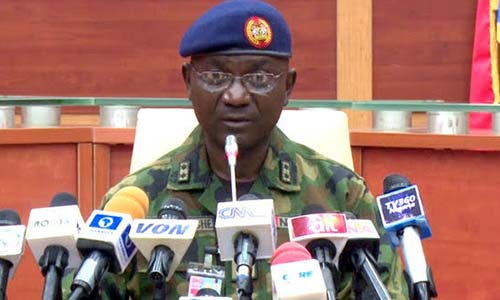
Against the backdrop of questions being asked as to the propriety of the Nigerian Army’s involvement in the shooting of Lekki EndSARS protesters and a recent report by CNN saying that live bullets were used, the Chief of Army Staff, Lt. General Tukur Buratai has said the Nigerian Army is a professional Army who will never operate outside the rules of engagement.
Speaking on the EndSARS issue when he received members of the House of Representatives committee on Army at Army headquarters on Wednesday, Buratai said, “let me assure you and all Nigerians that the Nigerian Army is a professional Army. We follow our rules of engagement. Nigerians should feel safe.
“We abide by rules of engagement and the constitution of the federal republic of Nigeria.
On the issue of kidnapping and banditry causing untold hardship on citizens along the Abuja – Kaduna road, the COAS said, “the issues of kidnapping and bandits attacks are being taken care of” noting that the Nigerian Air Force and the Army are doing a lot in this regard.
Towards boosting the capability of the Army to subsequently rise up to the challenges of insecurity in the country, Buratai disclosed that the Nigerian Army Aviation is being reactivated pointing out that the Helicopter project is at the ‘heart of our plans’
The movement to hold the Nigerian police force’s Special Anti-Robbery Squad accountable for its crimes has been driven by female activists.
Odunayo Eweniyi, one of Nigeria’s trailblazing tech entrepreneurs and the COO of the app PiggyVest. Wine and Whine was very successful, and Odufuwa and Eweniyi felt inspired to start a new venture with a focus “on education, financial freedom and representation of women in public office.”ADVERTISEMENT – CONTINUE READING BELOW
‘‘Over the past few years, Nigerian women and activists have crowdfunded on Twitter to support other women and girls who have experienced gender-based violence,” Odufuwa told ELLE.com. ‘‘These funds were used for legal aid, education, mental health support, housing, and shelter, etc. [Eweniyi] and I wanted to do more than just support or crowdfund donations intermittently. We also felt the fight for women’s rights needed to include financial freedom for women and many changes to the misogynistic laws and norms in Nigeria. But we knew we couldn’t do this alone.”
So in July 2020, Odufuwa and her contacts decided to come together to create a coalition of women who were passionate about making their country and the role of women in it better. They called it the Feminist Coalition, and they had no idea how soon their dream of changing Nigeria would become a reality.
Damilola Odufuwa, co-founder of the Feminist Coalition.AISHA IFE
In the early weeks of October 2020, videos made the rounds on social media showing members of the Nigerian Police Force’s Special Anti-Robbery Squad, shooting at, harassing and killing unarmed citizens. The videos appeared alongside increased reports from hundreds of Nigerians in different parts of the country all confirming an increase in brutality and harassment of citizens by the SARS unit. These reports all seemed to corroborate a simple fact: SARS, which was created to tackle violent crimes like kidnapping, murder and armed robbery, appeared guilty of committing the very crimes it was created to fight against, on the citizens it was created to protect. Within days of these videos spreading on social media, young Nigerians—first all around the country, then all around the world—took to the streets demanding the Nigerian government put an end to the infamous unit.
As the #ENDSARS movement gained significant momentum, many insisted the protests remained leaderless. On social media and in real life, Nigerians took to screaming ‘#ENDSARS no get leader, na all of us be the leader,” a phrase in the Nigerian vernacular that translates to “#ENDSARS doesn’t have one leader, we are all the leaders of it.” When pushed to pick a leader by government officials, organizers referred to the people who were killed, and said they were the leaders. But even as the movement remains without any one leader or governing body, behind the scenes, it’s largely being run by Nigerian women. RELATED STORYWhat to Know About #EndSARS
One of the first actual #ENDSARS protests of 2020 was organized in part by Rinu Oduala, a social media influencer who coordinated protesters in Lagos to head to the state government house. And one of the most viral images from the protests features Aisha Yesufu, a Nigerian Muslim woman and community organizer, who had marched with protesters in Abuja and was the only person who didn’t run when the police force in the Nigerian capital shot at protesters. Popular podcaster Feyikemi Abudu and lawyer Moe Odele are among other women who contributed greatly to the movement and helped create a network across the country that ensures the safety and release of protesters who were illegally detained. Although neither women are members of the Feminist Coalition, they worked with it to create and maintain these networks.
Ire Aderinokun, Nigeria’s first female Google developer expert and a founding member of the Feminist Coalition.KUNMI OWOPETUADVERTISEMENT – CONTINUE READING BELOW
Indeed, it’s hard to believe the Feminist Coalition wasn’t created for this moment and this movement. It’s even harder to believe it started planning for the demonstrations within days and was able to fund arguably the biggest and most organized protest in Nigeria in recent memory while remaining accountable and transparent with every kobo (the smallest denomination of Naira) it spent.
‘‘Believe it or not, all this was organized over a one-hour phone call,’’ Ire Aderinokun, Nigeria’s first female Google developer expert and a founding member of the Feminist Coalition, told ELLE.com. ‘‘We’ve regularly had monthly meetings since our inception, but we had not started on any projects yet. When we saw what was happening, we quickly decided we would take this on as our first project. We wanted to play our part and everyone was in agreement and very quickly stepped up. We joke that this was a baptism by fire. We designed a logo, set up the website, got some copy assets together, set up our social media, set up the donation accounts, the request forms, the tracking sheets; Feminist Coalition as it’s known today was literally a reality overnight. This was only possible because every founding member is at the top of her game. We handled it the same way we handle our professional work, and brought the same amount of focus and dedication to the table.’’This content is imported from Twitter. You may be able to find the same content in another format, or you may be able to find more information, at their web site.
There’ll be some traction to the #endsars movement when women organize around it.
There’ll be some traction to the #endsars movement when women organize around it.— Ozzy Etomi (@ozzyetomi) October 4, 2020
As historic as this is, it’s not the first time Nigerian women have been at the forefront of movements like this. The women of Nigeria have been leading, organizing, and maintaining the momentum of movements since colonial Nigeria. Recent movements like the fight to return the kidnapped Chibok girls and #ArewaMeToo—a form of the global #MeToo movement which focused on Northern Nigeria and was founded by Fakhus Hashim—are just two recent examples. It’s this history that made writer and communications strategist Oseyi Etomi tweet about the #ENDSARS movement just days before the protests gained significant global momentum. “There’ll be some traction to the #ENDSARS movement when women organize around it,” she wrote. She was right. Women—in particular feminist Nigerian women—organizing around #ENDSARS has been a significant reason the movement and protests have been sustained for as long as they have been, and why they’ve had such a global impact.
Ozzy Etomi, a writer and communications strategist.LAKIN OGUNBANWO STUDIOS
‘‘When you look back in history, women have always been at the forefront of organizing, especially when it comes to serving the community.’’ Etomi told ELLE.com. ‘‘This was no different. One thing you will see in common with, I’d say, almost all if not every woman who was at the forefront of organizing was that we are all feminist women—we have a strong sense of social justice and a desire for an equal society. An injustice to anyone is an injustice to us all, and there is an understanding that no one is free until we are all free. It just continues to show that women are an underestimated asset to society and that we need more women in leadership roles and at every level of governance including the highest seat in the country.’’
“An injustice to anyone is an injustice to us all, and there is an understanding that no one is free until we are all free.”
Within seven days of organizing around the movement, Feminist Coalition was able to fund over 154 protests around Nigeria with N20,188,280 (approximately $52,000), and by October 21 it raised a total of N77,190,305 (approximately $198,000). Beyond the impressive crowdfunding numbers, what’s perhaps the most striking for many Nigerians is the consistent transparency of Feminist Coalition; at the end of every day, it updates the public on how much has been raised and in what currency, and how much has been disbursed and for what. This transparency has been praised almost as much as the group’s efficiency—two qualities many Nigerians note their government lacks. Within Nigeria, a country where misogyny is rife and encouraged and where several patriarchal laws are still in place, the splash and impact made by Feminist Coalition is a win in and of itself.
Layo Ogunbanwo, VP of Product at PiggyVest and another founding member of the Feminist Coalition.LUMIOGUNDE
When the #ENDSARS protests got bloody on October 20, when members of the Nigerian army reportedly arrived at the Lekki Toll Gate in Lagos and shot and murdered dozens, Feminist Coalition turned its focus from sustaining physical protests—which are being discouraged to avoid further casualties—to paying out the bills of injured protesters, as well as working with other organizers to ensure peaceful protesters across the country that were arrested and wrongfully jailed are set free. Now, s in-person protests slow, the women of Feminist Coalition have been the targets of significant backlash. The names of the founding members were included in a recent lawsuit accusing them of encouraging domestic unrest, and the government denied several reports speculating that the women placed on a no-fly list that barred them from leaving the country. Despite the government’s denial, lawyer Odele, who has worked to release #ENDSARS protesters, was prevented from leaving the country and even temporarily had her passport seized. Still, the women of the Feminist Coalition are excited about turning their sights back to and focusing on their core goal of fighting against the oppression that is part of the daily lives of Nigerian women, and ensuring more feminist Nigerian women are placed in positions of power.
‘‘This is one of our founding pillars. We realize that beyond activism from the fringes of governance, we need more women with feminist values in actual power,’’ Layo Ogunbanwo told ELLE.com. ‘‘There are many other organizations, such as ElectHer, that are also advocating for women in public office. This shows a definite mindset shift in how we are approaching women’s rights, and understanding the importance of women in governance. We want more capable women to step up and we are ready to throw our support behind them.’’
An insidious trend has emerged across Germany: More and more young women from Nigeria are being trafficked into prostitution. It is one of organized crime’s most lucrative business models, but the ringleaders are rarely caught.
In the red-light districts of German cities, business is thriving – and so is the trade in young Nigerian women. Every year, more young women from the West African country are being smuggled into Germany and forced into prostitution.
Generally, girls and women who fall prey to trafficking networks are already vulnerable because of their circumstances – often they are the children of single parents or orphans, says Barbara Wellner from Solwodi, a German non-profit organization for trafficked women.
One victim, Anna, lived in her grandmother‘s house in Nigeria together with her mother, brothers and sisters. She had four years of schooling before she was put to work on the farm, German national radio Deutschlandfunk reported.
“When I was 16 years old, the family decided that I should be circumcised. I didn‘t want that, I was scared, so I refused. My mother hit me because I wouldn‘t conform to tradition. I couldn‘t see any other way to escape from being circumcised except to run away. I had no home anymore, so I walked the streets and tried to find help.“
Young Nigerian girls and women in vulnerable situations are easy pickings for human traffickers. The person who offers to “help” them is often a relative or family friend, Wellner says. But “help” means being caught in a trap via a criminal network controlled by a Nigerian “madam” and leading all the way to Germany.
The young victim is told that she will have to pay a lot of money to get to safety in Europe, but once she is there she will get a good job and easily repay the debt.
In 2018, a young Nigerian woman arrested by German police told them how she had become the victim of one of these networks. Born into a “relatively poor family” in Nigeria, she said she was told that she could earn huge amounts of money working in Europe.
The woman’s story led to a major trafficking investigation – Operation Redroot – and the prosecution of the ringleader of a network that brought young Nigerian women to Europe and forced them to work as prostitutes — a woman known to her victims as “Madam Sandra.”
The real story – Madam Sandra
It was during the long legal trial of Madam Sandra, whose real name was Josephine Iyamu, that the extent and the grisly details of how victims of trafficking are subjected to abuse were revealed.
Iyamu, a British nurse, had promised to arrange for her victims to travel to Europe if they paid her a staggering 30,000 euros each. First they had to swear that they would not betray her to police or fail to repay their debt.
This pact was sealed in a voodoo or “juju” ceremony, in which the women were forced to eat chicken hearts, drink blood mixed with worms and have powder rubbed into cuts. The process gave Iyamu “crushing psychological control” over the women, according to Nigeria’s National Agency for the Prohibition of Trafficking in Persons, NAPTIP, which was part of the joint operation that led to her arrest and conviction.
The victims were then sent on a journey across the Sahara desert from Nigeria to the Libyan coast, during which they were shot at and raped, according to the UK National Crime Agency‘s senior investigating officer, Kay Mellor. From Libya, they took an inflatable boat to Italy, where they were given false identification papers, allowing them to travel on to Germany.
Why Germany?
More than 20,000 Nigerian women have crossed the Mediterranean to Italy in the past three years. The UN estimates that roughly 80 percent have ended up in prostitution. For most of them, the journey to Europe ends there, on the streets on the outskirts of Rome or Verona.
Now, however, smugglers and traffickers are bringing increasing numbers further north, to Germany. There are at least two possible reasons why: First, organized prostitution, such as brothels, is legal in Germany. Solwodi says Germany’s liberal laws on prostitution, which were reformed in 2017, have turned the country into “the bordello of Europe.”
Second, Germany isn’t doing enough to stop the traffickers. The authorities say they are making a greater effort — this year, for example, a Nigerian madam was convicted and sentenced in Duisburg to five years imprisonment. Each year the national criminal police agency, BKA, publishes the figures on trafficking.
In the report for 2018 it notes that it identified 61 Nigerian victims, reflecting a continuing upward trend for that group. Germany has also been part of an EU-wide project ETUTU, cooperating with Nigerian authorities to crack down on international Nigerian trafficking networks.
But German authorities could be doing much better in tackling organized crime, including traffickers, says Sandro Mattioni, a German writer and expert on mafia groups. “Organized crime can be fought on a number of levels,” Mattioni told Deutschlandfunk. “If a state acts against organized crime in a significant way, then the state becomes unattractive for such groups.”
The market prevails
But with the value of just one woman trafficked into prostitution estimated at 55,000 euros, according to Deutschlandfunk, the business remains highly attractive to criminal groups.
Nigeria has been active in trying to expose and discredit people who misuse “juju”, and in targeting traffickers. But where this has led to gaps in the trafficking business, new operators have moved in – the so-called Nigerian mafia, whose tactics of absolute terror have replaced the trickery and psychological conditioning of the past.
“In the end, it all comes down to money,” says John Omoruan, a former member of prominent Nigerian trafficking gang the Black Axe. The trafficking of Nigerian women will go on for as long as there is demand in Europe for younger and younger girls, he told Deutschlandfunk. “Europe is hungry, hungry for drugs, underage girls, anything that’s forbidden.“
Another gang member was arrested in Germany and five other members were found to be members of a cult known as the Supreme Eiye Confraternity. In August 2016, the United Nation’s International Organisation for Migration (IOM) released a statement on the crises levels of trafficked women and girls from Nigeria to Europe.
The IOM put the number of Nigerian women who arrived by boat to Italy in the first six months of 2016 at about 3,600, nearly double the number who were registered in the same time period in 2015.
In 2014, about 1,500 Nigerian women arrived by sea. In 2015, that figure increased to 5,633. According to the IOM, more than 80 percent of these women will be trafficked in to prostitution in Italy and across Europe. Watch story of Nigerian woman trafficked into prostitution using black magic:
Meanwhile, we will like to hear from you. Feel free to share your thoughts with us in the comments section below.
SHOCKER! Over Half A Million Kenyans Are Not Aware They Have HIV | SEE WHY!
Kenya is home to one of the world’s worst HIV and AIDS epidemics. Approximately 1.5 million people are living with HIV, and an estimated 1 million children have been orphaned by the virus. The prevalence peaked in 2000 and, according to the latest figures (2010), has dramatically dropped to around 6.3%.
According to a report published by Daily Nation, about 530,000 Kenyans don’t know they are HIV positive. According to the report, a study done by the Ministry of Health in conjunction with the National Aids and STI Control Program shows that for every three Kenyans who test HIV positive, at least one new case is diagnosed through their referral.
Through the Assisted Partner Notification Services study, 1,119 Kenyans who tested positive were asked to provide contact information of people they have had s*x with in the last three years. The study, however, excluded women who faced the risk of s*xual partner violence.
Dr. Peter Cherutich from the Ministry of Health led the research and said they recruited patients who had tested HIV positive and requested them to provide contact details of their partners, including the casual ones. “We then notified these partners through phone calls within two days and in some instances visited them,” he added.
Last Thursday the House of Representatives declared viva voce that it would not reduce the humongous salaries, allowances and emoluments of its members despite the persistent demands of the public to that effect. The House argues that it is the executive arm of government which manages a large chunk of the national wealth that should reduce its salaries, not the National Assembly which manages just a paltry per cent of the national wealth.
Hear the House of Representatives Spokesman Benjamin Kalu, “The 0.8% of the national budget for the National Assembly is not enough to run the National Assembly. If you want to cut salaries, expenses, cost of governance, start it from the Executive…people think that the money that comes to the National Assembly is divided by members of the House of Representatives and the Senate. That’s a wrong narrative…Nigerians will be shocked that people they thought were rich are not able to meet their needs and that’s the truth…”
It is preposterous that amid the vicious cycle of poverty in the land and dwindling government income occasioned by the plummeting oil prices, the members of the National Assembly are opposed to the reduction of their fat salaries and emoluments aimed at pruning the high cost of governance, and, by extension saving Nigeria from imminent bankruptcy. You will recall that one of demands of the Nigerian youths during the #EndSARS protests was the reduction of the scandalous salaries and emoluments of the members of the National Assembly. Besides in August this year the Speaker of the House of Representatives, Femi Gbajabiamila stated that the ravaging COVID-19 pandemic had had a huge negative impact on the country’s revenue Nigeria and therefore Nigeria was inevitably committed to drastically reduce the cost of governance in order to stabilize the economy. You will recall that in June this year President Muhammadu Buhari approved the implementation of the report of the Rationalization and Restructuring of Federal Government Parastatals, Commissions and Agencies(popularly called the Oronsaye Report) which recommended the merger, conversion and scrapping of many government agencies. Former Governor of Central Bank Lamido Sanusi once shocked the nation when he revealed that 25 per cent of the entire federal overheads were expended on the National Assembly and that that the National Assembly alone was getting N136.259, 768,102, that is exactly 25.4 per cent of the total Federal Government overhead of N536, 268, 49,280. So, the high cost of governance in Nigeria has become such a disturbing phenomenon that everybody in Nigeria wants a reduction of the cost of governance in order to save Nigeria from final collapse.
If consensus had been reached across board on the need to reduce the cost of governance in Nigeria, why the procrastination in doing so? Why the sudden volte-face of the House of Representatives after Speaker Gbajabiamila had said that the House was committed to reducing the cost of governance in Nigeria?
The monthly emoluments of our Federal legislators is said to be higher than that of the Presidents of most countries. So, why are the Federal legislators complaining that they are not earning enough?. Why are they making a counter-accusation and alleging that it is the Executive arm that should reduce the salaries of its members not the Legislature?. Why the foot-dragging in implementing the Oronsaye Report? Nigeria has become a theatre of absurdities otherwise why should the Executive and Legislature which are supposed to be acting as checks and balances on each other now quarreling over the sharing of the spoils of office in a country completely ravaged by crass poverty. The Federal government is about to borrow another $750 million from the World Bank. What for? You may ask. I wouldn’t be surprised if the monies are used to settle the scandalous salaries, emoluments, travel allowances, ward-rope allowances, housing benefits and others of our legislators and public office holders.
The Buhari government is broke. So, common sense dictates that it should stop borrowing money and using it to indulge in fanciful spendthrift, extravagance and wasteful expenditure. Ours is a country of incestuous government extravagance and sheer waste. For example, the running of the Presidency alone guzzles a good chunk of the nation’s wealth. Likewise running a State government. A State governor was once quoted as boasting before a Senator and saying: “you people get N53 million every quarter, we get N3 billion every month”. Look at the scandalous amount budgeted to maintain the presidential fleet. The President has more than six aircrafts in his convoy, not to mention that his daughter flies on a Presidential jet from time to time. In the 2020 budget about N3 billion has been officially budgeted as travelling allowances of the President and Vice-President alone. Little or no work is done in many of the federal government Ministries, Commissions and Parastatals in Abuja yet the idle public officers employed therein are paid every month for doing nothing.
Worst still, many government offices in Abuja are bloated offices with little or no work done in them. During working hours, many of the so-called government workers are seen charting away or idling away along the corridors. If you go to the Federal Secretariat, Abuja you will find many government workers milling around without any work assigned to them to do. Once I went to the office of the Federal Character Commission, Abuja to ascertain the functions of the Commission. You can’t believe what transpired. Not even the staffers of the Commission could explain to me the specific functions of the Commission. How long shall we continue to sustain this grueling rip-off called democracy at the expense of the poverty-stricken people of Nigeria? How long shall we continue to tolerate a rip-off democracy in which the average Federal legislator rakes home about N53 million every quarter?
Therefore the Buhari government should muster the political will to implement the Oronsaye Report in order to trim down the cost of governance in Nigeria. All the Presidential jets should be sold off except one. Salaries and emoluments of our Federal legislators must be slashed now. The Presidency does not need about 100 government Parastatals under it. Most Federal agencies and Commissions encumbering Abuja should be scrapped or merged or collapsed into one or two agencies. Government bureaucracies should be reduced and streamlined.
Pursuant to section 147 of the Nigerian Constitution, we need 36 Ministers not 43 Ministers. A Minister does not need 10 official cars, 10 drivers, 10 special assistants and about five personal assistants. A Special Assistant to, say, a Minister, does not need a Special Assistant. A deputy-Director of a Parastatal or a Ministry does not need 5 official cars and 5 drivers. A Special Adviser does not need to have his own Special Advisor or executive assistant or a retinue of officials and cars. A legislator does not need a retinue of idle staff to be sleeping in the office every day. Since the Nigeria Police Force, ICPC, EFCC, CID, NDLEA and DSS are mostly performing the same functions, why retain all of them?. It is necessary to foster frugal lifestyles among our political office holders in which extravagance, spendthrift and waste would be minimized.
His Lordship, Hon. Justice Zaynab Bashir of the National Industrial Court, Portharcourt Judicial Division has declared MARITIME WORKERS UNION OF NIGERIA as the appropriate union to unionize workers or persons engaged by clearing and forwarding agencies for the purpose of haulage of containerized goods.
The Court held that by the provisions of the Constitution and the Trade Union Act that the members of the Maritime Workers union cannot be controlled by the NATIONAL UNION OF ROAD TRANSPORT WORKERS in whatever form, and cannot compel their members to become its members.
Justice Zaynab also granted an order of perpetual injunction restraining the NURTW either by itself, agents, acting or purporting to act on its behalf from demanding fees, dues, tolls or any payments whatsoever from the Maritime Workers union members, or in any manner whatsoever coercing or compelling the members to pay any dues to them.
From fact, the claimant- MARITIME WORKERS UNION had averred that sometime in 2011, the Defendant-NURTW started forcing and coercing the members in the haulage unit to pay dues and to become their members which were resisted, and further submitted that by law, NURTW cannot compel any person who subscribed to membership of their Union to belong to the Defendant’s union, sought amongst others for a declaration that the act of the NURTW and its members in blocking and harassing their members is illegal, unconstitutional and wrongful; and the sum of 1 Million Naira general damages.
In defense, the Defendant- NURTW maintained that since the clearing and forwarding agents engage the member of the Haulage Unit of the Union and issue receipt to such members is unlawful that it is their Union and its members that has the statutory power to engage in the business of transportation of goods and passengers in Nigeria while the duty of the Claimant-Maritime Workers is limited to the carriage of goods in the maritime environment only.
Furthermore, NURTW Counsel, Martin O. Nwabali Esq added that no trade dispute between the Claimant and the Defendant urged the Court to strike out the suit for want of jurisdiction and grant the counterclaim.
In opposition, the claimant’s counsel Awa Ndubuisi with E.I. Ikwuebesi maintained that the Court’s has jurisdiction to entertain the matter, urged the court to grant all the relief sought.
Delivering the Judgment, the presiding Judge, Hon. Justice Zaynab Bashir assumed court jurisdiction and held that both unions jurisdictional scopes do not expressly accommodate haulage drivers who convey containerized goods from Sea Ports.
“However, upon taking the general nature of the work of the Haulage drivers who convey containerized goods from Sea Ports to the respective owners into account, I am inclined to review both jurisdictional scopes of the Claimant and the Defendant to determine which of the two unions can indeed accommodate the said haulage drivers.
“The Defendant union can only accommodate workers involved in the transportation of person and goods by road. It is also not empowered to unionize persons who are transporting petroleum products and transportation undertaken by self-employed persons.
“In other words, the jurisdictional scope of the Defendant union is to be restrictively interpreted and by so doing, any worker who is undertaking transportation as self-employed cannot be unionized by the Defendant.
Lastly, the court refused the claimant claim on harassment and dismissed the counterclaim for lacking merit.
The Nigerian Embassy in Germany has suspended one of its staff accused of demanding sex-for-passport and equally began an investigation into the claims.
“The Embassy of Nigeria in Germany announced today that it has suspended with immediate effect a local staff (security unit) in connection with allegations of sexual abuse and other serious criminal activity,” the embassy said in a statement on its Twitter handle.
“The staff, who cannot be named for legal reasons, was suspended following the circulation of material on social media that suggested the official was demanding sexual favours in return for official services.”
H.E Yusuf Tuggar, Nigeria’s Ambassador in Germany said: “we have a zero-tolerance policy towards abuse of office and especially of sexual misconduct. Our full resources are being deployed to investigate a very serious incident and any other abuses that this inquiry may reveal.
It quoted the Nigerian Ambassador to Germany, Yusuf Tuggar as saying that the embassy has “zero-tolerance policy towards abuse of office and especially of sexual misconduct. Our full resources are being deployed to investigate a very serious incident and any other abuses that this inquiry may reveal.
Ambassador Tuggar explained that investigation into the matter would be done with urgency and due diligence “that this very serious situation demands. When due process is complete, any guilty party can expect to face the full weight of the law. Our heartfelt sympathies are with any innocent victims of abuse.”
The Embassy of Nigeria in Germany announced today that it has suspended with immediate effect a local staff (security unit) in connection with allegations of sexual abuse and other serious criminal activity.
A video showing an unnamed staff of the Nigerian embassy in a hotel where he had allegedly planned to meet a lady for sex to In a viral video, the unnamed staff of the Nigerian embassy was seen in a hotel where he had allegedly planned to meet a woman for sex in order to aid the issuance of her passport.
‘They pointed their guns at us and started shooting’
This story contains graphic imagery of injury and death. The full names of some interviewees and the identities of others have been withheld for their safety.
Sometime after midnight on October 21, Elisha Sunday Ibanga answered a phone call from his older brother’s number.The person on the other end of the line — a stranger — broke the news that Ibanga’s brother, Victor, had been shot dead at the Lekki toll gate, in Lagos, Nigeria, where he had been peacefully protesting against police brutality earlier that night.”The person told me that the police took his body away,” Ibanga, 24, told CNN.An eyewitness to Victor Sunday Ibanga’s death told CNN the 27-year-old entrepreneur was shot in the head during the protest.CNN has obtained and geolocated a photograph of Victor’s body lying in a pool of blood and wrapped in the white and green of the Nigerian standard — one of the same flags gripped by fellow protesters earlier in the evening as they sang the country’s national anthem. Ibanga confirmed the photograph is of his brother.
The body of Victor Sunday Ibanga is pictured in a pool of blood.The Ibangas are one of several families yet to locate the bodies of their missing loved ones — protestors at the toll gate — who dozens of eyewitnesses say were shot at, first by members of the Nigerian army and then hours later by police. Eyewitnesses told CNN they saw the army remove a number of bodies from the scene.What happened on October 20, and into the early hours of October 21, at the eight-lane Lekki toll gate — a key piece of Lagos’ road network — has stunned the country.The protesters who were present have told CNN it was a “massacre” with multiple people killed and dozens wounded. But local authorities have downplayed that account.Lagos State Governor Babajide Sanwo-Olu, admitted to CNN that footage showed uniformed soldiers firing on peaceful protesters but claimed only two demonstrators were killed. But, he then said there was “not a scratch of blood” at the toll gate when he visited. The governor said no families had approached authorities saying they were missing relatives.In the immediate aftermath of the shooting, the army denied any involvement, describing reports of the incident as “fake news,” before backtracking and saying that soldiers were present but fired their weapons in the air and used blanks, not live rounds.CNN’s calls to the Nigerian army have not been returned. But on November 14, during a judicial inquiry into the shooting, army representative Brigadier Ahmed Taiwo said, “There’s no way officers and men will kill their brothers and sisters. I repeat no way. We have those who constantly seek to drive a wedge between us and between the citizens of Nigeria…”The army also said at the hearing that it was the governor who called soldiers to the scene because the police were overrun. The governor has denied this, saying he does not have the authority to call in the army. The army has continued to restate that they did not fire live rounds.But an investigation by CNN into the disputed events has cast doubt on authorities’ shifting and changing statements.Evidence of bullet casings from the scene match those used by the Nigerian army when shooting live rounds, according to current and former Nigerian military officials. Verified video footage — using timestamps and data from the video files — shows soldiers who appear to be shooting in the direction of protesters. And accounts from eyewitnesses establish that after the army withdrew, a second round of shooting happened later in the evening.Victor Sunday IbangaSince Elisha Sunday Ibanga learned of his brother’s death, he has been visiting hospitals in a desperate search for his remains.”My mother, my sisters, all my family are in prayer, just to see if we can find out and know where my brother’s dead body is,” he said.The bodies of other protesters are nowhere to be found.Peace Okon, 24, hasn’t seen her younger brother Wisdom, 18, since he went to the protest the night of the shooting.Wisdom Okon”He just came back from work on that Tuesday, ate his food and went there,” Okon told CNN.She started worrying when he didn’t arrive home that night. By the next morning, Okon was out searching for him. “I’ve gone to hospitals, I’ve gone to police stations, I’ve gone to everywhere. I can’t find him,” she said.Her brother had only moved to Lagos a few weeks before the protest — Okon had helped him find a job as a cleaner at a bank. She says he didn’t know anyone at the protest and had never been to one before.Okon said she wants the Nigerian authorities to tell her if her brother is alive and detained or dead.The shootings at Lekki toll gate followed weeks of “#EndSARS” protests against police brutality that had burst onto the streets of cities across Nigeria.For almost a fortnight, thousands of young Nigerians mostly under 30 — a demographic that makes up 40% of the country’s population — protested, with calls for an end to the Special Anti-Robbery Squad, a police unit widely and repeatedly accused of kidnapping, harassment and extortion.Police had agreed to disband the controversial unit but protests continued. It would be the fourth time it was being disbanded.There were peaceful marches, candlelight vigils, multi-faith prayer sessions and DJ performances that attracted backing and solidarity from celebrities, the Nigerian diaspora and supporters around the world. The movement quickly widened beyond police brutality to other grievances — capturing the frustrations of a young population demanding an end to bad governance in the oil-rich country.
Lekki, a relatively affluent suburb of Lagos, and the toll gate became a focal point of the movement.However, about 10 days into the protests, the demonstrations were hijacked by “thugs and sponsored hoodlums” who attacked protesters, causing deaths and injuries, according to Amnesty International Nigeria.In response, on October 20, hours before the shooting, Governor Sanwo-Olu imposed a strict curfew starting at 4 p.m. following looting and vandalism in other parts of the state.It was later moved to 9 p.m. to allow commuters to get home. The timeline for when the curfew was imposed has become a point of contention between the Governor and the military. The army said their soldiers were unaware of the change to the later time, according to the army spokesperson’s testimony to the eight-person judicial panel on November 14.For 24 hours, only essential service providers were to be allowed on the streets of the 20-million strong city.Demonstrators protest police brutality at the Lekki toll gate on October 20.Testimony from dozens of eyewitnesses and family members interviewed by CNN and a forensic examination of hours of video and dozens of photographs captured before, during and after the two shooting incidents show how a fledgling protest movement was all but extinguished by the very thing Nigerians were demonstrating against.Less than three hours after the original curfew time came into effect, army trucks left the Bonny Camp barracks on Victoria Island and headed towards the toll gate plaza and the protesters, according to videos reviewed by CNN.Two eyewitnesses told CNN they saw soldiers arriving in a Toyota Hilux pickup truck with “OP Awatse” written on it — the name of a joint military task force that operates in Lagos State.Videos examined by CNN show the army trucks approaching the protesters from both sides of the toll gate — barricading them in.DJ Switch, a local musician whose real name is Obianuju Catherine Udeh, was streaming live on Instagram when it all happened and the shooting began.The shooting started almost immediately, with no warning given. Panic ensued as protesters attempted to flee.
“Please explain to me how, in which part of the world, do you go to a protest with live bullets.”DJ Switch
“There was a guy that was running, and he just… he fell, and we looked at him. He was shot in the back,” DJ Switch, 29, told CNN, as she tried to talk during an interview while crying.”Please explain to me how, in which part of the world, do you go to a protest with live bullets,” she said.From multiple videos, CNN has pieced together a timeline that shows that shooting by the army lasted from 6:43 p.m. until at least 8:24 p.m., according to video evidence.The videos capturing some of those 101 minutes tell a story of terror and chaos. They show graphic injuries and people bleeding on the ground.One eyewitness, Sarah, whose last name we’re not publishing for her safety, told CNN that the soldiers shot in the air but also directly at protesters.”They pointed their guns at us and they started shooting,” she said. “They were shooting in the air, they were shooting at us, they were shooting everywhere.”Some chanted: “We are peaceful protesters” and “End Sars, we no go gree [pidgin for we will not agree, or give in].””They’re shooting, they’re shooting,” another person screams in one of the videos. Cries of “Na lie, na lie [exclamations of disbelief in pidgin]” can also be heard.In several of the videos, reviewed and verified by CNN, some of the protesters can be seen carrying bodies, the flashlights on their phones the only thing illuminating the darkness as the sound of ambulance sirens wail in the background. It is not known whether these were dead or injured protesters.In another, there are several injured people, some on the ground bleeding while defiant protesters continued to wave Nigerian flags.Injured people whom CNN has confirmed were present at the toll gate started arriving in local hospitals — carried by civilians — from 7:19 p.m. while the shooting was still ongoing, according to videos analyzed by CNN.One of the protesters, Mathew, pictured, says he was injured when the army opened fire at Lekki toll gate. Using metadata, CNN geolocated the image to the protest location at 6:50 pm.CNN has also seen and verified footage from one man who used his car as a makeshift ambulance and transported people to hospital.Separately, Dr. Ayo Aranmolate, executive medical director at Grandville medical center, told CNN he and his colleagues received around 15 injured people that night with various gunshot wounds and cuts. None of the people they treated died, he added.”We referred some for treatment to other hospitals,” Dr. Aranmolate said. “One of the victims had to have his leg amputated.”The army has denied that anyone was taken to hospital with gunshot wounds, and that they only shot into the air.Speaking in front of the judicial panel, the army spokesman Brigadier Ahmed Taiwo continued to deny that anyone was shot.Multiple eyewitnesses told CNN that ambulances were prevented from reaching the scene by the authorities.A video filmed at 8:49 p.m., according to metadata, shows ambulance workers in a van at the scene saying they are unable to get through.When contacted by CNN to share the findings of this investigation, a Lagos State government spokesman declined to comment. “Talking about that subject now will be sub-judicial since the matter is already before a panel of inquiry. Until the panel concludes its investigation, the subject will not be open to any discussion or comment by any State official,” the spokesperson said.Members of the judicial panel visit the Lekki toll gate on October 30.DJ Switch said she wanted people to see what was happening which is why she started broadcasting.”I didn’t want anybody to come on and twist the story. I wanted people to see. So, I just went live.”At one point during the broadcast, there were attempts to resuscitate a man in red clothing who had passed out.Later, DJ Switch can be seen helping to extract a bullet lodged in another man’s thigh as he screams in agony. Someone in the crowd says, “you will live, you will not die.”As the live broadcast ends, people are still trying to apply CPR on the man in red, while DJ Switch can be heard saying, “this guy is dying.”DJ Switch told CNN that protesters lifted bodies with bullet wounds and put them at the soldiers’ feet.”I said, why are you killing us? Why are you doing this,” she said. “He expressly told me: ‘I am acting on orders from above.'”CNN has examined bullet casings found at the scene and confirmed with current and former Nigerian military sources that the bullet casings match those used by the army. Two ballistics experts have also confirmed with CNN that the shape of the bullet casings indicate they used live rounds, which contradicts the army’s claim they fired blanks.CNN has verified that bullets fired at Lekki toll gate are from live ammunition. This one was manufactured in Serbia in 2005, and is currently in use by the Nigerian army.And working with the Balkan Investigative Reporting Network, CNN has established that several of the bullets from the Lekki toll gate originated from Serbia. Export documents CNN has seen show that Nigeria purchased weaponry from Serbia almost every year between 2005 and 2016.After the army withdrew from the scene, members of the police, including the SARS police unit — disbanded by authorities on 11 October — moved in, according to multiple eyewitnesses CNN spoke with.In a video obtained by CNN and geolocated to Lekki toll gate at 2:36 a.m., one eyewitness, Legend, whose second name we’re not publishing for his safety, can be seen with the Nigerian flag around his head saying, “…my hand is broken, my leg is broken, and police are still shooting at us.”
“I couldn’t count how many dead because I was running for my life.”Legend
“They are shooting anything that moves outside…Stay safe through the night. And if I don’t make it through the night let it be known that I died fighting for our freedom, for what we believe in.”Legend, who survived, told CNN his father was a police officer and that he recognized the SARS uniform. About 200 protesters remained at the toll gate when witnesses say police and SARS arrived, he added.”I couldn’t count how many dead because I was running for my life,” Legend said. “If I stood my ground five more seconds, I would be dead.”While CNN has not been able to independently verify that SARS members were present, multiple eyewitnesses said they saw police officers, accompanied by officers from the unit, at the scene after the army left.A Lagos State police spokesman declined to comment because of the ongoing panel investigation. But police have denied any use of force against protesters on Twitter, saying, “….our police officers never resorted to use of unlawful force or shooting at the protesters.”The widespread looting and damage that occurred across Lagos in the aftermath of the Lekki toll gate shooting has led to the authorities clamping down on people who took part in the protests.Workers clean up the Lekki toll gate on October 24.Many feel they are being scapegoated for taking part in peaceful protests — wrongly blamed for the looting — and fear has descended on the movement since the shooting.Moe Odele, a prominent lawyer who was giving legal advice to demonstrators arrested during the protests, says she was recently prevented from leaving the country after her passport was seized. Odele told CNN that her passport has since been returned.The country’s central bank has obtained a 90-day court order freezing the accounts of those who took part in the demonstrations, according to media reports, while a journalist who covered the protests was arrested and detained for five days before being freed on bail.Several eyewitnesses have fled the country, while others are living in safe houses. Some told CNN they were offered money to recant their initial testimonies.CNN has seen some of the messages received, though it is unclear who is sending them.”We’re hiding because our lives are in danger,” an eyewitness named Sarah told CNN. “We can’t go out, our jobs are on hold right now, and it’s really sad because we did nothing wrong.”
The Nigerian Army said it has concluded plans for an inter-agency training workshop as part of its preparations for the launch of ‘Exercise Crocodile Smile VI’.
Col. Aliyu Yusuf, the Deputy Director of Army Public Relations, 82 Division, Enugu, stated this in a statement issued on Tuesday in Enugu.
“In line with Nigerian Army Training Directive 2020, 82 Division will be hosting a 2-day inter-agency training workshop to launch the Exercise Crocodile Smile VI in the South-East and Cross River.
“The workshop will be held between Nov. 18 and Nov. 19 at the division’s headquarters.
“The workshop is designed to further boost the existing cooperation among the various security agencies operating within 82 Division Area of Responsibility (AOR),’’ Yusuf stated.
The army spokesman said that the theme of the workshop: “Inter-agency collaboration: imperative for joint internal security operation,’’ would be achieved through carefully selected lectures.
The workshop is open to all security outfits and formations within the division’s AOR.
Delta Governor, Dr. Ifeanyi Okowa, yesterday, implored officers and men of the Armed forces to be humane in the discharge of their official responsibilities.
Governor Okowa gave the advice while flagging-off the Nigeria Army’s Operation Crocodile Smile VI at the army super camp located at kilometre 11, Benin-Asaba-Onitsha Expressway, Asaba.
Represented by the Secretary to the State Government, Mr. Chiedu Ebie, the governor said the advice became imperative because the society has become more conscious of their rights and how they want to be secured.
According to him, men of the Nigerian armed forces should not abuse the position they are given, adding that they should not use their position to abuse the rights of others in the society.
While applauding the Nigerian Army, especially the 63 Brigade, Asaba, for the event, he disclosed that the exercise, (Operation Crocodile Smile VI) was necessary as it showed the bond between the Nigerian Army and the society.
He therefore commended the military authorities for being conscious of the need for peace and security in the state and for contributing to the ‘Stronger Delta Agenda’ of the state government.
The 63 Brigade Commander of the Nigerian Army, Brig. Gen. Ibrahim Jallo said the exercise was an annual event that would dovetail into promoting sustainable peace and unity, pointing out that the exercise under the brigade was for the entire state
…Urges members of the public to disregard such publication
Adamawa police command through a press statement signed by DSP Suleiman Yahaya Nguroje denied invading a High Court in Adamawa and assaulting a lawyer.
In the statement, the command said a publication drawned their attention that “Police invade Adamawa high court, assault lawyers,brutalize suspects ,damage vehicle”.
The statement said that on 16/11/2020 Police Detectives attached to Criminal investigation Department (CID) received information on the where about of suspects that are on police wanted list over a case that is under investigation.
“The police acted within the context of the law with high level of professionalism and effect their arrest at the gate of the high court while on their way out of the court premises.
“The two suspects apprehended were connected with cases of Culpable Homicide and resisted arrest, turn down several police invitations.
“The police in Adamawa are friendly serving Officers with much respect to Court and Lawyers as such can not in any where assault our partners in enforcing the laws.
“The Commissioner of police OLUGBENGA ADEYANJU,fdc, commended Journalists for services they do render, equally advise them to always verify their reports before making it to the public.” The statement read
Our site uses cookies. By clicking “Accept All Cookies”, you direct Law and Society Magazine to store cookies on your device and disclose information in accordance with our Cookie Statement: cookie policyACCEPTREJECT
Privacy & Cookies Policy
Privacy Overview
This website uses cookies to improve your experience while you navigate through the website. Out of these cookies, the cookies that are categorized as necessary are stored on your browser as they are essential for the working of basic functionalities of the website. We also use third-party cookies that help us analyze and understand how you use this website. These cookies will be stored in your browser only with your consent. You also have the option to opt-out of these cookies. But opting out of some of these cookies may have an effect on your browsing experience.
Necessary cookies are absolutely essential for the website to function properly. This category only includes cookies that ensures basic functionalities and security features of the website. These cookies do not store any personal information.
Any cookies that may not be particularly necessary for the website to function and is used specifically to collect user personal data via analytics, ads, other embedded contents are termed as non-necessary cookies. It is mandatory to procure user consent prior to running these cookies on your website.