Home Blog Page 1111

Strike looms at CAC as union issues 21-day ultimatum to management

The Amalgamated Union of Public Corporations, Civil Service, Technical and Recreational Services Employees (AUPCTRE) at the Corporate Affairs Commission (CAC) in Abuja is spoiling for an industrial dispute with the management of the commission over what it termed “lingering industrial relations issues” bordering on injustice allegedly meted out to members of staff.

In a notice of industrial action dated December 18, 2020 and signed by Comrade Ibrahim Kiirfi, Chairman of AUPCTRE, CAC Chapter, the union accused the Registrar General of the CAC, Mr. Garba Abubakar of “high-handedness and grave injustice.”

According to the notice exclusively obtained by our correspondent, the union said it had written several letters to the commission’s board Chairman, Hon. Ademola Seriki and the Registrar General to address the “ugly situation,” but that nothing was done to address the “pains of the CAC workers.”

The aggrieved workers listed the issues at stake to include: “self-opinionated restrictions of vacancies on staff promotions against the recommendations of committee on organogram, unjustified barring of certain categories of staff from writing promotion examination against the recommendation of the committee on organogram, stoppage of all welfare proposals, hasty, draconian and unilateral decision-making leadership style, punishment of staff by stopping their salaries even before queries were issued during the peak of the COVID-19 pandemic as well as denial of earned 2019 promotion arrears,” among others.

In a resolution reached at the end of the union’s meeting on November 30, 2020, the agitating workers reminded the Registrar General of his pledge to run an “all-inclusive, staff-friendly, equitable and welfare based administration,” when Mr. Abubakar assumed duties at the commission in January 2020.  

“The Registrar General has enjoyed such a tremendous support and goodwill as evidently proven by such an unprecedented improvement in the commission’s productivity/revenue under his stewardship,” the union said.

In addressing the foregoing problems, the union urged the management to allow all eligible staff sit for the promotion examination without restrictions or exemptions.

To avert the looming industrial action, the union made the following recommendations:

“As earlier argued by the Board in December, 2019, Management should consider Principal Managers to Assistant Directors to Deputy Directors.

“Staff who were barred from writing earlier examinations should be rightly placed with the actual effective date they ought to have written the examination to ensure that seniority is maintained.

“To pay the 2019 promotion arrears or recognise it as future liability via accrual.

“Setting up modality for the consideration of recommendation on the proposed welfare package as key motivator to the existing effort that produces enhanced revenue.

“Management should be honourable, realistic and true with its promises,” amongst other recommendations.

Abraham Lincoln: A Courage Born of Depression

Abraham Lincoln knew great loss and deep sorrow throughout his life, and it may be that his lifelong melancholia gave him the strength to handle the crises of his years as president.

By Elizabeth Sherril

It was my grandfather who gave me a lifelong love of Abraham Lincoln, one that was to help me in a way he could never have imagined. As a boy of seven, Grandfather had seen the funeral train carrying Lincoln’s body home to Springfield, Illinois. From that moment, sobbing by the tracks, he’d taken Lincoln as the model for his own life of battling injustice.

I was seven when Grandfather gave me my first book about Lincoln. In Abraham Lincoln, the Backwoods Boy, I read about the son of a near-illiterate farmer, walking miles through the snow to borrow a book. Straining his eyes to read by firelight because he had to work in the fields in the daytime. Starting to write and getting whipped when his father caught him “scribbling” instead of feeding the pigs. Lincoln went right on writing. This determined boy became my model too. I started writing, and when I had to stop to set the dinner table I was sure Lincoln would have understood my feelings

At eight, I went to a new school. I remember going for the first time to its library, much bigger than the one in my old school, with quiet signs on the tables and portraits on the walls. Over the librarian’s desk was a color photograph of the president, Franklin Roosevelt, seated at his desk. On the right wall was a painting of George Washington standing by a cannon; on the left was one of Thomas Jefferson, holding the Declaration of Independence.

But it was the picture over the door, when I turned to leave with my new library card, that stopped me. It was a photograph, this one blackand-white: a tall, thin man with his hand on a table and with the saddest, most pain-filled face I’d ever seen. The gold letters on the frame said Abraham Lincoln. It couldn’t be! Lincoln, my brave hero, who won every wrestling match? The ragged boy who told such funny stories that crowds would gather to listen? They’d put the wrong name on the photograph

“Friendless, uneducated and penniless,” Lincoln left the family farm to strike out on his own in Illinois. That this disadvantaged young man was able to carve out a career for himself as a lawyer seems marvel enough. The fact that he did it while carrying the burden of depression was what astonished me. Lincoln was a sad, gloomy man, a man of sorrow.”

But of course it was Lincoln, and over time that portrait made him more important to me than ever. Already I was experiencing the bouts of depression that, three years later, would lead my parents to the then-rare step of taking me to a psychiatrist. Despite her help, I continued to have (and still do) occasional descents into those bottomless depths. And at these times, my model continued to be Abraham Lincoln.

My depression had no discernible cause. His had many. The death of an infant brother was not unusual for those times. But his mother’s death was as traumatic an experience as any nine-year-old could have. In the family’s one room cabin, there was no escaping her agonies from milk sickness, a disease then ravaging their Indiana frontier community. People who ingested milk or meat from cows that had fed on the white snakeroot plant suffered uncontrollable shaking, hideous stomach pains, continuous retching. For a week, Lincoln’s mother tossed in torture on her bed, her tongue turned black, unable even to speak words of farewell.

Abraham had one surviving sibling, a brilliant sister named Sarah who was two years older and his closest companion. Abe was 18 when Sarah gave birth to a stillborn child and died.

 At 22 and, in his own words, “friendless, uneducated and penniless,” Lincoln left the family farm to strike out on his own in Illinois. That this disadvantaged young man was able to carve out a career for himself as a lawyer seems marvel enough. The fact that he did it while carrying the burden of depression was what astonished me. “Lincoln was a sad, gloomy man, a man of sorrow,” his long-time friend and law partner said, noting once that “his melancholy dripped from him as he walked.”

Even after his successful run for a seat in the Illinois state legislature, his sense of dejection did not lift. When a bill he’d worked for was defeated, he wrote to a friend, “I am finished forever.” How familiar I was with this I’ve-failed-and-nowit’s-hopeless feeling! And yet…as despairing as he felt, Lincoln somehow managed to succeed in every way that mattered. It wasn’t that his depression went away. An artist working at the White House in the final year of Lincoln’s life remembered that “Mr. Lincoln had the saddest face I ever attempted to paint.” By my own late twenties, when my depression became incapacitating, reading about Lincoln’s life was a pathway back to the functioning world. Sometimes all I could do was stare at a photograph of his downcast face. Yet in the strange psychology of depression, this cheered me. If Lincoln could accomplish so much while feeling so bad, surely I could get up and do a little.

It was not until many years later that I began to see something even more life-giving in Lincoln’s story. Many times in accounts of his life, I’d noticed references to his melancholia. Now I came upon the defi- nition of that word as used in the 19th century: fear and sadness without apparent cause.

Without cause? But Lincoln had so many reasons to be depressed! They’d only multiplied throughout his life, culminating in the death of his two little sons and the terrible slaughter of the Civil War. But his melancholia suggested something more, something closer to the medical condition recognized today as clinical, or persistent, irrational depression.

It’s only in the last few years that researchers have delved into this aspect of Lincoln’s life. A family history of depression, “the Lincoln horrors.” Lincoln’s own conviction that he was constitutionally subject to melancholy, which he dubbed “my peculiar misfortune.” His frequent talk of suicide— there was a period when he didn’t dare carry a pocketknife for fear of using it to kill himself. Two major breakdowns, the first in his mid-twenties (the typical onset age for unipolar depression in men), the second in his early thirties.

“If what I feel were equally distributed to the whole human family, there would be not one happy face upon the earth.”

“I am now the most miserable man living,” he wrote at age 32. “If what I feel were equally distributed to the whole human family, there would be not one happy face upon the earth.” Concerned friends removed razors from his room, mounted a suicide watch and feared for his sanity. In an effort to escape his misery, Lincoln underwent the standard medical treatment of the times—a weeklong torment that would have included starving, bleeding, dunking in icy wa- ter, purging with black pepper drinks, swallowing mercury, applying mus- tard rubs that burned the skin raw. He emerged emaciated, exhausted and, unsurprisingly, feeling worse than ever. Today’s medicine offers effective drugs and skilled counseling. If these methods had been available then, Lincoln might have been a less sad and tormented person.

But would he have been as great? Here is the life-giving new insight Lincoln is bringing me. Many researchers today, looking afresh at Lincoln’s melancholia, are grateful that he was not “cured.” From his chronic depression may have come the coping skills, the realism, the wisdom that steered the nation through its greatest crisis. What strengths may depression have bestowed on our greatest president?

Humor.

Jokes and storytelling were Lincoln’s lifelong refuge from despair. As the casualty figures in the war mounted, grief threatened to overwhelm him. Far from a sign of callousness, his humor helped him bear the horrors he felt so deeply. “I laugh,” Lincoln told a disapproving member of his cabinet, “because I must not weep.”

Humility.

 He had the modesty of a man continually aware of his own defects. In an age of swaggerers, this highest official in the land called himself “a man without a name.” Knowing his own failings, he could forgive those of others. As Northern leaders called for continual retribution from the defeated South, Lincoln appealed for “malice toward none.

” Dedication to a great cause. It was the issue of slavery that pulled Lincoln back from the brink of suicide. Despairing of himself, he determined instead to devote his life to others. Dependence on God. “I am driven to my knees,” he said, “by the conviction that I have nowhere else to go.” He saw himself not as captain of the ship but as the humble helmsman, striving to steer as the true Captain directed.

Humor, humility, service to others, faith—these are qualities, I think, that all of us aim at. That it was not despite his depression, but in part because of it, that Lincoln’s character developed as it did—this is the wondrous promise he holds out to people like me. His arena was a national one, mine one of family and neighbors. But the fact that God can use the negatives of our lives, even the blackness of depression, to shape us to his purposes—this is good news indeed!


I SING

I sing
For the times of peace and plenty
For the times of laughter and love
For stomachs filled with bounties
For brows kissed with kindness
For lovers sated with pleasure.


I sing
For mornings of disquiet and
Perplexity turning to assurance.
I sing
In the moonlit night,
The wind carrying my melody to the
weary.


I sing
For the child cringing in the dark
For the widow brewing black tears
For the soldiers at war. For these,
For many I sing;
One voice, many melodies
I sing my song.

-By Kirsten Okenwa

JUSTICE

By Kirsten Okenwa

Who has seen the abode of Justice?
Where does she thrive and rest in solemnity,
Reigning as chieftain, defying wickedness?
Who knows the domain of Justice,
Where does she hold sway?
Is she satisfied after a day in the courts,
Does her grey hair inspire equity?
Does Justice prowl the streets in authority,
Does she find uprightness in the church?

Have you heard them hail her,
“Salute! To Justice, salute?”
Have you seen her bronzed marks –
On the limbs of the young,
Or her wise-grey streaks
On the hair of the old?

Who has seen Justice gambolling?
Is she jubilant on the dirt paths of the poor;
Those helpless ones called dispensable?
Who has seen Justice crush the wicked,
That conceited oppressor and tyrant?

Show me Justice.

Kanyip charting a new course for the National Industrial Court

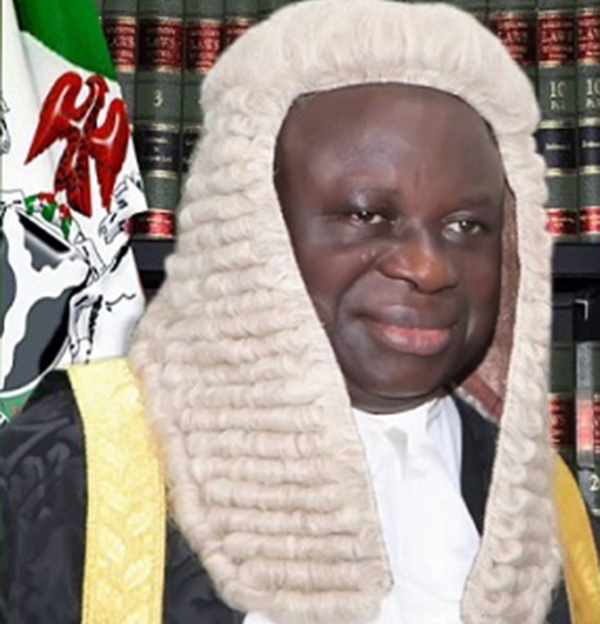
With a sound background in academics, Hon. Justice Benedict Kanyip who came in as the Court’s President a little over year ago has embarked on making quality labour justice delivery available to every litigant. Samuel Attah writes.

Over the years his doggedness, scholarship and contributions to issues bordering on the strengthening of labour jurisprudence and judiciary stood him out. These qualities particularly shone through when he concluded a study for the design of a Draft Labour Policy and Strategic Action Plan for the Economic Community of West African States (ECOWAS). Having distinguished himself, he caught the attention of the International Labour Organisation (ILO) and at their behest carried out a review of all the labour laws in Nigeria. Subsequently, the Federal Government of Nigeria nominated him as one of its two nominees in the Technical Committee for the reform of all the labour laws in the country. Ultimately, his elevation as President, National Industrial Court of Nigeria did not come as a surprise.

His predecessor focused on physical development, and repositioning of the Court, as a superior court of record. However, Hon. Justice Benedict B. Kanyip posits that that having consolidated that, it is time to build quality labour justice delivery. “The vision of any successor to an office is to take it to higher heights. But for us, it may not be in terms of increase in physical structures. There’s the issue of maintaining the structures that are on the ground but more importantly is the essence of the court itself which is justice delivery; quality labour justice delivery. And one of our priorities which I’ve made times without number is the possibility of reducing trial time and make dispensation of justice as quickly as possible. Once we can achieve that, we would have taken the court to the next level. Now is the time to concentrate on the quality of labour justice that we mete out.”

With a background in the academia, it is no surprise that Justice Kanyip is charting a different course. Further to his pursuit of quality labour justice delivery is the desire to be aided by digitalisation. “Right now our critical challenge is funding because issues of digitalisation is heavily capital based and you need a huge capital outlay to succeed. And digitalisation goes with e-filing, e-archiving and things like that. I’m sure you saw what happened to Lagos High Court at Igbosere where it was razed down. Imagine the loss of all documents in the court. So if we can achieve that in the long run, that will certainly be an achievement”, he remarked.

When he was appointed Judge of the National Industrial Court of Nigeria (NICN) in year 2000, for a tenure of four years, renewable for another four-year term, no one guessed that 19 years down the line, he will head the court. In the early days, appointments to the court could be for a term or renewed for another term. After completing his first term in June 2004, his appointment for another four-year term was renewed.

Born at Anturung-Attakar, Kaura Local Government Area in the Southern part of Kaduna State, North-West Nigeria, Kanyip obtained an LLB from Ahmadu Bello University, Zaria in 1985 and a BL from the Nigerian Law School, Lagos, Nigeria. He took up a teaching appointment with the university after the obligatory one-year national service in 1987 and rose to the position of Lecturer II before leaving for National Commission for Colleges of Education as Legal Adviser in the rank of Principal Legal Officer in 1992. He was appointed Senior Research Fellow at the Nigerian Institute of Advanced Legal Studies in 1995 and rose to the rank of Associate Research Professor of Law in 2000. He joined the Court in that year.

hor of the book: Consumer Protection in Nigeria: Law, Theory and Policy (2005), joint author of the text: Elements of Commercial Law (1994) and contributing editor of several academic law journals. Besides, he is a member of the International Bar Association; Fellow, Chartered Institute of Taxation of Nigeria; Life Member and Deputy President II, Nigerian Society of International Law.

After his confirmation as substantive President of the Court, Kanyip was sworn in on the 13th of December 2019. In his recommendation to President Mohammadu Buhari when he was due to retire, his predecessor Hon. Justice B. A. Adejumo recalled that when an opening for the position of Hon. President emerged in 2003, they both applied for the job and he (Adejumo) was chosen. Notwithstanding, Kanyip’s support was undiminished throughout his tenure. “I started everything with Justice Kanyip. I met him in this court. We both applied for the number one job and to the glory of God, I was chosen. To my surprise, he was the first person to call me to say congratulations and he promised unalloyed loyalty. He never derailed for once. I have no doubt that he will do well.”

“An author of numerous scholarly articles in the areas of consumer law, labour law, tax law and commercial law, Professor Kanyip is author of the book: Consumer Protection in Nigeria: Law, Theory and Policy (2005), joint author of the text: Elements of Commercial Law (1994) and contributing editor of several academic law journals.”

During his inaugural meeting with staff of the Court, the Hon. President announced that he will build on the achievements of the past to better reposition the court in line with global best practices. With a solid background in academics, labour and allied matters, there is little doubt that he will effectively lead NICN towards effective administration of justice.

Under his charge, between October 2019 and June, 2020, court disposed of 1,486 cases despite the challenges posed by the COVID-19 lockdown. While 627 cases were disposed of in the fourth quarter of 2019, the first quarter of 2020 saw the clearance of 619 cases. The figures dropped to 240 in the second quarter of 2020, the period when lockdown was most severe. Speaking at the commencement of the court’s new legal year, he disclosed that: “As at March 13, the court had 6,596 cases in its docket across the country with Lagos, Abuja, Port Harcourt and Ibadan leading in that order. Today, the total number of cased that are pending are 6095. This means that 501 cases were disposed of between March 13 and Sept. 30, 2020. COVID-19 did not allow for much filing of cases, but it did not stop the court from sitting and disposing of cases. The judges of the court, in line with the Practice Directions and Guidelines 2020, sat physically and virtually all through the COVID-19 lockdown and took the opportunity to dispose of especially cases that were at address and judgment stages.”

“The judges of the court, in line with the Practice Directions and Guidelines 2020, sat physically and virtually all through the COVID-19 lockdown and took the opportunity to dispose of especially cases that were at address and judgment stages.”

Kanyip further disclosed that one of the things which stood the court out was its regular and consistent uploads and updates of its judgments and rulings on its website, a fact that has received favourable reviews from commentators. The NICN is constitutionally recognized under sections 6 (5)(cc) and 254A of the Constitution as fourth on the list of superior courts of record. The Court consists of a President and such number of Judges as may be prescribed by an Act of the National

Assembly. It has exclusive jurisdiction in civil cases and matters relating to labour, employment, trade unions, industrial relations, national minimum wage, international best practices in labour and industrial relations matters, discrimination or sexual harassment at the workplace, application or interpretation of international labour standards, child labour, child abuse, human trafficking, interpretation and application of collective agreements, payment or non-payment of salaries, wages, personnel matters arising from any free trade zone in the Federation, etc. A total of 33 judges are currently serving in various divisions of the court.

Supreme Court makes history, has highest number of justices in 57 years

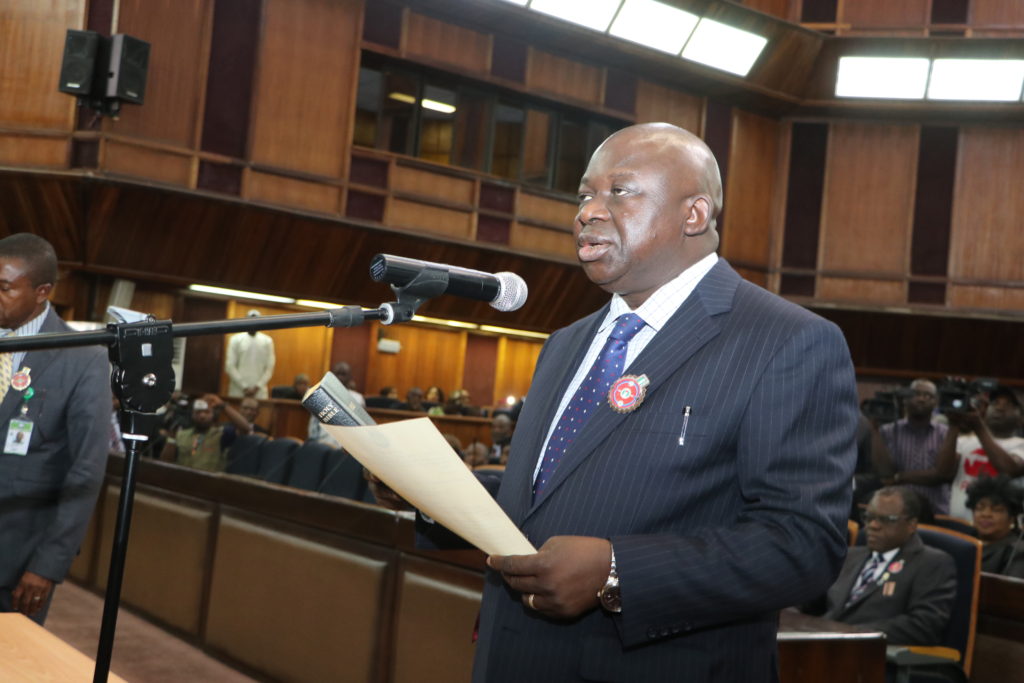
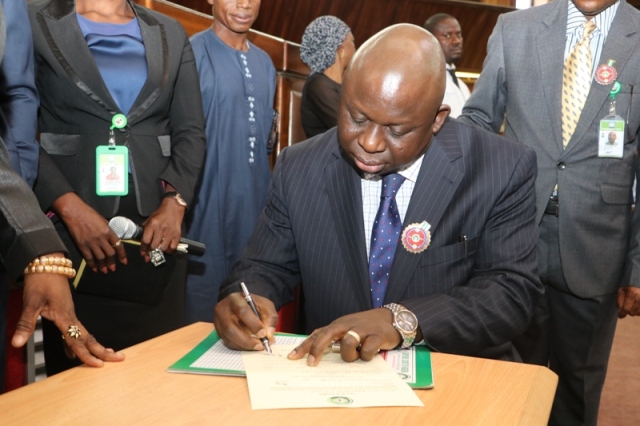
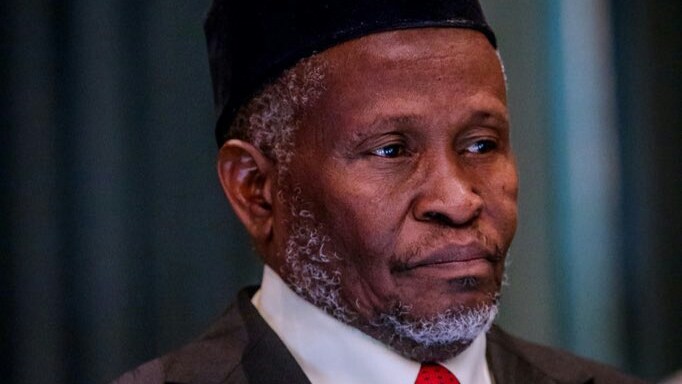
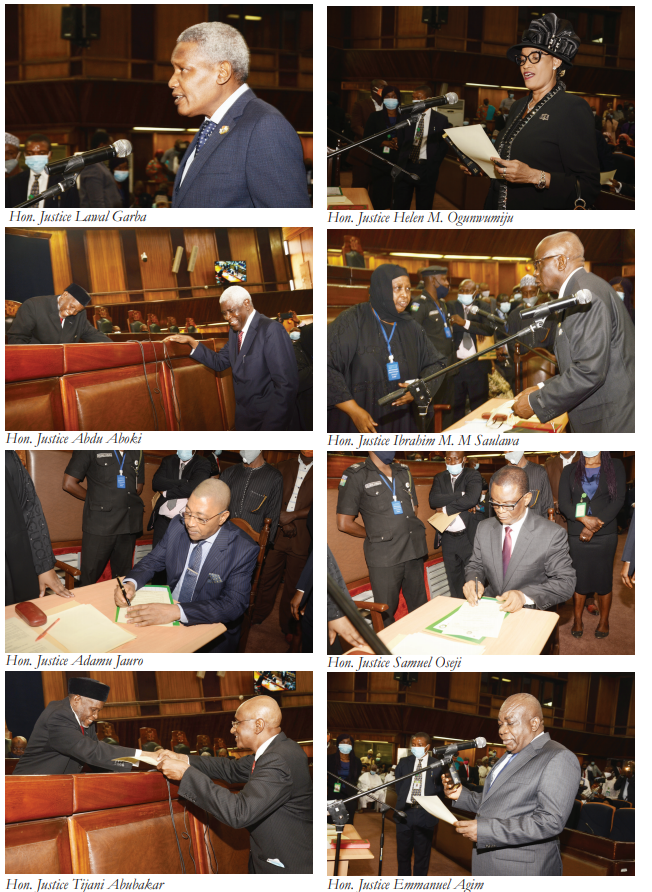
For the first time in its 57 years of existence, the Supreme Court of Nigeria now has 20 justices. This happened recently when the Chief Justice of Nigeria (CJN), Hon. Justice Tanko Muhammad, swore in eight new Justices of the Supreme Court.

The swearing-in, which took place at the Supreme Court complex, was sequel to the appointments made by President Muhammadu Buhari and confirmed by the Senate, on the recommendations of the National Judicial Council.

 The new Justices are Hon. Justice Lawal Garba, (North West), Hon. Justice Helen M. Ogunwumiju (South West), Hon. Justice Abdu Aboki (North West), and Hon. Justice Ibrahim M. M Saulawa (North West), Hon. Justice Adamu Jauro (North East), Hon. Justice Samuel Oseji (South South), Hon. Justice Tijani Abubakar (North East), and Hon. Justice Emmanuel Agim (South South).

On account of deaths and retirements, the number of justices prior to swearing in of the new justices was 12. Their elevation brought the number to 20, making it the highest in 57 years since the Court’s inception as Supreme Court of Nigeria on October 1st 1963.

The 1999 Constitution provides that the total number of justices of the Supreme Court shall not exceed 21. Over the years however, the number has been 16 Justices and the Chief Justice making them 17.

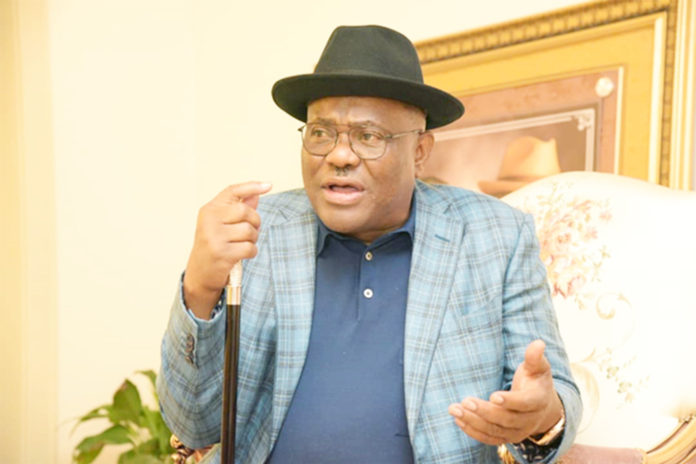
Governor Wike puts developmental strides on the front burner

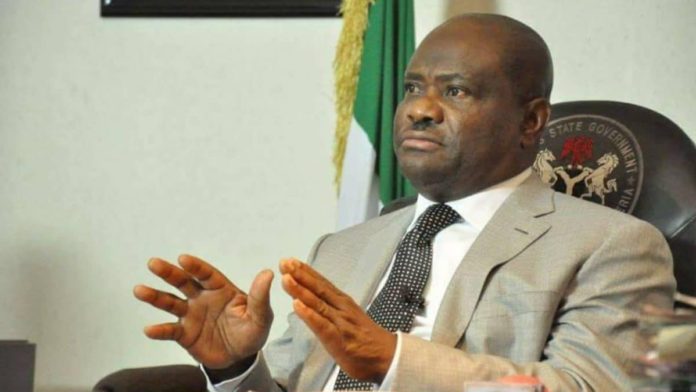
He insists that as a lawyer, the rule of law, independence of the judiciary and unhindered justice delivery are paramount to his administration. When Governor Nyesom Wike assumed office in 2015, he also pledged to embark on comprehensive urban renewal. This includes instituting projects that will transform the urban areas by improving the environment and infrastructure, thereby enhancing the quality of life and provision of social services. The following are excerpts on some thoughts His Excellency shared with Lillian Okenwa

You have been nicknamed “Mr Project”, Your Excellency. Could you tell us about some of them?

One of the key pledges I made to Rivers people when I assumed office in 2015, was to embark on comprehensive urban renewal as well as actualize the age-long yearnings of the indigenes and residents of the local government areas to be able to connect and access the rest of the State by tarred roads and durable bridges. Five years into our tenure, the urban renewal programme in the capital city and the interconnectivity across the length and breadth of the State is progressing.

 It is important that when you are given an opportunity to serve, you leave behind legacies that will make people to remember you are the one that provided a lot of infrastructure that enhanced economic activities. With prudent management of scarce resources, we have been able to achieve so much. Despite the economic downturn, we are not giving excuses but delivering on our promises. As far as I am concerned, from 2015 to 2023, I want to be remembered by the quality of projects I provided for my people Commissioning of Chokocho-Igbo-Etche-Umu-Echem-Ozuzu road by Acting President Yemi Osinbajo

We will continue to do what we are supposed to do for the people of Rivers State and being a lawyer, the judiciary is also part of my constituency so I will continue to support them in the best way that we can.

You are an administrator, a political scientist, a lawyer and many more. How does your training as a lawyer distinguish your style of governance from that of your colleagues who are non-lawyers?

You see, you cannot talk about governance without talking about the rule of law. It is important as a governor, and luckily for me as a lawyer, to adhere to the tenets of the rule of law. It is key to the running of any government. When people talk about governance, accountability and transparency; you cannot talk about all these things without adhering to the tenets of rule of law. My training as a lawyer gives me that background. You must follow the due process. You must adhere to the principle of rule of law. It is the backbone of getting to the core of democracy.

And that brings us to the way you dealt with insecurity; kidnappings and cultism. How did you do it?

Well, it is not a one-man show. It had to do with the collective efforts of every stakeholder: the security agencies, the people. And if the people are not with you, it will be difficult for you to try to curb the issue of insecurity. For instance, if the security agencies are not willing to fight insecurity, it will be difficult, because the governor is not a security personnel. Mine is to give them the necessary logistics to see that they curb these miscreants to the point that they would know that the state is not comfort- able for their illegal businesses to thrive. That is what our security agencies are doing.

“Well, it is not a one-man show. It had to do with the collective efforts of every stakeholder: the security agencies, the people. And if the people are not with you, it will be difficult for you to try to curb the issue of insecurity”

So, what we did was to sit down with security agencies, and said, look, how do you feel that today, for instance, you are the commis- sioner of police, the director of SSS, a garrison commander and you are in a state where there is so much insecurity, how would you think that people would say you did well, because that is part of your own scorecard. It is important that we must work together; collaborate and synergize in order to see that we achieve result. But what people do not understand is that when politics comes into it, we begin to have problems. But I can tell you that after the 2019 elections, the security agencies in the state have been working with us. The synergy is so tight now, and that is why we are achieving tremendous gains in the state, if not it would be difficult. It is not a one man show; it is not about me being governor. It is the collective ideas being put together by the security  council in the state. In other words, they say two good heads are better than one. We have collectively achieved so much in Rivers State.

Why did you study law?

 I had wanted to study law because of family problems. From the kind of litigations my family had, when I went to court in those days and saw the way lawyers argued, I picked interest in law. But it was not possible for me to get admission then so, I went on to study Political Science. After that, I felt Law is the profession I needed to get into as a tool to change society. Today, I’m not practicing Law, but it has helped me. I’m using that background to see how I can contribute to society.

What motivated you to join politics?

 Politics has to do with service to mankind. People will criticize those in govern- ment; saying they are not doing well; that elected officials are not doing well. If you know that they are not doing well, what contribution can you make?

 What difference can you make?

So, some of us have taken up the duty to make a difference. My aim of going into politics is that passion to serve society.

Do you ever relax?

 It is very difficult to answer but I will try. I do relax when my wife is around. With all due respect, she tries to make me relax with my children. I won’t lie to you; it is difficult. She says, ‘Look, you need to relax, unwind.’ So, I try to do that especially when we go on holidays with the children or even when they are back home from school. I can take three days off during the weekends.

So, you actually find time for family?

 Oh yes. It is very important. What is government or politics if you cannot sit down with your family to relax and discuss with them? Then you have a problem. After office, there must be home. If you don’t do that, by the time you come back home, you would discover that there is no more home. I always make sure that I’m in touch with my family; my wife and children, and communicating with them. And when I’m home, sometimes we can lie on the same bed and play.

Your wife is a judge. Did you set out to marry a legal practitioner?

 I cannot say that I wanted to marry a lawyer. But you see, God has a way of designing His own things. My wife and I were in the same Law class. I came back from the Youth Service after my first degree and I met her. From there, it clicked and we went to law school together. In fact, you may not believe that my room was 202 in Lagos Law School and hers was 204. I thank God the journey has been so wonderful. I am not one of those who would say, there is no problem or hiccup. No. We are human. But it is a lovely marriage and I have no regrets. We were in the same class at the Rivers State University of Science and Technology but we were not talking to each other until final year. That was when everything clicked.

To engender development, the three arms of government must work together –Wike

Says state now bears full responsibility to provide housing for Rivers-born judicial officers beyond service years

By Lillian Okenwa

Known for his boundless energy and the determination with which he undertakes every task, Governor Ezenwo Nyesom Wike threw himself into ensuring that every serving and retired judge of Rivers State origin owns a home. His excellency has achieved this goal. The buildings including residential quarters for Court of Appeal justices were recently commissioned by the Chief Justice of Nigeria, Hon. Justice Ibrahim Tanko Muhammad. This project is unprecedented and has been lauded by many. Governor Wike has proved the government’s appreciation for the immense contributions to the country by judicial officers. Knowing the sensitivity of their position in the society, it is through projects like this that judicial officers are shown that their labours are honoured and remembered.

In spite of the neck breaking workload of judicial officers particularly in the appellate courts, Federal High Courts and States High Court in the southern part of the country where people are more litigious, the question of owning a home in retirement has continued to pose a painful chal- lenge to judicial officers.

Earlier in the year, a Professor of Law and President of the Centre for Socio-Legal Studies, Professor Akinseye-George (SAN), faulted the practice of building mansions for retiring Chief Justices of Nigeria CJN), without any post-retirement housing plan for other Justices of the court. Noting that a CJN, like other jus tices of the Supreme Court and Court of Appeal, retires at the age of 70 and a mansion is built for him with funds provided for in the National Judicial Council’s budget, Akinseye-George (SAN) said it was illogical to build a mansion for a retiring CJN who probably would not need it, while most of other judges retired without owning a house. “It makes no sense to give a retirement mansion to a retiring Chief Justice of Nigeria, who does not need it at his age, when all his children have probably left home and give nothing to other retiring justices. Even if we continue to indulge in that, the system ought not to forget the other justices,”

“It makes no sense to give a retirement mansion to a retiring Chief Justice of Nigeria, who does not need it at his age, when all his children have probably left home and give nothing to other retiring justices.”

Changing the trend however, Governor Nyesom Wike set out a policy where every retired judicial officer from Rivers State would own a home. This is given the constitutional restriction on legal practice for judges after retirement. As it stands, every Rivers State born retired judicial officer who has served in any court in Nigeria has an assurance of a retirement home. Expressing concern over the prevailing situation where judges retire without having personal accommodation to move into the Governor observed that: “Post legal service years could be miserable for judges who were unable to buy or build their own homes before leaving the service.”

 He then disclosed that the provision of accommodation for judicial officers was a deliberate attempt to enhance their productivity and also ensure that they benefit like those in the executive and legislative arms of government. The policy covers all former Chief Judges, Presidents of Customary Courts of Appeal and all retired Judges who were in service when the policy was made. “With our policy, the State now bears the full responsibility of providing befitting accommodation for all judicial officers of Rivers State origin beyond their service years for life.”

 Wike insists that all the arms of government must work in synergy to discharge their respon- sibilities. “You must give the people all it takes to do their best because you can’t talk about fighting corruption and then you will not give the Judiciary the support that it requires. One arm of government that is key in the fight against corrup- tion is the judiciary. Judges cannot fight corruption when they are not provided with the basic facilities. You cannot talk about deepening democracy with- out having the Judiciary or Legislature playing their role. The three arms of government must work together to be able to engender development for the state.I am in the executive as a governor and I enjoy. The legislature enjoys. So, why will people think that the judiciary is cursed?”Presently, 20 units of four-bedroom duplexes have been completed and commissioned.

Governor Nyesom Wike also stepped up his game by building a new court complex for Port Harcourt division of the Court of Appeal, includ- ing residences for its Justices and staff members. He said the act was to boost their morale to confi- dently discharge their duties. Commending the Governor for investing in the judiciary, Chief Justice of Nigeria (CJN), Hon. Justice Ibrahim Tanko Muhammad, said Nigeria will suffer a grave effect if judicial officers are con- sistently deprived of requisite infrastructure.Jus- tice Muhammad who was represented by Supreme Court’s Justice Mary Odili, urged other states’ gov- ernorsto emulate the Rivers State example adding that: “The gesture will promote the comfort of the judicial officers and efficient justice delivery.” On her part, President, Court of Appeal, Hon. Justice Monica Dongban-Mensem, noted that the provision of the accommodation for the judicial officers would reduce the challenges that affect effective administration and dispensation of justice. She urged the Appeal Court Justices to reciprocate by continually upholding their oath of office by dispensing justice to all Nigerians without fear or favour.

The residences comprises of six bedroom duplex with Boys’ Quarters for the Presiding Justice of the Court of Appeal, four units of six bedroom duplexes at Forces Avenue, two units of six bedroom duplexes at Akasa Street, a six bedroom duplex at Elelenwo Street and a four bedroom bungalow at Ejor Street for other judges including 16 blocks of flats for staff members of the Court of Appeal.

#JusticeForDonDavis| Nigerians Demand Justice For 11-Year-Old Boy Molested At Deeper Life High School

Nigerians are demanding justice for Don Davis Archibong, the 11-year-old Deeper Life High School student who was allegedly molested in school.

Deborah Okezie, the mother of the JSS1 student who was allegedly molested in his boarding school in Uyo,

says he now suffers trauma following months of the alleged abuse.

In a recent update, she said he experiences nightmares and regularly jumps up from sleep suddenly.

Earlier, the mum who is seeking justice for her son, gave an initial update, claiming she was intimidated after she was summoned by the Commissioner for Education for further investigation.

Watch It Below

https://youtube.com/watch?v=_ShYe0REzqc%3Fautoplay%3D1%26controls%3D1

 She said her phone was seized and she was confronted for going live on Facebook to give an update about her son.

She cried out and said if anything happens to her, she wants Nigerians to know who to hold responsible.

Watch Deborah Okezie Narrate The Inhumane Treatment On Her Son

https://youtube.com/watch?v=4-9OKdPDNYI%3Fautoplay%3D1%26controls%3D1

Nigerians are now asking that Don Davis gets justice. 

See Some Reactions Below

Are you a good listener?

‘Everyone should be quick to listen, slow to speak.’ James 1:19 NIV

Someone quipped, ‘God gave us two ears and one mouth because we need to listen twice as much as we talk.’ Learning that means being ‘quick to listen, slow to speak.’ Good listening builds relationships. But good listeners aren’t born, they’re bred! So here are a few suggestions to improve your listening: 1) Listen without interrupting. Resist the temptation to jump in and finish the sentence, or hijack the floor. Rein yourself in – just listen. 2) Listen to understand. Try to understand their point of view, feelings, thinking and needs. Good listening is hearing what they actually think, mean or feel, not what you imagine they do. Instead of guessing, ask, ‘Am I understanding you correctly? Do you mean…? Are you feeling…?’ In other words, don’t assume – verify. 3) Listen without judging. Don’t rush to conclusions. If what they say doesn’t quite add up, keep listening. ‘He who answers a matter before he hears it, it is folly and shame to him’ (Proverbs 18:13 NKJV). When you hear more, it may make sense. 4) Listen without correcting, countering or devaluing. Saying, ‘That’s not the way it was,’ or, ‘What did you expect? If you hadn’t…’ or, ‘You’re just being too sensitive,’ puts people on guard and stops real communication. 5) Validate the speaker. Accept their perceptions and feelings as valid expressions of a valued person. ‘If I understand you correctly, you’re thinking…feeling…Am I right?’ Ask them to help get you on the same page with them. ‘Given what you’ve told me, I can see why you’d feel what you feel,’ is very validating and will increase their confidence and willingness to consider the solutions you may offer. And may God help us all. Amen.

Bible in a Year: Nahum 1-3, Revelation 11

The Word for Today

TIPS