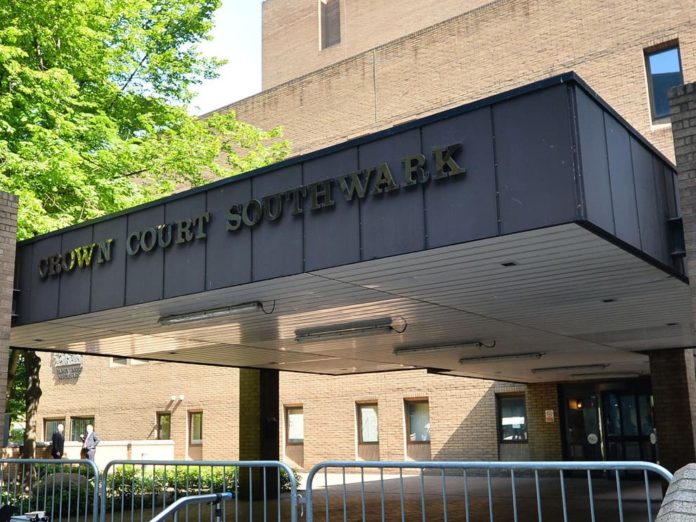
Southwark Crown Court, where Ehsan Abdulaziz denies raping the teenager (BEN STANSALL/AFP/Getty Images)
A millionaire property developer has been cleared of raping a teenager after claiming he accidently tripped and fell on her.
Ehsan Abdulaziz, 46, was accused of forcing himself on an 18 year-old-girl who had slept on his sofa in his Maida Vale flat after a night out drinking.
The businessman had already had sex with the teenager’s 24-year-old friend, whom he already knew, in the bedroom and said his penis might have been poking out of his underwear when he fell on the teen.
The young woman said she had woken up in the early hours of the morning, with Mr Abdulaziz on top of her, forcing himself inside her.
He claimed he had gone to see if the young woman wanted a t-shirt to sleep in, or a taxi home. But he said she pulled him on top of her and placed his hand between her legs.
His semen and DNA was found inside the young woman, but he said it was possible he had semen on his hands from having sex with the 24-year-old earlier.
In the evidence, Mr Abdulaziz showed how the girl had put her hand behind his head to pull him towards her, which is how he says he fell.
He said: “I’m fragile, I fell down but nothing ever happened, between me and this girl nothing ever happened.”
The women met the millionaire in London’s West End club, Cirque le Soir nightclub, where he invited them to his private table.
He was cleared of one count of rape at Southwark Crown Court on Tuesday.
Meanwhile, it has been reported that Saudi Arabia may jail a woman who posted a video of husband cheating with the housemaid. Watch video.
He made the explanation in Hausa language to journalists at the police headquarters in Katsina, where he and other suspects were paraded on Wednesday. Ibrahim Tukur, the Vice-Principal of the Kadandani Community School in the Rimi Local Government Area of Katsina State, who defiled his own student has made a confession. The man who allegedly r*ped and impregnated a student of the school, explained the circumstances surrounding the development. He made the explanation in Hausa language to journalists at the police headquarters in Katsina, where he and other suspects were paraded on Wednesday. Tukur stated, “I am being accused of committing rape and it’s true I committed the crime. I have been having affairs with the girl for eight months ago now. I used to take her to my house and offer her the sum of N300 of N500; some other times, I would give her N200 to have sex with her. “Information reaching me right now is that the girl has been delivered of a baby boy for me. I have three wives.” Tukur and the other suspects were arrested between January 9 and 14, 2021.
The spokesman for the command, SP Gambo Isah, told journalists during the parade that the vice-principal was arrested on January 9, 2021 following a formal report at the Rimi Divisional Police Headquarters by one Ibrahim Sani. Isah said Tukur took advantage of the victim to impregnate her. “The vice-principal, who is married to three wives, used to take the girl from the school to his house, where he had serial sex with her. As a result, he got the girl pregnant and she was delivered of a baby through caesarean section.”
Naija News Today : Latest News in Nigeria & Breaking News today CRIME NEWSI Offered My Student N300-N500 To Have S*x – Vice Principal Arrested For R*pe ConfessesPublished 3 days ago on January 21, 2021By Ademola Adam FacebookTwitterWhatsAppPinterestLinkedInShare He made the explanation in Hausa language to journalists at the police headquarters in Katsina, where he and other suspects were paraded on Wednesday. Ibrahim Tukur, the Vice-Principal of the Kadandani Community School in the Rimi Local Government Area of Katsina State, who defiled his own student has made a confession. The man who allegedly r*ped and impregnated a student of the school, explained the circumstances surrounding the development. He made the explanation in Hausa language to journalists at the police headquarters in Katsina, where he and other suspects were paraded on Wednesday. Tukur stated, “I am being accused of committing rape and it’s true I committed the crime. I have been having affairs with the girl for eight months ago now. I used to take her to my house and offer her the sum of N300 of N500; some other times, I would give her N200 to have sex with her. “Information reaching me right now is that the girl has been delivered of a baby boy for me. I have three wives.” Tukur and the other suspects were arrested between January 9 and 14, 2021. Ads The spokesman for the command, SP Gambo Isah, told journalists during the parade that the vice-principal was arrested on January 9, 2021 following a formal report at the Rimi Divisional Police Headquarters by one Ibrahim Sani. Isah said Tukur took advantage of the victim to impregnate her. “The vice-principal, who is married to three wives, used to take the girl from the school to his house, where he had serial sex with her. As a result, he got the girl pregnant and she was delivered of a baby through caesarean section.” Ads Other suspects paraded included Auwal Hamzat and Sulaiman Abubakar, who were alleged to have sodomised three boys, who were children of their neighbours. The neighbours reported the incident to the police, leading to the suspects’ arrest. One Ishiaku Sani, 25, was also paraded for a similar offence. Sani was alleged to have also sodomised the six-year-old son of his neighbour, who reported the incident to the police on January 10. Also paraded was a 61-year-old man, Lawan Sani, who was alleged to have molested a six-year-old girl, whose mother reported the incident at the Central Police Station, Katsina, on January 14. Similarly, one Jamilu Salisu was paraded for the alleged molestation of a five-year-old girl in Funtua on January 11.
The NEXT EDITION authoritatively reports that the Kaduna State Governor, Nasir El-Rufai, and Nigerian security forces ignored multiple warnings about the looming crisis in Southern Kaduna, and the rampant insecurity and abductions on the Kaduna-Abuja Expressway.
Cycles of violence and kidnappings in Southern Kaduna have led to the deaths of hundreds, and by not acting to pre-empt the bloodshed and lawlessness, some have accused El-Rufai and security agencies of contributing indirectly to the killings and looting in the area.
A former governor of the state, Balarabe Musa, said the violence was “politically-motivated.”
A former Attorney General and Commissioner for Justice in the state, Mark Jacobs, accused Governor El-Rufai of not only taking sides but also speaking for Fulani herders who have constantly killed people and plundered Southern Kaduna communities.
Jacob, who served as commissioner under Governor Ahmed Markafi said El-Rufai has at all times defended the actions of the killers and explained why Southern Kaduna people were being killed.
During a seven-month investigation, our reporter collected written documents, interviews and witness accounts showing that there was reliable intelligence that could have stopped several bloody attacks in the war-weary zone, but the government and the security agencies failed to act.
In the first part of this series, we recorded how, from June 10 to August 21, 2020, suspected Fulani herdsmen massacred 136 indigenous Southern Kaduna people and plundered their villages.
We also reported the chilling tales of 10 Fulani survivors who narrated how suspected youth of Atyap tribe and their allies murdered 85 Fulani from June 11, 2020 to August 2020.
Similarly, 10 indigenous Southern Kaduna survivors were identified and they recounted how heavily-armed Fulani militia unleashed mayhem on more than 24 villages across eight local government areas of the zone.
Details pieced from available records and interviews show how Governor El-Rufai and security agents overlooked vital intelligence, a situation that allowed militia groups to infiltrate and slaughter many in Southern Kaduna villages and settlements.
Our investigation shows that tribal groups and activists provided the governor and security agencies with reliable information about the location and mode of operation of bandits and militia groups responsible for the killings as early as 2016.
MACBAN warns El-Rufai, law enforcement agencies
Confidential reports addressed to El-Rufai and the Nigerian military by Miyetti Allah Cattle Breeders Association of Nigeria (MACBAN) have exposed how the government and the Nigerian military neglected credible intelligence sent to them.
In a letter dated October 18, 2016, which was stamped, signed and received at the Government House on October 20, 2016, MACBAN called the attention of the governor to the existence and activities of criminal elements in Kachia Local Government Area and its environs.
“Things are becoming deplorable; hence we feel duty-bound and obliged to inform Your Excellency and the Kaduna State Government of some goings on; especially the unpleasant, gory and condemnable acts of some criminal elements in Kachia Local Government,” a part of the report reads.
“Sir, we are sad but constrained to say that there are still a pocket of recurring incidences mostly affecting Fulani herders, rustling, abduction, armed robbery, kidnapping, illegal possession of arms and even acts of terrorism as well as perpetration of other criminal activities.
“Places mostly noted for these crimes in Kachia LGA are Jan Dutse, Gidan Sambo, Mashigin Mai Bakko, Turinga, Gidan Auta, Gidan Gajere, Mai Ido Rafi, Mai Goro, Maraya, Atufa, Mashigin Doruwa,” MACBAN tipped the governor.
The group listed the settlements and villages inhabited by the criminals and the routes they use when launching assaults and their retreat routes to make the job of security forces easier.
The bandits were said to have used three major entry and exit points along the Kaduna – Kachia and Kaduna – Abuja roads.
The first entry and exit point is the Crossing-Maro Junction, a road leading to Rijana village on the Kaduna Abuja Expressway by Kilometre 49.
The second entry and exit point is at Sabon-Gari Kachia (Navy-Bus Stop) by the Government Secondary School Kacia.
According to MACBAN, the road leads to Kilometre 67 on the Kaduna-Abuja Expressway at Pole-Wire village (Sarkin Fawa Road Junction).
The third entry and exit point is at Awon Road Junction from Kachia Township on the road leading to Katari located at Kilometre 79 on the Kaduna-Abuja Expressway.
Due to the presence of the violent groups, MACBAN reported that over 100 herders’ settlements have migrated to other parts of Southern Kaduna, noting that the exodus of the herders would further worsen the crisis in the zone.
“VERY SOON PLYING THE KADUNA-ABUJA EXPRESSWAY AND THE KADUNA-KACHIA-KAFANCHAN ROAD WILL BE ALMOST PRACTICALLY IMPOSSIBLE AS THESE CATEGORIES OF CRIMINALS WILL COMPLETELY TAKE OVER AND OPERATE WITHOUT LET OR HINDRANCE,” THE GROUP HAD WARNED.
MACBAN asked the government and security agencies to “set up machineries to ensure that security is maintained on these roads otherwise, peace may soon elude Kaduna State (God forbid).
“Another implication is that the economy of the state will be crippled because these criminals have disclosed that they know buyers of agricultural produce in Kachia, Kagarko and Kajuru local government areas.
“They are even boasting that they have finished with Fulanis, it is now the merchants and farmers that will bear the consequences of their activities.
“There is, therefore, urgent and indispensable need for the government, military, DSS (department of state services) and the Police to carry out sweep operation to save the people of these areas and the economy of the state.
“It will be of good service and for optimum result that the Niger State Government must be involved in this operation for the overall success,” MACBAN had advised.
When the governor and security agencies failed to act forcefully on their report, the group again raised the alarm and called for immediate action in another report to Governor El-Rufai dated October 27, 2016.
The letter, signed by the North-West Zonal Chairman of the group, Ahmadu Suleiman, was stamped and received at Government House on November 1, 2016.
“Your Excellency may recall that our correspondence on “Recurring Incidences of Criminal Activities in some Parts of Kachia Local Government Area” dated 18/10/2016 highlighted the problem at hand.
“We wish to say that much more needs to be done. Again, this month we have witnessed the resurgence of these unfortunate activities.
“Your Excellency, the need for an immediate flush-out operation cannot be overemphasised. If possible, such an operation should be within hours from the submission of this piece.
“Piecemeal operations by the law enforcement agents are not capable of eliminating these crimes and criminals.
“Sir, save our souls, save us and order for a marathon sweeping operation in our area. Please Sir, come to our aid,” Mr. Suleiman had pleaded with the governor.
Not willing to take any chances, the leader of MACBAN wrote to the Commander, Sector 1; Operation Yaki on October 27, 2016, telling him of the presence of criminals in their neighbourhood and the urgent need to get rid of them.
“Sir, it is with deep felt sadness that I am writing to inform you of a kidnapping incidence. On the night of Sunday, October 9, 2016 some kidnappers kidnapped a young Fulani girl, Sa’adiyya from her home (Ruga) in the residence of Alhaji Nawaila in Mai-Ido Kufai village.
“After the abduction, parents of the kidnapped girl secretly traced the kidnappers’ den. The kidnappers are spread (in camps and dens) around Gidan Auta, Gidan Gajere, Jan Dutse and Turinga villages of Akilbu, Doka and Mai-Ido Districts of Kachia Local Government Area.
“In another unfortunate related but different development, an Adara man was killed around Gidan Auta village by men of the underworld.
“This dastardly act has the tendency of causing reprisal and thereby escalating to a full-blown bloodshed or crisis in the area because an innocent Fulani herder may be wrongly accused of the killing.
“A Fulani herder may subsequently be hacked to death, thereby sparking a chain of killings and massacre,” Mr. Suleiman had written to the military.
Despite the letters, top leaders of MACBAN and other Fulfulde organisations who spoke to our reporter insisted that no action was taken.
In a memorandum to the Judicial Commission of Inquiry into the Crisis in Kajuru, Kachia and Chikun Local Government areas, the Chairman of MACBAN, Kaduna State Branch, Haruna Usman, gave a damning rebuke of the government and security agencies.
The group said it was worried that every foundation for the survival of Fulani tribesmen in Southern Kaduna was either shaken or in ashes, maintaining that the looming conflict was predicted and reported to the government and security agencies before it occurred.
“These streaks and cycle of violence at various levels were either reported to the government as a secret Intel or to our ‘vibrant’ security agencies before they occurred.
“This noble association had in 2016 on several instances written alarming reports on the looming catastrophe and crisis that have engulfed us today to the government and designated security agencies.
“In our reports, we had graphically analysed, studied and submitted the strategic placement of the flashpoints, the growing tension within the axis and the emigration of hostile and criminal elements coming in to regroup after they had been degraded from other states.
“It is hereby revealing to mention to the commission that after two to three letters and verbal intelligence reports to the government and some sensitive security agencies, violence erupted on July 17 – 18, 2017 in various settlements scattered around the axis of Kajuru, leaving ashes, tears and heaps of corpses behind,” memoranda had indicated.
While MACBAN did not mention the identities of the emigrated hostile elements into Kaduna at the time of writing the report, a leader of another Fulfulde group told our reporter the immigrants were of Fulani origin.
The source, who pleaded not to be named because of the sensitive nature of the issue, said the government and security agencies were aware of the migration of hostile herders into the region.
“The governor and security agencies cannot say they were not aware of what was happening. Many groups and individuals alerted them, but they decided to do nothing.
“The Fulani who have lived all their lives in Southern Kaduna are suffering because of the activities of the migrants,” the source said.
The crises MACBAN warned about and tried to avert, began to unfold almost immediately after the memos were sent to the government and the security agencies.
Amnesty International in a report released in August 2020 said at least 1,126 villagers were killed by bandits from January to June 2020, adding the attacks threatens the country’s food security.
The report also lamented the failure of the government and security agencies to bring the perpetrators to justice.
In a most recent report released in July 2020, the Human Rights Watch insisted that the police have failed to name the identity of the killers in Southern Kaduna.
“The police haven’t commented on the identity of the perpetrators or the motivations behind the attacks.
“The state governor claimed the recent attacks were carried out by armed bandits terrorising Nigeria’s North-west states, but media reports included witnesses attributing blame to a militia targeting southern Kaduna communities on ethnic grounds,” the international rights groups stated in its report.
While both the police and MACBAN failed to name the killers, Governor El-Rufai in 2016 said the killers were largely armed foreign Fulani herdsmen who came into the country and admitted paying them to stop killing Southern Kaduna natives.
The governor, who spoke on a live show on Channels Television decried attempts by some Nigerians to bring religion or ethnicity into the wanton killings in that part of the state.
“The same Fulanis are killing Fulanis in Zamfara. It is not about religion or ethnicity; this is a pure case of banditry. They are criminals, their ethnicity, their religion does not matter,” El-Rufai had said.
But some victims and critics say some actions and comments made by the governor portray him and the government he leads as being sympathetic and even providing support to those who kill and maimed innocent Nigerians.
Many communities, same story
The people of the Gidan Zaki District in Zangon Kataf Local Government Area said they have no history of conflict with Fulani or any other tribe living in the area.
But between July 10 and 11, 2020 when suspected Fulani militia invaded the villages of Chibob and Sabon Kaura, killing dozens and plundering properties, the people fled the entire district out of fear.
Instead of going after those who killed innocent villagers in their sleep, people who talked to our reporter said the state government and security forces arrested and detained community and youth leaders.
A local, Yakubu Musa, whose real name cannot be mentioned for his security, who had temporarily returned to take his animals away, said Governor El-Rufai had ordered the arrest of the Gora and Gidan Zaki district chiefs after their chiefdoms were attacked.
“After Fulani militia attacked several communities in Gora and Gidan Zaki districts in Atyap land, instead of going after the criminals, the government ordered the arrest of the two district heads and also went for the youth leaders.
“The two district heads were arrested and taken to Kaduna for questioning and their mobile phones were seized. The governor has done that to almost every Southern Kaduna chief whose domain has come under attack by herdsmen.
“Majority of the chiefs will not speak out because the governor has consistently threatened to deal with them if they say anything or even blame the Fulani for the attacks on their communities,” Musa told our correspondent.
Persecuted monarch finally silenced
For nearly two weeks in July 2020, our reporter was unable to meet with the district head of Gora, Elias Gora, and his Gidan Zaki counterpart, Haruna Kuye.
Except for security operatives who mounted roadblocks along the roads in the two districts, only a few residents were found trying to remove valuables from their homes to safe locations.
The entire area was under a 24-hour curfew besides a lockdown occasioned by the COVID-19 pandemic.
Attempts to speak to the monarchs on the phone were unsuccessful, as they were said to have switched off their cell phones after they were released by the police.
It was, however, on 1 August 2020 that Kuye, the district head of Gidan Zaki, was able to sneak into Asha Awuche, one of the villages in his chiefdom, to meet our reporter in a deserted compound.
At the time, 11 villages in the district were mostly deserted, except for Asha Awuche, which is located on the highway and had a strong presence of security operatives.
The visibly shaken traditional ruler said that his life and that of his people were in danger and accused El-Rufai and the Fulani militia of masterminding the Southern Kaduna crisis.
Kuye recalled the stories of attacks in his chiefdom, not only listing the casualties and properties lost, but also painting a picture of hopelessness and helplessness in the face of a relentless aggressor.
“When these killings and destructions were done to our people, we were looking forward to SARS (Special Anti-Robbery Squad) arresting the perpetrators but what we got was the police asking us to produce the Kataf youth who caused the problem,” the monarch stated.
“The police arrested me after the killings and kept me for over 24 hours and demanded that I should produce the troublemakers in my kingdom.
“When I was finally freed, we were invited to a meeting with the governor. At the meeting, we told Governor El-Rufai what had happened, and he told us that the Fulani people don’t forgive and that when they are offended, even if it takes 20 years, the Fulani will take revenge.
“After the first meeting, the governor invited us to another meeting with all the district heads where our handsets were seized.
“Some of the district heads got their phones back after three days while others are yet to get their phones.”Audio Player00:0000:00
BEFORE OPENING UP ON HIS FEARS, THE MONARCH INSISTED THAT HE DID NOT WANT TO BE RECORDED, APPARENTLY BECAUSE OF THE FEAR OF A BACKLASH FROM THE GOVERNOR, WHOM HE SAID DOES NOT FORGIVE ANYBODY HE CONSIDERED AS AN ENEMY.
Assured of confidentiality, Kuye told our reporter that he believed that the governor was monitoring his movements and listening to his conversations on his cell phones.
Kuye said the reason our reporter could not talk to him directly on his mobile phone was because the device had been off most of the time.
He said he moved his family to a safe place, adding that they would not return to Gidan Zaki until their safety was assured.
But he was so wrong to believe that his safety and that of his family could be assured in Nigeria’s epicenter of bloody violence.
Barely three months after the interview and after Kuye and his family reluctantly returned to his home in Gidan Zaki, unknown gunmen struck in the early hours of November 17, 2020 and killed the monarch and his son, Destiny. His wife and daughter survived with life-threatening injuries.
With the killing of the Gidan Zaki monarch, it was almost predictable that his counterpart from Gora would be also targeted.
And the assailants did not disappoint as they launched a brutal attack on the home of the Gora monarch exactly a month after they slew Kuye and his son.
A source who pleaded not to be named for fear of her safety said the gunmen stormed Gan Gora at about 8.00pm on December 18, 2020 and went straight to the home of the district head.
“They shot sporadically and people fled into the bushes just as they made their way straight to the home of our district head.
“Fortunately, Gora Hakimi (Gora chief) wasn’t at home but they broke down the first layer of the security door to the house but couldn’t break the second door.
“Apparently angry, they moved into the neighbouring compounds, shooting and butchering innocent people. They almost wiped out an entire family in one of the compounds,” the source told our correspondent.
Those who were killed in Gan Gora were: Peter Akaho (70), Ayuba Steven Sheyin (67), Jummai Ayuba (55), Ishaya Joel (35), Yakubu Saviour (14), Ayuba Goodluck (11) and Patience Ayuba (6).
Gan Gora was hit three times in 2020 and the first attack occurred on January 17, 2020 when gunmen opened fire on the local market, killing two and injuring several persons.
The second attack occurred on July 20, 2020 and 11 persons were murdered, several others injured and properties looted.
“They have always targeted our monarch, but God has saved the man each time they come. They were able to kill the district head of Gidan Zaki. Now the government claimed they have arrested the killers,” a local who would not give his name said.
“We don’t believe them because we know those who attacked our village. We know the young man who brought the killers to our village and we reported to security agencies.
“They boy was born in this village and he grew up here. He knows everywhere here, and we saw him when he brought Fulani killers here in July. Why have they not arrested him if they are serious? We don’t believe the government,” a man, who gave his name as Bulus told our reporter.
Kaduna-based Lawyer and Activist, Auta Maisamari, in a an interview with our reporter
A Kaduna-based lawyer, Auta Maisamari, who spoke to Next Edition, accused the Kaduna State government and security agencies of persecution when communities in Kanicho Chiefdom were attacked in 2016.
Sometime in October 2016, Maisamari said armed persons attacked Misisi, Pasakori and Mile One areas.
“Some people dressed in Army uniforms had come into Masisi and lured the village head, John Dogo, and he invited youth leaders to his house in the name of peace meeting,” he said.
“This happened after an initial attack in which the people were displaced. But while the meeting was ongoing, the visitors opened fire on the village head and the other leaders. Simultaneously, attackers invaded the village from behind and razed it down.”
The Kaduna State Police Command at the time confirmed the attack but said only four and not seven persons were killed.
Its Public Relations Officer at the time, Aliyu Usman, who confirmed the attack, said the police had since commenced investigation into the matter.
After the killings in Masisi, Maisamari said some youths from neighbouring Mile One, who were guarding their village, spotted gunmen in the bush fleeing the area and gave chase.
He said the fleeing assailants who might have run out of bullets abandoned three of their rifles in the bush near Gidan Waya
“The village head of Mile One, Laca Garba, came back to his house and found three rifles which were recovered from attackers who were confronted by local youth along the road to Gidan Wayia.
“When the chief observed that the rifles belonged to the police and as a law-abiding citizen, he decided without compulsion to take them to the Police at Kafanchan.
“As soon as the police got the rifles, they arrested him and detained him on October 26, 2016. He was later transferred to the state CID (Criminal Investigation Department) in Kaduna.
“At the time they arrested him they said the three rifles he brought belonged to serving policemen who they claimed were missing. They asked him to either produce those who brought the rifles to him or they would conclude he killed and dispossessed the police officers of their arms.
“The police did not make categorical statements about the identities of officers who had the rifles. The only thing they continued to say was that they (policemen) were missing.
“When they arrested the village head, the police didn’t have the courtesy to inform the District Head of the area, Moses Barde.
“They took him from his house to Kafanchan Division and from there to the headquarters in Kaduna. After some days, the district head felt the need to go and plead with the commissioner of police to release the chief to him so they would go and look for those who brought the guns to his home.
“On the same day, the district head went to bail the village head; he too was arrested and detained,” he told our reporter.
After the two were detained for over one month without trial, Maisamari said he applied for them to be granted administrative bail pending the conclusion of their investigation and because of their failing health and position as traditional rulers.
“They threatened to arrest other village heads and district heads in the area. It was then we decided to file an action for the enforcement of their fundamental rights at the Federal High Court here in Kaduna.
“On the day we went to move our exparte application for the release of the three persons in detention, the judge declined, saying that the personalities involved including the President of Nigeria, the national security adviser, the governor of Kaduna State, the Inspector General of Police and Commissioner of Policeare interested in the case.
“Instead of the judge hearing our application based on the Fundamental Human Right Rule, he chickened out claiming they have been warned never to grant exparte application.
“We argued that if the judge will not hear us exparte, he should fix the hearing of the application the next Monday because we approached him on a Thursday. That would have made it one week based on the rule.
“The judge adjourned the case sine die and that means adjourning it without fixing date for the next hearing. I told the judge he is not being fair to us.
“We were compelled to withdraw the case and took it to the state High Court. On the same day, the judge, Mohammed Bello granted them bail but the police quickly filed a first information report in the Magistrate Court alleging offences of kidnap and terrorism, thereby made the case of the gentlemen difficult.
“While the chiefs were being held for committing no crime, the other villages that were not attacked were razed by rampaging herdsmen.
“Over a hundred persons dressed in military uniforms came in and overwhelmed the few policemen and soldiers posted to Mile One and Pasakori and burnt the two villages. No fewer than 50 persons were killed during the attack,” the lawyer had recalled.
Maisamari, the lawyer who spoke to The Next Edition, died suddenly on June 18, 2020 after a brief illness.
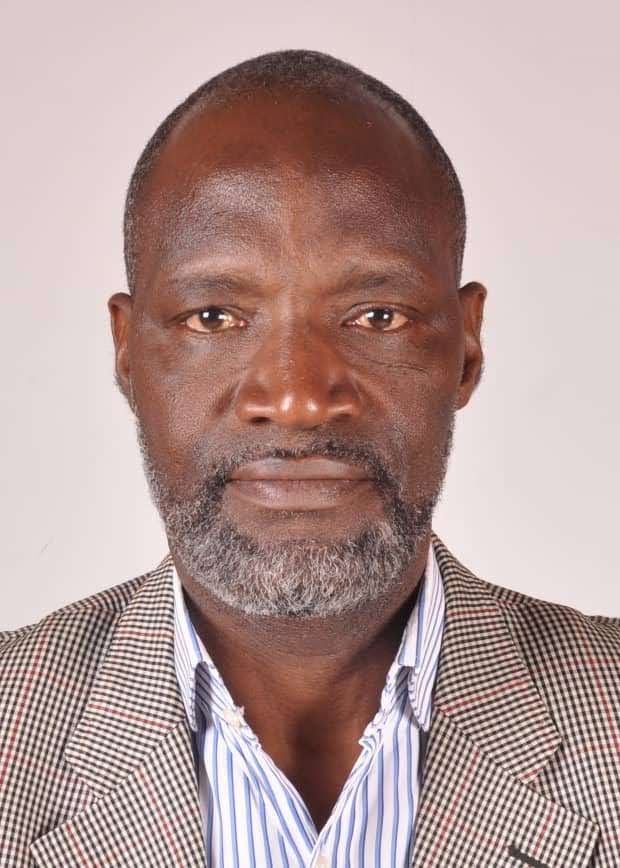
Former Commissioner for Justice, Kaduna State, Mark Jacobs. (Photo by Ibanga Isine
Former Justice Commissioner, Jacobs collaborated the story of persecution of victims of the killings who are of Southern Kaduna indigenous communities.
“When communities are attacked, there is usually no response from the security forces and when they finally move in reluctantly, it is the victims that are arrested particularly youth (who) come out with dane-guns, bows and arrows to defend their communities from the killers.
“I have bitter experiences representing some of these people in court. They are arbitrarily arrested and detained for months. The government has never gone after the attackers.
“We have seen that in Jema’a, Sanga, Kauru, Kajuru, Chikun, and Zangon Kataf local government areas,” Jacob said.
A rights activist and former Kaduna Senator, Shehu Sani, in an interview with our correspondent partly blamed El-Rufai for the worsening Southern Kaduna crisis.
He faulted the governor for constantly saying that the killings in the area are retaliatory, adding that such statements emboldened the killers to do more havoc.
“I can tell you that Southern Kaduna crises are sustained by politics and prejudice and the idea of saying that every killing is revenge would blur us from seeing the reality of the terrorism in the area.
“When terrorists kill people in Zamfara or Katsina or in Niger and parts of Sokoto, they condemn them out right. But when the same people kill in Southern Kaduna, they try to say it is reprisal or try to blame the people.
“With that kind of mindset, they only bolster the terrorists and it seems like they are providing the swords that were used to murder innocent people in Southern Kaduna.
“As far as I am concerned, anybody who has sworn allegiance to defend the Constitution of the Federal Republic of Nigeria should treat every citizen with justice, equity and fairness irrespective of religion, ethnic or political background.
“I believe El-Rufaiknows what he is doing. But right now, it is seems there’s a standoff between the government and the people of Southern Kaduna,” Sani said.
On his part, a former Governor of Kaduna State, Balarabe Musa, said the Southern Kaduna crisis is politically motivated and also blamed the government for not providing the kind of leadership that could douse the problem.
“Although I don’t know all the facts; these days you can’t rely on the security agencies for information because they are a part and parcel of the manipulation that is taking place.
“The problem is not in Kaduna State alone. It is a national problem. People are being manipulated to the extent that they fight each other and they claim that they are revenging. I wonder why they are calling it revenge when the same thing is happening all over the country.
The former governor had spoken to our correspondent on August 11, 2020 and died after a brief illness on November 11, 2020.
Government’s Response
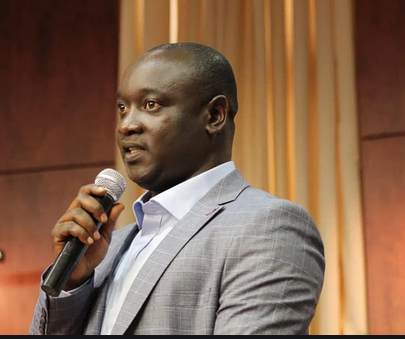
Commissioner for Internal Security and Home Affairs, Samuel Aruwan (Picture from Daily Nigerian)
Several attempts were made to have Governor El-Rufai speak to the issues raised in the course of this report.
When all the attempts failed, a letter was dispatched to the governor on October 15, 2020 but no response has been received from him or his aides.
The letter was also sent to the governor and to Kaduna State government on October 16, 2020 via his personal email address [email protected] and [email protected] respectively. There was no response to either letters.
But in a telephone conversation, the Commissioner for Internal Security and Home Affairs, Samuel Aruwan, said that the allegations against the governor are untrue.
“I was in the media office and now I am here (ministry of internal security and home affairs) and I can tell you that I now have a broader understanding of the Southern Kaduna crisis,” Aruwan began.
“I am an insignificant person. I am not the governor. I don’t know the district head of Gidan Zaki. But how will the governor trail the district head?
“These are things that will only prolong the crisis. I am telling you I have seen blood. Every day, I see blood. When I finish talking to you now, I am issuing a statement.
When reminded that the district head of Gidan Zaki complained that the governor was after him, Aruwan said, “I have heard that rhetoric. I have gone to Birnin Gwari, Kajuru, Giwa and across the state and I hear those stories. I don’t know the district head of Gidan Zaki. What has the governor got to do with the district head of Gidan Zaki?
“Some of these will rather complicate the Southern Kaduna security crisis. This is what I just want you to know. The governor did not threaten him. Why would the governor threaten him?
“From what you are telling me now, there is crisis in your report and Kaduna will burn. I am from Kaduna State. I was born in Kaduna and I have lived here in Kaduna. From what you are telling me from MACBAN to others, ‘Walai ta lai’ the state will burn.
“I am not the governor of Kaduna State but I want to tell you with all certainty that it is not correct. I do not doubt what you are saying. I am not also accusing you of fabricating the report. What I am trying to say is that these are conspiracy theories.
“Let me give you an example. In 2011, the Southern Kaduna Muslims said genocide was committed against them and they published a report.
“In 2020, the Southern Kaduna people also published a report that there is genocide against them. Do you understand? So, when I tell you that Kaduna is very delicate and complicated. The more you get closer to Kaduna issue, the more confusing it gets.
“I am inviting you to come to Kaduna so that I will explain to you the Kaduna crisis. But like I said, write a reminder to the governor about your request to interview him.”
Military’s response
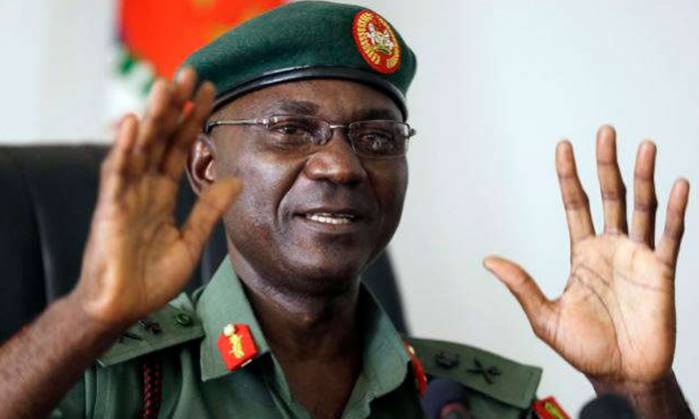
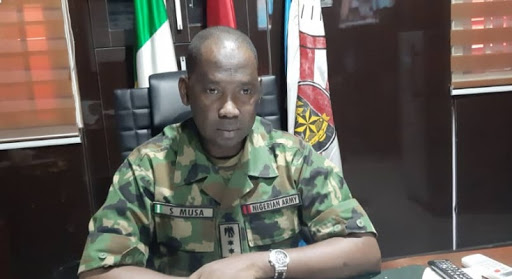
Director of Defense Information, John Enenche(Picture from PMNewsNigeria)Acting Director of Army Public Relations, Sagir Musa (picture from katsina post)
The Acting Director, Army Public Relations, Sagir Musa, told our reporter the Army Headquarters was not aware of the intelligence report by MACBAN.
“I cannot speak on that issue because I don’t know anything about it. It is like you are in my seat and someone is sending a letter to a command in Kaduna. There is no way you will know.
“Even the Chief of Army Staff will not know except the letter was forwarded to him because they were incapable of handling a situation and so that the Army Headquarters can help them.
“Or if they need additional troops or they are short of ammunition and want more or they want money before they bring such issues to the Army Headquarters.”
General Musa, however, referred our reporter to the Deputy Director, Public Relations, 1 Division, Kaduna, Ezindu Idimah.
However, in a telephone conversation, Idimah, a colonel, said, “What you spoke about are operational issues and we are not allowed to comment on operational issues.”
He referred our reporter to the Defence Headquarters; saying it is the sole authority vested with powers to speak on operational issues relating to the Nigerian Military.
When contacted on the telephone, the Director of Defence Information (DDI), John Enenche, said he does not respond to sensitive information on the phone.
“If you are doing an investigation, I don’t speak on the phone that way. Anything about journalism and the Armed Forces, it is a no no. I don’t discuss it on the phone.
“If you come for our press briefing and you want to clear the air on any issue, come on Thursday. The Armed Forces is very sensitive. I told journalist since March last year that I will no longer speak to the media on phone. Whatever I have said here remains. I don’t speak to journalists on the phone my dear.” Enenche said.
Shortly after the call ended, he sent a text message referring our correspondent to one Commander Sani, adding that the officer would be able to offer a clearer picture to our correspondent.
“Call him and explain what you want to him and say that I directed you to him. He will give you a clearer picture,” the text message read.
But when a call was put to Sani, he barely listened to our reporter when the phone went off and further attempts to call him or sent a text message to him were unsuccessful.
This report was supported by The WHISTLER Newspaper, Abuja (thewistler.ng) and the International Centre for Investigative Reporting (ICIR).
Four Police Inspectors identified as Emmanuel Michael, male, 40, Sunday Odubiyi, male, 40, Lawrence Amedu, male, 39, and Aroye Dickson, male, 40 are reportedly in trouble with the Nigerian Police Force after they were accused of extorting a student in Lagos.
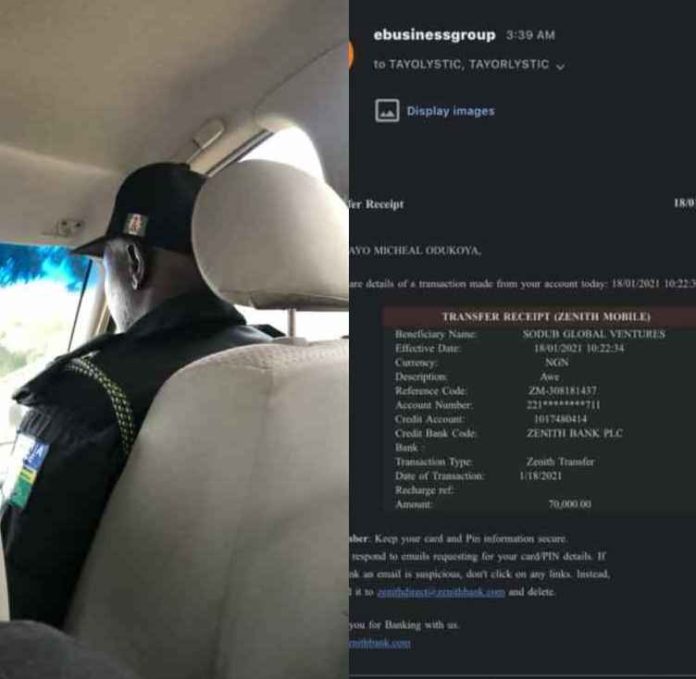
The 16-year-old student, simply identified as Segun was allegedly harassed and extorted by four police officers at NGAB Junction, Isheri area of Lagos State. He reported the issue at a police station on January 18, 2021.
Narrating his ordeal, Segun, said he was on his way to school when he was ‘abducted’ and driven around the state by the Policemen and finally taken to Isheri Divisional Police Station. He said, “my phone was seized by the Policemen after which they extorted N70,000 from me,”
To avert being traced, the money was transferred to a Point Of Service (POS) operator who was immediately called to confirm the alert.
The victim said after his release, he was quick to report the incident which attracted the attention of senior Police officers in the country.
The picture of the Policemen, that were caught in the act of unprofessionalism and extortion, had gone viral on the social media which attracted the Complaint Response Unit of the Nigeria Police Force, Force Headquarters Abuja, to track the policemen for necessary Police action and the matter was subsequently referred to the Lagos State Police Command for further action.
After due interrogations, the Policemen confessed to the crime and refunded the N70,000 to the student, on bond, which forms the key credible evidence/exhibit in the case.
The Commissioner of Police, Lagos State, Hakeem Odumosu, has condemned the act of the Police Inspectors which is detrimental to the image of the Police Force and counterproductive to the ongoing reform agenda of the Inspector-General of Police, IGP Mohammed Abubakar Adamu.
He has however ordered for the orderly room trial of the Inspectors with immediate effect so as to serve as a deterrent to other criminally-minded Police personnel in the command and beyond.
CP Hakeem Odumosu also warned officers and men in Lagos State that the command will spread its tentacles in fighting against such criminal, unprofessional and disgusting act amongst Police personnel in Lagos State.
He also assured members of the public of people-oriented and community-based policing styles in Lagos State, as justice will be done in Segun’s case.
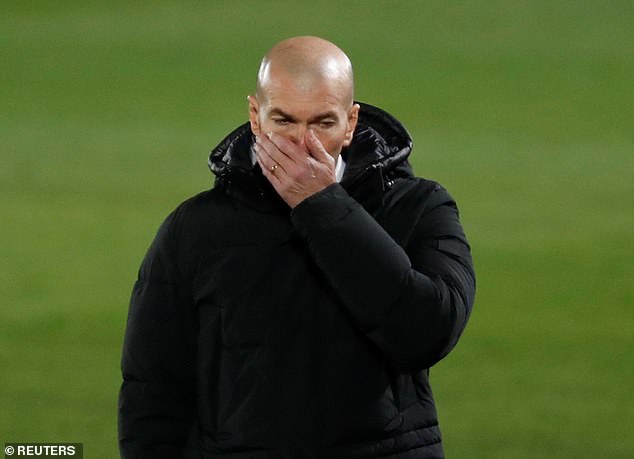
Real Madrid confirmed on Friday that their head coach Zinedine Zidane has tested positive for Covid-19.
The Spanish champions broke the news on Friday morning after releasing a statement.
The news comes two days after the club revealed Nacho Fernandez had contracted the virus
Zidane was allowed to take to the Madrid bench against Osasuna at the beginning of the month despite being in close contact with someone who had tested positive.
He delivered a negative test and so was granted permission to travel to the game, despite having sat out training sessions at his club’s training ground.
The 48-year-old saw his side dumped out by 10-man Alcoyano 2-1 after extra-time, defeat at the hands of the semi-professional third-tier outfit ramping up the pressure on the Frenchman.
Real Madrid have struggled for consistency during the Covid-impacted 2020-21 season, and have found themselves trailing neighbours Atletico by seven points at the top of LaLiga.
Their recent run of results have seen them held in the league by Elche and Osasuna, while they were also knocked out of the Spanish Supercopa semi-finals by eventual winners Athletic Bilbao.
Zidane admitted after defeat to Alcoyano that he is not in control of his future at present.
Real were humiliated by the third-tier semi-professional side in the last-32 of the Copa del Rey
‘There is always talk whenever we lose,’ said Zidane after the defeat. ‘I assume responsibility and what has to happen will happen. I am very calm.
‘The players want to win and they give everything to make that happen but sometimes it goes differently.’
It is not the first coronavirus outbreak at the club, with Eden Hazard and Casemiro both testing positive for it back in November. Defender Eder Militao had contracted the virus a week earlier.
The year 2020 was distinct for two reasons – COVID-19 pandemic and #EndSARS protest. Despite the preponderance of news coverage around these subjects, politicians still stole the headlines either for some big wins or wrong actions. Here are some of them.
President Muhammadu Buhari
Buhari (Photo – Hotfrom9ja)
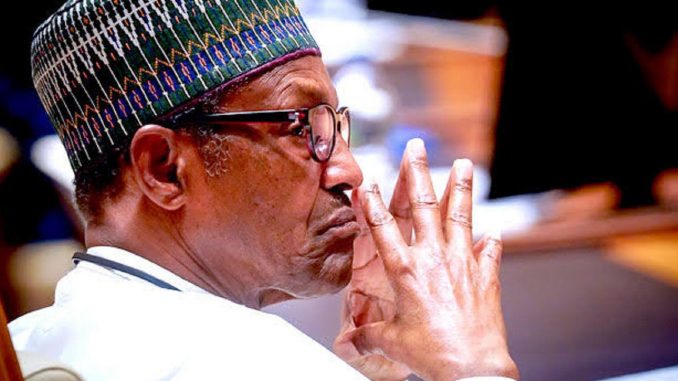
In the outgoing year, the growing insecurity in Nigeria kept President Muhammadu Buhari in the news for either refusing to rejig his Security Council or visit scenes of horrific incidents to commiserate with the bereaved.
Three times within the 12 months of 2020, the Senate asks Buhari to sack his service chiefs as a means of giving fresh breath to the fight against banditry and terrorism currently plaguing the country. The president consistently ignores the Senate, and held on to the service chiefs under whose watch Nigerians are being slain and abducted by numerous groups operating as warlords in different parts of the country.
The service chiefs whom president Buhari continues to retain at the expense of his perception as a do-nothing-president, include; the Chief of Defence staff, General Gabriel Olonishakin, Chief of Army Staff, General Tukur Buratai, Chief of Naval Staff, Vice Admiral Ibok-Ete Ibas, Chief of Air Staff, Air Marshall Sadique Abubakar and the Inspector General of Police, Mohammed Adamu.
The peak of the agitation for the sack of the service chiefs was when more than 40 farmers in Borno state were killed by the terrorist group, Boko Haram. President Buhari ignored the calls for a change of persons and ideas in dealing with the problem.
The abduction of 344 Kankara schoolboys and Buhari’s refusal to visit the school where the parents of the boys kept vigil, instead going to his ranch to check his cattle, gave the president negative press coverage. Although the boys were released six days after they were abducted, and the president savored the victory in numerous Villa press statements, the impact of his visit to see his cattle, and not the parents of the boys, gave him a media dent.
Godwin Obaseki
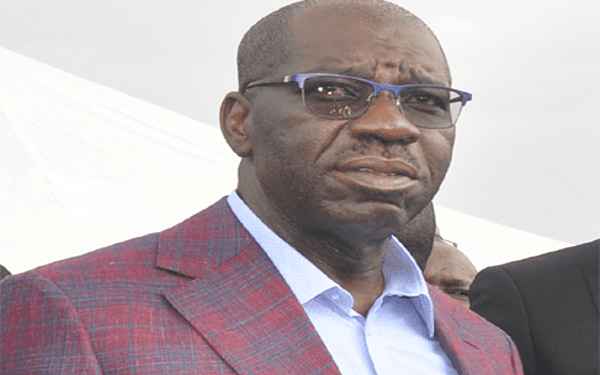
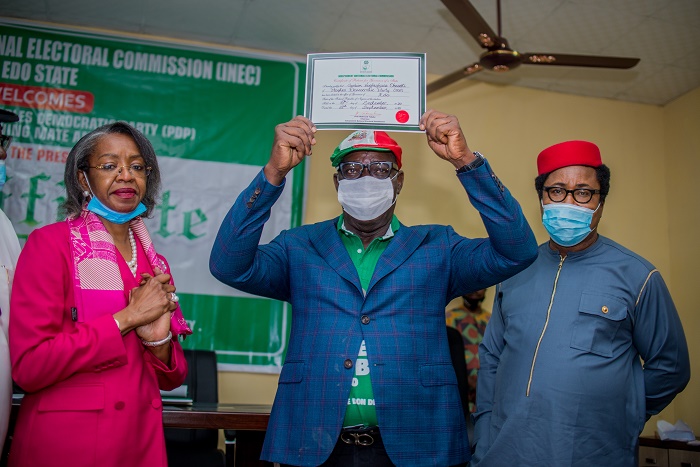
The Edo state governor, Godwin Obaseki, won a tight electoral contest in September against a determined foe, Comrade Adams Oshiomhole, his predecessor and former national leader of the All Progressives Congress (APC).
Obaseki’s win was grand because his foes were not only local, but national. In the local arena, Oshiomhole needed to show that he was relevant to the APC, hence he needed to win Edo.
For the APC, it needed Edo to keep the party in the map of the South South. The PDP controls all the states in the region, a scenario not food for a ruling party.
Seyi Makinde
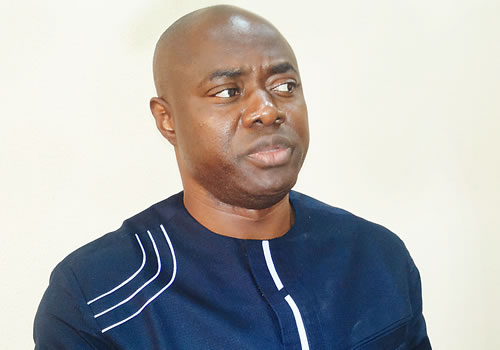
Governor Seyi Makinde (file photo)
Against the backdrop of thugs attacking protesters across the country during the #EndSARS protest, the Oyo state Governor, Seyi Makinde, rather than unleashed police to quell the protest or ban it, simply launched a special security operation named Operation Burst to provide protection for the protesters.
“We are deploying members of Operation Burst to various hotspots in Ibadan to arrest the situation and restore normalcy. The members of the team will continue to protect genuine protesters and their right to protest,” the governor said on October 20, 2020 at a time thugs were disrupting the protest. That decision spared Oyo from the thuggery that followed following the October 20 shooting of the #EndSARS peaceful Lekki protesters.
Governors who hoarded COVID-19 palliatives
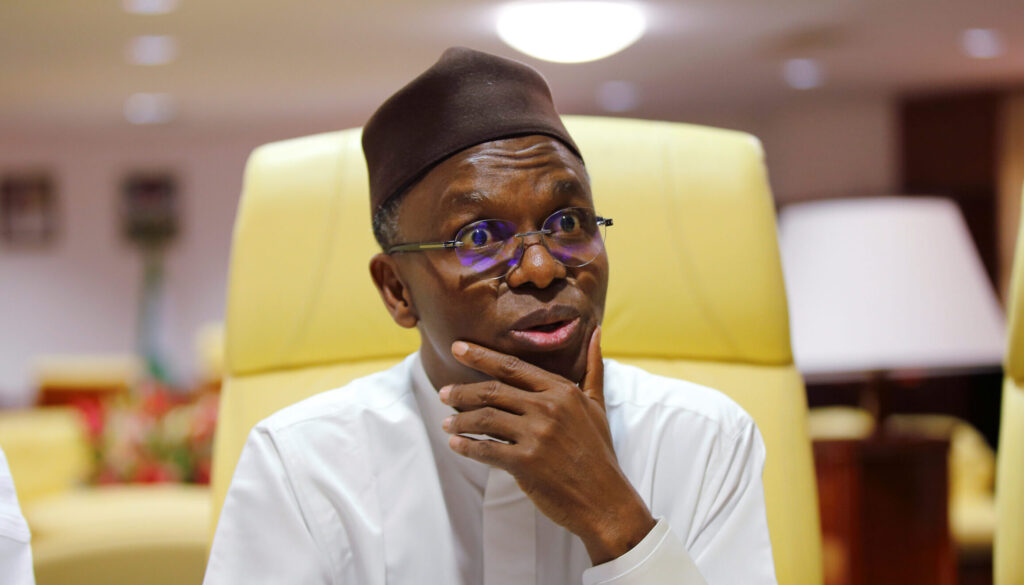
Nasir el-Rufai, Kaduna State governor
From Lagos to Osun, Adamawa to Taraba, Plateau to Kaduna, the looting of the COVID-19 palliatives was a dent on the image of the governors who delayed or refuse releasing the palliatives, leading to their looting.
Although all the governors claimed that they were planning to release the palliatives to the people, the delay in disbursing the COVID-19 palliatives created a food inflation for Nigeria. The reason was because the food were purchased from local market and locked up in warehouses for more than two months, resulting in scarcity which is the trigger for inflation.
Sachet water now an essential commodity in the community
By Ishaya Ibrahim, News Editor
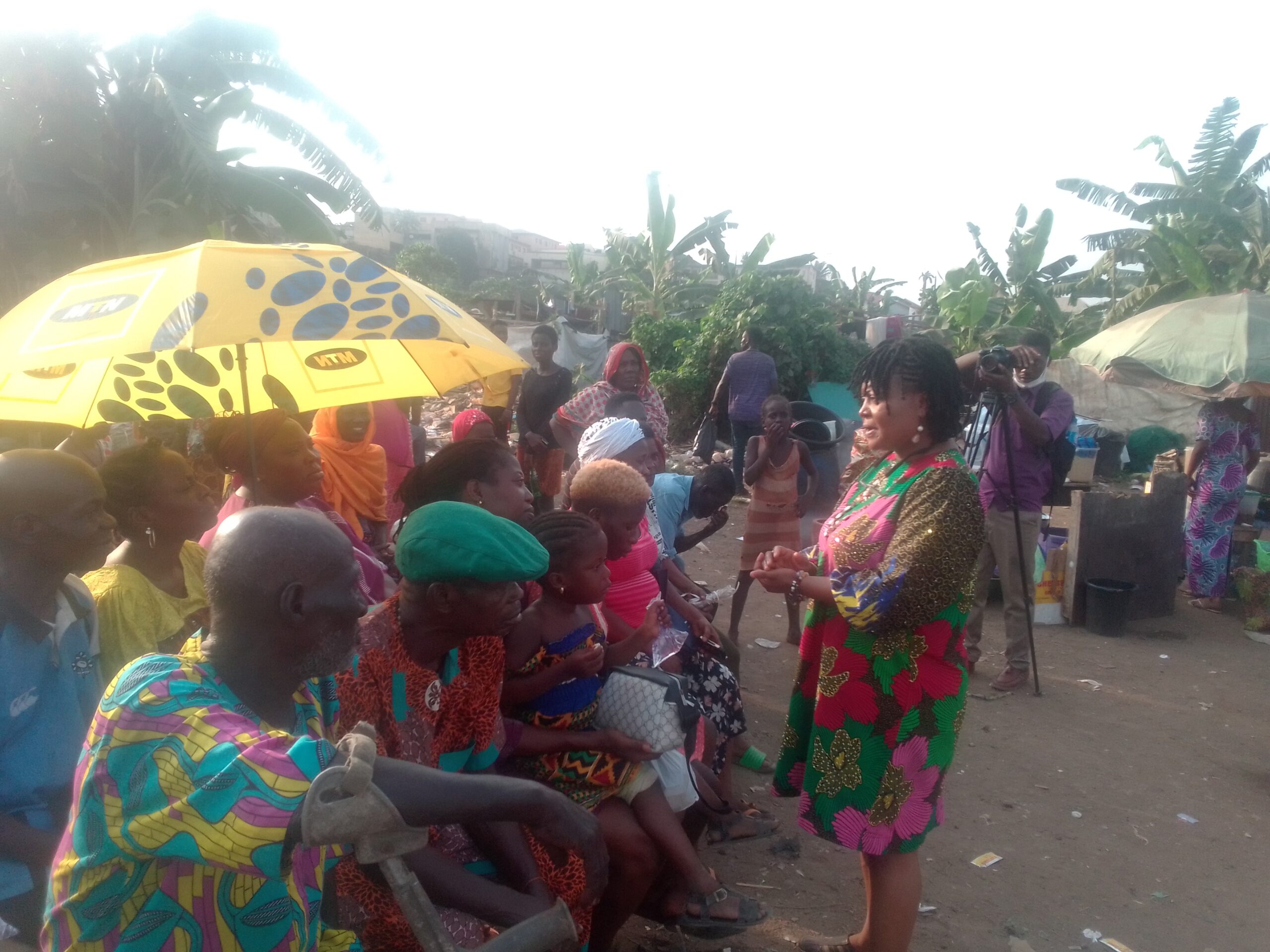
CEE-HOPE executive director, Betty Abah addressing the displaced residents
The name of the community – Monkey Village – sounds rather strange. But not many people, if any at all outside the residents, knew about it, though it shares boundaries with affluent suburbs.
Again, that is another contradiction. Monkey Village, a Lagos slum is in the same neighbourhood with Opebi, the posh Ikeja suburb that is a haven for the rich.
While Opebi is well known, little or nothing is known about the village, not even to people doing business on Allen Avenue.
But all that changed on December 31 when bulldozers owned by Lagos State government reduced the shanty to rubbles. Another oxymoron – Monkey Village became famous and known because it is no more.
Now, residents of Monkey Village live at the mercy of the elements five days after losing their homes in the demolition carried out by the state government.
The demolition team gave no notice to the residents before descending on them with the bulldozers. Many who had left their homes for the day’s business only received distress calls that bulldozers had arrived to level up the place. Some of them, who were not at home, lost everything because no one was available to retrieve their belongings.
Jida Abdulrahman
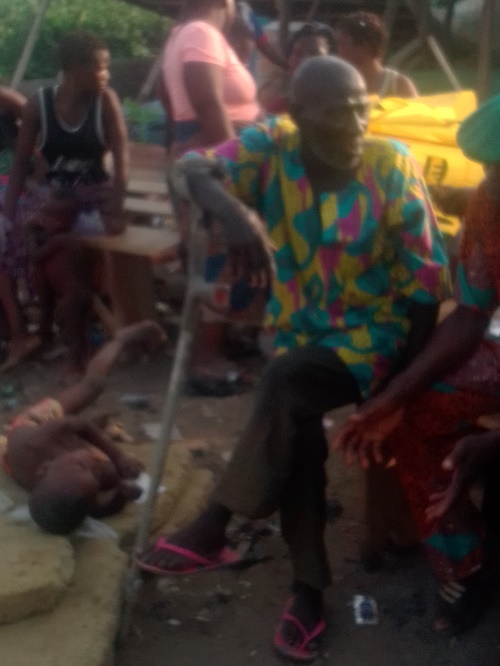
An aged member of the community, Jida Abdulrahman, was fast asleep when the bulldozers arrived, and was almost buried alive if not that the vibrations of his building jolted him from his slumber. He escaped with the clothes on his body as his only prized possession.
He told TheNiche that his food supplies and other stuff were crushed by the bulldozers whose operators he said appeared to be excited crushing everything within site.
A borehole provided by a non-governmental organization, CEE-HOPE, to the community to meet their water needs, was also crushed by the rampaging bulldozers.
The distraught residents, who said they have no other place to go, simply continued living in the debris, without roof over their heads and in the most unhygienic condition, hoping for the rain not to come.
But on January 4, the fifth night after the demolition, at about 7 pm, the cloud started gathering, and the rain came and drenched the hapless people whose only reason for being in that condition was their poverty.
Essentials like water, something in the past they could take for granted with the borehole provided for them by CEE-HOPE, is now the most difficult thing to come by.
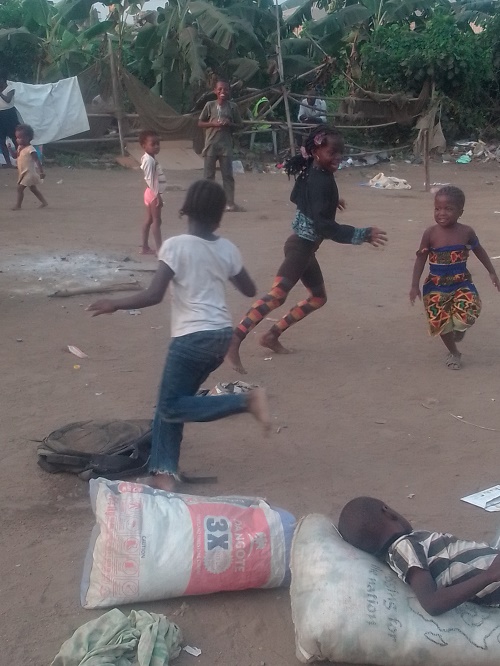
Children running around despite their plight of their parents
On January 4, CEE-HOPE’s executive director, Betty Abah, took dozens of bags of sachet water to Monkey Village to deliver to the people. The items were received like a life saver. The reason was because the only source of water available for them comes from a stagnant pond infested with many contaminants. And that’s what they use for cooking, laundry, bathing and other necessities. With the drinking water provided for them, their meager resources could be put to other use.
For members of the community who have been rendered roofless and who remain at the mercy of nature – rain, sunshine and even reptiles like snakes, a large number of which can be found in the neighborhood, roof over their head is their primary concern.
At a meeting CEE-HOPE held with members of the community, they pleaded for the government and well-meaning individuals to come to their aid as they neither have any other place to call home nor the means to afford any other accommodation.
A slow response to the humanitarian crisis that is building up in Monkey Village could be dire. And the most vulnerable are the children and the elderly who make up the larger demography in the neighborhood. (Thenicheng)
Saturday night November 28, 2020 was the last time neighbours saw Chukwuemeka Anichukwuegbo alive. His body was later found in an illegal private morgue with stitches on his chest.
He had disappeared from his home after just having a meal.
What happened to him? Was he murdered? Who did it, and why? His family has been seeking answers to these and other questions. But more than a month after the gruesome murder, the answers are still hanging in the air.
Chukwuemeka, 33, was a graduate of industrial physics from Ebonyi State University, Abakaliki and a manager with a chemical company, Diversey Nigeria Limited in Ijebu Ode, with its head office in Lagos.
He worked in Lagos for about six years before he was transferred to the ancient South West city in 2019.
He had lived in Ijebu Ode for about a year when his sister, Stella Anichukwu, got a call from his landlord that he had not seen him for 24 hours. About two weeks later, she got another call from the police requesting her to come and identify a corpse in a morgue.
It turned out to be Emeka – stone dead. Answers to enquiries are more confusing than helpful.
Beginning of the mystery
Father Hyacinth Ibeh
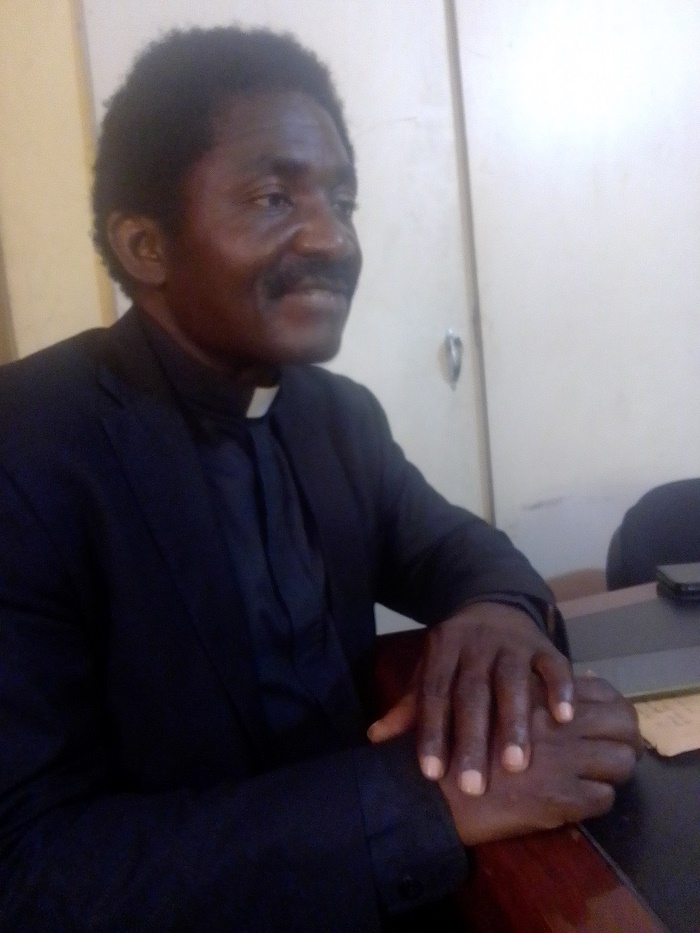
A Catholic priest, Reverend Father Hyacinth Ibeh, who took up the fatherly role for Emeka and his two siblings after they became orphans, told TheNiche what police investigation has so far unearthed and why justice for the deceased is a matter of urgency.
“I know Emeka is not coming back. But I want to stop these people from going on their killing spree so that they don’t kill more people. There are so many innocent people they are killing daily. I want them to be stopped,” he said.
“I want every person that is connected with this murder to be brought to book. That is precisely what I want, to save some innocent people. It seems to me that the killers are known as hired assassins and nothing is happening. And they are going on with business as usual.
“Emeka’s sister, Stella Onyebuchi Anichukwu, was the one that called to tell me that the landlord of Emeka called her on Sunday, November 29, 2020, to tell her that her brother had not been seen since Saturday, November 28, 2020. Apparently, it was that Saturday they saw him last.
“On Monday morning, Stella rushed down to Ijebu Ode. On getting there, they said that Emeka’s door was locked but the key was left on the window which naturally Emeka wouldn’t do. If he was going out, he would go with his key in his pocket.
“His wallet was in the bedroom, meaning that he really didn’t prepare to go out otherwise he would go out with his wallet.
“They looked into his wallet and his ATM cards and the money in his wallet were intact. But they saw that it appeared he cooked. And from all they could see, he had just finished eating. The plate which he used was on the table where he sat and ate. The rice he ate, you could see that it was on the stove where he took what he ate.
“From all they saw, the pot was still on the stove, and you could see where he took a scoop of what he ate. It didn’t seem he prepared to go out. Our inference is like they came to take him right there on the spot at gun point or they called him out. And we imagine that it must be a familiar person for him to go out.”
Emeka’s sister, Stella Onyebuchi Anichukwu
Questionable police investigation
Emeka’s phone became useful for the police in at least getting some suspects. The two suspects were in possession of Emeka’s phone and his corpse which they deposited in their illegal mortuary.
They also admitted to stitching his corpse on the left side of his chest.
“At a certain point, the police saw that somebody was using Emeka’s phone. The police called the number. It appeared the person sensed something and switched it off,” Ibeh narrated.
“So, the police now looked at the phone’s record and found somebody that he called so often. And they called that person, pretending to engage him in a job they wanted him to do. That person was picked.
“When they picked him up, they demanded to know about the other person that had Emeka’s phone. He now gave the police a different number which they used to get that person. They became two suspects.
“The police asked the other one how he got the phone. He said it was from Emeka’s corpse. They asked him how he got the corpse. He said it was the day that cult people were shooting and some people were shot, that Emeka was one of the persons that were shot.
“They asked him how the corpse got to his mortuary, he said it was the police that called them and asked them to pick up the corpse. They asked them, ‘do you know the police that called you;’ they said yes that they know.
“The one interviewing them was so surprised that the police would call them to pick up a corpse and would not take the body to a government mortuary!
“They asked them who authorised the embalmment. They didn’t have answers. They asked them about the stitches, they said they did it themselves. It was mind boggling.
“At the mortuary, Emeka was only in boxers. I was wondering whether he was not just in his boxers when they took him from his home. My suspicion was that he had just come back from work, removed his clothes, wearing only his boxers, cooked for himself and was eating when they came for him.
“That is what I am inclined to believe. But the two suspects said those were Emeka’s clothing, showing off some clothes. But the clothing, none of them could fit him. None of them was his size.
“Number two, they said he was shot. But the clothing didn’t have blood stains. Number three, if somebody is shot at a close range, the bullet can go from the front and come out at the back, but no exit at his back to confirm that a bullet pierced him.
“Finally, there was a third arrest that was made three days ago, a female. It was through phone tracking they got her because they said her call was the last Emeka received.
“She said she was a friend of Emeka. They asked her what she knew about what happened. She said that Emeka visited her and that she was escorting Emeka, and that right there, some men on okada stopped and shot him before her. That Emeka fell down and she ran for her dear life.
“We were wondering that she was escorting her friend and unknown people shot him and she ran for her dear life and left the friend, didn’t notify the police, did nothing until now that the phone records showed that she was the last person that called him.”
Curious attitude of Emeka’s landlord
Another shocker is Emeka’s landlord who was more concerned about other things than his dead tenant.
Ibeh said: “Just this morning (January 8), Onyebuchi was telling me that three days ago, Emeka’s landlord called her to say that Emeka’s rent expired in December, that she had only one week to come and collect the belongings of her brother.
“What kind of a human being would make that kind of statement? Is he hiding something? Otherwise how could his tenant be in the mortuary and there is a police case and you are giving one week ultimatum?
“This same landlord had told her that Emeka was the best tenant he ever had. Barely a month after his death he is giving ultimatum.”
Ibeh also expressed concern about the attitude of an assistant superintendent at the Igbeba police station in Ijebu Ode, where the case is being handled. The man told the family in a Yoruba adage that they should simply move on instead of pursuing a case that would not bring the dead back to life.
Ibeh said people like that in the police are the reasons why Nigeria is held down.
Emeka’s case was later transferred to the state CID in Abeokuta where the commissioner of police returned it to Igbeba police station in Ijebu Ode because they did a shoddy job – no autopsy report, no report from the so-called police that called the illegal mortuary attendants.
Now, what does Emeka’s family want? For justice to roll down like water.
China racing to overtake the United States in technology has unveiled a train that travels at 600 kilometres per hour, faster than an aeroplane, and faster than the latest Japanese bullet train in the making hoping to hit the tracks at 500km per hour.
The new technology in rail transportation with its prototype high-speed magnetic levitation bullet train beats the current Beijing rail that goes at 350km per hour.
The train was developed by China Railway Rolling Stock Corporation (CRRC) and the government is working on putting it in service by the second half of 2021.
Magnetic levitation is a kind of technology in a train transport system where magnetic forces are deployed to make trains travel at very great speed.
With the use of two magnetic forces, the train is pushed forward at a pace that makes it ‘float’ and the speed is boosted by the lack of friction between the train and the tracks.
CRRC Deputy Chief Engineer, Ding Sansan, said the train can travel from Beijing to Shanghai in about 3.5 hours, beating an aeroplane’s speed of 4.5 hours.
Tests before full operation
The new train will go through great tests before it launches. A centre and a production building are being set up for the new service.
CNN had reported in May 2019 that a new floating bullet train capable of hitting speeds of 600 kilometres per hour (about 372 miles/hour) was one step closer to reality in China.
That month, the body prototype for the latest high-speed magnetic-levitation (maglev) train project rolled off the assembly line in the eastern Chinese city of Qingdao.
Developed by the state-owned CRRC – the world’s largest supplier of rail transit equipment – the sleek-looking train is scheduled to go into commercial production in 2021 following extensive tests.
Those involved with the project are optimistic it will completely transform China’s travel landscape, filling the gap between high-speed rail and air transportation.
“Take Beijing to Shanghai as an example – counting preparation time for the journey, it takes about 4.5 hours by plane, about 5.5 hours by high-speed rail, and [would only take] about 3.5 hours with [the new] high-speed maglev,” said Sansan, head of the train’s research and development team, in a statement.
While the cruising speed of an aircraft is 800-900 km/h, at present trains on the Beijing-Shanghai line have a maximum operating speed of 350 km/h.
Five years in development
Maglev trains use magnetic repulsion both to levitate the train up from the ground, which reduces friction, and to propel it forward.
After nearly three years of technical research, Ding told CNN last May the team had developed a lightweight and high-strength train body that lays the technical foundation for the development of five sets of maglev engineering prototypes.
Japan’s maglev ambitions
CNN recalls that in the 1960s Japan revolutionised train technology with the bullet train. Japan’s newest Maglev promises to break world records.
China’s new prototype won’t be the first train to surpass the 600-kilometre mark when it hits the testing track.
A Japan Railway maglev train achieved a top spot of 603 km/hour on an experimental track in Yamanashi in 2015, setting a new world record.
Japan is now developing a new Chuo Shinkansen maglev line, with trains set to hit top speeds of about 500 kph.
The first phase of the project, connecting Tokyo and Nagoya, is scheduled to be completed in 2027 and is expected to cut travelling time between those cities by half.
Maglev in China, South Korea, Japan
China’s first commercial maglev system, a 30-km stretch between Shanghai Putong Airport and the city centre, opened in 2002. It has hit speeds of 431km per hour and was the world’s fastest commercial maglev system by 2019.
The project was co-created by Shanghai Maglev Transportation Development Co. Ltd., a German Consortium consisting of Siemens AG, Thyssen Transrapid GMBH and Transrapid International GMBH.
While the maglev technology has been developed and touted as the future of train transportation for decades, there are only a handful of countries operating maglev trains around the world: China, South Korea and Japan.
President Muhammadu Buhari has ordered for an immediate response to rising cases of bandit attacks on communities in Zamfara State.
In a statement signed by senior special assistant to President Muhammadu Buhari on media, Garba Shehu, the president directed the National Security Adviser, Major-General Babagana Monguno (Rtd) to set machinery in motion to end to end the resurgent banditry that has continued to cost lives and the displacement of thousands of families from their towns and villages.
The statement said: “Recall that recently, the Speaker of the Zamfara State House of Assembly, Hon. Nasir Magarya, wrote a letter in which he appealed to President Buhari to intervene and stop the incessant killings by bandits in the State.
“In this respect, a meeting is soon to take place that will deliberate on security and the issue of illegal mining which is fueling the crisis in Zamfara State.
“In addition to NSA the convener, the meeting will be attended by Major-General Bashir Magashi (Rtd), Ogbeni Ra’uf Aregbesola and Architect Olamilekan Adegbite, Ministers of Defence, Interior, and Mines and Steel respectively.
“Also to attend the meeting are the Directors-General of the Department of State Services, DSS, and the National Intelligence Agency, NIA.
“Beyond the problems of bandits and cattle rustlers, the scale of lawlessness has been aggravated by illegal miners who are harvesting resources they have no legal rights to exploit.
“Official statistics suggest that there are more than 20,000 such miners undermining this important part of the economy, operating in a manner that is extraordinarily harmful and destructive. The result is chaos.
“This meeting is expected to address these and associated issues of corruption, government oversight and lawlessness.”
Our site uses cookies. By clicking “Accept All Cookies”, you direct Law and Society Magazine to store cookies on your device and disclose information in accordance with our Cookie Statement: cookie policyACCEPTREJECT
Privacy & Cookies Policy
Privacy Overview
This website uses cookies to improve your experience while you navigate through the website. Out of these cookies, the cookies that are categorized as necessary are stored on your browser as they are essential for the working of basic functionalities of the website. We also use third-party cookies that help us analyze and understand how you use this website. These cookies will be stored in your browser only with your consent. You also have the option to opt-out of these cookies. But opting out of some of these cookies may have an effect on your browsing experience.
Necessary cookies are absolutely essential for the website to function properly. This category only includes cookies that ensures basic functionalities and security features of the website. These cookies do not store any personal information.
Any cookies that may not be particularly necessary for the website to function and is used specifically to collect user personal data via analytics, ads, other embedded contents are termed as non-necessary cookies. It is mandatory to procure user consent prior to running these cookies on your website.