Home Blog Page 1072

Beating the drums of war

Simon Kolawole

Recent events in south-western Nigeria, as I would offer to think, are not ordinary. First, Chief Sunday Adeyemo (also called Sunday Igboho), a private citizen described as “youth leader”, stormed the Fulani community in Igangan, Oyo state, and gave them seven days to vacate the land, failing which he would expel them. The “grassroots mobiliser” confronted the Seriki Fulani, Alhaji Saliu Kadri, accusing his kinsmen of killing Yoruba people. After issuing his ultimatum, Igboho said: “It’s not like I just commanded the Fulani to leave our land or that I suddenly said something arbitrarily. For like two weeks now, these Fulani people in Ibarapa have been killing our people.”

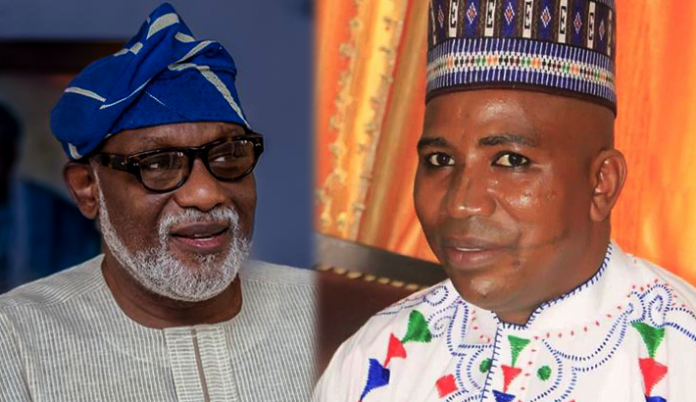
Second, Governor Rotimi Akeredolu of Ondo state issued another seven-day ultimatum to Fulani herdsmen to vacate the state’s forest reserves. The deadline is today. He has banned night-grazing and movement of cattle within cities and highways. He has also outlawed what he called “under-aged grazing” — which I must presume are the young herders. His Riot Act has been opposed by presidency and prominent northern elders. There is a debate on the constitutionality of his order. Akeredolu, though, does not seem to bother. He has ordered massive recruitment into Amotekun — the south-west quasi-state police outfit — ahead of the operations to flush out Fulani herders.

Why is Akeredolu so incensed? Bad elements, he said, have turned the forest reserves into hideouts for keeping victims of kidnapping, negotiating for ransom and carrying out “other criminal activities”. The governor asked those who wish to carry on with their cattle-rearing business “to register with the appropriate authorities”. Igboho, on his part, has defended his unilateral action. “Some are saying I am not in government and that I am meddling with what does not concern me. If there is a government and it is not doing what it is supposed to do, the people that voted will rise up,” he explained. In other words, there will be something like free-for-all — as we see in failed states.

Governor Seyi Makinde of Oyo state is more temperate in his own reaction. He has come out clearly against ethnic profiling. Labelling every Fulani a kidnapper, armed robber and murderer is unhelpful as far as he is concerned. Focus should be on the criminals, not the ethnic group, he warned. Makinde also had a dig at Igboho, whom many describe as a political agent rather than a youth leader. “For people stoking ethnic tension, they are criminals and once you get them, they should be arrested and treated like common criminals,” Makinde told the police commissioner, adding that they cannot hide “under the guise of protecting Yoruba’s interest” to perpetuate chaos.

Events are unfolding at a rapid pace. Houses owned by Fulani people have been burnt in Igangan after the expiration of Igboho’s ultimatum. On Saturday, Mallam Garba Shehu, presidential spokesman, announced that the inspector-general of police has issued an order for the arrest of Igboho for the eviction notice. Ordinarily, such an announcement should be coming from the police authorities and not presidential spokesman. But it is what it is. The Arewa Consultative Forum (ACF), the northern group, has warned that the attacks on Fulani communities in the south-west can lead to war. Afenifere, the Yoruba group, has described ACF’s statement as “insulting and arrogant”.

Indeed, the eviction notices to Fulani communities offer a different dimension to the security crises. There are many scenarios running through my head, but this particular one scares me: the notice expires; Amotekun launches an operation to evict them; they resist; they get killed; their bodies are taken to the north for burial; Fulani groups reinforce and launch reprisals — which, from experience, can become protracted and gruesome; Yoruba villages come under regular attacks; Yoruba youth groups take revenge on other northerners in the south-west; northerners attack Yoruba up north; and we end up with thousands of dead bodies in a number of states. Not looking good at all.

That is why I would rather suggest, or plead, that our immediate concern should be how to de-escalate the tension rather than fuel it. The easiest thing to say is “let us go to war”. Many people who witnessed the End SARS uprising in Lagos will testify that it was not a pleasant experience — and this was far from being a war. I have discussed with many Nigerians who witnessed the civil war from 1967 to 1970 and most of them always pray that Nigeria would never go to war again. There is hardly any Igbo family that did not lose a loved one during the war. War mongering is sweet on Twitter but the actual event is not a tea party. I would appeal to our leaders to curb the war rhetoric.

Here is my take on the situation. First, it boils down to one thing: the feeling that the security agencies are not doing enough to curtail the criminalities in the region. Igboho said if the government would not do something, the people would rise up and protect themselves. This is a major red flag for state failure. The moment government loses monopoly of use of legitimate force, militias will fill in the gap. The signs are already everywhere: citizens are forming vigilante groups because the security agencies are ineffective. Citizens have lost faith in the ability of the state to enforce law and order, to protect life and property. This is what you see in Somalia and Syria.

Meanwhile, it does not help that there is a theory that the Fulani have an agenda to take over the whole of Nigeria and “dip the Quran in the Atlantic Ocean”. The herders’ association, Miyetti Allah, is believed to be enjoying state protection. If you accept this theory, as millions of southerners and middle belters do, then you are likely to have serious sentiments for the anti-Fulani movement. And you are likely to support the actions of Akeredolu and Igboho. You will see their endeavours as an attempt to protect Yorubaland from Fulani “jihadists”. I fear that this suspicion is fuelling the tension between Yoruba and Fulani communities in the south-west. Hence, the songs of war.

Ironically, herders, mostly Fulani, are also heavily implicated in the insecurity ravaging the north-west. Most of the kidnappers in that region are said to be Fulani. There have been incessant kidnappings and killings in Zamfara state in the last seven years — that was before Buhari came to power. The crimes are usually attributed to bandits. Therefore, what we have in our hands is a failed security system that has led to insecurity nationwide. The narrative in the south is that the criminals are bandits when they strike up north but Fulani jihadists when they strike down south. That is the price we pay for the inability of the country to protect us. It creates room for all sorts.

I would also say that the federal government is not acting in a way that will make southerners trust the state. Take, for instance, the order to arrest Igboho — which I support. No individual, not even a governor or a president, has the power to evict any Nigerian from any part of the country based on ethnicity, politics or religion. But where this administration always loses the case is that it is not even-handed. In 2017, a group of northern youths led by Alhaji Shettima Yerima issued an ultimatum to Igbo people to leave the north by October 1 because of Biafra agitations. Nobody ordered his arrest, and we had a police force and an IGP to boot. That is how trust is lost.

Nevertheless, I would like to warn against ethnic profiling when it comes to criminal matters. It is a dangerous game. To the best of my knowledge, every ethnic group in Nigeria has criminals. For all you care, the Fulani guys that are implicated in kidnapping and ransom-taking might be working in conjunction with Yoruba insiders and police accomplices. They will be sharing the proceeds of crime without discrimination. That these people are getting away with these crimes — without any arrests or prosecutions even when the states have the power to do so — suggests that it is an organised network. They appear, to me, to be enjoying protection from security agencies.

The challenge facing us is two-fold: de-escalating the tension and improving security. While the first is urgent and immediate, the second is medium-term; without it, there will always be such flare-ups. Insecurity by itself is bad enough. When we now allow it to be layered with ethnic tensions, it is doubly dangerous. The Nigeria Governors Forum (NGF) has a role to play in calming nerves. Most importantly, Buhari needs to be actively involved. He should call the governors to a meeting and, if necessary, summon an emergency meeting of the National Security Council (NSC) to discuss the burning issues. We are, as it seems to me, playing with fire. We should not take our luck for granted.

In the final analysis, moments like this call for statesmanship, not war mongering. This is not the time to be beating drums of war. This is the time to “kulu temper” and confront the issues one by one: why are these crimes so easy to commit? Why is nobody facing prosecution? What can we do to protect the lives of all — no matter the ethnic or religious affiliation? We have enormous security problems to overcome if we are to enjoy peace. One of my favourite Yoruba proverbs says: “Irorun igi ni irorun eye.” You see, it is in the interest of the bird that the tree is comfortable for her to perch on. If we don’t silence the drumbeat of war, we may live to regret it. My two cents.

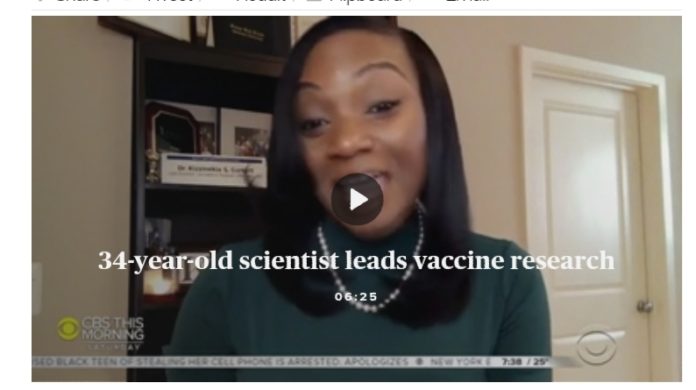
Meet the Black female scientist at the forefront of COVID-19 vaccine development

When President Donald Trump paid a visit to the National Institutes of Health last March, the leads at the vaccine research center explained their life-saving mission. The key to that mission was a 34-year-old doctor named Dr. Kizzmekia Corbett.

“I was just there telling the task force about the work that we’ve been doing,” Corbett told “CBS This Morning: Saturday” co-host Michelle Miller.

Two weeks after the visit, Corbett’s team began the first stage of clinical trials. She said they took a lot of the knowledge they have gained in the last six years and applied it to a vaccine platform in collaboration with Moderna. The vaccine rolled out 10 months later.

“The vaccine teaches the body how to fend off a virus, because it teaches the body how to look for the virus by basically just showing the body the spike protein of the virus” she explained. “The body then says ‘Oh, we’ve seen this protein before. Let’s go fight against it.’ That’s how it works.”

Dr. Anthony Fauci, the head of the National Institute of Allergy and Infectious Diseases at the National Institutes of Health, credited Corbett during a webinar for her work.

“The vaccine you are going to be taking was developed by an African American woman and that is just a fact,” Fauci said.

The Centers for Disease Control and Prevention reports that more than 6.5 million Americans have received their first dose of the COVID-19 vaccine. That number is expected to grow daily, though it is well behind what public health experts were hoping to see.

Corbett’s interest in science started from an early age, but she never knew the difference she would make.

“To be honest, I didn’t realize the level of impact that my visibility might have… I do my work because I love my work,” Corbett said.

One opportunity in her life made a key difference. She attended the University of Maryland, Baltimore, as a Meyerhoff Scholar, an aggressive program that mentors minorities and women in science. Graduates of the program include Surgeon General Jerome Adams.

Dr. Freeman Hrabowski has been president at the University of Maryland, Baltimore, for nearly 30 years. He said Corbett had a strong science background but the way she was able to talk to people separated her from the rest.

“She was definitely going to make it in life,” Hrabowski said. “We need more scientists who can connect to people. She could do that when she was 17, easily… What we do at UMBC is to support students of color, Black, but also students in general, to make sure they make it in science.”

According to the National Center for Education Statistics, only 18% of all students graduate with a STEM degree, among 2% are black — something Hrabowski believes needs to change.

“It’s important for people to see people looking like them, like themselves, who can be involved. If it’s about women, or if it’s about Blacks because it shows that you’ve got people who understand what you’ve gone through.”

Dr. Barney Graham and Corbett have worked together for over 15 years. Graham is not only her mentor. He’s also Corbett’s boss as deputy director of the Vaccine Research Center.

“When you recognize somebody has special qualities, you need to do things that can keep those other things out of the way and avoid some of the dismissiveness that often happens not only to minority people but to women,” Graham said.

Historically that bias strikes not just professionals in the field but those they serve. In 1931, scientists conducted the Tuskegee Syphilis Experiment, a study by the Public Health Service and Tuskegee Institute. It examined the progression of syphilis by letting infected Black men go untreated, with no regard to the suffering it caused.

Another example often cited is the removal of special cells of Henretta Lacks, a Baltimore, Maryland, cancer patient. In 1951, a research team at Johns Hopkins University removed Lacks’ cells without her permission and used them in medical research worth billions of dollars. Lacks died of cancer and her family was never compensated.

“There are many other examples of supposedly objective scientists who were caring about everyone, who valued people of color less… It’s a painful truth,” Hrabowski said.

Corbett’s understanding of the socio-cultural issues and her knowledge of science has made her an influential person in the scientific community.

In a time where vaccine skepticism is high among African Americans, Corbett hopes Black people will put faith in the vaccine and faith in the scientists working behind the scenes to bring it to the American people.

“Number one is that I get it. And then number two is to really take advantage of the level of transparency that we are attempting… even I haven’t even seen before, such as FDA hearings and briefings being broadcast online, and data coming out almost instantly,” she said. 

As for Dr. Hrabowski, he believes Corbett deserves all the visibility she can get.

“She cannot be a hidden figure,” he said. “She needs to be in textbooks. Little girls need to see her — of all races. This is what’s possible.”

CBS News

US Leaders Write Biden To Back Okonjo-Iweala

Some US leaders have written President Joe Biden, urging him to support the candidacy of Ngozi Okonjo-Iweala for the office of the director-general of the World Trade Organisation.

In an open letter addressed to the newly sworn-in president, the US leaders said Okonjo-Iweala’s ascension to the office of the DG would send a strong message to the rest of the world that Biden is leading an inclusive government.

The team of former senior US government officials and leaders in academia, civil society, and private sector said Okonjo-Iweala will be the first American woman to lead the WTO.

“We write to respectfully encourage you to support the candidacy of the eminently qualified Dr. Ngozi Okonjo-Iweala as she seeks to become the next Director-General of the WTO,” the letter read.

“Dr. Okonjo-Iweala is a dynamic woman of vision who can guide the WTO through its era of reform. She possesses a very rare combination of leadership and experience that is deeply grounded in international trade, finance, economics and diplomacy.

“Her selection, as the first American and woman of color to serve as the WTO’s director-general will send a clear message of inclusion to the rest of the world.”

In October 2020, Okonjo-Iweala was elected by 110 of 164 countries as the most qualified person to lead the world trade body.

The US opposed the selection of Okonjo-Iweala, claiming that she does not have trade experience.

However, in a letter signed by the US leaders, including John Negroponte, former ambassador to the United Nations, Okonjo-Iweala was said to possess a “very rare combination of leadership and experience that is deeply grounded in international trade”.

“We know Dr. Okonjo-Iweala and have found her to be a woman of integrity, an honest broker, and a pragmatist who consistently delivers results,” the letter read.

“We believe strongly that she can be a transformative director-general, one who — with your support — will be embraced and effective within and beyond the WTO.

“In sum, Dr. Ngozi Okonjo-Iweala is a uniquely qualified leader poised to help the WTO evolve and succeed for future generations. She is a leader who can also be relied on to pay due attention to the concerns many Americans have about global trade. She has what it takes to lead WTO reforms and take the organization into the future.

“We deeply appreciate any consideration you may provide to her candidacy which is critically important for our nation and the world.”

Okonjo-Iweala was nominated by the Muhammadu Buhari-led government as Nigeria’s candidate for the office of the WTO DG.

She became a US citizen in 2019 — after living and working in America for over four decades.

Source: Newspot

Ondo forest fertilised by Fulani cow dung for 250 years: Miyetti Allah

Abdullahi Bodejo’s comments appeared a direct challenge to the authority of Mr. Akeredolu, who has constitutional powers to appropriate lands across Ondo State.

Abdullahi Bodejo, a leader of cattle breeders group Miyetti Allah, has said Governor Rotimi Akeredolu has no powers to drive Fulani herdsmen from Ondo State forest reserves, pointing to a 250-year history of nomadic exploits in the region.

Mr. Bodejo, in an interview with Lagos-based tabloid The Sun, said Mr. Akeredolu should reconsider his seven-day ultimatum for herdsmen to leave Ondo forests following repeated deadly attacks.

“The Ondo State governor doesn’t have any right to give such an ultimatum to our people. People, including Fulani voted for him to be the governor; so he should be the governor of everybody in the state.

“Fulani have been in the forests he is talking about even before he was born; they have been there for over 250 years. No matter how dangerous a forest may be, Fulani would go and settle there.

“After staying there for a long time and their cow dung has made the place fertile, people would begin to come there to farm and settle and after then, they begin to make claims that our cattle are destroying their farms.

“We are suing the governor and seeking an injunction restraining him and others from carrying out his threat. But even at that, nobody, no power can send the herdsmen out of Ondo State.

“We are making consultations with our legal team. But before then, the governor and his people should stop embarrassing our people in the forests and all their businesses. No herdsman will obey the governor; the herdsmen will not step an inch out of Ondo forests; they are going nowhere,” Mr. Bodejo said.

Although the Miyetti Allah leader spoke furiously against violence linked to herdsmen, his comments appeared a direct challenge to the authority of Mr. Akeredolu, who has constitutional powers to appropriate lands across Ondo State.

A spokesman for the governor did not immediately return a request seeking comments Sunday afternoon. (Peoplesgazatte)

EX BODY OF BENCHERS CHAIR, ABDULLAHI IBRAHIM IS DEAD

Foremost senior lawyer and former Chairman of Body of Benchers, Alhaji Abdullahi Ibrahim SAN is dead. The leading Senior Advocate died Sunday afternoon.

Confirming the incident, a Partner in his law firm said: “He’s gone. He died this afternoon.” Alhaji Ibrahim is suspected to have died in Abuja from heart complications. A trending online post stated: “Innalillahi wa inna ilaihi rajiun the death of Abdullahi Ibrahim SAN has just been announced right now in Abuja from a heart ailment. May Allah SWT forgive his indiscretions and grant him jannatul firdaus.” A former Attorney General and Commissioner for Justice in one of the South West states had also posted thus: “May Allah grant Alhaji Abdullahi Ibraheem, SAN aljannah fridaus. Ameen.”

Ibrahim was a Commissioner, International Boundary, National Boundary Commission from 2000 to 2006. He was a member of the Nigerian team that successfully negotiated the Maritime Boundary Treaty between Nigeria and the Republic of Equatorial Guinea and also the Unitization Agreement of the Zafiro/Ekanga oil fields. He was Nigeria’s Agent and later Co-Agent in the dispute between the Federal Republic of Nigeria and Cameroon at the International Court of Justice, the Hague Netherlands. He also led the Nigerian delegation to the United Nations conference on the establishment of the International Criminal Court.

Below is his biography as posted on his law firm’s website:

Alhaji Abdullahi Ibrahim, CON, FCIArb, FINALS, SAN.

Our founding Partner; he was called to the English Bar in 1963 where he practised in chambers for a while before returning to Nigeria. He was later called to the Nigerian Bar in 1964. He was at different times legal adviser at the then Ministry of Finance, Northern Nigeria and New Nigeria Development Company; a one-time Senior State Counsel and head of prosecutions at the Ministry of Justice, Kano State; Alhaji Abdullahi Ibrahim has since 1973 remained in active private legal practice.

He was admitted into the Inner Bar as a Senior Advocate of Nigeria (SAN) (equivalent of a QC in England) in 1982. He is a Notary Public, a Life member of the Body of Benchers and was the Body’s Vice Chairman and Chairman between 1999 and 2001. He was a member of the National Judicial Council (NJC) between 2004 and 2008; Chairman, Legal Practitioners’ Disciplinary Committee between 2001 and 2006 and also Chairman, Legal Aid Council from 1990 to 1994.

He is a Fellow of the Chartered Institute of Arbitrators, Nigeria (FCIArb) and a Member of the Chartered Institute of Arbitrators (UK) (MCIArb), he is also a Fellow of the Institute of Advanced Legal Studies, Nigeria (FINALS).

Alhaji Abdullahi Ibrahim served the nation at various times in several capacities as Commissioner for Education in the old Kwara State, Nigeria, Federal Minister of Education, Science and Technology; Minister of Transport and Aviation and as the Attorney-General of the Federation and Minister of Justice.

He was a Commissioner, International Boundary, National Boundary Commission from 2000 to 2006. He was a member of the Nigerian team that successfully negotiated the Maritime Boundary Treaty between Nigeria and the Republic of Equatorial Guinea and also the Unitization Agreement of the Zafiro/Ekanga oil fields. He was Nigeria’s Agent and later Co-Agent in the dispute between the Federal Republic of Nigeria and Cameroon at the International Court of Justice, the Hague Netherlands. Alhaji Abdullahi Ibrahim also led the Nigerian delegation to the United Nations conference on the establishment of the International Criminal Court.

In acknowledgement of his contribution to the Nation he was conferred with the National honour/Award of Officer of the Federal Republic (OFR) and later Commander of the Order of Niger (CON). He was also conferred with the honours/Award of Gran Cruz de la Orden de la independencia de Guinea Ecutorial by the Government of Equatorial Guinea for his service to the country and Nigeria.

Alhaji Abdullahi Ibrahim was Chairman Nigerian Stock Exchange, Kaduna Branch and as a member of the National Stock Exchange he was the first Vice President of the Nigerian Stock Exchange in 1989. He was Chairman, Nigerian Institute of International Affairs from 1988 to 1994 and also Chairman of New Nigeria Development Company between 1992 and 1998.

Alhaji Abdullahi Ibrahim has acted as Amicus Curiae in several contentious matters before the Supreme Court of Nigeria. In recognition of his outstanding contributions to the development of the Nigerian Law and legal System, he was conferred with an honorary Doctorate Degree in Law (LLD, Honoris Causa) by the University of Kogi, Nigeria in 2008.

Alhaji Abdullahi Ibrahim is a seasoned Arbitrator; he once sat and he is currently a member of the Permanent Court of Arbitration at the Hague, Netherlands. He has chaired and sat as a member of several Arbitration panels. He is very much interested in International law, Taxation/Revenue Law, Constitutional Law, Administrative Law, Investment Law and core litigation.

Justice Department, FBI debating whether to charge all those involved in Capitol riots

BY CELINE CASTRONUOVO

Justice Department and FBI officials are reportedly discussing whether or not everyone who stormed the Capitol on Jan. 6 should be charged, with some arguing that charges should not be filed for those who did not engage in violent behavior.

The Washington Post reported on the internal deliberations Saturday, citing multiple people familiar with the discussions. The Post added that discussions on such a decision are in the early stages, with no formal stance taken on the matter.

The sources, who spoke on the condition of anonymity to freely discuss legal deliberations, reportedly told the Post that some federal officials pointed out logistical concerns of the cases swamping the local courthouse. Authorities estimate that roughly 800 people stormed the Capitol during the deadly pro-Trump riot.

Individuals have been arrested across multiple states in connection with the attack, but each case is being prosecuted by the U.S. Attorney’s Office for the District of Columbia.

As of Saturday, the Justice Department has already charged more than 135 individuals with committing crimes on or around the grounds of the Capitol, with more charges expected in the coming weeks and months.

Some federal officials have also internally proposed that those individuals who were only known to have committed unlawful entry, and were not engaged in any violent behavior, should not be charged, according to the newspaper.

However, other officials have pushed back against this proposal, asserting the importance of using the charges to send a message that similar actions in the future will not be tolerated.

The sources told the Post that they are sensitive to the fact that the credibility of the Justice Department and FBI could be called into question with such a decision.

Justice Department spokesman Marc Raimondi said in an email to the Post, “There is absolute resolve from the Department of Justice to hold all who intentionally engaged in criminal acts at the Capitol accountable.”

“We have consistently made clear that we will follow the facts and evidence and charge individuals accordingly,” Raimondi added. “We remain confident that the U.S. District Court for Washington, DC can appropriately handle the docket related to any resulting charges.”

The Hill has reached out to the Justice Department and FBI for additional comment.

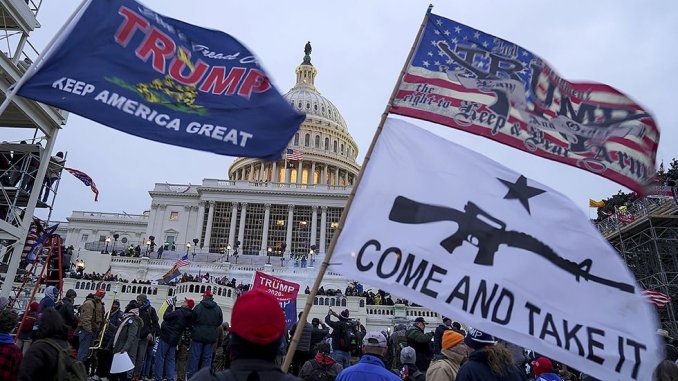
Supporters of Trump stormed the Capitol on Jan. 6 after the former president encouraged a crowd on the National Mall to march to the Capitol and demand that Congress halt the certification of President Biden’s Electoral College victory.

At the time, Congress was in the midst of debating an objection to the election results in the state of Arizona.

Trump in the past has repeated a false claim that the election was “stolen” from him and that the election was “rigged.”

Five people died amid the chaos, including a Capitol Police officer who sustained injuries while responding to the rioting, as well as a woman shot by a plainclothes officer.

Source: sundiatapost

Amotekun Operatives Arrest Students For Emulating Naira Marley (Video)

Amotekun operatives have arrested some students of a yet to be identified primary school in the South-West in a bush during school hours.

According to a viral video, the pupils were found in the bush mimicking a popular singer Azeez Adeshina Fashola who is professionally known as Naira Marley.

However, the singer reacted to the video of the pupils being arrested by Amotekun. The singer was so angry and furious seeing the video and has condemned the act of Amotekun personnel who arrested the pupils.

The singer sees it as child abuse and has asked people to find out the name of the school so he can go and question the school authority on why the school invited security personnel to arrest the kids.

The singer also said he wants to meet with the kids and plans to reward them financially

He wrote: “Guys look what’s happening in stupid Nigeria.

“How can you arrest school kids? This is child abuse. The teachers and this stupid uncles with guns need to get arrested.

“I want to meet all these kids I owe them � � please help me with the name of the school or link me up with any of my Marlian Kids.

“Thanks. I wanna see the witch behind the camera self. Wtf is amotekun self?? If they treat ur child like this, what would u do? Did u see the slap?? U calling someone child criminal?? Omoo I’m so angry�� give me school name pls. I need to go there”.

Source: Newspot

Now, it’s time to talk ‘Cement’ By Bola Bolawole

[email protected] 0807 552 5533

Last December 2020, I bought a bag of cement for between N2000 and N2200 but in the first week of January 2021, the price of a bag of cement had jumped to between N4000 and N4300! Cement had become like the other essential commodities (essenco) such as rice, beans, garri, tatase, tomato, rodo, onions, soft drinks and beer (not to talk of chicken, fish, beef, ponmon and transportation costs) that hit the roof during the yuletide period! The amazing thing about the cement price hike is that those who claim to know say we can import cement at the current abhorrent Naira exchange rate to the US dollar, sell at less than N2000 and still make a handsome profit! How come, then, that with local production, which was originally touted as the panacea to what was then seen as the prohibitive cost of cement, but which, with the benefit of hindsight, we can now look back upon with nostalgia as the golden age of cement – how come that the price of cement keeps rising, and at an alarming rate for that matter? The Nigerian cement is said to be the most outrageously expensive in the whole world. Cement produced in Nigeria and transported to other West African countries is said to sell cheaper there than here! How come?

Those who claim to know say that this is another example of an economic policy working beautifully well elsewhere but which, characteristically, has gone awry here. Like Fela crooned, everything upside down here. Corruption, impunity, nepotism, tribalism, greed, avarice, and selfishness have seen to it that a policy that was meant to alleviate the suffering of the people has instead accentuated it. Those who claim to know say the Olusegun Obasanjo administration wanted to recreate the Asian Tigers formula of empowering a few Nigerian capitalists to help grow the Nigerian economy as was done by the governments of the Asian countries now known as the “Asian Tigers”. A select group of Nigerian traders was thus singled out as beneficiaries of favourable economic policies and largesse (such as concessionary foreign exchange rates, tax holidays, import duty waivers, monopoly, and favourable access to bank facilities), etc. For example, while the country’s borders were closed to others during lockdown, it was specially opened to one of such highly favoured traders! While other entrepreneurs suffered humongous losses as a result of the border closure, this favoured person capitalised on the advantage to further tighten his grip on the nation’s economy to the chagrin of other competitors and the detriment of the nation’s economy.

One player who should know had this to say: “I think everybody knows that the Nigerian cement industry is as close as you can get to a perfect monopoly. They can even double the price now and the Government policy is that you must pay whatever price they ask you to pay”. That is not so with the Asian Tigers from whence we copied the policy of Government-supported capitalism. Selfishness, self-centredness, vanity, vain-glorious and vile ambition – even in the midst of the grinding poverty, squalor, misery, and deepening penury of their own people – drive our own capitalists here, and NEVER the growth or development of the nation’s economy. This is made possible because government officials are easily bribed and compromised to look away rather than enforce extant rules and penalize infractions while the Government itself makes laws that kill rather than protect the economy. Rather than serve the common good, Government panders to the wiles and whims of a favoured few chosen in deference to primordial and sectional interests. Here, the Government and the favoured few pile the misery upon hapless citizens.

This post went viral a while ago: “Cement has nearly doubled in price in the last two months, rising from N2500 to N4500 for the standard 50kg bag. We knew it was coming the moment the Federal Government panicked and loosened the foreign exchange knot on which it was choking itself… Cement is a product of no particular significance in any other country in the world except Nigeria. Cement companies all over the world return profits of no more than 5% annually. Not in Nigeria! Profits from cement production in Nigeria by the two oligarchs scale 40% annually. Cement assumes an oversized importance in Nigeria because two Northern oligarchs have seized its production and distribution. The monopoly enjoyed by these two oligarchs mean that everyone is forced to pay outlandish prices not related to the true value of the product and not comparable to the lower prices paid for it in the rest of the world. …So while Governments all over the world enforce and litigate antitrust laws to break monopolies, the Government of Nigeria is forcing a monopoly on the people…”

I was not surprised that the post in question ended on a defeatist note, the writer throwing his hands up in the air and believing nothing could be done to arrest the situation. The cement monopolist, the post concluded, could, “for now…sell his cement for any price he wants (but) someday, Nigeria will find new ways of building houses without cement”.

Yes, our fore-fathers built houses with mud and research supports that even this is better than cement; so we can return to it but must we all run away from cement – or suffer in silence – just because of a monopolist? Is it not better, then, to once and for all pick up the gauntlet and seize the bull by the horns?

Wike: Crying more than the bereaved

A market got burnt in Sokoto state; the Presidency offered platitudes, Kebbi state, which was created out of Sokoto, gave N30m toward the rebuilding of the market but Gov. Nyesom Wike from end-of-the-world Rivers state pledged a whopping and scandalous N500m. How much will the Sokoto State Government itself commit to the project? Every reasonable fellow is aghast! This is a clear case of being more Catholic than the Pope. With Wike crying even more profusely than the bereaved, I smell a rat! What is the total cost of rebuilding the burnt market? How rich is Rivers state that its governor can afford to dash out half a billion Naira without batting an eyelid – and in these austere times? Hasn’t Rivers state and its people needs of their own? Has this humongous sum been appropriated – or will it be appropriated – by the Rivers state House of Assembly or can Wike spend Rivers money anyhow he likes, even without appropriation? Is this generosity by Wike altruistic or is it Greek gift? Did Wike consult anyone in Rivers before making this donation – was his Cabinet, the House of Assembly, and other stakeholders consulted or did he not need such distractions before treating Rivers’ coffers as his personal bank account? The answer, as they say, is blowing in the wind! Nevertheless, we can hazard a guess: 2023! We have seen this before. Wike may be embarking on the same wild goose chase that his friend and political ally, ex-Gov. Ayo Fayose of Ekiti state, embarked upon in 2018 as he reportedly jostled to be presidential running mate to Gov. Aminu Tambuwal of Sokoto state. To make that happen, Fayose worked to push the PDP chairmanship position away from the South-west but, then, Atiku Abubakar scattered their plan and the South-west PDP lost out completely in the power equation. History has an uncanny way of repeating itself. It could be the turn of Wike to play second fiddle to Tambuwal in 2023. Some Southern political leaders are so myopic and selfish they wouldn’t mind promoting another Muslim/Fulani/North presidency in 2023 once the crumbs from the master’s table fall on their laps. Pity!

E tu, Akeredolu?

That was what loud-mouth Garba Shehu stopped short of telling Gov. Rotimi Akeredolu of Ondo State. Julius Caesar never expected that Brutus, the friend he trusted, would be one of those who would plot against him. Yet, when the hour came, it dawned on Caesar that Brutus was one of the conspirators. Shocked, as Brutus stabbed him, Caesar blurted “E tu, Brutus?” meaning “And you, too, Brutus?” As Antonio would later reveal, Brutus’ was “the unkindest cut of all” Commentator after commentator are not correctly reading the lips of Garba Shehu and those the “short man devil” runs errands for in the unfolding tango between Akeredolu and the Fulani herdsmen backed resolutely – always – by the Presidency. No, they understand the difference between town and forest, between forest and forest reserves; their grouse is that they never expected this effrontery from Akeredolu of all people. If anyone would lift a finger against Fulani interests, they did not expect that person to be Akeredolu. At least, not so soon! I am sure you know what I mean. The election they helped Akeredolu win was just a few months ago – October 20, 2020 to be precise. The man has not even been sworn in yet to start the second term. His nearest opponent in the election, Eyitayo Jegede of the PDP, is still in court and the tribunal is yet to make a pronouncement on the matter. I am sure you know they could have prevented Akeredolu from getting the APC ticket for the election and that could have thrown the election wide open. While boasting of his “democratic” credentials sometime ago, the president, retired Major- General Muhammadu Buhari, was reported as saying he could have used the armed forces to prevent the PDP from winning election all over the country. So, you know what that means. They could have made sure Akeredolu lost his second term bid. We had reports Akeredolu went crawling to Abuja and then to Bourdillon to appease the APC gods before they gave him the nod. And we all saw how the Gandujes, el-Rufais and Yahaya Bellos stormed Akure for Akeredolu during the Ondo governorship election. And you think all that is for nothing? When the Fulani give you a cap, they demand for your head in return. I cannot say what Akeredolu promised them but it is clear they are disappointed with him. And expect them to drive really hard to get their pound of flesh from the Ondo State governor. His case will still get to the Supreme Court and remember the Imo abracadabra. Akeredolu should quickly surrender to the Fulani and never be this insolent or audacious again or prepare for tough times ahead. He must mobilize his people behind and around him. Already, even his brother-governors, the ones closest to him, are ambivalent on this issue. They are speaking from both sides of the mouth – approbating and reprobating at same time. But how can Akeredolu enjoy his people’s full and unequivocal support when he is said not to have paid salaries since November last year? Efforts to get the comments of Hon. Donald Ojogo, the Ondo State Commissioner for Information, proved abortive. This, however, is not Akeredolu’s personal fight. It must be seen appropriately as the Yoruba or South-west fight for freedom, liberty, and equality. Otherwise, the Yoruba should get ready to be consigned to second class citizens in their own country and be treated as chattel on the land bequeathed to them by their forebears.

Does Southwest Need Federal Development Commission? (2) By Martins Oloja

Inside Stuff With MARTINS OLOJA,

As I was saying, it is a time to ask all our political leaders from Lagos, Ibadan, Oshogbo, Abeokuta through Ado-Ekiti to Akure since 1999, for instance, the values they have created at home and the benefits they have attracted from the capital of the complex federation Abuja – where national values are allocated. We need to speak truth to power in South West. We need to reconstruct the questions on where the rains began to beat us in Yoruba land.
Is it not extremely shameful that a democracy that began with a former Head of State as returning President (of Yoruba extraction) in 1999 has not been able to reconstruct Lagos-Ibadan Expressway, for instance, about 22 years after? Was Bode George (who hails from Lagos) a former military governor of Ondo state, not a Chairman of Nigerian Ports Authority (NPA)? Why didn’t he plan constructively with the PDP government (1999-2015) to construct a modern road network to the two ports in Apapa? Was Senator Adeseye Ogunlewe not a Works Minister in that dispensation? Who sabotaged Bicourtney’s contract to do the Lagos-Ibadan Expressway under a PPP deal? Some Governors of Yoruba states, Lagos, Ogun and Oyo did. Who owns Bicourtney? The name of the major investor there is Dr. Wale Babalakin who has invested in building what a former Aviation Minister referred to as ‘the best local airport in Nigeria’, MMA2, Lagos. It is not a time to discuss the character of Babalakin. Let’s discuss politics, enterprise and development. Why was there no consensus on the politics and grey areas of the contract instead of throwing away the baby with the bathwater? Why is the road (Lagos-Ibadan) Expressway still uncompleted?

I asked these questions before but they are still relevant. Do we need any power of attorney to ask why almost 22 uninterrupted years of democracy in Nigeria has not produced good link roads in the Western region? Is there any good road from Lagos to Abeokuta in Ogun state? Is there any good road that links Ogun state to Oyo state? Is there any road we can be proud of between Oyo state and Osun state (carved out of Oyo)? What of Ekiti state taken out of Ondo State? Is there any good road linking Akure to Ado-Ekiti? In other words, do the state capitals in Western Nigeria have good link roads? How long did they wait for the federal government to complete a rail line from Lagos to Ibadan? What of the legendary centre of excellence, Lagos? Are even the federal roads in Lagos infrastructure to be proud of? Does Lagos, our economic capital of West Africa have excellent roads as Centre of Excellence? Are all the federal roads worthy? Does Lagos maintain its inner city roads? Are the mega potholes everywhere in Lagos not a mega embarrassment to the authorities and the residents?

Can we ask the big man of Owu kingdom, former President Obasanjo, why the road from Lagos to Ota where he has a big farm, and even a university is still work in progress 22 years after he kick-started a democracy with a wonderful slogan in 1999: ‘Obasanjo: a man we can trust’?

Let’s leave Buhari and his wonderful party magicians alone this week. It is a time to do some self-examination of the region that sits on a hill and so can’t be hidden. Let’s leave the cheerleaders and mischievous distorters of Akeredolu’s lawful order to herdsmen in Ondo forest to their conscience this week. And so, it is a time to ask the leading lights and brand ambassadors of a region that is supposed to be the light of the world called Nigeria, some soul searching questions. I hope no one is carried away by a consistency in National Bureau of Statistics data that Western Nigeria is still the wealthiest and highest in literacy rate in its indices on poverty and literacy rates in Nigeria. There is also a new mind-blower: ‘sooner than later, Lagos will be the third largest economy in Africa, competing with Nigeria and South Africa. Just as we have California in the United States competing as the sixth largest economy in the world with $2.4 trillion GDP, which moved slightly above that of France and Brazil since 2015. That is good to hear. But how does this affect the people and critical infrastructure? How do these indicators compel a federal South-West Development Commission at this time?

Do we need a South-West Development Commission (SWDC) before the mighty Lagos can announce to the world that Lagos State University Teaching Hospital (LASUTH) is now the best teaching hospital even in West Africa? When will the Lagos State University too be equipped to be commissioned by the Office of the Citizen as a world-class University and a Centre of Engineering Excellence? When will LASU produce civil engineers who can take over from the mega mediocrity called Public Works Department that is even creating craters while maintaining Lagos roads?
We are in the forefront in the advocacy for practice of true federalism within the framework of restructuring. Where are the authentic brand ambassadors of federalism among the governors in Western Nigeria? Can’t the governors and leaders move beyond delivering seminal papers and making noise on different social media platforms?

In the last 22 years what have the Tinubus, the Agagus, the Mimikos, the Fasholas, the Aregbesolas, the Akeredolus, the Ambodes, the Amosuns, the Ajimobis, the Fayoses, the Aregbesolas, the Otunba Gbenga Daniels, etc invested significantly in education in their states? They are all very educated and so they all benefited from the robust investment that the iconic Obafemi Awolowo had in education quality as a weapon of country and global competitiveness. Let any of these our leaders beat their chests about the world-class universities they established since 1999. Ondo State has three state universities, Ogun state has two state-owned universities, Oyo too now has two universities. There are more state universities in today’s South West. But which of the three universities in Ondo State, for instance, is well funded to be called a centre of excellence?

As I once asked, do we then need more or better universities? When last did the government of Ondo state pay salaries of teachers and workers of the three universities? Do they require a federal South West Development Commission to fund their numerous universities?

One more important question, why didn’t Senator Ibikunle Amosun who was Governor of Ogun State for eight years on the platform of the APC collaborate with the APC-controlled Lagos state to complete an excellent link-road between Abeokuta and Lagos? What became of the routes he initiated and the roads and bridges he ought to have completed that would have terminated at Berger Lagos? Does he require the South West Development Commission (SWDC) to complete the roads – from Ota area to Lagos?

We should not get it twisted, there are legal ways of allocating values through appropriation bills in a democracy in Abuja. This is where the federal representatives of the people need to answer more questions. Here indeed is the thing, if all the members of the National Assembly from the South West states want the Lagos-Ibadan Expressway to be completed in a particular financial year, all they need is to lobby their colleagues in the appropriate committees to allocate adequate funds for the completion of the road. If they want to deepen the process in a transparent manner, they can visit the president to emphasise the importance of the routes to national development. The Works minister who hails from Lagos State, indeed a former Governor of the state, can even be democratically dragged into the fray. If they insist too on completion of the old Shagamu Interchange to Ore road, they will get it completed. That axis too has been in the works since 1999. It is still is a shame on all the legislators from the South West: Fashola once accused them of diverting funds meant for the Lagos-Ibadan road to their National Assembly budget.

In the main, all the legislators and governors (present and past) from South West deserve to be enrolled in a Hall of Shame for paying lip service to the completion of all federal roads in the region including the Lagos-Ibadan, Shagamu interchange-Ore axis.

What of Mile-2, Lagos Badagry Road that leads to Benin Republic? That is another emblem of shame for the South West political leaders. That route is a federal international route that the representatives too deserve a garland of dishonour for.

‘MURTALA AND HIS 45-YEAR-OLD PROMISE TO LAGOS’

Here is the conclusion of the whole matter: instead of unnecessary debate on the South West Development Commission bill, there should be some consensus this time on a bill, which seeks to fulfill general Murtala’s promise to Lagos almost 45 years ago when he proclaimed Abuja as Nigeria’s new capital on February 3, 1976. This is a worthy pursuit in support of the country’s economic capital based in South West.
As I always remind all of us, of all the failings exhibited about Nigeria’s capital, the most telling has been an unfulfilled promise made to Lagos, which was proposed by General Murtala Muhammed in 1976 as “Economic Capital of the Federation.”

In his broadcast to the nation on 3rd February, 1976, Murtala had promised that Lagos would not only be designated a “Special Area,” it would be Nigeria’s commercial capital and the deal would be incorporated into the 1979 Constitution then in the works. His words:

‘…Lagos will, in the foreseeable future, remain the nation’s commercial capital and one of its nerve centres. But in terms of servicing the present infrastructure alone, the committed amount of money and effort required will be such that Lagos State will not be ready to cope. It will even be unfair to expect the state to bear this heavy burden on its own. It is, therefore, necessary for the Federal Government to continue to sustain the substantial investment in the area. The port facilities and other economic activities in the Lagos area have to be expanded. There is need in the circumstance for the Federal Government to maintain a special defence and security arrangement in Lagos, which will henceforth be designated a SPECIAL AREA. These arrangements will be carefully worked out and written into the constitution. Kaduna and Port-Harcourt are to be accorded similar status and designated special areas under the constitution…’

This is one remarkable promise to Lagos that no government since February 14, 1976 has fulfilled. The General made the promise on 3rd February and he was assassinated on 13th February 1976.

So, Abuja, is a city founded by the Generals and General Buhari should be proud of that heritage. That is why he should join the bandwagon of builders by fulfilling the Murtala’s promise to Lagos 45 years ago (next month). After all, it was permissible to blame the PDP for neglecting the APC-controlled Lagos for 16 years before they came in 2015. But now Lagos and Abuja will no longer hate each other as they are both controlled by the same political party, the APC. President Buhari should let General Muhammed turn well in his grave today by fulfilling the covenant he (Murtala) had with the people of Nigeria on Lagos since February 3.

Newspotng

Sunday Igboho and the Spirit of Ogbori Elemoso By Festus Adedayo

By Festus Adedayo Ph.D

Two of Yorubaland’s most prized states’ helmsmen – Governors Oluwarotimi Akeredolu and Seyi Makinde – have made very strong but seemingly diametrically opposed positions on the security of their people, making it the most talked about issue in the nation today. In recent time, their Ondo and Oyo States have become hotbeds of the scalding hot security crises in Northeastern and Northwestern Nigeria. Flakes of the unending years of savage Boko Haram war in the Northeast are whooshing gently but destructively and settling on Western Nigeria. Fleeing displaced Northerners who escape to the bosom of Oduduwa are stretching Southwest space beyond tolerable level. Infrastructure is becoming unbearably elasticized. Firepower of artilleries is stampeding insurgents from the theater of war and with mounting fire of Northwest banditry, forests of Yorubaland are now comparatively safe havens for fleeing warlords. At the same time, proceeds of kidnapping in Yorubaland are said to be surviving funds renegades of Northeast insurgents and ragtag armies of the bandits of Northwest remit home for the sustenance of their evil war. Unable to withstand the economic weather at home, their neglect by government and the Islamic tzedakah system that constituted their survival for centuries, northern beggars and vagrants are also migrating westwards in thousands.
The above alien challenges have successfully defaced the aesthetics and perforated the peace of Yorubaland. The army of beggars in Southwest today will sober even Senegalese-born author and first published Black African Francophone novelist, Aminata Sow Fall of the Beggars’ Strike fame. In Ibadan, for instance, beggars paste themselves like foamy lather round the Mokola overhead bridge, in almost a hundred, while their kindred are scattered round the city in embarrassing proportions. They even have the temerity to sun-dry their tattered clothes on the Ibadan bridge’s metal railings which they have converted into their balustrade. The second evil is the small weevils in the form of ubiquitous young northern bicycle riders, known as Okada, which infest the land like irritant locusts. They are deadly riders who have no respect for traffic rules or law and order. They are responsible for a horde of fatalities on the highway.
One man who should know, Chairman of the Oyo State Security Network Agency, codenamed Amotekun, Col Kunle Togun, (rtd) last week introduced a new dimension to the infestation. Many of the Okada riders, he said, are foreigners and spies for kidnappers and bandits who enter Yorubaland through Nigeria’s porous borders. According to him, ferried into Oyo and other Yoruba States during the COVID-19 lockdown via articulated lorries, most of these Okada riders cannot speak any of the Nigerian languages or English but French and have no known residency permit. Coming on the heels of this invasion is another internal invasion, said Togun. It comes in the form of Yoruba traditional rulers allocating lands to Fulani herdsmen and who, “take money, cows and cars from these people and allow them to settle and wreak havoc in their domains.”
In January, 2018, I had written about the deadliness of Fulani herders. Fulani herdsmen have been declared one of the deadliest terrorist groups in the world by the Global Terrorism Index (GTI). In a survey, GTI said the herdsmen, mainly of the Fula ethnic group, killed 80 people in total in 2013 but by 2014, had murdered at least 1,229 people. The group, according to the report, operates between Nigeria and parts of the Central African Republic (CAR) and had killed 847 people in 2015 across five states in Nigeria through several coordinated attacks during which they inflict varying degrees of attacks on local civilian populations. According to GTI, the attacks were unleashed on private citizens and the Fulani terrorists’ primary and audacious contest is for the farmlands of their victims. These are the people the Nigerian government covers in baby shawl.
President Muhammadu Buhari and a few of his uncritical minded aides have annoyingly sought to legitimize Fulani invasion of Yorubaland and their audacious evils. In September 2018, on the sidelines of the China-Africa Cooperation Summit in Beijing, while addressing Nigerians, Buhari personally lapsed into a variant of his usual incoherent epistle, this time adumbrating why herdsmen terrorism persists in Nigeria. “To my disappointment…the press in Nigeria do not make enough efforts to study the historical antecedents of issues that are creating national problems for us,” the president had waffled, citing what he called “cultural and historical implications” as responsible for the mindless murders and impunity of his brother-Fulani herdsmen.

The last straw that broke the camel’s back was the president’s deployment of callous euphemisms in the service of his waffle. He labeled the Fulani carnage “misunderstanding, especially between herders and farmers” finally heaping the blame of the persistent murders on climate change and the drying up of Lake Chad. This, he claimed, necessitated the frenetic search for pastures by displaced cattle nomads. About the same time, his Minister of Defence, Mansur Dan Ali, another Fulani descent, toed same vacuous route of the drying-up of Lake Chad, as well as scarcity of pasture as cause of the Fulani mayhem. At another forum, we were told that renegades of Muammar Gaddafi’s armed men found their ways out of Tripoli to Nigeria with weapons and mutated into the killer herdsmen. At yet another forum, Buhari laid the blame squarely on the doorsteps of ISIS and later, on spiritic opposition members who, in the quest to tar-brush his government, have been funding the mayhem. Buhari’s incoherence has ceased to baffle intelligent listeners.
When it was reported that this self-same Fulani herdsmen had killed Mrs. Funke Olakunrin, daughter of Afenifere leader, Pa Reuben Fasoranti, along the Ondo-Ore road bordered by thick forests, Buhari again deployed his legendary incoherence. Fulani herdsmen were not responsible for her murder. Armed robbers, he said, killed her.
Unarguably, no one in the Buhari government has been as recklessly audacious in hurting victims of herdsmen’s terrorism as Garba Shehu, the President’s media aide. Shehu has constituted himself into the most notorious presidential megaphone renowned for his divisive comments on Nigeria’s interminable insecurity issue. A few hours after Governor Akeredolu articulated the views of the people he governs, announcing that the Ondo forest, which Fulani herders use as umbrella to commit heinous acts of murder and mindless terrorism, would no longer be accessible for their impunity, Garba shot a verbal poisonous arrow at the people of Ondo State, nay Yorubaland.
Clothing his garrulousness in the cloak of law, his statement also rankled with an argumentative pitfall called appeal to the person. Shehu began his fallacy with Akeredolu being “a seasoned lawyer, Senior Advocate of Nigeria and indeed, a former President of the Nigerian Bar Association (NBA)” and that he had “fought crime in his state with passion and commitment,” but, “in our view,” he said, “would be the least expected to unilaterally oust thousands of herders who have lived all their lives in the state on account of the infiltration of the forests by criminals.” Garba’s doggerel also appealed to “rights groups” and “makers of our constitution” who he said would be worried by Akeredolu’s action which he claimed “could set off a chain of events which he foresaw and tried to guard against.” He was apparently borrowing a leaf from his master’s incoherence.
To begin with, that statement was one of the swiftest to come from a presidency that seems in perpetual somnolence. It underscores Fulani issue being at the core of Buhari’s emotions. It came less than 24 hours after Akeredolu’s. As usual, it was a bid to again beatify Fulani herders who are known to be responsible for the spate of kidnappings and murders in the Southwest. But Akeredolu would not allow such hogwash dressed in a presidential bandana. “Shehu’s statement is a brazen display of emotional attachments and it’s very inimical to the corporate existence of Nigeria. We need clearly defined actions on the part of the federal government to decimate the erroneous impression that the inspiration of these criminal elements masquerading as herdsmen is that of power,” he said. He successfully echoed bothers on the streets that the Buhari government provides a nestling comfort and hibernation for Fulani killers and values the lives of his fellow Fulani cows more than Nigerians’. (Newspotng)

TIPS