Home Blog Page 1063

Is Appointment Of Service Chiefs Really Not Subject To The Nigerian Federal Character Law?

By Anthony S. Aladekomo

A few days ago, the Special Adviser to President Muhammadu Buhari on Media and Publicity, Mr. Femi Adesina, pontificated on a programme on Channels Television that his principal’s appointment of four new service chiefs was not subject to the Nigerian federal character law. There had been unabated allegations of violations of federal character provisions and sectional and ethno-religious justice, equity and fairness in Buhari’s appointment of the heads of the security agencies (in particular) in the country since he came into office in 2015.

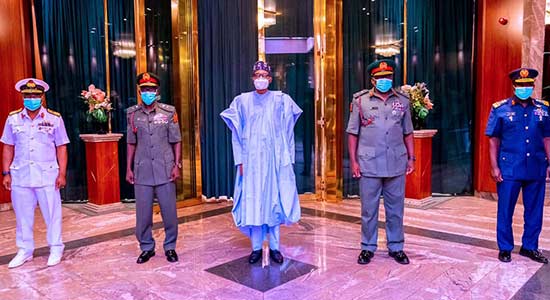
The television conversation was prompted by the recent appointment of the four new military service chiefs. To be specific, they were the Chief of Defence Staff, Chief of Army Staff, Chief of Naval Staff and the Chief of Air Staff. It is a notorious fact that about 80% of the heads of security or law enforcement agencies that have been appointed by President Buhari have been tilted in favour of Northern Muslims. This is what had provoked the unabated cries of Fulanisation and Islamisation by concerned Nigerians, including retired General/President Buhari’s fellow ex-servicemen like General Olusegun Obadanjo (rtd), Lt-General Theophilus Danjuma (rtd) and Colonel Abubakar Umar (rtd). 

However, the aim of this article is not to delve into the details of those pre-2021 security appointments, or even into whether the recent appointments in 2021 comply with the Nigerian federal character law. The goal of this article is rather to briefly x-ray the claim of Mr. Adesina vis-à-vis the Nigeria law with the view of giving the lie or commendation to the claim. Was Mr. Adesina right to have gone out of his way to boldly declare that the appointment of military service chiefs by the Nigerian President does not need to have regard for the Nigerian federal character law?

Though section 8 of the Armed Forces Act vesting the powers to appoint service chiefs in the President and Commander-in-Chief of the Nigerian Armed Forces is silent on whether or not the President’s appointments must reflect federal character, other relevant laws, including the 1999 Nigerian Constitution, which is the grundnorm, do make it a duty of the President to reflect federal character not only in the appointment of military service chiefs but of other heads of security agencies. For the avoidance of doubt, section 217 (3) of the Constitution provides that “the composition of the officer corps and other ranks of the armed forces of the Federation shall reflect the federal character of Nigeria.” Section 218 (2) of the same Constitution confers the powers to appoint the four service chiefs on the President. Section 4 (1) (a) of Nigeria’s Federal Character Commission (Establishment, etc) Act 1995 also categorically provides that the Federal Character Commission shall “work out an equitable formula, subject to the approval of the President, for the distribution of all cadres of posts in the civil and public services of the Federation and of the States, the armed forces, the Nigeria Police Force and other security agencies, bodies corporate owned by the Federal … Government.”

Indeed, if there is any sector where federal character or regard for the sectional, ethnic and religious diversity of a nation like Nigeria should be respected, it is in the appointment of the heads of security agencies. This is because this will give all the sectional, ethnic and religious interest groups a sense of belonging and see the national project as a common aspiration. Rwanda has learnt this very well from its civil war history and the lesson is making the African country to work excellently today. Unfortunately, Nigeria seems to be oblivious of this till date. In fact, nations far less diverse such as the US and the UK not only now recruit Africans and Asians into their Armed Forces and police services but sometimes appoint them as security heads. It will be instructive to note that the so-called super-racist, immediate former President Donald Trump of the United States did appoint a Black military service chief. If these far less diverse nations are implementing the “diversity principle,” why do Nigerian government officials call the bluff of Nigerians who call for adherence to our federal character law? Are the many separatist movements, secessionist activists and self-determination groups in the country today not enough glaring reason for Nigerian political office holders to comply with the Nigerian federal character law without any pressure?

Even international human rights law frowns at operation of government in such a way that there is deliberate exclusion of racial or religious interest groups. In this regard, in November 1989, the Human Rights Committee of the UN adopted a General Comment which stated that, for the purpose of the International Covenant on Civil and Political Rights, discrimination included “any … exclusion, restriction or preference which is based on any ground such as race, colour, sex, language, religion.”

It is submitted that Nigerian political office holders need to learn some lessons from the foregoing. Firstly, you do not have to throw caution, ethics and professionalism to the wind in order to defend your political godfather or appointor at all cost. Secondly, many a time, dignified silence or few words may pay better than pretence that one has all answers to all questions. Silence is golden. If you do not have the knowledge of or competence over any question thrown to you, do not pontificate. Better still, tell your interviewer to give you time to search the relevant facts or consult those competent in the field. I believe Mr. Adesina, a journalist, should not need anybody to lecture him on this. He could have done better if he had told Seun Okinbaloye, the Channels TV interviewer, that the Minister of Justice and Attorney-General of the Federation or some other Federal legal officer would be in a better position to answer that particular question. Thirdly, Nigerian official political advisers have got to learn that their primary loyalty should not be to any individual, including their paymaster, but to the nation and its Constitution.

God bless Nigeria!

Anthony S. Aladekomo, a lawyer, wrote from Lagos.

Court Sentences Man To 5 Years In Prison Over N55,000 Investment Scam On Facebook

One Anana Henry has been sentenced to five years imprisonment for defrauding one Amadi Musah Saleh the sum of Fifty-five Thousand Naira in a phony investment scheme in Kaduna.

The convict allegedly convinced his victim via Facebook chat, to invest in an online investment plan called ‘Honour Investment Services’ with a promise of 100% returns on the investment within 24 hours.

Following the chat, Saleh transferred N45, 000 and N10,000 to two separate accounts provided by Anana.

Upon payment of the money, instead of the expected returns on investment, Anana kept requesting for additional sums from the victim. Afterward, all efforts to recover the money by the victim proved abortive.

The charge reads, ‘that you Henry Anaba, sometime in January 2020 in Kaduna within the jurisdiction of Kaduna Honourable Court did commit cheating by impersonation by presenting to be one Favour Anaba on Facebook platform and in such assumed character obtained the sum of N55,000 from one Amadi Musa Saleh and you thereby committed an offence contrary to Section 308 of the Kaduna Satate Penal Code Law of Kaduna Stat, 2017 and punishable under Section 309 of the same Law’

In view of his ‘guilty’ plea, the prosecuting counsel Onyeka. Ekweozor urged the Court to convict the defendant accordingly, while the defence counsel C. Ezengwa appealed for mercy as the convict is a first time offender who has promised not indulge in such act again.

In his ruling, Justice M.T. M Aliyu of State High Court sitting in Kaduna convicted and sentenced Henry to five years imprisonment with the option of fine of N100, 000.

The convict had already paid the sum of N 55,000 as restitution to the nominal complainant. (thenigerialawyer )

We’ll Enforce Laws Of The Land, No Matter How Highly Placed You Are, Oyo CP Warns

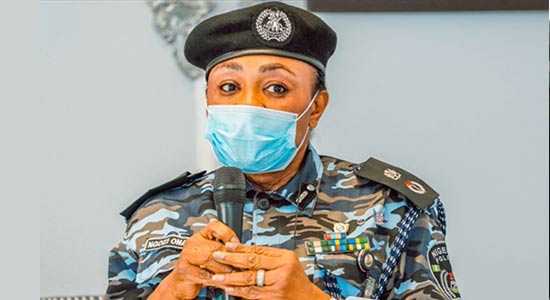
Commissioner of Police in Oyo State, Ngozi Onadeko has warned those exhibiting lawlessness and committing crimes with impunity, that laws of Nigeria will be enforced on them whenever they are caught, no matter the position they hold in the society.

The police commissioner talked tough on Friday during an emergency stakeholders’ meeting summoned in the wake of recent crises in the state.

Among those at the stakeholders’ meeting were state heads of Department of State Services (DSS), Nigeria Customs Service, Federal Road Safety Corps, Nigeria Security and Civil Defence Corps and Nigeria Immigration Service.

Others at the meeting were the Senior Special Adviser on Security, CP Fatai Owoseni (retd), traditional, community and ethnic leaders, local government chairmen, farmers, Miyetti Allah and youth organization leaders.

It will be recalled that the latest crisis was an attack on operatives of Mapo police station on Thursday by suspected hoodlums, who allegedly forcefully took back two suspects arrested by the police in connection with the killing a woman on Monday.

Onadeko, who decried the way criminals had taken laws into their hands, disclosed that the impromptu meeting was called because of what had been happening in the state.

According to her, “we need to brainstorm and seek a solution to how we can make Oyo State to be peaceful so that we shun the violence we have been witnessing for the past two, three weeks.

“I’ve come to tell all of us that we need peace in our communities and the state. If there is no peace, we can’t have economic growth or any development.

“Crime has no ethnic boundary or colour. We have good and bad people in all ethnicities.

“What we should do is to come in together and fish out all these criminal elements among us. Let us, partner, together with the police and other security agencies.

“We are in the time of community policing now, let us all come together and work as one entity.

“We should not think of where someone comes from regarding his criminal activities.

“I want to challenge us to sit down, talk and agree with one voice to fight those committing crime and criminality in the society, irrespective of ethnicity, religion, or colour.”

Onadeko said that all the security agencies in Oyo State were working hand in hand, in synergy, and cooperating to make the state safer for all.

“Anyone caught committing all these crimes and criminality, no matter who you are, no matter how high, low or middle-placed you are, we will enforce the laws of the land.

“We will do a thorough investigation, and anybody found wanting will be prosecuted. This will make the carnage and destructions to stop,” she asserted.

The police commissioner however assured that no law enforcement agencies would be after anyone, provided such a person is a law-abiding citizen and doing their legal duties.

“We are only after those people that are committing a crime.

I plead with everyone to let us join hands together and practise community policing.

“In the police force, we promise visibility policing. In every nook and cranny of the state, we will make sure that policemen and women are there, and we will respond promptly to any distress call,” she said.

She also enjoined the people to always give Intelligence-based information, so that the police would be able to nip crimes in the bud.

CP Owoseni, in his remarks, said that the stakeholders’ security meeting had been long overdue.

He described it as a good initiative, adding that it had demonstrated that the new leadership of the police and the other security heads had found it essential.

“They are passing a message that the people sitting back there in the community are actually the government and law enforcement and security agents, not only those wearing the uniform,” Owoseni stated.

He noted that since EndSARS protests, things had been as if there was no government or police again.

“The security challenges we have now, the EndSARS protests have made it to be like there is no government in the country or state again. We should change our mindsets,” the Senior Special Adviser on Security added.

In his contribution, the Serikin Sasa, Alhaji Katsina Maiyasin blamed the Fulani leaders for the incessant kidnapping and armed robbery allegedly being committed by the indigenes.

According to Serikin Sasa, any leader harbouring criminals and not reporting them would be causing Nigeria and himself injuries, upon the ones already being nursed.

“Any Fulani man, whether you are a Seriki, and you say that you don’t know any criminal among your people in your community, then you are a liar.

“I’m challenging them. They should come together and help the state so that we can all live in peace. Where they are now, they don’t have rest of mind. They are being hunted because they are afraid to tell the (security) leaders the truth about those giving problems.

“If they say they don’t know the kidnappers, how do they know how to bail the suspects arrested for kidnapping? When a kidnapper abducts someone, it is the Fulani heads within the area that would go and pay the ransom and bring the victim back home.

“How do they know the person? Who do they speak with? How do they go to the kidnappers? And they are saying they don’t know them (kidnappers)? They are liars; they know them.

“Why don’t they tell the police that this is where the kidnappers are residing? If someone calls himself ‘charge and bail’, then he is a thief.

“There is no Fulani man that will stand with me and say that he doesn’t know the kidnappers or armed robbers within the Fulani.

“The Fulani also kidnap themselves and their heads will be the ones to go and pay the ransom. If you don’t know someone or have anything to do with him, how do you have the boldness to go and meet and discuss with him, and then pay?” the Serikin Sasa queried.

He called on the Fulani to come out and help the people of the state and themselves so that all could live in peace in the state and in Nigeria.

“If a Fulani is arrested during robbery operation or kidnapping, people would be saying that all the Fulani are kidnappers or armed robbers.

“But they are very few among us; only that they are being helped by their leaders. These are the challenges we are facing now in Nigeria,” he added. (thenigerialawyer)

Amended Electoral Act To Allow For Electronic Transmission Of Results, Says Ekweremadu

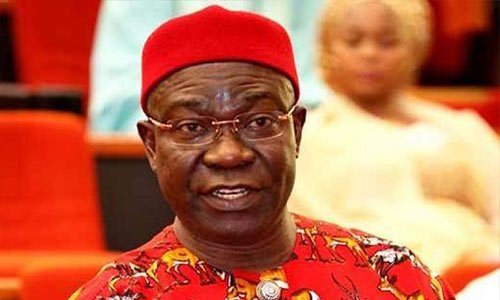
Former Deputy Senate President Ike Ekweremadu on Friday said lawmakers are attempting to amend the electoral act to allow for electronic transmission of election results.

Senator Ekweremadu is a member of the Senate Committee on INEC.

Speaking on Channels Television’s Politics Today, Ekweremadu said the electronic transmission of results will improve the integrity of elections in Nigeria.

“What we are working on now, we want to take a step further by saying that you don’t just conduct the elections through electronic means, but importantly you also need to transmit it through electronic means,” Ekweremadu said.

“Because most of the trouble we have with our elections happen between the polling booth and where they do the collation.

“So this can be bypassed by using the elctronic means of transmission. I was in Edo eelction and it worked. They simply uploaded the results from the polling booth straight to the INEC website and people can have access to it and can monitor the election as the results are coming in.

“But it wasn’t in any part of the electoral act or the constitution; so we intend to bring it into the electoral act and hoping that our colleagues will also accept it.”

The Joint Technical Committee on Repeal of Electoral Act 2010, on Tuesday, had submitted its report to the National Assembly Joint Committee on Independent National Electoral Commission (INEC) and Electoral Matters.

Ekweremadu said the lawmakers are also attempting to pass a bill that improves the timelines of elections. (Thenigerialawyer)

Son kills mother for being asked to get a job!

For asking her 22 year old son to get a job, she met an untimely death. Watch video.

We need collaboration to tackle terrorism, COVID-19, corruption, others – Buhari

  • Receives new Ambassadors of Egypt, Saudi Arabia and Argentina

President Muhammadu Buhari has again restated the need for collaborative efforts with the international community to combat terrorism, the COVID-19 pandemic, corruption and other common challenges affecting the globe.

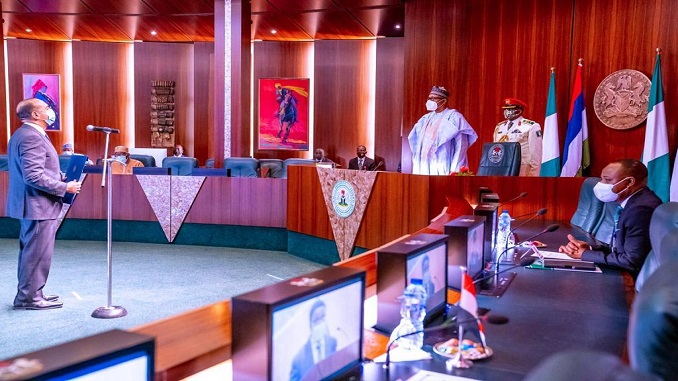
The President made the disclosure while speaking at an event to receive Letters of Credence of the new Ambassadors of Egypt, Saudi Arabia and Argentina at the Presidential Villa, Abuja.

The president in a statement by his Media Adviser, Femi Adesina said: “We have common challenges that impact so much on our countries, which include Terrorism, Insurgency, Climate Change, Population Explosion, Human Trafficking, Corruption, Poverty, and Proliferation of Small Arms and Light Weapons.

“On top of all these, the second wave of the COVID-19 pandemic has come with different strains that pose additional challenge to the initial outbreak. These challenges underscore the need for the international community to work even more in concert to collectively identify appropriate ways and means to globally resolve these challenges.”

He equally expressed admiration for the cooperation that Nigeria and the other three countries have enjoyed in other fora.

According to him, “All three countries represented here enjoy excellent multilateral relations with us. In addition to the United Nations, the largest multilateral umbrella platform, we are also members of the G-77 and the South-South Cooperation which Nigeria, Argentina, Egypt and Saudi Arabia have used to advance our collective interests and causes. Nigeria is proud to be associated with these platforms, for they have enabled us to work closely together with the Principal Representatives of these countries.”

The President told the Ambassadors the readiness of Nigeria “to work with you all to achieve global peace, food security and sustainable environment.”

While wishing the envoys a successful tenure, Buhari enjoined them to improve on the current level of relations

His words: “On behalf of the Government and people of Nigeria, I urge you, in the course of your duties in Nigeria, to build on the successes of your predecessors and enhance the existing fraternal relations between our countries”.

Speaking on behalf of others, H.E Ambassador Ihab Moustafa expressed appreciation to the President for receiving them and accepting their letters of credence.

He assured of their commitment “to work with Your Excellency’s government to further enhance and strengthen our countries’ friendship and partnership with the Federal Republic of Nigeria. We will count on your kind support and guidance to this end.”

The Ambassadors, who presented their Letters of Credence, are: Mr Ihab Moustafa Awad Moustafa, Arab Republic of Egypt; Mr Faisal Ebraheem Alajrafi Alghamdi, the Royal Kingdom of Saudi Arabia; and Mr Alejandro Miguel Francisco Herrero, the Republic of Argentina

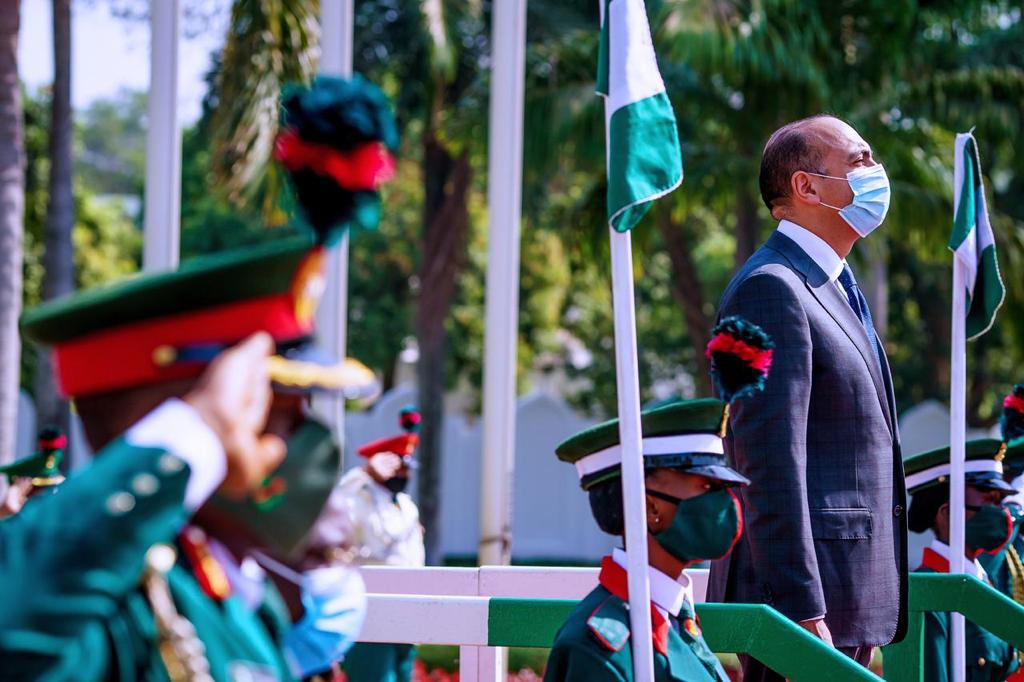
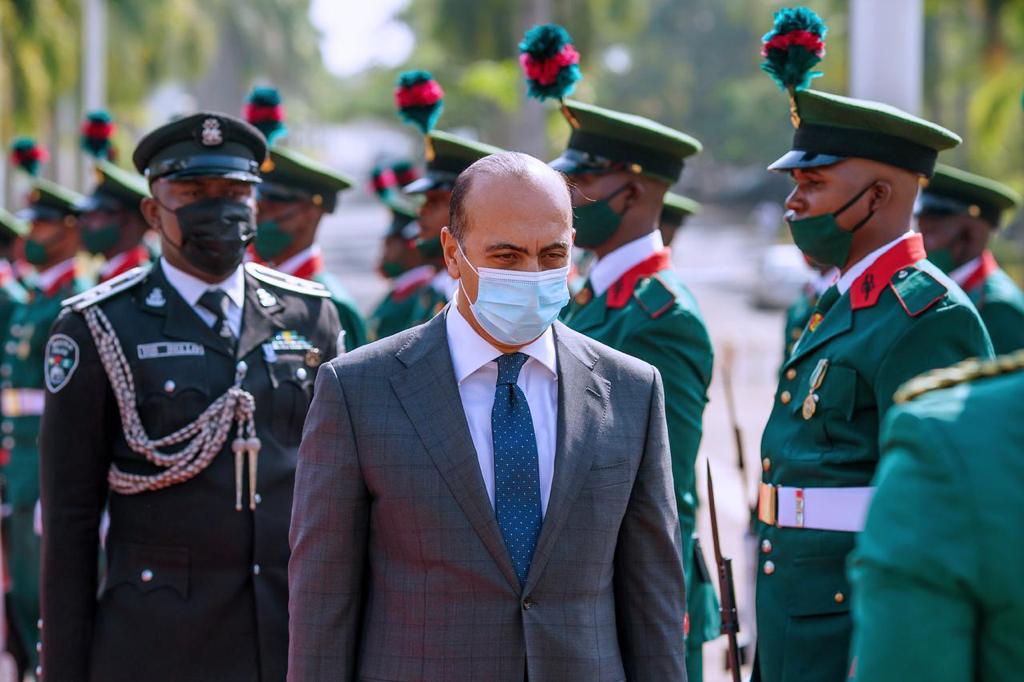
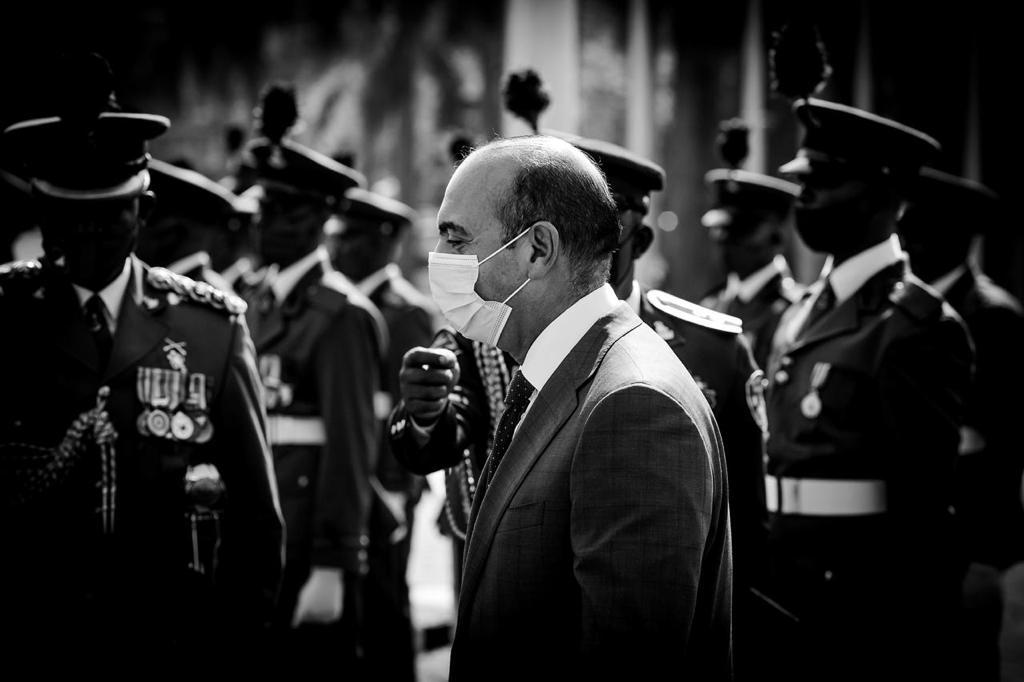
Below are photos of Ambassador Ihab Moustafa at the Presidential villa.

Bata vs. Salsa: Court okays virtual hearing of expert evidence

A Customary Court sitting in Pyakasa, Lugbe, Abuja, FCT, has granted the motion filed by the Intellectual Property Lawyers Association Nigeria for the virtual hearing of Expert witnesses in the suit seeking a declaration that Salsa originated from Bata dance.

The novel suit which is Africa’s first dance suit, seeks judicial recognition, authentication and declaration of Bata dance of the Yoruba people of Southwest Nigeria, as the origin and source of Salsa.

The motion which was filed by Mr. Folarin Aluko, of Trumann Rockwood Solicitors, lead counsel to IPLAN, prayed the Court for leave to hear the evidence of Yoruba Historians, Experts and Researchers, by virtual means, owing to COVID19 restrictions.

The Applicant in the suit Suit No. FCT/CC/PYS/CM/01/2021, urged Court to grant the application citing the decision in Esso West Africa Inc. v. T. Oyegbola (1969) NMLR 198, 26 where the Supreme Court observed that: “The law cannot be and is not ignorant of the modern business methods and must not shut its eyes to the mysteries of the computer.”

The Court, in granting the prayers, acknowledged the positive impact of technology on access to justice and relied on Paragraphs 4.5 and 4.6 of the Practice Directions on Remote Hearing of Sittings in the Federal Capital Territory Customary Court which were made pursuant to Section 61 of the Federal Capital Territory Customary Court Act.
Experts invited to give evidence in the suit include Mr. Opeyemi Raji, Mr. Seun Awobajo and Mr. Omolade Dalmas.

Mr. Opeyemi Raji, an alumnus of Obafemi Awolowo University and the University of Ibadan is a Custodian of Yoruba Culture, Yoruba Historian, award-winning Dance Director, Choreographer and Practitioner of more than 40 years, two-time National 1st Vice President of the Guild of Nigerian Dance Practitioners, Director, Oyo State Council for Arts & Culture.

Mr. Seun Awobajo an alumni of the University of Lagos, Akoka, is the National Director for Youth & Children of the Guild of Nigerian Dance Practitioners. He is the founder of Footprints of David Art FOundation where he serves on the Board of Directors along with Professor Wole Soyinka, Sir Peter Badejo OBE and other distinguished persons. He is a Dance Director, Researcher and Choreographer.

Mr. Omolade Dalmas is a cultural administrator, dance historian, researcher, award-winning percussionist and dance practitioner. He is the founder of Ayan’jo Dance Company and a member of the National Troupe of Nigeria.

For The Records: The COVID-19 Health Regulations Buhari Signed, And Consequences Of Breaches

CORONAVIRUS DISEASE (COVID-19) HEALTH PROTECTION REGULATIONS 2021

In the exercise of the powers conferred upon me by Section 4 of the Quarantine Act, Cap. Q2 Laws of the Federation of Nigeria 2010 and all other powers enabling me in that behalf; and in consideration of the urgent need to protect the health and wellbeing of Nigerians in the face of the widespread and rising numbers of COVID-19 cases in Nigeria, I, Muhammadu Buhari, President of the Federal Republic of Nigeria, hereby make the following Regulations –

PART 1
Restrictions on Gatherings

  1. At all gatherings, a physical distance of at least two metres shall be maintained at all times between persons.
  2. Notwithstanding the provision of Regulation 1, no gathering of more than 50 persons shall hold in an enclosed space, except for religious purposes, in which case the gathering shall not exceed 50% capacity of the space.
  3. All persons in public gatherings, whether in enclosed or open spaces, shall adhere to the provisions of Part 2 of these Regulations.
  4. The provisions of these Regulations may be varied by Guidelines and Protocols as may be issued, from time to time, by the Presidential Task Force (PTF) on Covid-19 on the recommendation of the Nigeria Centre for Disease Control (NCDC).

PART 2
Operations of Public Places
Markets (including open markets), Malls, Supermarkets, Shops, Restaurants, Hotels, Event Centres, Gardens, Leisure Parks, Recreation Centres, Motor Parks, Fitness Centres, etc.

  1. No person shall be allowed within the premises of a market, mall, supermarket, shop, restaurants, hotels, event centres, gardens, leisure parks, recreation centres, motor parks, fitness centre or any other similar establishment (hereinafter collectively referred to as “establishments”) except:

a. He is wearing a face covering that covers the nose and mouth;

b. He washes his hands or cleaned the hands using hand sanitiser approved by the National Agency for Food and Drug Administration and Control (NAFDAC); and

c. His body temperature has been checked. Any person found to have a body temperature above 38 degrees Celsius shall be denied entry and advised to immediately seek medical attention.

  1. Every establishment occupier shall make provision for regular hand hygiene for any person coming into the premises during opening hours. This includes a handwashing station with soap and running water, or hand sanitiser approved by NAFDAC.
  2. Each establishment occupier is responsible for cleaning and disinfecting his premises.
  3. It is the responsibility of the occupier of the establishment to:

a. Enforce the proper use of face covering;

b. Make provision for safe hygiene facilities;

c. Enforce provision of temperature checks prior to entry into the establishment;

d. Enforce provisions and use of face covering within the establishment;

e. Ensure that their customers queue up and are attended to serially while complying with physical distancing measures and avoiding overcrowding; and

f. Generally, ensure compliance with the provisions of these Regulations.

  1. Occupiers of establishments are liable for any observed non-compliance by any persons within the premises.

Places of Worship

  1. All worshippers and users of places of worship shall comply with the provisions of Parts 1 and 2 of these Regulations.
  2. Worshippers shall, where and whenever possible, avoid sharing worship items such as mats, bottles, hymnals, etc.
  3. It is the responsibility of the person in charge of a place of worship to ensure compliance with the provisions of these Regulations within the worship centre. Workplace and Schools
  4. All persons entering the premises of a workplace or school shall comply with the provisions of Parts 1 and 2 of these Regulations.
  5. It is the responsibility of the person in charge of a workplace or a school to ensure compliance with the provisions of these Regulations within the office or school premises. Banks 
  6. All employees, customers and visitors of banks shall comply with the provisions of Parts 1 and 2 of these Regulations.
  7. All banks shall comply with the guidelines, mode and scope of operations issued by the Central Bank and Federal Ministry of Finance as it relates to the COVID-19 response.
  8. All banks shall develop a schedule for regular cleaning of buttons and surfaces of Mantrap Entrance Doors, ATM machines and other commonly used areas.  Public Transportation Vehicles
  9. All operators and passengers of public transportation vehicles (hereinafter referred to as “operators”) shall comply with the provisions of Part 2 of these Regulations.
  10. Operators shall ensure adequate spacing in between passengers.
  11. Operators shall ensure frequent cleaning and disinfection of parts of the vehicle frequently handled by passengers and drivers such as doors and window handles/buttons, steering wheels and dashboards.
  12. Operators shall encourage passengers to frequently perform hand hygiene.
  13. All operators of trains, ships and planes shall have an occupational health and infectious diseases preparedness plan, in case an employee or traveller becomes unwell in the course of a journey.
  14. It is the responsibility of operators to ensure compliance with the provisions of these Regulations in the course of their operations.
    Hostels, Boarding Houses and Detention Centres.
  15. Managers of Hostels, Boarding Houses, Nursing Homes, Correctional Centres, Remand Homes, Holding Cells, Military Detention Facilities, and such centres for care and custody of persons, shall ensure compliance with the provisions of these Regulations.
  16. Managers of such facilities shall ensure that suspected cases of Covid-19 are promptly and appropriately separated from others and are reported to medical officers of the State Ministry of Health for necessary action.

PART 3
Mandatory Compliance with Treatment Protocols

  1. The health and safety protocols and guidelines are issued by the PTF on Covid-19 on the recommendation of the NCDC and shall be binding on all persons.
  2. Persons confirmed to have tested positive to COVID-19 by an NCDC accredited laboratory, may not refuse isolation and or admission to a designated health establishment for management of the disease.
  3. All public secondary and tertiary health facilities shall designate a space or holding bay for the initial triage or assessment of suspected persons with COVID-19 in line with the approved protocol for case management.
  4. All public secondary and tertiary health facilities shall establish sample collection centres, where test samples from suspected cases can be collected and transmitted to an accredited testing laboratory in the State.
  5. Notwithstanding the provision of Regulation 27, where a person confirmed to have tested positive to the COVID-19 is:
    a. Asymptomatic or has mild symptoms; and

b. Proves able to make an alternative isolation arrangement that satisfies protocols issued by the NCDC, as certified by a healthcare provider and assessment by a medical professional; 
such person may use such alternative arrangements, including supervised “home-based care,” for self-isolation and adhere strictly to the guidelines, until confirmed by the healthcare provider to be no longer at risk of infecting others with the virus.

PART 4
Offences and Penalties

  1. Any person who contravenes the provisions of these Regulations commits an offence. 
  2. Any person who, without reasonable cause, contravenes a direction given under Parts 1 and 2 of these Regulations commits an offence.
  3. Any person who, without reasonable cause, obstructs an authorised official from enforcement of these Regulations commits an offence. 
  4. An offence under these Regulations is punishable, on summary conviction, by a fine or a term of six months imprisonment or both in accordance with Section 5 of the Quarantine Act. PART 5
    Enforcement and Application
  5. Personnel of the Nigeria Police Force, the Nigeria Security and Civil Defence Corps, the Federal Road Safety Corps, the Nigeria Immigration Service, the Federal Airport Authority of Nigeria, and other relevant Local Government, State and Federal Government agencies are hereby directed to enforce the provisions of these Regulations.
  6. Any officer of the enforcement agencies who fails, neglects, or refuses to enforce the provisions of these Regulations shall be subject to disciplinary action by the disciplinary body of his respective agency.
  7. The provisions of these Regulations shall apply throughout the Federal Republic of Nigeria.
  8. State Governors may issue Regulations on further steps as may be considered necessary.

PART 6
Interpretation and Citation

  1. In these Regulations, unless the context otherwise requires:

a. “Offence” means any act, which may constitute a violation of the provisions of these Regulations.

b. “Enforcement Agency” means any law enforcement or security agency vested with the statutory power to investigate and prosecute any person in respect of any of the applicable offences.

c. “Face covering” means a covering of any type (other than a face shield) which covers, fully, a person’s nose and mouth.

d. “Gathering(s)” means an assembly or meeting of people.

e. “Occupier” means any person who is in current occupation and control of premises either as an owner or lessee.

f. “Public transportation vehicle” means bicycle, motorcycle, tricycle, car, taxi, limousine, bus, train, ship, plane, or any other vehicle of transportation that carries more than one person at a time.

g. “Reasonable cause” includes medical emergency, wherein the person in violation forgot to put on face covering, but complied with the directive to do so upon prompting; a natural disaster, wherein persons need to be evacuated into a public space; etc.

  1. These Regulations shall take effect immediately and remain in effect until otherwise determined.
  2. All other Protocols and Guidelines issued by the PTF, NCDC, and or State Governments, except as expressly provided, shall remain in force.
  3. These Regulations may be cited as the Coronavirus Disease (Covid-19) Health Protection Regulations 2021. (Everyday)

Five Nollywood actors/actresses who died in January 2021

NOLLYWOOD has recorded at least five deaths in the last 30 days.

Nollywood actors who died in January 2021 include:

  • Folake Aremu (Orisabunmi)

Popular Yoruba actress, Mrs. Folake Aremu popularly called Orisabunmi, died on January 5, 2021.

Her death, which threw the theatre industry into sadness, was confirmed by a family source.

The veteran actress, who hailed from Olla in Kwara State, died at 60 in her residence in Ibadan, Oyo State.

Her death came four months after the demise of her ex-husband, Jimoh Aliu popularly called Aworo under whose tutelage she rose to prominence in the film industry.

  • Jim Lawson Maduike

Nollywood veteran actor, Jim Lawson Maduike died on January 9, 2021.

The Imo-born thespian gave up the ghost after complaining of severe body pains.

He joined the film industry in 2004 where he starred in several films.

  • David Mela

The young actor was said to be passing through a hard time in his life as revealed by a post before his untimely death.

  • Dan Nkoloagu

Nollywood veteran actor Dan Nkoloagu died on January 22, 2021.

His son, Dan Nkoloagu Jnr, announced his death on his Facebook page.

He wrote: “IT WAS A BLACK FRIDAY FOR US YESTERDAY as my Dad left us without saying goodbye.”

Nkoloagu, who died at 83, was popular for playing the role of a native doctor in many Igbo movies.

  • Ernest Asuzu

Veteran Nollywood actor Ernest Asuzu died on evening of Tuesday January 26, 2021

His wife, Jennifer Asuzu, who confirmed the sad incident to The Nation, said he fainted on Tuesday evening and never woke up.

The Nation

– Jan. 27, 2021 @ 14:14 GMT |

USAID launches new Early Grade Learning book in Igbo, Yoruba

U.S. Agency for International Development (USAID) and the Nigerian Educational Research and Development Council have contributed towards the development of learning in Nigeria’s local languages with the launch of the new Igbo and Yoruba early grade reading materials.

USAID had earlier assisted in creating materials in Hausa language.

The materials entitled “Ka anyi gụo!” and
“Jẹ ká kawe!” in Igbo and Yoruba respectively, will expand the availability of quality local language teaching and learning materials for reading in Nigeria, and are targeting all Igbo and Yoruba speaking primary grades 1 to 3 learners in the southern region of the country.

A statement by USAID on Thursday, quoted the USAID Mission Director, Anne Patterson to have said: “Teaching children to read in a language they understand equips them with a powerful tool for lifelong learning.”

The Mission Director said in a virtual launch that: “Building foundational reading skills accelerates English language acquisition and other skills and contributes to developing a new generation of leaders equipped to help Nigeria meet the challenges ahead.”

Developed by the Research and Development Council with support from the USAID Northern Education Initiative (NEI) Plus activity, the new Igbo and Yoruba curricula will be available for any interested state to adopt, print, and distribute with their own resources.

According to the statement, the curriculum was tailored for a 21st century audience of emerging readers, “rich with culturally relevant stories, colorful pictures, gender-balanced representation, and a clear sequence of content that gradually builds upon the abilities of each learner as new skills and proficiencies are acquired.”

It also stated that, “Let’s Read” promotes active learner engagement, comprehension and critical thinking through three levels of instruction that ensured learners develop critical skills necessary for all aspiring readers: phonemic awareness, phonics, fluency, vocabulary, and comprehension.

It said the comprehensive curriculum package included learner textbooks and workbooks, teachers’ guides, and storybooks for practice in school or at home, all available at no expense for download.

The Minister of State for Education, Chukwuemeka Nwajiuba, was quoted to have commended the materials.

He said at the launch: “I commend all these laudable achievements and reiterate that the Ministry of Education will continue to partner with USAID to provide basic education services that promote self-reliance.”

He added that: “We are ready to consolidate and sustain gains made by USAID’s NEI Plus project beyond the two states of Bauchi and Sokoto.”

Bauchi and Sokoto were the first two states supported by NEI Plus, and they remain positive models and resources for states recently adopting an evidence-based early grade reading curriculum.

Since October 2015, NEI Plus has delivered over seven million teaching and learning materials to more than a million primary grades 1 through 3 learners in 2,500 formal schools. (Theconclaveng)

TIPS