Home Blog Page 1056

Intrigues, as Presidency faces dilemma over choice of NSCDC Commander-General

*Minister rejects board, DSS recommendations; insists on ‘examination’ for 18 ACGs *Audi Ahmed, Ningi Ibrahim, Nwinyi Nnamdi ‘recommended’ to replace acting CG, Hilary Madu *Aggrieved candidates oppose minister’s action; want Presidency to stick to board’s proposal By Soni Daniel, Northern Region Editor The Presidency appears to have run into murky waters over the choice of a substantive Commandant-General for the Nigeria Security and Civil Defence Corps, NSCDC, following the end of the tenure of the former boss of the agency, Abdullahi Mohammed Gana, in January.

The crisis now rocking the paramilitary agency, and may torpedo the entire process, stems from the decision of the Minister of Interior, Ogbeni Rauf Aregbesola, to introduce a new dimension into the selection of the boss of the agency against the standard practice of picking the best candidate based on the recommendation of the Civil Defence, Nigeria Correctional Service, Fire Service and Nigeria Immigration Service Board, CDCFIB. Vanguard learned that the minister’s action, which the board and other directors see as unprecedented in the history of the establishment, has also drawn bad blood from top officials of the agency. They fear that the minister was trying to rob them of the opportunity to be selected to head the para-military outfit and make the most out of their tenure like others before them. READ ALSO: NSCDC intensify protection of farmers, farmlands, as Nigerians seek more funding for security agency It was also gathered, from inside sources, that while the minister is trying to establish his wish through what most officers see as a ‘questionable and strange examination’ in picking the preferred candidate, the Office of the Secretary to the Government of the Federation and some influential presidential officials, would prefer the recall of the immediate past CG, Abdullahi Mohammed Gana, to run the affairs of the establishment for another two years. The contention of those in this group of top Federal Government officials is that Gana still has two more years to reach retirement age of 60 years or 35 years in service:. According to his record, he is 58 and has also put in less than the mandatory 35 years in service. Trouble is, however , brewing from the attempt by highly-placed officials in the Interior Ministry and some presidential influencers who have tried to sidetrack both the recommendation of the CDCFIB and the Security Report turned in by the Department of State Services, DSS, regarding the five persons they recommended for the post out of the 18 Assistant Commandants-General, ACGs, they interviewed since June 5, 2020 and the results of their performance sent to the Presidency since last year. Screening, recommendation A very competent security source familiar with the screening, confirmed that out of the five men, three candidates were strongly recommended for appointment as the NSCDC CG based on their performance, service records, leadership acumen, exposure to national issues and qualifications. A top source familiar with the process said: “After a painstaking screening process, the DSS cleared and recommended three persons it considered as the best choices to the Presidency to pick one from among them as is the usual practice. “But strangely, the Interior Minister (Aregbesola) and some powerful people around him have attempted to jettison the entire process supervised by the security agency in conjunction with the CDCFIB. “They have now ordered that 12 Assistant Commandants-General should present themselves for another examination in order to choose one of them for the post of CG. “This is strange, disappointing and a serious setback to the operations of the NCDSC. The government should not allow the achievements recorded by the NCDSC over the years to be washed away just because of the choice of one preferred person. READ ALSO: Yuletide: NSCDC Abdullahi Gana reassures Nigerians of adequate security “Under the CDCFIB operations, no officer to be elevated to head any of the para-military agencies is expected to write another ‘examination’ after having climbed to their positions through their regular professional examinations and courses in line with established public service requirements,” the official explained. Presidency Checks by Vanguard revealed that the Presidency was mulling what to do given the confusion that has trailed the exercise and cast doubts over the process and coupled with many lists of ‘qualified candidates’ sent in by interested parties. It is contemplating either the recall of the immediate past CG, Abdullaji Gana or allowing the acting CG, Hilary Madu, some more time in order to select a substantive administrator for the troubled agency. However, many ACGs, who feel they were cheated out of the selection process, alleging that the question papers for the ‘strange examination’ ordered by the Ministry of Interior, were seen by some preferred persons and that they were not given equal chance of being selected. They have already prepared a petition to be sent to the Villa to ‘properly guide’ Mr. President on what transpired in the selection process. But Vanguard has obtained two lists of preferred candidates already forwarded to the Presidency for consideration as the new CG of the agency. One of the lists has three names: Audu Ahmed, from Nasarawa State; Ningi Ibrahim, from Bauchi and one Nwinyi Nnamdi, from one of the South-Eastern states. Also penciled down for the top post are Rasak Olusesan from Ogun and Haruna Lawal, from Kogi. It was not yet clear from which of the camps the Presidency would pick its final choice.

Vanguard News Nigeria

Herdsmen invaded our maize farm with cattle, destroyed N72m produce –Ekiti farmers

Abiodun Nejo and Kayode Oyero

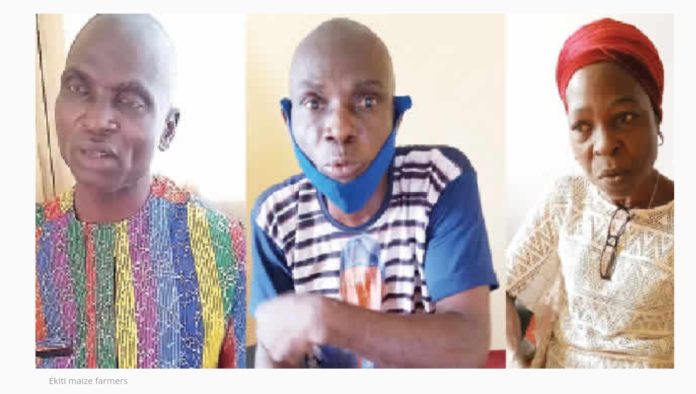
Members of the Maize Growers Processors and Marketers Association of Nigeria in Ekiti State have narrated how herdsmen invaded their maize farm with their cattle and destroyed produce worth N72m.

The farmers, who obtained loans from the Central Bank of Nigeria, said the herdsmen came with dangerous weapons and overpowered the security operatives manning the farm located at Ago Aduloju forest.

One of the farmers, Adekunle Falana, said the invasion shattered his hope of making profit and plunged him into debts.

He said, “When it was about three weeks to the harvest period, the herdsmen invaded the plantation with their cows and they grazed all the crops. We reported the case at the police station when it first happened on the January 18 (2021), we also went to the Amotekun operatives but we were told no bus was available.

“We took all these steps and had no help and as we returned to the plantation, the herdsmen were still there.

“We have been traumatized. We were advised to harvest the rest of the crops as they were, and we hired some Hausa men to do that but the Fulani herdsmen came again in the evening with their cows and chased them all away from the farm and no one could challenge them as they destroyed all the crops.

“The worth of the maize crops destroyed is up to 72 million naira. Because planting on an hectare of land will make us yield about eight tons of maize crops. If the CBN agents take two tons, we have the remaining six tons as our profit and we know how much that is worth when sold.

“We do not have any profit whatsoever and we are unable to pay back the loan we took. This is why we cry to the government that we are not antagonists to them, we are only showing our grievances as we do not have anywhere else to go. We beg everyone to assist us. The only farm work we depend on for our living has been destroyed within just four days.

“We beg the government to assist us, so we do not start committing atrocities in the town.”

Another farmer, Oke Rachael, said had the herdsmen not invaded the plantation with their cattle, MAGPAMAN would have been the largest maize plantation in the south-western part of Ekiti.

“If the cows had not eaten the crops, we would have been the ones with the largest maize plantation in the south-western part of Èkìtì. The passersby who saw the plantation at that time testified to this and joined our business initiative.

“I will like to plead to everyone, especially our governor- Fáyẹmí that they should all assist us and not let us be in absolute debt because we took a loan from the CBN to start the business. I plead to them all to assist us and not let us be in debt,” the female farmer said.

“Nothing was left for us and we are almost in penury and that is why we are crying because we don’t know where to start from,” lamented another farmer, Emmanuel Joseph. (Punchng)

The day I Confronted Professor Wole Soyinka!

By Ken Ikonne

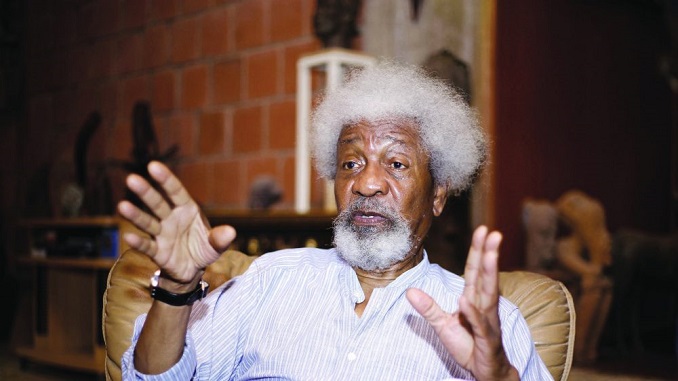
One odd evening in July, 2001, my boss and learned senior colleague in chambers, Amobi Nzelu Esq, did to me what I considered the greatest injustice on earth. He suddenly summoned me to his office on the intercom, and handed me a bulky file. To my utter astonishment, he then thundered: “Ikonne, tomorrow morning, at 9 am, you will go to Oputa Panel. You will cross examine Wole Soyinka, on a petition he filed at the Panel against Doctor Walter Ofonagoro, former Information Minister. Study the file well and good luck.” “But Sir, which Soyinka are you talking about?” I inquired in meek protest!”  “Are there two Soyinkas?” my boss fired back, and left the office for the day. I stood there in his office, momentarily transfixed, and frozen with utter dread. Professor Wole Soyinka was, and still is, the greatest literary figure to have come out of Africa, a Nobel Laureate in Literature, and a brilliant internationalist.

Less than two years earlier, I had left Lagos at the behest of my father, to undergo legal tutelage in Abuja, after a few years of trying my hands at private business. Chief Nzelu had mercifully taken me in at his flourishing Abuja law firm, and I had earnestly and zealously begun to learn the ropes, drafting processes, moving motions and watching trials, but I had never conducted a cross – examination.

 But now, not only was I to conduct a cross examination, but the witness to be cross examined was a living legend, and one of the most colossal literary figures of the modern world. To make matters worse, the cross examination was to be conducted on prime time television – and before the legendary Justice Chukwudifu Oputa, Nigeria’s most accomplished jurist, a sage whose knowledge of both the law and literature was encyclopaedic.

I made up my mind at that instant to drop that file there, resign immediately and flee from impending disgrace and disaster. Forlorn and sorely distressed, I walked back to my own office and confided in my younger colleague, Nonso Egwuagu, of both my grave predicament and my plans to avert it. Nonso surprisingly responded with a broad smile and said, in what must rank as one of the greatest affirmations of faith in another man’s abilities: “Ken, this is an opportunity of a lifetime, and I know you can pull it off. I will go with you to that Panel tomorrow and watch you seize the moment and show everyone what you can do.” He then looked into my eyes, smiled again and called me by that name which only he calls me: “The Old World Guyman.” Thus bolstered, I left for home, filled with a strange determination and zest to confront the Literary Principality in less than 14 hours from then.

 That very night, I didn’t sleep. I had met the legendary Professor once at Ife when he came to deliver a lecture on IDIOLECTS, and I had read several of his works, and had avidly followed his life both as a fearless advocate for freedom, and an incomparable champion of human rights. In fact, Soyinka was, in my eyes, a hero and a transcendental source of inspiration.

I went through his petition. His major complaint was that during his years in exile under the Abacha regime, most of which he spent as an Emeritus Professor of English Literature at the Emory University in Atlanta, United States, the Abacha regime had launched an injurious campaign against him. That campaign, according to him, was to discredit and malign him before the President of Emory University, and the entire University community. According to Professor Soyinka, the Abacha Government had sent several defamatory letters about him to the President of the University, and had similarly circulated same in the international press. But none of these letters was attached to the petition.

Despite my relative courtroom inexperience, I had spent the last one year and six months since I joined the law firm reading and researching voraciously, dedicating at least four hours daily to devouring a wide range of subjects, mostly on law. That effort was now about to pay off! The object of cross examination in law is traditionally to discredit the witness and demolish the case of the opposing party. But bearing in mind that the witness in this instance was an incredible intellectual pyrotechnic and that the theatre of the exercise was prime – time national television, I decided to divine a further objective: literary entertainment!

By the morning of D – day, I was fully prepared, and Nonso had also arrived my residence very early, and dressed for court. Together, we drove to the National Women’s Centre, the venue of the Panel’s sittings. We took our seats on the third row of the vast amphitheatre, having arrived quite early. Thirty minutes later, Doctor Walter Offonagoro, our client, arrived with his very delectable Indian – Canadian wife. We went out to meet him, and exchanged greetings. “Where is your boss, Amobi Nzelu?”, he inquired. “He is not coming, Sir,” I responded. “Who then will interrogate Professor Soyinka? You?” he exploded in utter indignation.

Doctor Offonagoro then reached for his mobile phone, the one in use at the time known colloquially as Nokia 090, and began to dial Amobi Nzelu frantically. But my boss, probably anticipating Offonagoro’s reaction, had switched off his own phone.

Then once again, Doctor Offonagoro, now totally consumed with rage, turned his fiery attention to me. He sized me up from head to toe, and thundered: “Do you know the man they’ve sent you here to interrogate? And you agreed and came here? Otolo gbagbu kwegi there. C’mon give me the bloody file. I will conduct my case myself.”

Thoroughly shaken, I was almost handing over the case file to him when his very affable wife intervened, calmed Doctor Offonagoro down, and warmly apologised to both me and Nonso. “Darling, give the young men a chance. Their boss must have seen something in them before giving them this all important task.” A strange calm suddenly came upon Doctor Offonagoro. He smiled at me, held my hand, and apologised profusely. “Do your best, your man,” he said, and followed both Nonso and I into the vast auditorium.

Walking behind us in dainty steps, accompanied by several aides and devotees, and flocked by a galaxy of press photographers and papparazi, was the legendary figure of the white – haired god of literature, Professor Wole Soyinka.

By the time Professor Soyinka and his entourage entered the auditorium, it was filled up with petitioners, lawyers, journalists and spectators. His arrival drew instant applause from the distinguished audience. He quickly took his seat, looking extremely ruddy, and exuding infectious bonhomie. He waved at Doctor Offonagoro and wife, both of whom waved back.

Soon afterwards, Professor Soyinka’s legal team walked in, led by the rugged old warhorse, Chief Ayanlaja, SAN. He walked over to Professor Soyinka, discussed briefly with him, and took his seat in the very front row of the auditorium. Soon, television cameras arrived, and were quickly set up. I threw a furtive glance backwards to where Doctor Offonagoro sat and caught him looking at me with pity.

At exactly 15 minutes past nine, the Secretary of the Tribunal indicated that the Panel was about to enter the auditorium. With the traditional bang and shout of “courrrrrt”, The packed audience reverently rose to its feet, and the Panel, consisting of Justice Oputa, retired Justice of the Supreme Court, Bishop Matthew Kukah, Mrs Pam, and another gentleman who was later to become deputy governor, and governor of Adamawa State, came in and took their seats.

Chief Ayanlaja, being the most Senior of the Senior Advocates present, indicated his interest, and our petition was then called by the Secretary out of turn. Chief Ayanlaja stood up and indicated to Professor Soyinka to proceed to the witness box. He then announced appearance for the professor, introducing a phalanx of distinguished advocates. The Tribunal Counsel, a lady, also announced appearance. I then rose to my feet, took the microphone, took a deep breath, and  introduced myself and Nonso Egwuagu , as appearing for Walter Offonagoro. I spoke slowly, but in a modulated tone.

Chief Ayanlaja then made a brief introductory speech, and then began to lead Professor Soyinka in evidence. He began by asking the Professor his name, address and what he did for a living. He then made Soyinka speak briefly to the petition, before finally tendering the petition in evidence. As Soyinka spoke, Nonso was taking notes. Chief Ayanlaja then cast what appeared to be a derisory glance at me, before announcing to the Tribunal: “My Lords, that is all for the witness. I now tender him for cross – examination.”

The microphone was brought to my direction, and I rose to receive it. I cleared my throat, standing, and looking the legendary witness straight in the eyes. At that moment, a wolf had begun to rise in my heart, and all my fears had dissolved, and were now replaced by a resolve to rise and conquer. Anyone who has been a public speaker, either as a student debater, an advocate or preacher, would be familiar with that inscrutable gush of adrenaline which a large audience inspires, banishing all fears and stutters. The speaker then rises to the occasion, or mars it, depending on how skilfully he adapts to it. To successfully seize the moment, the speaker must begin slowly, in modulated tones, and at all times maintaining eye contact with his quarry, voice – pitch rising gradually to a flourish, then descending and rising again, with deliberate pauses for effect, as the need arises. I bore all these secrets in mind, as I confronted this most formidable of witnesses.

“Professor Soyinka”, I began, “when in 1987, the French Ambassador to Nigeria at the time, Jean Christophe – Mitterrand, son of former French President Mitterrand, decided to confer upon you with the insignia of the Legion d’honour, France’s highest national honour, he said, and I quote: ‘a speech is expected of me, but I would much prefer to remain silent, and hand over to you the insignia of this new honour. For how do I dare raise my voice, even in praise, against this master of the language? How do I raise my voice against that booming overpowering voice which has sounded with resonance all over the world?”

I then paused, shifted my glance towards Justice Oputa, saw both encouragement and a distinct smile on his sage – like face, and resumed: “But, Professor, today, unlike the French Ambassador, I must raise my voice.” The urbane Professor regarded me with palpable incredulity, shifted his gaze to Justice Oputa who maintained a poker face. Soyinka then returned the gaze to me, and allowed a benign smile, revealing well shaped professorial teeth.

I resumed: “Professor, at the time you were receiving the insignia of the Legion d’honour from the French Ambassador, Camerounian gendarmes, with the active support of France, were over – running Nigeria’s Bakassi Peninsula. Why, Professor, did you not decline this award?” At that point, an enraged Chief Ayanlaja SAN, sprang to his feet, shouting “objection, my Lords, objection.”

But Justice Oputa quickly overruled the objection, holding that since it was a fact – finding proceeding, the witness was bound to answer the question.” At that point, I cast a quick glance at our client, Dr Offonagoro, who responded with a thumbs – up sign. My colleague, Nonso, still sitting, clutched my lower right leg in glee, silently muttering, “Old World Guyman, Old World Gee.”

Justice Oputa then spoke directly to the distinguished witness, and asked him to answer the question. The Professor responded that the award was in recognition of literary accomplishments, and his tremendous service to humanity.

I then followed up by reminding him that the petition served on Doctor Offonagoro did not contain a copy of any of the letters allegedly sent to Emory University in disparagement of his reputation. He agreed and said that it must have been the fault of his lawyers. I looked across to Chief Ayanlaja and noticed some sweat on his brow. He was desperately foraging for the letters in a massive file, succeeding in finding only one. He then sought the leave of the Panel to tender it from across the bar to which I vehemently objected, on the ground that he had closed the Professor’s case, and that the belated tendering was a veritable ambush, calculated to take me by surprise. After a few heated exchanges between me and the Chief, Justice Oputa overruled my objection, holding that since the proceeding was for fact – finding, the Tribunal was minded to admit it in evidence. He ruled that to avoid surprises, the newly admitted document be given to me for perusal, and that if I needed time to study it, the Tribunal would adjourn and give me time, in the interest of justice.

However, I quickly read the document, and finding that it was neither authored by Doctor Offonagoro nor by any officer of the Federal Ministry of Information which Offonagoro had headed in the Abacha regime, I quickly indicated to Justice Oputa that we were prepared to continue, and that we did not need an adjournment. As a matter of fact, the letter in question had been authored by a certain Chief Opadokun, who held no office during the Abacha interrugnum. Meanwhile, Chief Ayanlaja was nudging me to seek for adjournment to enable me study the letter properly, promising not to oppose my application. But I sensed what the wily Chief was up to. He had forgotten the really damning letters back in his office in Lagos, and was only bidding for time to produce and tender them at the next adjourned date.

Justice Oputa indicated that I continue the cross – examination. I motioned to the Secretary of the Tribunal to give to Professor the just admitted exhibit. “Professor”, I resumed, “take a proper look at the exhibit you are holding, and kindly show the Panel Doctor Offonagoro’s name on the letter.” The Professor took one perfunctory look at the exhibit and responded in that booming voice of his: “Offonagoro”s name is not there.” “Who then signed the letter”, I pressed further. “Chief Opadokun”, he responded. “Would you know, Professor, whether Chief Opadokun held any position in the Abacha regime?” “To the best of my knowledge, he held none, but we all knew the face behind the mask”, he quipped.

I continued: “Professor, did you ever know a man by the name, Christopher Okigbo?” The Professor said he knew him, and that Christopher Okigbo of blessed memory was his bosom friend and colleague at the University of Ibadan. “Sir, just like you, the late Christopher Okigbo was a precocious writer, and a quintessential poet.” He agreed. He then asked me whether I had read any of Okigbo’s works, to which I reminded him very courteously that I was the one to ask the questions – not him.

“Do you also know the great Kenyan writer, Professor Ali Mazrui?” I asked further. Professor Soyinka then reminded me that Mazrui was principally a political scientist. But I shot back and put it to him that Mazrui had also done some notable work in Literature, to which he conceded. “In fact, sir, one of those works is the TRIAL OF CHRISTOPHER OKIGBO, who died fighting in the Biafran war. Am I correct, Sir?” Soyinka agreed. “In that book, Sir, the angels gathered in heaven to try Christopher Okigbo, and found him guilty of fighting for a cause not worthy of a poem.” I could see both Justice Oputa and Bishop Kukah both roiling in their seats, beaming with smiles.

 On Professor Soyinka’s face however, was a quizzical look, as I pressed ahead. “Professor, I am sure you know Doctor Walter Offonagoro very well?” He said he knew him, and threw a jibe. “I have known him right from his days of Verdict 83”, a subtle reference to the days when it was Offonagoro’s infamous role to announce the results on NTA of the massively rigged elections of 1983.

“That is not the point, Sir,” I countered. “What then is the point? the now slightly enraged professor thundered. “The point, Sir, is that just like both you and Christopher Okigbo, Doctor Offonagoro is an accomplished man of letters. The last time you had a literary fallout with your friend Chinweizu, both of you resolved it by treating the world to a literary feast, exchanging to our eternal gratitude, a staccato of literary gunfire.” The literary sage responded with a huge smile, waved a friendly finger at me, regarding me with great pleasantness, and looked in the direction of Justice Oputa, who, together with Bishop Kukah and the other members of the Panel were now rocking on their seats, guffawing.

What I said next drew the ire of the distinguished Professor who yanked his reading glasses off his face, eyes blazing. “I put it to you, Sir, that by not adopting the literary solution in whatever Doctor Offonagoro may have done to you, you, like your friend Christopher Okigbo, are also guilty of fighting a cause not worthy of poem!”

There was pin – drop silence as a visibly enraged Professor Soyinka began to answer the question. “Look here, young man! Walter Offonagoro is a historian, and I doubt that he is a man of literature. Do you expect me to start bandying words with him on the pages of newspapers, instead of dragging him before a municipal tribunal established to redress human rights abuses? The regime which he served was a monster, and Nigerians expect a divulgence of the misdeeds of that infamous era. If you expect me to bandy words with Offonagoro, you are going to wait forever.”

The time keeper was indicating to me that my time was up, but Justice Oputa said I should continue if I wasn’t through. I applied to be given a copy of the Professor’s petition, and it was handed to me. I took a quick look at paragraph 3 where Soyinka had alleged that the defamatory letters were also circulated to “the Nigerian Embassy at the United Nations.” I applied that the letter be given to the witness. I then drew his attention to paragraph 3, and asked him to kindly read it out. He did. “I put it to you, Prof,” I probed, “that a county’s representation at the United Nations is known in diplomatic lexicon as a “Permanent Mission”, and never as “an Embassy.” He agreed. I then continued:

“I further put it to you, Professor, that by employing the terms interchangeably, you have done tremendous violence to both diplomatese and the technology of grammar.” The flustered literary giant looked at me, and looked at the paper again, amid pin – drop silence. Then he looked at me again and answered in that rich baritone voice of his: “Young man, I accept the correction in the educative spirit in which you have offered it.”  The audience erupted in thunderous applause, to which the bench also joined.

When the applause subsided, I sought leave of the Panel to conclude: “My Lords, I will not conclude this cross examination without paying tribute to Professor Wole Soyinka, a man I admire most fervently – Nobel Laureate, essayist and pamphleteer, foremost dramatist, erstwhile Commander of the Federal Road Safety Commission, the defender of human rights, the conscious citizen of a growing new nation, heir to the great Yoruba tradition, the Akogun of Isara, the hunter, the wine lover. The many facets of your polyvalent personality have astounded many of your contemporaries, even, I am told, to the point of exasperation! But who has not fallen to your binding spell? Sir, I am no exception.” Amid thunderous applause, the now beaming deity of literature bowed as I reeled out each of his many facets.

As we exited the raucous hall, a still beaming Professor Soyinka approached me and gave me a massive hug – a hug to savour for a lifetime.


The other side of the Orlu debacle

By Collins Opurozor

Before the dusk of Wednesday, the both sides – Nigerian forces and Nnamdi Kanu’s men – had agreed to a cessation of hostilities. If this is sustained, one can be sure that the Orlu situation has come under control. But the implications will be far-reaching.

First, Nigeria seems to have learnt nothing from her chequered history. The state’s response to every agitation by its ostensible citizens has never failed to reflect disproportionate bestiality, cruelty and belligerence. The mishandling of the Ogoni crisis has made the Niger Delta a sanctuary for militancy; the killing of Mohammed Yusuf has transformed the North East into a terrorism corridor; and the mindless killings of unarmed pro-Biafran agitators have in the end propelled them into armed struggle which is code named Eastern Security Network (ESN). Further, the undebatable inability of the state to stem the atrocities of the Fulani herdsmen has lent a rationalization to Kanu’s armed struggle, since self-defense, including even the use of deadly weapons, is a right recognized in multiple international protocols.

At the end of the Orlu confrontations, the men of the ESN were emboldened by their alleged successes. They were sighted in the bushes building buffers, and patently celebrating their vaunted invincibility. In hushed tones, Orlu residents praise their bravery and battlefield exploits, and mock the national security. This open withdrawal of allegiance from the state by its citizens speaks volumes about the future of the Biafran struggle, and unless Nigeria deemphasizes its militaristic approach to an irrepressibly fundamental debate like the neo-Biafran cause, “clubs may soon become trumps”, in the words of Thomas Hobbes.

The antinomy of the entire Nigeria-Biafra discourse is that those who feign to keep Nigeria united are the ones encouraging the secessionist agenda and making the message of Nnamdi Kanu gain appeal day after day. When some barely lettered horde of pastoralists named Miyetti Allah openly and unapologetically described all lands in Nigeria as theirs for the taking, what response were they expecting? When Igbo youths took up harmless flags and organized peaceful protests to register their marginalization in Nigeria, and they were brutally murdered in their hundreds, what response was Nigeria expecting? When an Igbo knows that his socio-political aspirations are inhibited in Nigeria simply because of his ethnic identity, what response does Nigeria expect? When a brilliant Igbo child with a high score fails to secure an admission into a university and watches a less qualified counterpart from Adamawa admitted, what idea about Nigeria does that child go home with?

The Orlu debacle should cause Nigeria and the Northern overlords to rethink their stale approach to issues of national cohesion. Avoiding a question through violence is an unsustainable, cowardly approach. Nigeria is not working, and the sense of alienation which the Igbo have is real. This cannot be resolved by rolling out military tanks. Every Nigerian, irrespective of tribe, deserves a country that works. The time to tinker with the structure of Nigeria is now!

Makinde visits Ibarapa woman whose son was shot by herdsmen

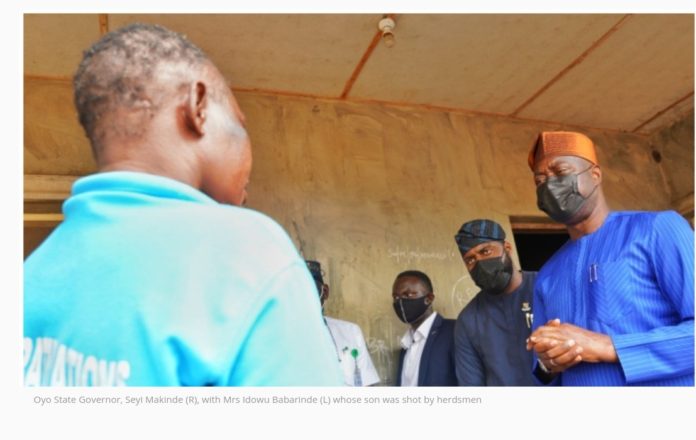
Oyo State Governor, Seyi Makinde, on Monday, visited the families of some of the victims of herdsmen brutality in the Ibarapa North-West Local Council Development Area of the state.

The governor visited Mrs Idowu Babarinde whose son was shot by herdsmen. He also visited the family of Dr Fatai Aborode, a prominent farmer who was allegedly killed by Fulani herders for protesting that the herdsmen used their cattle to destroy his farm.

Makinde, who arrived in the area on Sunday evening, held meetings with stakeholders in a bid to find lasting solution to the herdsmen crisis rocking the area.

“We used the opportunity of our visit to the Ibarapa zone to pay condolence visits to the families of victims of criminal activities. In Idere, we visited Mrs. Idowu Babarinde whose son was fatally shot by herdsmen.

“In Igangan, we visited Alhaji Azeez Aborode, father of the slain philanthropist, Dr Fatai Aborode. May their souls rest in peace,” he tweeted after the meetings.

The PUNCH had earlier reported that stern-looking youths in Igangan, Ibarapaland greeted the governor with several placards on Monday.

Some of the inscriptions on the placards read: ‘End Farmers Bloodshed in Igangan’, ‘Fulani Must Stop Raping Our Women’, ‘Ibarapaland Not Fulani RUGA’, ‘No More Seriki, No More Carnage’, ‘Stop Fulani Massacre Of Ibarapa People’.

The Convener, Igangan Development Advocates, Oladiran Oladokun, told The PUNCH that the inscriptions on placards were the specific demands of the people of Igangan and Ibarapaland.

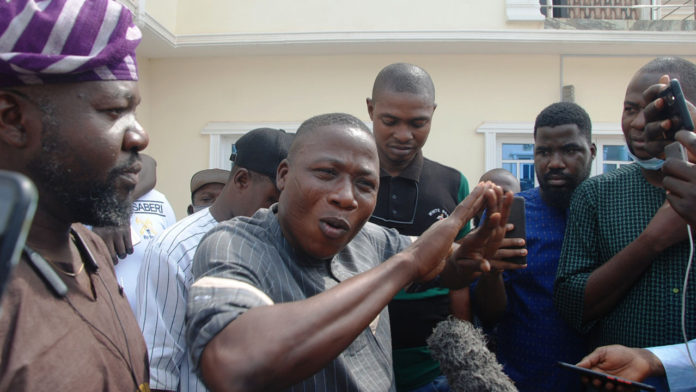
A popular Yoruba rights activist, Sunday Adeyemo, well known as Sunday Igboho, had asked herdsmen accused of perpetrating crimes ranging from kidnappings, killings, rape to invasion of farmlands with their cattle to leave Ibarapa within seven days.

At the expiration of the seven-day ultimatum, Igangan residents, emboldened by Igboho’s presence, had ejected the Seriki Fulani, Abdulkadri Saliu, and his herders out of the rustic town.

The residents of the town also vowed never to allow Saliu and his men return to the community. (Punchng)

There’ll be constitutional crisis if IGP stayed beyond 12 midnight -Adegboruwa

Sodiq Oyeleke

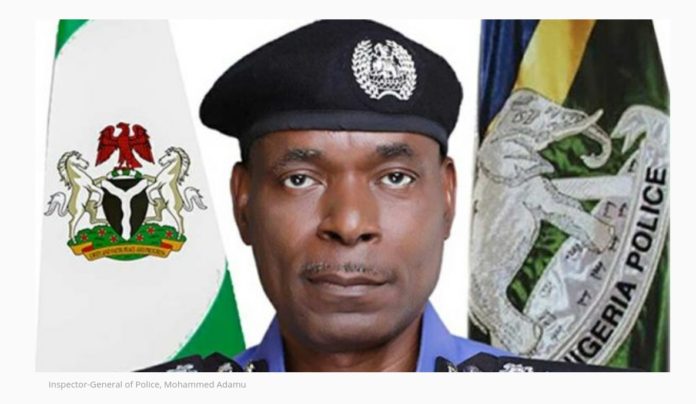
A Senior Advocate of Nigeria, Mr Ebun-Olu Adegboruwa, has warned that there will be a constitutional crisis in the country if the Inspector General of Police, Abubakar Adamu, stayed in office beyond 12 midnight of February 1, 2021.

In an exclusive interview with The PUNCH, Adegboruwa explained that, by law, Adamu seizes to be a member of the Nigeria Police Force from 12 midnight.

According to him, the failure of the President, Major General Muhammadu Buhari (retd.), to either extend the tenure of the IGP or name a replacement has several legal consequences.

“By midnight of February 1, 2021, Mr. Adamu seizes to be a member of the Nigerian police force. Having attained the mandatory year of service within the force. So, if he is no longer a member of the NPF, he cannot be a leader of the force.

“It is going to be a constitutional crisis if he does not vacate office by the end of today. There will be a serious constitutional crisis if he remains in office without extension or replacement by 12 midnight,” he said.

The PUNCH had reported that Adamu is expected to leave the office on Monday (today), having reached the mandatory retirement age, but the silence from the Presidency and failure of the council to meet are giving confusing signals.

Our correspondent had earlier reported moves by Adamu to secure tenure extension to enable him to complete the ongoing reforms in the police.

The silence from the Presidency and the inability of the police council to meet and appoint Adamu’s successor is strengthening rumours that the President may have approved additional months in office for him.

Punchng

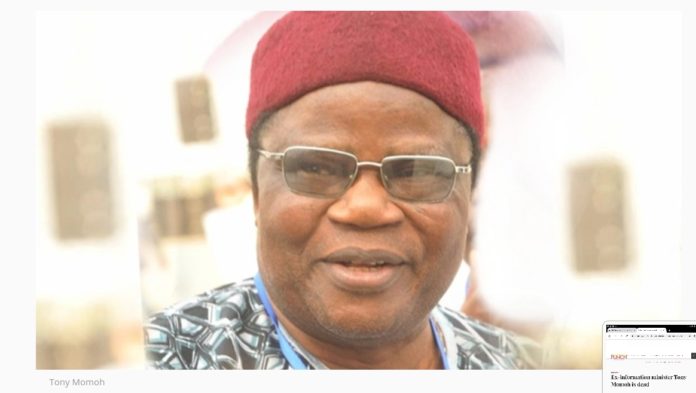
Ex-information minister Tony Momoh is dead

Sodiq Oyeleke

A former Minister of Information and Culture, Tony Momoh, has died at the age of 81.

Sources close to the deceased told our correspondent that he died on Monday at his residence in Abuja.

A former Vice-President Atiku Abubakar described the late Momoh as a good man.

In a message posted on his Twitter handle, @atiku, the former Vice-President wrote, “A good man, Prince Tony Momoh, has gone home. The veteran journalist, politician, and former minister was an avowed apostle of politics without bitterness. And like the prince he was, carried himself with dignity and respect. He will be sorely missed.

“My family and I, condole with his family; the Otaru of Auchi Kingdom, HRH Alhaji Aliru Momoh (Ikelebe III) and his Council; the government and people of Edo State, his friends, and associates. May his soul rest in peace.”

Momoh was appointed Minister of Information and Culture by General Ibrahim Babangida, holding the position from September 1986 until 1990.

He was Chairman of the African Conference of Information Ministers from 1988 to 1990.

He was educated at Government School Auchi, the school Momoh the First had established at Auchi in 1922. He also attended Teacher Training College, Abraka, the University of Nigeria, Nsukka, the University of Lagos, and the Nigerian Law school. (Punchng)

FAKE NEWS: Defence chief says no Chibok girl rescued by Nigerian troops

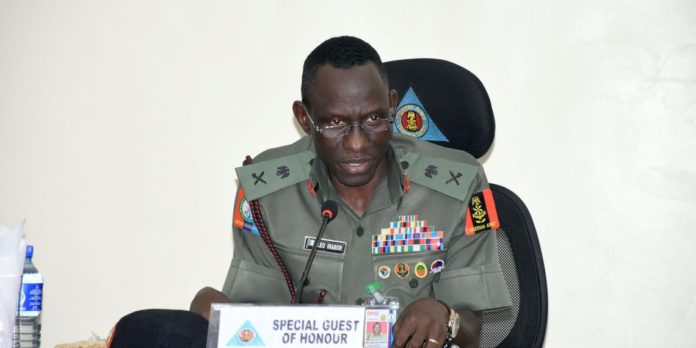
Major General Leo Irabor, Nigeria's New Chief of Defence Staff (PHOTO CREDIT: Twitter/@BashirAhmaad)

“What we know is that we do not have any of the Chibok schoolgirls in our custody. If they’re not with us, what do you want us to confirm to you?”

The Chief of Defence Staff, Lucky Irabor, on Sunday denied media reports that Nigerian troops had rescued some of the abducted Chibok schoolgirls.

In 2014 about 270 schoolgirls were abducted when Boko Haram terrorists attacked their school in Chibok, Borno State.

While some of the girls managed to escape, others spent over two years with their abductors before the Nigerian government negotiated their release.

About a hundred of the girls are still in the captivity of the insurgents.

Last week, an online medium reported that some of the schoolgirls escaped from a Boko Haram camp during a military operation.

This report was followed by others especially by international media like CNN and BBC who claimed to have spoken with the father of a rescued schoolgirl, Halima.

The media outfits that reported the incident quoted the father narrating how he spoke with his daughter who reportedly asked, “Is this my father?”

‘Not true’

PREMIUM TIMES on Sunday in an interview with the new Chief of Defence Staff, General Lucky Irabor, asked the top soldier to confirm whether the military had rescued any Chibok Schoolgirl.

“The military has been conducting operations in all the local government areas of Borno state and the operation has been on now for well over one month, and the intensity of the operation has led to so many of those held behind lines escaping,” he said.

“What we know is that we do not have any of the Chibok schoolgirls in our custody. If they’re not with us what do you want us to confirm to you?

“Yes, we desire to rescue the rest of the Chibok girls and any other person behind the lines…gladly. If our operations have helped those that have been alleged to have escaped I think we are glad. We hope to strengthen the efforts that we are putting now to free the rest that are behind lines.”

A report by CNN claimed that a father, Ali Maiyanga, said some of the girls “have finally escaped from their captors”.

“She asked me. Is this my daddy? Is this my daddy, and she started crying. The crying was [so] much and I couldn’t hear her very well,” the father reportedly told a CNN reporter.

The man further told the CNN reporter that the whole family was “so happy. Our house is full of people who are rejoicing with us.”

The report also quoted the father allegedly saying that he “didn’t get a chance to speak to his daughter properly, as she was emotional and the call was short. But he said she and others are safe and being looked after by the Nigerian army.”

And that “she was calling from a phone line belonging to a security official.”

Local journalists have tried without success to reach the reported father of the allegedly rescued girl.

Mr Maiyanga had two of his daughters, Maryam and Halima, amongst the schoolgirls abducted in April 2014. One of them, Maryam, managed to escape but her younger sister is believed to still be in the custody of the insurgents. (premiumtimesng)

CBN’s free meal and rising fiscal complacency

No penalty on earth will stop people from stealing if it is their only way of getting food,” says Raphael Nonsenso in Utopia. This, according to Thomas More, the author of the 1,516 fictional work, was a response of Nonsenso, a Portuguese traveller, during a dialogue with the Archbishop of Canterbury, John Morton, wherein the former argued that cash hand-outs could reduce theft in the city of Antwerpa.

Cash handout is an easy escape for an individual who is in desperate need of a means of survival. But as the old economic maxim – no free meal – suggests, every decision or option necessarily comes at a cost to the giver, the society or both. The one who gives suffers the opportunity cost of the money he parts with.

But that is tolerable compared to the moral burden it leaves on the society, which could manifest in the form of indolence or complacency. And when handout becomes a norm, rather than a stop-gap measure as Nonsenso, in Utopia, must have envisaged, it stifles state enterprise and kills creativity.

Sadly, handout giving has become a norm at the level of statecraft, with many countries either depending on aids and loans not as a last resort but as a perpetual means of public funding. Where external aids or loans or both dry up, as they currently do, the states, like calcium-starved chickens, turn on their citizens for a feast.

In different forms, the Nigerian government has had to turn to Nigerians for a distasteful feast, inflicting, with varied degrees of damage, on them thereafter.

According to Fitch, a global economic research and rating agency, Ways and Means (W&M), the use of a central bank overdraft to finance deficits, has become Nigerian government’s free lunch (an unworthy public lifestyle).

Among others, Fitch said the worrisome indulgence and abuse of W&M financing is partly responsible for the escalating inflation, which hit 15.75 per cent as of December, and the tumbling naira, which fell by about 30 per cent against the dollar at the parallel market last year.

Entitled, ‘Nigeria’s Deficit Monetisation May Raise Macro-Stability Risks’, Fitch report said: “The Federal Government of Nigeria’s (FGN) repeated recourse to its Ways and Means facility (WMF) with the Central Bank of Nigeria (CBN) highlights weaknesses in public finance management. Sustained use of direct monetary financing could raise risks to macroeconomic stability – given the current weak institutional safeguards – but we expect the FGN to reduce its use of the facility in 2021.

“The FGN directly borrowed 1.9 per cent of gross domestic product (GDP) from the CBN to fund its fiscal deficit in 2020, estimated by Fitch at 3.6 per cent of GDP. A number of emerging markets resorted to central bank deficit financing in 2020 against a background of urgent spending needs and temporary market dislocations associated with the coronavirus pandemic. However, the use of central bank financing in Nigeria predates the pandemic shock.

“We estimate that the balance of the government’s WMF with the CBN was around NGN9.8 trillion (6.7 per cent of GDP) at end-2019, up from NGN5.4 trillion (4.2 per cent of GDP) at end-2018. Unlike the government, we include this balance in our metrics for Nigeria’s government debt. Borrowing from the facility accounted for 30 per cent of the FGN’s debt at end-2019, on our estimates.

“Repeated central bank financing of government budgets could raise risks to macro-stability in the context of weak institutional safeguards that preserve the credibility of policymaking and the ability of the central bank to control inflation. The CBN’s guidelines limit the amount available to the government under its WMF to five per cent of the previous year’s fiscal revenues. However, the FGN’s new borrowing from the CBN has repeatedly exceeded that limit in recent years, and reached around 80 per cent of the FGN’s 2019 revenues in 2020.

“The CBN’s guidelines require borrowing under the WMF to be repaid in the year in which it was granted. The government has stated its intention to securitise balances borrowed under the facility, but published statistics indicate that the amounts borrowed have been rolled over repeatedly in recent years.

“Data published by the government indicates that the treasury paid NGN912.6 billion on the facility in 2020, equivalent to nine per cent only of the outstanding balance at end-2019. The government has opted to use this source of financing, despite ample liquidity on its domestic debt markets, as illustrated by negative real yields. Our understanding is that its ability to borrow from domestic debt markets is constrained by the authorisation granted by parliament in the budget law. The repeated resort to CBN thus reflects higher-than-expected deficits, pointing to entrenched weaknesses in public finance management.”

The agency warned that monetary financing of fiscal problems, monetary policy implementation, as “tight management of domestic liquidity is a key tool under the CBN’s policy of prioritising the stability of the naira.

It stressed that rising monetary financing could also complicate official efforts to stabilise inflation, which it viewed as though being primarily driven by cost as supposed loose monetary policy.

Last week, the CBN Governor, Godwin Emefiele, described Fitch’s position as “unfair” and “very unfortunate”, noting that it would amount to irresponsibility if the Central Bank fails to continue to “support” the government at this crucial moment.

Fitch is not the only organisation that has raised dust about Nigeria’s recourse to monetising its yearly unfunded deficit. Both the World Bank and its sister International Monetary Funds (IMF) have raised the alarm.

As pressure mounted, Emefiele and the Minister of Finance, Budget and Planning, Zainab Ahmed, promised to eliminate central bank lending by 2025 before the release of IMF’s $3.4 billion COVID-19 emergency funding last year.

Whereas the government may be willing to cut down its borrowing spree, experts said commitment to fiscal has goes beyond a statement of intent but that the government would need to work hard to achieve it in the near future.

Recently, Chairman of the Presidential Economic Advisory Council (PEAC), Dr. Doyin Salami, echoed the concerns of other stakeholders, saying “fiscal imbalance” is a major challenge comforting the economy.

Of course, Nigeria has maintained an unbroken commitment to deficit budgets in the past eight years. In 2013, the deficit was 2.3 per cent of the GDP while it fell to 2.1 per cent in 2014. Thereafter, it moved up to 3.2 per cent. In 2016, when the current administration planned its first budget, the deficit crossed four per cent and jumped to 5.4 per cent the subsequent year. It was consistently above four per cent until 2021 when it decelerated to 3.6 per cent.

Even with the reduction, President Muhammadu Buhari admitted the N5.2 trillion shortfalls in the proposal, later expanded by the National Assembly, was above the three per cent threshold advised in the Fiscal Responsibility Act (2007).

For eight years Nigeria has not recorded a budget surplus or, at least, hit the magical “black zero” (to borrow from German balance budgeting culture). Rather, the deficit has been growing, surpassing 40 per cent of the total budget in the 2021 budget.

Where the government cannot meet international market borrowing terms or source the shortfall locally, it resorts to cheap funds from the Central Bank for the unfunded deficit. Fortunately for the government, regularly accused of doing nothing about the bloated cost of governance, the CBN, in its response to Fitch, has promised to continue to lend to the government.

This, Fitch, said, is heightening the country’s macroeconomic instability, which Dr. Salami had earlier described as a bug on the country’s recovery.
But Godwin Owoh, a professor of applied economics, said Fitch’s alarm came when the problem caused by the continual CBN’s quantitative easing had grown into a full-blow “fever”.AdvertisementAdvertisementAdvertisementAdvertisement

About a decade ago, Owoh, an advisor to Prof. Charles Chukwuma Soludo during his days at the apex bank, raised the alarm bell of the economic distortions of the various bailout funds created by the CBN. He told The Guardian last week that if anything has changed in the past 10 years, the “misnomer” has rather grown into a norm.

In his analysis, Managing Director of Financial Nigeria, Jide Akintunde, said the two major concerns raised by Fitch have far-reaching consequences for “the macroeconomic stability of Nigeria” and that the Central Bank ought to have taken the warning seriously.

If the CBN disregards reasoning (of both internationally-renowned agencies and local experts) because it costs next to nothing to print money and ‘dash’ government, Nigerians will continue to bear the burden in form of weak purchasing power, as prices soar and naira becomes increasingly worthless.

Perhaps, the implication may be grimmer – access to cheap funding could continue to demotivate fiscal discipline and creativity while fuelling complacency among the revenue-generating parastatals. (guardian)

Herding and the drumbeats of war

Rights activist, Sunday Adeyemo (a.k.a. Sunday Igboho) (second left), addressing a press conference over his burnt house by arsonists in Ibadan…. PHOTO: NAJEEM RAHEEM

By Semiu Okanlawon

Hours before setting out to write this, I had a lengthy conversation with a notable Nigerian leader, now an octogenarian, who I placed so much trust in his ability to speak the truth to power at the right places. My proposal was for him to immediately initiate a meeting of like-minds that would culminate in an equally urgent meeting of heads across Nigeria with a view to dousing the tension that hangs so palpable in the air with an odious smell of pains, tears and blood. Sadly, he felt disillusioned. Unable to dismiss my suggestions yet, he was however saddened by the fact that not long ago, he initiated a similar meeting at the highest place where he called attention to the imminent confusion across the land if decisive actions were not taken to mend fences and set in motion a chain of actions that would preempt what appeared a clear and present danger.

A troubled federation that we have been, there has not been a time since the end of the military rule in 1999 that Nigeria came so close to being this cacophonous, distrustful of one another and ready to pounce on themselves than the last one month. In the midst of growing feelings of insecurity in the seemingly ‘peaceful’ south-west region of Nigeria, a sudden surge in cases of kidnapping, killings, rituals and other forms of crimes have led to increased mutual suspicion and the outcome is the dangerous ethnic profiling of criminals behind the spate of attacks in their various dimensions.

A near total failure of the country’s security architecture has resulted in a catastrophic rise in and popularity of self-defence mechanism that promises to lead Nigeria nowhere except Rwanda. A friend once said that Nigerian leaders don’t see a problem until it explodes on their faces.

That precisely is my thinking on the sudden emergence of Sunday Adeyemo (Sunday Igboho). Three months ago, Aare Ona Kakanfo, Gani Adams raised the alarm on the influx of undesirable elements in their various looks into the South-West of Nigeria through Oke-Ogun/Ibarapa axis of the South-West.

Well, in the characteristic lazy and lackadaisical responses to threats, what I call a feeble attempt was made by a few security organisations to make some show of force pretending to root out the criminals lurking in the forests of Ibarapa, Igboora and other belly of the Oke-Ogun.

Sadly, since Adams raised the alarm, not a bit were the Czars of mayhem, kingpins of kidnapping and mentors of marauders in that part of the South-West shaken. How else, do you explain this? A head of an ethnic group, known to have become established authority in negotiating release of kidnapped locales in the community that hosts him!

Speaking with locales, stories abound of how you dare not even approach the residence of Seriki Fulani of Igangan, Saliu Abdulkadir without passing through at least three ‘check-points’ manned by his own goons. This was the ‘lions den’ that the late Dr. Fatai Aborode, reportedly visited to make a report of his destroyed 600 acres of farms last year before he met his brutal end. 

The actor of this scene, whoever he might be, to me is as guilty as any other Yoruba unconscionable character or an Igbo kidnap kingpin operating in Abia and collecting his ransom in Akure. Criminals are criminals.

Last year, I travelled along the Abeokuta-Igboora-Eruwa Road. Between Abeokuta and Eruwa, one of those in my company was saddled with the responsibility of counting the number of security checkpoints. Arriving Eruwa, a journey of about 50 minutes from Abeokuta, we had counted 23 security posts. But then, this raised in me a greater fear of insecurity as I wondered the degree of insecurity that had commanded this level of proliferations. I compared this scenario to some 15 years ago when I frequently travelled the same route even in the dead of the night all alone and when perhaps I encountered only one police checkpoint on the way or in some cases none at all.

Today, who is that fellow who travels across Nigerian roads without entertaining the phobia of the road devils? We have suffered untold reductions in the quality of every aspect of our lives.

I monitored the meeting held in Igangan in the aftermath of the hoopla raised by Igboho when residents had a field day to open up before the delegation from the Inspector General of Police. What were clearly in the air were the efforts of the community to bring their plights to the knowledge of the authorities in both the state and the federal levels. No help came!

Igboho may be unlettered. But his revolutionary braving of odds to bring the plights of his people cannot be dismissed. You may dig deep to say his antecedents are not too enviable, but he may have succeeded in emerging as a champion of the oppressed, a record that will be hard to erase. If Oyo State and indeed the whole of the South-West is finally rid of the marauders, it will be hard to tell the tale without ample mention.

Igboho, put in a sad context of the Nigerian situation, represents one of the millions of the unorthodox, non-state actors that have been pushed to the walls to come up with unorthodox solutions. Every recognizable community in Nigeria today has an Igboho in its midst and the community look up more to them than even our funded security personnel.
 
Why did it take Governor Rotimi Akeredolu’s quit notice from his state’s forest reserves before the Presidency weighed in on the tragedy that had befallen Ondo in forms of daily kidnapping, killings and raping of innocent souls?

The Nigerian Police Force, the Nigerian Army, The Nigerian Air Force, The Navy, Nigerian Security and Civil Defence Corps, and other military and para-military formations are the known, orthodox security machinery of the state maintained by the taxpayers’ money in Nigeria.
 
The emergence of many non-state actors such as Igboho aptly illustrates the failure of these networks and their inability to provide security of lives and property of the people which is the primary objective of every government.
 
I still wonder how the authorities believe that the current unitary command of the police in Nigeria will work. The signal that emanates from Louis Edet House in Abuja simply becomes weak and evaporates before it gets to Iwo in Osun, Abakaliki in Ebonyi or Malamadori in Jigawa. The result in the end is that no policing takes place and everyone is just a lord unto himself in the very small domain that he colonizes. The monster that the Special Anti-Robbery Squad (SARS) eventually morphed into is one of the direct, ugly outcomes of having a behemoth as a security outfit.


And in the midst of this festering confusion, what should have been embraced as a quick solution to tackle crime much more effectively is gradually becoming another albatross. Last month, I saw a huge crowd of able-bodied men of the South-East extraction answering to the call of the self-acclaimed leader of the Indigenous People of Biafra (IPOB), Nnamdi Kanu to mass themselves into an army of community police. It was ostensibly in response to the formation of the South-West Security Network (Amotekun) presented as a child of necessity and a response to the strange surge in criminality.

The last few days have witnessed bloody engagements between members of the Eastern Security Network and the Nigerian Army especially in Orlu, Imo State.

From North much earlier had emerged similar groups like the Hisbah and the Civilian Joint Task Force (Civilian-JTF) dealing with issues of security breaches and insurgency in the northern part of the country.

There must be the political will to allow for state police. This is to create a synergy between the conventional Nigerian security machinery to make the community efforts compliment to stem the tide. Failure to do this will only lay Nigeria vulnerable to the combined rape of an incubus and succubus. Let’s all be guided before it’s too late, for the drumbeat is getting louder. 
Semiu Okanlawon, journalist, author and communication consultant writes from [email protected]   (guardian)

TIPS