ENL CONSORTIUM LTD v. SHAMBILAT SHELTER (NIG) LTD
CITATION: (2018) LPELR-43902(SC)
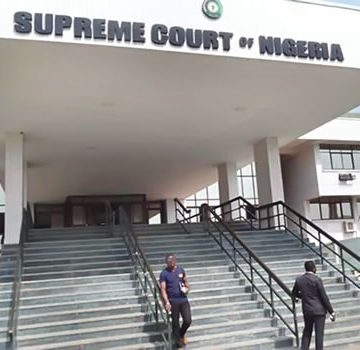
In the Supreme Court of Nigeria
ON FRIDAY, 26TH JANUARY, 2018
Suit No: SC.40/2015
Before Their Lordships:
- MARY UKAEGO PETER-ODILI Justice of the Supreme Court
- KUMAI BAYANG AKA’AHS Justice of the Supreme Court
- AMINA ADAMU AUGIE Justice of the Supreme Court
- PAUL ADAMU GALINJE Justice of the Supreme Court
- SIDI DAUDA BAGE Justice of the Supreme Court
Between
ENL CONSORTIUM LIMITED – Appellant(s)
And
SHAMBILAT SHELTER (NIG) LIMITED – Respondent(s)
RATIO DECIDENDI (2018) LPELR-43902(SC) 1. APPEAL – HEARING OF APPEAL: Whether Courts can hear an appeal on a date fixed for hearing of a motion without the consent of parties in the matter “This Court has at numerous occasions stated that a Court cannot hear an appeal on a date fixed for hearing of a motion without the consent of both parties and the Court. This is in tune with the principle of fair hearing as a party must be heard before a matter concerning him is determined. Stated differently, even though a party is aware of a motion that is not the same as being put on notice for a hearing of an appeal that is not slated for a given date. Therefore when on the date for hearing of a motion, the court set on a journey of taking on the appeal without a party being aware of the latter position and with his consent, the jurisdiction of the Court is invoked in futility and all that takes place would come to naught. See General Electric Co. v. Akande (2012) 16 NWLR (Pt.1327) 593 at 605; Assam v. Ararume (2016) 1 NWLR (Pt.1493) 368 at 388 – 389; Ominiyi v. Alabi (2015) 6 NWLR (Pt.1456) at 593 – 594; Section 36(1) of the 1999 Constitution of the Federal Republic of Nigeria; Judicial Service Commission, Cross Rivers State v. Young (2013) 1 NWLR (Pt. 1364) 25 – 26.”Per PETER-ODILI, J.S.C. (Pp. 14-15, Paras. D-C) – read in context.
APPEAL – DISMISSAL OF APPEAL: Whether the Court can suo motu dismiss an appeal “Although the Appellant failed to file its brief within 45 days after the receipt of the record, by Order 18 Rule 2 of the Court of Appeal Rules, that did not extinguish its appeal. The Respondent was required to bring an application for the dismissal of the appeal, where the Appellant failed to file the brief within time and did not take steps to ask for extension of time within which to file the brief. See Order 18 Rule 10(1) of the Rules which provides- “18 Rule 10(1) Where the Appellant fails to file his brief within the time provided for in Rule 2 of this Order, or within the time as extended by the Court, the Respondent may apply to the Court for the appeal to be dismissed for want of prosecution” Even though the Appellant was absent from Court on 3 December, 2014 together with its counsel and there was evidence that the Appellant had been notified on 1 December, 2014 of the matter coming up on 3 December, 2014, the business of the Court was to hear the pending motion. And since learned counsel was not around to move the application, the Court rightly struck out the application on the application of learned counsel to the Respondent.
The further step taken by the Court to suo motu dismiss the appeal for failure to file the Appellant’s brief was wrong. Even if learned counsel for the Respondent applied orally for the dismissal of the appeal, the Court still had to decide whether it was proper to grant such application without hearing from the Appellant. Since the Court below dismissed the appeal without a prompting from the Respondent’s counsel, there is failure by the Court to accord the Appellant fair hearing and therefore the appeal per force must be allowed.”Per AKA’AHS, J.S.C. (Pp. 17-19, Paras. E-A) – read in context (2018) LPELR-43902(SC) 3. APPEAL – DISMISSAL OF APPEAL: Whether the Court can suo motu dismiss an appeal “the Lower Court suo motu dismissed the appeal on the ground that the Appellant failed to file its brief of argument as the time to do so had expired. According to the record before this Court, the appeal that was dismissed by the Lower Court was entered in that Court on the 2nd of September 2014.
Clearly, as at 3rd of December 2014, the time within which the Appellant was required to file its brief of argument had expired. Order 18 Rule 2 of the Court of Appeal Rules provides that the Appellant shall within forty-five days of the receipt of the Record of Appeal from the Court below file in the Court a written brief, being a succinct statement of his argument in the appeal. Order 18 Rule 10(1) of the same Rules provides as follows:- “Where an Appellant fails to file his brief within the time provided for in Rule 2 of this Order, or within the time as extended by the Court, the Respondent may apply to the Court for the appeal to be dismissed for want of prosecution…” Order 18 Rule 10(1) of the Court of Appeal Rules is very clear.
An Appellant’s appeal could be dismissed for failure to file a brief of argument if the Respondent applies to the Court for the appeal to be dismissed. Learned Counsel for the Respondent did not make an application for the dismissal of the appeal. From the available record, that was the first time the appeal came up before the Court.
The major feature of Order 18 Rule 10(1) of the Court of Appeal Rules is the passive and inactive role of the Bench which emphasizes or promotes the active role of Counsel in the presentation of the cases for their respective parties. Learned Counsel for the Respondent was required to apply, if he wished, for the appeal to be dismissed. He only applied for the motion to be dismissed. It was therefore not his desire to have the appeal dismissed at that stage. See Godwin Josiah v. The State (1985) 1 SC.406 at 443. Even if the Respondent had asked for the appeal to be dismissed at that stage, since same was being mentioned for the first time, the Lower Court would have been reluctant to do so.
For a dismissal of an action or appeal in limine is the most punitive relief that a Court can grant to a defendant/Respondent against a plaintiff/Appellant. There must be a legal basis for such a request and a corresponding legal basis for granting it. See Inakoju v. Adeleke (2007) 4 NWLR (Pt.1025) 427.”Per GALINJE, J.S.C. (Pp. 20-22, Paras. D-D) – read in context (2018) LPELR-43902(SC) 4. CONSTITUTIONAL LAW – RIGHT TO FAIR HEARING: Whether a party who had an opportunity of being heard but did not utilize it can bring an action for breach of fair hearing “It is to be stated at the risk of repetition that fair hearing or the lack thereof is fundamental to the competence of a Court’s proceedings and the jurisdiction of the Court itself.
Therefore the facts that a party who ought to be placed on notice of an impending proceedings in Court and is not so notified the proceedings are thereby for that lack jeopardized and the fallout is that the Court’s jurisdiction cannot be ignited or activated. This does not mean that a party would be allowed to play hide and seek as an artful dodger from notice of process or hearing notice all in an attempt to plead non service so as to scale through the huddle of attending to the hearing, delay the proceedings and thereby obtain a cheap victory. The Courts have built in dispute settling mechanisms whereby the parties must come out in the open to make their cases with their cards on the table and not cunningly or craftily.
This has made the Court come up with its legal principle that when an appellant has been given ample opportunity or chance to present the appeal before the Lower Court, he skips Court, he does so at his own peril and would bear the result of the game he has played and cannot invoke his right of fair hearing in Court as a party who seeks fair hearing in Court must also be fair in litigation to the adverse party and to the proceedings. See Inakoju & Anor v Adeleke & 3 Ors (2007) 29 NSC QR (Pt.11) 958 at 979.”Per PETER-ODILI, J.S.C. (Pp. 12-13, Paras. D-D) – read in context
PRACTICE AND PROCEDURE – SERVICE OF COURT PROCESS(ES): Position of the law on electronic mode of service “The point has to be made that the phone call mode of service would ordinarily be of good service so long as the party is provided the notice at least 48 hours before the scheduled Court date.
The regularity of service is no longer jettisioned because it was made electronically as the current Rules of Court have ensured. See Order 2(c)(i) of the Court of Appeal, 2013 Rules.”Per PETER-ODILI, J.S.C. (P. 15, Paras. C-E) – read in context (2018) LPELR-43902(SC)
PRACTICE AND PROCEDURE – HEARING NOTICE: Fundamental nature of the service of hearing notice on parties in the adjudication process and effect of failure to serve same where required “Serving of hearing notice on the Appellant is a pre-condition to the exercise of jurisdiction of the Court below as it is basic to the invocation of jurisdiction of the Court. The flip side of the coin is that non-service of hearing notice therefore robs the Court of jurisdiction to hear and determine the matter and any order made thereby against the party who should have been served with the hearing notice becomes null and void.
I rely on Otabaimere v. Akporehe (2004) 14 NWLR (Pt.894) 591 at 614; FBN PLC v. TSA Ind. Ltd (2015) 11 NWLR (Pt.1470) 346 at 357; Guda v Kitta (1999) 12 NWLR (Pt.629) 21.”Per PETER-ODILI, J.S.C. (Pp. 15-16, Paras. F-B) – read in context (2018) LPELR-43902(SC) MARY UKAEGO PETER-ODILI, J.S.C. (Delivering the Leading Judgment): This is an appeal from the decision of the Court of Appeal or Court below on 3rd December, 2014 from Coram: Abubakar Jega Abdulkadir, Tinuade Akomalafe – Wilson and Joseph E. Ekanem JJCA of the Abuja Division in which the Court below dismissed the appeal from the Ruling of the High Court of the Federal Capital Territory on 7th August, 2014 per Valentine B. Ashi J in which the High Court recognised the Arbitral Award made by the sole arbitrator, Chief J. K. Gadzama SAN wherein the appellant was made liable to pay the sum of Two Hundred and FortyNine Million, Six Hundred and Twenty Thousand, Two Hundred and Ninety Eight Naira, Sixteen Kobo (N249,620,298.16) only to the respondent.
FACTS RELEVANT TO THE APPEAL: It is not disputed that both parties were all represented at all material times before the sole arbitrator Chief J. K. Gadzama SAN during the arbitral proceedings and before the trial Court save when the said trial Court on the 7th day of August, 2014 recognized the arbitral award and in the same proceedings granted leave to the respondent, to enforce the award 1 (2018) LPELR-43902(SC) by virtue of the nature of the ex-parte application in Motion No. M/6696/2014. That instead of timeously approaching the trial Court under the relevant Sections 29, 31 and 32 of the Arbitration and Conciliation Act Cap A18 LFN, the appellant anxiously elected to appeal to the Lower Court on the 4th September 2014. The appellant filed many applications which include applications on originating summons between the same parties and the same subject matter suit No. FCT/HC/CV/2291/14 dated and filed on 2nd of September, 2014.
There was also a Motion for stay of execution in the Court between the parties on the same subject matter in No. FCT/HC/2096/2014, Motion N. M/6641/2014. That in the Lower Court there was also a Motion No. M/6696/2014 in Appeal No. CA/A/520/2014. That despite the decision of the Lower Court on 3rd December 2014, some of the above, particularly 2.05 and 2.06 are still pending in the trial Federal Capital Territory High Court and are not abated in spite of this Appeal. The appellant’s counsel was informed on the 1st of December, 2014 of his appeal slated to come on the 3rd of December, 2014. (2018) LPELR-43902(SC) Further, that the 2 (2018) LPELR-43902(SC) narration of the Appellant from paragraph 2.05 of his brief of argument deemed properly filed and served on the 7th of February 2017 which is anchored on the Appellant’s counter-affidavit to the affidavit of service of Mr. Emmanuel (the bailiff) as contained on pages 182 – 184 of the records amount to nothing, other than a concocted, falsification and exposition of the lack of diligence of the Appellant. That in paragraph 5 of the Appellant’s counsel counteraffidavit, it is claimed that counsel went to settle records in the case between ”DR. J. O. ABALAKA V. THE PRESIDENT OF THE FEDERAL REPUBLIC OF NIGERIA & 2 ORS”.
In the Federal High Court Makurdi, Benue State, out of “the jurisdiction of the Court”. That the Appellant’s counsel went all the way to obtain a printout of his telephone conversation with the bailiff which is commendable but leaves a lot of missing links in his deposition that questions his integrity, professionalism, and ethical conduct when he failed, refused, and neglected to attach the cause list of the Federal High Court or invitation that is relevant to the settlement of the records. That there is nothing 3 (2018) LPELR-43902(SC) whatsoever that shows that he attended any legal duties or business at the Federal High Court, Makurdi, Benue State on either 1st, 2nd or 3rd December, 2014 besides the fact that a Federal High Court in judicial stare decisis and hierarchy is not concurrent or higher in hierarchy to a Court of Appeal.
That in furtherance of the above, counsel in utmost disrespect to the Lower Court and not according premium to the matter which he claimed he did not know, did not call back the bailiff to clarify which of his matters was coming up (assuming he was driving) after he arrived Makurdi, a journey of not more than four hours. That counsel, in deliberately avoiding and ignoring the bailiff’s telephone call (hearing notice) “outside the jurisdiction of the Court” did not deem it fit to call either the Appellant or any of its staff or junior counsel in chambers to attend Court on that day. Whereas from the records of the Lower Court, the Motion was struck out as he was not there to move it, the appeal was suo motu dismissed beyond his absence, because there was no brief of argument, neither was there an application for extension of time to file one. 4 (2018) LPELR-43902(SC) In other words, his, or anyone’s presence would not have saved the day because their Lordships acted correctly and within the scope of the rules of Court of Appeal.
That the said counter affidavit at page 182 of the records, only has attached the call history of the telephone conversation without any Court process regarding the so called record of the case of DR. J. O. ABALAKA v. PRESIDENT OF THE FEDERAL REPUBLIC OF NIGERIA as deposed in paragraph 5 of the said counter affidavit. On the 1st day of November 2017 date of hearing, learned counsel for the Appellant, J. B. Akomolafe Esq., adopted the Appellants brief of argument filed on 9/5/2016 and deemed filed on 7/2/17. In it were identified three issues for determination which are as follows:
1. Whether or not the phone call of the Bailiff of the Lower Court (Mr. Emmanuel) to the cell phone number 0803-722-6932 of B. J. Akomolafe, counsel to the Appellant, precisely at 18.44 hours on Monday the 1st day of December, 2014 suffices as adequate notice of the proceedings of the 3rd December, 2014 for the appellant. (Ground 1 of Notice of Appeal).
2. Whether or not the appellant was not denied the 5 (2018) LPELR-43902(SC) hearing of its Appeal No. CA/A/520/2014 when the substantive appeal was dismissed on the day fixed for the hearing of its Motion No. CA/A/520/M/2014. (Grounds 2 and 3 of the Notice of Appeal).
3. Whether or not the Lower Court had full grasp of the facts and processes before the Court when it held that “we note that the Record of Appeal was transmitted to this Court on 02/09/2014 till date the Appellant has failed to file its Brief of Argument and has not applied for extension of time to file his Brief of Argument, accordingly this appeal is dismissed for want of prosecution under Order 18 Rule 2 of the Court of Appeal Rules, 2011” whereas Supplementary Record of the appeal was shown at page 173 of the Record to have been transmitted on the 19th September, 2014. (Ground 4 of the Notice of Appeal). M. A. Nunghe Esq., learned counsel for the Respondent adopted its brief of argument filed on 14/3/2017 and in it were raised two issues for determination which are thus:-
1. Whether or not the Appellant was denied fair hearing by the Lower Court. 2. Whether their Lordships of the Lower Court had the requisite jurisdiction and powers to 6 (2018) LPELR-43902(SC) dismiss the Appeal which they so did in the circumstances of the Appeal. I see the issues as formulated by the Respondent as simple and apt for the use of the Court in the consideration of this appeal and I shall use them. ISSUES 1 AND 2: i. Whether or not the Appellant was denied fair hearing by the Court. ii. Whether their Lordships of the Lower Court had the requisite jurisdiction and powers to dismiss the Appeal which they so did in the circumstances of Appeal. Learned counsel for the Appellant contended that a phone call of the Bailiff of the Lower Court (Mr. Emmanuel) to the cell phone number 0803-722-6932 of B.J Akomolafe, counsel to the Appellant precisely at 18.44 hours on Monday, 1st day of December 2014 was grossly inadequate as notice of the proceedings of 3rd December, 2014. That under the Court of Appeal Practice Direction, 2013 the provisions of Order 1 Rules i & ii states that this Practice Direction shall save to the extent and as may otherwise be ordered by the President, Court of Appeal, pursuant to Section 248 of the Constitution of the Federal Republic of Nigeria, 1999 (as amended), apply to: 7 (2018) LPELR-43902(SC) i. All Criminal Appeals relating to the offence of Terrorism, Rape, Kidnapping, Corruption, Money Laundering and Human Trafficking. ii. Interlocutory appeals challenging the Ruling of the Court below on an interlocutory application.
That under Section 2 (c) (i) of the same Practice Direction the Rules made under this Practice Direction shall apply to all criminal cases which fall under the category of offences listed above as well as interlocutory appeals to which the appeal under discourse does not fall. It was submitted for the Appellant that serving of hearing notice on the Appellant herein is a pre-condition to the exercise of jurisdiction of the Lower Court and this was not done before the case of the Appellant was dismissed.
The cases of Otabaimere v Akpovehe (2004) 14 NWLR (Pt.894) 591 at 614; FBN PLC v TSA Ind. Ltd (2015) 11 NWLR (Pt.1470) 346 at 357; Guda v Kitta (1999) 12 NWLR (Pt.629) 21. Mr. Akomolafe of counsel for the Appellant contended that on the 3rd December, 2014 the case at the Lower Court was for the hearing of motion No: CA/A/520/M/2014 and not for the hearing of Appeal No: CA/A/520/2014 and so the matter not having been 8 (2018) LPELR-43902(SC) fixed for hearing of the appeal the Court below erred to have suo motu dismissed the appeal of the appellant as the fair hearing right of the Appellant was compromised. He cited General Electric Co v. Akande (2012) 16 NWLR (Pt.1377) 593 at 605; Assam v Ararume (2016) 1 NWLR (Pt.1456) 572 at 593-594. That the proceedings of the Lower Court of 3rd December, 2014 in Appeal No: CA/A/520/2014 wherein the Appellant’s substantive appeal was dismissed is a nullity. He referred to Udengwu v Uzuegbu (2003) 7 SC 64 at 69; Kalio v Woluchem (1985) 1 NWLR (Pt.4) 610 at 622. Learned counsel for the Respondent, M. A. Nunghe Esq., contended that what is in issue is whether the conduct of the proceedings of the 3rd day December 2014 accords with the relevant laws and rules of the court and that the answer is yes. He cited Odessa v. FRN (No.2) (2005) 10 NWLR (Pt.934) 528 at 556.
That the Appellant had notice and acknowledge service and did nothing, a situation that was a self-inflicted act in which he cannot turn around and accuse the Court below of denying him fair hearing. He referred to Inakoju & Anor v. Adeleke & 3 Ors (2007) 29 NSC QR (Pt.11) 958 9 (2018) LPELR-43902(SC) at 979; News Watch Communication Ltd v. Atta (2006) 4 SC (Pt.11) 114 at 140 – 141.
That in dismissing the Appeal the Court below acted under Order 18 Rule 10 of the Court of Appeal Rules, 2011 and also Order 18 Rules 2 & 4. For the Respondent, Mr. Nunghe stated that the attendance of counsel or Appellant could not have changed the situation since there was nothing before the Court as neither the supplementary records nor brief of argument filed within time and there was no motion for extension of time. He cited Williams & Ors v. Hope Rising Voluntary Funds Society (1982) 13 NSC 36; Ibigbami v. Military Governor Ekiti State (2004) 4 NWLR (Pt.863) 243 at 250. That Appellant failed to take advantage of Order 19 Rule 4 the Court of Appeal Rule 2011 wherein it would have approached that Court to review that order dismissing the appeal on 3rd December, 2016. He cited Intra Motors (Nig) Plc v. Akinloye (2001) 6 NWLR (Pt.708) 61 at 79; Chieshe v. NICON Hotels Ltd (2007) ALL FWLR (Pt.388) 1152 at 1162; Abah v Jabusco (Nig) Ltd (2008) 3 NWLR (Pt.1075) 526 at 546. Appellant’s position in brief is that this Court exercised its 10 (2018) LPELR-43902(SC) discretion to set aside the decision obtained by the Respondent at the Lower Court when the Court was misled into giving the decision dismissing the appeal of the Appellant.
The Respondent’s stand is that the appeal should be dismissed because Appellant was not denied fair hearing from the proceedings as the Appellant chose to keep away from the Court of Appeal on the day of hearing. At the proceedings of 3rd December, 2014 the Registrar of Court had reported to the Court thus: “The Appellant has been served with hearing notice against today through phone call to his counsel on record B.J. Akomolafe on the 1st of December, 2014 on cell No.0803- 722-6922”. The Appellant admitted the above facts in his counteraffidavit to the affidavit of service of Mr. Emmanuel (the bailiff) wherein he deposed:- “It is true that a bailiff of this Honourable Court named Mr. Emmanuel put a call through to my cell phone on Monday, the 1st Day of December, 2014 precisely by 18:44 hrs, that is 16 minutes to 7pm to inform me that one of my cases would be coming up at this Court (The call history of my Nokia phone on Monday December 2014 is hereby attached as (2018) LPELR-43902(SC) exhibit “A”)”.
The Court of Appeal had reacted to the information above stated on the service of process on the Appellant to which service the Appellant admitted in his counter affidavit above referred to and it is as follows:- “We note that the records of appeal were transmitted to the Court on the 2nd of September, 2014, till the said date, the Appellant has failed to file his brief of argument and has not applied for extension of time to file his brief of argument, accordingly this appeal is dismissed for want of prosecution under Order 18 Rule 2 of the Court of Appeal Rules 2011”. It is to be stated at the risk of repetition that fair hearing or the lack thereof is fundamental to the competence of a Court’s proceedings and the jurisdiction of the Court itself. Therefore the facts that a party who ought to be placed on notice of an impending proceedings in Court and is not so notified the proceedings are thereby for that lack jeopardized and the fallout is that the Court’s jurisdiction cannot be ignited or activated. This does not mean that a party would be allowed to play hide and seek as an artful dodger from notice of process or (2018) LPELR-43902(SC) hearing notice all in an attempt to plead non service so as to scale through the huddle of attending to the hearing, delay the proceedings and thereby obtain a cheap victory.
The Courts have built in dispute settling mechanisms whereby the parties must come out in the open to make their cases with their cards on the table and not cunningly or craftily. This has made the Court come up with its legal principle that when an appellant has been given ample opportunity or chance to present the appeal before the Lower Court, he skips Court, he does so at his own peril and would bear the result of the game he has played and cannot invoke his right of fair hearing in Court as a party who seeks fair hearing in Court must also be fair in litigation to the adverse party and to the proceedings. See Inakoju & Anor v Adeleke & 3 Ors (2007) 29 NSC QR (Pt.11) 958 at 979. The applying principle in the matter of service of hearing notice and whether the principle of fair hearing has been adhered to cannot be operated without situating to a given case like the one at hand. In the case in this instance on the 3rd December, 2014, the case at the Lower Court was for the 13 (2018) LPELR-43902(SC) hearing of motion No: CA/A/520/M/2014 and not for the hearing of Appeal No. CA/A/520/2014; therefore the hearing notice and the Appellant being in the know would not change the situation. Again to be stated is that as at 19th of September, 2014 Appellant had compiled and transmitted the Record of Appeal in the ex-parte decision against him delivered on the 7th of August, 2014 and the case came up before the Lower Court for the first time ever on the 3rd of December, 2014.
Therefore the Court below erred when it applied the provisions of the Court of Appeal Direction, 2013 in dismissing the appeal as the circumstances for such application did not exist. This Court has at numerous occasions stated that a Court cannot hear an appeal on a date fixed for hearing of a motion without the consent of both parties and the Court. This is in tune with the principle of fair hearing as a party must be heard before a matter concerning him is determined. Stated differently, even though a party is aware of a motion that is not the same as being put on notice for a hearing of an appeal that is not slated for a given date.
Therefore when on the date for hearing of a (2018) LPELR-43902(SC) motion, the court set on a journey of taking on the appeal without a party being aware of the latter position and with his consent, the jurisdiction of the Court is invoked in futility and all that takes place would come to naught. See General Electric Co. v. Akande (2012) 16 NWLR (Pt.1327) 593 at 605; Assam v. Ararume (2016) 1 NWLR (Pt.1493) 368 at 388 – 389; Ominiyi v. Alabi (2015) 6 NWLR (Pt.1456) at 593 – 594; Section 36(1) of the 1999 Constitution of the Federal Republic of Nigeria; Judicial Service Commission, Cross Rivers State v. Young (2013) 1 NWLR (Pt.1364) 25 – 26.
The point has to be made that the phone call mode of service would ordinarily be of good service so long as the party is provided the notice at least 48 hours before the scheduled Court date. The regularity of service is no longer jettisioned because it was made electronically as the current Rules of Court have ensured. See Order 2(c)(i) of the Court of Appeal, 2013 Rules.
Serving of hearing notice on the Appellant is a precondition to the exercise of jurisdiction of the Court below as it is basic to the invocation of jurisdiction of the Court. The flip side of 15 (2018) LPELR-43902(SC) the coin is that non-service of hearing notice therefore robs the Court of jurisdiction to hear and determine the matter and any order made thereby against the party who should have been served with the hearing notice becomes null and void. I rely on Otabaimere v. Akporehe (2004) 14 NWLR (Pt.894) 591 at 614; FBN PLC v. TSA Ind. Ltd (2015) 11 NWLR (Pt.1470) 346 at 357; Guda v Kitta (1999) 12 NWLR (Pt.629) 21. The facts and circumstances prevailing in this case showed that the Court below did not have the full grasp of the case before them in ruling and dismissing the appeal as they operated with the erroneous belief that the Record of Appeal was transmitted from the Trial Court registry as at the 2nd of September, 2014. Whereas, a supplementary Record was not transmitted by the Appellant as far back as the 19th September, 2014. The Court below clearly was ambushed by what the Learned Justices perceived to be the true state of affairs and so could not have considered the issues properly raised by the parties before them and so the conclusions reached stemmed from a mistaken view point which cannot be sustained. See Udengwu v Uzuegbu (2003) 7 SC 64 at 69, 16 (2018) LPELR-43902(SC) Kalio v Woluchem (1985) 1 NWLR (Pt.4) 610 at 622.
The conclusion as I am labouring to reach based on the foregoing is that this is an appeal with merit and I see no other option than to allow the appeal. Appeal is allowed as I set aside the judgment and orders of the Court of Appeal. I remit this appeal back to the President of the Court of Appeal for re-assignment to another panel of justices other than the members that handled the earlier one for a rehearing of the appeal on the merit from the trial High Court.
KUMAI BAYANG AKA’AHS, J.S.C.: I read before now the leading judgment of my learned brother, Mary Peter-Odili J.S.C. allowing the appeal. I agree with it. Although the Appellant failed to file its brief within 45 days after the receipt of the record, by Order 18 Rule 2 of the Court of Appeal Rules, that did not extinguish its appeal.
The Respondent was required to bring an application for the dismissal of the appeal, where the Appellant failed to file the brief within time and did not take steps to ask for extension of time within which to file the brief. See Order 18 Rule 10(1) of the Rules which 17 (2018) LPELR-43902(SC) provides- “18 Rule 10(1) Where the Appellant fails to file his brief within the time provided for in Rule 2 of this Order, or within the time as extended by the Court, the Respondent may apply to the Court for the appeal to be dismissed for want of prosecution” Even though the Appellant was absent from Court on 3 December, 2014 together with its counsel and there was evidence that the Appellant had been notified on 1 December, 2014 of the matter coming up on 3 December, 2014, the business of the Court was to hear the pending motion. And since learned counsel was not around to move the application, the Court rightly struck out the application on the application of learned counsel to the Respondent.
The further step taken by the Court to suo motu dismiss the appeal for failure to file the Appellant’s brief was wrong. Even if learned counsel for the Respondent applied orally for the dismissal of the appeal, the Court still had to decide whether it was proper to grant such application without hearing from the Appellant. Since the Court below dismissed the appeal without a prompting from the Respondent’s counsel, there is failure by the Court to 18 (2018) LPELR-43902(SC) accord the Appellant fair hearing and therefore the appeal per force must be allowed. For this reason and the fuller reasons contained in the judgment of my learned brother, Mary Peter-Odili J.S.C., I find merit in the appeal and it is accordingly allowed. The appeal is remitted to the Court of Appeal, Abuja for hearing. If any Justices who heard the matter on 3 December, 2014 are still serving in the Abuja Division, they should excuse themselves from hearing the appeal.
AMINA ADAMU AUGIE, J.S.C.: I had a preview of the judgment just handed out by my brother – Peter Odili, J.S.C., I agree with the reasons therein advanced to arrive at the conclusion that the appeal be remitted back to the President of the Court of Appeal for rehearing.
PAUL ADAMU GALINJE, J.S.C.: I have had the advantage of reading in draft the judgment just delivered by my Learned brother Mary Peter-Odili J.S.C., and I agree with the reasoning contained therein and the conclusion arrived thereat. The Appellant herein was the Appellant before the Lower Court. Its appeal to the Lower Court was against the Ruling of the FCT 19 (2018) LPELR-43902(SC) High Court delivered on the 7th August 2014 in which the arbitral award of N249,620,2986 made by Chief J.K. Gadzama, SAN in favour of the Respondent was recognized. Pending along with the appeal was a motion which was filed by the Appellant. When the appeal came up for the first time on the 3rd of December 2014, the Lower Court was informed that the Appellant was served through phone call on the 1st of December 2014 and its Counsel was not in Court. Learned Counsel applied that the motion dated 5th September 2014 and filed on the 9th September 2014 be struck out for want of diligent prosecution.
The Lower Court rightly in my view struck out the motion paper. Thereafter the Lower Court suo motu dismissed the appeal on the ground that the Appellant failed to file its brief of argument as the time to do so had expired. According to the record before this Court, the appeal that was dismissed by the Lower Court was entered in that Court on the 2nd of September 2014. Clearly, as at 3rd of December 2014, the time within which the Appellant was required to file its brief of argument had expired. Order 18 Rule 2 of the Court of Appeal Rules provides that 20 (2018) LPELR-43902(SC) the Appellant shall within forty-five days of the receipt of the Record of Appeal from the Court below file in the Court a written brief, being a succinct statement of his argument in the appeal.
Order 18 Rule 10(1) of the same Rules provides as follows:- “Where an Appellant fails to file his brief within the time provided for in Rule 2 of this Order, or within the time as extended by the Court, the Respondent may apply to the Court for the appeal to be dismissed for want of prosecution…” Order 18 Rule 10(1) of the Court of Appeal Rules is very clear. An Appellant’s appeal could be dismissed for failure to file a brief of argument if the Respondent applies to the Court for the appeal to be dismissed. Learned Counsel for the Respondent did not make an application for the dismissal of the appeal. From the available record, that was the first time the appeal came up before the Court.
The major feature of Order 18 Rule 10(1) of the Court of Appeal Rules is the passive and inactive role of the Bench which emphasizes or promotes the active role of Counsel in the presentation of the cases for their respective parties. Learned Counsel 21 (2018) LPELR-43902(SC) for the Respondent was required to apply, if he wished, for the appeal to be dismissed. He only applied for the motion to be dismissed. It was therefore not his desire to have the appeal dismissed at that stage. See Godwin Josiah v. The State (1985) 1 SC.406 at 443. Even if the Respondent had asked for the appeal to be dismissed at that stage, since same was being mentioned for the first time, the Lower Court would have been reluctant to do so.
For a dismissal of an action or appeal in limine is the most punitive relief that a Court can grant to a defendant/Respondent against a plaintiff/Appellant. There must be a legal basis for such a request and a corresponding legal basis for granting it. See Inakoju v. Adeleke (2007) 4 NWLR (Pt.1025) 427. For these few words and the fuller reasoning in the lead judgment, this appeal shall be and it is hereby allowed by me as well. I abide by all the consequential orders made in the said lead judgment including order as to costs.
SIDI DAUDA BAGE, J.S.C.: I have had the benefit of reading in draft the lead Judgment of my learned brother Mary Ukaego Peter-Odili, J.S.C., just delivered. I 22 (2018) LPELR-43902(SC) agree entirely with the reasoning and conclusion reached. I do not have anything useful to add. The appeal is meritorious and it is hereby allowed. I abide by all the orders contained in the lead Judgment.
Appearances: B. J. Akomolafe with him, I. E. Oyatoye For Appellant(s) M. A. Nunghe with him, Sylvester Ogbelu For Respondent(s)(barristerng)