Home Blog Page 1038

Unlike IPOB, Bandits Cannot Be Proscribed In Nigeria — Lai Mohammed

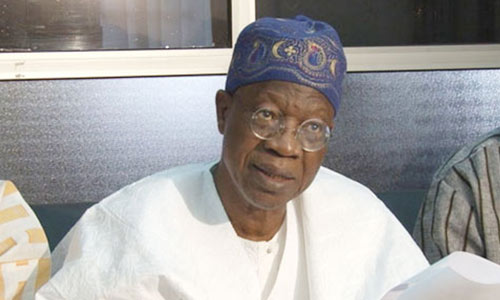
The Minister of Information and Culture, Lai Mohammed, has said bandits cannot be proscribed in Nigeria because they don’t have any identity or name they identify with as a group.

Mohammed spoke on AIT’s Kaakaki programme on Wednesday, explaining that proscribing bandits in the country is not what really matters but how they are treated.

Comparing bandits with armed robbers, the minister said bandits and others who challenge the security of a nation cannot be legally proscribed since they do not have an identity.

He said, “You proscribe known groups with names. You can’t just proscribe an unknown group legally. Secondly, it’s not whether they are proscribed or not, it is the way they are treated. Does the government actually treat them with kid gloves? The answer is no.”

Speaking on the proscription of the Indigenous People of Biafra by the Nigerian government, Mohammed also pointed out that there is a difference between the bandits and the group, noting that “When a group is championing a course for the disintegration of Nigeria… A group like IPOB (that) does not even recognise Nigeria as a state, sets up its own army and thinks it is a sovereign state, is different from bandits and criminals. Please, don’t compare apples and oranges.”

But when asked if the bandits do not also threaten the sovereignty of Nigeria by taking up arms against its citizens, Mohammed described the cases are completely different from each other.

He said, “Security challenges are one thing. Challenging the sovereignty of Nigeria is a completely different thing. Don’t let us dwell on semantics.”

Speaking further, he said, “Don’t armed robbers threaten the security of lives and property? They do. Is there anywhere in the world that armed robbers have been proscribed?”

Many Nigerians had been asking the government if it was justified to have proscribed IPOB, saying they were not known to be killers like groups of bandits terrorising citizens across the country. (Thenigerialawyer)

Jakande, first civilian governor of Lagos, dies at 91

The first executive Governor of Lagos State, Alhaji Lateef Kayode Jakande, is dead, ending an era characterised by guts in political decision making when confronted with options or choices.

He died in the early hours of Thursday at the age of 91.

Lagos Governor, Mr Babajide Sanwo-Olu, on his Twitter handle,  wrote: “With gratitude to God for a worthy life well spent in the service of Lagos State, Nigeria and humanity, I announce the death of a venerable statesman, outstanding politician, public administrator and the first Civilian Governor of Lagos State, Alhaji Lateef Kayode

“Baba Jakande’s record of service as a journalist of repute and a leader of remarkable achievements as governor of Lagos State will remain indelible for generations to come. His death is a collosal loss and he will be missed.

“On behalf of the Government and people of Lagos State, I want to express my sincere and heartfelt condolences to the family, friends and comrades of Baba Jakande. May Allah grant him Aljanat Firdaus, Aamin.”

The late Pa Jakande is expected to be buried according to Muslim rites.

Jakande, a former journalist became governor of Lagos State in Nigeria from 1979 to 1983, and later was Minister of Works under the Sani Abacha military regime.

His administration as governor of Lagos state is still revered for the massive infrastructure development recorded during his four-year stint especially the numerous Jakande Estates built across many local governments in the State as well as sterling investment in schools.

Jakande, known as “baba kekere”,  would be remembered among other things for the controversy spawned by his decision to serve in the Abacha regime against the wish of a clamorous political family in the Southwest with a strong sense of entitlement to Awoism.

The family believed Awo would not have kowtoed to legitimise a regime that was truncating the realisation of the annulled June 12, 1993 presidential poll mandate custodied at the time by the Chief MKO Abiola who was detained and later died in the custody of the junta at the point General Abdulsalami Abubakar was in the saddle as Head of State.

THE CONCLAVE recalls that he was one of the five Obafemi Awolowo-led Unity Party of Nigeria, UPN, governors in the Southwest and old Bendel State, namely Adekunle Ajasin (Old Ondo state) , Bisi Onabanjo (Ogun State), Bola Ige (Oyo state), Ambrose Alli (Old Bendel State) and Jakande (Lagos State).

His death thus qualifies as the exit of the last of the Mohicans of Awolowo’s governors in the defunct Nigeria’s Second Republic.

Photo Credit: Tribune

Okonjo-Iweala: Reviving world trade from COVID-19 pandemic

By Ikenna Emewu

After USA announced the endorsement of Nigerian renowned economist and former finance minister, Dr. Ngozi Okonjo-Iweala for the World Trade Organisation (WTO) top job, it is as good as done that she is director-general designate of the WTO. The coast cleared for her ascendance after her only contender and trade minister of South Korea, Yoo Myung-hee backed out from the race early February.

As a lone contender already endorsed by all 164 members of the WTO, taking the stepping down to imply that South Korea has queued behind her, it is a matter of when she would be announced the DG. But if there is an international job that would be strenuous now, Okonjo-Iweala’s coming mission is that. She would step in at a time the world economy is in a very terrible shape and yearns for quick fixes.

In addition to the normal tide, Okonjo-Iweala would be the first female to lead the WTO as well as first African. Those two firsts would also be two additional burdens to prove a point. I am sure she is not unaware of those extra tasks on her way, and I recall her boasting that she is used to tough tasks including fixing the Nigerian economy at the inception of democracy in 1999 and later the post global economic meltdown era during her second coming.

But her pending task is the world economy, far more complex and larger than Nigeria’s. The WTO is one of the major agencies of the United Nations that drives the global trade economy in a world of fast-paced change and swift movement of goods and services. On its importance, the body coached in an article on its website that: “Integration into the world economy has proven a powerful means for countries to promote economic growth, development, and poverty reduction. Over the past 20 years, the growth of world trade has averaged 6 percent per year, twice as fast as world output. But trade has been an engine of growth for much longer.”

Like Bill Gates book: Change at the Speed of Thought, she needs to work at the speed of the frenzied factors that drive the supersonic levers of the world economy today. She would come like someone on special mission to rebuild a collapsed house. The world economy and trade crumbled under the searing Covid-19 impacts in 2020, and yet to recover.While the devastating coronavirus pandemic gale blew over all countries, another devastation to global trade was also with prolific wrong zest making landfalls on several countries and regions.

That other devastation was Trump-made. President Donald Trump of the USA had in May 2018, with China and in 2019 with the European Union, India, Canada and others furthered his pet project of weaponizing tariffs to get at other economies in the implementation of his America-First agenda. But away from these, Okonjo-Iweala is like a candidate flying the African flag for the first time at the WTO. The pressure would be on her to deliver to Africa a better trade deal. This task seems to be the toughest for her for the reason that the WTO is concerned with only the business of world trade and trade facilitation.

Only those that have goods engage in trade. Unfortunately, Africa scarcely has goods to trade with the world. That is the reason the continent’s export quota was 2.4% of world volume in 2018, with the sub-Sahara Africa, holding only 1.7% of that. Even within Africa, the bloc trades only 16 percent made-in-Africa goods while the EU has as much as 64% and Asia, about 67% of their own goods in their markets.

I recall a visit to the Nansha port in Guangzhou, China in September 2016, just after leaving Hangzhou where I covered the G20 Summit. The information I got from the management of the port is that China imports mainly raw materials from Africa which they process and add value to. That is not the fault of China, but that of Africa that still hasn’t prioritized manufacturing in the 21s t Century. I was told that 30 percent of such imports from Africa come from the Lagos port. Although Okonjo-Iweala is Nigerian but her role in the WTO saddle would not include growing manufacturing in Africa. It is only trade terms.

In July last year, all the continental development banks, the IMF, WTO and the World Bank held a global parley to chart a course for the revival of international trade during and post-Covid-19 era. The Africa Development Bank was part of it with $1.06 billion it pledged for Africa international trade enhancement. The coronavirus pandemic, according to the United Nations Conference on Trade and Development (UNCTAD), caused a slump of 6.5% in global trade.

The president of the AfDB, Akinwumi Adesina was a colleague of Okonjo-Iweala at the Nigeria federal cabinet, and the two would prove a good partnership to create ways of swinging Africa to growth in international trade as major or bigger exporter. But that can never work out amazing dividends unless Africa has something to sell to the world. So solving Africa’s backwardness in export trade should not be foisted on Okonjo-Iweala but on the African market to grow their local economies in manufacturing. With a better face, the WTO would give further impetus.

The WTO has entrenched rules on how it assists poorer economies but that doesn’t include encouraging manufacturing, just trading in ready goods. WTO wrote concerning poorer economies that: “This process of trade opening takes place in the framework of WTO rules, which take into account the fact that some countries are better equipped than others to open their markets widely. Some countries, for instance, have a more advanced legal, regulatory and physical infrastructure than others. As a result, average tariffs (import duties) in developed countries, at least for manufactured goods, are much lower than in developing countries.

“Traditionally, tariffs were used simply as a political tool to protect certain vested economic, social, and cultural interests. The WTO is committed to lowering barriers to trade. The world’s nations meet through the WTO to negotiate how they can reduce barriers to trade, such as tariffs.”

For the other tasks of patching up the cracks created by the trade wars, she had assured in October 2020 of her readiness to reconcile China and the US. Beyond these two, the EU-US simmering trade anger needs to be assuaged. Trump’s unconscionable way was confirmed in two decisions by the WTO, one side in favour of China and the other benefitting the EU over his tariff wars.

On the China side, on September 5, 2020, WTO decided that “the U.S. sanctions on $200 billion Chinese goods are illegal and violated longstanding international trade rules. Beyond the ruling however, a viable resolution of the issues must come from bilateral diplomatic agreements and concessions that would need Okonjo-Iweala’s tact and diplomacy.

On November 20 last year, the European Union made good its threat of retaliatory tariffs on US goods worth $4 billion. This came after the WTO also ruled in favour of the EU that the trade sanctions Trump unleashed on the EU was illegal. Products targeted in the EU trade row included foods, drinks, equipment and jets. The tariffs took effect on November 10.

So the stakes are so high already that an incoming DG of the WTO must first reconcile the major trading forces and blocs, not leaving out India, Canada and Brazil. Brazil became mega international trade force as the only country outside China that benefitted and made positive trade balances during the Covid-19 downturn. Brazil reaped bounties with upswing of food exports ranging from frozen beef whose sales climbed from $464m in April 2020 to $639m in May.

China on her part regained export momentum from April 2020, just a little after her Covid-19 eased with mainly the pandemic consumables ranging from nose masks to PPEs, ventilators, hand gloves and more. So a world poorer because of divisions, the global pandemic and traditional poverty of the African bloc, needs trade opening up to bounce back to winning ways. The chief executive to come has the major task of driving that desired improvement.

Emewu, a journalist, writes from the Afri-China Media Centre, Lagos ([email protected])

Battle For Soul Of Nigeria’s Automotive Industry

Dike Onwuamaeze writes that the reduction of the import tariffs on automobiles as contained in the Finance Act 2020 has triggered a war of attrition between automotive manufacturers and the federal government over the future and viability of the industry.

When the PwC surveyed over 800 online respondents made up of business owners, chief executive officers, executive directors, tax managers and government officials on their perspectives on the Finance Act 2020, 92 per cent gave the legislation their approval.

These respondents also indicated that the top three changes in the Finance Act that excited them are the reduction of the minimum tax rate from 0.5 per cent to 0.25 per cent, the use of emails and other electronic means of communications with FIRS and the potential exemption of Small and Medium Enterprises from preparing audited financial statements.

They also showed that the top three changes they most disagreed with are the proposed establishment of unclaimed funds trust fund for unclaimed dividends and dormant bank balances, the plan to introduce excise duty on telecommunication services and the deployment of technology by FIRS for tax compliance monitoring.

None of these responses indicated wide-scale disapproval of the Finance Act or suggested that a raging storm is gathering around the act, especially on a section of the law that reduced import tariffs for automobiles from 70 per cent to 40 per cent.

The new import tariffs, as stated in the Finance Act, provides for a reduction in the import levy on cars from 30 per cent to five per cent, import duty on tractors from 35 per cent to five per cent as well as a reduction of imported duty on mass transit vehicles for the transportation of more than 10 persons and trucks from 35 per cent to 10 per cent.

The levy component of the tariff was set aside for the growth of the automotive industry in Nigeria while the import goes to the government.

However, the first sign that all is not calm about the policy manifested when the Manufacturers Association of Nigeria (MAN) and the Executive Director of Nigerian Automotive Manufacturers Association (NAMA), Mr. Remi Olaofe, aired their views on the reduction of tariffs on the importation of vehicles into the country as provided in Section 38 of the Finance Act 2020.

They said the reduction would destroy the market for sale of locally assembled automobiles.

Olaofe, described the reduction of the tariffs as deceit that would not enhance the welfare of Nigerians, which is being perpetrated by an administration that did not have full understanding of what the Nigerian Automobile Industry Development Plan (NAIDP) is all about.

He told THISDAY that it was sad that this is coming up at a time Nigeria should be working hard to remove its name from the lists of import-dependent nations and migrate to export-driven countries.

He said: “The sad part of it is that I am not even sure this administration has a good understanding of what we are doing. Because if it has had the understanding of this plan their approach to this issue would have been completely different from what they are doing.

“How can someone be saying that he is reducing tariffs because he wants to reduce transport costs? He is simply destroying the industry. They are not even giving a damn. Do you know how much people have pumped to this business and the government doesn’t even care? People that have been sent abroad to be trained are going to be laid off.

“The offshoot industries that are attached to assembly plants will be off the ground again. And all we will be doing is to be going to Apapa to collect vehicles that have been produced in Japan and Korea and very soon from Rwanda and Ghana.

“This is a shame that Rwanda will be shipping vehicles to Nigeria,” adding that the government is treating an ailment with a wrong medication because, “we have over the time confirmed that the correlation between duty paid on vehicles and the transportation fares is totally infinitesimal and almost not seen.”

The executive director of the NAMA in a tone that was laden with a feeling of betrayal said with the policy, the government was turning its back on those it has lured to invest in the country’s automotive sector to assemble cars within the concept of NAIDP.

“We invested hundreds of billions of naira based on the government’s policy and now all these are going to go down the drain. The fundamental mistake behind this policy is that government is thinking that this only affects us as auto assemblers, which is an error.

“Nigeria is going to be viewed in the eyes of investors as a country that cannot abide by its investment policy.”

Olaofe, stated that the NAIDP envisioned that operators of assembly plants would grow in phases from the importation of Semi-Knocked Down one (SKD1) components to the importation of SKD 2 and later to the Completely-Knocked Down (CKD) components at which point the original equipment manufacturers (OEMs) would begin to operate in Nigeria to produce components for automotive manufacturing in Nigeria.

Although many assemblers are still at the SKD level, there are some assemblers of trucks that have moved to the CKD stage.

He claimed that a lot of progress would have been made if the government had signed that automotive development policy into law, which would have given it a legal backing and encouraged investors to put more money into this sector.
“You cannot bring the OEMs into the country when they are unsure of the depth of your market. We want to grow volume first and foremost. It is volume that will drive every line of the business.

“So, the government came up with an executive order that said that government must patronise locally assembled vehicles. You can go around and check to see how many parastatals have locally assembled cars parked in front of their premises? People are expecting magic.”

This suggests that the implementation of the executive order has been observed in the breach.

Another factor that is hindering effective implementation of the NAIDP apart from the absence of legislation to back it up, is the lack of standardised components for automotive manufacturing in the country.

The NAMA told THISDAY that the designs for the standardised components like windscreen should be done by the National Automotive Design and Development Council (NADDC) and distributed to licensed assemblers for them to produce to specification.

“This is what we have been looking for to kick start by having standardised basic items for everyone. So, it will be easier for the equipment manufacturers to produce to that specification because they have the volume to support them,” he said.

It was expected that the volume attained with the standardised components would drive the addition of local content in the industry. According to the NAMA, the people that would mold seats, manufacture the windscreen, do the brake pads, and other components are already in this country. But they would not start operation without a sizable market to support them.

“So, we say that government should come up with a standardised vehicle template for Nigeria. This will be backed by the auto finance scheme that will enable people to buy the vehicles and the volume will pick up. Then the original manufacturers will come in,” Olaofe said, adding that “we should create a road map and have milestones that must be achieved at a specified period. If it could not be attained, then let us do a variation analysis to ask why are we not where we should have been? Do we have such a guideline? The answer is no. So, what they are measuring us with does not even exist.”

Olaofe, therefore, described the provision in the current Finance Act that lowered the import tariffs for automobiles as an opportunity for some people to make money instead of the government putting the right infrastructures in place and allow businesses to sort themselves out. “So, there is no argument the government can put up that will stand the test of time. It is just total rubbish,” he said.

Similarly, the Director General of the MAN, Mr. Segun Ajayi-Kadir, described the reduction in tariff as an avoidable erosion of the traction we have gained in the implementation of the NAIDP.

“As you are aware, government in its wisdom has encouraged investors in the industry, as part of the anticipatory approval of National Automotive Industry Development Policy (NAIDP), to key into importing the Complete Knock Down (CKD) and Semi-Knock Down (SKD) for assembling of cars, buses and trucks in Nigeria.

“So, this section of the Finance Act is an affront on the NAIDP. It is not consistent with the earlier stated objectives of government in this sector that holds so much promise for Nigeria, especially in the West African region.

“As you would have seen, this has created confusion in the automotive sector and brought to question investor confidence in Nigeria,” Ajayi-Kadir said, adding that the government’s departure from the NAIDP is a negative signal to the investing community that Nigeria is a country with an unstable investment climate.

In the same manner, the Director General of the Nigerian Association of Chambers of Commerce, Industry, Mines and Agriculture, Ambassador Ayo Olukanni, pointed out that the policy on reduction of import levies on cars, and passenger transport vehicles would not augur well for Nigeria’s local automotive industry which is struggling to cope in a harsh economic environment. “We must protect these producers and encourage them,’ Olukanni said.

Yet, THISDAY’s investigation also showed that there are strong arguments in support of the downward review of tariffs on imported vehicle from 70 per cent to 40 per cent.

The Minister of Industry, Trade and Investment, Mr. Niyi Adebayo, told THISDAY that the Finance Act 2020 is a significant milestone for Nigeria, as it marked a return to an era of active fiscal supervision geared towards making incremental adjustments to fiscal policy in order to stimulate the economy.

Adebayo, said the Finance Act 2020 was aimed at exploring various avenues to boost government revenue by addressing immediate and short-term issues affecting certain sectors across the economy.

“Accordingly, the Act seeks to relieve the pressure of high transportation and food cost brought about by fuel price and exchange rate changes that resulted from the COVID-19 pandemic. Section 38 of the Finance Act 2020 proposes significant reduction to the tariffs on importation of vehicles.

“On a general note, we have received various comments and even criticisms regarding what some are calling a policy somersault. It is important to distinguish between a policy somersault and what is essentially an absolutely critical review of an existing policy that requires adjustment,” Adebayo said.

He also argued that the Federal Ministry of Industry, Trade and Investment (FMITI) has been the foremost champion and advocate for a robust automotive sector by robustly defending the tariff regime, pushing for access to credit for both producers and consumers and planning to build infrastructure such as automotive clusters.

He averred that the automotive industry could have a catalytic effect on the industrialisation of a country as it drives mass production, local content, localisation of production techniques and job creation.

“It also stimulated growth of other sectors such as glass, rubber, asphalt, wood, gasoline, insurance and road construction. These are the kinds of benefits that we sought from the inclusion of the Automotive Sector in the Nigerian Industrial Revolution Plan (NIRP),” he said.

Some of the achievements of the NAIDP, according to the minister, include renewed investors’ confidence in the automotive industry in Nigeria; the attraction over $1 billion in foreign direct investment with installed capacity to assemble over 400,000 vehicles per annum. He added that over 30 companies are currently engaged in vehicle assembly operations in Nigeria and have created over 5,000 direct jobs and over 20,000 indirect jobs.

Other proponents of this argument believed that the previous rate had adverse impact on the cost of doing business, welfare of the people, government revenue and the capacity of the economy to create jobs as it has caused massive trade diversion to neighboring countries.

These proponents said that NAIDP, which was launched by former President Goodluck Jonathan, in 2013, is an import substitution industrialisation strategy aimed at reducing importation of vehicles and incentivise domestic vehicle assembly.

However, import substitution strategy would only thrive in the context of high domestic value addition in order for the economy to benefit from the inherent values of import substitution, which includes backward integration, economic inclusion, multiplier effects, conservation of foreign exchange, job creation and reduction of import bills.

They also contended that the cost of vehicles had risen beyond the reach of most citizens and corporate bodies and the impact has been negative with far-reaching consequences.

They further argued that the automotive policy, in its original form, is not in consonance with the NIRP, which is the main industrial policy document of the President Muhammadu Buhari’s administration that espoused the strategy of resource-based industrialisation.

The economy, according to them, has witnessed an increase in the price of vehicles by between 200 per cent and 400 per cent or more over the past seven years and the implication of the scenario for operational costs of organisations is worrisome.

The auto policy in its present form is most inappropriate for an economy that is heavily dependent on road transportation.

The Lagos Chamber of Commerce and Industry (LCCI) and the Nigerian Employers’ Consultative Assembly (NECA) have said that the new policy that reduced the import tariffs would redirect the Nigerian automobile industry on the path of manufacturing CKD automobile components in the country and pave the way for the emergence of truly made-in-Nigeria vehicles.

According to the Director-General of NECA, Mr. Timothy Olawale, critics of the new tariff policy should first understand the policy direction of the government and what it intends to achieve with it, which is to embrace a long term policy for the automotive sector.

Olawale said: “What we had before was the importation of SKD components from abroad to be coupled in Nigeria. That generates less employment and less income. What government is trying to do now is to reduce levies to discourage the imports of SKD and encourage the manufacture of CKD components in Nigeria. This is to stimulate the interest of those who have signified willingness in setting up auto industries in Nigeria to manufacture those components here. This will create the opportunity for value addition, jobs creation and more revenue.”

Similarly, the Director-General of the LCCI, Dr. Muda Yusuf, supported the new policy.

“What the government has done is to reduce the levy component of the tariffs to five per cent from 35 per cent. But the import duty of 35 per cent still subsists. The implication is that there is still a protective tariff of 40 per cent. If an industry cannot be competitive with a 40 per cent tariff protection, then we should interrogate our industrialisation strategy,” Yusuf said.

The Fiscal Policy Partner and West Africa Tax Leader of the PwC Nigeria, Mr. Taiwo Oyedele, said there was a need to review the NAIDP after seven years, especially when the local operators in the automotive industry have not been able to develop significant production capacity.

Oyedele said information the government had shared which has not been countered was that the operators are producing about 14,000 units per year while demand for cars is over 700,000 annually.

He advised the local auto assemblers to be content with the 40 per cent tariff because there are sectors that survive under five, 10 and 15 per cent import tariffs.

“So it does not make sense for citizens to be asked to pay 70 per cent import tariffs when the local producers cannot meet even 10 percent of the market demand.
“Secondly, government was not getting enough revenue even at the 70 per cent as a lot of smuggling was believed to be going on as only very few people, and well established companies, can pay that import tariffs.

“The point for me is that 40 per cent is high enough to discourage someone from importing a car from abroad. I still don’t think that the local assemblers have a demand problem. What they lack is the ability to supply the market.

“So it makes sense to reduce the tariff to avoid punishing your citizens for the inefficiency of the system. If imported cars are still cheaper at 40 per cent than those produced in Nigeria then we have a problem to address,” Oyedele said.
He advised the federal government to ensure that all agencies of government are compelled to patronize locally assemble vehicles as has been promised by the Vice President, Professor Yemi Osibanjo

Oyedele said: “I will tell the assemblers to first understand the policy properly. I have listened to some of them and in my view they have misinterpreted the policy. The second one is that they should sit down with the government with the spirit of partners in progress and provide data to proof that see what will be a better outcome for a win-win situation and prove that this 40 per cent is not going to solve problems. It must be a win-win for the investors, industry players, government and Nigerians because the citizens will not be penalised for the inefficiencies of the system.”

He, however, stated that the future is not promising for automotive assembling in the country not just because of this import tariff amendment.

“The reality is that producing vehicles require a lot of infrastructure, logistics, an ecosystem of supply and research support, which we do not have in Nigeria. It will not work effectively no matter the level of import duties that will be imposed.

“So, I am not very optimistic about the sector. Nigeria has to make choice between producing a whole car or just a part of it like engines, tyres etc. We must specialise on the area of our comparative advantage. We do not have to do everything,” Oyedele said.


The Bible and your health (2)

Healthy Living mind map flowchart with marker, health concept for presentations and reports

‘And there was none feeble among His tribes.’
Psalms 105:37 NKJV

Notice something Israel enjoyed in the wilderness: divine health. Think of the health issues you’d expect among two million people walking through endless desert with no doctor or hospital in sight. Yet from the youngest to the oldest, ‘He…brought them out…and there was none feeble among His tribes.’ That’s because they lived on a diet provided by God Himself. Their troubles began when they complained and wanted to go back to the food they ate as slaves in Egypt. There’s an important lesson here for those who live on fast foods that promote ailments like heart disease, cancer and diabetes. Imagine pouring five pounds of sugar into the fuel tank of your car and complaining that it won’t run properly. Now, when health problems run in your family, or economic circumstances force you to eat less than ideal food, God understands and you can go to Him with confidence, believing, ‘the prayer of faith will save the sick, and the Lord will raise him up’ (James 5:15 NKJV). But when the choice is between exercising wisdom in order to have good health or exercising faith in order to be healed, your choice is clear. When Israel entered the Promised Land, God told them, ‘serve the Lord…and He will bless your bread and your water…take sickness away from the midst of you…[and] fulfil the number of your days’ (Exodus 23:25-26 NKJV). Then He gave them dietary laws to live by that set them apart from the surrounding nations. Question: How many of us fail to ‘fulfil the number of [our] days’ and the assignment God gives us, because we refuse to exercise discipline when it comes to our diet? Think about it!

The Bible and your health (1)

‘A peaceful heart leads to a healthy body.’
Proverbs 14:30 NLT

In the last half century, doctors have come to understand and emphasise the correlation between mental and physical health. Yet the Bible talked about it over three thousand years ago when King Solomon gave us these four proverbs: 1) ‘A peaceful heart leads to a healthy body; jealousy is like cancer in the bones.’ 2) ‘A cheerful look brings joy to the heart; good news makes for good health’ (Proverbs 15:30 NLT). 3) ‘Kind words are like honey – sweet to the soul and healthy for the body’ (Proverbs 16:24 NLT). 4) ‘A cheerful heart is good medicine, but a broken spirit saps a person’s strength’ (Proverbs 17:22 NLT). These Scriptures could be summed up like this: a faith-filled attitude (focusing on what’s good instead of what’s bad), laughter (the ability to rejoice), and spoken words of encouragement have a profound effect on your health (and the health of those around you). What’s the antidote for stress? Serenity! What’s the remedy for fear? Faith! And where do serenity and faith come from? God! David was in bad shape when he wrote, ‘I begged the Lord for mercy, saying, “What will you gain if I die, if I sink into the grave?”’ (Psalm 30:8-9 NLT). We don’t know whether he was stressed-out mentally, or if he was physically ill. But God intervened, and later in the same psalm David wrote, ‘You have turned my mourning into…dancing. You have…clothed me with joy, that I might sing praises to you and not be silent’ (vv. 11-12 NLT). There’s no doubt about it – your thinking has a profound effect on your health!

The Word for Today

Criticising Zamfara gov for granting amnesty to bandits unfair – Lai Mohammed

Lai Mohammed, minister of information, says it is unfair to criticise Bello Matawalle, governor of Zamfara, for granting amnesty to bandits.

Recall reported that Auwalun Daudawa, the alleged mastermind of the abduction of some students from a secondary school in Kankara, Katsina state, “repented” and was granted amnesty.

Also, a few days ago, Ahmad Gumi, a prominent Islamic cleric, met with some suspected bandits in Zamfara forests and appealed for peace.

Reacting, Nasir el-Rufai, governor of Kaduna, had objected to the idea of holding peace talks with bandits, saying they do not deserve to be forgiven or compensated.

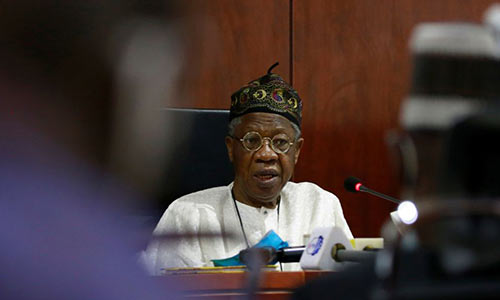
But speaking on the issue when he featured on ‘Kakaaki’, a programmed by AIT, Mohammed said criticising the Zamfara government’s approach would be unfair as each state deals with insecurity differently.

Asked if the federal government endorses Matawalle’s approach, Mohammed said there are no “one-cap-fits-all solutions” and that the federal government will not dissuade anybody from engaging the bandits.

He added that the government will always respect the views of state governments.

“What I know is when you are fighting insurgency, you use both kinetic and non-kinetic approach. Granting amnesty to notorious drug barons, militants is not a new thing. You see, you need to be in the shoes of the Zamfara state government or governor to appreciate what are the issues at stake? Why he has done that,” Mohammed said.

“Don’t forget that to a lot of extents, the state governors are their own chief security officers.

“When the Kankara boys were kidnapped it was not the state government that had the military or armed forces that freed them, when we are dealing with insurgency, kidnapping, banditry, you are interested in the bigger picture; how do we restore peace?

“If for instance, if granting amnesty to one notorious kidnapper is going to give me peace in my state, I might take that decision. If granting amnesty to one repentant warlord would help me capture a thousand bandits, I might take that decision. So, don’t just look at what is in the public place, understand the very high complexity of managing insurgency and banditry and kidnapping.

“The governor of a state understands the dynamics of the state and takes decision but it will be unfair of us to criticise him without knowing why he did and I want to believe that every governor work together with the security forces in their own state, so, it is not as straightforward as we think.”

On the proliferation of arms and declaring bandits as terrorists, the minister said: ”I don’t think the FG looks at kidnappers and bandits as anything but terrorists. Take a step back and ask yourself how come we have this proliferation of arms in the entire Sahel.

“The moment Libya disintegrated, proliferation of light arms became a phenomenon. If there is no peace in Libya, Mali, Niger, there is no way we are going to have peace in Nigeria or anywhere along that line.

“You proscribe known groups with names. It is not whether they are proscribed or not but the way they are treated. Does the government treat them with kids’ gloves, no.” (thenigerialawyer)

Cost Of Governance: We Can’t Keep Making Laws To Establish More Institutions — Gbajabiamila

…says killing, the kidnapping of citizens signal govt failures
…hints plans to amend ACJA, Human trafficking Act, Police Service Commission Reforms soon

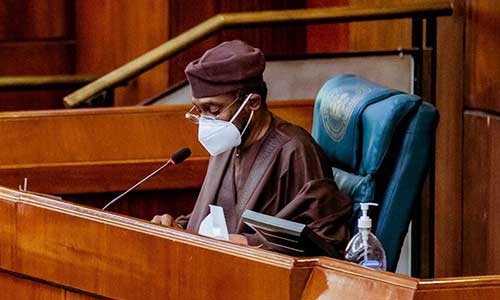
Speaker, House of Representatives, Femi Gbajabiamila has said that in view of the depleting revenue base of the country, the parliament would henceforth back down on establishment laws to create more institutions of government.

He, however, called for the reforms of the existing ones and removal of those no longer useful to the economy.

The Speaker gave the disclosure in his remarks to welcome the members of the House from their 2020 Christmas and New Year holidays on Wednesday plenary.

He said “In the 2021 legislative year, we will focus the attention of the House of Representatives on bills and motions that improve ease of doing business and unlock economic potential by stripping away restrictive regulation and ending predatory regulatory practices that deprive our young people the opportunity to conquer new frontiers. In this age of technology and innovation, of daring and enterprise, we cannot risk implementing policies that handicap our ability as a nation to participate in new markets and profit from emerging industries.

“At this time, I will crave the House’s indulgence to raise a matter of urgent importance. It has become more difficult with each appropriation cycle for the government to meet its obligations. The exploding recurrent cost of governance demands that we be more circumspect in the priorities we pursue, particularly regarding Establishment Bills in the National Assembly.

“At a time of reduced revenue, with preexisting and worsening infrastructure deficits requiring significant investments, we cannot afford to keep establishing more institutions that impose a permanent liability on government income. I am not unmindful of the realities that often necessitate such legislation, yet we cannot ignore the facts that lie before us. Let us work together to reform and strengthen the institutions already in existence, and remove those no longer fit for purpose. I believe most sincerely that this is the pathway to a legacy that we can all be proud of.”

Speaking on the debilitating security situation in the country, Gbajabiamila also said that the killing, kidnapping of citizens amongst social vices when successful signalled the failure of their obligations.

He, therefore, urged all hands to be on deck in tackling the security challenges.

“The security and welfare of the people shall be the primary purpose of government’’. With these words, the constitution obligates all of us who swear to serve in government to do everything to protect the lives and property of all citizens and promote their well-being above all else. This obligation is central to the governing contract between the government and the citizenry. Every time a citizen going about their business is killed or kidnapped, loses their property or livelihood, we have failed in our obligation. From the abundance of these failures has emerged a culture of self-help in matters of internal security that portends grave danger for our nation’s continued existence.

“If ever there was a time for us to put aside all other considerations, especially the petty concerns of partisanship and politics, it is now. If ever there was a time to set aside our differences of tribe and religion to focus on a concerted effort to defeat the challenges of insurgency and banditry, communal violence, and the violent struggle over land, that time is now.

“The forces that threaten our lives and property, our sovereignty and nationhood, do not make any exceptions based on the God we pray to or the language of our native tongue. From every region and state, citizens of every tribe and religion have suffered and will continue to suffer the pain of death and the grief of loss until we put an end once and for all to the terrors of banditry, insurgency and malignant crime in all forms.

“Here in the National Assembly, we do not command any armies or control the police. Command and control of our nation’s security infrastructure is an exclusively executive responsibility. Yet it is to us that our constituents look to when the forces of darkness descend to disrupt their lives, often irreparably. We have to reconcile the obligations we owe to our people with the constitutional limitations under which we operate. But we will not shrink from our role as advocates for the forgotten voices, and we will continue to exercise the appropriation and oversight authority vested in us to hold to account those who bear direct responsibility for the protection of all our nation’s people”, he said.

Gbajabiamila also gave hints of tinkering with the Administration of Criminal Justice Act and the Trafficking In Persons (Prohibition) Enforcement And Administration Act to reflect the current realities.

He added that the Police Service Commission Reforms Bill will also be completely processed by the House.

“Honourable colleagues, the true test of government is in our ability to protect the most vulnerable amongst us. We cannot separate the goal of economic prosperity from the ambition to ensure that all our people live in a just society free from abuse of power and protected by a justice system built on fairness and the rule of law. Therefore, we will shortly begin considering Bills to amend the Administration of Criminal Justice Act. We will follow up with a long-overdue review of the Trafficking In Persons (Prohibition) Enforcement And Administration Act and other legislation that seek to deliver a justice system that works for all.

“Last year we initiated legislative action in the House of Representatives, to build a more effective framework for policing accountability. That process is ongoing, with the Police Service Commission Reform Bill currently making the way through the legislative process. We will ensure that a Bill shortly emerges from the House of Representatives, without compromising any of the objectives that necessitated our intervention in the first instance”, Gbajabiamila said.

The Speaker also called on the members to brace up for the work ahead in the new legislative year.

“Honourable colleagues, we begin this new year with a renewed commitment to legislative action that drives the course of progress and brings us closer to achieving the highest aspirations we hold for our nation. We begin with renewed determination to achieve better oversight of government spending priorities through a collaborative effort with the executive arm of government and with civil society. And we remain dedicated to the lofty, yet clear ambitions we articulated in our Legislative Agenda when we resumed in the 9th Assembly”, the speaker said. (Thenigerialawyer)

Lawan To Buhari: Nominate FCT Indigene As Ambassador

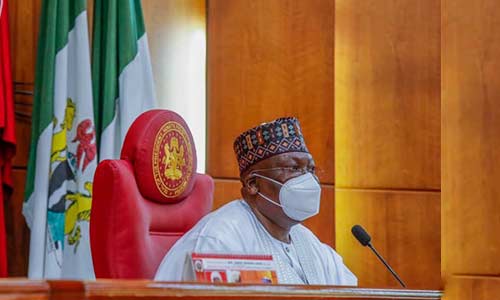
Senate President Ahmad Lawan, on Wednesday urged President Muhammadu Buhari to nominate an indigene of the Federal Capital Territory as a non-career ambassador.

Lawan made the appeal on Wednesday during plenary following a protest on the floor by Senator representing FCT, Philip Aduda, over the continuous exclusion of indigenes of the Territory for appointment as non-career diplomats by President Muhammadu Buhari.

Rising under Order 43 of the Senate Standing Rules, Senator Aduda said, “Mr. President, Distinguished Colleagues, I did yesterday raise some issues with you, Your Excellency, about the issue of the appointment of ambassadors.

“Your Excellency, I’ve consistently mentioned that before now we used had a non-career ambassador for the FCT.

“But when the first list came, the FCT was omitted. The second list came, the FCT was omitted; and then we have another opportunity where the FCT is supposed to be represented but it has still been omitted.

“Your Excellency, this gives us worry in the FCT, because it is showing that maybe it is Federal Character, or something is wrong somewhere.

“Mr. President, we know that the President of the Federal Republic of Nigeria has the power to hire and fire, but Mr. President, we urge you as our leader and Speaker of the people of the FCT, and indeed, the President, who incidentally by the Constitution – Section 299 – happens to be the Governor of the FCT, that in making nominations, he should look at us and please grant us our heart desire which is to have a non-career ambassador for the FCT.

“Indeed, the opportunity has come again, when some ambassadorial nominees have been submitted, and the Committee will be doing its work very soon.

“We want to crave the indulgence of this Senate, and it is a constitutional matter. Mr. President, my Distinguished Colleagues, here I come again today with the hope that we will get support from our State House of Assembly, which is the National Assembly, and indeed the Senate with you as Chairman, to intervene in this matter and ensure that the people of the FCT have a non-career ambassador.”

Lawan in his response appealed to Buhari to send in a nomination for the FCT in the fifth non-career ambassadorial list to be forwarded to the National Assembly for screening and confirmation.

Lawan said, “As speaker of the FCT House of Assembly and as members of the FCT House of Assembly, we are appealing to the Executive to send the nomination of a non-career ambassadorial nominee for the FCT in the fifth and final phase.” (thenigerialawyer)

Supreme Court’s Position On Whether Jurisdiction Must Be Prioritized

Daily Law Tips (Tip 733) by Onyekachi Umah, Esq., LL.M, ACIArb(UK)

Introduction:
Jurisdiction is the authority of a court to entertain a case, handle a case and give judgment on the case. Different courts in Nigeria have different authorities to treat different cases, and no court can treat a case where it lacks the authority to do so. As such, any judgment given by a court that lacks authority is invalid and useless.

For example, no court in Nigeria (including the Supreme Court) can handle a fresh case of aviation, maritime and possession of Indian hemp apart from the Federal High Court. Also, only a High Court can handle a fresh case of dishonored/bounced/dud cheques in Nigeria. While the custody of a child can only be handled by a Magistrate Court or a High Court but only a High Court can handle a fresh case of divorce.

This work emphasizes on the position of the Supreme Court of Nigeria on whether all courts in Nigeria must resolve the issue of jurisdiction as a matter of priority before any other business. The Supreme Court of Nigeria is the highest court in Nigeria and fifteen (15) decisions of the Supreme Court on the issue are revealed in this work.

15 Supreme Court Cases on Prioritization of Jurisdiction.
Since the Supreme Court of Nigeria is the apex court in Nigeria, there cannot be an appeal on the decision of the Supreme Court. Any disputant that is not pleased with the decision of the Supreme Court can do nothing about it on earth. Below are recent cases of the Supreme Court of Nigeria on whether the issues of jurisdiction of a court must first of all be determined by a court before any other business.

1. AJAOKUTA STEEL CO. LTD v. GREENBAY INVESTMENT & SECURITIES LTD & ORS (2019) LPELR-46929(SC)
Importance of jurisdiction; whether the issue of jurisdiction must be resolved as a matter of priority.
“The respondent has raised and argued a preliminary objection to the competence of the appeal in its brief adopted and relied upon at the hearing of the appeal. Being a challenge to the Court’s exercise of jurisdiction over the appeal, it is necessary that the preliminary objection be heard and determined first. This is so because of the fundamental nature of jurisdiction in the adjudication process. Jurisdiction remains a central issue to any matter before any court. Once challenged, the Court is duty bound to determine whether it has jurisdiction first before proceeding to determine the case. It is long settled that judicial proceedings conducted by a Court that is lacking of the necessary jurisdiction, no matter how well same were otherwise conducted, would be ab initio null and void. See OKIKE V. L.P.D.C. (NO 2) (2005) 7 SC III 75 AND ADESOLA V. ABIDOYE & ANOR (1999) LPELR-153 (SC) and MADUKOLU V. NKEMDILIM (1962) 1 SCNLR 341.” Per MUHAMMAD ,J.S.C ( Pp. 4-5, paras. E-C )

2. PERSONS, NAMES UNKNOWN v. SAHRIS INTL LTD (2019) LPELR-49006(SC)
Whether the issue of jurisdiction must be determined first when raised
“A cursory perusal of the first and third issues for determination raised by the respondent herein, clearly shows that the issues relate to Jurisdiction. As a matter of law and practice, Courts are always enjoined to determine issue of Jurisdiction first when raised by any of the parties before it, before considering or determining the appeal on the merit.” Per SANUSI ,J.S.C ( P. 27, paras. C-E )

3. ENUKORA v. FRN (2018) LPELR-43822(SC)
Importance of jurisdiction; whether the issue of jurisdiction must be resolved as a matter of priority
“It is settled that the issue of jurisdiction is fundamental as it touches on the competence of the Court. Jurisdiction remains a threshold issue. Being the lifewire of any determination by the Court, it should be considered and determined first before anything else since no matter how well considered the Court’s decision is, it will come to naught once the Court lacks the competence to try and determine the issue before it. In the case at hand, the lower Court’s judgment appealed against would come to nothing once the trial Court which decision the former affirmed is shown to have lacked the competence to try and determine the charge against the appellant. As it has always been, you can only add something unto something. See Madukolu V. Nkemdilim (1962) 1 ALL NLR 587, Skenconsult V. Ukey (1981) 11 SC 6 and AG Lagos State V. Dosunmu (1989) 3 NWLR (Pt III) 552.” Per MUHAMMAD ,J.S.C ( Pp. 4-5, paras. D-B )

4. OKWUOSA v. GOMWALK & ORS (2017) LPELR-41736(SC)
Whether the issue of jurisdiction must be resolved first before hearing a case on the merits
“Jurisdiction, being a threshold issue, whenever it raised as an issue, has to be and must be resolved first before any other issue. At the appellate level, whenever an issue is raised whether the Court below had jurisdiction to entertain the matter before it, the challenge to jurisdiction must be resolved before any other issue. See OKOYE v. NIG. CONSTRUCTION (1991) 7 SCNJ (Pt. 2) 365 at 388.” Per EKO ,J.S.C ( P. 9, paras. A-C )

5. ADEKOYE & ORS v. NIGERIAN SECURITY PRINTING AND MINTING CO LTD & ORS (2009) LPELR-106(SC)
Whether the issue of jurisdiction must be resolved first before hearing a case on the merits
“…However in the instant appeal where the issue raised in the cross appeal touches and concerns the jurisdiction of the trial Court to hear and determine the originating summons in the first place, it becomes of utmost importance that that issue be determined first before proceeding to determine the issue(s) touching and concerning the merit of the appeal if need be, as it is settled law that whenever an issue of jurisdiction, which is usually considered a periphery issue, is raised, it must be resolved first and foremost.” Per ONNOGHEN ,J.S.C ( P. 10, paras. E-G )

6. HDP v. OBI & ORS (2011) LPELR-8226(SC)
Whether the issue of jurisdiction must be resolved first before hearing a case on the merits
“It is trite law that where in the proceedings of a case the issue of jurisdiction is raised and challenged, the court must first and foremost decide on whether it has jurisdiction before proceeding to decide the case on the merits. The importance of the issue of jurisdiction had been over-emphasised in numerous decisions of this court. It is an accepted view that jurisdiction forms the foundation of adjudication. A court must first of all be competent, that is, have jurisdiction before it can proceed to adjudication. A defect in competence is extrinsic to adjudication.” Per ADEKEYE ,J.S.C ( P. 32, paras. D-F )

7. APGA v. ANYANWU & ORS (2014) LPELR-22182(SC)
Whether the issue of jurisdiction must be resolved first before hearing a case on the merits.
“The importance of a resolution of the issue of jurisdiction one way or the other cannot be over emphasized. The jurisdiction of the lower Court to entertain the appeal was dependent upon the jurisdiction of the trial Court to hear and determine the suit before it in the first instance. The importance of this issue was well illustrated in a recent decision of this Court in: SLB Consortium Ltd. V. NNPC (2011) 9 NWLR (1252) 317. In that case an objection was raised at the hearing of the appeal before this Court that the originating processes at the trial Court were incompetent, having been signed by a law firm instead of a qualified legal practitioner as required by the Rules of Practice of the Federal High Court and the decision of this Court in Okafor V. Nweke (2007) 3 SC (Part II) 55 @ 62 – 63. It was argued on behalf of the respondent that the appellant was deemed to have waived his right to complain not having raised the objection before the trial Court and having taken steps in the proceeding after becoming aware of the defect. This Court held at pages 332 – 333 G – B: “The argument that the objection ought to have been taken before the trial Court and that it is rather too late in the day to raise same in this Court particularly as the respondents had taken steps in the proceedings after becoming aware of the defect or irregularities is erroneous because the issue involved in the objection is not a matter of irregularity in procedure but of substantive law – an issue of jurisdiction of the Courts to hear and determine the matter as constituted and it is settled law, which has been conceded by both counsel in this proceedings – that an issue of jurisdiction is fundamental to adjudication and can be raised at any stage in the proceedings, even for the first time in the Supreme Court. In the circumstance I find merit in the preliminary objection which is accordingly upheld by me. I hold that the originating processes in this case having been found to be fundamentally defective are hereby struck out for being incompetent and incapable of initiating the proceedings thereby robbing the Courts of the jurisdiction to hear and determine the action as initiated.  In the final analysis, the appeal arising from the proceedings initiated and conducted without jurisdiction is hereby struck out for want of jurisdiction.” Per KEKERE-EKUN ,J.S.C ( Pp. 28-30, paras. D-A )

8. OKONKWO & ORS v. OKONKWO & ORS (2010) LPELR-9357(SC)
Whether the issue of jurisdiction must be resolved first before hearing a case on the merits.
“Usually when a courts jurisdiction is challenged in a suit, it is far pertinent to settle that issue of jurisdiction one way or the other before proceeding to hearing of the case on the merits. In short, the court in that situation must first assume jurisdiction to consider whether it has jurisdiction or lacks such. Jurisdiction is a radical and crucial question of competence, and once there is a defect in competence, it is fatal and the proceedings are a nullity, however well conducted and decided.” Per ADEKEYE ,J.S.C ( Pp. 18-19, paras. F-B )

9. FAMU & ORS v. KASSIM & ORS (2012) LPELR-15528(SC)
Whether the issue of jurisdiction must be resolved first before hearing a case on the merits.
“As clearly settled in a number of cases not least the cases of Madukolu v. Nkemdilim (1962) SC NLR 341 and Salami v. Oseni (2002) 14 NWLR (Pt.788) 623 – they have opined that jurisdiction amongst other questions in any matter being the bedrock of any decisions of a Court must of necessity be sorted out first as it is a fundamental and a threshold question before delving into any other questions relating to the subject-matter of a case as the instant one; again, more importantly as to case management in our courts, as it is no use belabouring over deciding the matter however well conducted on the merits where a court, ab initio has no jurisdiction to deal with the subject matter. The cases of Onyenacheya vs. Military Administrator of Imo State (1997) 1 NWLR (Pt.482) 429, Balogun vs. Panalpina World Transport (Nig) Ltd. (1991) 1 NWLR (pt585) 66 and Galadima v. Tabai (2000) 11 NWLR (pt.677) 1, have not only emphasized this underlying principles but they also have contemplated that the action must have been initiated by due process and that there must be no feature in the matter impinging on a court’s vires in the exercise of its jurisdiction.” Per CHUKWUMA-ENEH ,J.S.C ( Pp. 5-6, para. B )

10. BRITTANIA-U (NIG) LTD v. SEPLAT PETROLEUM DEVELOPMENT CO. LTD & ORS (2016) LPELR-40007(SC)
Whether the issue of jurisdiction must be resolved first before hearing a case on the merits.
“It is a matter now trite that the jurisdiction of any Court is sacrosanct and fundamental to the adjudicatory powers of a Court and being a threshold issue can be raised at any point or stage of the proceedings even on appeal for the very first time. Therefore once brought up no other thing should be allowed within the focus of the Court than the resolution of that jurisdictional question. This critical position of the matter of jurisdiction being so since a Court merely wastes its precious time when it has embarked upon a trial when it has no jurisdiction since everything therein done including the decision and order come to naught, indeed a futile exercise. That is why it is a bounden duty of the Court to have that question settled first and foremost before it can go further into the matter before it. Stated differently, the Court must ask itself if it has the power to handle the case and so when it is brought to a Court’s attention that it lacks jurisdiction, it has to pause a while, answer the question first and if positive go forth but if in the negative the Court says so before anything else. I place reliance on Okarika v. Samuel (2013) 7 NWLR (Pt. 1352) 19; Osakue v. Federal College of Education (Technical) Asaba (2010) 10 NWLR (Pt. 1201) 1; Cadbury Nig. Plc v. F.B.I.R. (2010) 2 NWLR (Pt. 1179). A Court is naked and exposed without jurisdiction. It is therefore the general rule to determine jurisdiction first whilst it is an exceptional rule to take steps in defending or protecting the authority of the Court first before jurisdiction.” Per PETER-ODILI ,J.S.C ( Pp. 87-88, paras. A-B )

11. CBN & ORS v. OKOJIE (2015) LPELR-24740(SC)
Whether the issue of jurisdiction must be resolved first before hearing a case on the merits.
“Jurisdiction is derived from the Constitution or some specific law. It is a threshold issue, so once raised it must be decided quickly. It is a threshold issue, so once raised it must be decided quickly. The issue of jurisdiction is fundamental to the hearing of all cases. Jurisdiction can be raised in the trial court, on appeal or in the Supreme Court for the first time as in this case. See Usman Dan Fodio University v. Kraus Thompson Organisation Ltd (2001) 15 NWLR pt. 736 p. 305.” Per RHODES-VIVOUR ,J.S.C ( P. 25, para. D )

12. AG RIVERS STATE v. AG AKWA IBOM STATE & ANOR (2011) LPELR-633(SC)
Whether the issue of jurisdiction must be resolved first before hearing a case on the merits
“Since an issue of jurisdiction hits at the foundation of adjudication by a court of law, it is usually considered expedient to resolve same first before proceeding further to consider the matter on the merit. It has been settled by a long line of cases that a determination by a Court of a matter is null and void if done without jurisdiction and that it does not matter how well the proceeding was/is conducted. An issue of jurisdiction is therefore considered a periphery matter.” Per ONNOGHEN ,J.S.C ( Pp. 39-40, paras. F-B )

13. ORIORIO & ORS v. OSAIN & ORS (2012) LPELR-7809(SC)
Whether the issue of jurisdiction must be resolved first before hearing a case on the merits
“Appellants’ issue three is on jurisdiction and being a threshold matter, it will be resolved before any more steps is taken in the appeal. This is because jurisdiction is the spinal cord of every litigation and, once raised, it must be resolved before further step is taken in the matter. See Charles Chinwendu Odedo v. INEC & Anor (2008) 17 NWLR (Pt. 1117) 554 at 595.” Per NGWUTA ,J.S.C ( P. 19, paras. C-E )

14. AFRO CONTINENTAL (NIG) LTD & ANOR v. CO-OPERATIVE ASSOCIATION OF PROFESSIONALS INC (2003) LPELR-217(SC)
Whether the issue of jurisdiction must be resolved first before hearing a case on the merits.
“When a court jurisdiction is challenged, the duty of the Court is to settle that issue one way or another first before proceeding to hear the case on merits. (See A.-G., Anambra State v. A.-G., Federation (1993) 6 NWLR (Pt. 302) 692; A.-G., Lagos State v. Dosunmu (1989) 3 NWLR (Pt. 111) 582). And the Court has the jurisdiction to do so. See Barclays Bank of Nigeria v. Central Bank of Nigeria (1976) I All NLR 409 at 421.” Per KALGO ,J.S.C ( P. 14, paras. B-D )

15. EBHODAGHE v. OKOYE (2004) LPELR-987(SC)
Whether the issue of jurisdiction must be resolved first before hearing a case on the merits.
“It is not in dispute that both learned counsel for the parties agree with the general principle that jurisdiction is a central issue to any case before any court and once it is challenged, the court concerned is duty bound to determine whether it has jurisdiction first before proceeding to entertain the case. See Ndaeyo v. Ogunnaya (1977) 1 SC 111; Oscroft v. Benabo (1967) 2 All ER 548. This is so, because any act, orders or proceedings made by a court without jurisdiction is a nullity and remains so for all purposes. See Funduk Engineering Ltd. v. McArthur (1995) 4 NWLR (Pt. 392) 640 at 651; Alao v. C.O.P. (1987) 4 NWLR (Pt. 64) 199; Alhaji Rufai v. Alhaji Olugbeja (1986) 5 NWLR (Pt. 40) 162.” Per KALGO ,J.S.C ( P. 11, paras. C-F).

Conclusion:
There cannot be a valid judgment of a court from a court that lacks jurisdiction. Jurisdiction is the foundation of every litigation and without it, no case or judgment can stand. Consequently, the Supreme Court of Nigeria has warned all courts in Nigeria to always verify and determine their jurisdiction before proceeding with any case to avoid waste of resources.

My authorities, are:
1. Sections 1, 6, 46, 232, 233, 239, 240, 251, 252, 253, 255, 257, 258, 260, 262, 263, 270, 272, 273, 275, 277, 278, 280, 282, 285 of the Constitution of Federal Republic of Nigeria, 1999.
2. The Supreme Court’s decision (on the finality of the Supreme Court) in the case of AYOADE v. STATE (2020) LPELR-49379(SC).
3. The Supreme Court’s decision (on the finality of the Supreme Court) in the case of EFCC v. REINL (2020) LPELR-49387(SC)
4. The Supreme Court’s decision (on the supremacy of the constitution) in the case of INDEPENDENT NATIONAL ELECTORAL COMMISSION v. ALHAJI ABDULKADIR BALARABE MUSA (2003) LPELR-24927(SC)
5. The Supreme Court’s decision (on prioritizing issues of jurisdiction) in the case of AJAOKUTA STEEL CO. LTD v. GREENBAY INVESTMENT & SECURITIES LTD & ORS (2019) LPELR-46929(SC)
6. The Supreme Court’s decision (on prioritizing issues of jurisdiction) in the case of PERSONS, NAMES UNKNOWN v. SAHRIS INTL LTD (2019) LPELR-49006(SC)
7. The Supreme Court’s decision (on prioritizing issues of jurisdiction) in the case of ENUKORA v. FRN (2018) LPELR-43822(SC)
8. The Supreme Court’s decision (on prioritizing issues of jurisdiction) in the case of OKWUOSA v. GOMWALK & ORS (2017) LPELR-41736(SC)
9. The Supreme Court’s decision (on prioritizing issues of jurisdiction) in the case of ADEKOYE & ORS v. NIGERIAN SECURITY PRINTING AND MINTING CO LTD & ORS (2009) LPELR-106(SC)
10. The Supreme Court’s decision (on prioritizing issues of jurisdiction) in the case of HDP v. OBI & ORS (2011) LPELR-8226(SC)
11. The Supreme Court’s decision (on prioritizing issues of jurisdiction) in the case of APGA v. ANYANWU & ORS (2014) LPELR-22182(SC)
12. The Supreme Court’s decision (on prioritizing issues of jurisdiction) in the case of OKONKWO & ORS v. OKONKWO & ORS (2010) LPELR-9357(SC)
13. The Supreme Court’s decision (on prioritizing issues of jurisdiction) in the case of FAMU & ORS v. KASSIM & ORS (2012) LPELR-15528(SC)
14. The Supreme Court’s decision (on prioritizing issues of jurisdiction) in the case of BRITTANIA-U (NIG) LTD v. SEPLAT PETROLEUM DEVELOPMENT CO. LTD & ORS (2016) LPELR-40007(SC)
15. The Supreme Court’s decision (on prioritizing issues of jurisdiction) in the case of CBN & ORS v. OKOJIE (2015) LPELR-24740(SC)
16. The Supreme Court’s decision (on prioritizing issues of jurisdiction) in the case of AG RIVERS STATE v. AG AKWA IBOM STATE & ANOR (2011) LPELR-633(SC)
17. The Supreme Court’s decision (on prioritizing issues of jurisdiction) in the case of ORIORIO & ORS v. OSAIN & ORS (2012) LPELR-7809(SC)
18. The Supreme Court’s decision (on prioritizing issues of jurisdiction) in the case of AFRO CONTINENTAL (NIG) LTD & ANOR v. CO-OPERATIVE ASSOCIATION OF PROFESSIONALS INC (2003) LPELR-217(SC)
19. The Supreme Court’s decision (on prioritizing issues of jurisdiction) in the case of EBHODAGHE v. OKOYE (2004) LPELR-987(SC)
20. Onyekachi Umah, “When Courts Must Refuse To Consider Issues/Applications Before It.” (LearnNigerianLaws.com, 10 September 2020) <https://learnnigerianlaws.com/when-courts-must-refuse-to-consider-issues-applications-before-it/> accessed 9 February 2021.

21. Onyekachi Umah, “Are Courts In Nigeria Administratively Independent Of The Chief Justice Of Nigeria And The Supreme Court ?” (LearnNigerianLaws.com, 20 April 2020) <https://learnnigerianlaws.com/are-courts-in-nigeria-administratively-independent-of-the-chief-justice-of-nigeria-and-the-supreme-court-daily-law-tips-tip-551-by-onyekachi-umah-esq-llm-aciarbuk/ > accessed 9 February 2021.
22. Onyekachi Umah, “The Nigerian Court For Ships and Aircrafts Matters.” (LearnNigerianLaws.com, 11 November 2020) <https://learnnigerianlaws.com/the-nigerian-court-for-ships-and-aircrafts-matters/> accessed 9 February 2021
23. Onyekachi Umah, “COURT THAT CAN TRY CASES ON QUARANTINE AND LOCKDOWN IN NIGERIA.” (LearnNigerianLaws.com, 23 April 2020) <https://learnnigerianlaws.com/court-that-can-try-cases-on-quarantine-and-lockdown-in-nigeria-daily-law-tips-tip-554-by-onyekachi-umah-esq-llm-aciarbuk-2/> accessed 9 February 2021.
24. Onyekachi Umah, “Which Court Can Try Cases Of Bounced/Dud Cheque In Nigeria ?” (LearnNigerianLaws.com, 18 October 2018) <https://learnnigerianlaws.com/daily-law-tips-by-onyekachi-umah-esq-tip-208-which-court-can-try-cases-of-bounced-dud-cheque-in-nigeria/> accessed 9 February 2021.
25. Onyekachi Umah, “Dud/Bounced Cheque Offences Cannot Be Tried In Magistrates Courts In Nigeria.” (LearnNigerianLaws.com, 27 July 2018) <https://learnnigerianlaws.com/daily-law-tips-by-onyekachi-umah-esq-tip-151-dud-bounced-cheque-offences-cannot-be-tried-in-magistrates-courts-in-nigeria/> accessed 9 February 2021
26. Onyekachi Umah, “THE RIGHT COURT FOR DIVORCE IN NIGERIA” (LearnNigerianLaws.com, 24 April 2018) <https://learnnigerianlaws.com/daily-law-tips-by-onyekachi-umah-esq-tip-87-the-right-court-for-divorce-in-nigeria/> accessed 9 February 2021
27. Onyekachi Umah, “Bounced Or Dud Cheque And Its Legal Consequence In Nigeria” (LearnNigerianLaws.com, 5 March 2016) <https://learnnigerianlaws.com/bounced-or-dud-cheque-and-its-legal-consequence/> accessed 9 February 2021.

Sabi Law Projects:
#SabiLaw
#DailyLawTips
#SabiBusinessLaw
#SabiElectionLaws
#SabiHumanRignts
#SabiLawOnBeatFm
#SabiLawLectureSeries
#CriminalJusticeMonday
#SabiLawVideoChallenge

Speak with the writer, ask questions or make inquiries on this topic or any other via [email protected], [email protected] or +2348037665878 (whatsapp).

To receive free Daily Law Tips, join our free Telegram group, via this link: https://t.me/LearnNigerianLaws
To keep up to date on all our free legal awareness projects of Sabi Law Foundation, follow us via
Facebook Page:@LearnNigerianLaws, Instagram: @LearnNigerianLaws and Twitter: @LearnNigeriaLaw

Please share this publication for free till it gets to those that need it most. Save a Nigerian today! NOTE: Sharing, modifying or publishing this publication without giving credit to the author or Sabi Law Foundation is a criminal breach of copyright and will be prosecuted. This publication is the writer’s view not a legal advice and does not create any form of relationship. You may reach the writer for more information.

This publication is powered by www.LearnNigerianLaws.com {A Free Law Awareness Program of Sabi Law Foundation, supported by the law firm of Bezaleel Chambers International (BCI).} Sabi Law Foundation is a Not-For-Profit and Non-Governmental Legal Awareness Organization based in Nigeria.

TIPS