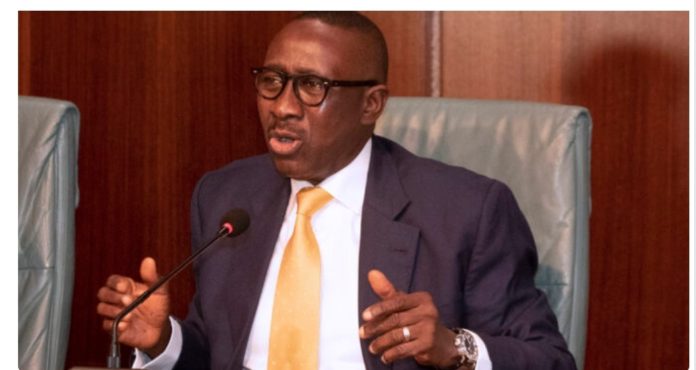
Babagana Monguno, national security adviser (NSA), says Ahmad Gumi, Islamic cleric, has offered to help the government in tackling insecurity.
Gumi who has been meeting with suspected bandits terrorising communities in the north-west and in the north-central had likened them to militants in the Niger-Delta, and asked that they are not tagged criminals.
At a state house briefing on Thursday, Monguno, while fielding questions from journalists, said he had met with Gumi, and that he is waiting to see how the cleric could help the government. Advertisement
“Sheik Gumi is doing what he’s doing because he believes in what he’s doing. He’s a Nigerian and under the constitution he can talk to anybody. He can deal with anybody,” he said.
“I met with him when I went with the service chiefs to Kaduna, and we spoke generally during the meeting and he resolved to help government. We are waiting for him. That’s all I can say.”
The NSA said the government is not averse to holding talks with bandits, but that it cannot negotiate with people who are unreliable.
“While government is not averse to talking with these entities, it also has to fully apply its weight. You can’t negotiate with people who are unreliable and who will continue to hurt society,” he said.
“We will apply the full weight of the government to deal with these criminals.
“These are not people looking for anything that is genuine or legitimate, they’re just out to take calculated measures to inflict pain and violence on innocent people. We must deal with them the way they need to be dealt with. We will fully assert the government’s will.”
The NSA also said President Muhammadu Buhari has directed that mercenaries must not be engaged in fighting insecurity in the country.
There have been calls by governors in the north-east for the federal government to engage mercenaries.
But Monguno said Nigeria has all the resources needed to fight, but has been underutilised.
“When this administration came in, it’s true, we had these mercenaries helping out in the north-east. But the directive of the commander in chief is that we do not engage mercenaries when we have our own people to deal with this problem,” he said.
“This is basically a presidential directive. And there are so many issues when you come to the issue of mercenaries. It has to do with the issue of national pride also. I know you’d say can pride be more of a concern than our security? I do understand that.
“But what we are looking at here is that we have the resources, it’s just misapplication or underutilisation that has affected our ability to deal with these people.” (TheCable)
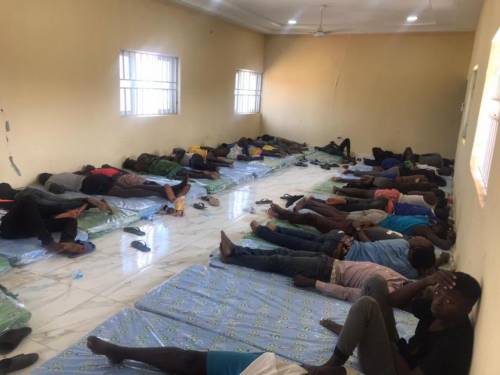
Two videos of kidnapped students of the Federal School of Forestry Mechanization, Afaka, Igabi Local Government Area, and others in their briefs and night wears, being flogged and pleading for government to pursue their freedom, have emerged on social media.
This comes as the management of the school shut the campus, with relatives picking up their loved ones.
One of the students and another abductee advised government military action against the bandits, in apparent fear for their own safety.
It was obvious they made the video under duress. In one of the videos, they were been flogged with whips by one of the bandits.
Recall that bandits stormed the school on Thursday night by breaching the perimeter fence and carrying away about 30 students, mainly females.
On Friday according to the Army, troops of Quick Response Force of 1 Division, Nigerian Army, foiled attempt by bandits to kidnap some students of Turkish International Secondary School located in Rigachikun, Kaduna State.
The Director, Army Public Relations, Brig.-Gen. Mohammed Yerima, in a statement on Friday, said the troops quickly mobilised to protect the school from the bandits following a tip off on the planned abduction.
According to him, troops also responded to another distress call that bandits had stormed the Federal School of Forestry Mechanization, Afaka, Igabi Local Government Area of the state with aim of kidnapping the staff and students.
“The troops swiftly moved to Afaka and decisively engaged the armed bandits.
“Following the fire fight, troops were able to rescue 180 persons, comprising of 132 male students, 40 female students and 8 civilian staff members,” he said.
Yerima said the bandits were said to have broken into the institution by breaching the perimeter fence of the school.
He added that the rescued students had been evacuated to a safe place while the injured are presently receiving medical attention at a military facility.
“Meanwhile, combined team of Army, Air Force, Police and DSS are currently combing the forest in pursuit of the bandits,” he said.
An excerpt of New York Times bestselling author, podcast host, and #ShareTheMicNow cofounder Luvvie Ajayi Jones’ new book, Professional Troublemaker: The Fear-Fighter Manual
Nigerians are world-renowned loudmouths who happen to exist in every place on earth, roll deep, and have a reputation for cleverness. We are legion, so hear us roar. I think everyone needs a Nigerian friend, pretend cousin, or auntie in their lives. In a world where fear rules our lives and we get used to cowering, we need to surround ourselves with some rowdy energy that takes up space unapologetically. That’s where Nigerians come in. Not saying others aren’t this, but there is a certain je ne sais quoi in Naijas. We are the parliamentarians of Team No Chill. We will add color to your life. We will loan you bravado if you ever need it.
Why will your life be better for having a Nigerian who you can call friend or framily? Let me break down the reasons.
We are amazing verbal fighters. We don’t even have to know how to physically fight because our tongues alone can beat anyone down. Our opponents won’t have the will to box us because we will have already destroyed them with our words.
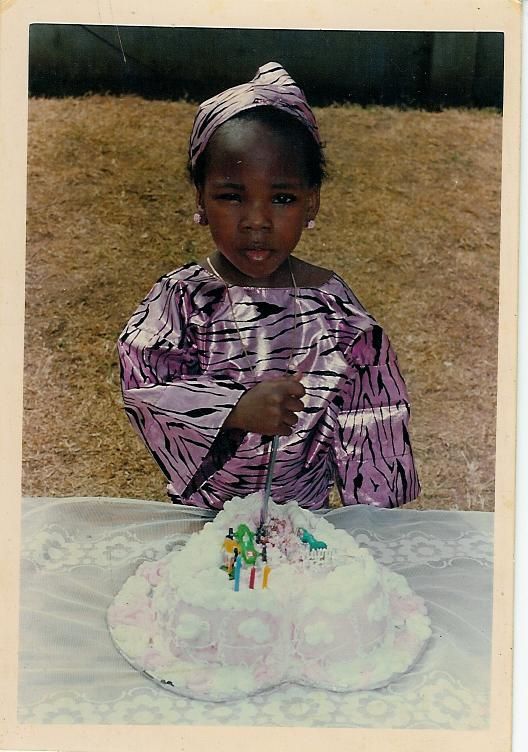
Luvvie on her 3rd birthday.COURTESY OF THE AUTHOR
You see, from childhood onward, our parents and family members have rained insults down upon us with reckless abandon. And when they weren’t slandering us, they were directing their disrespect to others, so many of us learned how to assassinate people with our words very early. We are undefeated in the art of verbal shaming—truly unfuckwithable.
I’m of the Yorùbá people, and our language is deeply metaphorical. Yorùbá people gotta be the pioneers of the put-downs—our tongues are Weapons of Ego Destruction. A common insult is that you’re a useless goat, meaning you’re daft and senseless. The one I used to get a lot when I was little, with my sharp tongue was, “Ẹlẹ́ẹ̀kẹ́ èébú ni ẹ́,” meaning “cheeks full of insults.” It’s not my fault. It was preparation for who I am today.
Your Nigerian friend might insult you for sport, but no one else can. We’re deeply loyal and stan those in our inner circles. You have nothing (read: everything) to fear but our mouths. We somehow straddle the line of not taking anything personally and taking everything personally. We have learned to get words thrown at us and have them slide off our shoulders, while also taking offense to everything being done to us.
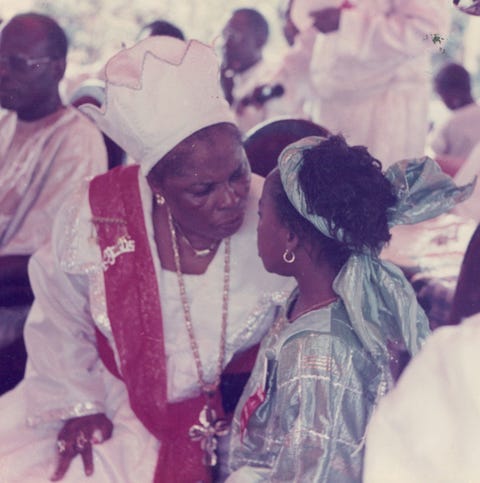
Luvvie talking to her grandmother, Mama Faloyin, whose life and way of living inspired her new book.COURTESY OF THE AUTHOR
You can tell your Nigerian friend, “You ain’t shit,” and they might laugh because they know for sure they are from royalty (even though they might not be), and your words will do nothing to affect their elevated sense of self. But similarly, come to their house, decline their offer of food, and watch them as they feel attacked that you dared to show up in their abode without being hungry—therefore not needing the delectable goodness that is Nigerian jollof. HOW DARE YOU??
We are great friends because we won’t let you carry your grudges by yourself. We will help. In fact, we are so good at holding a grudge that even after you drop it, we’re still behind you, holding on strong. You might call us petty, but our response might be “And so?”
Getchu a Nigerian friend to get the ego boost that comes with it. Why? We balance out the insults we might throw your way with ultimate cheerleading and hypeman-dom. Can’t nobody gas you up like a Naija pesin, because we keep the same energy across the board. The way we celebrate you will make your head swell five times its size. At which point we will then say, “See your head like water balloon.” Because, balance.
Luvvie and Yvonne Orji, Insecure actress and one of Luvvie’s Naija sister friends.COURTESY OF THE AUTHOR
The only thing Nigerians fear is God, Ghana jollof, and our parents’ disappointment. Everything else? We can tackle it. I think about how relentless Nigerians can be, and how we wear pride like a coat. It might be a coping mechanism because we come from a country where there are more than two hundred million people and everybody wants to be somebody. Nigerians wake up and cough adversity.
Nigerians are extra AF and we’re not sorry about it. Our weddings are proof because Nigerians use holy matrimony as an occasion to do the utter most with the most. We have costume changes, money dances, and all the pomp and circumstance one can imagine could be part of such a moment.
I swore I was not going to engage in all of that. I was wrong. I did all of it. In fact, I did it twice. I had two weddings in one day. There’s a video from our cocktail reception of someone’s mom (*coughs*) dropping it low to the ground as someone else’s mom (*coughs*) stuffed the front of her dress with dollars while someone else stood behind them pouring money on their heads. The reception hadn’t even started yet. Everyone should go to a Nigerian wedding at least once in your life.
Luvvie and her husband at their two-part wedding day in 2019 with the 1st part including Nigerian customs and the 2nd Western.KESHA LAMBERT PHOTOGRAPHY
We Nigerian people are a passionate lot, and we love us some Jesus (well, those who are Christians do). You haven’t heard prayer until you’ve heard a Naija person pray and give God the glory. We cover everything with the blood of Jesus and we often take it above and beyond.
Nigerian aunties are the prayer professionals, and they seem to have a mainline to God. If you tell someone you’re cold, the prayer you might get could go like this: “May the God of holy fire SET ABLAZE any manner of snow, ice, frozen precipitation, subzero moisture in the matchless name of Jesus!” LMAO! And AMEN O! I receive it in His mighty name!
If you’re reading this, maybe you already have a Nigerian friend. Or maybe you don’t. Maybe you’re thinking: “I mean I did go to school with some Nigerians, are we friends?” To that I ask, has their mom cooked for you? No? Then you’re probably not friends. It’s okay. It’s not too late for you.
Luvvie performing her Ted Talk “Getting Comfortable with Uncomfortable” in 2017 on the Ted stage.STACIE MCCHESNEY / TED
How do you make Nigerian friends? How do you find a shady and bold Naija to squad up with in this scary world, so y’all can take it on with sharp tongue in tow? I have a few tips.
1. Go to a college library. If you go to any school library, you are sure to find at least one Nigerian there, nose buried in books.
2. Go where afrobeats is being played. If you’re walking by somewhere and you hear some Afrobeats booming, there is a West African there, especially a Nigerian.
3. Declare allegiance to Nigerian jollof. We are in a never-ending jollof war with our Gold Coast cousins, the Ghanaians, and we know the truth: Naija jollof carries first.
I know you know a Nigerian. (We’re everywhere.) Cultivate a real relationship with them. Get a Naija auntie who can pray the Holy Trinity down, and a Naija friend who will gas you up, insult you, and then have a dance battle with you at the same time. Your life will never be the same.
Popular actress and filmmaker, Iyabo Ojo, has opened up on rape ordeals she underwent as a 14 year old.
The beautiful mother of two made the revelation in her vlog, ‘Bare it all with IY’.
she disclosed that the first time she was raped, it was in her aunt’s house.
Traumatic as the experience was, she said she couldn’t tell anyone then because rape was more like a taboo, hardly spoken about.
According to her: “It’s not something I enjoy talking about, but I just feel it’s time for me to talk about it. I have been raped before. Not once, not twice; I was raped five times. Trust me when I say it wasn’t easy.”
“The first time I was raped, I was 14. It happened in my aunty’s house. I didn’t tell anyone about it then because it was more like a taboo. I opened the door. I allowed the person come in but I didn’t know it would happen at the end of the day. When it happened, I was scared because the person in question had threatened me. He also begged me. I felt it was going to cause a whole lot of drama so I kept it to myself.
“That person kept coming back to tell me that he did it because he loved me. At a point in time, I think I actually believed that lie,” a report by TNG quoted her to have said.
Recounting her third rape experience, she said: “My third experience was orchestrated by a neighbor. We lived close to each other. My other experience was done by a friend to my first boyfriend but much older than him. I never knew he had such intentions.”
Iyabo Ojo added that her fourth rape experience happened while she was married with two kids in her husband’s house.
According to her, “the other one happened after I got married to my husband and had my kids, then we moved to Ikeja.
“I was raped by one of the armed robbers who came to our house. It is not easy to talk about rape. No matter how much you talk about it, you have to realise that it is painful, but you are not alone.”(theconclaveng)
The Supreme Court on Friday (March 12, 2021) ordered the Economic and Financial Crimes Commission (EFCC) to release the sum of N9,080,000,000.00 (Nine Billion and Eighty Million Naira) seized from the ex-First Bank Director, Dauda Lawal to him.
Counsel to the ex-top banker, Patrick I.N Ikwueto, SAN, stated that the five-man bench of the apex court led by Justice Muhammad Lawal Garba, in a unanimous judgment, dismissed the appeal filed by the Economic and Financial Crimes Commission (EFCC) against the judgment of the Court of Appeal which, among other things, ordered that:
“The decisions of the Federal High Court, Coram Judice: Hassan, J. delivered in Suit No: FHC/L/CS/13/2017 on 16th February 2017 are hereby set aside. The order of final forfeiture of the sum of N9,080,000,000.00 (Nine Billion and Eighty Million Naira) to the Federal Government of Nigeria is hereby set aside. It is hereby ordered that the said sum of N9,080,000,000.00 (Nine Billion and Eighty Million Naira) be returned to the Appellant forthwith.”
Ikweuto stressed that “the above judgment delivered by the court of Appeal, Lagos Division was in Appeal No CA/LAG/CV/480/2019 DAUDA LAWAL V. EFCC & ANOR dated 25 March 2020.
“The Supreme Court judgment which, unanimously, affirmed and upheld the above decision of the Court of Appeal is Appeal No: SC.212/2020, EFCC v. DAUDA LAWAL. By this final Judgment of the Supreme Court, the Apex Court has, conclusively, upheld, affirmed and determined that the Order of final forfeiture of the sum of N9,080,000,000.00 made against Dr Dauda Lawal is set aside and rescinded; and that the said sum of N9,080,000,000.00 be returned to Dr Dauda Lawal forthwith.
“The above Judgment given by the Supreme Court of Nigeria finally and conclusively brings to a close the malicious persecution by the EFCC against Dr Dauda Lawal which began in May 2016 when the EFCC invented the unfounded allegation of money laundering and obtaining monies suspected to be proceeds of unlawful activity against Dr Dauda Lawal.
“It is also worthy of note that by a final judgment dated 7 October 2020, the Federal High Court, Lagos Division discharged and acquitted Dr Dauda Lawal of the offences of money laundering, obtaining monies suspected to be proceeds of unlawful activities and the other unsubstantiated charges brought against him by the EFCC in Charge No FHC/L/419C/2018 FEDERAL REPUBLIC OF NIGERIA V. DAUDA LAWAL.” (thenigerialawyer)
Sesugh Akume, a businessman, has asked a Federal High Court sitting in Abuja to stop the destruction of alcoholic drinks by Hisbah, the Sharia law enforcement agency in some Northern states of the federation.
In a suit dated March 04, Akume said the destruction of alcoholic beverages bottles and wasting the content is economic sabotage.
Joined as first and second respondents in the suit are Attorney-General of the Federation and Minister of Justice, Abubakar Malami, and the Economic and Financial Crimes Commission.
The businessman added that states that do not appreciate monies sourced from VAT derived from alcohol might pass laws in their respective House of Assembly to refund such amount to the Nigerian government or donate to others who would appreciate same.
The court document read, “An order and declaration that the manufacture/production, transportation/haulage distribution sales, consumption or possession of alcoholic beverages are NOT forbidden in Nigeria by the Constitution of Federal Republic of Nigeria or any extant federal law; therefore any subsidiary legislation criminalising same is unconstitutional, null and void and of no consequence whatsoever.
“An order and declaration that the destruction of alcoholic beverages bottles and wasting of the content is an act of economic sabotage.
“A declaration that destroying a source value-added tax one enjoys is a contradiction and hypocritical. An order is compelling the 2nd Respondent(EFCC) to deter and publish the extent of financial loss for every act of destruction of alcoholic beverages and wasting its content, and prosecuting offenders under extant laws.
“An order and declaration that retaining and utilising any allocation, value-added tax, or any funds distributed by the federal government or give to others.
“The manufacture/production, transportation/haulage, distribution, sales, consumption, or possession of alcoholic beverages is not forbidden by the Federal Republic of Nigeria’s Constitution. The Constitution being the supreme law of the land to which every other legislation that contradicts it becomes a nullity.
“The alcoholic beverages industry is a top money earner for the country and a means of employment and livelihood for millions; therefore, any deliberate destruction and wastage of such products is economic sabotage.
“The EFFC must assess and determine the extent of financial loss for every such destruction and prevent and prosecute offenders. Retaining and utilising VAT from alcohol (and other ‘unethical’ sources like the lottery, gambling, etc.) is not compulsory; recipients may return the same to the federal government or donate to others.
“An interpretation of the statutes to address these issues becomes urgent and vital. For instance, the Kano State Hisbah Board, for example, on Friday, March 12 2010, destroyed 34,000 bottles of different alcoholic beverages, wasting its content.
“The practice continued, and on Wednesday 27, November 2013, it destroyed 244,151 bottles of alcohol and prosecuted dealers in it, and this has been a yearly occurrence. On Sunday, September 22, 2019, thedestroyed 196,400 bottles worth more than 50 million naira, and this last year, on Sunday, November 08, 2020, they destroyed 1,975,000 bottles of alcohol worth up to half a billion naira; copies of the media reports of these wanton destruction are attached and marked as Exhibit 1A-1D.
“Not only Kano is involved in this destruction of alcoholic beverages bottles and arresting dealers, but other states are also involved. For instance, 588 bottles of beer were wasted in Jigawa on Monday, August 24 2020. A copy of the media report of this wanton destruction is attached and marked as Exhibit 2.” (thenigerialawyer)
It was a plenary of the absurd when the Deputy House Of Representatives Speaker stopped Hon Mark Terseer Gbillah from Benue State from presenting a motion on behalf of a group of Nigerians in the diaspora before the House.
Trouble started when the Honourable stood up to move a motion on the continued occupation of some lands in Benue by Fulani herdsmen.
But the Deputy Speaker would not accept the motion with the excuses that the petitioners though Nigerians cannot present such petition because they live in the US
One of the students said to have been rescued by the military, told SaharaReporters that the soldiers only counted those who came out of hiding after the bandits had left and moved them to the Nigerian Defence Academy (NDA) campus, which is close to the institution.
The Nigerian army didn’t rescue 180 students and staff allegedly kidnapped by bandits at the Federal College of Forestry Mechanisation, Afaka in Igabi Local Government Area of Kaduna as claimed by the state government, SaharaReporters has gathered.
Bandits had on Thursday night invaded the school and abducted some students.
However, Samuel Aruwan, Commissioner for Internal Security and Home Affairs in the state in a statement on Friday claimed 42 female students, 130 male students and eight staff members were rescued by Nigerian soldiers.
“Troops of the Nigerian Army in the early hours of today, Friday, 12th March 2021 rescued 180 citizens, many of them students, at the Federal College of Forestry Mechanisation, Afaka, Igabi local government area of Kaduna State.
“The armed bandits in large numbers had attacked the institution at around 11:30 pm on Thursday and kidnapped several students and staff members.
“The armed bandits broke into the institution by breaching a perimeter fence. They then encroached about 600 meters to attack the first facility.
“The Ministry of Internal Security and Home Affairs, on receiving a distress call, alerted the 1 Division Nigerian Army and the Air Training Command of the Nigerian Air Force.
“Troops of the Nigerian Army immediately moved to the school and engaged the armed bandits accordingly.
“The troops successfully rescued 180 citizens; 42 female students, eight staff, and 130 male students. However, about 30 students, a mix of males and females, are yet to be accounted for.
“Some of the rescued students were injured and presently receiving medical attention at a military facility.
“Pictures of some of the rescued persons, and the broken perimeter fence, are attached to this update.
KDSG Security Update: Friday 12th March 2021: 180 rescued by troops of the Nigeria Army early today Friday, March 12. Several male+female students still missing following bandit attack at Federal College of Forestry Mechanization, Afaka-Igabi LG. Search & rescue efforts continue pic.twitter.com/dd9Rx78dpU
“Receiving the report, Governor Nasir El-Rufai thanked the troops for their swift response and the rescue of the 180 citizens. He also wished the injured students a speedy recovery.
“As at the time of this update, a combined team of Army, Air Force, Police, and DSS troops are conducting an operation to track the missing students.
“Citizens will be updated on emerging developments,” the statement had read.
However, one of the students said to have been rescued by the military, told SaharaReporters that the soldiers only counted those who came out of hiding after the bandits had left and moved them to the Nigerian Defence Academy (NDA) campus, which is close to the institution.
He said the gunmen, numbering about 80, broke into the school premises through its perimeter fence at the back.
He added that the bandits attacked the male hostel not far from the fence before heading to the female hostel, where they kidnapped most of their victims.
“They lied, how did they rescue people that were not kidnapped at all? They arrived at the school about 30 minutes after the gunmen had left. So who were those rescued by them?
“They came and moved those of us who went into hiding when the bandits attacked us to the Nigerian Defence Academy (NDA) campus and claimed they rescued us. How? They didn’t meet the bandits when they came here talkless of engaging (let alone engage) them in a gun battle.
“It was after the bandits had left with those kidnapped that they arrived, then they counted those of us they met on the campus and moved us away,” the student told SaharaReporters. (SaharaReporters)
Want to make a lawyer’s day? Give him/her a legal backing for his/her convictions. The feeling can be best compared to that feeling when one finds a functional item that had been lost. This euphoric feeling would probably have sufficed to describe the state of affairs at the Pyakasa Customary Court, Abuja, on the 16th day of February, 2021, when the Intellectual Property Lawyers Association Nigeria (IPLAN) achieved victory in the legally fascinating case colloquially known as the Bata vs. Salsa Case.
The team, which was led by Barr. Folarin Aluko, of Trumann Rockwood Solicitors, had amidst several challenges, researched on, investigated, filed and argued the case at the said Court, which would eventually uphold their arguments that Bata, a dance style that forms part of the Traditional Cultural Expressions (TCEs) of the Yoruba people of Nigeria, is the historical origin of the Latin-American dance style, popularly known as Salsa.
To understand better the comments which follow in this article, it would be necessary to have the contextual and historical background that sparks the interest of this commentator on the case.
Generally TCEs include, artistic creations, textiles, folklore, folksongs and all creative expressions of a tribe, community or body of people with a similar heritage, which have been passed down from generation to generation and which form part of the social, spiritual and cultural lives of the people. As one can imagine, this means that it is not property of any one person, but belongs to the entire community as a heritage. It also means that as mere artistic expressions, they are seldom written down or in anyway documented and in most case form some secret practices that are peculiar to such people. This also means evidence of it or its existence remains an issue of culture and is usually only disclosed by persons knowledgeable in such customs.
The above characteristics have made it an uphill task to legally identify and protect such works without affecting the cultural heritage of the people. Meanwhile, where unprotected, they filter out over time and as a result of globalization and digitization, could be and ore often copied, borrowed or outright stolen, without due regard, reference or return (this commentators three R’s to the proper protection and positive exploitation of TCE’s) to the community owners.
The drive to protect this class of creations leads to the discussion on Intellectual Property (IP). IP refers generally to the property rights conferred on persons who have created or invented something new. It is therefore not a tangible property right, but an incorporeal right to prevent others from using such creations and inventions without the authority of the holder of the property. The scope of each right under IP and which creations or inventions, popularly known as products of the intellect they refer to, is usually provided by Intellectual Property Laws (IPL) and IPL covers certain areas including Copyright for books, songs, poems, dramas, artworks, movies, dance, broadcasts, and so on. Considering the scope of intellectual creations that copyright covers as explained above, it is no wonder that Copyright is considered as an appropriate means of protecting TCE’s such as the Bata dance culture of the people of western Nigeria. Whether it is an appropriate means or not is an argument for another forum, but it suffices to note that the Nigerian Copyright Act, Cap C18, LFN, 2004 makes provision for the protection of folklore, including folkdances, under Section 31 (5) of the Act.
The above protection has however done little to solve situations of misappropriation of TCE’s or breaches of the three R’s that must necessarily guide any situation of commercial exploitation of such traditional creations of a people. This stems from many challenges identified by experts to the protection of TCE’s by Copyright or IP in general, the lack of adequate cover under the Nigerian law on copyright, the lack of documentation of TCE’s, the absence of proper precedent and general lack of awareness even on the part of the communities of their rights, or their incapacity to address or challenge any breaches of same even when they are aware.
It is for these reasons that the decision to take up the Bata Dance and Salsa affinity case is heralded here as a step in the right direction.
While there may be concerns expressed by learned legal commentators, IP enthusiasts and experts who now or later may hold the view that the Customary Court in Abuja lacked the jurisdiction to adjudicate on the matter in the light of Section 251 of the Constitution of the Federal Republic of Nigeria, 1999 (as amended), the case remains a win for TCE’s and IPL development in Nigeria. It must be understood, by way of allaying the fears of this hallowed body of experts that this was not an IP or copyright infringement case simpliciter, neither was it for the enforcement or interpretation of any of the provisions of any of our IPLs in the country.
This was more importantly, an opportunity to allow our cultural and customary laws draw their own nexus to the existence of this culture and how it has led to the creation of this whole other creative enterprise and creation. To put it in context, if we cannot protect it and challenge it, then at least we can recognize it and create awareness by way of precedent on the need to protect TCEs.
This commentator posits that there are some benefits and notable points for Nigeria from this win:
The win acts as precedent (even if only permissible in certain aspects) for the nexus between the two dance cultures and this could be used in making a case for asserting any rights on a more national scale.
The win serves as a boost to the culture of the people and awareness of the need to protect their heritage.
The win creates a backdrop for the nation to consider the use of Customary Courts to serve as courts of first instance in the documentation and protection of TCE’s. The likelihood of the creation of a sui generis (unique) set of rules, though borrowing from IP principles but based on and responsive to the culture and practices of the people becomes more apparent here.
The win serves as a statement on the need again for judicial activism, as case law is again acknowledged as part and parcel of the judicial system in Nigeria.
The win serves as documentation of the culture and expert opinions therein become public records that could be used in other fora.
The general need to revisit IP laws and continue the focus on protection of TCEs is a major take home for government.
In all, this commentator applauds the effort of the legal teams both for and against the arguments, applauds the Customary Court Pyakasa, Abuja, for its initiative, urges the government to continue its moves to find a lasting solution to the protection of TCE’s in Nigeria and looks forward to following up with the case, if it goes on appeal or if further steps are taken to push the narrative hopefully in the near future.
It’s been a confusing day in the country over the pump price of Premium Motor Spirit (PMS), otherwise known as petrol. It is not clear what exactly triggered the panic, but accusing looks are in the direction of the Petroleum Products Pricing Regulatory Agency (PPPRA) which earlier gave a guiding price for March of N211.11 per litre for PMS on its website, but quickly pulled it down as panic and confusion set in.
But that has not removed the queues that set in at fuel filling stations in parts of Abuja and Lagos. Even an assurance by the Nigerian National Petroleum Corporation (NNPC), the sole importer of petrol, that there was no price increase did not still the panic and confusion.
It is hoped that a statement by Minister of State for Petroleum Resources, Mr. Timipre Sylva, may do the magic, though many believe the kite flown by government, through PPPRA, is just days or weeks away, because of the rising price of crude in the international market.
Said Sylva: :”Dear Nigerians, you are by now very aware of the news trending that the federal govt has increased the price of petrol to N212.6 per liter.
“Irrespective of the source of that information, I want to assure you that it is completely untrue. Neither Mr. President who is the Minister of Petroleum Resources, nor my humble self who deputise for him as Minister of State, has approved that the pump price of petrol should be increased by one naira. I would therefore urge you to disregard this misleading information.
“You are all aware that for the past few months the govt has been in consultation with organized labour to find the least painful option to respond to the global rise in the price of crude, which in turn has inevitably led to increase in the price of PMS. It is unthinkable that govt would unilaterally abandon these discussions and act in the manner suggested by the information under reference.”
According to the PPPRA, based on the average costs of imported petroleum products, an appraisal of the pricing template put the average price per ton of the petrol at about N169.22 per litre, while the average freight rate cost (North-West Europe to West Africa) of about $21.63 per ton, or N6.51 per litre. This translates into an expected ex-coastal price of about N175.73 per litre.
Additional analysis of the component charges in the pricing model indicated that average littering expenses stood at about N4.81 per litre; Nigerian Ports Authority (NPA) charge N2.49 per litre; NIMASA charge N0.23 per litre; Jetty Thru put of N1.61 per litre and Storage charge of N2.58 per litre and average finance cost of N2.17 per litre, translating to an expected landing cost per litre of N189.61.https://googleads.g.doubleclick.net/pagead/ads?client=ca-pub-1103034130049335&output=html&h=280&adk=404415988&adf=2216820192&pi=t.aa~a.2816640267~i.21~rp.1&w=720&fwrn=4&fwrnh=100&lmt=1615612720&num_ads=1&rafmt=1&armr=3&sem=mc&pwprc=5679722703&psa=1&ad_type=text_image&format=720×280&url=https%3A%2F%2Feveryday.ng%2Ffinally-petroleum-minister-speaks-says-no-increase-in-pump-price-of-petrol%2F&flash=0&fwr=0&pra=3&rh=180&rw=720&rpe=1&resp_fmts=3&wgl=1&fa=27&adsid=ChAIgL-sggYQlfGhsL7wmr45Ej0A7d1iqCwOMjABEsSt6HxOIqse0jhyniAdt9sXglKDXoCKjkMvMhHHLUBGabM8TM3BreWmU-XucDHTZLNI&uach=WyJBbmRyb2lkIiwiOC4xLjAiLCIiLCJTTS1QNTg1IiwiODkuMC40Mzg5Ljg2IixbXV0.&dt=1615612720380&bpp=28&bdt=3787&idt=28&shv=r20210309&cbv=r20190131&ptt=9&saldr=aa&abxe=1&cookie=ID%3Df2c47d41162af3dc-22ca73c553ba00b9%3AT%3D1612516346%3ART%3D1612516346%3AS%3DALNI_MZYyV28EPP8hU1rjtaUXbKRvSVaVw&prev_fmts=0x0%2C468x60%2C468x60%2C720x280%2C720x280%2C720x280&nras=4&correlator=7722368623811&frm=20&pv=1&ga_vid=2032760845.1612516345&ga_sid=1615612719&ga_hid=1560359977&ga_fc=0&u_tz=60&u_his=1&u_java=0&u_h=1280&u_w=800&u_ah=1280&u_aw=800&u_cd=24&u_nplug=0&u_nmime=0&adx=40&ady=2352&biw=800&bih=1160&scr_x=0&scr_y=0&eid=42530672%2C31060005%2C31060407%2C21066973&oid=3&pvsid=1690589100945021&pem=191&rx=0&eae=0&fc=1408&brdim=0%2C0%2C0%2C0%2C800%2C0%2C800%2C1160%2C800%2C1160&vis=1&rsz=%7C%7Cs%7C&abl=NS&fu=8320&bc=31&ifi=8&uci=a!8&btvi=4&fsb=1&xpc=3kw9XWqbPR&p=https%3A//everyday.ng&dtd=353
The template threw up an expected ex-depot price for wholesale products marketers at N206.42 per litre given all other component charges factored into the price computation.
The charges include wholesale margin of N4.03 per litre; administration charge of N1.23 per litre; transporters’ allowance (NTA) of N3.89 per litre; Bridging Fund cost of N7.51 per litre and Marine transport average (MTA) of N0.15 per litre.
Available statistics further showed that the addition of retailers’ margin of N6.19 per litre brings the expected retail price on lower band to N209.61 per litre and expected retail price at the upper band to N212.61 per litre.
PPPRA explained that the guiding price of PMS was calculated at an average of 211.11 per litre.
However, in a statement later, embattled agency said a litre of petrol still sells for i N165 as there is no fuel price increase.
Its Executive Secretary, Abdulkadir Saidu said speculations of an increase were false.
His words: “The PPPRA by this release wishes to state clearly that the Guiding Prices posted on our website was only indicative of current market trends and do not translate to any increase in pump price of PMS. However, publications by the media to this effect have been misconstrued and thus misleading…
“The Agency wishes to remind the general public of the introduction of the Market-Based Pricing Regime for PMS Regulation 2020 as gazetted by the Federal Government. Based on this regulation, prices are expected to be determined by market realities in line with the dictates of market forces.
“One of the conditions for the implementation of the Market-Based Pricing Regime for PMS Regulation 2020 is the monthly release of Guiding Price to reflect current market fundamentals.
“The PPPRA in line with its mandate to maintain constant surveillance over all key indices relevant to pricing policy, monitors market trends on a daily basis to determine Guiding Prices.
“The Agency is not unaware of the challenges with the supply of PMS due to some concerns leading NNPC to be the sole importer of PMS. PPPRA is also mindful of the current discussion going on between the government and the Organised Labour on the deregulation policy. While consultation with relevant stakeholders is ongoing, PPPRA does not fix or announce prices and therefore there is no price increase. The current PMS price is being maintained while consultations are being concluded.
“Even though market fundamentals for PMS in the past few months indicated upward price trends, the pump price has remained the same and we are currently monitoring the situation across retail outlets nationwide.
“While assuring the public of adequate products supply as the average PMS Day-Sufficiency as of March 11, 2021 is over 35 days, the PPPRA pledges to continue to perform its statutory function in ensuring that the downstream sector remains vibrant as well as support both government and members of the public.” (Everyday)
Our site uses cookies. By clicking “Accept All Cookies”, you direct Law and Society Magazine to store cookies on your device and disclose information in accordance with our Cookie Statement: cookie policyACCEPTREJECT
Privacy & Cookies Policy
Privacy Overview
This website uses cookies to improve your experience while you navigate through the website. Out of these cookies, the cookies that are categorized as necessary are stored on your browser as they are essential for the working of basic functionalities of the website. We also use third-party cookies that help us analyze and understand how you use this website. These cookies will be stored in your browser only with your consent. You also have the option to opt-out of these cookies. But opting out of some of these cookies may have an effect on your browsing experience.
Necessary cookies are absolutely essential for the website to function properly. This category only includes cookies that ensures basic functionalities and security features of the website. These cookies do not store any personal information.
Any cookies that may not be particularly necessary for the website to function and is used specifically to collect user personal data via analytics, ads, other embedded contents are termed as non-necessary cookies. It is mandatory to procure user consent prior to running these cookies on your website.