London of the 1850s, like Lagos 150 years later, was a city of wastes and disease. It was the world’s largest city, and was a theatre of filth; its River Thames swollen with human waste, with dead animals, and industrial discharge. London’s stench entered everywhere, including literature. Charles Dickens writes in ‘Little Dorrit’: “Through the heart of the town a deadly sewer ebbed and flowed, in the place of a fine fresh river.”
The odious smell of 1858 is preserved on the website of the London Museum in these words: “A very smelly summer in the city. Modern London can be a grimy place. It often smells. But 1858’s Great Stink was on another level.” Curtains were soaked in chemicals to mask the smell; the wealthy fled; disease spread. Then, compelled by necessity, the British state acted. Within weeks, legislation was passed, and a modern sewer system began to take shape; one that still undergirds London today.
I am writing this for Lagos and other cities of filth. Some cities die by dirt because authorities choose politics over duty, they fear to act.
Cities we admire today for their cleanliness did not arrive there by accident; they chose it, fought for it, and sustained it. They, too, had their seasons of filth.
In January 1951, writing on environmental sanitation in Canada, J. R. Menzies, Chief of Public Health Engineering in Ottawa, observed that “there are still far too many open dumps on the outskirts of our urban areas which are an eyesore, a nuisance, and a breeding ground for flies and vermin.” Seventy-five years on, those words could well describe our cities.
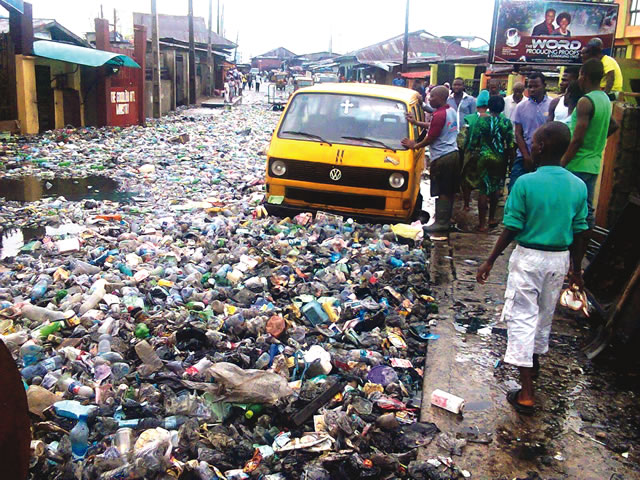
Lagos may not be the filthiest city in Nigeria, but it is a city-state that calls itself Centre of Excellence. Excellence and sludge should not sleep in the same bed. But in Lagos, gutters are clogged with refuse, canals are choked with plastic, walkways are dumpsites. These are the realities our streets preserve, not by accident, but by the daily choices of citizens who normalise the nuisance of filth.
Last week, an overwhelmed Lagos State government announced the reintroduction of the monthly sanitation exercise, to run from 6:30 a.m. to 8:30 a.m. on the last Saturday of every month, beginning April 2026. It is a policy that once defined civic discipline in the state. Now, like many things resurrected from memory, it returns to a chorus of both approval and resistance.
Critics of monthly sanitation exercise argue that it infringes on personal freedom, citing a court judgment. Freedom, they say, must not be curtailed, even for cleanliness. It is an argument that sounds persuasive until one asks: what is freedom in a society where disorder is a shared burden? As you answer that, you should not forget that a city cannot be free if it is not clean; and it cannot be clean if its citizens are free to defile it without consequence.
Public order begins in private habit. A city is not dirty by accident; it is dirtied by choice—repeated daily, normalised over time.
The Yoruba have a proverb: “Ilé la ti ń kó ẹ̀so r’ode”—it is from the home we take adornments to outside. But we take outside more than the desirable. We export virtues and vices. The misguided one who sneaks their refuse into a neighbour’s dustin transfers both cost and stench. The man who leaves his house spotless only to empty his waste into a roadside drain has merely transferred filth, he has not removed it.
Someone once told me that nature, unlike man, keeps a faithful account. People drive miles to dump refuse on highways, pour waste into canals, and block the drainage systems meant to protect them. When the rains come as they always do, the same waste returns, flooding homes, displacing families, and spreading disease.
History offers its own lessons. Cities that endure are cities that discipline themselves. In 19th-Century London, the Great Stink forced a reluctant government to act. What followed was more than an engineering response; there was a civic awakening. Cleanliness became not just policy, but culture.
Lagos stands at a similar threshold. If a monthly exercise is what we need to intubate a gasping environment why not have it? The monthly sanitation exercise may not, in itself, be a magic wand. Two hours of sweeping may not undo thirty days of negligence. But symbols matter. Rituals matter. They remind a people of their duty and collective responsibility.
But government must do more than the monthly ritual. Many residents still do not understand waste sorting, recycling, or proper disposal. That gap must be filled by enforcement, and more importantly by education. A policy imposed without understanding breeds resistance; a policy embraced with knowledge breeds ownership.
Yet, beyond knowledge lies will. The success of this initiative will depend not only on government directives, but on citizen cooperation. Laws can compel compliance; only values can sustain it. Sustainability is to know that cleanliness is not a monthly event; it is a daily ethic.
Those who oppose the monthly exercise in the name of freedom must also reckon with responsibility. Freedom without order is chaos in slow motion. The right to move freely cannot include the right to endanger others through collective neglect. A society that refuses small disciplines invites larger crises.
Nigeria’s attempt at civic discipline has a long history. Colonial records are full of efforts at defeating filthy living. I read Robert Stock’s ‘Environmental Sanitation in Nigeria: Colonial and Contemporary’ (1988). Stock reminds us that environmental sanitation formed the fifth phase of the War Against Indiscipline (WAI), launched in Kano on July 29, 1985, by Major-General Tunde Idiagbon. To spur compliance, a one-million-naira prize was announced for the cleanest state capital. What followed was a wave of frenzied sanitary activity across the country. State governments established sanitation task forces, hired additional workers to clear refuse, and ordered the closure of offices and businesses on designated clean-up days. Mobile sanitation courts were empowered, prosecuting defaulters with uncommon urgency. For a moment, order held. Streets were swept, drains cleared, and a sense prevailed that public space mattered. But discipline imposed without deep-rooted civic culture proved difficult to sustain. When the urgency faded, old habits quietly returned.
That history now shadows Lagos. The question is not whether monthly sanitation exercises can work—they once did. The question is whether this generation can internalise what was once enforced: that cleanliness is not a government programme, but a civic ethic.
In the end, the question is not whether Lagos should have a monthly sanitation exercise. The question is whether Lagosians are ready to see themselves as custodians of their environment, not its occupants who are free to clog its air with stench.
People who say Lagos works should know that a city is more than its roads and bridges. A state or city is a reflection of the habits of its people. And when those habits promote decay, no policy, however well-intentioned, can save it.
A popular hospital in Ibadan has this inscription: We care, God cures. Caring actually cures and saves. The city we do not care for will soon decay. Lagos, and all other cities of filth, must choose between convenience and consequence; between neglect and renewal, between a freedom that dirties and a discipline that cleans.
The views expressed by contributors are strictly personal and not of Law & Society Magazine.