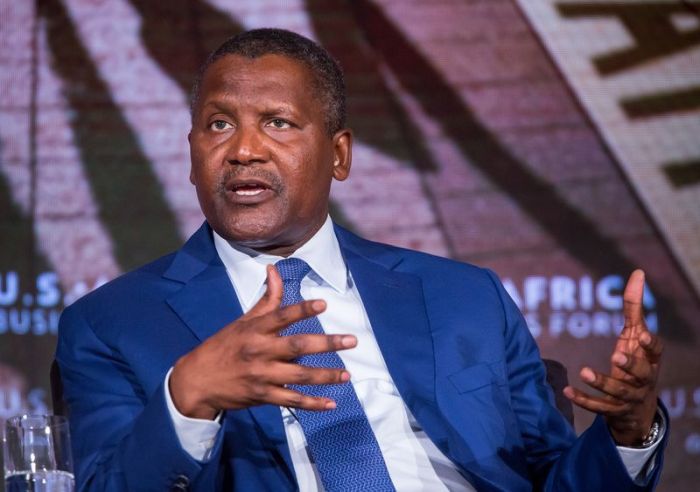
Africa’s richest man, Aliko Dangote, has accused the head of Nigeria’s downstream petroleum regulator of spending about $5 million on the foreign secondary education of his four children and called for a full public investigation, escalating a simmering controversy over alleged elite excess and regulatory capture.
Speaking Sunday at the Dangote Petroleum Refinery in Lekki, Lagos, Dangote alleged that Farouk Ahmed, Chief Executive of the Nigerian Midstream and Downstream Petroleum Regulatory Authority (NMDPRA), paid the sum to schools in Switzerland—an amount he said was impossible to reconcile with earnings from public service.
Dangote said Ahmed should appear before the Code of Conduct Tribunal to explain the source of the funds, warning that failure to address the allegation would further erode public trust and investor confidence in Nigeria’s oil and gas sector.
“I’ve had people making complaints about a regulator who has put his children in secondary school,” Dangote said. “Four of them, six years, costing Nigeria $5 million. You cannot imagine somebody paying $5 million for educating four children.”
The businessman stressed that the issue was not personal but systemic, describing the allegation as emblematic of deeper governance failures. He said such spending would ordinarily trigger scrutiny from tax authorities anywhere in the world.
“When you look at his income, it does not match paying this kind of fee,” Dangote said. “Even if it were me paying $5 million, the taxman would ask questions.”
Dangote contrasted the alleged expenditure with the hardship faced by ordinary Nigerians, particularly in northern communities.
“From Sokoto, where he comes from, people are struggling to pay ₦100,000 in school fees. Children are sitting at home because of ₦100,000,” he said. “Yet someone who has worked all his life in government allegedly pays $5 million for secondary school.”
Dangote said his own children attended secondary school in Nigeria, adding that he was not calling for Ahmed’s removal but demanding transparency.
“If he denies it, I will publish what was paid as tuition, and I will take legal steps to compel the schools to disclose the payments,” he said. “This is about accountability. What is happening amounts to economic sabotage.”
The NMDPRA has previously rejected similar allegations. In July, the agency dismissed claims by protesters that Ahmed spent more than $5.5 million on his children’s education, describing them as a coordinated smear campaign based on falsehoods.
Contacted again on Sunday, NMDPRA spokesman George Ene-Ita said: “For now, no comment.”
Dangote used the briefing to widen his criticism to what he described as regulatory failure and entrenched interests in the downstream petroleum sector, arguing that fuel importers continue to profit at Nigeria’s expense.
“There are powerful interests in the oil sector,” he said. “Allowing massive imports while discouraging domestic refining is unethical and does a disservice to Nigeria.”
He warned against conflicts of interest, saying regulators must be clearly separated from traders.
“A trader should never be a regulator,” Dangote said. “Forty-seven licences have been issued, yet no new refineries are being built because the environment is not conducive.”
The allegations echo long-standing concerns about unexplained wealth among Nigeria’s political elite. A 2021 report by the Carnegie Endowment for International Peace found that many senior Nigerian politicians sent their children to expensive British schools and universities despite modest official salaries, raising red flags about illicit financial flows.
The report cited convicted former governors James Ibori and Joshua Dariye among politically exposed persons who spent hundreds of thousands of pounds on UK education for their children while Nigeria’s public schools deteriorated.
Carnegie estimated that the average annual fee for a UK boarding school in 2020 exceeded the annual earnings of a Nigerian governor or cabinet minister, highlighting a stark gap between declared income and spending.
While elite families spend billions educating their children abroad, Nigeria’s education sector remains plagued by underfunding, repeated strikes and collapsing infrastructure. Since 1999, university lecturers have embarked on at least 15 strikes, costing the system more than four years of academic time.
As Nigeria grapples with inflation, unemployment and declining public services, Dangote’s allegations have reignited a sensitive national debate: whether anti-corruption enforcement applies equally to powerful regulators—and whether public office has become a pathway to unexplained wealth.