By Johnson Agu
As millions of Nigerians struggle with rising food prices, insecurity and the daily grind of survival, another battle is quietly unfolding behind the scenes: the grooming of political heirs. Across party lines and regions, the children and relatives of Nigeria’s political heavyweights are steadily positioning themselves for power, raising troubling questions about dynasty politics, access, and whether democracy is gradually becoming a family business.
While ordinary Nigerians battle worsening economic hardship, rising insecurity and bitter political divisions, another reality is quietly taking shape behind the scenes of the country’s political establishment: the rise of political heirs.
Across Nigeria’s major political families, sons, daughters and close relatives of influential political figures are steadily emerging into positions of power ahead of the 2027 elections, reinforcing growing concerns that political leadership in Africa’s largest democracy is increasingly becoming hereditary.
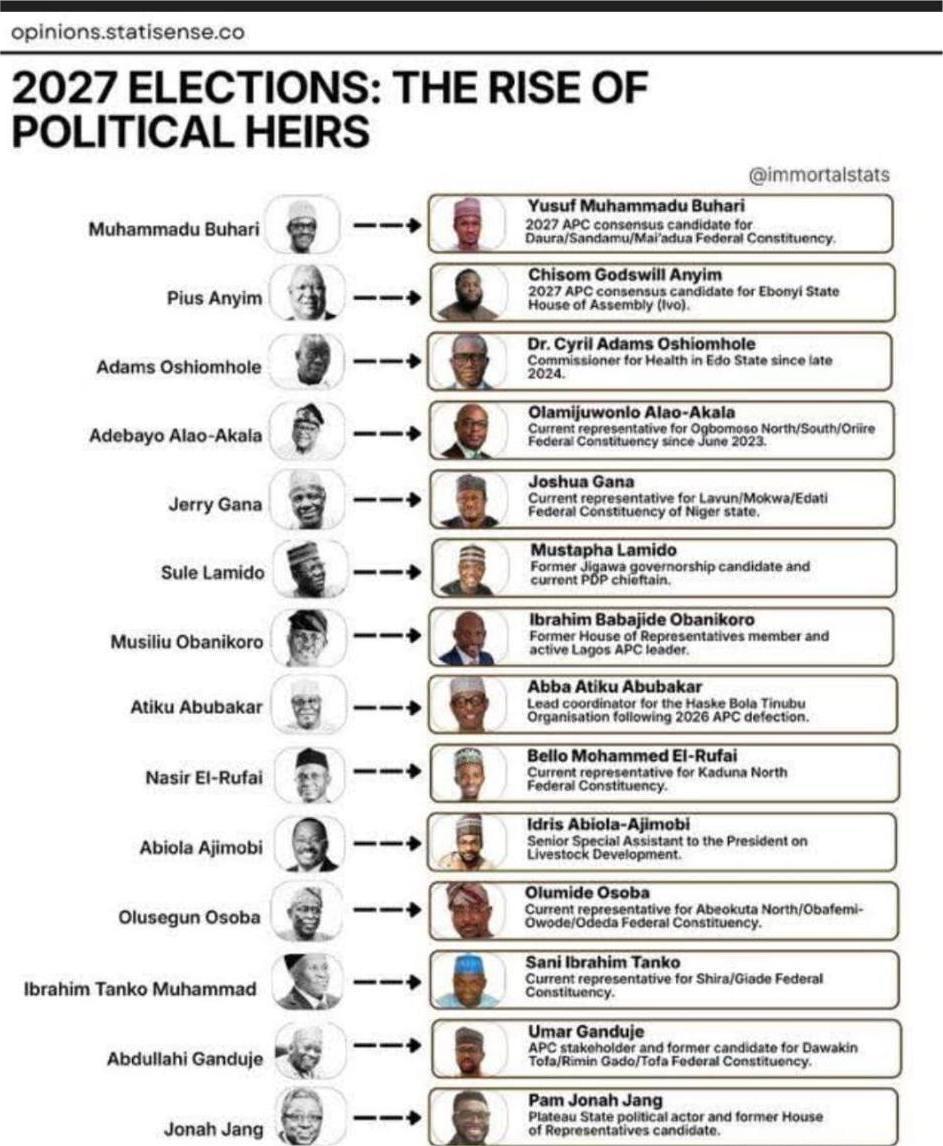
A viral political chart circulating online titled “2027 Elections: The Rise of Political Heirs” captures what many Nigerians say has long been happening quietly within the nation’s political structure. The document highlights a growing list of second-generation politicians linked to some of the country’s most powerful political figures.
Among those listed are Yusuf Muhammadu Buhari, son of former President Muhammadu Buhari; Bello Mohammed El-Rufai, son of former Kaduna governor Nasir El-Rufai; Idris Abiola-Ajimobi, son of late Oyo governor Abiola Ajimobi; and others connected to political heavyweights such as Atiku Abubakar, Adams Oshiomhole, Sule Lamido and Abdullahi Ganduje.
For many observers, the development reflects a deeper structural problem within Nigerian politics where access to power, influence, party structures and public visibility often remains concentrated within a small political elite.
The irony, critics argue, is striking.
While supporters of rival political parties engage in fierce online battles and sometimes violent confrontations on behalf of politicians, many of the political actors themselves appear united by a shared objective: preserving influence within their families and political networks.
On the streets, however, the realities facing ordinary Nigerians continue to deteriorate.
Inflation remains crushing. Food prices continue to soar. Youth unemployment remains alarming. Insecurity persists across several regions, with kidnappings, killings and displacement becoming almost routine in many communities.
Yet even amid growing public frustration, Nigeria’s political establishment appears focused on succession planning.
Analysts say the emergence of political heirs is not entirely new. Political families have existed for decades in Nigeria, much like in other democracies. What appears different now, however, is the increasing visibility and normalization of dynastic politics at a time when public trust in governance is already severely strained.
Critics warn that such trends risk deepening public cynicism about democracy itself.
For many young Nigerians struggling to survive in a harsh economy, the message can appear painfully clear: while millions fight for opportunities, access to political power often remains reserved for those born into influential families.
Supporters of the politicians involved argue differently. They insist that children of politicians should not be denied participation in politics simply because of their family backgrounds, noting that many are educated, experienced and politically active in their own right.
But opponents argue that the issue is larger than individual competence. They say the concentration of power within political bloodlines raises difficult questions about merit, inclusion, internal democracy and equal access to leadership opportunities.
The optics are particularly sensitive at a time when many Nigerians increasingly feel excluded from governance and abandoned by the political class.
For critics, the rise of political heirs reflects a widening disconnect between Nigeria’s rulers and the realities confronting ordinary citizens.
As access to the basic necessities of life becomes increasingly difficult, and frustration spreads across the country, many fear that the 2027 elections may further expose a political system increasingly dominated not by ideology or public service, but by entrenched networks determined to retain power across generations.
And while the masses argue passionately over party loyalty, ethnicity and political personalities, Nigeria’s elite families appear to be preparing quietly for the next transfer of power, not necessarily from one party to another, but from one generation of political insiders to the next.