By M.O.Idam
While many, including me, continue to cheer the young Lieutenant A.M. Yerima for unmasking the mini Idi Amin in Minister Wike, we must pause to ask—was that confrontation legally justified?
To refresh the memory of my readers, the summary of the facts leading to the face-off between Wike and Yerima is set out below:
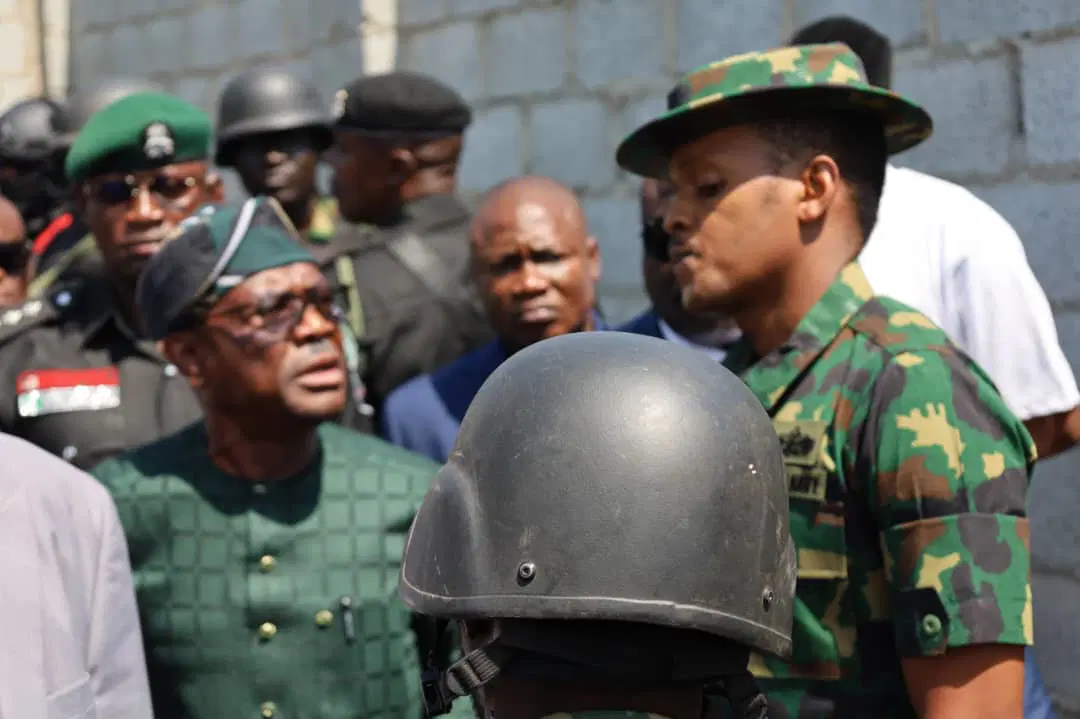
On November 11, 2025, Minister Nyesom Wike visited a construction site located at Plot 1946, Gaduwa, Abuja—an area reportedly designated as a buffer or restricted zone under the Abuja Master Plan. Upon arrival, his team was denied access to the property by armed military personnel led by Lieutenant A.M. Yerima, who was said to be acting on the orders of his superior. The encounter quickly escalated into a heated face-off between the minister and the officer.
Since the incident, Lieutenant Yerima has been celebrated, and rightly so across the media as a folk hero of sorts, for daring to confront the self-styled Hitler of Obio/Akpor.
A people who have endured one man’s grip on state resources and his delusion of supremacy over others will naturally celebrate every stumble that reminds him he is not El Shaddai. History offers many examples—Gaddafi, Hitler, Idi Amin, and others—are leaders undone by their own overreach.
Amid the chorus celebrating our new lieutenant-hero, a crucial question lingers—was the military right, in law, to assign its officers to guard or defend private property?
I will not answer the question without perusing the relevant statutory positions in this area:
Section 217(2) of the Constitution spells out the primary functions of the Nigerian Armed Forces. It states that the Armed Forces shall be charged with:
i. Defending Nigeria from external aggression;
ii. Maintaining its territorial integrity and securing its borders from violation on land, sea, or air;
iii. Suppressing insurrection and acting in aid of civil authorities to restore order when called upon to do so by the President (and subject to such conditions as may be prescribed by an Act of the National Assembly);
iv. Performing such other functions as may be prescribed by an Act of the National Assembly.
Interestingly, the provision of Section 1(2) of the Armed Forces Act, Cap A20, Laws of the Federation of Nigeria, 2004, is in pari materia with the already cited section of the Constitution, except that it adds “the protection of its citizens and their property” as one of the duties of the Armed Forces. However, reading the Act in isolation from the constitution, it will be doubtful whether this clause can be construed to authorize the military to engage in the protection of private property, as such an interpretation would extend beyond the intended constitutional framework of internal security support.
Nevertheless, a careful interpretation of this clause, together with the express provisions of the Constitution already cited, leaves no doubt that the Nigerian military has no business in internal security—except when expressly invited by the President—including activities such as the protection or defense of private land, a practice unfortunately observed too frequently in Nigeria.
However, even if it is assumed—without concession—that the Nigerian military has the the authority to protect private property, that authority cannot extend to preventing a statutory agency like the Federal Capital Territory Administration (FCTA ) from performing its regulatory duties, irrespective of the perceived illegality or otherwise of such duties.
By section 1(1) and (2) of the Land Use Act 1978, all land in the state and FCTA are vested in the Governor (or Minister, in the case of the FCT) who shall have the power to administer and hold same in trust for the people. Under this provision, the governor or minister is made the landlord over all the lands within his territory.
The Governor (in a state) or the Minister (in the FCT) has the authority to issue Certificates of Occupancy over any land, revoke them in the overriding public interest following due legal procedure, collect ground rent, and demolish illegal developments that do not conform with the master plan of the state or the FCT following land use regulations. See also Sections 18 and 1(3) of the FCT Act.
The foregoing in view, the use of military personnel to guard or defend a landed property from lawful or illegal demolition in Abuja—or anywhere else in Nigeria—is tantamount to employing the military to enforce a civil transaction. Such actions are utopian, uncivilized, unlawful, and unconstitutional, and should never be encouraged, regardless of any public excitement against the individual whose authority was resisted.
The court, and not the military or any other armed personnel, is the only lawful authority vested with constitutional powers to review, restrain, or overturn an official act. Therefore the military must remain in the barracks or at the boarders for external security.
CONCLUSION:
While Lieutenant A.M. Yerima is rightly celebrated for bravely standing his ground to oppose the apparent executive overreach and discourtesy exhibited by the Minister, the military hierarchy must be reminded to limit its operations strictly to external defense and constitutionally authorized duties.
M.O.Idam
[email protected]
The views expressed by contributors are strictly personal and not of Law & Society Magazine