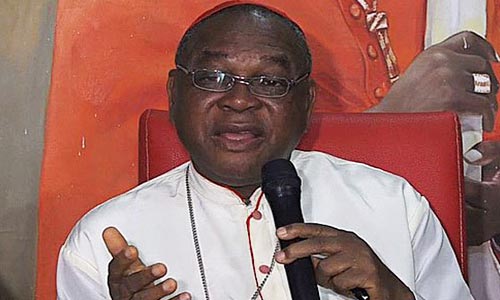
The Archbishop Emeritus of the Catholic Archdiocese of Abuja, Cardinal John Onaiyekan, has disclosed that President Bola Tinubu firmly rejected the Catholic bishops’ assessment of Nigeria’s economic and social conditions during a closed-door meeting at the Presidential Villa, saying the President made it “quite clearly” known that he did not share their concerns.
The revelation offers a rare glimpse into what transpired behind closed doors when members of the Catholic Bishops’ Conference of Nigeria (CBCN) met President Tinubu on July 28 to discuss the economy, insecurity and the country’s political direction.
Speaking during an interview on ARISE News on Friday, Onaiyekan said the bishops deliberately chose candour over diplomacy, believing they had a moral obligation to present the realities confronting millions of Nigerians rather than reinforce what he described as an overly optimistic picture of the country.
“When the nation is bleeding, you cannot expect a polite meeting with the Head of State. We had to let him know,” Onaiyekan said.
According to the cleric, the bishops told the President that worsening economic conditions were pushing more Nigerians into hardship.
“We told him the economy is not helping our poor people; he told us the economy is doing fine. Frankly speaking, he told us quite clearly that he did not agree with us.”
Onaiyekan said the bishops were neither surprised nor discouraged by the President’s response.
“We didn’t expect him to agree with us. We have done our duty, we have delivered our message, and we have a feeling that somehow, along the line, somebody will show him a few of the things we said.”
A Carefully Considered Message
The former Archbishop rejected suggestions that the bishops’ presentation reflected personal opinions, insisting that the statement was the product of extensive consultation within the Catholic Bishops’ Conference.
He said the document underwent several rounds of review before it was presented to the President and represented the collective position of the Catholic Church’s leadership in Nigeria.
Onaiyekan also dismissed any suggestion that the bishops were motivated by politics.
“We have no ambitions to take Mr. Tinubu’s job or anybody else’s job. We are not politicians running for office. We are, first and foremost, religious leaders who feel we have a duty—not just to preach our religious doctrines, but also to address the lives of our people.”
He added that the delegation intentionally resisted the temptation to present a comforting narrative.
“There are so many people hanging around Mr. President, giving him a rosy picture of what the country is, which it is not.
“We felt that we have the obligation to help him appreciate the reality of the situation in which we find ourselves.”
Although the discussions revealed clear differences, Onaiyekan said the bishops left convinced that the President had listened carefully because he responded directly to the issues they raised.
Official Optimism Meets Everyday Reality
The exchange reflects one of the defining debates surrounding Nigeria’s economic reforms.
Since assuming office in 2023, President Tinubu’s administration has defended difficult policy decisions—including the removal of the petrol subsidy, exchange-rate reforms and fiscal restructuring—as necessary measures to restore macroeconomic stability and attract investment.
Government officials have repeatedly pointed to improving economic indicators, stronger public revenues, rising foreign reserves and increasing investor confidence as evidence that the reforms are beginning to yield results. President Tinubu has maintained that Nigeria has turned an economic corner and that the benefits of the reforms will become more evident over time.
Yet many economists caution that improvements in macroeconomic indicators do not automatically translate into immediate relief for households.
Even the administration has acknowledged that progress must ultimately be reflected in the daily lives of citizens, with official policy documents emphasising that economic recovery must be “felt in every household, not just in national statistics.”
For many Nigerians, however, daily life continues to be defined by the rising cost of food, transportation, rent, electricity, healthcare and education. Families whose incomes have remained largely stagnant say their purchasing power has been eroded, leaving many struggling to meet basic needs despite official assurances that the economy is stabilising.
The Question of Shared Sacrifice
The bishops’ intervention also touches on another issue that has featured prominently in public discourse: whether government has demonstrated the same level of sacrifice it expects from citizens.
As households adjust to the consequences of economic reforms, questions have continued to be raised over the cost of governance, including expenditure on official convoys, public office renovations, luxury vehicles and other recurrent spending by political office holders.
Fiscal policy experts have consistently argued that difficult reforms are more likely to enjoy public confidence when they are accompanied by visible restraint, transparency and accountability in public spending. Without that balance, they warn, even economically necessary reforms risk losing public legitimacy because citizens perceive that the burden of adjustment is being shared unevenly.
More Than a Disagreement
The significance of the meeting therefore extends beyond whether the President agreed with the bishops.
It raises a broader question about how governments measure success during periods of painful economic transition.
Should economic progress be judged primarily by stronger fiscal indicators, improved foreign reserves and investor confidence?
Or should it be measured by whether ordinary citizens can afford food, transportation, school fees, healthcare and other basic necessities without sliding deeper into poverty?
That debate is unlikely to end with the meeting at the Presidential Villa.
For the Catholic bishops, speaking candidly to those in authority is part of their pastoral responsibility.
For government, defending difficult reforms is part of governing.
Between those two positions lies the everyday experience of millions of Nigerians, whose verdict on economic policy will ultimately be shaped less by official statistics than by whether life becomes more affordable, more secure and more dignified.