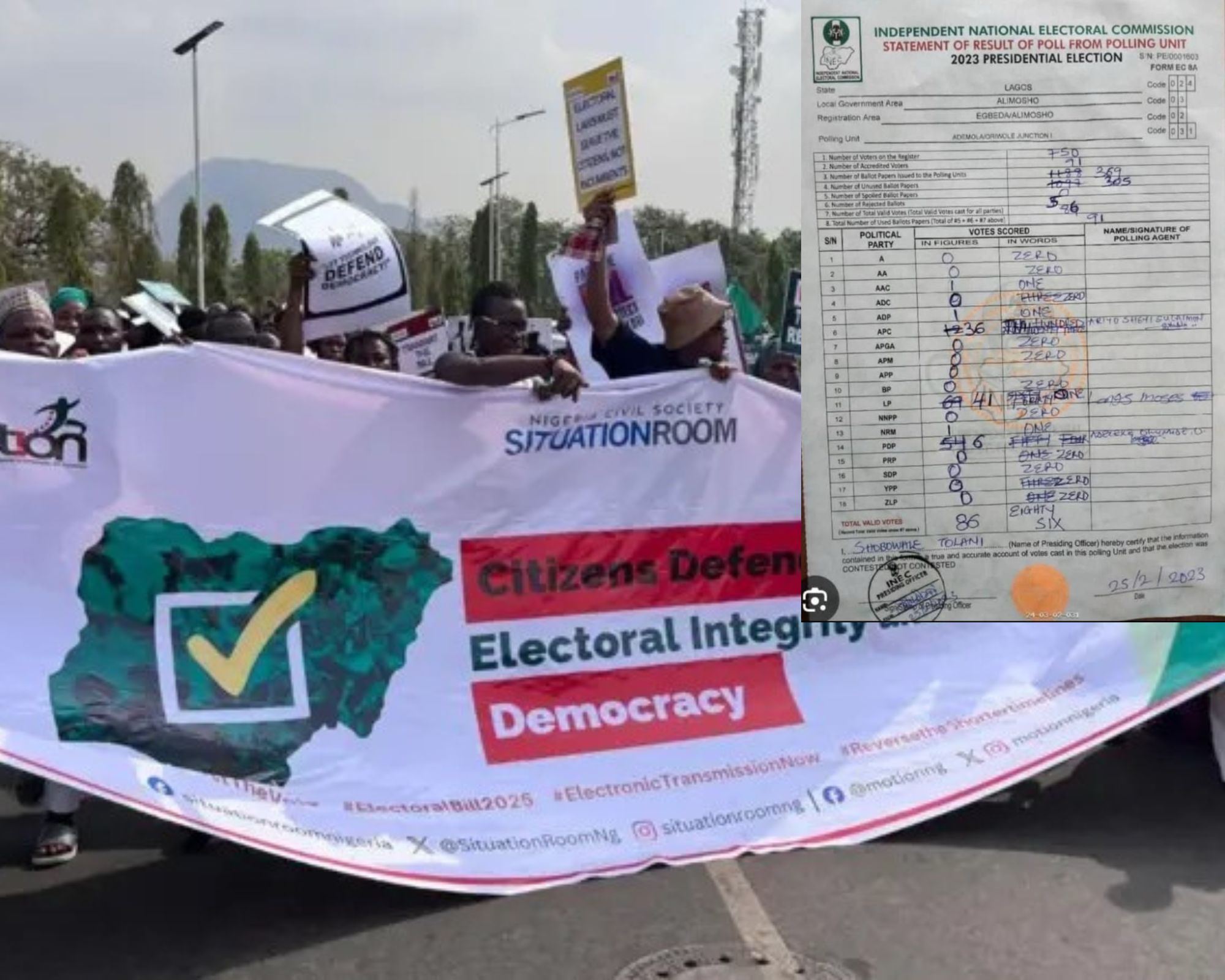
Nigeria’s fragile democratic landscape edged closer to confrontation on Wednesday as heavily armed security personnel flooded the National Assembly complex in Abuja, where protesters gathered to demand the mandatory inclusion of real-time electronic transmission of election results in the amended Electoral Act.
Under the banner “Occupy National Assembly,” demonstrators converged at the entrance of the legislative complex, warning that any attempt to weaken electronic safeguards would expose future elections to manipulation and further erode public trust in government institutions.
Personnel from the Nigeria Police Force, the Nigerian Army, and the Nigeria Security and Civil Defence Corps were deployed in large numbers, underscoring the growing tension around electoral reforms widely viewed as critical to the credibility of the 2027 general elections.
The protest comes amid mounting backlash over the National Assembly’s handling of the Electoral Act Amendment Bill 2026, with civil society groups, labour activists, legal experts and governance watchdogs accusing lawmakers of preserving loopholes historically exploited to influence election outcomes.
Although the Senate has recently denied rejecting electronic transmission outright, protesters insist the law must explicitly mandate it rather than leave the decision to the discretion of the Independent National Electoral Commission (INEC).
“We are here because democracy must not be negotiated behind closed doors,” one protester said. “If the law is ambiguous, the will of the people becomes vulnerable.”
Democracy at a Crossroads
For many observers, the scene of armed security guarding lawmakers from pro-democracy demonstrators reflects a deeper national anxiety: that Nigeria may be drifting toward another cycle of disputed elections at a time of worsening insecurity and economic strain.
Critics argue that blocking—or diluting—mandatory electronic transmission risks reopening the very cracks that triggered widespread distrust after the 2023 elections, when failures in uploading results to INEC’s Results Viewing Portal fuelled allegations of electoral manipulation and years of litigation.
The Concerned Citizens Leadership Integrity and Transparency Advocacy Initiative (CLITA) described the Senate’s position as a dangerous regression.
“Mandatory electronic transmission is not a luxury; it is a safeguard,” said CLITA Executive Director Isaiah Davies Ijele. “It limits human interference and strengthens public confidence. Removing certainty from the process suggests some actors prefer discretion over democracy.”
‘When Transparency Is Optional, Democracy Is at Risk’
Governance watchdog Connected Development (CODE) warned that Nigeria’s electoral credibility has historically been undermined not at polling units but during collation and transmission—precisely where digital systems provide oversight.
“With legal ambiguity preserved and timelines compressed, discretionary spaces remain,” said acting CEO Hyeladzira James Mshelia. “When transparency is left to discretion, democracy is left to chance.”
Legal practitioner Louis Koko dismissed claims that technological barriers justify caution, arguing that the infrastructure supporting BVAS and electronic transmission relies on satellite connectivity capable of reaching even remote regions.
“Arguments about technological limitations are misleading,” he said. “They risk confusing the public and weakening reform.”
Beyond Politics: The Cost of Distrust
Analysts warn that electoral uncertainty carries consequences far beyond politics. Nigeria is already battling banditry, insurgency, kidnappings and communal violence, while investors remain wary of instability in Africa’s largest economy.
“Credible elections are a pillar of national security,” said a political risk analyst. “When legitimacy is questioned, social tensions rise, investor confidence falls, and governance becomes harder.”
Labour groups and rights advocates have similarly cautioned that flawed elections could deepen divisions and heighten the risk of unrest, particularly in regions already stretched by violence and displacement.
Senate and House on Diverging Paths
The controversy has sharpened institutional fault lines within the National Assembly itself. The House of Representatives passed a version of the reform bill in December 2025 that explicitly mandates real-time electronic transmission of results—a provision widely supported by civil society.
The Senate’s more ambiguous language now sets the stage for a high-stakes harmonisation process before the bill can be forwarded to President Bola Tinubu for assent.
In a strongly worded editorial, Premium Times described the Senate’s move as a “deliberate assault on electoral transparency,” warning it could enable manipulation in 2027 and entrench public distrust.
Opposition lawmakers have also raised concerns, alleging that provisions backed by a majority were sidelined during closed-door deliberations led by Senate leadership.
Reform Window Narrowing
Meanwhile, the Independent National Electoral Commission has cautioned that delays in finalising the legal framework are already disrupting election planning. The statutory notice period for elections has reportedly been reduced from 360 days to 180 days, compressing preparation timelines.
Democracy advocates say such uncertainty risks repeating a familiar pattern—rushed reforms, contested results and prolonged court battles.
Nigeria has amended its electoral laws five times since returning to civilian rule in 1999, yet each cycle has produced fresh controversies tied to vague provisions and inconsistent enforcement.
A Test of Political Will
As protesters faced rows of security operatives outside the National Assembly gates, the symbolism was difficult to ignore: a democracy under guard, wrestling with the question of whether clarity or ambiguity will define its next election.
Civil society groups are urging lawmakers to choose decisively.
Quoting former UN Secretary-General Kofi Annan, one advocacy group reminded legislators that elections must be anchored on two non-negotiable pillars—credibility and integrity.
With the 2027 elections approaching against a backdrop of insecurity and economic pressure, the battle over electronic transmission has evolved into more than a legislative dispute.
It is increasingly seen as a referendum on whether Nigeria’s leaders are prepared to rebuild constitutional trust—or risk pushing Africa’s largest democracy toward another legitimacy crisis.