By Chinedu Agu
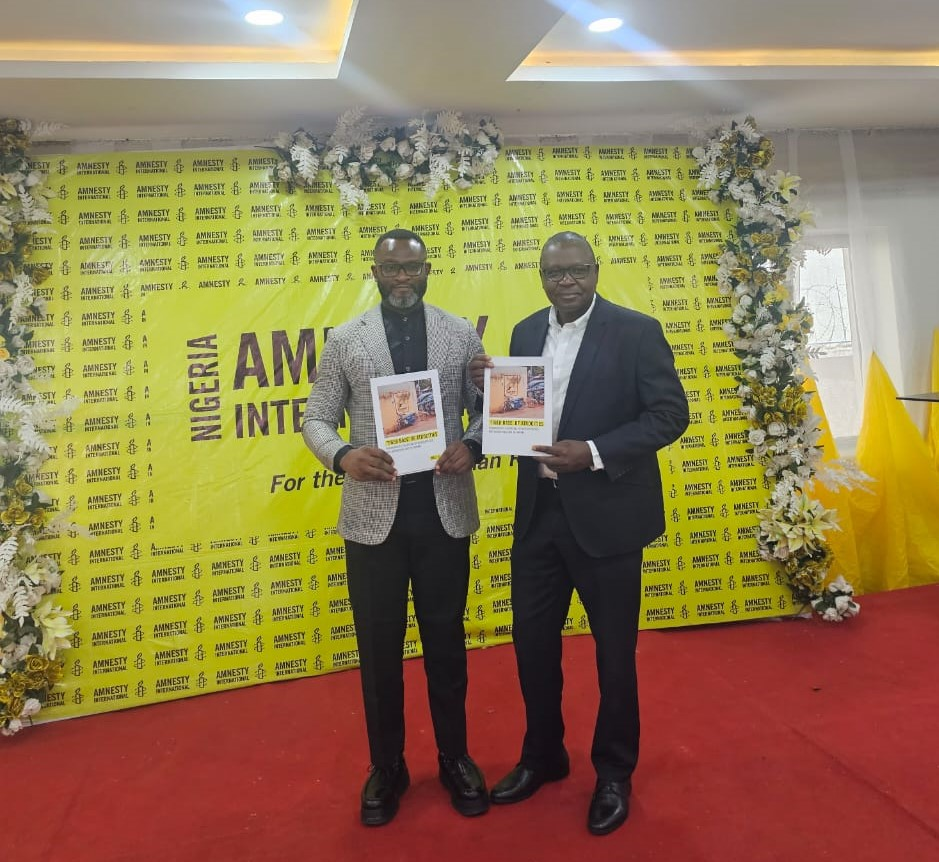
At the invitation of Amnesty International, I had the honour of serving as a resource person and panellist at the launch of its landmark report on Wednesday, 25 February 2026, titled “Tiger Base of Atrocities: Human Rights Violations by Nigeria Police Anti-Kidnapping Unit in Owerri.”
The report was formally presented in Enugu today before a distinguished audience of civic actors, members of the Bar, and human rights defenders, including Okechukwu Nwanguma, Executive Director of the Rule of Law and Accountability Advocacy Centre, and Marjorie Ezihe.
Today’s launch signals something significant: The campaign against Tiger Base is no longer local. It has crossed borders. It has attracted sustained international attention. Hope is no longer abstract, it is materialising.
Recall that on 15 December 2025, onbehalf of CAPTI [Coalition Against Police Tigerbase Inpunity] in Abuja, Omoyele Sowore and I launched the 97 page Tiger Base report. Since that moment, the issue has steadily garnered international interest. Today’s intervention by Amnesty International affirms that the world is watching.
The report is extensive and deeply troubling. It documents, among other findings within Tiger Base:
- Prolonged arbitrary detention without trial [page 9];
- Denial of access to family members and lawyers [page 11];
- Extortion and extortion-driven investigations [page 12];
- Court orders enabling unconstitutional detention churned out in Magistrate Courts in Imo [page 14];
- Inhuman and degrading detention conditions [pg 16];
- Enforced disappearance of children arrested with their mothers [page 18];
- Torture and other ill treatment [page 20];
- Death in detention [page 24];
- Arbitrary arrests and detention [page 28]; and
- Enforced disappearances [page 29]
In preparing the briefing, Amnesty International conducted three research missions between May and October 2025 and February 2026 in Owerri, Imo State. The findings are based on interviews with 23 individuals, including 14 women who were victims of prolonged arbitrary detention, torture, extortion, forced labour, and extortion driven investigations.
The organisation also reviewed court documents, autopsy reports, petitions, and reports from Nigerian human rights organisations.
The evidence is methodical, and the testimonies harrowing.
One victim of prolonged arbitrary detention without trial stated: “I was held in Tiger base for 2 years, 2 months, and 8 days from 10 October 2023 to 16 December 2025. My family members who came to bail me were detained, my step mother for 8 months, Mr. SCCC for 10 months, Mr. YYY for 8 months. He died two weeks after his release.”
She continues: “All of us, including the one year old child, were detained at Tiger base. My step mother was released on bail after three days, but Tiger base officials took the baby away. To this day, the baby has never been seen again.”
Another survivor recounted: “I saw them bring in two young boys. I was watching from inside the cell. As soon as they arrived, the officers chained them, went inside their office and then came back with a locally made gun, a machete, and another weapon. They put all those items in the boys’ hands and took pictures. The boys kept saying they hadn’t done anything and that the weapons weren’t theirs, but the officers ignored them and started beating them. That was how they later paraded them as IPOB members.”
Another testimony reveals: “The IPO seized my ATM card from my bag. He called a POS operator inside the compound and forced me to give him my PIN. He withdrew all the money in my account, N30,000, and never returned it.”
A woman detained for over two years narrated: “My family paid over thirty million naira to Tiger base officials. My brother in law who lives abroad sent the money in several instalments while trying to negotiate our release, but it made no difference. They kept demanding more and made promises they never kept. When the Tiger base commander lost his father, my family even contributed two million naira towards the burial, hoping it would persuade him to release us. Still, nothing changed.”
A 34 year old mother made perhaps the most devastating revelation: “I was arrested on 8 October 2023 with my three children. When I tried to leave my children with my neighbour, they refused. They chained my hands and chained my children. We were put in their vehicle and taken to Tiger base. They even shared the drinks they took from my fridge. They kept us behind the counter for about three days. After that, the officers took my three children away. That was the last time I saw them. They only told me the children had been taken to where they were supposed to be, then pushed me into the cell. Since 11 October 2023, I have not seen the three children I was arrested with. I have not seen my children in over two years.”
On court orders enabling unconstitutional detention, the report states: “Some Magistrates conspire with Tiger Base officials to detain people indefinitely. Tiger base operatives detain people indefinitely. Yet the ACJL of Imo State provides for a 14 day remand period, and if there is a reason for continued custody, perhaps for further investigation, the prosecutor is required to apply for renewal of that remand order for another 14 days. After that, the Magistrate should grant bail, except in exceptional circumstances where the Magistrate believes detention is still necessary. In such cases, the law allows a final 10 days, making a total of 42 days. The law clearly envisaged that nobody should be in detention for up to two months, but they are rarely willing to activate that part of the law.”
As a panelist, I remarked that this observation about some lower courts reflects lived courtroom reality. Courts are often reluctant to grant bail or strike out charges where defendants are products of Tiger Base detention. In some instances I have witnessed as counsel in court, when bail applications are made, the court rises abruptly, retires to chambers to make calls, and returns almost immediately to rule that bail cannot be granted. This happens even when the DPP report has been awaited for months, even where there is no complainant, even where the state has shown manifest indiligence.
In some instances, a bench ruling that ought to be delivered immediately a bail application is made is deliberately adjourned repeatedly, ostensibly to afford the State the opportunity to file an information. When counsel eventually appears in court on the scheduled date for ruling, the Magistrate announces, almost with malevolent relief, that an information has now been filed and that the court consequently lacks jurisdiction to deliver the ruling on the bail application. If this is not judicial complicity in prosecution, what else can it be called?!
I have personally witnessed a situation where a court scolded a state counsel for not opposing a bail application. The state counsel eventually opposes, and the court immediately rules and denies bail. One begins to question how an impartial arbiter comes to assume prosecutorial posture.
The complicity of certain lower courts is no longer subtle. It is brazen. It is executed with impunity, as though institutional checks have evaporated.
The significance of today cannot be overstated. From Abuja on December 15 under CAPTI, to Enugu under Amnesty International, the arc of this advocacy is bending toward accountability.
International attention has been triggered. Documentation is now global. Testimonies have left the shadows. The campaign against Tiger Base has begun to garner the weight of international scrutiny. And when scrutiny becomes sustained, reform is no longer impossible.
Chinedu Agu
[email protected]