


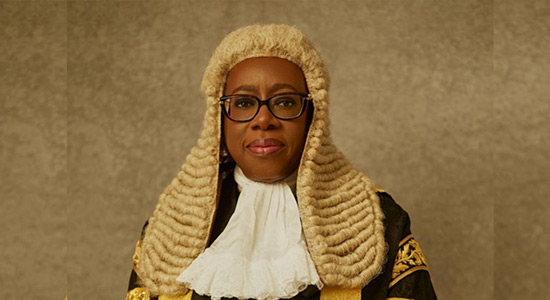
A pro-democracy, human rights and anti-corruption advocacy group, Tap Initiative, has expressed concern that no tangible reform to promote judicial accountability has been achieved in the one year in office of the Chief Justice of Nigeria, Kudirat Kekere-Ekun.
The initiative disclosed at a press briefing in Abuja to review the one year in office of Mrs Kekere-Ekun.
President Bola Tinubu inaugurated Mrs Kekere-Ekun as the 23rd Chief Justice of Nigeria and the second female justice to hold the office at the Council Chamber of the State House, Abuja, on August 24, pending her approval by the Senate in September 2024.
In a statement by the Executive Director of Tap Initiative, Martin Obono, said, “Justice Kekere-Ekun’s first year has been characterized by a clear articulation of the judiciary’s challenges but limited evidence of systematic reform implementation.”
“A few days before then, civil society groups, senior legal experts, members of academia, and other reform advocates led by Tap Initiative outlined a specific and measurable agenda: end the abuse of ex-parte orders by politicians, enforce discipline within the judiciary, implement digital courts, and restore public trust amid ongoing allegations of corruption and bias. One year later, the verdict is clear: while the rhetoric has been loud, tangible reforms remain elusive.’’
Highlighting abuse of ex-parte orders by politicians, indiscipline, allegations of corruption and bias in the Nigerian judiciary, Mr Obono said “Despite concerns about their misuse in political cases, no new guidelines or policy changes have been publicly announced addressing the issue.’’
He stated, “The CJN acknowledged over 243,000 pending cases in the higher courts. While the Supreme Court Rules 2024 provide for electronic filing, a fast-track procedure for specific criminal appeals, and tighter procedural timelines, there has been no clear strategy or progress update on reducing this backlog.”
Citing some cases involving top judicial officials, Mr Obono said “Judges often receive a slap on the wrist rather than facing the serious consequences of criminal prosecution for criminal actions.
“While the CJN has stated that the National Judicial Council (NJC) will discipline non-performing judges, no concrete disciplinary actions leading to deterrence have taken place. For instance, it is commendable that the NJC under her leadership recommended the compulsory retirement of the Chief Judge of Imo State and eight other judges in Imo State for falsifying their dates of birth to extend their tenure, and sanctioned Justice T. N. Nzeukwu, who positioned himself to be sworn in as acting Chief Judge despite being fourth in the hierarchy. Similarly, the NJC suspended Justice Inyang Ekwo of the Federal High Court, Abuja Division, for one year, placed him on a five-year watch-list, and barred him from elevation for delivering a ruling without hearing parties and ignoring a motion to set aside an ex parte proceeding.’’
He added, “Justice Jane E. Inyang of the Court of Appeal, Uyo Division, was also suspended for one year without pay for issuing inappropriate ex parte orders to sell a petrol station and other assets at an interlocutory stage. While these measures are commendable, they are manifestly inadequate considering that many of these offences are criminal. The CJN should have recommended prosecution by law enforcement agencies.”
Mr Obono commended Mrs Kekere-Ekun “for overseeing the retirement of judges based on age and investigating allegations of falsified ages,” but added that “her leadership style appears risk-averse, relying on speeches and moral persuasion rather than structural reforms. For a judiciary in crisis, this is insufficient.”






One year on, Justice Kekere-Ekun has made many speeches, but real action to fix court delays, digital reforms, and accountability is still missing.