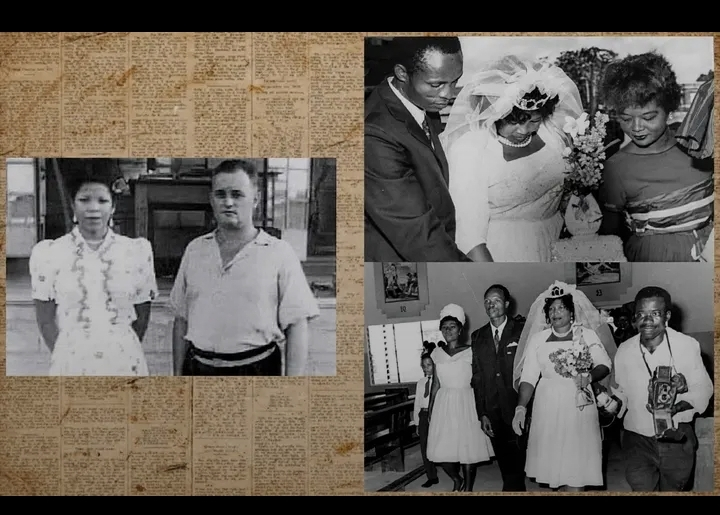
The extraordinary story of Ada Ocha Ntu, the young Lagos woman whose colonial-era murder case became a national sensation and ended with a pardon from Nnamdi Azikiwe
In the Lagos of the 1950s, where colonial power shaped almost every aspect of public life, the killing of a British railway worker by a young Nigerian woman became much more than a murder case.
It was a story of love and betrayal, money and anger, race and power — and eventually, mercy.
The woman at the centre of it was Ada Ocha Ntu, better known as Esther Johnson. She was about 22 when her relationship with British railway worker Mark Hall ended in violence, after a sequence of events that would send her to death row at Broad Street Prison and turn her into one of the most remembered inmates in the history of the prison, now the site of Freedom Park in Lagos.
More than seven decades later, the story remains alive in Nigerian popular memory and has even been adapted into the stage production Esther’s Revenge, which has taken the case to audiences in Nigeria and abroad.
The £400 that changed everything
The details of the relationship have survived largely through historical accounts and later retellings, but the central story has remained remarkably consistent.
Johnson had fallen deeply in love with Hall, a British railway worker who was preparing to return to England on leave. She reportedly entrusted him with £400 — described in several accounts as her savings — for the purchase of a car that would enable her to start a business.
Hall returned to Lagos with devastating news.
He had married an English woman while in Britain.
Worse still, according to the accounts, Johnson’s money had been used in connection with the new marriage, including the purchase of a car for his new wife.
For a young woman who had invested both her savings and her hopes in the relationship, the revelation was devastating.
What happened next became the subject of one of colonial Nigeria’s most sensational criminal cases.
During a confrontation, Johnson attacked Hall with a pair of scissors. He suffered fatal injuries.
The prosecution treated the incident in the matter of The Queen v. Esther Johnson (1953) as murder. The defence, according to later accounts, raised provocation and self-defence, portraying the killing as the culmination of an explosive confrontation rather than a coldly planned act.
Death sentence in colonial Lagos
Johnson was arrested, prosecuted and eventually convicted of murder and sentenced to death.
She was held at Broad Street Prison in Lagos, the colonial institution whose history would later become intertwined with Nigeria’s political and social history.
The prison housed ordinary criminals as well as political prisoners during the colonial period. Johnson’s presence there, however, acquired an unusual place in public memory because her case had already generated widespread fascination.
The racial dimension was impossible to ignore.
A young Nigerian woman had been convicted of killing a British man at a time when colonial society was structured around profound inequalities of power and status. Later accounts and theatrical interpretations of the case have consequently examined it not only as a crime of passion but through the wider questions of race, gender, colonial authority and the treatment of Nigerian women.
Her death sentence was eventually commuted to life imprisonment.
She remained in custody as Nigeria moved towards independence.
Azikiwe’s pardon
Nigeria became independent on October 1, 1960.
One year later, on October 1, 1961, Johnson received a full pardon from Dr Nnamdi Azikiwe, then Governor-General of Nigeria.
The pardon was granted within the constitutional arrangements of the period, when Azikiwe represented the Crown as Governor-General. Historical accounts record that Johnson was released after spending years in prison.
The timing gave the pardon a significance that extended beyond one prisoner.
A woman condemned under the colonial justice system was being released during the early years of an independent Nigeria, and the case consequently acquired a place in the country’s larger story of transition from colonial rule to self-government.
For Johnson, however, the significance was intensely personal. She was free.
She gave love another chance
Four years after her release, Johnson married again.
On April 23, 1964, she married Nigerian police officer Joshua Ayeni, according to accounts of her life.
The image is striking: a woman who had once been condemned to death after a disastrous relationship with a British man eventually rebuilt her life and entered another marriage, this time with a Nigerian policeman.
It is perhaps the least expected ending to a story that had begun with betrayal and bloodshed.
Johnson’s story did not disappear with her release.
At Freedom Park, created on the former site of Broad Street Prison, a section associated with her is known as “Esther’s Revenge.” The former prison has since been transformed from a colonial place of incarceration into a memorial and cultural site.
The name itself captures the way popular memory has interpreted the case, although the real history is considerably more complicated than the phrase suggests.
More than a murder story
It would be easy, more than 70 years later, to reduce Esther Johnson’s story to a familiar tale of a woman betrayed by a lover who responded with violence.
The historical record and its later interpretations suggest something larger.
Her case unfolded in a colonial society where race and social status profoundly influenced relationships between Europeans and Nigerians. It raised questions about the vulnerability of Nigerian women involved with European men, the harshness of colonial criminal justice and the extent to which public sympathy could influence the fate of a condemned prisoner.
The case has survived because it contains all of those tensions at once.
It is a murder story, but also a story about colonial Nigeria.
It is a story about betrayal, but also about economic vulnerability and unequal relationships.
And it is ultimately a story about what happened after the sentence was passed: a commutation, a pardon, freedom and an unexpected second chapter.
Esther Johnson entered Broad Street Prison as a young woman facing death.
She left years later with the chance to begin again.
And in 1964, she married Joshua Ayeni, giving a remarkable life story one final twist: The woman whose first great love ended in a colonial murder trial found a way to give love another chance.