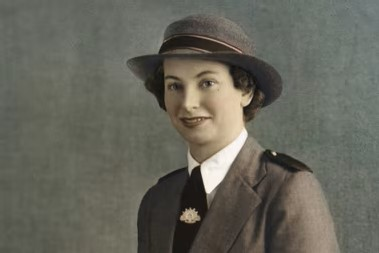
On February 16, 1942, twenty-two unarmed Australian Army nurses were ordered at gunpoint into the sea on Bangka Island in the South China Sea.
Moments later, a machine gun opened fire.
Twenty-one women were killed in the surf.
One survived.
Her name was Vivian Bullwinkel—and for three and a half years, she carried the secret of that massacre inside a Japanese prisoner-of-war camp, knowing that if she spoke, she would be executed.
The Bangka Island Massacre
Four days earlier, Bullwinkel and her fellow nurses had been aboard the SS Vyner Brooke, evacuating Singapore as Japanese forces advanced through Southeast Asia during World War II.
Japanese aircraft bombed the vessel. It sank. Survivors struggled ashore on Bangka Island.
On February 16, Japanese soldiers separated the men from the women. The men were marched into the jungle. Gunfire followed.
The nurses were ordered into the water.
As bullets tore through the group, Bullwinkel felt a shot rip through her body above her left hip. She fell forward into the sea and forced herself not to move. Around her, colleagues were cut down. The water darkened.
She lay face-down, motionless, as soldiers walked the beach to ensure no one survived.
When silence finally fell, she lifted her head.
She was the only nurse alive.
Survival Under Occupation
Wounded and alone, Bullwinkel hid in the jungle, where she encountered another survivor, British soldier Private Ernest Lloyd Kingsley. For twelve days, she used her medical training—without supplies—to treat both their injuries.
Kingsley died from infection.
Bullwinkel then made an extraordinary decision: she surrendered to the same Japanese forces who had just massacred her colleagues.
She told them nothing about what she had witnessed.
For the next three and a half years, she endured brutal conditions in a prisoner-of-war camp in Palembang, Sumatra—malnutrition, disease, forced labor, and constant surveillance. She continued nursing fellow prisoners in secret, risking punishment to provide care.
All the while, she remained silent about Bangka Island.
The Witness Who Spoke
In September 1945, Allied forces liberated the camps.
Emaciated and gravely weakened, Bullwinkel finally told her story.
She became the sole surviving eyewitness to what became known as the Bangka Island massacre. Her testimony later formed part of the evidence presented at postwar trials in Tokyo, where Japanese officers were prosecuted for war crimes connected to the executions.
Without her account, historians say, the massacre of the nurses might have faded into obscurity.
Instead, it entered the official record.
A Life Beyond Survival
After the war, Bullwinkel returned to Australia and resumed nursing. She rose to senior leadership roles in hospitals, worked extensively with veterans, and spent decades honoring the memory of the twenty-one nurses who died beside her.
She spoke publicly not with vengeance, but with clarity—carefully distinguishing between wartime atrocities and entire peoples. Her focus remained on service.
Bullwinkel died on July 3, 2000, at age 84.
The Power of a Single Witness
On that February morning in 1942, twenty-two nurses walked into the sea.
Twenty-one did not walk out.
But because Vivian Bullwinkel survived—because she endured, remained silent when survival demanded it, and spoke when justice required it—their deaths were not erased.
Their killers were held accountable.
And history recorded the truth.
In the face of systematic violence, her survival became testimony.
And her testimony became justice.
Click here to read more.