By Kachi Okezie, Esq.
Could FIFA’s $20 billion plan to spin off the commercial rights to the World Cup be the magic wand that transforms football funding, or could it fracture the sport forever? Is this a brilliant idea arriving at precisely the wrong time and through the wrong process? Or is it, at its core, a sound business proposition carrying potentially existential governance risks? And, ultimately, what would it mean for players, fans and the future of the game?
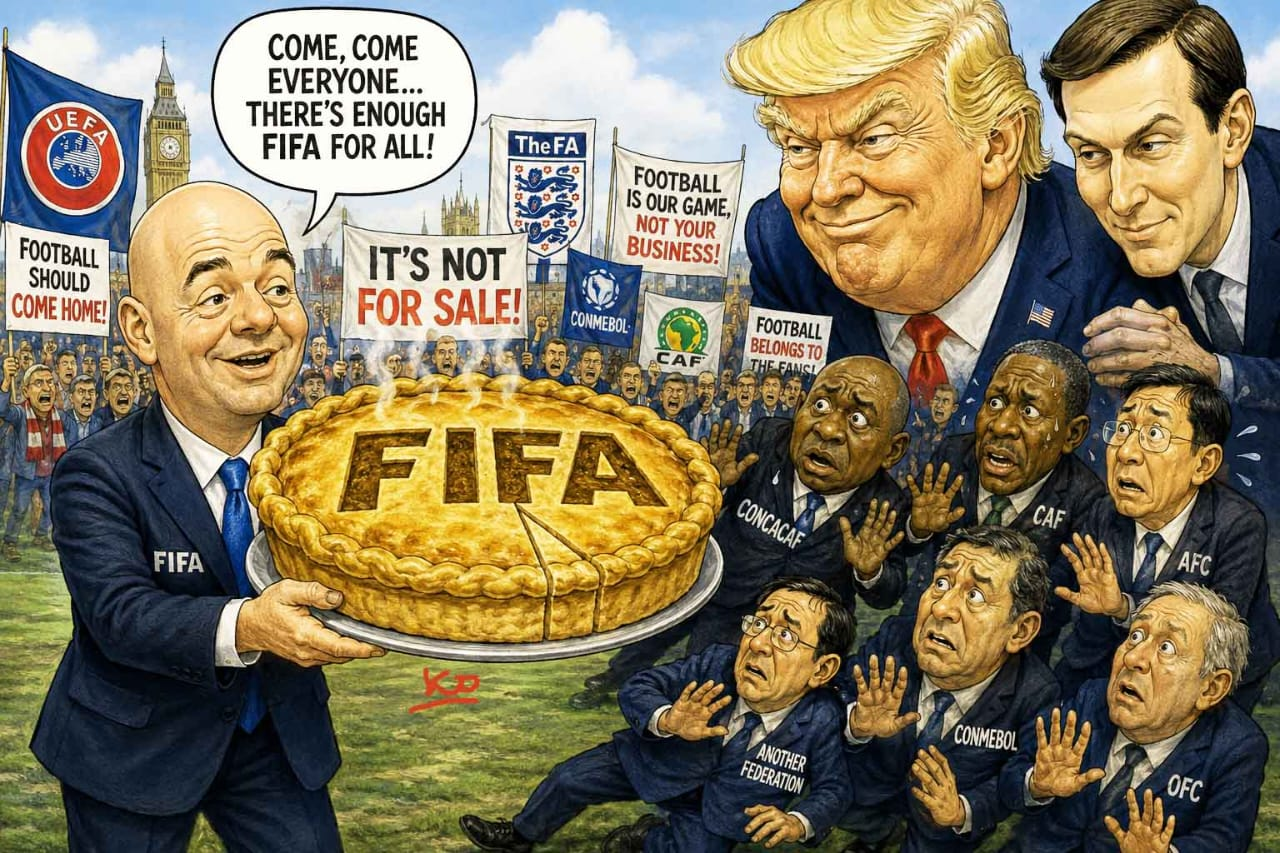
Football is at an inflection point. On July 28, 2026, reports emerged that FIFA President Gianni Infantino was advancing a plan to spin the commercial rights of the Men’s World Cup, Women’s World Cup and Club World Cup into a new for-profit entity, FIFA Forward Enterprise, or FFE. Significantly, the proposal was reported rather than formally disclosed by FIFA. Under the plan, FIFA would retain a majority stake, while selling between 20% and 30% to private investors for an estimated $4.2 billion. The proceeds would then be distributed among FIFA’s 211 member associations.
The reaction was immediate. The Union of European Football Associations (UEFA) described the proposal as “selling our game”. Fans dismissed it as a cash grab, while the Fédération Internationale des Associations de Footballeurs Professionnels (FIFPRO), the global representative organisation for professional footballers, made up of 70 national player unions and representing over 70,000 players worldwide, warned that the commercial logic could ultimately mean even more matches for players.
Yet beneath the headlines, the names of investors reportedly linked to the project and the political controversy surrounding them lies a much more fundamental question that every stakeholder in football needs to confront: is this a reckless attempt to privatise the sport, or the most rational structural reform FIFA has ever attempted?
To answer that, it is necessary to separate the idea from its messengers, the proposed structure from its timing, and the immediate financial gain from the longer-term governance implications.
At its core, FIFA would establish FIFA Forward Enterprise as a separate commercial vehicle responsible for the operational delivery of FIFA tournaments. It would house the commercial rights associated with broadcasting, sponsorship, licensing, hospitality and digital products for the men’s and women’s World Cups, as well as the expanded Club World Cup. FIFA would retain approximately 70% of the company, with private investors acquiring a minority stake of between 20% and 30%. Each of FIFA’s 211 member associations would receive shares valued at approximately $20 million, or around £15 million, which they would presumably be able to hold or sell. The initial equity valuation is estimated at around $20 billion, meaning a 20% to 30% sale could raise as much as $4.2 billion in upfront capital.
FIFA’s stated position is that investors would have no authority over sporting matters and that FIFA “will and must have leading roles”. The money raised would be directed towards development, with FIFA suggesting that total funding could exceed $10 billion over four years.
JP Morgan is reportedly advising on the transaction, while Thrive Capital, led by Joshua Kushner, has been linked to the investor group. Infantino himself is reportedly in line to run the company after leaving the FIFA presidency. That distinction matters. FIFA would not literally be selling the World Cup trophy or handing ownership of the tournament to private equity. What it would be doing is securitising a portion of the future cash flows generated by the World Cup and related competitions.
Viewed purely through the lens of corporate finance, the logic is compelling. FIFA’s existing model is highly cyclical. It generates roughly $7 billion to $8 billion every four years and then distributes and spends much of that money. The result is a boom-and-bust funding model for member associations. Selling a minority stake would allow FIFA to convert a decade or more of anticipated future revenues into capital today.
An upfront $4.2 billion could, in theory, finance thousands of pitches, support hundreds of women’s football initiatives and help professionalise dozens of federations immediately rather than spreading the same investment across three World Cup cycles. For more than 150 member associations that currently receive less than $5 million a year, the impact could be transformational.
There is also a strong structural argument. FIFA currently performs three distinct functions: it acts as regulator, tournament organiser and commercial seller. Those roles inevitably create conflicts. A separate commercial entity could allow FFE to operate like a genuine business, with professional sales teams, clear performance indicators and faster decision-making, while FIFA Congress concentrates on governance and sporting oversight.
There are precedents. Formula One’s relationship with Liberty Media demonstrates how commercial rights can be separated from sporting governance, while major American sports have long ring-fenced media and commercial operations. The underlying principle is straightforward: when the intellectual property is sufficiently powerful, professionalising its commercial exploitation can unlock enormous value. The World Cup is arguably the strongest intellectual property in global sport.
The proposal would also spread risk. Hosting tournaments involves enormous costs, while currency fluctuations, broadcaster failures and changes in market conditions can materially affect revenues. Bringing institutional investors into the structure means FIFA would no longer carry all of that exposure. If a future World Cup underperformed commercially, investors holding 30% of the company would absorb 30% of the economic consequences.
Perhaps the most radical element, however, is the proposed $20 million equity allocation for every member association. It would give every federation, from Vanuatu to Germany, a balance-sheet asset rather than simply an annual grant. For smaller nations, that could mean the difference between amateur football and a sustainable semi-professional structure. For women’s football in particular, it could provide a level of long-term capital that has historically been dependent on annual budgets and discretionary programmes. On paper, then, this resembles a textbook corporate-finance transaction. The problem is that football is not a normal business.
The first objection is philosophical. The World Cup is not merely a commercial product. It is a cultural institution and, in the eyes of many stakeholders, a global commons held in trust. To sell any part of its future economic value therefore feels fundamentally different from selling an ordinary corporate asset. The fear is not simply that 30% might be sold today, but that the transaction establishes a precedent: if 30% can be sold in 2026, why not 40% in 2034 or a full public listing in 2042? That slippery-slope argument has considerable emotional and political force.
Then comes the more practical governance problem. FIFA can promise that investors will have no influence over sporting decisions, but investors contributing $4.2 billion are unlikely to be entirely passive. They will expect returns, and returns require growth. In sport, growth usually means more commercial inventory, which means more competitions, more matches, more broadcast windows and more sponsorship opportunities.
That creates an unavoidable tension with player welfare. A for-profit company has a fiduciary responsibility to maximise shareholder value. FIFPRO, by contrast, exists to protect players. Those objectives can coexist, but they are not automatically aligned. The calendar is therefore central to the debate. Football is already approaching breaking point. The Club World Cup has expanded to 32 teams, the World Cup has expanded to 48, and proposals for an even larger 64-team World Cup have already surfaced. Domestic leagues, clubs and players are engaged in increasingly bitter disputes over workload and scheduling.
Against that backdrop, the creation of a profit-driven commercial vehicle inevitably raises the suspicion that more matches will follow. That is particularly sensitive because domestic leagues are not merely competitors for attention and revenue. They are where the overwhelming majority of professional players are developed.
The process has also damaged the proposal. Reports that the England FA, among others, was “completely unaware” of the plan until it became public reinforce the impression of a top-down initiative. The Kushner and Trump connections make the transaction politically toxic in some quarters, particularly in Europe, while the reported possibility of Infantino moving directly from the FIFA presidency to running FFE creates obvious conflict-of-interest questions, regardless of whether any improper conduct exists. In governance, process matters almost as much as substance. A proposal of this magnitude cannot easily command legitimacy if the stakeholders most affected by it believe they were excluded from its design.
Financially, the strengths remain obvious. FFE could unlock $4.2 billion immediately rather than requiring FIFA to wait across three World Cup cycles. It could reduce the volatility of FIFA’s revenues, provide capital for long-term planning and potentially create the largest development fund in football history. Hundreds of federations, leagues and women’s programmes could benefit simultaneously.
But the weakness is equally clear. A company backed by private investors is structurally incentivised to pursue perpetual growth. That creates pressure for more tournaments, more sponsors and more commercial inventory, potentially undermining FIFA’s stated priority of development.
The governance case follows the same pattern. Separating commercial operations from FIFA’s regulatory responsibilities could finally bring clarity to an organisation that has long attempted to perform too many functions at once. FFE could recruit and negotiate like a modern media company while FIFA Congress focuses on the governance of the sport.
The danger is mission drift. Even if FIFA retains a majority stake, a $20 billion company will develop its own institutional power. Over time, commercial priorities can begin to shape the organisation’s behaviour. Without hard guardrails, the commercial arm could become a parallel centre of power within global football.
Sporting integrity presents a similar contradiction. On paper, FIFA would retain authority over tournament formats, qualification, hosts and the Laws of the Game. Investors would not control the competitive core of the sport. But control is not only about formal voting rights. It is also about influence.
An investor committing billions will expect growth, and growth in sport almost inevitably generates pressure for more matches. That puts the greatest strain precisely where football is already most vulnerable: the calendar, player welfare and competitive balance.
The development argument may be the strongest case in favour of FFE. Giving each of the 211 member associations an equity stake worth around $20 million would represent an extraordinary redistribution of financial power. A small federation in Africa or Oceania could potentially use that asset to build academies, employ women’s coaches, upgrade facilities and digitise competitions without waiting for another funding cycle from Zurich.
But even here there is a potential unintended consequence. Smaller associations may be tempted or pressured to sell their shares quickly, particularly if they face immediate financial constraints. Without safeguards such as a right of first refusal, restrictions on buyers and a valuation floor, an initiative designed to decentralise wealth could ultimately concentrate ownership among larger investors or better-funded associations.
Stakeholder trust is therefore the biggest deficit surrounding the proposal. If implemented properly, FFE could become the financial engine of the global game and finally give grassroots, youth and women’s football access to a multi-billion-dollar capital base. But if the structure is perceived as something imposed by FIFA without meaningful participation from UEFA, the European Club Association, FIFPRO, leagues and national associations, even a sound financial model will struggle to achieve legitimacy.
The risks can be mitigated, but only if the protections are built into the shareholder agreement rather than left to promises. The first risk is mission drift and the inevitable pressure for more games. A contractual “calendar lock” could require a supermajority vote for any new tournament or major format change, combined with formal approval mechanisms involving FIFPRO, clubs and leagues. Player workload could also be subject to a clearly defined ceiling.
The second risk is investor control creeping beyond the original mandate. Investors could receive dividend rights without voting authority over sporting matters. FIFA could retain a golden share, while independent directors could have defined veto powers over decisions that threaten the sporting integrity of the competitions.
The third risk is development money disappearing into the corporate structure. A contractual requirement that the overwhelming majority of distributable profits return to FIFA for member development programmes could be independently audited each year. The member associations’ shares should also be protected against dilution.
The fourth risk is political capture. Individual investors should face ownership caps, while sovereign wealth funds or state-linked investors above an agreed threshold should require explicit Congress approval. Sponsors and investors should also be subject to independent ethical scrutiny.
Finally, there is the conflict-of-interest question. A meaningful cooling-off period should apply to FIFA executives moving into senior positions at FFE, accompanied by public disclosure of executive remuneration, related-party transactions and company accounts. Without those protections, this is not a partnership. It is a sale.
For local football, the consequences could be enormous. If the $20 million allocations to member associations are real, protected and genuinely accessible, FFE could represent the greatest decentralisation of financial power in FIFA’s history. A federation in Africa, Asia or Oceania could build academies, invest in women’s football, improve coaching structures and modernise its competitions without depending entirely on annual allocations from Zurich.
The danger is that local football could simultaneously become the victim of a more aggressive international calendar designed to generate FFE revenues. More international competitions may mean more money flowing down to federations while simultaneously weakening the domestic leagues that develop the players in the first place.
At the global level, FFE would formalise a two-tier structure: FIFA as regulator and FFE as commercialiser. That division could work exceptionally well if the checks and balances are genuine. It could also fail spectacularly if FFE becomes a parallel power centre with incentives that increasingly diverge from the interests of the wider game.
A sustainable model therefore requires three things. First, legitimacy: UEFA, CONMEBOL, FIFPRO, clubs, leagues and representative member associations must become co-authors rather than opponents. Second, constraints: profit must remain subordinate to player welfare, sporting integrity and competitive balance. Third, transparency: FFE should disclose its finances and executive remuneration to a standard comparable to that expected of a public company, even if its shares remain privately held.
If those conditions are met, FFE could provide the financial architecture for a 50-year expansion of football. If they are not, it could accelerate the already widening fracture between FIFA, clubs, leagues and players. That is why the argument is ultimately not about $4.2 billion. It is about sovereignty.
For a century, FIFA has maintained that football belongs to no one and therefore belongs to everyone, administered through 211 national associations. The FFE proposal starts from a different premise: that football’s most valuable assets require professional capital if they are to compete effectively in an era defined by streaming, technological disruption and the emergence of rival super-leagues. Both propositions can be true.
The NFL and NBA have demonstrated that private capital can coexist with strong sporting institutions and produce extraordinary commercial growth. Cricket’s Indian Premier League has followed a similar trajectory. But those models were built around comparatively strong alignment among owners, players and governing structures. FIFA does not begin from the same position. Its relationships with clubs, leagues and players are already strained. That is why the central verdict is relatively simple: the idea may be right, but the timing and process are wrong.
Football’s commercial assets are arguably under-monetised and excessively centralised. Creating a dedicated vehicle capable of investing, growing and distributing the value of those assets is not inherently reckless. Indeed, some form of structural reform may eventually become inevitable.
The timing, however, could hardly be more difficult. Launching the initiative amid an increasingly bitter battle over the football calendar, after years of accumulated mistrust and without meaningful player and league buy-in, makes it look less like a strategic reform and more like a cash extraction exercise. And the process is perhaps the biggest problem of all. Governance reforms of this magnitude cannot simply be announced. They have to be negotiated.
FIFA therefore faces a choice. It can force the proposal through by relying on support from CAF, AFC and CONCACAF, potentially using the promise of $20 million per association as the decisive incentive. That may win the immediate vote but lose the broader war. UEFA and powerful clubs and leagues could respond by accelerating alternative competitions and commercial structures of their own.
Or FIFA can pause and co-design the model. It could withdraw the current proposal, bring UEFA, FIFPRO, the ECA, leagues and a representative group of member associations into the process, negotiate the shareholder agreement and embed the necessary governance protections before returning with a structure that has been collectively designed. That approach would be slower. It would also have a far greater chance of becoming sustainable. Football’s future does not need more money alone. It needs more trust. FFE could provide both. But only if FIFA is prepared to share power in order to share revenue.
The ball is now in Zurich’s court, and ultimately in the hands of 211 member associations. They must decide whether the immediate attraction of the cash is worth the long-term consequences, and whether the objective is simply to monetise the game or to build a financial structure capable of protecting it for the next generation.
The real question is no longer whether FIFA can sell part of football’s future. It is whether it can do so without losing the trust of those who believe that future belongs to all of them.
-Kachi Okezie, Esq is a sports lawyer, chartered mediator and consultant.
The views expressed by contributors are strictly personal and not of Law & Society Magazine.